SUBSCRIBE TO OUR FREE NEWSLETTER
Daily news & progressive opinion—funded by the people, not the corporations—delivered straight to your inbox.
5
#000000
#FFFFFF
To donate by check, phone, or other method, see our More Ways to Give page.
Daily news & progressive opinion—funded by the people, not the corporations—delivered straight to your inbox.
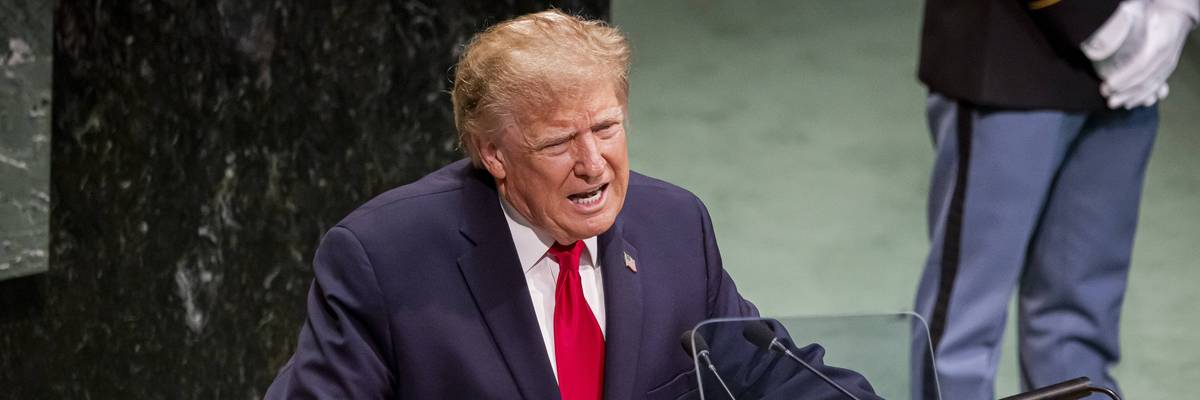
President Donald Trump speaks during the 81st United Nations General Assembly on September 22, 2026 in New York City.
"We must stop this madman," said US Sen. Ed Markey.
President Donald Trump is facing global condemnation for his threat to "annihilate" Iran during a Tuesday speech at the United Nations General Assembly.
Dr. Tara Drozdenko, director of the Global Security Program at the Union of Concerned Scientists (UCS), said on Tuesday that the president's speech "clearly constitutes an implied threat to use overwhelming nuclear force against Iran and the Iranian people broadly."
"This would be a nuclear genocide," Drozdenko emphasized. "Any threat to use nuclear weapons is unacceptable, and his decision to do so should be strongly condemned by government, military, and civil society leaders."
Drozdenko acknowledged that Trump's long history of unhinged rhetoric might make his statements easy to dismiss, but warned even empty threats involving nuclear weapons can have serious real-world ramifications.
"President Trump’s nuclear threats against Iran reinforce a counterproductive lesson also imparted by President Vladimir Putin’s nuclear threats against Ukraine," she said. "Specifically, these threats encourage other countries to conclude that protecting and securing themselves from authoritarians with nuclear weapons requires obtaining their own nuclear arsenal."
Sen. Ed Markey (D-Mass.) also said that Trump's menacing rhetoric toward Iran must be taken seriously.
"Trump threatened to 'annihilate' Iran," Markey wrote in a social media post. "His 'October surprise' must not be a mushroom cloud from a nuclear attack. With these threats and assistance to Saudi Arabia, Trump is inferring mass slaughter and escalating an arms race in the Middle East. We must stop this madman."
Robert Tait, US correspondent for The Guardian, wrote an analysis on Tuesday arguing that Trump's threat against Iran was "stunning, even for him."
Tait noted that it has been decades since the UN General Assembly has "witnessed such a display of bellicosity from a superpower leader," especially since it was delivered in a "forum created in the aftermath of the Second World War, with the explicit aim of preventing future conflicts."
"Whether or not the latest threat should be taken literally," Tait added, "little of what he said about Iran seemed reassuring."
This country and this world are at a monumental crossroads. US voters have an opportunity to beat back the forces of fascism and confront the billionaires who are rigging the economy, our media system, and our democracy, making it increasingly impossible for ordinary people to get by. We’re not just talking about the election. We’re talking about what must be done once these fascist elements are vanquished from power. We need a bolder set of solutions than what either major party has so far been willing to offer and a working-class movement ready to fight like hell for it. Trump didn't emerge from nowhere. The conditions that fueled MAGA authoritarianism were created by decades of radical neoliberal economic policies and a corrupt political system dominated by corporate interests. They slashed taxes on the super-rich, promising that the benefits would trickle down. They said giveaways to the corporate titans would make life more affordable for the rest of us. It was all bullshit. And when a bitter, betrayed populace searches for someone to blame, right-wing demagogues have little trouble finding scapegoats. People know when they're being lied to, but you won't hear any of this from the corporate media. Only independent journalism—powered and funded by people who believe in building a better world—can deliver truly trustworthy daily news. If you share our vision, please contribute whatever you can to sustain our work. |
President Donald Trump is facing global condemnation for his threat to "annihilate" Iran during a Tuesday speech at the United Nations General Assembly.
Dr. Tara Drozdenko, director of the Global Security Program at the Union of Concerned Scientists (UCS), said on Tuesday that the president's speech "clearly constitutes an implied threat to use overwhelming nuclear force against Iran and the Iranian people broadly."
"This would be a nuclear genocide," Drozdenko emphasized. "Any threat to use nuclear weapons is unacceptable, and his decision to do so should be strongly condemned by government, military, and civil society leaders."
Drozdenko acknowledged that Trump's long history of unhinged rhetoric might make his statements easy to dismiss, but warned even empty threats involving nuclear weapons can have serious real-world ramifications.
"President Trump’s nuclear threats against Iran reinforce a counterproductive lesson also imparted by President Vladimir Putin’s nuclear threats against Ukraine," she said. "Specifically, these threats encourage other countries to conclude that protecting and securing themselves from authoritarians with nuclear weapons requires obtaining their own nuclear arsenal."
Sen. Ed Markey (D-Mass.) also said that Trump's menacing rhetoric toward Iran must be taken seriously.
"Trump threatened to 'annihilate' Iran," Markey wrote in a social media post. "His 'October surprise' must not be a mushroom cloud from a nuclear attack. With these threats and assistance to Saudi Arabia, Trump is inferring mass slaughter and escalating an arms race in the Middle East. We must stop this madman."
Robert Tait, US correspondent for The Guardian, wrote an analysis on Tuesday arguing that Trump's threat against Iran was "stunning, even for him."
Tait noted that it has been decades since the UN General Assembly has "witnessed such a display of bellicosity from a superpower leader," especially since it was delivered in a "forum created in the aftermath of the Second World War, with the explicit aim of preventing future conflicts."
"Whether or not the latest threat should be taken literally," Tait added, "little of what he said about Iran seemed reassuring."