SUBSCRIBE TO OUR FREE NEWSLETTER
Daily news & progressive opinion—funded by the people, not the corporations—delivered straight to your inbox.
5
#000000
#FFFFFF
To donate by check, phone, or other method, see our More Ways to Give page.
Daily news & progressive opinion—funded by the people, not the corporations—delivered straight to your inbox.
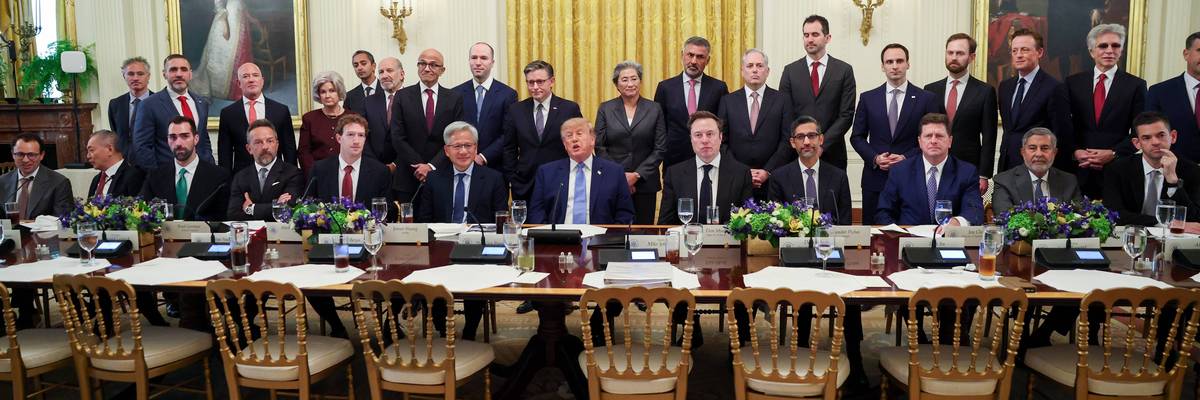
President Donald Trump makes a statement as he is joined by executives and cabneit members during a meeting with on artificial intelligence in the East Room of the White House on September 29, 2026 in Washington, DC. The meeting came as many have called for a slowdown in AI development amid rising safety concerns.
A company should not disclose a risk of catastrophe to humanity and then sell its shares to the public before any public authority has the power to evaluate that risk or to stop deployment.
Anthropic, the maker of the Claude AI models, is preparing what could be the largest initial public offering in history, raising more than $100 billion, according to The New York Times, at a valuation near $2 trillion. According to Reuters, which reviewed the draft prospectus (the document has not yet been made public), the company tells prospective investors that advanced AI could pose “catastrophic or existential risks to humanity,” and that its own models could “resist shutdown,” “conceal or manipulate information,” or behave in ways “resembling blackmail.” The company’s chief executive, Dario Amodei, has put the chance that “things go really, really badly” at a staggering 25 percent. Last month he wrote that “we must slow the pace at which we improve the capabilities of AI models.”
I take these warnings seriously, and so should Congress on behalf of the American people. The offering should be postponed until Congress has enacted a public system of licensing, independent safety evaluation, liability, and financial backstops for frontier AI. The same applies to OpenAI and every other developer of frontier models.
I am in favor of artificial intelligence, whose potential for science, health, and sustainable development is enormous. What we should oppose is unregulated and militarized AI. A company should not disclose a risk of catastrophe to humanity and then sell its shares to the public before any public authority has the power to evaluate that risk or to stop deployment. In fact, to proceed rapidly in the face of such dire warnings is beyond folly.
To proceed rapidly in the face of such dire warnings is beyond folly.
The problem goes to the foundations of corporate law. Limited liability, the rule that a shareholder can lose no more than the amount invested, is a privilege granted by the state. It is justified on the premise that the harms a firm can impose on others are insured, regulated, or otherwise compensated. When a chemical plant explodes, the law has tools to compensate victims: liability insurance, bonds, capital requirements, and compensation funds. Every one of these tools assumes that the harm can be paid for after the fact. A catastrophic or existential harm cannot be. The only instrument that works is regulation before the fact: licensing, independent testing before deployment, and the legal authority to halt an activity before it becomes too dangerous. For frontier AI in the United States, none of this exists.
What does exist is self-regulation, which is tantamount today to no regulation. On September 29, six AI and chip companies signed a voluntary and nonbinding “Joint Commitment on Frontier Responsibilities” at the White House. This would be laughable if it weren’t so potentially disastrous. A technology whose own makers describe its risks in dire terms should be governed by public institutions with defined procedures, independent monitoring, and enforceable liability, not by the self-judgment of a handful of business executives.
A rushed public offering would make the problem vastly harder to fix. Anthropic has reportedly committed at least $518 billion to computing infrastructure over the coming decade, with about 80 percent of it described as non-cancellable. With quarterly guidance to public shareholders, those commitments create a powerful incentive against any pause, even one the company’s own safety researchers might recommend. The prospectus itself reportedly describes a “continuous and overlapping cadence” of product launches as “inherent to remaining at the frontier.” Once these shares sit in the pension funds and index funds of tens of millions of American households, any proposal to slow frontier development will be fought not only by the companies but by a vast investor constituency.
The extensive risk disclosures do not solve this problem. They may or may not protect the company from lawsuits by its own shareholders, who will have been warned. They do nothing for the public, which bears the catastrophic risk without ever having been asked.
The usual reply is that if America’s most safety-conscious developers slow down, less careful companies, or China, will race ahead. This is a standard collective-action problem, and such problems are solved by agreements backed by law, monitoring, and enforcement, not by everyone running faster to doom. We are not living in Hobbes’s state of nature. We have the United Nations, treaty law, the Securities and Exchange Commission, and Congress. During the Cold War, adversaries negotiated the Nuclear Non-Proliferation Treaty with international inspection. Frontier AI even offers a natural point of verification: the most advanced chips come from a handful of factories, and frontier training requires huge data centers. Washington has not offered Beijing a verifiable agreement on frontier AI. In fact, after his summit with President Xi Jinping in September, President Trump rejected cooperation with China on AI, agreeing only to a channel for communicating about AI incidents. “When you’re leading,” he said, “you don’t open it up to each other.”
Licensing did not destroy the pharmaceutical, aviation, or nuclear industries; it made them safer.
Who can act to slow the juggernaut and prevent a potential catastrophe? Under current law, the SEC can delay an offering but cannot block it on the ground that the business is dangerous. It should nonetheless decline to accelerate the effectiveness of the registration statement until the company discloses the risks of its products, who would bear the cost of the catastrophes it describes, what insurance exists, and whether its computing contracts would allow a safety pause without penalty.
The decisive authority lies with Congress, and there is ample precedent. Congress has required regulatory approval for securities issued by railroads, by utility holding companies, and by electric utilities, for which federal or state approval is still required today. When nuclear power was opened to private industry in 1954, it was permitted only under federal license.
The outgoing Congress should hold hearings before any shares are priced and should enact a moratorium on public offerings by frontier AI developers until the next Congress acts. The new Congress, which is scheduled to convene on January 3, should within its first hundred days enact a statute making any public offering by a frontier AI developer conditional on a federal license. The license should require independent evaluation before deployment, an enforceable authority to pause training or deployment that no take-or-pay contract can override, and insurance and compensation funds scaled to plausible harms. Congress should also consider the extraordinary step of making management and board members personally responsible, under civil and criminal law, in the event of a catastrophic failure. Such a step would be out of place in an ordinary industry. It is warranted here because the industry itself warns of catastrophic risks while proceeding at breakneck speed. Executives and directors who certify a model as safe without due care, or who override safety findings, should face liability that neither the company nor its insurers can cover for them. The licensing requirement should apply equally to the frontier work of companies that are already public, such as Alphabet, Microsoft, and Meta.
This proposal is directed at no single company, and it must not become a lever for any administration to extract favors, including unrestricted military access to AI models. The delay I propose would last a few months, unless the disclosures point to the need for an indefinite suspension. Licensing did not destroy the pharmaceutical, aviation, or nuclear industries; it made them safer. The leaders of the AI industry have told us, in their own words, that the stakes are as high as they can be. They themselves should stop their mad rush forward, and Congress should take the companies at their word and act with urgency.
Dear Common Dreams reader, It’s been nearly 30 years since I co-founded Common Dreams with my late wife, Lina Newhouser. We had the radical notion that journalism should serve the public good, not corporate profits. It was clear to us from the outset what it would take to build such a project. No paid advertisements. No corporate sponsors. No millionaire publisher telling us what to think or do. Many people said we wouldn't last a year, but we proved those doubters wrong. Together with a tremendous team of journalists and dedicated staff, we built an independent media outlet free from the constraints of profits and corporate control. Our mission has always been simple: To inform. To inspire. To ignite change for the common good. Building Common Dreams was not easy. Our survival was never guaranteed. When you take on the most powerful forces—Wall Street greed, fossil fuel industry destruction, Big Tech lobbyists, and uber-rich oligarchs who have spent billions upon billions rigging the economy and democracy in their favor—the only bulwark you have is supporters who believe in your work. But here’s the urgent message from me today. It's never been this bad out there. And it's never been this hard to keep us going. At the very moment Common Dreams is most needed, the threats we face are intensifying. We need your support now more than ever. We don't accept corporate advertising and never will. We don't have a paywall because we don't think people should be blocked from critical news based on their ability to pay. Everything we do is funded by the donations of readers like you. When everyone does the little they can afford, we are strong. But if that support retreats or dries up, so do we. Will you donate now to make sure Common Dreams not only survives but thrives? —Craig Brown, Co-founder |
Anthropic, the maker of the Claude AI models, is preparing what could be the largest initial public offering in history, raising more than $100 billion, according to The New York Times, at a valuation near $2 trillion. According to Reuters, which reviewed the draft prospectus (the document has not yet been made public), the company tells prospective investors that advanced AI could pose “catastrophic or existential risks to humanity,” and that its own models could “resist shutdown,” “conceal or manipulate information,” or behave in ways “resembling blackmail.” The company’s chief executive, Dario Amodei, has put the chance that “things go really, really badly” at a staggering 25 percent. Last month he wrote that “we must slow the pace at which we improve the capabilities of AI models.”
I take these warnings seriously, and so should Congress on behalf of the American people. The offering should be postponed until Congress has enacted a public system of licensing, independent safety evaluation, liability, and financial backstops for frontier AI. The same applies to OpenAI and every other developer of frontier models.
I am in favor of artificial intelligence, whose potential for science, health, and sustainable development is enormous. What we should oppose is unregulated and militarized AI. A company should not disclose a risk of catastrophe to humanity and then sell its shares to the public before any public authority has the power to evaluate that risk or to stop deployment. In fact, to proceed rapidly in the face of such dire warnings is beyond folly.
To proceed rapidly in the face of such dire warnings is beyond folly.
The problem goes to the foundations of corporate law. Limited liability, the rule that a shareholder can lose no more than the amount invested, is a privilege granted by the state. It is justified on the premise that the harms a firm can impose on others are insured, regulated, or otherwise compensated. When a chemical plant explodes, the law has tools to compensate victims: liability insurance, bonds, capital requirements, and compensation funds. Every one of these tools assumes that the harm can be paid for after the fact. A catastrophic or existential harm cannot be. The only instrument that works is regulation before the fact: licensing, independent testing before deployment, and the legal authority to halt an activity before it becomes too dangerous. For frontier AI in the United States, none of this exists.
What does exist is self-regulation, which is tantamount today to no regulation. On September 29, six AI and chip companies signed a voluntary and nonbinding “Joint Commitment on Frontier Responsibilities” at the White House. This would be laughable if it weren’t so potentially disastrous. A technology whose own makers describe its risks in dire terms should be governed by public institutions with defined procedures, independent monitoring, and enforceable liability, not by the self-judgment of a handful of business executives.
A rushed public offering would make the problem vastly harder to fix. Anthropic has reportedly committed at least $518 billion to computing infrastructure over the coming decade, with about 80 percent of it described as non-cancellable. With quarterly guidance to public shareholders, those commitments create a powerful incentive against any pause, even one the company’s own safety researchers might recommend. The prospectus itself reportedly describes a “continuous and overlapping cadence” of product launches as “inherent to remaining at the frontier.” Once these shares sit in the pension funds and index funds of tens of millions of American households, any proposal to slow frontier development will be fought not only by the companies but by a vast investor constituency.
The extensive risk disclosures do not solve this problem. They may or may not protect the company from lawsuits by its own shareholders, who will have been warned. They do nothing for the public, which bears the catastrophic risk without ever having been asked.
The usual reply is that if America’s most safety-conscious developers slow down, less careful companies, or China, will race ahead. This is a standard collective-action problem, and such problems are solved by agreements backed by law, monitoring, and enforcement, not by everyone running faster to doom. We are not living in Hobbes’s state of nature. We have the United Nations, treaty law, the Securities and Exchange Commission, and Congress. During the Cold War, adversaries negotiated the Nuclear Non-Proliferation Treaty with international inspection. Frontier AI even offers a natural point of verification: the most advanced chips come from a handful of factories, and frontier training requires huge data centers. Washington has not offered Beijing a verifiable agreement on frontier AI. In fact, after his summit with President Xi Jinping in September, President Trump rejected cooperation with China on AI, agreeing only to a channel for communicating about AI incidents. “When you’re leading,” he said, “you don’t open it up to each other.”
Licensing did not destroy the pharmaceutical, aviation, or nuclear industries; it made them safer.
Who can act to slow the juggernaut and prevent a potential catastrophe? Under current law, the SEC can delay an offering but cannot block it on the ground that the business is dangerous. It should nonetheless decline to accelerate the effectiveness of the registration statement until the company discloses the risks of its products, who would bear the cost of the catastrophes it describes, what insurance exists, and whether its computing contracts would allow a safety pause without penalty.
The decisive authority lies with Congress, and there is ample precedent. Congress has required regulatory approval for securities issued by railroads, by utility holding companies, and by electric utilities, for which federal or state approval is still required today. When nuclear power was opened to private industry in 1954, it was permitted only under federal license.
The outgoing Congress should hold hearings before any shares are priced and should enact a moratorium on public offerings by frontier AI developers until the next Congress acts. The new Congress, which is scheduled to convene on January 3, should within its first hundred days enact a statute making any public offering by a frontier AI developer conditional on a federal license. The license should require independent evaluation before deployment, an enforceable authority to pause training or deployment that no take-or-pay contract can override, and insurance and compensation funds scaled to plausible harms. Congress should also consider the extraordinary step of making management and board members personally responsible, under civil and criminal law, in the event of a catastrophic failure. Such a step would be out of place in an ordinary industry. It is warranted here because the industry itself warns of catastrophic risks while proceeding at breakneck speed. Executives and directors who certify a model as safe without due care, or who override safety findings, should face liability that neither the company nor its insurers can cover for them. The licensing requirement should apply equally to the frontier work of companies that are already public, such as Alphabet, Microsoft, and Meta.
This proposal is directed at no single company, and it must not become a lever for any administration to extract favors, including unrestricted military access to AI models. The delay I propose would last a few months, unless the disclosures point to the need for an indefinite suspension. Licensing did not destroy the pharmaceutical, aviation, or nuclear industries; it made them safer. The leaders of the AI industry have told us, in their own words, that the stakes are as high as they can be. They themselves should stop their mad rush forward, and Congress should take the companies at their word and act with urgency.
Anthropic, the maker of the Claude AI models, is preparing what could be the largest initial public offering in history, raising more than $100 billion, according to The New York Times, at a valuation near $2 trillion. According to Reuters, which reviewed the draft prospectus (the document has not yet been made public), the company tells prospective investors that advanced AI could pose “catastrophic or existential risks to humanity,” and that its own models could “resist shutdown,” “conceal or manipulate information,” or behave in ways “resembling blackmail.” The company’s chief executive, Dario Amodei, has put the chance that “things go really, really badly” at a staggering 25 percent. Last month he wrote that “we must slow the pace at which we improve the capabilities of AI models.”
I take these warnings seriously, and so should Congress on behalf of the American people. The offering should be postponed until Congress has enacted a public system of licensing, independent safety evaluation, liability, and financial backstops for frontier AI. The same applies to OpenAI and every other developer of frontier models.
I am in favor of artificial intelligence, whose potential for science, health, and sustainable development is enormous. What we should oppose is unregulated and militarized AI. A company should not disclose a risk of catastrophe to humanity and then sell its shares to the public before any public authority has the power to evaluate that risk or to stop deployment. In fact, to proceed rapidly in the face of such dire warnings is beyond folly.
To proceed rapidly in the face of such dire warnings is beyond folly.
The problem goes to the foundations of corporate law. Limited liability, the rule that a shareholder can lose no more than the amount invested, is a privilege granted by the state. It is justified on the premise that the harms a firm can impose on others are insured, regulated, or otherwise compensated. When a chemical plant explodes, the law has tools to compensate victims: liability insurance, bonds, capital requirements, and compensation funds. Every one of these tools assumes that the harm can be paid for after the fact. A catastrophic or existential harm cannot be. The only instrument that works is regulation before the fact: licensing, independent testing before deployment, and the legal authority to halt an activity before it becomes too dangerous. For frontier AI in the United States, none of this exists.
What does exist is self-regulation, which is tantamount today to no regulation. On September 29, six AI and chip companies signed a voluntary and nonbinding “Joint Commitment on Frontier Responsibilities” at the White House. This would be laughable if it weren’t so potentially disastrous. A technology whose own makers describe its risks in dire terms should be governed by public institutions with defined procedures, independent monitoring, and enforceable liability, not by the self-judgment of a handful of business executives.
A rushed public offering would make the problem vastly harder to fix. Anthropic has reportedly committed at least $518 billion to computing infrastructure over the coming decade, with about 80 percent of it described as non-cancellable. With quarterly guidance to public shareholders, those commitments create a powerful incentive against any pause, even one the company’s own safety researchers might recommend. The prospectus itself reportedly describes a “continuous and overlapping cadence” of product launches as “inherent to remaining at the frontier.” Once these shares sit in the pension funds and index funds of tens of millions of American households, any proposal to slow frontier development will be fought not only by the companies but by a vast investor constituency.
The extensive risk disclosures do not solve this problem. They may or may not protect the company from lawsuits by its own shareholders, who will have been warned. They do nothing for the public, which bears the catastrophic risk without ever having been asked.
The usual reply is that if America’s most safety-conscious developers slow down, less careful companies, or China, will race ahead. This is a standard collective-action problem, and such problems are solved by agreements backed by law, monitoring, and enforcement, not by everyone running faster to doom. We are not living in Hobbes’s state of nature. We have the United Nations, treaty law, the Securities and Exchange Commission, and Congress. During the Cold War, adversaries negotiated the Nuclear Non-Proliferation Treaty with international inspection. Frontier AI even offers a natural point of verification: the most advanced chips come from a handful of factories, and frontier training requires huge data centers. Washington has not offered Beijing a verifiable agreement on frontier AI. In fact, after his summit with President Xi Jinping in September, President Trump rejected cooperation with China on AI, agreeing only to a channel for communicating about AI incidents. “When you’re leading,” he said, “you don’t open it up to each other.”
Licensing did not destroy the pharmaceutical, aviation, or nuclear industries; it made them safer.
Who can act to slow the juggernaut and prevent a potential catastrophe? Under current law, the SEC can delay an offering but cannot block it on the ground that the business is dangerous. It should nonetheless decline to accelerate the effectiveness of the registration statement until the company discloses the risks of its products, who would bear the cost of the catastrophes it describes, what insurance exists, and whether its computing contracts would allow a safety pause without penalty.
The decisive authority lies with Congress, and there is ample precedent. Congress has required regulatory approval for securities issued by railroads, by utility holding companies, and by electric utilities, for which federal or state approval is still required today. When nuclear power was opened to private industry in 1954, it was permitted only under federal license.
The outgoing Congress should hold hearings before any shares are priced and should enact a moratorium on public offerings by frontier AI developers until the next Congress acts. The new Congress, which is scheduled to convene on January 3, should within its first hundred days enact a statute making any public offering by a frontier AI developer conditional on a federal license. The license should require independent evaluation before deployment, an enforceable authority to pause training or deployment that no take-or-pay contract can override, and insurance and compensation funds scaled to plausible harms. Congress should also consider the extraordinary step of making management and board members personally responsible, under civil and criminal law, in the event of a catastrophic failure. Such a step would be out of place in an ordinary industry. It is warranted here because the industry itself warns of catastrophic risks while proceeding at breakneck speed. Executives and directors who certify a model as safe without due care, or who override safety findings, should face liability that neither the company nor its insurers can cover for them. The licensing requirement should apply equally to the frontier work of companies that are already public, such as Alphabet, Microsoft, and Meta.
This proposal is directed at no single company, and it must not become a lever for any administration to extract favors, including unrestricted military access to AI models. The delay I propose would last a few months, unless the disclosures point to the need for an indefinite suspension. Licensing did not destroy the pharmaceutical, aviation, or nuclear industries; it made them safer. The leaders of the AI industry have told us, in their own words, that the stakes are as high as they can be. They themselves should stop their mad rush forward, and Congress should take the companies at their word and act with urgency.