
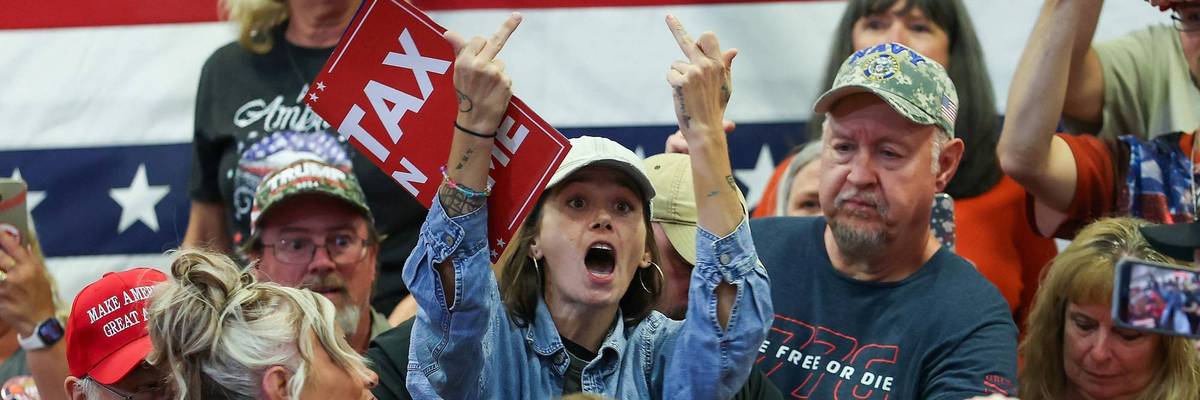
A protestor interrupts U.S. President Donald Trump as he speaks on stage during a campaign rally at the Shoemaker Center at Ohio University on October 28, 2026 in Chillicothe, Ohio. President Trump is rallying support for Republican candidates in Ohio ahead of the midterm elections.
4 Strikes Against a Deeply Unpopular, Warmongering Trump Creates Midterm Without Precedent
Let no one mistake the moment. Historians will look back at the conditions under which Americans voted in 2026, and they will find no midterm quite like it.
I have studied American elections for more than four decades, and I am wary of the word "unprecedented." Pundits use it for every news cycle. But as the country heads toward the November 3 midterms, I cannot find another word that fits. Never in the era of modern polling has a president taken his party into a midterm with all four of these burdens at once: a deeply unpopular presidency, an economy most Americans say is failing them, an unpopular war, and pervasive public alarm about corruption.
Any one of these can cost a party dearly. Two or three together have produced some of the worst midterm defeats in our history. All four, simultaneously, is new territory.
Consider the numbers. Donald Trump's job approval now averages in the mid-to-high 30s, with several major polls finding it at 30 or 31 percent. That is roughly where he stood when he left office in January 2021, after January 6. On the economy, the AP-NORC poll finds about three in four Americans disapproving of his performance, and nearly four in five disapproving of his handling of the cost of living. Even among Republicans, fewer than half approve of how he has handled prices.
The war with Iran began with less public support than any major American war in polling history, and it has lost ground since. Surveys now show it as unpopular as Iraq in 2006 and Vietnam in the early 1970s. One analysis of more than 150 surveys across seven major conflicts concluded that it is the most unpopular major war the United States has fought.
And corruption, long a background complaint, has moved to the foreground. In a recent Fox News poll, 88 percent of voters said they were concerned about corruption in government, ranking it above inflation and gas prices. Nearly two in three Americans tell pollsters the president uses his office to enrich himself, with the fastest increase among Republican-leaning voters over the past year.
Now look at history. In 1946, Harry Truman's approval sank to about one-third amid postwar inflation and strikes. Democrats lost 54 House seats, 11 Senate seats, and control over both chambers. But there was no unpopular war and no corruption scandal at the center of the campaign. In 1966, Lyndon Johnson’s Democrats lost House 47 seats, and 3 Senate seats, yet Vietnam had not yet turned a majority of Americans against it. In 1974, after Watergate and amid double-digit inflation, Republicans lost 48 House and 4 Senate seats. But American combat in Vietnam was largely over, and Gerald Ford had been president for only three months.
The closest parallel is 2006. George W. Bush stood in the high 30s, Iraq was going badly, and Republicans were mired in the Abramoff and Foley scandals. Republicans lost 30 House seats, 6 Senate seats, and like the Democrats in 1946, control over both chambers. Yet even then, the economy was middling rather than broadly seen as broken. Bush had three strikes, not four.
Harry Truman's Republican opponents did eventually assemble a four-part indictment of Korea, communism, corruption and a sputtering presidency. But that was the presidential election of 1952, not a midterm.
My Keys to the White House predict presidential elections, not midterms. But they rest on the simple principle that American elections are referendums on the governance of the party in power. Several of the keys measure exactly the forces at work today: the short-term economy, scandal, and foreign or military failure. When those turn against the party holding the White House, voters notice. This year, they have turned all at once.
Still, a historic environment does not guarantee a historic seat count. The House map is far less elastic than it was in 1946 or 1974. Two rounds of partisan line-drawing have shrunk the number of competitive districts. The Cook Political Report estimates Democrats must win 57 of 77 competitive seats to take the majority. Partisan polarization is also stronger than it was in Truman's day; a president at 35 percent keeps most of his own voters. And the Senate map leans Republican, with Democrats needing to win in Republican states to regain Senate control. When the president’s party is on defense in Texas, Ohio, and even Kansas, which hasn’t elected a Democratic Senator since 1932, the national environment is doing the work.
So four strikes may not pull the Republican Party completely under. A large popular-vote rebuke may yield a more modest shift in seats than the national mood would suggest.
But let no one mistake the moment. Historians will look back at the conditions under which Americans voted in 2026, and they will find no midterm quite like it. Whatever the final tally, the verdict on this presidency is already written in the polls. On November 3, voters will decide how loudly to deliver it.
We are at a crossroads
This country and this world are at a monumental crossroads. US voters have an opportunity to beat back the forces of fascism and confront the billionaires who are rigging the economy, our media system, and our democracy, making it increasingly impossible for ordinary people to get by. We’re not just talking about the election. We’re talking about what must be done once these fascist elements are vanquished from power. We need a bolder set of solutions than what either major party has so far been willing to offer and a working-class movement ready to fight like hell for it. Trump didn't emerge from nowhere. The conditions that fueled MAGA authoritarianism were created by decades of radical neoliberal economic policies and a corrupt political system dominated by corporate interests. They slashed taxes on the super-rich, promising that the benefits would trickle down. They said giveaways to the corporate titans would make life more affordable for the rest of us. It was all bullshit. And when a bitter, betrayed populace searches for someone to blame, right-wing demagogues have little trouble finding scapegoats. People know when they're being lied to, but you won't hear any of this from the corporate media. Only independent journalism—powered and funded by people who believe in building a better world—can deliver truly trustworthy daily news. Our Fall Campaign is underway, and we need your help. To power our newsroom through the rest of the year, we need to raise $125,000 by midnight on October 31. So if you share our vision, please contribute whatever you can to sustain our work. |
I have studied American elections for more than four decades, and I am wary of the word "unprecedented." Pundits use it for every news cycle. But as the country heads toward the November 3 midterms, I cannot find another word that fits. Never in the era of modern polling has a president taken his party into a midterm with all four of these burdens at once: a deeply unpopular presidency, an economy most Americans say is failing them, an unpopular war, and pervasive public alarm about corruption.
Any one of these can cost a party dearly. Two or three together have produced some of the worst midterm defeats in our history. All four, simultaneously, is new territory.
Consider the numbers. Donald Trump's job approval now averages in the mid-to-high 30s, with several major polls finding it at 30 or 31 percent. That is roughly where he stood when he left office in January 2021, after January 6. On the economy, the AP-NORC poll finds about three in four Americans disapproving of his performance, and nearly four in five disapproving of his handling of the cost of living. Even among Republicans, fewer than half approve of how he has handled prices.
The war with Iran began with less public support than any major American war in polling history, and it has lost ground since. Surveys now show it as unpopular as Iraq in 2006 and Vietnam in the early 1970s. One analysis of more than 150 surveys across seven major conflicts concluded that it is the most unpopular major war the United States has fought.
And corruption, long a background complaint, has moved to the foreground. In a recent Fox News poll, 88 percent of voters said they were concerned about corruption in government, ranking it above inflation and gas prices. Nearly two in three Americans tell pollsters the president uses his office to enrich himself, with the fastest increase among Republican-leaning voters over the past year.
Now look at history. In 1946, Harry Truman's approval sank to about one-third amid postwar inflation and strikes. Democrats lost 54 House seats, 11 Senate seats, and control over both chambers. But there was no unpopular war and no corruption scandal at the center of the campaign. In 1966, Lyndon Johnson’s Democrats lost House 47 seats, and 3 Senate seats, yet Vietnam had not yet turned a majority of Americans against it. In 1974, after Watergate and amid double-digit inflation, Republicans lost 48 House and 4 Senate seats. But American combat in Vietnam was largely over, and Gerald Ford had been president for only three months.
The closest parallel is 2006. George W. Bush stood in the high 30s, Iraq was going badly, and Republicans were mired in the Abramoff and Foley scandals. Republicans lost 30 House seats, 6 Senate seats, and like the Democrats in 1946, control over both chambers. Yet even then, the economy was middling rather than broadly seen as broken. Bush had three strikes, not four.
Harry Truman's Republican opponents did eventually assemble a four-part indictment of Korea, communism, corruption and a sputtering presidency. But that was the presidential election of 1952, not a midterm.
My Keys to the White House predict presidential elections, not midterms. But they rest on the simple principle that American elections are referendums on the governance of the party in power. Several of the keys measure exactly the forces at work today: the short-term economy, scandal, and foreign or military failure. When those turn against the party holding the White House, voters notice. This year, they have turned all at once.
Still, a historic environment does not guarantee a historic seat count. The House map is far less elastic than it was in 1946 or 1974. Two rounds of partisan line-drawing have shrunk the number of competitive districts. The Cook Political Report estimates Democrats must win 57 of 77 competitive seats to take the majority. Partisan polarization is also stronger than it was in Truman's day; a president at 35 percent keeps most of his own voters. And the Senate map leans Republican, with Democrats needing to win in Republican states to regain Senate control. When the president’s party is on defense in Texas, Ohio, and even Kansas, which hasn’t elected a Democratic Senator since 1932, the national environment is doing the work.
So four strikes may not pull the Republican Party completely under. A large popular-vote rebuke may yield a more modest shift in seats than the national mood would suggest.
But let no one mistake the moment. Historians will look back at the conditions under which Americans voted in 2026, and they will find no midterm quite like it. Whatever the final tally, the verdict on this presidency is already written in the polls. On November 3, voters will decide how loudly to deliver it.
- Spoiled Rotten Donald Trump Can't Buy His Way Out of the Mess He Made When He Started War With Iran ›
- As Trump Approval Hits New Low, Majority of Americans—Including Many of His Voters—Say They Are Worse Off ›
- Only 27% of Americans Support Trump Attack on Iran: Poll ›
- The NYT's Myopic Analysis of Trump’s Polling Misses the Story by Centering His Base ›
- Analysis of Major Polls Shows Trump’s War on Iran Is Historically Unpopular ›