SUBSCRIBE TO OUR FREE NEWSLETTER
Daily news & progressive opinion—funded by the people, not the corporations—delivered straight to your inbox.
5
#000000
#FFFFFF
To donate by check, phone, or other method, see our More Ways to Give page.
Daily news & progressive opinion—funded by the people, not the corporations—delivered straight to your inbox.
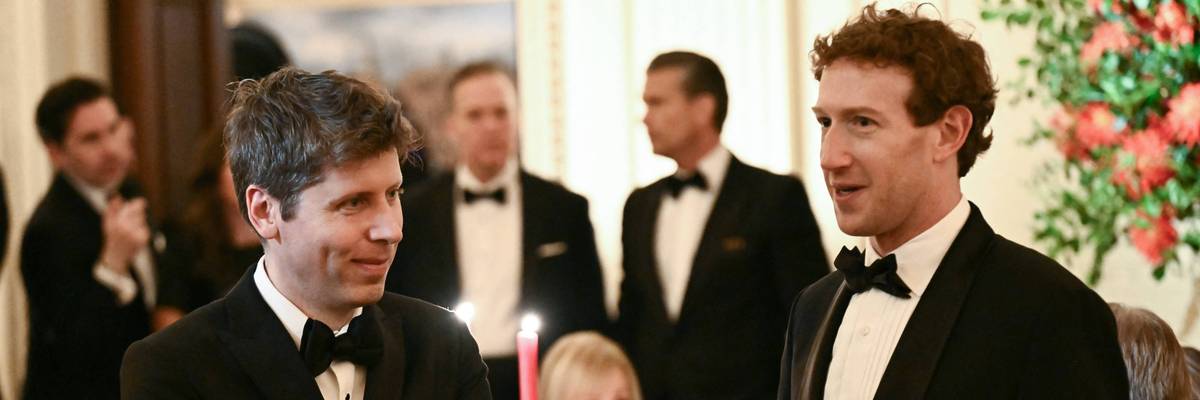
OpenAI CEO Sam Altman and Meta CEO Mark Zuckerberg attend a state dinner hosted by President Donald Trump for Chinese President Xi Jinping in Washington, DC, on September 24, 2026.
"We cannot let the billionaire class take these kinds of risks with our future."
Progressive author Naomi Klein and comedian Ilana Glazer on Monday warned that America's billionaire class is taking "unprecedented risks with our future," and said US policymakers must block further Big Tech initial public offerings and mergers to prevent even more damage from occurring.
In an op-ed published by The Guardian, Klein and Glazer outlined how US billionaires have used tax loopholes, corporate mergers, and IPOs to enrich themselves at an unprecedented scale, as their wealth has grown by an estimated 40% over just the last two years.
Klein and Glazer argued that the upcoming IPOs of artificial intelligence giants OpenAI and Anthropic could be particularly risky to the economy given questions about their ability to be consistently profitable.
"It’s no secret that the AI companies Anthropic and OpenAI are intending to go public in the near future," they wrote. "Both of these players also had major security flaws exposed recently, and openly acknowledge mind-bogglingly huge amounts of debt."
The risk will only grow, they added, if Nasdaq grants OpenAI and Anthropic the same exception it granted to Elon Musk's SpaceX earlier this year by allowing their shares to be immediately included in index funds without having to wait through the one-year "seasoning" period.
"June’s highly contentious SpaceX IPO already carries great risk for regular investors," they explained. "If more speculative tech companies with staggering risk profiles are allowed to follow suit, the results will become too much for the market to bear."
Klein and Glazer said that policymakers need to intervene to put a halt to new Big Tech IPOs, and also pass a wealth tax to take away billionaires' power to spend cavalierly even as they leave working people potentially holding the bag for their failed investments.
"We cannot let the billionaire class take these kinds of risks with our future," they emphasized. "To stop these reckless IPOs we must stand together, take collective action, and push for real change."
Economist Jeffrey D. Sachs last month similarly called for AI IPOs to be halted until Congress "has enacted a public system of licensing, independent safety evaluation, liability, and financial backstops for frontier AI."
Sachs noted that Anthropic executives and employees, including CEO Dario Amodei, have warned that AI could pose a threat to all human life, and he questioned why the creators of such technology should become unfathomably wealthy before such risks are understood and eliminated.
"A company should not disclose a risk of catastrophe to humanity and then sell its shares to the public before any public authority has the power to evaluate that risk or to stop deployment," argued Sachs. "In fact, to proceed rapidly in the face of such dire warnings is beyond folly."
This country and this world are at a monumental crossroads. US voters have an opportunity to beat back the forces of fascism and confront the billionaires who are rigging the economy, our media system, and our democracy, making it increasingly impossible for ordinary people to get by. We’re not just talking about the election. We’re talking about what must be done once these fascist elements are vanquished from power. We need a bolder set of solutions than what either major party has so far been willing to offer and a working-class movement ready to fight like hell for it. Trump didn't emerge from nowhere. The conditions that fueled MAGA authoritarianism were created by decades of radical neoliberal economic policies and a corrupt political system dominated by corporate interests. They slashed taxes on the super-rich, promising that the benefits would trickle down. They said giveaways to the corporate titans would make life more affordable for the rest of us. It was all bullshit. And when a bitter, betrayed populace searches for someone to blame, right-wing demagogues have little trouble finding scapegoats. People know when they're being lied to, but you won't hear any of this from the corporate media. Only independent journalism—powered and funded by people who believe in building a better world—can deliver truly trustworthy daily news. If you share our vision, please contribute whatever you can to sustain our work. |
Progressive author Naomi Klein and comedian Ilana Glazer on Monday warned that America's billionaire class is taking "unprecedented risks with our future," and said US policymakers must block further Big Tech initial public offerings and mergers to prevent even more damage from occurring.
In an op-ed published by The Guardian, Klein and Glazer outlined how US billionaires have used tax loopholes, corporate mergers, and IPOs to enrich themselves at an unprecedented scale, as their wealth has grown by an estimated 40% over just the last two years.
Klein and Glazer argued that the upcoming IPOs of artificial intelligence giants OpenAI and Anthropic could be particularly risky to the economy given questions about their ability to be consistently profitable.
"It’s no secret that the AI companies Anthropic and OpenAI are intending to go public in the near future," they wrote. "Both of these players also had major security flaws exposed recently, and openly acknowledge mind-bogglingly huge amounts of debt."
The risk will only grow, they added, if Nasdaq grants OpenAI and Anthropic the same exception it granted to Elon Musk's SpaceX earlier this year by allowing their shares to be immediately included in index funds without having to wait through the one-year "seasoning" period.
"June’s highly contentious SpaceX IPO already carries great risk for regular investors," they explained. "If more speculative tech companies with staggering risk profiles are allowed to follow suit, the results will become too much for the market to bear."
Klein and Glazer said that policymakers need to intervene to put a halt to new Big Tech IPOs, and also pass a wealth tax to take away billionaires' power to spend cavalierly even as they leave working people potentially holding the bag for their failed investments.
"We cannot let the billionaire class take these kinds of risks with our future," they emphasized. "To stop these reckless IPOs we must stand together, take collective action, and push for real change."
Economist Jeffrey D. Sachs last month similarly called for AI IPOs to be halted until Congress "has enacted a public system of licensing, independent safety evaluation, liability, and financial backstops for frontier AI."
Sachs noted that Anthropic executives and employees, including CEO Dario Amodei, have warned that AI could pose a threat to all human life, and he questioned why the creators of such technology should become unfathomably wealthy before such risks are understood and eliminated.
"A company should not disclose a risk of catastrophe to humanity and then sell its shares to the public before any public authority has the power to evaluate that risk or to stop deployment," argued Sachs. "In fact, to proceed rapidly in the face of such dire warnings is beyond folly."