SUBSCRIBE TO OUR FREE NEWSLETTER
Daily news & progressive opinion—funded by the people, not the corporations—delivered straight to your inbox.
5
#000000
#FFFFFF
To donate by check, phone, or other method, see our More Ways to Give page.
Daily news & progressive opinion—funded by the people, not the corporations—delivered straight to your inbox.
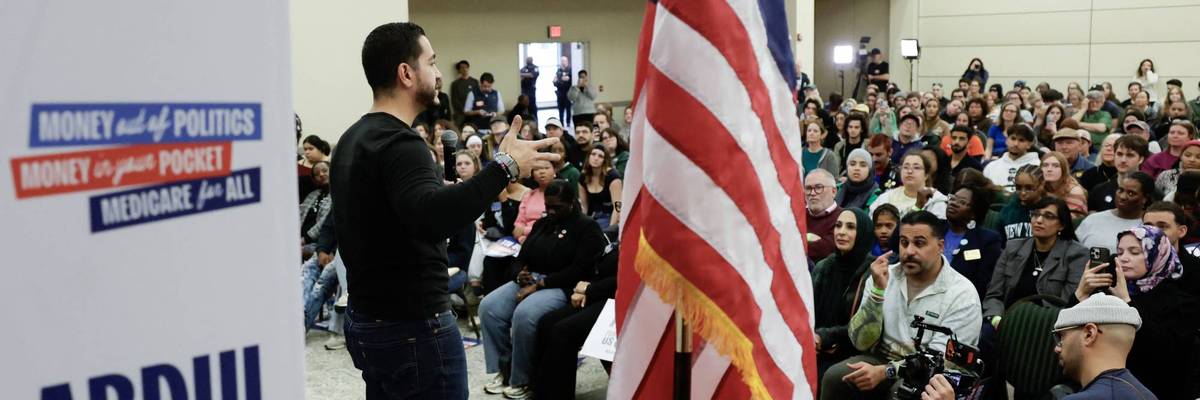
Democratic US Senate candidate for Michigan Abdul El-Sayed speaks at a midterm campaign rally at Eastern Michigan University in Ypsilanti, Ann Arbor, Michigan, on November 2, 2026.
One progressive organizer said that with a strong showing on Tuesday, “we’re going to be the center of gravity."
New polling data out Monday suggests a "blue tsunami" could be coming in this week's midterms, with Democrats holding leads in seven competitive US Senate races.
The polling, from The New York Times/Siena, showed Democratic candidates with solid leads in marquee races in Michigan, Maine, and Texas, ahead in states once thought to be unreachably red, including Ohio and Kansas, and narrowly ahead in Alaska and Iowa, with those advantages falling within the margin of error.
Astonishingly, this data may actually understate Democratic support—as the Times' chief political analyst, Nate Cohn, explained Monday, the paper changed its methodology to correct for undercounting Trump voters in presidential elections, potentially overcorrecting in a midterm when those voters are less likely to turn out.
If that’s the case, it may point to a clobbering of epic proportions, with states like Florida and Nebraska, and potentially even Louisiana and Mississippi, within reach, and the Democrats potentially coming away with large majorities in both chambers of Congress.
The sky may be the limit for Democrats on Tuesday. But the candidates, organizers, and leaders from the nation's progressive movement are taking nothing for granted.
"I was elected mayor of [Burlington, Vermont] after a recount by 10 votes," Sen. Bernie Sanders (I-Vt.) said in a video message Monday. "My point: Every vote counts."
"We can win this election," said Sanders, who has appeared at events alongside Democratic nominees Abdul El-Sayed in Michigan, Angie Nixon in Florida, and Troy Jackson in Maine, among others, over the final weeks of the campaign. "But the only way we win it is if millions of people come out and vote; we bring our friends, our uncles, our aunts, our neighbors."
The progressive advocacy group Our Revolution, initially formed following Sanders’ 2016 presidential run, says it has sought to reach 5 million voters in battleground states as it works to counter unprecedented spending by superrich donors.
“Big money can buy ads, but it can’t knock on a door, make a call, or have a conversation,” the group said in an email to volunteers last week.
The AFL-CIO said it had reached more than 16 million union voters as of October 30 and had tens of thousands of volunteers conducting doorstep, phone, and workplace conversations with voters as part of its largest ever midterm operation. The labor federation cited internal polling showing 83% of union members are “extremely motivated” about voting in the election—10 percentage points higher than in 2022.
“For months, workers have been talking to their fellow workers and families. And in every community, we hear the same thing: Shit is too expensive, and working people are sick and tired of the failed economic status quo that prioritizes billionaires over the people who make this country run,” AFL-CIO president Liz Shuler said.
This weekend, nearly 100 union members took part in a Halloween canvass in Des Moines, Iowa, where they said they exceeded their door-knocking goal for the election cycle.
“Every door we knock between now and Tuesday counts and will make the difference,” said Iowa Federation of Labor president Charlie Wishman.
With President Donald Trump now at new lows in public approval, Democratic candidates have focused their closing message on accountability and blocking his agenda.
"This is for... control of the United States Senate, to put a check on Trump and this ridiculous war, whether it's a war with Canada over tariffs, or a war in Iran that's raising our gas prices and our groceries," El-Sayed said in a get-out-the-vote video Monday. "But it's also for the Supreme Court, because if we don't win this race, Donald Trump is going to have another two Supreme Court nominations."
El-Sayed also looked toward a future in which Democrats are back in power and can use their sizable majority to advance a progressive agenda.
“This movement,” he said, “is about getting money out of politics, putting money in your pocket, passing ‘Medicare for All,’ standing up for union rights, standing up for the right to choose, standing up for healthcare for everybody.”
Joseph Geevarghese, the executive director of Our Revolution, said Tuesday could be a make-or-break moment for a progressive movement that has won the hearts of the Democratic base but faced pushback from the party establishment.
“There are centrists who don’t want to see us win, and who will lay any setbacks on Election Day at the feet of progressives,” Geevarghese told The Wall Street Journal on Monday.
He said a strong showing on the left could set the tone for the direction of the party entering 2028: “We’re going to be the center of gravity.”
This country and this world are at a monumental crossroads. US voters have an opportunity to beat back the forces of fascism and confront the billionaires who are rigging the economy, our media system, and our democracy, making it increasingly impossible for ordinary people to get by. We’re not just talking about the election. We’re talking about what must be done once these fascist elements are vanquished from power. We need a bolder set of solutions than what either major party has so far been willing to offer and a working-class movement ready to fight like hell for it. Trump didn't emerge from nowhere. The conditions that fueled MAGA authoritarianism were created by decades of radical neoliberal economic policies and a corrupt political system dominated by corporate interests. They slashed taxes on the super-rich, promising that the benefits would trickle down. They said giveaways to the corporate titans would make life more affordable for the rest of us. It was all bullshit. And when a bitter, betrayed populace searches for someone to blame, right-wing demagogues have little trouble finding scapegoats. People know when they're being lied to, but you won't hear any of this from the corporate media. Only independent journalism—powered and funded by people who believe in building a better world—can deliver truly trustworthy daily news. If you share our vision, please contribute whatever you can to sustain our work. |
New polling data out Monday suggests a "blue tsunami" could be coming in this week's midterms, with Democrats holding leads in seven competitive US Senate races.
The polling, from The New York Times/Siena, showed Democratic candidates with solid leads in marquee races in Michigan, Maine, and Texas, ahead in states once thought to be unreachably red, including Ohio and Kansas, and narrowly ahead in Alaska and Iowa, with those advantages falling within the margin of error.
Astonishingly, this data may actually understate Democratic support—as the Times' chief political analyst, Nate Cohn, explained Monday, the paper changed its methodology to correct for undercounting Trump voters in presidential elections, potentially overcorrecting in a midterm when those voters are less likely to turn out.
If that’s the case, it may point to a clobbering of epic proportions, with states like Florida and Nebraska, and potentially even Louisiana and Mississippi, within reach, and the Democrats potentially coming away with large majorities in both chambers of Congress.
The sky may be the limit for Democrats on Tuesday. But the candidates, organizers, and leaders from the nation's progressive movement are taking nothing for granted.
"I was elected mayor of [Burlington, Vermont] after a recount by 10 votes," Sen. Bernie Sanders (I-Vt.) said in a video message Monday. "My point: Every vote counts."
"We can win this election," said Sanders, who has appeared at events alongside Democratic nominees Abdul El-Sayed in Michigan, Angie Nixon in Florida, and Troy Jackson in Maine, among others, over the final weeks of the campaign. "But the only way we win it is if millions of people come out and vote; we bring our friends, our uncles, our aunts, our neighbors."
The progressive advocacy group Our Revolution, initially formed following Sanders’ 2016 presidential run, says it has sought to reach 5 million voters in battleground states as it works to counter unprecedented spending by superrich donors.
“Big money can buy ads, but it can’t knock on a door, make a call, or have a conversation,” the group said in an email to volunteers last week.
The AFL-CIO said it had reached more than 16 million union voters as of October 30 and had tens of thousands of volunteers conducting doorstep, phone, and workplace conversations with voters as part of its largest ever midterm operation. The labor federation cited internal polling showing 83% of union members are “extremely motivated” about voting in the election—10 percentage points higher than in 2022.
“For months, workers have been talking to their fellow workers and families. And in every community, we hear the same thing: Shit is too expensive, and working people are sick and tired of the failed economic status quo that prioritizes billionaires over the people who make this country run,” AFL-CIO president Liz Shuler said.
This weekend, nearly 100 union members took part in a Halloween canvass in Des Moines, Iowa, where they said they exceeded their door-knocking goal for the election cycle.
“Every door we knock between now and Tuesday counts and will make the difference,” said Iowa Federation of Labor president Charlie Wishman.
With President Donald Trump now at new lows in public approval, Democratic candidates have focused their closing message on accountability and blocking his agenda.
"This is for... control of the United States Senate, to put a check on Trump and this ridiculous war, whether it's a war with Canada over tariffs, or a war in Iran that's raising our gas prices and our groceries," El-Sayed said in a get-out-the-vote video Monday. "But it's also for the Supreme Court, because if we don't win this race, Donald Trump is going to have another two Supreme Court nominations."
El-Sayed also looked toward a future in which Democrats are back in power and can use their sizable majority to advance a progressive agenda.
“This movement,” he said, “is about getting money out of politics, putting money in your pocket, passing ‘Medicare for All,’ standing up for union rights, standing up for the right to choose, standing up for healthcare for everybody.”
Joseph Geevarghese, the executive director of Our Revolution, said Tuesday could be a make-or-break moment for a progressive movement that has won the hearts of the Democratic base but faced pushback from the party establishment.
“There are centrists who don’t want to see us win, and who will lay any setbacks on Election Day at the feet of progressives,” Geevarghese told The Wall Street Journal on Monday.
He said a strong showing on the left could set the tone for the direction of the party entering 2028: “We’re going to be the center of gravity.”