

SUBSCRIBE TO OUR FREE NEWSLETTER
Daily news & progressive opinion—funded by the people, not the corporations—delivered straight to your inbox.
5
#000000
#FFFFFF
To donate by check, phone, or other method, see our More Ways to Give page.
Daily news & progressive opinion—funded by the people, not the corporations—delivered straight to your inbox.
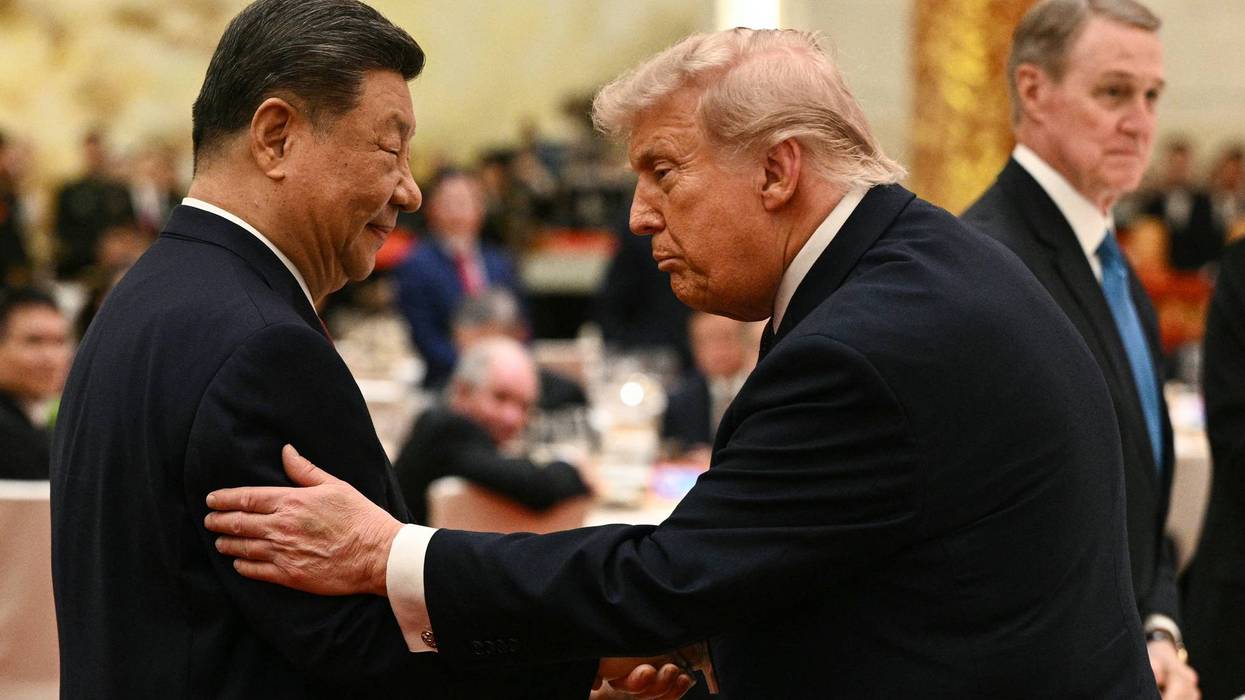
Western media is trying to make it sound like war was China’s idea, when it’s the US that has been actively preparing for it for the last decade.
This month, the world watched as US President Donald Trump wrangled up his bro-squad of capitalist billionaires and chartered them across the world to China. We watched in disbelief as the China-hating Trump administration paraded around Beijing gawking at beautiful ceilings and giant rose bushes. “China is beautiful,” Trump said.
All the while, the top US oligarchs met with Chinese officials, hoping to find openings they could us to slither into China’s large, booming markets and siphon off even more wealth that they most definitely don’t need. Fortunately, China just wasn’t that interested.

Even though nothing much came of the meetings, all the China hawks in Washington were on the edge of their seats, anxious that better relations with China would risk their favorite justification for raising the military budget to an unprecedented $1.5 trillion. But we need to prepare for war with China by 2025… no, 2027… wait, maybe 2030? Forever?
Mainstream media had a lot to say about the meeting. The Guardian was especially deceptive, with one article titled:

This is the kind of headline we’ve come to expect from outlets like the New York Post, whose credibility is on par with a spam email. In fact, they did have a similar article:

It’s not a huge surprise that Western media is trying to make it sound like war was China’s idea, when it’s the US that has been actively preparing for it for the last decade. It’s part of their strategy to use misleading headlines to stoke fear about China, so nobody pays attention to the war-antagonizing behavior of the United States.
When President Xi Jinping speaks about the “Thucydides Trap,” he is warning the US against treating war with China as inevitable and instead urging it to pursue diplomacy and cooperation. Many US policymakers, however, continue to frame China’s rise primarily as a military threat, expanding military posturing across the Asia-Pacific in an effort to preserve US dominance even at the risk of escalation.
It’s reported that Trump and Xi also talked at length about the US war on Iran. This conflict—as well as US military actions in Venezuela—is also tied to the broader US confrontation with China. Both countries possess major oil, gas, and critical mineral reserves and have become important economic partners to China. By targeting two of China’s key energy suppliers, the US is attempting to limit China’s access to the resources, while hoarding them for itself (and Israel).
The US war on Iran has been a disaster, which is one of the reasons Trump is in China, hoping for concessions. It’s not just energy dominance the US is worried about. While oil and gas prices are skyrocketing around the world, Iran has made an exception for Chinese oil tankers, which trade with Iran using the Chinese yuan. For decades, US global power has depended on the petrodollar system, which keeps global energy trade tied to the US dollar and gives the US enormous economic warfare abilities. But China’s continued purchase of Iranian oil using the yuan, along with growing efforts by countries across the Global South to trade outside the dollar system, threatens to weaken that dominance.
The global order is clearly shifting toward a more multipolar world. The question is whether the US will respond with diplomacy or attempt to preserve unipolar dominance through military confrontation with China. To prevent escalation, we must reject the idea that war between great powers is inevitable. And we must also demand media coverage that accurately and credibly covers the role the United States is playing in escalating tensions. That includes news outlets like The Guardian, which clearly prioritize painting China as the villain over credible and in-depth reporting.
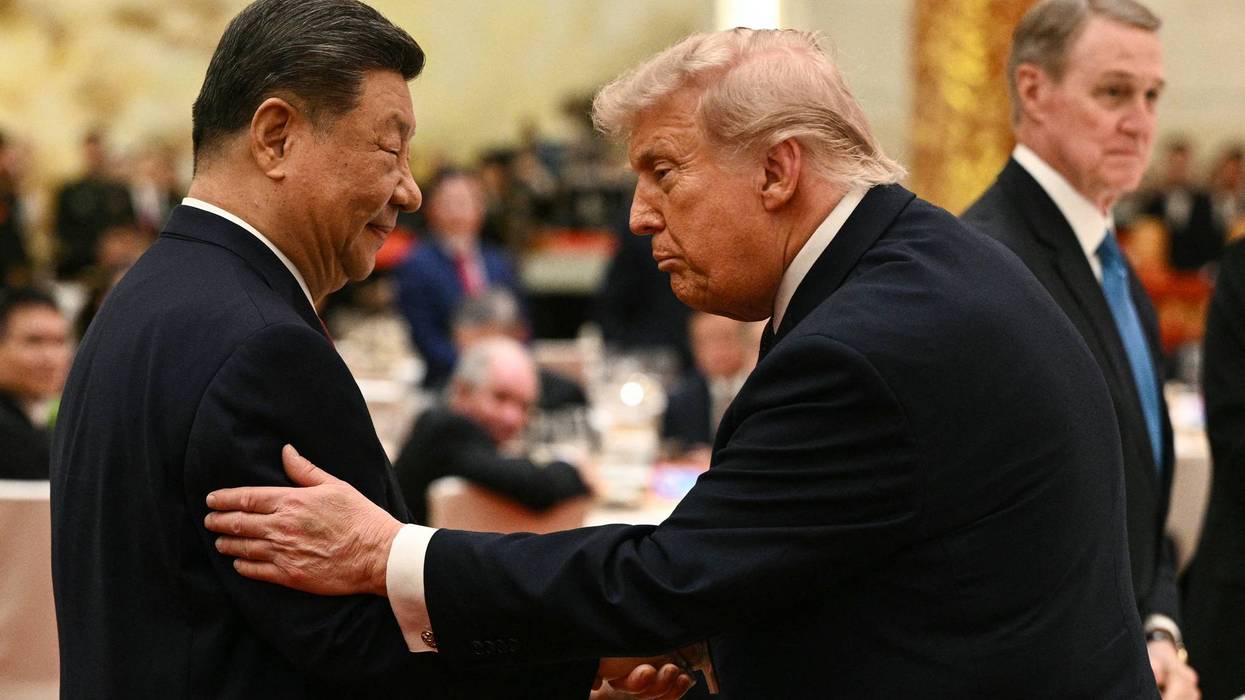
“Americans are increasingly supportive of US-China cooperation, while tensions with China do not serve American interests,” said dozens of anti-war groups as President Trump met with Chinese President Xi.
As US President Donald Trump meets with Chinese President Xi Jinping, a coalition of anti-war groups is calling on Congress to pressure the administration to "prioritize peace, cooperation, and stability" at a time when the US-China relationship is increasingly hostile.
“Americans are increasingly supportive of US-China cooperation, while tensions with China do not serve American interests,” argued the coalition, which includes Just Foreign Policy, Win Without War, the Friends Committee on National Legislation, Our Revolution, and dozens of other groups in a letter sent to members of Congress on Thursday.
They cited recent surveys showing that negative perceptions of China are consistently falling among Americans, including a Pew Research poll from January, which showed that just 28% of Americans viewed China as an "enemy" compared with 42% who saw it that way in 2024.
“At a time when so many domestic needs are going unmet, a confrontational posture toward China is costing untold billions of dollars in military build-up, trade and energy disruption, and securitization of technology—money that could and should be spent on the things Americans need at home," the coalition continued.
Trump's first visit to China in nearly a decade comes amid a global energy crisis caused by his war in Iran, a conflict where China has expressed a desire to act as a mediator.
While the coalition denounced Trump's war as "an unauthorized war of choice" that has led the world to a "deeply dangerous and uncertain place," it also said it presented an opportunity for the US and China to engage in diplomacy in hopes of putting the relationship "on a more stable footing."
Xi said that Taiwan remains the "most important issue in China-US relations” as the talks kicked off, warning that if mishandled, it could create a "very dangerous situation."
Secretary of State Marco Rubio said after a meeting on Thursday that the decadesold "One China Policy," which takes no explicit view on Taiwan's sovereignty, hasn't changed. Though he warned that it would be “a terrible mistake” for China to attempt to seize the island by force.
Friction between the US and China has only been heightened after Trump announced the sale of more than $11 billion worth of weapons to Taiwan in December, the largest ever arms sale to the island. At the time, China said the sale "gravely violates" the One China Policy.
The anti-war coalition warned that "current military and political trends in the United States, China, and Taiwan are moving us closer to a serious crisis or conflict over the island" and called on the US to "revitalize its One China Policy and press Beijing to reaffirm its focus on peaceful unification, with no timeline."
“Diplomacy with Beijing, rather than military posturing or arms racing across the Taiwan Strait,” they said, “is the only realistic path forward, especially since the American public has little interest in participating in a military conflict against China in defense of Taiwan.”
According to a survey by the Institute for Global Affairs in November, just 35% of Americans said they'd support the US sending troops to defend Taiwan if it were to be attacked by China. In a January poll commissioned by The New Republic, just 10% of Democratic voters said they wanted their party to support sending troops, and 30% wanted it to support sending weapons.
But Democratic leadership has pressured Trump to take the opposite approach and ramp up hostility toward Beijing in advance of this week's talks.
On Wednesday, Rep. Gregory Meeks (D-NY), the ranking member of the House Foreign Affairs Committee, was joined by Reps. Ro Khanna (D-Calif.), Jim Himes (D-Ct.), and Rep. Adam Smith (D-Wash.) to send a letter urging Trump to approve a delayed $14 billion arms sale to Taiwan ahead of his visit.
The Democrats on the House Foreign Affairs Committee joined in support for the sale, saying that "Trump must reaffirm in his meeting with Xi that the US will continue to uphold our longstanding One-China policy while standing firmly with Taiwan’s democracy and security. And he must make that clear by notifying Congress of the $14 billion arms sales to Taiwan. Anything else would undermine American credibility."
Just Foreign Policy (JFP) countered that the request to send more weapons just before talks were set to begin was "deeply unserious" and an "absurdly ill-timed move that would sabotage diplomacy—or worse."
Jake Werner, the director of the East Asia program at the Quincy Institute for Responsible Statecraft—another signatory to the anti-war letter—warned that while Democrats should confront Trump on the issue of China, they shouldn't goad him into an even more hawkish approach.
“If you want to attack Trump, that's great, but you should attack Trump on the basis of prudent, conflict-avoiding principles,” Werner said. “They should be criticizing him not for engaging in diplomacy, but for engaging in the wrong kind of diplomacy.”
In their letter to Congress, these and the other anti-war groups pushed for a similar diplomatic approach to other sources of tension with China, arguing that the US should take no position on the sovereignty of disputed territory in the South China Sea.
They also encouraged members of Congress to avoid creating "incentives" for other nations to adopt more confrontational stances toward China.
They singled out a first-ever test launch of an American Tomahawk missile in the Philippines last week, which had the capability to reach the Chinese mainland. Chinese military observers described it as the “worst provocation” in years by the US and suggested that Beijing should ramp up its air-defense and stealth-strike drone capabilities in response, according to the South China Morning Post.
The anti-war coalition said they "urge Congress to press the administration to avoid further escalatory signals and to instead pursue diplomacy to restore and expand non-proliferation agreements that can prevent a wasteful and dangerous arms race."
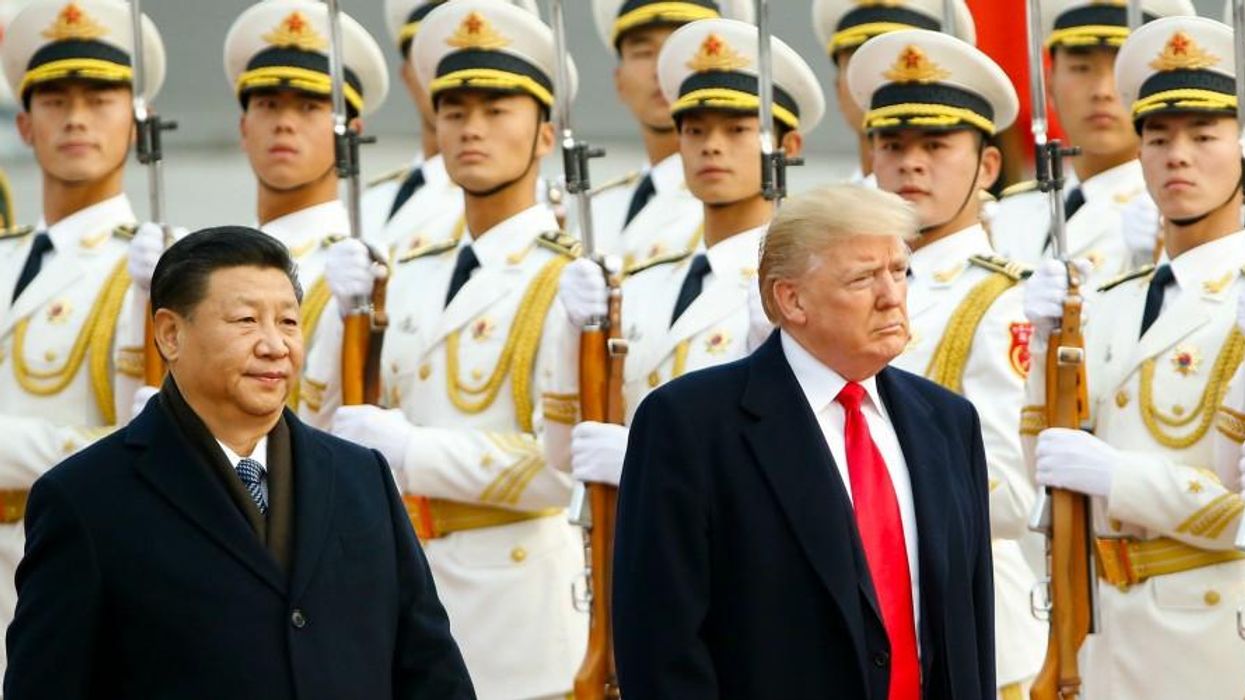
In all aspects of the U.S.-China rivalry, Trump will be pulled toward both increased militancy and combativeness and a more pragmatic, transactional approach.
Gaza, Haiti, Iran, Israel, Lebanon, Russia, Syria, Ukraine, and Venezuela: President-elect Donald Trump will face no shortage of foreign-policy challenges when he assumes office in January. None, however, comes close to China in scope, scale, or complexity. No other country has the capacity to resist his predictable antagonism with the same degree of strength and tenacity, and none arouses more hostility and outrage among MAGA Republicans.
In short, China is guaranteed to put President Trump in a difficult bind the second time around: He can either choose to cut deals with Beijing and risk being branded an appeaser by the China hawks in his party, or he can punish and further encircle Beijing, risking a potentially violent clash and possibly even nuclear escalation. How he chooses to resolve this quandary will surely prove the most important foreign test of his second term in office.
Make no mistake: China truly is considered The Big One by those in Trump’s entourage responsible for devising foreign policy. While they imagine many international challenges to their “America First” strategy, only China, they believe, poses a true threat to the continued global dominance of this country.
Trump will enter office in January with a toolkit of punitive measures for fighting China ready to roll along with strong support among his appointees for making them the law of the land.
“I feel strongly that the Chinese Communist Party has entered into a Cold War with the United States and is explicit in its aim to replace the liberal, Western-led world order that has been in place since World War II,” Rep. Michael Waltz (R-Fla.), Trump’s choice as national security adviser, declared at a 2023 event hosted by the Atlantic Council. “We’re in a global arms race with an adversary that, unlike any in American history, has the economic and the military capability to truly supplant and replace us.”
As Waltz and others around Trump see it, China poses a multi-dimensional threat to this country’s global supremacy. In the military domain, by building up its air force and navy, installing military bases on reclaimed islands in the South China Sea, and challenging Taiwan through increasingly aggressive air and naval maneuvers, it is challenging continued American dominance of the Western Pacific. Diplomatically, it’s now bolstering or repairing ties with key U.S. allies, including India, Indonesia, Japan, and the members of NATO. Meanwhile, it’s already close to replicating this country’s most advanced technologies, especially its ability to produce advanced microchips. And despite Washington’s efforts to diminish a U.S. reliance on vital Chinese goods, including critical minerals and pharmaceuticals, it remains a primary supplier of just such products to this country.
For many in the Trumpian inner circle, the only correct, patriotic response to the China challenge is to fight back hard. Both Rep. Waltz, Trump’s pick as national security adviser, and Sen. Marco Rubio (R-Fla.), his choice as secretary of state, have sponsored or supported legislation to curb what they view as “malign” Chinese endeavors in the United States and abroad.
Waltz, for example, introduced the American Critical Mineral Exploration and Innovation Act of 2020, which was intended, as he explained, “to reduce America’s dependence on foreign sources of critical minerals and bring the U.S. supply chain from China back to America.” Sen. Rubio has been equally combative in the legislative arena. In 2021, he authored the Uyghur Forced Labor Prevention Act, which banned goods produced in forced labor encampments in Xinjiang Province from entering the United States. He also sponsored several pieces of legislation aimed at curbing Chinese access to U.S. technology. Although these, as well as similar measures introduced by Waltz, haven’t always obtained the necessary congressional approval, they have sometimes been successfully bundled into other legislation.
In short, Trump will enter office in January with a toolkit of punitive measures for fighting China ready to roll along with strong support among his appointees for making them the law of the land. But of course, we’re talking about Donald Trump, so nothing is a given. Some analysts believe that his penchant for dealmaking and his professed admiration for Chinese strongman President Xi Jinping may lead him to pursue a far more transactional approach, increasing economic and military pressure on Beijing to produce concessions on, for example, curbing the export of fentanyl precursors to Mexico, but when he gets what he wants letting them lapse. Howard Lutnick, the billionaire investor from Cantor Fitzgerald whom he chose as Commerce secretary, claims that Trump actually “wants to make a deal with China,” and will use the imposition of tariffs selectively as a bargaining tool to do so.
What such a deal might look like is anyone’s guess, but it’s hard to see how Trump could win significant concessions from Beijing without abandoning some of the punitive measures advocated by the China hawks in his entourage. Count on one thing: This complicated and confusing dynamic will play out in each of the major problem areas in U.S.-China relations, forcing Trump to make critical choices between his transactional instincts and the harsh ideological bent of his advisers.
Of all the China-related issues in his second term in office, none is likely to prove more challenging or consequential than the future status of the island of Taiwan. At issue are Taiwan’s gradual moves toward full independence and the risk that China will invade the island to prevent such an outcome, possibly triggering U.S. military intervention as well. Of all the potential crises facing Trump, this is the one that could most easily lead to a great-power conflict with nuclear undertones.
When Washington granted diplomatic recognition to China in 1979, it “acknowledged” that Taiwan and the mainland were both part of “one China” and that the two parts could eventually choose to reunite. The U.S. also agreed to cease diplomatic relations with Taiwan and terminate its military presence there. However, under the Taiwan Relations Act of 1979, Washington was also empowered to cooperate with a quasi-governmental Taiwanese diplomatic agency, the Taipei Economic and Cultural Representative Office in the United States, and provide Taiwan with the weapons needed for its defense. Moreover, in what came to be known as “strategic ambiguity,” U.S. officials insisted that any effort by China to alter Taiwan’s status by force would constitute “a threat to the peace and security of the Western Pacific area” and would be viewed as a matter “of grave concern to the United States,” although not necessarily one requiring a military response.
If, however, he chooses to act “crazy” by embracing “strategic clarity” and stepping up military pressure on China, he would likely receive accolades from many of his supporters, while provoking a (potentially nuclear) war with China.
For decades, one president after another reaffirmed the “one China” policy while also providing Taiwan with increasingly powerful weaponry. For their part, Chinese officials repeatedly declared that Taiwan was a renegade province that should be reunited with the mainland, preferably by peaceful means. The Taiwanese, however, have never expressed a desire for reunification and instead have moved steadily toward a declaration of independence, which Beijing has insisted would justify armed intervention.
As such threats became more frequent and menacing, leaders in Washington continued to debate the validity of “strategic ambiguity,” with some insisting it should be replaced by a policy of “strategic clarity” involving an ironclad commitment to assist Taiwan should it be invaded by China. President Joe Biden seemed to embrace this view, repeatedly affirming that the U.S. was obligated to defend Taiwan under such circumstances. However, each time he said so, his aides walked back his words, insisting the U.S. was under no legal obligation to do so.
The Biden administration also boosted its military support for the island while increasing American air and naval patrols in the area, which only heightened the possibility of a future U.S. intervention should China invade. Some of these moves, including expedited arms transfers to Taiwan, were adopted in response to prodding from China hawks in Congress. All, however, fit with an overarching administration strategy of encircling China with a constellation of American military installations and U.S.-armed allies and partners.
From Beijing’s perspective, then, Washington is already putting extreme military and geopolitical pressure on China. The question is: Will the Trump administration increase or decrease those pressures, especially when it comes to Taiwan?
That Trump will approve increased arms sales to and military cooperation with Taiwan essentially goes without saying (as much, at least, as anything involving him does). The Chinese have experienced upticks in U.S. aid to Taiwan before and can probably live through another round of the same. But that leaves far more volatile issues up for grabs: Will he embrace “strategic clarity,” guaranteeing Washington’s automatic intervention should China invade Taiwan, and will he approve a substantial expansion of the American military presence in the region? Both moves have been advocated by some of the China hawks in Trump’s entourage, and both are certain to provoke fierce, hard-to-predict responses from Beijing.
Many of Trump’s closest advisers have, in fact, insisted on “strategic clarity” and increased military cooperation with Taiwan. Michael Waltz, for example, has asserted that the U.S. must “be clear we’ll defend Taiwan as a deterrent measure.” He has also called for an increased military presence in the Western Pacific. Similarly, last June, Robert C. O’Brien, Trump’s national security adviser from 2019 to 2021, wrote that the U.S. “should make clear” its “commitment” to “help defend” Taiwan, while expanding military cooperation with the island.
Trump himself has made no such commitments, suggesting instead a more ambivalent stance. In his typical fashion, in fact, he’s called on Taiwan to spend more on its own defense and expressed anger at the concentration of advanced chip-making on the island, claiming that the Taiwanese “did take about 100% of our chip business.” But he’s also warned of harsh economic measures were China to impose a blockade of the island, telling the editorial board of The Wall Street Journal, “I would say [to President Xi]: if you go into Taiwan, I’m sorry to do this, I’m going to tax you at 150% to 200%.” He wouldn’t need to threaten the use of force to prevent a blockade, he added, because President Xi “respects me and he knows I’m [expletive] crazy.”
Such comments reveal the bind Trump will inevitably find himself in when it comes to Taiwan this time around. He could, of course, try to persuade Beijing to throttle back its military pressure on the island in return for a reduction in U.S. tariffs—a move that would reduce the risk of war in the Pacific but leave China in a stronger economic position and disappoint many of his top advisers. If, however, he chooses to act “crazy” by embracing “strategic clarity” and stepping up military pressure on China, he would likely receive accolades from many of his supporters, while provoking a (potentially nuclear) war with China.
The question of tariffs represents another way in which Trump will face a crucial choice between punitive action and transactional options in his second term—or, to be more precise, in deciding how severe to make those tariffs and other economic hardships he will try to impose on China.
In January 2018, the first Trump administration imposed tariffs of 30% on imported solar panels and 20%-50% on imported washing machines, many sourced from China. Two months later, the administration added tariffs on imported steel (25%) and aluminum (10%), again aimed above all at China. And despite his many criticisms of Trump’s foreign and economic policies, President Biden chose to retain those tariffs, even adding new ones, notably on electric cars and other high-tech products. The Biden administration has also banned the export of advanced computer chips and chip-making technology to China in a bid to slow that country’s technological progress.
Accordingly, when Trump reassumes office on January 20, China will already be under stringent economic pressures from Washington. But he and his associates insist that those won’t be faintly enough to constrain China’s rise. The president-elect has said that, on day one of his new term, he will impose a 10% tariff on all Chinese imports and follow that with other harsh measures. Among such moves, the Trump team has announced plans to raise tariffs on Chinese imports to 60%, revoke China’s Permanent Normal Trade Relations (also known as “most favored nation”) status, and ban the transshipment of Chinese imports through third countries.
Most of Trump’s advisers have espoused such measures strongly. “Trump Is Right: We Should Raise Tariffs on China,” Marco Rubio wrote last May. “China’s anticompetitive tactics,” he argued, “give Chinese companies an unfair cost advantage over American companies… Tariffs that respond to these tactics prevent or reverse offshoring, preserving America’s economic might and promoting domestic investment.”
But Trump will also face possible pushback from other advisers who are warning of severe economic perturbations if such measures were to be enacted. China, they suggest, has tools of its own to use in any trade war with the U.S., including tariffs on American imports and restrictions on American firms doing business in China, including Elon Musk’s Tesla, which produces half of its cars there. For these and other reasons, the U.S.-China Business Council has warned that additional tariffs and other trade restrictions could prove disastrous, inviting “retaliatory measures from China, causing additional U.S. jobs and output losses.”
As in the case of Taiwan, Trump will face some genuinely daunting decisions when it comes to economic relations with China. If, in fact, he follows the advice of the ideologues in his circle and pursues a strategy of maximum pressure on Beijing, specifically designed to hobble China’s growth and curb its geopolitical ambitions, he could precipitate nothing short of a global economic meltdown that would negatively affect the lives of so many of his supporters, while significantly diminishing America’s own geopolitical clout. He might therefore follow the inclinations of certain of his key economic advisers like transition leader Howard Lutnick, who favor a more pragmatic, businesslike relationship with China. How Trump chooses to address this issue will likely determine whether the future involves increasing economic tumult and uncertainty or relative stability. And it’s always important to remember that a decision to play hardball with China on the economic front could also increase the risk of a military confrontation leading to full-scale war, even to World War III.
And while Taiwan and trade are undoubtedly the most obvious and challenging issues Trump will face in managing (mismanaging?) U.S.-China relations in the years ahead, they are by no means the only ones. He will also have to decide how to deal with increasing Chinese assertiveness in the South China Sea; continued Chinese economic and military-technological support for Russia in its war against Ukraine; and growing Chinese investments in Africa, Latin America, and elsewhere.
In these, and other aspects of the U.S.-China rivalry, Trump will be pulled toward both increased militancy and combativeness and a more pragmatic, transactional approach. During the campaign, he backed each approach, sometimes in the very same verbal outburst. Once in power, however, he will have to choose between them—and his decisions will have a profound impact on this country, China, and everyone living on this planet.
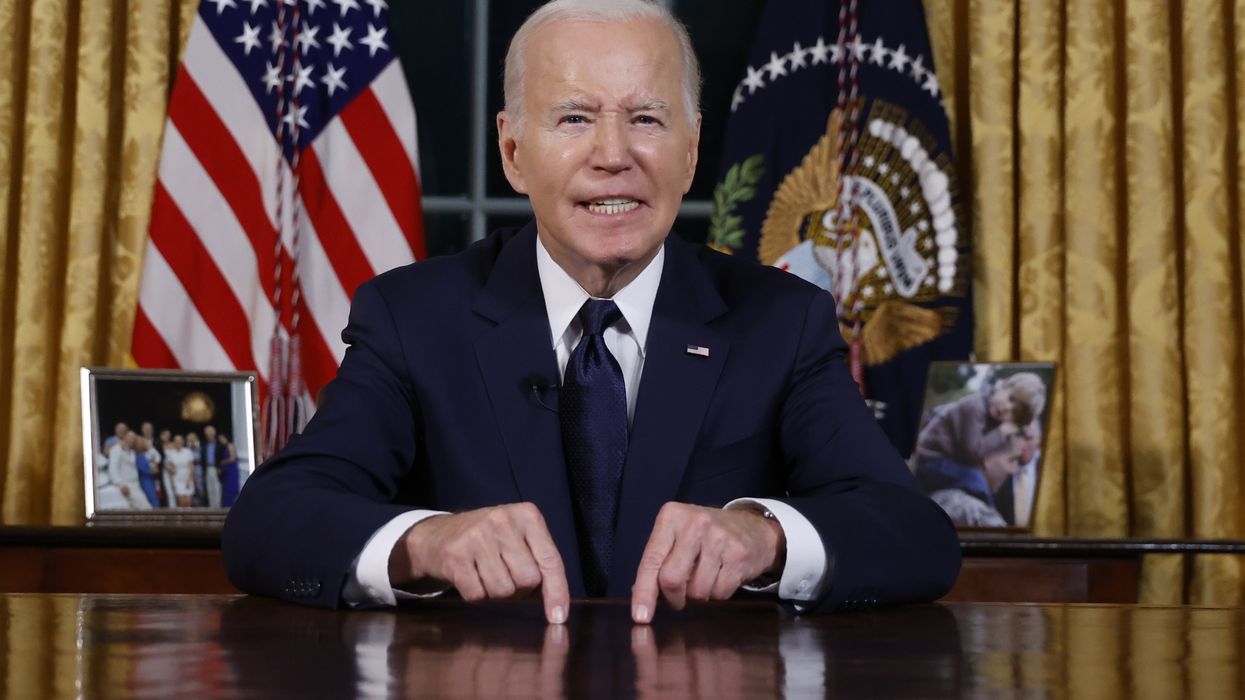
My wish for you in 2024 is to imbibe this wisdom and act on it: What is hateful to yourself, do not do to your fellow man.
Dear Joe,
I would wish you a Happy New Year; but it seems trite and banal, given all the challenges and troubles you and our country face in 2024—some inherited from previous administrations, others of your own making.
Americans are 10 times more likely to be shot to death than people in other wealthy countries, with homicides, suicides, and mass shootings on the increase. For the past four years, mass murders have skyrocketed into the 600s per year, breaking all past records. Since 2020 more children and teens are killed by firearms than any other cause.
Don’t these sound like war statistics?
Yes, you have established the first White House Office of Gun Violence Prevention. But it is rare to find anyone in your administration making the connection between our country’s record-breaking gun violence at home and our country’s record-breaking military weapons sales across the world, to democracies and autocracies alike, having grown dramatically over the past five years. To restate, isn’t it possible that the U.S. global culture of weapons and militarism, with nearly 100 military bases ringing the world, and our long and persistent history of war (nearly 40 in your and my lifetime) rebounds back to infect our violent culture here at home?
You are generous with weapons, but dismissive of dialogue where it is most needed.
The U.S. pledged $17.5 million to a loss and damage fund for poor countries vulnerable to extreme climate damage (for which the U.S. is more responsible than any other country) at the 2023 U.N. climate conference while doling out over $100 billion in weapons and military aid in the same year to feed and fuel wars in Gaza and Ukraine, wars that destroy and contaminate, likely irreparably, the homeland and ecosystems of those peoples who survive these wars and genocide in the case of Gaza. Crumbs for climate crisis and ruined ecosystems fall from the master’s table, while feasts of weapons abound.
Our habit of war “has yielded a host of perverse results here at home,” writes war veteran and noted historian of American military history, Andrew Bacevich. Neither have our wars brought about “peace [or democracy] by even the loosest definition of the word… the opposite in most case[s].” His wise counsel: Discard militarism in favor of “prudence and pragmatism.”
You often state proudly that we are the strongest military in the world, as if it is a crown of excellence, when in fact it is a crown of thorns on our country, which hangs on a cross of iron. As former president Dwight Eisenhower memorably said in 1953: “Every gun that is made, every warship launched, every rocket fired signifies, in the final sense, a theft from those who hunger and are not fed, those who are cold and are not clothed.”
What felonious theft our military budget is from the 140 million poor and low-income American people, 40% of U.S. citizens, for whom the crucial Poor People’s Campaign advocates. Forty-four million Americans “struggled with hunger” in 2022, according to USDA. Diseases of despair are rampant. Our life expectancy—a critical marker of people’s overall health—is lower than all comparable wealthy countries and many other countries including China and Cuba. Recall Dr. Martin Luther King, Jr.’s warning: “If America does not use her vast resources of wealth to end poverty and make it possible for all of God’s children to have the basic necessities of life, she too will go to hell.”
I do wish that that you had read the other Catholic president John F Kennedy’s 1963 peace speech at American University before you met recently in San Francisco with Xi Jinping, president of the People’s Republic of China. At the height of the Cold War with the Soviet Union and the Cuban Missile crisis, Kennedy and Soviet Premier Nikita Khrushchev opened a line of communication and held many secret talks, despite monumental political differences, for the sake of moving away from imminent nuclear war. In his 1963 address at American University, Kennedy, after stating his abhorrence of communism, praised Russia’s key role in saving Europe from Nazism while losing 20 million citizens, and he foregrounded the two countries’ shared humanity: “If we cannot end now our differences, at least we can help make the world safe for diversity. For, in the final analysis, our most basic common link is that we all inhabit this small planet. We all breathe the same air. We all cherish our children’s future. And we are all mortal.”
In many diplomatic private talks and communications, also involving Pope John XXIII, Kennedy and Khrushchev laid the groundwork for ending above ground nuclear weapons testing with the goal of eliminating nuclear weapons and forging a more peaceful country-to-country relationship. Within six-and-a-half months President Kennedy was assassinated, with the CIA strongly implicated.
Xi’s remarks to a gathering of business leaders, following your more private meeting with him last November, manifests a kinship with JFK’s speech. He displayed respect for our country’s accomplishments (even if for self-serving reasons) and advocated the two countries accept political diversity in a multipolar world. Joe, if you had listened more deeply, you may have given a wiser response to a reporter’s question than your dismissive, “Yes, I think Xi is a dictator” —an off-the cuff remark that conveys little wisdom or will to work together to rescue the world from war and climate crisis and to live in a multipolar, diverse world. You are generous with weapons, but dismissive of dialogue where it is most needed.
My wish for you in 2024 is to imbibe this wisdom and act on it: What is hateful to yourself, do not do to your fellow man. That is the core of the Torah, the New Testament, the Quran, and other religious traditions. Make it your own, end the U.S. addiction to war, and save your country’s soul and your own.
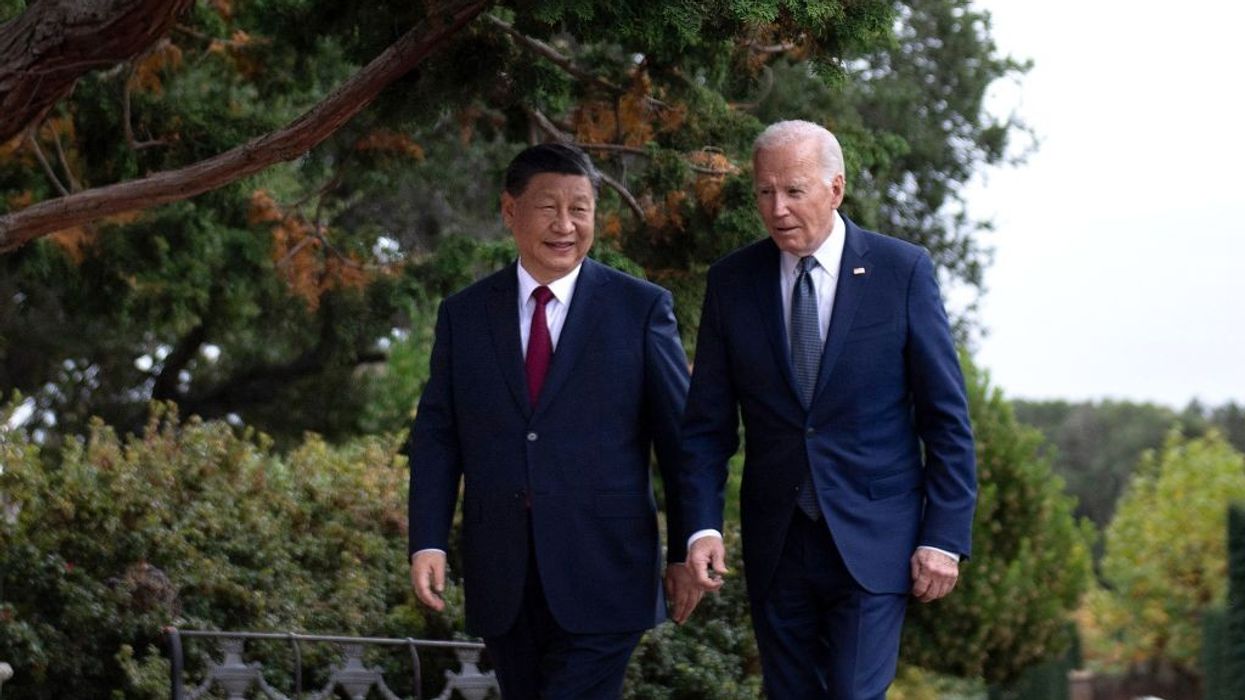
Given the dangers in Taiwan and the South China Sea, Presidents Biden and Xi will have to exercise extreme patience and prudence to prevent the ignition of a full-blown crisis next year.
This hasn’t exactly been a year of good news when it comes to our war-torn, beleaguered planet, but on November 15, U.S. President Joe Biden and Chinese President Xi Jinping took one small step back from the precipice. Until they talked in a mansion near San Francisco, it seemed as if their countries were locked in a downward spiral of taunts and provocations that might, many experts feared, result in a full-blown crisis, even a war—even, god save us all, the world’s first nuclear war. Thanks to that encounter, though, such dangers appear to have receded. Still, the looming question facing both countries is whether that retreat from disaster—what the Chinese are now calling the “San Francisco vision”—will last through 2024.
Prior to the summit, there seemed few discernible obstacles to some kind of trainwreck, whether a complete breakdown in relations, a disastrous trade war, or even a military clash over Taiwan or contested islands in the South China Sea. Beginning with last February’s Chinese balloon incident and continuing with a series of bitter trade disputes and recurring naval and air incidents over the summer and fall, events seemed to be leading with a certain grim inevitability toward some sort of catastrophe. After one such incident last spring, New York Times columnist Thomas Friedman warned that “the smallest misstep by either side could ignite a U.S.-China war that would make Ukraine look like a neighborhood dust-up.”
In recent months, top leaders in both Beijing and Washington were becoming ever more concerned that a major U.S.-China crisis—and certainly a war—would prove catastrophic for all involved. Even a major trade war, they understood, would create economic chaos on both sides of the Pacific. A complete breakdown in relations would undermine any efforts to come to grips with the climate crisis, prevent new pandemics, or disrupt illegal drug networks. And a war? Well, every authoritative nongovernmental simulation of a U.S.-China conflict has ended in staggering losses for both sides, as well as a significant possibility of nuclear escalation (and there’s no reason to assume that simulations conducted by the American and Chinese militaries have turned out any differently).
As Xi reportedly asked Biden, “Should [the U.S. and China] engage in mutually beneficial cooperation or antagonism and confrontation? This is a fundamental question on which disastrous mistakes must be avoided.”
As summer turned into fall, both sides were still searching for a mutually acceptable “offramp” from catastrophe. For months, top officials had been visiting each other’s capitals in a frantic effort to bring a growing sense of crisis under control. Secretary of State Antony Blinken traveled to Beijing in June (a trip rescheduled after he cancelled a February visit thanks to that balloon incident); Treasury Secretary Janet Yellen arrived in July; and Commerce Secretary Gina Raimondo in August. Similarly, Foreign Minister Wang Yi traveled to Washington in October. Their meetings, according to New York Times reporters Vivian Wang and David Pierson, were arranged “in the hope of arresting the downward spiral” in relations and to pave the way for a Biden-Xi meeting that might truly ease tensions.
Not surprisingly, for both Biden and Xi, the primary objective of the San Francisco summit was to halt that downward spiral. As Xi reportedly asked Biden, “Should [the U.S. and China] engage in mutually beneficial cooperation or antagonism and confrontation? This is a fundamental question on which disastrous mistakes must be avoided.”
From all accounts, it appears that the two presidents did at least stop the slide toward confrontation. While acknowledging that competition would continue unabated, both sides agreed to “manage” their differences in a “responsible” manner and avoid conflict-inducing behavior. While the United States and China “are in competition,” Biden reportedly told Xi, “the world expects the United States and China to manage competition responsibly to prevent it from veering into conflict, confrontation, or a new Cold War.” Xi reportedly endorsed this precept, saying that China would strive to manage its differences with Washington in a peaceful fashion.
In this spirit, Biden and Xi took several modest steps to improve relations and prevent incidents that might result in unintended conflict, including a Chinese promise to cooperate with the U.S. in combating the trade in the narcotic drug fentanyl and the resumption of high-level military-to-military communications. In a notable first, the two also “affirmed the need to address the risks of advanced [artificial intelligence] systems and improve AI safety through U.S.-China government talks.” They also put their stamp of approval on a series of cooperative steps agreed to by their climate envoys John Kerry and Xie Zhenhua to mutually combat climate change.
Still, neither president agreed to any fundamental alterations in policy that might have truly shifted bilateral relations in a more cooperative direction. In fact, on the most crucial issues dividing the two countries—Taiwan, trade, and technology transfers—they made no progress. As Xue Gong, a China scholar at the Carnegie Endowment for International Peace, put it, whatever the two presidents did accomplish, “the Biden-Xi meeting will not change the direction of U.S.-China relations away from strategic competition.”
With that still the defining constant in relations and both leaders under immense pressure from domestic constituencies—the military, ultra-nationalist political factions, and assorted industry groups—to hang tough on key bilateral issues, don’t be surprised if the slide towards crisis and confrontation regains momentum in 2024.
Assuming U.S. and Chinese leaders remain committed to a nonconfrontational stance, they will face powerful forces driving them ever closer to the abyss, including both seemingly intractable issues that divide their countries and deeply entrenched domestic interests intent on provoking a confrontation.
Although several highly contentious issues have the potential to ignite a crisis in 2024, the two with the greatest potential to provoke disaster are Taiwan and territorial disputes in the South China Sea.
A self-governing island that increasingly seeks to pursue its own destiny, Taiwan is viewed by Chinese officials as a renegade province that should rightfully fall under Beijing’s control. When the U.S. established formal diplomatic relations with the People’s Republic of China (PRC) in 1979, it acknowledged the Chinese position “that there is one China and Taiwan is part of China.” That “one China” principle has remained Washington’s official policy ever since, but is now under increasing pressure as ever more Taiwanese seek to abandon their ties with the PRC and establish a purely sovereign state—a step that Chinese leaders have repeatedly warned could result in a military response. Many American officials believe that Beijing would indeed launch an invasion of the island should the Taiwanese declare their independence and that, in turn, could easily result in U.S. military intervention and a full-scale war.
Joe Biden could face a major military crisis remarkably early in 2024.
For now, the Biden administration’s response to a possible Chinese invasion is governed by a principle of “strategic ambiguity” under which military intervention is implied but not guaranteed. According to the Taiwan Relations Act of 1979, any attempt by China to seize Taiwan by military means will be considered a matter “of grave concern to the United States,” but not one automatically requiring a military response. In recent years, however, increasing numbers of prominent Washington politicians have called for the replacement of “strategic ambiguity” with a doctrine of “strategic clarity,” which would include an unequivocal pledge to defend Taiwan in case of an invasion. President Biden has lent credence to this stance by repeatedly claiming that it is U.S. policy (it isn’t), obliging his aides to eternally walk back his words.
Of course, the question of how China and the U.S. would respond to a Taiwanese declaration of independence has yet to be put to the test. The island’s current leadership, drawn from the pro-independence Democratic Progressive Party (DPP), has so far accepted that, given the way Taiwan is slowly achieving de facto independence through diplomatic outreach and economic prowess, there’s no need to rush a formal declaration. But presidential elections in Taiwan this coming January and the possible emergence of another DPP-dominated administration could, some believe, trigger just such a move—or, in anticipation of it, a Chinese invasion.
Should the DPP candidate William Lai win on January 13, the Biden administration might come under enormous pressure from Republicans—and many Democrats—to accelerate the already rapid pace of arms deliveries to the island. That would, of course, be viewed by Beijing as tacit American support for an accelerated drive toward independence and (presumably) increase its inclination to invade. In other words, Joe Biden could face a major military crisis remarkably early in 2024.
The South China Sea dispute could produce a similar crisis in short order. That fracas stems from the fact that Beijing has declared sovereignty over nearly the entire South China Sea—an extension of the western Pacific bounded by China, Taiwan, the Philippines, Borneo, and Vietnam—along with the islands found within it. Such claims have been challenged by that sea’s other bordering states, which argue that, under international law (notably the U.N. Convention on the Law of the Sea) they are entitled to sovereignty over the islands that fall within their individual “exclusive economic zones” (EEZs). In 2016, the Permanent Court of Arbitration in the Hague ruled on a petition from the Philippines that China’s claims were invalid and that the Philippines and its neighbors were indeed entitled to control their respective EEZs. China promptly both protested the ruling and announced its intention to disregard it.
Chinese control over those islands and their surrounding waters would have significant economic and strategic implications. To begin with, it extends China’s defense perimeter several hundred miles from its coastline, complicating any future U.S. plans to attack the mainland while making a PRC assault on U.S. and allied bases in the region far easier. The South China Sea also harbors major fisheries, an important source of sustenance for China and its neighbors, as well as vast reserves of oil and natural gas coveted by all the states in the region. China has consistently sought to monopolize those resources.
To facilitate its control over the area, the PRC has established military installations on many of the islands, while using its coast guard and maritime militias to drive off the fishing boats and oil-drilling vessels of other states, even ramming some of those ships. On October 22, for example, a large Chinese coast guard vessel bumped into a smaller Philippine one seeking to reinforce a small outpost of Philippines Marines located on the Second Thomas Shoal, an islet claimed by both countries.
In both the U.S. and China, vast military-industrial operations have blossomed, fed by mammoth government disbursements intended to bolster their ability to defeat the other’s military in all-out, high-tech combat.
In reaction to such moves, officials in Washington have repeatedly asserted that the U.S. will assist allies affected by Chinese “bullying.” As Secretary of Defense Lloyd Austin declared in July at a meeting with Australian officials in Brisbane, “We’ll continue to support our allies and partners as they defend themselves from bullying behavior.” Three months later, following that clash at the Second Thomas Shoal, Washington reaffirmed its obligation to defend the Philippines under the 1951 Mutual Defense Treaty, should Filipino forces, ships, or aircraft come under armed attack, including “those of its coast guard—anywhere in the South China Sea.”
In other words, a future clash between Chinese vessels and those of one of Washington’s treaty partners or close allies could easily escalate into a major confrontation. Just what form that might take or where it might lead is, of course, impossible to say. But it’s worth noting that, in recent South China Sea exercises, the U.S. Indo-Pacific Command has conducted large-scale combat drills, involving multiple aircraft carriers, cruisers, destroyers, and submarines. Any U.S. military response on such a scale would undoubtedly prompt a comparable Chinese reaction, setting in motion a potential spiral of escalation. Assuming that China continues its policy of harassing the fishing and exploration activities of its southern neighbors, a clash of this sort could occur at almost any time.
Given the dangers in Taiwan and the South China Sea, Presidents Biden and Xi will have to exercise extreme patience and prudence to prevent the ignition of a full-blown crisis in 2024. Hopefully, the understanding they developed in San Francisco, along with new crisis-management tools like enhanced military-to-military communications, will help them manage any problems that do arise. In doing so, however, they will have to overcome both the escalatory dynamics built into those disputes and bellicose domestic pressures from powerful political and industrial factions that view intense military competition with the other side (if not necessarily war) as attractive and necessary.
In both the U.S. and China, vast military-industrial operations have blossomed, fed by mammoth government disbursements intended to bolster their ability to defeat the other’s military in all-out, high-tech combat. In this hothouse environment, military bureaucracies and arms-makers on each side have come to assume that perpetuating an environment of mutual suspicion and hostility could prove advantageous, leaving key politicians ever more obliged to shower them with money and power. On December 13 and 14, for example, the U.S. Senate and House, seemingly incapable of passing anything else, approved a record defense policy bill that authorized $886 billion in military spending in 2024 ($28 billion more than in 2023), with most of the increase earmarked for ships, planes, and missiles intended primarily for a possible future war with China. American military leaders—and politicians representing districts with a high concentration of defense contractors—are sure to request even greater spending increases in future years to overcome “the China threat.”
A similar dynamic fuels the funding efforts of top Chinese military-industrial officials, who no doubt are citing evidence of Washington’s drive to overpower China to demand a reciprocal buildup, including (all too ominously) of their country’s nuclear forces. In addition, in both countries, various political and media figures continue to benefit by harping on the “China threat” or the “America threat,” adding to the pressure on top officials to take strong action in response to any perceived provocation by the other side.
That being the case, Presidents Biden and Xi are likely to face a series of demanding challenges in 2024 from the seemingly intractable disputes between their two nations. Under the best of circumstances, perhaps they’ll be able to avoid a major blow-up, while making progress on less contentious issues like climate change and drug trafficking. To do so, however, they’ll have to resist powerful forces of entrenched bellicosity. If they can’t, the fierce wars in Ukraine and Gaza in 2023 could end up looking like relatively minor events as the two great powers face off against each other in a conflict that could all too literally take this planet to hell and back.
With the two nations taking steps towards a more harmonized agenda on climate change mitigation, we would expect these leading plastic producer countries to also show leadership in relation to plastics.
President Joe Biden and Chinese President Xi Jinping met in California this week in their first meeting in person in over a year. The two countries released a joint climate statement this week and committed to work together more closely to fight climate change.
World leaders are also gathering this week in Nairobi, Kenya, at the United Nation’s Third Session (INC-3) to craft an ambitious Global Plastics Treaty to end plastic pollution. This is a huge opportunity to show the world what the U.S. and China can do to address climate change, phase out fossil fuels, and end all forms of plastic pollution in every stage of the life cycle.
This week’s statement reaffirmed their commitment to address climate change, and to end plastic pollution and work together and with others to develop an internationally legally binding instrument. On both climate and plastics, it is critical that the U.S. and China work with the rest of the world.
The ongoing negotiations for the plastics treaty are a unique opportunity to show how the ambitious targets for net-zero emissions set by U.S. and China can be translated to an effective international agreement focusing on one of the most emissions-intensive industries.
Scientists, including myself, have demonstrated the connection between unsustainable production and consumption of plastics and the climate crisis. Plastics are a fully integrated link of the fossil fuel value chain—99% of plastics are derived from fossil fuels, primarily oil and gas fractions—as well as a core and growing business of many of the largest fossil fuel firms. This has in recent years led to a deeper fossil fuel lock-in for plastics. Plastics are associated with around 5% of global greenhouse gas emissions (GHG), and this share is expected to grow rapidly in the coming decades if projections for continued growth of plastic production materialize.
Of particular concern is the rapid growth of plastic production in countries and regions with energy systems and plastic feedstocks that use coal, leading to GHG emissions from plastics production growing at a higher rate than production itself. Plastic producers have very limited targets and programs for reducing their GHG emissions such as through renewable energy. And necessary long-term targets for eliminating the use of fossil fuel feedstocks are completely absent. So far international climate policy has largely ignored the need to phase out fossil fuels for both energy and plastic feedstocks.
It is clear that one of the most effective ways of mitigating climate change impacts as well as all other forms of pollution associated with plastics is to restrict future production. This has been identified by scientists as a central goal for the Global Plastics Treaty and is one of the key requirements for the treaty emphasized by the global Scientists’ Coalition for an Effective Plastics Treaty.
Civil society organizations and business leaders from around the world agree, and have rallied around a call for a treaty that prioritizes production reduction. And they have pointed out that the treaty is too focused on downstream measures which will be inadequate for meeting the challenge.
With China and the U.S. taking steps towards a more internationally harmonized agenda on climate change mitigation, we would expect these leading plastic producer countries to also show leadership in relation to plastics. The ongoing negotiations for the plastics treaty are a unique opportunity to show how the ambitious targets for net-zero emissions set by U.S. and China can be translated to an effective international agreement focusing on one of the most emissions-intensive industries.
It is imperative, for the climate as well as both terrestrial and marine ecosystems, that the plastics treaty addresses the full life cycle of plastics through measures and interventions in production, consumption, and end-of-life management.
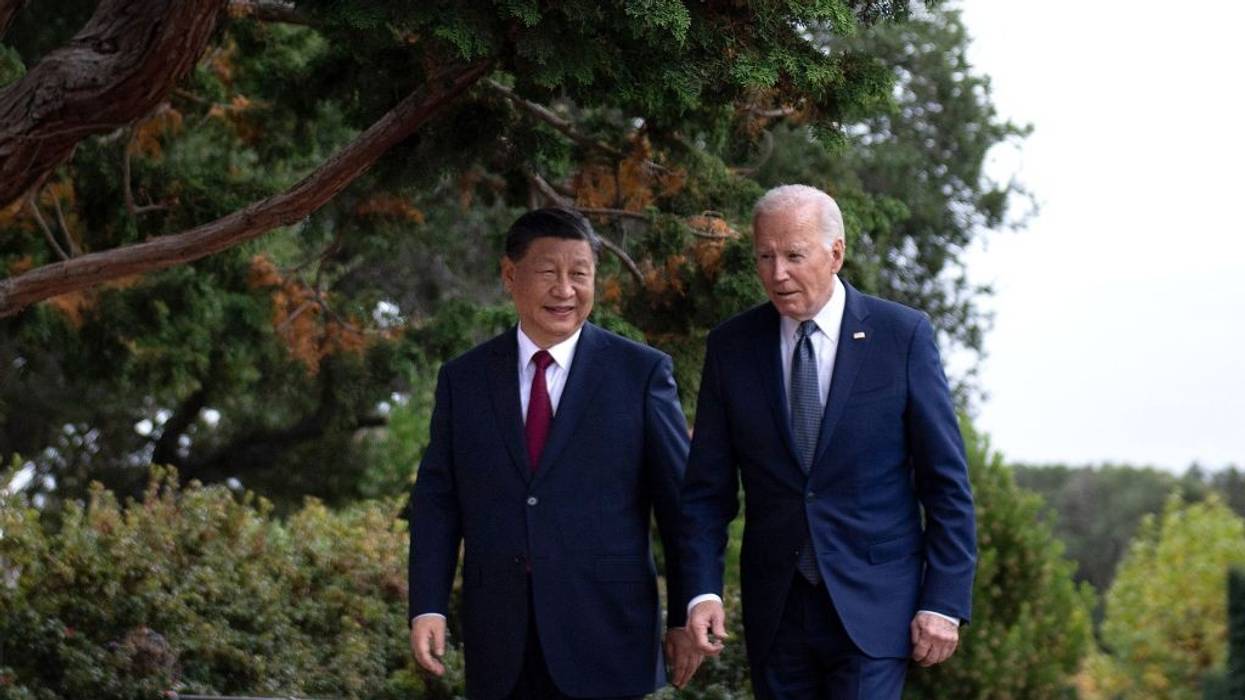
When a couple doesn’t trust each other, someone has to make a first attempt at reconciliation, however modest.
Chinese leader Xi Jinping arrived in the United States this week to participate in the annual Asia-Pacific Economic Cooperation (APEC) meeting. He also met one-on-one with President Joe Biden.
But it hasn’t been exactly a red-carpet kind of visit.
For one thing, because the two leaders will be talking in San Francisco, their confab will generate very little of the pomp and circumstance of a U.S. president welcoming a foreign dignitary to Washington. Second, the focus of Xi’s visit is the APEC meeting. He’ll be absorbed in wooing the other 20 members of the group, which works on facilitating trade and investment in the larger Asia-Pacific region. The APEC region, after all, is responsible for nearly half of all global trade.
But perhaps most importantly, and ominously, the United States and China are not exactly on great terms at the moment.
In addition to the deterioration in security relations—the U.S. shootdown of the Chinese balloon, the increasing tensions in the South China Sea—the two countries have been involved in a low-intensity trade war and a tit-for-tat brawl on advanced technology. The United States has imposed an escalating series of export controls on semiconductors, artificial intelligence technology, and the like. This summer, China retaliated by restricting exports of gallium and germanium—it produces 90 percent and 60 percent respectively of these two rare earth elements—to essentially zero.
Pundits and media commentators, following the lead of the Biden administration, have worked hard to lower expectations for the Biden-Xi meeting.
“We’re not talking about a long list of outcomes or deliverables,” a senior administration official told reporters. “The goals here really are about managing the competition, preventing the downside risk of conflict and ensuring channels of communication are open.”
Sounds to me like the first meeting at the office of a couples counselor. Since the Trump presidency, everyone has been talking about the “decoupling” of China and the United States. It’s really too bad that Biden and Xi don’t have the services of a third-party facilitator who can help the couple sort through their problems.
But wait: how about if I offer to fly out to San Francisco to mediate?
True, I’m not a licensed therapist. But some of my nearest and dearest are, and their professional wisdom has inevitably rubbed off on me. Plus, I think I have some good ideas of how to prevent the United States and China from falling into a messy divorce.
My clients have built a strong relationship that has stretched across five decades. They come from very different backgrounds, so it’s only to be expected that they will have some conflicts. But even while they were bickering with one another, China and the United States set a new record in trade in goods last year (though it has declined a bit since then). Like any successful couple, they have become dependent on one another while preserving a good deal of independence.
During their first visit with me, I will encourage Biden and Xi to start out by acknowledging what’s working well in the relationship.
My guess, however, is that the two will soon fall to griping.
Beijing is angry about the tariffs that Donald Trump imposed during his presidency and that Biden hasn’t lifted, which China pegs at an average of 19 percent compared to the 7.3 percent that China imposes on U.S. products. It’s not happy about the export controls on advanced technology that the United States and European Union have levied. And it really doesn’t like the way that Europe and the United States have put pressure on manufacturers to stop relying on China for critical raw materials.
Washington, meanwhile, has accused China of ripping off the intellectual property of U.S. firms. It’s beyond annoyed that China has been using advanced technology to upgrade its military, and it’s concerned as well about China’s human rights record. It puts Chinese tariffs on U.S. goods at somewhere between 15 and 25 percent.
Both countries have other complaints. The United States worries about China’s military actions in the Taiwan Strait and the South China Sea, its military alliance with Russia, and its efforts to gobble up critical resources in the Global South. China is furious at how the United States is building alliances—such as the “Quad” with India, Japan, and Australia—designed specifically to contain China’s ambitions. Another major irritant is the aggressive actions that U.S. military craft take near China’s borders. And don’t get Beijing started on the double standard that the United States maintains on human rights where Washington basically looks the other way at Saudi and Israeli violations but holds China strictly to account.
Complaining is not the royal road to reconciliation. Biden and Xi have to listen to each other to make any progress. That’s certainly what administration officials mean when they say that both sides have to commit to “ensuring channels of communication are open.”
But let’s face it: listening isn’t enough either.
If couples have children, they have an obvious mutual interest in raising the family in a healthy environment.
Biden and Xi don’t have any children in common. But the trade between the two countries functions as a kind of offspring of the relationship. And let’s face it: my clients are really screwing up with that particular kid.
The tariffs in particular have not benefited either side. They have cost U.S. consumers a huge amount of money, to the tune of $1.4 billion a month (by the end of 2018). Through 2021, that added up to $48 billion that consumers shelled out in extra cash. According to a 2020 Brookings report:
The tariffs forced American companies to accept lower profit margins, cut wages and jobs for U.S. workers, defer potential wage hikes or expansions, and raise prices for American consumers or companies. A spokesperson for the American Farm Bureau stated that “farmers have lost the vast majority of what was once a $24 billion market in China” as a result of Chinese retaliatory actions.
U.S. businesses are well aware of how much these tariffs—and other practices—have damaged their own bottom line. Perhaps that’s why business leaders are hosting Xi in San Francisco at a $2,000 a plate dinner.
It’s harder to know how much China has been affected by the tariffs, though one study concluded on the basis of a reduction in the intensity of night-time lighting in China that local economic activity has shrunk. However, China has probably not suffered as much as the United States, since its U.S.- bound exports decreased by only 8.5 percent (compared to a decrease of 26.3 percent of China-bound exports from the United States) and its exports to the rest of the world increased by 5.5 percent (compared to an increase of only 2.2 percent for U.S. exports to the rest of the world).
Then there’s the matter of the global commons. A couple that spends less time and energy squabbling can turn their attention to improving their own house or even the surrounding neighborhood. To do so, however, they have to stop wasting resources on feeding their mutual grievances.
Both China and the United States devote enormous sums to countering perceived threats from the other side. It’s hard to separate out precisely what percentage of the nearly trillion-dollar military budget is allocated to this particular bilateral dispute, but safe to say it’s a lot. China spends somewhere between $225 billion (Beijing’s figures) and $300 billion (outside estimates). It’s likely that at least half of that combined figure—around $650 billion a year—is being poured down the drain of “preparedness” for some future battle between the two superpowers.
If China and the United States engaged in threat reduction—and then proceeded to arms control—that would free up a lot of money that could go, for instance, toward addressing climate change. Fortunately, it looks like the two countries are going to restart face-to-face climate discussions, which could help pave the way for some future reallocation of resources.
The couple could team up to work on other resource questions. The United States and China are competing furiously to secure critical raw materials throughout the world. What if they cooperated instead on research on recycling and less mining-dependent alternatives? The United States and China are both guilty of over-fishing (with China the more serious culprit). What if they led a global effort to manage ocean resources more responsibly?
Of course, it’s not my job to tell clients what to think or do. But therapist bias is a real thing, and I never claimed to be licensed. Maybe I can steer them toward what I think are more useful ways of working together as a couple.
One tactic is to get them to talk about the various threats that they view in common. My clients are both worried about unpredictable leaders—aside from themselves, naturally—who could start a nuclear war or unleash a pandemic. They are also worried about religious fundamentalism. They are both concerned about the collapse of the Russian government and its replacement by fratricidal chaos (there’s no lack of countries that fall into this category).
The list of potential common projects is immense. But how can the two sides overcome a trust deficit to re-establish a health working relationship?
When a couple doesn’t trust each other, someone has to make a first attempt at reconciliation, however modest. It might be an apology or the purchase of some flowers or a promise, finally, to watch a baseball game together.
As therapist, my bias is revealed through my leading questions.
“With the presidential election coming up next year,” I ask Joe Biden, “what are you most worried about?”
“The economy,” he says, curtly.
“Can you be more specific?”
“Prices shooting back up.”
“How can you best prevent that?”
He looks impatient. “Well, there’s the Federal Reserve, and the interest rates, and the – “
I’m shooting meaningful glances at Xi, who is glowering in his chair. “And…?”
“Yes,” Biden begrudgingly agrees. “The economy is still taking a hit from the tariffs.”
“Which means?” I prompt.
Biden glances at Xi. “I suppose we could consider a partial reduction of some of the tariffs if…”
“If…?” I ask.
“If he does something in return.”
I turn my attention to Xi. “What do you think?”
“We could consider a partial reduction of some of the tariffs if…”
“If…?”
“If he does something in return,” Xi says.
“Those rare earth element export controls have to go,” Biden says.
“And so do the controls on AI chips,” Xi says.
The horse-trading begins in earnest. In short order, the clients have drawn up a preliminary agreement on tariffs and export controls.
It’s a start.
Next week, they’ll meet again in my office and we’ll practice our affirmations. We’ll do a short exercise involving gratitudes.
Then we’ll move on to saving the planet.
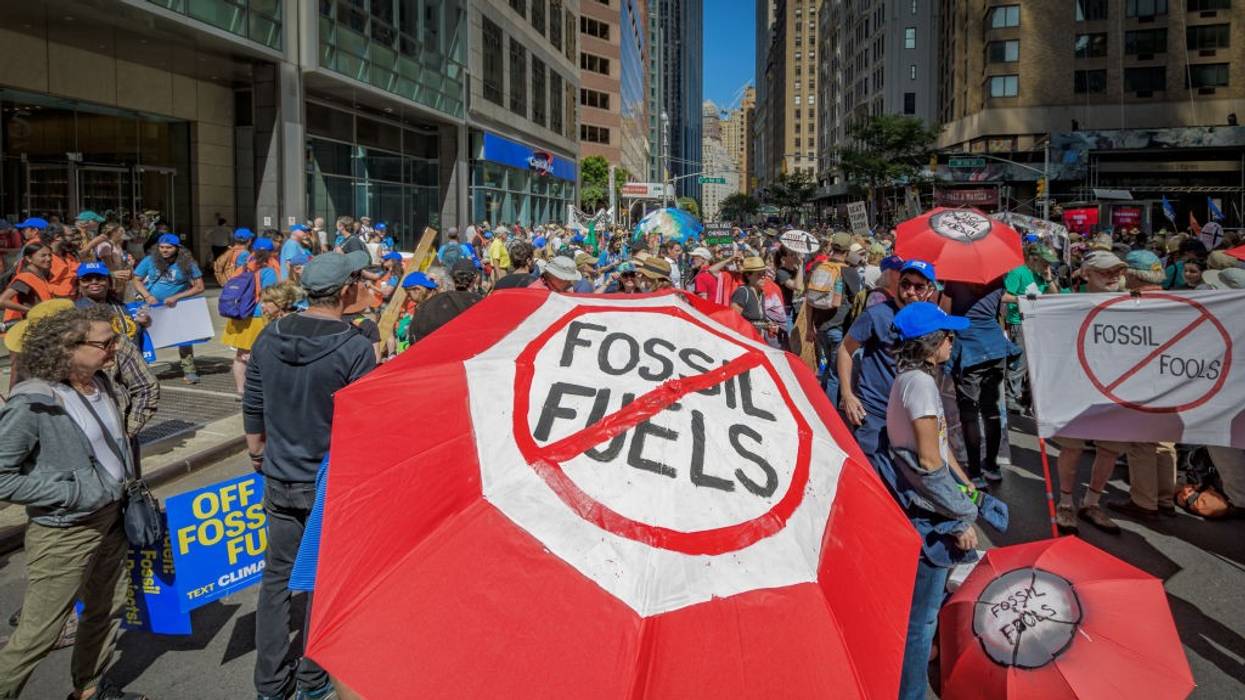
Governments are being asked to commit to more ambitious emission reduction commitments for 2030 and beyond by 2025, as well as to boost climate finance commitments from rich nations.
On September 20, the U.N. Secretary-General António Guterres is hosting a Climate Ambition Summit seeking to galvanize greater climate action from world leaders. Coming on the heels of the powerful March to End Fossil Fuels last weekend, this summit continues the pressure on governments to meet the urgency of the moment.
Despite this year’s grim series of extreme climate-fueled disasters and record-breaking temperatures—part of a trend of worsening climate impacts—global heat-trapping emissions continue their alarming rise. The big question, though, is whether world leaders will show up and deliver—or will they, once again, fail us?
Back in March of this year, when the sobering IPCC AR6 Synthesis Report was released, the U.N. Secretary-General made a powerful speech calling the scientific report a “how-to guide to defuse the climate time-bomb.” He also called for a quantum leap in climate action and announced an Acceleration Agenda for governments, the financial sector, and businesses. The upcoming Climate Ambition Summit will serve as an opportunity for those who have taken up the challenge to announce specific actions and commitments to deliver on this agenda.
The three tracks for the Acceleration Agenda are Ambition, Credibility, and Implementation, outlined in more detail here.
Governments are being asked to commit to more ambitious emission reduction commitments for 2030 and beyond by 2025, as part of the regular cycle of updates in line with the latest science called for in the Paris agreement, as well as to boost climate finance commitments from rich nations.
Secretary-General Guterres is using the full moral and convening power of his position to shine the light on an urgent global crisis and genuine solutions to address it.
At the same time, businesses, states, and others making commitments to net zero goals are being asked to ensure that these are robust commitments, with high standards for integrity and without harmful loopholes designed to perpetuate business-as-usual fossil fuel use while misleadingly invoking carbon management technologies as a panacea. A session on Loss and Damage is designed to help deliver on this critical climate justice outcome for COP28.
This is not meant to be a talk-fest, full of hot air and meaningless bloviation. This is a summit that is meant to be action-oriented. Secretary-General Guterres has made clear that countries that want to participate prominently in speaking roles must come to the table with a tangible increase in their climate commitments.
Some major world leaders—including U.S. President Joe Biden, British PM Rishi Sunak, and China’s President Xi Jinping—have already indicated that they will not attend the summit. (Special Envoy John Kerry is expected to represent the United States.) That is a worrying political signal about the seriousness with which countries are taking the goals of the summit.
Secretary-General Guterres is using the full moral and convening power of his position to shine the light on an urgent global crisis and genuine solutions to address it. Of course, the U.N. cannot compel national governments to do anything, and national governments have sovereignty over their decisions, but they will certainly feel the heat from their own people if they fail to step up. And meanwhile, climate-vulnerable countries are being forced to contend with impacts they have no choice over—impacts that are also undermining sustainable development goals—because of decisions imposed by richer, major polluters.
As the weekend’s climate march showed, all eyes are on world leaders to do better, and young people especially have run out of patience for half measures as they see their future threatened.
Here in the U.S., despite important progress on clean energy secured through the Inflation Reduction Act and other federal and state policies, fossil fuel production and exports continue to expand and threaten to undermine that forward momentum.
The goals of the summit are for nations—especially richer countries and major emitters—to provide clear plans and commitments to advance climate action, including through:
The Climate Ambition Summit is one important political moment on the way to COP28 later this year. The goals of the summit are very much in accord with what we will be fighting for at COP28. Success at COP28 depends on securing significant footholds ahead of time that can help increase the level of goodwill and cooperation among nations to secure more ambitious and just outcomes at the U.N. climate conference.
In addition to this summit, world leaders must use every opportunity to make multilateral and bilateral progress on climate issues ahead of COP28, to ensure that nations arrive at COP in the best position to consolidate that progress and deliver a robust outcome. These opportunities include a meeting hosted by South Africa and Denmark on responding to the Global Stocktake report on September 21 ahead of a workshop October 12-14; Meetings to address operationalizing the Loss and Damage fund, including a ministerial meeting on September 22 and the fourth Transitional Committee meeting on October 17-20; the conference for the second replenishment of the Green Climate Fund on October 5; and the fall meetings of the World Bank and the IMF on October 9-15.
As a relatively rich country, the largest contributor to historical heat-trapping emissions, and a leading producer and exporter of fossil fuels, the U.S. certainly has an important responsibility to help deliver on global climate goals. The Biden administration and Congress simply must do more, and faster.
It’s in our own self-interest to limit catastrophic climate change, and it is the only way to unlock the necessary reciprocal actions from other countries required to meet our collective global climate goals.
Self-interested and narrow geopolitical fights, as well as obstruction and deception from the fossil fuel industry, remain very significant challenges to addressing the climate crisis. But shame on world leaders if a year like this one—filled with tremendous suffering and exorbitant costs from human-caused climate change, and on track to be one of the hottest on record—is not enough to make them rise to the occasion.

Chinese officials blamed the U.S. for pushing the relationship between the two countries to the "lowest point since its establishment."
U.S. Secretary of State Antony Blinken met with leading Chinese officials, including President Xi Jinping, in Beijing on Monday in what was portrayed by both sides as an effort to ease increasingly dangerous tensions between the two nuclear-armed powers.
Blinken met with Xi for roughly 35 minutes on Monday after speaking to Wang Yi, China's top foreign policy official, for several hours earlier in the day.
According to China's foreign ministry, which said the relationship between Washington and Beijing is "at the lowest point since its establishment," Wang told Blinken during the meeting that "we must take a responsible attitude toward the people, history, and the world and reverse the downward spiral of U.S.-China relations."
Wang also accused the U.S. of "hyping" the "China threat theory" and "recklessly interfering in China's internal affairs," a reference to Taiwan and other issues that were reportedly central to Blinken's talks with Chinese officials on Sunday and Monday.
"China has no room to compromise or concede" on Taiwan, Wang told Blinken, according to the Chinese foreign ministry's readout. "The United States must... respect China's sovereignty and territorial integrity and clearly oppose 'Taiwan independence.'"
The U.S. provides arms and other military support to Taiwan, and recent visits to the island by top U.S. lawmakers and officials—including former House Speaker Nancy Pelosi (D-Calif.)—have infuriated China, contributing to a further breakdown of relations between the two countries and fueling fears of a new Cold War.
In its readout of the Wang-Blinken meeting, the U.S. State Department said the two officials "discussed opportunities to explore cooperation on shared transnational challenges."
Blinken is the first U.S. secretary of state to visit Beijing since 2018, and his trip came after several high-profile incidents and disputes that only served to ratchet up concerns about a conflict between the two global powers.
One such incident occurred in February, when the U.S. military shot down a balloon that it accused China of using to surveil key military sites. China said the balloon was a civilian aircraft that drifted into U.S. airspace by mistake and condemned the Pentagon's response as "an excessive reaction that seriously violates international convention."
Republican war hawks in the U.S. reacted hysterically to the situation and accused the Biden administration of not responding with sufficient force.
GOP lawmakers offered similarly outraged responses to Blinken's trip to Beijing. U.S. Sen. Tom Cotton (R-Ark.), one of the most virulent warmongers in Congress, tweeted Friday that the Biden administration "needs to confront the Chinese, not chase them for meetings."
Despite the outcry from U.S. hawks, Xi said at the beginning of his meeting with Blinken on Monday that Washington and Beijing have "made progress" and reached "agreement on specific issues," without going into detail about the areas of agreement.
"I hope that through this visit, Mr. Secretary, you will make more positive contributions to stabilizing China-U.S. relations," Xi told Blinken.
The top U.S. diplomat, for his part, said that "the United States and China have an obligation and responsibility to manage our relationship."
"The United States is committed to doing that," Blinken added. "It's in the interest of the United States, in the interests of China, and in the interest of the world."
Chinese Foreign Minister Qin Gang accepted Blinken's invitation to meet in Washington at a "mutually convenient time," according to the Associated Press.

With all the major players already committed to fighting a forever war, how could peace possibly come about?
All wars do end, usually thanks to a negotiated peace agreement. Consider that a fundamental historical fact, even if it seems to have been forgotten in Brussels, Moscow, and above all, Washington, D.C.
In recent months, among Russian President Vladimir Putin’s followers, there has been much talk of a “forever war” in Ukraine dragging on for years, if not decades. “For us,” Putin told a group of factory workers recently, “this is not a geopolitical task, but a task of the survival of Russian statehood, creating conditions for the future development of the country and our children.”
Visiting Kyiv last February, President Joseph Biden assured Ukraine’s President Volodymyr Zelensky, “You remind us that freedom is priceless; it’s worth fighting for, for as long as it takes. And that’s how long we’re going to be with you, Mr. President: for as long as it takes.” A few weeks later, the European Council affirmed “its resolute condemnation of Russia’s actions and unwavering support for Ukraine and its people.”
With all the major players already committed to fighting a forever war, how could peace possibly come about? With the U.N. compromised by Russia’s seat on the Security Council and the G-7 powers united in condemning “Russia’s illegal, unjustifiable, and unprovoked war of aggression against Ukraine,” the most likely dealmaker when it comes to ending this forever war may prove to be President Xi Jinping of China.
In the West, Xi’s self-styled role as a peacemaker in Ukraine has been widely mocked. In February, on the first anniversary of the Russian invasion, China’s call for negotiations as the “only viable solution to the Ukraine crisis” sparked a barbed reply from U.S. National Security Advisor Jake Sullivan who claimed the war “could end tomorrow if Russia stopped attacking Ukraine.”
When Xi visited Moscow in March, the statement Chinese officials released claiming that he hoped to “play a constructive role in promoting talks” prompted considerable Western criticism. “I don’t think China can serve as a fulcrum on which any Ukraine peace process could move,” insisted Ryan Hass, a former American diplomat assigned to China. Ursula von der Leyen, president of the European Commission, pointed out that “China has taken sides” in the conflict by backing Russia and so could hardly become a peacemaker. Even when Xi made a personal call to Zelensky promising to dispatch an envoy to promote negotiations “with all parties,” critics dismissed that overture as so much damage control for China’s increasingly troubled trade relations with Europe.
The Symbolism of Peace Conferences
Still, think about it for a moment. Who else could bring the key parties to the table and potentially make them honor their signatures on a peace treaty? Putin has, of course, already violated U.N. accords by invading a sovereign state, while rupturing his economic entente with Europe and trashing past agreements with Washington to respect Ukraine’s sovereignty. And yet the Russian president relies on China’s support, economically and otherwise, which makes Xi the only leader who might be able to bring him to the bargaining table and ensure that he honors any agreement he signs. That sobering reality should raise serious questions about how any future Beijing-inspired peace conference might happen and what it would mean for the current world order.
For more than 200 years, peace conferences have not only resolved conflicts but regularly signaled the arrival at stage center of a new world power.
For more than 200 years, peace conferences have not only resolved conflicts but regularly signaled the arrival at stage center of a new world power. In 1815, amid the whirling waltzes in Vienna’s palaces that accompanied negotiations ending the Napoleonic wars, Britain emerged for its century-long reign as the globe’s greatest power. Similarly, the 1885 Berlin Conference that carved up the continent of Africa for colonial rule heralded Germany’s rise as Britain’s first serious rival. The somber deliberations in Versailles’s grand Hall of Mirrors that officially ended World War I in 1919 marked America’s debut on the world stage. Similarly, the 1945 peace conference at San Francisco that established the U.N. (just as World War II was about to end) affirmed the ascent of U.S. global hegemony.
Imagine the impact if, sooner or later, envoys from Kyiv and Moscow convene in Beijing beneath the gaze of President Xi and find the elusive meeting point between Russia’s aspirations and Ukraine’s survival. One thing would be guaranteed: after years of disruptions in the global energy, fertilizer, and grain markets, marked by punishing inflation and spreading hunger, all eyes from five continents would indeed turn toward Beijing.
After all, with the war disrupting grain and fertilizer shipments via the Black Sea, world hunger doubled to an estimated 345 million people in 2023, while basic food insecurity now afflicts 828 million inhabitants of Asia, Africa, and Latin America. Should such negotiations ever prove fruitful, a televised signing ceremony, hosted by President Xi and watched by countless millions globally, would crown China’s rapid 20-year ascent to world power.
Forget Ukraine for a moment and concentrate on China’s economic rise under communist rule, which has been little short of extraordinary. At the founding of the People’s Republic in 1949, China was an economic lightweight. Its massive population, 20% of the world’s total, was producing just 4% of global economic output. So weak was China that its leader Mao Zedong had to wait two weeks amid a Moscow winter for an audience with Soviet leader Joseph Stalin just to plead for the industrial technology that would help rebuild an economy devastated by 12 years of war and revolution. In the decade following its admission to the World Trade Organization in 2002, however, China quickly became the workshop of the world, accumulating an unprecedented $4 trillion in foreign-exchange reserves.
Instead of simply swimming in a hoard of cash like Scrooge McDuck in his Money Bin, in 2013 President Xi announced a trillion-dollar development scheme called the Belt and Road Initiative (BRI). Its aim was to build a massive infrastructure across the Eurasian landmass and Africa, thereby improving the lives of humanity’s forgotten millions, while making Beijing the focal point of Eurasia’s economic development. Today, China is not only an industrial powerhouse that produces 18% of the global gross domestic product, or GDP (compared to 12% for the U.S.), but also the world’s chief creditor. It provides capital for infrastructure and industrial projects to 148 nations, while offering some hope to the quarter of humanity still subsisting on less than four dollars a day.
Testifying to that economic prowess, for the past six months, world leaders have ignored Washington’s pleas to form a united front against China. Instead, remarkable numbers of them, including Germany’s Olaf Scholz, Spain’s Pedro Sánchez, and Brazil’s Lula da Silva, have been turning up in Beijing to pay court to President Xi. In April, even French President and U.S. ally Emmanuel Macron visited the Chinese capital where he proclaimed a “global strategic partnership with China” and urged other countries to become less reliant on the “extraterritoriality of the U.S. dollar.”
Then, in a diplomatic coup that stunned Washington, China took a key step toward healing the dangerous sectarian rivalry between Shia Iran and Sunni Saudi Arabia by hosting a meeting of their foreign ministers in Beijing. As the Saudis’ chief oil customer and Iran’s largest creditor, Beijing had the commercial clout to bring them to the bargaining table. China’s top diplomat Wang Yi then hailed the restored diplomatic relations as part of his country’s “constructive role in facilitating the proper settlement of hot-spot issues around the world.”
Geopolitics as a Source of Change
Underlying the sudden display of Chinese diplomatic clout is a recent shift in that essential realm called “geopolitics” that’s driving a fundamental realignment in global power. Around 1900, at the high tide of the British Empire, an English geographer, Sir Halford Mackinder, started the modern study of geopolitics by publishing a highly influential article arguing that the construction of the 5,000-mile-long Trans-Siberian Railway from Moscow to Vladivostok was the beginning of a merger of Europe and Asia. That unified land mass, he said, would soon become the epicenter of global power.
Underlying the sudden display of Chinese diplomatic clout is a recent shift in that essential realm called “geopolitics” that’s driving a fundamental realignment in global power.
In 1997, in his book The Grand Chess Board, former U.S. National Security Advisor Zbigniew Brezinski updated MacKinder, arguing that “geopolitics has moved from the regional to the global dimension, with preponderance over the entire Eurasian continent serving as the central basis for global primacy.” In words particularly apt for our present world, he added: “America’s global primacy is directly dependent on how long and how effectively its preponderance on the Eurasian continent is sustained.”
More than a quarter-century later, imagine geopolitics as a deep substrate shaping far more superficial political events, even if it’s only noticeable in certain moments, much the way the incessant grinding of the planet’s tectonic plates only becomes visible when volcanic eruptions break through the earth’s surface. For centuries, if not millennia, Europe was separated from Asia by endless deserts and sprawling grasslands. The empty center of that vast land mass was crossed only by an occasional string of camels travelling the ancient Silk Road.
Now, thanks to its trillion-dollar investment in infrastructure — rails, roads, pipelines, and ports — China is fundamentally changing that geopolitical substrate through a more than metaphoric merger of continents. If President Xi’s grand design succeeds, Beijing will forge a unified market stretching 6,000 miles from the North Sea to the South China Sea, eventually encompassing 70% of all humanity, and effectively fusing Europe and Asia into a single economic continent: Eurasia.
Despite the Biden administration’s fervid attempts to create an anti-Chinese coalition, recent diplomatic eruptions are shaping a new world order that isn’t at all what Washington has in mind. With the economic creation of a true Eurasian sphere seemingly underway, from that Iran-Saudi entente to Macron’s visit to Beijing, we may be seeing the first signs of the changing face of international politics. The question is: Could a Chinese-engineered peace in Ukraine be next in line?
Pressures on China for Peace
Such growing geopolitical power is giving China both the motivation and potentially even the means to negotiate an end to the fighting in Ukraine. First, the means: as Russia’s chief customer for its commodity exports, and Ukraine’s largest trading partner before the war, China can use commercial pressure to bring both parties to the bargaining table — much as it did for Iran and Saudi Arabia.
Next, the motivation: while Moscow and Kyiv might each exude confidence in ultimate victory in their forever war, Beijing has reason to grow impatient with the economic disruptions radiating out across the Black Sea to roil a delicately balanced global economy. According to the World Bank, almost half of humanity (47%) is now surviving on seven dollars a day, and most of them live in Africa, Asia, and Latin America where China has made massive, long-term developmental loans to 148 countries under its Belt and Road Initiative.
With 70% of its lands and their rich black soils devoted to agriculture, Ukraine has, for decades, produced bumper crops of wheat, barley, soybeans, and sunflower oil that made it “the breadbasket of the world,” providing the globe’s hungry millions with reliable shipments of affordable commodities. Right after the Russian invasion, however, world prices for grains and vegetable oils shot up by 60%. Despite stabilization efforts, including the U.N.’s Black Sea Grain Initiative to allow exports through the war zone, prices for such essentials remain all too high. And they threaten to go higher still with further disruption of global supply chains or more war damage like the recent rupture of a crucial Ukrainian irrigation dam that’s turning more than a million acres of prime farmland into “desert.”
As costs for imports of fertilizer, grain, and other foodstuffs have soared since the Russian invasion, the Council on Foreign Relations reports that “a climbing number of low-income BRI countries have struggled to repay loans associated with the initiative, spurring a wave of debt crises.” In the Horn of Africa, for example, the sixth year of a crippling drought has pushed an estimated 23 million people into a “hunger crisis,” forcing the governments of Ethiopia and Kenya to balance costly food imports with the repayment of Chinese loans for the creation of critical infrastructure like factories, railroads, and renewable energy. With such loans surpassing 20% of gross domestic product (GDP) in nations like Ghana, Malaysia, Pakistan, and Zambia, while China itself holds outstanding credits equivalent to 25% of its GDP, Beijing is far more invested in global economic peace and stability than any other major power.
Beyond Western Fantasies of Victory
At present, Beijing might seem alone among major nations in its concern about the strain the Ukraine war is placing on a world economy poised between starvation and survival. But within the coming six months, Western opinion will likely start to shift as its inflated expectations for Ukrainian victory in its long-awaited “spring counteroffensive” meet the reality of Russia’s return to trench warfare.
After the stunning success of Ukraine’s offensives late last year near Kharkiv and Kherson, the West dropped its reticence about provoking Putin and began shipping billions of dollars of sophisticated equipment — first, HIMARS and Hawk missiles, then Leopard and Abrams battle tanks, and, by the end of this year, advanced F-16 jet fighters. By the war’s first anniversary last February, the West had already provided Kyiv with $115 billion in aid and expectations of success rose with each new arms shipment. Adding to that anticipation, Moscow’s own “winter offensive” with its desperate suicide attacks on the city of Bakhmut suggested, as Foreign Affairs put it, that “the Russian military demonstrated… it was no longer capable of large-scale combat operations.”
But defense is another matter. While Moscow was wasting some 20,000 lives on suicide assaults on Bakhmut, its specialized tractors were cutting a formidable network of trenches and tank traps along a 600-mile front designed to stall any Ukrainian counteroffensive.
Ukraine’s troops will probably achieve some breakthroughs when that offensive finally begins, but are unlikely to push Russia back from all its post-invasion gains. Remember that Russia’s army of 1.3 million is three times larger than Ukraine’s which has also suffered many casualties. In March, the commander of Ukraine’s 46th Air Assault brigade told the Washington Post that a year of combat had left 100 dead and 400 wounded in his 500-man unit and that they were being replaced by raw recruits, some of whom fled at the very sound of rifle fire. To counter the few dozen “symbolic” Leopard tanks the West is sending, Russia has thousands of older-model tanks in reserve. Despite U.S. and European sanctions, Russia’s economy has actually continued to grow, while Ukraine’s, which was only about a tenth the size of Russia’s, has shrunk by 30%. Facts like these mean just one thing is likely: stalemate.
Beijing as Peacemaker
By next December, if Ukraine’s counteroffensive has indeed stalled, its people face another cold, dark winter of drone attacks, while Russia’s rising casualties and lack of results might by then begin to challenge Putin’s hold on power. In other words, both combatants might feel far more compelled to sit down in Beijing for peace talks. With the threat of future disruptions damaging its delicate global position, Beijing will likely deploy its full economic power to press the parties for a settlement. By trading territory, while agreeing with China on reconstruction aid, and some further strictures on Ukraine’s future NATO membership, both sides might feel they had won enough concessions to sign an agreement.
Not only would China then gain enormous prestige for brokering such a peace deal, but it might win a preferential position in the reconstruction bonanza that would follow by offering aid to rebuild both a ravaged Ukraine and a damaged Russia. In a recent report, the World Bank estimates that it could take $411 billion over a decade to rebuild a devastated Ukraine through infrastructure contracts of the very kind Chinese construction companies are so ready to undertake. To sweeten such deals, Ukraine could also allow China to build massive factories to supply Europe’s soaring demand for renewable energy and electric vehicles. Apart from the profits involved, such Chinese-Ukrainian joint ventures would ramp up production at a time when that country is likely to gain duty-free access to the European market.
In the post-war moment, with the possibility that Ukraine will be an increasingly strong economic ally at the edge of Europe, Russia still a reliable supplier of cut-rate commodities, and the European market ever more open to its state corporations, China is likely to emerge from that disastrous conflict — to use Brzezinski’s well-chosen words — with its “preponderance over the entire Eurasian continent” consolidated and its “basis for global primacy” significantly strengthened.