

SUBSCRIBE TO OUR FREE NEWSLETTER
Daily news & progressive opinion—funded by the people, not the corporations—delivered straight to your inbox.
5
#000000
#FFFFFF
To donate by check, phone, or other method, see our More Ways to Give page.
Daily news & progressive opinion—funded by the people, not the corporations—delivered straight to your inbox.
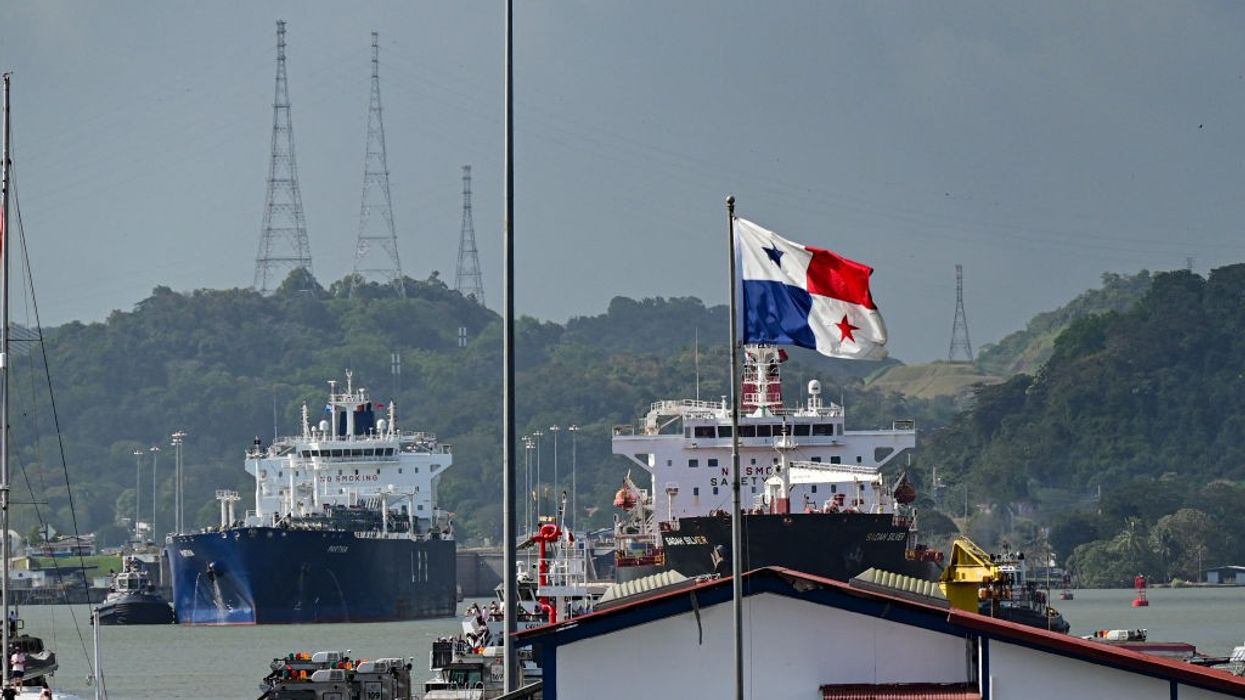
U.S. officials familiar with the planning said options for "reclaiming" the vital waterway include close cooperation with Panama's military and, absent that, possible war.
President Donald Trump has directed the Pentagon to prepare plans for carrying out his threat to "take back" the Panama Canal, including by military force if needed, two U.S. officials familiar with the situation told NBC News Thursday.
According to the outlet, the officials said that U.S. Southern Command (SOUTHCOM) is drawing up potential plans that run the gamut from working more closely with Panama's military to a less likely scenario in which U.S. troops invade the country and take the canal by force. They also said that SOUTHCOM commander Adm. Alvin Holsey has presented draft strategies to be reviewed by U.S. Defense Secretary Pete Hegseth, who is scheduled to visit Panama next month.
The officials explained that the likelihood of a U.S invasion depended on the level of cooperation shown by the Panamanian military.
Trump has repeatedly refused to rule out use of military force to seize control of the vital U.S.-built waterway, as well as Greenland, an autonomous territory of NATO ally Denmark.
Last week during his joint address to Congress, Trump proclaimed that "to further enhance our national security, my administration will be reclaiming the Panama Canal," but his administration has not clarified precisely what "reclaiming" entails.
The Republican president says the U.S. needs to retake control of the Panama Canal to enhance "economic security," and has falsely claimed that the waterway is "operated by China."
Earlier this month, the New York-based investment firm BlackRock led a group of investors in a $23 billion deal to purchase ports at both ends of the Panama Canal from a Hong Kong-based conglomerate, an agreement Trump dubiously seized upon as proof that "we've already started" reclaiming the conduit.
Panamanian President José Raúl Molina countered that "the Panama Canal is not in the process of being reclaimed... The canal is Panamanian and will continue to be Panamanian!"
The U.S. controlled what was formerly called the Panama Canal Zone from the time of the waterway's construction in the early 20th century—largely done by Afro-Caribbean workers, thousands of whom died in what's widely known as the world's deadliest construction project—until then-President Jimmy Carter transferred sovereignty to Panama in the late 1970s. Under the Torrijos-Carter treaties, the U.S. reserves the right to use military force to defend the canal's neutrality.
The United States has repeatedly used deadly military force in Panama over the decades, including during a 1964 student-led uprising against American control in which 22 Panamanians and four U.S. soldiers were killed, and in a full-scale invasion in 1989 ordered by then-President George H.W. Bush to capture erstwhile ally and CIA asset turned narcotrafficking dictator Manuel Noriega. The U.S. invaders killed hundreds of Panamanians, including many civilians.
Writing for Americas Quarterly this week, Panamanian jurist Alonso E. Illueca argued that Panama's efforts to appease Trump aren't working. These include the BlackRock deal and other moves like quitting China's "Belt and Road" initiative, taking in third-country migrants deported by the U.S., backing a U.S. resolution on Ukraine at the United Nations Security Council, auditing the country's ports, and revisiting a railway project originally developed by the Chinese government.
"Panama should abandon its accommodating policy towards the U.S., which can only lead to escalating demands to banish Chinese influence, to the detriment of Panama's national sovereignty," Illueca asserted.
"An alternative policy for Panama is to align with the rules based international order," he continued. "This includes establishing synergies with like-minded states which have been also affected by U.S. actions such as Canada, Mexico, Greenland, and Denmark. The country should seek to transcend the U.S.-China binary and find alternatives for alliances, which should include partners like the European Union."
"In short," Illueca added, "the way forward for Panama lies in replacing strategic dissonance with strategic clarity."
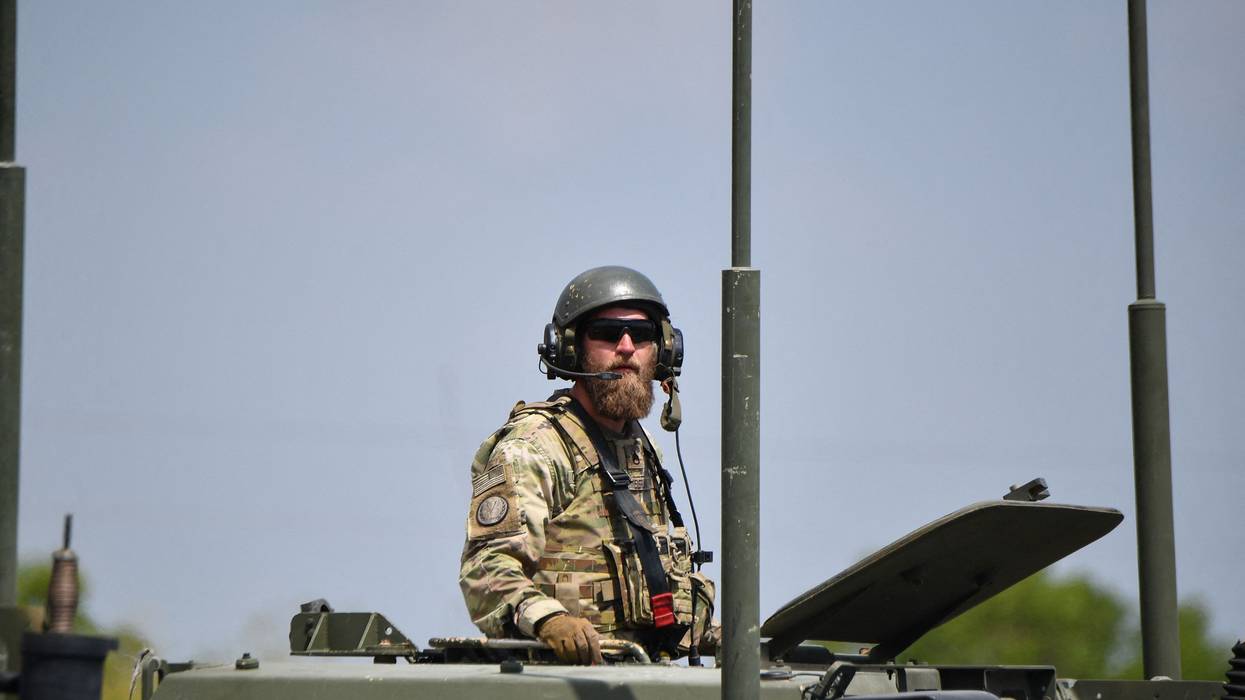
Americans have to ask themselves: Is it worth risking nuclear war—and an apocalyptic nuclear winter—for no loftier purpose than to maintain their country’s violently enforced grasp of overwhelming global power?
Twenty years ago, Noam Chomsky published a bestselling book called Hegemony or Survival. Since then, the stark choice he posed has only become more urgent. Depending on how humanity responds to the challenges of ecological destruction and imperialistic war, in the coming decade that terrifying question “Hegemony or survival?” may well be answered.
Modern history shows that the most dangerous periods are when two or more great powers are struggling for hegemony. The eighteenth century in Europe was a time of “multipolarity,” as Britain, France, Prussia, Austria, and Russia were almost continually at war, competing for geopolitical advantage and to divide up the continent between them. The conflicts escalated in the era of the French Revolution and Napoleonic Wars, as a mighty France, bursting with revolutionary energy, strove for absolute dominance against, in the end, Britain and Russia.
The 1815 Congress of Vienna led to a century-long relative balance of power presided over by an industrializing Britain, which soon became the supreme world power. Once industrialization swept the rest of Europe, however, particularly Germany, Britain’s hegemony began to be challenged, not only in the Scramble for Africa but even in Europe itself. German elites wanted their country to be the next Britain, and to a great extent it was their desire for hegemony that caused World War I. As well as World War II, of course.
Since 1945, the United States has been the global hegemon, or something close to a hegemon. As John Ross notes in the recently published Washington’s New Cold War, even at the height of its relative economic achievement in the mid-1970s, the Soviet Union’s GDP was only 44 percent of the U.S.’s. The Soviets had vast power in their limited sphere encompassing Eastern Europe and Central Asia, but they were not a capitalistically expansive, dynamically growing imperial power in the mode of the United States—or, more recently, of a resurgent China. China’s GDP is 74 percent of the U.S.’s, and its growth rate is higher (it has grown seven times faster than the American economy since 2007). Measured by purchasing power parities, the U.S. accounts for only 16 percent of the world economy, and China’s economy is 18 percent larger. In short, for the first time since World War II, we are entering an era of real competition between two mammoth economies, a declining hegemon and an aspiring hegemon.
When people talk about “the China threat,” this is all they mean. In the long run, China poses a greater threat to U.S. power than the Soviet Union ever did. Mainstream commentators and politicians will prate about China’s threat to democratic values and human rights—there always has to be an ideological rationalization for geopolitical strategy—but U.S. foreign and domestic policy since the Second World War tells us how much its elites care about democracy and human rights. From the Vietnam War to the catastrophic invasion of Iraq, and from U.S. support for thugs like Batista, Diem, Iran’s Shah, Suharto, Duvalier, Trujillo, Somoza, Pinochet, Marcos, Rios Montt, Mobutu, Saddam Hussein, Mubarak, Sisi, Modi, Mohammed bin Salman, and Netanyahu to CIA coups and attempted coups against countless governments, it is self-evident that policymakers couldn’t care less about the moral values they pretend to espouse.
Americans have to ask themselves: Is it worth risking nuclear war—and an apocalyptic nuclear winter—for no loftier purpose than to maintain their country’s violently enforced grasp of overwhelming global power?
The current flashpoint, of course, is the war in Ukraine, which is helping to midwife a “partnership” between China and Russia, both of which are also deepening their ties with Iran.
Decades ago, Zbigniew Brzezinski wrote that “a coalition allying Russia with both China and Iran can develop only if the United States is shortsighted enough to antagonize China and Iran simultaneously.” He would presumably not be very happy with U.S. policies that are bringing about exactly this coalition. At the same time, U.S. missteps in the Middle East and its relative disengagement from the region since the Obama presidency are allowing China to improve its position there, as illustrated by the deal it recently brokered between Iran and Saudi Arabia to normalize relations. China’s burgeoning economic interests not only in the Middle East but across most of the world, a function of its colossal, globe-spanning Belt and Road Initiative, necessitate that the country play an ever-greater diplomatic role in fraught regions. Saudi Arabia, for its part, has shown it is happy to defy Washington, even joining much of the world in disregarding Western sanctions on Russia.
While Washington’s failure to convince most countries to economically and diplomatically isolate Russia highlights the U.S.’s declining “hegemony,” the real threats to American power run deeper than diplomatic embarrassments. In the coming years, the very status of the dollar as the world’s dominant currency may be threatened. A kind of “de-dollarization” has been happening for some time now, as, for example, the share of dollar reserves held by central banks declined from 71 percent in 1999 to 59 percent in 2021. But in the last few years, and especially since Russia’s invasion of Ukraine, the ongoing effort by many countries to undermine the dollar’s dominance of the global financial system has intensified.
In part, this is because of the U.S.’s “weaponization” of the dollar: in the recent past, Cuba, Venezuela, Iran, Afghanistan, and Russia have all suffered from financial and trade sanctions that have included even freezing overseas assets and removal from the SWIFT messaging system that underpins the world’s financial infrastructure. Other countries, understandably worried about suffering the same fate, share Russia’s interest in developing new financial institutions and networks outside of the U.S.-led system. Apart from this motivation, they simply want to reduce their exposure to the effects of U.S. economic and monetary policy, which can devastate economies. And as China rises, it makes sense for it to promote use of the renminbi, or at least non-dollar currencies.
To that end, the BRICS countries, for instance, have been establishing new institutions and market mechanisms to bypass the dollar, and are even exploring the possibility of creating a new reserve currency based on the BRICS basket of currencies. Institutions like the New Development Bank, the Shanghai Cooperation Organization, new payment infrastructures that are alternatives to SWIFT, central bank digital currencies, bilateral trade conducted in currencies other than the dollar, and a renminbi oil futures market to partially de-dollarize the global oil trade all point toward a future currency regime that is at least multilateral, if not bilateral. The famous economist Nouriel Roubini argues that, “in a world that will be increasingly divided into two geopolitical spheres of influence,” a bilateral currency regime is likely to emerge, perhaps in the next decade.
Given that “the dollar’s dominant position in the global financial system [is] the very foundation of [the U.S.’s] global leadership,” as two experts note, Washington can hardly be viewing all these developments with equanimity. Loss of the dollar’s status as the world’s reserve currency would have severe consequences for the American economy. But this outcome is exactly the end goal of Washington’s bellicose policies toward its perceived rivals! Through economic sanctions and aggressive military actions—expanding NATO to Russia’s borders and encircling China with U.S. bases, military forces, and militarized partner states like Japan, South Korea, Australia, the Philippines, and even Taiwan—the United States is driving into existence a hostile bloc of great powers and medium-sized powers that are necessarily committed to its defeat. Their policies, then, will become increasingly belligerent, which will serve to justify even more belligerent U.S. policies, in a vicious circle that amounts to an extraordinarily dangerous “hybrid war” and arms race.
History shows that imperial hubris goes before a fall. In this case, though, it won’t be only the empire that falls; it will, in all likelihood, be civilization itself.
The Pentagon has made a record budget request this year of $842 billion, which it says is necessary to counter China. This claim should inspire skepticism, given that the U.S. has around 750 overseas military bases and China has about eight—one in Djibouti and a few on man-made islands in the South China Sea. China’s military budget, which has been increasing since America’s “Pacific Pivot,” is $225 billion, not a small sum but still a fraction of the Pentagon’s.
It is an interesting thought experiment, incidentally, to imagine how Washington would react if China had scores of military bases off the U.S. coast and had deputized countries in the Americas to act as its armed sentinel states. Most probably, we wouldn’t be around to talk about it, because a world war would already have wiped us out.
In fact, contemporary China is probably the most pacific great power in world history, as Craig Murray observes. As the U.S. has rampaged all over the Middle East and expanded its direct or indirect military presence to virtually every region of the globe, what wars has China started?
What territories has it annexed? What countries has it invaded? The usual response is that sometime in the future it might invade Taiwan—but given the harm such an invasion would likely inflict on the Chinese economy (because of Taiwan’s cutting-edge semiconductor industry, whose physical facilities could well be damaged or destroyed in an invasion), we should be skeptical of this claim too. Even hawkish Chinese generals seem to think war with Taiwan would be “too costly.” In any event, are annual military budgets of almost a trillion dollars necessary to defend Taiwan?
The conclusion is inescapable that the U.S. is simply trying to intimidate an economic rival, a country that, like Putin’s Russia (only more so), challenges its unfettered dominance of the entire world economy. The record of Washington’s foreign policy since 1945 is to seek and enforce compliance in any way it can, whether through carrots or sticks—blandishments and economic or military aid in some cases, coups, invasions, sanctions, paramilitary operations, and militaristic bullying in others. Defiant regimes cannot be tolerated. Accordingly, policymakers want a compliant (or weakened) Russia and a compliant or weakened China. The calculus is evidently that military buildup, whatever crises it leads to and however unpredictable its long-term effects, is the surest means of achieving these ends. It also has the virtue of projecting overwhelming power, which is something powerful states value for its own sake.
Even if the United States doesn’t succeed in provoking military conflicts with China (as it did with Russia), the new Cold War of which Washington is the primary instigator is profoundly damaging to the interests of humanity. As the Washington Post reports, this new Cold War “may see the world divided into opposing camps for decades, stymieing cooperation on climate change, choking global action on human rights abuses, paralyzing international institutions and increasing tensions in contested regions.” If only for the sake of cooperating to tackle global warming, nothing is more imperative than for great powers, first among them the U.S., to adopt conciliatory policies.
But that means Americans have to pressure their government to this end. And that, in turn, means building an anti-imperialist left. From Bernie Sanders to Alexandria Ocasio-Cortez (not to mention right-wing legislators), there isn’t a single principled anti-imperialist in Congress. In a time of staggering dangers from war and ecological destruction, this is an astonishing and shameful fact.
For now, it seems that humanity is choosing the path of battling for hegemony rather than surviving.
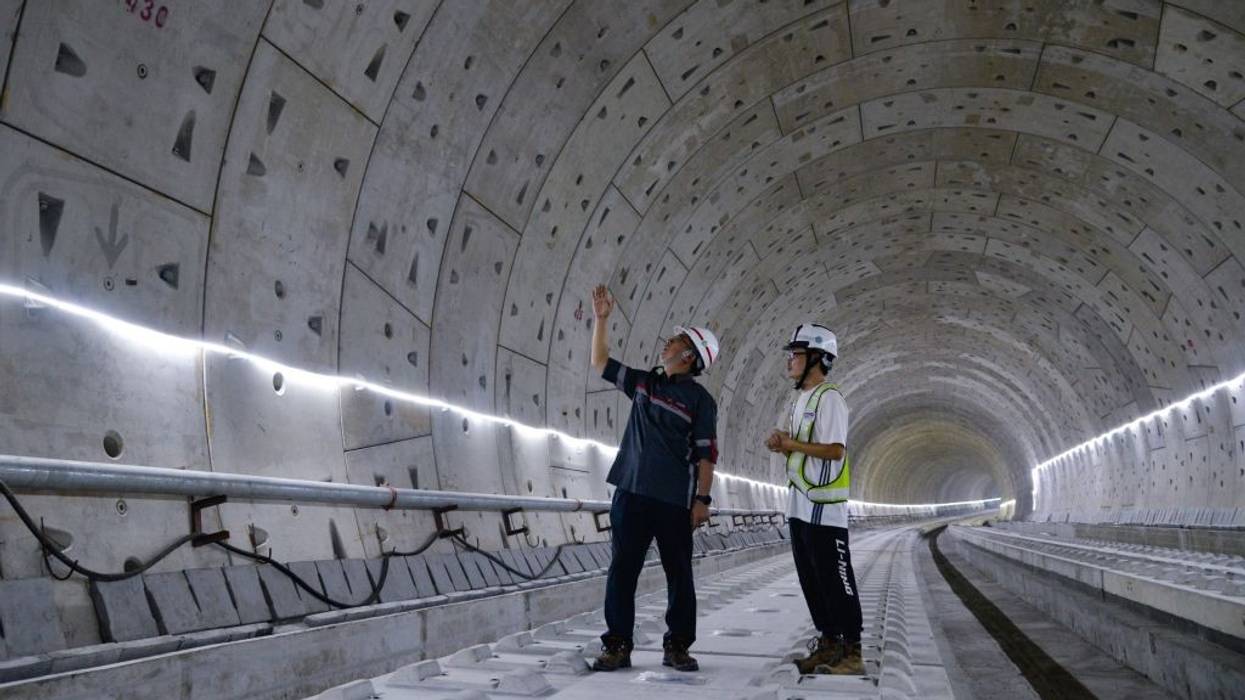
China’s Belt and Road Initiative is a dizzyingly ambitious plan to connect Asia and more than 100 nations with 21st Century economic infrastructure, everything from highways and high-speed rail lines to power generation, energy pipelines, communication systems, cities, ports, and more.
“Light at the end of the tunnel” was an iconic phrase used by the warmongers who kept the U.S. in Vietnam long after the War had been lost. The implication was that insiders could see through the fog of war and know that things were getting better. It was a lie.
In January 1966, long before the military height of the War, Secretary of Defense Robert McNamara told President Johnson that the U.S. had a one-out-of-three chance of winning on the battlefield. But Johnson, like Eisenhower and Kennedy before him, and Nixon after him, didn’t want to be the first American president to lose a war. So, he ginned up a simplistic lie and “soldiered on.”
The lie was blown by the Tet Offensive in January 1968. More than 100 U.S. military installations were attacked in a simultaneous nationwide assault that stunned the U.S. The broadcaster, Walter Cronkite, then “the most trusted man in America,” bellowed on national television, “I thought we were supposed to be winning this damned thing.” It was the beginning of the end of the U.S.’ murderous and failed occupation.
We’re now facing another light-and-tunnel event, this time in Ukraine. Only now, it’s not the light at the end of the tunnel. It’s the tunnel at the end of the light. What do we mean by that?
Until now, it’s been all light. Remember when the scrappy Ukrainian forces were kicking the barbarian Russian hordes’ asses? When every development betrayed the Russians’ clod-footed strategy, its soldiers’ bad morale, its army’s poor provisioning and worse leadership, and the perilous political situation for Putin back home? The testosterone was flowing. The bravado was intoxicating. The exceptionalism was sublimely seductive. It was only a matter of time and pluck and determination before Ukraine would bloody the bully’s nose and show it what the West was made of.
Remember?
No more.
You can prosecute a war for only so long on the strength of smoke and mirrors, delusions and illusions, lies and press releases. Eventually, however, reality catches up with you. The thuggishly propagandized American citizenry couldn’t know it, but that catching up began in the first weeks of the War and has only accelerated since.
Within the first week of the War, Russia had destroyed Ukraine’s air force and air defenses. By the second week, it had taken out most of Ukraine’s armories and weapons depots. Over following weeks and months, it systematically demolished artillery shipped in from former Warsaw Pact, now NATO, countries in Eastern Europe. It dismantled the country’s transportation and fuel supply systems. It has recently taken out most of the country’s electrical infrastructure.
The Ukrainian army has lost an estimated 150,000 troops, a pace more than 140 times the rate of U.S. losses in Vietnam. This, at a time when 10 million of its formerly 36 million people have fled the country. The military is down to dragooning 16-year-old boys and 60-year-old men to man the barricades. It cannot get replacement ammunition. Russia has knocked out some 90% of Ukraine’s drones, leaving it largely sightless. Delivery times for the tanks that are the hoped-for “game changer” are running into months and years. Not that that will matter.
Remember all the other failed “game changers”? The M777 howitzers and the Stryker armored fighting vehicles? The HIMARS multiple rocket launchers and the PATRIOT air defense systems? All were going to turn the tide at one time. All have proven impotent to stop Russia from seizing 20% of Ukraine’s territory and annexing it and its people to Russia.
The U.S. lost the economic war, as well. Remember Joe Biden’s delusional prediction that the U.S. would see that “the ruble will be reduced to rubble”? And that “the most stringent sanctions regime in history” was going to “weaken” Russia, perhaps even leading to Putin’s overthrow? Most of it backfired, badly. Last year, the ruble reached its highest exchange rate in history. Russia’s 2022 trade surplus of $227 billion was up 86% from 2021. The U.S.’ trade deficit over the same period rose 12.2%, and is approaching $1 trillion.
As a result of all of the above and more, the tide of insider opinion has turned against the War. Senior officials in Europe are talking openly about how the losses are unsustainable and they need to get back to security architectures that prevailed before the poisoned CIA-supported coup in Maidan in 2014. Mark Milley, Chairman of the Joint Chiefs of Staff, recently let slip that “It will be very, very difficult to eject the Russians from all of occupied Ukraine in the next year. The Washington Post warned recently that Ukraine faced a “critical moment” in the war, belaboring the fact that U.S. support was not limitless and would soon be reached. Hint. Hint.
The Rand Corporation, one of the U.S.’ best-connected strategic whisperers, just published a report stating that “The consequences of a long war far outweigh the benefits.” It explicitly states that the U.S. needs to husband its resources for its more important upcoming conflict with China. Newsweek headlined that “Joe Biden Offered Vladimir Putin 20 Percent of Ukraine to End War.” It also revealed that “Nearly 90 percent of the world isn’t following us on Ukraine.” Vast swaths of Latin American, Africa, and Asia refuse to support the U.S. in its demand for sanctions against Russia.
These are not “Light at the end of the tunnel” divinations. Quite the contrary. If there’s a common thread running through it all it is the sickening recognition that the war is lost, militarily, economically, and diplomatically, that there is no plausible scenario in which those losses will be turned around by soldiering on, and that what is needed now is a hide-the-loss, get-out-any-way-you-can, face-saving exit strategy.
That will not be available, either. That’s where the tunnel at the end of the light comes into play.
Even before the U.S. and its NATO puppets undertook the War, the rest of the world—and that means most of the world—was congealing itself into an anti-Western economic and security bloc. Led by China and its strategic ally, Russia, that bloc includes more than a dozen trade and security organizations. Those include the BRICS confederation of Brazil, Russia, India, China, and South Africa, working explicitly to devise multi-polar institutions to stand up to the U.S.’ unipolar hegemonic model.
It includes the Shanghai Cooperation Organization, a security compact made up of leading nations from east, central, and south Asia, including China, Russia, India, and soon, Iran, Turkey, and Saudi Arabia. It is explicitly working to devise measures to prevent the kind of predatory military assaults the U.S. carried out against Iraq, Libya, Somalia, Yemen, and Afghanistan.
The organizing economic engine behind these efforts it is China’s Belt and Road Initiative. BRI is a dizzyingly ambitious plan to connect Asia and more than 100 nations with 21st Century economic infrastructure, everything from highways and high-speed rail lines, to power generation, energy pipelines, communication systems, cities, ports, and more. It is critical to understand why BRI poses such daunting challenges to U.S. supremacy in the world.
Infrastructure is so powerful because it spins off a vast, unimaginable array of secondary, and tertiary economic benefits. It was the railroads in the nineteenth century that bound the U.S. together as the world’s first continental-scale market. Manufacturers could produce for a larger market, and, therefore, at larger scale, and, therefore, at lower cost, than could producers anywhere else on earth.
The railroads made the U.S. the largest market in the world for iron, steel, machine tools, grading equipment, farm equipment, and scores of other commercial and industrial products essential to a modern industrial economy. The U.S. began the 1800s with 1.5% of the world’s GDP. It ended the century with 19% of a four-times larger number, making it the largest economy in the world.
Similarly, automobiles. People think it was Henry Ford and mass production that made the Twentieth Century “The American Century.” In fact, it was the build-out of millions of miles of roads and, later, interstates, without which automobiles would have remained expensive playthings of the wealthy. Those roads stitched the country together into an asphalt network that allowed individual mobility, by virtually anybody, anywhere, down to every street address in the country. The world had never seen anything like it.
The secondary and tertiary economic effects were astounding, everything from the world’s largest markets for steel, glass, plastics, and rubber, to gasoline, diesel, highway construction on a continental scale, repair shops and drive-ins, to the entire panoply of culture we know of as suburbia. The Twentieth Century was the Century of the Automobile. The infrastructure the U.S. built to make it possible was the major reason—at least economically—that the U.S. led the world for most of that century.
China is now proposing to do the same for Asia in the Twenty-First Century, but on a much larger scale. It is leading an infrastructure build-out that will dwarf Eisenhower’s Interstate highway system. It will serve most of the five billion people in Eurasia, thirty TIMES more than the 150 million people Eisenhower’s project helped.
Wisely, China has ensured that all of the 100+ nations joining BRI are enriched by their participation, whether building themselves up domestically, or extending their reach internationally. It is the largest, most compelling, geographically extensive, nationally inclusive, mutually enriching economic enterprise in the history of the world. The U.S. is not part of it.
Finally, there is the matter of the dollar. Since the Bretton Woods Agreement of 1944, the global economy has used the dollar as the primary currency of international trade. This has given the U.S. an “exorbitant privilege” in that it can essentially write an unlimited stream of hot checks to the world, because countries need dollars to be able to conduct international commerce. The U.S. “sells” them dollars by issuing Treasury debt, which is a universally fungible international medium of exchange.
One of the consequences of this arrangement is that it has allowed the U.S. to spend far beyond its means, running up $32 trillion of debt since 1980, when its national debt stood at a mere $1 trillion. The U.S. uses this debt to, among other things, fund its gargantuan military with its 800 military bases around the world, which it uses to do things like destroy Serbia, Libya, Iraq, Afghanistan, Syria, Somalia, and a host of lesser predations on other countries. All the world sees this and is repulsed by it.
The world sees how dollar hegemony underwrites the U.S.’ ability to carry out or attempt coups in Honduras, Venezuela, Peru, Bolivia, Kazakhstan, Pakistan, Myanmar, Belarus, Egypt, Syria, and, of course, Ukraine, among others. And these are just those in the past two decades.
The same dollar hegemony underwrote U.S. predations in the latter part of the Twentieth Century against Iran, the Dominican Republic, Guatemala, Vietnam, Nicaragua, Cuba, Chile, Congo, Brazil, Indonesia, and dozens of other countries. Again, the rest of the world sees this. U.S. citizens, rapturously oblivious in their hermetically sealed media bubble, do not.
The world saw how the U.S. stole $300 billion of Russian funds that were held in Western banks, part of its sanctions regime against Russia for its role in the Ukraine war. They’ve seen how the U.S. has carried out similar thefts against dollar-denominated funds of Venezuela, Afghanistan, and Iran. It sees how the Federal Reserve’s raising of interest rates to take care of U.S. needs makes capital flow out of other countries, and how it makes their currencies fall, forcing inflation on them. Not a single country in the world is left untouched.
The cumulative impact of these facts is that many countries would rather not be held hostage to the implicit and explicit negative consequences of dollar hegemony. They also want to remove the “exorbitant privilege” that they believe the U.S. has abused to their individual and collective detriment.
They have begun—again, led by Russia and China—to build an international finance and trading system that doesn’t rely on dollars, that uses countries’ local currencies, gold, oil, or other assets to trade. This received special impetus last year when Saudi Arabia announced it would begin accepting Chinese yuan in exchange for its oil. Oil is the world’s most valued internationally-traded commodity, so the perception is that a dam is beginning to break.
It will take years before an equally functional substitute for the dollar is devised but what began a few years ago as a trickle has gained momentum and urgency as a consequence of U.S. actions in Ukraine. When the dollar is no longer the world’s international reserve currency and nations don’t need dollars to trade with each other, the U.S. will no longer be able to fund its massive budget and trade deficits by writing hot checks. The withdrawal will be agonizing and will greatly circumscribe the U.S.’ role as global hegemon.
U.S. actions in Ukraine have driven together its two greatest adversaries, Russia and China. They, joined by India, Turkey, Saudi Arabia, Iran and dozens of other countries, are carrying out a Mackinder-feared Eurasian integration that will leave the U.S. outside of the world’s largest and most dynamic trading bloc.
The U.S.’ military failure has advertised, once again (after Iraq and Afghanistan), the relative impotence of U.S. military solutions. Yes, it can still destroy small, defenseless countries like Serbia, Libya, Afghanistan, and Iraq. But against a peer competitor that has chosen to stand up to it, the U.S. has, frankly, been handed its ass. All the world can see it.
Events have shown the hollowness of U.S.-led economic and financial systems, as well, especially compared to China. China’s economic performance has far surpassed that of the U.S. It has lifted more people out of poverty more quickly than any country in the history of the world. Its growth has made it the largest economy in the world in purchasing power parity terms. While average inflation-adjusted incomes in the U.S. are little higher than they were 50 years ago, incomes in China are up more than 10 TIMES over the same period. And it has done this without brutalizing and pillaging other nations that refuse to bend to its hegemonic will.
And, the War has betrayed, as nothing else possibly could, the diplomatic isolation of the U.S., with the vast majority of the world’s people refusing to implement U.S.-demanded sanctions against Russia. Its destruction of the Nord Stream gas pipeline is recognized as the greatest act of state-sponsored terrorism in history, easily surpassing 911 in terms of the hundreds of millions of people it will hurt. And this, to one of its putative allies, Europe. Imagine what happens to its enemies.
This is the tunnel at the end of the light, a multi-polar as opposed to a unipolar world. It means increasing isolation of the U.S. from the rest of the world, the closing in of options, the narrowing of opportunities, the loss of strategic primacy that once graced the greatest power in the history of the world. It will mean dramatically reduced power and influence vis-à-vis the U.S.’ strategic adversaries, and markedly constrained ability to operate militarily, economically and financially in the world, what with the hot checkbook soon to be taken away.
In twenty or thirty years, the U.S. will still be a substantial regional power, perhaps like Brazil in South America, Iran in West Asia, or Nigeria in Africa. But it will not be the global hegemon it once was, able to project and inflict power in the world as it has done for the last century. The U.S. abused its providential anointment as the exceptional nation. That abuse has been recognized, called out, and is now being acted against by most of the other nations of the world. The future will be very different for the U.S. than it has been for the past 80 years, since the end of World War II when it towered over the rest of the world like a giant among pygmies. Ukraine will prove to have been the turning point in this transformation, the tunnel at the end of the light.
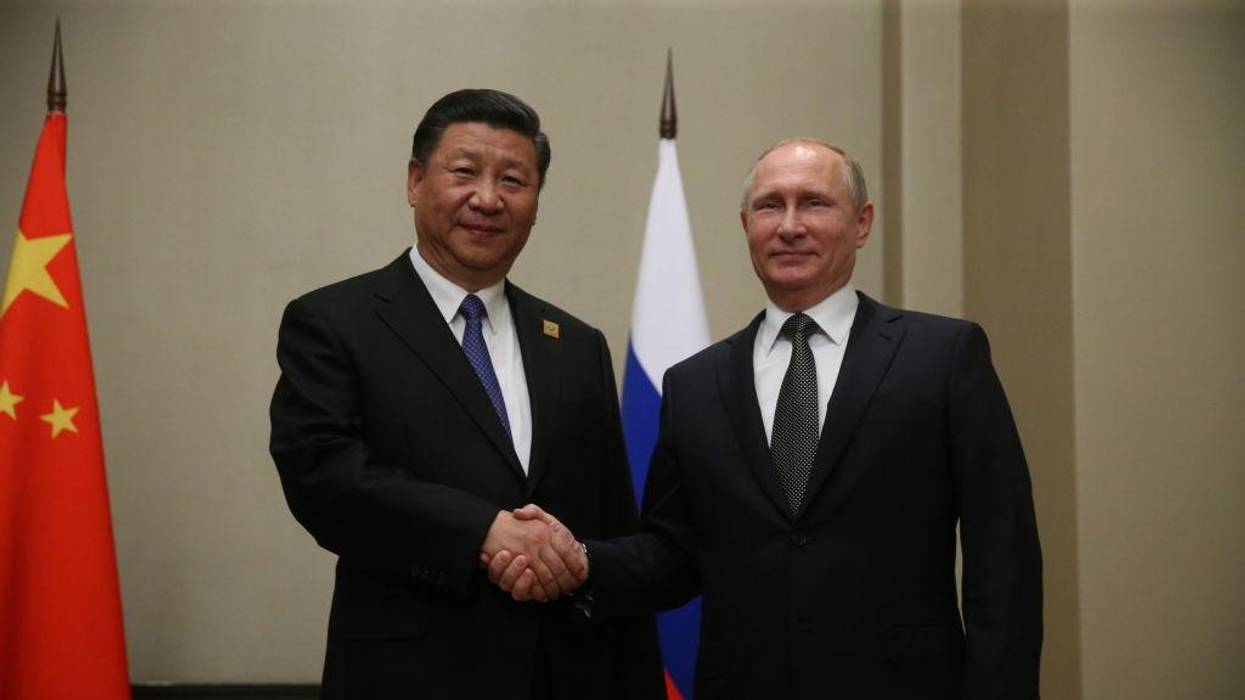
After publishing the first two editions of the Confessions of an Economic Hit Man trilogy, I was invited to speak at global summits. I met with heads of state and their top advisors from many countries. Two particularly significant venues were conferences in the summer of 2017 in Russia and Kazakhstan, where I joined an array of speakers that included major corporate CEOs, government and NGO heads such as UN Secretary-General António Guterres, Indian Prime Minister Narendra Modi, and (before he invaded Ukraine) Russian President Vladimir Putin. I was asked to speak on the need to end an unsustainable economic system that’s consuming and polluting itself into extinction — a Death Economy — and replace it with a regenerative one that was beginning to evolve — a Life Economy.
When I left for that trip, I felt encouraged. But something else happened.
In talking with leaders who had been involved in the development of China’s New Silk Road (officially, the Belt and Road Initiative, or BRI), I learned that an innovative, potent, and dangerous strategy was being implemented by China’s economic hit men (EHMs). It began to seem impossible to stop a country that in a few decades had pulled itself from the ashes of Mao’s Cultural Revolution to become a dominant world power and a major contributor to the Death Economy.
During my time as an economic hit man in the 1970s, I learned that two of the most important tools of the US EHM strategy are:
US EHMs maintain that the world is divided into the good guys (America and its allies) and the bad guys (the Soviet Union/Russia, China, and other Communist nations), and we try to convince people around the world that if they don’t accept neoliberal economics they’ll be doomed to remain “undeveloped” and impoverished forever.
Neoliberal policies include austerity programs that cut taxes for the rich and wages and social services for everyone else, reduce government regulations, and privatize public-sector businesses and sell them to foreign (US) investors — all of which support “free” markets that favor transnational corporations. Neoliberal advocates promote the perception that money will “trickle down” from the corporations and elites to the rest of the population. However, in truth, these policies almost always cause greater inequality.
Although the US EHM strategy has been successful in the short term at helping corporations control resources and markets in many countries, its failures have become increasingly obvious. America’s wars in the Middle East (while neglecting much of the rest of the world), the tendency of one Washington administration to break agreements made by previous ones, the inability of Republicans and Democrats to compromise, the wanton destruction of environments, and the exploitation of resources create doubts and often cause resentment.
China has been quick to take advantage.
Xi Jinping became president of China in 2013 and immediately began campaigning in Africa and Latin America. He and his EHMs emphasized that by rejecting neoliberalism and developing its own model, China had accomplished the seemingly impossible. It had experienced an average annual economic growth rate of nearly 10 percent for three decades and elevated more than 700 million people out of extreme poverty. No other country had ever done anything even remotely approaching this. China presented itself as a model for rapid economic success at home and it made major modifications to the EHM strategy abroad.
In addition to rejecting neoliberalism, China promoted the perception that it was ending the divide-and-conquer tactic. The New Silk Road was cast as a vehicle for uniting the world in a trading network that, it claimed, would end global poverty. Latin American and African countries were told that, through Chinese-built ports, highways, and railroads, they would be connected to countries on every continent. This was a significant departure from the bilateralism of colonial powers and the US EHM strategy.
Whatever one thinks of China, whatever its real intent, and despite recent setbacks, it’s impossible not to recognize that China’s domestic successes and its modifications to the EHM strategy impress much of the world.
However, there’s a downside. The New Silk Road may be uniting countries that were once divided, but it’s doing so under China’s autocratic government — one that suppresses self-evaluation and criticism. Recent events have reminded the world about the dangers of such a government.
Russia’s invasion of Ukraine offers an example of how a tyrannical administration can suddenly alter the course of history.
It’s important to keep in mind that rhetoric around China’s modifications to the EHM strategy disguises the fact that China is using the same basic tactics as those employed by the US. Regardless of who implements this strategy, it’s exploiting resources, expanding inequality, burying countries in debt, harming all but a few elites, causing climate change, and worsening other crises that threaten our planet. In other words, it’s promoting a Death Economy that’s killing us.
The EHM strategy, whether implemented by the US or China, must end. It’s time to replace the Death Economy based on short-term profits for the few with a Life Economy that’s based on long-term benefits for all people and nature.
Taking action to usher in a Life Economy requires:
With wars raging in Ukraine, Yemen, Somalia and elsewhere, Roe v. Wade overturned and our resources being wasted on militarism instead of addressing the climate crisis, it can be hard to remember the hard-won progress being made. As we end a difficult year, let's pause to remind ourselves of some of the positive changes that happened in 2022 that should inspire us to do more in the year to come. While some are only partial gains, they are all steps towards a more just, peaceful and sustainable world.
1. The growth of Latin America's "Pink Tide." Continuing the wave of progressive wins in 2021, Latin America saw two new critical electoral victories: Gustavo Petro in Colombia and Luiz Inacio Lula da Silva in Brazil. When President Biden's June Summit of the Americas excluded Cuba, Nicaragua and Venezuela, several Latin American leaders declined to attend, while others used the opportunity to push the United States to respect the sovereignty of the countries in the region. (Stay tuned for CODEPINK's spring forum "In Search of a New U.S. Policy for a New Latin America.")
2. The U.S. labor movement caught fire. In 2022 we witnessed the brilliant organizing of Chris Smalls and the Amazon workers, Starbucks reached nearly 7,000 unionized workers and close to 300 unionized stores. Requests to the National Labor Relations Board to hold union elections were up 58% in the first eight months of 2022. Labor is back and fighting the good fight.
3. Despite assaults on our elections, people fought back and gained some notable wins.
Voters delivered victories for progressives in districts across the country, including in Texas, Illinois, Michigan, Florida, Hawaii, California, Pennsylvania and Vermont, and Democrats kept control of the Senate. Young people showed up at the polls in record numbers--one out of eight voters in the midterms was under the age of 30. Abortion rights won in states where it was on the ballot (California, Michigan and Vermont) and in the "red" state of Kentucky, voters rejected a proposed amendment to the Kentucky constitution that would declare there is no constitutional right to an abortion. Another plus: Every election denier running to oversee state elections lost.
4. Peace comes to Ethiopia. After a devastating two-year civil war that left hundreds of thousands dead and millions displaced and facing starvation, the federal government of Ethiopia and the Tigray People's Liberation Front (TPLF) signed a peace treaty on November 2, 2022. The surprise deal came out of peace talks convened by the African Union. So far, the fighting has ceased, and both parties vowed that they are determined to make the peace deal last.
5. Mainstream media finally did right by Julian Assange, as his international support grew.
The New York Times, The Guardian, Le Monde, El Pais and Der Spiegel-the media outlets that published WikiLeaks' revelations 12 years ago--finally called on President Biden to free Assange. Australian Prime Minister Anthony Albanese (Assange is an Australian citizen) also finally said he has personally urged the U.S. government to end its pursuit of Assange. More enthusiastic has been his support in Latin America, with calls for his release coming from President Gustavo Petro in Colombia, Mexico's President Lopez Obrador, Nicaragua's President Daniel Ortega, Venezuela's President Nicolas Maduro, and Brazil's President-elect Lula da Silva.
6. Indigenous and Global South voices were finally heard at the largest climate summit, COP27.
Thanks to the relentless work of Indigenous peoples and organizers from the Global South, marginalized communities not only got into COP27 this year but their voices were finally heard and a historic loss and damage fund was established to help vulnerable countries cope with the destructive impacts of climate change. The development marks an important achievement for civil society and collective action in the Global South that has been nearly three decades in the making. Now we have to push the wealthier countries to come through with the funds, and to finally get serious about our own transition to clean energy before it is too late to avoid global catastrophe.
7. Some 200 countries (minus the U.S. and the Vatican) commit to stemming the loss of nature worldwide. Another critical environmental gathering, the COP15 Biodiversity Summit in Canada, reached a watershed agreement pledging to protect nearly one-third of Earth's land and oceans as a refuge for the planet's remaining wild plants and animals by 2030-dubbed "30 by 30." This agreement is critical to stemming the massive loss of diversity--about a million species are at risk of disappearing forever. But it will take constant grassroots pressure, and significant resources from the wealthier countries, to put this 30 by 30 goal into practice.
8. The passage of the Respect for Marriage Act. The U.S. Supreme Court legalized same-sex marriage nationwide in 2015 but the court's June decision overturning a right to abortion at the federal level raised concerns that federal protections for same-sex marriage might be in jeopardy. The Respect for Marriage Act was passed to address this by guaranteeing federal recognition of any marriage between two individuals if the union was valid in the state where it was performed. It won't force states to issue same-sex marriage licenses should nationwide marriage equality be overturned by the Supreme Court but it will extend equality under the law to all same-sex couples, no matter which state they got married in. It also protects interracial marriages.
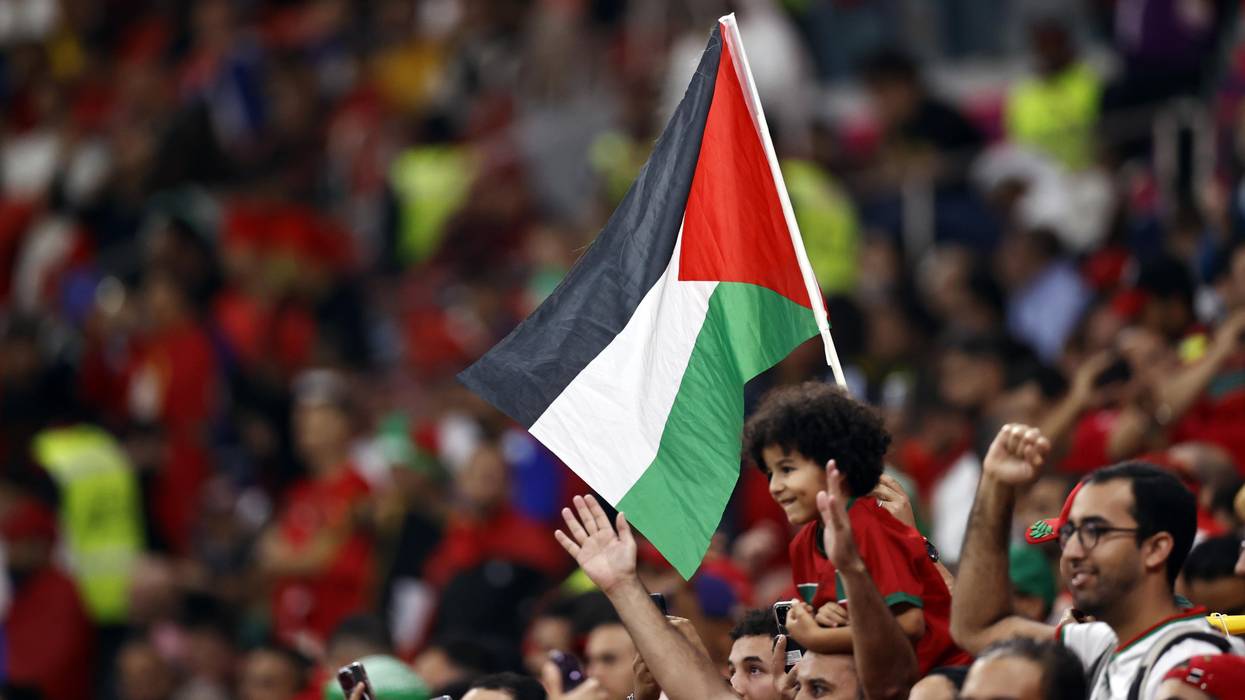
9. The World Cup put the spotlight on Palestine. The World Cup was a spectacular event that created a sense of global solidarity and joy, with Argentina's win lifting up all of Latin America. But the fans, especially from Muslim and Arab countries, put the spotlight on another place in the world: Palestine. Palestinian flags and chants popped up everywhere-on the field, in the bleachers, on the streets, while videos showing Israeli journalists being ostracized went viral. At least for the month of these games, the call to "Free Palestine" went global.
10. A multi-polar world is here. China's enormously ambitious Belt and Road Initiative now encompasses over 80 countries. And with the U.S. abusing its economic power by imposing extraterritorial sanctions against countries all over the globe, the push for alternatives to the dollar has exploded. Over a dozen countries have asked to join BRICS (the alliance of the powerful economies of Brazil, Russia, India, China and South Africa), whose countries account for 40 percent of the global population and 25 percent of the world's GDP. BRICS members are already transacting their bilateral trade in local currencies. And new or strengthened non-aligned movements have emerged in Latin America and Africa. A multi-polar world is already a reality for much of the world, and this is actually better for people everywhere-even for Americans-than one where the U.S. keeps using war, militarism and coercive financial sanctions to try to prolong its post-Cold War unipolar moment into our new century.
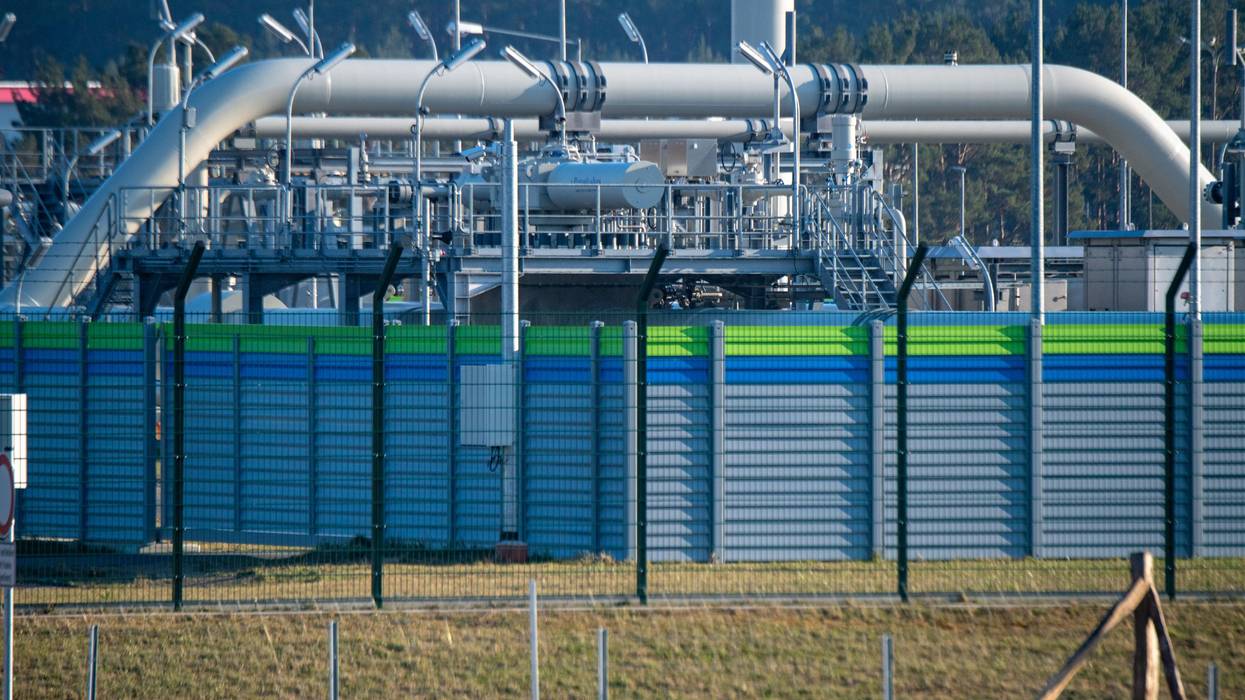
Two stunning explosions deep below the Baltic Sea last month set off one of the greatest whodunits in the long history of US-Russia hostility.
The sabotage of Nord Stream is just the latest and most spectacular example of how vital pipelines are to the political and economic security of many nations.
The explosion ruptured a pipeline that was built to bring liquid natural gas from Russia to Germany. That is likely to reshape European life. It will drive up energy prices as winter begins while removing an instrument Russia has used to influence European governments. The attack also illustrates the profound but little-understood importance of pipelines in modern geopolitics. This is the first major sabotage of an important international pipeline. Now that a precedent has been set, it may not be the last.
The pipeline that was attacked, called Nord Stream 2, was a joint Russian-German project that the United States opposed from the start. In February President Biden promised that if Russia invaded Ukraine, "there will no longer be a Nord Stream 2. We will bring an end to it." When asked how that would be possible, he replied, "I promise you, we would be able to do that." After the September 26 attack, Secretary of State Antony Blinken called it "a tremendous opportunity once and for all to remove the dependence on Russian energy...We're now the leading supplier of LNG to Europe."
Germany and other countries that planned to use liquid natural gas from Russia may now have to buy it from the United States. Hours after the explosion, former Polish defense minister Radek Sikorski tweeted a picture of the methane bubble rising from the Baltic with the caption "Thank you USA." In a second tweet he elaborated: "Nord Stream's only logic was for Putin to be able to blackmail or wage war on Eastern Europe with impunity."
The pipeline is heavily armored, with layers of concrete surrounding tubes made from metal alloys. Most who have studied the attack agree that it could only have been carried out by a "state actor." The United States, Britain, Russia, and possible Germany, Sweden, and Denmark, are thought to be the only countries with the undersea power to carry it off. Once accomplished, the action removed the most important tool Russia had to pressure Germany--and perhaps assured that Germany will not stray from the US policy of arming Ukraine. Circumstantial evidence suggests that this could have been an American operation.
Journalists and other professional skeptics, however, realize that some things that seem obvious and just plain common sense are actually not true. Russia may not have undersea commandos able to plant powerful explosives along the pipeline, but it could have been blown up from inside. Russia, which controls access to the pipeline, could have carried out the attack that way. Why would it blow up its own pipeline? According to those who support this theory, the motive would be to drive gas prices higher and push Europeans into freezing darkness so they would press their leaders to stop supporting Ukraine.
The executive director of the International Energy Agency, Fatih Birol, asserted soon after the sabotage attack that it was "very obvious" who did it, but refused to say more. Sweden is investigating but will not reveal what it discovers because, according to a Swedish official, "that is subject to confidentiality directly linked to national security." A member of the German parliament asked what Germany's government knows, and the government reportedly replied that it could not answer because "even the slight risk of disclosure cannot be accepted."
This mystery will probably not be resolved soon, or perhaps ever. The sabotage of Nord Stream is just the latest and most spectacular example of how vital pipelines are to the political and economic security of many nations.
Conflict over a pipeline led the CIA to participate in its first regime-change operation. In 1949 the first president of independent Syria, Shukri al-Quwatli, refused to allow a consortium of American oil companies to run the Trans-Arabian Pipeline across his country. That defiance led the CIA to promote a military coup that deposed Quwatli and installed a military-led government that quickly approved the pipeline. Syria never returned to democracy.
In the 1990s, the United States exercised intense pressure to assure that new pipelines from rich fields in the former Soviet Union would not run through Iran or other unfriendly countries. Russia has periodically raised or lowered the price of gas from its pipelines according to whether particular governments are friendly or hostile. China is using pipelines as part of its ambitious Belt and Road initiative that seeks to bind Eurasia together under Chinese influence. In 2014, after Russia's annexation of Crimea, the European Union blocked a proposed pipeline that would have carried Russian gas to Austria and Italy.
Most pipelines are vulnerable. One candidate for future sabotage might be Turkstream, designed to carry gas from Russia to Turkey and then on to Bulgaria, Hungary and Serbia--all countries that have been reluctant to support Ukraine. A "pipeline war" could lie ahead.
So who blew up the Nord Stream pipeline? Thousands of unexploded mines from World Wars I and II still litter the Baltic. Blaming one of those mines would be most convenient. That would allow all to believe that this was an unfortunate accident, not an act of international vandalism. There's no hard evidence to support that theory, but neither is there any to support the charge that the culprit was the United States or Russia. That may keep speculation bubbling like the methane gas that exploded from under the Baltic last month.

It is no secret that the United States and NATO are engaged in a proxy war with Russia, perhaps to be fought to the last Ukrainian. In June, as heads of state gathered in Madrid for the Alliance's annual summit, I joined more than 10,000 activists from across Spain and around the world for mega anti-NATO peace conferences and a massive No to NATO rally. Their focus was not only NATO's roles in the Ukraine War but also its transformation into the world's dominant GLOBAL alliance whose new strategic concept also prioritizes containing China. Highlighting this transformation, the Prime Ministers of Australia, Japan, New Zealand, and the Republic of Korea joined the summit for the first time in the Alliance's history.
LESSONS FROM THE EUROPEAN LEFT
Before turning to NATO's history and decisions taken at the summit, there were a number of lessons I took from the European Left while in Madrid and elsewhere during my recent travels in Asia and Europe.
HISTORY & NATO's NEW STRATEGIC CONCEPT
In the United States, public perceptions of NATO remain rooted in the Cold War misconception that NATO is an exclusively defensive alliance. In Europe there are recent memories of NATO's aggressions in Afghanistan, Serbia, Libya, and Iraq. There is also memory of NATO's first General Secretary's, Lord Hastings Ismay, who stated that the purpose of NATO was to "keep the Russians out, the Americans in, and the Germans down."
Hasting's observation helps us understand why NATO was not retired when the public rationale for its existence, defense of Western Europe from possible Soviet invasion, evaporated with the demise of the Soviet Union in 1991. But Zbigniew Brzezinski, President Carter's national security advisor. provided a more detailed explanation in his seminally important primer about how to maintain the United States' "imperial project," The Grand Chessboard. Reaffirming the geopolitical theory that whoever controls the core of Eurasia will be the world's dominant power, and noting that the United States, like Britain before it, is an "island power," he explained that NATO is critical to U.S. global dominance. It provides the "toehold" on Eurasia's western periphery, reinforced by its other toeholds in the Middle East and Central Asia, and by its Asia-Pacific allies. Even before Moscow's invasion of Ukraine, the U.S. had 100,000 troops and hundreds of military bases and installations deployed across a still functionally militarily occupied Europe.
While Russia's invasion of Ukraine is an unacceptable and deadly violation of the U.N. Charter and other international laws, it also appears to have been driven by two primary forces: Moscow's perceptions of Russia's strategic vulnerability given NATO's expansion to its borders (including deepening integration of Ukraine into NATO's systems) and by the desire to restore much of the Russian imperium that was lost with the collapse of the Soviet empire.
Few in the United States are aware of Europe's 1990s Common Security commitments and the vision of a "Common European Home," which included Russia. In 1990 the OSCE (Organization for Security and Cooperation in Europe), inclusive of both the United States and Russia adopted the Paris Charter. This commitment was reiterated in the NATO-Russia Founding Act, and again in the 1999 OSCE Charter for European Security. And, despite it never have been committed in writing, in the U.S.-Russian negotiations leading to German reunification on West German terms, the GHW Bush Administration committed not to move NATO a centimeter closer to Russia's border.
Why was this important to Russia? Just as deep as our national memories of Washington crossing the Delaware, of our deadly Civil War, and of Japan's attack on Pearl Harbor, are Russian memories of catastrophic invasions from the West, first by Napoleon and later by the German Kaiser and Hitler.
Yet as Russia's political and economic systems imploded during Boris Yeltsin's rule, and in the tradition of the arrogance of power, despite George Kennan, the architect of the Cold War containment doctrine's warning that it would lead to disastrous conflict, in 1999 President Clinton initiated the campaign to enlarge NATO. Poland, Hungary, and the Czech Republic became alliance members. Bush II added seven Central and Eastern European nations in 2004. In 2007, despite his senior advisor Fiona Hill's warning that inviting Ukraine and Georgia would lead to war, and against the opposition of Germany and France, Bush the Lesser forced the invitation to Ukraine and Georgia through NATO's 2007 summit. In its immediate aftermath, the Georgia-Russian war followed. It has been reported the Putin began his planning for the Ukraine invasion in response to the welcome mat put out by NATO for Kiyv. Baltic and other Eastern and Central European nations were also welcomed to NATO.
Even before Russia's invasion of Ukraine, U.S. and German military forces were deployed and conducted military exercises along Russia's borders, and U.S. and Russian warships and warplanes conducted provocative and extremely dangerous military "exercises" in the Baltic and Black Seas.
Yet, even as NATO was expanding eastward toward Russia, it also became a global alliance. Today German, Dutch, English, French, Japanese and even Indian warships join provocative U.S. naval "exercises"in the South China Sea. "Partners"including Columbia, Australia, Iraq, Japan, South Korea, New Zealand, Mongolia and even Pakistan were added to the alliance. NATO's webpage tells us that these partners "are part of many of NATO's core activities, from shaping policy to building defense capacity, developing interoperability and managing crises." The Alliance also has formal partnership frameworks including the Euro-Atlantic Partnership Council, Partnership for Peace, the Mediterranean Dialogue, and the Istanbul Cooperation Initiative, each of which serve similar purposes to the formal partnerships.
SUMMIT DECISIONS & NATO'S NEW STRATEGIC CONCEPT
As our movements recalibrate in order to address the growing threat to what remains of constitutional democracy, human and political rights and existential nuclear and climate threats, we need to bear in mind NATO's impacts on the new era of great power confrontation and what Michael Klare terms "blockification." In addition to NATO becoming global, Russia is increasingly dependent on China, and a new movement of non-aligned nations is trying to be born.
At the Madrid Summit, NATO Leaders took what they described as "transformative decisions" with the "biggest overhaul"of the "allied collective defense" since the Cold War and set the Alliance's strategic direction for the near and long-term future. Contrary to earlier expectations that the Alliance's focus on Russia would be downgraded, with China being named as NATO's #1 priority. But with the Ukraine War NATO's Strategic Concept named Russia as the "most significant and direct threat." It was followed by China being named for the first time as a threat to the rules based order, followed by the challenges of terrorism, cyber and hybrid warfare. (It is important to remember that the post-war Bretton Woods "order" was imposed without meaningful Chinese input when the Middle Kingdom was impoverished and weak. Like any other major power, it seeks to advance what its elite identifies as the country's national interests.)
Commitments to continuing arming and supporting Ukraine were reiterated at the summit, as well as deepening Ukraine's integration with the Alliance by supporting its transition from Soviet-era military equipment to modern NATO equipment. More troops and more pre-positioned equipment and weapon stockpiles will go to Eastern Europe and the Baltics, with NATO's eight multinational battlegroups growing exponentially from 40,000 to 300,000 troops. NATO was reaffirmed as a nuclear alliance. The alliance doubled down on Ukraine and Georgia, reaffirming the commitment to NATO's "Open Door" policy for aspiring members. As part of the "Open Door," Sweden and Finland were invited to join the alliance, doubling the length of NATO's border with Russia. Member states committed to spending at least 2 per cent of their national GDPs by 2024 for their militaries. And new support commitments were made for "other partners at risk," including Bosnia and Herzegovina, Georgia, and the Republic of Moldova.
With no apparent sense of shame or acknowledgment of what George Orwell termed "double speak," the allies reiterated their "strong commitment to the rules-based international order and Allies' shared values of individual liberty, human rights, democracy, and the rule of law." Missing from photographs of the assembled national leaders must have been the smirks on the faces of Turkey's, Hungary's, and Poland's leaders, not to mention President Biden and Secretary Blinken as they contemplated planned summits in Israel and Saudi Arabia.
BY WAY OF CONCLUSION
There is no denying that we are moving into an increasingly dangerous period. NATO, Russia and Ukraine are committed to fighting a long war which could escalate geographically or to the possible use of weapons of mass destruction. The Democratic Party is unquestioningly supporting an endless proxy war and has been reluctant to press President Biden to prioritize a negotiated settlement to the war. The illegitimate U.S. Supreme Court majority and those associated with the January 6 insurrection are plotting to secure white supremacist, medieval Christian, and corporate power for the long term.. And the war, the contest for primacy with China, and the recent Supreme Court EPA decision are sentencing future generations to climate catastrophes.
Noam Chomsky reminds us that these crises were created by humans and that we know their solutions: Impose a cease fire and negotiate a just settlement of the war. Abolish nuclear weapons. Invest in clean energy and protect our coastal cities against surging tides instead of funding the Pentagon with more the military spending than the world's next 10 biggest military spenders COMBINED! Expand and defend an inclusive if imperfect democracy. Restore a progressive graduated income tax to weaken the oligarchs and provide economic security.
Where then are sources of hope and inspiration? There are no easy answers in this dark time. On the one hand, I wish that I could transmit the commitments and surging energy of the thousands who rallied in Madrid. The Poor People's Campaign here in the United States provides a model and foundation for intersectional organizing and advocacy. There is inspiration to be taken from the centuries of African-Americans daily struggle for liberation and freedom against oppressive political and social systems stacked against them. Having had the extraordinary privilege of working with women and men who resisted Nazi rule in Hitler's Europe, nonviolently and otherwise, I take inspiration from their quiet courage. There is also the reality that within the oppressive rule of Soviet commissars in Eastern Europe and U.S.-backed oligarchs across Latin America people built culture and foundations for greater freedom.
And there is Leonard Cohen's poetic insight that "There is a crack in everything/that's how the light gets in."

From his first days in office, Joe Biden and his national security advisers seemed determined to revive America's fading global leadership via the strategy they knew best--challenging the "revisionist powers" Russia and China with a Cold War-style aggressiveness. When it came to Beijing, the president combined the policy initiatives of his predecessors, pursuing Barack Obama's "strategic pivot" from the Middle East to Asia, while continuing Donald Trump's trade war with China. In the process, Biden revived the kind of bipartisan foreign policy not seen in Washington since the Soviet Union collapsed in 1991.
Writing in the December 2021 Foreign Affairs, a group of famously disputatious diplomatic historians agreed on one thing: "Today, China and the United States are locked in what can only be called a new cold war." Just weeks later, the present mimed the past in ways that went well beyond even that pessimistic assessment as Russia began massing 190,000 troops on the border of Ukraine. Soon, Russian President Vladimir Putin would join China's Xi Jinping in Beijing where they would demand that the West "abandon the ideologized approaches of the Cold War" by curtailing both NATO's expansion into Eastern Europe and similar security pacts in the Pacific.
As Russia's invasion of Ukraine loomed in late February, the New York Times reported that Putin was trying "to revise the outcome of the original Cold War, even if it is at the cost of deepening a new one." And days later, as Russian tanks began entering Ukraine, the New York Times published an editorial headlined, "Mr. Putin Launches a Sequel to the Cold War." The Wall Street Journal seconded that view, concluding that recent "developments reflect a new cold war that Xi Jinping and Vladimir Putin have initiated against the West."
Instead of simply accepting that mainstream consensus, it couldn't be more important right now to explore that Cold War analogy and gain a fuller understanding of how that tragic past does (and doesn't) resonate with our embattled present.
The Geopolitics of Cold Wars
There are indeed a number of parallels between our Cold Wars, old and new. Some 70 years ago, in January 1950, Mao Zedong, the head of a Chinese People's Republic ravaged by long years of war and revolution, met Soviet leader Joseph Stalin in Moscow as a supplicant. He was seeking a treaty of alliance and friendship that would provide much-needed aid for his fledgling communist state.
Within months, Stalin played upon this brand-new alliance by persuading Mao to send troops into the maelstrom of the Korean War, where China soon began hemorrhaging money and manpower. Until his death in 1953, Stalin kept the U.S. military bogged down in Korea, as he sought "an advantage in the global balance of power." With Washington focused on war in Asia, Stalin consolidated his grip on seven "satellite states" in Eastern Europe--but at a cost. In those years, a newly created NATO would be transformed into a genuine military alliance, as 16 nations dispatched troops to Korea.
Last February, in a reversal of Cold War roles, Putin arrived at that Beijing summit as a supplicant, desperately seeking Chinese President Xi Jinping's diplomatic support for his Ukrainian gambit. Proclaiming their relations "superior to political and military alliances of the Cold War era," the two leaders asserted that their entente had "no limits... no 'forbidden' areas of cooperation."
Soon after, the Russian president would invade Ukraine, while ominously putting his nuclear forces on high alert, a warning to the West not to meddle in his war. In a clear parallel to the old Cold War, nuclear weapons are far too dangerous for a direct superpower conflict to break out, so the U.S. and its NATO allies chose surrogate warfare in Ukraine. Just as the Soviet Union once armed North Vietnam with surface-to-air missiles and tanks to bloody the U.S. military, so Washington now began supplying Kyiv with high-tech weaponry to damage the Russian army.
As Ukrainian defenders armed with U.S.- and NATO-supplied shoulder-fired missiles destroyed 2,500 of its armored vehicles, Russia would be forced to pull back from its bid to capture the Ukrainian capital and shift to a months-long slog to seize the Russian-speaking Donbas region near its own border. This effort has, in turn, sparked an artillery duel now fast approaching the sort of strategic stalemate not seen since the Korean War (a conflict that remains unresolved nearly 70 years later).
Beneath such surface similarities between the two eras, however, lies a crucial if elusive difference: geopolitics. As I explain in my recent book, To Govern the Globe, this is essentially a method for the management of empire. At the high tide of the British Empire in 1904, English geographer Halford Mackinder published an influential article arguing that Europe, Asia, and Africa weren't, in fact, three separate continents but a unitary landmass he dubbed "the World-Island," whose strategic pivot lay in the "heartland" of central Eurasia. Mackinder later boiled his thinking down to a memorable maxim: "Who rules the Heartland commands the World-Island; Who rules the World-Island commands the World."
Apply Mackinder's principles to the old Cold War and you can indeed see an underlying geopolitics that lends coherence to an otherwise disparate conflict spread across four decades and five continents. In the 500 years since European exploration first brought the continents into continuous contact, the rise of every major world power has required one thing above all: dominance over Eurasia, now home to 70% of the world's population and productivity. Those five centuries of imperial rivalry could be summarized, thanks to Mackinder, in a succinct geopolitical axiom: "The exercise of global hegemony requires control over Eurasia, and contestation over that vast continent thus determines the fate of empires and their world orders."
By the time the Cold War ended in 1991, Washington had translated that axiom into a three-part geopolitical strategy to defeat the Soviet Union. First, it encircled Eurasia with military bases and mutual-defense pacts to contain Beijing and Moscow behind an "Iron Curtain" stretching 5,000 miles across that vast land mass. Second, the U.S. intervened, using either conventional force or CIA covert operations whenever the communists threatened to expand their power beyond that "curtain"--whether in Korea, Southeast Asia, the Middle East, or sub-Saharan Africa. Finally, Washington aggressively defended its own hemisphere from communist influence of any sort, however homegrown--whether in Cuba, Central America, or Chile.
In a magisterial sweep through a millennium of Eurasian history, Oxford scholar John Darwin found that, after World War II, Washington achieved its "colossal imperium... on an unprecedented scale" by becoming the first power ever to control the strategic axial points "at both ends of Eurasia." Initially, Washington defended Eurasia's western axis through the NATO defense pact signed with a dozen allies in April 1949, making the Cold War, at its outset, little more than a regional conflict over Eastern Europe.
In October 1949, however, communists surprised the world by capturing China. Moscow then forged a Sino-Soviet alliance that suddenly threatened to become the dominant force on the Eurasian land mass. In response, Washington moved quickly to counter that geopolitical challenge by forging four bilateral defense pacts, thereby developing a 5,000-mile chain of military bases along the Pacific littoral from Japan and South Korea all the way to Australia. By serving as the frontier for the defense of one continent (North America) and a springboard for its dominance of another (Eurasia), the Pacific littoral would become Washington's key geopolitical fulcrum.
In the 1960s, the Sino-Soviet alliance would suddenly collapse into a bitter rivalry--a lucky break for Washington that left Moscow without a major ally anywhere in Eurasia. Reeling from their breach with Beijing, the Soviet leaders would spend several decades trying, unsuccessfully, to break out of their geopolitical isolation by expanding into Latin America, Southeast Asia, the Middle East, southern Africa, and, fatally, Afghanistan, catalyzing a succession of local conflicts that led to the deaths of some 20 million people between 1945 and 1990.
A New Geopolitical Balance
At the close of the Cold War, when the U.S. seemed to stand astride the globe like a Titan of Greek legend, Zbigniew Brzezinski, the former national security adviser to President Jimmy Carter and a devotee of Mackinder's geopolitical theory, warned that Washington should take care to avoid three pitfalls that could erode its global power. It must, he warned, preserve its strategic "perch on the Western periphery" of Eurasia through NATO; it must prevent "the expulsion of America from its offshore bases" along the Pacific littoral; and it must block the rise of "an assertive single entity" in the "middle space" of that vast landmass.
Now, skip three decades and, in response to Russia's invasion of Ukraine, NATO countries have worked with surprising unanimity to slap sanctions on Moscow, ship advanced weaponry to Kyiv, and even take in previously neutral Sweden and Finland as possible members. In this way, Washington seems to have forged a trans-Atlantic solidarity not seen since the Cold War and preserved, at least for now, Washington's strategic "perch on the Western periphery" of Eurasia.
By his surprisingly blunt statement last month that the U.S. would "get involved militarily to defend Taiwan" (a key driver of the global economy through its mass production of sophisticated computer chips) and his warning that a possible Chinese attack there would be "similar to what happened in Ukraine," President Biden has been trying to assert an ever stronger American military presence in the Pacific. China has, however, also been moving in that region, militarily, politically, and diplomatically, potentially winning over islands that were once an American preserve.
Whatever Washington has done to strengthen its "strategic perch" in Europe by rallying NATO and allies in the Pacific as well, it has clearly failed to meet Brzezinski's critical third criteria for the preservation of its global power. Indeed, the rise of China as "an assertive single entity" in the pivotal "middle space" of Eurasia could potentially prove a fatal geopolitical blow to Washington's global ambitions, the equivalent of the impact the Sino-Soviet split had on Moscow during the old Cold War.
As its foreign reserves reached an extraordinary $4 trillion in 2014, Beijing announced a trillion-dollar Belt and Road Initiative (BRI) meant to build an economic bloc encompassing the whole of Mackinder's tri-continental world island. To overcome Eurasia's vast distances, China quickly began constructing a steel grid of rails, roads, and gas pipelines that, when integrated with Russia's networks, would reach across the continent. Within just five years, a World Bank study found that BRI transportation projects were boosting trade among 70 nations by up to 9.7% and lifting 32 million people out of poverty. By 2027, Beijing is expected to commit $1.3 trillion to this project, which would make it the largest investment in history--more than 10 times the foreign aid Washington allocated to its famed Marshall Plan that rebuilt a ravaged Europe after World War II.
To strengthen its regional influence and weaken the U.S. grip on the Pacific littoral, China has also used the BRI to court allies in the Asia-Pacific region. In 2020, in fact, it formed a Regional Comprehensive Economic Partnership, the world's largest trade pact with 15 Asia-Pacific nations representing 30% of global trade.
Taking a leaf out of Stalin's geopolitical playbook, President Xi has much to gain from Vladimir Putin's headstrong plunge into Ukraine. In the short term, Washington's focus on Europe slows any serious strategic "pivot" to the Pacific, allowing Beijing to further consolidate its burgeoning commercial dominance there. By allying with Russia and so meeting its own food and energy needs, while maintaining ties to Europe through formal neutrality in the Ukraine war, Beijing could emerge, like Moscow after the Vietnam War, with its global influence markedly enhanced and the U.S. geopolitical position significantly weakened.
The Limits of Historical Analogy
However strong the geopolitical continuities between the two eras may be, history also spins skeins of discontinuity, making the past, at best, an imperfect guide to the present. During the 30 years after the Cold War ended, a relentless economic globalization has incorporated China as the world's industrial workshop and Russia as a key provider of energy, minerals, and grains into the world economy.
As a result, despite recent sanctions, geopolitical "containment" of the sort once used against the old Soviet Union's feeble command economy is no longer feasible. With the war already causing what the World Bank calls an "an enormous humanitarian crisis," pressures are building for some way to reintegrate Russia into a global economy that is suffering badly from the ostracism of a country that ranks first in world wheat and fertilizer exports, second in gas production, and third in oil output.
By blockading Ukraine's Black Sea ports and advancing toward its main one, Odessa, Putin has disrupted grain exports from both Russia and Ukraine, which together provide almost one third of the world's wheat and barley and so are critical to feeding the Middle East, as well as much of Africa. With the specter of mass starvation looming for some 270 million people and, as the U.N. recently warned, political instability growing in those volatile regions, the West will, sooner or later, have to reach some understanding with Russia.
Similarly, Europe's escalating embargo of Russia's natural gas and oil exports is proving profoundly disruptive to global energy markets, stoking inflation in the United States and sending fuel prices soaring on the continent. Already, Putin has successfully shifted much of his country's oil and gas exports from Europe to China and India. Within months, the European Union's embargo will likely hit a wall as Germany finds its premature closure of nuclear power plants has created an irresolvable dependence on Russian natural gas imports.
As the conflict in Ukraine becomes a protracted military stalemate, there are signs that both sides are reaching their war-making limit and may yet be forced to seek a diplomatic resolution. Even if the flow of heavy weapons from the West continues, Ukraine's battered army can, at best, push Russia back to the territory it held before the start of current hostilities, perhaps leaving Moscow in control of Ukraine's southeast, much or all of the Donbas region, and the Crimea.
In contrast to the Pentagon's triumphalist rhetoric about using the war to render Russia's military permanently "weakened," French President Emmanuel Macron has made the sober suggestion that "we must not humiliate Russia so... we can build an exit ramp through diplomatic means." Although controversial, that view may yet prevail. If so, there might well be a diplomatic agreement in which Ukraine swaps bits of territory for the acceptance of a neutral status akin to Austria's, allowing it to join the European Union, but not NATO.
By attacking Ukraine and alienating Europe, Putin has suffered a serious but not necessarily fatal geopolitical blow. Blocked from expanding westward, he is now accelerating Russia's "pivot to the East" and rapidly integrating its economy with China's. In doing so, he's likely to consolidate Beijing's geopolitical dominance over the vast Eurasian land mass, the epicenter of global power, while the United States, wallowing in domestic chaos, suffers a distinctly non-Cold War-ish decline.
In this century as in the last one, the geopolitical struggle over Eurasia has proven to be a relentless affair, one that, in the years to come, will likely contribute both to Beijing's rise and to the ongoing erosion of Washington's once formidable global hegemony.

In certain quarters in this country, Russia's illegal invasion of Ukraine has generated enthusiasm for a new cold war. At the New York Times, Joe Biden and Vladimir Putin have been described as "children of the [old] Cold War" now involved in a "face off," an "eyeball to eyeball" confrontation harkening back to John F. Kennedy and Nikita Khrushchev contesting Berlin and Cuba in "dramatic fashion" 60 years ago. (Never mind that the "drama" over Cuba nearly led to nuclear war and the possible end of most life on Earth.) Such breathless accounts make me think of the role Slim Pickens played as Major Kong in Stanley Kubrick's famed film Dr. Strangelove, giddy with resolve, even relief of a kind, now that he and his B-52 crew are finally headed for nuclear combat with the Russkies.
Whatever else one might say of the crisis in Ukraine, the new cold war dreamscape that Washington think tanks and the Pentagon helped promulgate over the last decade against Russia or China or both is here to stay. Consider that a calamity in its own right. The end of America's failed wars in Iraq and Afghanistan, the disastrous results of America's Global War on Terror launched amid a barrage of lies and self-praise, might indeed have left an opening, however slight, for a shift away from colossal military budgets and creeping militarization.
Putin's actions, whatever their motivation and justification, are being seized upon by the military-industrial-congressional complex as proof positive that Pentagon budgets, already in the stratosphere, must soar higher yet.
Russia's ill-planned and immoral invasion of Ukraine marks the definitive end of that possibility, however small it might have been. Putin's actions, whatever their motivation and justification, are being seized upon by the military-industrial-congressional complex as proof positive that Pentagon budgets, already in the stratosphere, must soar higher yet. For so many of the Putin-haters (and I'm no fan), his destructive actions supposedly demonstrate why the U.S. must be prepared to double down in kind.
That, of course, means yet more weapons production and sales globally for the country that's already the planet's leading purveyor of such products. It also means more bellicose rhetoric, and ultimately more militarism, because that's all Putin and his authoritarian ilk will allegedly ever understand (as is sadly true of so many in Washington as well). Consider all this a peculiar form of American madness, akin to the idea that a guy with a gun, or better yet, lots of guys with lots of guns, the more powerful the better, are the sanest way to prevent gun violence.
Thought about a certain way, in taking such an approach, our government and, by extension, the American people are ceding our autonomy of thought and action to "bad actors" like Vladimir Putin and Xi Jinping. For every war Putin launches, America, so we're told, must respond with yet more weapons sales, troop deployments, debilitating sanctions, and above all, astronomically higher military spending. For every aircraft carrier the Chinese build, or any new expansion onto yet another tiny island in the South China Sea, the U.S. military must "pivot" harder toward Asia, while building yet more staggeringly expensive ships of its own. As possibilities, disengagement and detente go unmentioned. "Peace" isn't a word American presidents favor anymore. As a result, even modest military moves by Putin and Xi are essentially guaranteed to drive the U.S. economy yet deeper into militarized debt. (As if $6 trillion already squandered on the disastrous war on terror wasn't pricey enough.) After all, full-spectrum dominance over the global battlespace, a fantasy in the "best" of times, and a new cold war won't come cheap, a fact that U.S. weapons manufacturers are surely banking on.
Even before the recent Russian invasion, estimates for the fiscal year 2023 Pentagon budget had risen to $770 billion or even $800 billion. With Russian tanks now rolling through (or stalled in) Ukraine, you can bet your bottom dollar that $800 billion will be the floor, not the ceiling for that future budget and the Pentagon's 2023 demands from Congress. This country, we're once again hearing, is to be the arsenal of democracy (to steal a phrase from the World War II era). But count on this: if you're not careful an arsenal of democracy can easily enough devolve into little more than an arsenal. And that time, I suspect, is now.
The World Is Not Enough
Don't misunderstand me: I condemn Russia's invasion of Ukraine. It's a horror and an obvious disaster in the making. That said, Russia may have a super nuclear arsenal, but it's not a superpower, despite all those Cold War memories of ours, nor does its attack on Ukraine, in and of itself, pose a major threat to our own national security. Indeed, experts around the world have been predicting for decades that NATO expansion, exacerbated by U.S. meddling in Ukraine, could provoke Vladimir Putin to launch just such a war. In short, Russia's invasion was indeed predictable, even if not faintly excusable.
Nor are the Russian president's designs on Ukraine and his quest for greater power in eastern Europe historically surprising. In fact, serious self-reflection should lead us to the obvious conclusion that the scale of Russia's ambitions, objectionable as they might be, are also limited compared to ours.
Again, Russia remains a distinctly regional power, while the United States still fancies itself to be the last remaining superpower on planet Earth. No other country comes close to the scale of our global ambitions (and they're higher still, if you count this country's Trump-era Space Force with its vision that the heavens are but the next "warfighting domain" for us to dominate). In other words, in this century, when it came to our military, the world was not enough. All realms were to be under its command: land, sea, air, space, and cyberspace. Note, in fact, that we have a military force or special military command for all of them and our leaders simply take for granted that such dominance is to be ours and no one else's.
Think about it. Of all the countries on Earth, only the U.S. divides the entire globe into military commands run by four-star generals and admirals; only America has 750 or so military bases scattered across every continent except Antarctica; only America sees a country--I'm thinking here of Ukraine (although not so long ago it could have been Afghanistan or Iraq), roughly 5,000 miles away across a vast ocean, as its legitimate eastern flank. At the same time, only this country sees a body of water like the South China Sea as a lake for its Navy to navigate and dominate, as if it were part of our coastal waters.
Imagine, for a moment, that Russia or China had an America Command, an AMERCOM. Imagine that Russian advisors were training and equipping Canadian troops, while Chinese aircraft carrier task forces regularly sailed the Gulf of Mexico. As Americans, we, of course, can't imagine such things and yet that's the world we inhabit, even if in reverse.
Most of us seem to consider the imperial ambitions of this country, including the eventual expansion of NATO into Ukraine and Georgia and the continued deployment of powerful aircraft carrier battlegroups near the coast of China, as benign, uncontroversial evidence of our military resolve. Under the circumstances, it shouldn't be that hard to recognize that others on this planet might not feel quite the same way.
That America's pursuit of global reach and global power would be seen as a challenge, indeed a provocation, by a regional power like Russia or one with full-scale imperial ambitions, even if of a largely economic sort, like China with its trillion dollar Belt and Road Initiative, should surprise no one. Under the circumstances, it was inevitable that, sooner or later, this country's continued pursuit of full-spectrum dominance would produce a new cold war, as certain American experts predicted, and some seemed to desire. Think of the chaotic and disturbed world we're now living in as a kind of self-fulfilling prophecy, as well as a rare "triumph" of long-term strategic planning by certain elements within the national security state. What they wished for, they got. Today, it should be all too obvious that the results are anything but pleasing.
Your Role as a Loyal American in the New Cold War
It does, however, expect you to cheer at the right times, be "patriotic," wave the flag, gush about America, and celebrate its fabulous, militarized exceptionalism.
My fellow Americans, in this new cold war of ours, the national security state expects both all too much and all too little of you. Let's start with the little. It doesn't expect you to enlist in the military if you're rich or have "other priorities" (as former Vice President Dick Cheney said about the Vietnam War). It doesn't expect you to pay close attention to our wars, let alone foreign policy. You don't even have to vote. It does, however, expect you to cheer at the right times, be "patriotic," wave the flag, gush about America, and celebrate its fabulous, militarized exceptionalism.
To enlist in this country's cheerleading squad, which is of course God's squad, you might choose to wear a flag lapel pin and affix a "Support Our Troops" sticker to your SUV. You should remind everyone that "freedom isn't free" and that "God, guns, and guts" made America great. If the godly empire says Ukraine is a worthy friend, you might add a blue-and-yellow "frame" to your Facebook profile photo. If that same empire tells you to ignore ongoing U.S. drone strikes in Somalia and U.S. support for an atrocious Saudi war in Yemen, you are expected to comply. Naturally, you'll also be expected to pay your taxes without complaint, for how else are we to buy all the weapons and wage all the wars that America needs to keep the peace?
Naturally, certain people need to be collectively despised in our very own version of George Orwell's "Two Minutes Hate." So, when Putin's visage comes on the screen, or Xi's, or Kim Jong-un's, or whoever the enemy du jour is, be prepared to express your outrage. Be prepared to treat them as aliens, almost incomprehensible in their barbarity, as if, in fact, they were Klingons in the original Star Trek series. As a peaceful member of the "Federation," dominated by the United States, you must, of course, reject those Klingon nations and their warrior vision of life, their embrace of might-makes-right, choosing instead the logic, balance, and diplomacy of America's enlightened State Department (backed up, of course, by the world's greatest military).
Again, little is expected of you (so far) except your obedience, which should be enthusiastic rather than reluctant. Yet whether you know it or not, much is expected of you as well. You must surrender any hopes and dreams you've harbored of a fairer, kinder, more equitable and just society. For example, military needs in the new cold war simply won't allow us to "build back better." Forget about money for childcare, a $15 federal minimum wage, affordable healthcare for all, better schools, or similar "luxuries." Maybe in some distant future (or some parallel universe), we'll be able to afford such things, but not when we're faced with the equivalent of the Klingon Empire that must be stopped at any cost.
But wait! I hear some of you saying that it doesn't have to be this way! And I agree. A better future could be imagined. A saying of John F. Kennedy's comes to mind: "We shall be judged more by what we do at home than what we preach abroad." What we're currently doing at home is building more weapons, sinking more tax dollars into the Pentagon, and enriching more warrior-corporations at the expense of the poor, the weak, and the vulnerable. Where's the democratic future in that?
Sheer military might, our leaders seem to believe, will keep them forever riding high in the saddle. Yet you can ride too high in any saddle, making the fall that's coming that much more precipitous and dangerous.
Americans, acting in concert, could stop that fall, but not by giving our current crop of leaders a firmer grasp of the reins. Do that and they'll just spur this nation to greater heights of military folly. No, we must have the courage to unseat them from their saddles, strip them of their guns, and corral their war horses, before they lead us into yet another disastrously unending cold war that could threaten the very existence of humanity. We need to find another way that doesn't prioritize weapons and war, but values compromise, compassion, and comity.
At this late date, I'm not sure we can do it. I only know that we must.

Just as the relentless grinding of the earth's tectonic plates produces earthquakes and volcanic eruptions, so the endless superpower struggle for dominance over Eurasia is fraught with tensions and armed conflict. Beneath the visible outbreak of war in Ukraine and the U.S.-Chinese naval standoff in the South China Sea, there is now an underlying shift in geopolitical power in process across the vast Eurasian landmass--the epicenter of global power on a fast-changing, overheating planet. Take a moment to step back with me to try to understand what's now happening on this increasingly embattled globe of ours.
If geology explains the earth's eruptions, geopolitics is the tool we need to grasp the deeper meaning of the devastating war in Ukraine and the events that led to this crisis. As I explain in my recent book, To Govern the Globe: World Orders and Catastrophic Change, geopolitics is essentially a method for the management of empire through the use of geography (air, land, and sea) to maximize military and economic advantage. Unlike conventional nations, whose peoples can be readily mobilized for self-defense, empires are, by dint of their extraterritorial reach and the perils inherent in any foreign military deployment, a surprisingly fragile form of government. To give an empire a fighting chance of survival against formidable odds requires a resilient geopolitical architecture.
For nearly 100 years, the geopolitical theories of an obscure Victorian geographer, Sir Halford Mackinder, have had a profound influence on a succession of leaders who sought to build or break empires in Eurasia--including Adolf Hitler, U.S. National Security Advisor Zbigniew Brzezinski, and, most recently, Vladimir Putin. In an academic essay published in 1904, when the Trans-Siberian Railway was completing its 5,700-mile crawl from Moscow to Vladivostok, Mackinder argued that future rails would knit Eurasia into a unitary landmass that, along with Africa, he dubbed the tri-continental "world island." When that day came, Russia, in alliance with another land power like Germany--and, in our time, we might add China--could expand across Eurasia's endless central "heartland," allowing, he predicted, "the use of vast continental resources for fleet-building, and the empire of the world would be in sight."
As the Versailles Peace Conference opened in 1919 at the end of World War I, Mackinder turned that seminal essay into a memorable maxim about the relationship between East European regions like Ukraine, the Central Asian heartland, and global power. "Who rules East Europe commands the Heartland," he wrote. "Who rules the Heartland commands the World-Island. Who rules the World-Island commands the World."
At the core of recent conflicts at both ends of Eurasia is an entente between China and Russia that the world hasn't seen since the Sino-Soviet alliance at the start of the Cold War. To grasp the import of this development, let's freeze frame two key moments in world history--Communist Chinese leader Mao Zedong's Moscow meeting with the Soviet Union's Joseph Stalin in December 1949 and Vladimir Putin's summit in Beijing with Xi Jinping just last month.
To avoid facile comparisons, the historical context for each of those meetings must be kept in mind. When Mao came to Moscow just weeks after proclaiming the People's Republic in October 1949, China had been ravaged by a nine-year war against Japan that killed 20 million people and a five-year civil war that left seven million more dead.
In contrast, having defeated Hitler, seized an empire in eastern Europe, rebuilt his socialist economy, and tested an atomic bomb, making the Soviet Union a superpower, Stalin was at the peak of his strength. In contrast to China's army of ill-equipped infantry, the Soviet Union had a modern military with the world's best tanks, jet fighters, and missiles. As the globe's top communist, Stalin was "the boss" and Mao came to Moscow as essentially a supplicant.
When Mao Met Stalin
During his two-month trip to Moscow starting in December 1949, Mao sought desperately needed economic aid to rebuild his ravaged land and military support for the liberation of the island of Taiwan. In a seemingly euphoric telegram sent to his comrades in Beijing, Mao wrote:
"Arrived in Moscow on the 16th and met with Stalin for two hours at 10 p.m. His attitude was really sincere. The questions involved included the possibility of peace, the treaty, loan, Taiwan, and the publication of my selected works."
But Stalin surprised Mao by refusing to give up the territorial concessions in northern China that Moscow had won at the 1945 Yalta conference, saying the issue couldn't even be discussed until their subsequent meeting. For the next 17 days, Mao literally cooled his heels waiting during a freezing Moscow winter inside a drafty dacha where, as he later recalled, "I got so angry that I once pounded the table."
Finally, on January 2, 1950, Mao cabled the communist leadership in Beijing:
"Our work here has achieved an important breakthrough in the past two days. Comrade Stalin has finally agreed to... sign a new Sino-Soviet Treaty of Friendship."
With Russia giving up its territorial claims in exchange for assurances about demilitarizing the long border between the two countries, their leaders signed a Treaty of Friendship and Alliance in February 1950. It, in turn, sparked a sudden flow of Soviet aid to China whose new constitution hailed its "indestructible friendship" with the Soviet Union.
But Stalin had already planted the seeds for the Sino-Soviet split to come, embittering Mao, who later said Russians "have never had faith in the Chinese people and Stalin was among the worst."
At first, the China alliance proved a major Cold War asset for Moscow. After all, it now had a useful Asian surrogate capable of dragging the U.S. into a costly conflict in Korea without the Soviets suffering any casualties at all. In October 1950, Chinese troops crossed the Yalu River into a Korean maelstrom that would drag on for three years and cost China 208,000 dead troops as well as 40% of its budget.
Following Stalin's death in May 1953 and the Korean armistice two months later, the new Soviet leader Nikita Khrushchev tried to repair relations by presiding over a massive, yet distinctly inequitable program of economic aid to China. However, he also refused to help that country build an atomic bomb. It would be a "huge waste," he said, since China was safe under the Soviet nuclear umbrella. At the same time, he demanded the joint development of uranium mines Soviet scientists had discovered in southwest China.
Over the next four years, those initial nuclear tensions grew into an open Sino-Soviet split. In September 1959, Khrushchev visited Beijing for a disastrous seven-hour meeting with Mao. In 1962, Mao finally ended diplomatic relations entirely, blaming Moscow for failing to launch a nuclear strike on the U.S. during that year's Cuban missile crisis.
In October 1964, China's successful test of a 22-kiloton nuclear bomb marked its arrival as a major player on the world stage. That bomb not only made it an independent world power but transformed the Sino-Soviet split from a war of words into a massive military confrontation. By 1968, the Soviet Union had 16 divisions, 1,200 jet aircraft, and 120 medium-range missiles arrayed along the Sino-Soviet border. Meanwhile, China was planning for a Soviet attack by building a nuclear-hardened "underground city" that spread for 30 square miles beneath Beijing.
Washington's Cold War Strategy
More than any other event since World War II, the short-lived Sino-Soviet alliance changed the course of world history, transforming the Cold War from a regional power struggle over Eastern Europe into a volatile global conflict. Not only was China the world's largest nation with 550 million people, or 20% of all humanity, but its new communist government was determined to reverse a half-century of imperialist exploitation and internal chaos that had crippled its international influence.
The rise of China and the conflict in Korea forced Washington to radically revise its strategy for fighting the Cold War. Instead of focusing on NATO and Europe to contain the Soviet Union behind the Iron Curtain, Washington now forged mutual defense pacts from Japan to Australia to secure the offshore Pacific littoral. For the past 70 years, that fortified island rim has been the fulcrum of Washington's global power, allowing it to defend one continent (North America) while dominating another (Eurasia).
To tie those two axial ends of Eurasia into a strategic perimeter, Cold War Washington ringed the Eurasian continent's southern rim with chains of steel -- including three navy fleets, hundreds of combat aircraft, and a string of mutual-defense pacts stretching from NATO in Europe to ANZUS in the South Pacific. It took a decade, but once Washington accepted that the Sino-Soviet split was the real thing, it belatedly began to cultivate an entente with Beijing that would leave the Soviet Union ever more geopolitically isolated, contributing to its ultimate implosion and the end of the Cold War in 1991.
That left the U.S. as the world's dominant power. Nonetheless, even without a near-peer rival on the planet, Washington refused to cash in its "peace dividend." Instead, it maintained its chains of steel ringing Eurasia--including those three naval fleets and hundreds of military bases, while making multiple military forays into the Middle East (some disastrous) and even recently forming a new Quadrilateral alliance with Australia, India, and Japan in the Indian Ocean. For 15 years following Beijing's admission to the World Trade Organization in 2001, a de facto economic alliance with China also allowed the U.S. sustained economic growth.
When Putin Met Xi
Last month, when Vladimir Putin met Xi Jinping in Beijing at the start of the Winter Olympics, it proved a stunning reversal of the Stalin-Mao moment 70 years earlier. While Russia's post-Soviet economy remains smaller than Canada's and overly dependent on petroleum exports, China has become the planet's industrial powerhouse with the world's largest economy (as measured in purchasing power) and 10 times the population of Russia. Moscow's heavy-metal military still relies on Soviet-style tanks and its nuclear arsenal. China, on the other hand, has built the world's largest navy, its most secure global satellite system, and its most agile missile armada, capped by cutting-edge hypersonic missiles whose 4,000 miles-per-hour speed can defeat any defense.
This time, therefore, it was the Russian leader who came to China's capital as the supplicant. With Russian troops massing at Ukraine's borders and U.S. economic sanctions looming, Putin desperately needed Beijing's diplomatic backing. After years of cultivating China by offering shared petroleum and natural-gas pipelines and joint military maneuvers in the Pacific, Putin was now cashing in his political chips.
At their February 4th meeting, Putin and Xi drew on 37 prior encounters to proclaim nothing less than an ad-hoc alliance meant to shake the world. As the foundation for their new "global governance system," they promised to "enhance transport infrastructure connectivity to keep logistics on the Eurasian continent smooth and... make steady progress on major oil and gas cooperation projects." These words gained weight with the announcement that Russia would spend another $118 billion on new oil and gas pipelines to China. (Four-hundred billion dollars had already been invested in 2014 when Russia faced European sanctions over its seizure of Crimea from Ukraine.) The result: an integrated Sino-Russian oil-and-gas infrastructure is being built from the North Sea to the South China Sea.
In a landmark 5,300-word statement, Xi and Putin proclaimed the "world is going through momentous changes," creating a "redistribution of power" and "a growing demand for... leadership" (which Beijing and Moscow clearly intended to provide). After denouncing Washington's ill-concealed "attempts at hegemony," the two sides agreed to "oppose the... interference in the internal affairs of sovereign states under the pretext of protecting democracy and human rights."
To build an alternative system for global economic growth in Eurasia, the leaders planned to merge Putin's projected "Eurasian Economic Union" with Xi's already ongoing trillion-dollar Belt and Road Initiative to promote "greater interconnectedness between the Asia Pacific and Eurasian regions." Proclaiming their relations "superior to political and military alliances of the Cold War era," an oblique reference to the tense Mao-Stalin relationship, the two leaders asserted that their entente has "no limits... no 'forbidden' areas of cooperation." On strategic issues, the two parties were adamantly opposed to the expansion of NATO, any move toward independence for Taiwan, and "color revolutions" such as the one that had ousted Moscow's Ukrainian client in 2014.
Given the Ukraine invasion just three weeks later, Putin got what he so desperately needed. In exchange for feeding China's voracious appetite for energy (on a planet already in a climate crisis of the first order), Putin got a condemnation of U.S. interference in "his" sphere. In addition, he won Beijing's diplomatic support--however hesitant China's leadership might actually be about events in Ukraine--once the invasion started. Although China has been Ukraine's main trading partner since 2019, Beijing set aside those ties and its own advocacy of inviolable sovereignty to avoid calling Putin's intervention an "invasion."
A Planet Mackinder Would Hardly Recognize
In fact, even before the invasion of Ukraine, Russia and China were pursuing a strategy of ratcheting up slow, relentless pressure at both ends of Eurasia, hoping the U.S. chains of steel ringing that vast continent would sooner or later snap. Think of it as a strategy of push-push-punch.
For the past 15 years, Putin has been responding to NATO in just that manner. First, through surveillance and economic leverage, Moscow has tried to keep client states in its orbit, something Putin learned from his four years as a KGB agent working with East Germany's Stasi secret police in the late 1980s. Next, if a favored autocrat is challenged by pro-democracy demonstrators or a regional rival, a few thousand Russian special forces are sent in to stabilize the situation. Should a client state try to escape Moscow's orbit, however, Putin promptly moves to massive military intervention and the expropriation of buffer enclaves, as he did first in Georgia and now in Ukraine. Through this strategy, he may be well on his way to reclaiming significant parts of the old Soviet sphere of influence in East Europe, Central Asia, and the Middle East.
Due south of Moscow in the ever-volatile Caucasus Mountains, Putin crushed NATO's brief flirtation with Georgia in 2008, thanks to a massive invasion and the expropriation of the provinces of North Ossetia and Abkhazia. After decades of fighting between the former Soviet republics of Armenia and Azerbaijan, Russia recently sent in thousands of "peace-keeping" forces to resolve the conflict in favor of the loyal, pro-Moscow regime in Azerbaijan. Further east, when democratic protesters challenged Moscow's local ally in Kazakhstan in January, thousands of Russian troops--under the rubric of Moscow's version of NATO--flew into the former capital, Almaty, where they helped crush the protests, killing dozens and wounding hundreds.
In the Middle East where Washington backed the ill-fated Arab spring rebels who tried to topple Syria's ruler, Bashar al-Assad, Moscow operates a massive air base at Latakia in that country's northwest from which it has bombed rebel cities like Aleppo to rubble, while serving as a strategic counterweight to U.S. bases in the Persian Gulf.
But Moscow's main push has been in Eastern Europe. There, Putin backed Belarus's strongman, Alexander Lukashenko, in crushing the democratic opposition after he had rigged the 2020 elections, and so making Minsk a virtual client state. Meanwhile, he's been pressing relentlessly against Ukraine since his loyal client there was ousted in the 2014 Maidan "color revolution." First, he seized Crimea in 2014 and then he armed separatist rebels in that country's eastern region adjacent to Russia. Last month, after proclaiming that "modern Ukraine was entirely created by Russia," Putin recognized the "independence" of those two separatist enclaves, much as he had done years before in Georgia.
On February 24th, the Russian president sent nearly 200,000 troops across the Ukraine's borders to seize much of the country and its capital, Kyiv, as well as replace its feisty president with a pliable puppet. As international sanctions mounted and Europe considered providing Ukraine with jet fighters, Putin ominously put his nuclear forces on high alert to make it clear he would brook no interference with his invasion.
Meanwhile, at the eastern end of Eurasia, China has pursued a somewhat similar, if more subtle push-push strategy, with the punch yet to come. Starting in 2014, Beijing began dredging a half-dozen military bases from atolls in the South China Sea, slowly ramping up their role from fishing ports to full-fledged military bases that now challenge any passing U.S. naval patrol. Then came swarming fighter squadrons over the Taiwan Strait and East China Sea, followed, last October, by a joint Chinese-Russian fleet of 10 ships that steamed provocatively around Japan in what had previously been considered unchallenged U.S. waters.
If Xi follows Putin's playbook, then all that push/push could indeed lead to a punch--possibly an invasion of Taiwan to reclaim lands Beijing sees as an integral part of China, much as Putin sees Ukraine as a former Russian imperial province that should never have been given away.
Should Beijing attack Taiwan, Washington might find itself hamstrung to do anything militarily except express admiration for the island's heroic yet futile resistance. Should Washington send its aircraft carriers into the Taiwan Straits, they would be sunk within hours by China's formidable DF-21D "carrier-killer" missiles or its unstoppable hypersonic ones. And once Taiwan was gone, Washington's position on the Pacific littoral could be effectively broken and a retreat to the mid-Pacific preordained.
All of this looks possible on paper. However, in the grim reality of actual invasions and military clashes, amid the deaths of thousands of innocent civilians, and on a planet that's seen better days, the very nature of geopolitics is likely to be up for grabs. Yes, it's possible that, if Washington is whipsawed between the eastern and western edges of Eurasia with periodic eruptions of armed combat from the Xi-Putin entente, its chains of steel could strain and finally snap, effectively evicting it from that strategic land mass.
As it happens, though, given a Sino-Russian alliance so heavily based on the trade in fossil fuels, even if Vladimir Putin doesn't himself go down thanks to his potentially disastrous invasion of Ukraine, both Beijing and Moscow may find themselves whipsawed in the years to come by a troubled energy transition and climate change. The ghost of Sir Halford Mackinder might then point out to us not just that U.S. power will fade with the loss of Eurasia, but that so much other power may fade as well on an ever hotter, ever more endangered planet he couldn't in his lifetime have truly imagined.