SUBSCRIBE TO OUR FREE NEWSLETTER
Daily news & progressive opinion—funded by the people, not the corporations—delivered straight to your inbox.
5
#000000
#FFFFFF
To donate by check, phone, or other method, see our More Ways to Give page.
Daily news & progressive opinion—funded by the people, not the corporations—delivered straight to your inbox.
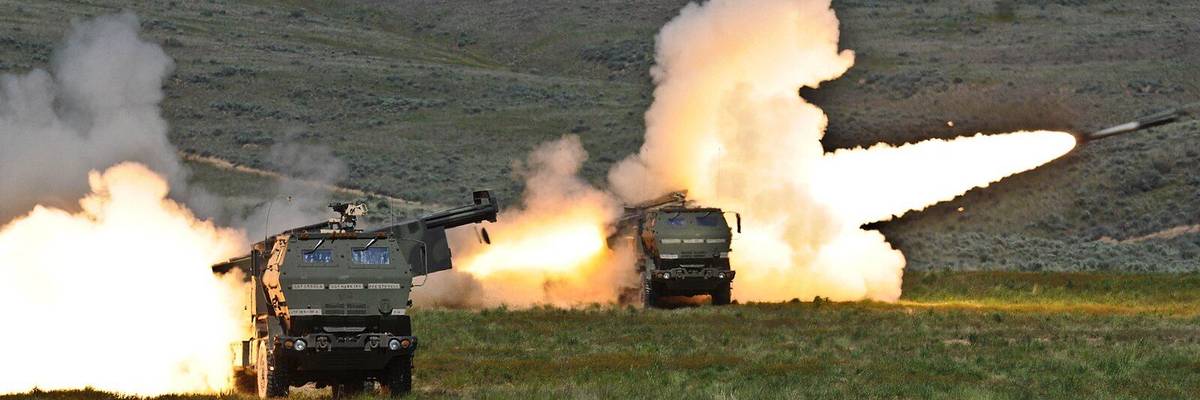
Lockheed Martin HIMARS rocket systems fire at the Yakima Training Center in Washington state.
China's foreign minister warned that US weapons sales to Taipei "will only accelerate the push towards a perilous state of military confrontation across the Taiwan Strait."
The Chinese government on Thursday condemned the Trump administration's announcement of a proposed $11 billion weapons package for Taiwan, a move that Beijing said violates both the "One China" principle and an agreement in which the US pledged to reduce arms sales to Taipei.
The US State Department said the record $11.154 billion package contains a broad range of weaponry and other military equipment, including Lockheed Martin High Mobility Artillery Rocket Systems (HIMARS), Lockheed Martin Army Tactical Missile System (ATACMS) long-range missiles, BAE Systems M109A7 self-propelled howitzers, drones and tactical software, Javelin and TOW missiles, and M2A1 machine guns and other armaments.
"This proposed sale serves US national, economic, and security interests by supporting the recipient’s continuing efforts to modernize its armed forces and to maintain a credible defensive capability," the State Department said in a statement. "The proposed sale will help improve the security of the recipient and assist in maintaining political stability, military balance, and economic progress in the region."
Taiwanese leaders thanked the US for its continued efforts to help the island defend itself.
However, Chen Binhua, spokesperson for China's Taiwan Affairs Office, blasted the proposed sale as “flagrant interference in China’s internal affairs" that "severely undermines China’s sovereignty and security interests and sends erroneous signals to separatist forces."
Chen said that the arms package "gravely violates" the "One China" principle, which, to the US means that the People's Republic of China (PRC) is “the sole legal government of China," but to Beijing means that Taiwan—which it views as a breakaway province—is an inseparable part of the Chinese nation.
While the US acknowledges the PRC's position that there is but one China, Washington does not recognize or accept Beijing's stance. Although it has no formal diplomatic relations with Taipei, the US is obliged under the 1979 Taiwan Relations Act to "provide Taiwan with arms of a defensive character."
China says this directly contradicts US obligations under the so-called "Three Communiques" with Beijing—especially an August 17, 1982 agreement under which Washington pledged that it would respect PRC sovereignty and that it "intends gradually to reduce its sale of arms to Taiwan."
China has accused the US of violating the August 17 communique with each of its many arms sales to Taiwan.
"We urge the United States to immediately cease its policy of arming Taiwan and to stop condoning and supporting separatist forces advocating Taiwan independence," Chen said Thursday. "We urge the United States to exercise the utmost caution in handling the Taiwan issue.”
Chen added that US "warmongers" and Taiwan's ruling Democratic Progressive Party—which he accused of “stubbornly pursuing independence”—risk turning the island into a "powder keg" and the Taiwanese people into "cannon fodder."
Under pressure from the Trump administration to buy more US arms, Taiwanese President Lai Ching-te last month announced a special $40 billion budget for the purchase of weapons between 2026 and 2033.
The latest proposed US arms sale follows Congress' passage of the 2026 National Defense Authorization Act (NDAA), which authorizes up to $1 billion in funding for Taiwan's defense. US President Donald Trump is expected to imminently sign the record $900.6 billion bill into law.
Chinese Foreign Ministry spokesperson Guo Jiakun said Thursday that the US effort to contain China by arming Taiwan is "doomed to fail."
"It will only accelerate the push towards a perilous state of military confrontation across the Taiwan Strait,” he added.
Dear Common Dreams reader, It’s been nearly 30 years since I co-founded Common Dreams with my late wife, Lina Newhouser. We had the radical notion that journalism should serve the public good, not corporate profits. It was clear to us from the outset what it would take to build such a project. No paid advertisements. No corporate sponsors. No millionaire publisher telling us what to think or do. Many people said we wouldn't last a year, but we proved those doubters wrong. Together with a tremendous team of journalists and dedicated staff, we built an independent media outlet free from the constraints of profits and corporate control. Our mission has always been simple: To inform. To inspire. To ignite change for the common good. Building Common Dreams was not easy. Our survival was never guaranteed. When you take on the most powerful forces—Wall Street greed, fossil fuel industry destruction, Big Tech lobbyists, and uber-rich oligarchs who have spent billions upon billions rigging the economy and democracy in their favor—the only bulwark you have is supporters who believe in your work. But here’s the urgent message from me today. It's never been this bad out there. And it's never been this hard to keep us going. At the very moment Common Dreams is most needed, the threats we face are intensifying. We need your support now more than ever. We don't accept corporate advertising and never will. We don't have a paywall because we don't think people should be blocked from critical news based on their ability to pay. Everything we do is funded by the donations of readers like you. When everyone does the little they can afford, we are strong. But if that support retreats or dries up, so do we. Will you donate now to make sure Common Dreams not only survives but thrives? —Craig Brown, Co-founder |
The Chinese government on Thursday condemned the Trump administration's announcement of a proposed $11 billion weapons package for Taiwan, a move that Beijing said violates both the "One China" principle and an agreement in which the US pledged to reduce arms sales to Taipei.
The US State Department said the record $11.154 billion package contains a broad range of weaponry and other military equipment, including Lockheed Martin High Mobility Artillery Rocket Systems (HIMARS), Lockheed Martin Army Tactical Missile System (ATACMS) long-range missiles, BAE Systems M109A7 self-propelled howitzers, drones and tactical software, Javelin and TOW missiles, and M2A1 machine guns and other armaments.
"This proposed sale serves US national, economic, and security interests by supporting the recipient’s continuing efforts to modernize its armed forces and to maintain a credible defensive capability," the State Department said in a statement. "The proposed sale will help improve the security of the recipient and assist in maintaining political stability, military balance, and economic progress in the region."
Taiwanese leaders thanked the US for its continued efforts to help the island defend itself.
However, Chen Binhua, spokesperson for China's Taiwan Affairs Office, blasted the proposed sale as “flagrant interference in China’s internal affairs" that "severely undermines China’s sovereignty and security interests and sends erroneous signals to separatist forces."
Chen said that the arms package "gravely violates" the "One China" principle, which, to the US means that the People's Republic of China (PRC) is “the sole legal government of China," but to Beijing means that Taiwan—which it views as a breakaway province—is an inseparable part of the Chinese nation.
While the US acknowledges the PRC's position that there is but one China, Washington does not recognize or accept Beijing's stance. Although it has no formal diplomatic relations with Taipei, the US is obliged under the 1979 Taiwan Relations Act to "provide Taiwan with arms of a defensive character."
China says this directly contradicts US obligations under the so-called "Three Communiques" with Beijing—especially an August 17, 1982 agreement under which Washington pledged that it would respect PRC sovereignty and that it "intends gradually to reduce its sale of arms to Taiwan."
China has accused the US of violating the August 17 communique with each of its many arms sales to Taiwan.
"We urge the United States to immediately cease its policy of arming Taiwan and to stop condoning and supporting separatist forces advocating Taiwan independence," Chen said Thursday. "We urge the United States to exercise the utmost caution in handling the Taiwan issue.”
Chen added that US "warmongers" and Taiwan's ruling Democratic Progressive Party—which he accused of “stubbornly pursuing independence”—risk turning the island into a "powder keg" and the Taiwanese people into "cannon fodder."
Under pressure from the Trump administration to buy more US arms, Taiwanese President Lai Ching-te last month announced a special $40 billion budget for the purchase of weapons between 2026 and 2033.
The latest proposed US arms sale follows Congress' passage of the 2026 National Defense Authorization Act (NDAA), which authorizes up to $1 billion in funding for Taiwan's defense. US President Donald Trump is expected to imminently sign the record $900.6 billion bill into law.
Chinese Foreign Ministry spokesperson Guo Jiakun said Thursday that the US effort to contain China by arming Taiwan is "doomed to fail."
"It will only accelerate the push towards a perilous state of military confrontation across the Taiwan Strait,” he added.
The Chinese government on Thursday condemned the Trump administration's announcement of a proposed $11 billion weapons package for Taiwan, a move that Beijing said violates both the "One China" principle and an agreement in which the US pledged to reduce arms sales to Taipei.
The US State Department said the record $11.154 billion package contains a broad range of weaponry and other military equipment, including Lockheed Martin High Mobility Artillery Rocket Systems (HIMARS), Lockheed Martin Army Tactical Missile System (ATACMS) long-range missiles, BAE Systems M109A7 self-propelled howitzers, drones and tactical software, Javelin and TOW missiles, and M2A1 machine guns and other armaments.
"This proposed sale serves US national, economic, and security interests by supporting the recipient’s continuing efforts to modernize its armed forces and to maintain a credible defensive capability," the State Department said in a statement. "The proposed sale will help improve the security of the recipient and assist in maintaining political stability, military balance, and economic progress in the region."
Taiwanese leaders thanked the US for its continued efforts to help the island defend itself.
However, Chen Binhua, spokesperson for China's Taiwan Affairs Office, blasted the proposed sale as “flagrant interference in China’s internal affairs" that "severely undermines China’s sovereignty and security interests and sends erroneous signals to separatist forces."
Chen said that the arms package "gravely violates" the "One China" principle, which, to the US means that the People's Republic of China (PRC) is “the sole legal government of China," but to Beijing means that Taiwan—which it views as a breakaway province—is an inseparable part of the Chinese nation.
While the US acknowledges the PRC's position that there is but one China, Washington does not recognize or accept Beijing's stance. Although it has no formal diplomatic relations with Taipei, the US is obliged under the 1979 Taiwan Relations Act to "provide Taiwan with arms of a defensive character."
China says this directly contradicts US obligations under the so-called "Three Communiques" with Beijing—especially an August 17, 1982 agreement under which Washington pledged that it would respect PRC sovereignty and that it "intends gradually to reduce its sale of arms to Taiwan."
China has accused the US of violating the August 17 communique with each of its many arms sales to Taiwan.
"We urge the United States to immediately cease its policy of arming Taiwan and to stop condoning and supporting separatist forces advocating Taiwan independence," Chen said Thursday. "We urge the United States to exercise the utmost caution in handling the Taiwan issue.”
Chen added that US "warmongers" and Taiwan's ruling Democratic Progressive Party—which he accused of “stubbornly pursuing independence”—risk turning the island into a "powder keg" and the Taiwanese people into "cannon fodder."
Under pressure from the Trump administration to buy more US arms, Taiwanese President Lai Ching-te last month announced a special $40 billion budget for the purchase of weapons between 2026 and 2033.
The latest proposed US arms sale follows Congress' passage of the 2026 National Defense Authorization Act (NDAA), which authorizes up to $1 billion in funding for Taiwan's defense. US President Donald Trump is expected to imminently sign the record $900.6 billion bill into law.
Chinese Foreign Ministry spokesperson Guo Jiakun said Thursday that the US effort to contain China by arming Taiwan is "doomed to fail."
"It will only accelerate the push towards a perilous state of military confrontation across the Taiwan Strait,” he added.