SUBSCRIBE TO OUR FREE NEWSLETTER
Daily news & progressive opinion—funded by the people, not the corporations—delivered straight to your inbox.
5
#000000
#FFFFFF
To donate by check, phone, or other method, see our More Ways to Give page.
Daily news & progressive opinion—funded by the people, not the corporations—delivered straight to your inbox.
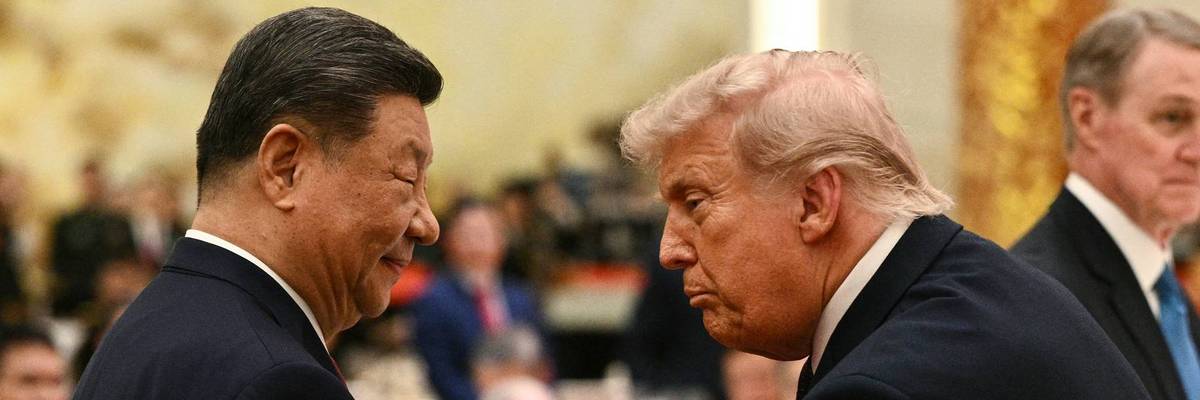
China's President Xi Jinping (L) looks at US President Donald Trump as they attend a state banquet at the Great Hall of the People in Beijing on May 14, 2026.
“Americans are increasingly supportive of US-China cooperation, while tensions with China do not serve American interests,” said dozens of anti-war groups as President Trump met with Chinese President Xi.
As US President Donald Trump meets with Chinese President Xi Jinping, a coalition of anti-war groups is calling on Congress to pressure the administration to "prioritize peace, cooperation, and stability" at a time when the US-China relationship is increasingly hostile.
“Americans are increasingly supportive of US-China cooperation, while tensions with China do not serve American interests,” argued the coalition, which includes Just Foreign Policy, Win Without War, the Friends Committee on National Legislation, Our Revolution, and dozens of other groups in a letter sent to members of Congress on Thursday.
They cited recent surveys showing that negative perceptions of China are consistently falling among Americans, including a Pew Research poll from January, which showed that just 28% of Americans viewed China as an "enemy" compared with 42% who saw it that way in 2024.
“At a time when so many domestic needs are going unmet, a confrontational posture toward China is costing untold billions of dollars in military build-up, trade and energy disruption, and securitization of technology—money that could and should be spent on the things Americans need at home," the coalition continued.
Trump's first visit to China in nearly a decade comes amid a global energy crisis caused by his war in Iran, a conflict where China has expressed a desire to act as a mediator.
While the coalition denounced Trump's war as "an unauthorized war of choice" that has led the world to a "deeply dangerous and uncertain place," it also said it presented an opportunity for the US and China to engage in diplomacy in hopes of putting the relationship "on a more stable footing."
Xi said that Taiwan remains the "most important issue in China-US relations” as the talks kicked off, warning that if mishandled, it could create a "very dangerous situation."
Secretary of State Marco Rubio said after a meeting on Thursday that the decades-old "One China Policy," which takes no explicit view on Taiwan's sovereignty, hasn't changed. He warned that it would be “a terrible mistake” for China to attempt to seize the island by force.
Friction between the US and China has only been heightened after Trump announced the sale of more than $11 billion worth of weapons to Taiwan in December, the largest ever arms sale to the island. At the time, China said the sale "gravely violates" the One China Policy.
The anti-war coalition warned that "current military and political trends in the United States, China, and Taiwan are moving us closer to a serious crisis or conflict over the island" and called on the US to "revitalize its One China Policy and press Beijing to reaffirm its focus on peaceful unification, with no timeline."
“Diplomacy with Beijing, rather than military posturing or arms racing across the Taiwan Strait,” they said, “is the only realistic path forward, especially since the American public has little interest in participating in a military conflict against China in defense of Taiwan.”
According to a survey by the Institute for Global Affairs in November, just 35% of Americans said they'd support the US sending troops to defend Taiwan if it were to be attacked by China. In a January poll commissioned by The New Republic, just 10% of Democratic voters said they wanted their party to support sending troops, and 30% wanted it to support sending weapons.
But Democratic leadership has pressured Trump to take the opposite approach and ramp up hostility toward Beijing in advance of this week's talks.
On Wednesday, Rep. Gregory Meeks (D-NY), the ranking member of the House Foreign Affairs Committee, was joined by Reps. Ro Khanna (D-Calif.), Jim Himes (D-Ct.), and Rep. Adam Smith (D-Wash.) to send a letter urging Trump to approve a delayed $14 billion arms sale to Taiwan ahead of his visit.
The Democrats on the House Foreign Affairs Committee joined in support for the sale, saying that "Trump must reaffirm in his meeting with Xi that the US will continue to uphold our longstanding One-China policy while standing firmly with Taiwan’s democracy and security. And he must make that clear by notifying Congress of the $14 billion arms sales to Taiwan. Anything else would undermine American credibility."
Just Foreign Policy (JFP) countered that the request to send more weapons just before talks were set to begin was "deeply unserious" and an "absurdly ill-timed move that would sabotage diplomacy—or worse."
Jake Werner, the director of the East Asia program at the Quincy Institute for Responsible Statecraft—another signatory to the anti-war letter—warned that while Democrats should confront Trump on the issue of China, they shouldn't goad him into an even more hawkish approach.
“If you want to attack Trump, that's great, but you should attack Trump on the basis of prudent, conflict-avoiding principles,” Werner said. “They should be criticizing him not for engaging in diplomacy, but for engaging in the wrong kind of diplomacy.”
In their letter to Congress, these and the other anti-war groups pushed for a similar diplomatic approach to other sources of tension with China, arguing that the US should take no position on the sovereignty of disputed territory in the South China Sea.
They also encouraged members of Congress to avoid creating "incentives" for other nations to adopt more confrontational stances toward China.
They singled out a first-ever test launch of an American Tomahawk missile in the Philippines last week, which had the capability to reach the Chinese mainland. Chinese military observers described it as the “worst provocation” in years by the US and suggested that Beijing should ramp up its air-defense and stealth-strike drone capabilities in response, according to the South China Morning Post.
The anti-war coalition said they "urge Congress to press the administration to avoid further escalatory signals and to instead pursue diplomacy to restore and expand non-proliferation agreements that can prevent a wasteful and dangerous arms race."
Dear Common Dreams reader, It’s been nearly 30 years since I co-founded Common Dreams with my late wife, Lina Newhouser. We had the radical notion that journalism should serve the public good, not corporate profits. It was clear to us from the outset what it would take to build such a project. No paid advertisements. No corporate sponsors. No millionaire publisher telling us what to think or do. Many people said we wouldn't last a year, but we proved those doubters wrong. Together with a tremendous team of journalists and dedicated staff, we built an independent media outlet free from the constraints of profits and corporate control. Our mission has always been simple: To inform. To inspire. To ignite change for the common good. Building Common Dreams was not easy. Our survival was never guaranteed. When you take on the most powerful forces—Wall Street greed, fossil fuel industry destruction, Big Tech lobbyists, and uber-rich oligarchs who have spent billions upon billions rigging the economy and democracy in their favor—the only bulwark you have is supporters who believe in your work. But here’s the urgent message from me today. It's never been this bad out there. And it's never been this hard to keep us going. At the very moment Common Dreams is most needed, the threats we face are intensifying. We need your support now more than ever. We don't accept corporate advertising and never will. We don't have a paywall because we don't think people should be blocked from critical news based on their ability to pay. Everything we do is funded by the donations of readers like you. When everyone does the little they can afford, we are strong. But if that support retreats or dries up, so do we. Will you donate now to make sure Common Dreams not only survives but thrives? —Craig Brown, Co-founder |
As US President Donald Trump meets with Chinese President Xi Jinping, a coalition of anti-war groups is calling on Congress to pressure the administration to "prioritize peace, cooperation, and stability" at a time when the US-China relationship is increasingly hostile.
“Americans are increasingly supportive of US-China cooperation, while tensions with China do not serve American interests,” argued the coalition, which includes Just Foreign Policy, Win Without War, the Friends Committee on National Legislation, Our Revolution, and dozens of other groups in a letter sent to members of Congress on Thursday.
They cited recent surveys showing that negative perceptions of China are consistently falling among Americans, including a Pew Research poll from January, which showed that just 28% of Americans viewed China as an "enemy" compared with 42% who saw it that way in 2024.
“At a time when so many domestic needs are going unmet, a confrontational posture toward China is costing untold billions of dollars in military build-up, trade and energy disruption, and securitization of technology—money that could and should be spent on the things Americans need at home," the coalition continued.
Trump's first visit to China in nearly a decade comes amid a global energy crisis caused by his war in Iran, a conflict where China has expressed a desire to act as a mediator.
While the coalition denounced Trump's war as "an unauthorized war of choice" that has led the world to a "deeply dangerous and uncertain place," it also said it presented an opportunity for the US and China to engage in diplomacy in hopes of putting the relationship "on a more stable footing."
Xi said that Taiwan remains the "most important issue in China-US relations” as the talks kicked off, warning that if mishandled, it could create a "very dangerous situation."
Secretary of State Marco Rubio said after a meeting on Thursday that the decades-old "One China Policy," which takes no explicit view on Taiwan's sovereignty, hasn't changed. He warned that it would be “a terrible mistake” for China to attempt to seize the island by force.
Friction between the US and China has only been heightened after Trump announced the sale of more than $11 billion worth of weapons to Taiwan in December, the largest ever arms sale to the island. At the time, China said the sale "gravely violates" the One China Policy.
The anti-war coalition warned that "current military and political trends in the United States, China, and Taiwan are moving us closer to a serious crisis or conflict over the island" and called on the US to "revitalize its One China Policy and press Beijing to reaffirm its focus on peaceful unification, with no timeline."
“Diplomacy with Beijing, rather than military posturing or arms racing across the Taiwan Strait,” they said, “is the only realistic path forward, especially since the American public has little interest in participating in a military conflict against China in defense of Taiwan.”
According to a survey by the Institute for Global Affairs in November, just 35% of Americans said they'd support the US sending troops to defend Taiwan if it were to be attacked by China. In a January poll commissioned by The New Republic, just 10% of Democratic voters said they wanted their party to support sending troops, and 30% wanted it to support sending weapons.
But Democratic leadership has pressured Trump to take the opposite approach and ramp up hostility toward Beijing in advance of this week's talks.
On Wednesday, Rep. Gregory Meeks (D-NY), the ranking member of the House Foreign Affairs Committee, was joined by Reps. Ro Khanna (D-Calif.), Jim Himes (D-Ct.), and Rep. Adam Smith (D-Wash.) to send a letter urging Trump to approve a delayed $14 billion arms sale to Taiwan ahead of his visit.
The Democrats on the House Foreign Affairs Committee joined in support for the sale, saying that "Trump must reaffirm in his meeting with Xi that the US will continue to uphold our longstanding One-China policy while standing firmly with Taiwan’s democracy and security. And he must make that clear by notifying Congress of the $14 billion arms sales to Taiwan. Anything else would undermine American credibility."
Just Foreign Policy (JFP) countered that the request to send more weapons just before talks were set to begin was "deeply unserious" and an "absurdly ill-timed move that would sabotage diplomacy—or worse."
Jake Werner, the director of the East Asia program at the Quincy Institute for Responsible Statecraft—another signatory to the anti-war letter—warned that while Democrats should confront Trump on the issue of China, they shouldn't goad him into an even more hawkish approach.
“If you want to attack Trump, that's great, but you should attack Trump on the basis of prudent, conflict-avoiding principles,” Werner said. “They should be criticizing him not for engaging in diplomacy, but for engaging in the wrong kind of diplomacy.”
In their letter to Congress, these and the other anti-war groups pushed for a similar diplomatic approach to other sources of tension with China, arguing that the US should take no position on the sovereignty of disputed territory in the South China Sea.
They also encouraged members of Congress to avoid creating "incentives" for other nations to adopt more confrontational stances toward China.
They singled out a first-ever test launch of an American Tomahawk missile in the Philippines last week, which had the capability to reach the Chinese mainland. Chinese military observers described it as the “worst provocation” in years by the US and suggested that Beijing should ramp up its air-defense and stealth-strike drone capabilities in response, according to the South China Morning Post.
The anti-war coalition said they "urge Congress to press the administration to avoid further escalatory signals and to instead pursue diplomacy to restore and expand non-proliferation agreements that can prevent a wasteful and dangerous arms race."
As US President Donald Trump meets with Chinese President Xi Jinping, a coalition of anti-war groups is calling on Congress to pressure the administration to "prioritize peace, cooperation, and stability" at a time when the US-China relationship is increasingly hostile.
“Americans are increasingly supportive of US-China cooperation, while tensions with China do not serve American interests,” argued the coalition, which includes Just Foreign Policy, Win Without War, the Friends Committee on National Legislation, Our Revolution, and dozens of other groups in a letter sent to members of Congress on Thursday.
They cited recent surveys showing that negative perceptions of China are consistently falling among Americans, including a Pew Research poll from January, which showed that just 28% of Americans viewed China as an "enemy" compared with 42% who saw it that way in 2024.
“At a time when so many domestic needs are going unmet, a confrontational posture toward China is costing untold billions of dollars in military build-up, trade and energy disruption, and securitization of technology—money that could and should be spent on the things Americans need at home," the coalition continued.
Trump's first visit to China in nearly a decade comes amid a global energy crisis caused by his war in Iran, a conflict where China has expressed a desire to act as a mediator.
While the coalition denounced Trump's war as "an unauthorized war of choice" that has led the world to a "deeply dangerous and uncertain place," it also said it presented an opportunity for the US and China to engage in diplomacy in hopes of putting the relationship "on a more stable footing."
Xi said that Taiwan remains the "most important issue in China-US relations” as the talks kicked off, warning that if mishandled, it could create a "very dangerous situation."
Secretary of State Marco Rubio said after a meeting on Thursday that the decades-old "One China Policy," which takes no explicit view on Taiwan's sovereignty, hasn't changed. He warned that it would be “a terrible mistake” for China to attempt to seize the island by force.
Friction between the US and China has only been heightened after Trump announced the sale of more than $11 billion worth of weapons to Taiwan in December, the largest ever arms sale to the island. At the time, China said the sale "gravely violates" the One China Policy.
The anti-war coalition warned that "current military and political trends in the United States, China, and Taiwan are moving us closer to a serious crisis or conflict over the island" and called on the US to "revitalize its One China Policy and press Beijing to reaffirm its focus on peaceful unification, with no timeline."
“Diplomacy with Beijing, rather than military posturing or arms racing across the Taiwan Strait,” they said, “is the only realistic path forward, especially since the American public has little interest in participating in a military conflict against China in defense of Taiwan.”
According to a survey by the Institute for Global Affairs in November, just 35% of Americans said they'd support the US sending troops to defend Taiwan if it were to be attacked by China. In a January poll commissioned by The New Republic, just 10% of Democratic voters said they wanted their party to support sending troops, and 30% wanted it to support sending weapons.
But Democratic leadership has pressured Trump to take the opposite approach and ramp up hostility toward Beijing in advance of this week's talks.
On Wednesday, Rep. Gregory Meeks (D-NY), the ranking member of the House Foreign Affairs Committee, was joined by Reps. Ro Khanna (D-Calif.), Jim Himes (D-Ct.), and Rep. Adam Smith (D-Wash.) to send a letter urging Trump to approve a delayed $14 billion arms sale to Taiwan ahead of his visit.
The Democrats on the House Foreign Affairs Committee joined in support for the sale, saying that "Trump must reaffirm in his meeting with Xi that the US will continue to uphold our longstanding One-China policy while standing firmly with Taiwan’s democracy and security. And he must make that clear by notifying Congress of the $14 billion arms sales to Taiwan. Anything else would undermine American credibility."
Just Foreign Policy (JFP) countered that the request to send more weapons just before talks were set to begin was "deeply unserious" and an "absurdly ill-timed move that would sabotage diplomacy—or worse."
Jake Werner, the director of the East Asia program at the Quincy Institute for Responsible Statecraft—another signatory to the anti-war letter—warned that while Democrats should confront Trump on the issue of China, they shouldn't goad him into an even more hawkish approach.
“If you want to attack Trump, that's great, but you should attack Trump on the basis of prudent, conflict-avoiding principles,” Werner said. “They should be criticizing him not for engaging in diplomacy, but for engaging in the wrong kind of diplomacy.”
In their letter to Congress, these and the other anti-war groups pushed for a similar diplomatic approach to other sources of tension with China, arguing that the US should take no position on the sovereignty of disputed territory in the South China Sea.
They also encouraged members of Congress to avoid creating "incentives" for other nations to adopt more confrontational stances toward China.
They singled out a first-ever test launch of an American Tomahawk missile in the Philippines last week, which had the capability to reach the Chinese mainland. Chinese military observers described it as the “worst provocation” in years by the US and suggested that Beijing should ramp up its air-defense and stealth-strike drone capabilities in response, according to the South China Morning Post.
The anti-war coalition said they "urge Congress to press the administration to avoid further escalatory signals and to instead pursue diplomacy to restore and expand non-proliferation agreements that can prevent a wasteful and dangerous arms race."