SUBSCRIBE TO OUR FREE NEWSLETTER
Daily news & progressive opinion—funded by the people, not the corporations—delivered straight to your inbox.
5
#000000
#FFFFFF
To donate by check, phone, or other method, see our More Ways to Give page.


Daily news & progressive opinion—funded by the people, not the corporations—delivered straight to your inbox.
"This decision will ensure nothing but a continued lack of justice and accountability for everyone involved in the 9/11 military trial at Guantánamo," said one critic.
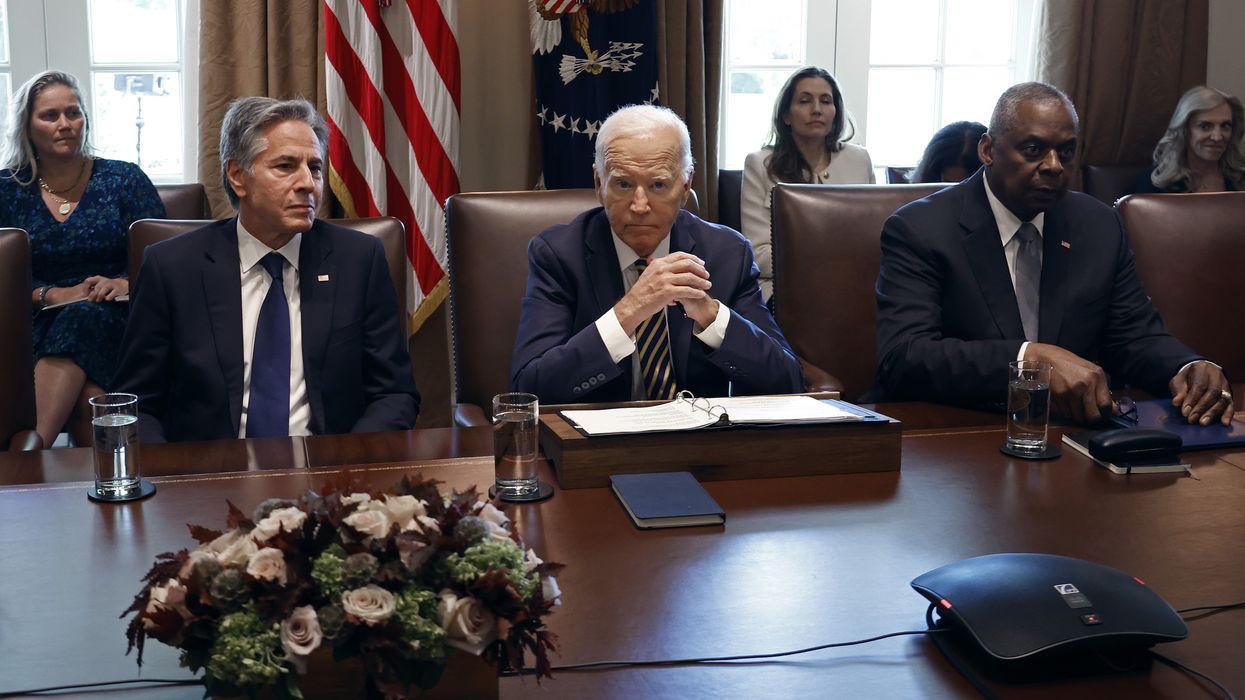
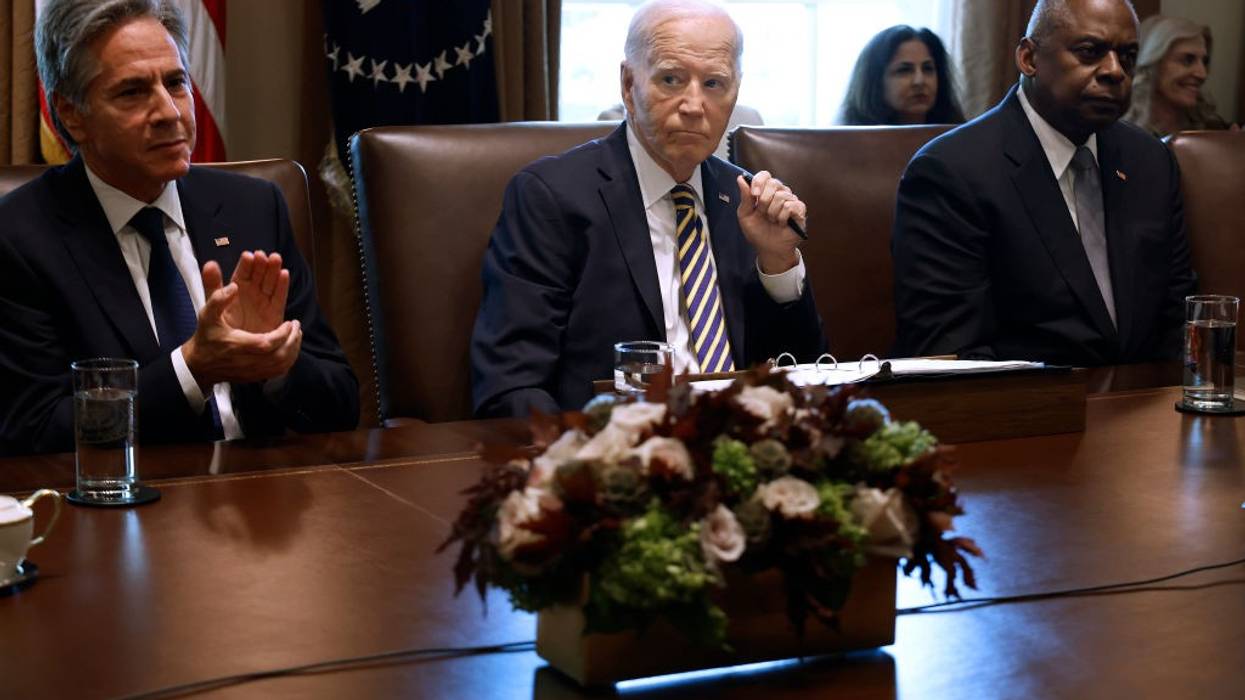
Human rights defenders on Friday condemned a federal appellate panel's decision upholding former U.S. Defense Secretary Lloyd Austin's withdrawal of pretrial plea agreements for three men accused of plotting the September 11, 2001 attacks on the United States.
Austin, who served under former President Joe Biden, "indisputably had legal authority to withdraw from the agreements; the plain and unambiguous text of the pretrial agreements shows that no performance of promises had begun," the D.C. Court of Appeals panel ruled in a 2-1 decision.
Under the proposed deal, accused 9/11 mastermind Khalid Sheikh Mohammed and alleged co-conspirators Mustafa al-Hawsawi and Walid bin Attash would have been spared execution in return for pleading guilty. The agreement came amid years of stalled legal proceedings in a case complicated by the U.S. government's torture of the defendants and efforts to cover it up.
Austin withdrew the plea agreements last August, explaining that he "long believed that the families of the victims, our service members, and the American public deserves the opportunity to see military commission trials carried out in this case."
However, attorneys for the defendants called the legally dubious military commission regime established at the Guantánamo Bay prison—notorious for detainee torture and indefinite detention—during the George W. Bush administration "obviously corrupt and rigged." During the 2000s, several military prosecutors resigned from the commissions in protest over what some of them called a rigged system designed to ensure there were no acquittals.
"The 9/11 case will never be resolved through a contested trial because the defendants were tortured by the CIA."
Last November, Air Force Col. Matthew McCall, a military judge, ruled that Lloyd "did not have the authority to do what he did, asserting that the plea deals "remain valid, and are enforceable," prompting the government's appeal. The following month, a military appeals court also ruled against Austin's bid to ditch the plea deals.
The Center for Constitutional Rights (CCR)—which has long represented Guantánamo detainees—called Friday's decision "a betrayal of justice."
"This decision will ensure nothing but a continued lack of justice and accountability for everyone involved in the 9/11 military trial at Guantánamo," CCR senior staff attorney Wells Dixon said in a statement. "The Biden administration's invalidation of plea agreements that would have resulted in convictions and life sentences for the 9/11 defendants is a painful betrayal of 9/11 victims' families."
"The 9/11 case will never be resolved through a contested trial because the defendants were tortured by the CIA," Dixon added. "The only way to resolve this case is for the Trump administration to succeed where every prior administration has failed and negotiate new deals with the 9/11 defendants that will finally close the 'War on Terror' prison at Guantánamo."
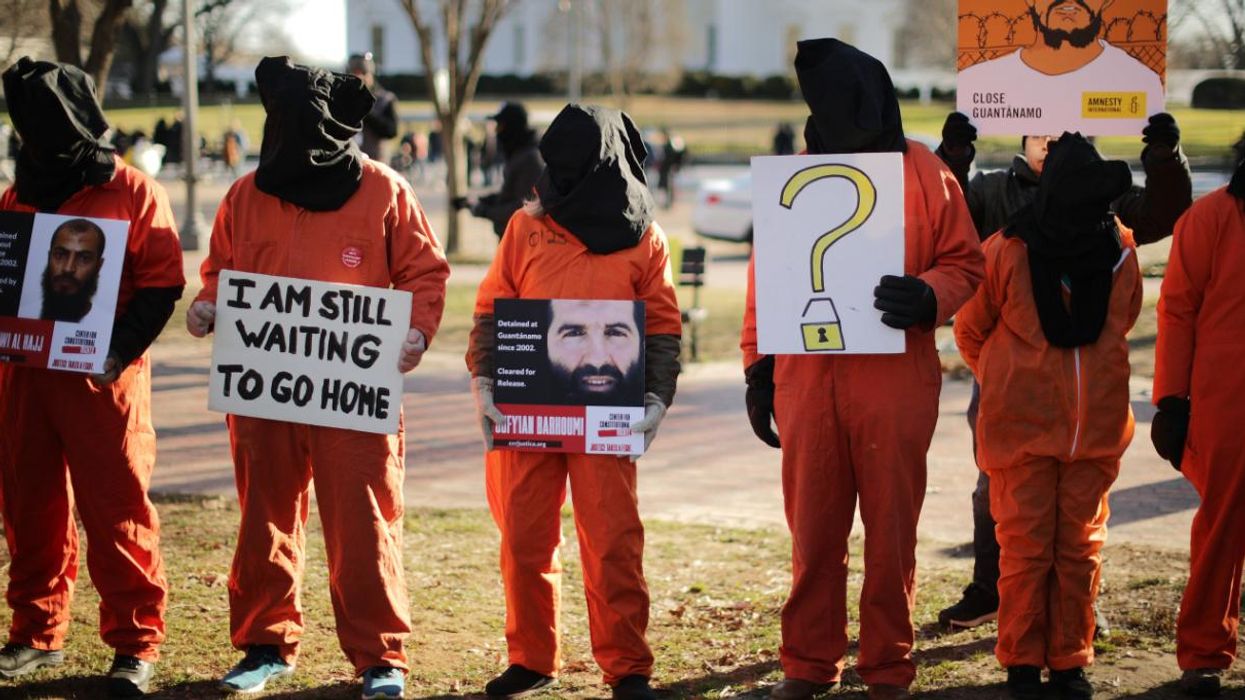
There are still 15 men currently imprisoned in Guantánamo, which is located on Cuban land leased to the U.S. in perpetuity by a dictatorship overthrown in 1959. Multiple detainees have been cleared for release, one of them for 15 years.
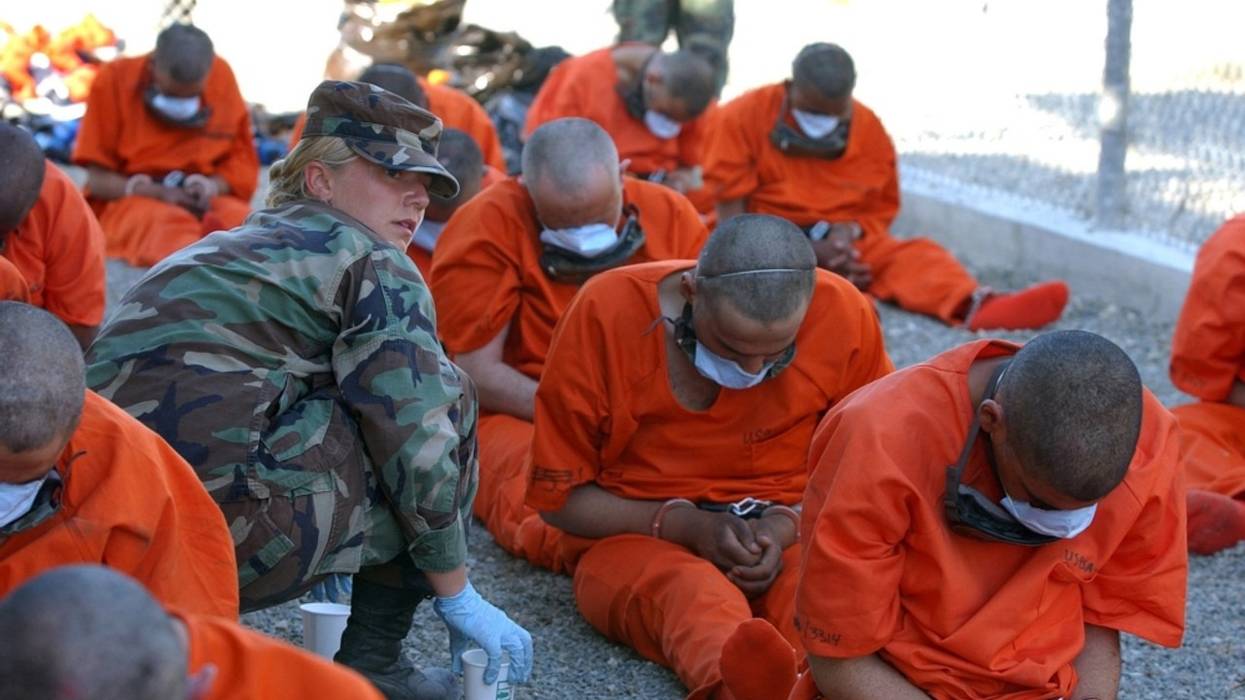
Some legal experts doubted whether the U.S. government would ever be able to try, let alone convict, the 9/11 suspects. Military judges and prosecutors have cited defendants' torture in declining to proceed with cases against them. Many men and boys were tortured at CIA "black sites," Guantánamo, and military prisons including Abu Ghraib. At least dozens of detainees died.
The three co-defendants were all captured in Pakistan during late 2002 and early 2003. After being turned over the United States, they were sent to CIA black sites, including the notorious "Salt Pit" outside Kabul, Afghanistan, where suspected militant Gul Rahman was tortured to death in November 2002. In 2006, the men were transferred to Guantánamo.
Mohammed was subjected to interrupted drowning, commonly called "waterboarding," 183 times, as well as other torture and abuse approved under the Bush administration's "enhanced interrogation" program. Hawsawi suffered a shredded rectum resulting from sodomization during so-called "rectal hydration" and has had to manually reinsert parts of his anal cavity to defecate. Bin Attash said he was placed in stress positions for extended periods, beaten, and doused in cold water.
The co-defendants must now decide whether to appeal the ruling to the full D.C. appeals court, the U.S. Supreme Court, or both.
"Putting aside the fantasy that this case is ever going to go to trial—assuming it does go to trial and that there's a conviction—you get to sentencing, and they have a right to put forward evidence... that they were tortured," Dixon told CNN Friday. "That's never going to happen."
A veteran war crimes lawyer argues that "there are solid grounds to investigate Joe Biden, Antony Blinken, and Lloyd Austin for complicity in Israel's crimes."
A human rights group revealed Monday that on the last full day of U.S. President Joe Biden's term, it encouraged the International Criminal Court to investigate him and two of his Cabinet members for "aiding and abetting" Israeli war crimes and crimes against humanity in the Gaza Strip.
U.S.-based Democracy for the Arab World Now (DAWN) announced that on January 19, it submitted to the ICC Prosecutor Karim Khan a 172-page communication detailing why the tribunal should probe Biden and his former secretaries of defense and state, Lloyd Austin and Anthony Blinken.
Although a fragile cease-fire took effect in Gaza last month, Israel—backed by the Biden administration and Congress—responded to the Hamas-led October 7, 2023 attack with a 15-month blockade and military assault that killed tens of thousands, possibly hundreds of thousands, of Palestinians and left the territory in ruins.
"There are solid grounds to investigate Joe Biden, Antony Blinken and Lloyd Austin for complicity in Israel's crimes," DAWN board member and veteran war crimes lawyer Reed Brody said in a Monday statement. "The bombs dropped on Palestinian hospitals, schools, and homes are American bombs, the campaign of murder and persecution has been carried out with American support. U.S. officials have been aware of exactly what Israel is doing, and yet their support never stopped."
"By investigating and prosecuting U.S. officials, the ICC can deter and discourage further international support for Israeli crimes in Gaza and demonstrate that no one is above the law."
DAWN's document lays out how the United States, under Biden, "provided unwavering direct military and political support to Israel, even after it became manifest that Israel continued to carry out severe violations of international humanitarian law and human rights." That includes at least $17.9 billion in taxpayer-funded military assistance since October 2023, a 381% increase from the around $3.8 billion a year before Hamas' attack.
"In addition to new arms transfers and sales authorizations, the U.S. used pre-existing contracts and additional emergency military aid measures to expedite the delivery of major arms," the submission continues, also noting "the deployment of U.S.-operated military intelligence and active military operations targeting groups posing threats to Israel on other fronts."
Israel—like the United States—is not a party to the Hague-based ICC, but Palestine is. The court in November issued arrest warrants for Israeli Prime Minister Benjamin Netanyahu, former Israeli Defense Minister Yoav Gallant, and Hamas leader Mohammed Diab Ibrahim Al-Masri, also known as Mohammed Deif, who is dead.
DAWN's submission makes the case that "by continuously and unconditionally providing political support and military
support to Israel while being fully aware of the specific crimes committed by Netanyahu, Gallant, and their subordinates, President Biden, Secretary Blinken, and Secretary Austin contributed intentionally to the commission of those crimes while at least knowing the intention of the group to commit the Israeli crimes, if not aiming of furthering such criminal activity."
The group's executive director, Sarah Leah Whitson, said Monday that "not only did Biden, Blinken, and Secretary Austin ignore and justify the overwhelming evidence of Israel's grotesque and deliberate crimes, overruling their own staff recommendations to halt weapons transfers to Israel, they doubled down by providing Israel with unconditional military and political support to ensure it could carry out its atrocities."
"They provided Israel with not only essential military support but equally essential political support by vetoing multiple cease-fire resolutions at the U.N. Security Council to ensure Israel could continue its crimes," Whitson highlighted. She argued that "by investigating and prosecuting U.S. officials, the ICC can deter and discourage further international support for Israeli crimes in Gaza and demonstrate that no one is above the law."
DAWN also recommended that the ICC consider looking into half a dozen other Biden officials including Jake Sullivan, national security adviser; Gina Raimondo, secretary of commerce; Bonnie Jenkins, under secretary of arms control and international security; Stanley L. Brown, acting assistant secretary for the Bureau of Political-Military Affairs; Amanda Dory, acting under secretary of defense for policy; and Mike Miller, acting director of the Defense Security Cooperation Agency.
"It is important for the international community, and Palestinians in particular, to know that the American people do not support the crimes their elected officials committed in Palestine and that American organizations are doing their part to hold these officials accountable," said Whitson. "We have a duty, not just a right, as American civil society, to exercise our free speech to serve truth and seek justice."
So far, efforts to hold Biden and other U.S. leaders accountable for enabling what many experts around the world have called Israel's genocidal assault on Gaza via the U.S. court system have been unsuccessful. That includes a December lawsuit against Blinken backed by DAWN—which was founded by assassinated Saudi journalist Jamal Khashoggi.
"We have tried every available avenue within the U.S. to stop our government's complicity in the outrageous crimes we've witnessed since October 2023 in Gaza," said Raed Jarrar, DAWN's advocacy director. "When domestic institutions fail to uphold black-letter laws prohibiting military support to commit war crimes, we have a particular responsibility as Americans to hold American officials accountable for their roles in those crimes."
Since Biden left office last month, U.S. President Donald Trump has already welcomed Netanyahu to the White House, responded to the warrants by targeting the ICC with sanctions, and promoted a U.S. takeover of Gaza that would involve ethnically cleansing the territory of Palestinians.
"Trump isn't just obstructing justice; he's trying to burn down the courthouse to prevent anyone from holding Israeli criminals accountable," said Jarrar. "His plan to forcibly displace all Palestinians from Gaza should also merit ICC investigation—not just for aiding and abetting Israeli crimes but for ordering forcible transfer, a crime against humanity under the Rome Statute."
Once you violate both fair treatment of prisoners and the basic principles of law, finding an unchallenged resolution to such cases is essentially inconceivable.
On January 10, one day before the 23rd anniversary of its opening, a much-anticipated hearing was set to take place at the Guantánamo Bay Detention Facility on the island of Cuba. After nearly 17 years of pretrial litigation, the prosecution of Khalid Sheikh Mohammed, or (KSM), the “mastermind” of the devastating attacks of September 11, 2001, seemed poised to achieve its ever-elusive goal of bringing his case to a conclusion. After three years of negotiations, the Pentagon had finally arranged a plea deal in the most significant case at Guantánamo. Along with two others accused of conspiring in the attacks of 9/11, KSM had agreed to plead guilty in exchange for the government replacing the death penalty with a life sentence.
After more than 50 pre-trial hearings and other related proceedings, Americans–and the victims’ families—would finally see closure for those three individuals who stood at the center of this country’s attempt to reckon legally with the 9/11 attacks.
More than 23 years after the 9/11 attacks, here we are in the very same place we’ve been for endless years—on pause again, despite the endless charade of forward steps that go nowhere.
Because of the fact that the defendants had been tortured at notorious CIA “black sites” before arriving at Guantánamo, the case had long been endlessly stalled. After all, so much of the evidence against them came from torture confessions. As it happens, such evidence is not admissible in court under U.S. or international law, or even under the rules of Guantánamo’s military commissions. For obvious reasons, it’s considered tainted information, “the fruit of the poisonous tree,” and so inadmissible in court. Although military commission prosecutors tried repeatedly over the years to find ways to introduce that all too tainted evidence at trial, attempts to do so failed time and again, repeatedly pushing potential trial dates years into the future. As a recently compiled Center on National Security chart shows, the forever delays in those hearings led to calendars of such length as to defy comprehension. In Khalid Sheikh Mohammed’s case, for example, such delays have so far amounted to 870.7 weeks.
With the plea deal now set to come before Judge Matthew McCall, who had agreed to delay his retirement in an effort to see this case to its conclusion, attorneys, journalists, and victims’ family members boarded planes, preparing to witness the longed-for conclusion to a case that had seemed endless. Perhaps you won’t be surprised to learn, however, that the hearing never took place. Delay was again the name of the game. As it turned out, from the moment the plea deal was announced, it became the centerpiece of an intense battle launched by then-Secretary of Defense Lloyd Austin.
Two days after the August 2024 announcement of the plea deal by the “convening authority,” Brigadier General (Ret.) Susan Escallier, the Pentagon official in charge of the military commissions at Guantánamo Bay, Austin summarily overruled her, revoking the plea deal with little explanation and leaving experts and observers alike confused and disappointed. Had the secretary of defense not been consulted on the plea arrangement? That seemed unlikely. Had political pressure caused him to take such a drastic act? If so, then perhaps after the election he would change his mind and restore it. No such luck.
Whatever Austin’s motivation, Judge McCall refused to take “no” for an answer, declaring his revocation invalid.
McCall made it clear, instead, that he was moving forward. As the judge explained, in the memo that Austin had long ago issued appointing Escallier, he had attested to her independent authority. “Ms. Escallier shall exercise her independent legal discretion with regard to judicial acts and other duties of the Convening Authority.” But even as McCall prepared to go forward, Austin appealed to the Court of Military Commissions Review, asking it to rule that he did indeed have the authority to revoke the plea deal. However, that court then ruled that the secretary had improperly rescinded the deal after it had taken effect.
Still, he refused to give up, seeking help elsewhere. And he found it. On the eve of the scheduled hearing, the Department of Justice filed papers asking the D.C. Circuit Court to prohibit the Gitmo court from moving ahead and to stay proceedings while it contemplated the decision. Those who had flown to Guantánamo then returned home, and a new hearing was set for January 28th at the D.C. Circuit Court. At issue was both Austin’s authority to take over the plea deal and whether he had the right to withdraw from it, as lawyers argue that the dependents had already started performing their part of the deal. Of course, in the second age of Trump, it is no longer Austin but Secretary of Defense Pete Hegseth who will decide what happens next.
So, more than 23 years after the 9/11 attacks, here we are in the very same place we’ve been for endless years—on pause again, despite the endless charade of forward steps that go nowhere.
At this point, it’s worth asking whether the resolution of those cases by trial was ever a priority—or even a realistic goal. A look back over the course of the military commissions and the 9/11 case suggests some answers.
The Guantánamo detention facility was set up by a presidential military order issued on November 13, 2001. It authorized the detention of war-on-terror captives and mentioned future trials. “It is necessary for individuals subject to this order… to be detained, and, when tried, to be tried for violations of the laws of war and other applicable laws by military tribunals.” Accordingly, the commander of the naval base at Guantánamo spent the early months of the detention operation scouring the base itself for a suitable facility in which to hold such trials. He was surprised when no one at the Pentagon approached him about the need for such a building.
So here we stand, with Donald Trump back in the White House, awaiting what this will mean for the future of the forever prison.
Fast forward six years, a year after those “high-value detainees” already tortured at CIA black sites were brought to Guantánamo. As NBC’s Bob Windrem later reported, an “Expeditionary Legal Complex was built in 2007 in the expectation it would be used for the trial of terrorists accused of murdering nearly 3,000 people with twin attacks on New York and Washington on September 11, 2001.” In 2008, the 9/11 defendants were charged. And last April, 17 years later, the Pentagon opened a second courtroom at the cost of $4 million for other cases pending before the military tribunals. Intrepid New York Times Gitmo reporter Carol Rosenberg recently summed up the costs associated with those signs of a continuing belief that actual trial proceedings were indeed in the cards this way: “The war court proceedings have cost hundreds of millions of dollars in salaries, infrastructure, and transportation. Since 2019, the Office of Military Commissions has added two new courtroom chambers, new offices and temporary housing, more lawyers, more security personnel, and more contractors.”
On the surface, it would seem as if the commitment to holding various war-on-terror trials was perfectly real. The price tag was certainly hefty enough, as were the numerous pre-trial proceedings in the 9/11 case, as well as in other cases before the military commissions, each involving charges against those accused of committing acts of terrorism—the bombing of the U.S.S. Cole destroyer with one defendant; terror bombings in Bali, Indonesia, with three defendants; and the cases of several other individuals charged with crimes of terrorism.
Yet given the failure of significant forward movement in such cases for so long, it’s hard not to wonder just how serious the commitment to resolving them ever was and whether the construction of such expensive trial buildings was either a mirage, intended to hide the fact that the cases were destined to go nowhere, or self-deception on the part of presidents George W. Bush, Barack Obama, and Joe Biden. (Donald Trump halted the military commissions during his first term in office, leaving them in legal limbo.)
After all this time, only two cases have ever gone to trial, one of which, that of Salim Hamdan, was later overturned. In the other, Ali Hamza al-Bahlul was convicted on three counts, two of which were eventually overturned. (At present, Mr. Bahlul is serving a life sentence at Gitmo, having arrived on its opening day 23 years ago.)
Meanwhile, there have been a grand total of nine plea deals over all these years. Of those, one convicted detainee is serving out a sentence at Guantánamo that ends in 2032, two convictions have been overturned, and two remain on appeal—a paltry record at best, especially given the grimness of those acts of terror. For all of the time, effort, and money, not to mention emotional distress, the results have been appallingly minimal.
To his credit, President Joe Biden, who inherited a Guantánamo with only 40 detainees left out of a total population that once stood at 790, seemed determined to make progress both in the military commissions and in releasing some of the remaining “forever prisoners” (a term originally coined by Times reporter Rosenberg to describe those living in the legal limbo of indefinite detention, neither charged nor released). Biden provided Gitmo watchers (like me) with some hope that the prison, distinctly offshore of American justice, would actually close someday.
During Biden’s years in office, the population was reduced to 15 men—six forever prisoners and nine still part of the military commissions (two of whom are already convicted). Eleven of the Biden releases, consisting of Yemenis sent to Oman, occurred amid the battle over Khalid Sheikh Mohammed’s plea deal, as if he were whispering to us that we needn’t worry, the road to closure was still available. Yet even that set of transfers suffered from the same sort of one-step-forward-two steps-back shuffle that’s been the essence of Gitmo’s history. The Oman arrangement had originally been planned for October 2023, only to be put on pause once the war in Gaza erupted. One of the men released had been cleared since 2010, only to await arrangements made two presidencies later.
The Biden administration unfortunately never released the last prisoners held without charge or brought the accused to trial. Even in these final moments of his presidency, when he was arguably free to do whatever he wanted, including closing the prison, he chose instead, by virtue of his administration putting the deal on hold, to halt forward progress, leaving us to wonder why.
So here we stand, with Donald Trump back in the White House, awaiting what this will mean for the future of the forever prison.
Sometimes, when it comes to Gitmo, it almost seems as if forces beyond the capacity of mere mortals are at play. No matter what promises are made, no matter what hope-inspiring acts are taken, no matter what progress occurs, the prison seems to have a life of its own, aided and abetted by those who continue to mount obstacles to any significant steps forward.
Of course, the biggest of the lessons learned should have been to honor the laws, both domestic and international, forbidding torture. Had the United States not authorized a program of what was euphemistically referred to by the administration of President George W. Bush as “enhanced interrogation techniques,” including beatings, waterboarding, sleep deprivation, sexual humiliation, sensory bombardment, and all too much more, those trials could have been held in a timely fashion and in federal court on the mainland.
As President Barack Obama’s attorney general, Eric Holder, had wanted, the federal courts would have been capable of handling such cases without using “evidence” produced by torture. In fact, one Guantánamo detainee, Ahmed Ghailani, was indeed transferred to the United States for trial in federal court and, though he was acquitted on 284 of 285 charges, he was found guilty on one count and sentenced to life in federal prison. Still, the hundreds of acquittals in his case chased away the idea of trying the remaining Guantánamo defendants in federal court.
From all of this, there’s a basic lesson to be learned: Once you violate both fair treatment of prisoners and the basic principles of law, finding an unchallenged resolution to such cases is essentially inconceivable.
In other words, once you break it, you can never really fix it.
Today, that long, soul-crushing, legally abhorrent story stands, at a far greater cost than we might once have imagined, where it has always stood—as a mistake that never should have happened and that, once made, never found a leader able to muster the courage to end it.
"Every landmine planted is a child, a civilian, a woman, who is just waiting for their legs to be blown off, for his life to be taken," said one survivor who lost a leg to a landmine in 2005.
"Look what anti-personnel landmines will do to your people," read a sign displayed by two of the protesters who gathered in Siem Reap, Cambodia this week to confront delegates at a conference on the Anti-Personnel Mine Ban Treaty.
The people holding the sign were among those who took part in the demonstration while using wheelchairs or crutches due to the amputations and serious injuries they have suffered from landmine attacks.
More than 100 people lined a walkway leading to the conference venue on Sunday as the Siem Reap-Angkor Summit on a Mine-Free World opened.
The conference began days after the Biden administration announced a reversal of its own policy and approved a plan to provide anti-personnel landmines to Ukraine—a decision that was condemned by the International Campaign to Ban Landmines (ICBL) and other human rights groups.
As Amnesty International USA advocacy direct Ben Linden said last week, the weapons are "inherently indiscriminate" because they cause explosives to scatter across a wide region, putting people at risk long after conflicts end. The majority of landmine victims are children.
In 2023, at least 5,757 people were killed or maimed by landmines, 84% of whom were civilians. Over one-third were children.
Alex Munyambabazi, who lost a leg to a landmine in 2005 in Uganda, was among those who assembled at the landmines summit.
"We don't want to see any more victims like me, we don't want to see any more suffering," he told Agence France-Presse (AFP). "Every landmine planted is a child, a civilian, a woman, who is just waiting for their legs to be blown off, for his life to be taken. I am here to say we don't want any more victims. No excuses, no exceptions."
The U.S. and Russia are not signatories to the Convention on the Prohibition of the Use, Stockpiling, Production, and Transfer of Anti-Personnel Mines and on Their Destruction, but Ukraine is. According to U.S. Defense Secretary Lloyd Austin, Ukraine "asked" for anti-personnel landmines.
Tamar Gabelnick, director of ICBL, told AFP that Ukraine's use of U.S.-supplied landmines would signify a "blatant disregard for their obligations under the mine ban treaty."
Ukrainian delegates were present at the Siem Reap conference this week.
In a message delivered to delegates in Siem Reap, United Nations Secretary-General António Guterres acknowledged the "important progress" made by the treaty, "with over 55 million anti-personnel devices destroyed across 13,000 square kilometers in over 60 countries, and thousands of people receiving lifesaving awareness education and victim assistance services."
"I call on states parties to meet their obligations and ensure compliance to the convention, while addressing humanitarian and developmental impacts through financial and technical support," he said. " I also encourage all states that have not yet acceded to the convention to join the 164 that have done so."
"A world without anti-personnel mines is not just possible," Guterres said. "It is within reach."
"Ukraine already faces years of demining due to Russian landmine use," said the International Campaign to Ban Landmines. "Adding to this contamination would impact its own population for decades to come."
The Biden administration's decision Tuesday to reverse its own policy and greenlight the provision of anti-personnel landmines to Ukraine drew international condemnation, with human rights organizations warning that generations of civilians will bear the costs of the move.
The International Campaign to Ban Landmines (ICBL), which won the Nobel Peace Prize in 1997 for its work against the weapons, said Wednesday that it "strongly condemns" the Biden administration's move and noted that Ukraine is prohibited from acquiring or using landmines under the terms of the Convention on the Prohibition of the Use, Stockpiling, Production, and Transfer of Anti-Personnel Mines and on Their Destruction.
Neither the United States nor Russia—which has used landmines repeatedly against Ukraine since its full-scale invasion in February 2022—are signatories to the treaty. But in 2022, the Biden administration barred the transfer and U.S. of American-made landmines except in defense of South Korea, reversing a Trump-era policy that weakened restrictions on the weapons.
"The U.S. must respect its own policy prohibiting landmine transfers," ICBL said Wednesday. "As the world's largest donor to mine clearance, spending millions annually to protect civilians, it's inconceivable the U.S. would facilitate laying new mines."
"Ukraine has repeatedly affirmed its commitment to the Mine Ban Treaty since 2022. ICBL urges Ukrainian officials to demonstrate this commitment by refusing this transfer. International humanitarian law cannot be set aside during conflict," the organization added. "Ukraine already faces years of demining due to Russian landmine use. Adding to this contamination would impact its own population for decades to come."
ICBL implored the administration to reverse its decision, saying that "the protection of civilians cannot be compromised, even in extraordinarily difficult circumstances."
It's unclear when U.S. landmines will be shipped to Ukraine, which is already littered with landmines that, at the current pace, will take an estimated 757 years to remove. An unnamed official told Defense News that the U.S. landmines would be delivered to Ukraine "soon."
On Wednesday, the Biden administration announced a fresh package of military assistance for Ukraine that includes mortar rounds, artillery ammunition, and "demolitions equipment and munitions." The package was announced hours after Ukraine fired American-made long-range missiles deep into Russian territory for the first time in the wake of U.S. President Joe Biden decision to allow Ukrainian forces to do so.
"Anti-personnel landmines are inherently indiscriminate weapons that maim and kill civilians long after conflicts end and shouldn't have a place in the arsenal of any country."
Speaking to reporters Wednesday, U.S. Defense Secretary Lloyd Austin said that Ukraine has "asked for" anti-personnel landmines.
"So I think it's a good idea," Austin said of the administration's decision to roll back its 2022 policy.
Ben Linden, advocacy director for Europe and Central Asia for Amnesty International USA, expressed strong disagreement, saying in a statement that the decision was "reckless" and "a deeply disappointing setback for a president who once agreed that landmines put more civilians at increased risk of harm."
"It is devastating, and frankly shocking, that President Biden made such a consequential and dangerous decision just before his public service legacy is sealed for the history books," said Linden. "Anti-personnel landmines are inherently indiscriminate weapons that maim and kill civilians long after conflicts end and shouldn't have a place in the arsenal of any country. Even the 'nonpersistent' mines are a threat to civilians. In the face of continued Russian aggression, including the killing and injuring of Ukrainian children, landmines are not the answer to keep civilians safe."
News of the Biden administration's decision came shortly before ICBL issued its annual report on anti-personnel landmines and their impacts worldwide.
The 142-page report found that "there were at least 5,757 new casualties from landmines and explosive remnants of war in 53 countries and two other areas in 2023, including 1,983 deaths."
"Civilians made up 84% of all recorded casualties in 2023," the report noted, "while children were 37% of casualties when the age was recorded."
Mark Hiznay, associate arms director at Human Rights Watch and an editor of the report, said in a statement that "new use of anti-personnel mines by countries that have not joined" the international mine ban convention "threatens both civilian lives and the effectiveness of this lifesaving treaty."
One advocate urged action "to prevent further loss of innocent life, the deepening of an extraordinary humanitarian crisis, and the continued erosion of U.S. credibility as an upholder of international humanitarian law."
As the deadline set by the Biden administration last month for Israel to step up aid deliveries to Gaza passed on Tuesday, human rights groups demanded that the U.S. stick to its commitment to holding the Israeli government accountable for what one advocate called "a campaign of ethnic cleansing."
But the White House's refusal over the last 13 months to follow U.S. and international law provoked doubt that it would do so.
U.S. Secretary of State Antony Blinken and Defense Secretary Lloyd Austin wrote a letter to Israeli Prime Minister Benjamin Netanyahu's government on October 13, giving Israel 30 days to allow at least 350 humanitarian aid trucks per day into Gaza, open a fifth crossing into the enclave, and ensure access to northern Gaza for aid groups, among other specific steps outlined in the letter.
Noncompliance would violate National Security Memorandum 20, which President Joe Biden issued in February to demand credible assurances from Israel that it was acting according to international law, and Section 620I of the Foreign Assistance Act, which prohibits the U.S. from providing military aid to countries that are blocking U.S. humanitarian aid.
Advocates have said for months that Israel and the U.S. have been violating both statutes, as mounting evidence has shown U.S. weapons have been used in Israeli attacks on civilians and United Nations experts have warned Gaza has descended into famine.
Louise Wateridge, a senior emergency officer for the U.N. Relief and Works Agency for Palestine Refugees in the Near East (UNRWA), said Tuesday that the Biden administration's warning 30 days ago did not improve conditions in Gaza, with aid entering the enclave "at its lowest level in months."
"Thousands and thousands of people have been killed senselessly. They have been killed because there is lack of aid, because the bombs have continued, and because we have not been able to even reach them under the rubble," Wateridge said at a press briefing in Geneva. "The average for October was 37 trucks a day into the entire Gaza Strip... That is for 2.2 million people... Children are dying. People are dying every day."
With the number of daily deliveries since October 13 far below the level stipulated by the Biden administration, Wateridge emphasized that "anything that happens now is already too late."
As the deadline passed, Israel appeared eager to put new humanitarian aid efforts on display, with the Coordinator of Government Activities in the Territories (COGAT) posting on social media an image of a convoy delivering what it said were "hundreds of food and water packages to the Jabaliya and Beit Hanoun areas in 6n Gaza."
The military also arranged a photo call on Monday where journalists "were invited to film around eight aid trucks passing into Gaza," reported Jon Donnison at the BBC. "They were laden with sacks of flour, rice, and toilet paper, among other things."
"So, aid is getting into Gaza," wrote Donnison. "But nowhere near enough."
Before Israel began its bombardment of Gaza in October 2023, about 500 aid trucks entered the enclave each day.
A spokesperson for COGAT told the BBC Tuesday that "most aspects [of Blinken's demands] have been met and those which have not are being discussed."
The publisher of a Substack newsletter titled Gaza Updates said in response, "In other words, expect nothing today."
U.N. officials said this week that aid workers have been unable to deliver relief even after the Israel Defense Forces gave approval for deliveries in northern Gaza, which has been cut of from virtually all aid for more than a month. Israeli troops on the ground have restricted aid despite the IDF's approval.
In southern Gaza, hundreds of trucks containing aid have been sitting on the enclave's side of the border with Egypt because U.N. workers cannot reach them due to "lawlessness, theft, and Israeli military restrictions," according to The Associated Press.
As the deadline passed Tuesday, a coalition of human rights groups including Oxfam, Refugees International, and Save the Children released a scorecard assessing Israel's progress in complying with the conditions set by Blinken and Austin on October 13.
They found "outright failure" by Israel to meet 15 out of 19 measures of compliance, and said the IDF has only partially complied with the remaining four.
Israel has failed to allow 350 aid trucks into Gaza over the last month, said the groups, and has not ended the isolation of northern Gaza or allowed the International Committee of the Red Cross (ICRC) access to Palestinians detained by Israel, among other requirements set last month.
"The U.S. government once again laid out basic measures for how the government of Israel must follow international law and allow for aid delivery in Gaza," said Oxfam America president and CEO Abby Maxman. "Since then, we have seen Israeli forces accelerate their efforts to bombard, depopulate, deprive, and erase the Palestinian population of the North Gaza governorate. We are witnessing a campaign of ethnic cleansing."
"Oxfam and partner organizations are unable to provide any support to the remaining civilians in the North Gaza governorate, where people are dying every day," added Maxman. "jAccess to the rest of Gaza is also severely restricted, with civilians facing starvation and relentless violence. The U.S. must finally make this overdue call to suspend deadly arms sales to Israel or be complicit in the horrific atrocities unfolding before our eyes."
Michelle Nunn, president and CEO of CARE, said that with the letter sent to Netanyahu's government last month, the U.S. "created a critical opportunity to respond to the facts on the ground, and to insist upon accountability to our own laws."
"It is imperative to act now to prevent further loss of innocent life, the deepening of an extraordinary humanitarian crisis, and the continued erosion of U.S. credibility as an upholder of international humanitarian law," said Nunn.
The analysis, added Refugees International president Jeremy Konyndyk, "demonstrates that the Israeli government is violating its obligations under U.S. and international law to facilitate humanitarian relief for suffering Palestinians in Gaza."
"With experts again projecting imminent famine in north Gaza, there is no time to lose," he added. "The United States must impose immediate restrictions on security cooperation with Israel as required under Section 620I of the Foreign Assistance Act."
"We should not wait 30 days," one group argued. "U.S. law requires ending the weapons NOW."
After a year of outrage over U.S. support for Israel's devastating assault on the Gaza Strip, multiple media outlets reported Tuesday that the Biden administration threatened to cut off U.S. weapons if the Israeli government does not take "urgent and sustained actions" to improve humanitarian conditions in the Palestinian territory within 30 days.
The October 13 letter from U.S. Secretary of State Antony Blinken and Secretary of Defense Lloyd Austin is addressed to Israeli Minister of Defense Yoav Gallant and Minister of Strategic Affairs Ron Dermer. Axios reporter Barak Ravid published images of the letter on social media and The Washington Post reported that its "authenticity was confirmed by U.S. and Israeli officials."
Blinken and Austin noted requirements under federal law—which critics of the war have often cited in arguments that continuing to provide Israel with weapons is illegal—and National Security Memorandum 20, which President Joe Biden issued in February. NSM-20 directs the secretary of state "to obtain certain credible and reliable written assurances from foreign governments" that they use U.S. arms in line with international humanitarian law and will not "arbitrarily deny, restrict, or otherwise impede, directly or indirectly, the transport or delivery of United States humanitarian assistance."
The U.S. secretaries wrote that "to reverse the downward humanitarian trajectory and consistent with its assurances to us, Israel must, starting now and within 30 days, act on the following concrete measures. Failure to demonstrate a sustained commitment to implementing and maintaining these measures may have implications for U.S. policy under NSM-20 and relevant U.S. law."
The letter calls on the Israeli government to "surge all forms of humanitarian assistance throughout Gaza," with a list of specific actions. It also demands that Israel "ensure that the commercial and Jordan Armed Forces (JAF) corridors are functioning at full and continuous capacity" and "end the isolation in northern Gaza."
While acknowledging concerns about Israel's unverified allegations that a small number of staff from the United Nations Relief and Works Agency for Palestine Refugees in the Near East were involved in the Hamas-led October 7, 2023 attack, Blinken and Austin also expressed alarm about the Knesset's potential adoption of UNRWA legislation that "would devastate the Gaza humanitarian response at this critical moment and deny vital educational and social services to tens of thousands of Palestinians in the West Bank and East Jerusalem, which could have implications under relevant U.S. law and policy."
As CNN reported Tuesday:
Israel appears to already be responding to the letter, at least indirectly. Just one day after the letter was sent, COGAT, the Israeli agency that manages policy for the Palestinian territories and the flow of aid into the strip, tweeted photos of aid going into Gaza.
"30 trucks entered northern Gaza through the Erez Crossing earlier today. Israel is not preventing the entry of humanitarian aid, with an emphasis on food, into Gaza," COGAT said in a post on X. "Israel will continue to allow the entry of humanitarian aid to the residents of Gaza, while simultaneously destroying Hamas’ military and governance infrastructures."
However, since Sunday, Israel has also continued killing civilians in Gaza, bombing a hospital complex and refugee camps—actions that have led progressive U.S. lawmakers to call on Biden to stop "this evil genocide."
Israel faces a genocide case at the International Court of Justice over its yearlong assault on Gaza—which, according to local officials in the Hamas-governed enclave, has killed at least 42,344 Palestinians and wounded another 99,013, with thousands more missing.
Responding to the new letter in a Tuesday statement, Sarah Leah Whitson, executive director of Democracy for the Arab World Now, said that "however long overdue, this official warning that Israel must stop blocking humanitarian aid to Gaza or face a suspension of U.S. military aid is an important and unprecedented signal that Israel has crossed even the Biden administration's permissive red lines."
"We now need the Biden administration to show action, not just words, in enforcing U.S. laws, which prohibit aid to Israel given not only its relentless obstruction of humanitarian relief but deliberate starvation and incessant bombardment of Gaza's civilians," she added.
The Institute for Middle East Understanding Policy Project noted on social media that the United States Agency for International Development and the State Department's Bureau of Population, Refugees, and Migration "recommended ending weapons to Israel months ago for these violations."
"Blinken ignored them and lied to Congress about their findings," the group said. "We should not wait 30 days. U.S. law requires ending the weapons NOW."
Georgia state Rep. Ruwa Romman (D-97), who is Palestinian American, agreed. She declared: "Do it now! There's 370 days of evidence. The hundreds of thousands of people being starved in Gaza won't survive 30 more days."
Outgoing Congressman Jamaal Bowman (D-N.Y.)—who lost his June primary to a pro-Israel candidate backed by lobbyist money—also argued Tuesday that "30 days is too long to wait and see if we will impose an arms embargo."
"How many more Palestinians are we going to allow Israel to murder in 30 days?" he asked. "How many more children and families and generations? We need an arms embargo NOW!"
"Numerous credible reports of gross violations of human rights by Israeli security forces have rightly placed U.S. enforcement of the Leahy Law in sharp focus."
As the death tolls from the U.S.-backed Israeli assaults on Gaza and Lebanon neared 42,000 and 2,000 respectively, a group of House Democrats this week urged the Biden administration to hold Israel accountable to human rights standards established under existing domestic law.
In a letter to Secretary of State Antony Blinken and Defense Secretary Lloyd Austin dated September 30 but first published Friday by HuffPost, the Democratic lawmakers—Reps. Jim McGovern (Mass.), Barbara Lee (Calif.), Betty McCollum (Minn.), Mark Pocan (Wis.), and Joaquin Castro (Texas)—expressed their "deep alarm regarding the lack of U.S. enforcement of the Leahy Law as it pertains to U.S. assistance to Israel."
Named after its author, former Sen. Patrick Leahy (D-Vt.), the Leahy Laws were approved in two rounds in the late 1990s. The legislation built on the Foreign Assitance Act of 1961, which prohibits U.S. military aid to foreign security forces that commit gross human rights violations.
"We strongly urge you to apply the law as written and act swiftly to bar any Israeli military unit that faces credible accusations of committing a gross violation of human rights from receiving U.S. assistance or training," the lawmakers wrote in their letter.
"As longtime friends and allies of Israel, we have supported, and continue to support, security assistance to Israel for the purposes of legitimate self-defense," the letter states. "Israel continues to face serious threats from Hamas, Hezbollah, and other terrorist groups. As it defends against these threats, Israel must ensure it is using U.S. security assistance and funding in compliance with U.S. law—whether in the West Bank, Gaza, Lebanon, or elsewhere."
According to the letter:Numerous credible reports of gross violations of human rights by Israeli security forces have rightly placed U.S. enforcement of the Leahy Law in sharp focus. Israeli and international human rights organizations have released credible reports of Israeli security units subjecting Palestinians in Israeli detention facilities to torture, ill-treatment, prolonged detetion without charges or trial, and rape under color of law. Extensive investigations by reputable media outlets have also documented multiple instances of civilians carrying white flags being shot and killed by the Israel Defense Forces (IDF) in Gaza.
The letter comes ahead of the anniversary of the Hamas-led October 7 attack on Israel and that country's retaliation, which has left more than 148,000 Palestinians in Gaza dead, maimed, or missing and millions more forcibly displaced, starved, and sickened.
Israel is currently on trial for genocide at the International Court of Justice, and International Criminal Court Prosecutor Karim Khan is seeking arrest warrants for Israeli Prime Minister Benjamin Netanyahu and Defense Minister Yoav Gallant, as well as for leaders of Hamas.
In recent weeks, Israel has also ramped up airstrikes and launched a ground invasion in Lebanon, from which Hezbollah has been launching aerial attacks on Israel since shortly after October 7. Thousands of Lebanese have been killed or wounded.
All of this is enabled by tens of billions of dollars worth of nearly unconditional U.S. military aid and diplomatic cover including multiple vetoes of United Nations Security Council cease-fire resolutions. While the Biden administration delayed shipment of a limited number of heavy bombs of a type that Israel was using to massacre civilians in densely populated areas, those shipments soon resumed, even as the Gaza death toll soared ever higher.
"The failure of the United States to consistently apply our own laws has contributed to a culture of impunity in the IDF that actively endangers the lives of U.S. citizens," the lawmakers asserted before highlighting "gross violation[s] of human rights" perpetrated by Israeli forces against several Americans.
These include Omar Assad, an elderly former Milwaukee grocer who in January 2023 was dragged from his vehicle, blindfolded, gagged, and handcuffed before falling silent while being detained in Jiljilya; renowned Al Jazeera correspondent Shireen Abu Akleh, who multiple probes found was deliberately shot dead while covering an IDF raid in the West Bank in May 2022; and, most recently, 26-year-old International Solidarity Movement (ISM) activist Ayşenur Ezgi Eygi, who was shot in the head during a September 6 demonstration against Israel's illegal West Bank settler colonies.
Israeli impunity for killing Americans far predates the examples listed in the letter. For example, in 2003, ISM activist Rachel Corrie was crushed to death by a U.S.-supplied Israeli military bulldozer while trying to stop the demolition of Palestinian homes in the West Bank. In 1967 Israeli warplanes and warships repeatedly attacked the spy ship USS Liberty in the Mediterranean Sea, killing 34 sailors and others and wounding 171 more in what numerous senior U.S. officials including the then-secretary of state and CIA director said was a deliberate act.
At least one American has also been killed by Israeli bombing in Lebanon this week. Hajj Kamel Ahmad Jawad, 56, of Dearborn, Michigan was killed in an airstrike Tuesday while in Nabatieth in southern Lebanon caring for his sick mother and volunteering to help elderly, disabled, and injured patients at a local hospital.
"When it functions properly, the Leahy Law serves two crucial purposes: It prevents U.S. complicity in gross violations of human rights, and it deters violations by incentivizing foreign governments to hold perpetrators accountable," the Democratic lawmakers wrote in their letter. "However, the Leahy Law can only serve these purposes when it is enforced."
Indeed, successive U.S. administrations have supported some of the world's worst human rights violators—including the perpetrators of genocidal mass murder in Indonesia, Paraguay, Cambodia, Guatemala, Bangladesh, East Timor, Kurdistan, and Gaza—since the passage of the Foreign Assistance Act and Leahy Laws.
"We strongly urge you to uphold the rule of law, bar assistance to any unit that is credibly implicated in a gross violation of human rights, and ensure perpetrators of crimes against American citizens face accountability and justice," the letter's signers concluded.
"Israel is using the same script in Lebanon that it used to justify the total destruction and mass slaughter in Gaza because they faced no consequences," said one analyst.
The Israeli military launched a wave of deadly airstrikes in eastern and southern Lebanon on Monday, the latest escalatory step toward a full-blown war following Israel's mass detonations of electronic devices that killed dozens of people last week.
The Lebanese health ministry ordered hospitals in the southern part of the country to temporarily halt elective surgeries to make room for victims of Israel's latest barrage of airstrikes, which came just hours after U.S. Defense Secretary Lloyd Austin expressed his "support for Israel's right to defend itself from Lebanese Hezbollah attacks" in a conversation with his Israeli counterpart, Yoav Gallant.
While Austin also stressed "the importance of finding a diplomatic solution," he did not signal any potential change to the U.S. policy of unconditional support for Israel as it continues to bombard the Gaza Strip and expands its attacks on Lebanon—military campaigns that would likely be impossible to sustain without the help of U.S. weaponry. Analysts have argued that ongoing U.S. support for Israel's war on Gaza has enabled the intensifying attacks on Lebanon.
António Guterres, secretary-general of the United Nations, warned in a CNN interview on Sunday that all-out war would risk "the possibility of transforming Lebanon into another Gaza," which he said would be "a devastating tragedy for the world."
At least 270 people have reportedly been killed and more than 1,000 injured by Israel's new strikes on Lebanon, which the Israel Defense Forces (IDF) characterized as an "extensive" assault on Hezbollah, the political party and paramilitary group. An IDF spokesperson said in a video posted to social media that Monday's bombing campaign was a preemptive attack, launched amid "indications that Hezbollah was preparing to fire towards Israeli territory."
Assal Rad, a Middle East analyst and historian, wrote in response that "Israel is using the same script in Lebanon that it used to justify the total destruction and mass slaughter in Gaza because they faced no consequences."
"U.S. weapons continue to flow and the media continues to whitewash," Rad added.
Israel's airstrikes came a day after Hezbollah fired around 150 rockets at Israel, most of which were intercepted. Hezbollah said the rocket fire was an "initial" response to last week's device attacks, which killed around 40 people and wounded thousands.
Air-raid sirens went off in northern Israel on Monday amid the IDF's bombardment of Lebanon.
Israeli Prime Minister Benjamin Netanyahu signaled on Sunday that the IDF's attacks on Lebanon are just beginning, boasting that "over the past few days, we hit Hezbollah with a series of blows it hadn't imagined."
"If Hezbollah didn't get the message," he added, "I promise you, they will."
Unnamed U.S. officials told Axios over the weekend that they agree with Israel's strategy in Lebanon, which one Israeli official described as "deescalation through escalation."
"If this is true," responded Drop Site News journalist Murtaza Hussain, "it's very damning confirmation they have no plan or idea how to off-ramp from this situation."
"The U.S. is providing the bombs for this genocide," said one plaintiff. "I have lost countless friends and neighbors... When will the courts uphold the law and stop the horror?"
Six weeks after a three-judge panel of the 9th U.S. Circuit Court of Appeals dismissed a lawsuit filed by Palestinians, Palestinian Americans, and rights groups accusing senior Biden administration officials of complicity in Israel's Gaza genocide, plaintiffs in the case on Thursday asked the full federal appellate court to revisit their suit.
The plaintiffs' petition—which was filed by the Center for Constitutional Rights (CCR) and the law firm Van Der Hout LLP—requests an en banc rehearing of their case, in which U.S. President Joe Biden, Secretary of State Antony Blinken, and Defense Secretary Lloyd Austin are defendants. To win such a rehearing, a case must involve a matter of "exceptional importance" or be inconsistent with previous court rulings.
"With unconditional U.S. support, Israel has killed about 40,000 Palestinians, injured more than 90,000, forcibly displaced 2 million, and pushed large segments of Gaza into famine," CCR said in a statement. "Israel's actions, which followed numerous expressions of eliminationist intent by its leaders, have led many legal experts and scholars to conclude that it is committing genocide, the most serious human rights crime."
"With unconditional U.S. support, Israel has killed about 40,000 Palestinians, injured more than 90,000, forcibly displaced 2 million, and pushed large segments of Gaza into famine."
Plaintiff Ayman Nijim said: "Just this week, my brother's apartment building in Gaza was completely destroyed—the second time he lost his home, after our family house was obliterated in 2009. The U.S. is providing the bombs for this genocide. I have lost countless friends and neighbors, so many that I couldn't know where to start to grieve. When will the courts uphold the law and stop the horror?"
The lawsuit—originally filed in November in the U.S. District Court for the Northern District of California in Oakland—sought to stop the Biden administration from aiding Israel's bombardment of Gaza. Billions of dollars worth of U.S.-supplied weapons have played a critical role in Israel's war and have been used in some of the deadliest Israel Defense Forces massacres of Palestinians.
While the court found that "the current treatment of the Palestinians in the Gaza Strip by the Israeli military may plausibly constitute a genocide in violation of international law," it dismissed the case on jurisdictional grounds in late January. The 9th Circuit subsequently granted an expedited appeal in the case, which was heard by the three-judge panel in June and dismissed the following month.
"For almost 11 months we have witnessed the intentional destruction of the Palestinian people in Gaza made possible by these officials," CCR senior staff attorney Pam Spees said on Friday. "With this ruling, the panel has said our courts are too small to do the job they were assigned at the founding—to be a co-equal branch in our government and a check and balance on presidential power."
"If the 9th Circuit doesn't course-correct here, it will be giving this and future presidents license to violate the law at will in the realm of foreign relations," Spees added.