

SUBSCRIBE TO OUR FREE NEWSLETTER
Daily news & progressive opinion—funded by the people, not the corporations—delivered straight to your inbox.
5
#000000
#FFFFFF
To donate by check, phone, or other method, see our More Ways to Give page.
Daily news & progressive opinion—funded by the people, not the corporations—delivered straight to your inbox.
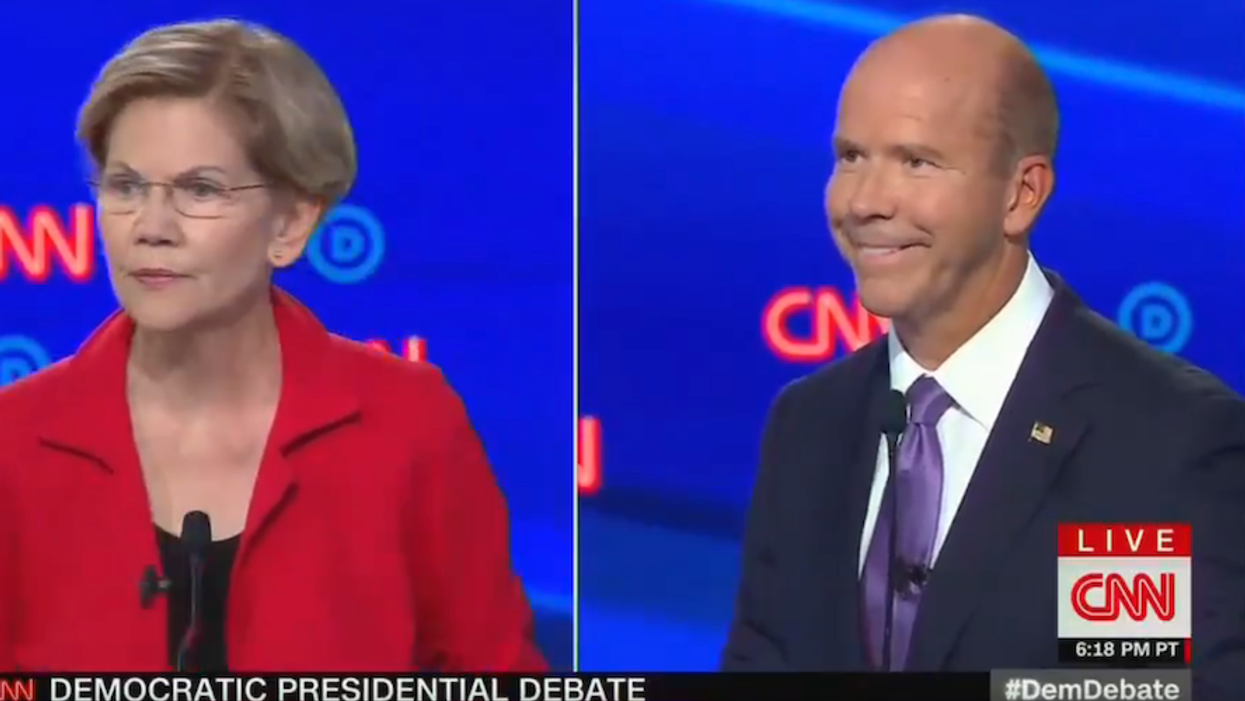
In one line during Tuesday's CNN Democratic primary debate, Sen. Elizabeth Warren made a distinction between her vision of the Democratic Party and that of her more conservative opponents.
Replying to former John Delaney, a former congressman from Maryland polling at around one percent who has made opposing left-leaning policy ideas the centerpiece of his quixotic run for the nomination, Warren wondered aloud what use it was trying to lead the American people without a vision.
"You know, I don't understand why anybody goes to all the trouble of running for president of the United States just to talk about what we really can't do and shouldn't fight for," said the Massachusetts Democrat.
A split screen showed Delaney with a large, but awkward, smile.
Elizabeth Warren: "I don't understand why anybody goes to all the trouble of running for president of the United States just to talk about what we really can't do and shouldn't fight for."pic.twitter.com/ciQUEwNQkU
-- Keith Boykin (@keithboykin) July 31, 2019
"Extremely rude of Elizabeth Warren to murder John Delaney on national television like this," tweeted social media manager Erick Fernandez.
Warren has based her primary campaign on a list of policy ideas backed up with detailed proposals: "I've got a plan for that" has become a mantra of sorts for the senator's presidential campaign.
Delaney, on the other hand, has struggled to gain traction with voters and has stuck mostly to attacking the candidates to his left for their plans to expand Medicare and tackle the climate crisis.
Both Warren and Sen. Bernie Sanders (I-Vt.) hit Delaney on Tuesday, prompting a celebration from Twitter user @non_bona_dicta.
"Gotta say though, I'm really loving watching Delaney get pummeled by Sanders and Warren," said @non_bona_dicta, "they're burying the motherfucker."
After the applause from her one-line cutdown of Delaney died down, Warren made clear that the real issue at hand was a corrupt political system that, along with corporations, is taking the government and "holding it by the throat."
"We need to have the courage to fight back against them," said Warren. "Until we're ready to do that, it's just more of the same."
"Well, I'm ready to get in this fight," said Warren. "I'm ready to win this fight."
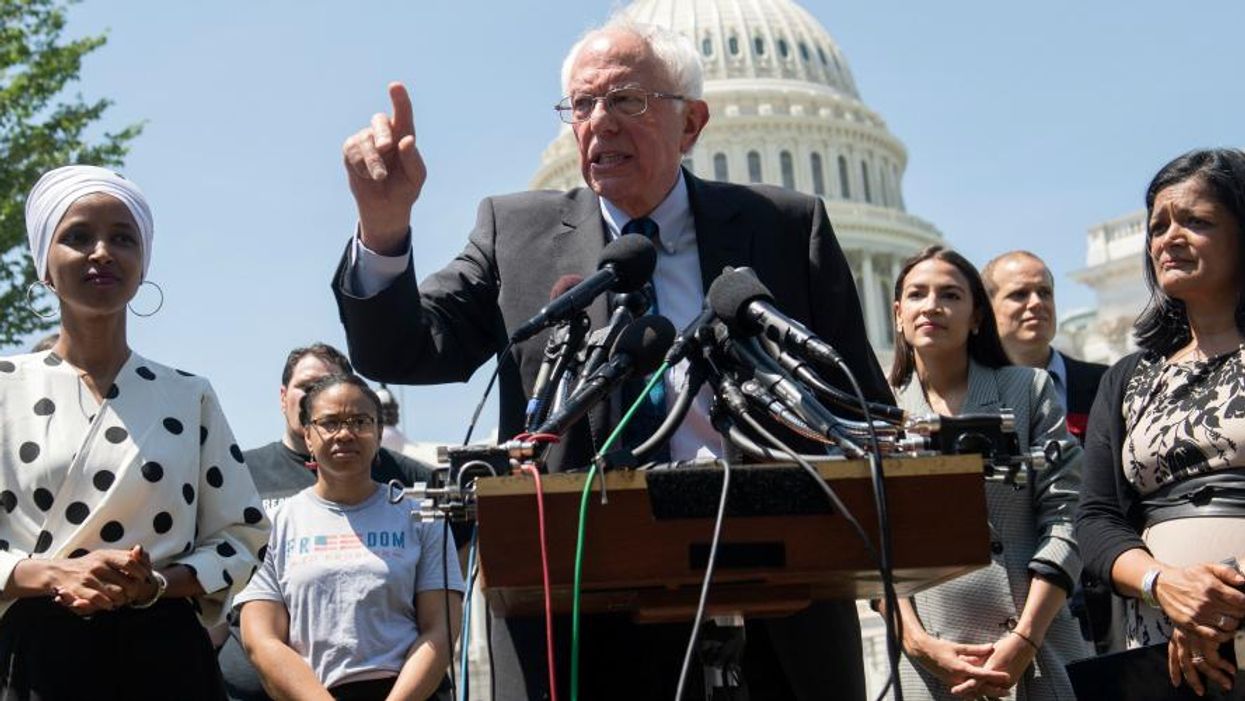
During a press conference unveiling his plan to eliminate all $1.6 trillion of student debt in the United States and make public colleges tuition-free, Sen. Bernie Sanders on Monday clearly staked out his position in a debate that has revealed stark political divisions among 2020 Democratic presidential candidates.
"Bernie understands that means-tested policies crumble under political pressure from right-wingers (and moderates) who attack them as going to 'undeserving' people."
--Briahna Joy Gray, Sanders's national press secretary
"I believe in universality," Sanders said when asked whether his free college plan would also apply to the rich. "That means if [President Donald] Trump wants to send his grandchildren to public school, he has the right to do that."
Sanders's remarks brought into sharp focus an "internal rift" among Democratic presidential contenders over the most economically and politically effective way to design government programs, the Washington Post's Jeff Stein reported Wednesday.
While Sanders has long been a proponent of universal programs like free public college and Medicare for All--which benefit everyone regardless of income--other Democratic White House hopefuls have displayed a preference for means-tested policies that are tailored toward low-income or middle-class Americans, while disqualifying those in higher income brackets.
As Stein reported, some "experts and Democratic presidential candidates note universal programs tend to be more expensive, often by dramatic margins, and offer help to those who may not need it."
During the Black Economic Alliance's presidential forum last month, South Bend, Indiana Mayor Pete Buttigieg said he opposes tuition-free public college and across-the-board student debt cancellation because he doesn't "believe all of us should be paying for the children" of billionaires.
Presidential candidate John Delaney backed this position in an interview with the Post. "Programs to provide relief to people with student debt," Delaney said, "should be targeted for those who are actually struggling."
Sen. Elizabeth Warren (D-Mass.), meanwhile, has advocated a mixture of universal and means-tested policies. In April, Warren unveiled a debt forgiveness plan that would wipe out $50,000 in student debt for every person with household income under $100,000.
Those who earn between $100,000 and $250,000 would see more limited debt relief under Warren's plan, while those who earn more than $250,000 would not qualify for any relief.
But supporters of universal programs argue that means-tested plans like Warren's debt forgiveness proposal are inherently divisive, and thus more politically fragile, than policies that benefit everyone regardless of income.
"Bernie understands that means-tested policies like Warren's tend to crumble under political pressure from right-wingers (and moderates) who attack them as going to 'undeserving' people who don't work hard enough. Think food stamps, Section 8, and 'welfare,'" tweeted Briahna Joy Gray, national press secretary for Sanders's presidential campaign.
"By contrast, policies like Social Security have real staying power because all Americans are bought in," Gray added. "Universal policies create strong coalitions which benefit us all. You can't just have a plan for policy. You need a plan to enact and preserve it."
As New York Magazine's Eric Leviz wrote Wednesday, the "strongest argument for a clean, across-the-board student-debt jubilee" over means-tested proposals "is a political one."
While it's clear that a large portion of Sanders's progressive base would mobilize behind the proposal, Levitz suggested there are also electoral benefits when it comes to voting blocks who might otherwise feel that Bernie's policies are hostile towards them.
"Canceling all student debt is simple to execute, and easy to understand," explained Levitz. "The policy's substantive drawbacks may double as political benefits--upper-middle-class professionals vote and donate to political campaigns at higher rates than less privileged people. It's conceivable that cutting doctors and lawyers in on the deal will make it easier to get major student-debt relief enacted."
As Sanders spokesperson Keane Bhatt put it in an interview with Vox earlier this week, "There is something to be said about simple, intelligible policies that build broad constituencies."
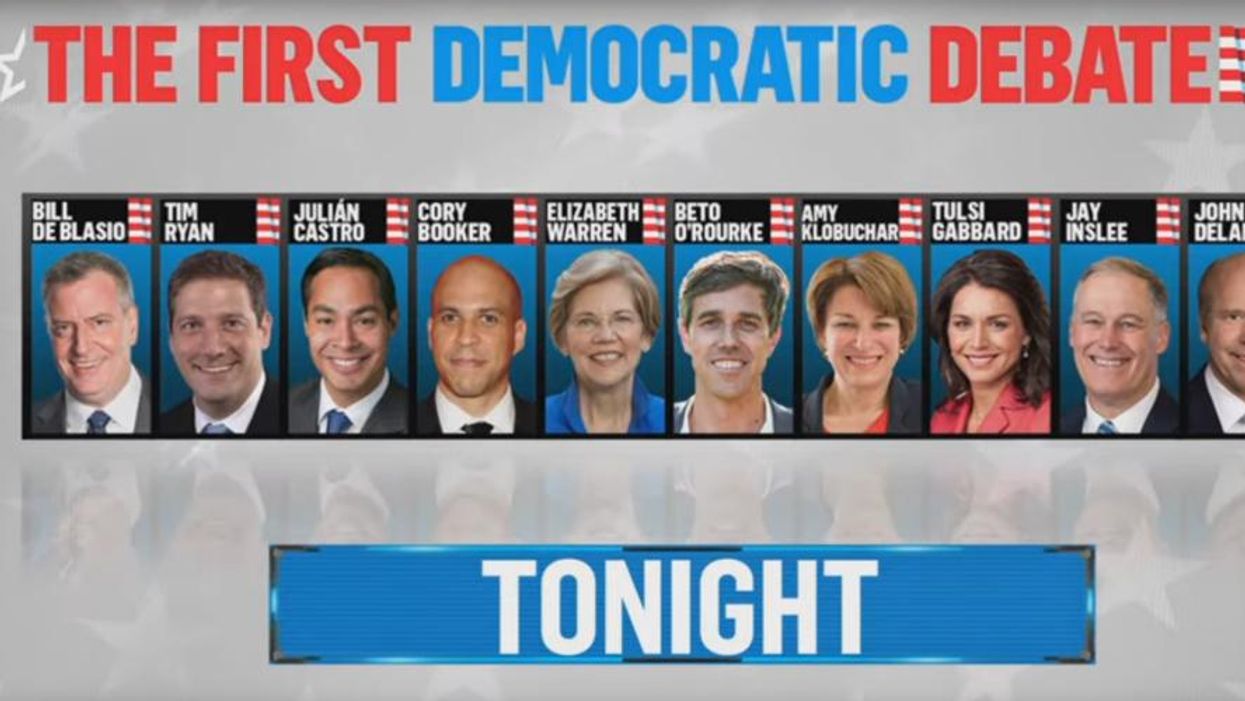
The first in a pair of kick-off round Democratic debates taking place in Miami, Florida will air Wednesday at 9:00pm E.T. and feature 10 of the party's top candidates vying for the 2020 presidential nomination.
Hosted by NBC News, MSNBC, and Telemundo, the debate at the city's Adrienne Arsht Center will be shown on each of the respective networks' cable channels as well as be streamed online on their websites.
The candidates who will be on the stage for Wednesday's debate are: Sen. Elizabeth Warren; Sen. Cory Booker; former Rep. Beto O'Rourke; Sen. Amy Klobuchar; former Rep. John Delaney; Rep. Tulsi Gabbard; former Housing Secretary Julian Castro; Rep. Tim Ryan; New York City Mayor Bill de Blasio; and Washington Gov. Jay Inslee.
On its website, NBC News posted the rules and additional details about the scheduled two-hour debate. Savannah Guthrie, Lester Holt, Chuck Todd, Rachel Maddow, and Jose Diaz-Balart will moderate the debates in Miami.
On Thursday night, the rules and moderators will be the same, but will feature the other 10 candidates who met the threshold put forth by the Democratic National Committee. They are: Sen. Bernie Sanders; Former Vice President Joe Biden; Sen. Kamala Harris; South Bend, Indiana Mayor Pete Buttigieg; Sen. Michael Bennet; Marianne Williamson; Rep. Eric Swalwell; Sen. Kirsten Gillibrand; Andrew Yang; and former Colorado Gov. John Hickenlooper.
Watch Wednesday night's debate live below (or visit this link for additional viewing options in your area):

The attitudes of Democratic voters toward the Israeli-Palestinian conflict have become decidedly more balanced in the past two decades. Favorable attitudes toward Palestinians are up while attitudes toward Israel appear to be in decline. While, overall views of Israel remain positive, substantial numbers of Democrats are opposed to Israeli policies - namely settlement construction and violations of Palestinian rights. Israel's leader, Benjamin Netanyahu, is also viewed negatively by most Democrats.
These shifts in opinion have placed many Democratic presidential candidates in a bind - especially those who have served in Congress or as Governors. As conscious as they may be of their base's changing mood, they have also been schooled not to alienate pro-Israel donors or cross Israel's lobbyists, who can, if aroused, distract their campaigns with a barrage of protests.
It was against this backdrop that I watched the results of a months-long New York Times' project in which they interviewed 21 of the Democrats running for president on a range of foreign and domestic policy issues that will confront the next president. There were questions on Afghanistan, handguns, health care, immigration, and the death penalty.
Most intriguing to me was question #4: "Do you think that Israel meets international standards of human rights?" because it was deeply revealing about each of candidates' principles, their understanding of, and readiness to deal with the Israeli-Palestinian conflict.
It was disturbing how few of the candidates appear to have given the matter any serious thought. With the notable exceptions of Senator Bernie Sanders, Mayor Pete Buttigieg, and Congressmen Eric Swalwell and Seth Moulton, most of the elected officials stumbled about like frightened high schoolers being asked a test question for which they hadn't prepared.
Only a handful found the inner strength to suggest that Israel, in fact, was violating human rights.
Only a handful found the inner strength to suggest that Israel, in fact, was violating human rights. Most respondents hedged their replies noting the challenges Israel faces or "Israel attempts meet human rights standards...but could do a better job. A few, Senators Kamala Harris and Michael Bennet, Mayor Bill de Blasio, and Congressman John Delaney, actually indicated that they believed that Israel was upholding human rights. Some, instead of addressing the question, shifted to a more comfortable critique of the failings of President Trump or Prime Minister Netanyahu - as if to suggest that problems began with these two leaders.
Additionally, those who hedged their answers implying that Israel's record was less than perfect offered, as their way out of appearing to be critical of Israel, something like - "Israel's trying to do the right thing, but sometimes they fail and need our help." Finally, other than the few that mentioned settlement expansion, most failed to consider other human rights violations that occur in the Occupied Territories. The only Democrat who did was Seth Moulton, who cited his earlier support for legislation calling for "not supplying Israel with weapons and goods if they do not uphold standards for the treatment of Palestinian kids in prison."
As they awkwardly struggled to get out of the challenge foisted upon them, you could almost see the wheels spinning inside their heads weighing their need to assert their pro-Israel bona fides with the newly felt need to be relevant to the changing mood of the Democratic electorate. It was for many "a damned if they do, damned if they don't" situation.
What became painfully clear was the extent to which most of the candidates, either because they were loath to offer any criticism of Israel or because they simply had no idea how to answer this question, found themselves forced to recall comfortable, though irrelevant, talking points.
The top of mind reply of a majority of the respondents was a variation of "Israel is our most important ally" or "Israel is a liberal democracy" - completely dodging the question asked. Equally off-topic was the support a majority of the candidates expressed for a "two state solution."
You can read the transcripts of their comments, but far more interesting was watching their faces as they struggled to answer this simple question. First, there was the obvious discomfort at being called upon to talk about a topic they would rather avoid. Then, you could see them fumbling about trying to remember talking points and looking for a safety net. At one point, you can see the lights go on when they recalled the magical "two state solution" formula. It was as if at the end of a long and grueling half-baked answer to an unwanted question, they remembered "Ah ha! Two states - that's the way out of this mess." then without any connection to the question or anything they had said up until that point, they would shift into their comfort zone and say "we should be doing more to press the parties to negotiate a two-state solution" - end of answer and smile - as if they were saying "Phew! Did I get out of that one?"
What's especially troubling about this "fall back" two-state solution answer, in addition to the fact that it had nothing to do with the question that was asked, is that most seemed to act as if just saying they supported two states absolved them of needing to say or do more - for this reason, I've come to refer to it as "the two state absolution." The notable exception here was Congressman Julian Castro who acknowledged that settlement expansion made the goal of two states "harder."
Most disappointing was the non-response of the usually thoughtful Senator Elizabeth Warren, who said that she would urge the Israelis and Palestinians to "come to the table and negotiate" and then "stay out of the way to let them negotiate," as if that had never been tried before and as if the ascendancy of far-right in Israel isn't hell-bent on doing everything they can to avoid an independent Palestinian state.
The bottom line is that most of the Democrats running for president have a long way to go to in dealing with Israel/Palestine. The reason is simple. Because of the pervasive presence and power of pro-Israel forces, elected officials have long taken a "hands off" approach to dealing with this issue. Many have learned that stepping "out of line" brings painful results - calls that tie up their office phones and angry emails that fill up their inboxes, leading them to avoid this issue like a disease. The result is what I called "willed ignorance." They focus on "their issues" - the ones that got them elected and ignore those that can only bring trouble. Therefore, they don't receive or even request briefings on this critical question.
But the situation is changing. The evolving attitudes of the electorate - especially key blocs of Democratic voters and the disgust of many Democrats with Netanyahu's policies and the Trump/Netanyahu "love-fest" - all point to the fact that this will not be the last time uncomfortable questions about Israel-Palestine will be asked. It's time for those who hope to lead us to take the time to learn about this issue that has vexed every American president for 70 years.

Before this week, you might not have heard of Rep. John Delaney, a moderate Democrat from Maryland who is running for President. In fact, he was technically the first Democrat to run for President (he announced just 7 months after the inauguration), but that doesn't seem to be doing him much good.
If you've heard of him recently, it's probably because, over the weekend, he went to the California Democratic convention, said Medicare for All is "not good policy, nor is it good politics," and claimed it would "kick 150 million Americans off their healthcare."
He then proceeded to be loudly booed non-stop for a minute and a half.
Apparently, the Delaney campaign has been busy traveling the country and talking to voters, but it doesn't seem like he's done much listening, because he's come to a profoundly wrong conclusion.
It's no secret that healthcare is consistently found to be the leading issue among voters in recent election cycles, and it's easy to see why.
Everyone knows someone who's been devastated by the American healthcare system, and most of us have faced the strain of it ourselves. Premiums and deductibles never stop rising, out of pocket costs keep increasing, it's eating up larger portions of our wages, it's outgrowing inflation and hurting the bottom line for employers, and it's forcing patients to ration care, leading to worse health outcomes, and even death.
Even a comfortable middle-class family lives under the threat of a surprise medical bill driving them to bankruptcy. Or maybe they worry that when they need the insurance they've been paying into their whole lives to cover a medical procedure, they'll end up getting their claim denied instead.
It is difficult to imagine a less efficient and more expensive system.
That's a big part of the reason why 70% of Americans support Medicare for All, including 85% of Democrats who John Delaney is currently trying to woo, and 52% of Republicans.
Not a lot of issues poll at 70% approval. Sounds like pretty good politics to me.
Now let's talk policy. Mr. Delaney either doesn't know what an effective policy tool Medicare for All will be, or he's unwilling to face the facts. Either way, not a great look for a Presidential hopeful.
Let's start with the obvious: The current, multi-payer system is economically unsustainable.
I assume that when the Congressman claimed that 150 million people would be kicked off their insurance, he was referring to those of us who get our insurance through the workplace. However, the value of employer-sponsored insurance has been completely deteriorating.
The same costs that are straining families and patients are also a disaster for small and mid-sized businesses and workers.
Over the past 10 years, premiums in the employer-market have gone up 55%, and an employer-sponsored family plan now costs an average of 19,616 a year per employee. Even though these premiums costs are rising, the plans are actually getting worse. Worker deductibles have gone up 212% in the last decade, far outpacing inflation and wage growth.
Because the plans are getting more expensive and covering less, people with insurance through their workplace are the largest driver of the growing "underinsured" rate.
So to review: money that could be going to job creation, new products or marketplaces, raising wages, or keeping competitive internationally is going to health insurance companies, who are serving as nothing more than bloated and inefficient middle-men, and aren't providing adequate coverage.
Medicare for all would finance healthcare with a lower cost, manageable, and predictable tax rate that would ensure every single person in this country had comprehensive coverage without financial barriers.
The impact on economic growth goes beyond the hundreds of millions we would save in healthcare spending every year. That's why, last month, over 200 economists signed on to a letter endorsing Medicare for All on the basis that it was a "Win-Win." A more healthy populace is a more productive populous. It's that simple.
I'm not sure what's motivating Delaney to shun good policy and good politics, but I am sure I don't trust the political instinct of a man polling near .05%. I just hope all the other candidates heard the boos loud and clear.
This piece was originally published at Businessinitiative.org.

Inspired by Sen. Bernie Sanders's speech at the California Democratic Convention in California--in which the 2020 contender took a thinly veiled shot at fellow White House hopeful Joe Biden's centrist policy approach--progressives made the Twitter hashtag #NoMiddleGround go viral on Sunday in an effort to make clear that there can be no compromises when it comes to confronting the global climate crisis, providing healthcare to all as a right, and battling inequality.
"We have got to make it clear that when the future of the planet is at stake, there is no 'middle ground,'" Sanders said, in a clear reference to Biden's reported middle-of-the-road climate agenda. "We will take on the fossil fuel industry and transform our energy system."
"When it comes to healthcare, there is no middle ground," Sanders continued. "When it comes to abortion, there is no middle ground. When it comes to mass shootings and the fact that 40,000 people were killed last year with guns, no middle ground."
The Vermont senator's remarks inspired a flood of tweets from his supporters and other progressives, who expressed enthusiastic agreement with Sanders's call for an uncompromising approach to the most pressing crises facing the United States and the planet.
The tweets from Sanders backers and others quickly made #NoMiddleGround a trending Twitter topic in the U.S.
Sanders's remarks demanding an unabashedly bold progressive agenda were also applauded at the California Democratic Party Convention in San Francisco, where the Vermont senator received a standing ovation while calls for moderation by Colorado Gov. John Hickenlooper and former Rep. John Delaney were panned by many in the crowd.
Biden, who is currently the Democratic frontrunner according to most national polls, did not attend the California convention.
"In my view, we will not defeat Donald Trump unless we bring excitement and energy into the campaign, and unless we give millions of working people and young people a reason to vote, and a reason to believe that politics is relevant to their lives," Sanders told the San Francisco audience. "We cannot go back to the old ways, we have got to go forward with a new and progressive agenda."

Scoring 15 presidential candidates on their commitment to climate action, the advocacy group 350 Action found that only three contenders have demonstrated true leadership by supporting key policies to address the crisis of a rapidly warming planet.
Sens. Bernie Sanders (I-Vt.), Elizabeth Warren (D-Mass.), and Kirsten Gillibrand (D-N.Y.) received checkmarks across the board on 350 Action's 2020 Scorecard, which the group released Wednesday.
All three support a Green New Deal to shift to a green energy economy while creating millions of jobs; have taken action to end fossil fuel extraction projects; and signed a pledge not to accept donations from the fossil fuel industry.

"We're making it clear where 2020 candidates land on the policies and practices essential to any meaningful attempt at addressing the climate crisis," said May Boeve, executive director of 350 Action. "Stopping new fossil fuel projects, supporting a Green New Deal, and saying no to Big Oil money are the standards by which we should measure any presidential hopeful."
"Bold climate action that strengthens our economy and communities is not only what most Americans want--it's also the reasonable and responsible way forward," she added.
The scorecard illustrates which candidates are most closely aligned with the American public on climate action issues, the group notes.
According to a recent poll by YouGov Blue, 56 percent of respondents favored renewable energy projects over the continued use of oil, gas, and coal, while 59 percent backed a Green New Deal.
Along with President Donald Trump, John Delaney and John Hickenlooper are the only Democratic candidates who don't support a Green New Deal, while Rep. Tulsi Gabbard's (D-Hawaii) position is not known by 350 Action.
Sen. Cory Booker (D-N.J.), Pete Buttigieg, Julian Castro, Sen. Kamala Harris (D-Calif.), Sen. Amy Klobuchar (D-Minn.), Beto O'Rourke, Delaney, and Hickenlooper have so far not signed the pledge to refuse fossil fuel industry campaign donations.
On 350 Action's website, users can view the scorecard along with information about how they can get in touch with candidates to demand that they join the majority of the American public and more than 100 lawmakers in supporting the Green New Deal and other climate action policies.
"Our next president needs to be a real climate leader," 350 Action said. "No one is getting an A+ on this climate test just for admitting that the climate crisis is happening. Real climate leadership means real commitment to bold action."
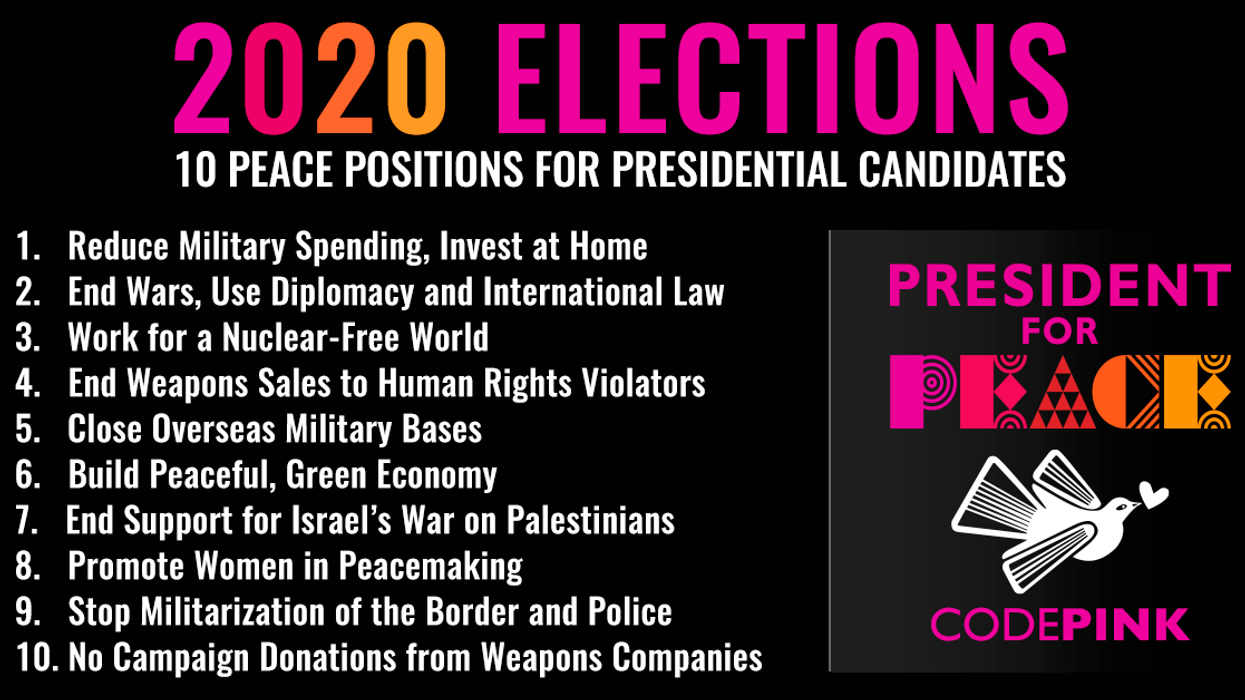
Forty-five years after Congress passed the War Powers Act in the wake of the Vietnam War, it has finally used it for the first time, to try to end the U.S.-Saudi war on the people of Yemen and to recover its constitutional authority over questions of war and peace. This hasn't stopped the war yet, and President Trump has threatened to veto the bill. But its passage in Congress, and the debate it has spawned, could be an important first step on a tortuous path to a less militarized U.S. foreign policy in Yemen and beyond.
While the United States has been involved in wars throughout much of its history, since the 9/11 attacks the U.S. military has been engaged in a series of wars that have dragged on for almost two decades. Many refer to them as "endless wars." One of the basic lessons we have all learned from this is that it is easier to start wars than to stop them. So, even as we have come to see this state of war as a kind of "new normal," the American public is wiser, calling for less military intervention and more congressional oversight.
The rest of the world is wiser about our wars, too. Take the case of Venezuela, where the Trump administration insists that the military option is "on the table." While some of Venezuela's neighbors are collaborating with U.S. efforts to overthrow the Venezuelan government, none are offering their own armed forces.
"Ever since the Bush/Cheney administration launched the present-day 'Long Wars,' new presidents from both parties have dangled superficial appeals to peace during their election campaigns. But neither Obama nor Trump has seriously tried to end our 'endless' wars or rein in our runaway military spending."
The same applies in other regional crises. Iraq is refusing to serve as a staging area for a U.S.-Israeli-Saudi war on Iran. Traditional Western allies of the U.S. oppose Trump's unilateral withdrawal from the Iran nuclear agreement and want peaceful engagement, not war, with Iran. South Korea is committed to a peace process with North Korea, despite the erratic nature of Trump's negotiations with North Korea's Chairman Kim Jung Un.
So what hope is there that one of the parade of Democrats seeking the presidency in 2020 could be a real "peace candidate"? Could one of them bring an end to these wars and prevent new ones? Walk back the brewing Cold War and arms race with Russia and China? Downsize the U.S. military and its all-consuming budget? Promote diplomacy and a commitment to international law?
Ever since the Bush/Cheney administration launched the present-day "Long Wars," new presidents from both parties have dangled superficial appeals to peace during their election campaigns. But neither Obama nor Trump has seriously tried to end our "endless" wars or rein in our runaway military spending.
Obama's opposition to the Iraq war and vague promises for a new direction were enough to win him the presidency and the Nobel Peace Prize, but not to bring us peace. In the end, he spent more on the military than Bush and dropped more bombs on more countries, including a ten-fold increase in CIA drone strikes. Obama's main innovation was a doctrine of covert and proxy wars that reduced U.S. casualties and muted domestic opposition to war, but brought new violence and chaos to Libya, Syria and Yemen. Obama's escalation in Afghanistan, the fabled "graveyard of empires," turned that war into the longest U.S. war since the U.S. conquest of Native America (1783-1924).
Trump's election was also boosted by false promises of peace, with recent war veterans delivering critical votes in the swing states of Pennsylvania, Michigan and Wisconsin. But Trump quickly surrounded himself with generals and neocons, escalated the wars in Iraq, Syria, Somalia and Afghanistan, and has fully backed the Saudi-led war in Yemen. His hawkish advisers have so far ensured that any U.S. steps toward peace in Syria, Afghanistan or Korea remain symbolic, while U.S. efforts to destabilize Iran and Venezuela threaten the world with new wars. Trump's complaint, "We don't win any more," echoes through his presidency, ominously suggesting that he's still looking for a war he can "win."
While we can't guarantee that candidates will stick to their campaign promises, it is important to look at this new crop of presidential candidates and examine their views--and, when possible, voting records--on issues of war and peace. What prospects for peace might each of them bring to the White House?
Senator Sanders has the best voting record of any candidate on war and peace issues, especially on military spending. Opposing the oversized Pentagon budget, he has only voted for 3 out of 19 military spending bills since 2013. By this measure, no other candidate comes close, including Tulsi Gabbard. In other votes on war and peace, Sanders voted as requested by Peace Action 84% of the time from 2011 to 2016, despite some hawkish votes on Iran from 2011-2013.
One major contradiction in Sanders' opposition to out-of-control military spending has been his support for the world's most expensive and wasteful weapon system: the trillion-dollar F-35 fighter jet. Not only did Sanders support the F-35, he pushed--despite local opposition--to get these fighter jets stationed at the Burlington airport for the Vermont National Guard.
In terms of stopping the war in Yemen, Sanders has been a hero. Over the past year, he and Senators Murphy and Lee have led a sustained effort to shepherd his historic War Powers bill on Yemen through the Senate. Congressman Ro Khanna, whom Sanders has chosen as one of his 4 campaign co-chairs, has led the parallel effort in the House.
"Senator Sanders has the best voting record of any candidate on war and peace issues, especially on military spending."
Sanders' 2016 campaign highlighted his popular domestic proposals for universal healthcare and social and economic justice, but was criticized as light on foreign policy. Beyond chiding Clinton for being "too much into regime change," he seemed reluctant to debate her on foreign policy, despite her hawkish record. By contrast, during his current presidential run, he regularly includes the Military-Industrial Complex among the entrenched interests his political revolution is confronting, and his voting record backs up his rhetoric.
Sanders supports U.S. withdrawals from Afghanistan and Syria and opposes U.S. threats of war against Venezuela. But his rhetoric on foreign policy sometimes demonizes foreign leaders in ways that unwittingly lend support to the "regime change" policies he opposes - as when he joined a chorus of U.S. politicians labeling Colonel Gaddafi of Libya a "thug and a murderer," shortly before U.S.-backed thugs actually murdered Gaddafi.
Open Secrets shows Sanders taking in over $366,000 from the "defense industry" during his 2016 presidential campaign, but only $17,134 for his 2018 Senate reelection campaign.
So our question on Sanders is, "Which Bernie would we see in the White House?" Would it be the one who has the clarity and courage to vote "No" on 84% of military spending bills in the Senate, or the one who supports military boondoggles like the F-35 and can't resist repeating inflammatory smears of foreign leaders? It is vital that Sanders should appoint genuinely progressive foreign policy advisors to his campaign, and then to his administration, to complement his own greater experience and interest in domestic policy.
Tulsi Gabbard
While most candidates shy away from foreign policy, Congressmember Gabbard has made foreign policy--particularly ending war--the centerpiece of her campaign.
She was truly impressive in her March 10 CNN Town Hall, talking more honestly about U.S. wars than any other presidential candidate in recent history. Gabbard promises to end senseless wars like the one she witnessed as a National Guard officer in Iraq. She unequivocally states her opposition to U.S. "regime change" interventions, as well as the New Cold War and arms race with Russia, and supports rejoining the Iran nuclear deal. She was also an original cosponsor of Rep. Khanna's Yemen War Powers bill.
"Gabbard still believes in a militarized approach to counterterrorism, despite studies showing that this feeds a self-perpetuating cycle of violence on both sides."
But Gabbard's actual voting record on war and peace issues, especially on military spending, is not nearly as dovish as Sanders'. She voted for 19 of 29 military spending bills in the past 6 years, and she has only a 51% Peace Action voting record. Many of the votes that Peace Action counted against her were votes to fully fund controversial new weapons systems, including nuclear-tipped cruise missiles (in 2014, 2015 and 2016); an 11th U.S. aircraft-carrier (in 2013 and 2015); and various parts of Obama's anti-ballistic missile program, which fueled the New Cold War and arms race she now decries.
Gabbard voted at least twice (in 2015 and 2016) not to repeal the much-abused 2001 Authorization for the Use of Military Force, and she voted three times not to limit the use of Pentagon slush funds. In 2016, she voted against an amendment to cut the military budget by just 1%. Gabbard received $8,192 in "defense" industry contributions for her 2018 reelection campaign.
Gabbard still believes in a militarized approach to counterterrorism, despite studies showing that this feeds a self-perpetuating cycle of violence on both sides.
She is still in the military herself and embraces what she calls a "military mindset." She ended her CNN Town Hall by saying that being Commander-in-Chief is the most important part of being president. As with Sanders, we have to ask, "Which Tulsi would we see in the White House?" Would it be the Major with the military mindset, who cannot bring herself to deprive her military colleagues of new weapons systems or even a 1% cut from the trillions of dollars in military spending she has voted for? Or would it be the veteran who has seen the horrors of war and is determined to bring the troops home and never again send them off to kill and be killed in endless regime change wars?
Elizabeth Warren made her reputation with her bold challenges of our nation's economic inequality and corporate greed, and has slowly started to stake out her foreign policy positions. Her campaign website says that she supports "cutting our bloated defense budget and ending the stranglehold of defense contractors on our military policy." But, like Gabbard, she has voted to approve over two-thirds of the "bloated" military spending bills that have come before her in the Senate.
Her website also says, "It's time to bring the troops home," and that she supports "reinvesting in diplomacy." She has come out in favor of the U.S. rejoining the Iran nuclear agreement and has also proposed legislation that would prevent the United States from using nuclear weapons as a first-strike option, saying she wants to "reduce the chances of a nuclear miscalculation."
"Warren made her reputation with her bold challenges of our nation's economic inequality and corporate greed, and has slowly started to stake out her foreign policy positions."
Her Peace Action voting record exactly matches Sanders' for the shorter time she has sat in the Senate, and she was one of the first five Senators to cosponsor his Yemen War Powers bill in March 2018. Warren took in $34,729 in "Defense" industry contributions for her 2018 Senate reelection campaign.
With regards to Israel, the Senator angered many of her liberal constituents when, in 2014, she supported Israel's invasion of Gaza that left over 2,000 dead, and blamed the civilian casualties on Hamas. She has since taken a more critical position. She opposed a bill to criminalize boycotting Israel and condemned Israel's use of deadly force against peaceful Gaza protesters in 2018.
Warren is following where Sanders has led on issues from universal healthcare to challenging inequality and corporate, plutocratic interests, and she is also following him on Yemen and other war and peace issues. But as with Gabbard, Warren's votes to approve 68% of military spending bills reveal a lack of conviction on tackling the very obstacle she acknowledges: "the stranglehold of defense contractors on our military policy."
Senator Harris announced her candidacy for president in a lengthy speech in her native Oakland, CA, where she addressed a wide range of issues, but failed to mention U.S. wars or military spending at all. Her only reference to foreign policy was a vague statement about "democratic values," "authoritarianism" and "nuclear proliferation," with no hint that the U.S. has contributed to any of those problems. Either she's not interested in foreign or military policy, or she's afraid to talk about her positions, especially in her hometown in the heart of Barbara Lee's progressive congressional district.
"Either [Harris} is not interested in foreign or military policy, or she's afraid to talk about her positions."
One issue Harris has been vocal about in other settings is her unconditional support for Israel. She told an AIPAC conference in 2017, "I will do everything in my power to ensure broad and bipartisan support for Israel's security and right to self-defense." She demonstrated how far she would take that support for Israel when President Obama finally allowed the U.S. to join a UN Security Council resolution condemning illegal Israeli settlements in occupied Palestine as a "flagrant violation" of international law. Harris, Booker and Klobuchar were among 30 Democratic (and 47 Republican) Senators who cosponsored a bill to withhold U.S. dues to the UN over the resolution.
Faced with grassroots pressure to #SkipAIPAC in 2019, Harris did join most of the other presidential candidates who chose not to speak at AIPAC's 2019 gathering. She also supports rejoining the Iran nuclear agreement.
In her short time in the Senate, Harris has voted for six out of eight military spending bills, but she did cosponsor and vote for Sanders' Yemen War Powers bill. Harris was not up for reelection in 2018, but took in $26,424 in "Defense" industry contributions in the 2018 election cycle.
After Senator Sanders, Senator Gillibrand has the second best record on opposing runaway military spending, voting against 47% of military spending bills since 2013. Her Peace Action voting record is 80%, reduced mainly by the same hawkish votes on Iran as Sanders from 2011 to 2013. There is nothing on Gillibrand's campaign website about wars or military spending, despite serving on the Armed Services Committee. She took in $104,685 in "defense" industry contributions for her 2018 reelection campaign, more than any other senator running for president.
"Gillibrand cosponsored the Anti-Israel Boycott Act in 2017 but later withdrew her cosponsorship when pushed by grassroots opponents and the ACLU, and she voted against S.1, which included similar provisions, in January 2019."Gillibrand was an early cosponsor of Sanders' Yemen War Powers bill. She has also supported a full withdrawal from Afghanistan since at least 2011, when she worked on a withdrawal bill with then Senator Barbara Boxer and wrote a letter to Secretaries Gates and Clinton, asking for a firm commitment that U.S. troops would be out "no later than 2014."
Gillibrand cosponsored the Anti-Israel Boycott Act in 2017 but later withdrew her cosponsorship when pushed by grassroots opponents and the ACLU, and she voted against S.1, which included similar provisions, in January 2019. She has spoken favorably of Trump's diplomacy with North Korea. Originally a Blue Dog Democrat from rural upstate New York in the House, she has become more liberal as a Senator for New York state and now, as a presidential candidate.
Senator Booker has voted for 16 out of 19 military spending bills in the Senate. He also describes himself as a "staunch advocate for a strengthened relationship with Israel," and he cosponsored the Senate bill condemning the UN Security Council resolution against Israeli settlements in 2016. He was an original cosponsor of a bill to impose new sanctions on Iran in December 2013, before eventually voting for the nuclear agreement in 2015.
"Despite serving on the Foreign Affairs Committee, [Booker] has not taken a public position for ending America's wars or cutting its record military spending." Like Warren, Booker was one of the first five cosponsors of Sanders' Yemen War Powers bill, and he has an 86% Peace Action voting record. But despite serving on the Foreign Affairs Committee, he has not taken a public position for ending America's wars or cutting its record military spending. His record of voting for 84% of military spending bills suggests he would not make major cuts. Booker was not up for reelection in 2018, but received $50,078 in "defense" industry contributions for the 2018 election cycle.
Senator Klobuchar is the most unapologetic hawk of the senators in the race. She has voted for all but one, or 95%, of the military spending bills since 2013. She has only voted as requested by Peace Action 69% of the time, the lowest among senators running for president. Klobuchar supported the U.S-NATO-led regime change war in Libya in 2011, and her public statements suggest that her main condition for the U.S. use of military force anywhere is that U.S. allies also take part, as in Libya.
"Klobuchar is the most unapologetic hawk of the senators in the race."In January 2019, Klobuchar was the only presidential candidate who voted for S.1, a bill to reauthorize U.S. military aid to Israel that also included an anti-BDS provision to allow U.S. state and local governments to divest from companies that boycott Israel. She is the only Democratic presidential candidate in the Senate who did not cosponsor Sanders' Yemen War Powers bill in 2018, but she did cosponsor and vote for it in 2019. Klobuchar received $17,704 in "defense" industry contributions for her 2018 reelection campaign.
Beto O'Rourke
Former Congressmember O'Rourke voted for 20 out of 29 military spending bills (69%) since 2013, and had an 84% Peace Action voting record. Most of the votes Peace Action counted against him were votes opposing specific cuts in the military budget. Like Tulsi Gabbard, he voted for an 11th aircraft-carrier in 2015, and against an overall 1% cut in the military budget in 2016. He voted against reducing the number of U.S. troops in Europe in 2013 and he twice voted against placing limits on a Navy slush fund. O'Rourke was a member of the House Armed Services Committee, and he took in $111,210 from the "defense" industry for his Senate campaign, more than any other Democratic presidential candidate.
"O'Rourke has not highlighted foreign or military policy in his Senate or presidential campaigns, suggesting that this is something he would like to downplay."
Despite an obvious affinity with military-industrial interests, of which there are many throughout Texas, O'Rourke has not highlighted foreign or military policy in his Senate or presidential campaigns, suggesting that this is something he would like to downplay. In Congress, he was a member of the corporate New Democrat Coalition that progressives see as a tool of plutocratic and corporate interests.
John Delaney
Former Congressmember Delaney provides an alternative to Senator Klobuchar at the hawkish end of the spectrum, after voting for 25 out of 28 military spending bills since 2013, and earning a 53% Peace Action voting record. He took in $23,500 from "Defense" interests for his last Congressional campaign, and, like O'Rourke and Inslee, he was a member of the corporate New Democrat Coalition.
Jay Inslee, the Governor of Washington State, served in Congress from 1993-1995 and from 1999-2012. Inslee was a strong opponent of the U.S. war in Iraq, and introduced a bill to impeach Attorney General Alberto Gonzalez for approving torture by U.S. forces. Like O'Rourke and Delaney, Inslee was a member of the New Democrat Coalition of corporate Democrats, but also a strong voice for action on climate change. In his 2010 reelection campaign, he took in $27,250 in "defense" industry contributions. Inslee''s campaign is very focused on climate change, and his campaign website so far does not mention foreign or military policy at all.
Marianne Williamson and Andrew Yang
These two candidates from outside the world of politics both bring refreshing ideas to the presidential contest. Spiritual teacher Williamson believes, "Our country's way of dealing with security issues is obsolete. We cannot simply rely on brute force to rid ourselves of international enemies." She recognizes that, on the contrary, the U.S. militarized foreign policy creates enemies, and our huge military budget "simply increase(s) the coffers of the military-industrial complex." She writes, "The only way to make peace with your neighbors is to make peace with your neighbors."
Williamson proposes a 10 or 20 year plan to transform our wartime economy into a "peace-time economy." ""From massive investment in the development of clean energy, to the retrofitting of our buildings and bridges, to the building of new schools and the creation of a green manufacturing base," she writes, "it is time to release this powerful sector of American genius to the work of promoting life instead of death."
Entrepreneur Andrew Yang promises to "bring our military spending under control," to "make it harder for the U.S. to get involved in foreign engagements with no clear goal," and to "reinvest in diplomacy." He believes that much of the military budget "is focused on defending against threats from decades ago as opposed to the threats of 2020." But he defines all these problems in terms of foreign "threats" and U.S. military responses to them, failing to recognize that U.S. militarism is itself a serious threat to many of our neighbors.
Julian Castro, Pete Buttigieg and John Hickenlooper
Neither Julian Castro, Pete Buttigieg nor John Hickenlooper mention foreign or military policy on their campaign websites at all.
Although Biden has yet to throw his hat into the ring, he is already making videos and speeches trying to tout his foreign policy expertise. Biden has been engaged in foreign policy since he won a Senate seat in 1972, eventually chairing the Senate Foreign Relations Committee for four years, and becoming Obama's vice president. Echoing traditional mainstream Democratic rhetoric, he accuses Trump of abandoning U.S. global leadership and wants to see the U.S. regain its place as the "indispensable leader of the free world."
Biden presents himself as a pragmatist, saying that he opposed the Vietnam War not because he considered it immoral but because he thought it wouldn't work. Biden at first endorsed full-scale nation-building in Afghanistan but when he saw it wasn't working, he changed his mind, arguing that the U.S. military should destroy Al Qaeda and then leave. As vice president, he was a lonely voice in the Cabinet opposing Obama's escalation of the war in 2009.
Regarding Iraq, however, he was a hawk. He repeated false intelligence claims that Saddam Hussein possessed chemical and biological weapons and was seeking nuclear weapons, and therefore was a threat that had to be "eliminated." He later called his vote for the 2003 invasion a "mistake."
Biden is a self-described Zionist. He has stated that the Democrats' support for Israel "comes from our gut, moves through our heart, and ends up in our head. It's almost genetic."
There is one issue, however, where he would disagree with the present Israeli government, and that is on Iran. He wrote that "War with Iran is not just a bad option. It would be a disaster," and he supported Obama's entry into the Iran nuclear agreement. He would therefore likely support re-entering it if he were president.
"Like many other corporate Democrats, Biden champions a misleadingly benign view of the dangerous and destructive role the U.S. has played in the world over the past 20 years, under the Democratic administration in which he served as vice-president as well as under Republican ones." While Biden emphasizes diplomacy, he favors the NATO alliance so that "when we have to fight, we are not fighting alone." He ignores that NATO outlived its original Cold War purpose and has perpetuated and expanded its ambitions on a global scale since the 1990s - and that this has predictably ignited a new Cold War with Russia and China.
Despite paying lip service to international law and diplomacy, Biden sponsored the McCain-Biden Kosovo Resolution, which authorized the U.S. to lead the NATO assault on Yugoslavia and invasion of Kosovo in 1999. This was the first major war in which the U.S. and NATO used force in violation of the UN Charter in the post-Cold War era, establishing the dangerous precedent that led to all our post-9/11 wars.
Like many other corporate Democrats, Biden champions a misleadingly benign view of the dangerous and destructive role the U.S. has played in the world over the past 20 years, under the Democratic administration in which he served as vice-president as well as under Republican ones.
Biden might support slight cuts in the Pentagon budget, but he is not likely to challenge the military-industrial complex he has served for so long in any significant way. He does, however, know the trauma of war firsthand, connecting his son's exposure to military burn pits while serving in Iraq and Kosovo to his fatal brain cancer, which might make him think twice about launching new wars.
On the other hand, Biden's long experience and skill as an advocate for the military-industrial complex and a militarized U.S. foreign policy suggest that those influences might well outweigh even his own personal tragedy if he is elected president and faced with critical choices between war and peace.
Conclusion
The United States has been at war for over 17 years, and we are spending most of our national tax revenues to pay for these wars and the forces and weapons to wage them. It would be foolish to think that presidential candidates who have little or nothing to say about this state of affairs will, out of the blue, come up with a brilliant plan to reverse course once we install them in the White House. It is especially disturbing that Gillibrand and O'Rourke, the two candidates most beholden to the military-industrial complex for campaign funding in 2018, are eerily quiet on these urgent questions.
"We need to hear a much more vigorous debate about war and peace in this campaign, with more specific plans from all the candidates."
But even the candidates who are vowing to tackle this crisis of militarism are doing so in ways that leave serious questions unanswered. Not one of them has said how much they would cut the record military budget that makes these wars possible - and thus almost inevitable.
In 1989, at the end of the Cold War, former Pentagon officials Robert McNamara and Larry Korb told the Senate Budget Committee that the U.S. military budget could safely be cut by 50% over the next 10 years. That obviously never happened, and our military spending under Bush II, Obama and Trump has outstripped the peak spending of the Cold War arms race.
In 2010, Barney Frank and three colleagues from both parties convened a Sustainable Defense Task Force that recommended a 25% cut in military spending. The Green Party has endorsed a 50% cut in today's military budget. That sounds radical, but, because inflation-adjusted spending is now higher than in 1989, that would still leave us with a larger military budget than MacNamara and Korb called for in 1989.
Presidential campaigns are key moments for raising these issues. We are greatly encouraged by Tulsi Gabbard's courageous decision to place solving the crisis of war and militarism at the heart of her presidential campaign. We thank Bernie Sanders for voting against the obscenely bloated military budget year after year, and for identifying the military-industrial complex as one of the most powerful interest groups that his political revolution must confront. We applaud Elizabeth Warren for condemning "the stranglehold of defense contractors on our military policy." And we welcome Marianne Williamson, Andrew Yang and other original voices to this debate.
"We are calling for this debate most of all because we mourn the millions of people being killed by our country's wars and we want the killing to stop."
But we need to hear a much more vigorous debate about war and peace in this campaign, with more specific plans from all the candidates. This vicious cycle of U.S. wars, militarism and runaway military spending drains our resources, corrupts our national priorities and undermines international cooperation, including on the existential dangers of climate change and nuclear weapons proliferation, which no country can solve on its own.
We are calling for this debate most of all because we mourn the millions of people being killed by our country's wars and we want the killing to stop. If you have other priorities, we understand and respect that. But unless and until we address militarism and all the money it sucks out of our national coffers, it may well prove impossible to solve the other very serious problems facing the United States and the world in the 21st century.

And one troubling sign is the dangerous new orthodoxy that seems to be hardening in Washington, in which Democrats are forbidden from criticizing other Democrats to avoid empowering Trump ahead of the election. It's fine to debate policy, this thinking goes, but it's not OK to criticize governing records, question priorities or impugn motivations. Any hint of intra-party infighting, it's argued, would only weaken the eventual 2020 nominee.
Given Trump's weakness, the only way Democrats are going to lose in 2020 is by failing to nominate a credible change agent.
Jared Bernstein, who served as chief economist to Vice President Joe Biden, made the case succinctly in The Washington Post last week: Since Democrats are really all on the same page about everything important, they should stick to arguments over policy solutions. Voters will eventually decide whether they prefer "incrementalism" or "leapfrogging," but on everything serious -- health care, climate, jobs and taxes -- Bernstein claimed that "you would need a high-powered electron microscope to see the difference among the Democrats."
Somebody should get Bernstein to an eye doctor. The differences between former Maryland Rep. John Delaney's agenda and Massachusetts Sen. Elizabeth Warren's platform are stark and obvious. But even if Bernstein were right about Democratic policy uniformity, he has the 2020 dynamic all wrong. The most critical issues facing 2020 voters aren't really about dialing in the right policy solutions; they're fundamental questions about power and accountability in American democracy.
Given Trump's weakness, the only way Democrats are going to lose in 2020 is by failing to nominate a credible change agent. The key word there is "credible," and the way candidates establish credibility with voters is by developing a governing record. The stuff Democratic candidates have actually done when they've had the opportunity to exercise power matters at least as much as what they promise in their white papers. It's not just fair game to attack their records; it's an essential part of the vetting process.
But the truth is, even a bad candidate with a lousy record still stands a pretty good chance of beating Trump in 2020. He's just really, really unpopular. In January, he was underwater with even his core demographic, white working-class voters. His signature policy proposal, a border wall, hasn't cleared 40 percent approval since January 2017. On the stuff that actually matters for voters who might be on the fence next year -- the opioid epidemic, the collapse of rural communities, the skyrocketing cost of urban living -- Trump has done nothing.
So now is a very good time for the Democratic Party to hash out some of its very real differences -- over reforming democratic accountability in the American political system, eliminating corruption within the Democratic Party's power structure, and yes, discussing who has the credibility with voters to tackle both. There's no way to do that without scrutinizing the character and motivations of the party's 2020 candidates.
Whatever Democrats put in their policy papers should really be considered a secondary problem behind this basic test: Are they actually willing to exercise power? Do they have any record of challenging entrenched power? For plenty of Democrats, some of whom may well have pure hearts and pristine motives, the answer to both questions is no.
Power matters. Whether you want a carbon tax or a Green New Deal, you aren't going to see your preferred policy enacted if the Supreme Court remains limited to its nine justices. Senate Majority Leader Mitch McConnell (R-Ky.) would rather let the planet burn than willingly cede to Democrats a single legislative victory. So you'll have to reform the way the Senate works, too. At minimum, that means abolishing the filibuster and letting the people of Washington, D.C., and Puerto Rico actually have senators.
The Democratic Party itself has been much too cozy with corporate power for decades.
The United States is a corrupt oligarchy administered by a decadent aristocracy. The parade of outrages from top Trump administration officials has made this fact impossible for Democrats to ignore. But the trouble did not begin on Jan. 21, 2017. The Democratic Party itself has been much too cozy with corporate power for decades.
In 2008, President-elect Barack Obama tapped a Citigroup executive to pick top Cabinet officials and staffers for his administration, which subsequently refused to prosecute white-collar crime. Citigroup received more federal bailout help than any other faltering megabank. This wasn't a one-time lapse of judgment. Obama spent election night 2012 huddled with Google billionaire Eric Schmidt, even as the Federal Trade Commission was investigating the search giant for potential antitrust violations. The FTC ultimately let Google off the hook -- a decision that looks increasingly suspect as European regulators continue to hit the company with a cascade of fines.
The word for this style of governance is corruption. It should be intolerable to a party that calls itself Democratic.
The good news is, 2020 Democratic candidates are starting to take steps that acknowledge problems with the party's historical role in coddling corruption. Sens. Cory Booker (D-N.J.), Kirsten Gillibrand (D-N.Y.) and Kamala Harris (D-Calif.) have all sworn off corporate PAC money in their 2020 campaigns. Sen. Elizabeth Warren (D-Mass.) has gone further, vowing not to host any high-end fundraisers whatsoever in the primary.
But Democrats don't all agree on whether or how to fight corruption in their ranks, and there's no avoiding questions of integrity when discussing it. Nor should there be. These are politicians we're talking about -- the idea that Republicans have a monopoly on all the seedy operators is naive. Voters deserve to have that debate.

As a growing number of Democratic contenders announce their 2020 presidential campaigns, a coalition of grassroots groups hoping Sen. Bernie Sanders (I-Vt.) will also run are not waiting for an official declaration as they expand their organizing efforts and continue to make the case for why the senator would be the best candidate.
Organizing for Bernie has partnered with Our Revolution, Progressive Democrats of America, and The People for Bernie Sanders to plan a national "Weekend of Action" for Jan. 26-27.
The coalition has put together an interactive map for those interested in hosting or attending an event as well as a canvassing guide (pdf) that details Sanders' key policies and how to encourage supporters to sign a petition urging him to run for president.
"It's up to us to organize in our community and invite people into this movement for Medicare for All, tuition-free college, abolish ICE, end mass incarceration, end prohibition, and pass cannabis legalization.
--Kat Brezler, The People for Bernie Sanders
"It's up to us to organize in our community and invite people into this movement for Medicare for All, tuition-free college, abolish ICE, end mass incarceration, end prohibition, and pass cannabis legalization," Kat Brezler, co-founder of The People for Bernie Sanders, said in a statement. "We can have a future to believe in but it's incumbent on us to bring the momentum to this campaign. We are the campaign."
Dulce Anayasaenz, co-founder of Organizing for Bernie, said: "I'm eager to talk to people in my community next weekend about the important role we have this year. The 2020 election will be a platform for bold leaders to offer an alternative to the current administration and an opportunity for us as voters to vote for candidates that we believe are most aligned with our values and vision for America."
"Sen. Sanders is the people's champion we need in the White House," Anayasaenz added, "and I'm ready to discuss that with my friends, neighbors, and new people I meet."
The pool of Democrats considering or officially seeking the party's nomination for 2020 is rapidly growing, and so far includes Sens. Elizabeth Warren (Mass.), Kirsten Gillibrand (N.Y.) and Kamala Harris (Calif.), Rep. Tulsi Gabbard (Hawaii), and former Housing and Urban Development (HUD) Secretary Julian Castro.
While lesser known, multi-millionaire John Delaney, a former congressman from Maryland, as well as Richard Ojeda, a state senator from West Virginia, are also running.
Many Sanders supporters, however, believe that "because of his experience and commitment to the common good, he is the most qualified candidate," as labor leader RoseAnn DeMoro argued in a recent op-ed for Common Dreams. "Just imagine what it looks like if Bernie wins. A warrior backing such fine and necessary policies would be a seismic shift for our lives, this nation, and the world."
Sanders was in Columbia, South Carolina on Monday to speak at the annual King Day at the Dome rally and a town hall hosted by the NAACP's state chapter.
Honoring the civil rights activist's "incredible courage" and "revolutionary spirit," the senator declared in a pair of tweets that "Dr. King's vision of ending the triple evils of racism, economic injustice, and war is as important today as it was when Dr. King fought for those principles, and must motivate us in all of our work."