

SUBSCRIBE TO OUR FREE NEWSLETTER
Daily news & progressive opinion—funded by the people, not the corporations—delivered straight to your inbox.
5
#000000
#FFFFFF
To donate by check, phone, or other method, see our More Ways to Give page.
Daily news & progressive opinion—funded by the people, not the corporations—delivered straight to your inbox.

After he had received more than $1 million as a Signature board member, the architect of the Dodd-Frank banking regulations minimized the risks of weakening rules he helped enact post-2008 financial crisis.
Barney Frank, a former House Democrat from Massachusetts, has been the subject of criticism since federal regulators took over Signature Bank on Sunday.
That's because Frank, architect of the Dodd-Frank banking regulations implemented in the aftermath of the 2008 financial crisis, played a key role in whitewashing the bipartisan effort to weaken those rules in 2018—after he had received more than $1 million while serving on Signature's board following his departure from Congress.
Since federal regulators seized Signature's assets on Sunday—two days after they intervened to protect depositors amid the collapse of Silicon Valley Bank (SVB)—progressive critics have been quick to blame a deregulatory measure approved five years ago by the then-Republican-controlled Congress for engendering two of the three largest bank failures in U.S. history.
The GOP, however, wasn't alone in supporting Sen. Mike Crapo's (R-Idaho) Economic Growth, Regulatory Relief, and Consumer Protection Act. As Sen. Elizabeth Warren (D-Mass.), a trenchant critic of the legislation, observed when it was moving through Congress, several Democrats—including Sens. Mark Warner (Va.), Joe Manchin (W.Va.), and Jon Tester (Mont.)—were integral to its passage.
To justify their decision, many of them pointed to Frank. The originator of the Dodd-Frank Wall Street Reform and Consumer Protection Act used his cachet as a presumed banking expert to legitimize a rollback of the very framework he helped enact in 2010 as chair of the House Financial Services Committee. But the ex-lawmaker wasn't merely an uninterested bystander. In 2015, he joined the board of directors at Signature, a crypto-friendly bank that was poised to benefit from less stringent oversight.
Frank said Crapo's Economic Growth, Regulatory Relief, and Consumer Protection Act "would not help the biggest Wall Street banks and denied it would increase the risks of another financial crisis," The Washington Post reported when then-President Donald Trump signed the bill into law in May 2018. "Some Democrats leaned heavily on those words as they pushed back against the plan's liberal critics."
However, the newspaper noted, "proponents of the law rarely, if ever, mentioned that Frank is not just the author of the 2010 law, but also sits on the board of New York-based Signature Bank."
In the wake of Signature's collapse on Sunday night, Frank's role in downplaying the risks of deregulation—while being paid by a bank that stood to gain from it—has received fresh light.
As the Post reported in May 2018: "Dodd-Frank imposed additional regulatory safeguards on banks with more than $50 billion in assets, but the rollback that passed this week, among other things, raises that threshold to $250 billion. Signature Bank has more than $40 billion in assets and can now grow significantly without automatically facing additional regulation."
But the bank's growth over the past half-decade came to a screeching halt over the weekend when its customers, alarmed by the failure of SVB, quickly withdrew $10 billion.
"Frank acknowledged that Signature stood to benefit, but he said his role on the bank's board did not influence his thinking," the Post reported five years ago. "Frank said his position on the threshold predates his compensation from the financial sector."
As Politico reported on Monday, Frank disputes that Trump-era deregulation "had anything to do with" Signature's failure, even though it weakened oversight of "mid-size and regional banks like his own."
"I don't think that had any impact," Frank told the outlet. "They hadn't stopped examining banks."
Frank went so far as to tell CNBC that there was "no real objective reason" that Signature had to enter federal receivership.
"I think part of what happened was that regulators wanted to send a very strong anti-crypto message," Frank argued. "We became the poster boy because there was no insolvency based on the fundamentals."
Warren, by contrast, has focused her ire directly on the deregulatory moves minimized by Frank.
"Had Congress and the Federal Reserve not rolled back the stricter oversight, SVB and Signature would have been subject to stronger liquidity and capital requirements to withstand financial shocks," Warren wrote Monday in a New York Times opinion piece.
"They would have been required to conduct regular stress tests to expose their vulnerabilities and shore up their businesses," the lawmaker continued. "But because those requirements were repealed, when an old-fashioned bank run hit SVB, the bank couldn't withstand the pressure—and Signature's collapse was close behind."
"These bank failures were entirely avoidable if Congress and the Fed had done their jobs and kept strong banking regulations in place since 2018," she added. "SVB and Signature are gone, and now Washington must act quickly to prevent the next crisis."
Like Warren, Independent Sen. Bernie Sanders of Vermont has called for fully repealing "the disastrous 2018 bank deregulation law."

Progressives raised alarm this weekend after Democratic National Committee chair Tom Perez released his picks for the 2020 Democratic National Convention committees.
The list of nominees, Sunrise Movement political director Evan Weber said Sunday, looks like "a who's-who of people explicitly opposed to the progressive agenda."
Kevin Gosztola, managing editor of Shadowproof, sparked a flurry of responses when he shared Perez's list on social media Saturday afternoon.
Gosztola's Twitter thread delved into the backgrounds of a number of candidates, including Bakari Sellers, who's nominated to sit on the Platform Committee.
"Sellers drafted letter and spearheaded effort in 2016 to ensure the DNC platform did not adopt language Bernie Sanders supported, which would've acknowledged responsibility to confront humanitarian crisis facing Palestinians in Gaza," Gosztola added.
Gosztola wasn't alone in criticizing Sellers's placement on the list.
Carol Browner was on the list for the Platform Committee as well. Browner, as "a Clinton delegate, during the 2016 Platform Drafting Committee meeting, voted against a ban on fracking, Medicare For All, opposing the Trans-Pacific Partnership (TPP), keeping fossil fuels in ground, and measure to halt abuse of eminent domain by fossil fuel industry," wrote Gosztola.
Perez also nominated former Congressman Barney Frank to be co-chair of the Rules Committee.
Frank, as Gosztola pointed out, has argued against the Green New Deal and sits on the board of directors of Signature Bank in New York, which a New York Times report showed "was a go-to lender for President Donald Trump's family, as well as Jared Kushner's family." Frank also penned a 2015 Politico op-ed entitled "Why Progressives Shouldn't Support Bernie."
Political analyst Lauren Martinchek, in a Sunday post on Medium, also highlighted concerns with Perez's list. She wrote:
Even more controversial and dangerous than Barney Frank is John Podesta, also on the Rules Committee, who said in the infamous leaked DNC emails that they needed to make sure Bernie is "ground to a pulp," and asked "where would you stick the knife in?" If this process was even remotely designed to be fair, this man would not be allowed anywhere near this convention.
Another incredibly questionable choice is Alex Padilla, Vice-chair of the Platform Committee. Padilla gained notoriety for refusing to count 2 million votes in the 2016 California primary, a move that undeniably favored Clinton and handed a massive disadvantage to the Sanders campaign. He was sued for this.
Win Without War executive director Stephen Miles and Sanders foreign policy advisor Matt Duss suggested the list shows that the DNC is out of touch with its base.
The list of Perez's nominees, Andrew Cockburn, Washington editor of Harper's Magazine, wrote Sunday on Twitter, represents "The true, grim, face of the Democratic establishment."
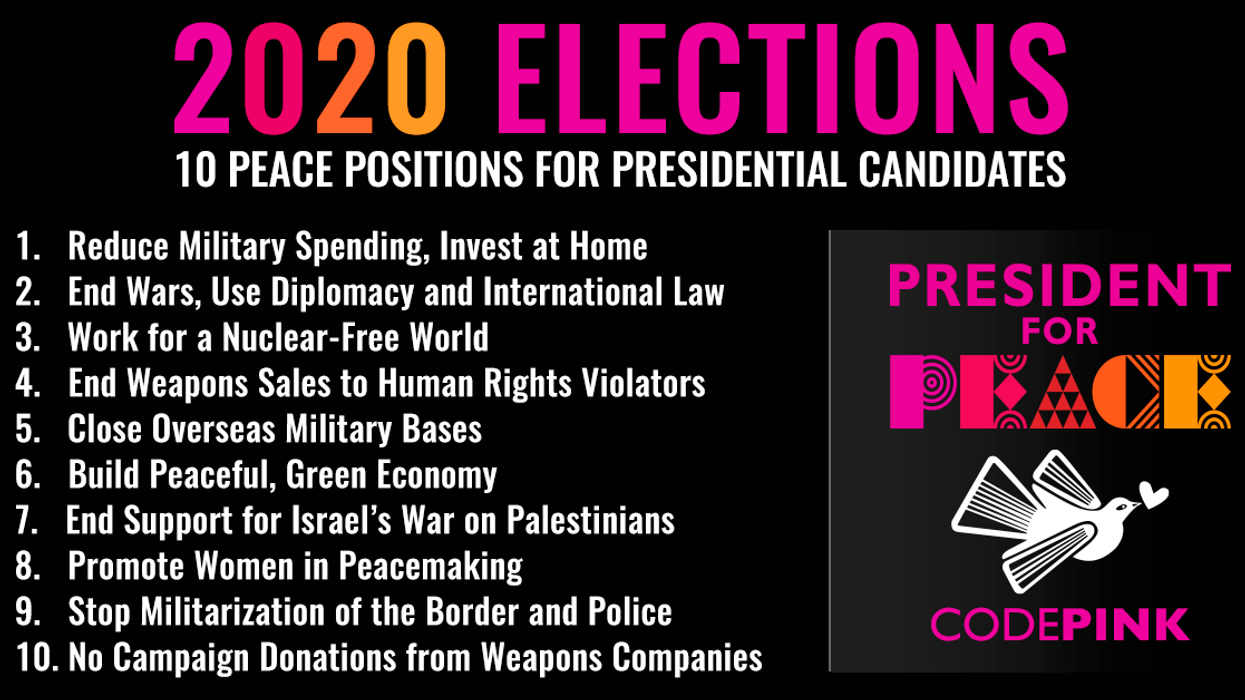
Forty-five years after Congress passed the War Powers Act in the wake of the Vietnam War, it has finally used it for the first time, to try to end the U.S.-Saudi war on the people of Yemen and to recover its constitutional authority over questions of war and peace. This hasn't stopped the war yet, and President Trump has threatened to veto the bill. But its passage in Congress, and the debate it has spawned, could be an important first step on a tortuous path to a less militarized U.S. foreign policy in Yemen and beyond.
While the United States has been involved in wars throughout much of its history, since the 9/11 attacks the U.S. military has been engaged in a series of wars that have dragged on for almost two decades. Many refer to them as "endless wars." One of the basic lessons we have all learned from this is that it is easier to start wars than to stop them. So, even as we have come to see this state of war as a kind of "new normal," the American public is wiser, calling for less military intervention and more congressional oversight.
The rest of the world is wiser about our wars, too. Take the case of Venezuela, where the Trump administration insists that the military option is "on the table." While some of Venezuela's neighbors are collaborating with U.S. efforts to overthrow the Venezuelan government, none are offering their own armed forces.
"Ever since the Bush/Cheney administration launched the present-day 'Long Wars,' new presidents from both parties have dangled superficial appeals to peace during their election campaigns. But neither Obama nor Trump has seriously tried to end our 'endless' wars or rein in our runaway military spending."
The same applies in other regional crises. Iraq is refusing to serve as a staging area for a U.S.-Israeli-Saudi war on Iran. Traditional Western allies of the U.S. oppose Trump's unilateral withdrawal from the Iran nuclear agreement and want peaceful engagement, not war, with Iran. South Korea is committed to a peace process with North Korea, despite the erratic nature of Trump's negotiations with North Korea's Chairman Kim Jung Un.
So what hope is there that one of the parade of Democrats seeking the presidency in 2020 could be a real "peace candidate"? Could one of them bring an end to these wars and prevent new ones? Walk back the brewing Cold War and arms race with Russia and China? Downsize the U.S. military and its all-consuming budget? Promote diplomacy and a commitment to international law?
Ever since the Bush/Cheney administration launched the present-day "Long Wars," new presidents from both parties have dangled superficial appeals to peace during their election campaigns. But neither Obama nor Trump has seriously tried to end our "endless" wars or rein in our runaway military spending.
Obama's opposition to the Iraq war and vague promises for a new direction were enough to win him the presidency and the Nobel Peace Prize, but not to bring us peace. In the end, he spent more on the military than Bush and dropped more bombs on more countries, including a ten-fold increase in CIA drone strikes. Obama's main innovation was a doctrine of covert and proxy wars that reduced U.S. casualties and muted domestic opposition to war, but brought new violence and chaos to Libya, Syria and Yemen. Obama's escalation in Afghanistan, the fabled "graveyard of empires," turned that war into the longest U.S. war since the U.S. conquest of Native America (1783-1924).
Trump's election was also boosted by false promises of peace, with recent war veterans delivering critical votes in the swing states of Pennsylvania, Michigan and Wisconsin. But Trump quickly surrounded himself with generals and neocons, escalated the wars in Iraq, Syria, Somalia and Afghanistan, and has fully backed the Saudi-led war in Yemen. His hawkish advisers have so far ensured that any U.S. steps toward peace in Syria, Afghanistan or Korea remain symbolic, while U.S. efforts to destabilize Iran and Venezuela threaten the world with new wars. Trump's complaint, "We don't win any more," echoes through his presidency, ominously suggesting that he's still looking for a war he can "win."
While we can't guarantee that candidates will stick to their campaign promises, it is important to look at this new crop of presidential candidates and examine their views--and, when possible, voting records--on issues of war and peace. What prospects for peace might each of them bring to the White House?
Senator Sanders has the best voting record of any candidate on war and peace issues, especially on military spending. Opposing the oversized Pentagon budget, he has only voted for 3 out of 19 military spending bills since 2013. By this measure, no other candidate comes close, including Tulsi Gabbard. In other votes on war and peace, Sanders voted as requested by Peace Action 84% of the time from 2011 to 2016, despite some hawkish votes on Iran from 2011-2013.
One major contradiction in Sanders' opposition to out-of-control military spending has been his support for the world's most expensive and wasteful weapon system: the trillion-dollar F-35 fighter jet. Not only did Sanders support the F-35, he pushed--despite local opposition--to get these fighter jets stationed at the Burlington airport for the Vermont National Guard.
In terms of stopping the war in Yemen, Sanders has been a hero. Over the past year, he and Senators Murphy and Lee have led a sustained effort to shepherd his historic War Powers bill on Yemen through the Senate. Congressman Ro Khanna, whom Sanders has chosen as one of his 4 campaign co-chairs, has led the parallel effort in the House.
"Senator Sanders has the best voting record of any candidate on war and peace issues, especially on military spending."
Sanders' 2016 campaign highlighted his popular domestic proposals for universal healthcare and social and economic justice, but was criticized as light on foreign policy. Beyond chiding Clinton for being "too much into regime change," he seemed reluctant to debate her on foreign policy, despite her hawkish record. By contrast, during his current presidential run, he regularly includes the Military-Industrial Complex among the entrenched interests his political revolution is confronting, and his voting record backs up his rhetoric.
Sanders supports U.S. withdrawals from Afghanistan and Syria and opposes U.S. threats of war against Venezuela. But his rhetoric on foreign policy sometimes demonizes foreign leaders in ways that unwittingly lend support to the "regime change" policies he opposes - as when he joined a chorus of U.S. politicians labeling Colonel Gaddafi of Libya a "thug and a murderer," shortly before U.S.-backed thugs actually murdered Gaddafi.
Open Secrets shows Sanders taking in over $366,000 from the "defense industry" during his 2016 presidential campaign, but only $17,134 for his 2018 Senate reelection campaign.
So our question on Sanders is, "Which Bernie would we see in the White House?" Would it be the one who has the clarity and courage to vote "No" on 84% of military spending bills in the Senate, or the one who supports military boondoggles like the F-35 and can't resist repeating inflammatory smears of foreign leaders? It is vital that Sanders should appoint genuinely progressive foreign policy advisors to his campaign, and then to his administration, to complement his own greater experience and interest in domestic policy.
Tulsi Gabbard
While most candidates shy away from foreign policy, Congressmember Gabbard has made foreign policy--particularly ending war--the centerpiece of her campaign.
She was truly impressive in her March 10 CNN Town Hall, talking more honestly about U.S. wars than any other presidential candidate in recent history. Gabbard promises to end senseless wars like the one she witnessed as a National Guard officer in Iraq. She unequivocally states her opposition to U.S. "regime change" interventions, as well as the New Cold War and arms race with Russia, and supports rejoining the Iran nuclear deal. She was also an original cosponsor of Rep. Khanna's Yemen War Powers bill.
"Gabbard still believes in a militarized approach to counterterrorism, despite studies showing that this feeds a self-perpetuating cycle of violence on both sides."
But Gabbard's actual voting record on war and peace issues, especially on military spending, is not nearly as dovish as Sanders'. She voted for 19 of 29 military spending bills in the past 6 years, and she has only a 51% Peace Action voting record. Many of the votes that Peace Action counted against her were votes to fully fund controversial new weapons systems, including nuclear-tipped cruise missiles (in 2014, 2015 and 2016); an 11th U.S. aircraft-carrier (in 2013 and 2015); and various parts of Obama's anti-ballistic missile program, which fueled the New Cold War and arms race she now decries.
Gabbard voted at least twice (in 2015 and 2016) not to repeal the much-abused 2001 Authorization for the Use of Military Force, and she voted three times not to limit the use of Pentagon slush funds. In 2016, she voted against an amendment to cut the military budget by just 1%. Gabbard received $8,192 in "defense" industry contributions for her 2018 reelection campaign.
Gabbard still believes in a militarized approach to counterterrorism, despite studies showing that this feeds a self-perpetuating cycle of violence on both sides.
She is still in the military herself and embraces what she calls a "military mindset." She ended her CNN Town Hall by saying that being Commander-in-Chief is the most important part of being president. As with Sanders, we have to ask, "Which Tulsi would we see in the White House?" Would it be the Major with the military mindset, who cannot bring herself to deprive her military colleagues of new weapons systems or even a 1% cut from the trillions of dollars in military spending she has voted for? Or would it be the veteran who has seen the horrors of war and is determined to bring the troops home and never again send them off to kill and be killed in endless regime change wars?
Elizabeth Warren made her reputation with her bold challenges of our nation's economic inequality and corporate greed, and has slowly started to stake out her foreign policy positions. Her campaign website says that she supports "cutting our bloated defense budget and ending the stranglehold of defense contractors on our military policy." But, like Gabbard, she has voted to approve over two-thirds of the "bloated" military spending bills that have come before her in the Senate.
Her website also says, "It's time to bring the troops home," and that she supports "reinvesting in diplomacy." She has come out in favor of the U.S. rejoining the Iran nuclear agreement and has also proposed legislation that would prevent the United States from using nuclear weapons as a first-strike option, saying she wants to "reduce the chances of a nuclear miscalculation."
"Warren made her reputation with her bold challenges of our nation's economic inequality and corporate greed, and has slowly started to stake out her foreign policy positions."
Her Peace Action voting record exactly matches Sanders' for the shorter time she has sat in the Senate, and she was one of the first five Senators to cosponsor his Yemen War Powers bill in March 2018. Warren took in $34,729 in "Defense" industry contributions for her 2018 Senate reelection campaign.
With regards to Israel, the Senator angered many of her liberal constituents when, in 2014, she supported Israel's invasion of Gaza that left over 2,000 dead, and blamed the civilian casualties on Hamas. She has since taken a more critical position. She opposed a bill to criminalize boycotting Israel and condemned Israel's use of deadly force against peaceful Gaza protesters in 2018.
Warren is following where Sanders has led on issues from universal healthcare to challenging inequality and corporate, plutocratic interests, and she is also following him on Yemen and other war and peace issues. But as with Gabbard, Warren's votes to approve 68% of military spending bills reveal a lack of conviction on tackling the very obstacle she acknowledges: "the stranglehold of defense contractors on our military policy."
Senator Harris announced her candidacy for president in a lengthy speech in her native Oakland, CA, where she addressed a wide range of issues, but failed to mention U.S. wars or military spending at all. Her only reference to foreign policy was a vague statement about "democratic values," "authoritarianism" and "nuclear proliferation," with no hint that the U.S. has contributed to any of those problems. Either she's not interested in foreign or military policy, or she's afraid to talk about her positions, especially in her hometown in the heart of Barbara Lee's progressive congressional district.
"Either [Harris} is not interested in foreign or military policy, or she's afraid to talk about her positions."
One issue Harris has been vocal about in other settings is her unconditional support for Israel. She told an AIPAC conference in 2017, "I will do everything in my power to ensure broad and bipartisan support for Israel's security and right to self-defense." She demonstrated how far she would take that support for Israel when President Obama finally allowed the U.S. to join a UN Security Council resolution condemning illegal Israeli settlements in occupied Palestine as a "flagrant violation" of international law. Harris, Booker and Klobuchar were among 30 Democratic (and 47 Republican) Senators who cosponsored a bill to withhold U.S. dues to the UN over the resolution.
Faced with grassroots pressure to #SkipAIPAC in 2019, Harris did join most of the other presidential candidates who chose not to speak at AIPAC's 2019 gathering. She also supports rejoining the Iran nuclear agreement.
In her short time in the Senate, Harris has voted for six out of eight military spending bills, but she did cosponsor and vote for Sanders' Yemen War Powers bill. Harris was not up for reelection in 2018, but took in $26,424 in "Defense" industry contributions in the 2018 election cycle.
After Senator Sanders, Senator Gillibrand has the second best record on opposing runaway military spending, voting against 47% of military spending bills since 2013. Her Peace Action voting record is 80%, reduced mainly by the same hawkish votes on Iran as Sanders from 2011 to 2013. There is nothing on Gillibrand's campaign website about wars or military spending, despite serving on the Armed Services Committee. She took in $104,685 in "defense" industry contributions for her 2018 reelection campaign, more than any other senator running for president.
"Gillibrand cosponsored the Anti-Israel Boycott Act in 2017 but later withdrew her cosponsorship when pushed by grassroots opponents and the ACLU, and she voted against S.1, which included similar provisions, in January 2019."Gillibrand was an early cosponsor of Sanders' Yemen War Powers bill. She has also supported a full withdrawal from Afghanistan since at least 2011, when she worked on a withdrawal bill with then Senator Barbara Boxer and wrote a letter to Secretaries Gates and Clinton, asking for a firm commitment that U.S. troops would be out "no later than 2014."
Gillibrand cosponsored the Anti-Israel Boycott Act in 2017 but later withdrew her cosponsorship when pushed by grassroots opponents and the ACLU, and she voted against S.1, which included similar provisions, in January 2019. She has spoken favorably of Trump's diplomacy with North Korea. Originally a Blue Dog Democrat from rural upstate New York in the House, she has become more liberal as a Senator for New York state and now, as a presidential candidate.
Senator Booker has voted for 16 out of 19 military spending bills in the Senate. He also describes himself as a "staunch advocate for a strengthened relationship with Israel," and he cosponsored the Senate bill condemning the UN Security Council resolution against Israeli settlements in 2016. He was an original cosponsor of a bill to impose new sanctions on Iran in December 2013, before eventually voting for the nuclear agreement in 2015.
"Despite serving on the Foreign Affairs Committee, [Booker] has not taken a public position for ending America's wars or cutting its record military spending." Like Warren, Booker was one of the first five cosponsors of Sanders' Yemen War Powers bill, and he has an 86% Peace Action voting record. But despite serving on the Foreign Affairs Committee, he has not taken a public position for ending America's wars or cutting its record military spending. His record of voting for 84% of military spending bills suggests he would not make major cuts. Booker was not up for reelection in 2018, but received $50,078 in "defense" industry contributions for the 2018 election cycle.
Senator Klobuchar is the most unapologetic hawk of the senators in the race. She has voted for all but one, or 95%, of the military spending bills since 2013. She has only voted as requested by Peace Action 69% of the time, the lowest among senators running for president. Klobuchar supported the U.S-NATO-led regime change war in Libya in 2011, and her public statements suggest that her main condition for the U.S. use of military force anywhere is that U.S. allies also take part, as in Libya.
"Klobuchar is the most unapologetic hawk of the senators in the race."In January 2019, Klobuchar was the only presidential candidate who voted for S.1, a bill to reauthorize U.S. military aid to Israel that also included an anti-BDS provision to allow U.S. state and local governments to divest from companies that boycott Israel. She is the only Democratic presidential candidate in the Senate who did not cosponsor Sanders' Yemen War Powers bill in 2018, but she did cosponsor and vote for it in 2019. Klobuchar received $17,704 in "defense" industry contributions for her 2018 reelection campaign.
Beto O'Rourke
Former Congressmember O'Rourke voted for 20 out of 29 military spending bills (69%) since 2013, and had an 84% Peace Action voting record. Most of the votes Peace Action counted against him were votes opposing specific cuts in the military budget. Like Tulsi Gabbard, he voted for an 11th aircraft-carrier in 2015, and against an overall 1% cut in the military budget in 2016. He voted against reducing the number of U.S. troops in Europe in 2013 and he twice voted against placing limits on a Navy slush fund. O'Rourke was a member of the House Armed Services Committee, and he took in $111,210 from the "defense" industry for his Senate campaign, more than any other Democratic presidential candidate.
"O'Rourke has not highlighted foreign or military policy in his Senate or presidential campaigns, suggesting that this is something he would like to downplay."
Despite an obvious affinity with military-industrial interests, of which there are many throughout Texas, O'Rourke has not highlighted foreign or military policy in his Senate or presidential campaigns, suggesting that this is something he would like to downplay. In Congress, he was a member of the corporate New Democrat Coalition that progressives see as a tool of plutocratic and corporate interests.
John Delaney
Former Congressmember Delaney provides an alternative to Senator Klobuchar at the hawkish end of the spectrum, after voting for 25 out of 28 military spending bills since 2013, and earning a 53% Peace Action voting record. He took in $23,500 from "Defense" interests for his last Congressional campaign, and, like O'Rourke and Inslee, he was a member of the corporate New Democrat Coalition.
Jay Inslee, the Governor of Washington State, served in Congress from 1993-1995 and from 1999-2012. Inslee was a strong opponent of the U.S. war in Iraq, and introduced a bill to impeach Attorney General Alberto Gonzalez for approving torture by U.S. forces. Like O'Rourke and Delaney, Inslee was a member of the New Democrat Coalition of corporate Democrats, but also a strong voice for action on climate change. In his 2010 reelection campaign, he took in $27,250 in "defense" industry contributions. Inslee''s campaign is very focused on climate change, and his campaign website so far does not mention foreign or military policy at all.
Marianne Williamson and Andrew Yang
These two candidates from outside the world of politics both bring refreshing ideas to the presidential contest. Spiritual teacher Williamson believes, "Our country's way of dealing with security issues is obsolete. We cannot simply rely on brute force to rid ourselves of international enemies." She recognizes that, on the contrary, the U.S. militarized foreign policy creates enemies, and our huge military budget "simply increase(s) the coffers of the military-industrial complex." She writes, "The only way to make peace with your neighbors is to make peace with your neighbors."
Williamson proposes a 10 or 20 year plan to transform our wartime economy into a "peace-time economy." ""From massive investment in the development of clean energy, to the retrofitting of our buildings and bridges, to the building of new schools and the creation of a green manufacturing base," she writes, "it is time to release this powerful sector of American genius to the work of promoting life instead of death."
Entrepreneur Andrew Yang promises to "bring our military spending under control," to "make it harder for the U.S. to get involved in foreign engagements with no clear goal," and to "reinvest in diplomacy." He believes that much of the military budget "is focused on defending against threats from decades ago as opposed to the threats of 2020." But he defines all these problems in terms of foreign "threats" and U.S. military responses to them, failing to recognize that U.S. militarism is itself a serious threat to many of our neighbors.
Julian Castro, Pete Buttigieg and John Hickenlooper
Neither Julian Castro, Pete Buttigieg nor John Hickenlooper mention foreign or military policy on their campaign websites at all.
Although Biden has yet to throw his hat into the ring, he is already making videos and speeches trying to tout his foreign policy expertise. Biden has been engaged in foreign policy since he won a Senate seat in 1972, eventually chairing the Senate Foreign Relations Committee for four years, and becoming Obama's vice president. Echoing traditional mainstream Democratic rhetoric, he accuses Trump of abandoning U.S. global leadership and wants to see the U.S. regain its place as the "indispensable leader of the free world."
Biden presents himself as a pragmatist, saying that he opposed the Vietnam War not because he considered it immoral but because he thought it wouldn't work. Biden at first endorsed full-scale nation-building in Afghanistan but when he saw it wasn't working, he changed his mind, arguing that the U.S. military should destroy Al Qaeda and then leave. As vice president, he was a lonely voice in the Cabinet opposing Obama's escalation of the war in 2009.
Regarding Iraq, however, he was a hawk. He repeated false intelligence claims that Saddam Hussein possessed chemical and biological weapons and was seeking nuclear weapons, and therefore was a threat that had to be "eliminated." He later called his vote for the 2003 invasion a "mistake."
Biden is a self-described Zionist. He has stated that the Democrats' support for Israel "comes from our gut, moves through our heart, and ends up in our head. It's almost genetic."
There is one issue, however, where he would disagree with the present Israeli government, and that is on Iran. He wrote that "War with Iran is not just a bad option. It would be a disaster," and he supported Obama's entry into the Iran nuclear agreement. He would therefore likely support re-entering it if he were president.
"Like many other corporate Democrats, Biden champions a misleadingly benign view of the dangerous and destructive role the U.S. has played in the world over the past 20 years, under the Democratic administration in which he served as vice-president as well as under Republican ones." While Biden emphasizes diplomacy, he favors the NATO alliance so that "when we have to fight, we are not fighting alone." He ignores that NATO outlived its original Cold War purpose and has perpetuated and expanded its ambitions on a global scale since the 1990s - and that this has predictably ignited a new Cold War with Russia and China.
Despite paying lip service to international law and diplomacy, Biden sponsored the McCain-Biden Kosovo Resolution, which authorized the U.S. to lead the NATO assault on Yugoslavia and invasion of Kosovo in 1999. This was the first major war in which the U.S. and NATO used force in violation of the UN Charter in the post-Cold War era, establishing the dangerous precedent that led to all our post-9/11 wars.
Like many other corporate Democrats, Biden champions a misleadingly benign view of the dangerous and destructive role the U.S. has played in the world over the past 20 years, under the Democratic administration in which he served as vice-president as well as under Republican ones.
Biden might support slight cuts in the Pentagon budget, but he is not likely to challenge the military-industrial complex he has served for so long in any significant way. He does, however, know the trauma of war firsthand, connecting his son's exposure to military burn pits while serving in Iraq and Kosovo to his fatal brain cancer, which might make him think twice about launching new wars.
On the other hand, Biden's long experience and skill as an advocate for the military-industrial complex and a militarized U.S. foreign policy suggest that those influences might well outweigh even his own personal tragedy if he is elected president and faced with critical choices between war and peace.
Conclusion
The United States has been at war for over 17 years, and we are spending most of our national tax revenues to pay for these wars and the forces and weapons to wage them. It would be foolish to think that presidential candidates who have little or nothing to say about this state of affairs will, out of the blue, come up with a brilliant plan to reverse course once we install them in the White House. It is especially disturbing that Gillibrand and O'Rourke, the two candidates most beholden to the military-industrial complex for campaign funding in 2018, are eerily quiet on these urgent questions.
"We need to hear a much more vigorous debate about war and peace in this campaign, with more specific plans from all the candidates."
But even the candidates who are vowing to tackle this crisis of militarism are doing so in ways that leave serious questions unanswered. Not one of them has said how much they would cut the record military budget that makes these wars possible - and thus almost inevitable.
In 1989, at the end of the Cold War, former Pentagon officials Robert McNamara and Larry Korb told the Senate Budget Committee that the U.S. military budget could safely be cut by 50% over the next 10 years. That obviously never happened, and our military spending under Bush II, Obama and Trump has outstripped the peak spending of the Cold War arms race.
In 2010, Barney Frank and three colleagues from both parties convened a Sustainable Defense Task Force that recommended a 25% cut in military spending. The Green Party has endorsed a 50% cut in today's military budget. That sounds radical, but, because inflation-adjusted spending is now higher than in 1989, that would still leave us with a larger military budget than MacNamara and Korb called for in 1989.
Presidential campaigns are key moments for raising these issues. We are greatly encouraged by Tulsi Gabbard's courageous decision to place solving the crisis of war and militarism at the heart of her presidential campaign. We thank Bernie Sanders for voting against the obscenely bloated military budget year after year, and for identifying the military-industrial complex as one of the most powerful interest groups that his political revolution must confront. We applaud Elizabeth Warren for condemning "the stranglehold of defense contractors on our military policy." And we welcome Marianne Williamson, Andrew Yang and other original voices to this debate.
"We are calling for this debate most of all because we mourn the millions of people being killed by our country's wars and we want the killing to stop."
But we need to hear a much more vigorous debate about war and peace in this campaign, with more specific plans from all the candidates. This vicious cycle of U.S. wars, militarism and runaway military spending drains our resources, corrupts our national priorities and undermines international cooperation, including on the existential dangers of climate change and nuclear weapons proliferation, which no country can solve on its own.
We are calling for this debate most of all because we mourn the millions of people being killed by our country's wars and we want the killing to stop. If you have other priorities, we understand and respect that. But unless and until we address militarism and all the money it sucks out of our national coffers, it may well prove impossible to solve the other very serious problems facing the United States and the world in the 21st century.
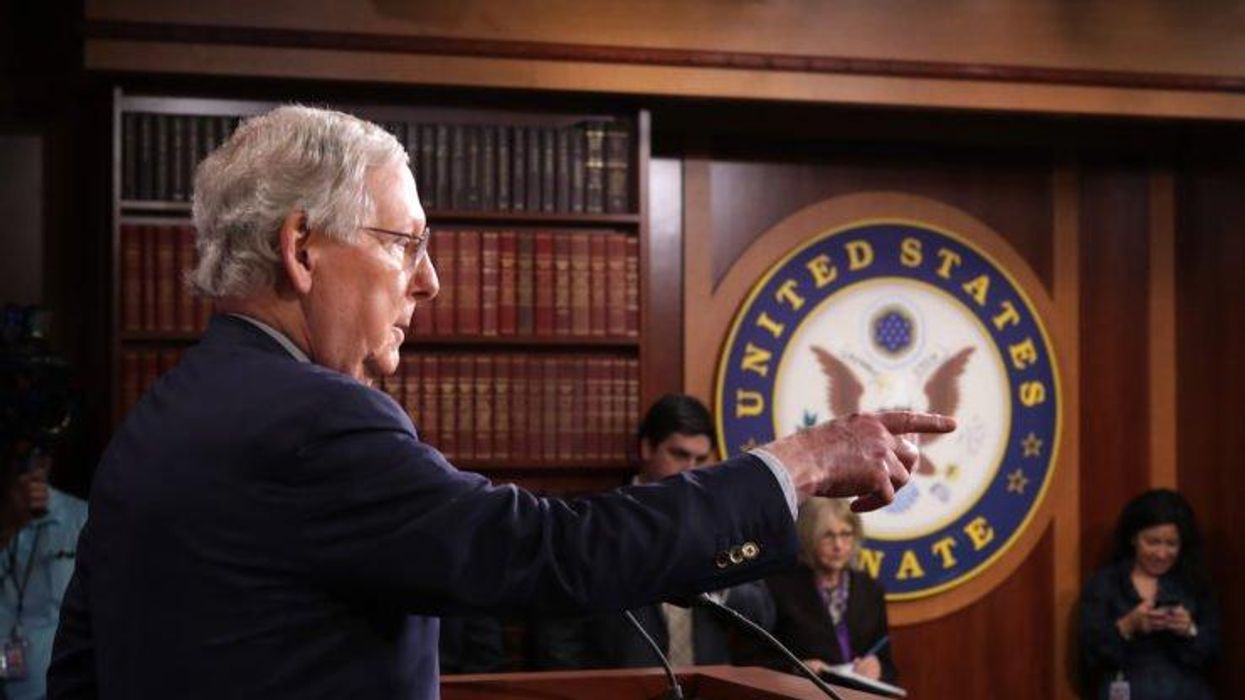
Right after the right-wing extremists in charge of the Trumpian outfit masquerading as Abraham Lincoln's Republican Party succeeded in confirming Brett Kavanaugh to the U.S. Supreme Court, Sen. Mitch McConnell spiked the football. The Kentucky Republican attacked the thousands of activists and citizen lobbyists who almost pulled off the improbable feat of stopping the confirmation by smearing them as a "mob" and claiming, without any evidence, that their activism was some kind "political gift" for the Republican Party.
And the media hand-wringing started almost immediately. The so-called impartial reporters and pundits in traditional corporate media outlets (hereinafter I will refer to them as "trad-media") immediately adopted McConnell's talking points in their ridiculous "both sides" frame. As Media Matters documented, "The Washington Post's analysis of the week concluded that Democrats and Republicans are equally at fault for divisive politics." The dean of Washington's "both sides" nonsense, Chuck Todd, agreed with right-wing pundits that both sides in Washington are taking part in the "vulgarization" of politics. These claims were made, naturally, without any viable data or evidence as support.
These trad-media reporters and pundits went with what is clearly their gut instinct to punch down at liberals. In this case, they were denigrating the heroic advocacy of hundreds of activists--primarily women--who came to the Hart Senate Office Building from all over the country to engage in grassroots lobbying in an effort to make survivors of sexual assault visible to a mostly male Republican Party. And they were getting results.
I can list a couple of examples just off the top of my head:
First, the obvious one. Unless you have been hiding under a rock by now you have read the story about two survivors who confronted Arizona Republican Sen. Jeff Flake in an elevator before he was headed to the first crucial vote in the Senate Judiciary. They told their stories of assault, and tearfully both challenged and pleaded with Flake to at least look them in the eye. And by all accounts their powerful advocacy made an impact: They were able change his mind at least at that point of time. Second, Sen. Lisa Murkowski met with dozens of Alaskan women, including several sexual assault survivors, in what was reported as an "emotional, hour+ meeting." No one can argue that those meetings did not have an impact. It's worth noting that, unlike Sen. Murkowski, who took time to meet her constituents, Sen. Susan Collins cut and ran from her own.
Yet without a shred of evidence, the traditional corporate media outlets ran with McConnell's spin, and Democratic insiders in the beltway predictably took the bait. Instead of reflecting on the at best uninspiring and at worst incompetent leadership of Senate Democrats, Democratic insiders immediately joined in on the right-wing-inspired attack on the progressive base of their own party by trad-media reporters.
Then a funny thing happened. Actual data undercut the conventional wisdom within the elite political and media establishment living in the beltway bubble. A CNN poll Monday revealed data of a deeply tarnished Kavanaugh opposed by majority of Americans:
52% of Americans say they believe the women accusing Kavanaugh of sexual misconduct over the judge's denials of those accusations (38% said they believed him more than the women). And half (50%) said they thought he lied about his alcohol use as a young adult, more than thought he was telling the truth about it (37%). Half say Kavanaugh's personal conduct has disqualified him to serve on the court, and 53% say his professional qualifications do not outweigh any questions about his personal conduct.
The poll countered the conventional wisdom of backlash among previously unenthusiastic Republican voters. And that was not all. Fresh polls also came out on Monday showing Democrats leading in key battleground districts in House races across the country. The numbers underscored that the narrative driven by McConnell and the right-wing about progressive activism against Kavanaugh hurting Democratic chances was likely just hot air.
This was not the first time we have seen this movie. Time and time again, far-right extremists in Congress and the Trump regime inject their nonsensical spin without any basis in reality. Their foot soldiers in the right-wing echo chambers rinse, repeat, and lather that spin, sending it out like dutiful robots across all their channels. And then trad-media reporters run with it without any sort of pushback.
Again, just think about the absurdity of all that just happened in the last few days. McConnell went on overdrive talking about an assault by a bunch of activists around the Hill who were engaging in nothing more than boisterous lobbying and advocacy around one of the biggest legislative fights in recent years. And the serious reporters in trad-media outlets just ran with that spin.
The underlying activity of those progressive activists was not any different than that of the hundreds--if not thousands--of lobbyists in expensive suits who go to the Hill every single day to push for billions of dollars in handouts for big banks or for big pharma or big oil. They were making a case for their cause. And, full disclosure, I was one of the people lobbying Senators. I asked Sen. Murkowski in the Hart basement tunnel whether she cared about perjury. She stopped and provided an answer in a thoughtful manner. Progressive activists had a respectful and meaningful exchange with her, unlike right-wing extremist Sen. Bill Cassidy from Louisiana, who cut and ran from us when we just asked basic questions. He literally ran from us.
What we did was nothing compared to what (overwhelmingly white) Tea Partiers did a few years ago, when they actually physically assaulted Democratic members of Congress on their way to work. As noted by Crooked Media's Brian Beutler, who was around the Hill at the time:
Back in 2010 tea partiers spit on Emanuel Cleaver, hurled racist slurs at Andre Carson and John Lewis, and called Barney Frank a "faggot" to cheers. I personally witnessed the latter incident.
You can see what is going on here. No matter what Democrats do, they cannot win. As David Dayen noted, "the narrative stays the same":
The right-wing "aristocrats" in the Republican leadership, their Trumpian allies in the current regime, and the far-right echo chamber will always attack without any facts. They are experts at concern-trolling. The problem is not that these prevaricators exist, it's that the elites in trad-media outlets and the Democratic establishment will dutifully take their bait.
The last thing progressive activists--who have powered the unprecedented resistance to stop the effort by Trump, McConnell, and Ryan to gut our health care and came so close to stopping their hijacking of the Supreme Court--should do right now is listen to these trolls. If we had listened to these trolls who had been working so hard to weave a narrative of inevitability for Kavanaugh's confirmation, he would have been sworn into the Court weeks ago.
As I noted, the data we have seen so far indicates that despite the rights' best effort to undermine and denigrate the progressive movement's activism, the voters in battleground districts are not falling for it. Neither should we.
Let's keep our eyes on the prize, focus on our message, and get our voters out in massive numbers to win back at least one chamber of Congress. Then we can push for real accountability and start the process of restoring our democracy.

Other than shouting about building a wall on the U.S.-Mexico border, one of Donald Trump's most frequently proclaimed promises on the 2016 campaign trail was the launching of a half-trillion-dollar plan to repair America's crumbling infrastructure (employing large numbers of workers in the process). Eighteen months into his administration, no credible proposal for anything near that scale has been made. To the extent that the Trump administration has a plan at all for public investment, it involves pumping up Pentagon spending, not investing in roads, bridges, transportation, better Internet access, or other pressing needs of the civilian economy.
Not that President Trump hasn't talked about investing in infrastructure. Last February, he even proposed a scheme that, he claimed, would boost the country's infrastructure with $1.5 trillion in spending over the next decade. With a typical dose of hyperbole, he described it as "the biggest and boldest infrastructure investment in American history."
That $6-trillion, 10-year figure represents more than 30 times as much direct spending as the president's $200 billion infrastructure plan.
Analysts from the Wharton School at the University of Pennsylvania -- Trump's alma mater -- beg to differ. They note that the plan actually involves only $200 billion in direct federal investment, less than one-seventh of the total promised. According to Wharton's experts, much of the extra spending, supposedly leveraged from the private sector as well as state and local governments, will never materialize. In addition, were such a plan launched, it would, they suggest, fall short of its goal by a cool trillion dollars. In the end, the spending levels Trump is proposing would have "little to no impact" on the nation's gross domestic product. To add insult to injury, the president has exerted next to no effort to get even this anemic proposal through Congress, where it's now dead in the water.
There is, however, one area of federal investment on which Trump and the Congress have worked overtime with remarkable unanimity to increase spending: the Pentagon, which is slated to receive more than $6 trillion over the next decade. This year alone increases will bring total spending on the Pentagon and related agencies (like the Department of Energy where work on nuclear warheads takes place) to $716 billion. That $6-trillion, 10-year figure represents more than 30 times as much direct spending as the president's $200 billion infrastructure plan.
In reality, Pentagon spending is the Trump administration's substitute for a true infrastructure program and it's guaranteed to deliver public investments, but neglect just about every area of greatest civilian need from roads to water treatment facilities.
The Pentagon's Covert Industrial Policy
One reason the Trump administration has chosen to pump money into the Pentagon is that it's the path of least political resistance in Washington. A combination of fear, ideology, and influence peddling radically skews "debate" there in favor of military outlays above all else. Fear -- whether of terrorism, Russia, China, Iran, or North Korea -- provides one pillar of support for the habitual overfunding of the Pentagon and the rest of the national security state (which in these years has had a combined trillion-dollar annual budget). In addition, it's generally accepted in Washington that being tagged "soft on defense" is the equivalent of political suicide, particularly for Democrats. Add to that the millions of dollars spent by the weapons industry on lobbying and campaign contributions, its routine practice of hiring former Pentagon and military officials, and the way it strategically places defense-related jobs in key states and districts, and it's easy to see how the president and Congress might turn to arms spending as the basis for a covert industrial policy.
The Trump plan builds on the Pentagon's already prominent role in the economy. By now, it's the largest landowner in the country, the biggest institutional consumer of fossil fuels, the most significant source of funds for advanced government research and development, and a major investor in the manufacturing sector. As it happens, though, expanding the Pentagon's economic role is the least efficient way to boost jobs, innovation, and economic growth.
Unfortunately, there is no organized lobby or accepted bipartisan rationale for domestic funding that can come close to matching the levers of influence that the Pentagon and the arms industry have at their command. This only increases the difficulty Congress has when it comes to investing in infrastructure, clean energy, education, or other direct paths toward increasing employment and economic growth.
Former congressman Barney Frank once labeled the penchant for using the Pentagon as the government's main economic tool "weaponized Keynesianism" after economist John Maynard Keynes's theory that government spending should pick up the slack in investment when private-sector spending is insufficient to support full employment. Currently, of course, the official unemployment rate is low by historical standards. However, key localities and constituencies, including the industrial Midwest, rural areas, and urban ones with significant numbers of black and Hispanic workers, have largely been left behind. In addition, millions of "discouraged workers" who want a job but have given up actively looking for one aren't even counted in the official unemployment figures, wage growth has been stagnant for years, and the inequality gap between the 1% and the rest of America is already in Gilded Age territory.
Such economic distress was crucial to Donald Trump's rise to power. In campaign 2016, of course, he endlessly denounced unfair trade agreements, immigrants, and corporate flight as key factors in the plight of what became a significant part of his political base: downwardly mobile and displaced industrial workers (or those who feared that this might be their future fate).
The Trump Difference
Although insufficient, increases in defense manufacturing and construction can help areas where employment in civilian manufacturing has been lagging. Even as it's expanded, however, defense spending has come to play an ever-smaller role in the U.S. economy, falling from 8%-10% of the gross domestic product in the 1950s and 1960s to under 4% today. Still, it remains crucial to the economic base in defense-dependent locales like southern California, Connecticut, Georgia, Massachusetts, Michigan, Missouri, Ohio, Pennsylvania, Texas, Virginia, and Washington state. Such places, in turn, play an outsized political role in Washington because their congressional representatives tend to cluster on the armed services, defense appropriations, and other key committees, and because of their significance on the electoral map.
A long-awaited Trump administration "defense industrial base" study should be considered a tip-off that the president and his key officials see Pentagon spending as the way to economincally prime the pump. Note, as a start, that the study was overseen not by a defense official but by the president's economics and trade czar, Peter Navarro, whose formal title is White House director of trade and industrial policy. A main aim of the study is to find a way to bolster smaller defense firms that subcontract to giants like Boeing, Raytheon, and Lockheed Martin.
Although Trump touted the study as a way to "rebuild" the U.S. military when he ordered it in May 2017, economic motives were clearly a crucial factor. Navarro typically cited the importance of a "healthy, growing economy and a resilient industrial base," identifying weapons spending as a key element in achieving such goals. The CEO of the Aerospace Industries Association, one of the defense lobby's most powerful trade groups, underscored Navarro's point when, in July 2017, he insisted that "our industry's contributions to U.S. national security and economic well-being can't be taken for granted." (He failed to explain how an industry that absorbs more than $300 billion per year in Pentagon contracts could ever be "taken for granted.")
Trump's defense-industrial-base policy tracks closely with proposals put forward by Daniel Goure of the military-contractor-funded Lexington Institute in a December 2016 article titled "How Trump Can Invest in Infrastructure and Make America Great Again." Goure's main point: that Trump should make military investments -- like building naval shipyards and ammunition plants -- part and parcel of his infrastructure plan. In doing so, he caught the essence of the arms industry's case regarding the salutary effects of defense spending on the economy:
"Every major military activity, whether production of a new weapons system, sustainment of an existing one or support for the troops, is imbedded in a web of economic activities and supports an array of businesses. These include not only major defense contractors such as Lockheed Martin, Boeing, General Dynamics, and Raytheon, but a host of middle-tier and even mom-and-pop businesses. Money spent at the top ripples through the economy. Most of it is spent not on unique defense items, but on products and services that have commercial markets too."
What Goure's analysis neglects, however, is not just that every government investment stimulates multiple sectors of the economy, but that virtually any other kind would have a greater ripple effect on employment and economic growth than military spending does. Underwritten by the defense industry, his analysis is yet another example of how the arms lobby has distorted economic policy and debate in this country.
These days, it seems as if there's nothing the military won't get involved in. Take another recent set of "security" expenditures in what has already become a billion-dollar-plus business: building and maintaining detention centers for children, mainly unaccompanied minors from Central America, caught up in the Trump administration's brutal security crackdown on the U.S.-Mexico border. One company, Southwest Key, has already received a $955 million government contract to work on such facilities. Among the other beneficiaries is the major defense contractor General Dynamics, normally known for making tanks, ballistic-missile-firing submarines, and the like, not ordinarily ideal qualifications for taking care of children.
Last but not least, President Trump has worked overtime to tout his promotion of U.S. arms sales as a jobs program. In a May 2018 meeting with Saudi Crown Prince Mohammed bin Salman at the White House (with reporters in attendance), he typically brandished a map that laid out just where U.S. jobs from Saudi arms sales would be located. Not coincidentally, many of them would be in states like Pennsylvania, Michigan, Ohio, and Florida that had provided him with his margin of victory in the 2016 elections. Trump had already crowed about such Saudi deals as a source of "jobs, jobs, jobs" during his May 2017 visit to Riyadh, that country's capital. And he claimed on one occasion -- against all evidence -- that his deals with the Saudi regime for arms and other equipment could create "millions of jobs."
The Trump administration's decision to blatantly put jobs and economic benefits for U.S. corporations above human rights considerations and strategic concerns is likely to have disastrous consequences. Its continued sales of bombs and other weapons to Saudi Arabia and the United Arab Emirates, for example, allows them to go on prosecuting a brutal war in Yemen that has already killed thousands of civilians and put millions more at risk of death from famine and disease. In addition to being morally reprehensible, such an approach could turn untold numbers of Yemenis and others across the Middle East into U.S. enemies -- a high price to pay for a few thousand jobs in the arms sector.
Pentagon Spending Versus a Real Infrastructure Plan
While the Trump administration's Pentagon spending will infuse new money into the economy, it's certainly a misguided way to spur economic growth. As University of Massachusetts economist Heidi Garrett-Peltier has demonstrated, when it comes to creating jobs, military spending lags far behind investment in civilian infrastructure, clean energy, health care, or education. Nonetheless, the administration is moving full speed ahead with its military-driven planning.
In addition, Trump's approach will prove hopeless when it comes to addressing the fast-multiplying problems of the country's ailing infrastructure. The $683 billion extra that the administration proposes putting into Pentagon spending over the next 10 years pales in comparison to the trillions of dollars the American Society of Civil Engineers claims are needed to modernize U.S. infrastructure. Nor will all of that Pentagon increase even be directed toward construction or manufacturing activities (not to speak of basic infrastructural needs like roads and bridges). A significant chunk of it will, for instance, be dedicated to paying the salaries of the military's massive cadre of civilian and military personnel or health care and other benefits.
In their study, the civil engineers suggest that failing to engage in a major infrastructure program could cost the economy $4 trillion and 2.5 million jobs by 2025, something no Pentagon pump-priming could begin to offset. In other words, using the Pentagon as America's main conduit for public investment will prove a woeful approach when it comes to the health of the larger society.
One era in which government spending did directly stimulate increased growth, infrastructural development, and the creation of well-paying jobs was the 1950s, a period for which Donald Trump is visibly nostalgic. For him, those years were evidently the last in which America was truly "great." Many things were deeply wrong with the country in the fifties -- from rampant racism, sexism, and the denial of basic human rights to McCarthyite witch hunts -- but on the economic front the government did indeed play a positive role.
In those years, public investment went far beyond Pentagon spending, which President Dwight Eisenhower (of "military-industrial complex" fame) actually tried to rein in. It was civilian investments -- from the G.I. Bill to increased incentives for housing construction to the building of an interstate highway system -- that contributed in crucial ways to the economic boom of that era. Whatever its failures and drawbacks, including the ways in which African-Americans and other minorities were grossly under-represented when it came to sharing the benefits, the Eisenhower investment strategy did boost the overall economy in a fashion the Trump plan never will.
The notion that the Pentagon can play a primary role in boosting employment to any significant degree is largely a myth that serves the needs of the military-industrial complex, not American workers or Donald Trump's base. Until the political gridlock in Washington that prevents large-scale new civilian investments of just about any sort is broken, however, the Pentagon will continue to seem like the only game in town. And we will all pay a price for those skewed priorities, in both blood and treasure.

Already facing a lawsuit charging that his appointment to head the Consumer Financial Protection Bureau (CFPB) is "unlawful," White House budget director Mick Mulvaney was confronted with outraged protests on Monday as he arrived at CFPB headquarters for his first day as "acting director" of the agency--a title also claimed by Leandra English, the CFPB's deputy director.
"This is about whose side President Trump is on--big banks, or working families. So far in his administration, he has chosen the big banks time after time."
--Sen. Elizabeth Warren (D-Mass.)Mulvaney and English began jostling for position almost immediately after the workday began Monday morning, with both insisting that the law is on their side.
In an email to CFPB staffers, English wrote "[i]t is an honor to work with all of you," signing the note "acting director." Around two hours later, Mulvaney sent his own message to the agency's 1,600 employees, imploring them to "disregard any instructions you receive from Ms. English in her presumed capacity as acting director."
Weighing in on who has the proper authority to run the agency, former Rep. Barney Frank (D-Mass.)--co-author of the 2010 legislation that brought the CFPB into existence--concluded that it is "clearly" English.
"When we wrote the law creating the CFPB, we deliberately tried to give it some protection from the normal political process," Frank noted, arguing that such protections are necessary for an agency tasked with battling powerful Wall Street firms.
Sen. Elizabeth Warren (D-Mass.)--an original architect of the CFPB--echoed Frank's conclusion in an interview with the Washington Post on Monday. "Dodd-Frank is quite specific: It provides its own succession planning," Warren observed. "There is no vacancy for President Trump to fill."
The demonstrators who gathered outside CFPB headquarters early Monday morning also expressed their agreement with Frank's assessment.
Led by a coalition of consumer advocacy groups including Public Citizen and Americans for Financial Reform, protesters denounced the White House's attempt to appoint Mulvaney and hoisted signs highlighting the CFPB's role in combating "the abuses of triple-digit interest payday and car-title lenders," going "to bat for victims of sham for-profit colleges," and "standing up to Wall Street banksters and fraudsters."
In a speech during Monday's gathering, Rep. Jamie Raskin (D-Md.) argued that the Trump administration's effort to place Mulvaney at the helm of the CFPB represents an explicit move to "thwart the independence" of the agency and "vaporize" its power to protect consumers from predatory financial institutions.
Watch:
As Common Dreams has reported, the legal stand-off between Mulvaney and English was sparked by CFPB director Richard Cordray's departure on Friday--a week sooner than anticipated.
Shortly after announcing his resignation, Cordray named English deputy director of the agency, placing her in line to become acting director according to Dodd-Frank. The Trump administration quickly countered by naming Mulvaney as interim CFPB chief, a move the White House has since justified by citing a Justice Department memo penned by Steven Engel--a DOJ attorney who has represented payday lenders before the CFPB, as David Dayen reported for The Intercept on Monday.
"Having a former adversary to CFPB weigh in on who is the legal acting director of the agency raises questions over Engel's independence and potential conflict of interest," Dayen wrote.
Sen. Warren concluded on Monday that the Trump administration's maneuvering also raises questions about the president's expressed commitment to being the "voice" of the working class.
"This is about whose side President Trump is on--big banks, or working families," Warren said. "So far in his administration, he has chosen the big banks time after time."
As the showdown at the agency continues, a ruling on the lawsuit filed by English from a federal district court is expected as the next legal development.
In what was characterized as "terrible luck" for the CFPB, English v. Trump was assigned to Judge Timothy Kelly, a Trump appointee.

Most Americans suffer from the unfortunate delusion that economic problems are violations of some mathematical order. When recession, severe inflation or other hard times engulf society, it is because the sacred equations have been angered. If we adjust the right variable just so, a set of very important numbers will respond appropriately, and a process of mystical, self-sustaining prosperity will begin. Knowledge of these secret statistical potions is closely guarded, and its practitioners deploy sophisticated abstractions to explain away common-sense calls for reform.
Why do so many people work 60-hour weeks for poverty wages while a few luxuriate in the fabulous returns of interest-bearing assets? Why are the citizens of Puerto Rico threatened by a deadly social collapse while the fruit of the island's labor is shipped to Wall Street bondholders? The answer surely cannot be that some wealthy members of our society are exercising political power over the lives and incomes of others. We must consider growth, productivity, liquidity, gross domestic product and the debt-to-GDP ratio.
But at the heart of every important economic issue are simple and straightforward power relationships. When you are in debt, someone else has financial power over the ordering of your affairs. Wealth enables rich people to buy their way out of troubles that overwhelm the lives of the poor. For much of our history, the American government granted some people the right to own other people. Economic problems are political problems. They have always been so; they can never be otherwise.
And so in a perverse sense, President Donald Trump's most recent tax proposal is a great gift to society. It clears away much of the obfuscating hocus-pocus that leaders of both political parties have been busy constructing around our politics over the past 40 years. Trump wants a massive tax cut for the very wealthy. He doesn't really care how much it costs, or what it will do to the federal budget deficit, or to economic growth or to worker productivity. He isn't even very picky about how, exactly, taxes for the rich are reduced, so long as they are diminished by a very large amount.
His framework suggests eliminating the estate tax, dramatically slashing corporate taxes, reducing the top rate on individual income taxes, and limiting the levies on special "pass through" accounts -- all perks that generate terrific sums for CEOs and hedge fund managers. If you want to tack on a few hundred dollars for middle-class families, Trump will not raise a fuss.
We could describe this as a complex, disembodied economic idea -- the mathematical inelegance of extreme inequality or the fearful ratios implied by a ballooning deficit. But it is really a simple expression of power. The Trump tax plan is a public demonstration of the political priority the American government has decided to grant to the wealthiest members of our society. It is a clear, unequivocal statement that in America, some citizens are more equal than others. Everything else we can say about the plan with statistics is window-dressing.
The billionaire donors cheering it on don't need the money. It will not make them wealthier in any meaningful sense. They will buy the same Hermes scarves and Tom Ford sunnies they would have purchased without it. Their yachts will continue to be elegantly contoured and divinely upholstered. Many quite literally cannot use the money Trump wants to offer them. One of the biggest perks in Trump's proposed framework is the elimination of the estate tax -- a levy that falls not on the millionaires of today, but on the inheritances of their heirs and heiresses. A wealthy individual needs to leave behind over $5 million to trigger the estate tax. For a married couple, the figure is nearly $11 million.
So Trump loves the rich so much he will cut their taxes even when they are dead. And the ultra-rich love Trump's plan because it is a formal political recognition of their social prestige, an acknowledgement that they carry more weight than others in the political system we still optimistically refer to as a democracy. This is, as they see it, how it should be. It has, after all, been the way of things for decades.
In 2010, billionaire Blackstone CEO Stephen Schwarzman was enraged by President Barack Obama's suggestion that taxes on private equity and hedge fund managers be increased from 15 percent to 35 percent -- the level that other wealthy people have to pay on their salaries. It was "war," according to Schwartzman, who likened the plan to "when Hitler invaded Poland."
Obama settled for 23.8 percent.
"I believe one of the major things people want from politicians is psychic income," former House Financial Services Committee Chairman Barney Frank (D-Mass.) told HuffPost in 2014. "They want to be told that they are wonderful people, that their jobs are important for the human race, that they contribute greatly. Lloyd Blankfein was not really kidding when he said that, 'We are doing God's work.' That's his inner feeling. I don't think that the [Dodd-Frank financial reform] legislation really hurt them much, and I think a lot of them, frankly, some of them welcome it because they're not under competitive pressure to do stupid things -- now, nobody can do them. But we really hurt their feelings mightily, particularly the president. You've seen that with these ridiculous statements from Steve Schwarzman going on about Nazis."
Frank was close, but not quite right. Many Wall Streeters did have their feelings hurt when Obama told CBS that he didn't run for president to protect the paychecks of "fat cat bankers." But this was because the president's words implied a political demotion. After years of being celebrated as "Masters of the Universe," bankers were suddenly threatened with the prospect of becoming ordinary, humdrum members of a democracy; people whose actions might be subject to democratic forms of accountability. It must have been terrifying.
Wall Street's very public freakout -- a fellow named Anthony Scaramucci implored Obama to stop bashing the "Wall Street pinata," and JPMorgan Chase CEO Jamie Dimon declared he could now barely tolerate calling himself a Democrat -- obscured the profound degree to which Obama was protecting Wall Street interests.
Obama named a top lobbyist from JPMorgan Chase as his chief of staff. He and his attorney general, Eric Holder, steadfastly refused to prosecute what everyone knew to be widespread criminality on Wall Street during the 2008 financial crisis. The Obama foreclosure relief plan became a vehicle for big banks to harvest funds from desperate families through illegal foreclosures. Obama even protected the bonuses at AIG and big banks that received taxpayer bailouts. When vulture fund investors descended on Puerto Rico, forcing the closure of schools and hospitals in the name of debt payments, Obama waved through a half-hearted reform plan that preserved the political priority of bondholders over basic social services.
These bailouts and bonuses and other protections were not only infuriating because bankers were rich. They divorced socially destructive activity from political accountability. You could enrich yourself by destroying entire communities -- you could even break the law to do it -- and face no meaningful consequences. Members of a democracy, it seemed to many people, ought to be able to protect themselves from such abuses.
And yet studies by respected academics from Princeton, Northwestern University and the University of Connecticut concluded that the concerns of the wealthy dominate the congressional agenda. Some reporters on Capitol Hill noticed the same trend. But the idea has generally been dismissed by Washington officialdom, which prides itself on interpreting the mathematical codes and metaphors that show why simple problems of power are in fact very thorny economic matters.
Paul Ryan, in particular, hypnotized D.C. journalists in the days before he became House speaker with pronouncements about debt and deficits. Ryan's story conveniently excluded credit default swaps, proprietary trading and other high-risk activity on Wall Street. He warned of an inevitable "debt crisis" just around the corner if America didn't cut its spending -- particularly on social programs for the poor and elderly.
This wasn't because he hated the indigent, mind you -- he merely recognized that we now had too many "takers" and not enough "makers" and were nearing a "tipping point." He even found the magic number: If America's public debt reached 90 percent of its gross domestic product, we were headed for another 2008, only worse. The figure, based on research from two prominent conservative economists, was eventually discredited by a lowly graduate student who discovered it was the result of a very simple Microsoft Excel error.
Today, as Trump proposes massive tax benefits for the super-rich, the deficit hawks and austerity mongers have fallen strangely silent. The profound ratios and disequilibria that once threatened to dissolve society itself have disappeared now that they are being fueled by tax cuts rather than spending programs.
We can have a political system that respects its citizens as political equals, or we can have a society dominated by the arbitrary interests of unaccountable wealth. Trump, like Obama before him, has chosen the latter. In the not-so-distant past, polities ruled by unaccountable wealth have demonstrated a marked tendency to generate less accountability and an astonishing capacity for statistical deception and logical absurdity.
In 1929, the global economy was in terrible shape. There was a tremendous amount of work to be done -- highways to be built, telephone lines to be wired, electrical grids to be constructed -- yet millions of people were out of work. The British economist John Maynard Keynes co-authored a political pamphlet with a simple solution: The government could hire the unemployed people to do the work. Financiers in the city of London were aghast at the idea, and told the public that it was all much more complicated than Keynes suggested. If the government hired people, after all, it would deprive future generations of the chance to get a job. All of the work would already have been done. Keynes knew he wasn't proposing anything particularly clever, just trying to knock down silly ideas that people only took seriously because they were delivered by very prestigious people.
"Our main task," he wrote, "will be to confirm the reader's instinct that what seems sensible is sensible, and what seems nonsense is nonsense."
No one in power listened to him then, and there will probably be plenty of Democrats and Republicans in Congress who shrug off critics of the Trump tax plan now. Our government, like those of the Gilded Age, likes to give the wealthy what they want. At least with Trump, we will not mistake a simple act of political domination for the music of the spheres.
The Massachusetts Democratic Party has been plunged into turmoil by a proposed resolution stating that Israel's illegal settlements in the West Bank are an obstacle to peace between Israel and Palestine, the Boston Globe reported Friday.
Carol Coakley of Millis, Mass., proposed the resolution that reads in part: "the Massachusetts Democratic State Committee affirm our support for the long-standing U.S. policy of the State Department and every administration from President Lyndon Johnson to President Barack Obama, that Israel's settlements in the occupied West Bank are obstacles to peace." Coakley has been a member of the Massachusetts Democratic State Committee for 18 years, the Globe notes.
"This resolution targets a hypocrisy in the position of the national Democratic Party [...] which says it supports a two-state solution, but gives huge aid and backing to Israel and very little to Palestinians."
--Cole Harrison, Massachusetts Peace Action
And while multiple U.S. presidential administrations, global leaders, and the United Nations have also repeatedly stated that Israel's West Bank settlements are an obstacle to peace in the region, some Massachusetts Democrats are attempting to derail Coakley's resolution before it heads to the full Democratic State Committee next week.
The Globe reports:
[Former state treasurer Steve] Grossman, the former chairman of both the state and national Democratic parties, as well the one-time head of the pro-Israel American Israel Public Affairs Committee, said the resolution, if successful, could gravely damage Democrats politically.
He said it feeds a "one-sided blame game," which is playing out across college campuses and in pockets of the "progressive wing of the Democratic Party," and would send a disturbing message to many Democratic activists.
"A lot of people would read about it and would read the language and say: 'Frankly, that's the last straw. This is not a place I feel comfortable any longer,'" Grossman said.
Other Democrats also oppose the resolution, the newspaper observes.
"The Democratic State Committee cannot afford such a divisive and ill-advised resolution at a time when our party needs to unite to protect the values and commitments we hold dear," wrote James Segel, a former state representative and aide to Barney Frank, in a letter. "If adopted it is almost certain to spark a bitter, very public, and entirely unnecessary debate that would seriously undermine party unity and alienate many of our core supporters."
MassLive reports that Segel has gone so far as to propose an alternate resolution that states that there are "many impediments" to peace in the region.
"These include Palestinian incitement and terrorism, Israeli settlement expansion, and many others," the resolution reads. "To achieve a lasting solution to this conflict, both sides will have to make significant concessions and refrain from actions that undermine prospects for peace."
Boston City Councilor Josh Zakim also reportedly characterized Coakley's effort as "unnecessarily divisive."
Yet flying in the face of such critique is the fact that Coakley's resolution quotes from Obama's State Department, which at one point described the settlements as "corrosive to the cause of peace." Such statements don't seem to have hurt Obama in Massachusetts: state voters overwhelmingly supported Obama in the 2008 and 2012 presidential elections.
Cole Harrison, the executive director of Massachusetts Peace Action, testified Wednesday before a subcommittee in support of Coakley's resolution, the Globe reported, and characterized Grossman's statements as "scare tactics."
"This resolution targets a hypocrisy in the position of the national Democratic Party--let's call it the Hillary-wing of the party--which says it supports a two-state solution, but gives huge aid and backing to Israel and very little to Palestinians," Harrison said, according to the Globe.
MassLive further reports that "Coakley said she was inspired to bring the issue to the Massachusetts party in August, after the national fight," referring to failed attempts by supporters of Sen. Bernie Sanders (I-Vt.) to include statements in the Democratic Party platform condemning Israel's West Bank settlements.
"Because the national party could not come to grips with it, or acknowledge the problem, perhaps one state could do it, and perhaps another state could follow, and maybe in four years we'll be able to say Palestinians have rights too," Coakley said.
The subcommittee created to study the resolution will vote on it over the weekend, the Globe reports: "The subcommittee has several options. It can refer the document to the full state committee for a vote on April 29. It can table the resolution. It could amend it. Or members can farm it out to another subcommittee for more review."
Democrats were once ardent opponents--at least in word--of the Supreme Court's Citizens United decision, which has, as the New York Times editorial board noted, "thrust politics back to the robber-baron era of the 19th century." They were also proponents of the view that corporate money, no ma
Democrats were once ardent opponents--at least in word--of the Supreme Court's Citizens United decision, which has, as the New York Times editorial board noted, "thrust politics back to the robber-baron era of the 19th century." They were also proponents of the view that corporate money, no matter the intentions of those receiving it, is inherently corrupting.
They have since done much to cast doubt on what were often characterized as principled stands, making the notion that their party alone can wrest the political process from the grip of corporate America--one position they have maintained--dubious at best.
Particularly in 2016, it's hard to miss the fact that Democrats have benefited greatly from Citizens United and the great torrent of cash it sparked, and they have largely abandoned what was once their central argument against the ruling (some, like Barney Frank, have gone further, arguing not only that corporate money is not inherently corrupting, but also that those who argue the opposite are engaging in McCarthyism).
"It's an irony that's not lost on me," David Bossie, the president of Citizens United, said of the fact that "Hillary Clinton has become one of the greatest beneficiaries" of a lawsuit filed with the intention of impeding her path to the presidency.
And as the New York Times reported last week, the Citizens United ruling was far from the only hammer blow dealt to an already faltering democratic process: In 2014, the Supreme Court "struck down the aggregate limits on the amount an individual may contribute during a two-year period to all federal candidates, parties and political action committees combined." Such limits, the majority argued, constituted a violation of the First Amendment.
Again, despite their public declarations that corporate money subverts democracy, Democrats quickly pounced on the opportunity to fill their coffers.
"Democrats denounced it as an assault on democracy and a sop to billionaires," the Times noted, referring to the court's ruling in McCutcheon v. Federal Election Commission. "But Hillary Clinton and Democratic Party leaders are now exploiting the decision, funneling tens of millions of dollars from their wealthiest donors into a handful of presidential swing states."
As with their many other rightward lurches, Democrats have justified their embrace of what Thomas Ferguson and his colleagues call "money-driven" politics on pragmatic grounds. And, not surprisingly, some Democratic donors have taken it upon themselves to bolster this stance at every opportunity.
"Despite their public declarations that corporate money subverts democracy, Democrats quickly pounced on the opportunity to fill their coffers."
We learn from a recent analysis by the Washington Post that "10 mega-donor individuals and couples contributed nearly 20 percent of the $1.1 billion raised by super PACs by the end of August," easily besting the amount contributed in 2012. We also learn that the top two donors--hedge fund veterans Tom Steyer and Donald Sussman--are both supporters of the former secretary of state.
Steyer's interview with the Post, in which he discussed his sizable contributions, reeks of feigned reluctance; "money is corrupting our politics," he said after describing the Citizens United ruling as "terrible." But, he added, "the other side is going always to have a ton more money than us." So his hand is forced.
(The "Republicans made us do it" excuse has a long history.)
Of course, this argument--if it can be labeled as such--did not originate with backers of the Clinton campaign, nor is it purely a result of widespread fear of Donald Trump. It has been deployed by Democrats for years as a part of efforts to close the widening gulf between their public condemnations of corporate cash and their private embrace of it.
Do a quick Google search of "unilaterally disarm" and, scattered among discussions of military matters, you'll find numerous examples of Democrats insisting that to abandon big money entirely would be to eschew necessary strength in the face of an adequately equipped opponent.
"With so much at stake," said Jim Messina in 2012, when he was President Obama's campaign manager, "we can't allow for two sets of rules in this election whereby the Republican nominee is the beneficiary of unlimited spending and Democrats unilaterally disarm."
This should sound familiar, because it is precisely the same line the Clinton camp has used to justify its reliance on corporate patrons.
"There is too much at stake for our future for Democrats to unilaterally disarm," an anonymous Clinton staffer said last year.
More recently -- just last month, in fact -- Clinton spokesman Josh Schwerin told the New York Times that "Hillary Clinton has fought for campaign finance reform her entire career and, as president, will make it a priority to restore the role of everyday voters in elections."
But, he added, "the stakes of this election are too high to unilaterally disarm."
The point, of course, is that the stakes are always "too high." As Hal Draper noted in 1968, "Every time the liberal labor left has made noises about its dissatisfaction with what Washington was trickling through, all the Democrats had to do was bring out the bogy of the Republican right."
And for a party that often treats winning elections not as the first step in the pursuit of a more comprehensive agenda but as an end in itself, the stakes will forever be "too high." Perpetual anxiety thus becomes a tool of political coercion.
Despite Democrats' claims of practical necessity, underlying their acceptance of corporate money are deep ideological commitments. While these commitments have long been understood, the campaign of Bernie Sanders was uniquely successful in bringing them to the surface.
Specifically, the Sanders campaign demonstrated that, with a sufficiently ambitious--and, in today's political context, radical--agenda, grassroots support can compete with the most powerful political machine in the country.
"Mr. Sanders's commitment to small individual contributions," observed the New York Times editorial board in April, "has put the lie to Democrats' excuses that they, too, must play the big money game to win."
"If there is to be any chance of fundamentally restructuring the political and economic order, neoliberals and their partners in the private sector--along with the fascists, misogynists, and racists of the reactionary right--must be defeated."
What the Times omitted is the fact that Sanders didn't have to play the big money game because his articulation of a genuinely progressive platform engendered remarkable grassroots enthusiasm, which translated into a seemingly bottomless source of small donations.
The leaders of the Democratic Party, as was made clear throughout the primary process, do not share this devotion to progressive politics, so they must rely on big money donors to make up the difference.
At bottom, the contrast between the Sanders left and the party establishment that so furiously shunned his candidacy is quite simple.
Clinton, as is made clear by her lucrative remarks to several large banks, views America's dominant institutions as partners. Sanders was explicit in expressing the opposite view: Corporate America is an obstacle to be overcome, an anti-democratic opponent that must be defeated. To join hands with big business is to undercut any progressive project.
Over the last several decades, Clinton's view has emerged victorious among the Democratic leadership, a fact that has monumental implications, spanning well beyond the confines of electoral politics; one need look no further than climate change.
Republicans, for their part, are rabid science deniers who openly side with the fossil fuel industry over the planet; Donald Trump's view on the issue is consistent with his overall lunacy and ignorance.
But Clinton, as Kate Aronoff points out, "is in her own form of climate denial."
"Among the noticeable absences from Clinton's plan are a moratorium on fracking, an end to all fossil fuel exploration, a ban on extraction on federal land and its rapid phase-out everywhere else," Aronoff writes. "Similarly missing is the change scientists are calling for most loudly: A carbon budget."
The argument is not only that Clinton's acceptance of corporate cash prevents her from embracing the radical agenda necessary to combat climate change--or income inequality, or corporate criminality, or poverty. It is also that, as Naomi Klein has argued, her "corporate worldview" makes her embrace of corporate cash perfectly normal, and her rejection of radical proposals perfectly predictable.
If there is to be any chance of fundamentally restructuring the political and economic order, neoliberals and their partners in the private sector--along with the fascists, misogynists, and racists of the reactionary right--must be defeated.
"Our movement's success," Andrew Tillett-Saks and Warren Heyman, labor organizers for UNITE HERE, conclude, "depends on how widely and how militantly we can organize workers to fight corporate power and the 1 percent, not embrace them."
Wells Fargo CEO John Stumpf was on the hot seat Tuesday when he faced Senator Elizabeth Warren of Massachusetts and other angry lawmakers at a Senate Banking Committee hearing designed to investigate the bank's widespread rip-off of its customers.
Warren told Stumpf, who earns $19 million a year: "You should resign...You should be criminally investigated."
Wells Fargo CEO John Stumpf was on the hot seat Tuesday when he faced Senator Elizabeth Warren of Massachusetts and other angry lawmakers at a Senate Banking Committee hearing designed to investigate the bank's widespread rip-off of its customers.
Warren told Stumpf, who earns $19 million a year: "You should resign...You should be criminally investigated."
Warren's verbal assault on Stumpf generated considerable publicity. But this issue wouldn't have surfaced in the first place without the hard work of several grassroots community and labor organizations - especially the Committee for Better Banks -- that first brought the scandal to the attention of the media, elected officials, and regulators. Wells Fargo is the nation's fourth largest bank by assets and its leading home lender.
Watch:
Warren demanded both the Department of Justice and Securities and Exchange Commission criminally investigate Stumpf for the Well Fargo's practice of pressuring its low-level employees to create over 2 million unwanted checking and credit-card accounts without consumers' knowledge or permission in order to grow the bank's stock price. She told Stumpf that during the years that Wells Fargo engaged in this "scam," Stumpf's own portfolio of company stock increased by $200 million.
She urged Stumpf to return the compensation he received while these practices went on.
"So, you haven't resigned, you haven't returned a single nickel of your personal earnings, you haven't fired a single senior executive," Warren told Stumpf. "Instead, evidently, your definition of accountable is to push the blame to your low-level employees who don't have the money for a fancy PR firm to defend themselves. It's gutless leadership."
"You squeezed your employees to the breaking point so they would cheat customers and you could drive up the value of your stock and put hundreds of millions of dollars in your own pocket," Warren said.
Wells Fargo's official line is that the employees were acting on their own to skim extra pay from the bogus accounts. Warren questioned Stumpf about the fraudulent accounts, asking how such an operation could have occurred without the knowledge of top management.
Wells Fargo employees say they did so because of what they've called the bank's "sell or die" quota system which put pressure on them to engage in these practices in order to keep their jobs. They've said it was a routine practice that employees referred to as "sandbagging."
Activists are up in arms over Wells Fargo's double standard in dealing with its employees. After the scandal was exposed by grassroots advocates, the media, and government regulators, the bank fired at least 5,300 employees and refunded millions of dollars to customers. But bank reform activists are skeptical that so many employees could have acted on their own without the knowledge of higher-up bank executives.
Meanwhile, in July, in the wake of the scandal, Carrie Tolstedt, Wells Fargo's director of consumer banking, the operation that opened the fake accounts, abruptly left the bank where she worked for 27 years. She took with her a $124.5 million bonus. After her retirement announcement, Stumpf praised Tolstedt as "a standard-bearer of our culture" and "a champion for our customers."
Warren criticized Stumpf for failing to withdraw Tolstedt's bonus (a practice known as a "clawback") in light of the revelations about her division's behavior. Stumpf said it was up to the bank's compensation committee, comprised of board members, to decide whether to rescind Tolstedt's bonus.
"If you have no opinions on the most massive fraud that's hit this bank since the beginning of time, how can it be that you get to continue to collect a paycheck?" Warren asked.
Moreover, activists say that the problem goes well beyond Wells Fargo and is an industry-wide scandal.
Ruth Landaverde, a former employee at both Wells Fargo and Bank of America, said the pressure from her supervisors at both banks was so intense that she developed a tic in her eye and had trouble sleeping. She told the Associated Press that in order to keep her job she was required to sell four credit cards and four auto loans each week in addition to three home mortgages or refinances.
"I wasn't going to do something unethical, but the sales pressure was very real," she said. "I can see why some employees did what they did."
Landaverde is now a member of the Alliance of Californians for Community Empowerment (ACCE), a statewide advocacy group that works on housing and banking issues and is a member of the Committee for Better Banks, a coalition of community and labor groups. In an email this week to ACCE members and supporters, she wrote:
"When I worked for Bank of America, I felt uncomfortable when I was given a list of bank customers and told to call them and push new accounts and credit cards that could end up sticking them with unnecessary fees and debt. What's worse, we were targeting customers in low-income communities of color much more than the customers in more affluent zip codes."
Landaverde explained that "there are still many more banks that have not committed to stop requiring their employees to push unnecessary products in order to keep their jobs. And now, Wells Fargo CEO John Stumpf is throwing his own employees under the bus rather than accepting responsibility for the outrageous high-pressure sales culture that he and other Wall Street executives are creating!"
"I know first-hand that predatory sales exist across the U.S. banking industry," said Cassaundra Plummer, a former teller at TD Bank and member of the Committee for Better Banks. "At TD bank, sales goals made it impossible for frontline bank workers to help customers find the financial products best suited to them. My manager would encourage customers to take out home equity lines to go on vacation which is the worst financial advice I've ever heard! We need to end predatory sales goals across the industry not just Wells Fargo."
Last year the Committee for Better Banks delivered a petition signed by more than 11,000 people to Stumpf, along with a letter noting that workers faced "pressures to meet sales quotas under strict monitoring and threat of losing their jobs, often forcing them to push unnecessary products and fees on to their customers, causing them stress and financial hardship," and that loan servicing departments have been using similar tactics to push consumers toward riskier products they can ill afford.
The group has now launched another petition asking elected leaders in Los Angeles and other cities around the country to ban all city business with banks that force their employees to meet sales goals for high fee products such as credit cards, new accounts and home refinance loans. They say that these incentive programs create a system where bank workers are forced to engage in predatory practices against their professional and ethical beliefs.
"Wells Fargo's action to eliminate sales quotas is a hard-won victory for front-line bank workers who have been denouncing abusive sales goals for over two years," said Reuben Traite, an organizer with the Committee for Better Banks. "The fact that Wells Fargo turned a blind eye is appalling. But these high pressure sales goals are rampant across big banks and we need to end it across the industry."
Activists with the Los Angeles chapter of ACCE brought the issue to the attention of the Los Angeles Times, which broke the story in 2013. Once it made the papers, Los Angeles City Attorney Michael Feuer conducted his own investigation and then sued Wells Fargo. All that got the attention of the Consumer Financial Protection Bureau (CFPB), a federal agency.
Last week, CFPB Director Richard Cordray, Comptroller of the Currency Thomas Curry, and Feuer announced that they had reached settlements with Wells Fargo over its "major breach of trust." Wells Fargo agreed to pay the CFPB $100 million (the largest fine the agency has ever imposed) in addition to $50 million to the city and county of Los Angeles, and $35 million to the Office of the Comptroller of the Currency. Wells Fargo did not admit any wrongdoing in the settlements, although it issued an apology to its customers, promised to revise its sales practices, and agreed to pay consumers refunds for fees assessed on checking and credit cards accounts they didn't authorize.
Activists point out that the fines being levied against Wells Fargo are a drop in the bucket compared with Wells Fargo's 2015 profits of $20 billion. It is even less than the more than $200 million in company stock that Stumpf owns. He serves on the board of directors of Target Corporation and Chevron Corporation and, until recently, on the board of the Financial Services Roundtable, a powerful industry lobby group.
The bank's apology and refunds won't make the issue go away. Many consumers are suing the banks as are former employees who say they were fired (or forced to resign) when they refused to engage in the fraudulent practices in order to meet the bank's unrealistic sales quotas.
The issue first emerged last year when the Los Angeles Times uncovered Wells Fargo's illegal practices. In response to the Times story, Feuer initiated his own investigation and sue the bank, alleging that it had "victimized their customers by using pernicious and often illegal sales tactics," including unattainable quotas that pressured bank employees to "engage in fraudulent behavior."
The CFPB - the federal agency created by the 2010 Dodd-Frank bank reform law -- undertook its own investigation. It discovered that Wells Fargo employees opened as many as 1.5 million checking and savings accounts, and more than 500,000 credit cards, without consumers' knowledge or permission.
The LA and CFPB investigations, the resulting media coverage, and Wells Fargo's attempt to blame its lower-rung employees for the scandal led five Democrats on the Senate Banking Committee -- Sherrod Brown (Ohio), Jack Reed (R.I.), Robert Menendez (N.J.), Jeff Merkley (Ore.), and Warren -- to push its Republican chairman, Richard Shelby of Alabama, to hold Tuesday's hearings. They sent Strump a letter last week expressing concern that consumers and low-level employees will bear the burden of the bank's misconduct "while senior executives walk away with multi-million dollar awards based on what the company later finds out are fraudulent practices."
The San Francisco-based Wells Fargo has long been a target of bank reform activists for its troublesome track record of risky and reckless behavior. For more than a decade, grassroots groups have challenged Wells Fargo's racially discriminatory lending practices and aggressive foreclosures. They have picketed at the offices and homes of the bank's top executives, sued the bank for violating laws against racist mortgage lending, and testified before Congress, state legislatures and City Councils demanding that they investigate and reign in Wells Fargo's troublesome practices.
The activists have primarily been bank consumers and residents of neighborhoods harmed by Wells Fargo's redlining and other practices. But the two-year old Committee for Better Banks is comprised of bank employees as well as consumers, representing a new and potentially powerful coalition. Not surprisingly, the Committee for Better Banks is now part of the broader movement to raise wages for service-sector employees like bank tellers to $15 an hour.
The CBB is aligned with the Center for Popular Democracy, a national network of local activist groups that work on housing, banking, and workers rights issues. CPD helped set the stage for the current campaign with its study of bank workers. The CPD report revealed that some of the nation's largest banks, including Wells Fargo and Citigroup, pressure its front-line employees to engage in fraudulent practices to keep their jobs. According the report, these bank employees try to serve customers responsibly, but feel pressure from higher-ups to meet the quotas in order to keep their jobs.
A report last year by the National Employment Law Center on banking industry wages found that almost three quarters (74.1 percent) of U.S. bank tellers and almost half (44.2 percent) of bank customer service representatives earn less than $15 an hour. The median hourly wage for bank tellers is $12.44. A study by the UC Berkeley Center for Labor Research and Education found that nearly one-third of the families of all tellers are on public assistance. In New York City--the capital of the nation's banking industry--39 percent of tellers and their family members are on some form of public assistance program.
Other groups involved in the better banking campaign include Move On, the Communication Workers of America, New York Communities for Change, ACCE, Jobs with Justice, Make the Road, and Americans for Financial Reform, a DC-based watchdog group.
The idea for the CFPB was first proposed by Elizabeth Warren when she was still a professor at Harvard Law School. Before she was elected to the Senate in 2012, she helped shepherd the plan for the agency through Congress in the wake of the Wall Street crisis and nationwide mortgage meltdown that began in 2008. President Obama supported the idea and, along with then-Cong. Barney Frank (D-Massachusetts), helped get it incorporated into the Dodd-Frank reform bill that was enacted over heavy opposition from the bank industry lobby.
Since 2010, banking and business lobby groups, with the help of Republican allies in Congress, have sought to undermine the agency by reducing its budget and authority.
Writing in The New Yorker, Adam Davidson pointed out that the CFPB's entire budget is little more than $600 million. In contrast, he wrote, "Wells Fargo's revenues are more than eighty billion dollars. And Wells is just one of thousands of banks, insurance companies, and other institutions that the CFPB is mandated to monitor."
Senate Banking Committee chair Shelby, an Alabama Republican, is one of many GOP members of Congress who complain that the CFPB is too powerful and that its tough regulations lead banks to offer fewer consumer products. But a recent article in American Banker, an industry publication, suggested that Wells' settlement would make it difficult for bank lobbyists and Republicans in Congress to attack the CFPB.
Even so, GOP presidential nominee Donald Trump has called for dismantling nearly all of the Dodd-Frank reforms. In contrast, Democratic nominee Hillary Clinton last week touted the CFPB's "forceful response" to the Wells Fargo scandal, adding that it was "a stark reminder of why we need a strong consumer watchdog to safeguard against unfair and deceptive practices."
Echoed Lisa Donner, executive director of Americans for Financial Reform, a DC-based watchdog group that has played an important part in defending the CFPB from its opponents: "The current Wells Fargo scandal reveals why we need a strong regulatory agency that has the backs of bank consumers as well as employees."
"Wells Fargo's action to eliminate sales quotas is a hard-won victory for front-line bank workers like me who have been coming together in the Committee for Better Banks and working to end to high-pressure sales goals that hurt our families and communities," said Julie Miller, a former Wells Fargo branch manager and a member of the Committee for Better Banks.
"Wells Fargo got into this scandal because it turned a deaf ear to the alarms sounded by consumers and its own workers, and its experience proves that these sales goals have no place in the consumer banking industry," Miller observed. "Predatory sales goals are rampant at big banks across the country, and we will keep on working and organizing to make sure Wells Fargo makes good on its word and that other banks follow suit by implementing fair business practices for workers and customers."