SUBSCRIBE TO OUR FREE NEWSLETTER
Daily news & progressive opinion—funded by the people, not the corporations—delivered straight to your inbox.
5
#000000
#FFFFFF
To donate by check, phone, or other method, see our More Ways to Give page.

Daily news & progressive opinion—funded by the people, not the corporations—delivered straight to your inbox.
Less than a day after the third and final 2016 presidential debate, GOP nominee Donald Trump faced new accusations from a woman who recounted a story of her sexual assault at his hands. Karena Virginia told members of the press how Trump groped her in public at the U.S. Open in 1998 while asking, "Don't you know who I am?"
Two days later, two more women, Kristin Anderson and Summer Zervos, made similar allegations. Earlier this year, a woman named Katie Johnson said Trump raped her in 1994 when she was 13 years old; she filed a lawsuit against him that was later thrown out on a technicality. Trump's ex-wife, Ivana Trump, has also accused him of raping her. To date a dozen women have publicly alleged that Trump in some way assaulted them.
Jane Piper, an activist who faced her rapist in court in 2014, told me in an interview that she believes the women who have accused Trump. "I take their word as their word, and I believe them," she said. "We have this documented evidence of [Trump's] attitude and behavior toward women," added Piper, referring to his numerous public statements revealing a callous and disrespectful attitude toward women. To Piper, the idea that Trump might be a serial perpetrator of sexual assault is consistent with his language and the attitude he has publicly displayed.
Think about Bill Cosby. While he has not been convicted on charges of sexual assault, in the court of public opinion, he is already considered guilty. He has admitted to drugging women in order to have sex with them, and the sheer volume of accusers against him leaves one wondering: "How could they possibly all be lying?" As Fox News' Chris Wallace asked Trump during the final presidential debate, "Why would so many different women from so many different circumstances, from so many different years, why would they all ... make up these stories?"
Indeed, in cases such as those involving Cosby and Trump, there is little to be gained by publicly proclaiming oneself the victim of rape and assault. All a woman gains is to be forever known as someone who accused a famous man of a vile crime. According to Piper, "It is not comfortable to be known in this way. It makes no sense, and it is ridiculous and offensive and insulting" to imply that a woman might make it all up for fame.
Like Cosby, Trump has bragged about assaulting women. In a now infamous recording obtained by The Washington Post, Trump revealed to TV host Billy Bush that he simply has his way with women: "Just kiss. I don't even wait. And when you're a star, they let you do it. You can do anything. Grab them by the pussy. You can do anything." And, as in Cosby's case, women are emerging from the woodwork as the election looms to reveal sordid stories about Trump's alleged assaults on them.
One major difference here is that Cosby is an actor (who will indeed face the accusations against him in court), while Trump is running for the highest office in the nation. While all men, including Cosby, need to be held to high standards on sexual assault, those who run for president deserve the utmost scrutiny.
Piper dismissed the response by Trump's supporters that the timing of the accusations now emerging is suspect. "Of course, this timing is perfect," she told me, "because [Trump's accusers] just listened to him in that video describe what he did and [be] proud of it, and the next day, in the debate, lie and say that he never ever actually did that." Piper said that if she had been one of the women who had alleged assault by Trump, she "would be doing everything in my power to make sure that the public knew what kind of person this man was so that they would know what kind of leader they were choosing to elect." Essentially, anyone running for president of the United States should expect his or her past and present to be scrutinized under the most stringent of microscopes.
"Womanizing," or having affairs, as presidential candidate Gary Hart was accused of in 1987, is very different from being accused of sexual assault or rape. Hart was brought down by a media frenzy that began with a single, provocative photograph. Trump is heading straight into an election dogged by repeated accusations of crimes--not affairs--and all he has offered are simplistic denials and deflections.
Rape is not a minor phenomenon in the U.S. It is not something that used to happen regularly but has now subsided. It is not something that happens only in other countries. According to the Rape, Abuse & Incest National Network, one in six American women has experienced an attempted or completed rape. Campus rape incidents are particularly rampant, with female college students three times more likely to be raped than women in the general public.
Piper pointed out that women who have suffered the worst forms of sexual violence, such as rape and battery, "so often ... do not get to see justice because it's basically their word against the perpetrator's, and often, district attorneys don't even want to bring it trial because they see that they will never win." She added, "This happens over and over and over again." Women who are touched, grabbed, kissed or violated in a way that is less severe than rape are even less likely to be taken seriously and are simply expected to walk away and forget it ever happened.
That a man who is running for the nation's highest office is being accused of sexual assault by so many women ought to be extremely disturbing to all Americans. Indeed, new polls show that American women are rejecting Trump by large margins, so much so that some Trump supporters took to Twitter to call for a repeal of the 19th Amendment, which gave women the right to vote.
The fact that so many men are willing to back Trump despite his sexist attitudes, his bragging about sexual assault and the chorus of women accusing him of assaulting them is a hugely depressing statement on our society. The GOP nominee seems to embody the most regressive streak in the nation--one that is dangerously close to being represented in the White House.
The vast majority of U.S. establishment media organizations report Democratic Party "super delegates," as if they are part of the delegate totals presidential candidates Hillary Clinton and Bernie Sanders are winning in primaries. However, this is incredibly misleading, and whether intended or not, it essentially serves to strengthen Clinton's campaign against Sanders.
The New York Times, the Washington Post, and the Associated Press report Clinton has 1,121 delegates after primaries and caucuses in Kansas, Nebraska, and Louisiana. The outlets report Sanders has 481 delegates. These numbers are untruthful.
True and accurate numbers are the following: after "Super Saturday," Clinton has 663 pledged delegates. Sanders has 459 pledged delegates. Clinton needs 1,720 delegates to win. Sanders needs 1,924 delegates to win.
"And any media outlet, which reports 'super delegates' as part of one lump sum, is doing the Clinton campaign a huge favor, whether that outlet intends to do so or not."
Sanders is a few hundred delegates behind Clinton, and Clinton has over a thousand delegates to go before she clinches the nomination. Put like that, one's view of the race is probably dramatically different than the views being pushed by establishment media outlets.
The above numbers are accurate because "super delegates," or party leaders, can shift their support at any time. If Sanders wins more primaries than Clinton, there is no reason to think the vast majority of "super delegates" would defy voters and go with Clinton over Sanders. Doing so would be devastating for the party, especially going into an election against a populist Republican candidate like Donald Trump.
Fairness and Accuracy in Reporting's Jim Naureckas has called attention to the fact that the Times used to report delegate counts as if they were only a result of "voters who mattered." Naureckas wrote, "The unpledged superdelegates can only indicate who they intend to vote for, which is not necessarily who they will actually vote for; they can and in the past have changed their minds. Counting them the same as pledged delegates is a bit like counting delegates from states that haven't voted yet because voters in those states tell pollsters they intend to vote for one candidate or the other. They may or may not feel differently when the time comes."
In 2008, when Clinton ran against then-Senator Barack Obama, the Times treated the number of pledged delegates as the accurate and current delegate count in the race. The Times counted "only delegates that have been officially selected and are bound by their preferences."
"The way the media has been reporting this is incorrect," DNC chairwoman Debbie Wasserman Schultz said on MSNBC on February 27. "There aren't pledged delegates, i.e. super delegates, earned at any of these primary or caucus contests. Those unpledged delegates are elected officials, party leaders, people who have spent years and years in the Democratic Party. Members of Congress, our DNC members are super delegates. And they have the ability to decide who they choose to support at the convention at any point."
"They're really free to decide all the way up until July," Wasserman Schultz added. She later added that combining "super delegates" with "pledged delegates" from primaries or caucuses at each phase of the contest does not provide an "accurate picture" of how this works.
In other words, when MSNBC puts up graphics like this, it is not reporting the truth of what is unfolding in the primary race:
Tad Devine, who is now a senior adviser for the Sanders campaign, wrote in a column for the Times in 2008, "If the superdelegates determine the party's nominee before primary and caucus voters have rendered a clear verdict, Democrats risk losing the trust that we are building with voters today. The perception that the votes of ordinary people don't count as much as those of the political insiders, who get to pick the nominee in some mythical back room, could hurt our party for decades to come."
He recounted an experience he had working for Walter Mondale's presidential campaign, which is exceptionally relevant to what is currently unfolding:
On the first Wednesday in June, the morning after the last day of voting in the 1984 campaign for the Democratic presidential nomination, the long, drawn-out battle that began with Gary Hart's stunning victory in New Hampshire ended -- but only after one last plot twist. I was Walter Mondale's delegate counter, and I had stayed up all night to estimate the delegates won and lost in the five states, including California and New Jersey, that had voted the day before. I realized we were in big trouble. Mr. Mondale was not going to deliver on his pledge to be over the top in the delegate count by noon on the day after the last primary. He fell 40 delegates short of a majority.
We began a frantic morning of telephone calls to superdelegates, the party leaders and elected officials who only two years earlier had been given 15 percent of the vote in the Democratic nominating process. By noon, the former vice president had persuaded enough delegates to ensure himself the nomination. The superdelegates did the work they were created to do: they provided the margin of victory to the candidate who had won the most support from primary and caucus voters.
Given this history, a similar shift could easily happen again. Sanders could win a majority of primaries and caucuses, and "super delegates" could follow the will of citizens and provide the margin of victory necessary for his campaign to win the nomination.
One can make a case that the "super delegate" system was instituted to guard against insurgent campaigns, like the one mounted by Sanders. He promotes a vision that runs counter to the corporate and special interests, which the Democratic Party leadership is perfectly willing to serve. And, in fact, Wasserman Schultz has been frank, saying, "Unpledged delegates exist really to make sure that party leaders and elected officials don't have to be in a position where they are running against grassroots activists."
But, regardless of how one views the "super delegate" system, "super delegates" are not part of the pledged delegate count. They should not be part of delegate counts reported after the results of each primary or caucus is tallied.
Sanders has an exceptionally difficult route ahead of him if his campaign and supporters expect to win. However, it is not wholly unreasonable to suggest there is still a "path to victory" for Sanders. And any media outlet, which reports "super delegates" as part of one lump sum, is doing the Clinton campaign a huge favor, whether that outlet intends to do so or not.
Former Secretary of State Hillary Clinton's stunning 22-point loss to Sen. Bernie Sanders in New Hampshire is even more devastating when looked at in the context of the modern history of this first-in-the-nation primary: No one has ever lost by such a margin and gone on to win the presidency.
Among Democrats, no one who lost by even half that margin in New Hampshire has recovered. In 2008, Barack Obama lost to Hillary Clinton by 2.6 percentage points; in 1992, Bill Clinton lost to Paul Tsongas by 8.4 percentage points; in 1984, Walter Mondale lost to Gary Hart by 9.4 percentage points; in 1972, George McGovern lost to Edmund Muskie by 9.3 percentage points.
In two of those cases, New Hampshire did favor neighboring politicians - Sen. Tsongas from Massachusetts and Sen. Muskie from Maine - but Tuesday's 22-point margin for Vermont Sen. Sanders cannot be explained simply by making the "nearby-favorite-son" argument. Sanders swept nearly every demographic group, including women, losing only to Clinton among New Hampshire's senior citizens and the state's small number of non-white voters. Sanders's margin among young voters was particularly impressive, 82 percent, roughly the same proportion as the Iowa caucuses last week.
If Hillary Clinton hopes to overcome her New Hampshire drubbing, she would have to look for encouragement from the legacy of Republican George W. Bush who lost the 2000 New Hampshire primary to Sen. John McCain by a margin of 49 percent to 30.2 percent, but even Bush's landslide loss represented a smaller margin of defeat than Clinton suffered on Tuesday.
A Worried Establishment
Clinton's failure to generate momentum or much enthusiasm in her pursuit of the Democratic presidential nomination presents the Democratic Party establishment with a dilemma, since many senior party leaders fret about the risk that Sanders, a self-described "democratic socialist," might lead the Democrats to the kind of electoral disaster that Sen. George McGovern did in 1972.
Though the Democrats rebounded in 1976 with Jimmy Carter's victory amid Republican disarray over Richard Nixon's Watergate scandal, the Republicans soon reestablished their domination over presidential politics for a dozen years with Ronald Reagan and George H.W. Bush. For the Democrats to reclaim the White House in 1992, it took a "New Democrat," Arkansas Gov. Bill Clinton, to repackage the Democratic message into one proposing "neo-liberal" (anti-regulatory, free-trade) economics, embracing Republican tough-on-crime tactics, and rejecting "Big Government."
President Clinton also emphasized "micro-policies," best illustrated by his call for "school uniforms," rather than proposing "macro-policies" for addressing poverty and other structural problems facing Americans. Though the economy performed fairly well under Clinton - his success lessening pressures from liberal groups - he also opened the door to Wall Street and other corporate excesses (by supporting deregulation of the financial and media industries).
At that point in the 1990s, the "neo-liberal" strategies had not been tested in the U.S. economy and thus many Americans were caught off-guard when this new anti-regulatory, free-trade fervor contributed to a hollowing out of the Great American Middle Class and a bloated Gilded Age for the top One Percent.
The full consequences of neo-liberalism became painfully apparent with the Wall Street Crash of 2008 and the resulting Great Recession. The suffering and hopelessness now affecting many Americans, including the white working class, has led to an angry political rejection of the American Establishment as reflected in the insurgent candidacies of Donald Trump and Sanders.
A Legacy Campaign
Hillary Clinton (like Jeb Bush) faces the misfortune of running a legacy campaign at a time when the voters are angry about the legacies of both "ruling families," the Clintons and the Bushes. Though Sanders is a flawed candidate faulted for his muddled foreign-policy prescriptions, he (like Trump) has seized the mantle of fighting the Establishment at a time when millions of Americans are fed up with the Establishment and its self-serving policies.
In some ways, the Iowa and New Hampshire results represented the worst outcome for establishment Democrats. Clinton's razor-thin victory in Iowa and her slashing defeat in New Hampshire have left Democratic strategists uncertain as to whether they should rally behind her - despite her lukewarm to freezing-cold reception from voters - or try to recruit another candidate who could cut off Sanders's path to the nomination and represent a "more electable" choice in November.
If Clinton continues to stumble, there will be enormous pressure from Democratic leaders to push her aside and draw Vice President Joe Biden or perhaps Sen. Elizabeth Warren into the race.
If that were to occur -- and, granted, the Clintons are notoriously unwilling to admit defeat -- the Democrats could experience a political dynamic comparable to 1968 when anti-Vietnam War Sen. Eugene McCarthy challenged the prohibitive favorite President Lyndon Johnson and came close enough in New Hampshire to prompt Sen. Robert Kennedy to jump into the race -- and to convince Johnson to announce that he would not seek another term.
Many idealistic Democrats who had backed McCarthy in his seemingly quixotic fight against Johnson were furious against "Bobby-come-lately," setting up a battle between two anti-war factions of the Democratic Party. Of course, the history of the 1968 campaign was marred by the assassinations of Martin Luther King Jr. and then Robert Kennedy, followed by the chaotic Chicago convention, which handed the nomination to Johnson's Vice President Hubert Humphrey.
Then, after Republican Richard Nixon secretly sabotaged Johnson's Vietnam peace talks, Nixon managed to eke out a victory over Humphrey.
While Campaign 2016 reflects a very different America - and the key Democratic issue is "income inequality," not the Vietnam War - some parallels could become obvious if the presumptive nominee (Johnson in 1968 and Clinton in 2016) is pushed out or chooses to step aside.
Then, the Democratic choice would be plunging ahead with a back-bench candidate (McCarthy in 1968 and Sanders in 2016) or looking for a higher-profile and more mainstream alternative, such as Biden who (like Humphrey) would offer continuity with the sitting president or Warren who shares many of Sanders's positions (like Robert Kennedy did with McCarthy) but who might be more acceptable to "party regulars."
A Warren candidacy also might lessen the disappointment of women who wanted to see Hillary Clinton as the first female president. At the moment, however, the question is: Did New Hampshire deal a death blow to Hillary Clinton's campaign or can she become the first candidate in modern U.S. political history to bounce back from a 22-point loss in the first-in-the-nation primary?
Without mincing words, the new Russian documentary World Order is a devastating critique of U.S. global hegemony justified in the name of "democracy promotion" and "human rights" ever since the fall of the Soviet Union in 1992.
It is directly in line with Russian President Vladimir Putin's first repudiation of the American unipolar world issued in his speech to the Munich Security Conference in February 2007 and his further, ever more explicit exposes in a succession of speeches that challenged specific manifestations of "American exceptionalism."
World Order, which is now posted on YouTube (in Russian), illustrates through graphic footage and the testimony of independent world authorities the tragic consequences, the spread of chaos and misery, resulting from U.S.-engineered "regime change" and "color revolutions," of which the violent overthrow of the Yanukovich regime in Ukraine in February 2014 is only the latest example. (Some of the highlights from Putin's interview are translated into English here and here.)
The title of the film follows on Putin's address to the 70th anniversary gathering of the United Nations General Assembly in September 2015 which had as its central message that world order rests on international law, which in turn has as its foundation the UN Charter.
By flouting the Charter and waging war without the sanction of the UN Security Council, starting with the NATO attack on Serbia in 1999 and continuing with the invasion of Iraq in 2003 up to its illegal bombings in Syria today, the United States and its NATO allies have shaken the foundations of international law.
As set out in World Order, Putin's identification of the root cause of the failure to bring the U.S. back to reason lies not in given individuals, like Barack Obama or George W. Bush, but in the mentality of Western, and in particular American elites formed by their impunity, their ability to walk away from the catastrophes their policies create without any feeling of responsibility, without being held to account. Their evasion of responsibility and failure to learn from error come from being the richest and militarily most powerful nation on earth.
World Order presents dramatic evidence of the brutality which flows from American policies when functioning if flawed states are converted into failed states through color revolutions, as has happened across the Middle East and North Africa since the new millennium. We are shown Saddam Hussein's final moments before execution, then the denunciation of this judicial murder by Muammar Gaddafi before a laughing audience of Arab League deputies, then the barbaric mob murder of Gaddafi himself followed by the exultant face of Hillary Clinton after this triumph of U.S. foreign policy.
We also listen to Gaddafi's detailed prediction of the vast flood of refugees and spread of jihadists in North Africa that would follow should his regime be toppled. And we are given video footage from the 2015 refugee flows into Europe with their mob scenes at state borders that bear out those warnings.
Diverse Points of View
The foreign interviewees in World Order comprise an impressive and diverse selection of leaders in various domains, including American film director Oliver Stone; Thomas Graham, former National Security Council director for Russia under George W. Bush and current managing director at Kissinger Associates; former IMF Director Dominique Strauss-Kahn; former Pakistan President Perwez Musharraf; former French Foreign Minister Dominique Villepin; former Israeli President Shimon Peres; Wikileaks founder Julian Assange; and deputy leader of the Die Linke party in the German Bundestag Sahra Wagenknecht. Others, like UN Secretary General Ban Ki Moon, put in cameo appearances.
Strauss-Kahn, Musharraf and others charge that the U.S. plots against and destroys foreign leaders who dare to oppose America's total control over global flows of money, goods and people. Wagenknecht addresses the question of Germany's subservience to American Diktats and its de facto circumscribed sovereignty. The statements support Putin's long-standing argument, reiterated in the film, that the Western European allies of the U.S. are nothing more than vassals.
Vladimir Putin's closing remarks about the place of nuclear arms in Russia's military doctrine must not be played down. Saying aloud that Russia has not and will not brandish its nuclear truncheon, is, in effect, doing just that. All of this is of one piece with the way Russia's aerospace forces have conducted their attacks in Syria on the Islamic State and on the armed opposition to Syrian President Bashar al-Assad these past two months.
The use of heavy bombers flying 15,000 kilometers from the Kola Peninsula, in northwest Russia along the Arctic Circle, with the help of night-time in-flight refueling; the use of cruise missiles fired from frigates in the Caspian Sea at distances of 1,300 km to targets in Syria; and the use of cruise missiles launched from Russian submarines in the Mediterranean have all had a political dimension far exceeding military necessity in the Syrian theater: they demonstrate Russia's capability of waging global war, including global nuclear war. These actions are also depicted in the film.
Is World Order propaganda? It most certainly is. Is it directed primarily at the Russian domestic audience, as the Telegraph newspaper insists? No. Like all of Putin's foreign policy addresses, whether delivered abroad or at home, as in the Valdai Discussion Club, whether issued with subtitles in English or not, its primary audience is in Washington, D.C. with a secondary audience in Brussels.
One may suppose that the purpose is not to touch off or accelerate an arms race but, on the contrary, to bring the other side to its senses and persuade it of 1) Russia's seriousness about defending militarily what it sees as vital national interests and 2) its ability to deliver massive destruction to an enemy even in the face of a possible first nuclear strike, and so to reinstate the Mutually Assured Destruction deterrence that America's global missile defense was supposed to cancel out.
However, in World Order, Putin lists several areas of common concern over which Russia is prepared to cooperate with the West. Indeed these very same prospective areas of cooperation come up repeatedly in the public writings and speeches of the relatively few "fighters for peace" who are trying to draw the world community back from the brink into some kind of detente.
Dangerous Clash
Yet, pulling that raisin out of cake is to seriously misunderstand the very clear message coming out of Russia: that the destruction of world order by U.S.-led "democracy promotion" and its spread of "universal values" will not be tolerated and that Russia has set down certain red lines, such as against NATO expansion into Ukraine or Georgia over which it will fight to the death using all its resources. We ignore these messages at our peril.
As we enter the U.S. presidential electoral season and a vast number of foreign policy and military advisers are emerging to give counsel to the candidates on relations with Russia and other major powers in the hope of securing high posts in the next U.S. administration, it is worth looking again at the lessons of the summer and autumn of 2008, when what became the "reset" policy was formulated, through April 2009 when its implementation began.
That initiative took shape the last time that the United States and Russia were on a course of confrontation leading straight to armed conflict. The context was the Russian-Georgian war and the deployment of U.S. naval forces off the coast of Abkhazia, poised to attack the nearby Russian ground forces.
The imminent threat of war and the ongoing campaigning for presidential elections in November formed a nexus of circumstances not very dissimilar from where we are today when U.S. and allied air forces compete for space in the skies above Syria with a substantial Russian force that includes fighters, bombers and the most advanced air-defense system in the Russian arsenal.
I have set out the origins of the reset policy in the 15-page chapter entitled "Obama Changes US-Russian Relations" in my 2013 book Stepping Out of Line to which I refer the reader for full details. Here I will limit myself to several key facts and conclusions as they bear on our present situation.
First among these key facts was the mobilization of America's political and scientific elites to bring about a change in U.S. foreign policy that would take us back from the brink of war. Many of the names which came into play then are once again being summoned by the fighters for peace to weigh in on the side of the angels.
The problem is that those who had created the conventional wisdom about the role of the U.S. in the world were ill-prepared to go beyond tinkering at the edges of that wisdom, resulting in the failure of reset to go to the heart of the dispute with Russia and ultimately this led to many tears of regret all around.
An Incomplete Reset
The starting point of what became the "reset" was the founding on Aug. 1, 2008, of the Commission on U.S. Policy Toward Russia under the aegis of former Senators Chuck Hagel (Republican) and Gary Hart (Democrat), setting the bipartisan course of the initiative. It had as its backers the Nixon Center in Washington, a think tank whose Honorary Chairman was former Secretary of State Henry Kissinger. It was also supported by the Belfer Center for Science and International Affairs, a research center within the John F. Kennedy School of Government, Harvard University.
Members included former U.S. ambassadors to the USSR or Russia James Collins, Jack Matlock and Thomas Pickering as well as former National Security Council or Defense Department officials and top business leaders, such as the former chairman of the world's largest insurance company, Maurice Greenberg. Among those who worked closely with the Commission either inside or outside were former Secretary of State George Schultz, former Defense Secretary William Perry and former Senator Sam Nunn.
Ultimately the Commission issued a 17-page report entitled "The Right Direction for U.S. Policy toward Russia" which contained many of the points taken up in the papers outlining reset which President Obama's delegation signed off with the Russians when they met in London on April 1, 2009, on the sidelines of the first summit meeting between Obama and Russian President Dmitry Medvedev.
The centerpiece of "reset" - as defined in the state papers signed in London - was renewal of the 1994 Strategic Arms Limitation Treaty (START) that was scheduled to expire in December 2009. It also called for organizing "contacts between our two governments in a more structured and regular way." And it went on to urge greater cooperation between societies: more cultural exchanges, student exchanges, scientific cooperation, and cooperation among NGOs.
START renewal was established as a priority of the Obama administration's overall foreign policy, which called for stopping and reversing deployment of nuclear arms and enforcing non-proliferation. In the end, that objective was achieved. But in the end, that achievement did nothing to prevent the outbreak of a new arms race and ever greater risk of nuclear war among the great powers that we see today.
A major reason for this failure was the timidity of those calling for a new policy on Russia. The report from the Commission assumed continuing U.S. hegemony in world affairs. It stood by the policy of continuing expansion of NATO membership, including to Ukraine and Georgia, and the only concession was to slow down the timetable. It called for the continued roll-out of the global missile defense shield.
While the authors urged ending U.S. restrictions on trade with Russia and its admission to the World Trade Organization, they nonetheless espoused the conventional wisdom on the dangers of Russia's dominant position as energy supplier to Europe and came out in favor of building gas pipelines to Europe skirting Russian territory and thereby diversifying Europe's energy supplies at Russia's expense.
A New Security Architecture
The overriding Russian concern for a new security architecture to be put in place in Europe that would bring them in from the cold received a sympathetic if noncommittal response from the Commission. The proposals in this regard put forward by President Medvedev in April 2008 should be formally reviewed, they said, but without any specific recommendations.
With respect to "democracy promotion" in Russia, the Commission members called for the volume of criticism of Russia to be turned down. They also called for a show of decency by Americans in their dealings with Russia.
Aside from the new strategic arms reduction treaty, Obama's reset came to naught.
It bears stressing that today's situation is more threatening than in 2008. Against a background of shrill Information Warfare between Russia and the West, the denigration of the Russian leadership and of the country in general by the occupant of the Oval Office and by leading members of Congress has advanced to levels unequaled in the worst days of the Cold War.
Meanwhile Russia's strategic military capabilities in both nuclear and conventional warfare have advanced incredibly from the levels of 2008 when Western military observers expressed their satisfaction that the performance of the Russian military did not seem much improved over the days of the ill-fated Afghan war that brought down the Soviet Union. Today, if we are to escape from the cycle of "resets" - from bitter disappointment over souring of relations after a few landmark fruits of cooperation and then the onset of new, heightened risks of nuclear war - we must seize the nettle and resolve to address the underlying problems of international relations that the Russian leadership cite, most recently in the documentary film World Order.
Detente, i.e., relaxation of tensions and improved atmospherics, is only a good beginning, nothing more.
It's worth noting that the film's director and co-author is one of the most intelligent and fair-minded presenters on Russian television, Vladimir Soloviev, who is best known today for prime-time evening debates on hot domestic and international issues in which the "other side," whether Ukrainian or American or the Russian opposition parties in the Duma, is always present in what amounts at times to astonishing openness of discussion on live television, when it does not descend into shouting matches.
Soloviev has a Ph.D. in economics from the Institute of World Economics and International Relations of the USSR Academy of Sciences. He was an active entrepreneur in the 1990s and spent some time back then in the U.S., where his activities included teaching economics at the University of Alabama. If he is the author of propaganda, one can be certain it is sophisticated and serves certain philosophical and ethical values, not individuals or power for power's sake.
The documentary was released by the state broadcaster Pervy Kanal on Dec. 20.
Last week, press reports revealed more about the National Security Agency's (NSA) elite hacking unit, the Office of Tailored Access Operations (TAO). The press also helped the public grasp other NSA activities, like how the NSA is weakening encryption. All of this is on top of the NSA's collection of users' phone calls, emails, address books, buddy lists, calling records, online video game chats, financial documents, browsing history, and calendar data we've learned about since June.

Something is very wrong when Congress and the public learn more about the NSA's activities from newspaper leaks than from the Senate and House intelligence committees. The committees are supposed to oversee the intelligence community activities on behalf of the public, but more often--as the New Yorker describes it--"treat[] senior intelligence officials like matinee idols."
It's time for Congress to reassert its oversight role and begin a full-scale investigation into the NSA's surveillance and analytic activities. The current investigations--which aren't led by Congress--are unable to fully investigate the revelations, Congressional committees' hearings have added little, and Congress cannot rely solely on mandating more reports from the NSA as a solution.
So far, Senate Judiciary Committee Chair Patrick Leahy is valiantly attempting to shine more light on the NSA's activities, but the hearings have only served as venues for administration officials to parrot talking points and provide non-answers to important questions. This is very similar to what happened after the New York Times released the first reports of warrantless wiretapping in December 2005.
The hearings' ineffectiveness are shown by the fact that it took three hearings--nine hours--for Senator Leahy to clarify just how many terrorist attacks the collection of all Americans' calling records stopped. In the first hearing (July), government witnesses said the program stopped "54 terrorist attacks." By the third hearing (October)--and after much pressure by Senator Leahy--General Alexander corrected his statement: it turns out the program had only stopped "one, perhaps two" terror plots, one of which involved "material support." Aside from this, there are still two sets of questions from the hearings by Senator Richard Blumenthal and Senator Ron Wyden that the intelligence community has still left unanswered.
It shouldn't take three hearings over several months for a member of Congress to obtain accurate and understandable information from the Director of the NSA.
Congress must initiate a full-scale, targeted, investigation outside of its regular committees. Such an investigation would normally fall under Congress' intelligence or other oversight committees. But any investigation into the NSA's activities must include a review of the current Congressional oversight regime. Since the creation of the intelligence committees in 1978, there has been no external audit or examination of how the system has performed.
A review is needed when the Senate intelligence committee's own chair, Senator Dianne Feinstein, admits how extraordinary difficult it is to obtain information from the intelligence community. Members of Congress have complained that briefings are like "playing a game of 20 questions" and other members have even noted how the House intelligence committee may have neglected to pass information to members before a key vote.
Current members of Congress aren't the only ones complaining: former Vice President Walter Mondale and Senator Gary Hart--two former members of Congress who were instrumental in creating the Senate intelligence committee--have also said that the intelligence committees are not operating as they were originally intended.
So far, Congress favors increasing reporting requirements or asking for an investigation by an Inspector General (IG). Transparency bills--like bills brought by both Senator Al Franken and Representative Zoe Lofgren--are a fantastic start. But such reports won't uncover the secret law the NSA is using or the secret collection of ordinary people's information. It also won't tell us about the use of Executive Order 12333. The bills will only provide a numerical range regarding the orders the government sends, companies receive, and the number of users or accounts the orders impact.
What's worse, the Inspector General of the Intelligence Community--who reports directly to the very officials who authorized the spying--told Senators he is unable to carry out a review of the programs due to a lack of resources. And even if such an investigation were to occur, the IG is unable to even request documents without the approval of the Director of National Intelligence.
The NSA leaks are ushering in a new day regarding Congressional oversight of the intelligence community. And it's why Congress must dedicate the resources to a full-scale investigation by a special committee. Such a committee will allow Congress to delve into what other data the NSA may be collecting en masse about Americans, to learn about how the surveillance laws it passed are being used, and to inform the American public--all while protecting national security. It's a tough balancing act, but Congress was able to do it in the 1970s with the Church and Pike Committees. And it should have the courage to do it again today.
_________________
The Congress, that polls show the American people would like to replace in its entirety, has "kicked the can down the road" again, putting off the government shutdown until January 15th and another debt ceiling showdown until February 7th.

The Congress, that polls show the American people would like to replace in its entirety, has "kicked the can down the road" again, putting off the government shutdown until January 15th and another debt ceiling showdown until February 7th.
The polls also show, convincingly, that people blame the stubborn Republicans more than the Democrats for the adverse effects of the impasse on workers, public health, safety, consumer spending, recreational parks and government corporate contracts.
There is another story about how all this gridlock came to be, fronted by the question: "Why didn't the Democrats landslide the cruelest, most ignorant, big-business-indentured Republican Party in its history during the 2010 and 2012 Congressional elections? (See "The Do Nothing Congress: A Record of Extremism and Partisanship" )
There are a number of answers to this fundamental political question. First and most obvious is that the Democrats are dialing for the same commercial campaign dollars, which beyond the baggage of quid pro quo money, detours the Party away from concentrating on their constituents' needs, in a contrasting manner with the GOP.
Democrats like Rep. Marcy Kaptur (Dem. Ohio) tell me that when the House Democrats get together in an election year, they go into the meetings talking about money and walk out talking about money, burdened with the quotas assigned by their so-called leadership.
Last year, House Democratic leader Nancy Pelosi (Dem. Calif.) was reported to have attended 400 fundraisers in DC and around the country for her campaigning Democrats. Helping Democratic candidates with fundraising is a major way she asserts her control over them. Over ninety percent of the Democrats in the House defer to her and do not press her on such matters as upping the federal minimum wage, controlling corporate crime, reducing corporate welfare giveaways, reasserting full Medicare for all, diminishing a militaristic foreign policy and other policies reputed to be favored by the Party's Progressive Caucus, numbering 75 Representatives. Instead, the Progressive Caucus remains moribund, declining to press their policy demands on leader Pelosi, as the hardcore Tea Partiers do with their leaders.
So when election time comes around, voters do not know what the Democrats stand for other than to save Social Security and Medicare from the Republicans. Former Senator and Presidential candidate Gary Hart, now living in Denver, said last year that the local Democrats in Denver didn't know what the national Democrats stood for.
The 2010 election was crucial for the winners in the state government races who gained the upper hand in redistricting decisions for a decade. That meant more gerrymandered one-party dominated districts. The Republicans won a majority of those gubernatorial and state legislative races and took over the U.S. House of Representatives with Speaker John Boehner (Rep. Ohio) and his curled-lip deputy, Eric Cantor (Rep. Va.).
And there is also President Obama's political selfishness. Obama knew that he could not govern with a knee-jerk blocking Republican House of Representatives. Yet he did not provide serious campaign support and progressive policy leadership for Democratic candidates. Consequently he was overcome in 2011 by the Republican demands for sharp cuts in federal budgets serving people, while exempting corporate entitlements from similar cuts, and the spectre of government shutdowns and Republicans in Congress refusing to raise the government's debt ceiling to pay current debts, during his first term Presidency.
So you'd think that in 2012 President Obama would run arm-in-arm with Congressional Democrats. No way. He not only signaled his "going it alone" approach by turning down a Democrat's request for $30 million from his billion dollar campaign hoard, but he had little interest in campaigning with the local Congressional candidates as he travelled around the country. The House Democrats were dismayed, but kept quiet.
So he got the Boehner/Cantor duo for another two years after the 2012 election. That meant another shut-the-government-down don't-lift-the-debt-ceiling imbroglio - a clash that crowded out all the necessities and the matters of justice that our government is supposed to champion. The greed and power of the Walmarts, the Exxons, the Aetnas, the Lockheed Martins and the rest of the global corporate power structure that has turned its back on taxpaying, American workers and their families remains unchecked by our government.
Fast forward to the elections of 2014. No House Democrat believed, until the recent Congressional impasse, that the Democrats would win back the House in 2014. Given that many House-passed Republican votes since 2011 sided with big business, on the wrong side of fair treatment of children, student borrowers, workers, women, consumers, small taxpayers and providing necessary public services, one would think the Democrats should win next year in a slam dunk. Not likely, unless the Republican echo chamber, with its "mad dog" extremists, hand control of the House to the Democrats.
From the Nineteen Forties to the Nineteen Nineties, the Republican Party did not behave as badly as today's snarling version of the GOP. Yet the Democrats beat Republicans in most Congressional races. Imagine what Presidents Franklin D. Roosevelt, Harry S. Truman, John F. Kennedy and Lyndon Baines Johnson would have done with today's crop of Republican corporatists and rabid ideologues.
Today's Democrats with very few exceptions are dull, tired and defeatist. They regularly judge themselves by how bad the Republican Party is, instead of how affirmatively good they could be for our country and its politically alienated people. They cannot even muster themselves to battle for a higher minimum wage on behalf of 30 million American workers, just to the level of 1968, inflation adjusted, which is supported by over 70 percent of the people.
Neither Harry Reid, the Senate Majority Leader, nor House Democratic Leader, Nancy Pelosi are really taking this minimum wage fairness issue to the people and directly confronting the Republican Party. Yet they both profess to believe in "catching up with 1968." They just don't believe in themselves enough to generate the focused energy to make it happen.
(For those readers interested in letting their members of Congress have an earful, the switchboard is 202-224-3121.)
You have to hand it to Barack Obama when it comes to having it both ways: He never stops serving the ruling class, yet the mainstream media, from right to left, continues to pretend that he's some sort of reincarnation of Franklin D. Roosevelt, fully committed to the downtrodden and deeply hostile to the privileged and the rich.

The president's double game was never more adroit than during his most recent State of the Union address. Reacting to the speech, the right-wing columnist Charles Krauthammer spoke on Fox News of Obama's "activist government" beliefs and his penchant for "painting the Republicans as the party of the rich" while portraying himself as the defender of the "middle class, Medicare and all this other stuff." Meanwhile, the "liberal" New York Times praised his "broad second-term agenda" as "impressive" and blamed the GOP for "standing in the way" of the many liberal reforms that the president supposedly wants to enact to help the poor and the middle class.
Yet the address contained hardly anything progressive: On the contrary, Obama's proposal to raise the federal minimum wage to only $9 an hour - and not for two years - was a populist parody. Under the president's proposal, a minimum-wage worker supporting a family of three (two parents, one child) would make $18,720 a year in 2015 - barely above today's federal poverty line of $18,480 and well short of the 1968 peak, inflation-adjusted, of $21,840 a year, or $10.50 an hour. Combined with Obama's mosquito bite of an increase in the top marginal income-tax rate to 39.6 percent - restoring Bill Clinton's top rate would still put it at way less than the Eisenhower-era top rate of 91 percent - the minimum-wage bill insults the many millions of less fortunate people who voted for the incumbent. So much for "activist government" and an "impressive" agenda.
Never has a leading American Democrat (including the dean of "New Democrats," Bill Clinton) done less to promote "activist government" in support of less privileged people while getting so much undeserved credit for "trying" to help them.
Of course, I don't take this sort of hyperbolic commentary seriously anymore. If Obama ever had a "philosophy," it's about power sharing - that is, sharing parts of his plastic personality with the powers that be -- from the Daley brothers in Chicago who advanced his career, to the bankers and hedge-fund mangers who financed his campaigns, to the lobbyists and party barons in Washington who write his legislative proposals. Never has a leading American Democrat (including the dean of "New Democrats," Bill Clinton) done less to promote "activist government" in support of less privileged people while getting so much undeserved credit for "trying" to help them.
But as a student of propaganda and politics, I can't help but remark on how effective Obama has been at muzzling criticism, or even intelligent analysis, from the liberals who should be revolting against him. The other week I was reading the very pro-Obama Nation magazine when I happened upon "Defeatist Democrats." It was uncharacteristically critical of the Democratic Party and the president. With no byline at the top of the article, I found myself wondering who (now that Alexander Cockburn is dead) in the left-wing weekly's regular stable would write something as tough as this: "The decay of the Democratic Party can't be better confirmed than by the actions of its leader."
Noting that in the 2008 campaign Obama "championed" an increase in the minimum wage to $9.50 "but after winning fell silent" (even though the Democrats had solid majorities back then in both houses of Congress), the article went on to point out that after the 2012 election "Democrats privately blamed Obama for not running with the Congressional Democrats and refusing to share campaign money from the President's $1 billion stash." It quoted former Colorado Sen. Gary Hart as saying that "Democrats don't know what the party stands for," and predicted losses in the 2014 midterm elections if the Democrats pursued their strategy of "raising the money and taking care not to offend business interests by talking vaguely about the middle class and ignoring the growing poorer classes that are the Democratic Party's natural constituency."
Who was this mystery writer and why wasn't his name on the magazine's cover? At the end of the piece I found the answer, and the byline - Ralph Nader - who is among the last national political figures who will call something what it really is. His name wasn't on the cover because for liberals the Obama dream dies hard.
Lately, besides talking up "deficit reduction" and creating a "thriving middle class," Obama is pushing an even more ambitious and destructive "free-trade" agenda certain to weaken the middle class even more. The ultra-realistic Financial Times reported last month that Obama had put "trade at the heart of" his agenda. This means that we will no doubt see lovely bipartisan cooperation between the two enemy parties when there's real money on the table for their big donors.
Of the proposed deals, the most damaging for American manufacturing and decent factory wages would be the Trans Pacific Partnership, which if signed would follow on Obama's 2011 job-killing trifecta - the "free-trade" agreements with South Korea, Colombia and Panama. More Japanese and other Asian imports would result, but Obama's cheerleaders in the media blur the debate by touting a supposed manufacturing revival they cutely call "insourcing." The insourcing "boom" is another administration fraud (see anything written by Alan Tonelson), but it neatly distracts people from the ever-increasing foreign trade deficit.
Preposterous though it may seem, Republican leaders in Congress, despite their simple-minded obsession with spending cuts, come off like straight shooters by comparison with Obama. As for Obama, well, as one of the president's former supporters put it to me, "He's one of them!" But if liberals like the odds for 2014, by all means, they should stay the course. They might well wind up with Majority Leader Mitch McConnell.
The Republicans are openly introspective about why they failed to regain the presidency and the Senate. It is time for the same kind of rigorous self-analysis by the Democrats, who floated through their failure to regain control of the House without apparent dismay.

In the last Congress, Democrats were up against the cruelest, most extremist, most corporate-controlled Republican Party in history--a party far too extreme for the likes of Senator Robert Taft or Ronald Reagan. Last fall, the House Democratic Caucus issued a list of sixty outrageous Republican votes. If these bills had not been blocked in the Senate, the legislation would have been very unpopular with most voters.
The list cited GOP votes to protect massive tax breaks for the wealthiest, end the universal Medicare guarantee, jeopardize Social Security, oppose measures that would protect seniors from abusive financial practices, attack women's health and safety, weaken consumer protections, undermine the Pell Grant program for low-income students, favor corporations shipping jobs overseas at the expense of American workers, slash the food stamp program, weaken protections to ensure that every voter's vote counts, and allow big oil companies and speculators to drive up gas prices along with a raft of brazen anti-environmental bills that would have despoiled our air, water and soil.
House Republicans even blocked bills to help veterans, including one that would have guaranteed our soldiers' pay during any GOP-led government shutdown. One can easily imagine how the party of Franklin Roosevelt or Lyndon Johnson would have eviscerated Republicans who took such an arrogant plutocratic record into the elections of their eras. Today's Democrats are of a decidedly different ilk.
* * *
Early in 2012, I asked a number of high-ranking House Democrats the same question: "If you believe that on their record this is the worst Republican Party ever, why aren't you landsliding them?" Their replies, preceded by wistful smiles, ranged from citing the difficulty of regaining gerrymandered districts to big-money support for the Republican Party. But the most candid response came from a high-ranking Democrat, who blurted, "Because we'd raise less money." In other words, the Democrats are so beholden to their own big-money contributors that they can't fight on issues that they know have overwhelming public support. Plainly, the House Democrats raised enough money. They benefited from their gerrymandering, too. On the issues, the Democrats had a huge advantage. Yet instead of confronting Republicans in district after district with the vicious Ryan budget and the Boehner Band's voting record, the Democrats displayed open defeatism.
At least 70 percent of Americans polled favor a minimum wage adjusted to inflation--but so indentured, so cautious, so distant from these workers and their children are today's Democrats that none of them would push the issue unless President Obama championed it.
When I asked veteran House Democrats in the spring of 2012 how many seats they thought they would gain in November, the highest estimate was twelve to fifteen (they needed twenty-five to win the House but gained only eight). So even six months or more before the November elections, they were predicting defeat. Defeatism with no offensive agenda is not a winning strategy. Granted, they did call for protecting Social Security and Medicare. But they kept harping, repeatedly and vaguely, on the "middle class," as if 100 million poor and near-poor Americans didn't need to hear from them.
In June, former presidential candidate and Senator Gary Hart told me that in Denver, where he lives, "Democrats don't know what the party stands for." A few weeks later, Hart received confirmation of his observation. Joining nineteen other prominent Democrats, including former New York Mayor David Dinkins and Public Advocate Mark Green, Hart signed a letter to House and Senate Democratic leaders, including Nancy Pelosi and Harry Reid, beseeching them to be more aggressive in giving people concrete reasons to vote for Democratic candidates. They never received a response.
The decay of the Democratic Party can't be better confirmed than by the actions of its leader. During his 2008 election campaign, Barack Obama championed a federal minimum wage--but after winning, he fell silent. The 1968 minimum, its historic peak in real-dollar terms, would be the equivalent now of $10.50 per hour, compared with the present minimum, $7.25, one of the lowest among major Western nations. Thirty million working Americans laboring between those two hourly rates are making less than workers made in 1968.
Tens of billions of overdue dollars annually for these hard-pressed workers would be a very effective stimulus program; the increased purchasing power for a stressed and indebted working class would immediately increase consumer demand and thus create more jobs. At least 70 percent of Americans polled favor a minimum wage adjusted to inflation--but so indentured, so cautious, so distant from these workers and their children are today's Democrats that none of them would push the issue unless President Obama championed it. Obama finally lifted the party taboo in his recent State of the Union address, when he proposed a $9 federal minimum wage by 2015--a weak contrast to his 2008 proposal for a $9.50 minimum by 2011.
After the elections, Democrats privately blamed Obama for not running with the congressional Democrats and refusing to share campaign money from the president's $1 billion stash. Truly, Obama ran a very selfish campaign. He knew he could get votes and money for Democrats in close races, and he knew he really could not achieve much at all unless the Democrats won the House. But his electoral strategy was all about Numero Uno. Obama's relations with his party in Congress-- including the Congressional Black Caucus--are terrible, even though the strain has usually not erupted in public. On a radio show with me last October, Representative Maxine Waters did sadly acknowledge that "unlike Clinton," Obama did not campaign with the congressional Democrats.
Democratic defeatism has continued into the New Year. There are no signs of a leadership-driven progressive agenda for workers, consumers, the environment or corporate reform. The diluted and marginalized Progressive Caucus in the House has put forth good proposals, but it has no organized power in the party's hierarchy. The leadership is still reluctant to represent the more than three-quarters of the American people who want big business to be held accountable for its special privileges, reckless behavior and disregard for people's livelihoods. Many senior Democrats are settled in their own safe seats and care little about the overall prospects of the party winning a majority in the House.
There is no effort by the Democratic leadership to question the failed strategies of 2010 and 2012. For 2014, it is likely to be more of the same: raising the money and taking care not to offend business interests by talking vaguely about the middle class and ignoring the growing poorer classes that are the Democratic Party's natural constituency. What all this presages is another loss in 2014--unless the Republican Party takes an even more extremist stand for the rich and powerful and saves the Democrats from their own unprecedented stagnation.
Dear President Obama:
Like many people around the world, I am heartened by your reelection, which I see as an opportunity to continue and improve on your social policies. As you know, relations among nations many times have a psychological connection, aside from their obvious historical one. Because of that, relations among or between nations can contribute to the creation either of a climate of antagonism and war or of cooperation and peace. Nowhere is this truer than in the relationship between the United States and Cuba.

Mainly because of internal political considerations, both countries have chosen the path of antagonism. While the influence of the Cuban lobby in Florida dictates US policy towards the island country, keeping alive the antagonism with the US agglutinates the Cuban people's support for the Castro brothers.
The commercial, economic and financial embargo imposed by the US on Cuba has been the US response to Cuba's nationalization of US citizens and corporations' properties in that country. The US which now holds $6 billion worth of financial claims against the Cuban Government, states that this is the appropriate response to these claims. This is a position that is not universally accepted.
As you know, Mr. President, the trade embargo against Cuba, the most enduring in modern history, has been strongly criticized not only by those sympathetic to the Cuban regime but also by many leading US officials and legislators. In 2005, George P. Schultz, Secretary of State under President Ronald Reagan, called the continuing embargo "insane."
Reflecting on what is now widespread sentiment former US Senator Gary Hart stated in March 2011, "Future students of American history will be scratching their heads about this case for decades to come. Our embargo and refusal to normalize diplomatic relations has nothing to do with communism. Otherwise, we wouldn't have had diplomatic relations with the Soviet Union throughout the Cold War, with China since Nixon, and with Vietnam despite our bitter war there. No, Cuba was pure politics. Though it started to be a measure of an administration's resistance to Castro's politics, it very soon became a straight-jacket whereby first-generation Cuban-Americans wielded inordinate political power over both parties and constructed a veto over rational, mature democracy."
By overwhelming majority, the United Nations General Assembly has repeatedly condemned the embargo as a violation of international law every year since 1992. On November 13, 2012, for the 21st time, that same Assembly again condemned the embargo, 188 to 3 with 2 abstentions. Only Israel and Palau sided with the US.
The embargo against Cuba has proven to be one the most inefficient political measures ever taken by the US against any country. It has only gained the US universal condemnation and has not forced the Castro brothers to change any of their policies. At the same time, the new generations of Cuban-Americans see the embargo as an anachronistic measure that brings them no positive return.
During one of my visits to Cuba on UN-sponsored health-related missions, I had the opportunity to talk to a 22-year-old Cuban who opposed the Castro regime. "Americans don't get it," he told me, "they can get much more with Levy jeans than with the embargo or with the military invasion of our country."
This, I found later, is the opinion of many Cubans who, despite the embargo, are very fond of Americans. They consider the embargo a political measure that doesn't respond to the wishes of the American people. I found their attitude very surprising, because they didn't seem to be equally fond of Russians, even at the time the Soviet Union was substantially helping them.
Mr. President, with your renewed mandate, this is the time to change paradigms, too. Your administration could spearhead a movement to re-establish normal relations with Havana. The world today, besieged by violence and war, will welcome a change of policy that until now has only hurt the Cuban people, alienated US allies, and drastically curtailed US commercial opportunities with that island nation.
A prime rule of US political culture is that nothing rivets, animates or delights the political media like a sex scandal. From Bill Clinton, Gary Hart, and Eliot Spitzer to John Edwards, Larry Craig and David Vitter, their titillation and joy is palpable as they revel in every last arousing detail. This giddy package is delivered draped in a sanctimonious wrapping: their excitement at reporting on these scandals is matched only by their self-righteous condemnations of the moral failings of the responsible person.
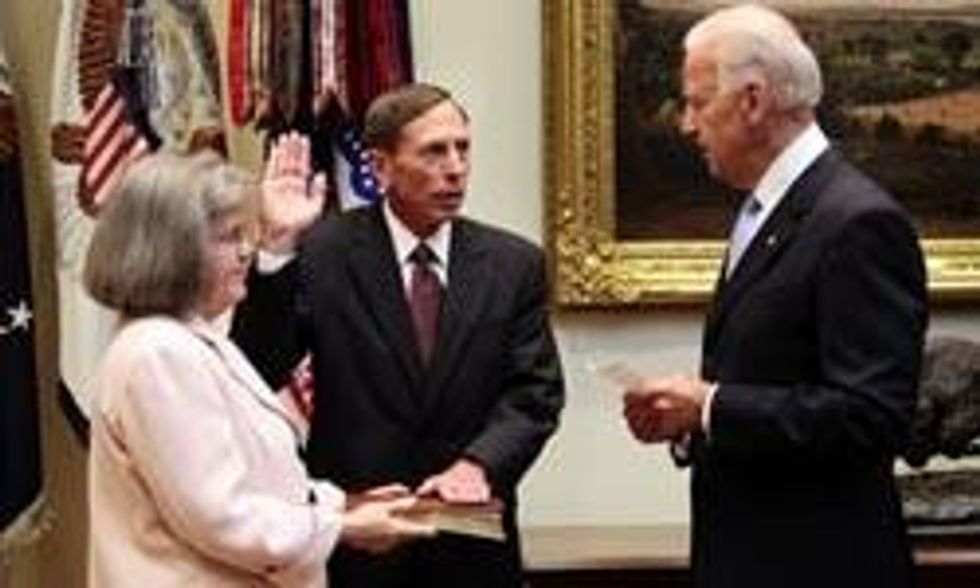
All of these behaviors have long been constant, inevitable features of every political sex scandal - until yesterday. Now, none of these sentiments is permitted because the newest salacious scandal features at its center Gen. David Petraeus, who resigned yesterday as CIA Director, citing an extramarital affair.

Gen. Petraeus is the single most revered man in the most venerated American institution: the National Security State and, specifically, its military. As a result, all the rules are different. Speaking ill of David Petraeus - or the military or CIA as an institution - is strictly prohibited within our adversarial watchdog press corps. Thus, even as he resigns in disgrace, leading media figures are alternatively mournful and worshipful as they discuss it.
On MSNBC, Andrea Mitchell appeared genuinely grief-stricken when she first reported Petraeus' resignation letter. "This is very painful", she began by announcing, as she wore a profoundly sad face. Her voice quivered with a mix of awe and distress as she read his resignation letter, savoring every word as though she were reciting from the Dead Sea Scrolls. On the Rachel Maddow Show later that night, Mitchell began her appearance by decreeing that "this is a personal tragedy" and said she was particularly sorrowful for "the men and women of the CIA, an agency that has many things to be proud about: many things to be proud about" [emphasis in original].
Christiane Amanpour of CNN and ABC made Mitchell look constrained by comparison as she belted out this paean on Twitter:
For good measure, she then added:
What does all that even mean? From which glorious "battlefield" is the CIA Director now absent, and how and why are we "at a time when we need them most"? But Amanpour is reciting something akin to a prayer here, and it's thus insusceptible to rational inquiry of that sort.
Meanwhile, Michael Hastings - whose Rolling Stone cover story ended Gen. McChrystal's career by including numerous intemperate quotes and, in doing so, revealingly prompted widespread animosity among his media colleagues for the crime of Making a General Look Bad - was on MSNBC yesterday with Martin Bashir. Hastings explained how the media has been devoted to Petraeus' glorification and thus ignored all the substantive reasons why Petraeus should have received far more media scrutiny and criticism in the past. In response, Bashir - who has previously demonstrated his contempt for anyone who speaks ill of a US General - expressed his anger at Hastings ("That's a fairly harsh assessment of a man who is regarded by many in the military as an outstanding four-star general") and then quickly cut him off just over two minutes into the segment.
Then there's the Foreign Policy Community, for which David Petraeus has long been regarded with deity status. Foreign Policy Magazine Managing Editor Blake Hounshell, under the headline "The Tragedy of David Petraeus", gushed that "Petraeus's downfall is a huge loss for the United States," as "not only was he one of the country's top strategic thinkers, he was also one of the few public figures revered by all sides of the political spectrum for his dedication and good judgment." He added: "He salvaged two disastrous wars, for two very different presidents."
Also at Foreign Policy, Thomas Ricks, formerly of the Washington Post, argued that Obama should not have accepted his resignation: "So the surprise to me is that Obama let him go. But the administration's loss may be Princeton's gain." Like most people in the media, Ricks has long been an ardent admirer of Petraeus, even turning his platform over to Paula Broadwell in the past for her to spread her hagiography far and wide.
There are several revealing lessons about this media swooning for Petraeus even as he exits from a scandal that would normally send them into tittering delight. First, military worship is the central religion of America's political and media culture. The military is by far the most respected and beloved institution among the US population - a dangerous fact in any democracy - and, even assuming they wanted to (which they don't), our brave denizens of establishment journalism are petrified of running afoul of that kind of popular sentiment.
Recall the intense controversy that erupted last Memorial Day when MSNBC's Chris Hayes gently pondered whether all soldiers should be considered "heroes". His own network, NBC, quickly assembled a panel on the Today Show to unanimously denounce him in the harshest and most personal terms ("I hope that he doesn't get more viewers as a result of this...this guy is like a - if you've seen him...he looks like a weenie" - "Could you be more inappropriate on Memorial Day?"), and Hayes then subjected himself to the predictable ritual of public apology (though he notably did not retract the substance of his remarks).
Hayes was forced (either overtly or by the rising pressure) to apologize because his comments were blasphemous: of America's true religion. At virtually every major sporting event, some uber-patriotic display of military might is featured as the crowd chants and swoons. It's perfectly reasonable not to hold members of the military responsible for the acts of aggression ordered by US politicians, but that hardly means that the other extreme - compelled reverence - is justifiable either.
Yet US journalists - whose ostensible role is to be adversarial to powerful and secretive political institutions (which includes, first and foremost, the National Security State) - are the most pious high priests of this national religion. John Parker, former military reporter and fellow of the University of Maryland Knight Center for Specialized Journalism-Military Reporting, wrote an extraordinarily good letter back in 2010 regarding why leading Pentagon reporters were so angry at WikiLeaks for revealing government secrets: because they identify with the military to the point of uncritical adoration:
"The career trend of too many Pentagon journalists typically arrives at the same vanishing point: Over time they are co-opted by a combination of awe - interacting so closely with the most powerfully romanticized force of violence in the history of humanity - and the admirable and seductive allure of the sharp, amazingly focused demeanor of highly trained military minds. Top military officers have their s*** together and it's personally humbling for reporters who've never served to witness that kind of impeccable competence. These unspoken factors, not to mention the inner pull of reporters' innate patriotism, have lured otherwise smart journalists to abandon - justifiably in their minds - their professional obligation to treat all sources equally and skeptically. . . .
"Pentagon journalists and informed members of the public would benefit from watching 'The Selling of the Pentagon', a 1971 documentary. It details how, in the height of the Vietnam War, the Pentagon sophisticatedly used taxpayer money against taxpayers in an effort to sway their opinions toward the Pentagon's desires for unlimited war. Forty years later, the techniques of shaping public opinion via media has evolved exponentially. It has reached the point where flipping major journalists is a matter of painting in their personal numbers."
That is what makes this media worship of All Things Military not only creepy to behold, but downright dangerous.
Second, it is truly remarkable what ends people's careers in Washington - and what does not end them. As Hastings detailed in that interview, Petraeus has left a string of failures and even scandals behind him: a disastrous Iraqi training program, a worsening of the war in Afghanistan since he ran it, the attempt to convert the CIA into principally a para-military force, the series of misleading statements about the Benghazi attack and the revealed large CIA presence in Libya. To that one could add the constant killing of innocent people in the Muslim world without a whiff of due process, transparency or oversight.
Yet none of those issues provokes the slightest concern from our intrepid press corps. His career and reputation could never be damaged, let alone ended, by any of that. Instead, it takes a sex scandal - a revelation that he had carried on a perfectly legal extramarital affair - to force him from power. That is the warped world of Washington. Of all the heinous things the CIA does, the only one that seems to attract the notice or concern of our media is a banal sex scandal. Listening to media coverage, one would think an extramarital affair is the worst thing the CIA ever did, maybe even the only bad thing it ever did (Andrea Mitchell: "an agency that has many things to be proud about: many things to be proud about").
Third, there is something deeply symbolic and revealing about this whole episode. Broadwell ended up spending substantial time with Petraeus when she, in essence, embedded with him and followed him around Afghanistan in order to write her biography. What ended up being produced was not only the type of propagandistic hagiography such arrangements typically produce, but also deeply personal affection as well.
This is access journalism and the embedding dynamic in its classic form, just a bit more vividly expressed. The very close and inter-dependent relationship between media figures and the political and military officials they cover often produces exactly these same sentiments even if they do not find the full-scale expression as they did in this case. In that regard, the relationship between the now-former CIA Director and his fawning hagiographer should be studied in journalism schools to see the results reliably produced by access journalism and the embedding process. Whatever Broadwell did for Petraeus is what US media figures are routinely doing for political and especially military officials with their "journalism".