SUBSCRIBE TO OUR FREE NEWSLETTER
Daily news & progressive opinion—funded by the people, not the corporations—delivered straight to your inbox.
5
#000000
#FFFFFF
To donate by check, phone, or other method, see our More Ways to Give page.


Daily news & progressive opinion—funded by the people, not the corporations—delivered straight to your inbox.
The nominees "took an oath to 'support and defend the Constitution against all enemies, foreign and domestic,'" said retired Maj. Gen. Dennis Laich. "Through their actions, or inaction, they are violating that oath."
A network of former intelligence, military, and national security officials on Tuesday launched the Profiles in Cowardice Award and urged the public to vote for nominees who are "silent in the face of the country's descent into fascism," a march led by U.S. President Donald Trump.
"We are in a constitutional crisis," says the Eisenhower Media Network's (EMN) website for the award. "Trump is amassing power in the executive branch, ignoring Congress and the courts. Meanwhile, leaders who have sworn an oath to support and defend the Constitution are sitting on their hands."
The new honor is the inverse of the John F. Kennedy Profile in Courage Award, created by the late president's family "to recognize and celebrate the quality of political courage that he admired most." This year's recipient is Trump's former vice president, Mike Pence, "for putting his life and career on the line to ensure the constitutional transfer of presidential power on January 6, 2021," when Trump incited an insurrection and his supporters stormed the U.S. Capitol.
"We, the American people, are here to remind them of who they serve, and that it's time to do their constitutional duty by standing up to this administration and its authoritarian bent."
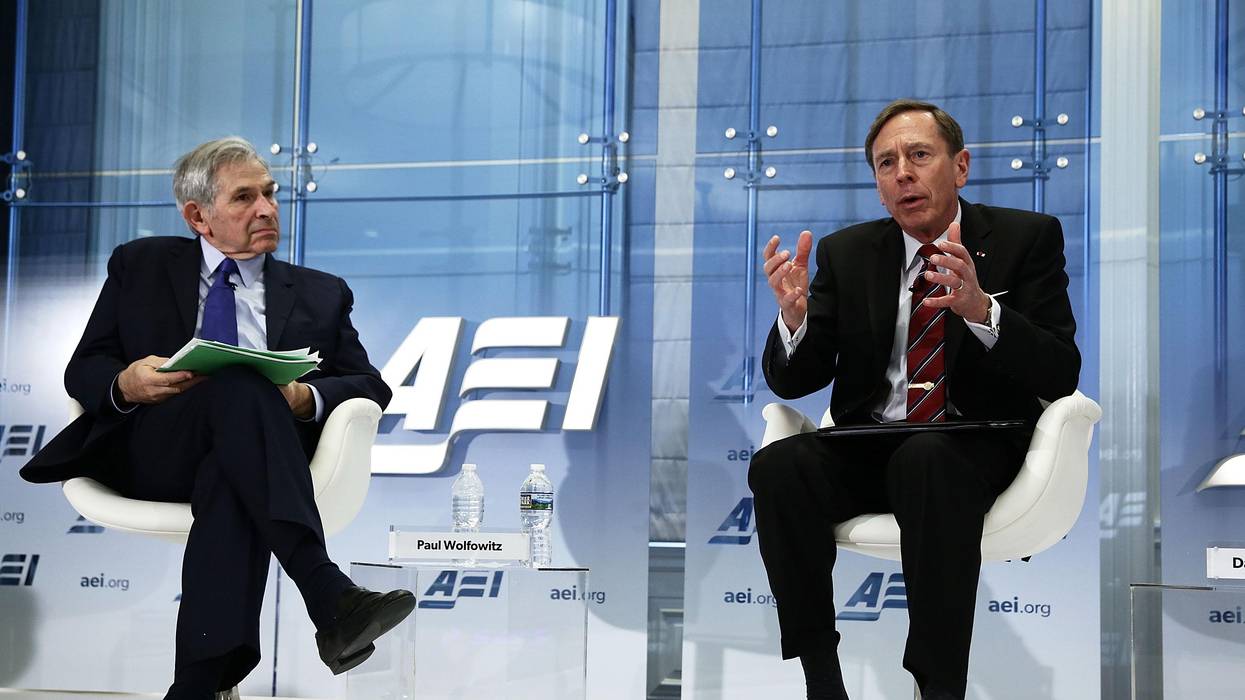
Nominees for the inaugural Profiles in Cowardice Award are former President George W. Bush, former Secretary of State Anthony Blinken, Sen. Jack Reed (D-R.I.), Rep. Nancy Mace (R-S.C.), retired Gens. David Petraeus and Mark Milley, the Joint Chiefs of Staff, and the Republican members of the Senate Armed Services Committee.
"The 'Profiles in Cowardice' Award was created to call out those weak souls who are failing to engage in efforts to keep our country from sleepwalking into fascism," said EMN's director, retired Maj. Gen. (ret.) Dennis Laich, in a statement.
"These leaders, both past and present, took an oath to 'support and defend the Constitution against all enemies, foreign and domestic,'" he noted. "Through their actions, or inaction, they are violating that oath. We, the American people, are here to remind them of who they serve, and that it's time to do their constitutional duty by standing up to this administration and its authoritarian bent."
The public can vote at ProfilesInCowardice.org until August 1, after which the award will be presented to the winner "at the most inconvenient time possible," according to the website.
The site lays out why people were nominated as "cowards." For example, "Bush has a long and storied history of cowardice" and "is solidifying his legacy" by retreating rather than serving as a leader in the Republican Party and standing up to Trump.
In Congress, "Mace is a one-woman culture war content machine—exactly how the military-industrial complex and mainstream media like it," the site continues. Reed, the top Democrat on the Senate Armed Services Committee, "has chosen to push through Trump's agenda of unfettered militarism and confirm unqualified MAGA loyalists like Pete Hegseth," the defense secretary. Republicans on that committee also "rubber-stamped Pete Hegseth to cater to Trump and his blindly loyal MAGA cronies."
Among former military leaders, the site says, "Milley attempted to make a principled stand after the January 6th insurrection—but cowardice won out in the end," and Petraeus said at a conference that "the world was in for 'exciting times' under Trump."
"The Joint Chiefs of Staff are tasked with defending the Constitution against all enemies, foreign and domestic," the site notes. "But as reckless U.S. military actions push the world closer to nuclear catastrophe, they've chosen silence over service. No resignations. No public warnings."
As for Blinken, who served under former President Joe Biden, "he ignored a flood of real-time reports detailing Israeli human rights violations—and now we know his public claims of 'working overtime' on cease-fires were outright lies," the site adds. "With American diplomacy in free fall, Blinken chose complicity and cover stories over truth and action."
Christian Sorenson, EMN's associate director, said that "it takes courage to do the right thing... It takes even more courage to do the right thing when the system itself fosters militarism and war profiteering."
"Targeting 'leaders' in the nation's capital, Profiles in Cowardice highlights the craven and the pushovers, as well as those who eagerly abet authoritarianism and nonstop war for personal and professional gain," Sorenson added. "Virtue and public service will arrive in D.C. one way or another. Profiles in Cowardice is part of that broader effort."
The war in Ukraine is the culmination of a 30-year project of the American neoconservative movement. The Biden Administration is packed with the same neocons who championed the US wars of choice in Serbia (1999), Afghanistan (2001), Iraq (2003), Syria (2011), Libya (2011), and who did so much to provoke Russia's invasion of Ukraine. The neocon track record is one of unmitigated disaster, yet Biden has staffed his team with neocons. As a result, Biden is steering Ukraine, the US, and the European Union towards yet another geopolitical debacle. If Europe has any insight, it will separate itself from these US foreign policy debacles.
The neocon outlook is based on an overriding false premise: that the US military, financial, technological, and economic superiority enables it to dictate terms in all regions of the world.
The neocon movement emerged in the 1970s around a group of public intellectuals, several of whom were influenced by University of Chicago political scientist Leo Strauss and Yale University classicist Donald Kagan. Neocon leaders included Norman Podhoretz, Irving Kristol, Paul Wolfowitz, Robert Kagan (son of Donald), Frederick Kagan (son of Donald), Victoria Nuland (wife of Robert), Elliott Cohen, Elliott Abrams, and Kimberley Allen Kagan (wife of Frederick).
The main message of the neocons is that the US must predominate in military power in every region of the world, and must confront rising regional powers that could someday challenge US global or regional dominance, most important Russia and China. For this purpose, US military force should be pre-positioned in hundreds of military bases around the world and the US should be prepared to lead wars of choice as necessary. The United Nations is to be used by the US only when useful for US purposes.
This approach was spelled out first by Paul Wolfowitz in his draft Defense Policy Guidance (DPG) written for the Department of Defense in 2002. The draft called for extending the US-led security network to the Central and Eastern Europe despite the explicit promise by German Foreign Minister Hans-Dietrich Genscher in 1990 that German unification would not be followed by NATO's eastward enlargement. Wolfowitz also made the case for American wars of choice, defending America's right to act independently, even alone, in response to crises of concern to the US. According to General Wesley Clark, Wolfowitz already made clear to Clark in May 1991 that the US would lead regime-change operations in Iraq, Syria, and other former Soviet allies.
The neocons championed NATO enlargement to Ukraine even before that became official US policy under George W. Bush, Jr. in 2008. They viewed Ukraine's NATO membership as key to US regional and global dominance. Robert Kagan spelled out the neocon case for NATO enlargement in April 2006:
[T]he Russians and Chinese see nothing natural in [the "color revolutions" of the former Soviet Union], only Western-backed coups designed to advance Western influence in strategically vital parts of the world. Are they so wrong? Might not the successful liberalization of Ukraine, urged and supported by the Western democracies, be but the prelude to the incorporation of that nation into NATO and the European Union--in short, the expansion of Western liberalhegemony?
Kagan acknowledged the dire implication of NATO enlargement. He quotes one expert as saying, "the Kremlin is getting ready for the 'battle for Ukraine' in all seriousness." The neocons sought this battle. After the fall of the Soviet Union, both the US and Russia should have sought a neutral Ukraine, as a prudent buffer and safety valve. Instead, the neocons wanted US "hegemony" while the Russians took up the battle partly in defense and partly out of their own imperial pretentions as well. Shades of the Crimean War (1853-6), when Britain and France sought to weaken Russia in the Black Sea following Russian pressures on the Ottoman empire.
Kagan penned the article as a private citizen while his wife Victoria Nuland was the US Ambassador to NATO under George W. Bush, Jr. Nuland has been the neocon operative par excellence. In addition to serving as Bush's Ambassador to NATO, Nuland was Barack Obama's Assistant Secretary of State for European and Eurasian Affairs during 2013-17, where she participated in the overthrow of Ukraine's pro-Russian president Viktor Yanukovych, and now serves as Biden's Undersecretary of State guiding US policy vis-a-vis the war in Ukraine.
In the "battle for Ukraine," the neocons were ready to provoke a military confrontation with Russia by expanding NATO over Russia's vehement objections because they fervently believe that Russia will be defeated by US financial sanctions and NATO weaponry.
The neocon outlook is based on an overriding false premise: that the US military, financial, technological, and economic superiority enables it to dictate terms in all regions of the world. It is a position of both remarkable hubris and remarkable disdain of evidence. Since the 1950s, the US has been stymied or defeated in nearly every regional conflict in which it has participated. Yet in the "battle for Ukraine," the neocons were ready to provoke a military confrontation with Russia by expanding NATO over Russia's vehement objections because they fervently believe that Russia will be defeated by US financial sanctions and NATO weaponry.
The Institute for the Study of War (ISW), a neocon think-tank led by Kimberley Allen Kagan (and backed by a who's who of defense contractors such as General Dynamics and Raytheon), continues to promise a Ukrainian victory. Regarding Russia's advances, the ISW offered a typical comment: "[R]egardless of which side holds the city [of Sievierodonetsk], the Russian offensive at the operational and strategic levels will probably have culminated, giving Ukraine the chance to restart its operational-level counteroffensives to push Russian forces back."
The facts on the ground, however, suggest otherwise. The West's economic sanctions have had little adverse impact on Russia, while their "boomerang" effect on the rest of the world has been large. Moreover, the US capacity to resupply Ukraine with ammunition and weaponry is seriously hamstrung by America's limited production capacity and broken supply chains. Russia's industrial capacity of course dwarfs that of Ukraine's. Russia's GDP was roughly 10X that of Ukraine before war, and Ukraine has now lost much of its industrial capacity in the war.
The most likely outcome of the current fighting is that Russia will conquer a large swath of Ukraine, perhaps leaving Ukraine landlocked or nearly so. Frustration will rise in Europe and the US with the military losses and the stagflationary consequences of war and sanctions. The knock-on effects could be devastating, if a right-wing demagogue in the US rises to power (or in the case of Trump, returns to power) promising to restore America's faded military glory through dangerous escalation.
Instead of risking this disaster, the real solution is to end the neocon fantasies of the past 30 years and for Ukraine and Russia to return to the negotiating table, with NATO committing to end its commitment to the eastward enlargement to Ukraine and Georgia in return for a viable peace that respects and protects Ukraine's sovereignty and territorial integrity.
Following President Donald Trump's assassination of Iranian Gen. Qasem Soleimani, several United States media outlets have turned to retired military general David Petraeus for "expert" commentary on Iran because he was Soleimani's "adversary" when he ran U.S. Central Command.
Not only did Petraeus empower Shiite militias to torture and ethnically cleanse neighborhoods in Iraq, but when he was CIA director under President Barack Obama, he leaked top secret information to Washington Post reporters in March 2011. He also lied to the FBI and improperly handled highly-classified "Black Books," which contained identities of covert officers, war strategy, intelligence capabilities, and notes from discussions with Obama.
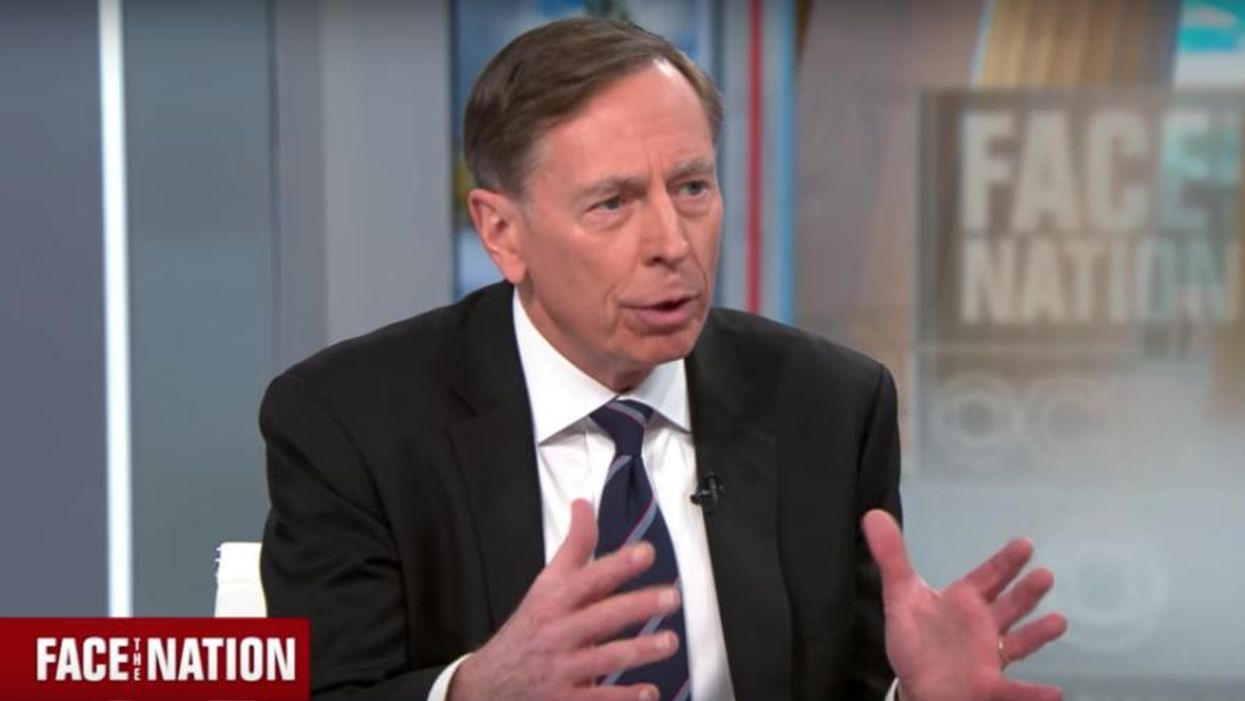
Petraeus appeared on CBS' Sunday morning news program, "Face The Nation," on Jan. 5. He praised Trump for restoring "deterrence" by authorizing a lethal drone strike in Baghdad.
During the Iraq War, Petraeus commanded military forces that carried out the "surge," which was widely celebrated. Yet, in retrospect, it is rather clear that U.S. forces implemented a strategy of ethnic cleansing, where Shiite militias were allowed to expel hundreds of thousands of Sunni Arabs from Baghdad.
Shiite militias in Iraq established secret detention centers, where opponents of the U.S. occupation were tortured, and Col. James Steele, a veteran of U.S. "dirty wars" in Central America, was enlisted to oversee what essentially operated as paramilitary death squads. Col. James Coffman worked alongside Steele and reported to Petraeus.
The U.S. government largely views Shiite militias in Iraq as proxies for Iran. Back in 2015, Petraeus told the Washington Post the "foremost threat to Iraq's long-term stability and the broader regional equilibrium is not the Islamic State; rather, it is Shiite militias, many backed by--and some guided by--Iran."
Not only did Petraeus empower Shiite militias to torture and ethnically cleanse neighborhoods in Iraq, but when he was CIA director under President Barack Obama, he leaked top secret information to Washington Post reporters in March 2011. He also lied to the FBI and improperly handled highly-classified "Black Books," which contained identities of covert officers, war strategy, intelligence capabilities, and notes from discussions with Obama.
Petraeus granted access to his biographer, Paula Broadwell, with whom he was having an affair. Although he was forced to resign from his position as head of the CIA, he served no jail time and was issued a modest $40,000 fine.
All of the above would disqualify most people from invitations to appear on news programs. It would lead editors and producers to question their credibility. But among a media and political establishment that easily forgives and forgets the misconduct--or criminal acts--of high-ranking officials, Petraeus' insights on military operations and foreign policy are still sought after.
On "Face The Nation," Petraeus argued prior to the assassination the U.S. government lost the "component of deterrence that was seen as American will." He selectively recalled events that had transpired between the U.S. and Iran in the past year.
"Our drone, a hundred-thirty-million-dollar drone is shot down, [no] significant response; five percent of the world's oil production taken out of operation; numerous attacks on shipping and then attacks on our forces; ultimately, of course, killing an American and wounding four of our soldiers," Petraeus said. "So, ultimately, the president appears to have decided that it was necessary to take an action to shore up deterrence to show that we were not going to accept this."
As the Associated Press reported, on Dec. 29, U.S. military forces launched strikes that killed 25 people and wounded dozens of fighters. The military said it targeted the Iranian-backed Kataeb Hezbollah militia for launching a rocket attack on Dec. 24 that allegedly killed an American contractor stationed at a U.S. military base in Kirkuk. However, Kataeb Hezbollah insisted their fighters were not in the area when the attack was launched.
Protesters responded to the attack with a demonstration at the U.S. embassy in the Green Zone on Dec. 31. The walls of the embassy were breached as they demanded an end to the U.S. military occupation. Days later, Soleimani was assassinated, along with Abu Mehdi Al Muhandis of the Popular Mobilization Forces (PMF) of Iraq.
For the most part, no media outlet bothered to disclose that Petraeus works for the private equity firm Kohlberg Kravis Roberts & Co. (KKR), which has assets in the military industrial-complex. KKR recently added Novaria Group, an aerospace contractor, to capitalize on Trump's increased military spending.
"We'd never gone after [Soleimani] before, although I hasten to add that he never dared set foot inside Iraq to my recollection, when I was commanding the surge, nor in the time that I was the commander of U.S. Central Command," Petraeus declared on "Face The Nation." "He only really became visible in the way that he has in more recent years after the Arab Spring, supporting the murderous Bashar al-Assad in Syria and then very actively supporting the Iranian-supported militia inside Iraq that were helping to contend with the Islamic State invasion of northern and western Iraq."
Part of this remark was echoed in an NBC News column from Bill Rivers, the speechwriter for former U.S. Defense Secretary James Mattis, who asserted assassinating Soleimani was the "smart thing to do."
"Soleimani intervened to salvage the Syrian civil war for President Bashar al-Assad, organizing more than 100,000 fighters to prop up the crumbling, corrupt regime and planning the infamous campaign to retake the city of Aleppo from Syrian rebels in 2016. That siege redefined carnage in the modern era, while the civil war overall sent thousands of refugees fleeing to Europe," Rivers wrote.
Rivers entirely ignores the fact that al Qaida-linked fighters from Jabhat al-Nusra controlled parts of Aleppo. Secretary of State John Kerry said during a 2016 meeting with Syrian regime change activists: "Nusra makes it hard. Nusra and Daesh [ISIS] both make it hard, because you have this extreme element out there and unfortunately some of the opposition has kind of chosen to work with them."
Kerry revealed that the U.S. watched Islamic State forces grow in strength because they believed they could "manage" the threat, and it would hopefully force Assad to negotiate an end to his administration in Syria.
"We were watching. We saw that Daesh was growing in strength, and we thought Assad was threatened. We thought, however, we could probably manage, that Assad would then negotiate. Instead of negotiating, he got [Vladimir] Putin to support him."
Both Russia and Iran intervened to prevent the collapse of a government. In spite of U.S. operations, they mounted operations to ensure the Islamic State did not take control of more territory in Syria and become an even greater threat to the region.
Soleimani and the militia groups he led played a key role in defeating the Islamic State in Iraq, but Petraeus denies this reality. "Make no mistake about it, those militia and the Iraqi security forces could not have defeated the Islamic State in Iraq without our enabling forces, our drones, our precision munitions, and our intelligence and advice."
Yet, as PBS reported, when the U.S. was gone and Iraq was threatened by the Islamic State, the PMF--armed, funded, and trained by Iran--saved the country.
Correspondent Reza Sayeh said, "It was Soleimani who led many of the PMF brigades in a three-year ground campaign that overpowered ISIS and eventually set the stage for Iraqi forces to defeat the extremist group in Mosul, its last major stronghold in Iraq."
Robin Wright, a contributing writer to The New Yorker, featured Petraeus in her coverage of the Soleimani assassination. Wright helped Petraeus spread propaganda about the number of American troops Soleimani allegedly killed.
"To counter U.S. influence in Iraq between 2003 and 2011, he provided Iraqi militants with rockets, bombs, and explosively formed projectiles that could slice through the armor of an American M1 tank. 'He has the blood of hundreds of Americans on his hands,' Petraeus said."
Journalist Gareth Porter wrote in June 2019, "After General David Petraeus took over as commander of coalition forces in Iraq in January 2007," his command argued "Iran was providing Shiite militias with the powerful roadside bombs called Explosively Formed Penetrators (EFPs) that were causing [an] increasing number of U.S. casualties in Iraq. But the evidence proved otherwise."
Porter added, "Hezbollah--not Iran--had been well known as the world's most knowledgeable designer and user of EFPs." And, a 2007 military briefing later confirmed "Iraqi extremist group members" and not Iran's Islamic Revolutionary Guard Corps (IRGC) were behind the explosives.
"Major General Rick Lynch, the U.S. commander for southern Iraq, admitted in a July 6 press briefing, his troops had not 'captured anybody that [they could] directly tie back to Iran,'" he wrote.
NPR also had Petraeus on their "Weekend Edition" on Sunday, Jan. 5. Host Sarah McCammon asked the retired general about his role in overseeing militias that developed into paramilitary death squads.
MCCAMMON: You mentioned the Shia militia's general. But there are those who see your role as instrumental in the influence of the Shia militias inside Iraq's U.S.-backed security forces because they were absorbed into the police. How do you respond to that?
PETRAEUS: Well, there's no question that, again, there was a presence of these different militias that was emerging during my time as a three-star. There is also no question that I insisted on the removal of key leaders--all of the brigadier generals and above in the police forces, for example. There was--these were actually paramilitary police forces, not just cops on the beat--two full divisions of them.
We would refuse to reconstitute these forces, to retrain them, to fill them back up with people, equipment, and weapons and so forth until the toxic leaders were removed. Sadly, those leaders were returned to their positions several years later. And unfortunately, these toxic leaders were a large part of the undoing of Iraq that allowed the Islamic State to get back up on its feet and ultimately to come back into Iraq and to defeat the Iraqi security forces in the north and the west.
But revelations based on evidence of torture--contained in military incident reports published by WikiLeaks and disclosed by U.S. Army whistleblower Chelsea Manning--showed Petraeus looked the other way when he learned of this brutality.
Even former British Prime Minister Tony Blair conceded the 2003 invasion of Iraq fueled the rise of the Islamic State. "Of course, you can't say those of us who removed Saddam [Hussein] in 2003 bear no responsibility for the situation in 2015."
Journalist Patrick Cockburn previously wrote: "U.S. policy has an Alice in Wonderland absurdity about it, everything being the opposite of what it appears to be. The so-called 'coalition of the willing' is, in practice, very unwilling to fight [the Islamic State], while those hitherto excluded, such as Iran, the Syrian government, Hezbollah, and the PKK, are the ones actually fighting."
That largely explains why Petraeus hypes the effectiveness of U.S. military strategy while seeking to discredit operations by groups the U.S. opposes, even though they achieved success.
On Jan. 5, after the Iraqi parliament backed a resolution to expel U.S. troops, the Boston Herald spoke with Petraeus. He said the outcome was "disappointing, given all that we did over the years to defeat (al Qaida in Iraq) and then to enable defeat of ISIS" and that the vote is "very concerning given that many Iraqis--if not most--do not want to see Iraq 'Lebanonized,'--that is, controlled by Iran."
Petraeus further suggested "a portion of the Iraqi Parliament is controlled by Iran and many others are intimidated by Iranian proxy militias."
This is the same imperial hubris that the U.S. media fell for when the Bush administration lied America into a war in Iraq. Neoconservatives like Petraeus accuse Iraqi politicians of being ungrateful, like they should thank the U.S. for the sanctions, bloodshed, and terrorism that was unleashed on their country.
The reality is Iraqis would like to be free from U.S. military occupation because all these forces do is attract extremist groups, which want to fight a superpower viewed as responsible for countless acts of aggression in the past decades. If they have to look to neighboring countries for help in restoring their sovereignty and independence, they will.
In the 1960s, at the very dawn of the New Right rebellion, William F. Buckley, Jr., declared that he would rather be governed by persons selected from the phone directory than the faculty of Harvard. Conservative egghead bashing has a long pedigree, and even Buckley, an aspiring patrician with one of the most laboriously affected accents ever heard, felt obliged to join in the populist trolling.
Over the succeeding five decades, the conservative movement and its chosen vehicle, the Republican Party, have substantially achieved the goal of systematically devaluing expertise, thereby accomplishing one of their most cherished ideological goals: to prove to the American people that government doesn't work.
As I have written before, the Republican push for non-expertise got a big boost during the Gingrich speakership. It continued its long march through institutions during the riotously incompetent planning and conduct of the Iraq war under George W. Bush, and has reached ghastly perfection with Donald Trump.
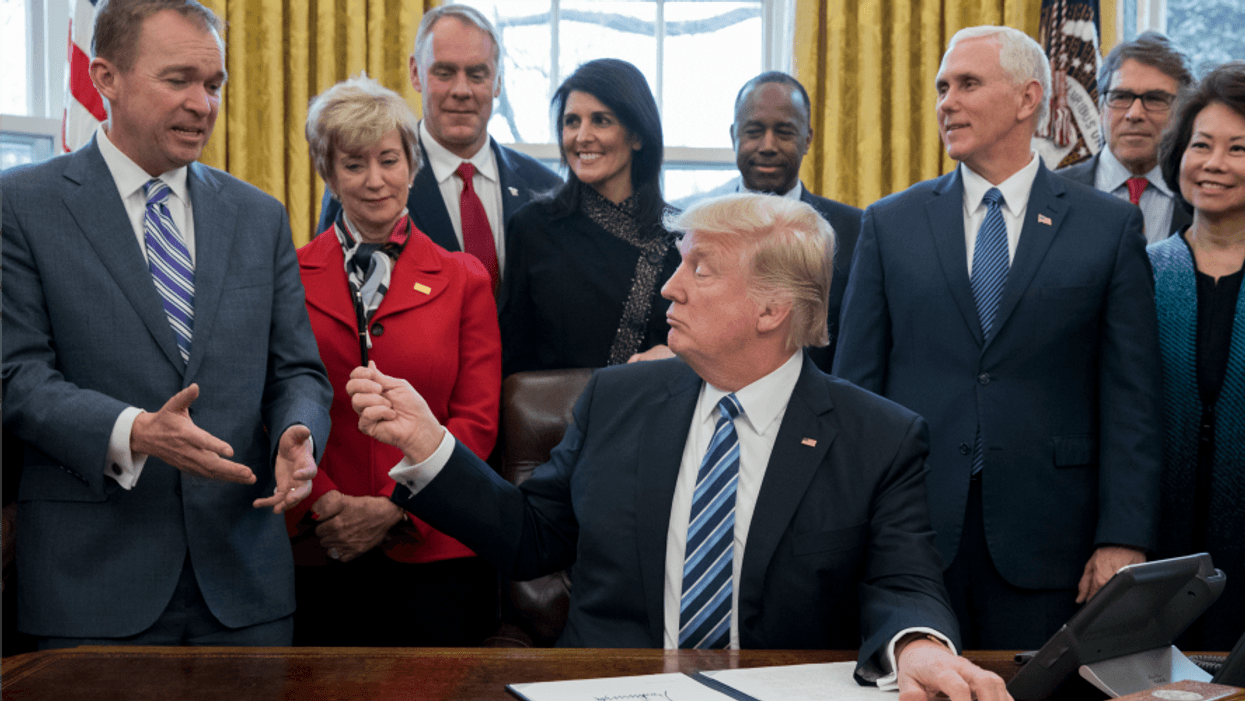
Just look at a few of the uniquely awful Trump personnel at the top tier: Mike Pompeo, John Bolton, Stephen Miller, Ben Carson, Betsy DeVos, departing Sarah Huckabee Sanders. Their unsuitability is matched by Trump appointees at lower levels.
The conclusion is inescapable: one could get better people for the jobs by recruiting candidates from the checkout line at a dollar store. Would such people be qualified for their positions? Probably not. But they might occasionally heed reasonable advice rather than reflexively doing the opposite, and they almost certainly would not unanimously possess the iron and unerring resolve of the current Trump team always to do the stupid, unethical or immoral thing.
Recently leaked vetting documents show what the Trump administration looks for in personnel. Despite warnings that former EPA administrator Scott Pruitt and former HHS Secretary Tom Price had considerable ethics and management problems, they were hired anyway. In their jobs, they proceeded to demonstrate just those same qualities the administration had been warned about.
Their downfall was less the result of their grifting and self-dealing than the fact that the capo in the White House was irritated by the conspicuous swaggering of these two arrogant underlings. They ought to have realized that such public flaunting of their bad-assery is reserved for the mob boss and his immediate family.
The vetting criteria for General David Petraeus, who was mooted for either secretary of state or national security adviser, are particularly telling. There were legitimate grounds for rejecting Petraeus: he was a major player in the Iraq debacle, a policy disaster that Trump roundly condemned during his campaign. The general's government career as CIA director ended abruptly when the FBI found he had been sharing code-word level classified information with his lover, who just happened not to be his wife. Petraeus compounded the damage by lying to the FBI.
But why was he rejected for a position in the Trump administration? Vetting personnel at the Republican National Committee "red flagged" Petraeus because he opposed torture - possibly the one unambiguously praiseworthy thing about the man.
As with personnel, so inevitably with policy. Flipping a coin before deciding among critical policy options would seem statistically to produce a better result than what we have seen in the Trump administration. By some strange reverse-Darwinian principle, Trump and his coat-holders invariably default to the worst conceivable option. Examples follow.
Let us imagine you are in charge and want to improve this country's terms of trade with China. Three broad options present themselves:
Of course, Trump picked option 3 because it was objectively the worst option.
Now, let's try tax cuts:
Naturally, Trump, with united assistance from the Republican Congress, chose option 3.
Now let us assume that for some reason you are dissatisfied with the Iran nuclear agreement (The Joint Comprehensive Plan of Action, or JCPOA) that your predecessor signed. Let us run though the options:
The answer to the Iran policy conundrum is of course now playing out in the news headlines.
Throughout American history, there has always been a strident minority opinion that aggressive and self-righteous stupidity is nobler and more virtuous in the sight of God than prudent and circumspect intelligence. This view now controls most of our government and is in a position to make its will the law of the land. Sooner or later, we shall see whether the higher laws of natural selection act to weed out stupidity in as spectacular and unpleasant a fashion as occurred with the Habsburg and Ottoman empires.
"Veni, Vidi, Vici," boasted Julius Caesar, one of history's great military captains. "I came, I saw, I conquered."
Then-Secretary of State Hillary Clinton echoed that famed saying when summing up the Obama administration's military intervention in Libya in 2011 -- with a small alteration. "We came, we saw, he died," she said with a laugh about the killing of Muammar Gaddafi, that country's autocratic leader. Note what she left out, though: the "vici" or victory part. And how right she was to do so, since Washington's invasions, occupations, and interventions in Afghanistan, Iraq, Libya, and elsewhere in this century have never produced anything faintly like a single decisive and lasting victory.
"When men like Petraeus measure the supposed sustainability of their wars in terms of blood and treasure, the first question should be: Whose blood, whose treasure?"
"Failure is not an option" was the stirring 1995 movie catchphrase for the dramatic 1970 rescue of the Apollo 13 moon mission and crew, but were such a movie to be made about America's wars and their less-than-vici-esque results today, the phrase would have to be corrected in Clintonian fashion to read "We came, we saw, we failed."
Wars are risky, destructive, unpredictable endeavors, so it would hardly be surprising if America's military and civilian leaders failed occasionally in their endless martial endeavors, despite the overwhelming superiority in firepower of "the world's greatest military." Here's the question, though: Why have all the American wars of this century gone down in flames and what in the world have those leaders learned from such repetitive failures?
The evidence before our eyes suggests that, when it comes to our senior military leaders at least, the answer would be: nothing at all.
Let's begin with General David Petraeus, he of "the surge" fame in the Iraq War. Of course, he would briefly fall from grace in 2012, while director of the CIA, thanks to an affair with his biographer with whom he inappropriately shared highly classified information. When riding high in Iraq in 2007, however, "King David" (as he was then dubbed) was widely considered an example of America's best and brightest. He was a soldier-scholar with a doctorate from Princeton, an "insurgent" general with the perfect way -- a revival of Vietnam-era counterinsurgency techniques -- to stabilize invaded and occupied Iraq. He was the man to snatch victory from the jaws of looming defeat. (Talk about a fable not worthy of Aesop!)
Though retired from the military since 2011, Petraeus somehow remains a bellwether for conventional thinking about America's wars at the Pentagon, as well as inside the Washington Beltway. And despite the quagmire in Afghanistan (that he had a significant hand in deepening), despite the widespread destruction in Iraq (for which he would hold some responsibility), despite the failed-state chaos in Libya, he continues to relentlessly plug the idea of pursuing a "sustainable" forever war against global terrorism; in other words, yet more of the same.
Here's how he typically put it in a recent interview:
"I would contend that the fight against Islamist extremists is not one that we're going to see the end of in our lifetimes probably. I think this is a generational struggle, which requires you to have a sustained commitment. But of course you can only sustain it if it's sustainable in terms of the expenditure of blood and treasure."
His comment brings to mind a World War II quip about General George S. Patton, also known as "old blood and guts." Some of his troops responded to that nickname this way: yes, his guts, but our blood. When men like Petraeus measure the supposed sustainability of their wars in terms of blood and treasure, the first question should be: Whose blood, whose treasure?
When it comes to Washington's Afghan War, now in its 18th year and looking ever more like a demoralizing defeat, Petraeus admits that U.S. forces "never had an exit strategy." What they did have, he claims, "was a strategy to allow us to continue to achieve our objectives... with the reduced expenditure in blood and treasure."
Think of this formulation as an upside-down version of the notorious "body count" of the Vietnam War. Instead of attempting to maximize enemy dead, as General William Westmoreland sought to do from 1965 to 1968, Petraeus is suggesting that the U.S. seek to keep the American body count to a minimum (translating into minimal attention back home), while minimizing the "treasure" spent. By keeping American bucks and body bags down (Afghans be damned), the war, he insists, can be sustained not just for a few more years but generationally. (He cites 70-year troop commitments to NATO and South Korea as reasonable models.)
Talk about lacking an exit strategy! And he also speaks of a persistent "industrial-strength" Afghan insurgency without noting that U.S. military actions, including drone strikes and an increasing reliance on air power, result in ever more dead civilians, which only feed that same insurgency. For him, Afghanistan is little more than a "platform" for regional counterterror operations and so anything must be done to prevent the greatest horror of all: withdrawing American troops too quickly.
In fact, he suggests that American-trained and supplied Iraqi forces collapsed in 2014, when attacked by relatively small groups of ISIS militants, exactly because U.S. troops had been withdrawn too quickly. The same, he has no doubt, will happen if President Trump repeats this "mistake" in Afghanistan. (Poor showings by U.S.-trained forces are never, of course, evidence of a bankrupt approach in Washington, but of the need to "stay the course.")
Petraeus's critique is, in fact, a subtle version of the stab-in-the-back myth. Its underlying premise: that the U.S. military is always on the generational cusp of success, whether in Vietnam in 1971, Iraq in 2011, or Afghanistan in 2019, if only the rug weren't pulled out from under the U.S. military by irresolute commanders-in-chief.
Of course, this is all nonsense. Commanded by none other than General David Petraeus, the Afghan surge of 2009-2010 proved a dismal failure as, in the end, had his Iraq surge of 2007. U.S. efforts to train reliable indigenous forces (no matter where in the embattled Greater Middle East and Africa) have also consistently failed. Yet Petraeus's answer is always more of the same: more U.S. troops and advisers, training, bombing, and killing, all to be repeated at "sustainable" levels for generations to come.
The alternative, he suggests, is too awful to contemplate:
"You have to do something about [Islamic extremism] because otherwise they're going to spew violence, extremism, instability, and a tsunami of refugees not just into neighboring countries but... into our western European allies, undermining their domestic political situations."
No mention here of how the U.S. invasions of Afghanistan and Iraq spread destruction and, in the end, a "tsunami of refugees" throughout the region. No mention of how U.S. interventions and bombing in Libya, Syria, Somalia, and elsewhere help "spew" violence and generate a series of failed states.
And amazingly enough, despite his lack of "vici" moments, the American media still sees King David as the go-to guy for advice on how to fight and win the wars he's had such a hand in losing. And just in case you want to start worrying a little, he's now offering such advice on even more dangerous matters. He's started to comment on the new "cold war" that now has Washington abuzz, a coming era -- as he puts it -- of "renewed great power rivalries" with China and Russia, an era, in fact, of "multi-domain warfare" that could prove far more challenging than "the asymmetric abilities of the terrorists and extremists and insurgents that we've countered in Iraq and Syria and Afghanistan and a variety of other places, particularly since 9/11."
For Petraeus, even if Islamic terrorism disappeared tomorrow and not generations from now, the U.S. military would still be engaged with the supercharged threat of China and Russia. I can already hear Pentagon cash registers going ka-ching!
And here, in the end, is what's most striking about Petraeus's war lessons: no concept of peace even exists in his version of the future. Instead, whether via Islamic terrorism or rival great powers, America faces intractable threats into a distant future. Give him credit for one thing: if adopted, his vision could keep the national security state funded in the staggering fashion it's come to expect for generations, or at least until the money runs out and the U.S. empire collapses.
Two Senior Generals Draw Lessons from the Iraq War
David Petraeus remains America's best-known general of this century. His thinking, though, is anything but unique. Take two other senior U.S. Army generals, Mark Milley and Ray Odierno, both of whom recently contributed forewords to the Army's official history of the Iraq War that tell you what you need to know about Pentagon thinking these days.
Published this January, the Army's history of Operation Iraqi Freedom is detailed and controversial. Completed in June 2016, its publication was pushed back due to internal disagreements. As the Wall Street Journal put it in October 2018: "Senior [Army] brass fretted over the impact the study's criticisms might have on prominent officers' reputations and on congressional support for the service." With those worries apparently resolved, the study is now available at the Army War College website.
The Iraq War witnessed the overthrow of autocrat (and former U.S. ally) Saddam Hussein, a speedy declaration of "mission accomplished" by President George W. Bush, and that country's subsequent descent into occupation, insurgency, civil war, and chaos. What should the Army have learned from all this? General Milley, now Army chief of staff and President Trump's nominee to serve as the next Chairman of the Joint Chiefs, is explicit on its lessons:
"OIF [Operation Iraqi Freedom] is a sober reminder that technological advantages and standoff weapons alone cannot render a decision; that the promise of short wars is often elusive; that the ends, ways, and means must be in balance; that our Army must understand the type of war we are engaged with in order to adapt as necessary; that decisions in war occur on the ground in the mud and dirt; and that timeless factors such as human agency, chance, and an enemy's conviction, all shape a war's outcome."
These aren't, in fact, lessons. They're military banalities. The side with the best weapons doesn't always win. Short wars can turn into long ones. The enemy has a say in how the war is fought. What they lack is any sense of Army responsibility for mismanaging the Iraq War so spectacularly. In other words, mission accomplished for General Milley.
General Odierno, who commissioned the study and served in Iraq for 55 months, spills yet more ink in arguing, like Milley, that the Army has learned from its mistakes and adapted, becoming even more agile and lethal. Here's my summary of his "lessons":
* Superior technology doesn't guarantee victory. Skill and warcraft remain vital.
* To win a war of occupation, soldiers need to know the environment, including "the local political and social consequences of our actions... When conditions on the ground change, we must be willing to reexamine the assumptions that underpin our strategy and plans and change course if necessary, no matter how painful it may be," while developing better "strategic leaders."
* The Army needs to be enlarged further because "landpower" is so vital and America's troops were "overtaxed by the commitments in Iraq and Afghanistan, and the decision to limit our troop levels in both theaters had severe operational consequences."
* The Iraq War showcased an Army with an "astonishing" capacity "to learn and adapt in the midst of a war that the United States was well on its way to losing."
The gist of Odierno's "lessons": the Army learned, adapted, and overcame. Therefore, it deserves America's thanks and yet more of everything, including the money and resources to pursue future wars even more successfully. There would, however, be another way to read those lessons of his: that the Army overvalued technology, that combat skills were lacking, that efforts to work with allies and Iraqi forces regularly failed, that Army leadership lacked the skills needed to win, and that it was folly to get into a global war on terror in the first place.
On those failings, neither Milley nor Odierno has anything of value to say, since their focus is purely on how to make the Army prevail in future versions of just such wars. Their limited critique, in short, does little to prevent future disasters. Much like Petraeus's reflections, they cannot envision an end point to the process -- no victory to be celebrated, no return to America being "a normal country in a normal time." There is only war and more war in their (and so our) future.
The Undiscovered Country
Talk of such future wars -- of, that is, more of the same -- reminded me of the sixth Star Trek movie, The Undiscovered Country. In that space opera, which appeared in 1991 just as the Soviet Union was imploding, peace finally breaks out between the quasi-democratic Federation (think: the USA) and the warmongering Klingon Empire (think: the USSR). Even the Federation's implacable warrior-captain, James T. Kirk, grudgingly learns to bury the phaser with the Klingon "bastards" who murdered his son.
Back then, I was a young captain in the U.S. Air Force and, with the apparent end of the Cold War, my colleagues and I dared talk about, if not eternal peace, at least "peace" as our own -- and not just Star Trek's -- undiscovered country. Like many at the time, even we in the military were looking forward to what was then called a "peace dividend."
But that unknown land, which Americans then glimpsed ever so briefly, remains unexplored to this day. The reason why is simple enough. As Andrew Bacevich put it in his book Breach of Trust, "For the Pentagon [in 1991], peace posed a concrete and imminent threat" -- which meant that new threats, "rogue states" of every sort, had to be found. And found they were.
It comes as no surprise, then, that America's generals have learned so little of real value from their twenty-first-century losses. They continue to see a state of "infinite war" as necessary and are blind to the ways in which endless war and the ever-developing war state in Washington are the enemies of democracy.
The question isn't why they think the way they do. The question is why so many Americans share their vision. The future is now. Isn't it time that the U.S. sought to invade and occupy a different "land" entirely: an undiscovered country -- a future -- defined by peace?
John Bolton has never made a secret of his burning desire to stoke a war between the United States and Iran. But Bolton is not the only one on Donald Trump's national security team who dreams of such a military confrontation. Secretary of State Mike Pompeo has joined with Bolton in recent months to prepare a case for possible war with Iran.
The tactics used by Pompeo and Bolton bear a strong resemblance to those pursued by Dick Cheney when he pushed for an attack on Iran from 2004 to 2007. Like Cheney, Pompeo and Bolton have sought to generate a phony crisis over Iranian "proxies" in Iraq, and have created the equivalent of a myth of an Iranian covert nuclear weapons program by conjuring up a nonexistent Iranian intercontinental ballistic missile (ICBM) threat.
When the plan for unprecedented economic sanctions on Iran was unveiled in May 2018, along with Trump's announcement that he was pulling out of the Joint Comprehensive Plan of Action--commonly known as the Iran nuclear deal--the administration denied that its objective was regime change. As Pompeo put it, Trump was "ready, willing and able to negotiate a new deal."
The Trump White House has taken advantage of Trump's diplomacy with North Korean leader Kim Jong Un to sell the idea that he's willing to negotiate a new relationship with Iran. In July, Trump said of the Iranians, "[A]t some point, they're going to say 'let's make a deal.' "
At the top of Pompeo's list are demands that Iran end its support for Hezbollah, including its supply of ballistic missiles to the Lebanese Shiite organization, and the "halt [to] further launching or development of nuclear-capable missile systems."
Those demands reflect an extraordinary agreement in December 2017, reported in the Israeli press, between the Trump administration and the Netanyahu government on a joint strategic work plan that included precisely those points on Pompeo's list--countering Iranian ballistic missile development, as well as the supply of more accurate missiles to Hezbollah through Syria.
The consequences of enforcing such demands would be a dangerous destabilization of the already tense military standoff between Israel and Iran. Iran now depends on a combination of its own ballistic missiles and Hezbollah's ability to retaliate against Israel to deter an Israeli, Saudi or U.S. attack on its homeland. To agree to stop testing its own missiles to improve their accuracy and supplying Hezbollah with accurate weapons would allow Israel, which has long wanted to destroy Hezbollah's military capability, to degrade Hezbollah's deterrent over time through its own missile strikes. The net result would be to leave Iran with a seriously degraded deterrent, especially in light of Israel's modern missile defense system.
No Iranian leader, regardless of ideology, could survive politically after agreeing to such demands, as any intelligence analyst worth his or her salt has pointed out in recent months. Those clearly nonnegotiable demands give away the real aim of the Trump administration to bring about regime change. Instead of relying entirely on internal Iranian dynamics to topple the regime, the administration's Iran strategy has now begun to resemble the one pursued by Cheney and the neoconservatives, who sought an excuse to provoke war with Iran during the George W. Bush administration.
Threatening War Over Harmless Incidents
In September, the response of Bolton and Pompeo to incidents in Iraq involving a few rockets that reportedly fell in the vicinity of U.S. diplomatic posts in Baghdad provides insight into their concept of regime change. Bolton requested retaliatory options from the Pentagon, which responded with a set of options that included a raid on an Iranian military facility, according to The New York Times.
But senior U.S. military officials were alarmed at Bolton's apparent promotion of such a retaliatory strike, which they feared could either start a war with Iran or result in the complete expulsion of U.S. military personnel from Iraq. "People were shocked," one former administration official said. "It was mind-boggling how cavalier they were about hitting Iran."
But it wasn't only Bolton who seized on the incident to lay the political basis for a possible strike against Iran. In a Sept. 21 interview with CNN, Pompeo said, "We will not let Iran get away with using a proxy force to attack American interests. If they are responsible for the arming and training of these militias, we will go to the source."
And in a Foreign Affairs magazine article in October, Pompeo claimed that Iranian "proxies" had "launched [a] life-threatening rocket attack against the U.S. embassy compound in Baghdad and the U.S. consulate in Basra." He declared that the administration would "respond swiftly and decisively in defense of American lives" if such an attack were to result in injury to U.S. personnel or damage to U.S. facilities.
But Pompeo's description of the incidents bore little resemblance to the reality. Not only was there no danger to U.S. diplomats, but no reason to believe that any such danger was intended. On Sept. 8 and 9, two rockets fired in Baghdad landed in an "abandoned lot" near the Egyptian Embassy, according to a Reuters report--more than one full kilometer away from the U.S. Embassy.
That same night, in southern Iraq, two rockets fired in the general direction of the U.S. Consulate, which is adjacent to the Basra International Airport, struck the airport's outer security perimeter, well away from the consulate, according to Michael Knights of the Washington Institute for Near East Policy. This indicates that they were not intended to harm the consulate, but were merely warning shots, Knights believes. On Sept. 28, three more rockets struck consulate property, but caused no damage or casualties.
The distortion of incidents that appear to have reflected a cautious political signaling by Shiite militias in order to justify a U.S. retaliatory strike against Iran presents a striking parallel with Cheney's effort to spark a war with Iran in 2007. Cheney's ploy was to claim that Iran was supplying Iraqi Shiite militias with highly lethal charges that could penetrate U.S. armored vehicles.
Other key policymakers in the Bush administration rejected Cheney's assertion that Iran was supplying those weapons, so Cheney did an end run around them: He prevailed on Bush to choose Gen. David Petraeus as the new commander in Iraq in early 2007 on the condition that Petraeus support the Cheney charge against Iran.
That summer, Cheney proposed that if the U.S. military found evidence of Iranian support for anti-U.S. forces in Iraq, it should carry out a limited strike against Iranian Islamic Revolutionary Guard Corps camps in Iran used to train Shiite militia fighters in Iraq. But Pentagon officials stifled Cheney's proposal by arguing that such a move would begin a tit-for-tat escalation with Iran, according to former Deputy Assistant Secretary of State J. Scott Carpenter.
Thus, both Cheney in 2007 and Bolton and Pompeo in 2018 discussed a U.S. strike against Iran based on a fabricated Iranian threat to U.S. personnel in Iraq through "proxy" forces.
The Mythical Iranian ICBM Program
Bolton and Pompeo are pursuing another angle on Iran that parallels Cheney's. As Cheney's policymaker on Iran from 2003 to 2007, Bolton argued that Iran was threatening to get nuclear weapons. Now, Bolton and Pompeo have adopted Netanyahu's longtime argument that Iran is developing an intercontinental ballistic missile that will allow it to target the United States with nuclear weapons.
On Jan. 3, Pompeo condemned Iran for planning to launch three rockets called Space Launch Vehicles (SLV) that he said incorporate technologies "virtually identical" to what is used in intercontinental ballistic missiles. Pompeo said the planned rocket launches would violate U.N. Security Council Resolution 2231, which called upon Iran not to "undertake any activity related to ballistic missiles designed to be capable of delivering nuclear weapons." He warned Iran that the administration "will not stand by and watch the Iranian regime's destructive policies place international stability at risk."
Pompeo and Bolton base their ICBM argument on the spurious claim that Iranian SLVs rely on technology that is essentially indistinguishable from an ICBM. But that idea has been thoroughly demolished by the leading independent specialist on the issue. Michael Elleman of the International Institute for Strategic Studies, in Washington, D.C., explained in detail in March 2018 why Iran's SLVs--the Safir and the Simorgh--are fundamentally different from an ICBM or any other ballistic missile.
The second-stage propulsion systems for the SLVs, Elleman wrote, "rely on low-thrust, long-action time engines, which are ideal for accelerating a satellite on a path parallel to the earth's surface and into a sustainable orbit." But such engines are "poorly suited for ballistic missile trajectories," which must reach much higher altitudes, he observed.
Elleman also pointed out that the Simorgh must be "prepared for launch over an extended time on a fixed launching pad," making it "vulnerable to pre-launch attack." That would explain why, he wrote, no country has ever "converted a satellite launcher into a long-range ballistic missile."
Because Iranian SLVs cannot be considered as designed to carry a nuclear weapon, testing them is certainly not a violation of Resolution 2231, contrary to Pompeo's position. But for Pompeo and Bolton, it provides another rationale to attack Iran--just as Cheney originally planned to use the false claim of a covert Iranian nuclear weapons program as justification for attacking Iran, until he and Bush were rebuffed by the Joint Chiefs of Staff in a December 2006 meeting.
These parallels between the Cheney push for war against Iran and the Pompeo-Bolton schemes to justify such a war tell only part of the story. There are differences between the two situations that could make the present danger even greater. Trump may be more manipulable by Pompeo and Bolton than George W. Bush was by Cheney. And although the military leadership is clearly still opposed to war with Iran, as it was in 2006 and 2007, it remains to be seen whether the next secretary of defense will be independent enough to stand up to Pompeo and Bolton on the issue.
On the face of it, the combination of Bolton, who seems utterly irrational about war with both Iran and North Korea, and Pompeo, who has apparently adopted extreme right-wing views on Israel as a result of his belief in "the rapture," presents a greater danger of success in precipitating war than did Cheney. Unless much stronger anti-war forces can be organized in coming months, that danger appears extremely serious.
One of the finest military memoirs of any generation is Defeat Into Victory, British Field Marshal Sir William Slim's perceptive account of World War II's torturous Burma campaign, which ended in a resounding victory over Japan. When America's generals write their memoirs about their never-ending war on terror, they'd do well to choose a different title: Victory Into Defeat. That would certainly be more appropriate than those on already published accounts like Lieutenant General Ricardo Sanchez's Wiser in Battle: A Soldier's Story (2008), or General Stanley McChrystal's My Share of the Task (2013).
Think about it. America's Afghan War began in 2001 with what was essentially a punitive raid against the Taliban, part of which was mythologized last year in 12 Strong, a Hollywood film with a cavalry charge that echoed the best of John Wayne. That victory, however, quickly turned first into quagmire and then, despite various "surges" and a seemingly endless series of U.S. commanders (17 so far), into a growing sense of inevitable defeat. Today, a resurgent Taliban exercises increasing influence over the hearts, minds, and territory of the Afghan people. The Trump administration's response so far has been a mini-surge of several thousand troops, an increase in air and drone strikes, and an attempt to suppress accurate reports from the Pentagon's special inspector general for Afghan reconstruction about America's losing effort there.
Turn now to the invasion of Iraq: in May 2003, President George W. Bush cockily announced "Mission Accomplished" from the deck of an aircraft carrier, only to see victory in Baghdad degenerate into insurgency and a quagmire conflict that established conditions for the rise of the Islamic State. Gains in stability during a surge of U.S. forces orchestrated by General David Petraeus in 2007 and hailed in Washington as a fabulous success story proved fragile and reversible. An ignominious U.S. troop withdrawal in 2011 was followed in 2014 by the collapse of that country's American-trained and armed military in the face of modest numbers of Islamic State militants. A recommitment of U.S. troops and air power brought Stalingrad-style devastation to cities like Mosul and Ramadi, largely reduced to rubble, while up to 1.3 million children were displaced from their homes. All in all, not exactly the face of victory.
Nor, as it happened, was the Obama administration's Libyan intervention of 2011. "We came, we saw, he died," boasted a jubilant Secretary of State Hillary Clinton at the time. The "he" was Muammar Gaddafi, Libya's autocratic ruler whose reign of terror looked less horrible after that country collapsed into a failed state, while spreading both terror groups and weaponry throughout the region. That, in turn, led to wider and more costly U.S. interventions in Africa, including the infamous loss of four Green Berets to an ISIS franchise in Niger in 2017.
"We don't win [wars] anymore," said candidate Donald Trump in 2016 and he wasn't wrong about that. In fact, that remarkable record of repeatedly turning initially advertised victory into something approximating defeat would be one reason candidate Trump could boast that he knew more about military matters than America's generals. Yet for all his talk of winning, victories (large or small) have proved no less elusive for him as commander-in-chief. Recall the botched raid in Yemen early in 2017 that resulted in the death of a Navy SEAL and many Yemeni innocents, which Trump blamed on his generals. Recall the president's "beautiful" cruise missile attack against Syria in April of that same year, which resolved nothing. Or recall the way he recently "fired" retired general Jim Mattis (just after he resigned as secretary of defense) supposedly because he couldn't bring the Afghan War to a victorious close.
The question is: What's made America's leaders, civilian and military, quite so proficient when it comes to turning victories into defeats? And what does that tell us about them and their wars?
A Sustained Record of Losing
During World War II, British civilians called the "Yanks" who would form the backbone of the Normandy invasion in June 1944 (the one that contributed to Nazi Germany's unconditional surrender less than a year later) "overpaid, oversexed, and over here." What can be said of today's Yanks? Perhaps that they're overfunded, overhyped, and always over there -- "there" being unpromising places like Iraq, Syria, Afghanistan, and Somalia.
Let's start with always over there. As Nick Turse recently reported for TomDispatch, U.S. forces remain deployed on approximately 800 foreign bases across the globe. (No one knows the exact number, Turse notes, possibly not even the Pentagon.) The cost: somewhere to the north of $100 billion a year simply to sustain that global "footprint." At the same time, U.S. forces are engaged in an open-ended war on terror in 80 countries, a sprawling commitment that has cost nearly $6 trillion since the 9/11 attacks (as documented by the Costs of War Project at Brown University). This prodigious and prodigal global presence has not been lost on America's Tweeter-in-Chief, who opined that the country's military "cannot continue to be the policeman of the world." Showing his usual sensitivity to others, he noted as well that "we are in countries most people haven't even heard about. Frankly, it's ridiculous."
Yet Trump's inconsistent calls to downsize Washington's foreign commitments, including vows to withdraw all U.S. troops from Syria and halve the number in Afghanistan, have encountered serious pushback from Washington's bevy of war hawks like Republican Senator Lindsey Graham and his own national security advisor, John Bolton. Contrary to the president's tweets, U.S. troops in Syria are now destined to remain there for at least months, if not years, according to Bolton. Meanwhile, Trump-promised troop withdrawals from Afghanistan may be delayed considerably in the (lost) cause of keeping the Taliban -- clearly winning and having nothing but time -- off-balance. What matters most, as retired General David Petraeus argued in 2017, is showing resolve, no matter how disappointing the results. For him, as for so many in the Pentagon high command, it's perfectly acceptable for Americans to face a "generational struggle" in Afghanistan (and elsewhere) that could, he hinted, persist for as long as America's ongoing commitment to South Korea -- that is, almost 70 years.
Turning to overfunded, the unofficial motto of the Pentagon budgetary process might be "aim high" and in this they have succeeded admirably. For example, President Trump denounced a proposed Pentagon budget of $733 billion for fiscal year 2020 as "crazy" high. Then he demonstrated his art-of-the-deal skills by suggesting a modest cut to $700 billion, only to compromise with his national security chiefs on a new figure: $750 billion. That eternal flood of money into the Pentagon's coffers -- no matter the political party in power -- ensures one thing: that no one in that five-sided building needs to think hard about the disastrous direction of U.S. strategy or the grim results of its wars. The only hard thinking is devoted to how to spend the gigabucks pouring in (and keep more coming).
Instead of getting the most bang for the buck, the Pentagon now gets the most bucks for the least bang. To justify them, America's defense experts are placing their bets not only on their failing generational war on terror, but also on a revived cold war (now uncapitalized) with China and Russia. Such rivals are no longer simply to be "deterred," to use a commonplace word from the old (capitalized) Cold War; they must now be "overmatched," a new Pentagon buzzword that translates into unquestionable military superiority (including newly "usable" nuclear weapons) that may well bring the world closer to annihilation.
Finally, there's overhyped. Washington leaders of all stripes love to boast of a military that's "second to none," of a fighting force that's the "finest" in history. Recently, Vice President Mike Pence reminded the troops that they are "the best of us." Indeed you could argue that "support our troops" has become a new American mantra, a national motto as ubiquitous as (and synonymous with) "In God we trust." But if America's military truly is the finest fighting force since forever, someone should explain just why it's failed to produce clear and enduring victories of any significance since World War II.
Despite endless deployments, bottomless funding, and breathless hype, the U.S. military loses -- it's politely called a "stalemate" -- with remarkable consistency. America's privates and lieutenants, the grunts at the bottom, are hardly to blame. The fish, as they say, rots from the head, which in this case means America's most senior officers. Yet, according to them, often in testimony before Congress, whether in Iraq, Afghanistan, or elsewhere, that military is always making progress. Victory, so they claim, is invariably around the next corner, which they're constantly turning or getting ready to turn.
America's post-9/11 crop of generals like Mattis, H.R. McMaster, John Kelly, and especially Stanley McChrystal and David Petraeus have been much celebrated here in the mainstream media. And in their dress uniforms shimmering with colorful ribbons, badges, and medals, they certainly looked the part of victors.
Indeed, when three of them were still in Donald Trump's administration, the pro-war mainstream media unabashedly saluted them as the "adults in the room," allegedly curbing the worst of the president's mad impulses. Yet consider the withering critique of veteran reporter William Arkin who recently resigned from NBC News to protest the media's reflexive support of America's wars and the warriors who have overseen them. "I find it disheartening," he wrote, "that we do not report the failures of the generals and national security leaders. I find it shocking that we essentially condone continued American bumbling in the Middle East and now Africa through our ho-hum reporting." NBC News, he concluded in his letter of resignation, has been "emulating the national security state itself -- busy and profitable. No wars won but the ball is kept in play."
Arkin couldn't be more on target. Moreover, self-styled triumphalist warriors and a cheeringly complicit media are hardly the ideal tools with which to fix a tottering republic, one allegedly founded on the principle of rule by informed citizens, not the national security state.
Can America Turn Defeat Into Victory?
Like Field Marshal Slim and his coalition army in Burma, America must find a way to turn defeat into victory. Here's the rub: Slim and his forgotten army knew that they were fighting a war of survival against a ruthless Japanese enemy. Under his results-oriented leadership, his forces proved willing to make the sacrifices necessary for victory. In the U.S. case, however, no such sacrifices would matter as there's no way to win thoroughly misbegotten wars by finding the right general or defining a new strategy or throwing more money at the Pentagon. The only way to win such wars is by ending them and, at some gut level, candidate Trump seemed to recognize this. On occasion as president, he has indeed questioned both the high cost and disastrous results of those wars, but so far he has been more interventionist than isolationist, greatly expanding air and drone strikes across the Greater Middle East as well as committing, at the urging of "his" generals, more troops to Afghanistan and Syria.
Endless war for any purpose other than the literal preservation of the republic isn't a measure of fortitude or toughness or foresight; however, it is the path to national suicide. And the "war on terror" has proven to be the very definition of endless war.
A quick recap: what started in 2001 as a punitive raid and blossomed into endless war against the Taliban and later other terrorist organizations in Afghanistan shows no sign of abating; a war to rid Saddam Hussein of (nonexistent) weapons of mass destruction cratered in 2003 when none were found, the Iraqis did not greet their "liberators" with flowers, and no preparations had been made to stabilize an increasingly ethnically riven country after a massively destructive invasion; a shortsighted operation to overthrow a bothersome dictator in Libya in 2011 led to the spread of death, destruction, and weaponry throughout the region; efforts in Syria to train "moderate" Islamic forces to counter extremists and overthrow the country's autocratic ruler Bashar al-Assad only aggravated a preexisting civil war. These and similar interventions are already lost causes. There is no way for better leaders, cleverer tactics, or booming defense budgets to win them today.
In the future, the surest way to turn defeat into victory would be to avoid such needless wars. On the other hand, a surefire way to defeat is to persist in them out of fear, greed, opportunism, careerism, or similar motives. These are lessons America's gung-ho defense experts have little incentive to absorb, let alone act upon -- and because they won't, we must.
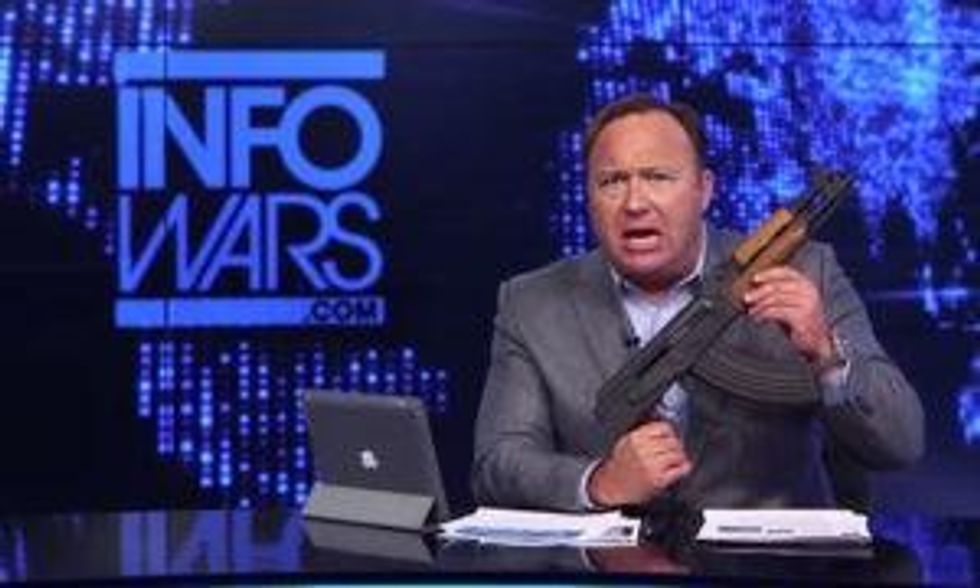
On August 6, a number of giant online media companies, including Facebook, YouTube, Apple, Spotify and Pinterest, took the seemingly coordinated decision to remove all content from Alex Jones and his media outlet Infowars from their platforms.
Jones, perhaps the internet's most notorious far-right conspiracy theorist, has claimed that the Sandy Hook shooting was a hoax, the Democratic Party is running a child sex ring inside a DC pizzeria and that the Las Vegas shooting was perpetrated by Antifa. Despite or perhaps because of such claims, his website Infowars has built up an enormous following: 3 million Americans, almost 1 percent of the population, visited the site in July 2018, according to Alexa.

The reaction from the media to the decision to ban Jones and Infowars was largely celebratory. On the Late Show (8/7/18), Stephen Colbert joked that it looked like "Infowars just lost their war on info." The Daily Beast (8/9/18) urged readers to "shed absolutely no tears for Alex Jones," while Salon (8/9/18) and CNN (8/9/18) put pressure on Twitter to follow suit, with the former asking, "Why is Alex Jones still allowed on Twitter?"
Some worried about a slippery slope of corporate censorship. Writing in Rolling Stone 8/2/18), Matt Taibbi warned: "The endgame here couldn't be clearer. This is how authoritarian marriages begin, and people should be very worried."
Yet this appeared to be a minority opinion. Media critic and news presenter David Doel shared his message to progressives via Twitter (8/6/18):
Lefties defending Alex Jones right now: I hear you, on the surface it appears to set bad precedent to give massive corporations control over who's silenced. But if you aren't performing hate speech, libel or slander on a regular basis, then I don't know what you're worried about.
Unfortunately, Facebook immediately used this new precedent to switch its sights on the left, temporarily shutting down the Occupy London page and deleting the anti-fascist No Unite the Right account (Tech Crunch, 8/1/18). Furthermore, on August 9, the independent, reader-supported news website Venezuelanalysis had its page suspended without warning.
The site does not feign neutrality, offering news and views about Venezuela from a strongly left-wing perspective. But it's not uncritical of the Venezuelan government, either, and provides a crucial English-language resource for academics and interested parties on all sides wishing to understand events inside Venezuela from a leftist perspective, something almost completely absent in corporate media, which has been actively undermining elections (FAIR.org, 5/23/18) and openly calling for military intervention or a coup in the country (FAIR.org, 5/16/18).
My latest book, Bad News From Venezuela: Twenty Years of Fake News and Misreporting, detailed the complete lack of diversity, and the strict adherence to an anti-Chavista editorial line, across corporate media. Venezuelanalysis, praised by the likes of Noam Chomsky, Tariq Ali and John Pilger, offers an alternative perspective.
The abrupt nature of its de-platforming is a worrying development for alternative media. Following an appeal and a public outcry on social media, Venezuelanalysis was reinstated on Facebook. However, the social media site offered no explanation for what happened.
Facebook recently announced it had partnered with the Atlantic Council in an effort to combat "fake news" on its platform (FAIR.org, 5/21/18). An offshoot of NATO, the Council's board of directors is a who's who of neo-conservative hawks, including Condoleezza Rice, Colin Powell, Henry Kissinger and James Baker; CIA directors like Robert Gates, Leon Panetta and Michael Hayden; retired generals like Wesley Clark and David Petraeus; as well as senior tech executives.
Forty-five percent of Americans get their news from Facebook. When an organization like the Atlantic Council decides what news we see and do not see, that is tantamount to state censorship.

Venezuelanalysis (12/13/17) exposed that the Council was working closely with the Venezuelan opposition, donating over $1 million to it, part of a wide-ranging effort at regime change against multiple progressive governments in the region (Brasilwire, 12/28/17). That Facebook censored a news site responsible for investigating its partner is a worrying development in journalism.
Venezuelanalysis' statement (8/9/18) on its removal noted that "Facebook appears to be targeting independent or left-wing sites in the wake of Russiagate." As I previously argued (FAIR.org, 7/27/18), the utility of the Russian "fake news" scandal is that it allows corporate media to tighten their grip over the means of communication. Under the guise of combating fake news, media organizations like Google, Bing, Facebook and YouTube have changed their algorithms. The effect has been to hammer progressive media outlets. AlterNet's Google traffic fell by 63 percent, Media Matters by 42 percent, TruthOut by 25 percent and The Intercept by 19 percent (WSWS, 8/2/17). Sites like these that challenge corporate perspectives are being starved of traffic and advertising revenue.
On August 13, the situation escalated as Facebook, citing a clause in its terms of service barring "hateful, threatening or obscene" media, deplatformed TeleSUR English, an English-language Latin American news network. TeleSUR is funded by a number of Latin American states, including Venezuela, and offers news and opinion from a progressive viewpoint. It was set up precisely to provide an alternative to Western corporate-dominated media. In its statement on its censorship, TeleSUR English (8/13/18) noted, "This is an alarming development in light of the recent shutting down of pages that don't fit a mainstream narrative."
That Facebook's stated concern about stopping the spread of hate speech is genuine is challenged by the fact that the far-right Alternative fur Deutschland (AfD) party went to Facebook headquarters in Berlin in 2017 to discuss how it could use the platform for recruitment and for micro-targeting in the German elections, as Bloomberg Businessweek (9/29/17) reported. Through Facebook and with the help of American companies, AfD nearly tripled its previous vote share, becoming the third-largest party in Germany, the far right's best showing since World War II.
The Russian fake news scandal has provided enormous media monopolies an avenue to try to reassert control over the means of communication. This latest action by Facebook is part of a worrying trend towards greater censorship of media. It is unlikely it will end here. Progressives should not necessarily shed tears for Jones, but they should be aware that their media is next in line, and that Jones' deplatforming sets a dangerous precedent that is already being used against them.
Following an appeal and a public outcry on social media, both Venezuelanalysis and TeleSUR English were reinstated on Facebook, with the latter being told being told its suspension was due to "instability" and "suspicious activity," though it had earlier gotten a message accusing it of "violating our Terms of Use." As Venezuelanalysis (8/9/18) noted, "the whole thing is extremely mysterious, to say the least."
With a little-noticed remark at a friendly event, Treasury Secretary Steven Mnuchin discarded his past arguments for the Trump/GOP tax bill. All Mnuchin could offer in their place was one of the oldest and most discredited ideas in the conservative playbook (and that's saying something).
It was a startlingly cynical move, even for the preternaturally cynical gaggle of gold-plated grifters running our government - a crowd whose sole ambition is the single-minded pursuit of additional wealth for themselves and their fellow Gilded Age grandees.
When the final taxonomy of these Trump Era swamp creatures is conducted, a special category will be reserved for Mnuchin, the Goldman Sachs banker turned Treasury Secretary who took a leading role in selling the Trump/GOP tax scam to the American people. His rule seems to be: If they don't believe one lie, tell another.
From the tax bill's name - the "Tax Cuts and Jobs Act" - to the arguments made in its favor, the bill has been a three-card monte played on middle-class Americans.
This revamp of this age-old streetcorner scam was devised by Trump, in collaboration with GOP congressional leaders Mitch McConnell and Paul Ryan, but Steve Mnuchin was the pitchman holding the bets and fast-talking the crowd.
To sell the tax cut, Trump, Mnuchin and Congressional Republicans insisted that most of the bill's benefits would go to the middle class, which is demonstrably untrue. In fact, lower-income and middle-class Americans lose needed benefits and will eventually pay more in taxes than they did before the bill was passed.
Mnuchin, like his boss and his boss's cronies, also insisted that the bill's massive tax corporate cuts would lead to worker bonuses and new jobs as corporations reinvested their new-found billions.
He told these fibs, not just once, but over and over, even after the bill became law. Some examples:
September 27, 2017:
The President outlined a framework with Congress that will... (fuel) job creation, higher wages, and economic growth ... Indiana is a great example of how tax relief and reforms like these can lead to record-high employment, more investment in education and innovation, and more manufacturing right here in America.
October 11, 2017:
We are working with Congress to pass historic tax relief and reform that will invigorate American manufacturing and ensure that the many truckers who attended the President's speech today will have plenty of American-made goods to deliver to every corner of our nation.
November 5, 2017:
With a tax code made for Americans, we will see much more 'Made in America.'
December 20, 2017:
Today Congress delivered tax cuts to middle-income families and a level playing field for American businesses. I congratulate the House and Senate for passing this historic legislation, which will usher in higher wages and more jobs for American workers...
January 8, 2018:
To date, over one million American workers and counting are receiving special bonuses in response to President Trump signing the Tax Cuts & Jobs Act. Many other middle-income families are seeing their wages increased, and companies across the country are announcing additional hiring and workforce investments.
February 5, 2018:
Hardworking men and women across the country ... are receiving bonuses, higher wages, new jobs, and enhanced benefits thanks to tax reform.
Many of the bonuses touted by the Trump Administration were largely "optics," in one observer's words. That's putting it generously. And corporations were never planning to invest their tax breaks. A gathering of corporate CEOs pretty much told Trump economic advisor Gary Cohn as much last November.
Instead, as with past packages of cuts, many corporations are using their tax windfalls not to create jobs or invest in growth, but to conduct stock buybacks that create additional wealth for their investors but leave everyone else behind.
Apple, for example, is conducting a $100 billion buyback that will add 16 percent to its quarterly dividend. That means more money for its shareholders, not more jobs or pay for American workers. For perspective, Apple's buyback is roughly 50 percent larger than the Department of Education's entire 2018 budget of $68.3 billion.
Drug company Pfizer announced a stock buyback four days before the tax bill passed. As Michael Hiltzik of the Los Angeles Times notes, Pfizer also announced a cutback in research for Alzheimer's and Parkinson's treatments not long afterwards.
Stock buybacks were considered illegal for most of the twentieth century, because they are commonly used to manipulate share prices.
Under Ronald Reagan, the SEC loosened the rules and made the practice legal - but that didn't make it right. As executive packages tilted more toward stock-based compensation, executives had a powerful incentive to abuse the process for personal gain.
The wave of stock buybacks triggered by the "Tax and Jobs Act" was, therefore, highly predictable. One assumes, in fact, that savvy bankers like Mnuchin expected it - and that this wave of wealth-taking at the public's expense was, in fact, their goal all along.
The tax bill is best understood as another step in the class war being waged by the wealthy on working Americans. Most of its tax savings go to the wealthy (all of them, in the long term). The shareholder gains it has triggered also primarily benefit the wealthiest Americans. A Gallup survey found that nine out of ten families earning $100,000 or more owned stocks, while only one in five of those making $30,000 or less did (largely through 401-k's and other employer-based plans). And the top 1 percent owns most of the shares:
Faced with mounting evidence of this eminently predictable wave of wealth consolidation, Mnuchin apparently decided the time had come to change his story.
Days before embarking on a trade trip to China, Mnuchin appeared before a friendly audience in Beverly Hills at the Milken Institute Global Conference, where television personality Maria Bartiromo largely lobbed softball questions.
Bartiromo did, however, raise the issue of stock buybacks (at about the one-hour mark in this video), saying:
... (y)es, we've got all of those bonuses [not true-see above], but (corporations are) buying back a lot of stock and not necessarily hiring all the people that perhaps we thought. Is that a fair statement?
"No," responded Mnuchin, who continued:
The one thing I know this crowd gets (is)... stock buybacks are a mechanism that companies can return capital to shareholders. If a company has excess capital, they return that capital to shareholders. This group recycles that capital through the economy. It doesn't disappear. So there's nothing wrong with stock buybacks. Um, that's not a bad thing.
In other words: This tax giveaway to corporations was "excess capital" - that is, they didn't need the money - so they're giving it back to shareholders. But "that's not a bad thing," according to Mnuchin, because the largely wealthy shareholders who get that money will spend it and the economy will benefit.
If that argument sounds familiar, it should. It's the same old "trickle-down economics" Republicans have been foisting on the American people for decades. It has never worked, and it never will.
Trump and Mnuchin didn't use the "trickle-down" argument to sell this bill, because they know nobody believes it anymore. Instead, they argued that businesses would use this money for investment. That was easily disproved, because businesses were already hoarding a record $1.9 trillion in cash.
As Standard & Poor's SPC Global division notes, this cash hoard is disproportionately held by the largest corporations (who are also the largest beneficiaries of the GOP tax law). "Wealth inequality in the U.S. isn't just for individuals," says SPC Global, "the divide between the haves and the have-nots continues to widen for American companies too.
The group also predicts that the tax law will have some negative rating consequences for companies as they repatriate offshore holdings and give them away to shareholders.
Apple had the biggest cash pile of any corporation, at $261.5 billion. Now it has announced the largest stock buyback in history. Again: Nothing about this outcome was unpredictable.
Since these corporations were already sitting on large cash stockpiles, it was never reasonable to expect them to invest their new windfalls. They were always going to give the money back to shareholders -- a group that includes the executives and board members tasked with deciding how to spend the money.
When confronted with the reality of stock buybacks, even by a gentle interviewer in front of a friendly audience, Mnuchin has no response to offer except an old and discredited idea. He had no choice but to discard his now-discredited arguments, toss out a stale right-wing myth in their place, and hope nobody would notice.
Meanwhile, he and his cronies are on track to win twice - with tax cuts and stock payouts that benefit the wealthiest among us - while most Americans are destined to lose.
That's what happens under a government of grifters.
After meeting with President Donald Trump last week to reaffirm U.S. military support for Saudi Arabia's brutal assault on Yemen, crown prince and accused war criminal Mohammed bin Salman, or MbS, is continuing his "whitewash tour" across the country with "a who's who of America's rich and powerful."
"When you meet with Oprah, even if you're not going to be interviewed, you're seeking the approval of an opinion maker. You're going into people's homes and reaching deep into American culture."
--Nader Hashemi, Middle East expert
A peek at the prince's itinerary, leaked to The Independent on Wednesday, reveals meetings with top U.S. leaders in politics, media, and major industries--shedding light on the "full extent of the heir to the throne's American charm offensive."
From New York to the Silicon Valley, the prince's coast-to-coast welcoming committee reportedly includes up to four previous presidents as well as former Secretary of State Henry Kissinger, Amazon CEO Jeff Bezos, media mogul Oprah Winfrey, and several newspaper editorial boards.
" Saudi Arabia has always had a public image problem in the West because of the obvious things like women's rights and beheadings," Nader Hashemi, director of the Center for Middle East Studies at the University of Denver's Josef Korbel School of International Studies, told The Independent. "When you meet with Oprah, even if you're not going to be interviewed, you're seeking the approval of an opinion maker. You're going into people's homes and reaching deep into American culture."
While America's so-called A-listers have seemingly lined up to rub elbows with MbS, critics of the prince--and the war his nation is waging against one of the world's poorest countries, causing a horrific humanitarian crisis--were less receptive to his supposed charm.
"If you didn't know better, you would think Saudi Arabia is on a path to major reform," warned Amnesty International on Thursday. "However, in the months since the crown prince's appointment, we have seen little reason to believe that his overtures are anything more than a slick PR exercise. In fact, Saudi Arabia retains an atrocious human rights record and the situation has only deteriorated since the crown prince was appointed as official heir to the throne in June 2017."
During MbS's tour of America, the public is being subjected to a full-blown public relations campaign, which has included an interview with CBS's "60 Minutes" that Mehdi Hasan, writing for The Intercept, described as "an infomercial for the Saudi regime" and "a crime against journalism."
There is also a "nearly 100-page magazine published by Donald Trump's allies at American Media Inc.," which has infiltrated supermarket newsstands across the country.
The glossy magazine, as Spencer Ackerman writes for the Daily Beast, "Disneyfies Saudi Arabia as 'the Magic Kingdom.' It's easily the most uncritical encomium to MBS since Thomas Friedman."
The magazine, Ackerman notes, fails to mention "Saudi Arabia's system of male guardianship, a literal patriarchal tool that requires male relatives to provide women 'permission'" for daily activities, or the nation's "massive number of executions, which are conducted by stoning and even Islamic State-like public beheadings."
In addition to meetings with Trump and Oprah, MbS's itinerary for the trip, according to The Independent, is as follows (emphasis added):
On Tuesday alone in New York City, the prince is believed to have met with former secretary of state Henry Kissinger, ex-president Bill and presidential candidate Hillary Clinton, New York state senator Chuck Schumer, U.N. secretary general Antonio Guterres and businessman and former New York mayor Michael Bloomberg.
Other notable media meetings include dinner with The New York Times' Thomas Friedman, Rupert Murdoch, the head of The Atlantic's editorial board Jeffrey Goldberg, meetings with the editorial boards of The New York Times, Washington Post, Wall Street Journal, Los Angeles Times, and San Francisco Chronicle, as well as interviews with Time and Vanity Fair.
Current government officials on MbS's schedule include CIA director (and nominee for new U.S. Secretary of State) Mike Pompeo, Vice President Mike Pence, senior advisor and unofficial Middle East envoy Jared Kushner, national security adviser HR McMaster, and Defense Secretary James Mattis.
He is also meeting past luminaries such as Barack Obama, John Kerry, Gen. David Petraeus, and Condoleezza Rice, as well as paying a visit to George W. Bush's Texas ranch.
Other notable meets outside of politics include Bill Gates, Elon Musk, Peter Thiel, Tim Cook of Apple, and the CEOs of Microsoft, Boeing, Amazon, Uber, the Walt Disney Company, and Lockheed Martin.