SUBSCRIBE TO OUR FREE NEWSLETTER
Daily news & progressive opinion—funded by the people, not the corporations—delivered straight to your inbox.
5
#000000
#FFFFFF
To donate by check, phone, or other method, see our More Ways to Give page.


Daily news & progressive opinion—funded by the people, not the corporations—delivered straight to your inbox.
Friday's edition of The View became the site of an argument about war crimes, the U.S. military, and WikiLeaks as actress Pamela Anderson and program co-host Meghan McCain battled during Anderson's appearance on the hit daytime talk show.
The dispute began when View hosts attacked Anderson for her unwavering support of Julian Assange, the founder of WikiLeaks. McCain pounced, claiming that Assange is merely a "cyber terrorist."
"He hacked information," McCain said. "His leaks included classified documents that put our national security at risk, our military, and the lives of spies and diplomats at risk."
Anderson replied by pointing out that the U.S. military, not WikiLeaks, is responsbile for the deaths of many innocent people around the world.
"How many people have the American government killed innocently and how many has Wikileaks?" Anderson asked. "The military has put many innocent lives at risk."
That response spurred a cheer from the audience.
"Oh, calm down, sir," McCain snapped at one boisterous supporter.
Later in the discussion, McCain extolled the virtues of American spies and intelligence officers and asked if Anderson was concerned for their safety from Assange leaking information to the public.
"Well, there's no evidence he's put anyone at risk," said Anderson. "And I think people like Edward Snowden, Chelsea Manning are heroes."
Progressive reaction online to the argument focused on Anderson's effective batting away of McCain's right-wing talking points.
"What a breath of fresh air!!" Splinter managing editor Katherine Kreuger wrote in her recap of the argument.
"Pamela Anderson talking about how war crimes need to be punished and of course Meghan McCain is crying about it," said Twitter user @Millerheighlife.
In a rare omission, Meghan McCain did not mention that her father was late war hawk Sen. John McCain (R-Ariz.) during the discussion.
Watch Anderson's appearance:
white person telling a person of color to "go back" to where they came from (usually Africa) is, unfortunately, as common as it is racist.
It's also such a dumb thing to say--especially in a nation where the majority of us came from somewhere else. It's an epithet that often issues from the lips of knuckle-draggers who can't think of a more subtle way to spew their racism.
In the years prior to Hitler's "Final Solution," his first solution was to tell Germany's Jewish population to go back to their "home" country.
Israel? Umm, no. Nazis being Nazis, they held tight to the (incorrect) theory that Jews originated from the island of . . . drum roll please . . . Madagascar!
Nazis held tight to the (incorrect) theory that Jews originated from the island of . . . drum roll please . . . Madagascar.
Now we have the President of the United States joining in the fun. The same weekend that Donald Trump had scheduled wholesale deportation raids of thousands of undocumented immigrants, he tweeted that four "Democrat Congresswomen" should "go back and help fix the totally broken and crime infested places from which they came." He added that, as far as he was concerned, they "can't leave fast enough."
In fact, three of the four Congresswomen--Alexandra Ocasio-Cortez of New York, Rashida Tlaib of Michigan, and Ayanna S. Pressley of Massachusetts--were born and raised in the United States. The fourth--Ilhan Omar of Minnesota, born in Somalia--is like the others an American citizen. Literally the only thing that distinguishes them from others in Congress is their non-whiteness, making Trump's racist intention perfectly clear.
Sure, Trump has dived deep into the septic tank before--leading the birther nonsense, calling white supremacists "good people," declining to condemn the KKK, and intentionally conflating Hispanic immigrants with violent criminals. But, folks, this is truly a new low.
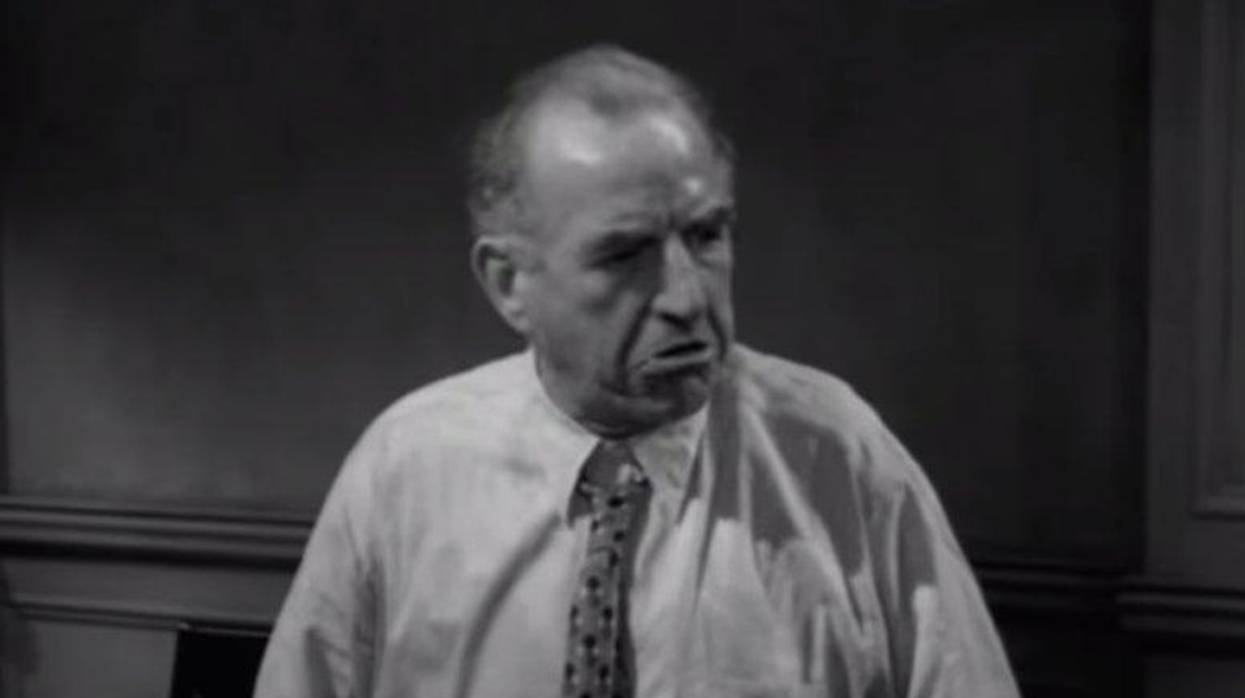
I was reminded of the famous jury deliberation scene in 12 Angry Men in which, after two hours of dropping hints, Ed Bagley's character suddenly explodes in an unequivocally racist rant, exclaiming, "They're no good, there's not a one of them that's any good!" As Bagley continues to spew, each juror gets up and slowly turns away in repulsion, until Henry Fonda's character famously says, "Sit down and don't open your mouth again."
Unfortunately, there are no fellow jurors turning their back on Trump or demanding that he shut up. Most Republicans in Congress could muster nary a peep of protest over the President's remarks. Virtually the sole exception was Lindsey Graham of South Carolina, who, in an interview on Fox News, offered this tepid response:
"We all know that A.O.C. and this crowd are a bunch of communists. They hate Israel, they hate our own country." But, he went on to allow, the four "are American citizens" who "won an election."
With defenders like these, who needs racist Presidents?
We'd all like to believe that if John McCain was still around, he might be the "Henry Fonda" in the room, but for now, his daughter, Meghan McCain, will have to do. She has bluntly denounced Trump's tweets as "racist" while also decrying the "cowardice" in other Republicans for not standing up to Trump.
Somewhere, Richard Spencer, the white supremacist leader who attended the 2016 Republican convention in support of Trump and "sipped Manhattans as he matter-of-factly called for removing African-Americans, Hispanics and Jews from the United States," is smiling triumphantly.
"Trust me. Trump thinks like me," Spencer told AP reporter Steve Peoples back then. "Do you think it's a coincidence that everybody like me loves Trump and supports him?"
No, Dick, we don't think it's a coincidence at all.
Bomb bomb bomb, bomb bomb Iran . . .
Thanks, John McCain! Let's mix a little humor in with war. It's so much easier to take when we do. By the way, have you noticed that we're always on the verge of war?
"The bombing will be massive, but will be limited to a specific target." So said a U.N. diplomat recently, according to the Jerusalem Post. Guess which country he was referring to.
An act of war is how we "send messages." So the Trump hawks (this term may or may not include Donald himself) are thinking -- if the paper's sources have any credibility -- of bombing an Iranian nuclear facility as an act of punishment because Iran "has announced that it intends to deviate from the nuclear agreement signed in 2015 and to enrich uranium at a higher level than the maximum it has committed to within the framework of the nuclear deal."
This is all hush-hush, of course. War has to be planned in secret. The public's role is definitely not to be part of the debate in the lead-up process or to question the facts that justify taking action. Its role is to cheer loudly when the hostilities begin, fervently hating the specified enemy and embracing the new war as a necessary, last-resort action to protect all that we hold dear.
"War-making must be renounced. It is past time for the paradigm shift. We have one planet and we must see ourselves as one and we must take a stand."
Its role is definitely not to question war itself or to bring up the inevitability of unintended consequences, whether that be the death of babies or the poisoning of the environment. Its role is not to suggest that creating peace is essentially the opposite of waging war, or to cry out:
"War-making must be renounced. It is past time for the paradigm shift. We have one planet and we must see ourselves as one and we must take a stand."
These are the words of Dud Hendrick of Veterans for Peace, and I pause here and let the words settle -- in all their complexity -- into the collective consciousness.
Perhaps what is most stunning about them is their complete absence from the corridors and smoke-filled rooms of American government. Instead, in virtually every story I read about one aspect or another of national security, what I hear is the echo of John McCain's humorous chant. National security is always seen, in the corridors of power, as a matter of striking back against some enemy or other, an attitude that strikes me as both stupid and cowardly.
I'm not saying security -- either national or personal -- is in any way a simple concept, or that acknowledging "we are one planet" leads to some obvious course of action. Indeed, the opposite is the case. Striking back is the simple course of action, and jumping on its bandwagon requires ignoring the absolute certainty of unintended consequences that will result from a bombing campaign or an invasion or a cyberwar or the imposition of sanctions.
Welcome to the 21st century: the century of endless war.
The absence of "we are one planet" voices at the highest levels of government guarantees that the government will pretty much always make simple, impulsive -- wrong -- decisions about national security. The absence of such voices in the mainstream media, at least in its geopolitical reportage, guarantees that there will be no long-term accountability for such decisions or any memory of the resulting consequences. Welcome to the 21st century: the century of endless war.
Thus:
"Over the past few months," Politico reports, "senior Trump aides have made the case in public and private that the administration already has the legal authority to take military action against Iran, citing a law nearly two decades old that was originally intended to authorize the war in Afghanistan."
The law in question is AUMF: the Authorization for Use of Military Force, passed in 2001, in the wake of 9/11, which gave the Bush administration permission to go on a hunting spree for terrorists without the need for ongoing congressional approval. Critics at the time argued that this gave dangerous leeway to the executive branch to wage war whenever it felt like doing so, without any sort of accountability to the requirements of democracy -- such as making a case that the war in question is necessary.
And so the Politico story quotes Rep. Ruben Gallego (D-Ariz.), who, upon leaving a closed-door briefing in May held by acting Secretary of Defense Patrick Shanahan, noted: "What I heard in there makes it clear that this administration feels that they do not have to come back and talk to Congress in regards to any action they do in Iran."
Bomb bomb bomb, bomb bomb Iran . . .
Or whatever.
As Medea Benjamin, and Nicolas J. S. Davies point out: "Whether in Iran, Venezuela, Cuba, North Korea or one of the 20 countries under the boot of U.S. sanctions, the Trump administration is using its economic weight to try to exact regime change or major policy changes in countries around the globe."
And the New York Times informs us that the United States and Russia are currently fighting a "daily digital Cold War" -- each country playing nasty little games with the other's power grid. The Pentagon even has an arm called the United States Cyber Command, which "runs the military's offensive and defensive operations in the online world" -- and it's getting more aggressive.
"But now the American strategy has shifted more toward offense, officials say, with the placement of potentially crippling malware inside the Russian system at a depth and with an aggressiveness that had never been tried before. It is intended partly as a warning, and partly to be poised to conduct cyberstrikes if a major conflict broke out between Washington and Moscow.
"The commander of United States Cyber Command, Gen. Paul M. Nakasone, has been outspoken about the need to 'defend forward' deep in an adversary's networks to demonstrate that the United States will respond to the barrage of online attacks aimed at it."
Somehow the existence of this crazy game doesn't make me feel safer. And the president, the story points out, doesn't even know about it: "Pentagon and intelligence officials described broad hesitation to go into detail with Mr. Trump about operations against Russia for concern over his reaction -- and the possibility that he might countermand it or discuss it with foreign officials, as he did in 2017 when he mentioned a sensitive operation in Syria to the Russian foreign minister."
The U.S. government, I fear, contains a terrible void where it ought to have sanity.
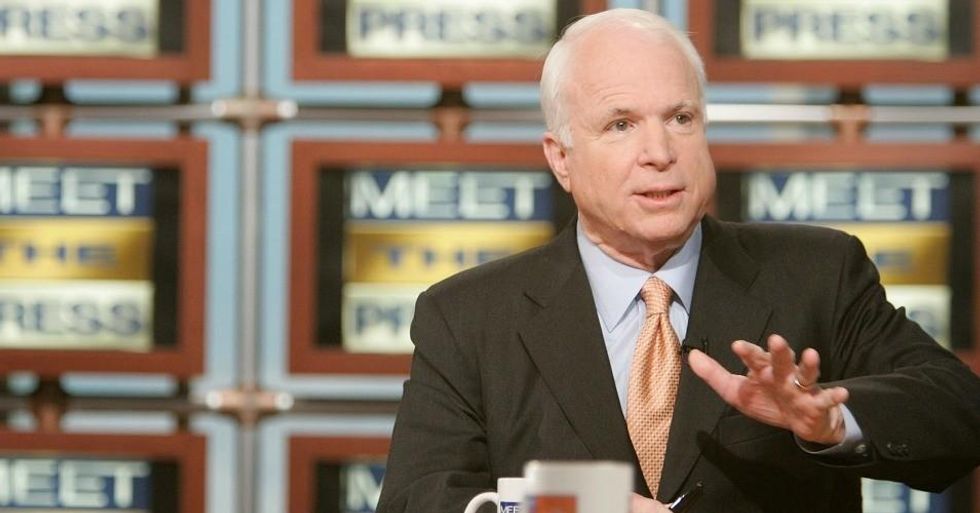
John McCain was an American politician. That sums up his best and worst qualities.
He was not a maverick. As a rather conventional politician, he wasn't even particularly courageous or much of a straight talker. He represented establishment values as the establishment tilted ever rightward.
And yet, in comparison to what passes for political orthodoxy in the White House these days, John McCain was a symbol of rectitude and honesty. However much I dislike the establishment for which he stood, that establishment now serves as powerful resistance to Donald Trump, who is the true maverick in American politics right now.
John McCain was no moderate Republican. He was a reliable right-winger who favored cutting taxes and government spending but also never missed an opportunity to boost the Pentagon budget.
He was a big fan of promoting regime change around the world and held a particular animus toward the government in Iran. He supported the war in Iraq and wanted the United States to increase its involvement in Syria. He opposed negotiations with North Korea. He embraced the conventional view that global alliances like NATO maintain U.S. global dominance.
Not surprisingly, he received a lifetime rating of 80 percent from the American Conservative Union. On some particular scorecards, he did even better. The National Right to Life Committee ranked him at 100 percent. And despite all the notoriety he received for standing up to Donald Trump, McCain generally supported this most disgraceful of presidents. According to the FiveThreeEight blog, McCain voted with Trump 83 percent of the time.
At times, he even demonstrated some very Trump-like behaviors. As Peter Certo writes in OtherWords, "For years he referred to East Asians by a Vietnam-era slur, opposed making MLK Day a holiday, and reportedly had a habit of calling women, even his wife, the c-word." His choice of Sarah Palin to be his vice president in the 2008 election wasn't really such a stretch, at least in terms of her politics.
But McCain wasn't entirely predictable. He complicated his relationship with the right wing of the Republican Party by adopting a few idiosyncratic positions. Those positions might not have been popular with his Republican peers, but they were often popular with the public more generally. But that makes McCain a politician, not an unorthodox or independent-minded person (the definition of maverick).
So, although he pushed for huge military budget increases, he castigated his congressional colleagues for their pork barrel spending and criticized the Pentagon for its military waste. He denounced the U.S. government for engaging in torture (yet quietly made political compromises that enabled the George W. Bush administration to continue its practices). Along with former Senator John Kerry (D-MA), McCain supported detente with Vietnam. These moves ultimately endeared McCain to (some) liberals
On Trump, John McCain went back and forth -- just like a politician. He initially endorsed Trump's presidential candidacy because he was, after all, a party loyalist. But then he withdrew that endorsement after the release of the Access Hollywood tape. In addition to taking a belatedly principled stance, McCain probably thought Trump was toast at that point.
Once Trump occupied the White House, McCain made a deal with the devil just like virtually every other Republican. Mephistopheles could continue to stick pitchforks into everyone left and right as long as he cut government regulations and taxes for the wealthy, enlarged the Pentagon, and populated the judiciary with legal lunatics.
But early on, McCain also voiced selective criticisms: of the Muslim travel ban, Trump's Russia policy, the failed mission in Yemen, and so on. Again, McCain proved to be not so much courageous as simply political. He expected that his congressional opposition might actually affect policy.
And here's the major difference between McCain and Trump. As a politician, McCain was open to engagement. Sure, he was a diehard conservative. But he would partner with the Dems on the issues he cared about, like campaign finance reform or opening up relations with Vietnam.
He played by the (admittedly rigged) rules of the game in Washington. He cared what his constituents thought about him. He wanted to win reelection. He also fancied himself an elder statesman who could effect change because of the longevity of his service.
It was a sad acknowledgement of how sclerotic American politics had become that John McCain acquired the reputation of a maverick.
It was a sad acknowledgement of how sclerotic American politics had become that John McCain acquired the reputation of a maverick. In a paint-by-number Congress, he only occasionally colored outside the lines, and then only when he thought he had the public on his side.
Donald Trump, meanwhile, is a true maverick. He takes positions that no one in their right mind would ever adopt as a Republican politician, as a conservative president, and in some cases, as a human being.
Oppose free trade? Check.
Meet with the North Korean leader? Check.
Talk about breaking up NATO? Check.
Insult major world leaders, virtually every politician in the United States, and even members of his own administration? Check.
Indulge in racist, sexist, and xenophobic slurs? Check.
In Bob Woodward's new book Fear, excerpted this week in The Washington Post, Trump emerges as such an unorthodox character that his closest advisors can only react with horror and exasperation. Trump wants to assassinate President Bashar al-Assad. He asks the Pentagon to plan a preemptive strike on North Korea. He ignores his top economic advisors and insists on pulling out of NAFTA.
This is true independence of thinking. It also edges close to madness, but that's the risk mavericks take.
Mind you, this kind of maverick is only a hero in a country that celebrates outlaws, gangsters, and bat-shit crazy celebrities, and Trump is only a hero to a minority of the population. Meanwhile, the establishment -- minus the Republican Party and its wealthy backers -- has had enough of Donald Trump because he cares so little about observing protocol, respecting tradition, or acting like a grownup.
In short, Donald Trump is not a politician. He doesn't even play one on TV. There is no negotiating with him. There's no give and take. You are either with him or against him. You can't reason with a Mafioso.
Once Trump is deposed, America can return to politics as usual, with all its ugliness and messy compromises and ordinary corruption. It can return to the politics of John McCain, a politics that combines a civility of discourse with a cruelty of consequences. And that, alas, will be an improvement.
After Trump dons an orange jumpsuit that complements his hairstyle -- or at the very least retires in semi-obscurity to Mar-a-Lago -- then comes the hard work of pushing the political center to the left.
Perhaps, just like in the wake of Watergate, a wave of young, talented, and honest newcomers like Alexandria Ocasio-Cortez and Ayanna Pressley will change politics as usual. Then we'll look back at the current era in which the likes of John McCain is considered a maverick and shudder.
McCain's death also conjured stories of his military career as a Navy A-4 Skyhawk pilot and five-and-a-half years as a POW in Vietnam, which reminded me how Ronald Reagan was fond of quoting--and sometimes misquoting--a line from the movie version of James Michener's Korean War novel, The Bridges at Toko-Ri.
Damp, murky and stinking of venality and corruption. Over the months of this misbegotten White House, we have seen the Washington swamp not drained but freshened with a whole new supply of frogs and snakes. It's a crime spree that makes the Grant and Harding administrations look like Toys for Tots.
The book is Carson McCullers' 1940 Southern Gothic tome, The Heart is a Lonely Hunter. The story is about a deaf-mute man named John Singer who loses his companion and suddenly shows up in a small Southern town, except that the story is even more about the reactions of the various characters -- a young woman coming of age, a black doctor angry about racism, the "town drunk," and others -- who pour out their heart and soul and project their own dreams and fears onto McCullers' protagonist, who cannot hear them or speak back.
In 2018, the American heart is the loneliest hunter of all, and so an increasingly lost and disillusioned nation turned its lonely eyes toward McCain. The late senator's 81-plus years on Planet Earth embodied so many contradictions -- the military man of honor and stoic POW who also took free trips from a sleazeball savings-and-loan multi-millionaire and cheated on his first wife after she'd been injured in a car wreck, the political "maverick" who nonetheless enabled the modern GOP's turn toward authoritarianism with the vast majority of his votes -- that Americans of every ideology and every psychological state could project onto him their own vision of what this country ought to, or our despair over what it's become. The story isn't really about who was John McCain, now no longer able to hear our plaintive appeals. The story is really about our anxiety over who we are.
It was McCain's adoptive West, where -- in a line from 1962's The Man Who Shot Liberty Valance that's been repeated in newsrooms thousands of times -- the supposed mantra was, "When the facts become legend, print the legend." (The movie, ironically, is about a character elected U.S. senator on a mangled version of his supposed heroic act as a younger man.)
In death, it was the John McCain legend -- the myth that a public so desperately craves when vainglorious "Individual-1" and his sweaty 1 a.m. Twitter fingers is keeping the lights on in the White House -- that landed on America's front doorstep Sunday morning.
The truth is that had there not been a John McCain to shoehorn into a broader myth -- a POW who endured years of torture for his brothers-in-arms and the doomed war effort and then entered politics as a public service, a "maverick" who did the right thing in a time of knee-jerk polarization, the last defender of true American values who rode off into the sunset -- America would likely have invented just such a character.
And let's be clear, it's impossible to write about McCain's passing without acknowledging the many places where the man and the myth overlapped, without expressing gratitude for the sacrifices and awe at the pain he endured during the "Hanoi Hilton" years, and without expressing deep sympathy to all those who loved him. But in the end, McCain the man was very much just like the rest of us flawed mortals -- with no novelistic plot line pointing to some grand moral climax, just the normal blend of human contradiction.
McCain the man, after all, tended to only be a "maverick" when it didn't matter. Yes, he became the leading Republican advocate for campaign finance reform -- but only after he was caught red-handed in the cookie jar with future S&L felon Charles Keating, with official favors and lavish free trips that are almost identical to the bad behavior that got his later Senate colleague Bob Menendez indicted. Yes, his experiences in Hanoi led McCain to become a moral beacon on the torture issue, but his nightmarish Vietnam experiences (including some real-time regret over his bombing and napalm runs) didn't stop him from advocating for more immoral Vietnam-style military actions around the globe. Yes, his 3 a.m. vote saved Obamacare, which saved lives. but just a few months later he voted to end the Obamacare individual mandate, which will ultimately price many middle-class Americans out of the health market. Yes, he was a man from a bygone era of honor on U.S. politics -- except for that time he told an ugly and beyond misogynistic joke about Chelsea Clinton and Janet Reno.
McCain the myth is largely the result of McCain's brilliant strategy of courting and even flattering reporters when his 99 Senate colleagues mostly sprinted to the elevator to get away from them, and the bonds among the Beltway elite who shape public opinion -- or at least used to. The legend of McCain riding in from the West to tell humble truths and clean up a wicked, sinful Washington is the kind of self-aggrandizing story about American politics that so many people at the pinnacle of power cling to, the story that we tell ourselves in order to live.
The epic moment where the man and the myth collided with full force occurred when McCain was at the high point of his 30-year career in politics, after he'd finally won the Republican presidential nomination in the summer of 2008 and -- with the economy in shambles and many voters unhappy with the Iraq War that McCain had cheered for -- faced an uphill fall campaign against Barack Obama.
True to the moral-less storyline of McCain the man, the Arizona senator only won the nomination after turning away from the beloved McCain of his failed 2000 race who'd won so much admiration with his "Straight Talk Express" and with more moderate stands on issues. The last, hard kick was nominating the supremely unqualified right-wing ideologue Sarah Palin to serve as his running mate, unleashing forces with her talk of Obama as a kind of "terrorist" and defining where is "the real America" that McCain didn't seem to anticipate and could barely control.
It all came to a head on a Friday night in a packed school gym in a place called Lakeville, Minn., in a town meeting held on Oct. 10, 2008. Palin's pitbull-in-lipstick-hockey-mom attacks had stoked up a GOP base that was increasingly angry as Obama pulled ahead in the polls; several times the audience actually booed McCain voiced his "respect" for his Democratic opponent even as those in the audience were branding Obama as a socialist or a terrorist.
Finally, a woman in a bright red T-shirt with gray hair was called onto the stage and took the mic for her question.
"I can't trust Obama. I have read about him and he's not, he's not uh -- he's an Arab. He's not -- "
McCain dramatically grabbed the mic before she could say another word.
"No, ma'am. He's a decent family man [and] citizen that I just happen to have disagreements with on fundamental issues and that's what this campaign's all about. He's not [an Arab]."
This was the Rashomon moment -- 29 seconds that would come to define American politics, where all of us saw the same event but, like characters in the classic Kurosawa movie, spun wildly different interpretations of what it all meant.
To the McCain myth-makers and legend keepers, McCain's honorable comments -- viewing politics as a decent if spirited clash of ideas, not a war of hateful stereotypes -- was the America That Used To Be, even if it requires a pair of rose-colored glasses to see it that way. To this interpretation, McCain was committing an act of cowboy-style patriotism by standing up for American values -- the moment that defined him even as the actual values he stood up for were slipping away.
The problem is that to millions of people watching the same scene -- just not the people with the loud megaphone of the mainstream media -- the hero of those 29 seconds was not McCain but the woman in red. Over the next decade, the people like her would grow louder and more influential, a Tea Party screaming at politicians that "I want my country back," to be climaxed by a demagogic political leader happy to ride their waves of racism and xenophobia. Not the America That Used to Be, but the America That Really Is.
There is a less-heard third perspective on what went down in Lakeville on that Friday night. Why, some people asked, was McCain's instinctive, gut-level reaction that being a "decent family man" was the polar opposite of being "a Muslim"? Aren't most of the millions of American Muslims decent, family men and women? What if -- imagine the thought -- an actual Muslim ran for president in the nation that once embraced the world's refugees?
This is The America That Should Be But Never Was -- the America that can never fully get past its McCain-like contradictions, that saved the American middle class with the Depression-era New Deal, as long as the middle class was white, and that defeated fascism during World War II even as it tossed thousands of Japanese-Americans into internment camps. There's something to be said for looking at the McCain Moment and wondering if -- instead of a gauzy view of a lost America was there was more liberty and justice, but not for all - we can't do even better than that.
But in the present moment we're a long way away from that. I think a big reason why the 2008 McCain Moment got so much play with his passing is because -- as much as we want to hold aloft the senator's decent response -- we're even more mortified that the bad guys ultimately won. And with each passing day we're running out of good ideas for what to do about it.
John McCain was maddeningly inconsistent and too often self-serving, and yet compared to the current crew of crooks, he comes off like the blessed love child of Abraham Lincoln and Joan of Arc. And so now we're just left staring into an orange sunset, with The Man Who Shot Liberty Valance -- even if he didn't, really -- gone on the other side of the mountain.
In the last days of his life, an old video of John McCain surfaced on the internet.
It's 2008. He's running for president and fielding questions from voters in Minnesota. A middle-aged woman takes the microphone.
"I can't trust Obama," she complains of McCain's Democratic opponent. "He's an Arab."
Whether they realize it or not, I think the "straight talk" people praise McCain for is actually what most of them can't stand about politicians: They say noble words but cast ignoble votes.
The Arizona Republican shakes his head. Obama is "a decent family man and citizen that I just happen to have disagreements with," McCain retorts. And adds: "He's not [an Arab]."
Standing up for a rival was classic McCain, many believed, and his handling of the incident got praise at the time. No wonder it's circulating again now, after a later presidential candidate made that woman's slanderous race-baiting look tame.
Still, too few people asked: Do real Arabs not make "decent family men" or citizens? Can one not have principled "disagreements" with them?
More concretely: McCain was then campaigning on a pledge to expand the Iraq war, which he'd championed from the beginning. That war had killed perhaps a million Arabs. It would lead later to a devastating occupation by ISIS, and yet more U.S. military intervention.
Throwing an entire ethnic group under the bus may not have been McCain's intent, though he'd had his brushes with bigotry before. For years he referred to East Asians by a Vietnam-era slur, opposed making MLK Day a holiday, and reportedly had a habit of calling women, even his wife, the c-word.
But it's not really about McCain or what's in his heart. It's more about how the D.C.-based media reported him, and how admiring Americans interpreted his behavior.
Sporadically, the late Republican senator did take some principled stands. As a POW who suffered torture himself, he took on multiple Republican presidents to keep the U.S. from resuming it (though he steadfastly supported the wars in which that torture took place). And last year he cast a surprise, decisive vote against the GOP's effort to kill Obamacare (though he'd voted against Obamacare earlier).
Mostly, though, McCain was a reliable vote for his party's worst ideas, and contributed many of his own (like putting Sarah Palin a heartbeat from the presidency). And despite his well-known feud with President Trump, he voted in support of the president's agenda 83 percent of the time.
McCain supported the $2 trillion corporate tax giveaway that could tear our safety net to shreds. His unrelenting passion for military conflict was a thing of caricature ("bomb, bomb, bomb, bomb, bomb Iran," he famously sang). And his support for empire-crumbling military budgets was so renowned that his colleagues named this year's $717 billion atrocity after him.
Trump never thanked McCain when he signed it, but sign it he did. Some feud!
The point isn't that McCain's odes to honor or civility were somehow dishonest. To him, I'm sure they were genuine.
But in emphasizing McCain's personal style over his actual politics, his eulogizers imply there's some "honorable" way to implement an agenda like Trump's (or 83 percent of it, anyway), as long as you don't talk like Trump himself.
Personally, I disagree. Whether they realize it or not, I think the "straight talk" people praise McCain for is actually what most of them can't stand about politicians: They say noble words but cast ignoble votes.
I don't mean to suggest that Trump's personal style is a welcome change from McCain's. It's not. But politics can't just be a theater for elites, where standing up for one rival outweighs supporting a war that killed a million people.
Actions matter more than words, and that's the straightest talk I can think of.

Longtime U.S. Senator John McCain, the Republican from Arizona whose pro-war record includes aggressively pushing for the illegal invasion of Iraq by the United States in 2003, has died. He was 81.
While major news outlets broke into programming to bring viewers word of his death on Saturday evening, a few journalists like Tim Dickinson at Rolling Stone offered accounts of McCain's life that went beyond myopic hagiography.
Anti-war activists like CodePink's Medea Benjamin, who knew his policy record well and stood proudly against it, offered their condolences:
But journalist Jon Schwarz took note of the many millions of people in countries where McCain waged or advocated for war who had reasons not feel warm, fuzzy, or instinctively mournful by the news:
Meanwhile, media critics Nima Shirazi and Adam Johnson offered this pre-spin news brief--titled "Don't Let the Media Erase McCain's Far Right Legacy"--as a warning against the inevitable narrative that will dominate the coming days in which efforts to venerate the lawmaker will steadfastly ignore the sizeable and documented damage his political career left in his wake:
"McCain has passed," Shirazi and Johnson write. "Don't let the media forget the thousands of Arabs and Asians he helped displace, injure or kill. Their lives mattered too."
And in a separate tweet, Johnson recognized that it's "a reasonable human instinct to not want to say bad things about people who just passed," but added that "major historical figures aren't your friends' grandmother, they carry mountains of ideological baggage and sanctifying them is an inherently political act and it's childish to act otherwise."
On an otherwise sleepy August day, President Trump signed the John McCain National Defense Authorization Act. Named for the dying Arizona senator who's championed military budgets for his entire career, the bill increases U.S. military spending to an astonishing $717 billion.
According to my Institute for Policy Studies colleague Lindsay Koshgarian, that's about double what American taxpayers were spending at the end of the Cold War, and upwards of $300 billion more than what we spent before the War on Terror.
The bill also contains language encouraging a confrontation with Iran, while also making it possible for the administration to continue offering weapons and support to the Saudi-led coalition that's bombing Yemen. (Where, the very week the bill was signed, they bombed a school bus, killing 51 people -- 40 of them children.)
You'd expect a bill of this magnitude to generate lots of critical coverage -- and you'd be right! But only kind of.
The most controversial thing about this bill, to hear most of the media tell it, is that the president refused to thank John McCain when he signed it.
Countless outlets, from Newsweek to TIME to the Washington Post, reported the omission as a "snub" against the bill's namesake senator, an occasional Trump critic. CNN's Jake Tapper used an entire segment on his show to scold the president about it -- and even sanctimoniously thanked McCain himself.
The New York Times ran the numbers: Trump spoke for 28 minutes about the bill, with 0 mentions of McCain.
I ran some numbers of my own: A Google news search on the story turned up nearly 150,000 pieces like this. That's almost 3 times the number of results I got when I searched the same story, but replaced "John McCain" with the actual price tag of the bill: $717 billion.
To put it kindly, this is garbage.
If the media deems a petty snub more controversial than a massive, war-mongering spending bill, you can be sure Congress will follow. The bill passed by huge bipartisan margins in both the House and Senate.
I can assure you, Trump's not going to speak more kindly of John McCain as a result of this coverage. But more school buses are probably going to get blown up -- and so are more pressing human needs in our own communities.
For instance, my home state of Ohio has, by some measures, the most student debt of any state. According to Koshgarian, taxpayers there spent $15.5 billion on the Pentagon base budget alone this past year. For that money, we could've funded nearly 700,000 four-year Pell grants.
For Texas, the most uninsured state in the union, their $45 billion in Pentagon dollars could've covered 15 million adults and 16 million kids. That's the entire state -- and then some.
Flint, Michigan taxpayers, Koshgarian calculates, spent some $38 million. That could've paid for nearly 700 infrastructure jobs to fix things like, say, lead in their water pipes.
Nationally, that money could've provided solar power to the entire country. Or funded universal health care. Or debt-free higher education. Instead, we'll be shelling out more money on fruitless, destructive wars and boondoggle weapons systems like the F-35 (which McCain himself has called "a scandal and a tragedy").
The real scandal is that such expenditures aren't deemed controversial -- not by our lawmakers, and not by many of the outlets that cover them. Next time they say McCain's name, they should report what his bill costs the rest of us.
The 2019 National Defense Authorization Act (NDAA) President Donald Trump signed into law during a jingoistic ceremony at Fort Drum on Monday authorizes $22 billion in spending for nuclear weapons that could wipe out the human species, 77 new F-35 fighter jets, and $717 billion in military funding overall, but the corporate media apparently decided that the worst part about Trump signing this "obscenity" of a bill was his failure to acknowledge that it is named after Sen. John McCain (R-Ariz.).
"The myth of U.S. as noble but flawed defender of Human Rights and Freedom is our civic religion--the one thing all Serious pundits, pols, think-tankers, and high status media creators must accept. McCain is this myths greatest avatar, this is why they rush to his defense."
--Adam Johnson
"Trump snubs John McCain during bill signing intended to honor him," NBC News complained in a headline that was repeated almost verbatim in Business Insider, the Washington Post, The Daily Beast, The New Republic, Bloomberg, and many other major news outlets after Trump signed the (emphasis added) John S. McCain National Defense Authorization Act for Fiscal Year 2019.
"Can't think of anything that better sums up the moral bankruptcy and cliquishness of D.C. media than the uniform meltdown over a $717B defense bill--one that codifies funding for Saudis massacre of Yemeni children--not being properly credited to McCain as if that's the goddamn problem," media critic and Fairness and Accuracy in Reporting (FAIR) contributor Adam Johnson wrote on Twitter, highlighting just one of the countless grotesque components of the NDAA.
As Common Dreams reported, the $717 billion military spending bill was supported by 40 Democrats in the Senate and 139 Democrats in the House.
"The myth of U.S. as noble but flawed defender of Human Rights and Freedom is our civic religion--the one thing all Serious pundits, pols, think-tankers, and high status media creators must accept," Johnson added. "McCain is this myths greatest avatar, this is why they rush to his defense so vehemently."
Others similarly ridiculed the corporate media's obsession with the bill's official title over the devastating effects it will have on actual lives overseas--a topic that elicited little concern from those penning offended tweets and headlines on behalf of McCain, a fervent supporter of endless war.
Predictably, Congress's bipartisan support for and Trump's subsequent signature of one of the largest military spending bills in American history was not met with the usual consternation and hand-wringing from pundits about how the U.S. can afford such funding.
"Nobody ever calls massive increases in military spending 'unrealistic.' Not even when Donald Trump wants them."
--Matt Taibbi, Rolling Stone
But, as The Intercept's Alex Emmons has noted, the $82 billion military spending increase authorized by the 2019 NDAA could easily pay for Sen. Bernie Sanders' (I-Vt.) free public college plan, which is estimated to cost $47 billion a year.
In a column last month, Rolling Stone's Matt Taibbi posed the simple question corporate media outlets never deign to ask when it comes to spending on the Pentagon, new nuclear weapons, and shiny fighter jets: "Can You Think of Any Other Ways to Spend $716 Billion?"
"The ease with which this massive spending increase passed exposes all the howling we always get from think-tanks and the press whenever any ambitious social program is proposed. It's all bunk--all of it," Taibbi concluded. " Ask experts how much it would cost to make higher education at public colleges and universities free, and you'll get some big numbers. You will also hear strident opposition in op-ed pages to how 'unrealistic' the idea is, even though most free-ed proposals would fit easily into an $80 billion-per-year outlay. Nobody ever calls massive increases in military spending 'unrealistic.' Not even when Donald Trump wants them."