

SUBSCRIBE TO OUR FREE NEWSLETTER
Daily news & progressive opinion—funded by the people, not the corporations—delivered straight to your inbox.
5
#000000
#FFFFFF
To donate by check, phone, or other method, see our More Ways to Give page.
Daily news & progressive opinion—funded by the people, not the corporations—delivered straight to your inbox.
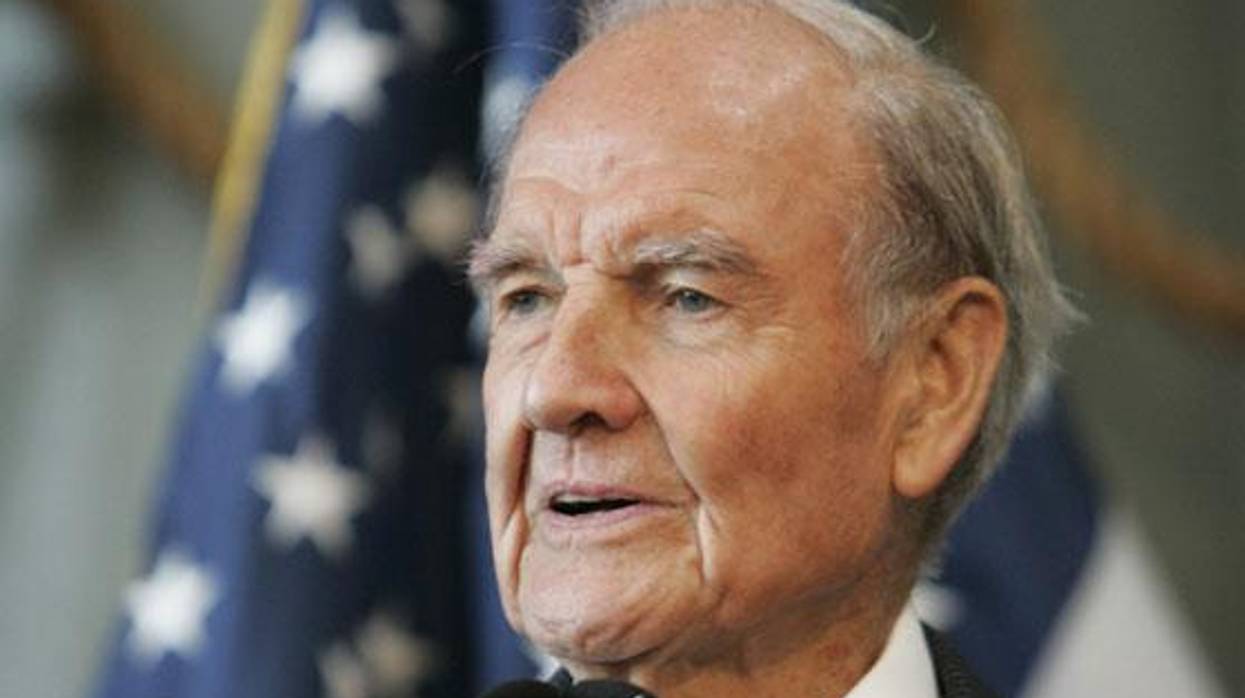
As I lived through the nightmare of the election campaign just past, I often found myself dreaming of another American world entirely. Anything but this one.
In that spirit, I also found myself looking at a photo of my fourth-grade class, vintage 1972. Tacked to the wall behind our heads was a collage, a tapestry of sorts that I could make out fairly clearly. It evoked the promise and the chaos of a turbulent year so long ago. The promise lay in a segment that read "peace" and included a green ecology flag, a black baseball player (Brooklyn Dodgers second baseman Jackie Robinson, who had died that year), and a clenched fist inside the outline of the symbol for female (standing in for the new feminism of that moment and the push for equal rights for women).
Representing the chaos of that era were images of B-52s dropping bombs in Vietnam (a war that was still ongoing) and a demonstration for racist Alabama governor and presidential candidate George Wallace (probably because he had been shot and wounded in an assassination attempt that May). A rocket labeled "USA" reminded me that this country was then still launching triumphant Apollo missions to the moon.
How far we've come in not quite half a century! In 2020, "peace" isn't even a word in the American political dictionary; despite Greta Thunberg, a growing climate-change movement, and Joe Biden's two-trillion-dollar climate plan, ecology was largely a foreign concept in the election just past as both political parties embraced fracking and fossil fuels (even if Biden's embrace was less tight); Major League Baseball has actually suffered a decline in African-American players in recent years; and the quest for women's equality remains distinctly unfulfilled.
Bombing continues, of course, though those bombs and missiles are now aimed mostly at various Islamist insurgencies rather than communist ones, and it's often done by drones, not B-52s, although those venerable planes are still used to threaten Moscow and Beijing with nuclear carnage. George Wallace has, of course, been replaced by Donald Trump, a racist who turned President Richard Nixon's southern strategy of my grade school years into a national presidential victory in 2016 and who, as president, regularly nodded in the direction of white supremacists.
Progress, anyone? Indeed, that class photo of mine even featured the flag of China, a reminder that Nixon had broken new ground that very year by traveling to Beijing to meet with Chinese Communist leader Mao Zedong and de-escalate the Cold War tensions of the era. Nowadays, Americans only hear that China is a military and economic threat; that Joe Biden and some Democrats are allegedly far too China-friendly (they aren't); and that Covid-19 (aka the "Wuhan Flu" or "Kung Flu") was -- at least to Donald Trump and his followers -- a plague sent by the Chinese to kill us.
Another symbol from that tapestry, a chess piece, reminded me that in 1972 we witnessed the famous Cold War meeting between the youthful, brilliant, if mercurial Bobby Fischer and Soviet chess champion Boris Spassky in a match that evoked all the hysteria and paranoia of the Cold War. Inspired by Fischer, I started playing the game myself and became a card-carrying member of the U.S. Chess Federation until I realized my talent was limited indeed.
The year 1972 ended with Republican Richard Nixon's landslide victory over Democratic Senator George McGovern, who carried only my home state of Massachusetts. After Nixon's landslide victory, I remember bumper stickers that said: "Don't blame me for Nixon, I'm from Massachusetts."
Eighteen years later, in 1990, I would briefly meet the former senator. He was attending a history symposium on the Vietnam War at the U.S. Air Force Academy and, as a young Air Force captain, I chased down a book for him in the Academy's library. I don't think I knew then of McGovern's stellar combat record in World War II. A skilled pilot, he had flown 35 combat missions in a B-24 bomber, winning the Distinguished Flying Cross for, at one point, successfully landing a plane heavily damaged by enemy fire and saving his crew. Nixon, who had served in the Navy during that war, never saw combat. But he did see lots of time at the poker table, winning a tidy sum of money, which he would funnel into his first political campaign.
Like so many combat veterans of the "greatest generation," McGovern never bragged about his wartime exploits. Over the years, however, that sensible, honorable, courageous American patriot became far too strongly associated with peace, love, and understanding. A staunch defender of civil rights, a believer in progressive government, a committed opponent of the Vietnam War, he would find himself smeared by Republicans as weak, almost cowardly, on military matters and an anti-capitalist (the rough equivalent today of democratic-socialist Bernie Sanders).
Apparently, this country couldn't then and still can't accept any major-party candidate who doesn't believe in a colossal military establishment and a government that serves business and industry first and foremost or else our choice in 2020 wouldn't have been Trump-Pence versus Biden-Harris.
Channeling Lloyd Bentsen
As I began writing this piece in late October, I didn't yet know that Joe Biden would indeed win the most embattled election of our lifetime. What I did know was that the country that once produced (and then rejected) thoughtful patriots like George McGovern was in serious decline. Most Americans desperately want change, so the pollsters tell us, whether we call ourselves Republicans or Democrats, conservatives, liberals, or socialists. Both election campaigns, however, essentially promised us little but their own versions of the status quo, however bizarre Donald Trump's may have been.
In truth, Trump didn't even bother to present a plan for anything, including bringing the pandemic under control. He just promised four more years of Keeping America Trumpish Again with yet another capital gains tax cut thrown in. Biden ran on a revival of Barack Obama's legacy with the "hope and change" idealism largely left out. Faced with such a choice in an increasingly desperate country, with spiking Covid-19 cases in state after state and hospitals increasingly overwhelmed, too many of us sought relief in opioids or gun purchases, bad habits like fatty foods and lack of exercise, and wanton carelessness with regard to the most obvious pandemic safety measures.
Since the presidencies of Richard Nixon and Ronald Reagan, and especially since September 11, 2001, it's amazing what Americans have come to accept as normal. Forget about peace, love, and understanding. What we now see on America's streets aren't antiwar protesters or even beat cops, but Robocops armed to the teeth with military-style weaponry committing indefensible acts of violence. Extremist "militias" like the Proud Boys are celebrated (by some) as "patriots." Ludicrous QAnon conspiracy theories are taken all too seriously with political candidates on the Republican side of the aisle lining up to endorse them.
Even six-figure death tolls from a raging pandemic were normalized as President Trump barnstormed the country, applauding himself to maskless crowds at super-spreader rallies for keeping Covid-19 deaths under the mythical figure of 2.2 million. Meanwhile, the rest of us found nothing to celebrate in what -- in Vietnam terms -- could be thought of as a new body count, this time right here in the homeland.
And speaking of potential future body counts, consider again the Proud Boys whom our president in that first presidential debate asked to "stand back and stand by." Obviously not a militia, they might better be described as a gang. Close your eyes and imagine that all the Proud Boys were black. What would they be called then by those on the right? A menace, to say the least, and probably far worse.
A real militia would, of course, be under local, state, or federal authority with a chain of command and a code of discipline, not just a bunch of alienated guys playing at military dress-up and spoiling for a fight. Yet too many Americans see them through a militarized lens, applauding those "boys" as they wave blue-line pro-police flags and shout "all lives matter." Whatever flags they may wrap themselves in, they are, in truth, nothing more than nationalist bully boys.
Groups like the Proud Boys are only the most extreme example of the "patriotic" poseurs, parades, and pageantry in the U.S.A. of 2020. And collectively all of it, including our lost and embattled president, add up to a red-white-and-blue distraction (and what a distraction it's been!) from an essential reality: that America is in serious trouble -- and you can take that "America" to mean ordinary people working hard to make a living (or not working at all right now), desperate to maintain roofs over their heads and feed their kids.
It's a distraction as well from the reality that America hasn't decisively won a war since the time George McGovern flew all those combat missions in a B-24. It's a distraction from some ordinary Americans like George Floyd, Breonna Taylor, and Jacob Blake being not just manipulated and exploited, but murdered, hence the need for a Black Lives Matter movement to begin with. It's a distraction from the fact that we don't even debate gargantuan national security budgets that now swell annually above a trillion dollars, while no one in a position of power blinks.
Today's never-ending wars and rumors of more to come remind me that George McGovern was not only against the Vietnam conflict, but the ones in Afghanistan and Iraq, too. Joe Biden, meanwhile, voted for the Iraq War, which Donald Trump also spoke in favor of, then, only to campaign on ending this country's wars in 2016, even if by 2020 he hadn't done so -- though he had set up a new military service, the Space Force. Feeling the need to sharpen his own pro-war bona fides, Biden recently said he'd raise "defense" spending over and above what even Trump wanted.
If you'll indulge my fantasy self for a moment, I'd like to channel Lloyd Bentsen, the 1988 Democratic vice presidential nominee who, in a debate with his Republican opposite Dan Quayle, dismissed him as "no Jack Kennedy." In that same spirit, I'd like to say this to both Trump and Biden in the wake of the recent Covid-19 nightmare of a campaign: "I met George McGovern. George McGovern, in a different reality, could have been my friend. You, Joe and Donald, are no George McGovern."
Prior military service is not essential to being president and commander-in-chief, but whose finger would you rather have on America's nuclear button: that of Trump, who dodged the draft with heel spurs; Biden, who dodged the draft with asthma; or a leader like McGovern, who served heroically in combat, a leader who was willing to look for peaceful paths because he knew so intimately the blood-spattered ones of war?
A Historical Tapestry for Fourth Graders as 2020 Ends
What about a class photo for fourth graders today? What collage of images would be behind their heads to represent the promise and chaos of our days? Surely, Covid-19 would be represented, perhaps by a mountain of body bags in portable morgues. Surely, a "Blue Lives Matter" flag would be there canceling out a Black Lives Matter flag. Surely, a drone launching Hellfire missiles, perhaps in Somalia or Yemen or some other distant front in America's endless war of (not on) terror, would make an appearance.
And here are some others: surely, the flag of China, this time representing the growing tensions, not rapprochement, between the two great powers; surely, a Trump super-spreader rally filled with the unmasked expressing what I like to think of as the all-too-American "ideal" of "live free and die"; surely, a vast firenado rising from California and the West, joined perhaps by a hurricane flag to represent another record-breaking year of such storms, especially on the Gulf Coast; surely, some peaceful protesters being maced or tased or assaulted by heavily armed and unidentified federal agents just because they cared about the lives of George Floyd and Breonna Taylor, among others.
And I suppose we could add something about sports into that collage, maybe an image of football players in empty stadiums, kneeling as one for racial equality. Look, sports used to unite us across race and class lines, but in his woebegone presidency, Donald Trump, among others, used sports only to divide us. Complex racial relations and legacies have been reduced to slogans, Black Lives Matter versus blue lives matter, but what's ended up being black and blue is America. We've beaten ourselves to a pulp and it's the fight promoters, Donald Trump above all, who have profited most. If we are to make any racial progress in America, that kind of self-inflicted bludgeoning has to end.
And what would be missing from the 2020 collage that was in my 1972 one? Notably, clear references to peace, ecology, and equal rights for women. Assuming that, on January 20th, Joe Biden really does take his place in the Oval Office, despite the angriest and most vengeful man in the world sitting there now, those three issues would be an ideal place for him to start in his first 100 days as president (along, of course, with creating a genuine plan to curb Covid-19): (1) seek peace in Afghanistan and elsewhere by ending America's disastrous wars; (2) put the planet first and act to abate climate change and preserve all living things; (3) revive the Equal Rights Amendment and treat women with dignity, respect, and justice.
One final image from my fourth-grade collage: an elephant is shown on top of a somewhat flattened donkey. It was meant, of course, to capture Richard Nixon's resounding victory over George McGovern in 1972. Yet, even with Joe Biden's victory last week, can we say with any confidence that the donkey is now on top? Certainly not the one of McGovern's day, given that Biden has already been talking about austerity at home and even higher military spending.
Sadly, it's long past time to reclaim American idealism and take a stand for a lot less war and a lot more help for the most vulnerable among us, including the very planet itself. How sad that we don't have a leader like George McGovern in the White House as a daunting new year looms.
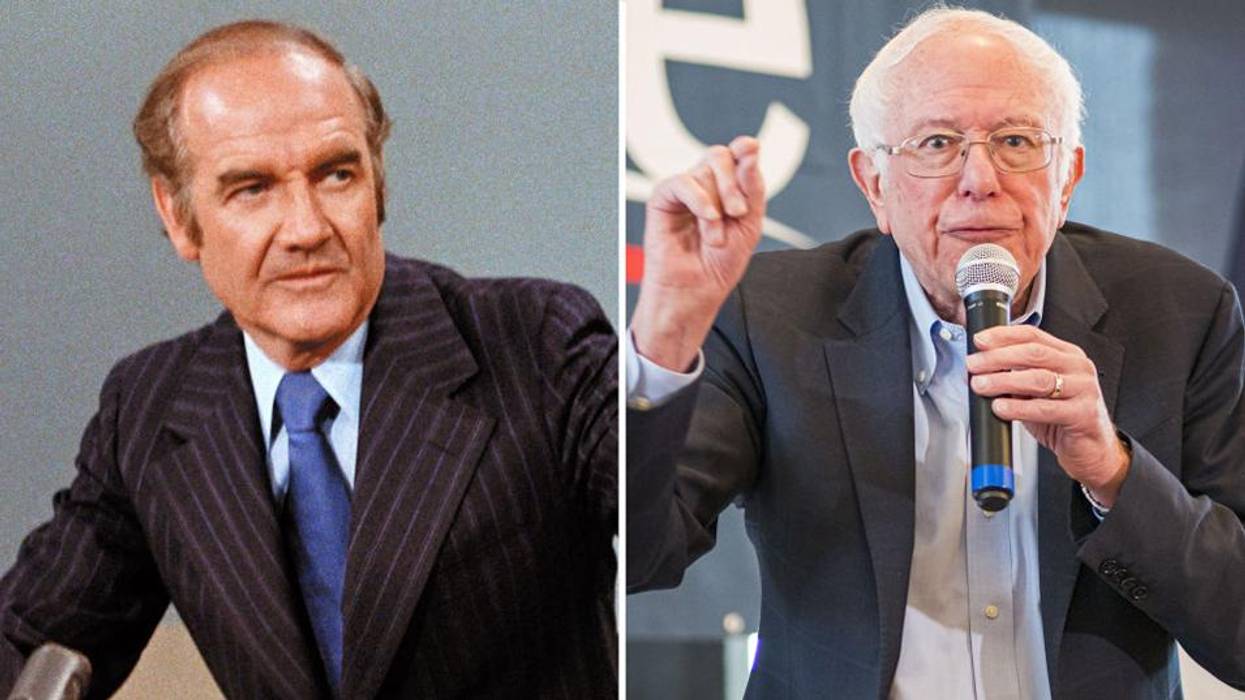
There'll be no fiftieth reunions for the class of '70, it seems. Abruptly thrust out into the world in the uproar following the National Guard's killing of four students at a Kent State University antiwar demonstration, the class now find their return just as abruptly canceled by Covid-19. A scriptwriter could hardly have done the irony any better, but the more interesting set of bookends to the group's half-century in the sun might be their first and last (so far, that is) presidential elections, specifically the campaigns of George McGovern and Bernie Sanders.
There'll be no fiftieth reunions for the class of '70, it seems. Abruptly thrust out into the world in the uproar following the National Guard's killing of four students at a Kent State University antiwar demonstration, the class now find their return just as abruptly canceled by Covid-19. A scriptwriter could hardly have done the irony any better, but the more interesting set of bookends to the group's half-century in the sun might be their first and last (so far, that is) presidential elections, specifically the campaigns of George McGovern and Bernie Sanders. The contrast might have made for interesting talk in some corners of the room at some of those reunions that are not to be.
The immediate response to the May 4, 1970 shootings was massive: perhaps four out of five colleges and an unknown number of high schools saw some type of anti-war protest; as many as a fifth of colleges canceled the remainder of their semesters; and numerous on-campus Reserve Officers Training Corps offices were destroyed in one fashion or another. No subsequent academic year would come to such an unexpected end - until this one. Widespread as they were, however, the 1970 protests did not carry the day, as Richard Nixon remained in the White House unmoved. They did intensify the fervor for evicting him in 1972, though.
The class of '70 would not carry the day in the '72 presidential election either. The anti-Vietnam War movement seems to be rather like what they say about the French Resistance - significantly larger in memory than it actually was at the time. While polls suggested that the newest, youngest voters (including 18-20 year-olds given the vote in a presidential election for the first time) did indeed support the antiwar McGovern, Nixon would actually win the overall under-30 vote by a 52-46% margin, according to the election day exit polls employed for the first time that year. (Still, the McGovern campaign qualified as a youth movement in that his over-sixty vote share was 16% lower than his under-thirty vote, an age gap not surpassed until Barack Obama in 2008.)
History's judgment appears to have been kinder. If the class of 70 didn't carry the day, it did carry the era: Twenty years later, a Gallup poll showed 74% of Americans considering the Vietnam War a mistake, and there's been little subsequent indication of a reversal of that sentiment. As for Nixon-McGovern, by August 1973, an NBC post-Watergate Hearing poll showed McGovern winning a hypothetical re-run, and here again, continued revelations seem to have pretty well cast the verdict in concrete.
Since McGovern fared so poorly in the election, when his campaign is recalled at all it is pretty much remembered as an antiwar candidacy and little more. Actually, there was a lot more. The 1972 party platform supported "universal National Health Insurance," deplored "the increasing concentration of economic power in fewer and fewer hands," and concluded that a "Democratic Administration should pledge itself to combat factors which tend to concentrate wealth." In short, it sounded a lot like the Bernie Sanders campaign, even going it one better in stating that "Full employment--a guaranteed job for all--is the primary economic objective of the Democratic Party." (Full employment and national health insurance actually survived in the next two platforms, until Ronald Reagan's election convinced the Party that it needed to tack right in 1984.)
Today, Sanders has also failed to carry the day electorally, not even advancing to the nomination. Yet he is already widely acknowledged to have permanently altered the era's politics in his 2016 campaign, to the point where four years later he faced multiple candidates backing positions he had introduced to the political mainstream. The country's growing gap in wealth and power he brought to the fore was now widely understood as a problem to be confronted, rather than a fact to be celebrated. Even on health care, where the other candidates almost all did not agree with him, all had to define their position in relation to the Medicare for All proposal that he brought to the presidential debate table. All of this shift accomplished on the strength of a support base skewed toward youth to a degree far surpassing McGovern's (or Obama's): On Super Tuesday, he took 58 percent of under-thirty vote and only15 percent of the over-sixty-five.
In other words, the age cohort of voters that includes the class of '70 - high school and college - once the youthful base of George McGovern's support, has grown up to be the group that stymied Bernie Sanders. Might anyone at those not-to-be reunions have mused that if only everyone in their age group still remembered now what they used to know then, Sanders would be the nominee? Would any have asked how so many could forget so much - learned at such great cost - about disastrous foreign invasions launched under false pretenses, that the Democrats would be on the verge of choosing a Senator who had voted for the Iraq invasion as their nominee for the third time?
As the night went on, might someone cite the irony of their peers supporting a presidential candidate who proposed universal national health insurance in 1972, but opposing the one who promoted Medicare for All in 2020? And what did anyone make of the "Old New Left" leaders of the Students for a Democratic Society pulling together a letter urging the left to back Joe Biden, but never having had anything to say about Sanders? Anyone wonder how many of the people involved in the first Earth Day in 1970 voted for the candidate who supported the Green New Deal in 2020? Might someone have eventually gotten to talkin' 'bout their generation and posing the question of just how well it had "kept the faith" - as it might have been said back then?
And by evening's end, would someone raise a toast to the class of 2020 - and all of today's younger voters - along with a wish that they be blessed with better memories than their elders?
Hey, Sanders, hey, Warren, hey, Biden and the rest of you. Listen, I know from party divisiveness. As a very (very!) young man, I worked on the campaign staff of Democratic presidential candidate George McGovern. There now will be a slight pause as you imitate explosions and other sound effects from your favorite disaster movies.
That 1972 campaign to defeat Richard Nixon for reelection began with 15 hopefuls seeking the Democratic nod, including Shirley Chisolm, the first African-American woman to run for the nomination, and Rep. Patsy Mink, the first Asian-American.
There was much dissension within the ranks--some of it, we now know, fostered by dirty tricksters from the Nixon campaign--as well as honest disagreements on issues that roiled the primary season. When the dust had cleared, McGovern was the nominee--in part because reforms he helped engineer took a lot of the electioneering out of the backrooms and gave increased power to grassroots organizing.
But sadly, McGovern's success in '72 ended there. As the general election race against Nixon began, his campaign was wounded by the discovery that vice presidential pick Tom Eagleton had failed to let McGovern know he had received electroshock therapy for depression. He withdrew and was replaced by Sargent Shriver. What's more, many party regulars were resentful of the McGovern reformers; some even refused to endorse or vote for him.
In Connecticut, where I spent the fall campaign, there was a further complication--the last primary for local offices was only a few weeks before the November election and wounds remained raw. My job, with the nebulous title "field liaison," was to mediate and try to get everyone to work together and support the ticket.
We had some success, but nationwide, the results were catastrophic. McGovern won the District of Columbia and Massachusetts, then lost the other 49 states. The nation was divided, the Democrats were divided and Nixon won big. It was a dark and rainy drive back to Washington.
Debate always is essential and dissent healthy and democratic, but in the end, disunity can mean disaster. That's why one of the heartening moments of this week's Martin Luther King Day was seeing Democratic presidential candidates marching together, arm-in-arm, from the Zion Baptist Church to a rally at the statehouse in Columbia, South Carolina.
It was a reminder that despite all the disagreements on the issues, the feuds petty and large, the promise of social justice preached by King is universal among those candidates. It's still only a promise, and the infighting will doubtless continue, but first and foremost, our eyes must be on the prize: defeating Donald Trump and the enablers who have made his reign the national nightmare it has been to so many. For that to happen, to rid ourselves of the man the Sanders campaign described Tuesday as "the most dangerous president in American history," we'll need unity and commitment.
As Trump's US Senate trial on the charges for which he already has been impeached begins, no matter the outcome, no matter how many obstacles Majority Leader Mitch McConnell throws in its way, no matter how late into the hours of the morning he and the president's lawyers force the proceedings, keep in mind that this president erodes our rights and freedoms every single minute of the night and day.
This is true for all of us. As several have noted over the last couple of days, it was Dr. King who wrote, in his Letter from Birmingham Jail, "Whatever affects one directly, affects all indirectly. I can never be what I ought to be until you are what you ought to be. This is the interrelated structure of reality."
Commentator Frida Ghitis neatly summed up Trump's impeachment defense in a tweet: "A president can break the law, withhold foreign aid, pressure a country to smear his rival; ignore Congress and cheat to win re-election. The constitution allows it all and does not permit the people to stop him."
The coverup is calamitous, the damage to the republic wrought by this kangaroo court in the Senate approaching the irreparable. The harrumphing obfuscation from McConnell and the bloviating Trump defense team's hypocrisy and Orwellian illogic eat away at the body politic like flesh-eating bacteria. Thank goodness for the clarity and common sense of House intelligence committee chair Adam Schiff and the rest of his management squad as they nimbly rebut and put the lie to every argument of the defense.
But it's not enough yet, especially in the face of a Senate majority that cherishes its power, money and perqs above justice, that runs in fear of a mean tweet from Trump, the potential forfeiture of incumbency or perhaps worse, the loss of a juicy lobbying job when it's all over.
There's a reason we don't have a monarch in this country; the revolution was fought to overthrow a king who brooked no opposition. Try telling that to Trump or the Republican legislators who fall before him in unseemly obeisance.
Miracles aside, knowing that a Senate acquittal will soon be upon us, there's only one way out. Okay, two ways out--there's always the excellent chance that something so awful will be revealed that we'll impeach him again and maybe next time convict.
No, November 3 will be our best chance and no matter the Democratic candidate, we must band together as one to make it happen--the defeat of a man who, honest to God, reportedly tried to read aloud part of the Constitution and proclaimed, "It's like a foreign language."
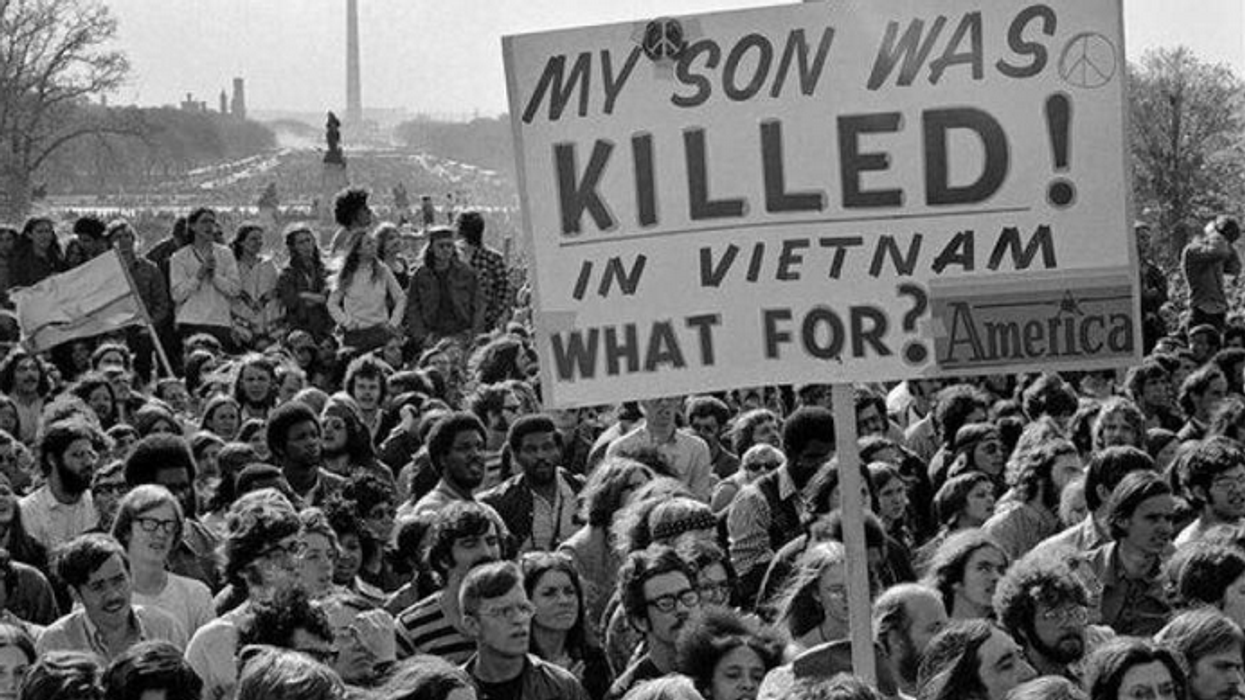
Earlier this month, the USS Abraham Lincoln carrier strike group -- the massive aircraft carrier itself with its dozens of warplanes and thousands of sailors and marines, a guided missile cruiser, and four destroyers -- suddenly began to make its way from the Mediterranean Sea into the Persian Gulf, heading for the waters off Iran. Pentagon sources spoke of ominous but unspecified threats. The U.S. military moved into a showy state of readiness, with reports that a force of up to 120,000 troops might be mobilized and sent to the Middle East for a possible future war with Iran.
In the Trump era, such American saber rattling, especially by hyper-hawkish National Security Advisor John Bolton, feels so unnervingly routine that it might not have even made me sit up. Then I read that the latest Middle East deployment included a task force of -- god save us from memory! -- B-52s, the massive strategic bombers dating from the 1950s that wreaked such havoc in the first great war of my adulthood: Vietnam.
Even as that now-ancient national trauma popped back into my mind, I chastised myself. Not every provocative U.S. naval deployment in sketchy waters off some distant coast is a set-up for a replay of the Gulf of Tonkin, that war-igniting North Vietnamese "attack" on U.S. destroyers that never was. I reminded myself as well that just because Bolton is sounding the alarm doesn't mean his counterparts in Tehran are harmless or that Donald Trump, who years ago warned against a president launching an attack on Iran to win a future election, would be willing to go there. Why, oh why, I kept asking myself, won't that antiwar trick knee of mine stop jerking?
The Ghost Bomber Flies Again, or 12 Drummers Drumming
But B-52s? I just couldn't get them out of my mind. How could those aged monsters with their massive swept-wings, eight pylon-mounted engines, and 70,000-pound payloads of bombs still be flying?
B-52s were brought into service in the 1950s as the emissaries of an orgasmic, potentially civilization-destroying nuclear assault against hundreds of cities in the Soviet Union and communist China. Thank god, it never came to that, but then the B-52 was reconfigured as the ultimate instrument of carpet-bombing in Vietnam, leveling vast numbers of mile-square "target boxes" across that land. Its crowning performance, however, didn't come until near that war's end: the "Christmas bombing" of 1972. From December 13th to December 29th, over the mythic 12 days of Christmas, like so many drummers drumming, wave after wave of those strategic bombers were sent against previously off-limit targets in and around the North Vietnamese cities of Hanoi and Haiphong. It would prove to be the biggest heavy bomber assault since World War II.
Then an antiwar activist and a priest, I was among those who, as soon as we heard about the bombing campaign, assumed our country was engaged in a war crime of the first order -- a modern Guernica, as the French newspaper Le Monde put it. Events would prove us right and, yes, the B-52 has haunted me ever since. That's why the news of its latest provocative deployment against Iran takes me back across the years to a set of as-yet-unreckoned-with mistakes -- ones that are distinctly the property of the Pentagon, but also, given the U.S. wars that followed, the American people. That's why, as recent events began to unfold, I found myself returning to what I still consider my own mistake rooted in the absurdity of that distant moment almost half a century ago, one that I suddenly felt a need to revisit.
The 12 Days of Christmas
The story begins with that Christmas bombing. Here's my best recollection of what happened. Less than two months before it began, just ahead of the presidential election of 1972, Richard Nixon's secretary of state, Henry Kissinger, announced that, when it came to the Vietnam War, "peace is at hand." In that way, he gave his president, if not a partridge in a pear tree, then at least the means to smother Democratic antiwar presidential candidate George McGovern that November. And a Washington-Hanoi peace accord had indeed been agreed to in Paris in October only to break down in December. At that time, the reelected president ordered the most savage bombing campaign of an already savage war, dispatching more than 100 B-52s to drop high explosives on, among so much else, the Bach Mai Hospital in the North Vietnamese capital, Hanoi. Once again, civilians were being killed by American flyers.
At that point in the war, as a member of the Catholic wing of the peace movement, I had been an organizer of numerous antiwar demonstrations and a participant in a handful of civil disobedience "actions," but something in me snapped on first hearing news of that barbarous burst of yuletide violence. I experienced a jolting urge to escalate myself and immediately thought of a good friend in Washington, another Catholic antiwar organizer and priest, as firmly committed to nonviolence as I was but less in the grip of timidity. He, too, was enraged by the Christmas bombing. "Let's do something about it,"he said.
The week before Christmas, I travelled from Boston to Washington to join him in shaping a response. By the time I got there, he had already gathered a few other activists, most of whom I knew. I trusted them. We were all old hands at antiwar protests (with small-potato arrest records to show for it). None of us, however, had engaged in the serious kinds of law breaking that had sent other Catholic pacifist-protesters off for significant prison terms. Yet all of us were appalled by the ongoing Christmas bombing, which, for us, felt like a new kind of draft notice.
Our collective urge seemed clear enough: Stop the war! Shut down the Pentagon! The question was: How? Inspired by a plain-spoken fellowwhose father had been a teamster and who had himself been a trucker, we were soon hunched over maps of the roadways ringing the Pentagon. A patchwork of clover leafs and ramps brought traffic into its two massive parking lots that accommodated almost all of the 20,000 workers who daily filed into the largest office building in the world. Its five sides enclosed five concentric rings, 17 miles of corridors. Because one of its sides fronted on Arlington National Cemetery and another on the Potomac River, automobile traffic generally flowed in from just two main arteries. Most of those thousands of vehicles passed, morning and night, through a single complex interchange, "the mixing bowl." A pair of Y-shaped crossings then funneled vehicles into the parking lots, each with its own choke point.
Shut down the Pentagon? Here perhaps was a way to do it: somehow block the traffic at one or more of those congestion points at the height of the morning rush hour and so stop its workforce, however briefly, from showing up to run the American war machine.
A Plunge into the Absurd, or 10 Lords A-Leaping
I recall feeling like I'd been dropped into another reality as I listened to my co-conspirators improvise strategies for blocking those critical roadways, grand designs that seemed so much less cockamamie once our trucker chum took charge. He had determined that I-95, the highway adjacent to the Pentagon, was under construction. Large trucks were already ubiquitous in the area. His idea: we would join them and who would even notice? In short order, we had a plan. He still possessed his "CDL" -- a commercial driver's license -- which would allow him to rent a set of dump trucks with which we could then deposit something on the highway, shutting things down in the most literal way possible.
It tells you everything about that moment that his plan left us effervescent, even though in any other time it would have seemed imprudent at best and lacking even a modicum of common sense at worst. I then returned to Boston where, within hours, the fantastic unreality, the folly of that plan seemed, to my relief, obvious. No way would it go forward.
As the days passed though and the bombing continued, my Washington-based conspirators began working all too seriously to make it real. Soon, a half-dozen rental dump trucks had indeed been lined up; a demolition contractor, happy to avoid landfill fees, had agreed to load them with concrete debris; and a date had already been set -- the last week of January -- for six teams of us to do practice runs. January 30th was then settled on as D (for "Dump") Day.
The plan: six dump trucks, each manned by a pair of protesters wearing hard hats and safety vests, would simultaneously roar up to pre-arranged sites. At a synchronized stroke of the clock, the "flag man" would leap out to halt oncoming vehicles at a safe distance, while the driver would flip the tailgate release, raise the bed, and offload several tons of concrete chunks and rubble onto the two key choke-points of the mixing bowl -- enough, that is, to block the entrance ramps to those immense Pentagon parking lots. We would then leap back in the trucks and speed away.
After making a beeline back to the rental lot and leaving the trucks, we would rendezvous at the Jefferson Memorial. There, we would await the police. A friendly lawyer had already warned us that we could be charged with anything from a misdemeanor civil infraction -- blockage of a public passageway -- to (gulp) criminal conspiracy to commit sabotage in a time of war. The police would know to come for us because we would have scattered copies of our manifesto around the rubble piles and it would include the time and place of our projected surrender. A call would also be made to the Washington Post, explaining that we were the ones who had created the massive traffic jam then spreading across northern Virginia. The manifesto was to be headlined "Stop the Bombing!" All well and good until, that December 29th, the Christmas bombing stopped. But that didn't stop us: we would simply headline the manifesto, "Stop the war!"
By the time I was briefed on the latest iteration of the plan by phone, 11 others had already agreed to take part. I swallowed hard, took a deep breath, cleared my calendar for the last week of January, and said I was in.
Peace with Honor?
But events outran us. By mid-January, peace talks had resumed in Paris between Kissinger and North Vietnam's Le Duc Tho. On January 23rd, President Nixon went on television to announce that a peace deal had been agreed to. A ceasefire was to take effect at once and U.S. combat operations halted. North Vietnam recognized the legitimacy of the South Vietnamese government in Saigon. That government, in turn, accepted zones of communist control in the south. American prisoners were to be released. The Nixon administration claimed the Christmas bombing -- those days of drummers drumming -- had forced the North Vietnamese back to the negotiating table, a case of ends justifying means if ever there was one.
In fact, however, that ceasefire would not hold. Savage fighting would continue for two more years until the Communists finally overran Saigon in April 1975. Still, the U.S. would no longer be a direct combatant. Vietnamese suffering would, of course, continue. For Americans, however, it would prove to be the ultimate not-with-a-bang-but-a-whimper ending. Still, an ending it was.
I recall that moment not as one of joy but of profound relief that the American war was finally over. But I must admit as well that, for me, there was also a sense of deliverance from the coming action at the Pentagon. Only with this turn in the story could I acknowledge to myself the depth of dread into which the prospect of our quixotic plan of faux-sabotage had plunged me.
After watching Nixon's peace announcement on television, I called my buddy in Washington and he promptly shocked me to the core. He assured me that the president was, as ever, obviously lying. The deal would never hold. The U.S. would soon gin up its war machine again. "Don't be a sucker, Jim," he insisted. And, of course, our dump-demo at the Pentagon was to take place as planned. In fact, the dummy runs with the trucks were about to start. Nonplussed, I pushed back. "Our demand," I insisted, "is to stop the war. How can we go through with this when that's exactly what they've done?"
But he wasn't having it and promptly put his ace on the table. "You signed up, Jim!" he said.
In the end, only three of the original dozen plotters, including that one-time trucker, saw the thing through. The rest of us dropped out and, though concrete rubble was indeed dumped on an access road to the Pentagon, there was but one measly truckload of it left at a potential chokepoint around 7:30 that D-Day morning, a pile far too small to block even that one road. Other drivers simply swung around it, hurling curses at what they took to be an incompetent construction crew. The few manifesto-flyers strewn about were quickly lost in the wind.
When, having returned the truck to the rental lot, the three would-be saboteurs called the Washington Post and showed up at the Jefferson Memorial ready to be arrested (or interviewed), neither police nor reporters appeared. Not even the morning radio traffic report mentioned anything out of the ordinary around the Pentagon. When my friend went back to the scene of the crime that afternoon, as he later told me, all evidence had already been swept away.
To my surprise, I was left feeling guilty and sad -- and so finally acknowledged the obvious to myself, though not to him: the entire project had been ridiculous from the get-go, Mahatma Gandhi meets the Keystone Kops. And doing it after the American war ended would only have emphasized the absurdity of it all (had anyone noticed). That such a mad action was conceived during the penultimate madness of those grim Christmas bombing days laid bare the madness with which, by then, that war had infected us all.
The War That Began With a Lie Ended With a Lie
In reality, the terms Hanoi agreed to that January were identical to those it had accepted in Paris in October (except for certain sticking points on which the Americans, not the North Vietnamese, gave way). As American negotiator John Negroponte later reportedly put it, we bombed them "into accepting our concessions."
If the Christmas bombing had any purpose at all, it was, by means of such a brutal display, to pressure U.S. ally and South Vietnamese leader Nguyen Van Thieu into accepting a peace treaty he had not been party to. In other words, the American war in Vietnam, which had begun with a lie, was now ending with a lie. President Nixon had promised "peace with honor." Now, the Paris agreement was going to deliver a final betrayal of the country's South Vietnamese allies, who would soon enough be crushed.
In the end, however, the Christmas bombing's true purpose wasn't to change the North or even convince Thieu to sanction the deal. It was simply to deliver 12 days of unprecedented violence, a pure spasm of hate and vengeance, a summary act of mass murder directed at an enemy that had refused to be defeated -- simply because it refused to be defeated.
As I recall all of this now, so many decades later, feelings of guilt and sadness swamp me once again, especially as, in the wake of that Christmas-tide spasm of bombing, my friendship with my Washington buddy would never be the same again.
The Last Antiwar Action, a la Doonesbury
If the Christmas bombing was the last direct American military action of the Vietnam War, it is likely that the overlooked single rubble-dump on that road near the Pentagon was the final antiwar protest of that era. And if its memory haunts me, it's undoubtedly because I can finally see that I was wrong not to join that foolish act of fake sabotage. After so many years of mass antiwar actions that were truly meaningful, even those six dump trucks -- those six geese a-laying their concrete debris on those access roads that morning -- would undoubtedly have had little more impact than that one pathetic dump did. Had the Christmas bombings been ongoing, the Pentagon engine of violence, generally on a kind of autopilot in those years, would surely have continued to purr along. The last anti-war action, if noticed at all, would, at best, have been laughed at. If the Washington Post had taken notice, it would have been in Doonesbury.
During these last 18 years of forever war across significant parts of the planet, such detachment has, in fact, been a striking mark of American life, while policies conceived in, and pursued from, the Pentagon have again and again unleashed havoc.
The difference would have been in me. I would have actively refused to accept at face value the Vietnam War's last lie: that those B-52s had brought home a victory of any kind.If I feel differently now, it's because of the nearly 50 years that have passed since that moment, the equivalent of a cumulative song whose lyrics would have been one lie a-laying after another: that, even with the Soviet Union gone, the U.S. still needed a hair-trigger nuclear arsenal; that NATO must expand, encroaching on Russia; that the threat of terror after 9/11 was existential and endless; that Iraq had weapons of mass destruction (or even a program to produce them); that there's no alternative to a new Cold War with China; and most recently, that the Iranians, thanks to their threatening actions, are bringing us to the edge of another incipient conflict.
To engage in a futile act of war protest, as my friend did then, was still to have refused to be fooled. It was to have done something. As he steered a lumbering dump truck into that Pentagon mixing bowl, I and countless others like me, whether out of hope, fear, or mere exhaustion, were busy detaching ourselves from an unfinished business, an unfinished duty: to actively resist the unjust violence being perpetrated or threatened in our names (and not just in Vietnam either).
During these last 18 years of forever war across significant parts of the planet, such detachment has, in fact, been a striking mark of American life, while policies conceived in, and pursued from, the Pentagon have again and again unleashed havoc -- both in an increasingly rubble-strewnGreater Middle East (and North Africa) and in a Europe increasingly overrun by the desperate refugees from our wars. As American military leaders have failedeven to come close to winning those wars (mission accomplished!), our politicians, right to left, have similarly failed to stop them -- have, in fact, often only encouraged them -- even as the wicked futility of such eternal violence has become ever plainer.
Yes, many Americans have come to disapprove of those forever wars, but what have we citizens actually done about them? Have we been waiting all this time for a mode of prudent protest to emerge? Looking for a reasonable way to object, for a realistic method of civic dissent to miraculously appear? Or have we merely been so many swans a-swimming, not caring enough, paying enough attention, to have become half-crazed, as my old friend was so long ago by the ongoing madness of the acts of our government?
Now, those ancient, ghostly B-52s are threatening to fly in yet another possible war in the Middle East, even as the Pentagon's lies keep coming. Yes, that building has five rings, but they're hardly golden (as that Christmas song has it). The U.S. war machine keeps chugging along, spitting lead. What can stop it? I ask this, regretting the day I had a chance, however laughable, to lend a hand in putting an obstacle -- if only a bit of rubble, if only for an hour -- in its way.
My three friends -- those three French hens of that Christmas moment -- acted. I declined to do so when still a young man, because it seemed too absurd to me at time. Here's something far more absurd, so many years later when I've become an old man: America's unending crimes of war have come to feel utterly routine. In our moment, John Bolton's bloody mischief continues to unfold and even a peep of actual public protest is missing in action.
My foolish friend died long ago. Otherwise, I would call my former fellow turtle dove this very moment and assure him that he was right, that I was wrong, and I would fervently apologize.

ancy Pelosi is worried about 2020. As, of course, is every Democrat, but Pelosi has an analysis of the challenge the party faces that is striking in how tentative it sounds, even frightened. Here's what she told The New York Times over the weekend:
Sitting in her office with its panoramic view of the National Mall, Ms. Pelosi--the de facto head of the Democratic Party until a presidential nominee is selected in 2020--offered Democrats her "coldblooded" plan for decisively ridding themselves of Mr. Trump: Do not get dragged into a protracted impeachment bid that will ultimately get crushed in the Republican-controlled Senate, and do not risk alienating the moderate voters who flocked to the party in 2018 by drifting too far to the left.
"Own the center left, own the mainstream," Ms. Pelosi, 79, said.
It wasn't that long ago that Pelosi was supposed to epitomize the left's radicalism, a "San Francisco liberal" who filled every heartland American with rage and disgust. Now she's telling the Democratic Party that the path to victory is by limiting conflict with Donald Trump and offering a sedate policy centrism.
She's not the only one. The current front-runner for the Democratic presidential nomination, Joe Biden, is basing his candidacy on the proposition that he will be able to win over significant numbers of Republican voters, once they see that he's more moderate than other Democrats and realize what a repellent human being Donald Trump is.
The only problem with that theory is that there is no reason to believe it's true. Trump's approval from Republican voters is at a near-perfect 90 percent, according to Gallup, and it isn't like they haven't gotten a good enough look at him to realize who he is. Their elected officials have proven time and time again that there is literally nothing Trump could do that would make them turn their backs on him; the one or two who felt that they might, like former Senator Jeff Flake, did it only when they were on their way to retirement.
But Joe Biden has faith in the GOP. "This is not the Republican Party," he says, testifying to his bond with "my Republican friends in the House and Senate." Once Trump is gone, they'll revert to their old responsible selves and become reasonable again. Just like they were when Biden was vice president and they pursued a strategy of total opposition to everything Barack Obama wanted to do, capping it off by refusing to allow his nomination to a vacant Supreme Court seat to even get a hearing. Those Republicans are the ones who are supposedly going to join with President Biden in a spirit of bipartisan compromise to do what is best for the country.
While Biden has no excuse for his absurdly deluded beliefs about how Republicans would act if he were president, at least his belief about how to win a national election has a logic to it. It says that you have to persuade voters in the middle (and across it) in order to win, showing the largest number of voters that you're ideologically closer to them than your opponent.
It's called the Median Voter Theorem (since the idea is to position yourself closer to the median voter than your opponent), and though it makes a kind of intuitive sense, in practice it usually turns out to be wrong. That's because ideology plays a minor role at most in voters' decisions, and the electorate itself is not static. A great deal depends on which voters are excited enough to get to the polls and which voters are disengaged enough to stay home.
And in an era of partisan polarization, there are few voters in the middle left to persuade. In 2016 Hillary Clinton thought she could win over moderate Republicans who were disgusted with their party's nominee; she failed. In fact, if you look over recent presidential elections you'll see one supposedly moderate candidate after another losing, while the winners are almost always those who excite their own party enough to drive turnout. In order to find a presidential nominee who lost because he was too far out of the ideological mainstream, you'd have to go back almost half a century to George McGovern in 1972. Meanwhile, the list of losers is heavy with candidates who thought they would win if only voters understood how moderate they were.
Nobody understands this better than Republicans, who manage to regularly win elections with a spectacularly unpopular policy agenda of tax cuts for the wealthy, outlawing abortion, taking health coverage from millions of people, and exacerbating climate change. If it was all about who could be more of a centrist, they'd never stand a chance.
Nobody understands this better than Republicans, who manage to regularly win elections with a spectacularly unpopular policy agenda of tax cuts for the wealthy, outlawing abortion, taking health coverage from millions of people, and exacerbating climate change. If it was all about who could be more of a centrist, they'd never stand a chance.
Then they get quoted in news stories explaining that rationale for their decision, and the cycle continues. As one voter told the Times's Lisa Lerer, "I like Joe. We need someone in the first place who's electable in 2020. Look, my own personal beliefs are probably a little to the left of where he is, but independents are going to be crucial in 2020."
When voters put on their pundit hats in this way, they adopt the same fear and distrust of the electorate that characterizes so many elected Democrats--including, it appears, Nancy Pelosi. They think that if Democrats offer liberal policy ideas then the public will reject them, no matter how many polls they see showing that their policy agenda is vastly more popular than what Republicans favor.
They've bought into a conservative myth, one that has existed for some time. As multiple studies by political scientists have shown (see here or here), elected officials tend to believe their own constituents are more conservative than they actually are. Most remarkably, that's true of both Republican and Democratic officeholders (though the Republicans overestimate the public's conservatism by wider margins).
Pelosi likes to point out that many of the Democrats who won in 2018 came from swing districts and stopped short of advocating single-payer health care or a government jobs guarantee, which is true. But it's also true that the Democrats won such big victories because turnout exploded--it topped 50 percent, compared to just 37 percent in the last midterm.
The 2020 election will be as complex as any other, but it isn't going to be determined by which candidate is closer to the ideological midpoint. If Democrats are going to win, they're going to have to nominate someone who gets their own party's voters motivated to organize and get to the polls. That could be any number of candidates, even Joe Biden. But it won't be because they took positions designed to offend as few Republicans as possible.

If anyone else were president, the "liberals" would be celebrating. After all, pulling American soldiers out of a couple of failing, endless wars seems like a "win" for progressives. Heck, if Obama did it there might be a ticker-tape parade down Broadway. And there should be. The intervention in Syria is increasingly aimless, dangerous and lacks an end state. Afghanistan is an unwinnable war - America's longest - and about to end in outright military defeat. Getting out now and salvaging so much national blood and treasure ought to be a progressive dream. There's only one problem: Donald Trump. Specifically, that it was Trump who gave the order to begin the troop withdrawals.
Lost in the haze of their pathological hatred of President Trump, the majority of mainstream liberal pundits and politicians can't, for the life of them, see the good sense in extracting the troops from a couple Mideast quagmires.
Lost in the haze of their pathological hatred of President Trump, the majority of mainstream liberal pundits and politicians can't, for the life of them, see the good sense in extracting the troops from a couple Mideast quagmires. That or they can see the positives, but, in their obsessive compulsion to smear the president, choose politics over country. It's probably a bit of both. That's how tribally partisan American political discourse has become. And, how reflexively hawkish and interventionist today's mainstream Democrats now are. Whither the left-wing antiwar movement? Well, except for a few diehards out there, the movement seems to have been buried long ago with George McGovern.
Make no mistake, the Democrats have been tacking to the right on foreign policy and burgeoning their tough-guy-interventionist credentials for decades now. Terrified of being painted as soft or dovish on martial matters, just about all the "serious" baby-boomer Dems proudly co-opted the militarist line and gladly accepted campaign cash from the corporate arms dealers. Think about it, any Democrat with serious future presidential aspirations back in 2002 voted for the Iraq War - Hillary, Joe Biden, even former peace activist John Kerry! And, in spite of the party base now moving to the left, all these big name hawks - along with current Senate Minority Leader Chuck Schumer - are still Democratic stalwarts. Heck, some polls list Biden as the party's 2020 presidential frontrunner.
Enter Donald Trump. Ever since the man won the 2016 election, Maddow's nightly show has been dominated the hopeless dream of Russia-collusion and a desire for Trump's subsequent impeachment. Admittedly, Maddow's anti-Trump rhetoric isn't completely unfounded - this author, after all, has spent the better part of two years criticizing most of his policies - but her zealousness has clouded her judgment, or worse. Indeed, that Maddow, and her fellow "liberals" at MSNBC have now criticized the troop withdrawals and even paraded a slew of disgraced neoconservatives - like Bill Kristol - on their shows seems final proof of their descent into opportunistic hawkishness.
One of the most disturbing aspects of this new "liberal" hawkishness is the pundits' regular canonization of Jim Mattis and the other supposed "adults" in the room. For mainstream, Trump-loathing, liberals the only saving grace for this administration was its inclusion of a few trusted, "grown-up" generals in the cabinet. Yet it is a dangerous day, indeed, when the supposedly progressive journalists deify only the military men in the room. Besides, Mattis was no friend to the liberals. Their beloved President Obama previously canned "mad-dog" for his excessive bellicosity towards Iran. Furthermore, Mattis - so praised for both his judgment and ethics - chose an interesting issue for which to finally fall-on-his-sword and resign. U.S. support for the Saudi-led starvation of 85,000 kids in Yemen: Mattis could deal with that. But a modest disengagement from even one endless war in the Middle East: well, the former SECDEF just couldn't countenance that. Thus, he seems a strange figure for a "progressive" network to deify.
Personally, I'd like to debate a few of the new "Cold Warriors" over at MSNBC or CNN and ask a simple series of questions: what on the ground changed in Syria or Afghanistan that has suddenly convinced you the US must stay put? And, what positivist steps should the military take in those locales, in order to achieve what purpose exactly? Oh, by the way, I'd ask my debate opponents to attempt their answers without uttering the word Trump. The safe money says they couldn't do it - not by a long shot. Because, you see, these pundits live and die by their hatred of all things Trump and the more times they utter his name the higher go the ratings and the faster the cash piles up. It's a business model not any sort of display of honest journalism.
Foreign policy won't, by itself, tip a national election. But make no mistake, if the clowns at MSNBC and "liberal" hacks on Capitol Hill keep touting their newfound militarism, they're likely to emerge from 2020 with not only smeared consciences, but four more years in the opposition.
There's a tragic irony here. By the looks of things, so long as Mr. Trump is president, it seems that any real movement for less interventionism in the Greater Middle East may come from a part of the political right - libertarians like Rand Paul along with the president's die hard base, which is willing to follow him on any policy pronouncement. Paradoxically, these folks may find some common cause with the far left likes of Bernie Sanders and the Ocasio-Cortez crowd, but it seems unlikely that the mainstream left is prepared to lead a new antiwar charge. What with Schumer/Pelosi still in charge, you can forget about it. Given the once powerful left-led Vietnam-era protest movement, today's Dems seem deficient indeed on foreign policy substance. Odds are they'll cede this territory, once again, to the GOP.
By taking a stronger interventionist, even militarist, stand than Trump on Syria and Afghanistan, the Democrats are wading into dangerous waters. Maybe, as some say, this president shoots from the hip and has no core policy process or beliefs. Perhaps. Then again, Trump did crush fifteen Republican mainstays in 2015 and shock Hillary - and the world - in 2016. Indeed, he may know just what he's doing. While the Beltway, congressional-military-industrial complex continues to support ever more fighting and dying around the world, for the most part the American people do not. Trump, in fact, ran on a generally anti-interventionist platform, calling the Iraq War "dumb" and not to be repeated. The president's sometimes earthy - if coarse - commonsense resonated with a lot of voters, and Hillary's hawkish establishment record (including her vote for that very same Iraq War) didn't win her many new supporters.
Liberals have long believed, at least since McGovern's 1972 trouncing by Richard Nixon, that they could out-hawk the Republican hawks and win over some conservatives. It rarely worked. In fact, Dems have been playing right into bellicose Republican hands for decades. And, if they run a baby-boomer-era hawk in 2020 - say Joe Biden - they'll be headed for another shocking defeat. The combination of a (mostly, so far) strong economy and practical policy of returning US troops from unpopular wars, could, once again, out weigh this president's other liabilities.
Foreign policy won't, by itself, tip a national election. But make no mistake, if the clowns at MSNBC and "liberal" hacks on Capitol Hill keep touting their newfound militarism, they're likely to emerge from 2020 with not only smeared consciences, but four more years in the opposition.

Donald Trump and his base -- the leftover scraps of Jim Crow, the broken shards of racist hatred that once were the American mainstream and made the country seem "great" to those who weren't its victims -- have, it appears, a crucial role to play in our future.
President Trump is the increasingly naked truth. He's what we have wound up with: a raw, uncensored scapegoating and fear-mongering that's too much for most of the American public. And thus the political center, the military-industrial-media consensus that has ruled the country for the past four and a half decades, pushing progressive values to the margins of American politics, is unraveling. Centrist compromise, which birthed the Trump presidency, can't mask the truth anymore.
It's time to evolve.
If we don't, we're stuck in the mire of racism, exploitation, empire and war. We're stuck in the dead past, which has given us the current state of Planet Earth: a planet at war with itself in multiple ways. We're stuck in a dead past and a dying future.
This is the context, I believe, in which we should evaluate the Green New Deal, which may well be the most brightly shining political ideal to emerge on the national horizon in my Boomer lifetime. Here's how one of the Deal's arch enemies, Justin Haskins of the Heartland Institute, described it recently in the Washington Examiner:
"Make no mistake about it: This is one of the most dangerous and extreme proposals offered in modern U.S. history. It's the sort of thing you'd see in the Soviet Union, not the United States. If we don't stop the Green New Deal, our economy may not survive. This isn't a battle we can afford to lose."
The Deal should take on militarism and war as well as climate change and poverty; they are all linked.
So it must be good! If nothing else, it's a piece of potential legislation with real traction that transcends Democratic centrism and timidity -- its instinct to cave to well-funded right-wing criticism and avoid upsetting the military-industrial applecart -- that became de rigueur party behavior since the defeat of George McGovern in 1972.
But the GND needs to go further than it does. Since it's already being pilloried as the most radical piece of legislation in modern history, it might as well open itself up to become just that: the cornerstone of a truly sustainable national and global future. The Deal should take on militarism and war as well as climate change and poverty; they are all linked. Our near-trillion-dollar military budget, and the endless and needless wars it funds -- not to mention the ongoing development of our nuclear arsenal -- can't be quietly, politely ignored as we envision a sane tomorrow.
Right now, the draft legislation for the Green New Deal calls for ten years of intense national focus on such objectives as: establishing 100 percent of national power generation from renewable sources; decarbonizing U.S. industry, agriculture and transportation; the drawdown and capture of greenhouse gases; the building of an energy-efficient national grid; and, along with this, the recognition "that a national, industrial, economic mobilization of this scope and scale is a historic opportunity to virtually eliminate poverty in the United States and to make prosperity, wealth and economic security available to everyone,"
It's a rallying cry and vision that virtually transcends political thinking as we know it, reflecting a near-complete dismissal of status quo politics and its obeisance to Big Money.
This is no small plan! It's a rallying cry and vision that virtually transcends political thinking as we know it, reflecting a near-complete dismissal of status quo politics and its obeisance to Big Money. It refuses to comprise with the forces of either Trump or the Koch brothers. It challenges America to be a democracy.
Let it also challenge the military-industrial complex. The organization Code Pink has taken the lead in calling for it to do so, suggesting, for instance, that the list of goals on the draft legislation should include this one: "a major transition away from the environmental destruction of war and war-preparations, including the closure of most of the U.S. military bases abroad and within the United States and the thorough cleanup of the land and water in those locations."
Code Pink also suggests, regarding funding for the project, that "much of the 60 percent of discretionary spending now going into the environmentally destructive project of militarism can be moved to environmental protection."
The point, as I see it, is to create a holistic vision for the future. We can't just shrug that war is politically untouchable. Doing so -- avoiding all serious discussion of militarism, both its costs and its consequences -- leaves the global noose dangling.
The military-industrial PR machine spews noise about glory, honor and national defense, but mostly what keeps the system running in perpetuity is a complete lack of discussion about alternatives to violent self-defense. The need for a strong military presence -- my God, the need for a new generation of nuclear weapons -- is taken for granted by the mainstream media and much of the public, and must be challenged at the national level. The time to do so is now.
A number of years ago I wrote: "From the radioactive fallout spread by depleted uranium munitions to the destruction of the 'compression-fragile' desert floor, we are pursuing a geopolitical strategy with single-minded, and ultimately suicidal, indifference to the consequences of our actions. And nothing can stop us except our own awakened consciences."
The Green New Deal resonates with awareness and awakened conscience, with transcendent vision and, hallelujah, youthful determination. It represents a yanking of the future away from the moneyed interests that think they own it. Let the future it begins to build be one of peace: with the planet and with ourselves.

How much real change manifested itself in the 2018 midterms? How deeply does the outcome reflect the American soul?
Apparently, about 113 million Americans, basically half the electorate, felt compelled to vote in the midterms, revved up either by intense opposition to or support for Donald Trump. This is a lot more than usual for a non-presidential election, but still fairly pathetic for "the world's greatest democracy."
How much closer did we move to becoming a nation able and willing to focus on the real issues that threaten the planet?
To the extent that the election was about Trump and Trumpism:
". . . keep in mind," Tom Engelhardt reminds us, "that he entered an unsettled world already well prepared for such a presidency by his predecessors in Washington. If the fascist . . . tendency that lurks in him and in the situation that surrounds him does come out more fully, he will obviously be aided by the ever more imperial presidency that was created in the decades before he left Trump Tower for the White House.
"When he entered the Oval Office, he found there a presidency in which -- particularly on the subject of war (the president was, for instance, already America's global assassin-in-chief) -- his powers increasingly stood outside both Congress and the Constitution. The weapons he's now bringing to bear, including executive orders and the U.S. military, were already well prepared for him."
This country has been spiraling in the wrong direction for a long time. Some progressives determined to change the game were among those who gained office in this election, which is something worth celebrating -- but hardly reason to heave a sigh of relief. Most of the issues that truly matter, that require a fundamental shift in American politics, remain rawly unaddressed and unacknowledged. They were essentially invisible in the mainstream election coverage, which, as usual, presented it as a horse race for the entertainment of Spectator America, not the creation of the future.
These issues include:
A. Militarism, endless war, unconscionable military spending, nuclear weapons. This was utterly off the table in the midterms. As Chris Hedges pointed out, some 85 percent of Senate Dems voted for this year's $716 billion military spending bill, indicating a "unity" of surrender to military-industrialism. We no longer glorify our wars, we ignore them. And even progressive candidates seldom declare an intent to challenge the culture of war. Is there any political traction whatsoever for the antiwar movement? I fear there hasn't been for four and a half decades -- since the defeat of George McGovern.
B. Climate change, environmental catastrophe. This is not unrelated to the issue of war, since the world's militaries are by far the biggest polluters. While environmental sanity is at least something that can be addressed politically, the urgency of global warming hardly has political traction. And, as a headline on Vox summed things up regarding the midterms: "Fossil fuel money crushed clean energy ballot initiatives across the country."
C. Poverty, inequality. "In the wealthiest country in the history of the world," writes Maria Svart, national director of Democratic Socialists of America, "many of us live in quiet desperation. Farmers are committing suicide, and so are taxi drivers in New York City. That's why in the battle for the soul of our country, we must win." Capitalism is still sacrosanct and Donald Trump, the alleged working class populist, cuts the taxes of the rich and is, as Hedges notes, an "embarrassing tool of the kleptocrats." But socialism is no longer a taboo word in American politics and self-declared socialists are getting elected. Medicare for all and publicly funded college tuition are gaining political traction. The 99 percent have a voice. But of course the rich still have almost all the power; for the most part, this means that their self-interest rules.
D. Guns, violence, mass murder, a culture of violence. This issue still carves a deep gouge across the American electorate. Mass murders keep occurring. Should we get serious about gun control or should teachers and rabbis be armed? There is no real dialogue across the divide. We still live in a culture that worships violence. Just as we will not, as a nation, consider demilitarizing, neither will we disarm. And war keeps coming home.
E. Militarized police, police shootings and racism. The antidote emerges in concepts such as community policing and restorative justice -- security that involves connecting with and understanding others, even those we dislike and distrust. This transformation is taking place across the whole planet, quietly, and for the most part beyond the world of politics. From my point of view, it's one of the biggest sources of hope -- it's the cultural path beyond the worship and glorification of violence.
F. The prison-industrial complex. The United States has the largest prison system in the world (and it's becoming increasingly privatized), with 2.3 million people -- mostly impoverished people of color -- behind bars. Our prison system is a regrouping of Jim Crow America, which can't stand having a country without second-class and tenth-class citizens. But here's some good news from this year's midterms: "Florida restored voting rights to more than 1 million people with felony records, which amounts to the biggest enfranchisement since the Voting Rights Act of 1965 and the women's suffrage movement," Vox reports.
G. Immigrant scapegoating, hatred and fear. Because our unwinnable, endless wars can no longer serve the function of unifying the country, Trump has turned to immigrants -- in particular, that "invading caravan" of desperate, shoeless Central Americans -- as the Other he needs to rev his base and get the vote out. However, the Trump administration's treatment of immigrants, including the cruel separation of parents and children, has shocked and enraged much of the country, putting the country's long-standing policy of cruel indifference to global suffering (and of course one of its leading creators as well) into the national spotlight like never before.
H. Voter suppression, gerrymandering, hacking. Ah, democracy, a nuisance to the powerful, a system to be gamed! If the voting can't be controlled, my God, Republicans could lose. Witness Georgia and North Dakota, where bureaucratic twists deprived African-American and Native American citizens of their right to vote in large enough numbers to skewer election results. Stacey Abrams may yet prevail in her quest for the governorship of Georgia over Secretary of State and Purger in Chief Brian Kemp. But American democracy is not safe from itself, no matter how much the media insists on blaming all its flaws on the Russians.

Part of my awkward youth was spent in service of the New York State Democratic Party, an act of true hubris if you grew up, as I did, in rural upstate, where it was easier being a Menshevik than a Democrat.
So solidly Republican was my small hometown back then that when the local Democratic chairman showed up and asked my father, who owned a drugstore, to run as the party's candidate for mayor, Dad gently rushed him out the back door for fear of losing business if anyone heard.
To call yourself a Democrat was risky, although we did have a Democratic congressman, the rather conservative, pro-Vietnam Sam Stratton, and a local industrialist who ran unsuccessfully for the Democratic gubernatorial nomination four times. But for the most part, in those days, being a Democrat implied a certain frisky turn of mind that was inimical to the more hidebound of bucolic upstaters, and even worse, meant someone who might tend to favor that downstate Gomorrah known as New York City, where all manner of depravity resided, especially spending taxpayer money on stuff.
As a teenager, I did volunteer work for the Democrats, canvassing, making phone calls, taking boxes of candy to the poll workers on Election Day. Because of this and apparently for lack of other, suitable upstate candidates, one day I received a telegram (they were rare to get even then, especially for a 17-year-old) informing me that I had been appointed to an official Democratic State Party Commission on Youth Participation in Government and Politics (honest, that was its name).
It turned out I was the token youth on the youth commission; I lowered the median age of the other members to about 55. The person closest to my age was our intern. We spent the summer before my freshman year of college being very important, holding hearings around the state and ultimately issuing a report filled with sterling recommendations for reform that as far as I know has steadfastly been ignored ever since.
The commission experience marked my first time in a hotel alone, my first Chinese restaurant, my first strip club, and worst, my first real exposure to a statewide political machine. Even as a kid, I could see it was a broken, corrupt system. Many years later, I went to a holiday reception thrown by the state party and was troubled to see that a lot of the same hacks I had met while working for that commission still were in place.
I worked on several campaigns after the commission, including the quixotic presidential bid of George McGovern, and finally concluded that the life of a political professional that I once had fancied probably was not the way forward for me. Better to stay interested by writing and commenting on the scene as an informed observer, a bit above the fray. And so I did.
Now I'm not so sure. After all these years, Thursday's Democratic primaries here in New York have got me rethinking getting involved in a more direct, hands-on way.
True, the old NY Democratic machine clanked into gear once again and fueled by a reported $25 million, Governor Andrew Cuomo won the nomination for a third term. His campaign flooded the zone with mailers, TV ads and robocalls, defeating challenger Cynthia Nixon (although her candidacy definitely pushed him leftward) and providing coattails for his chosen candidate for lieutenant governor, incumbent Kathy Hochul, and attorney general candidate Letitia James, currently New York City's public advocate.
James beat anti-corruption reformer and law professor Zephyr Teachout, a progressive favorite, a well as Congressman Sean Patrick Maloney and Leecia Eve, a Verizon lobbyist who has worked for Cuomo and Hillary Clinton. If elected, Tish James will be the first African-American woman to hold statewide office here.
But what's especially heartening and exciting about the September 13 results is not the almighty Cuomo Democratic machine, a fusty yet still powerful and crooked contraption of smoke and mirrors, corporate and union cash, smear tactics and spare parts. It's the explosive achievement of No IDC NY, a grassroots campaign that successfully managed to overthrow six of eight Democratic state senators who had aligned themselves with the Republican Party, effectively preventing the progressive agenda New York State really needs.
IDC--the so-called Independent Democratic Conference--empowered Senate Republicans, greasing the wheels for the governor's secret deal-making with the GOP and effectively blocking progressive legislation passed by the legislature's lower house, the Assembly, including single-payer health care, protection of women's reproductive health, election law reform and increased support of renewable energy.
Created in 2011, earlier this year, the IDC claimed to have dissolved itself at Cuomo's urging, returning to the Democratic fold, but that wasn't enough for a dedicated group of young activists, many of whom had never before worked in politics. They came together and vowed to defeat the turncoat Dems. With little money, No IDC NY used the power of volunteers and the fierceness of their commitment to back an alternative slate of progressive Democratic primary challengers. They were successful beyond hope.
Knocking on doors, telephoning, mailing handmade postcards, even covering sidewalks with chalk messaging, they got out the word. Elections, especially primaries, are all about turnout, identifying the voters who back your candidates and getting them to the polls. Large infusions of cash from real estate and financial interests made the IDC incumbents complacent; the insurgents beat them using all the tools of electoral, asymmetric warfare. This was old-fashioned retail campaigning, neighborhood by neighborhood, augmented by a savvy use of email and social media.
As Politico New York's Bill Mahoney reported, "The IDC defeats were unprecedented in a state in which incumbents almost never lose. From 2006 through 2016, there had never been a year in which more than three members of the 213-person Legislature were defeated in a primary... Sen. Jeff Klein, who led the conference since its creation in 2011, became the first former legislative leader not under indictment or federal investigation to lose in four decades."
(Klein, who spent more to hold onto his Senate job than Cynthia Nixon spent on her entire gubernatorial bid, was knocked down by Alessandra Biaggi, a young lawyer and former aide to Cuomo. Also losing: Sen. Jesse Hamilton in Brooklyn, beaten by lawyer and community activist Zellnor Myrie; Sen. Tony Avella and Sen. Jose Peralta in Queens, defeated by former City Comptroller John Liu and Jessica Ramos, a former Latino media advisor toBill de Blasio; Sen. Marisol Alcantara, taken down by former NYC councilman Robert Jackson; and Sen. David Valesky, who lost to Syracuse University's Rachel May. And while not an official member of the conference, IDC-friendly Brooklyn Sen. Martin Dilan, heavily funded by real estate interests, was beaten by newcomer Julia Salazar, who in the final weeks was tailed by controversy surrounding her biography but won by a healthy margin.)
"If you are a progressive, these are the results that matter," Charlie Pierce wrote in Esquire. "Turnout was robust all over the state; Nixon got more votes on Thursday than Cuomo did the last time he ran. Cuomo got shoved to the left on a number of issues and now he doesn't have the votes in Albany to walk those new positions back. If you want Andrew Cuomo defanged, and what sensible person doesn't, then this is the next best thing than beating him outright. To get anything done, he now has to deal with people he otherwise would have ignored."
There's still the general election in November and Democrats need to flip some Republican-held seats to truly take control of the State Senate. What's more, all of the IDC Dems remain on the ballot as third party candidates. But should you choose, New Yorkers will continue to be able to cast a vote against Andrew Cuomo - former Democratic mayor of Syracuse Stephanie Miner is running as an independent, and depending on discussions over the coming weeks, Cynthia Nixon may remain on the ballot as the candidate of the Working Families Party.
Thursday was a momentous day for New York State Democratic politics. Change is happening after years of incumbent-driven inertia. Fueled in part by reaction to Trump's election and its horrific impact on civil society, a multitude of voters are angry, energized as they haven't been for years and committed to throwing the rascals out at every level; federal, state and local.
This may be a tectonic shift, that fundamental change in the political landscape that Nixon talked about in her concession speech. It is, she said, "what happens when we hold our leaders accountable... We have changed what is expected of a Democratic candidate running in New York."
With luck and hard work, it could be just the beginning, especially if more of us get involved, not only as volunteers but even as candidates. As primary winner Rachel May told a Syracuse newspaper Thursday night, "We need to encourage people to run. I'm not doing this to be a career politician. I'm doing it so someone great can challenge me in a few years."

Donald Trump's tenure as the 45th U.S. president may last another few weeks, another year, or another 16 months. However unsettling the prospect, the leaky vessel that is the S.S. Trump might even manage to stay afloat for a second term. Nonetheless, recent headline-making revelations suggest that, like some derelict ship that's gone aground, the Trump presidency may already have effectively run its course. What, then, does this bizarre episode in American history signify?
Let me state my own view bluntly: forget the atmospherics. Despite the lies, insults, name calling, and dog whistles, almost nothing of substance has changed. Nor will it.
To a far greater extent than Trump's perpetually hyperventilating critics are willing to acknowledge, the United States remains on a trajectory that does not differ appreciably from what it was prior to POTUS #45 taking office. Post-Trump America, just now beginning to come into view, is shaping up to look remarkably like pre-Trump America.
I understand that His Weirdness remains in the White House. Yet for all practical purposes, Trump has ceased to govern. True, he continues to rant and issue bizarre directives, which his subordinates implement, amend, or simply disregard as they see fit.
Except in a ceremonial sense, the office of the presidency presently lies vacant. Call it an abdication-in-place. It's as if British King Edward VIII, having abandoned his throne for "the woman I love," continued to hang around Buckingham Palace fuming about the lack of respect given Wallis and releasing occasional bulletins affirming his admiration for Adolf Hitler.
In Trump's case, it's unlikely he ever had a more serious interest in governing than Edward had in performing duties more arduous than those he was eventually assigned as Duke of Windsor. Nonetheless, the 60-plus million Americans who voted for Trump did so with at least the expectation that he was going to shake things up.
And bigly. Remember, he was going to "lock her up." He would "drain the swamp" and "build a wall" with Mexico volunteering to foot the bill. Without further ado, he would end "this American carnage." Meanwhile, "America First" would form the basis for U.S. foreign policy. Once Trump took charge, things were going to be different, as he and he alone would "make America great again."
Yet the cataclysm that Trump's ascendency was said to signify has yet to occur. Barring a nuclear war, it won't.
If you spend your days watching CNN or MSNBC or reading columnists employed by the New York Times and the Washington Post, you might conclude otherwise. But those are among the institutions that, on November 8, 2016, suffered a nervous breakdown from which they have yet to recover. Nor, it now seems clear, do they wish to recover as long as Donald Trump remains president. To live in a perpetual state of high dudgeon, denouncing his latest inanity and predicting the onset of fascism, is to enjoy the equivalent of a protracted psychic orgasm, one induced by mutual masturbation.
Yet if you look beyond the present to the fairly recent past, it becomes apparent that change on the scale that Trump was promising had actually occurred, even if well before he himself showed up on the scene. The consequences of that Big Change are going to persist long after he is gone. It's those consequences that now demand our attention, not the ongoing Gong Show jointly orchestrated by the White House and journalists fancying themselves valiant defenders of Truth.
Trump himself is no more than a pimple on the face of this nation's history. It's time to step back from the mirror and examine the face in full. Pretty it's not.
The Way We Were
Compare the America that welcomed young Donald Trump into the world in 1946 with the country that, some 70 years later, elected him president. As the post-World War II era was beginning, three large facts--so immense that they were simply taken for granted--defined America.
First, the United States made everything and made more of it than anyone else. In postwar America, wealth derived in large measure from the manufacture of stuff: steel, automobiles, refrigerators, shoes, socks, blouses, baseballs, you name it. "Made in the USA" was more than just a slogan. With so much of the industrialized world in ruins, the American economy dominated and defined everyday economic reality globally.
Postwar America was the emblematic middle-class country, the closest approximation to a genuinely classless and democratic society the world had ever seen.
Second, back then while the mighty engine of industrial capitalism was generating impressive riches, it was also distributing the benefits on a relatively equitable basis. Postwar America was the emblematic middle-class country, the closest approximation to a genuinely classless and democratic society the world had ever seen.
Third, having had their fill of fighting from 1941 to 1945, Americans had a genuine aversion to war. They may not have been a peace-loving people, but they knew enough about war to see it as a great evil. Avoiding its further occurrence, if at all possible, was a priority, although one not fully shared by the new national security establishment just then beginning to flex its muscles in Washington.
Now, by twenty-first-century standards, many, perhaps nearly all, Americans of that era were bigots of one sort or the other. Racism, sexism, and homophobia flourished, lamented by some, promoted by others, tolerated by the vast majority. An anti-communist political hysteria, abetted by cynical politicians, also flourished. Americans worked themselves into a tizzy over the putative threat posed by small numbers of homegrown subversives. And they fouled the air, water, and soil with abandon. Add to this list violence, crime, corruption, sexual angst, and various forms of self-abuse. Taken as a whole, American society, as it existed when Trump was growing up, was anything but perfect. Yet, for all that, postwar Americans were the envy of the world. And they knew it.
Attitudes toward people of color, women, and gays that a half-century earlier had been commonplace were now largely confined to a pathological fringe. Hysteria about communists had essentially disappeared, only to be replaced by hysteria over Islamic terrorists.
By 2016, when Trump was elected president, America had become an altogether different country. Without actually disappearing, racism, sexism, and homophobia had--at least for the moment--gone underground. Attitudes toward people of color, women, and gays that a half-century earlier had been commonplace were now largely confined to a pathological fringe. Hysteria about communists had essentially disappeared, only to be replaced by hysteria over Islamic terrorists. Pollution, of course, persisted, as did violence, crime, corruption, and sexual angst. New and more imaginative forms of self-destructive behavior had made their appearance.
Yet little of that turned out to be central. What had truly changed in the decades since Trump was a babe-in-arms were those three taken-for-granted facts that had once distinguished the United States. New realities emerged to invert them.
By 2016, the U.S. was no longer by any stretch of the imagination the place that made everything, though it bought everything, often made elsewhere. It had long since become the ultimate consumer society, with Americans accustomed to acquiring and enjoying more than they produced or could afford. Accounts no longer balanced. The government lived on credit, assuming that the bills would never come due. So, too, did many citizens.
By 2016, the U.S. had long since become a deeply unequal society of haves and have-nots. Finance capitalism, the successor to industrial capitalism, was creating immense fortunes without even pretending to distribute the benefits equitably. Politicians still routinely paid tribute to the Great American Middle Class. Yet the hallmarks of postwar middle-class life--a steady job, a paycheck adequate to support a family, the prospect of a pension-- were rapidly disappearing. While Americans still enjoyed freedom of a sort, many of them lacked security.
The 99% of Americans who were not soldiers learned to tune out those wars, content merely to "support the troops," an obligation fulfilled by offering periodic expressions of reverence on public occasions. Thank you for your service!
By 2016, Americans had also come to accept war as normal. Here was "global leadership" made manifest. So U.S. troops were now always out there somewhere fighting, however obscure the purpose of their exertions and however dim their prospects of achieving anything approximating victory. The 99% of Americans who were not soldiers learned to tune out those wars, content merely to "support the troops," an obligation fulfilled by offering periodic expressions of reverence on public occasions. Thank you for your service!
The Way We Are
But note: Donald Trump played no role in creating this America or consigning the America of 1946 to oblivion. As a modern equivalent of P.T. Barnum, he did demonstrate considerable skill in exploiting the opportunities on offer as the strictures of postwar America gave way. Indeed, he parlayed those opportunities into fortune, celebrity, lots of golf, plenty of sex, and eventually the highest office in the land. Only in America, as we used to say.
In 1946, it goes without saying, he would never have been taken seriously as a would-be presidential candidate. By 2016, his narcissism, bombast, vulgarity, and talent for self-promotion nicely expressed the underside of the prevailing zeitgeist. His candidacy was simultaneously preposterous, yet strangely fitting.
By the twenty-first century, the values that Trump embodies had become as thoroughly and authentically American as any of those specified in the oracular pronouncements of Thomas Jefferson, Abraham Lincoln, or Franklin Roosevelt. Trump's critics may see him as an abomination. But he is also one of us.
And here's the real news: the essential traits that define America today--those things that make this country so different from what it seemed to be in 1946--will surely survive the Trump presidency. If anything, he and his cronies deserve at least some credit for sustaining just those traits.
Candidate Trump essentially promised Americans a version of 1946 redux. He would revive manufacturing and create millions of well-paying jobs for working stiffs. By cutting taxes, he would put more money in the average Joe or Jill's pocket. He would eliminate the trade deficit and balance the federal budget. He would end our endless wars and bring the troops home where they belong. He would oblige America's allies, portrayed as a crew of freeloaders, to shoulder their share of the burden. He would end illegal immigration. He would make the United States once more the God-fearing Christian country it was meant to be.
How seriously Trump expected any of those promises to be taken is anyone's guess. But this much is for sure: they remain almost entirely unfulfilled.
True, domestic manufacturing has experienced a slight uptick, but globalization remains an implacable reality. Unless you've got a STEM degree, good jobs are still hard to come by. Ours is increasingly a "gig" economy, which might be cool enough when you're 25, but less so when you're in your sixties and wondering if you'll ever be able to retire.
While Trump and a Republican Congress delivered on their promise of tax "reform," its chief beneficiaries will be the rich, further confirmation, if it were needed, that the American economy is indeed rigged in favor of a growing class of plutocrats.
While Trump and a Republican Congress delivered on their promise of tax "reform," its chief beneficiaries will be the rich, further confirmation, if it were needed, that the American economy is indeed rigged in favor of a growing class of plutocrats. Trade deficit? It's headed for a 10-year high. Balanced budget? You've got to be joking. The estimated federal deficit next year will exceed a trillion dollars, boosting the national debt past $21 trillion. (Trump had promised to eliminate that debt entirely.)
And, of course, the wars haven't ended. Here is Trump, just last month, doing his best George McGovern imitation: "I'm constantly reviewing Afghanistan and the whole Middle East," he asserted. "We never should have been in the Middle East. It was the single greatest mistake in the history of our country." Yet Trump has perpetuated and, in some instances, expanded America's military misadventures in the Greater Middle East, while essentially insulating himself from personal responsibility for their continuation.
As commander-in-chief, he's a distinctly hands-off kind of guy. Despite being unable to walk, President Franklin Roosevelt visited GIs serving in combat zones more often than Trump has. If you want to know why we are in Afghanistan and how long U.S. forces will stay there, ask Defense Secretary James Mattis or some general, but don't, whatever you do, ask the president.
On Not Turning America's Back on the World
And then there is the matter of Trump's "isolationism." Recall that when he became president, foreign policy experts across Washington warned that the United States would now turn its back on the world and abandon its self-assigned role as keeper of order and defender of democracy. Now, nearing the mid-point of Trump's first (and hopefully last) term, the United States remains formally committed to defending the territorial integrity of each and every NATO member state, numbering 29 in all. Add to that an obligation to defend nations as varied as Japan, South Korea, and, under the terms of the Rio Pact of 1947, most of Latin America. Less formally but no less substantively, the U.S. ensures the security of Israel, Saudi Arabia, and various other Persian Gulf countries.
As for obliging those allies to pony up more for the security we have long claimed to provide, that's clearly not going to happen any time soon. Our European allies have pocketed both Trump's insults and his assurances that the United States will continue to defend them, offering in return the vaguest of promises that, sometime in the future, they might consider investing more in defense.
By-the-by, U.S. forces under Donald Trump's ostensible command are today present in more than 150 countries worldwide. Urged on by the president, Congress has passed a bill that boosts the Pentagon budget to $717 billion, an $82 billion increase over the prior year. Needless to say, no adversary or plausible combination of adversaries comes anywhere close to matching that figure.
To call this isolationism is comparable to calling Trump svelte.
As for the promised barrier, that "big, fat, beautiful wall," to seal the southern border, it has advanced no further than the display of several possible prototypes. No evidence exists to suggest that Mexico will, as Trump insisted, pay for its construction, nor that Congress will appropriate the necessary funds, estimated at somewhere north of $20 billion, even with Republicans still controlling both houses of Congress. And in truth, whether it is built or not, the U.S.-Mexico border will remain what it has been for decades: heavily patrolled but porous, a conduit for desperate people seeking safety and opportunity, but also for criminal elements trafficking in drugs or human beings.
The point of this informal midterm report card is not to argue that Donald Trump has somehow failed. It is rather to highlight his essential irrelevance.
Trump is not the disruptive force that anti-Trumpers accuse him of being. He is merely a noxious, venal, and ineffectual blowhard, who has assembled a team of associates who are themselves, with few exceptions, noxious, venal, or ineffectual. Trump is not the disruptive force that anti-Trumpers accuse him of being. He is merely a noxious, venal, and ineffectual blowhard, who has assembled a team of associates who are themselves, with few exceptions, noxious, venal, or ineffectual.
So here's the upshot of it all: if you were basically okay with where America was headed prior to November 2016, just take a deep breath and think of Donald Trump as the political equivalent of a kidney stone--not fun, but sooner or later, it will pass. And when it does, normalcy will return. Soon enough you'll forget it ever happened.
If, on the other hand, you were not okay with where America was headed in 2016, it's past time to give up the illusion that Donald Trump is going to make things right. Eventually a pimple dries up and disappears, often without leaving a trace. Such is the eventual destiny of Donald Trump as president.
In the meantime, of course, there are any number of things about Trump to raise our ire. Climate change offers a good example. And yet climate change may be the best illustration of Trump's insignificance.
Under President Obama, the United States showed signs of mounting a belated effort to address global warming. The Trump administration wasted little time in reversing course, reverting to the science-denying position to which Republicans adhered long before Trump himself showed up.
No doubt future generations will find fault with Trump's inaction in the face of this crisis. Yet when Miami is underwater and California wildfires rage throughout the year, Trump himself won't be the only--or even the principal--culprit charged with culpable neglect.
The nation's too-little, too-late response to climate change for which a succession of presidents share responsibility illustrates the great and abiding defect of contemporary American politics. When all is said and done, presidents don't shape the country; the country shapes the presidency--or at least it defines the parameters within which presidents operate. Over the course of the last few decades, those parameters have become increasingly at odds with the collective wellbeing of the American people, not to mention of the planet as a whole.
Yet Americans have been obdurate in refusing to acknowledge that fact.
Americans today are deeply divided. There exists no greater symbol of that division than Trump himself--the wild enthusiasm he generates in some quarters and the antipathy verging on hatred he elicits in others.
The urgent need of the day is to close that divide, which is as broad as it is deep, touching on culture, the political economy, America's role in the world, and the definition of the common good. I submit that these matters lie beyond any president's purview, but especially this one's.
Trump is not the problem. Think of him instead as a summons to address the real problem, which in a nation ostensibly of, by, and for the people is the collective responsibility of the people themselves. For Americans to shirk that responsibility further will almost surely pave the way for more Trumps--or someone worse--to come.