SUBSCRIBE TO OUR FREE NEWSLETTER
Daily news & progressive opinion—funded by the people, not the corporations—delivered straight to your inbox.
5
#000000
#FFFFFF
To donate by check, phone, or other method, see our More Ways to Give page.
Daily news & progressive opinion—funded by the people, not the corporations—delivered straight to your inbox.
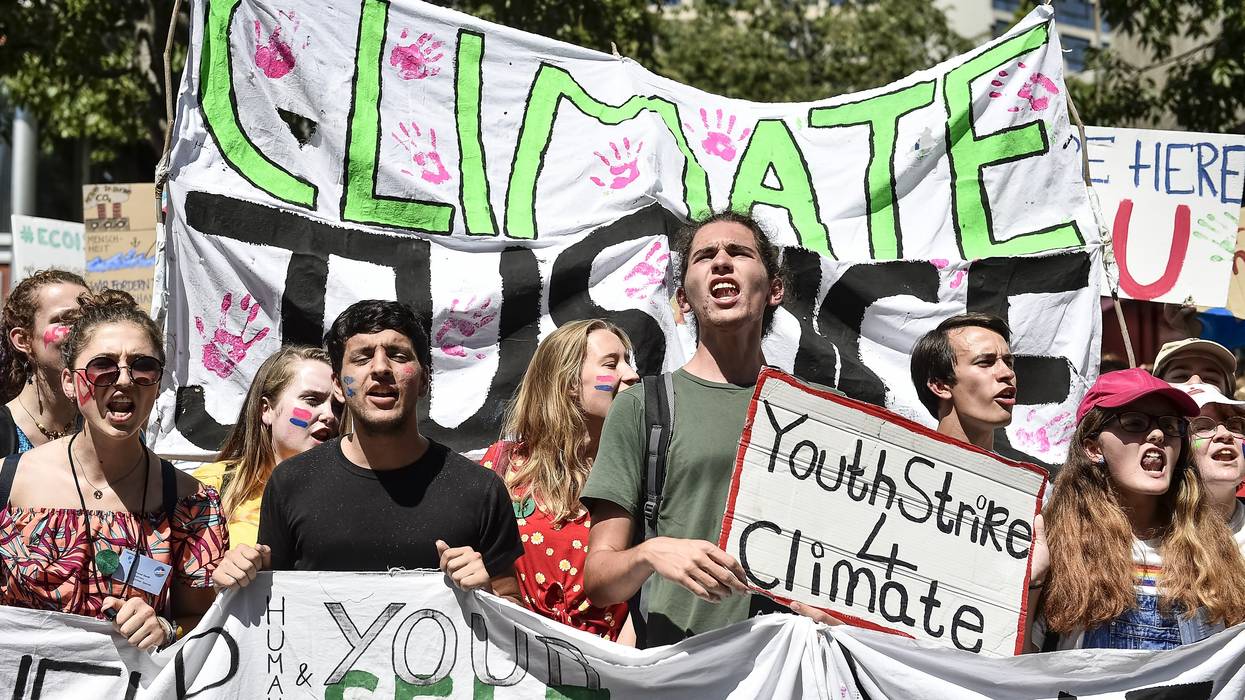
The leaders of tomorrow are already here, working to solve the problems that older generations have failed to address. Now, it’s time to support them.
The stereotype that youth-led climate initiatives are too risky to fund is outdated and, in fact, severely limits the opportunities for talented young entrepreneurs and activists. It stifles the very innovation needed to create a sustainable future. As we grapple with the pressing realities of the climate crisis, it is no longer a matter of whether we should support young leaders; it’s a matter of urgency. To succeed in addressing our environmental challenges, we need to tap into the energy, creativity, and bold leadership that young people bring to the table.
When I was just 16 years old, I submitted a climate research paper to the United Nations Development Program in Pakistan. Since then, I’ve had the privilege of working with global organizations, speaking on CNN about the devastating impact of climate change in my home country, and leading the transformation of a college club into a full-fledged nonprofit. These experiences have shown me firsthand how young people are not just passionate about environmental change—they are driving it.
Yet, despite their passion and fresh ideas, youth-led environmental action remains massively underfunded. Less than 1% of institutional climate funding currently goes toward young people. Many, like myself, have struggled to secure the necessary resources to bring our ideas to life. As the next generation holds the key to solving the climate crisis, failing to support these leaders only exacerbates the problem. The global climate crisis is urgent, and so is the need to empower young people with the funding, mentorship, and platforms they need.
We know time is running out to avert the worst impacts of the climate crisis. If we are to truly address it, we must fund and support young activists today.
I’ve seen this challenge play out in my own journey. As a student in London, I faced challenges from being a woman of color trying to secure funding and support for environmental initiatives. Back in Pakistan, while I’ve been able to push forward with awareness campaigns and advocacy, I’ve encountered plenty of hurdles—whether it’s dealing with politicians who don’t take me seriously or navigating security concerns because of my public activism. Despite these challenges, I remain convinced that the future of climate change solutions lies in the hands of young people—especially women.
Supporting youth-driven solutions is not just about giving young people opportunities—it’s about ensuring our movement is more inclusive, diverse, and effective. Young leaders have the ability to solve problems that older generations may not recognize. I founded the Climate Action Society at University College London, a project that eventually became an international nonprofit. The key to its success was understanding that leadership doesn’t come with age—it comes from a commitment to action and collaboration. The support we received, including recognition from the United Nations and the U.K. Government, was crucial in amplifying our impact.
One of many initiatives directly addressing the need to support youth-led climate solutions is The Iris Prize by The Iris Project, an international award that celebrates and funds young environmental stewards dedicated to catalyzing climate action in their communities. Fiscally hosted by the Global Fund for Children, The Iris Prize invites young people aged 16-24 who are actively protecting local ecosystems, restoring natural habitats, and driving community-based environmental efforts to showcase their innovative ideas and solutions for a sustainable future.
The awards aim to help close the funding gap by shining a light on the action young people are already taking to protect and restore nature, and the lives of those working to defend their environment. Beyond financial support, winners also receive climate communications training, organizational development training, and mentorship, equipping them with the resources they need to increase their impact and scale their projects.
The funds have supported a range of projects, such as revitalising ecosystems in Bolivia, training women in sustainable farming in Guatemala, and addressing pollution in Sierra Leone. These projects are having a real impact on communities, and supporting them through funding will go a long way in helping them scale that impact. At a time when global philanthropic funding has been cut, putting pressure on hundreds of organizations in the global South, funding grassroots initiatives is more important than ever.
As someone who has worked tirelessly in climate activism, I have seen how young people are already changing the world through their grassroots efforts. However, without the support of initiatives like The Iris Prize and others, many of these projects will struggle to scale and reach their full potential.
The global community must shift its mindset. If we are to make a real, lasting difference, we must embrace youth-led initiatives as central to our global strategy. The leaders of tomorrow are already here, working to solve the problems that older generations have failed to address. Now, it’s time to support them.
We know time is running out to avert the worst impacts of the climate crisis. If we are to truly address it, we must fund and support young activists today. The future depends on it. Through initiatives like The Iris Prize and others, we can ensure that youth-led solutions not only thrive but are scaled for maximum impact. Let’s give these innovators the funding and resources to make the change we desperately need.
Energy Transfer’s case against Greenpeace could redefine First Amendment rights for everyone in the U.S. It must be exposed for the grave threat it is.
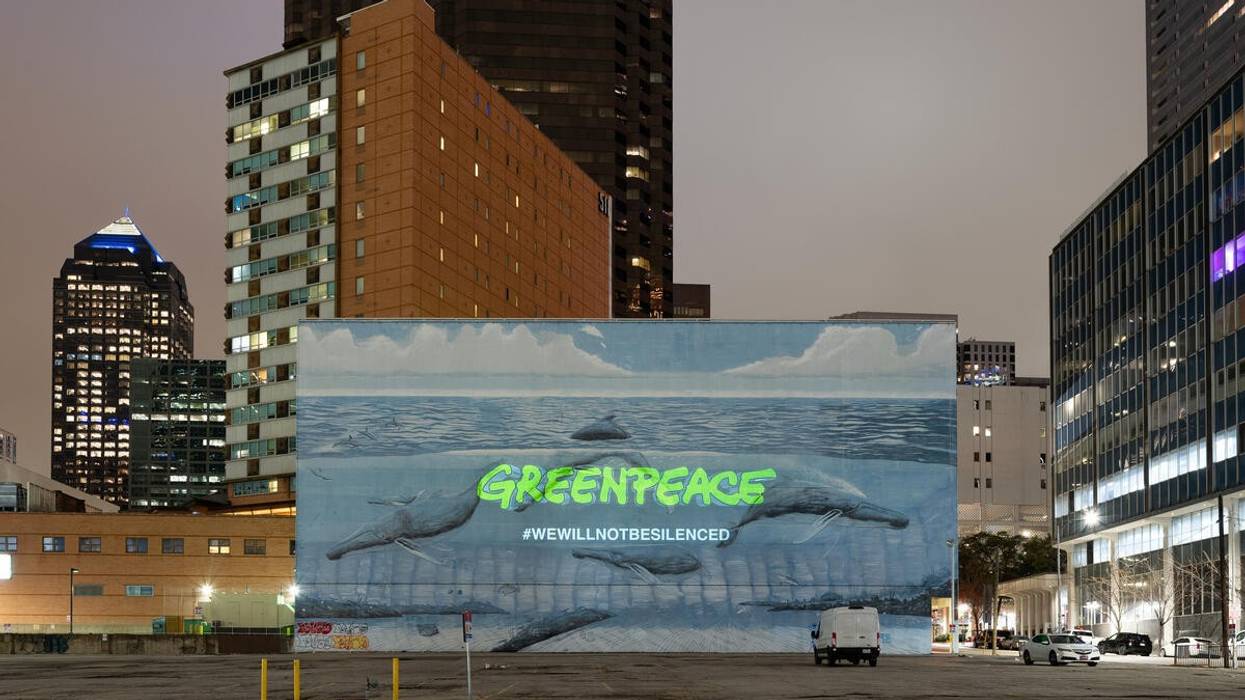
The strategic lawsuit against public participation, or SLAPP, lawsuit by Energy Transfer Partners against Greenpeace is a blatant attack on free speech, enabled by a biased legal system stacked with unqualified, partisan judges. It exemplifies how corporate power, run amok, threatens one of the most fundamental American rights—the right to dissent.
In late February, we watched this unfold in a small courtroom in Mandan, North Dakota—a town just across the Missouri River from Bismarck, now the site of a legal mugging. The victims? The entire climate and environmental movement, represented by Greenpeace. The assailants? Energy Transfer Partners (ETP), Dakota Access Pipeline, and their legal enforcers at the infamous fossil fuel law firm Gibson, Dunn, & Crutcher.
In President Donald Trump’s dystopian America, stacked juries and sham trials may soon become the new normal.
ETP’s CEO, Kelcy Warren, isn’t even pretending otherwise. He admitted the lawsuit’s purpose is “to send a message.” When asked if he wanted to cut off funding for groups like Greenpeace, he answered, “Absolutely.” He has even suggested that environmental activists should be “removed from the gene pool.” Now Warren has commandeered a public court and stolen public resources and citizens’ time, all to wage his revenge attack and get his “pound of flesh.” He’s just picked out the biggest environmental justice name he could think of—Greenpeace—as his victim.
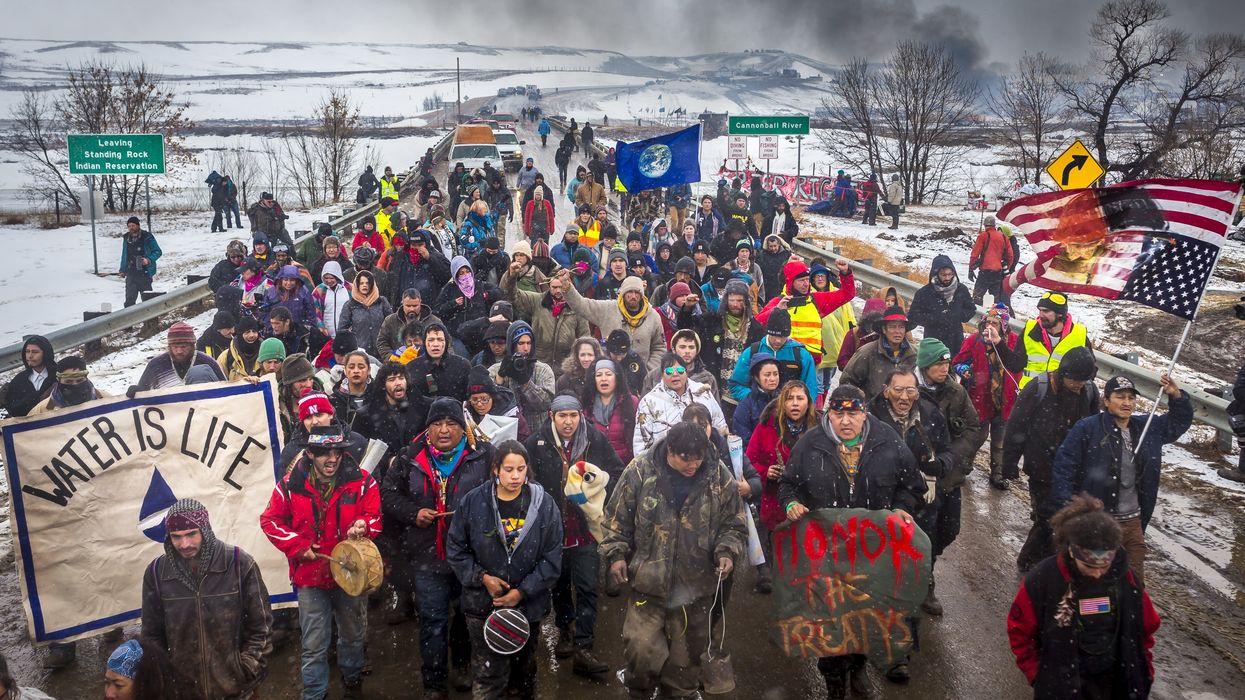
In truth, this case is about silencing dissent. It continues the long-standing erasure of Native American rights, sidelining the Standing Rock Sioux Tribe—the true leaders of the DAPL protest movement—while targeting anyone who dares challenge corporate billionaires and fossil fuels.
We've seen this playbook before. When Chevron lost a $9.5 billion judgment in Ecuador for its deliberate dumping of billions of gallons of cancer-causing oil waste as Texaco. It decimated Indigenous communities and is a big reason why Native Americans should be worried fossil fuels will poison their water—Chevron did it intentionally. Then, to escape justice in Ecuador, it weaponized the U.S. legal system to wage SLAPP attacks and denied access to justice for Indigenous peoples, which culminated in the unprecedented imprisonment of a U.S. lawyer for a misdemeanor contempt charge—via a private corporate prosecution.
Gibson Dunn, central to both cases, is a prime example of how unethical lawyers manipulate the courts to crush free speech. In the Greenpeace case, they claim “tortious interference” over statements Greenpeace repeated from news reports—statements that were true. More chillingly, ETP argues that Greenpeace is liable for any alleged crimes at Standing Rock because it trained activists in deescalation, nonviolence, and safety. If the same logic applied, those who trained January 6 insurrectionists in political activism would be held liable for the Capitol riot—an irony that exposes the selective use of accountability.
The world saw the footage from Standing Rock: brutal police crackdowns, mass arrests, and unchecked violence against Indigenous and allied protesters. Yet no security personnel faced consequences—only demonstrators. Now, ETP seeks to gaslight the public in a courtroom where nearly every juror has admitted bias against Native Americans and environmental activists, with direct ties to the fossil fuel industry. In President Donald Trump’s dystopian America, stacked juries and sham trials may soon become the new normal.
This case could redefine First Amendment rights for everyone in the U.S. It must be exposed for the grave threat it is. Bipartisan efforts are underway to bring a federal anti-SLAPP law into effect to help protect the right to free speech. This case should light a fire under those efforts because, for many, the ability to peacefully protest and organize is all we have left.
A lawsuit against Greenpeace in North Dakota threatens the existence of all nonprofits.
Imagine a world without effective nonprofit advocacy. When a corporation exploits a local community, no one speaks up or resists. Everyone is too afraid of the weaponized legal system, too vulnerable to liability. The ultra-wealthy take whatever they want and leave others to pick up the pieces. Opposition and resistance have been extinguished.
Those are the risks of a lawsuit against Greenpeace, now going to trial in North Dakota after a seven-year legal battle. Energy Transfer, the company behind the Dakota Access Pipeline, is seeking $300 million for tort damages, including defamation. Energy Transfer’s previous attempt to sue Greenpeace under federal anti-racketeering laws was blocked by the courts. But the state charges have been upheld, with a trial beginning on February 24, and free-speech advocates are raising alarms about the dangerous precedent that would follow a loss for Greenpeace, or even from the trial proceeding at all.
I recently spoke with Scott W. Badenoch, Jr., a visiting attorney at the Environmental Law Institute. He’s part of a team of distinguished international legal scholars, including Steven Donziger and Jeanne Mirer, who have launched a Trial Monitoring Committee to ensure the case against Greenpeace proceeds fairly and transparently.
While the Trial Monitors and some activists will be on the ground in North Dakota, we need to make noise online and in the media, ensuring that as many people as possible know what’s at stake.
As Badenoch described it, the court is trying to maintain “as much of a black box as you could possibly create in the U.S. court system.” Judge James Gion recently denied a motion to allow live streaming of the trial proceedings.
Instead, Badenoch said the case should be dismissed immediately. The allegations attempt to hold Greenpeace responsible for the actions of activists and volunteers unaffiliated with the group. Legal advocates and climate organizers have called it an unconstitutional SLAPP suit, intended to burden Greenpeace with costly legal fees, shut them down, and restrict the free speech of nonprofits more broadly. “There is absolutely no justification for this trial happening in this court, at this time, with this judge,” Badenoch said. “Just none.”
In a press release from the Trial Monitoring Committee, Steven Donziger pointed to recent trends, writing that “this appears to be part of a broader strategy by the fossil fuel industry to weaponize the courts against activists and weaken organizations like Greenpeace in retaliation for their advocacy.”
While the trial itself presents dangers, the recent actions of Energy Transfer have also brought accusations of jury-tampering. In October, residents of rural Morton County, North Dakota, where the trial will be set, received what appeared to be a legitimate newspaper. However, it contained almost exclusively critical attacks on Greenpeace and the pipeline protests, while praising Energy Transfer. The “newspaper” was actually a political mailer from a company called Metric Media, with links to electioneering and fossil fuel companies, as reported in the North Dakota News Cooperative. Even more concerning, financial records link the CEO of Energy Transfer, Texas billionaire Kelcy Warren, to the creation of the fake newspaper. It looks a like blatant attempt to taint the jury pool. Despite this, Judge Gion refused to allow Greenpeace to investigate the origins of the biased mailer.
The crucial role of the Trial Monitoring Committee is to bring attention to these abuses of due process. “We are going to monitor this case one way or the other,” Badenoch told me. “But the more that [Judge Gion] withholds transparency and access from us, the more obvious it is that something is going on that they don’t want people to see.”
Meanwhile, the stakes of the case extend far beyond Greenpeace. If Energy Transfer is successful, Badenoch said, the precedent would be cataclysmic for nonprofit advocacy. An organization could be held liable for any actions by any activists, however tenuously affiliated. “Literally every social justice, climate justice, civil rights, human rights organization across the country—and maybe the planet—is at risk of legal murder in a courtroom, where an organization is put to death by a SLAPP suit.”
As members of the public, that means we all have a responsibility to advocate for transparency, fairness, and ideally dismissal of Energy Transfer’s lawsuit. While the Trial Monitors and some activists will be on the ground in North Dakota, we need to make noise online and in the media, ensuring that as many people as possible know what’s at stake. Badenoch was emphatic about this: “The number one thing is to bring attention to the case. Don’t let Greenpeace die with a whimper.”
In a time of chaos and distraction, it’s all too easy to let cases like this one go unnoticed. But the risks are simply too dire to ignore. “It’s absolutely terrifying for advocacy in this country and beyond. The risks are really hard to overstate,” Badenoch told me. “If Greenpeace is allowed to die in this field in North Dakota, then every single nonprofit is next in line.”
If you’re a climate activist who doesn’t know what to do for the next four years, the answer is remarkably simple: Join other movements.
Ever since my first foray into climate activism in 2019, I have dreaded the year 2025. In my mind, it’s always been the Big Deadline.
The 2015 Paris agreement concluded that greenhouse gas emissions must peak before 2025 if we have any chance of limiting global warming to 1.5°C.
And yet, now that we’re standing at the precipice of this once-far off deadline, we are still so far from the meaningful climate action necessary to fend off unstoppable climate catastrophe. Indeed, we’ve just worsened our chances at a survivable future.
We need to build a strong left to fight fascism during Trump’s presidency and to build a just green future in its aftermath.
The U.S. became the largest oil producer in 2018 and continues to expand domestic fossil fuel production. American citizens just elected a fascist president who has promised to gut the EPA and establish U.S. “energy dominance,” but the Democrat who supposedly could have saved us from Donald Trump refused to ban fracking and praised U.S. oil production.
Technically, I should be panicking. I certainly was when my college graduation last May was preceded by some headlines announcing the 1.5°C limit had already been reached. But now, as a climate activist in New York City, I find myself surprisingly calm.
This calm isn’t simply due to local climate wins, though I have celebrated those. Gov. Kathy Hochul just signed the Climate Change Superfund Act into law, which will require fossil fuel companies to pay billions into a fund to help New Yorkers recover from climate disasters. In other words, New York will force polluters to pay to clean up their own messes. This is a huge step in holding fossil fuel companies accountable.
Yet my optimism arises out of a different trend in the climate movement: Climate activists are (finally) showing up for other movements.
Historically, the climate movement has attempted to isolate itself from other political and social issues, arguing that climate policy is “just science.” This majority-white movement has failed to see that fossil fuel emissions are part of a larger history of the Global North colonizing and exploiting both people and the planet for decades. The climate crisis is a symptom of a broader exploitative system. To change that system, we need a united left that will fight for all people—not just those who identify as environmentalists.
In 2020, climate activists were rightfully berated for not showing up enough for the Black Lives Matter movement. Thankfully, I think many climate activists heard that message because today, they have come out in droves for Palestine.
Many of the college students who organized campus encampments last spring to urge their school administrators to divest from Israel and the U.S. imperial war machine were students who had previously organized for climate justice. I witnessed this firsthand at the Claremont Colleges when I was a senior: The student organizations demanding fossil fuel divestment fell to the wayside as the crisis in Gaza intensified. Globally, many climate organizations chose to speak out and take direct action to call for a cease-fire in Gaza.
But none of these climate activists had stopped caring about the climate. In fact, they often pointed out that Israel’s actions were not just genocide, but ecocide as well. The onslaught of bombs dropped on Gaza will contaminate the soil and groundwater in the region for decades. And the destruction has produced at least 54.5 million tons of carbon dioxide, equal to the annual emissions of 16 coal-fired power plants.
Climate activists cannot claim to fight for a just future and stay silent about genocide. “If we, as climate activists, aren’t able to see and speak up against the current marginalization and oppression and killing of people today, then I don’t think we should be able to call ourselves climate justice [activists],” climate champion Greta Thunberg told Al Jazeera in early December 2024.
As Trump prepares to enter the White House, we will undoubtedly see more people oppressed and killed. Among the many groups who are vulnerable under his administration are undocumented immigrants, whom Trump has vowed to round up and deport.
Migrant justice has long been intertwined with climate justice. As climate change makes many areas around the world uninhabitable, climate refugees have no choice but to leave their home.
In response to Trump’s election, climate organizers Jeff Ordower and Ahmed Gaya called on their fellow activists to bring their experiences of shutting down pipelines and coal plants to fight the incarceration and deportation we can expect under Trump. Climate activists should answer this call: The struggles for migrant justice and climate justice are intertwined, and we must meet the needs of the current moment.
“[Climate is] not more urgent than kids being ripped away from their families and dying in the desert—anyone who tries to win that argument is monstrous themselves. We either merge, join forces, or we lose,” writer and activist Naomi Klein said in 2019.
With Trump as president, things will undoubtedly get worse before they get better. We need to build a strong left to fight fascism during Trump’s presidency and to build a just green future in its aftermath. To do so, climate activists must put their words into action when they say they fight for every living being.
Sure, there might be a few people who will drink from the doomer cup and curl into fetal surrender. But there will be far more who will take this message and fight back.
I recently complained that public narratives about climate—those promoted on so called mainstream platforms, and featured in cryptic one-liners from Democratic Party hopefuls—boil down to evasive bullshit.
We are rather stuck with a climate narrative that offers two wrong answers, and, in its bifurcated and reductionist limitations, rather mirrors our two party system that offers two, and only two bad choices. The Republicans loudly tell us that climate overheating is an outright hoax, or some minor and wholly natural fluctuation of geological cycles. The Democrats counter this with a fetishized future of wind and solar power. Meanwhile corporate arsonists burn coal, oil and gas with ever more maniacal fervor.
I don't need to debunk Republican climate orthodoxy—it thrives on drooling acolytes who have capitulated to facile explanations. The popular Democratic Party fairytale on climate, however, may need to be examined here—many of us mindlessly accept that a future of limitless indulgence will inevitably come to pass. Wind and sunlight shine, and blow upon the faces of the rich and poor alike. Once we harvest these free gifts from creation, the collective wealth of our species will be "decoupled" from the alleged finite resources of the planet. We can all have everything we want. It will be as if we each had our own private Amazon/Walmart nirvana. The climate apocalypse has raged against a population morally and cognitively broken by false hopes.
Even if we pretend that human society will lurch into a utopian phase with no war, no overproduction and no burning of fossil fuels, it may be too late to prevent wholesale species extinction and further environmental collapse.
Many of us have been so disabled by impossible promises that we miss four enormous points: 1) Nations cannot create energy systems to harvest the unlimited wind and sunlight without exhausting planetary resources. 2) The required extracted materials to manufacture solar panels and renewable storage batteries must be stolen from the Global South. 3) Renewable energy under capitalism does not replace fossil fuels—it creates additional growth thereby expanding the need to burn even more fossil fuels. 4) The collapse of our ecosystems from greenhouse gasses and industrial poisons is so far along that massive sea level rise, heating and degradation of oceans (coral reef bleaching, anoxic waters, fish die offs) and inland desertification will inevitably continue well into the future by the sheer momentum already launched. Even if we pretend that human society will lurch into a utopian phase with no war, no overproduction and no burning of fossil fuels, it may be too late to prevent wholesale species extinction and further environmental collapse.
The climate/environmental momentum toward hell, however, is but one component that drives inevitable pessimism. Far worse is the suicidal intentions of corporations, governments, and our concomitant air of mass indifference. Most of us are not resigned from a sense of hopelessness, but disabled by unwarranted optimism, or buoyed by a delusional faith in technology and reason. Even on the left there is little narrative climate clarity—our confusion likely inspires triumphant chuckles in the private board meetings of the oil industry. One truly bizarre story told in progressive circles is that mass resistance to environmental destruction has been eroded by "doomerism."
Here, for example, is Nathan Robinson's take on climate from a piece in Current Affairs:
Writing about climate change in a way that makes people feel scared and hopeless, like they are going to die in a wildfire whether they like it or not, is, in my opinion, part of why climate coverage is such a “ratings killer.” My suspicion is not that nobody wants to confront the subject of climate change—Don’t Look Up faces the matter head-on, and is hugely popular—but that if discussion of it just feels disempowering and depressing, there is no reason for anyone to read about it. Here at Current Affairs, two of our most popular recent articles have been on climate change, but the underlying message has been about taking action rather than merely forecasting the inevitable apocalypse.) I do not think it is helpful to tell anyone to “settle into the trans-apocalypse.” No! Join the Sunrise Movement and throw political leaders who refuse to act on climate out of office.
Robinson's warnings about the dangers of large-scale pessimism echo those of Michael Mann who asserted that "Doomerism is the new denial." As an aside, I must mention that I am an admirer of both Robinson and Mann. The former is one of our most important progressive writers (and the first editor to post one of my pieces on a large platform!) while Mann has been a critically important scientist in detailing the trajectory of our climate. His "Hockey Stick" climate graphs inspired the term and popularized the concept.
But the entire construct of doomerism (as Robinson and Mann understand it) rests on a shibboleth—is inaction really founded on collective despair—or is fear of doomerism another distracting trope? Do masses of people go from understanding that corporate goons burn our world to a crisp, to tossing up their hands and saying, “Fuck it, it’s hopeless?” At some sudden moment in time do they simply come (so the story of doomerism goes) to accept that there is no point to civil disobedience? Are we truly disabled due to a vision of unstoppable, irredeemable collapse? To the contrary, perhaps pessimism inevitably accompanies an honest appraisal of our precarious environmental future.
The oil industry understands with pristine clarity that hopeless people are as likely to respond with violent rage as with passivity.
If doomerism is really the "new denial," if a brigade of fatalistic and resigned people eagerly reject hope and let the oil industry off the hook, we would expect to see screeds by Guy McPherson and Eliot Jacobson posted prominently at The Heartland Institute.
However, we see no such thing. The last thing that oil companies and fascist think tanks want to convey to the public is that corporate crimes have ruined the planet and nothing can be done to change it. The oil industry understands with pristine clarity that hopeless people are as likely to respond with violent rage as with passivity. Doomerism is not the new denial. In fact, you will never see a word of pessimism on an oil industry funded propaganda platform. The industry honchos want your brain to be infused with optimism—hope, upbeat faith in human schemes to find new and better ways serves the cause of energy profits. Here is a Chevron happy ad to prove my point.
- YouTubeyoutu.be
Recent Pew research shows that some 63% of US citizens feel that climate is not the most critical issue facing the country. Less than a third of U.S. adults favor phasing out fossil fuels. We are clearly not a nation beset by fatalistic resignation, and collective environmental surrender, but, rather, a country collectively neutered by Chevron-style ad campaigns.
Even our best climate narratives stumble at the point where capitalism enters the story. Many writers insert a ghostly entity known as "we," as in a superbly written piece by Priya Satia entitled, "The Way We Talk About Climate Change is Wrong."
We will not be ushered past the grim reaper by optimists.
Satia argues quite originally that the notion of time that is indispensable to the capitalist mindset—the prioritizing of the future as it exists in the concept of delayed gratification—drives the system of imperial plunder and overconsumption. But who is the "we" in Satia's narrative that talks about climate in the wrong way?
There is no we—no public that owns a unique climate narrative. "We" are all tools of industry and politicians. Our climate narratives have been injected into our heads by means of well practiced repetition. Satia argues that indigenous people have historically lived according to natural rhythms. They have, from their intimacy with the earth, developed the capacity to take pleasure in the moment (a perspective embraced by some western writers as well, such as Thoreau). The political force needed to initiate a mass movement willing to abandon capitalist addictions for a deeper happiness can only take place under the leadership and passion of people with little to lose.
Even a writer with the depth of Priya Satia reduces climate mitigation to an act of mental transformation. She understands that capitalist mindsets comprise an obstacle, but does not explicitly discuss the critical preliminary task—the overthrowing of capitalism. The leadership in such an improbable effort—if we can even imagine it—will have to come from people who conceive of their choices in the darkest terms. If we are to survive another century, doomers will be the key to an eleventh hour reprieve. We will not be ushered past the grim reaper by optimists.
Extinction Rebellion insists that governments tell the truth about climate. If this were to happen, doomerism would flood our collective mindset—most of us would be doomers. Governments know that they can only retain power by sugar coating the climate story with fantasies about solar powered utopias.
A few years ago both Jonathan Franzen and Roy Scranton wrote, in effect, that it is highly unlikely that a massive climate catastrophe can be averted. Both were attacked in intellectual circles despite the fact that neither discouraged climate activism, and neither had access to platforms affecting mass opinion. Nor were their positions illogical considering what we know about capitalist history. I believe that the real threats to climate centered civil disobedience are not pessimists from the literary world, but optimists from corporate propaganda platforms, party politicians and mainstream media. Barack Obama stated at the 2024 DNC Convention that the U.S. will "lead the way on climate." If only those espousing Pollyannaish bullshit were attacked the way that Franzen was, the climate future might be less dire.
The fiercest fighters might well be those who have no chance to succeed.
In short, we need doomers—people encouraged to use their platform to scream that we are fucked. There might be a few people who will drink from the doomer cup and curl into fetal surrender. There will be far more who will take this message and fight back.
Anyone familiar with the Nazi Holocaust recalls that prisoners confined to the Warsaw Ghetto only rebelled when all hope was lost. Hopelessness has historically been the driver of action. Perhaps Nat Turner was a doomer, John Brown as well. The fiercest fighters might well be those who have no chance to succeed. I am not saying that we have no hope to survive and maybe even flourish, but anyone who does not consider that hopelessness may be a rational response to current reality is living in a fantasy world.
Hope is a tranquilizer. The first step to mass civil disobedience involves a shared pessimism, a deep understanding that we are truly and inescapably fucked. Only then can we form a movement that has a chance. Nathan Robinson and Michael Mann are two brilliant figures but dead wrong about doomers. We need more of them—there can never be enough.
"You don't have to agree with the tactics of climate activists to understand the importance of defending their rights to protest and to free speech."
Rich Western countries have cracked down on non-violent climate protests with harsh laws and lengthy prison sentences, in violation of international law and the civil rights they champion globally, according to a report released Monday by Climate Rights International.
CRI, an advocacy group based in California, found that Australia, Germany, France, the Netherlands, Sweden, the United Kingdom, and the United States had used heavy-handed measures to silence climate protesters in recent years. The measures aren't in keeping with the freedoms of expression, assembly, and association enshrined in international law, the report says.
"You don't have to agree with the tactics of climate activists to understand the importance of defending their rights to protest and to free speech," Brad Adams, CRI's executive director, said in a statement.
"Governments too often take such a strong and principled view about the right to peaceful protest in other countries—but when they don't like certain kinds of protests at home they pass laws and deploy the police to stop them," Adams told The Guardian.
“These defenders are basically trying to save the planet... These are people we should be protecting, but are seen by governments & corporations as a threat to be neutralised. In the end it’s about power & economics”
- @MaryLawlorhrdshttps://t.co/WPunhbDhCq
— Dr. Aaron Thierry (@ThierryAaron) September 10, 2024
The CRI report details relevant international law, disproportionate actions taken against climate protestors, and draconian new laws established in four of the countries studied. It also lays out recommendations and proposed reforms. CRI was founded in 2022 with a mission that states, "Progress on climate change cannot succeed without protecting human rights—and the fight for human rights cannot succeed without protecting our planet against climate change."
The examples of government crackdowns on climate protesters are numerous. In October 2022, Just Stop Oil activists Morgan Trowland and Marcus Decker climbed the cables of a major bridge in England and remained there for two days, causing police to stop traffic across the bridge. They called for the U.K. to stop licensing new oil and gas projects in the North Sea.
Trowland and Decker were each subsequently sentenced to more than 30 months in prison under a 2022 law passed by the Conservative government that led the country at the time. The sentencing prompted concern from a United Nations special rapporteur. An op-ed published Tuesday in The Guardian by Linda Lakhdhir, CRI's legal director, indicated that the Labour Party, now in power in the U.K., has not made a total break from the Conservatives policies.
A similar U.K. case involved Just Stop Oil's disruption of traffic on a highway in November 2022. Five campaigners, including Roger Hallam, well-known as a co-founder of Extinction Rebellion, had spoken on a Zoom call designed to increase participation in the direct action. This July, they were each sentenced to at least four years in jail, with Hallam receiving a five-year sentence—the longest sentences ever given in the country for non-violent protest, The Guardian reported.
Michel Forst, the U.N.'s special rapporteur on environmental defenders, attended part of the trial and called the sentencing a "dark day for peaceful environmental protest."
The attempt to silence climate protest has gone well beyond the U.K. In late August, a German court sentenced a 65-year-old man to nearly two years in prison for blocking a road as part of a protest. An Australian protester was given 15 months in prison for blocking one lane in a five-lane road for 28 minutes in 2022.
In April 2023, Joanna Smith was one of two protesters who put water-soluble paint on the protective case of a sculpture at the National Gallery of Art in Washington, D.C. She faced unexpectedly harsh federal charges—for two felonies—that could have landed her in prison for five years, and ended up making a plea deal for a 60-day sentence. Her fellow protestor, Timothy Martin, has a trial scheduled for November.
The report makes the following four general recommendations for governments:
The final recommendation stems from the fact that some jurisdictions and judges have prevented climate activists from stating the reasons for their civil disobedience in court. A U.K. judge, Silas Reid, has repeatedly denied climate protesters the ability to explain their motivations to juries, and even jailed two of them for contempt of court when they did so anyway.
The U.S. has not passed a harsh federal bill along the lines of the 2022 U.K. law, but many states have placed anti-protest laws on the books in recent years, and other state legislatures have considered measures, the report says. A 2019 Texas law strengthened penalties for protests around pipelines and other fossil fuel infrastructure, and a 2020 Tennessee law did so for "inconvenient" protests.
Harsh penalties are not the only danger that environmental defenders face. Nearly 200 environmental defenders were killed across the world in 2023, according a report released Tuesday by Global Witness.
Crackdowns on non-violent protest in rich Western countries extend beyond the issue of climate. Pro-Palestinian campus protests in the U.S. have also seen harsh crackdowns in the past year, with fears among campaigners that anti-protest measures could increase.
The report posits that governments should take a different approach to such civil disobedience, given its importance in spurring social change in the past.
"Governments should welcome peaceful protests as the sign of an engaged citizenry," the report says. "Those who engage in peaceful protest should, at a minimum, be assured that their rights will be respected."
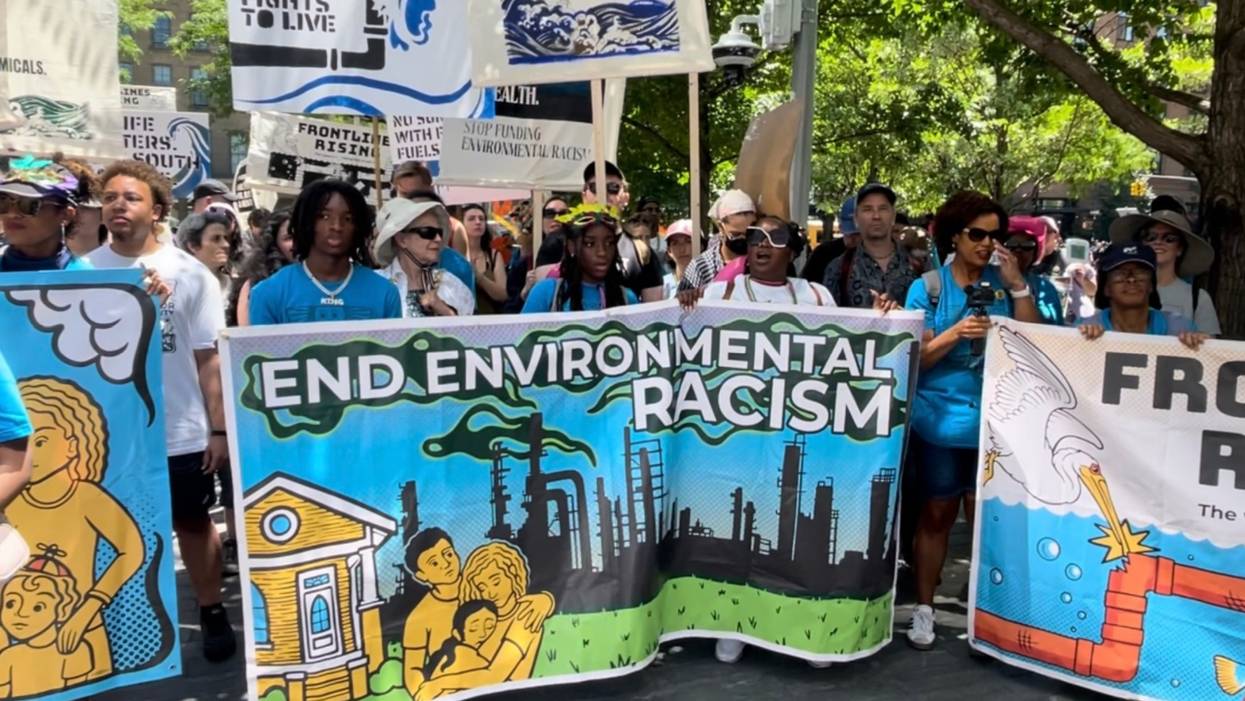
Scores of activists were arrested Friday during a protest outside Citigroup's New York City headquarters, where demonstrators condemned what organizers called the megabank's "racist investments devastating Black and brown communities" and fueling the worsening climate emergency.
Around 1,000 people including environmental leaders from the Gulf Coast of Texas and Louisiana gathered at Zuccotti Park in Lower Manhattan's Financial District, where they rallied before marching to "demand that Wall Street stop funding the fossil fuel projects causing environmental devastation in mostly Black and brown communities in the Gulf South and across the globe."
The march ended at Citigroup's headquarters on the west side of Lower Manhattan, where organizers from New York Communities for Change said 68 people were arrested. The group said a total of 259 activists have been arrested during ongoing Summer of Heat on Wall Street protests, which it organized along with Stop the Money Pipeline, Climate Defenders, and Planet Over Profit.
"On Monday, climate activists from the Gulf South and allies held a roving speak out in front of financial institutions backing the fossil fuel industry, including KKR, BlackRock, and Bank of America," New York Communities for Change said. "On Wednesday, protesters held a civil disobedience action in front of the insurance conglomerate Chubb, which insures petrochemical projects destroying the climate in the Gulf South and around the globe."
One of the protest's organizers, Roishetta Ozane—who founded the Vessel Project of Louisiana—said that "projects that kill our communities like Freeport LNG (liquefied natural gas), Cameron LNG, Corpus Christi LNG, and others would not exist without the backing of financial institutions like Citigroup."
"Money made from them is blood money," Ozane added. "Since they destroy our homes, we're coming to pay them a visit. We will break this cycle of violence and exploitation now because later is too late. We want Citigroup to stop funding fossil fuels and to stop hurting our communities and our families."
As Stop the Money Pipeline coordinator Alec Connon explained in an opinion piece published earlier this month by Common Dreams:
Since the adoption of the Paris agreement in 2015, Citi has provided $204.46 billion in financing to the company's most rapidly developing new coal, oil, and gas fields. Remarkably, Citi has provided more money to those oil and gas companies than even JPMorgan Chase―the bank that climate activists like to call the 'Doomsday Bank.'
To be clear, I'm talking here only about the financing Citi has provided for companies developing new oil and gas reserves, not merely investing in infrastructure to keep the oil pumping from existing reserves. When we take into account financing to all fossil fuel companies, Citi has provided a little shy of $400 billion to coal, oil, and gas companies since 2015.
Citigroup contends that it is "supporting the transition to a low-carbon economy through our net zero commitments and our $1 trillion sustainable finance goal," and that its "approach reflects the need to transition while also continuing to meet global energy needs."
However, Climate Defenders organizing director Marlena Fontes countered that "Citi's business model is frying our planet."
"Every credible climate scientist says that we can't afford to put one more penny into fossil fuels, but Citi is the number one funder of fossil fuel expansion in the world," Fontes added. "Until Citi stops funding fossil fuels, they can expect resistance from everyday people like us who want our children to be able to play outside without coughing on wildfire smoke or getting sick from deadly heatwaves."
"We can't address the housing crisis by chopping the weed off at the top. We have to pull it out by the roots," said one panelist at the intimate event in Los Angeles that looked at the issue from the local, state, and federal level.
We want to educate the public. We want to shift the narrative. We want to organize for transformational and lasting change.
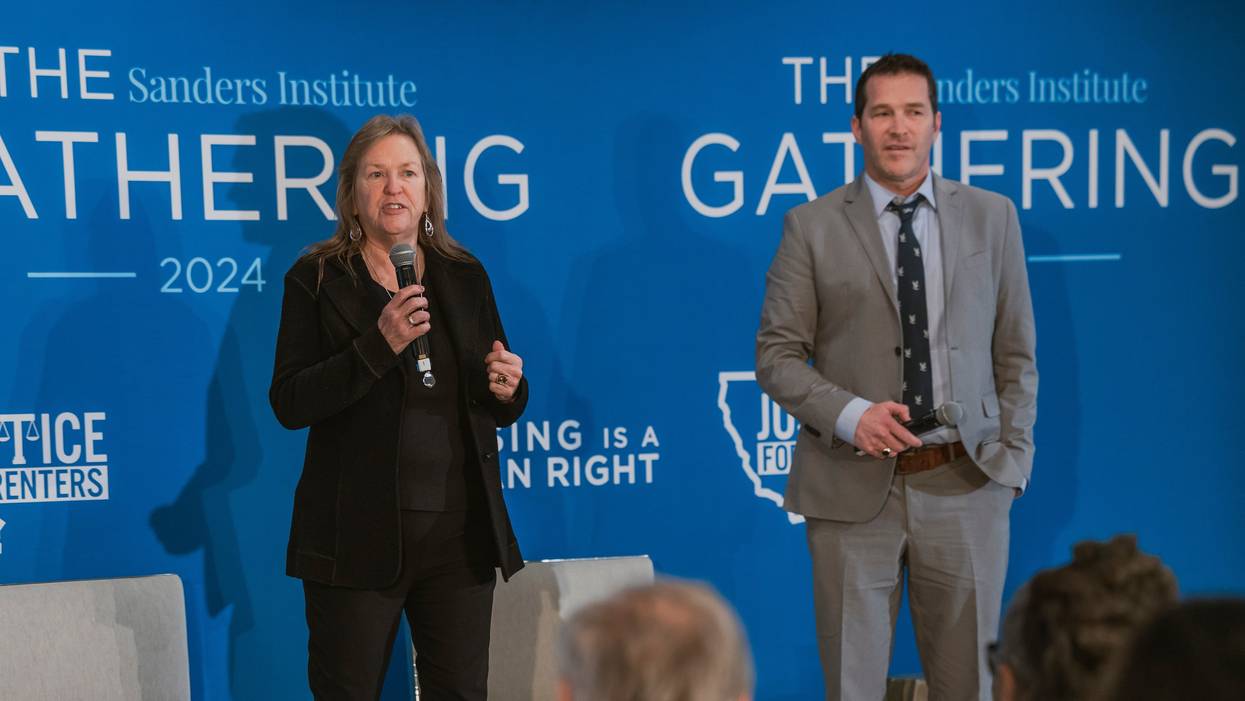
Those were the stated goals and repeated themes at the heart of a three-day event in Los Angeles over recent days, a gathering focused on the national housing crisis organized by the Sanders Institute, spearheaded by co-founder Dr. Jane O'Meara Sanders and executive director Dave Driscoll.
While the policy discussion around housing has a reputation for being dynamic and complex—especially as an issue that straddles municipal, state, and federal governance—the human story at the center of what it means to have a home or be housed is simple and universal, a thread woven into over a dozen panels, presentations, and keynote speeches by progressive lawmakers, top experts, frontline advocates, academics, and community organizers.
In a conversation with Common Dreams, Sanders and Driscoll explained that everyone who attended the event—kept intentionally small and low-profile—was told that the focus would be on "concrete remedies" and "replicable policies" with the ultimate purpose of informing a national audience about not only how severe the housing crisis has become, but also the concrete ways to address it.
"We believe democracy requires an informed electorate and civil discourse and bold ideas. That's part of our mission," Sanders said. "And the purpose was to come at the housing crisis from many aspects—not all of the aspects, but many of them—with the goal of actionable solutions."
"None of us are very interested in making small incremental change, which might mean building some more affordable housing or supporting this or that initiative. That's not what this is about." —Dr. Jane O'Meara Sanders, The Sanders Institute
But why housing? Why now? According to Sanders, the issue is potent politically because it's an issue that is not just about the poor and unhoused, but also central to the working class.
"Everybody knows somebody that has a problem getting affordable housing or just affording their life and having to make different choices," she told Common Dreams. "It's middle-income people, it's everybody having a problem with the housing crisis, and elected officials are getting pressure. Those lawmakers and politicians are hearing it more and more. And we said, okay, now's the time to bring people together around this."
Driscoll targeted private equity, Wall Street investors, and real estate developers that have used their outsized economic and political power to further skew the nation's housing market in search of ever-larger profits, squeezing out low- or middle-income individuals and families in the process.
"It's just another way in which the gap is growing between the rich and the poor and increasing inequality," said Driscoll. "And that needs to stop."
It is powerful interests most of all, says Michael Weinstein, president of the AIDS Healthcare Foundation (AHF), who must be named, shamed, and overcome if any of the progressive solutions championed at the gathering—including rent control, social housing models, community land trusts, more climate-resilient communities, and proven efforts to curb homelessness—are to have any hope of being implemented at the necessary scale.
Weinstein—a driving force behind the event, a supporter of the Sanders Institute, and a major player in California's healthcare and housing political landscape—agrees fully with Sanders and Driscoll that the moment, both in California and nationally, is ripe for an invigorating politics focused on housing.
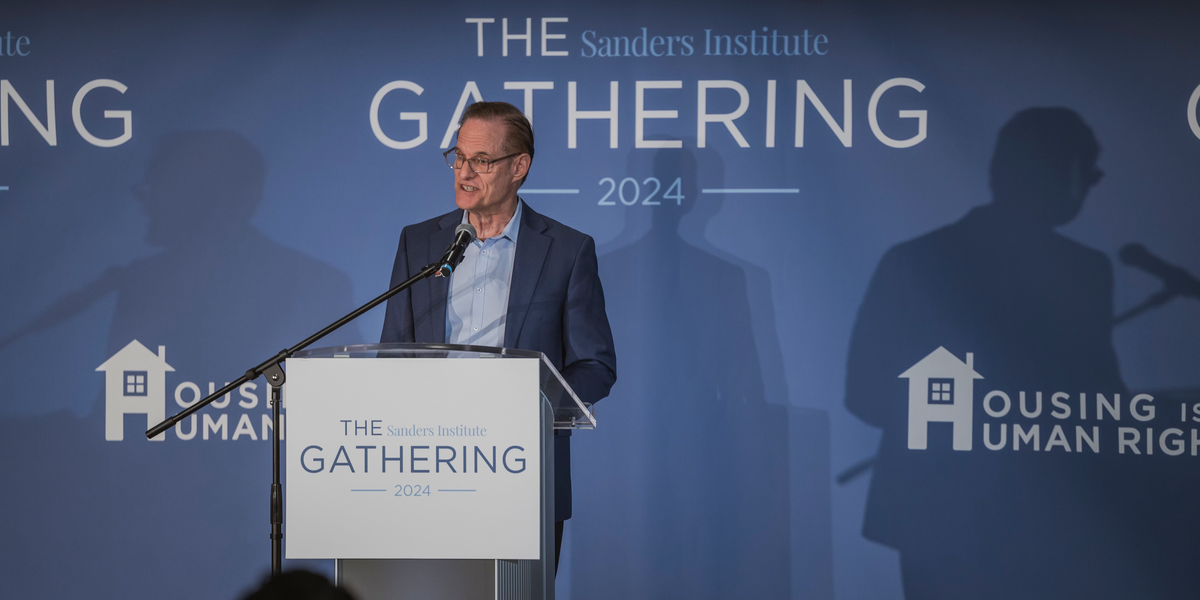
Michael Weinstein, president of the AIDS Healthcare Foundation, presenting at the Sanders Institute event in Los Angeles on Thursday, April 4, 2024. (Photo: © Bryan Giardinelli / The Sanders Institute)
During opening remarks focused on "perpetually affordable housing" and a 2024 ballot initiative in California that would end the state's existing ban on local rent control ordinances, Weinstein said that he has argued for years that "the housing issue was not high enough on the progressive agenda."
"This is a battle for the poor and working-class people in California," Weinstein said of the Justice for Renters campaign, an effort funded by AHF, local unions, and others to see the Justice for Renters Act become law via a ballot measure this year.
"There are 17 million renters in California—that's 45% of the population," he explained. "There are tens of millions more renters across the country. Our primary job as progressives is to improve the lives of people and housing is their greatest need."
If enacted, the law would remove the existing ban on rent control laws in California, encourage expanded rent control at the local level, and curb the power of "predatory landlords" who charge "unfair and unaffordable" rent.
While everyone at the gathering agreed more housing stock is a key part of the solution, Weinstein was among those who emphasized that the biggest obstacle is unaffordability of homes and rental units—a problem attributable to the greed of landlords and the investor class within an economy designed to siphon the wealth of workers into the coffers of the already rich.
"We can't address the housing crisis by chopping the weed off at the top. We have to pull it out by the roots," Weinstein explained. "And high rents are the root cause of the housing affordability crisis. It's that transfer of wealth that's causing the problem. And if we do nothing about rising rents, then nothing else we do in terms of producing housing or other changes will make a difference. If we continue to treat housing as a commodity, we'll never be able to house everyone. It's very similar to healthcare. If we leave it up to the marketplace, we're lost."
With the homeless population in Los Angeles estimated to be over 70,000—in a city of approximately 3.9 million—Weinstein said that L.A. is "not just the homeless capital of this country" but the "homeless capital of the world." This, he lamented, is "truly shameful," but also the reason why California has a vital role to play in showing people that the crisis can be confronted.
As a veteran healthcare advocate and the head of a nonprofit organization focused on AIDS, Weinstein rejected the accusation he sometimes receives from political opponents that he is somehow "out of his lane" by pushing so loudly and aggressively for rent control reforms. One reason that assessment is wrong, Weinstein explained, is that housing is the largest predeterminant of health, which is also why so many at the gathering rallied around the demand that housing be treated like the human right it is.
"But the main reason I'm involved in housing," Weinstein told the audience at the gathering, "is that I feel the same outrage about the housing situation and homelessness today as I did in the 1980s about AIDS, where the benign neglect saw tens of thousands of people die needlessly."
In his remarks, Weinstein stressed the crisis is a result of the most powerful in society refusing to meet the needs of its most vulnerable. But he said the galvanizing potential of housing—and the political potency and opportunities of social uplift embedded in the solutions presented at the conference—must be recognized.
"This is a cry for unity," he said. "Unity behind rent control and unity behind opposing corporate real estate and unity behind housing justice. There's no better time than now."
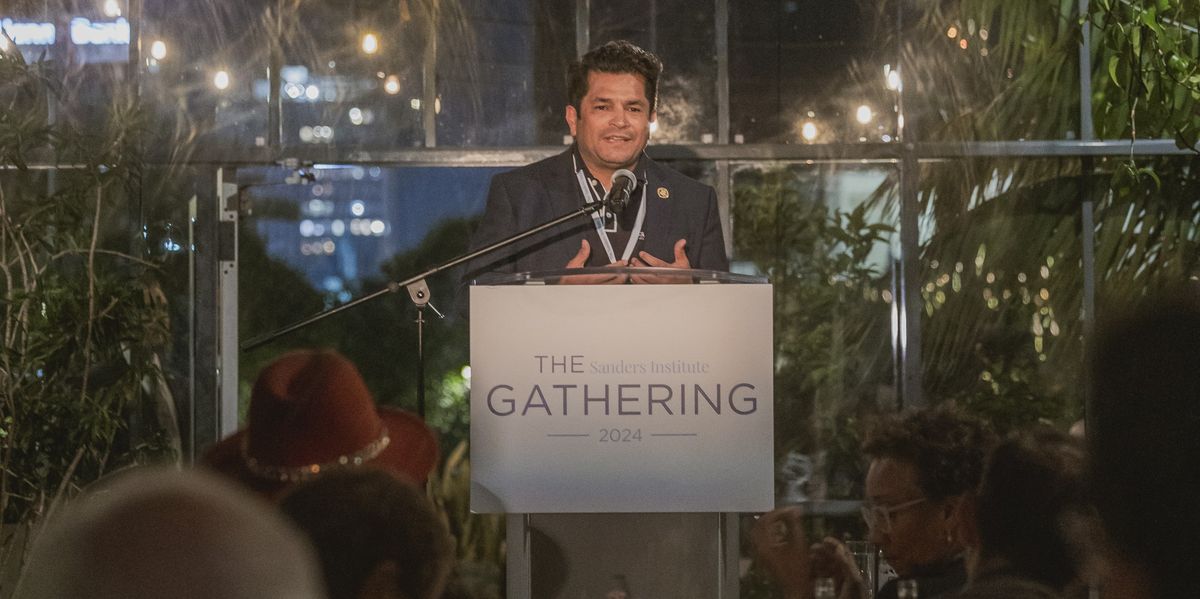
Rep. Jimmy Gomez (D-Calif.) said during the event that Democrats are ready to put housing back at the top of the party's national agenda. (Photo: © Bryan Giardinelli / The Sanders Institute)
The sense of urgency felt by attendees of the event was unmistakable.
Speaking at the opening night dinner for the conference, Rep. Jimmy Gomez (D-Calif.), who represents parts of Los Angeles County, said the creation of the Renters Caucus in Congress last year is a sign that lawmakers are beginning to take housing more seriously at the federal level.
The goal of the new caucus, Gomez said, "is to make sure that the renters agenda is at the top of the Democratic Party agenda." This was a focus of all the members of Congress who attended the gathering in some capacity, including Reps. Pramila Jayapal (D-Wash.) and Ro Khanna (D-Calif.) as well as Sen. Bernie Sanders (I-Vt.), also notable as Jane's husband. Driscoll is their son.
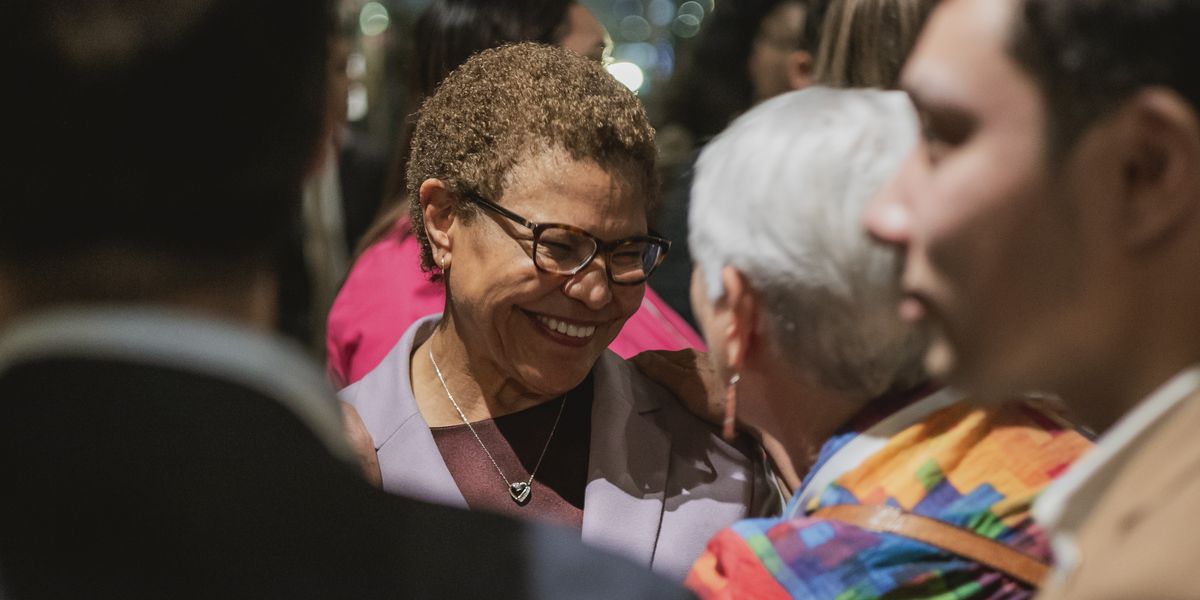
Los Angeles Mayor Karen Bass speaking with attendees at the event focused on the housing crisis, where she delivered an opening speech on the issue that focused on both the local battles for housing and, as a former member of Congress, the need for federal action. (Photo: © Bryan Giardinelli / The Sanders Institute)
Democratic Los Angeles Mayor Karen Bass, who left Congress to provide more local leadership, said she did so because she saw that the rightward political shift at the local government level was set to take the city backward on a numerous fronts, including on the issues of affordable housing, education, and homelessness.
Calling housing "one of the most important issues of our lifetime right now," Bass praised the Sanders Institute's focus on the crisis and for bringing the event to California. "I know that you are going to be the brains behind what we need, which is a national movement," said Bass. "That's the only thing that is going to bring about the type of fundamental change that we need."
"What we need... is a national movement." —Los Angeles Mayor Karen Bass
Speaking after Jayapal—who had told the audience the battle for better housing policy in the United States should be viewed much like the battle for universal healthcare—Bass acknowledged there are things on the housing agenda that will require action by leaders at every level of government.
"But nothing takes the place of the grassroots day-to-day organizing that is needed," she said, "so that we can win what Pramila said: Housing should be a human right in the richest country in the history of the world, just like healthcare should be a human right."
According to Sen. Sanders, who delivered the keynote address and was an active participant throughout, the purpose of the gathering was to get beyond talk in order to get down to the real work of making change.
"Our task is to organize and to educate," Sanders said. "It's easy to come up with rhetoric—which I have done once or twice in my life—but when you're the mayor of a city, you're going to need some concrete plans. How do you do it? You're going to have to bring a lot of smart people together to figure out the best way forward."
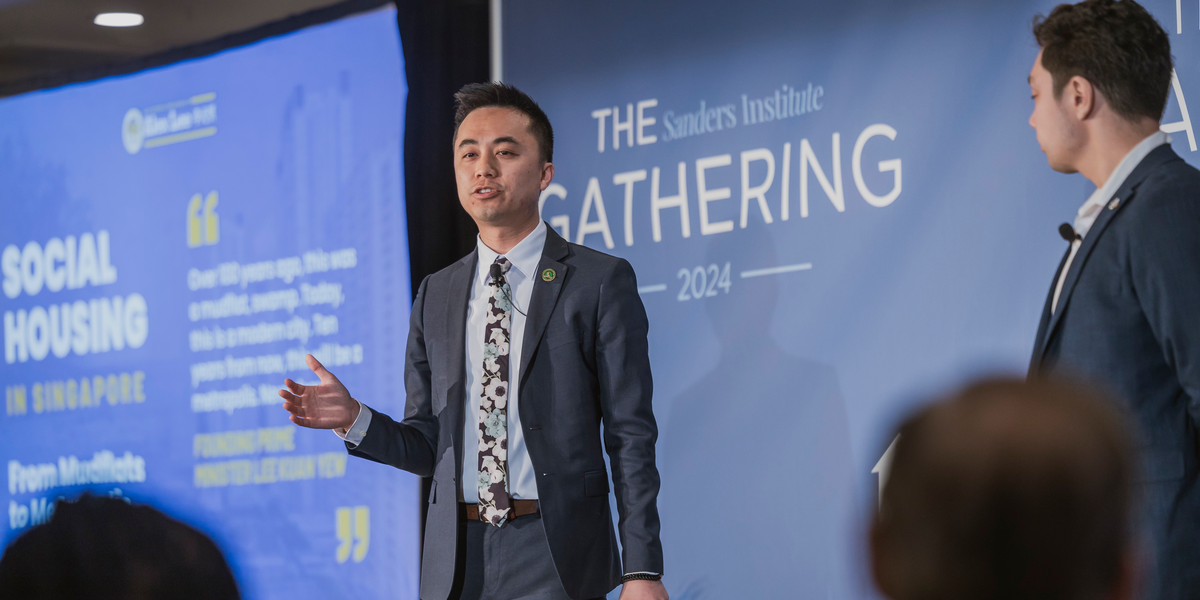
California Assemblyman Alex Lee (D-25), center, and South San Francisco Mayor James Coleman, right, present on social housing models during the event in Los Angeles on Thursday, April 4, 2024. (Photo: © Bryan Giardinelli / The Sanders Institute)
A constant theme at the event was that not only does the housing crisis demand progressive solutions, but the implementation of those solutions are themselves opportunities to revive democracy, increase social cohesion, and expand the public imagination.
In their joint presentation on social housing, California Assemblymember Alex Lee (D-25) and South San Francisco Mayor James Coleman, also a Democrat, detailed a vision for "social housing" which aims to demolish preconceived notions that tend to dominate understandings of "public housing" throughout the United States.
When it comes to defining the term "social housing," Lee explained that he likes to "keep it simple." Social housing, he said, "is beautiful, sustainable, and publicly led developed housing that is available to everyone and for everyone."
The idea of universality, he emphasized, is critical in the U.S. context where public housing is typically subsidized housing only for low-income individuals or families. Social housing models across the world provide housing across economic classes, which creates more buy-in from communities and residents.
"There's a very deliberate reason of why we stick to the term social housing," Lee said, "even though it is three letters away from a scary thing that Americans fear." But it is the term used around the world, he explained—both in highly capitalistic economies like Singapore's as well as in the various social democracies of Europe and beyond.
Because it's housing for everyone—the poor, the middle class, and even the upper-middle class—Lee and Coleman explained that "universality" and the lack of means-testing are core components of a model they believe can transform people's understanding of what's possible in this country.
"With social housing," argued Coleman, "you'll see broad spots of the public be able to look at it and say: 'That is quality housing. I want to live there. I want my children to live there and I know I'm going to be paying lower rents than market rate.' And when people start seeing that, then they're going to want to continue to invest in social housing and we won't see the decades of disinvestment that we have seen here in the United States for our public housing program."
In an interview with Common Dreams, Lee offered a parallel example.
"In America," he said, "there is no constitutional guarantee of education, yet every parent will wake up tomorrow not having a single doubt in their mind that their child will go to school." Lee acknowledged not all children go to the same kinds of school, but said that people never doubt that education will be there for their families.
"But there is not the similar sense of options in housing—people don't have that." But they should, he said, and there are models out there—not just abroad but also examples in the U.S.—that show how it could work.
Citing housing construction in the post-war years, Lee said the country has shown it's capable of amazing things when it comes to housing.
"We could end the housing crisis in four years, at true scale," said Lee. "That's why it's really important to prove that this can work at the state level, especially in a state as populous as California. If we prove the concept here, we can show nationally how it can be done."
Actor and activist Jane Fonda and community organizer Nalleli Cobo speak to the audience at The Gathering. (Photo: © Bryan Giardinelli / The Sanders Institute)During another session, actor and activist Jane Fonda presented alongside local activist Nalleli Cobo, a cancer survivor who has been fighting the oil industry that operates drilling wells in her urban neighborhood since she was a child.
Cobo, co-founder of the South Central Youth Leadership Coalition and a 2022 Goldman Environmental Prize winner for the activism that she initiated while still a teenager living in South Los Angeles, told the audience that the hard-fought victories she and her allies were able to win against the fossil fuel industry "were made possible because of a frontline community that was historically viewed as silenced, invisible, and disposable finally said: 'Enough is enough. We deserve to open our windows and our home and we deserve to breathe clean air.'"
"This is the largest crisis humanity has ever faced. We're running out of time and we have to fight back." —Jane Fonda
Living her whole life in a home neighboring a fossil fuel operation beset Cobo with health challenges throughout her childhood and ultimately led to a cancer diagnosis. Now three years in remission, she said affordable and healthy housing is something that every single member of society is entitled to.
"They may not be drilling in your community right now, but they can be unless we stand up and fight back," she said.
With nearly 3 million Californians living within a mile or less from oil and gas drilling wells, Fonda championed the courage and determination of Cobo to end this toxic practice, including with a ballot fight in California this year to ban such operations permanently.
"What Nalleli didn't tell you," Fonda told the audience when she took the podium, "is that at age 10 and 11, she and her mother had to be put into a witness protection program because of her organizing in the community to shut the oil well down; that at 19 she had to have a total hysterectomy; that her dream was to be a dancer and now that is no longer possible for her."
People must understand, Fonda said, that "the climate crisis is actually a massive health crisis" for people living in communities made toxic by fossil fuels all over the country and around the world. A cancer survivor in her own life, Fonda said she was told by someone when she threatened to tattoo the phrase "climate emergency" on her bald head if the chemotherapy took her hair that "the cancer community doesn't like to be looped in with other causes."
"Causes?!" she recalled exclaiming in response. "Honey, the climate crisis is not a cause. This is the largest crisis humanity has ever faced. We're running out of time and we have to fight back."
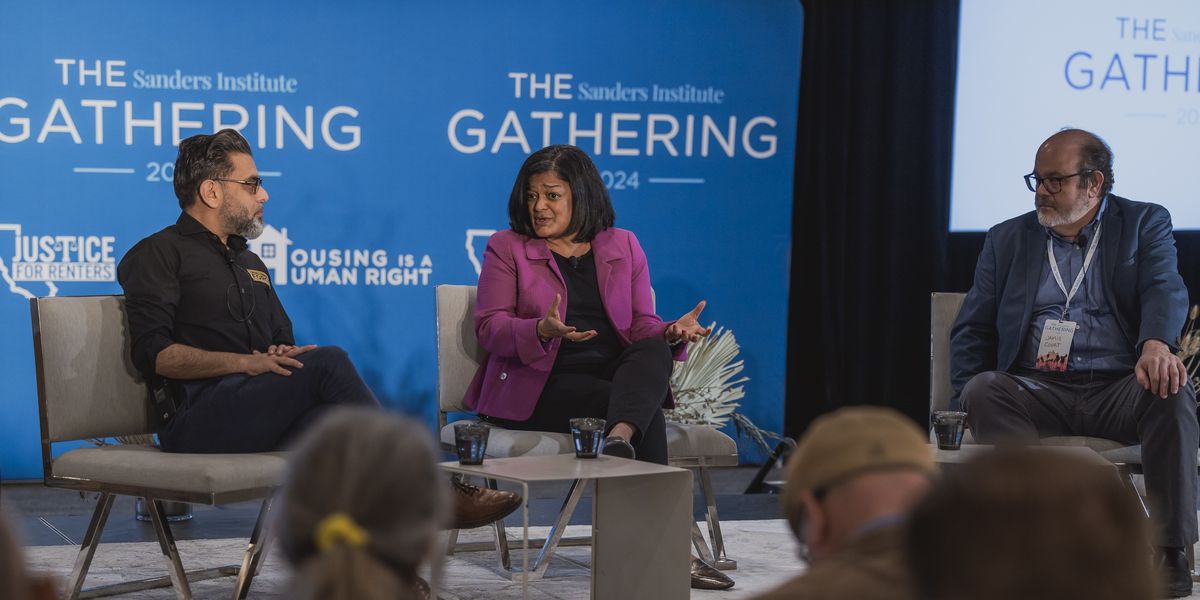
(From left): Author and labor organizer Saket Soni, Rep. Pramila Jayapal (D-Wash.), and Consumer Watchdog's Jamie Court. (Photo: © Bryan Giardinelli / The Sanders Institute)
Also on the climate front—which highlighted the intersectional style of the Sanders Institute's gathering—Congresswoman Jayapal joined with author and labor organizer Saket Soni as well as Jamie Court of the California-based Consumer Watchdog, an advocacy group, to discuss the linked issues of community resilience amid extreme weather disasters and soaring insurance costs that have arrived hand-in-hand with rising global temperatures.
While Soni in his work has been at the forefront of building up climate resilience in communities for decades—both by helping to mitigate the impact of extreme weather and also working on disaster relief and rebuilding—Jayapal explained that she has a bill in the U.S. House—called the Climate Resilience Workforce Act—that would formalize processes and establish funding to make such work a more integral part of federal, state, and local planning.
Among others, one component of the legislation would be to make sure that people in communities "disproportionately affected by climate change are actually at the table" when federal funds are dispersed.
According to the panel, the increasing impacts of climate change are a key driver of housing costs but nothing will get better without a justice lens through which to see the crisis of housing in an increasingly hotter world that is resulting in more floods, larger fires, and too little accountability for the corporate interests profiting from those extremes.
"In the context of our climate crisis," Soni explained during the panel discussion, "there is an opening for justice that Jayapal's bill is trying to take and that we're all trying to take. There is an opening where resilience is a framework that can accelerate housing justice, justice for the incarcerated, and justice for immigrants. And that's what we should all be trying to do, is look at how resilience is a real majoritarian framework—maybe one of the last ones left in our country—and inside of that there is so much consensus that we can push justice forward in many, many ways."
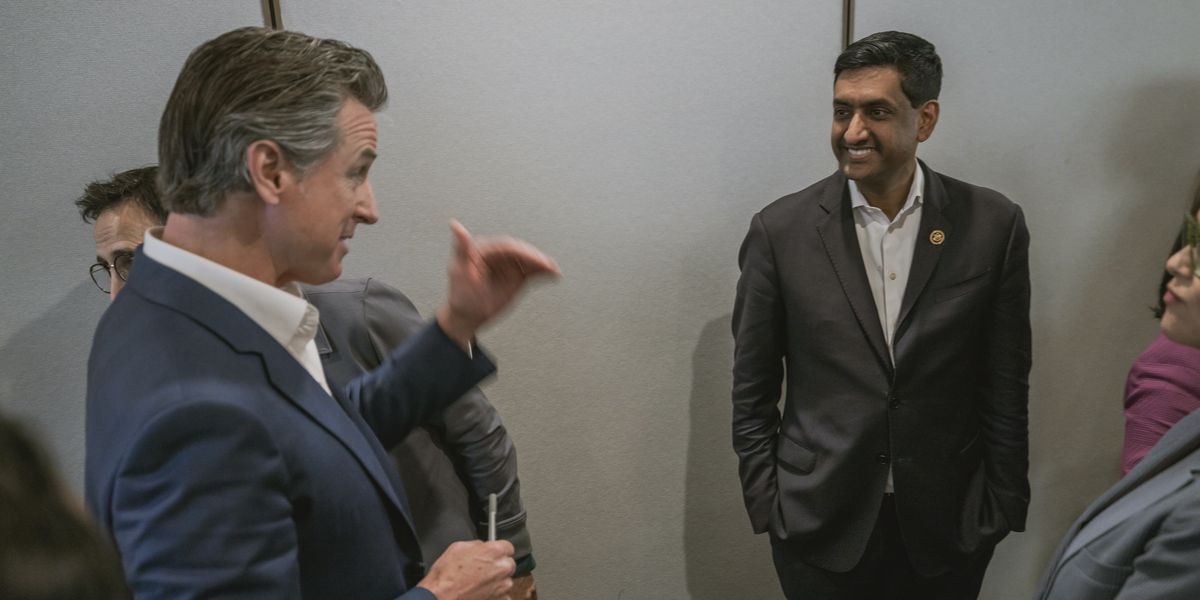
California's Democratic Gov. Gavin Newsom talks with Rep. Ro Khanna (D-Calif.) during the event in Los Angeles on Thursday, April 4, 2024. (Photo: © Bryan Giardinelli / The Sanders Institute)
On the state level, California's Democratic Gov. Gavin Newsom arrived at the event to champion the recently approved measure known as Proposition 1, which will, among other things, provide state revenue from a nearly $6.4 billion bond to build and service more treatment beds for those experiencing severe mental health and addiction disorders as a way to curb homelessness across California.
During a panel discussion with Sacramento Mayor Darrell Steinberg and California Secretary of Health & Human Services Dr. Mark Ghaly, both Democrats, Newsom said that Prop. 1 would allow for a "strike force" that could better confront the overlapping issues of housing, homelessness, mental health, and substance addiction disorders.
Acknowledging the potential for hyperbole, Newsom said he believes what's contained in the new law "are the most significant" and far-reaching "behavioral health reforms happening anywhere in the United States of America."
While the debate over Proposition 1 was heated in the state, including among progressives who landed on various sides of the initiative, a subsequent panel focused on the implementation mostly landed on the side of cautious optimism for what it could be and what kind of model it might represent.
"There is a lot of potential for Prop 1," said Dr. Margot Kushel, professor of medicine at University of California San Francisco and director of the UCSF Benioff Homelessness and Housing Initiative.
"No matter where you stood on it before it passed," Kushel added, "there is a lot of potential now that it's here and we need to exercise that in the right way, which is that we need to be sure that it is used to enable these living-in-the-community, choice-driven, client-driven, but very supportive programs for people who are suffering terribly."
The evidence for what it will take to solve the mental health crisis as it pertains to homelessness, said Kushel, is overwhelming. "You don't need me to do more studies on it," she said, "we actually just need to bring to bear that funding [supplied by Prop 1] to solve some of these really sticky funding issues so that we can create the workforce, sustain the workforce, and create the programming" that will really serve the unhoused population "with dignity" in the communities they live in.
Several researchers presented on the severe impacts that homelessness and housing insecurity have on students and young people, including those in the foster care system. Other presenters described how community land trusts and other innovative housing collaborations, including faith-based initiatives, are providing models that could be replicated nationwide. Separately, a panel focused on the struggle of homeless veterans told the harrowing tale of former U.S. soldiers denied access to housing and care in Los Angeles who remain in a protracted legal fight with the U.S. Department of Veterans Affairs over land set aside for exactly that purpose.
"We don't suffer from scarcity in this country, we suffer from greed. We have enough money to house people and to create situations where people aren't going to fear for what tomorrow's going to look like." —Rep. Pramila Jayapal
In her reflections as a presenter and participant of the gathering, Congresswoman Jayapal explained to Common Dreams that the event was significant because "it lifted up an issue that" has been central for progressives but too often ignored and neglected by those in the media and within both major political parties.
"We don't suffer from scarcity in this country. We suffer from greed," Jayapal said. "We have enough money to house people, and to create situations where people aren't going to fear for what tomorrow's going to look like."
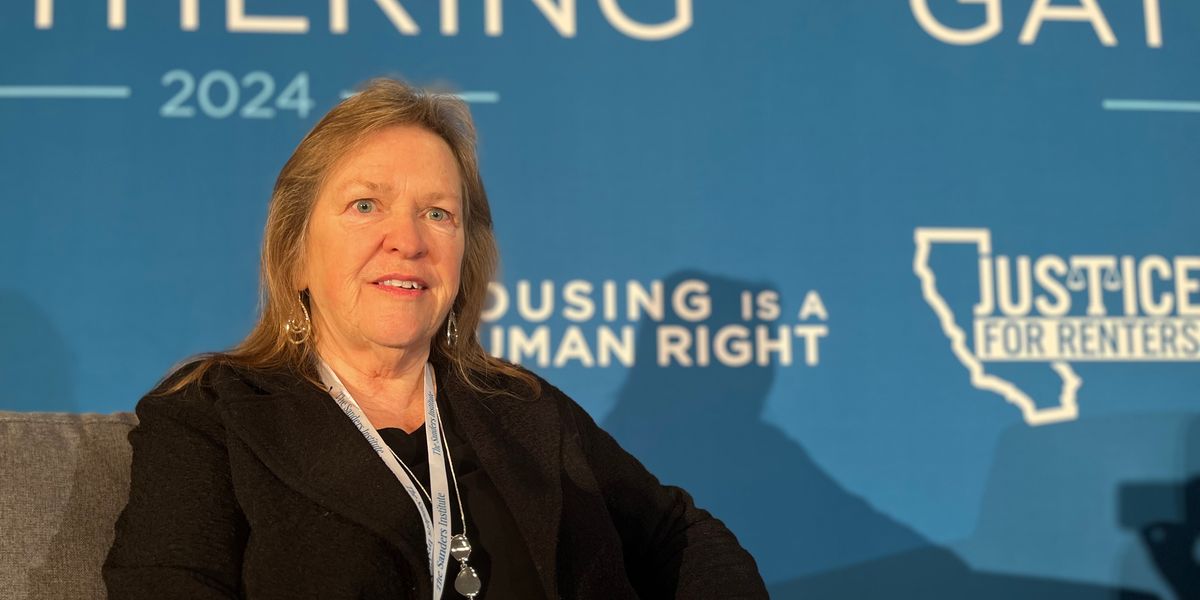
Sanders Institute co-founder Dr. Jane O'Meara Sanders in Los Angeles on Friday, April 5. "We're talking about transformational change," she said about the event. (Photo: J. Queally / Common Dreams)
The germination of the gathering, Jane Sanders explained to Common Dreams in the wake of the three days, was like "peeling back the onion" as one area of focus led to another, and a discussion with one invited expert resulted in the introduction to another.
As she realized the issue of housing was such a "hornet's nest" of intersecting issues, overlapping viewpoints, and innovative thinking, Sanders said it became increasingly clear that was exactly the reason to go forward with the event.
"We're talking about transformational change," she said of the work that she, Driscoll, and their colleagues are doing at the Sanders Institute. "None of us are very interested in making small incremental change, which might mean building some more affordable housing or supporting this or that initiative. That's not what this is about."
The Sanders Institute was initially in founded in 2018 with the goal of extending the energy, ideas, and political movement sparked during Bernie's presidential run in 2016. When the senator decided to run again in 2020, Jane and Dave decided to pause operations and then went into full hiatus when the coronavirus pandemic hit. In this context, holding an intimate housing conference in Los Angeles was conceived as a reawakening for the organization and a chance to let people know the time has now arrived to continue their original mission.
Reflecting on his experience after the gathering had concluded, Driscoll said it had been great to see so many people—whether in government or through an organization or at the grassroots level—having the chance to connect, learn from one another, and hopefully collaborate in the future.
"Sometimes this can be a lonely fight, whether or not you're fighting for housing or you're fighting for healthcare, sometimes you feel like you're not getting anywhere," he said. "But when you bring all these people together like we did over the last couple days, I felt at times a real energy in the room. People felt good about a really tough fight. So I think it inspired and fired people up, and also gave people hope for the future."
While they don't have it pinned down yet—that was the admission of the gathering—the point going forward is to clarify what the progressive agenda on housing should be and help push out to others how that fits into the broader movement for bold and lasting change.
When it comes to the opponents of such transformational proposals—national rent control, expansion of social housing, ending homelessness, or forging the Green New Deal for public housing—Driscoll said it's important that people understand powerful financial interests will fight such ideas with everything they have.
"We need to start calling people out like we did with tobacco money or with oil money," Driscoll said. "We need to start calling people out and saying, you're taking money from big real estate and developers that are causing this harm and stopping this progress." As is true in so many other areas of policy and politics, he said, following the money will be key in the battles to come.
"I don't like to call out individuals," Sanders said, "but we need to call out the system."
"It's a systematic problem that we don't say 'housing is a human right.' That's not shared in a capitalist society," she continued. "Not everybody would agree with that statement. We agree with that statement, but it's not one of those accepted truisms in this country. So what's our goal? That it become one."
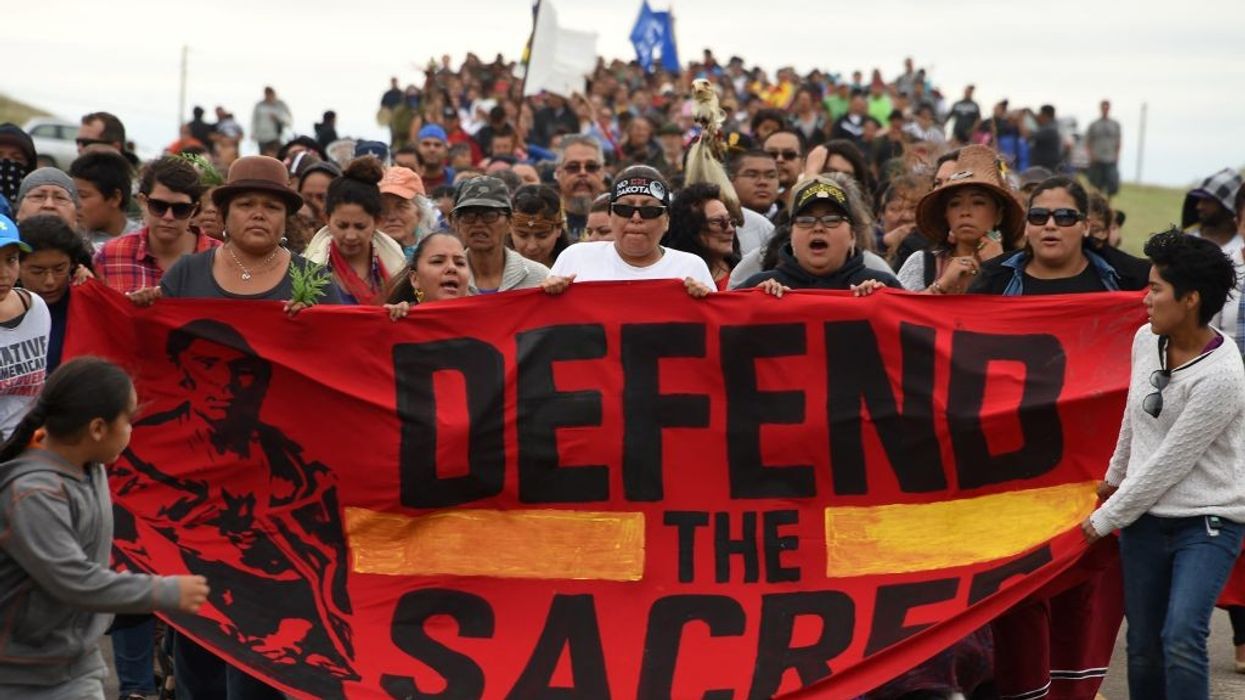
Fossil fuel companies have contributed millions of dollars to legislators who sponsored such laws, according to a new report.
In the seven years since the massive protests against the Dakota Access pipeline at Standing Rock, the fossil fuel industry and their allies in politics and law enforcement have been hard at work to prevent a repeat: Around 60% of oil and gas infrastructure in the U.S. is now shielded by anti-protest laws that make direct action much riskier for activists and frontline communities who want to protect their local and global home from dangerous pollution, a new Greenpeace report has found.
The report, Dollars vs. Democracy 2023: Inside the Fossil Fuel Industry's Playbook to Suppress Protest and Dissent in the United States, reveals that fossil fuel companies made up nine of the 10 most determined lobbyists for anti-protest measures since 2017 and that 25 oil, gas, coal, and energy companies contributed more than $5 million to legislators who sponsored these laws.
"Our current climate emergency is a direct result of the oil and gas industry’s operations," Greenpeace USA executive director Ebony Twilley Martin said in a statement. "Frontline activists should not face extreme, life-altering legal risks for putting their bodies on the line to keep our planet habitable. Oil and gas companies are finding new and dangerous ways to delay the transition to clean energy and protect their own profits."
The oil and gas industry has played an outsize role in the spread of so-called "critical infrastructure" laws. These laws impose extra penalties for campaigners who trespass on the property of pipelines and other fossil fuel infrastructure, despite the fact that states already have anti-trespass laws on the books. In 2017, Marathon Petroleum and the American Fuel and Petrochemical Manufacturers pushed the American Legislative Exchange Council (ALEC) to adopt an anti-fossil fuel protest measure as one of its "model bills." ALEC is a shadowy network of corporations and lawmakers that prepares bill templates aligned with business interests that can be easily spread from state to state.
Since 2017, 18 states have passed critical infrastructure laws that now protect around 60% of oil and gas infrastructure, and four other states have passed slightly watered-down versions of these laws. In 2023 alone, lawmakers have introduced 23 anti-protest bills in 15 states, and four states have passed anti-fossil fuel protest laws. North Carolina passed the most draconian of the year. It classifies trespassing on an energy facility as a felony punishable with up to two years in prison and attempting to “obstruct, impede, or impair the services of transmissions of an energy facility" as felonies that carry up to 19 years in prison and $250,000 in fines. Oregon, Utah, and Georgia also passed more limited anti-protest laws.
The oil, gas, and coal industry has financed the spread of these laws: Nine of the top 10 lobbyists for these bills from 2017 to 2023 were Marathon, ExxonMobil, Enbridge, TC Energy, Koch Industries, Chevron, Energy Transfer, Williams Companies, and Valero. In addition, 25 fossil fuel companies gave $5 million to lawmakers pushing these laws, with the top five donors being Duke Energy, Dominion Energy, Marathon Petroleum, BNSF Railway Co., and Koch Industries.
"It is time to stop pretending that the fossil fuel industry is so vital to our national interest that it needs to be protected from any and all criticism; nothing could be further from the truth."
"The fossil fuel industry has lobbied for these extreme anti-protest laws to shut down criticism of them," Nicholas Robinson, senior legal advisor at the International Center for Not-for-Profit Law, said in a statement. "Climate change is an urgent challenge and all Americans, including the communities most impacted by these fossil fuel projects, have a right to have their voice heard, not silenced, at this critical moment for the planet."
Pushing anti-protest laws isn't the only way that the fossil fuel industry has tried to stifle protest. It also relies on a tactic known as strategic lawsuits against public participation (SLAPP). Almost three-quarters of the 116 SLAPP lawsuits filed since 2010 came from companies that also supported anti-protest laws, among them Energy Transfer, ExxonMobil, Murray Energy Corporation, Chevron, and TransCanada.
"We at Greenpeace USA are all too familiar with these tactics," Twilley Martin explained in a statement. "We are facing a $300 million lawsuit from Energy Transfer, the company behind the Dakota Access Pipeline. Energy Transfer alleges that we organized the massive Indigenous resistance at Standing Rock. They targeted Greenpeace as a proxy for the movement as a whole. Now, the industry is watching our lawsuit—and others—to see how effective this tactic will be in silencing protest."
Other ways that the fossil fuel industry quashes protest include having their private security collaborate with law enforcement—sometimes using physically harmful tactics against demonstrators—and by working to depict land defenders and environmental activists as radicals or terrorists.
To push back against the oil-and-gas-funded attack on protest and free speech, Greenpeace offers four policy recommendations:
"It is time to stop pretending that the fossil fuel industry is so vital to our national interest that it needs to be protected from any and all criticism; nothing could be further from the truth," Greenpeace USA senior researcher Andres Chang, who wrote the report, said in a statement. "Black, Brown, Indigenous, and low-income communities are getting hit by climate change and polluting oil and gas projects first and hardest, and their voices need to be heard, not silenced."
The activist group Climate Defiance asked: "Why are we getting handcuffed while people who literally torch the planet get celebrated for their 'civility' and their 'moderation'?"
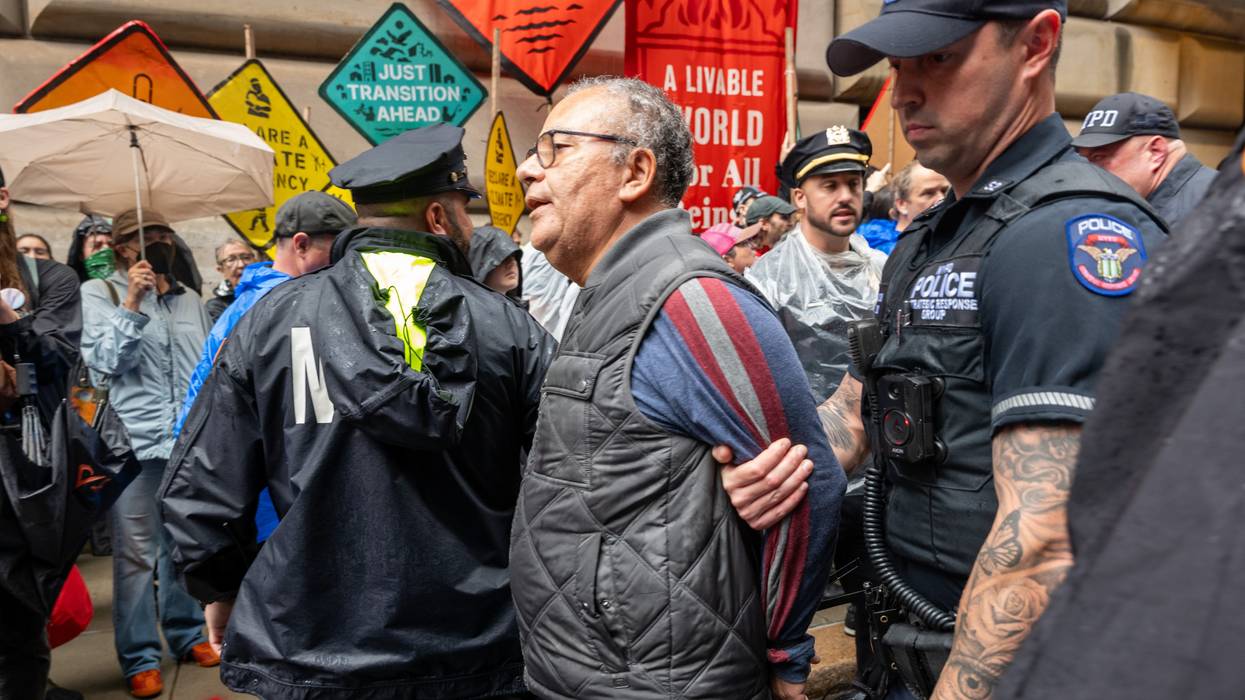
A day after tens of thousands of climate activists marched through Manhattan's Upper East Side demanding an end to oil, gas, and coal production, thousands more demonstrators hit the streets of Lower Manhattan Monday, where more than 100 people were arrested while surrounding the Federal Reserve Bank of New York to protest fossil fuel financing.
Protesters chanted slogans like "No oil, no gas, fossil fuels can kiss my ass" and "We need clean air, not another billionaire" as they marched from Zuccotti Park—ground zero of the 2011 Occupy Wall Street movement—to pre-selected sites in the Financial District. Witnesses said many of the activists attempted to reach the New York Stock Exchange but were blocked by police.
"We're here to wake up the regulators who are asleep at the wheel as they continue to let Wall Street lead us into ANOTHER financial crash with their fossil fuel financing," the Stop the Money Pipeline coalition explained on social media.
Local and national media reported New York Police Department (NYPD) officers arrested 114 protesters and charged them with civil disobedience Monday after they blocked entrances to the Fed building. Most of those arrested were expected to be booked and released.
"I'm being arrested for exercising my First Amendment right to protest because Joe Manchin is putting a 300-mile-long pipeline through my home state of West Virginia and President [Joe] Biden allowed him to do it for nothing in return," explained Climate Defiance organizer Rylee Haught on social media, referring to the right-wing Democratic senator and the Mountain Valley Pipeline.
As she was led away by an NYPD officer, a tearful Haught said Biden "sold us out."
"He promised to end drilling on federal lands, and he's selling out Appalachia's future for profit," she added.
Responding to the "block-long" line of arrestees, Climate Defiance asked: "Why are we getting handcuffed while people who literally torch the planet get celebrated for their 'civility' and their 'moderation'?"
Alicé Nascimento of New York Communities for Change told WABC that the protests—which are part of Climate Week and are timed to coincide with this week's United Nations Climate Ambition Summit—are "our last resort."
"We're bringing the crisis to their doorstep and this is what it looks like," said Nascimento.
As they have at similar demonstrations, protesters called on Biden to stop approving new fossil fuel projects and declare a climate emergency. Some had a message for the president and his administration.
"We hold the power of the people, the power you need to win this election," 17-year-old Brooklynite Emma Buretta of the youth-led protest group Fridays for Future told WABC. "If you want to win in 2024, if you do not want the blood of my generation to be on your hands, end fossil fuels."