SUBSCRIBE TO OUR FREE NEWSLETTER
Daily news & progressive opinion—funded by the people, not the corporations—delivered straight to your inbox.
5
#000000
#FFFFFF
To donate by check, phone, or other method, see our More Ways to Give page.
Daily news & progressive opinion—funded by the people, not the corporations—delivered straight to your inbox.
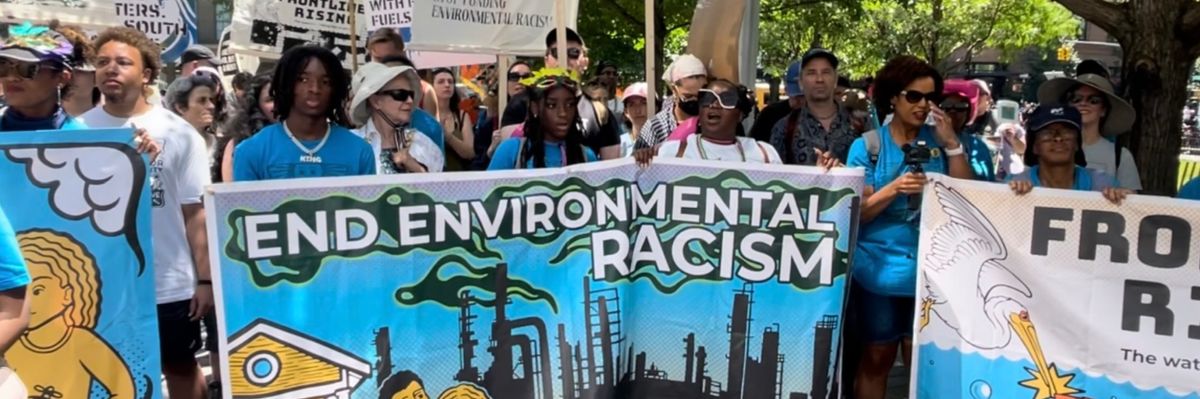
Summer of Heat on Wall Street activists march in New York City on June 28, 2024.
Scores of activists were arrested Friday during a protest outside Citigroup's New York City headquarters, where demonstrators condemned what organizers called the megabank's "racist investments devastating Black and brown communities" and fueling the worsening climate emergency.
Around 1,000 people including environmental leaders from the Gulf Coast of Texas and Louisiana gathered at Zuccotti Park in Lower Manhattan's Financial District, where they rallied before marching to "demand that Wall Street stop funding the fossil fuel projects causing environmental devastation in mostly Black and brown communities in the Gulf South and across the globe."
The march ended at Citigroup's headquarters on the west side of Lower Manhattan, where organizers from New York Communities for Change said 68 people were arrested. The group said a total of 259 activists have been arrested during ongoing Summer of Heat on Wall Street protests, which it organized along with Stop the Money Pipeline, Climate Defenders, and Planet Over Profit.
"On Monday, climate activists from the Gulf South and allies held a roving speak out in front of financial institutions backing the fossil fuel industry, including KKR, BlackRock, and Bank of America," New York Communities for Change said. "On Wednesday, protesters held a civil disobedience action in front of the insurance conglomerate Chubb, which insures petrochemical projects destroying the climate in the Gulf South and around the globe."
One of the protest's organizers, Roishetta Ozane—who founded the Vessel Project of Louisiana—said that "projects that kill our communities like Freeport LNG (liquefied natural gas), Cameron LNG, Corpus Christi LNG, and others would not exist without the backing of financial institutions like Citigroup."
"Money made from them is blood money," Ozane added. "Since they destroy our homes, we're coming to pay them a visit. We will break this cycle of violence and exploitation now because later is too late. We want Citigroup to stop funding fossil fuels and to stop hurting our communities and our families."
As Stop the Money Pipeline coordinator Alec Connon explained in an opinion piece published earlier this month by Common Dreams:
Since the adoption of the Paris agreement in 2015, Citi has provided $204.46 billion in financing to the company's most rapidly developing new coal, oil, and gas fields. Remarkably, Citi has provided more money to those oil and gas companies than even JPMorgan Chase―the bank that climate activists like to call the 'Doomsday Bank.'
To be clear, I'm talking here only about the financing Citi has provided for companies developing new oil and gas reserves, not merely investing in infrastructure to keep the oil pumping from existing reserves. When we take into account financing to all fossil fuel companies, Citi has provided a little shy of $400 billion to coal, oil, and gas companies since 2015.
Citigroup contends that it is "supporting the transition to a low-carbon economy through our net zero commitments and our $1 trillion sustainable finance goal," and that its "approach reflects the need to transition while also continuing to meet global energy needs."
However, Climate Defenders organizing director Marlena Fontes countered that "Citi's business model is frying our planet."
"Every credible climate scientist says that we can't afford to put one more penny into fossil fuels, but Citi is the number one funder of fossil fuel expansion in the world," Fontes added. "Until Citi stops funding fossil fuels, they can expect resistance from everyday people like us who want our children to be able to play outside without coughing on wildfire smoke or getting sick from deadly heatwaves."
Dear Common Dreams reader, It’s been nearly 30 years since I co-founded Common Dreams with my late wife, Lina Newhouser. We had the radical notion that journalism should serve the public good, not corporate profits. It was clear to us from the outset what it would take to build such a project. No paid advertisements. No corporate sponsors. No millionaire publisher telling us what to think or do. Many people said we wouldn't last a year, but we proved those doubters wrong. Together with a tremendous team of journalists and dedicated staff, we built an independent media outlet free from the constraints of profits and corporate control. Our mission has always been simple: To inform. To inspire. To ignite change for the common good. Building Common Dreams was not easy. Our survival was never guaranteed. When you take on the most powerful forces—Wall Street greed, fossil fuel industry destruction, Big Tech lobbyists, and uber-rich oligarchs who have spent billions upon billions rigging the economy and democracy in their favor—the only bulwark you have is supporters who believe in your work. But here’s the urgent message from me today. It's never been this bad out there. And it's never been this hard to keep us going. At the very moment Common Dreams is most needed, the threats we face are intensifying. We need your support now more than ever. We don't accept corporate advertising and never will. We don't have a paywall because we don't think people should be blocked from critical news based on their ability to pay. Everything we do is funded by the donations of readers like you. When everyone does the little they can afford, we are strong. But if that support retreats or dries up, so do we. Will you donate now to make sure Common Dreams not only survives but thrives? —Craig Brown, Co-founder |
Scores of activists were arrested Friday during a protest outside Citigroup's New York City headquarters, where demonstrators condemned what organizers called the megabank's "racist investments devastating Black and brown communities" and fueling the worsening climate emergency.
Around 1,000 people including environmental leaders from the Gulf Coast of Texas and Louisiana gathered at Zuccotti Park in Lower Manhattan's Financial District, where they rallied before marching to "demand that Wall Street stop funding the fossil fuel projects causing environmental devastation in mostly Black and brown communities in the Gulf South and across the globe."
The march ended at Citigroup's headquarters on the west side of Lower Manhattan, where organizers from New York Communities for Change said 68 people were arrested. The group said a total of 259 activists have been arrested during ongoing Summer of Heat on Wall Street protests, which it organized along with Stop the Money Pipeline, Climate Defenders, and Planet Over Profit.
"On Monday, climate activists from the Gulf South and allies held a roving speak out in front of financial institutions backing the fossil fuel industry, including KKR, BlackRock, and Bank of America," New York Communities for Change said. "On Wednesday, protesters held a civil disobedience action in front of the insurance conglomerate Chubb, which insures petrochemical projects destroying the climate in the Gulf South and around the globe."
One of the protest's organizers, Roishetta Ozane—who founded the Vessel Project of Louisiana—said that "projects that kill our communities like Freeport LNG (liquefied natural gas), Cameron LNG, Corpus Christi LNG, and others would not exist without the backing of financial institutions like Citigroup."
"Money made from them is blood money," Ozane added. "Since they destroy our homes, we're coming to pay them a visit. We will break this cycle of violence and exploitation now because later is too late. We want Citigroup to stop funding fossil fuels and to stop hurting our communities and our families."
As Stop the Money Pipeline coordinator Alec Connon explained in an opinion piece published earlier this month by Common Dreams:
Since the adoption of the Paris agreement in 2015, Citi has provided $204.46 billion in financing to the company's most rapidly developing new coal, oil, and gas fields. Remarkably, Citi has provided more money to those oil and gas companies than even JPMorgan Chase―the bank that climate activists like to call the 'Doomsday Bank.'
To be clear, I'm talking here only about the financing Citi has provided for companies developing new oil and gas reserves, not merely investing in infrastructure to keep the oil pumping from existing reserves. When we take into account financing to all fossil fuel companies, Citi has provided a little shy of $400 billion to coal, oil, and gas companies since 2015.
Citigroup contends that it is "supporting the transition to a low-carbon economy through our net zero commitments and our $1 trillion sustainable finance goal," and that its "approach reflects the need to transition while also continuing to meet global energy needs."
However, Climate Defenders organizing director Marlena Fontes countered that "Citi's business model is frying our planet."
"Every credible climate scientist says that we can't afford to put one more penny into fossil fuels, but Citi is the number one funder of fossil fuel expansion in the world," Fontes added. "Until Citi stops funding fossil fuels, they can expect resistance from everyday people like us who want our children to be able to play outside without coughing on wildfire smoke or getting sick from deadly heatwaves."
Scores of activists were arrested Friday during a protest outside Citigroup's New York City headquarters, where demonstrators condemned what organizers called the megabank's "racist investments devastating Black and brown communities" and fueling the worsening climate emergency.
Around 1,000 people including environmental leaders from the Gulf Coast of Texas and Louisiana gathered at Zuccotti Park in Lower Manhattan's Financial District, where they rallied before marching to "demand that Wall Street stop funding the fossil fuel projects causing environmental devastation in mostly Black and brown communities in the Gulf South and across the globe."
The march ended at Citigroup's headquarters on the west side of Lower Manhattan, where organizers from New York Communities for Change said 68 people were arrested. The group said a total of 259 activists have been arrested during ongoing Summer of Heat on Wall Street protests, which it organized along with Stop the Money Pipeline, Climate Defenders, and Planet Over Profit.
"On Monday, climate activists from the Gulf South and allies held a roving speak out in front of financial institutions backing the fossil fuel industry, including KKR, BlackRock, and Bank of America," New York Communities for Change said. "On Wednesday, protesters held a civil disobedience action in front of the insurance conglomerate Chubb, which insures petrochemical projects destroying the climate in the Gulf South and around the globe."
One of the protest's organizers, Roishetta Ozane—who founded the Vessel Project of Louisiana—said that "projects that kill our communities like Freeport LNG (liquefied natural gas), Cameron LNG, Corpus Christi LNG, and others would not exist without the backing of financial institutions like Citigroup."
"Money made from them is blood money," Ozane added. "Since they destroy our homes, we're coming to pay them a visit. We will break this cycle of violence and exploitation now because later is too late. We want Citigroup to stop funding fossil fuels and to stop hurting our communities and our families."
As Stop the Money Pipeline coordinator Alec Connon explained in an opinion piece published earlier this month by Common Dreams:
Since the adoption of the Paris agreement in 2015, Citi has provided $204.46 billion in financing to the company's most rapidly developing new coal, oil, and gas fields. Remarkably, Citi has provided more money to those oil and gas companies than even JPMorgan Chase―the bank that climate activists like to call the 'Doomsday Bank.'
To be clear, I'm talking here only about the financing Citi has provided for companies developing new oil and gas reserves, not merely investing in infrastructure to keep the oil pumping from existing reserves. When we take into account financing to all fossil fuel companies, Citi has provided a little shy of $400 billion to coal, oil, and gas companies since 2015.
Citigroup contends that it is "supporting the transition to a low-carbon economy through our net zero commitments and our $1 trillion sustainable finance goal," and that its "approach reflects the need to transition while also continuing to meet global energy needs."
However, Climate Defenders organizing director Marlena Fontes countered that "Citi's business model is frying our planet."
"Every credible climate scientist says that we can't afford to put one more penny into fossil fuels, but Citi is the number one funder of fossil fuel expansion in the world," Fontes added. "Until Citi stops funding fossil fuels, they can expect resistance from everyday people like us who want our children to be able to play outside without coughing on wildfire smoke or getting sick from deadly heatwaves."