

SUBSCRIBE TO OUR FREE NEWSLETTER
Daily news & progressive opinion—funded by the people, not the corporations—delivered straight to your inbox.
5
#000000
#FFFFFF
To donate by check, phone, or other method, see our More Ways to Give page.
Daily news & progressive opinion—funded by the people, not the corporations—delivered straight to your inbox.
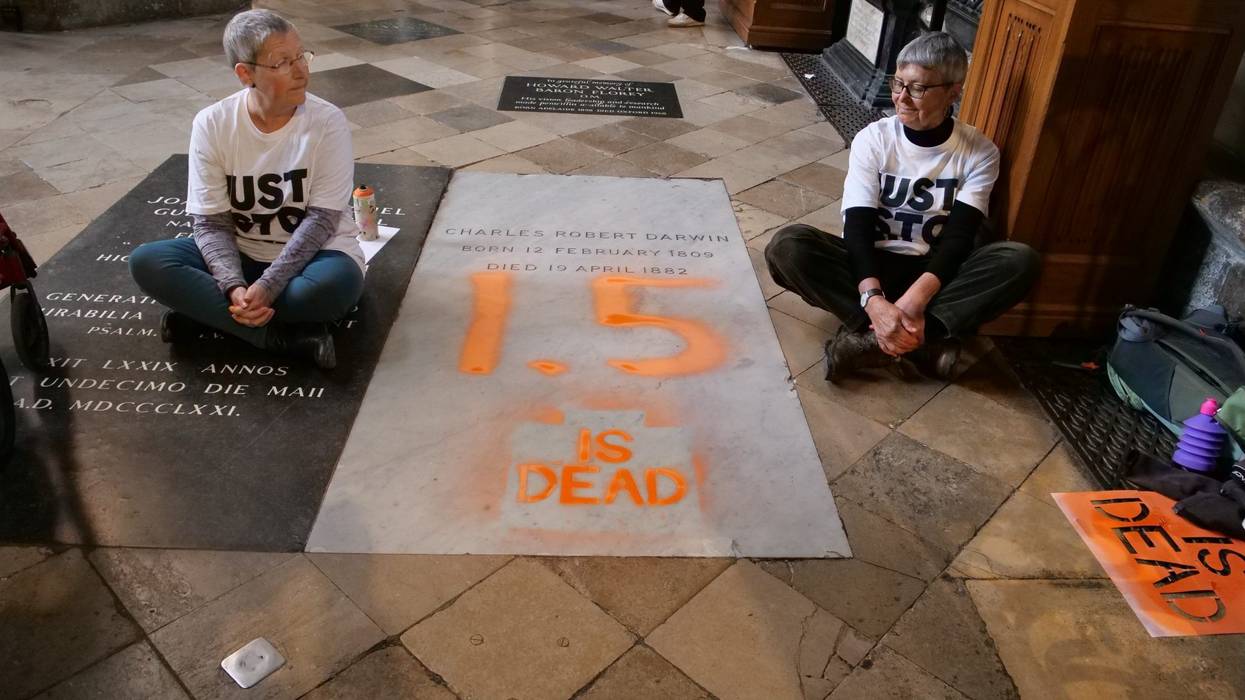
"We've done this because there's no hope for the world, really," said one of the activists who participated.
Two activists with the group Just Stop Oil on Monday used orange spray chalk paint to write "1.5 Is Dead" on the gravestone of Charles Darwin—the scientist most famous for developing the theory of evolution by natural selection.
In a statement released Monday, Just Stop Oil, a British group demanding an end to fossil fuel use, said that the action was taken in order to "demand that the U.K. government works with others to phase out the extraction and burning of fossil fuels by 2030."
The BBC reported that Met Police were called to the incident in Westminster Abbey in London and said two women were arrested on suspicion of causing criminal damage.
The message "1.5 Is Dead" is in reference to the news on Friday that 2024 was "the first year with an average temperature clearly exceeding 1.5°C above the pre-industrial level," according to the European Union's Copernicus Climate Change Service (C3S). 2024 was 1.60°C warmer than the pre-industrial level.
Signatories to the Paris climate agreement pledged to reduce their global greenhouse gas emissions with the aim of keeping global temperature rise this century to 1.5ºC, well below 2°C above preindustrial levels. According to the United Nations, going above 1.5ºC on an annual or monthly basis doesn't constitute failure to reach the agreement's goal, which refers to temperature rise over decades—however, "breaches of 1.5°C for a month or a year are early signs of getting perilously close to exceeding the long-term limit, and serve as clarion calls for increasing ambition and accelerating action in this critical decade."
The news comes as California is reeling from multi-day wildfires that have consumed tens of thousands of acres of Los Angeles County and killed over 20 people.
"We've done this because there's no hope for the world, really," said one of the activists who was arrested, Di Bligh. "We've done it on Darwin's grave specifically because he would be turning in that grave because of the sixth mass extinction taking place now," the activist said, according to the BBC.
The other protestor, Alyson Lee, said she did not think Darwin would be unhappy with their act of climate protest: "I believe he would approve because he was a good scientist and he would be following the science, and he would be as upset as us with the government for ignoring the science."
Two Just Stop Oil activists were arrested in England last summer after they sprayed an orange powder on the monoliths at Stonehenge. According to a statement released at the time from Just Stop Oil, the protestors "decorated" Stonehenge to demand that the U.K. government commit to "working with other governments to agree an equitable plan to end the extraction and burning of oil, gas, and coal by 2030."
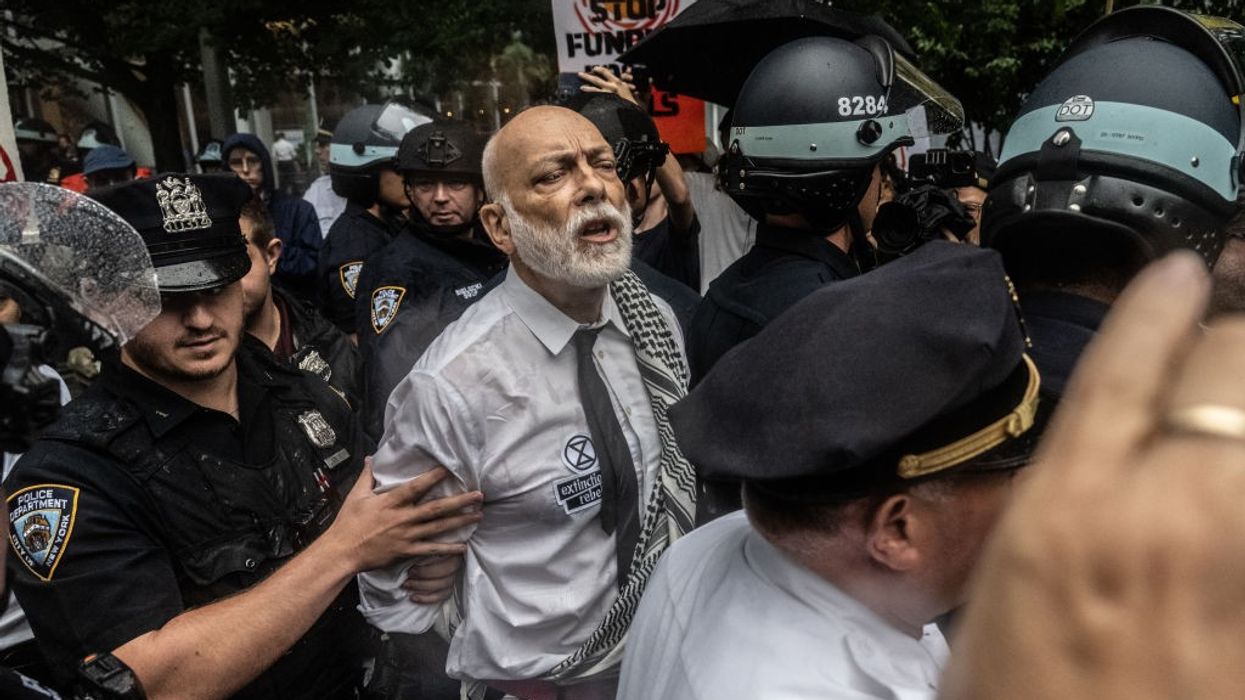
On both sides of the Atlantic, volleys of laws threatening long-term imprisonment for nonviolent dissent are being put on the books to cow the climate movement into silence. Trump promises to go further.
In August, climate activist and cellist John Mark Rozendaal was arrested and charged with criminal contempt for playing a few minutes of Bach outside Citibank’s headquarters in New York City. Rozendaal, 63, was prominent in the “Summer of Heat on Wall Street” campaign that targeted Citibank for its prolific financing of fossil-fuel projects. He and a co-defendant now face up to seven years imprisonment if convicted.
Meanwhile in Atlanta, more than 50 justice and environmental activists are awaiting trial on domestic terrorism and other charges arising from their years-long defense of the city’s South River Forest against the construction of an 85-acre police training center there. They are being prosecuted under Georgia’s Racketeer Influenced and Corrupt Organization (RICO) law. Any of them found guilty of “racketeering” would have five to 20 years of imprisonment added to their sentences for the alleged underlying crimes.
Such situations are symptomatic of a grim trend in both the United States and Europe. Nonviolent, nondestructive climate protest is increasingly being subjected to criminal prosecution, while punishments are being ratcheted up to levels befitting violent and far more serious crimes.
The state abuses described in this article should be considered a preview of what is almost guaranteed to be even worse to come if Donald Trump does indeed retake the White House and the Republicans win majorities in the House and Senate.
Across the Global South, such environmental protests are all too often being met by corporate and state forces with extreme extrajudicial violence, especially in Indigenous communities. Here in the Global North, however, the clampdown on protest has largely been through legal action, at least so far. But that might—especially in an America with Donald Trump as its president again—only be a prelude to more violent kinds of suppression as global warming accelerates.
For embattled American climate activists, this trend further raises the stakes of the November 5 election. The crackdowns on climate protest are so far being carried out by state and local governments. But the state abuses described in this article should be considered a preview of what is almost guaranteed to be even worse to come if Donald Trump does indeed retake the White House and the Republicans win majorities in the House and Senate. As recently as October 13, in fact, Trump insisted that, once back in the White House, he’d call in the military to quash domestic dissent of any sort.
In addition, a Trumpian Congress would be likely to pass laws gutting federal climate policies and imposing extreme penalties on future climate protesters. Both prospects also feature prominently in the Heritage Foundation’s Project 2025, produced in part by a gaggle of former Trump officials. That now-infamous blueprint for his possible second administration calls explicitly for—as the Center for American Progress describes it—“suppressing dissent and fomenting political violence.” Among other things, Project 2025 suggests that a future President Trump could invoke the Insurrection Act of 1807, which would indeed allow him to use the military to punish lawful nonviolent protest. And count on it, he’s almost certain to exploit that act if he does indeed become president again.
Since 2016, 21 states have passed a total of 56 laws criminalizing protest or dramatically increasing the penalties for engaging in it. To be sure, John Mark Rozendaal was arrested in New York, a city located in a blue state, but all the states that have adopted new anti-protest laws are governed by Republican-majority legislatures. And the specific activity most frequently targeted for prosecution is protesting the construction or existence of oil and gas pipelines. (Note that all state laws mentioned below are described in detail in a recent report by the International Center for Not-For-Profit Law, or ICNL.)
The state of Alabama, for example, can now punish a person who simply enters an area containing “critical infrastructure,” including such pipelines, with up to a year in jail and a fine of up to $6,000. If you go near a pipeline in Arkansas, you’re at significantly higher risk: imprisonment of up to six years and a $10,000 fine. Impeding access to a pipeline or a pipeline construction site in Mississippi carries a sentence of up to seven years. Do that in North Carolina as a member of a group and you’ve got even bigger problems. As the ICNL reports, “[A] group of people protesting the construction of a fossil fuel pipeline could face more than 15 years in prison and a mandatory $250,000 fine if they impede or impair the construction of a pipeline.”
Even as protest is being criminalized, assaulting protesters by car is, in effect, being decriminalized.
Many such sentences for protesting are wildly disproportionate to the severity of the act committed. In Florida, trespassing on property that contains pipelines can result in up to five years imprisonment, compared to only 60 days for trespassing just about anywhere else. Enter a pipeline facility in Ohio with the intention of tampering with it in any way and face a potential ten-year sentence. Simply spraying graffiti on an Ohio pipeline installation can carry a six-year sentence, while anyone who “conspires” with the person creating such graffiti could be fined an eye-popping $100,000.
Many climate marches or demonstrations involve walking or standing in roadways. Politicians have been exploiting the fact that “automobile supremacy is inscribed in law by every branch of government and at every level of authority” (in the words of law professor Gregory Shill) to pass highly punitive measures against street protests with little fear of having them overturned. In effect, the laws privilege fossil-fueled vehicles over the human beings who speak out against them.
In May, the Tennessee legislature passed a law that mandates a prison sentence of 2 to 12 years for protesters convicted of knowingly obstructing roadways. In Florida, groups of 25 or more protesters impeding traffic can be charged with “rioting” and face up to 15 years imprisonment. Anyone in Louisiana who does no more than help plan a protest that would impede traffic can be charged with conspiracy or with “aiding and abetting,” even if the protest ends up not hindering traffic or not occurring at all.
In Iowa, being on the street or sidewalk during a vociferous but nonviolent protest can cost you five years in prison, yet (believe it or not) a driver who runs into you during a protest, causing injury, is immune from civil liability if that driver can convince authorities that he or she had taken “due care.”
Laws that permit drivers to run into or over pedestrians engaged in protest have been passed in four states. Three of those laws hit the books in 2021 in the midst of a 16-month period during which American drivers deliberately rammed into groups of protesters a whopping 139 times, according to a Boston Globe analysis. Three victims were killed and at least 100 injured. Drivers were criminally charged in fewer than half of the ramming incidents and in only four was a driver actually convicted of a felony. In other words, even as protest is being criminalized, assaulting protesters by car is, in effect, being decriminalized.
Finally, Louisiana can file RICO charges against people who, as part of a “tumultuous” demonstration, block roads or damage oil or gas pipelines. And protesters beware, since that state’s RICO law carries the possibility of 50 years in prison at hard labor and a $1 million fine. (And yes, you read that right!)
Many laws that impose severe penalties for protest were passed in the wake of the Indigenous-led campaign against the Dakota Access oil pipeline in 2016-2017. Hundreds of people were arrested in that struggle. More than 700 protesters with the Indigenous Environment Network have been criminalized for their untiring efforts to impede or halt pipeline projects across North America.
If the dozens of state anti-protest laws display many suspicious similarities, that’s no coincidence. In response to pipeline protests, oil and gas companies teamed up with the American Legislative Exchange Council, which draws up “model legislation” for Republicans in statehouses across the country to use as templates for bills that push various corporate and hard-right priorities. Once this genre of legislation was directed toward on-site pipeline protests and passed in state after state, it was also seized upon to criminalize street marches and demonstrations, including those against racist violence, fossil fuels, and other ills—all with “traffic safety” as a pretext.
Following the lead of their kindred state legislators, Republicans in Congress have proposed their own raft of bills criminalizing protest. Fortunately, they haven’t succeeded in getting any of them passed—yet. Many of the bills were prompted by campus protests against U.S.-supported genocide in Gaza or over climate policy and against the fossil-fuel industry.
Some of the congressional bills amounted to less-than-serious grandstanding. One, for instance, would have required a person convicted of “unlawful activity” on a university campus at any time since last October 7 to perform six months of “community service” in Gaza. But there were also dead-serious bills like the one prescribing a prison sentence of up to 15 years for inhibiting traffic on an interstate highway. Other proposed bills would have withheld federal funding (in one case, even pandemic aid) from states that refused to prosecute people who took part in protests on public roadways.
Punitive measures against climate protest are reaching new extremes in Europe, too. Since the British Parliament passed harsh new anti-protest laws in 2022, more than 3,000 activists associated with the Just Stop Oil movement have been arrested. According to CNN, “Most of those arrests have been for planning or carrying out direct actions, including slow marching,” which impedes traffic.
In response to such repression, Michel Forst, the United Nations Special Rapporteur on Environmental Defenders, wrote that under the Aarhus Convention (a 1998 agreement most European countries have signed but not the United States), “Whether intended or not, any disruptions that [environmental] actions may cause, such as traffic jams or disturbances to normal economic activity, does not remove the protection for the exercise of fundamental rights during such action under international human rights law.”
In defiance of that principle, the new British laws prescribe a sentence of up to 10 years imprisonment for those convicted of planning protests judged to be a “public nuisance” (which often means disrupting traffic). Such prison terms, noted CNN, are comparable to those for aggravated robbery or rape under British law.
When the climate change group Extinction Rebellion announced an action near The Hague in September 2023, more than 10,000 people of all ages showed up. They’d come to protest the more than $40 billion in subsidies that the Netherlands government gives fossil fuel companies annually. The police blasted the crowd with water cannons, then arrested and hauled away 2,400 protesters, including children.
The group Climate Rights International (CRI) reports that “some democratic countries are even taking measures designed to stop peaceful climate protests before they start.” In June 2023, for instance, German police detained an activist before he could even leave his home to join a climate protest. Five months earlier, a Dutch activist was held in custody for two days to keep him from an action by Extinction Rebellion. He ended up being convicted of sedition (yes, sedition!) for encouraging others to attend the protest. None of that sounds like something “democratic countries,” as CRI called them, should be doing.
People charged with nonviolent protest often invoke the “necessity defense,” declaring that they committed a minor law violation to stop a far greater crime. Unfortunately, that defense almost never succeeds and judges often forbid defendants from even explaining their motives during a trial.
That’s what happened to members of the group Insulate Britain who stood trial this year for a climate protest that disrupted traffic by nonviolently occupying streets and climbing onto overpasses along a major London ring road in 2022. The judge presiding over their trials ordered the defendants not to mention climate change in court. Several of the activists defied that order, citing the climate emergency as their motivation, so the judge promptly held them in contempt of court and sent two of them to jail for seven weeks.
One of the protesters cited for contempt, Nick Till, told CRI that, while trying to bar him and the others from explaining the purpose of their actions, the judge allowed the prosecutors to depict the defendants as threats to society. “There’s an attempt to insinuate we’re a ‘cell,’” Till said, “which is language that implies some kind of revolutionary group. They had an expert in counterterrorism testify. They tried to portray us as dangerous extremists.”
Though also being threatened with increasing penalties under state laws, Americans have somewhat stronger protections under the First Amendment.
In July, four people who planned the London protests were convicted and sentenced to a draconian four years in prison. A fifth defendant, Roger Hallam, one of the most prominent British climate activists, was sentenced to five years even though, bizarrely enough, he was neither a planner of the protest nor a participant. He was charged instead for a speech he gave regarding civil disobedience as an effective form of climate action in a Zoom call with that protest’s planners.
In their trial, the five defendants represented themselves. Over the course of four days, with the judge repeatedly trying and failing to silence them, they presented what could be the most extensive and compelling version of the necessity defense ever heard in a courtroom. (Later, in his prison cell, Hallam wrote up an account of the trial. It’s well worth reading.)
On both sides of the Atlantic, volleys of laws threatening long-term imprisonment for nonviolent dissent are being put on the books to cow the climate movement into silence. So far, European protesters who dare to resist are getting hit hardest with convictions and sentences. Though also being threatened with increasing penalties under state laws, Americans have somewhat stronger protections under the First Amendment. But how long will dissent continue to enjoy such protections in this country? That largely depends on how we all vote between now and November 5.
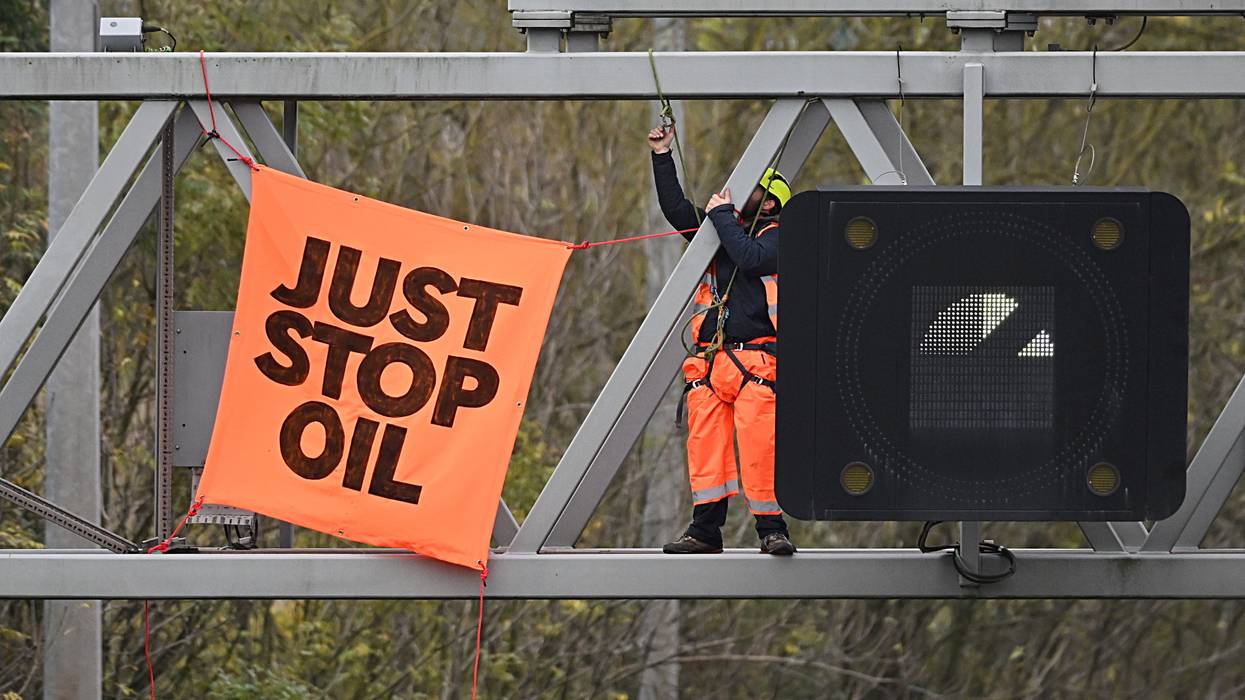
"Rulings like today's set a very dangerous precedent, not just for environmental protest but any form of peaceful protest," a U.N. official said.
In a decision that one United Nations official called "beyond comprehension," a U.K. judge on Thursday sentenced five Just Stop Oil activists to a combined 21 years in prison over a Zoom call in which they discussed plans to disrupt London's orbital M25 highway.
The sentences are believed to be the longest on record for nonviolent protest in U.K. history, The Guardian reported.
"The sentences handed to the five Just Stop Oil campaigners are utterly disproportionate," environmentalist and author George Monbiot wrote on social media. "Four and five years in prison for peaceful protest? This is what you might expect in Russia or Egypt, not in a supposed democracy."
"Why are we punishing the people trying to prevent disaster while allowing the oil company giants causing it to reap super profits?"
The five activists—Roger Hallam, Daniel Shaw, Louise Lancaster, Lucia Whittaker De Abreu, and Cressida Gethin—were found guilty last week of conspiring to cause a public nuisance due to a four-day direct action protest on the M25 that Just Stop Oil ultimately held in November 2022. All of the defendants participated in a Zoom call in which they planned to recruit volunteers for the protest, which was intended to pressure the U.K. government to end oil and gas exploration in the North Sea, a policy that the incoming Labour government has now adopted. The Zoom call had been infiltrated by a Sun journalist, who shared its contents with the Metropolitan Police.
On Thursday, Judge Christopher Hehir sentenced Hallam to five years in prison and Shaw, Lancaster, De Abreu, and Gethin to four each.
The sentences sparked outrage from humans rights advocates and environmental campaigners.
Michel Forst, U.N. special rapporteur on environmental defenders who also observed part of the trial, said the sentencing "marks a dark day for peaceful environmental protest, the protection of environmental defenders, and indeed anyone concerned with the exercise of their fundamental freedoms in the United Kingdom."
Forst added: "Rulings like today's set a very dangerous precedent, not just for environmental protest but any form of peaceful protest that may, at one point or another, not align with the interests of the government of the day."
Former Green Party leader and Member of Parliament Caroline Lucas called the sentences "obscene."
"Why are we punishing the people trying to prevent disaster while allowing the oil company giants causing it to reap super profits?" she asked on social media.
Current Deputy Leader of the Green Party Zack Polanski said: "'Conspiracy to commit a public nuisance' is a deeply authoritarian description that should send shivers down the spine of all of us who want to live in a free society. Even worse when the real crime is consecutive governments who have played down the climate emergency."
Campaigners and experts also criticized the trial itself, in which Hehir did not allow the defendants to present evidence about the climate crisis to explain their actions.
"Defendants should be allowed to explain why they have decided to use nonconventional but yet peaceful forms of action, like civil disobedience, when they engage in environmental protest," Forst
told The Guardian after attending part of the trial.
Bill McGuire, emeritus professor of geophysical and climate hazards at University College London—who Hehir did not allow the defendants to call as a witness—called the trial and verdict a "farce."
"They mark a low point in British justice, and they were an assault on free speech," McGuire in a statement said Thursday. "The judge's characterization of climate breakdown as a matter of opinion and belief is completely nonsensical and demonstrates extraordinary ignorance. Similarly to suggest that the climate emergency is irrelevant in relation to whether the defendants had a reasonable case for action is crass stupidity."
The verdict and sentencing also come amid an increasing crackdown on climate protest, both globally and in the U.K. The previous longest known civil disobedience sentences in the country were also for Just Stop Oil activists.
"The U.K. is a nightmare for climate activists from this point of view, in the sense that the sentences imposed in other countries are neither that harsh, nor that widespread," Forst said July 12.
Greenpeace U.K.'s program director Amy Cameron said on Thursday: "These sentences are not a one-off anomaly but the culmination of years of repressive legislation, overblown government rhetoric, and a concerted assault on the right of juries to deliberate according to their conscience. It's part of the mess the Labour government has inherited from its predecessor, and they must fix it by giving back to people the right to protest that's been slowly being taken away from them."
Forst also called on the new government to reverse course.
"Given the gravity of the situation, I urge the new United Kingdom government, with absolute urgency and without undo delay, to take all necessary steps to ensure that Mr. Shaw's sentence is reduced in line with the United Kingdom's obligations under the Aarhus Convention," Forst wrote on Thursday.
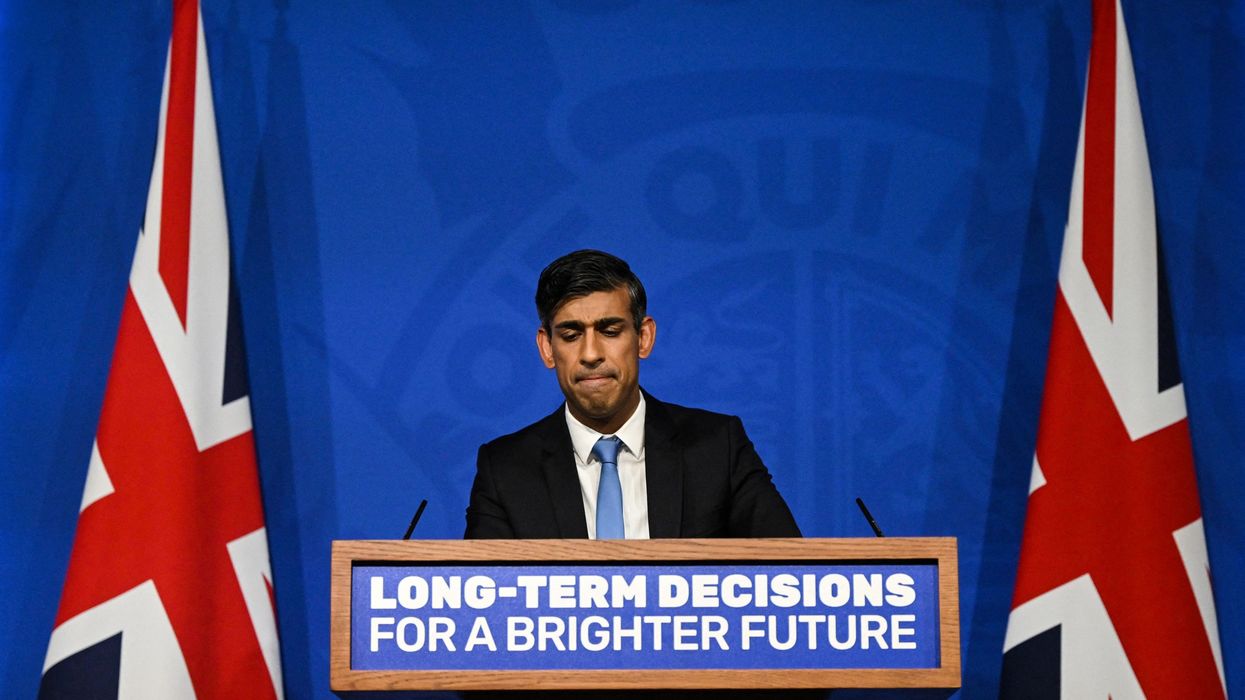
"Sunak's U-turn today will be devastating for the people of the U.K. and for the planet we call home," warned one Scottish Green. "It's nothing short of evil."
Critics across the political spectrum—from Conservative members of Parliament and corporations to Greens and climate campaigners—reacted with anger and resolve Wednesday following the announcement by U.K. Prime Minister Rishi Sunak that his Tory government would retreat from some of its key net-zero commitments.
Speaking Wednesday at the Downing Street Press Briefing Room in London, Sunak said his government is still committed to reaching net-zero by 2050, but in a "more proportionate way" that would bring a "greener planet and a more prosperous future."
The rollback will reportedly include delaying a ban on the sale of petrol- and diesel-powered vehicles from 2030 to 2035, pushing back the phaseout of gas boilers, scrapping energy efficiency targets for some homes, dropping recycling plans, and canceling a planned air travel tax.
"This is a U-turn that will leave the Tories facing in the opposite direction of almost everyone, and finally end their hopes of reelection."
"No one can deny climate change is happening," Sunak said, adding that the county needs "sensible green leadership" instead of false choices that "never go beyond a slogan."
However, Conservative peer Lord Zac Goldsmith—who resigned his ministerial post earlier this summer due to what he called Sunak's climate "apathy"—called the prime minister's reversal "a moment of shame."
"His short stint as PM will be remembered as the moment the U.K. turned its back on the world and on future generations," he added.
Shadow Climate Secretary Ed Miliband led Labour condemnation of the reversal, which he called "a complete farce from a Tory government that literally does not know what they are doing day to day."
Brighton Pavilion Green MP Caroline Lucas slammed what she called Sunak's "coordinated, calculated, and catastrophic rollback."
"What this all reveals is that Sunak really doesn't seem to care about the climate in the slightest—it's little more than an afterthought," Lucas wrote in a Guardian opinion piece published Wednesday.
Sunak must call a general election by January 2025, and his Tories are trailing the opposition Labour Party in opinion polls amid persistently high inflation, slow economic growth, and rising inequality.
"If Sunak mistakenly thinks the climate is merely a political device to draw dividing lines between his party and Labour, he will fail on his own terms," wrote Lucas. "All it will do is draw an ever-greater divide between him and the people he seeks to govern."
Climate campaigners roundly condemned Sunak's decision.
"The government needs to double down now, not U-turn," Kennedy Walker, a U.K. organizer with the climate action group 350.org, said in a statement. "We have the opportunity to show what a transition to a greener economy that works for people and the planet can look like; we need to hold leadership to account to make sure it happens and they follow through on their own promises."
Riffing on the government's "long-term decisions for a brighter future" slogan, Extinction Rebellion U.K. wrote on the social media site X: "Short-term decisions for a shitter future. Remember, this government took £3.5 million in donations from Big Oil and other industries before licensing new gas and oil."
Many companies including automaker Ford and energy giant E.ON joined in criticism of the rollback.
"Our business needs three things from the U.K. government: ambition, commitment, and consistency. A relaxation of 2030 would undermine all three," Ford U.K. chair Lisa Brankin said Wednesday. "We need the policy focus trained on bolstering the EV market in the short term and supporting consumers while headwinds are strong: infrastructure remains immature, tariffs loom, and cost-of-living is high."
Some critics noted that Sunak's announcement came on the same day the leaders of many nations—but not Britain or the world's two top carbon polluters, China and the United States—gathered in New York for the United Nations Climate Ambition Summit.
"We're in a climate emergency. The deadly impacts of climate change are here now and we have to act urgently," Labour London Mayor Sadiq Khan—the only U.K. speaker at the summit—told The Guardian Wednesday. "We have seen record high temperatures in London earlier this month and the hottest ever July. Over the last two years, we have experienced unprecedented wildfires and flash floods, destroying homes and livelihoods."
"This government's response flies in the face of common sense and shows they are climate delayers," Khan added. "It beggars belief that not only are they watering down vital commitments, but they are also passing up the opportunity to create green jobs, wealth, and lower energy bills—as well as failing to give investors the certainty they need to boost the green economy."
Sunak's reversal also infuriated many people in Scotland.
"Rishi Sunak has blood on his hands," National Union of Students Scotland president and Scottish Young Greens co-convener Ellie Gomersall told The National. "His excuse? It's too costly. Well then all the more kudos to the Scottish government who are still moving forward with net-zero policies like low-emission zones, phasing out gas boilers, cheaper public transport, all the while on a budget severely restrained by the confines of devolution."
"And of course when the Scottish government does try to implement simple yet effective measures like a deposit return scheme, Westminster comes along and blocks it," she added. "Sunak's U-turn today will be devastating for the people of the U.K. and for the planet we call home. It's nothing short of evil."
Alistair Heather, a Scottish writer and TV presenter, told The National that he was "almost pleased" by Sunak's announcement.
"This is a U-turn that will leave the Tories facing in the opposite direction of almost everyone, and finally end their hopes of reelection," he explained. "For mainstream voters, who understand that a clear, urgent movement of travel towards a green future is the best chance we have of mitigating the worst effects of the climate collapse, the Tories have made themselves completely unelectable. Good... Fuck the Tories. Mon the independence."
"With the Left AWOL, our species is being quick-marched to extinction."
The outrage was felt far beyond U.K. shores.
"At a time when the U.K. should be providing global leadership in transitioning off fossil fuels, especially in recognition of the impact its historical emissions have had in bringing about the climate crisis, the U.K. government is considering backtracking on already insufficient commitments," 350.org Europe regional director Nicolò Wojewoda said in a statement.
Yanis Varoufakis, a former Greek finance minister who heads the left-wing MeRA25 party, wrote on X that "Sunak's U-turn is a reflection of the total Europe-wide collapse of the market-based, neoliberal consensus on how to tackle the climate crisis. It marks the center‐right's new path."
"And with the Left AWOL," he added, "our species is being quick-marched to extinction."

"I am afraid that the careless summers, as we knew them… will cease to exist," the Greek prime minister said.
Historic flooding in Greece, Turkey, and Bulgaria has killed at least 11 people as rain followed heat and fire in a summer of extremes.
The storm knocked out bridges, swept cars out to sea, and made roads impassable, dumping more than two feet of rain on some parts of Greece within hours.
"This is the most extreme phenomenon in terms of the maximum amount of rain in a 24-hour period since records began in the country," Vassilis Kikilias, who acts as Greece's climate crisis and civil protection minister, said, as The Guardian reported.
The torrential rain follows deadly wildfires in the country that killed more than 20, including one megafire that scorched 81,000 hectares of forest, making it the largest in Europe since record-keeping began in 2000, as The Associated Press reported at the time.
Both fires and heavy rains are made more likely by the climate crisis caused primarily by the burning of fossil fuels. Hotter temperatures generate ideal fire conditions, and the atmosphere can hold around 7% more moisture per 1.8°F of warming. The floods come as the European Union's Copernicus Climate Change Service determined that summer 2023 was the hottest on record.
"I am afraid that the careless summers, as we knew them… will cease to exist and from now on the coming summers are likely to be ever more difficult," Greek Prime Minister Kyriakos Mitsotakis said Tuesday, as The Guardian reported.
"We almost couldn't believe the forecast."
"Correct," Just Stop Oil responded on social media. "It's not getting better. It gets worse until we stop oil and gas."
The immediate cause of the rain was a system called Storm Daniel, as The New York Times reported. In the 13 hours between 12 am and 3 pm Tuesday, it dumped more than 25 inches of rain on the town of Pelion and its surroundings.
"We almost couldn't believe the forecast," Konstantinos Lagouvardos, the research director at the National Observatory of Athens, told The New York Times. "This is a number we've never seen before. It's unreal."
Another town in the Pelion region, Zagora, saw 21 inches in 10 hours Tuesday, with more predicted to fall.
"A historic flooding event is underway!" European Synchrotron Radiation Facility researcher Nahel Belgherze wrote on the site formerly known as Twitter.
One Pelion resident, Iro Proia, shared a dramatic video on Facebook of cars being pushed out to sea by floodwaters.
Another hard-hit area was the city of Volos, which received approximately 10 times its monthly rainfall in less than 14 hours, as CNN reported. There, the River Krafsidonas overflowed, destroying a bridge, according to The New York Times. One man was also killed in the city when a wall collapsed on top of him, The Guardian reported. Another woman died close to Pelion.
One resident who lives near Volos described the toll of back-to-back extreme weather events.
"Everything saved from the fire we had in July has been destroyed by this bad weather," 49-year-old Christos Kleftakis told Agence France-Presse. "This is unprecedented—these severe weather events, the strength of the rain, the wind. I've never seen anything like that before."
The death toll was even higher in Turkey, where two people died in Istanbul and four died in the city of Kirklareli, while two remain missing.
In another example of weather whiplash, Istanbul's reservoirs had been at their lowest in nine years before the floods. The storm flooded streets and homes in the capital, closing some subway stations and trapping about 12 people in a library, who were eventually rescued, Al Jazeera reported.
In Bulgaria, the usually dry Black Sea Coast saw its heaviest rainfall since 1994, according to AFP, entirely cutting off the area south of the city of Burgas and killing at least three people.
"It's a disaster," Prime Minister Nikolay Denkov said, as AFP reported.
And it's predicted the situation could worsen in the coming days, as Storm Daniel potentially develops into a hurricane-like cyclone over the Mediterranean, also known as a "medicane," CBS News explained.
Such storms usually need sea temperatures of around 79°F to form, and meteorologists said that there was "more than enough warmth."

"Whether we like it or not, the history of social change is also a history of political contestation and disruption," said one academic.
When two campaigners with the climate protest group Just Stop Oil threw confetti onto a tennis court at the Wimbledon championship in London on Wednesday, the action—like others by Just Stop Oil in recent months—sparked a renewed debate about the effectiveness of disruptive demonstrations.
"As always, Just Stop Oil's actions have done nothing to further their cause," claimed one public affairs consultant.
A new survey of 120 experts on social movements, however, found on Friday that nearly seven in 10 academics say disruptive protest tactics are "at least quite important" to the success of a movement, particularly if the protesters' demands—in the case of Just Stop Oil, climate action—already have widespread support.
Although interrupted tennis matches; stalled traffic caused by Just Stop Oil's "slow march" through London, which is now in its 12th week; and soup cans thrown at glass-covered art as in another high-profile protest by the group last year have befuddled and frustrated observers, the study by Apollo Surveys and the protest think tank Social Change Lab found that disruptive tactics do not, by and large, harm a group's ability to effect change.
"Disruption of everyday life is often the best way to receive media attention, generate visibility for a cause, and above all to push political and economic elites to compromise and accept change, if only to protect their own interests."
"We were really struck by the contradiction between what the public and media say about disruptive protests and what academics said," James Özden, director of Social Change Lab, told The Guardian. "The experts who study social movements not only believe that strategic disruption can be an effective tactic, but that it is the most important tactical factor for a social movement's success."
A poll by YouGov in February—four months after Just Stop Oil garnered international attention, including outrage, for its soup can protest—found that 78% of British people believed disruptive demonstrations make it less likely that protesters will be successful in their cause.
The new survey of experts shows that "we shouldn't take people's first reactions as the indicator of an effective protest," Özden told The Guardian.
The experts were also asked about factors that harm protests movements. More than 70% said that internal conflicts and infighting can hinder a group's ability to achieve its goals, and 67% said a lack of clear political objectives can harm the movement.
Only 36% said that objectives deemed "too radical" are harmful to a group's success, and 44% said an unwillingness to compromise can stand in the way of protesters' agenda.
"Whether we like it or not, the history of social change is also a history of political contestation and disruption," said Bart Cammaerts, a professor of politics and communication at the London School of Economics, in response to the survey. "Disruption of everyday life is often the best way to receive media attention, generate visibility for a cause, and above all to push political and economic elites to compromise and accept change, if only to protect their own interests."
The results suggested that a multi-pronged effort to effect change—including letter-writing campaigns, legal protests that have the approval of law enforcement, and disruptive protests like those of Just Stop Oil and Extinction Rebellion—are needed to push for climate action and other policy changes.
Both legal protests and disruptive actions were rated highly by the experts as tactics that have a positive effect on "movement-building" and sparking "higher salience in public discourse."
In response to the survey results, Extinction Rebellion co-founder Roger Hallam recalled an interaction he had with an official at Kings College after he staged a disruptive protest to pressure the institution to divest from fossil fuels.
Others pointed out that highly-regarded, historic protest movements such as the fight for women's voting rights and the civil rights movement of the 1950s and 60s had their own disruptive elements.
"There are two strands to civil resistance," James Skeet, a spokesperson for Just Stop Oil, told The Guardian. "One is disruption and the next is dialogue. Time and again, we see that public disruption is necessary to spark the conversations that result in much needed political pressure."
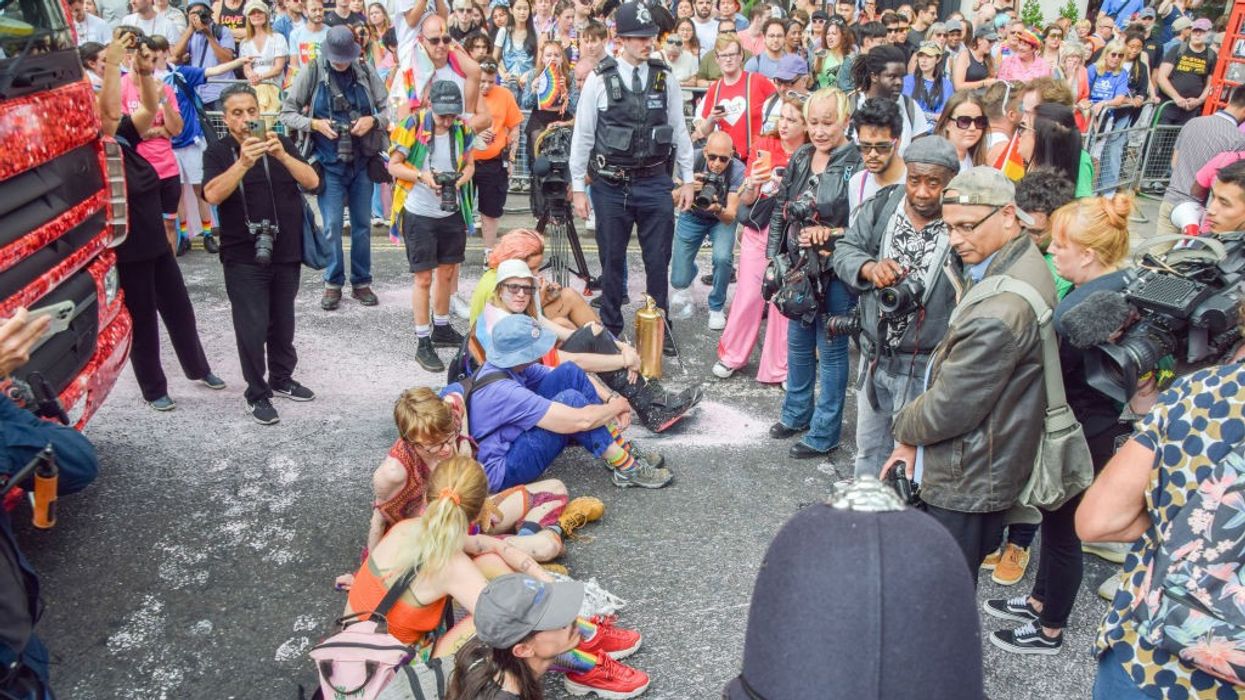
'These partnerships embarrass the LGBTQ+ community at a time when much of the cultural world is rejecting ties to these toxic industries'
Just Stop Oil protesters temporarily blocked London’s Pride Parade Saturday afternoon to protest the event accepting sponsorship money from “high-polluting industries.”
Pride faced accusations of “pinkwashing” over its decision to make United Airlines the headline sponsor of this year’s event.
Seven protesters were arrested at 1:30 pm after blocking the road in front of a Coca-Cola truck. Coca-Cola is seen as the world's biggest plastic polluter.
LGBTQ+ members of Just Stop Oil called on organizers to condemn new oil, gas, and coal licenses and stop allowing the inclusion of floats from these corporations in the parade.
James Skeet, a Just Stop Oil spokesperson, said in a statement:
“Pride was born from protest. It speaks to how far we’ve come as a community, that high-polluting industries and the banks that fund them, now see Pride as a useful vehicle for sanitizing their reputations, waving rainbow flags in one hand whilst accelerating social collapse with the other. It is queer people, and particularly queer people of color in the global south, who are suffering first in this accelerating social breakdown. What would those who instigated the gay liberation movement during the Stonewall riots in 1969, make of the corporatized spectacle Pride has now become?"
“These partnerships embarrass the LGBTQ+ community, at a time when much of the cultural world is rejecting ties to these toxic industries. We call on Pride to remember the spirit in which it was founded and to respect the memory of all those who fought and died to secure the rights we now possess whilst taking the necessary steps to protect our community long into the future.”
London Mayor Sadiq Khan speaking before the parade said:
“I agree with protesting in a way that is lawful, safe, and peaceful. I think that Extinction Rebellion and Just Stop Oil are really important pressure groups trying to put power on those who have power and influence."
“I fully support the right to protest. It’s really important to recognize the joy of democracy is protest."
“I am somebody who feels quite passionately that we have to tackle the climate emergency. And I feel quite passionately about encouraging people to join the movement to tackle the climate emergency. In my view, protest should be peaceful, lawful, and safe.”
Peter Tatchell, the legendary LGBTQ+ rights campaigner, and prominent member of the Gay Liberation Front and the civil resistance group OutRage! Said:
“I helped organize the first Pride in the UK in 1972 and have attended every Pride London march since then. Pride was always meant to be both a celebration and a protest. From the outset, we stood in solidarity with other struggles for freedom and social justice, against corporate pinkwashing and all forms of exploitation. We saw queer liberation as just one aspect of a wider liberation movement.”
“Climate destruction is destroying communities, jobs, homes and lives across the world, especially in poorer countries. Fossil fuels are endangering the survival of humanity – including LGBTQ+ people. Our community must not collude with environment, species and climate destroying companies.”

'We're now living in a dystopian nightmare'
Thousands of King Charles III's subjects protested against the monarchy Saturday in London — and heavy-handed police detained many of them for "suspicion of breaching the peace."
Earlier this week, the Metropolitan Police tweeted that they would have an “extremely low tolerance” of those seeking to “undermine” King Charles III's coronation day.
“A significant police operation is underway in central London,” the Metropolitan Police said in a statement Saturday. “The individuals have been held on suspicion of breaching the peace.”
At around 7 a.m. police stopped six of the anti-monarchy group Republic’s organizers and told them they were detaining and searching them, Republic director Harry Stratton told CNN at the protest. The group had been walking behind a rental van containing hundreds of placards. “They didn’t say why they were arresting them. They didn’t tell them or us where they were taking them. It really is like something out of a police state,” Stratton said.
Among those arrested ahead of a protest in London’s Trafalgar Square was Graham Smith, chief executive of Republic.
“This morning, Graham Smith and five members of our team were arrested. Hundreds of placards were seized,” Republic tweeted. “Is this democracy?”
Protesters say police warned them not to chant ‘anything that may be deemed offensive.’
The Metropolitan Police said those arrested were being “held on suspicion of conspiracy to cause public nuisance.”
Just Stop Oil reported that around 20 of its climate demonstrators had been arrested, with photos showing a man wearing a T-shirt with the group’s name being detained in Whitehall. “He was arrested along with 20 others,” Just Stop Oil tweeted. “Free speech is a core British value – and we have just lost it. No supporters of Just Stop Oil arrested in the crowd had glue, paint or any plans to disrupt the coronation. We are living in a dystopian nightmare.”
Human Rights Watch's UK director Yasmine Ahmed said in a statement: "The reports of people being arrested for peacefully protesting the coronation are incredibly alarming. This is something you would expect to see in Moscow not London.
"Peaceful protests allow individuals to hold those in power to account, something the UK government seems increasingly averse to.”
Sacha Deshmukh, Amnesty International UK’s chief executive, said: “We need to see what details emerge around these incidents but merely being in possession of a megaphone or carrying placards should never be grounds for a police arrest.
“Peaceful protest is clearly protected under international human rights law and it’s been worrying to see the police this week making numerous statements about their ‘low tolerance’ for disruption at the coronation. The coronation shouldn’t become yet another excuse for undermining people’s basic human rights in this country and we’re awaiting more details over these concerning reports of arrests.”
“We’ve recently had the introduction of extremely draconian legislation outlawing ‘disruptive’ or ‘noisy’ protests, which has given the police excessive – and highly subjective – powers and seriously damaged people’s right of free speech and public assembly.
“The coronation shouldn’t become yet another excuse for undermining people’s basic human rights in this country.”

"It's the ordinary people of this country, taking a stand against this greed and destruction that the British legal system prosecutes and imprisons, jailing them just for talking about the climate crisis and fuel poverty."
More than 120 mostly English lawyers on Friday published a "declaration of conscience" pledging to withhold their services from "supporting new fossil fuel projects" and "action against climate protesters exercising their democratic right of peaceful protest."
The United Kingdom has in recent years faced protests from numerous climate groups, including those with more pronounced direct actions like Just Stop Oil, Insulate Britain, and Extinction Rebellion. As part of those protests, participants have filled the streets, blocked fossil fuel facilities, glued scientific papers and themselves to a government building, called out major law firms for "defending climate criminals," and even, controversially, tossed tomato soup on one of Vincent van Gogh's glass-protected paintings.
Released on the heels of the latest Intergovernmental Panel on Climate Change (IPCC) report, the lawyers' statement notes the U.K. Parliament's 2019 climate emergency declaration, the International Energy Agency's warning against future oil and gas development, and United Nations Secretary-General António Guterres' proclamation that "investing in new fossil fuels infrastructure is moral and economic madness."
The attorneys' declaration also recognizes that the world is on track to breach the 2015 Paris climate agreement's 1.5°C goal and the "dire consequences" of doing so, pointing out that "in the U.K. alone, we are already seeing unprecedented heatwaves, wildfires, flooding, and coastal erosion. In other parts of the globe the effects are already far worse."
Along with vowing to restrict their services, the lawyers:
The attorneys, collectively calling themselves Lawyers Are Responsible, are supported by the groups Good Law Project and Plan B.Earth—whose director, Tim Crosland, highlighted that "the U.N. has said we're on a 'highway to climate hell' and that to get off it, we need to stop new fossil fuel developments now. But behind every new oil and gas deal sits a lawyer getting rich."
"Meanwhile, it's the ordinary people of this country, taking a stand against this greed and destruction that the British legal system prosecutes and imprisons, jailing them just for talking about the climate crisis and fuel poverty," Crosland said. "The rule of law has been turned on its head. Lawyers are responsible. It's time to take a stand."
Taking a stand is not without risk. In the United Kingdom, generally, solicitors advise clients on specific issues and barristers argue in court—and the former are able to choose their cases and clients while the latter are subject to the "cab rank rule," obligating them to provide services as long as they are qualified, even if the case or client is objectionable.
As Lawyers Are Responsible's website details in response to some right-wing outrage over the declaration:
The classic example of the cab rank rule in action is of a criminal barrister who accepts a brief to represent a person accused of murder, against whom there is strong evidence of guilt. In that situation, there is no conflict between the cab rank rule and the interests of justice. The barrister is agreeing to perform his or her role within a system of justice that produces, on the whole, just outcomes. By representing the accused, the barrister is merely helping to ensure that there is a fair trial and is serving the greater good.
The signatories to the declaration are convinced that at the present time offering their services in support of new fossil fuel projects or action against peaceful climate protesters would not serve the greater good.
Good Law Project director and declaration signatory Jolyon Maugham wrote in a Friday opinion piece for The Guardian that "like Big Tobacco, the fossil fuel industry has known for decades what its activities mean. They mean the loss of human life and property, which the civil law should prevent but does not."
"The scientific evidence is that global heating, the natural and inevitable consequence of its actions, will cause the deaths of huge numbers of people. The criminal law should punish this but it does not," Maugham continued. "Nor does the law recognize a crime of ecocide to deter the destruction of the planet. The law works for the fossil fuel industry—but it does not work for us."
"Today's history books speak with horror about what the law of yesterday did, of how it permitted racism, rape, and murder," he added. "And tomorrow's history books will say the same about the law as it stands today, of how it enabled the destruction of our planet and the displacement of billions of people."
The Guardian reported that "18 barristers, including six king's counsel, have signed the declaration" and "will now self-refer to the Bar Standards Board." The newspaper noted that while barristers can face fines for rule-breaking, "the consequences can be more far-reaching for junior members of the profession, who can find themselves blocked from receiving the 'silk' awarded to king's counsel, or from promotion to the judiciary."
In a statement from Plan B, one junior lawyer who wished to remain anonymous said that "young lawyers are being placed in an impossible position. We're being told by our firms and regulators it's a professional obligation to act for fossil fuel projects, knowing that doing so will poison our own future and all of life on Earth."
"That's wrong on every level. It's indefensible," the lawyer added. "If the profession doesn't look out for my generation, how does it expect to survive?"