I’m thinking about all this because I’ve taken a day off of the campaign trail to come to Independence, Missouri (just a stone’s throw from the Kansas Senate race!). The town is best known as Harry Truman’s home, but it’s also the headquarters of a denomination, the Community of Christ, that had been unknown to me until they asked me if I’d accept their annual International Peace Award, which had gone in previous years to some of my real heroes: Dolores Huerta, Rev. James Lawson, Terry Tempest Williams, Jane Goodall.
As people in these nations endure horrific lives, and the world edges closer to truly unspeakable catastrophe, the fact that it’s all connected to oil suggests a way out: which is to make oil less important.
As it turns out, the Community of Christ is an interesting group—they’re descended from the Mormons who didn’t follow Brigham Young to Utah but instead stayed in the Midwest with the family of Joseph Smith after he was killed by an armed mob. Over the years they drifted apart from their Utah brethren, until in the last generation they’ve become much closer to the Protestant mainline, indeed an avowedly progressive church, led by a woman, committed to LGBT participation, and very focused on peace. As I write this, I’m looking out on a Japanese garden, planted with a sister community in that country, in recognition of the complicated role that Independence and its most famous son played in the planet’s nuclear history; I’ve just come from a daily Prayer for Peace service. If I had to describe this group, I’d say: Imagine Unitarians, except that they believe in Jesus and are earnestly Midwestern in their manners and customs. I like them very very much; they’ve built something special.
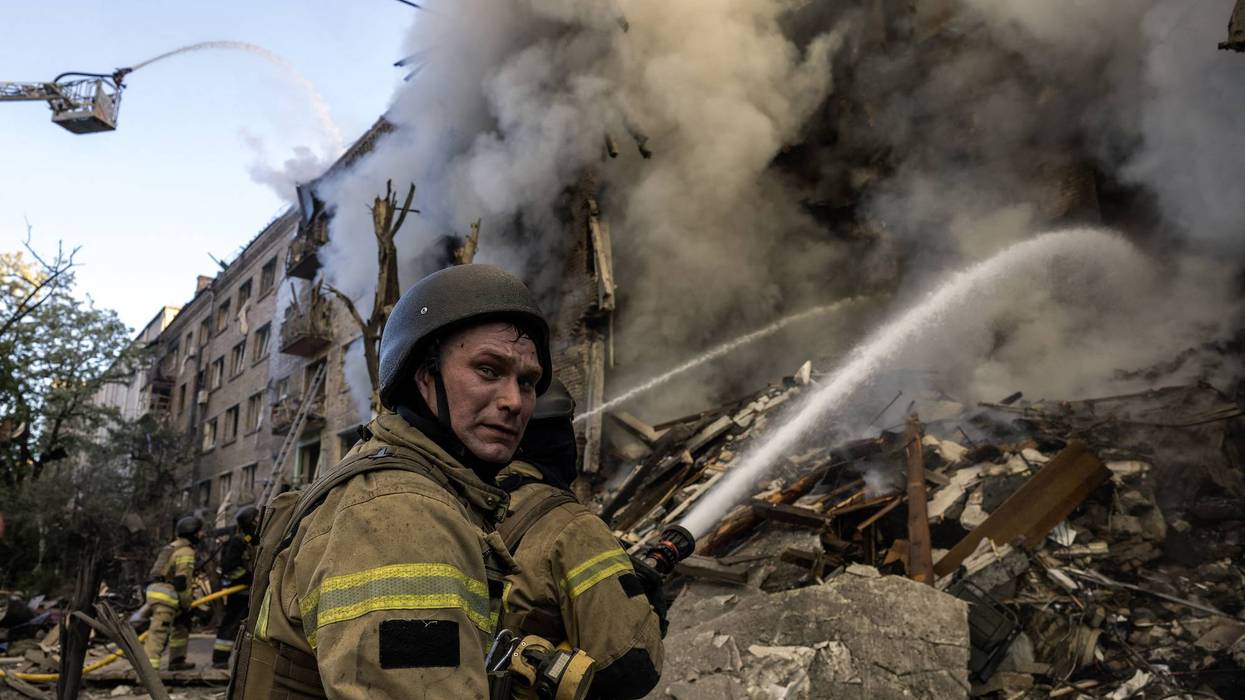
Anyway, the fact that I needed to give a talk as part of this awards ceremony got me more focused than I usually am on questions of peace, and the more I thought, the simpler my task seemed. The world is obviously at war right now; in fact, one Times columnist mused last month that World War III may already be in its early stages. Russian President Vladimir Putin is hammering civilian infrastructure across Ukraine, as his ongoing and unprovoked attack nears the five-year mark. The US, having attacked Venezuela and then Iran, finds itself running short of missiles and interceptors, bad news for the Saudis who are suddenly facing strikes from renegade Yemenis. There are plenty of other conflicts around the world, some military and some for the moment just running on intimidation and coercion—the US siege of Cuba, for instance, which is killing silently. (In 2018, infant mortality on the island was 4 per 1,000 births, lower than in the US. Now, thanks to us, it’s more than double that).
War, of course, has many causes—ethnic and religious supremacy, personal ambition—but it is very simple to see the degree to which oil plays a crucial part in so many of these conflicts, as cause, as weapon, and increasingly as vulnerability.
Consider. We attacked Venezuela, holder of the world’s second-largest oil reserves—as far as I can tell there’s been no effort by our leaders to explain this in terms of human rights or democracy, but only as an effort to secure its oil supplies. Read the “fact sheet” the White House put out this summer about our purposes there:
In the biggest oil deal in world history, President Donald J. Trump has secured US majority control of more than 65 billion barrels of proven oil reserves in Venezuela—vastly expanding our current US territorial proven reserves of roughly 46 billion barrels. This deal secures our energy dominance for the next century—all at zero cost to the United States. The deal, signed by Secretary of State Marco Rubio and Secretary of War Pete Hegseth, gives the US government powerful governance rights, economic ownership, and guaranteed low-cost off-take from a new private Venezuelan oil champion, which will be the second-largest private oil company by reserves in the world.
Our attack on Iran was somewhat more complex, clearly affected by Israeli Prime Minister Benjamin Netanyahu’s desire to cripple the Tehran regime (and stay out of jail) but also clearly driven by Trump’s fascination with the world’s third-largest oil and gas reserves. In March, for instance, Trump said in a social media post that
the US would hit Iran "VERY HARD TONIGHT" and would "assume total control" of Iran's oil and gas industries, including the key Kharg Island oil terminal, in the "not too distant future."
As he explained to the Financial Times:
To be honest with you, my favorite thing is to take the oil in Iran but some stupid people back in the US say: "Why are you doing that?" But they’re stupid people.
And whatever the cause, oil has clearly become the weapon in this ugly and stupid war, with each side trying to close off the other’s crude traffic, in hopes of forcing economic capitulation. Trump may be in the harder place here, because he’s facing an election soon, and despite his best attempts to render the electorate impotent, it appears we will actually be allowed to vote somewhat freely, and that $6 diesel may be coming close to “mutilization of our children” as a campaign issue.
Trump’s clever response to this dilemma has been to betray the people of Ukraine. Remember, Putin was able to attack them because of his country’s oil wealth (John McCain’s classic line: “a gas station with nukes”), and he used his hydrocarbons to try and win the war early on, cutting off the supply to Western Europe in an effort to get them to abandon the defense of Kyiv. Now he’s using his supply of diesel (and the lure of lots of “deals” with Trump associates) to get America to walk away from its one-time ally; Trump on Saturday suspended the Lindsay Graham Act sanctioning Russian oil, in an act that even at this late date left diplomats speechless.
In particular Putin wants Trump to get Ukraine to stop attacking his oil refineries, the tactic that Ukrainian President Volodymyr Zelenskyy has hit on during the past six months, and which is causing endless pain (and spiking EV sales) in Russia. Trump, of course, has obliged, and his main satrap (or is it the other way round?) Elon Musk has apparently literally sabotaged his Starlink system so as to endanger Ukrainians. It is oil top to bottom—cause, effect, weapon. As it is in the Gulf, where the Houthis and the Iranians target pipelines and pumping stations in Saudi Arabia and the UAE, who in turn use their oil wealth to hit back. As it is in Cuba, where our main weapon is an oil blockade.
Here’s how Trump put that one back in January
THERE WILL BE NO MORE OIL OR MONEY GOING TO CUBA—ZERO! I strongly suggest they make a deal, BEFORE IT IS TOO LATE. Thank you for your attention to this matter.
And in March:
They have no money, they have no oil, they have no nothing. They have nice land. They have nice landscape.
And Marco Rubio, in June:
For decades, the regime has stolen and hoarded available fuel—using it for the Castros’ private jet, the security services forces used to repress the Cuban people, to keep empty tourist hotels lit up, and to bus people in for fake protests and political stunts.
Mostly, of course, they used it to run hospitals and schools and a power grid for people’s homes. But no more. As The Associated Press reported in August:
A 20-minute burst of electricity is a small miracle in Havana nowadays—a miracle that sometimes comes at 3 am.
That’s when 72-year-old Leidis Rodríguez frantically cooked beans after the lights switched on this week following hours of uninterrupted blackouts.
“The power has come back on, everyone go!” Rodríguez shouted.
Public transportation and cultural events have come to a standstill. So has tourism, the country’s economic engine, especially as tourism companies have withdrawn, leaving 25,000 hospitality jobs vacant. Flights to the island are regularly canceled and workdays have been shortened to adjust to the new reality of a Cuba without power. Medicine shortages have worsened and food rots in fridges without power.
“If there’s no electricity, there’s no water because it doesn’t get pumped to the tank. When there’s water, there’s no electricity,” Rodríguez lamented.
Anyway, as people in these nations endure horrific lives, and the world edges closer to truly unspeakable catastrophe, the fact that it’s all connected to oil suggests a way out: which is to make oil less important.
And there’s really exactly one way to do that, which everyone with a heart or a mind (or a calculator) is edging toward: replacing it with clean, cheap, far-less-vulnerable power from the sun and wind. That’s what Cuba is doing, installing solar panels faster than anyplace else on Earth. It’s what Ukraine is trying to do, with leadership from heroes like Svitlana Romanko and Razom We Stand. (I was unsurprised to see that she’d given up on Trump this week: “Europe must now lead, closing every remaining Russian energy loophole this month, and proving that the democratic world will keep starving Putin's war machine even when the White House will not."). And it’s what all the bystanders to these wars are trying to do, as they move decisively toward clean energy and EVs to cope with the fallout of events they did not initiate.
Since Trump likes plaques, we should give him one as EV salesman of the decade. We will look back on 2026 as the year that it became entirely clear the Internal Combustion Engine was a relic—sales of electric cars are soaring everywhere. Six hundred thousand electrics were sold in Europe in September, up 39% from the year before. As Michelle Lewis reports:
The UK, France, Spain, Portugal, and Finland all posted their highest monthly EV sales ever. France’s sales climbed 78% year over year to almost 80,000, while Germany’s rose 61% to 117,000.
Look: Every EV sold drops the demand for oil. Every heat pump sold cuts the demand for natural gas. Every solar system that goes up on a roof or balcony produces clean energy with no need for hydrocarbons. And all of it not only helps take some pressure off the climate, it helps—really, far more quickly—to rein in the siege of warfare now underway. If we lived on a planet that ran mostly on wind and solar power, war would be less likely. It’s hard to fight over sunshine. I’ve heard often from people over the years, asking if the climate movement and the peace movement could be more united, and it seems to me that this is the key.
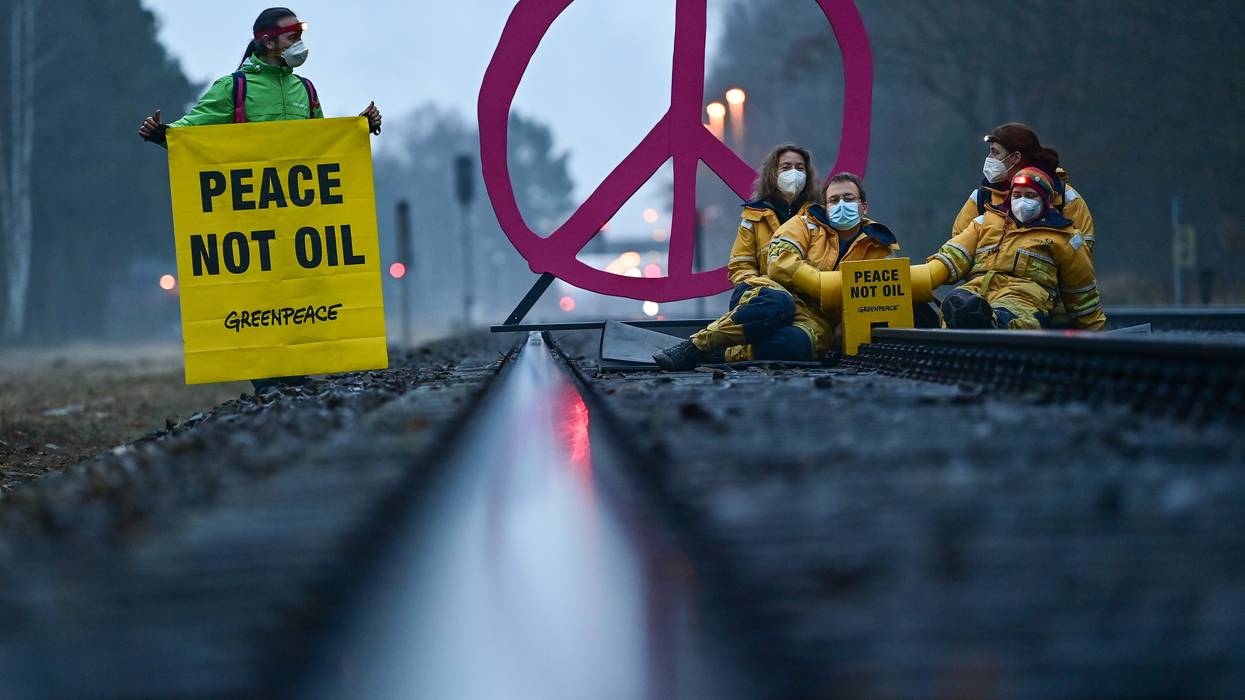
The solar panel is the new peace symbol. Pass it on.