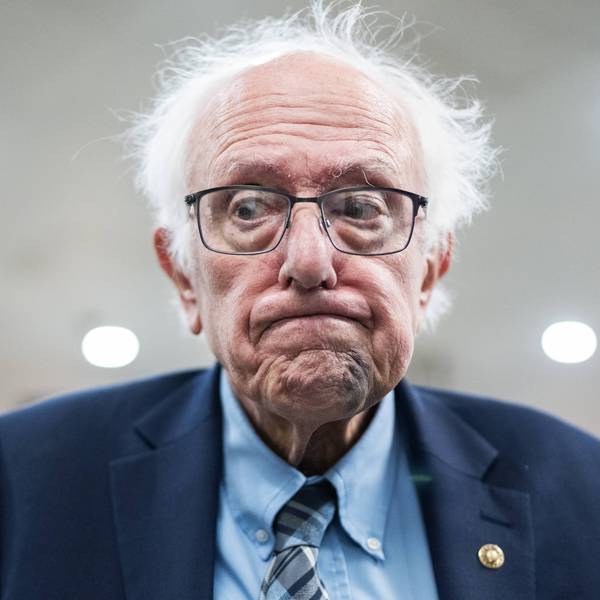
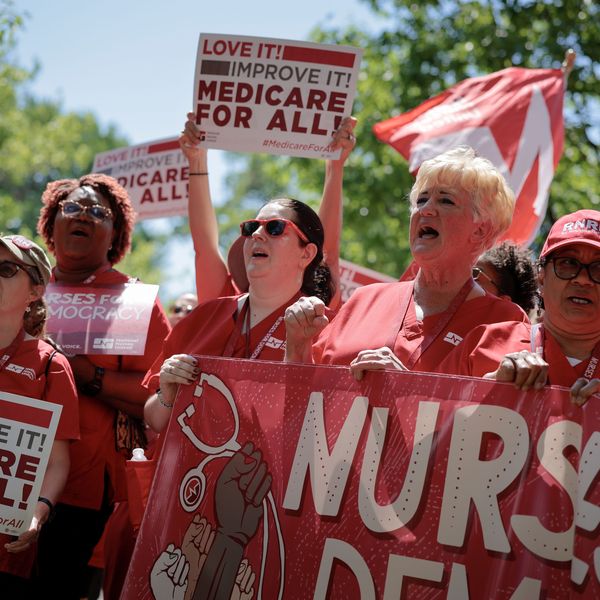
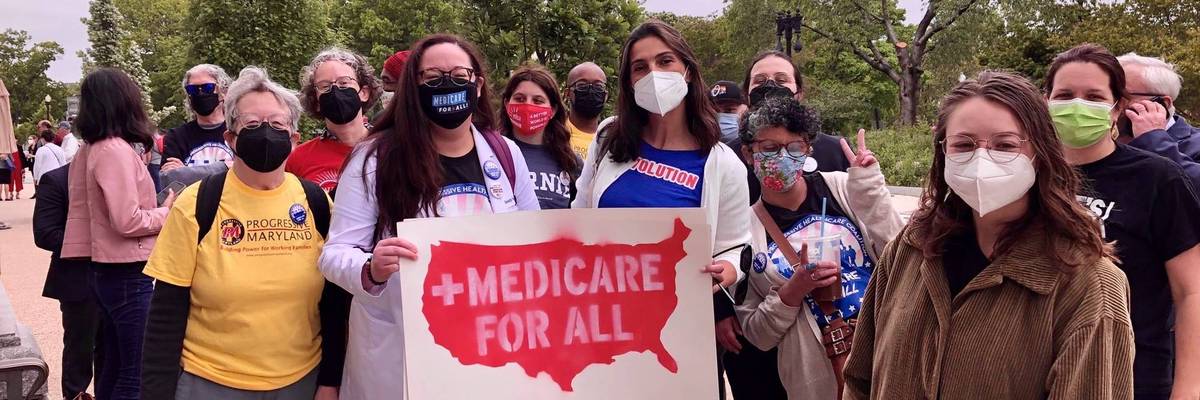
Supporters pose outside of a Senate hearing on Medicare for All in 2022.
Democrats Ignore the Shift in Voter Support for Medicare for All at Their Peril
Premiums are exploding, voters are demanding more, and candidates are winning on it. Dodging Medicare for All is now the real political risk.
I have sat in the room for every congressional hearing on Medicare for All since Congress held its first one in 2019. I am one of very few people, and even fewer healthcare providers, who can say that. I was there at the beginning, alongside representatives from organizations including National Nurses United and Physicians for a National Health Program, invited by Congresswoman Pramila Jayapal to witness and advocate for that historic moment. That first hearing centered on H.R. 1384, the Medicare for All Act of 2019, introduced by Jayapal and championed alongside Congresswoman Debbie Dingell. It was the first time in history that Congress held a hearing specifically on Medicare for All legislation.
I watched Ady Barkan testify through a computerized voice as ALS took away his ability to speak on his own, telling Congress what it costs a family to fight a terminal illness in a country that treats healthcare as a commodity. Then-House Speaker Nancy Pelosi (D-Calif.) appeared at the start of the hearing, a sign of how significant the moment was even to Democratic leaders who were not prepared to embrace the policy. Outside, advocates and reporters crowded the hallways because the room could not hold everyone who wanted to witness what was happening.
That room does not exist anymore. From the unique vantage point of someone who has been present at every congressional hearing on Medicare for All, the shift is impossible to miss.
The Math Has Broken
Employers are projected to face another 9.5% increase in healthcare costs in 2027, pushing average employer-sponsored healthcare costs above $19,000 per employee and marking a fourth consecutive year of near-double-digit increases. Employees are projected to spend about $5,300 themselves in 2026 through payroll contributions and out-of-pocket costs, up 7.9% from the year before.
From where I have sat through every congressional Medicare for All hearing since 2019, the most important change is not that opposition has disappeared. It has not. It is that the old political assumptions no longer fit the evidence.
At some point, the status quo becomes the disruption. A new Yale-led preprint estimates that a national single-payer system modeled on the Medicare for All Act could reduce annual health spending by $1.04 trillion, nearly 20%, while averting roughly 114,000 deaths each year.
Washington Is Underestimating the Support
A national Data for Progress survey found 65% of voters support a Medicare for All system, including 78% of Democrats, 71% of independents, and 49% of Republicans. After voters heard competing arguments both for and against the policy, 58% still supported it. Two-thirds of voters say the government does too little to help Americans afford healthcare, while nearly two-thirds hold unfavorable views of private insurers and pharmaceutical companies.
It is increasingly difficult to describe a policy with numbers like these as politically fringe.
Democrats Are Behind Their Own Voters
For years, Democratic leaders treated Medicare for All as something the party's progressive wing might demand but broader electorates would punish. Sen. Bernie Sanders (I-Vt.) changed that conversation more than perhaps any other national political figure. He made Medicare for All a defining issue in two presidential campaigns and introduced the Senate Medicare for All Act.
One image from the 2020 Democratic presidential primary captures how politically risky support for the policy still seemed. During the first Democratic debates in 2019, candidates were asked whether they were willing to replace private health insurance with a government-run plan. On this night, only Sanders and Kamala Harris raised their hands, and Harris later said she had misunderstood the question. Even on a Democratic debate stage, fully embracing Medicare for All was something most candidates were reluctant to do.
Six years later, Democratic candidates can hardly raise their hands fast enough.
The party's electorate is moving toward, not away from, a policy Washington still too often treats as politically dangerous.
In Michigan, Abdul El-Sayed won the Democratic nomination for US Senate while championing Medicare for All. I met El-Sayed at the Senate's first Medicare for All hearing in 2022, where he testified as a physician and public health leader in support of the policy. Sanders chaired that hearing. Four years later, El-Sayed won the Democratic nomination for Senate in Michigan. In Illinois, Juliana Stratton won the Democratic Senate primary while pledging to fight for Medicare for All. In New Jersey, physician and combat surgeon Dr. Adam Hamawy won a crowded congressional primary while campaigning on Medicare for All and rejecting corporate PAC money.
Medicare for All was part of the fundamental economic argument these candidates made about affordability, corporate power, and what Democrats should stand for. Their success is evidence that the party's electorate is moving toward, not away from, a policy Washington still too often treats as politically dangerous.
Democrats should also pay attention to what has happened with the American Israel Public Affairs Committee. The Washington Post has documented how AIPAC's brand has become increasingly politically toxic in Democratic primaries. Health insurance and pharmaceutical money could be headed down a similar path. As anger toward the healthcare industry grows, accepting money from companies profiting from the system voters want changed becomes harder to explain. A candidate running on Medicare for All might not need a complicated attack line when an opponent is taking money from the very industry they are promising to confront.
The Tide Has Turned
From where I have sat through every congressional Medicare for All hearing since 2019, the most important change is not that opposition has disappeared. It has not. It is that the old political assumptions no longer fit the evidence. Healthcare costs are rising faster than workers can absorb them. A majority of voters still support Medicare for All after hearing arguments against it. Candidates are winning major Democratic primaries while running openly on the policy.
Democrats have spent years asking whether supporting Medicare for All is too politically risky. They should now be asking whether opposing it is becoming the greater risk.
The tide isn't turning. It has turned. Democrats can recognize it and build around it, or they can be the last ones standing on the beach wondering what happened.
We are at a crossroads
This country and this world are at a monumental crossroads. In a few short weeks, US voters will have an opportunity to beat back the forces of fascism and confront the billionaires who are rigging the economy, our media system, and our democracy, making it increasingly impossible for ordinary people to get by. We’re not just talking about the election. We’re talking about what must be done once these fascist elements are vanquished from power. We need a bolder set of solutions than what either major party has so far been willing to offer and a working-class movement ready to fight like hell for it. Trump didn't emerge from nowhere. The conditions that fueled MAGA authoritarianism were created by decades of radical neoliberal economic policies and a corrupt political system dominated by corporate interests. They slashed taxes on the super-rich, promising that the benefits would trickle down. They said giveaways to the corporate titans would make life more affordable for the rest of us. It was all bullshit. And when a bitter, betrayed populace searches for someone to blame, right-wing demagogues have little trouble finding scapegoats. People know when they're being lied to, but you won't hear any of this from the corporate media. Only independent journalism—powered and funded by people who believe in building a better world—can deliver truly trustworthy daily news. Our Fall Campaign is underway, and we need your help. To power our newsroom through the rest of the year, we need to raise $125,000 by midnight on October 31. So if you share our vision, please contribute whatever you can to sustain our work. |
I have sat in the room for every congressional hearing on Medicare for All since Congress held its first one in 2019. I am one of very few people, and even fewer healthcare providers, who can say that. I was there at the beginning, alongside representatives from organizations including National Nurses United and Physicians for a National Health Program, invited by Congresswoman Pramila Jayapal to witness and advocate for that historic moment. That first hearing centered on H.R. 1384, the Medicare for All Act of 2019, introduced by Jayapal and championed alongside Congresswoman Debbie Dingell. It was the first time in history that Congress held a hearing specifically on Medicare for All legislation.
I watched Ady Barkan testify through a computerized voice as ALS took away his ability to speak on his own, telling Congress what it costs a family to fight a terminal illness in a country that treats healthcare as a commodity. Then-House Speaker Nancy Pelosi (D-Calif.) appeared at the start of the hearing, a sign of how significant the moment was even to Democratic leaders who were not prepared to embrace the policy. Outside, advocates and reporters crowded the hallways because the room could not hold everyone who wanted to witness what was happening.
That room does not exist anymore. From the unique vantage point of someone who has been present at every congressional hearing on Medicare for All, the shift is impossible to miss.
The Math Has Broken
Employers are projected to face another 9.5% increase in healthcare costs in 2027, pushing average employer-sponsored healthcare costs above $19,000 per employee and marking a fourth consecutive year of near-double-digit increases. Employees are projected to spend about $5,300 themselves in 2026 through payroll contributions and out-of-pocket costs, up 7.9% from the year before.
From where I have sat through every congressional Medicare for All hearing since 2019, the most important change is not that opposition has disappeared. It has not. It is that the old political assumptions no longer fit the evidence.
At some point, the status quo becomes the disruption. A new Yale-led preprint estimates that a national single-payer system modeled on the Medicare for All Act could reduce annual health spending by $1.04 trillion, nearly 20%, while averting roughly 114,000 deaths each year.
Washington Is Underestimating the Support
A national Data for Progress survey found 65% of voters support a Medicare for All system, including 78% of Democrats, 71% of independents, and 49% of Republicans. After voters heard competing arguments both for and against the policy, 58% still supported it. Two-thirds of voters say the government does too little to help Americans afford healthcare, while nearly two-thirds hold unfavorable views of private insurers and pharmaceutical companies.
It is increasingly difficult to describe a policy with numbers like these as politically fringe.
Democrats Are Behind Their Own Voters
For years, Democratic leaders treated Medicare for All as something the party's progressive wing might demand but broader electorates would punish. Sen. Bernie Sanders (I-Vt.) changed that conversation more than perhaps any other national political figure. He made Medicare for All a defining issue in two presidential campaigns and introduced the Senate Medicare for All Act.
One image from the 2020 Democratic presidential primary captures how politically risky support for the policy still seemed. During the first Democratic debates in 2019, candidates were asked whether they were willing to replace private health insurance with a government-run plan. On this night, only Sanders and Kamala Harris raised their hands, and Harris later said she had misunderstood the question. Even on a Democratic debate stage, fully embracing Medicare for All was something most candidates were reluctant to do.
Six years later, Democratic candidates can hardly raise their hands fast enough.
The party's electorate is moving toward, not away from, a policy Washington still too often treats as politically dangerous.
In Michigan, Abdul El-Sayed won the Democratic nomination for US Senate while championing Medicare for All. I met El-Sayed at the Senate's first Medicare for All hearing in 2022, where he testified as a physician and public health leader in support of the policy. Sanders chaired that hearing. Four years later, El-Sayed won the Democratic nomination for Senate in Michigan. In Illinois, Juliana Stratton won the Democratic Senate primary while pledging to fight for Medicare for All. In New Jersey, physician and combat surgeon Dr. Adam Hamawy won a crowded congressional primary while campaigning on Medicare for All and rejecting corporate PAC money.
Medicare for All was part of the fundamental economic argument these candidates made about affordability, corporate power, and what Democrats should stand for. Their success is evidence that the party's electorate is moving toward, not away from, a policy Washington still too often treats as politically dangerous.
Democrats should also pay attention to what has happened with the American Israel Public Affairs Committee. The Washington Post has documented how AIPAC's brand has become increasingly politically toxic in Democratic primaries. Health insurance and pharmaceutical money could be headed down a similar path. As anger toward the healthcare industry grows, accepting money from companies profiting from the system voters want changed becomes harder to explain. A candidate running on Medicare for All might not need a complicated attack line when an opponent is taking money from the very industry they are promising to confront.
The Tide Has Turned
From where I have sat through every congressional Medicare for All hearing since 2019, the most important change is not that opposition has disappeared. It has not. It is that the old political assumptions no longer fit the evidence. Healthcare costs are rising faster than workers can absorb them. A majority of voters still support Medicare for All after hearing arguments against it. Candidates are winning major Democratic primaries while running openly on the policy.
Democrats have spent years asking whether supporting Medicare for All is too politically risky. They should now be asking whether opposing it is becoming the greater risk.
The tide isn't turning. It has turned. Democrats can recognize it and build around it, or they can be the last ones standing on the beach wondering what happened.
- For First Time Ever, Majority of House Dems Support 'Medicare-for-All' Bill ›
- Michigan Just Put Medicare for All on the Ballot, and Voters Said Yes ›
- As Americans Face Affordability Crisis, Poll Reaffirms 'Supporting Medicare for All Is Not Radical' ›
- 'This Man Is So Out of Touch': Hakeem Jeffries Slammed for Opposition to Medicare for All ›
- A Winning Message for 2026 Swing Voters: Tax the Rich and Medicare for All! ›
- Critics Say 'Medicare for Americans' Is Corporate Democrats' Latest Way of 'Protecting' For-Profit Insurers ›