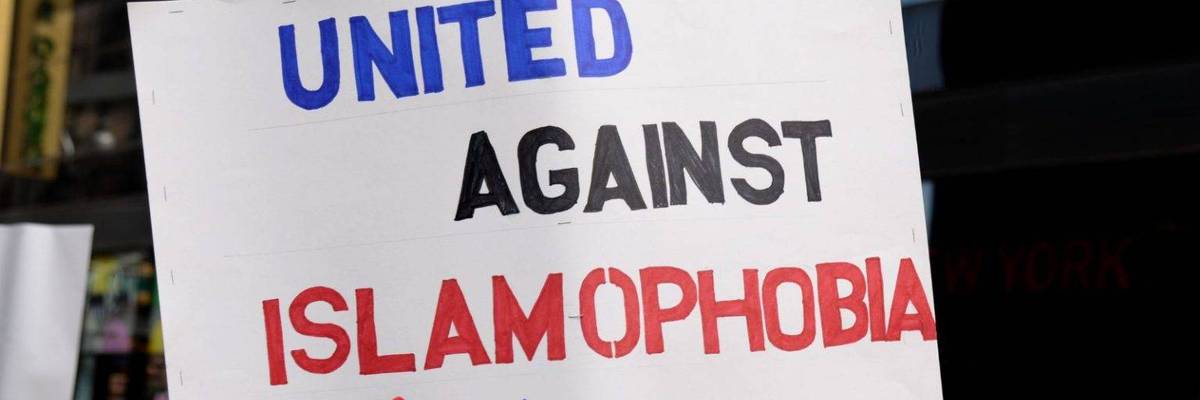
Protesters hold a sign reading, “United Against Islamophobia.”
What Do You Tell a Child When a Teacher Disparages Her Religion?
The Texas State Board of Education has approved new social studies standards taking effect in 2030 that require teachers to denigrate the religion of Islam with biased, ahistorical, and offensive characterizations.
What do you tell a child attending public school when her teacher singles out and disparages her religion?
That is the question parents of Muslim children in Texas schools might soon confront. The Texas State Board of Education has approved new social studies standards taking effect in 2030 that require teachers to denigrate the religion of Islam with biased, ahistorical, and offensive characterizations.
One of the most controversial edits would require students to study "the Prophet Mohammed’s brutal military campaigns against Jewish and Christian tribes, the normalization of slavery, and the taking of female captives as harem slaves.”
All students have a right to attend public school without being singled out, stereotyped, or silenced because of their faith.
None of these claims stand up to a neutral reading of history.
Even prominent secular historians recognize that the Prophet and many of the Muslim leaders who followed him protected Jews, Christians, and other religious minorities under their governance; that Islamic law outright banned most forms of slavery and never permitted the type of race-based enslavement practiced in the West; and the Prophet was a married man who never had a so-called "harem."
The new curriculum’s characterization of warfare in Muslim history as "brutal" is also deeply dishonest.
All wars are inherently brutal, yet the new Texas curriculum does not require teachers to describe wars undertaken by the United States, European powers, Israel, Protestant and Catholic empires, the Greeks, the Romans, the Mongols, ancient Israelites, and other historical actors as “brutal.”
“Brutal” is not a historical fact; it is a judgment. Presenting that judgment as objective history crosses a line that public schools should never cross.
For a Muslim child attending public school, the new curriculum's misleading claims about Muslim history and its negative characterization of the Prophet strike directly at her faith, her identity, and the values she holds dear. It tells her that the historic figure her family reveres as a model of mercy, compassion, justice, and dignity is someone her own government has chosen to portray as “brutal."
That is not neutral instruction, and the harm caused by this biased curriculum can extend far beyond the classroom.
The anti-Muslim sentiment expressed by a teacher can follow a student from the classroom, to the cafeteria table, and into conversations with her classmates in the locker room. Imagine being a Muslim teenager when your teacher introduces a lesson that denigrates Islam. Imagine your classmates looking at you and asking, “But you're Muslim. What do you think about that?”
No child should have to sit at a desk while the adult entrusted with teaching her is required to pass judgment on the religious figure she loves or her faith. Muslim students should not be asked to absorb that message in silence, to manage the discomfort of their classmates, or to wonder whether their teacher sees their faith as something dangerous or inferior.
They should not have to listen politely while their most sacred figure is reduced to a state-mandated mischaracterization, then be expected to return to homework, group projects, and hallway conversations as if nothing happened.
A classroom lesson should not become a moment where a Muslim child feels targeted, isolated, or forced to choose between respecting the classroom environment and honoring her own religious identity.
These new standards do more than shape what students learn. They risk increasing anti-Muslim sentiment among non-Muslim students, silencing Muslim students, placing teachers in an extraordinarily difficult position, and creating classrooms where children may feel that their faith and the people they love are subjects of suspicion or contempt.
Texas teachers should teach historical facts about Islam and all religions accurately, fairly, and in their proper context.
Students can learn about the development of Islam; the civilizations it shaped; its contributions to math, science, art, and culture; and the positive and negative events in Muslim history, without reducing an entire faith to biased, dishonest characterizations.
Texas public school teachers have a responsibility to teach about the religion followed by one-fourth of the world’s population with the same fairness, accuracy, and respect it owes to every other faith discussed in their classrooms. No teachers should institutionalize hate or force students to defend, much less denigrate, their own faith
A Muslim student should be able to sit in a Texas history classroom and learn about the past without being forced to agree with the denigration of Islam, her Prophet, or her family’s beliefs. She should not have to listen to the person standing at the front of the room pass judgment on her faith and then be expected to carry that wound quietly through the rest of the school day. She should not have to prove that her faith is worthy of respect, that her family is good, or that she is American enough to belong.
All students have a right to attend public school without being singled out, stereotyped, or silenced because of their faith. Their faith belongs here. Their dignity belongs here. And their classrooms belong to them, too.
We are at a crossroads
This country and this world are at a monumental crossroads. In a few short weeks, US voters will have an opportunity to beat back the forces of fascism and confront the billionaires who are rigging the economy, our media system, and our democracy, making it increasingly impossible for ordinary people to get by. We’re not just talking about the election. We’re talking about what must be done once these fascist elements are vanquished from power. We need a bolder set of solutions than what either major party has so far been willing to offer and a working-class movement ready to fight like hell for it. Trump didn't emerge from nowhere. The conditions that fueled MAGA authoritarianism were created by decades of radical neoliberal economic policies and a corrupt political system dominated by corporate interests. They slashed taxes on the super-rich, promising that the benefits would trickle down. They said giveaways to the corporate titans would make life more affordable for the rest of us. It was all bullshit. And when a bitter, betrayed populace searches for someone to blame, right-wing demagogues have little trouble finding scapegoats. People know when they're being lied to, but you won't hear any of this from the corporate media. Only independent journalism—powered and funded by people who believe in building a better world—can deliver truly trustworthy daily news. Our Fall Campaign is underway, and we need your help. To power our newsroom through the rest of the year, we need to raise $125,000 by midnight on October 31. So if you share our vision, please contribute whatever you can to sustain our work. |
What do you tell a child attending public school when her teacher singles out and disparages her religion?
That is the question parents of Muslim children in Texas schools might soon confront. The Texas State Board of Education has approved new social studies standards taking effect in 2030 that require teachers to denigrate the religion of Islam with biased, ahistorical, and offensive characterizations.
One of the most controversial edits would require students to study "the Prophet Mohammed’s brutal military campaigns against Jewish and Christian tribes, the normalization of slavery, and the taking of female captives as harem slaves.”
All students have a right to attend public school without being singled out, stereotyped, or silenced because of their faith.
None of these claims stand up to a neutral reading of history.
Even prominent secular historians recognize that the Prophet and many of the Muslim leaders who followed him protected Jews, Christians, and other religious minorities under their governance; that Islamic law outright banned most forms of slavery and never permitted the type of race-based enslavement practiced in the West; and the Prophet was a married man who never had a so-called "harem."
The new curriculum’s characterization of warfare in Muslim history as "brutal" is also deeply dishonest.
All wars are inherently brutal, yet the new Texas curriculum does not require teachers to describe wars undertaken by the United States, European powers, Israel, Protestant and Catholic empires, the Greeks, the Romans, the Mongols, ancient Israelites, and other historical actors as “brutal.”
“Brutal” is not a historical fact; it is a judgment. Presenting that judgment as objective history crosses a line that public schools should never cross.
For a Muslim child attending public school, the new curriculum's misleading claims about Muslim history and its negative characterization of the Prophet strike directly at her faith, her identity, and the values she holds dear. It tells her that the historic figure her family reveres as a model of mercy, compassion, justice, and dignity is someone her own government has chosen to portray as “brutal."
That is not neutral instruction, and the harm caused by this biased curriculum can extend far beyond the classroom.
The anti-Muslim sentiment expressed by a teacher can follow a student from the classroom, to the cafeteria table, and into conversations with her classmates in the locker room. Imagine being a Muslim teenager when your teacher introduces a lesson that denigrates Islam. Imagine your classmates looking at you and asking, “But you're Muslim. What do you think about that?”
No child should have to sit at a desk while the adult entrusted with teaching her is required to pass judgment on the religious figure she loves or her faith. Muslim students should not be asked to absorb that message in silence, to manage the discomfort of their classmates, or to wonder whether their teacher sees their faith as something dangerous or inferior.
They should not have to listen politely while their most sacred figure is reduced to a state-mandated mischaracterization, then be expected to return to homework, group projects, and hallway conversations as if nothing happened.
A classroom lesson should not become a moment where a Muslim child feels targeted, isolated, or forced to choose between respecting the classroom environment and honoring her own religious identity.
These new standards do more than shape what students learn. They risk increasing anti-Muslim sentiment among non-Muslim students, silencing Muslim students, placing teachers in an extraordinarily difficult position, and creating classrooms where children may feel that their faith and the people they love are subjects of suspicion or contempt.
Texas teachers should teach historical facts about Islam and all religions accurately, fairly, and in their proper context.
Students can learn about the development of Islam; the civilizations it shaped; its contributions to math, science, art, and culture; and the positive and negative events in Muslim history, without reducing an entire faith to biased, dishonest characterizations.
Texas public school teachers have a responsibility to teach about the religion followed by one-fourth of the world’s population with the same fairness, accuracy, and respect it owes to every other faith discussed in their classrooms. No teachers should institutionalize hate or force students to defend, much less denigrate, their own faith
A Muslim student should be able to sit in a Texas history classroom and learn about the past without being forced to agree with the denigration of Islam, her Prophet, or her family’s beliefs. She should not have to listen to the person standing at the front of the room pass judgment on her faith and then be expected to carry that wound quietly through the rest of the school day. She should not have to prove that her faith is worthy of respect, that her family is good, or that she is American enough to belong.
All students have a right to attend public school without being singled out, stereotyped, or silenced because of their faith. Their faith belongs here. Their dignity belongs here. And their classrooms belong to them, too.
- New CAIR, UC Berkeley Report Reveals Funding, Negative Impact of Islamophobic Groups in America ›
- Texas Schools Board Rewrites US History With Lessons Promoting God and Guns ›
- Christian Nationalism Marches on With 'Bible-Infused' Texas Curriculum ›
- Despite Delay, Texas Republicans Push Proposal Forcing Students to Read Bible in School ›
- Education Watchdog Calls Out 'Attempted Indoctrination' in Texas Text Books ›