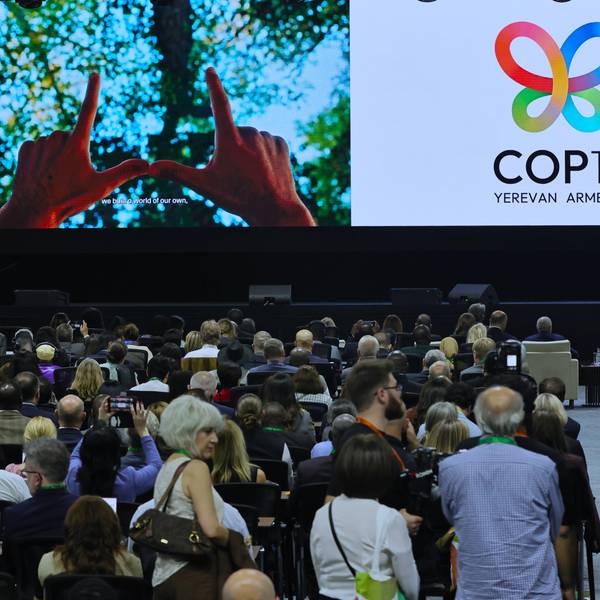
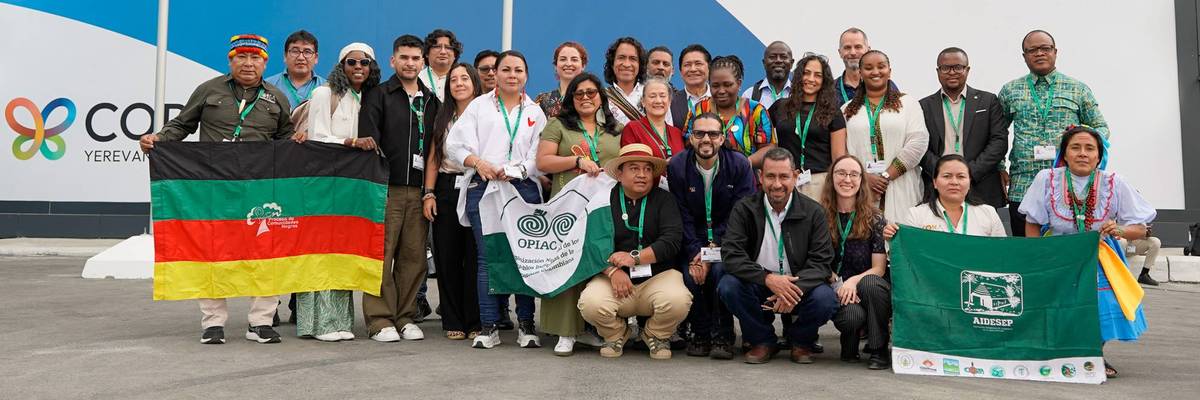
The Rights and Resources Initiative delegation to the Convention on Biological Diversity's 17th Conference of the Parties gathers together.
You Cannot Protect Nature by Rolling Back Indigenous Rights
As governments gather for the UN Biodiversity Conference, they must recognize that protecting biodiversity means protecting the rights of Indigenous peoples, Afro-descendant peoples, and local communities who sustain it.
In the highlands of Pernambuco, Brazil, the Xukuru do Ororubá Indigenous people are bringing a damaged landscape back to life.
After generations of colonization, land occupation, deforestation, and intensive agriculture, their ancestral territory had suffered profound ecological damage. Forests had diminished, wildlife had disappeared, and springs had been compromised.
Through the Jupago Kreká Sacred Agriculture Collective, the community is combining ancestral knowledge, traditional agriculture, and forest restoration to regenerate its territory. According to the community, approximately 360 hectares are undergoing restoration, 14 springs are recovering, and wildlife is returning to previously degraded areas. Their work includes recovering ancestral seeds, cultivating medicinal plants, and passing traditional ecological knowledge to younger generations. For the Xukuru, protecting biodiversity is inseparable from protecting culture, livelihoods, and territorial rights.
Communities are already protecting and restoring biodiversity through their traditional knowledge and management practices, yet their contributions are not always formally recognized in conservation policies.
As governments gather in Yerevan, Armenia, from October 19-30 for the 17th Conference of the Parties to the United Nations Convention on Biological Diversity (CBD COP17), their experience offers a reminder that biodiversity depends on the rights of the people who have protected and restored it for generations.
Yet there are growing concerns that hard-won protections for Indigenous peoples, Afro-descendant peoples, and local communities could be weakened during negotiations. Rather than recognizing and strengthening the conservation work these communities are already leading, as demonstrated by the Xukuru's restoration efforts, governments risk undermining the territorial rights and community governance that make these efforts possible.
Conservation Cannot Come at the Expense of Communities
Governments will undertake their first collective review of progress toward implementing the Kunming-Montreal Global Biodiversity Framework, adopted in 2022. The framework includes conserving at least 30% of the world's land and waters by 2030. But achieving this target is not simply a matter of expanding protected areas. It also requires addressing who has the authority to govern the lands and ecosystems on which biodiversity depends.
For too long, conservation policies have treated Indigenous peoples and local communities as obstacles rather than rights holders and essential partners. This approach has too often resulted in exclusion, displacement, and restrictions on traditional ways of life.
The Xukuru people's restoration efforts demonstrate why recognizing Indigenous-led conservation matters. Communities are already protecting and restoring biodiversity through their traditional knowledge and management practices, yet their contributions are not always formally recognized in conservation policies. Governments must ensure that Indigenous and Traditional Territories are recognized as conservation areas in their own right, rather than treated as secondary to conventional protected areas.
Hard-Won Rights Are Not Negotiating Chips
The Global Biodiversity Framework includes commitments to respecting the rights of Indigenous peoples and local communities, achieved through years of advocacy by Indigenous leaders, community organizations, and allies.
Yet these protections could be diluted through negotiating language on the voluntary guidelines to achieve the Goal 2 and 3 of the Global Kunming Framework. Replacing a commitment that governments should act with language saying they may act weakens accountability. Treating Indigenous and Traditional Territories as merely complementary to conventional protected areas risks marginalizing community governance. Diluting references to free, prior, and informed consent threatens communities' ability to make decisions about their lands.
That is why the Rights and Resources Initiative and its partners have issued an open letter to CBD negotiators calling on governments to stop the rollback of hard-won rights protections at CBD COP17. Through the #StopTheRollbacks campaign, the coalition has outlined 10 demands, including stronger recognition of Indigenous and Traditional Territories; protection of free, prior, and informed consent; direct access to biodiversity finance; and meaningful recognition and participation of Afro-descendant peoples.
CBD COP17 is an opportunity to move beyond conservation models that separate nature from people.
Furthermore, digital sequence information (DSI) draws on vast amounts of genetic information derived from forests and other ecosystems that have long been protected, managed, and conserved by Indigenous peoples, Afro-descendant peoples, and local communities. Yet the growing use of DSI risks disconnecting genetic information from the traditional knowledge, practices, and stewardship systems that have enabled communities to sustainably use, manage, and conserve these genetic resources.
The fact that the Cali Fund, a fund designed to share the benefits from the use of genetic data, is not yet fully operational, combined with inadequate mechanisms to ensure the traceability of genetic resource data, puts at risk the principles of fairness, equity, and justice that should guide the global use of genetic information. Ultimately, this raises a fundamental question: Will genetic information be governed primarily for profit, or for life?
CBD COP17 must advance the financing arrangements necessary to make the Cali Fund fully operational, while strengthening community governance over data related to genetic resources and respecting collective rights. Governments must also ensure that Indigenous peoples, Afro-descendant peoples, and local communities receive a fair and equitable share of the benefits generated from the use of genetic information derived from biodiversity. The Cali Fund, as a global mechanism for benefit sharing, should recognize and uphold their rights and provide meaningful opportunities for communities to access funding directly.
CBD COP17 must build on commitments to recognize Afro-descendant peoples in global biodiversity governance. Through #StopTheRollbacks, RRI and its partners are calling on governments to uphold CBD Decision 16/6, which recognizes the contributions of people of African descent to biodiversity conservation, and ensure that recognition translates into meaningful participation in decisions affecting their territories and livelihoods.
Governments must also advance the CBD's Gender Plan of Action, ensuring women can participate in biodiversity decision-making and access resources. Women in the Xukuru community play a central role in preserving traditional medicinal knowledge and passing ancestral practices to future generations.
CBD COP17 Must Move Forward, Not Backward
As an environmental lawyer who has worked for more than two decades at the intersection of conservation, public policy, and Indigenous rights, I have seen how easily ambitious environmental commitments lose their meaning when governments fail to translate them into enforceable protections.
Millions of communities are still waiting for their daily efforts to protect ecosystems, water sources, and genetic resources to be fully recognized and respected. In many cases, their stewardship has proven highly effective in conserving biodiversity, including in comparison with nationally designated protected areas managed by governments, with some areas managed by communities proving six times lower deforestation than national protected areas. The lack of recognition impacts lives of communities because of restrictions on the use of natural resources, by generating conflicts for land use, and by reducing the possibility to access to financing.
CBD COP17 is an opportunity to move beyond conservation models that separate nature from people. Governments must defend rights already recognized in international agreements, strengthen community-led governance, and ensure biodiversity finance reaches those doing the work.
There can be no lasting victory for nature if it comes at the expense of the rights of the people who protect it.
We are at a crossroads
This country and this world are at a monumental crossroads. In a few short weeks, US voters will have an opportunity to beat back the forces of fascism and confront the billionaires who are rigging the economy, our media system, and our democracy, making it increasingly impossible for ordinary people to get by. We’re not just talking about the election. We’re talking about what must be done once these fascist elements are vanquished from power. We need a bolder set of solutions than what either major party has so far been willing to offer and a working-class movement ready to fight like hell for it. Trump didn't emerge from nowhere. The conditions that fueled MAGA authoritarianism were created by decades of radical neoliberal economic policies and a corrupt political system dominated by corporate interests. They slashed taxes on the super-rich, promising that the benefits would trickle down. They said giveaways to the corporate titans would make life more affordable for the rest of us. It was all bullshit. And when a bitter, betrayed populace searches for someone to blame, right-wing demagogues have little trouble finding scapegoats. People know when they're being lied to, but you won't hear any of this from the corporate media. Only independent journalism—powered and funded by people who believe in building a better world—can deliver truly trustworthy daily news. Our Fall Campaign is underway, and we need your help. To power our newsroom through the rest of the year, we need to raise $125,000 by midnight on October 31. So if you share our vision, please contribute whatever you can to sustain our work. |
In the highlands of Pernambuco, Brazil, the Xukuru do Ororubá Indigenous people are bringing a damaged landscape back to life.
After generations of colonization, land occupation, deforestation, and intensive agriculture, their ancestral territory had suffered profound ecological damage. Forests had diminished, wildlife had disappeared, and springs had been compromised.
Through the Jupago Kreká Sacred Agriculture Collective, the community is combining ancestral knowledge, traditional agriculture, and forest restoration to regenerate its territory. According to the community, approximately 360 hectares are undergoing restoration, 14 springs are recovering, and wildlife is returning to previously degraded areas. Their work includes recovering ancestral seeds, cultivating medicinal plants, and passing traditional ecological knowledge to younger generations. For the Xukuru, protecting biodiversity is inseparable from protecting culture, livelihoods, and territorial rights.
Communities are already protecting and restoring biodiversity through their traditional knowledge and management practices, yet their contributions are not always formally recognized in conservation policies.
As governments gather in Yerevan, Armenia, from October 19-30 for the 17th Conference of the Parties to the United Nations Convention on Biological Diversity (CBD COP17), their experience offers a reminder that biodiversity depends on the rights of the people who have protected and restored it for generations.
Yet there are growing concerns that hard-won protections for Indigenous peoples, Afro-descendant peoples, and local communities could be weakened during negotiations. Rather than recognizing and strengthening the conservation work these communities are already leading, as demonstrated by the Xukuru's restoration efforts, governments risk undermining the territorial rights and community governance that make these efforts possible.
Conservation Cannot Come at the Expense of Communities
Governments will undertake their first collective review of progress toward implementing the Kunming-Montreal Global Biodiversity Framework, adopted in 2022. The framework includes conserving at least 30% of the world's land and waters by 2030. But achieving this target is not simply a matter of expanding protected areas. It also requires addressing who has the authority to govern the lands and ecosystems on which biodiversity depends.
For too long, conservation policies have treated Indigenous peoples and local communities as obstacles rather than rights holders and essential partners. This approach has too often resulted in exclusion, displacement, and restrictions on traditional ways of life.
The Xukuru people's restoration efforts demonstrate why recognizing Indigenous-led conservation matters. Communities are already protecting and restoring biodiversity through their traditional knowledge and management practices, yet their contributions are not always formally recognized in conservation policies. Governments must ensure that Indigenous and Traditional Territories are recognized as conservation areas in their own right, rather than treated as secondary to conventional protected areas.
Hard-Won Rights Are Not Negotiating Chips
The Global Biodiversity Framework includes commitments to respecting the rights of Indigenous peoples and local communities, achieved through years of advocacy by Indigenous leaders, community organizations, and allies.
Yet these protections could be diluted through negotiating language on the voluntary guidelines to achieve the Goal 2 and 3 of the Global Kunming Framework. Replacing a commitment that governments should act with language saying they may act weakens accountability. Treating Indigenous and Traditional Territories as merely complementary to conventional protected areas risks marginalizing community governance. Diluting references to free, prior, and informed consent threatens communities' ability to make decisions about their lands.
That is why the Rights and Resources Initiative and its partners have issued an open letter to CBD negotiators calling on governments to stop the rollback of hard-won rights protections at CBD COP17. Through the #StopTheRollbacks campaign, the coalition has outlined 10 demands, including stronger recognition of Indigenous and Traditional Territories; protection of free, prior, and informed consent; direct access to biodiversity finance; and meaningful recognition and participation of Afro-descendant peoples.
CBD COP17 is an opportunity to move beyond conservation models that separate nature from people.
Furthermore, digital sequence information (DSI) draws on vast amounts of genetic information derived from forests and other ecosystems that have long been protected, managed, and conserved by Indigenous peoples, Afro-descendant peoples, and local communities. Yet the growing use of DSI risks disconnecting genetic information from the traditional knowledge, practices, and stewardship systems that have enabled communities to sustainably use, manage, and conserve these genetic resources.
The fact that the Cali Fund, a fund designed to share the benefits from the use of genetic data, is not yet fully operational, combined with inadequate mechanisms to ensure the traceability of genetic resource data, puts at risk the principles of fairness, equity, and justice that should guide the global use of genetic information. Ultimately, this raises a fundamental question: Will genetic information be governed primarily for profit, or for life?
CBD COP17 must advance the financing arrangements necessary to make the Cali Fund fully operational, while strengthening community governance over data related to genetic resources and respecting collective rights. Governments must also ensure that Indigenous peoples, Afro-descendant peoples, and local communities receive a fair and equitable share of the benefits generated from the use of genetic information derived from biodiversity. The Cali Fund, as a global mechanism for benefit sharing, should recognize and uphold their rights and provide meaningful opportunities for communities to access funding directly.
CBD COP17 must build on commitments to recognize Afro-descendant peoples in global biodiversity governance. Through #StopTheRollbacks, RRI and its partners are calling on governments to uphold CBD Decision 16/6, which recognizes the contributions of people of African descent to biodiversity conservation, and ensure that recognition translates into meaningful participation in decisions affecting their territories and livelihoods.
Governments must also advance the CBD's Gender Plan of Action, ensuring women can participate in biodiversity decision-making and access resources. Women in the Xukuru community play a central role in preserving traditional medicinal knowledge and passing ancestral practices to future generations.
CBD COP17 Must Move Forward, Not Backward
As an environmental lawyer who has worked for more than two decades at the intersection of conservation, public policy, and Indigenous rights, I have seen how easily ambitious environmental commitments lose their meaning when governments fail to translate them into enforceable protections.
Millions of communities are still waiting for their daily efforts to protect ecosystems, water sources, and genetic resources to be fully recognized and respected. In many cases, their stewardship has proven highly effective in conserving biodiversity, including in comparison with nationally designated protected areas managed by governments, with some areas managed by communities proving six times lower deforestation than national protected areas. The lack of recognition impacts lives of communities because of restrictions on the use of natural resources, by generating conflicts for land use, and by reducing the possibility to access to financing.
CBD COP17 is an opportunity to move beyond conservation models that separate nature from people. Governments must defend rights already recognized in international agreements, strengthen community-led governance, and ensure biodiversity finance reaches those doing the work.
There can be no lasting victory for nature if it comes at the expense of the rights of the people who protect it.
- COP17: A Global Reckoning for Nature Conservation ›
- The Rights of Nature: A Paradigm Shift for Environmental Protection ›
- How the US Can Help With Last Best Chance to Reverse Biodiversity Loss ›
- Montreal-Bound Biodiversity COP Must Recognise the Rights of Indigenous Peoples and Local Communities in Protecting Nature ›
- A River's Rights: Indigenous Kukama Women Lead the Way with Landmark Legal Victory ›
- Legal Rights of the Natural World: Beyond Personhood ›