

SUBSCRIBE TO OUR FREE NEWSLETTER
Daily news & progressive opinion—funded by the people, not the corporations—delivered straight to your inbox.
5
#000000
#FFFFFF
To donate by check, phone, or other method, see our More Ways to Give page.
Daily news & progressive opinion—funded by the people, not the corporations—delivered straight to your inbox.
"This is brazen genocide denial," said the policy director for the Armenian National Committee of America.
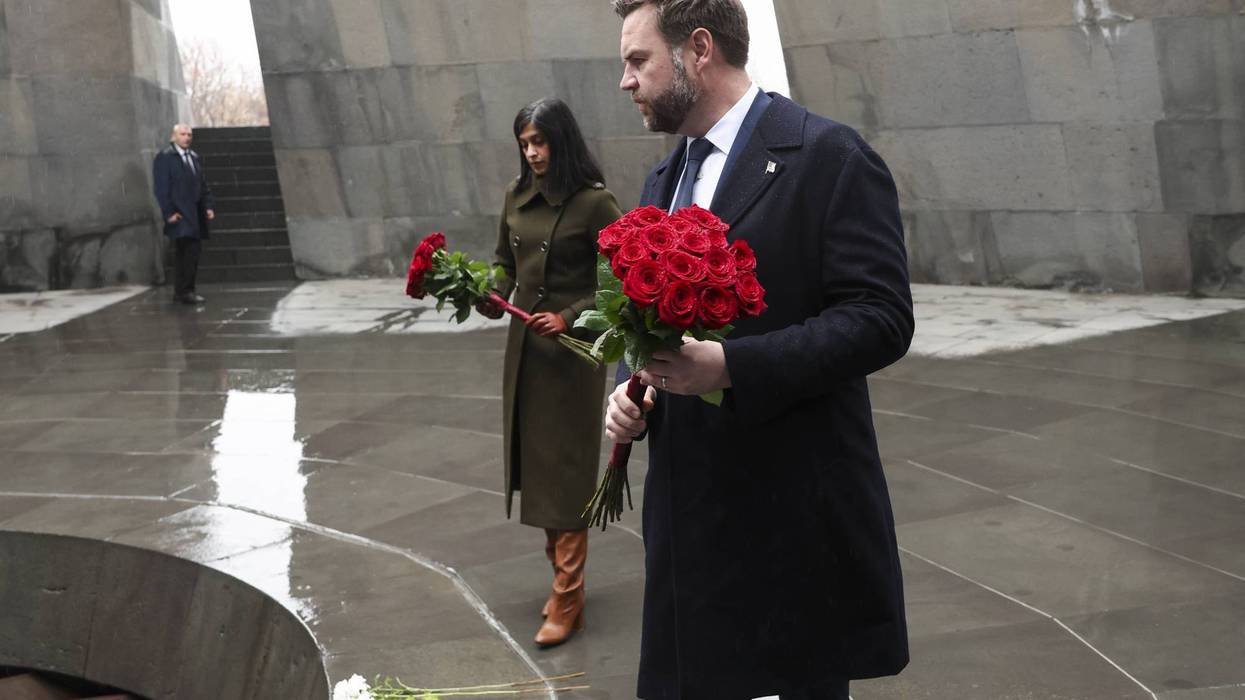
The office of Vice President JD Vance made multiple posts commemorating the Armenian genocide on Tuesday, but was forced to take them down because the Trump administration doesn't formally recognize that the genocide happened.
Vance's X account posted a photo of the vice president and his wife, Usha, attending a wreath-laying ceremony at a memorial in the Armenian city of Yerevan. The post said the Vances were there "to honor the victims of the 1915 Armenian genocide."
But the post was swiftly taken down, with a Vance spokesperson blaming it on a staff member.
"This is an account managed by staff that primarily exists to share photos and videos of the vice president's activities," they said. "For the vice president's views on the substance of the question, I refer you to the comments he made earlier on the tarmac in response to the pool's question."
This was referring to Vance's comments to reporters about visiting the memorial, which were posted by an official White House account. "I'm the first vice president to ever visit Armenia. They asked us to visit the site... I wanted to go and pay my respects."
That post has since been deleted as well.
Alex Galitsky, the policy director for the Armenian National Committee of America (ANCA) reacted: "This is brazen genocide denial. An insult to the memory of the 1.5 million victims of the Armenian Genocide—and an affront to a community that fought tirelessly for decades to ensure recognition of that crime."
Historians widely agree that the Ottoman Empire's systemic killing and deportation of mostly Christian Armenians during the First World War constitutes one of the 20th century's worst genocides. According to the United States Holocaust Memorial Museum:
There were approximately 1.5 million Armenians living in the multiethnic Ottoman Empire in 1915. At least 664,000 and possibly as many as 1.2 million died during the genocide, either in massacres and individual killings, or from systematic ill treatment, exposure, and starvation.
But the government of Turkey continues to adamantly deny the genocide committed by its predecessor state to this day. And due to Turkey's status as a NATO ally, US presidents dating back more than half a century have likewise refused to describe the historic crime as a "genocide."
This began to change in 2019, when Congress passed a historic resolution finally recognizing the genocide more than a century after it began. In 2021, then-President Joe Biden became the first US president to formally acknowledge the genocide without ambiguity.
But in April 2025, after President Donald Trump returned to office, he rolled this acknowledgment back, referring to the mass killing as a "great catastrophe" and "one of the worst disasters of the 20th century" while evading the term "genocide."
Julien Zarifian, a professor of US history at the University of Poitiers in France, wrote that "Trump's reversal seemed to make genocide recognition taboo not only in the White House, but in the whole executive branch."
The return to a denialist stance put the US back into line not only with Turkey, but with Azerbaijan, with which Armenia has been locked in conflict over the disputed Nagorno‑Karabakh region for decades.
In 2023, more than 100,000 Armenians—virtually the whole population—were forced to flee the territory in what has been described as an ethnic cleansing by Azerbaijan, which occupied large parts of the area.
While the US has remained formally neutral in the conflict, it has provided hundreds of millions of dollars of security assistance to Azerbaijan under presidents of both parties, which critics say has emboldened Azerbaijan to act more aggressively. Azerbaijan notably has the steadfast backing of Turkey in the conflict, as well as key US ally Israel.
Vance's visit to Armenia was the first leg of a trip that continued to Azerbaijan, where he met with its leaders to discuss ending the conflict and to shore up an agreement that would give the US greater access to the region's natural resources.
Last August, Trump boasted of brokering a “peace deal” between the two nations, but Azerbaijan had not signed anything—only agreed to further talks.
One of the provisions of the deal pushed by the Trump administration is that Armenia would drop any legal claims against Azerbaijan over its human rights abuses, which Just Security analysts David J. Simon and Kathryn Hemmer said would be "thereby depriving Nagorno-Karabakh’s 150,000 victims of justice."
During a summit with Azerbaijani President Ilham Aliyev, Vance laid on the flattery: "Other than President Trump, the only leader in the world that has really good relations with both the Turks and the Israelis is President Aliyev," he said. "That means one, the food must be really good here, or two, he must be really charming. I can confirm that he's very charming."
Gev Iskajyan, the advocacy director of ANCA, responded: "Vance thinks Aliyev is really charming. Especially when he’s committing war crimes, rigging his own elections, or ethnically cleansing an entire people."
"This is a victory for right, justice, legitimacy, and the struggle of our Palestinian people for liberation and independence," said one Palestinian official.
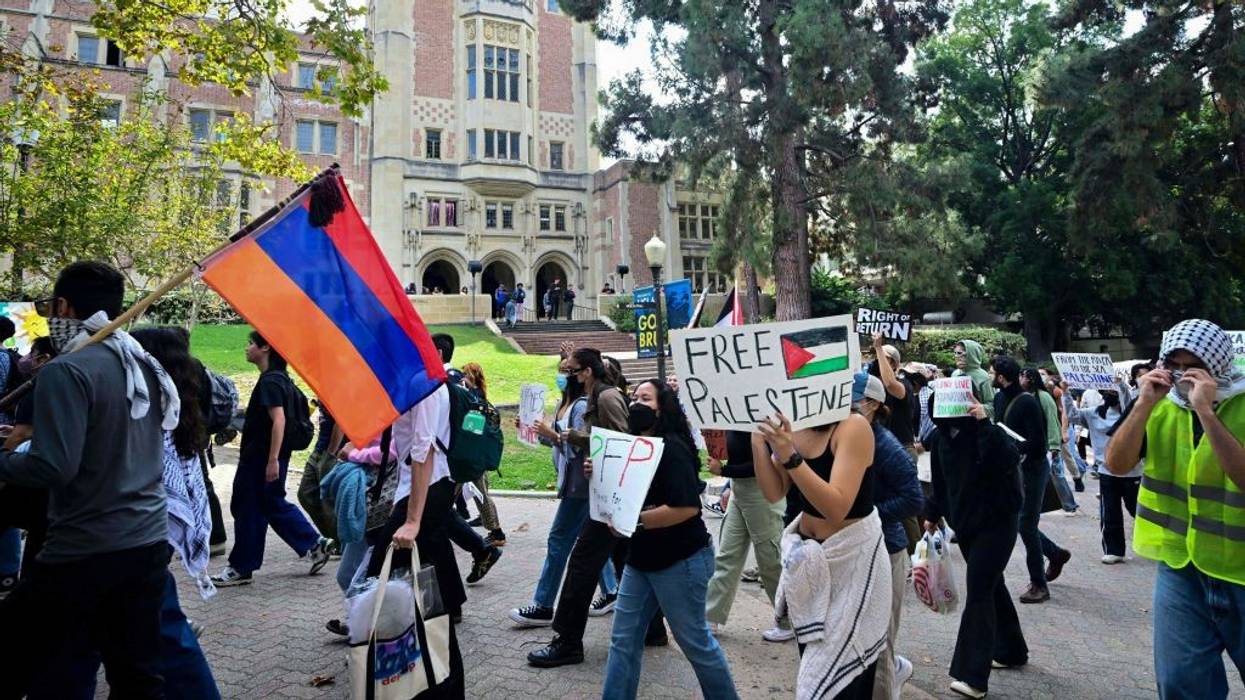
Armenia on Friday became the latest nation to formally recognize the state of Palestine, a move that infuriated Israel but was hailed by human rights defenders—some of whom urged nations including the United States and Britain to join the overwhelming majority of countries in supporting Palestinian statehood.
"The Republic of Armenia is genuinely committed to establishing peace and stability in the Middle East and lasting reconciliation between the Jewish and Palestinian peoples," the Armenian Foreign Ministry said in a statement.
"On various international platforms, our position has consistently been in favor of a peaceful and comprehensive settlement of the Palestinian issue, and we support the 'two-state' solution to the Israeli-Palestinian conflict," the statement continued. "We are convinced that this is the only way to ensure that both Palestinians and Israelis can fulfill their legitimate aspirations."
"Based on the foregoing and reaffirming our commitment to international law and the principles of equality, sovereignty, and peaceful coexistence of peoples, the Republic of Armenia recognizes the state of Palestine," the ministry added.
Palestinian officials applauded the move by Armenia, which they said is the 149th nation to formally recognize the state of Palestine.
"This is a victory for right, justice, legitimacy, and the struggle of our Palestinian people for liberation and independence," Palestine Liberation Organization Executive Committee Secretary-General Hussein al-Sheikh said on social media. "Thank you, our friend Armenia."
However, Israel reacted angrily to Armenia's recognition of Palestine. A spokesperson for Israel's Ministry of Foreign Affairs summoned Armenian Ambassador Arman Akopian for what they called a "harsh reprimand" following the move.
Armenia and Israel have historically had generally cordial relations. However, in 2020 Armenia recalled its ambassador to Tel Aviv over Israel's arming of its enemy Azerbaijan during fighting between the two Caucasus countries over the disputed Nagorno-Karabakh region. Armenians have also bristled at Israel's continued refusal to acknowledge Turkey's 1915-17 genocide, in which at least 600,000 and possibly more than 1 million Armenians were killed. Armenian Christians also face persecution by Israeli authorities and bigotry from Jewish supremacists in illegally occupied East Jerusalem, home to a more than 1,500-year-old Armenian community.
The Armenian Foreign Ministry's Friday statement condemned the targeting of civilians in Gaza, where officials say that more than 133,000 people—most of them women and children—have been left dead, maimed, or missing by Israel's 259-day assault and siege, which has forcibly displaced around 90% of the embattled strip's 2.3 million people, destroyed hundreds of thousands of homes, and caused
widespread starvation throughout the coastal strip and a famine that's killed dozens of people in the north.
The ministry also condemned Hamas' kidnapping of more than 240 Israelis and others on October 7—when over 1,100 people were killed during the Palestinian resistance group's attack on southern Israel—and demanded the hostages' "unconditional release."
Israel's conduct is the subject of an International Court of Justice genocide case brought by South Africa. International Criminal Court Prosecutor Karim Khan is
seeking arrest warrants for Israeli Prime Minister Benjamin Netanyahu and Yoav Gallant, his defense minister, as well as three senior Hamas officials including Yahya Sinwar, who leads the group, for crimes including extermination.
Given the country’s extensive energy resources, especially its oil and natural gas, U.S. officials have seen Azerbaijan as the key to creating a U.S.-led Caucasus
Officials in Washington are doubling down on their efforts to create a new energy corridor that runs through the Caucasus, a major transit route for trade and energy that connects Europe and Asia.
Focusing on Armenia and Azerbaijan, two countries at odds over land and history, officials in Washington hope to link the two countries with energy pipelines, despite Azerbaijan’s recent incursion into Nagorno-Karabakh, which resulted in more than 100,000 ethnic Armenians fleeing the territory in September.
“A transit corridor built with the involvement and consent of Armenia can be a tremendous boon to states across the region and to global markets,” State Department official James O’Brien told Congress in November.
For decades, U.S. officials have pursued geopolitical objectives in the Caucasus. Viewing the region as a strategically important area that connects Europe and Asia, they have sought to integrate the region with Europe while pulling it away from Iran and Russia, both of which maintain close ties to the region.
“The Caucasus is tremendously important as a crossroads between Europe, Asia, and the Middle East,” Senator James Risch (R-ID) said in a statement last year. “Trade agreements, energy deals, infrastructure, and investment all have the potential to better integrate the region within the transatlantic community.”
At the heart of U.S. planning is Azerbaijan. Given the country’s extensive energy resources, especially its oil and natural gas, U.S. officials have seen Azerbaijan as the key to creating a U.S.-led Caucasus that will help Europe transition away from its dependence on Russian energy.
“We have been hard at work, along with our European colleagues, over the course of the last decade, trying to help Europe slowly wean itself off of dependence on Russian gas and oil,” Senator Christopher Murphy (D-CT) explained at a hearing in September. “Part of that strategy has been to deliver more Azerbaijani gas and oil to Europe.”
Another reason for the U.S. focus on Azerbaijan is its location. With Russia to the north, the Caspian Sea to the east, and Iran to the south, U.S. officials have seen the country as “the epicenter of Eurasia energy policy,” as U.S. diplomats once described it. The United States has worked to position Azerbaijan as the starting point for an east-west energy corridor that benefits the West and deters a north-south corridor that would work to the advantage of Iran and Russia.
For the United States and its European allies, the Baku-Tbilisi-Ceyhan (BTC) pipeline demonstrates the possibilities. Since 2006, the BTC pipeline has carried oil from Azerbaijan to the Mediterranean Sea, where it has been shipped to global energy markets. The pipeline is controlled by a consortium of energy companies headed by BP, the British oil giant.
“We need that to keep functioning,” State Department official Yuri Kim told Congress in September.
From the U.S. perspective, another major geopolitical achievement has been the Southern Gas Corridor. The corridor, which combines three separate pipelines, runs from Azerbaijan all the way to Europe. Since its initial deliveries of natural gas to Europe in 2020, the corridor has been critically important to keeping Europe supplied with energy during the war in Ukraine.
“That Southern Gas Corridor is extremely important for ensuring that there is energy diversity for Turkey, Greece, Bulgaria, potentially Albania, and definitely Italy, and possibly into the Western Balkans,” Kim said. “We cannot underestimate how important that is.”
As pipelines carry oil and natural gas from Azerbaijan to the West, U.S. officials have sought to reinforce the east-west corridor by creating additional pipelines that run through Armenia. Not only would a pipeline through Armenia add another route to the corridor, but it would pull Armenia away from Russia, which maintains a military presence in the country and provides Armenia with most of its energy.
For decades, one of the major challenges to U.S. plans has been the Nagorno-Karabakh Conflict. As long as Armenia and Azerbaijan have remained at odds over the region, U.S. officials have seen few options for integrating Armenia into a broader east-west energy corridor.
“If not for the frozen Nagorno-Karabakh conflict,” U.S. diplomats reported in 2009, “the Baku-Tbilisi-Ceyhan pipeline could have been routed through Armenia, reducing the distance and construction cost, and providing Armenia both an alternative source of gas as well as much-needed transit fees.”
In recent years, regional dynamics have rapidly shifted, however. As Azerbaijan grew flush with cash from its operations as an energy hub for the West, it began spending more money on weapons. With Israel and Turkey selling Azerbaijan increasingly sophisticated weapons, Azerbaijan built a large arsenal and acquired the upper hand over Armenia.
“Where other Western nations are reluctant to sell ground combat systems to the Azerbaijanis for fear of encouraging Azerbaijan to resort to war to regain [Nagorno-Karabakh] and the occupied territories, Israel is free to make substantial arms sales and benefits greatly from deals with its well-heeled client,” U.S. diplomats reported in 2009.
Emboldened by its growing power and influence, Azerbaijan made its move. As fighting broke out between Armenia and Azerbaijan in late September 2020, Azerbaijan’s military forces took advantage of their advanced weaponry from Israel and Turkey to capture the territories surrounding Nagorno-Karabakh.
Before Azerbaijan’s military forces could seize control of Nagorno-Karabakh, however, Russia intervened, brokering a ceasefire and deploying about 2,000 peacekeepers to the region. Although various observers portrayed the outcome as a victory for Russia, the deal did not last long.
This past September, Azerbaijan moved to take the rest of Nagorno-Karabakh, armed by additional supplies of Israeli weapons. Following Azerbaijan’s incursion, more than 100,000 ethnic Armenians fled the territory for Armenia, where they remain today.
Now that Azerbaijan has taken control of Nagorno-Karabakh, U.S. officials are renewing their efforts to persuade Armenia and Azerbaijan to forge a peace deal that could be the basis for a new energy corridor.
“There is business to be done in this region,” State Department official James O’Brien told Congress in November.
At the Start Department, officials have been reviewing U.S.-funded plans for building the new energy corridor. As O’Brien noted, “the feasibility studies on this transit corridor [have] actually been done, funded by [the Agency for International Development (AID)], so we’re in the middle of seeing what kind of economic future there may be.”
Several obstacles stand in the way of U.S. plans. One possibility is that an increasingly emboldened Azerbaijan will invade Armenia and take the territory it wants for new pipelines. If Azerbaijan continues to acquire weapons from Turkey and Israel, it could take Armenian land by force, something that U.S. officials believe could happen.
“I think, from what I hear, the Armenians are concerned and feel threatened by that corridor and what it might imply for another grabbing of land by Azerbaijan,” Representative James Costa (D-CA) said at the hearing in November.
A related possibility is that Azerbaijan could work more closely with Russia. As Russia maintains military forces in Azerbaijan, it could facilitate a move by Azerbaijan to take Armenian land for a north-south energy corridor that benefits Russia.
Although Russia maintains a security pact with Armenia, relations have soured over Azerbaijan’s seizure of Nagorno-Karabakh, making it possible that Russia will side with Azerbaijan.
Another challenge is the Azerbaijani government. For years, critics have charged Azerbaijani President Ilham Aliyev with leading a corrupt and repressive regime that has hoarded the country’s wealth while leaving the population to suffer.
In internal reports, U.S. diplomats have been highly critical of Aliyev. Not only have they compared him to mobsters, but they have suggested that the country “is run in a manner similar to the feudalism found in Europe during the Middle Ages.”
As critics have called on Washington to reconsider the U.S. relationship with Azerbaijan, some members of Congress have begun questioning U.S. strategy, particularly as it concerns the U.S. partnership with Aliyev.
The United States may have made “the wrong bet by moving more Azerbaijani resources into Europe,” Senator Murphy said in September. “This strategy of being dependent on a system and series of dictatorships… may not necessarily bear the strategic game that we think it does.”
Other members of Congress have questioned the State Department’s claims that a new energy corridor can bring peace to the region.
“I don’t see the peace process as going nearly as well as some of the description I’ve just heard,” Representative Costa said at the hearing in November. “It was ethnic cleansing that happened with the removal of these Armenians from their historic homeland in Nagorno-Karabakh.”
Regardless, officials at the State Department remain confident in their plans. Pushing forward with efforts to forge a deal between Armenia and Azerbaijan, they remain hopeful that they can create a new energy corridor that runs through Armenia, even if means that the ethnic Armenians who fled Nagorno-Karabakh will never be able to return to their homes.
“As we go from the medium to the longer term, there’s going to have to be some effort made to help integrate these folks into Armenian life,” AID official Alexander Sokolowski told Congress in November. “Many of them dream of going back to Nagorno-Karabakh, but for right now, they’re oriented towards making a life in Armenia.”

U.S. President Joe Biden cracked many decades of U.S. government silence on Saturday by publicly and officially recognizing that the systematic killing of an estimated 1.5 million Armenians by the Ottomans during the First World War was--as historians, survivors, and their descendants have long known--a "genocide."
In an official White House statement, Biden said, "Each year on this day, we remember the lives of all those who died in the Ottoman-era Armenian genocide and recommit ourselves to preventing such an atrocity from ever again occurring."
In a phone call on Friday, Biden reportedly told Turkey's President Recep Tayyip Erdogan that such an announcement--which the Turkish government has long, and successfully thus far, campaigned against--would be issued, as it ultimaely was, on Armenian Genocide Remembrance Day, commemorated each year on April 24 to mark what is called the "Meds Yaghern" by the Armenian people.
"We honor the victims of the Meds Yeghern so that the horrors of what happened are never lost to history," Biden said in his statement. "And we remember so that we remain ever-vigilant against the corrosive influence of hate in all its forms."
According to the Associated Press:
Officials said Biden wanted to speak with Erdogan before formally recognizing the events of 1915 to 1923 as genocide--something past U.S. presidents had avoided out of concern about damaging relations with Turkey.
Friday's call between the two leaders was the first since Biden took office more than three months ago. The delay had become a worrying sign in Ankara; Erdogan had good rapport with former President Donald Trump and had been hoping for a reset despite past friction with Biden.
Upon earlier reports that Biden was preparing to make his announcement, Armenian National Committee of America executive director Aram Hamparian on Thursday said in a statement that his organization, which lobbied for nearly a century for public recognition by the U.S. government, would welcome the effective end of "the longest lasting foreign gag rule in American history."
"This principled stand represents a powerful setback to Turkey's century-long obstruction of justice for this crime," Hamparian said, "and its ongoing hostility and aggression against the Armenian people."
Recognition of the genocide, he added, "holds great meaning in terms of remembrance, but it is--at its heart--about the justice deserved and the security required for the survival of the Armenian nation--a landlocked, blockaded, genocide-survivor state."
Salpi Ghazarian, director of the University of Southern California's Institute of Armenian Studies, told the AP that the U.S. recognition of genocide would have resonance beyond Armenia and the diaspora.
"Within the United States and outside the United States, the American commitment to basic human values has been questioned now for decades," Ghazarian said. "It is very important for people in the world to continue to have the hope and the faith that America's aspirational values are still relevant, and that we can in fact to do several things at once. We can in fact carry on trade and other relations with countries while also calling out the fact that a government cannot get away with murdering its own citizens."
Writing in Newsweek on Friday, Danielle Tcholakian, an Armenian American journalist and essayist, wrote fiercely about the pain of growing up in a nation whose government has openly denied the reality of the atrocities perpetrated against her people and questioned what the declaration by Biden will mean at this point given the decades of self-interested and cynical U.S. foreign policy. She wrote:
It's difficult to see recognition this late as courage, especially as our ally relationship with Turkey has grown tenuous. The only excuse left is the one that always rang false: The naive delusion that not using the word "genocide" will somehow result in Erdogan's Turkey making any sort of effort at peaceful relations with Armenia. Armenia will never be safe as long as Erdogan is in charge of Turkey and Ilham Aliyev in charge of Azerbaijan. If America cares about Armenia's safety, leaving it in the hands of malignant autocrats is a bizarre way of showing it.
Recognition alone, 106 years after the fact, will not mean much to me personally, if I'm being honest. It will be a good thing to have in the historic record, and our hope has long been that it will help clarify when a genocide is happening and the urgency of intervention. Even today, the situation in the Tigray region in Ethiopia could not be more dire.
According to Hamparian--who also cited the ongoing persecution by the Turkish government and Azerbaijan--the declaration will have limited meaning if it does not "translate into a fundamental reset in U.S. policy toward the region--one which ensures the security of Armenia and Artsakh, and lays the groundwork for a durable peace based upon a just resolution of the Armenian Genocide."
Americans are dealing with an upcoming general election, a pandemic that has killed over 200,000 of us, and corporate news media whose business model has degenerated to selling different versions of "The Trump Show" to their advertisers. So who has time to pay attention to a new war halfway around the world? But with so much of the world afflicted by 20 years of U.S.-led wars and the resulting political, humanitarian and refugee crises, we can't afford not to pay attention to the dangerous new outbreak of war between Armenia and Azerbaijan over Nagorno-Karabakh.
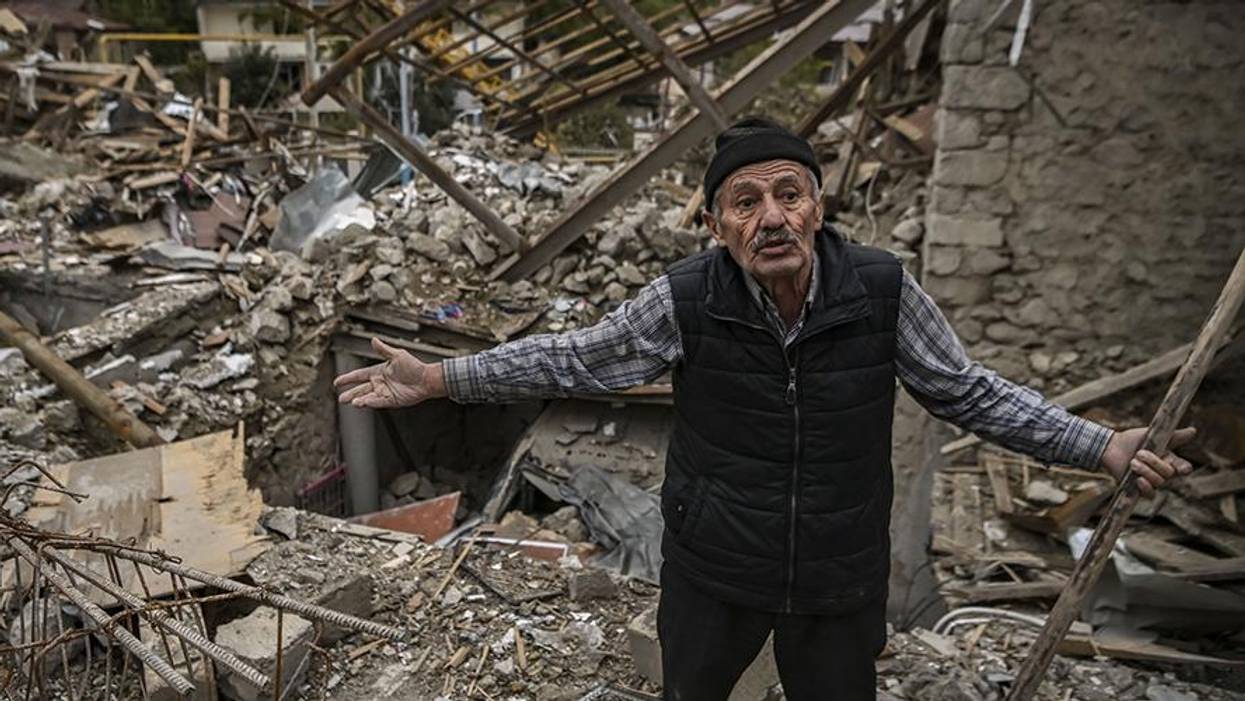
Armenia and Azerbaijan fought a bloody war over Nagorno-Karabakh from 1988 to 1994, by the end of which at least 30,000 people had been killed and a million or more had fled or been driven out of their homes. By 1994, Armenian forces had occupied Nagorno-Karabakh and seven surrounding districts, all internationally recognized as parts of Azerbaijan. But now the war has flared up again, hundreds of people have been killed, and both sides are shelling civilian targets and terrorizing each other's civilian populations.
Nagorno-Karabakh has been an ethnically Armenian region for centuries. After the Persian Empire ceded this part of the Caucasus to Russia in the Treaty of Gulistan in 1813, the first census ten years later identified Nagorno-Karabakh's population as 91% Armenian. The USSR's decision to assign Nagorno-Karabakh to the Azerbaijan SSR in 1923, like its decision to assign Crimea to the Ukrainian SSR in 1954, was an administrative decision whose dangerous consequences only became clear when the U.S.S.R. began to disintegrate in the late 1980s.
In 1988, responding to mass protests, the local parliament in Nagorno-Karabakh voted by 110-17 to request its transfer from the Azerbaijan SSR to the Armenian SSR, but the Soviet government rejected the request and inter-ethnic violence escalated. In 1991, Nagorno-Karabakh and the neighboring Armenian-majority Shahumian region, held an independence referendum and declared independence from Azerbaijan as the Republic of Artsakh, its historic Armenian name. When the war ended in 1994, Nagorno-Karabakh and most of the territory around it were in Armenian hands, and hundreds of thousands of refugees had fled in both directions.
There have been clashes since 1994, but the present conflict is the most dangerous and deadly. Since 1992, diplomatic negotiations to resolve the conflict have been led by the "Minsk Group," formed by the Organization for Cooperation and Security in Europe (OSCE) and led by the United States, Russia and France. In 2007, the Minsk Group met with Armenian and Azerbaijani officials in Madrid and proposed a framework for a political solution, known as the Madrid Principles.
The Madrid Principles would return five of the twelve districts of Shahumyan province to Azerbaijan, while the five districts of Naborno-Karabakh and two districts between Nagorno-Karabakh and Armenia would vote in a referendum to decide their future, which both parties would commit to accept the results of. All refugees would have the right to return to their old homes.
Ironically, one of the most vocal opponents of the Madrid Principles is the Armenian National Committee of America (ANCA), a lobby group for the Armenian diaspora in the United States. It supports Armenian claims to the entire disputed territory and does not trust Azerbaijan to respect the results of a referendum. It also wants the de facto government of the Republic of Artsakh to be allowed to join international negotiations on its future, which is probably a good idea.
On the other side, the Azerbaijani government of President Ilham Aliyev now has the full backing of Turkey for its demand that all Armenian forces must disarm or withdraw from the disputed region, which is still internationally recognized as part of Azerbaijan. Turkey is reportedly paying jihadi mercenaries from Turkish-occupied northern Syria to go and fight for Azerbaijan, raising the specter of Sunni extremists exacerbating a conflict between Christian Armenians and mostly Shiite Muslim Azeris.
On the face of it, despite these hard-line positions, this brutal raging conflict should be possible to resolve by dividing the disputed territories between the two sides, as the Madrid Principles attempted to do. Meetings in Geneva and now Moscow seems to be making progress toward a ceasefire and a renewal of diplomacy. On Friday, October 9th, the two opposing foreign ministers met for the first time in Moscow, in a meeting mediated by Russian Foreign Minister Sergei Lavrov, and on Saturday they agreed to a temporary truce to recover bodies and exchange prisoners.
The greatest danger is that either Turkey, Russia, the U.S. or Iran should see some geopolitical advantage in escalating or becoming more involved in this conflict. Azerbaijan launched its current offensive with the full backing of Turkey's President Erdogan, who appears to be using it to demonstrate Turkey's renewed power in the region and strengthen its position in conflicts and disputes over Syria, Libya, Cyprus, oil exploration in the Eastern Mediterranean and the region in general. If that is the case, how long must this go on before Erdogan has made his point, and can Turkey control the violence it is unleashing, as it has so tragically failed to do in Syria?
Russia and Iran have nothing to gain and everything to lose from an escalating war between Armenia and Azerbaijan, and are both calling for peace. Armenia's popular Prime Minister Nikol Pashinyan came to power after Armenia's 2018 "Velvet Revolution" and has followed a policy of non-alignment between Russia and the West, even though Armenia is part of Russia's CSTO military alliance. Russia is committed to defend Armenia if it is attacked by Azerbaijan or Turkey, but has made it clear that that commitment does not extend to Nagorno-Karabakh. Iran is also more closely aligned with Armenia than Azerbaijan, but now its own large Azeri population has taken to the streets to support Azerbaijan and protest their government's bias toward Armenia.
As for the destructive and destabilizing role the United States habitually plays in the greater Middle East, Americans should beware of any U.S. effort to exploit this conflict for self-serving U.S. ends. That could include fueling the conflict to undermine Armenia's confidence in its alliance with Russia, to draw Armenia into a more Western, pro-NATO alignment. Or the U.S. could exacerbate and exploit unrest in Iran's Azeri community as part of its "maximum pressure" campaign against Iran.
At any suggestion that the U.S. is exploiting or planning to exploit this conflict for its own ends, Americans should remember the people of Armenia and Azerbaijan whose lives are being lost or destroyed every day that this war rages on, and should condemn and oppose any effort to prolong or worsen their pain and suffering for U.S. geopolitical advantage.
Instead the U.S. should fully cooperate with its partners in the OSCE's Minsk Group to support a ceasefire and a lasting and stable negotiated peace that respects the human rights and self-determination of all the people of Armenia and Azerbaijan.
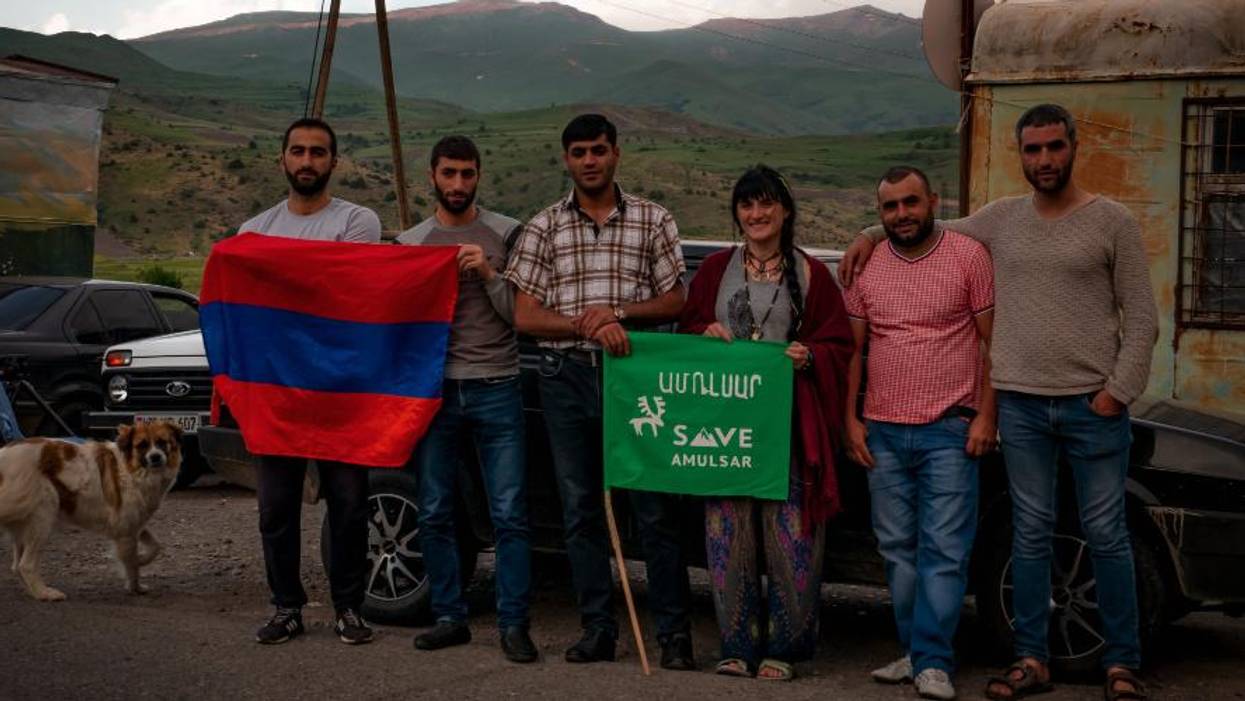
Early last week--despite popular resistance and grave environmental concerns--the Armenian government green-lit a gold mine on Amulsar Mountain in Southern Armenia.
The new Prime Minister Nikol Pashinyan, who steered the movement that brought about Armenia's 'Velvet Revolution,' appears to have bowed to pressure from mining firm Lydian International, including the threat of a $2 billion lawsuit in a 'corporate court.' But the grassroots resistance is determined to hold strong and continue blocking construction. Will the government remove protestors and clear the path for Lydian? The answer will show the strength of Armenia's new democracy.
Two months ago I travelled to Amulsar to meet with and interview the communities at the center of resistance against the gold mine, which was set to open on their doorstep. The community fear that the mine will destroy their environment, landscape and their jobs. They're right to be worried; the area around Amulsar is one of astounding beauty, the economy of the nearby spa town of Jermuk relies on the purity of the mountain's mineral water, and even the start of construction activities decimated local livestock. Amulsar is at the heart of Armenia's water supply, so any potential mining disaster would have grave repercussions far beyond the immediate area.
"Essentially Lydian is using corporate courts to bully the Armenian government into taking a more repressive approach to public protest."UK-registered mining company Lydian was given the go-ahead for the gold mine by the previous Armenian government, even though the communities most likely to be affected had expressed longstanding concerns. That government was an authoritarian administration with a track record of police violence and repression of public protest. Then in 2018, Armenia had a 'Velvet Revolution' and a new democratic government was formed. The communities around Amulsar felt they had a chance to make their voices heard. Protests began, ultimately leading to the blockade.
For an entire year, people from the town and villages next to Amulsar have blockaded the entry roads to the mine and have succeeded in completely shutting down construction. This was made possible thanks to the efforts of the entire community--from those living for months at a time at the blockade sites, to the shopkeepers sending food and supplies. Environmental activists along with the local community had been campaigning around Amulsar before this and faced police repression, but since the revolution, this peaceful protest has been allowed to continue without any violence or repression from the authorities.
However, this amazing act of resistance came under threat earlier this year when Lydian threatened to sue the government in corporate courts, also known as Investor State Dispute Settlements (ISDS)--a lesser known feature of modern trade deals that place an unbelievable amount of power and control into the hands of corporations. These corporate courts allow companies to sue states for decisions that reduce projected profits, so Lydian based the challenge on the government's 'failure' to remove the protest blockades, using both a UK-Armenia and Canada-Armenia investment deal, asking for a pay-out equivalent to two thirds of Armenia's annual budget.
Essentially Lydian is using corporate courts to bully the Armenian government into taking a more repressive approach to public protest.
Now that the Armenian government has caved to corporate pressure and given the go-ahead to the mine, there's a real risk that it will move to remove the local protestors.
This is corporate courts in action--holding the government to ransom until it backs down. What is on the table is billions in compensation. It sounds like a kind of Kafkaesque situation, and it is. The Armenian government is right to be worried--these corporate courts have been successfully used to strip billions from the public purse of governments that could really do with that money to spend on much needed public services. This is why campaigning against corporate courts is so important.
We need to tell Lydian to drop the corporate court case and respect the wishes of the local communities.
Note: The film War on Want produced, More precious than gold: community resistance v corporate courts, highlights the struggle of the community, and the concerns of environmental experts, showing that the case against the mine is compelling.
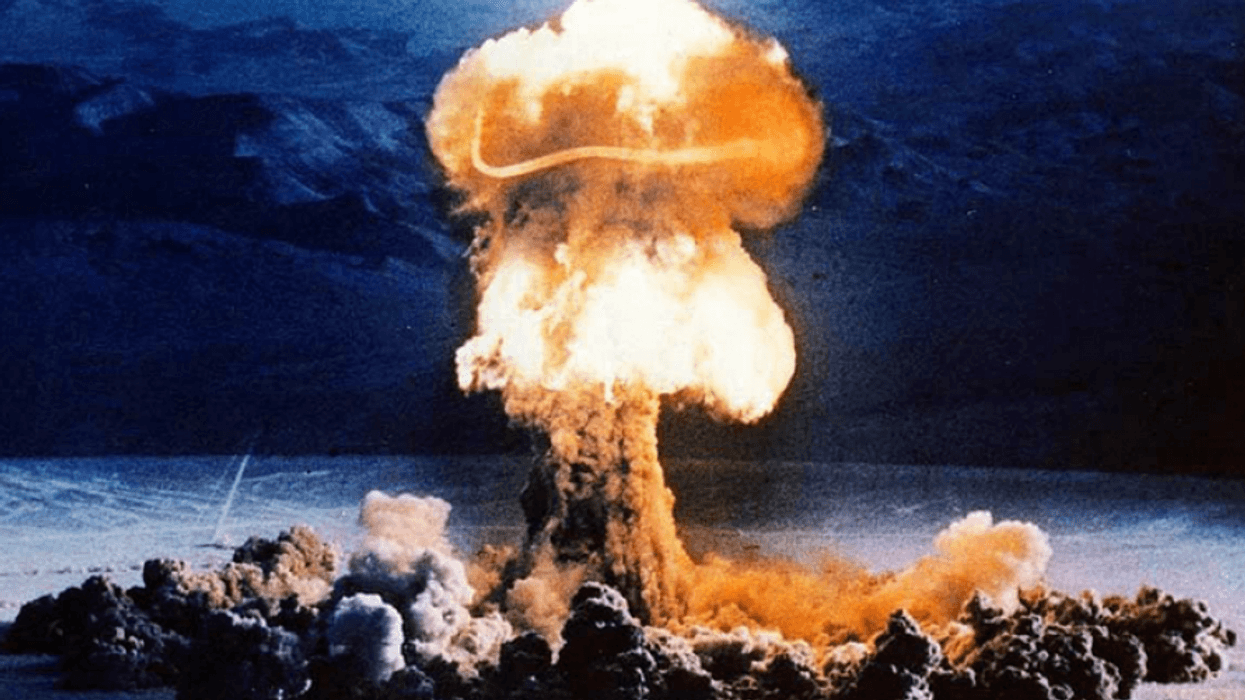
Last month two nuclear-armed countries, India and Pakistan, came to the brink of war. Their border skirmish was a scary message from the future. If controls on nuclear weapons continue to weaken, more countries will probably develop those weapons. Each time one does, its rivals are likely to do the same. Local conflicts will suddenly have the potential to explode into nuclear war.
Like more than a few neighbors, India and Pakistan have a property dispute. Theirs is over Jammu and Kashmir, a former princely state nestled against the Himalayas. India is in control and Pakistan sponsors militant raids under a fig leaf of deniability. Conflicts like these exist around the world. They are a natural consequence of geography and politics. If contending parties arm themselves with nuclear weapons, these regional quarrels will suddenly have apocalyptic potential.
That was chillingly clear along the India-Pakistan border last month. The crisis erupted after a suicide bomber drove a car packed with explosives into an Indian military convoy, killing more than 40 soldiers. India blamed Pakistan, which has a long history of supporting such attacks. In retaliation, it sent a dozen planes to bomb what it said were terrorist camps inside Pakistan. One plane was shot down and its pilot captured. Then the crisis, which might have raced out of control, unexpectedly eased. It turned out that India's air raids had been just for show and may not have killed a soul. The downed pilot was released and called his captors "thorough gentlemen."
It's easy to imagine even more dangerous faceoffs elsewhere in the world. The most terrifying new nuclear powers would be Iran and Saudi Arabia. Iran has enough scientific talent to develop a bomb, and Saudi Arabia could buy what it needs. Hearing the leaders of those countries snarl at each other is scary enough today. If both had nuclear weapons -- not a far-fetched scenario if present trends continue -- war between them could be devastating. So could a war over Taiwan, if Taiwan were to build a nuclear arsenal to compete with China's. Serbia and Kosovo are in bitter conflict over disputed territory. So are Armenia and Azerbaijan.
Once while waiting for a flight at an airport in Ecuador, I stared at a giant map of the country that was painted on the terminal wall. It looked odd. Ecuador seemed much larger than I remembered. Finally, I realized that on this map, its borders had been drawn to include territory in the Amazon that Ecuador lost to Peru in the 19th century and still claims. A banner over the map proclaimed: "Ecuador Was, Is and Will Always Be an Amazon Nation." The dispute over this territory has set off several wars between Peru and Ecuador. The last one, in 1995, led to several hundred casualties. In a world where nuclear weapons are widely spread, political passion could turn an obscure dispute like this into global catastrophe.
That world is emerging. The Trump administration has been moving systematically to undermine accords that have kept nuclear proliferation within possibly manageable limits over the last half-century. Most recently it announced that the United States will withdraw from the 1987 Intermediate-Range Nuclear Forces Treaty with Russia, which regulates several classes of nuclear missiles. Steps like this produce little if any military gain and damage the United States in the court of world opinion.
Senior policymakers around President Trump reject the very idea of arms control. They are resuming the wrecking rampage launched by President George W. Bush, who pulled the United States out of the Anti-Ballistic Missle treaty in 2001. That move left Russia and China free to develop a new generation of hypersonic missiles. All steps away from control of nuclear arms have effects like that. They also, however, make a stark political point. By renouncing arms control, the United States declares its wish for a world without treaties; if that frees other countries to build nuclear arsenals, so be it.
Giving up on arms control increases the possibility that governments with violently irredentist ambitions could build or acquire nuclear weapons. That volatile mix -- a local conflict plus nuclear weapons -- could one day produce the explosion humanity fears. Last month's clash between India and Pakistan was a warning. Cooler heads prevailed, but that won't happen every time. By dismantling accords that limit nuclear weapons, we bring the explosion steadily closer.

Yes, you could say I'm trying to put lipstick on a pig. 2018 was a year of whiplash, a never-ending series of assaults on our environment, immigrants, people of color, Muslims, Jews, the poor, international law. But there is light at the end of the tunnel, and here are some rousing points of light from 2018, both domestic and international.
1. The election of the progressive new members of Congress, particularly women of color such as Alexandria Ocasio-Cortez, Rashida Tlaib, Ilhan Omar, Deb Haaland, Ayanna Pressley and Sharice Davids. Before even taking office they are shaking up the D.C. establishment: Calling out lobbyists for briefing new members of Congress? Refusing to take the "mandatory" AIPAC trip to Israel? Paying congressional interns? Calling for a Green New Deal and Medicare for All? It's head-spinning for the establishment and thrilling for the rest of us. With these new progressive allies, with Democrats now controlling the House, and with an expanded and invigorated Progressive Caucus, we have a chance to drag centrist Democrats into supporting policies that might not be popular with their big-dollar donors but are wildly popular with the public.
2. 2018 was a year of awe-inspiring youth activism. The Parkland school shooting two days after Valentine's Day led to a massive student-led movement for tougher gun laws. Students mobilized in Washington, D.C., at March for Our Lives and in schools across the country. This same kind of energy and creativity exploded with the Sunrise Movement, a youth movement determined to make climate change an urgent priority for U.S. elected officials with a Green New Deal. And just as the year was coming to an end, a sensational 15-year-old student from Sweden, Greta Thunberg, captured world attention at the UN climate summit with her call for youth to hold adults accountable for the mess they've created. In a fabulous example of synergy between young activists, Greta's school strike (she sat in front of the Swedish Parliament instead of going to school) was itself inspired by the walkouts initiated by the Parkland students.
3. An historical turning point was reached this year to start breaking up the 75-year U.S.-Saudi alliance. With three years of relentless Saudi bombing of Yemen leading to the world's greatest human catastrophe and the barbaric murder of Washington Post journalist Jamal Khashoggi, Congress and business leaders finally began to question their relationship with this retrograde kingdom and its brutal de facto leader Mohammad bin Salman. In an unprecedented vote, the Senate approved a measure to halt U.S. support to the Saudis in Yemen, which is helping promote a negotiated settlement. The effort to curb Trump's support for the Saudi war in Yemen comes at the same time that Trump announced the withdrawal of U.S. troops from Syria and a halving of U.S. troops in Afghanistan. Maybe, just maybe, 2019 will mark the winding down of the disastrous wars that have marked U.S. policy since the 9/11 attacks in 2001.
4. Labor organizing has been on the rise, from teachers to high-tech workers. The audacious 13-day strike by teachers in West Virginia won a 5 percent pay increase and launched a wave of similar actions from Oklahoma to Arizona. West Virginia teachers stood with bus drivers, janitors, school kitchen staff before calling an end to the strike, refusing to take a pay increase until everyone's demands were met. In the tech industry, Google employees pushed the company to end its contract to help with Pentagon with artificial intelligence that could be used in drone strikes. They also demanded that Google not cooperate with Chinese censorship. Microsoft employees are pushing the company to break its contract with ICE; Amazon workers want Jeff Bezos to stop supplying facial recognition technology to the police.
5. Florida's restoration of voting rights through Amendment 4, the ballot measure lifting the state's permanent ban on voting by anyone with a felony conviction, received overwhelming support from nearly 65 percent of voters. It restores voting rights for some 1.4 million people, potentially changing the Florida--and national--electoral landscape, since most formerly incarcerated people vote Democratic and the 2000 president election was determined in Florida by a mere 537 votes. Iowa and Kentucky are now the only states that must change this retrograde lifetime ban. But with the myriad examples of voter suppression in the 2018 election, voter rights must be a key focus before 2020!
6. Stopping the Keystone XL pipeline is a victory for the coalition of environmental and Indigenous groups that have been opposing the pipeline for years. Among the opponents is the Cheyenne River tribe. Like Standing Rock in the case of the Dakota pipeline, the Cheyenne River tribe fears a tar sands oil spill from the pipeline would contaminate its waters. President Obama, under tremendous pressure from the grassroots, halted further work in 2015 but Trump started it up again in 2017. Thanks to legal challenges, in November a federal court blocked any further work until the Trump administration undertakes a serious review of its climate impact. This reprieve gives organizers more time...to organize!
7. Medicare for All has the highest level of public support ever recorded. An August poll found that a whopping 70 percent of Americans, including 85 percent of Democrats and 52 percent of Republicans, back the single-payer plan. When Senator Bernie Sanders promoted this idea during his presidential campaign, he was pilloried by liberal commentators. Well, guess what? Medicare for All now has support from 124 House members and 16 senators, including most of the high-profile likely 2020 presidential contenders. Even Barack Obama, who eschewed single-payer in favor of the Affordable Care Act during his presidency, has now endorsed Medicare for All. In 2018, the Congressional "Medicare For All Caucus" was launched with 76 members. Since health care was the top concern for voters in the 2018 midterms, Medicare for All should be a no-brainer for politicians who care more about their constituents than Big Pharma.
8. The election of Andres Manuel Lopez Obrador (AMLO) in Mexico is a bright spot. In a dismal landscape in Latin America, where right-wing governments are on the rise. Crushing the two old dynastic political parties, the PAN the PRI, AMLO's Movement for National Regeneration, or Morena, was just founded in 2014. Ruling a nation mired in drugs, violence and poverty will be tough, but check out the incredible policies he has already put in place! Also, Mexico City elected its first woman mayor, who is also Sephardic Jewish, a leftist, a climate scientist, and a Nobel Peace prize winner. Her first act was to disband the riot police, who have been responsible for much of the political violence in Mexico City.
9. Ethiopia's new prime minister, 42-year-old Abiy Ahmed, took office in April and immediately went to work ending the 20-year war with Eritrea, releasing thousands of prisoners, allowing dissidents to return home and lifting censorship. Then he appointed a cabinet with 50 percent women and the nation's first female president! His astounding reforms have won him adoration among millions, but he has been challenged with an assassination attempt by the old guard and ethnic clashes. His message to the nation's 90 ethnic groups remains one that Donald Trump should hear: "Take down the wall, build the bridge."
10. Armenia experienced a dramatic, people power uprising against corrupt, autocratic rulers, in which one out of every three Armenians participated. The campaign of nonviolent civil disobedience was led by a young member of parliament, Nikol Pashinyan. After initially attacking the protesters, the police later joined them. In April, the massive street protests were so powerful they pushed the prime minister to resign and coerced the ruling party to elect the opposition street leader, Pashinyan, as prime minister. In December, the new political bloc went on to trounce the former ruling party 70 percent to 5 percent in parliamentary elections. This "velvet revolution," which represented the climax of a decade of peaceful protest focused on human rights, women's rights, workers' rights and environmentalism, succeeded in taking power without shedding a drop of blood!
So there you have it. Despite Trump in the White House and the rise of right-wing movements around the globe, 2018 was chock full of good things--most of which went underreported because of all the attention on Donald Trump. And oh, speaking of Trump, I left out probably the most important development of all: the wagons encircling Trump, making his presidency seems less and less tenable. So...put on your seatbelts and hold tight--or better yet, prepare to take to the streets. If you thought 2018 was frenetic, 2019 promises to be one helluva ride.

A church in The Hague is going to extreme measures to show its intolerance for the anti-immigrant sentiment that has spread across Europe in recent years, as it enters its 38th day holding continuous services in order to protect an asylum-seeking Armenian family from deportation.
The Tamrazyan family was given sanctuary by Bethel Church on October 26 after they learned the Dutch government planned to deport them. They have lived in the country since 2010, after reportedly fleeing death threats in Armenia due to their political activism.
"There was only one thing you could do and that was starting a church service to save the life of this family, but also call attention for the fate of so many children in similar circumstances." --Theo Hettema, General Council of the Protestant Church of The Hague
Taking advantage of an old Dutch law stating that police and immigration authorities cannot enter a place of worship when services are taking place, the church has held round-the-clock worship for more than 900 hours since the family moved in.
"There was only one thing you could do and that was starting a church service to save the life of this family, but also call attention for the fate of so many children in similar circumstances," Theo Hettema, chair of the General Council of the Protestant Church of The Hague, told the Associated Press.
The church's pastor started by copying and pasting "the liturgies of the last 10 years into one huge document" and preaching from it until other preachers from the area volunteered to take shifts at all hours of the day and night.
As of Monday, about 500 volunteers from all over the country and neighboring Belgium had offered to give sermons and lead services.
"The aim is to create time and space for dialogue with the government about a dilemma that no church should be placed: choosing between respect for the government and protecting the rights of a child," Hettema said in a statement.
The Tamrazyan family has three children ranging in age from 15 to 21. Like hundreds of other young refugees in the Netherlands, the three children were denied an appeal after the Dutch government overturned their asylum status. The Netherlands has a "Children's Pardon" law ostensibly granting asylum to children who have been in the country for more than five years, but according to the group Defense for Children, the law is rarely observed because "the eligibility criteria are so strict."
The church's direct action comes as other faith leaders are calling on religious communities to do more to protect refugees and immigrants across Europe and elsewhere and to combat the fear-mongering of far-right politicians like President Donald Trump, Dutch opposition leader Geert Wilders, and Italian interior minister Matteo Salvini as they push dehumanizing anti-immigrant policies.
"Condemning the violence at the border and the lack of humanity in our country's actions is not enough," the Rev. John C. Dorhauer, president of the United Church of Christ (UCC) said in a statement late last month as human rights supporters were horrified by images of parents and children being tear-gassed by border patrol agents at the U.S.-Mexico border. "We need to take public stands about the cruel withholding of lifesaving refuge by the United States government."
Dorhauer urged church leaders and members to contact their representatives to challenge the treatment of refugees by the Trump administration, as well as "make visible a sign of support for migrants seeking better life" by placing signs on church property to express solidarity with immigrants around the world.
"It is a tangible reminder that 'Jesus was a refugee...Matthew 2:14.' This story is the story much of our nation will be focusing their attention on for the next four to five weeks - the birth of Jesus," said Amanda Sheldon, a program associate with the UCC, in a statement. "We should not miss this Kairos moment God is creating for us to force people to see the parallel with the birth and subsequent flight of Jesus and the Holy Family and the thousands of families at our border asking simply for the same."
Nation-states: what a quaint notion.
As a means of organizing territory, they seem to be a brief transition period between large empires and an even larger, borderless world. Sure, nation-states might live on in the form of anthems and flags and independence days, but the idea of fixed borders just don't make sense in a world of cell phones, the Internet, and global assembly lines. Borders just seem like a twentieth-century contrivance that slows everything down, like those paper forms you still have to fill out at the doctor's office.
But just when you think you've progressed to the next level, along comes a reminder that the past is nipping at your heels, eager to bring you down.
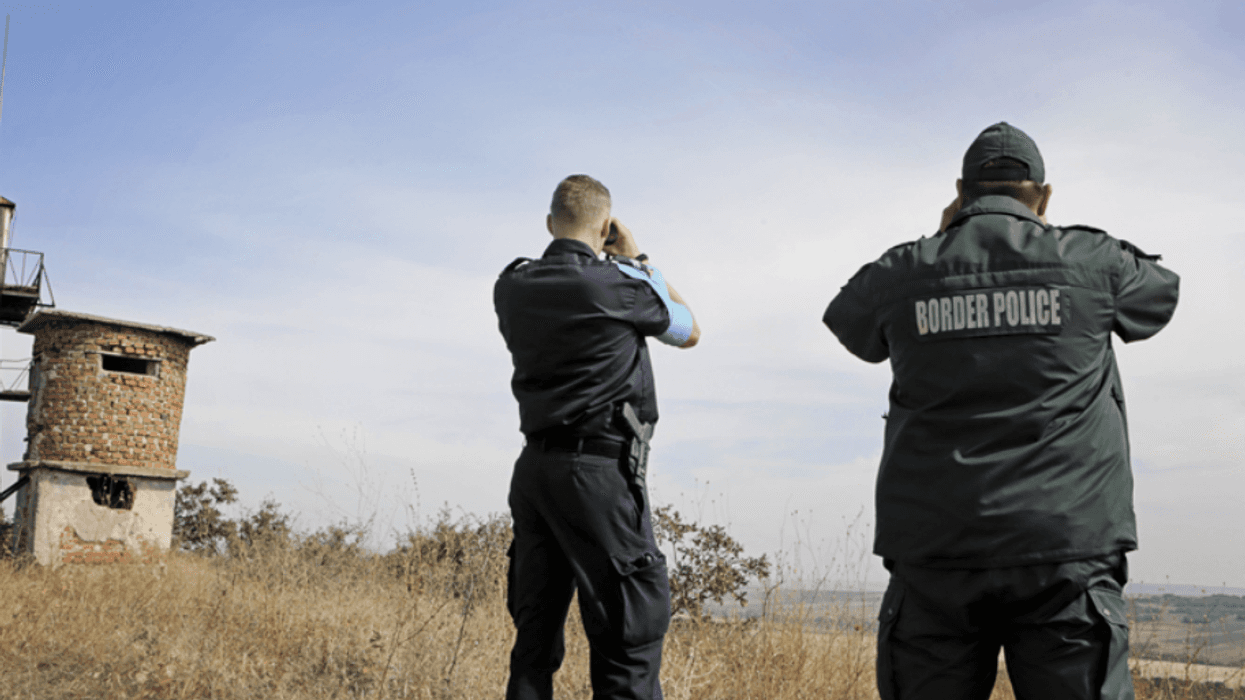
This Sunday, Donald Trump temporarily closed the border crossing at San Ysidro in San Diego, across from Tijuana, Mexico. In response to a surge in migrants and asylum-seekers from Central America, the president has threatened to close the entire border permanently and even shut down the U.S. government if Congress doesn't fund his border wall.
Also this Sunday, the European Union approved British Prime Minister Theresa May's Brexit proposal. If the British parliament gives its okay, Britain will begin its formal withdrawal from the transnational pact at the end of March. Parliamentary approval, however, is far from certain, which leaves the border between the EU and its second most economically powerful member still very much up in the air.
Finally, in the Azov Sea this Sunday, Russian border patrol boats opened fire on three Ukrainian vessels and then took them into custody. Russia is currently holding 24 Ukrainian sailors. Both Russia and Ukraine border the Sea of Azov, as does the disputed territory of Crimea. It's only the latest in a long series of clashes over the border between the two most populous successor states of the Soviet Union.
The border disputes this Sunday were by no means the only ones. Tensions continue over who controls what islands and reefs in the South China Sea. Israel and Palestine continue to clash around the Gaza border and over the West Bank. Syria remains an internally divided country, as is Libya and, frankly, Iraq as well.
Borders are back in fashion. Whether they're trying to keep out immigrants, confront neighbors, or just reassert sovereignty in an increasingly intrusive world, the latest batch of nationalist and authoritarian leaders are challenging the notion that history is heading in an ever more frictionless direction.
Actually, these leaders are all about friction, especially at the borders, because that's precisely where worldviews rub up against each other and create dangerous sparks.
The Break
The decision by a narrow majority of Britons, in a 2016 referendum, to leave the EU was impulsive, uninformed, and splenetic. It was, ultimately, a crime of passion. And now, unless someone issues a last-minute reprieve, the authorities are going to execute the judgment.
I can't resist another metaphor. There is no good Brexit, just as there is no good broken kneecap. They are both ruptures that require careful surgery and a long period of rehabilitation. In this case, there's not just one fracture. Other border issues have included Gibraltar (resolved at the last minute), Northern Ireland (still unclear), and Scotland (it might vote for independence in order to negotiate its own EU membership).
The "soft" Brexit deal to which May and the EU have agreed would keep the UK in the trade area, for a transition period, but also force it to comply with many of the EU regulations that prompted the "leave" campaign to begin with. That's why a number of May's cabinet ministers, including Foreign Minister Boris Johnson, resigned in mid-November. They wanted a "hard" Brexit that represents a clean break with the EU regulatory system - a deal that the EU was not likely to approve.
If the British parliament rejects May's proposal, however, the prime minister might be forced to negotiate a divorce without any deal at all, the hardest of hard Brexits. At the moment, the parliament seems to be gearing up to do just that, though May will use the threat of impending chaos to force the wary to line up behind her.
There are other possibilities, such as an even softer "Norway-plus" arrangement. Also, the European Court of Justice is now considering whether an interpretation of Article 50 of the Lisbon Treaty - which covers withdrawal from the EU - could permit Britain to revoke its Brexit declaration unilaterally. If that's the case, then, the British could go ahead with a second referendum to see if the people, now apprised of the consequences of their actions, are willing to change their minds. It's a rewind button that those who commit crimes of passion and break their kneecaps are not given. Back in March, the people building a new anti-Brexit campaign, with the help of donors like George Soros, gave the prospects of a second referendum at 50/50. With the May government increasingly rickety, the EU standing firm, and virtually everyone predicting economic decline under any Brexit scenario, those odds have gone up.
Still, as Andrew Rawnsley points out in The Guardian, preaching to the Remainers may not be enough to secure a win the second time around.
It is one thing to hold Boris Johnson and his gang to account for the mendacities they peddled in 2016. It is another thing to say that the millions of voters who bought into the bogus Brexit prospectus were idiots and suckers. It is never a smart idea to tell voters that they have been fools. Even, perhaps especially, when they have been. The anti-Brexit campaign has to show respect for Leave voters and for the reasons that they voted Leave. They may be willing to change their minds but they won't hear the arguments for doing so unless they are convinced that they have been listened to as well.
Sound familiar? The Democrats will face the same choice in two years when it comes time to address the buyer's remorse of the American people for shelling out good money for a lemon president.
The Wall
It's no surprise that Donald Trump has declared his first war against a group of civilians, many of them women and children. In a Cabinet memo on November 20, the president authorized U.S. soldiers to use lethal force against asylum-seekers at the Mexican border. Pentagon chief Jim Mattis has tried to indicate that calmer heads will prevail at the border. But impatient protesters threw some rocks on Sunday at the San Ysidro border crossing, and Customs and Border Protection officers sprayed the crowd with tear gas. It was bad enough for the protesters. The visuals also reinforced the message that the Trump administration will do whatever it takes to break national and international law that requires processing the claims of asylum-seekers fairly and expeditiously.
Tear gas is only the latest indignity visited upon the people waiting in Mexico for safe passage out of the horror that had become their lives. In an episode from mid-September, This American Life recounted all the different ways that the Trump administration has made life even more difficult for asylum-seekers.
Over the last six months, Customs and Border Protection officers have been stopping asylum seekers from even walking up to federal facilities at the border. This has been filmed by crews from CBS, NBC, Fox, and many others. They stop people in the middle of bridges that cross from Mexico into the United States at El Paso and Brownsville, and turn them away before they can even get to the official ports of entry on the other side to apply for asylum.
These were people freely exercising their right - not folks jumping over walls or swimming across rivers. Before the latest caravan arrived, a thousand people were basically waiting in line in Mexico for the few opportunities to make their case for asylum. By November 10, the administration closed down that option as well with its asylum ban, which a federal judge blocked 10 days later (which set up the testy exchange between the president and Chief Justice Roberts about "Obama" judges).
Asylum-seekers: can you think of a more ragtag "enemy" to target? Trump has tried to beef up his purported adversary by claiming that gang members and Middle Eastern terrorists have infiltrated their ranks. No one except perhaps the lunatic Ann Coulter, who has urged an invasion of Mexico, believes that particular claim. But a few thousand civilians with no more than rocks for weapons, are just the straw man he needs. The president doesn't want to go up against an opponent that has any chance of winning. Ronald Reagan, when dealing with the legacy of the Vietnam War syndrome, went to war against the tiny island nation of Grenada. Trump, dealing with the Iraq War syndrome, has chosen an even weaker target.
But what motivates the president's attack on immigrants and the caravan more specifically is the opportunity to weaponize America's borders. Right-wing populists in Europe used the immigration issue for the same purpose. Viktor Orban built his own wall to keep the desperate out of Hungary. More importantly, Orban and Poland's Jaroslaw Kaczynski and the Czech Republic's Milos Zeman discovered that nothing defines a nation's sovereignty better than a full-scale effort to keep people out of the country. Moreover, in so doing, they can challenge a key principle of European integration, the free movement of people, in a way to reinforce their Euroskeptical agenda.
Trump doesn't have to deal with Brussels. But he is sandwiched between a liberal in Canada and a socialist in Mexico. He has insulted the former and twisted the arm of the latter to line up behind a new (sort of) regional trade deal. They are stand-ins for what Trump considers an invasive species: globalists. Trump has challenged international institutions, imposed tariffs on allies and adversaries alike, and ridiculed global principles like human rights. And like many so-called conservatives, he has benefited enormously from the system he lambastes (the immigrants he's hired, the global assembly line that has produced his namesake goods).
But again, Trump prefers wars that have favorable odds. He wants to win. Globalization's ardent supporters, like politicians and financiers, are powerful people. They cross borders with ease. Much easier to pick on the poorest and most disadvantaged people in the world.
The War
The conflict between Ukraine and Russia has largely disappeared from the headlines. The Crimean Peninsula remains in Russian hands, the status of eastern Ukraine is still up in the air, and Russia continues to manipulate matters behind the scenes to weaken Ukraine as a whole and battle Western influence in the region. People are still dying every day in the conflict. The separatist ranks in the Donbass have been thinned by assassination and exile. And corruption in eastern Ukraine is rampant. But Europe has too many other crises to manage in-house and not a lot of spare resources to focus on Ukraine.
It's hard not to see the latest naval clash in the Azov Sea as a convenient provocation by Kiev. Ukrainian President Petro Poroshenko has been trying to persuade his parliament to grant him state-of-emergency powers. They balked and balked. But on Monday, after Russia seized the Ukrainian vessels, Poroshenko got what he wanted, for the next month at least. Plus, the most recent crisis strengthens the case for an extension of sanctions against Moscow.
Ukraine says that the boats sought permission to enter the sea when the Russian crafts suddenly attacked. It also complains that Russia has been trying to turn the Azov Sea into a Russian lake. Moscow controls the narrow access of the Kerch strait, particularly after it built a low bridge connecting Crimea to the Russian mainland - which has slowed Ukraine's access to its Azov ports. A 2003 agreement gives both countries access to this body of water, but Russia no longer seems to adhere to it.
It all sounds like a plot line out of Occupied, the TV series about the Russian occupation of Norway. In that series, the Russians and Free Norway rebels both escalate situations in order to improve their strategic positions. It's often hard to know who has provoked whom.
Russian President Vladimir Putin, however, has a very clear agenda. He needs to keep his public opinion ratings high (they've been dropping). He'd like to widen the split between Washington and Brussels and perhaps was thinking that Trump would overlook a naval spat much as he has apparently let Saudi Crown Prince Mohammed bin Salman off the hook for planning the assassination of journalist Jamal Khashoggi. And he'd like to strengthen the wall that divides the EU from all areas to the east.
In a recent interview with Putin, a Russian journalist complains about the EU. "They are working on Belarus, Kazakhstan and now they are very active in Armenia. We can see how they drip poison into their ears. We should do something about it. Our allies are leaving us." Putin responds with a verbal threat that has all too much resonance in light of Russian conduct.
"The poisoners dripping poison into someone's ears will sooner or later swallow it and get poisoned," Putin says.
After this latest clash in the Sea of Azov, Russian allies and adversaries will think twice about sidling up to the bear. Putin would like to reinforce the border between Russia and the West in order to maintain greater influence over Russia's "near abroad." For that same reason, however, the Russian president prefers that the borders closer to home are more fluid, which enables him to meddle more easily in the affairs of his neighbors.
Against Fluidity
It might seem ironic that countries are getting so hung up over borders just when so many people around the world are challenging borders in their everyday lives. Gender fluidity asserts a spectrum of options rather than a rigid binary. Greater racial diversity pushes everyone to think beyond black and white. Workplaces have been revolutionized by telecommuting and automation and the sharing economy. Race, class, and gender are no longer such clearly delineated categories.
Trump is against many things: immigrants, Europeans, strong women, cosmopolitans, policy wonks, whiny democrats, anyone who crosses him. But in his references to an imagined past when America was great and prosperous and commanded global respect - claims that require just the kind of asterisks that Trump hates - the president is also channeling the anxiety of many people for a time of certainties: when men were men and never changed their minds about it, when men married women and never had second thoughts, when a job was a lifetime appointment, and when nation-states were like billiard balls that clashed or kissed but never interpenetrated one another.
Trump's message is so appealing to the older generation, evangelicals, and traditional conservatives that they're willing to overlook the fluidities in the president's own life (divorce, adultery, political perambulations). Trump's supporters cling to his false certainties because they're preferable to true uncertainties.
Such delusions can last only so long.
After all, countries will rise and fall. Regional pacts may crumble. Rates of migration will fluctuate according to national and international policy, the vicissitudes of war and peace, and the hazards of climate change.
But however much the Trumps and Putins and Euroskeptics of the world beef up the borders, fluidity is here to stay.