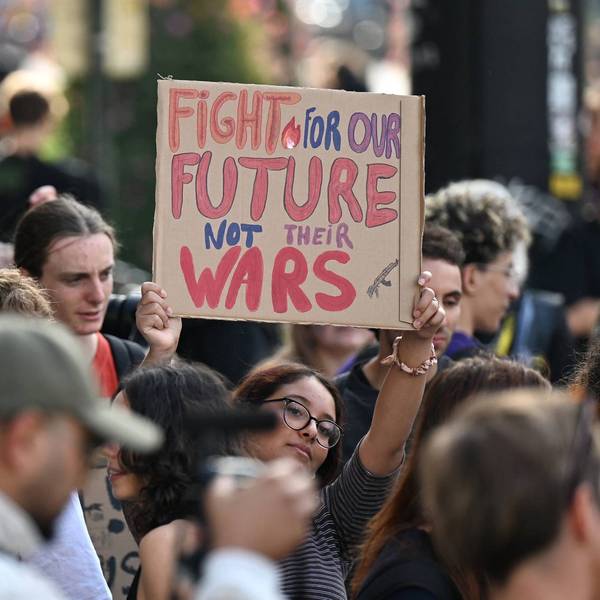

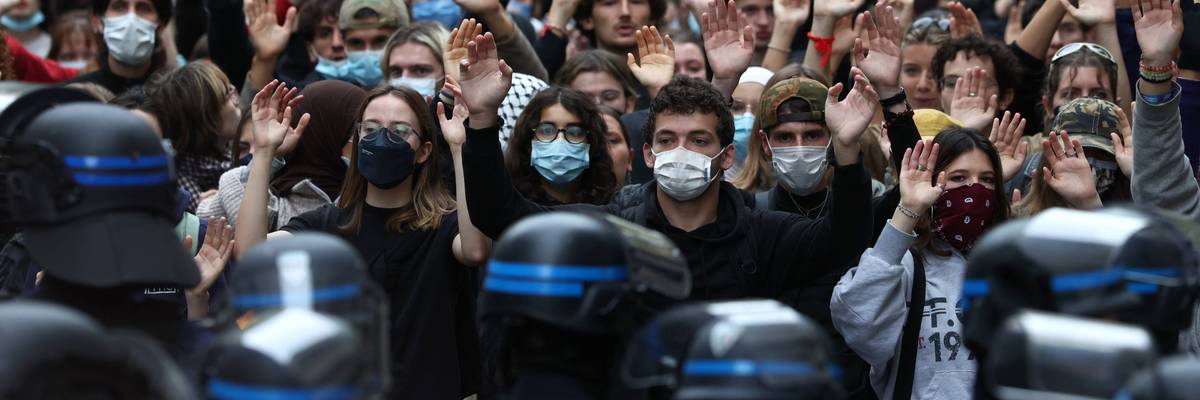
Students raise their hands in front of Police officers as they demonstrate outside Sciences Po during a protest over school overcrowding and decay on October 7, 2026 in Paris, France.
We Are on a Path to a Global Intifada Against Empire
As the center fragments, the periphery learns the lesson that empires forget: The scattered peoples, humiliated by the organized force of a few, are beginning to recognize themselves in a common cause.
This week, a student—a former US Marine—approached me at the end of a class to ask, "But don’t you think Iran, Russia, or China might invade us?”
“No,” I replied. “That’s another fear instilled by the merchants of death. It is the empires that invade; everyone else must resist them. If China ever invades us, it will be because this country has insisted that it do so: those at the top, because wars and conflicts are their best business and strategy; those at the bottom, because of their vocation as slaves and their lack of class consciousness.”
It is an old superstition, promoted by the mercenary media, that empires fall because an external enemy invades them. “Rome fell due to barbarian invasions,” history textbooks repeat, as if a handful of Germanic tribes could have overcome the military machine that had crushed Carthage and Attila himself in present-day France.
Every time a dumpster burns or a storefront window is smashed on the streets of France, the mercenary media suddenly discover “violence.”
Empires do not fall because they are invaded; they are invaded because they fall. If one day China establishes a military base in the United States, it will be because this society passionately accepted not only 800 bases in other countries but also a collective suicide: obscene inequalities; exploitation and demonization of workers (both its own and others’); marginalization of the dispossessed; racial, religious, and class-based hatreds; divisions instilled by the feudal lords… The perfect formula for large-scale civil conflict. As long as the prosperity born of imperial bloodsucking lasts, patriotic fanaticism masks internal colonization. Then come the demagogues peddling nostalgia and more hatred—not to delay the fall, but to hasten it.
How is this absurdity possible? Through the concentration of power, accelerated according to the formula of compound interest: the legal mafias of sects and lobbies. Resistance lies in the very same thing: in the unity of the peoples.
Around 1830, when its ships dominated the seas, Great Britain produced about 5% of the world’s wealth. China still produced 30%. An island with an economy six times smaller imposed opium, “free trade treaties,” and a campaign of evangelization that left 30 million dead upon the greatest civilization of its time.
It wasn’t GDP, that obsession of modern economists. It was the capacity to concentrate. London concentrated capital, fleets, trading companies, and, above all, an idea of itself. China was rich, but its wealth was scattered, its state worn down, its court divided. When the “civilizing” cannons arrived, the giant was already wounded from within. Later, the Taiping Christian Rebellion would kill more Chinese than all the Opium Wars combined.
Wealth follows empires, but empires rise through fanatical centralization. The first to fragment falls. The discussion must center on the type of union: the union Hitler achieved in Germany, or the union the Iroquois achieved through their radical democracy, which survived for centuries as the Great Law of Peace?
Power has never resided in individuals, no matter how much liberalism has built its mythology around the entrepreneur and the dogma that “my selfishness is good for others.” It has resided in unions: lobbies, sects, corporations, unions, churches. A thousand people organized under a single conviction can accomplish more than a million scattered individuals.
Wages and arguments alone are not enough to mobilize a society. Faith is required. The Puritans who believed themselves to be the chosen people, the settlers of Manifest Destiny, the missionaries who accompanied slave traders with the Bible under their arms—all of them, too. Not to mention the Zionists.
There is nothing more powerful than shared madness. When the fanatic wins, any genocide becomes civilization. Plunder becomes the free market. Attacks are self-defense. Great Britain did not impose opium: It opened markets. The United States did not invade: It liberated. Israel does not massacre children: It defends itself. Narrative is not merely an embellishment of power; it is one of its most effective weapons, because it convinces even its own victims.
But the faith that unites during times of ascent divides during times of decline. When the promise of prosperity ceases to be fulfilled, fanaticism turns inward, and tribes begin to view one another as enemies. This is what we are seeing in the United States. The dollar—Washington’s exorbitant privilege for 80 years—is losing ground in central bank reserves. Gold, the age-old witness to mistrust, is breaking records. The debt exceeds $39 trillion, and interest payments on it drain more resources than the Pentagon’s budget. Half the country views the other half as an existential threat. Militias, walls, distrust of elections and the courts. These are not isolated symptoms. It is the dissolution of that union born to conceal its deep divisions (state-based, racial, class-based) and which functioned as long as the fiction yielded enormous dividends—such as slavery.
Washington needs a new external enemy to continue privatizing fortunes and socializing debts. Now it’s China’s turn, then Iran’s… But neither Iran nor China would even dream of invading the United States. It’s enough for them to wait: If your enemy is making a mistake, don’t interrupt them.
Meanwhile, the new “banana republic” Europe is being militarized under Washington’s orders. To do so, it must defund its socialist institutions. As in Argentina, every time a dumpster burns or a storefront window is smashed on the streets of France, the mercenary media suddenly discover “violence.” They speak of vandalism, of radicals, of a threat to democratic order. They never “discover” it when a government eliminates labor rights won over generations; when a reform, decided in distant offices, forces millions to work longer for less; when the value produced by workers is transferred to VIP shareholders (hedge funds) and creditors; nor when their retirement savings are invested in the death industry. That violence doesn’t shatter windows. It shatters lives, and that’s what they call “liberal democracy,” capitalism’s master scam.
In the last 30 years alone, Western empires have bombed, invaded, and financed massacres that left millions dead, from Iraq to Libya, from the Sahel to Palestine. How many of those responsible have been held accountable in any court? None. The very same people who demand order on the streets of Paris have decreed chaos, slavery (today in Libya and Congo), hunger, and death in dozens of countries. Impunity is not a flaw in the system; it is its raison d’être.
By comparison, the violence of popular protests is minimal. It is the response of those who have exhausted the ballot box, the demands for justice, and the marches against endless wars and genocides. History confirms this with irrefutable regularity: No right was granted out of the generosity of the powerful. All were wrested through the pressure and violence of those below.
As the center fragments, the periphery learns the lesson that empires forget. The scattered peoples, humiliated by the organized force of a few, are beginning to recognize themselves in a common cause. The catalyst has been Gaza. We are on the path to a global intifada. The global power elites are investing fortunes in repression, propaganda, and elections to delay it. They may be able to postpone it for a few years. They will not be able to prevent it. The powder keg will continue to dry out, and a spark will do the rest.
We are at a crossroads
This country and this world are at a monumental crossroads. In a few short weeks, US voters will have an opportunity to beat back the forces of fascism and confront the billionaires who are rigging the economy, our media system, and our democracy, making it increasingly impossible for ordinary people to get by. We’re not just talking about the election. We’re talking about what must be done once these fascist elements are vanquished from power. We need a bolder set of solutions than what either major party has so far been willing to offer and a working-class movement ready to fight like hell for it. Trump didn't emerge from nowhere. The conditions that fueled MAGA authoritarianism were created by decades of radical neoliberal economic policies and a corrupt political system dominated by corporate interests. They slashed taxes on the super-rich, promising that the benefits would trickle down. They said giveaways to the corporate titans would make life more affordable for the rest of us. It was all bullshit. And when a bitter, betrayed populace searches for someone to blame, right-wing demagogues have little trouble finding scapegoats. People know when they're being lied to, but you won't hear any of this from the corporate media. Only independent journalism—powered and funded by people who believe in building a better world—can deliver truly trustworthy daily news. Our Fall Campaign is underway, and we need your help. To power our newsroom through the rest of the year, we need to raise $125,000 by midnight on October 31. So if you share our vision, please contribute whatever you can to sustain our work. |
This week, a student—a former US Marine—approached me at the end of a class to ask, "But don’t you think Iran, Russia, or China might invade us?”
“No,” I replied. “That’s another fear instilled by the merchants of death. It is the empires that invade; everyone else must resist them. If China ever invades us, it will be because this country has insisted that it do so: those at the top, because wars and conflicts are their best business and strategy; those at the bottom, because of their vocation as slaves and their lack of class consciousness.”
It is an old superstition, promoted by the mercenary media, that empires fall because an external enemy invades them. “Rome fell due to barbarian invasions,” history textbooks repeat, as if a handful of Germanic tribes could have overcome the military machine that had crushed Carthage and Attila himself in present-day France.
Every time a dumpster burns or a storefront window is smashed on the streets of France, the mercenary media suddenly discover “violence.”
Empires do not fall because they are invaded; they are invaded because they fall. If one day China establishes a military base in the United States, it will be because this society passionately accepted not only 800 bases in other countries but also a collective suicide: obscene inequalities; exploitation and demonization of workers (both its own and others’); marginalization of the dispossessed; racial, religious, and class-based hatreds; divisions instilled by the feudal lords… The perfect formula for large-scale civil conflict. As long as the prosperity born of imperial bloodsucking lasts, patriotic fanaticism masks internal colonization. Then come the demagogues peddling nostalgia and more hatred—not to delay the fall, but to hasten it.
How is this absurdity possible? Through the concentration of power, accelerated according to the formula of compound interest: the legal mafias of sects and lobbies. Resistance lies in the very same thing: in the unity of the peoples.
Around 1830, when its ships dominated the seas, Great Britain produced about 5% of the world’s wealth. China still produced 30%. An island with an economy six times smaller imposed opium, “free trade treaties,” and a campaign of evangelization that left 30 million dead upon the greatest civilization of its time.
It wasn’t GDP, that obsession of modern economists. It was the capacity to concentrate. London concentrated capital, fleets, trading companies, and, above all, an idea of itself. China was rich, but its wealth was scattered, its state worn down, its court divided. When the “civilizing” cannons arrived, the giant was already wounded from within. Later, the Taiping Christian Rebellion would kill more Chinese than all the Opium Wars combined.
Wealth follows empires, but empires rise through fanatical centralization. The first to fragment falls. The discussion must center on the type of union: the union Hitler achieved in Germany, or the union the Iroquois achieved through their radical democracy, which survived for centuries as the Great Law of Peace?
Power has never resided in individuals, no matter how much liberalism has built its mythology around the entrepreneur and the dogma that “my selfishness is good for others.” It has resided in unions: lobbies, sects, corporations, unions, churches. A thousand people organized under a single conviction can accomplish more than a million scattered individuals.
Wages and arguments alone are not enough to mobilize a society. Faith is required. The Puritans who believed themselves to be the chosen people, the settlers of Manifest Destiny, the missionaries who accompanied slave traders with the Bible under their arms—all of them, too. Not to mention the Zionists.
There is nothing more powerful than shared madness. When the fanatic wins, any genocide becomes civilization. Plunder becomes the free market. Attacks are self-defense. Great Britain did not impose opium: It opened markets. The United States did not invade: It liberated. Israel does not massacre children: It defends itself. Narrative is not merely an embellishment of power; it is one of its most effective weapons, because it convinces even its own victims.
But the faith that unites during times of ascent divides during times of decline. When the promise of prosperity ceases to be fulfilled, fanaticism turns inward, and tribes begin to view one another as enemies. This is what we are seeing in the United States. The dollar—Washington’s exorbitant privilege for 80 years—is losing ground in central bank reserves. Gold, the age-old witness to mistrust, is breaking records. The debt exceeds $39 trillion, and interest payments on it drain more resources than the Pentagon’s budget. Half the country views the other half as an existential threat. Militias, walls, distrust of elections and the courts. These are not isolated symptoms. It is the dissolution of that union born to conceal its deep divisions (state-based, racial, class-based) and which functioned as long as the fiction yielded enormous dividends—such as slavery.
Washington needs a new external enemy to continue privatizing fortunes and socializing debts. Now it’s China’s turn, then Iran’s… But neither Iran nor China would even dream of invading the United States. It’s enough for them to wait: If your enemy is making a mistake, don’t interrupt them.
Meanwhile, the new “banana republic” Europe is being militarized under Washington’s orders. To do so, it must defund its socialist institutions. As in Argentina, every time a dumpster burns or a storefront window is smashed on the streets of France, the mercenary media suddenly discover “violence.” They speak of vandalism, of radicals, of a threat to democratic order. They never “discover” it when a government eliminates labor rights won over generations; when a reform, decided in distant offices, forces millions to work longer for less; when the value produced by workers is transferred to VIP shareholders (hedge funds) and creditors; nor when their retirement savings are invested in the death industry. That violence doesn’t shatter windows. It shatters lives, and that’s what they call “liberal democracy,” capitalism’s master scam.
In the last 30 years alone, Western empires have bombed, invaded, and financed massacres that left millions dead, from Iraq to Libya, from the Sahel to Palestine. How many of those responsible have been held accountable in any court? None. The very same people who demand order on the streets of Paris have decreed chaos, slavery (today in Libya and Congo), hunger, and death in dozens of countries. Impunity is not a flaw in the system; it is its raison d’être.
By comparison, the violence of popular protests is minimal. It is the response of those who have exhausted the ballot box, the demands for justice, and the marches against endless wars and genocides. History confirms this with irrefutable regularity: No right was granted out of the generosity of the powerful. All were wrested through the pressure and violence of those below.
As the center fragments, the periphery learns the lesson that empires forget. The scattered peoples, humiliated by the organized force of a few, are beginning to recognize themselves in a common cause. The catalyst has been Gaza. We are on the path to a global intifada. The global power elites are investing fortunes in repression, propaganda, and elections to delay it. They may be able to postpone it for a few years. They will not be able to prevent it. The powder keg will continue to dry out, and a spark will do the rest.