

SUBSCRIBE TO OUR FREE NEWSLETTER
Daily news & progressive opinion—funded by the people, not the corporations—delivered straight to your inbox.
5
#000000
#FFFFFF
To donate by check, phone, or other method, see our More Ways to Give page.
Daily news & progressive opinion—funded by the people, not the corporations—delivered straight to your inbox.

So long as lawmakers remain more loyal to their Wall Street donors than to working-class, don't expect even this Blue Tsunami to alter their political leanings very much.
As the November 3 euphoria fades, the grim reality remains: Trump and his lawless regime, along with Corporatist Democratic leaders Hakeem Jeffries and Chuck Schumer, still hold the reins of power. Granted, the Democrats now have a comfortable majority in the House and Senate and will hold many investigative hearings into the Trump rein of corruption, cruelty, violence, mass lawbreaking and Elon Musk’s DOGE crimes. However, the grim prospect is that they will mostly produce few results.
Why? First, they have to clear the corporatist Democratic Committee Chairs (more about that later) and then clear Speaker Hakeem Jeffries and Majority Leader Chuck Schumer. Jeffries and Schumer take large amounts of Wall Street campaign money. They take money from the big weapons manufacturers, and they are first in line for AIPAC-related campaign bucks.
Second, they show few signs of heeding the anger of their Democratic voters—90% of whom want Trump impeached. Voters also want Congress to give big corporations a heavy dose of “law and order,” restore taxes on them, and take these corporate giants and the super-rich owners off welfare.
In short, the New York-based Democratic leadership in Congress remains very supportive of the Wall Streeters, the bloated military budget, corporate welfare, and the Netanyahu-AIPAC lobby, backing Netanyahu’s genocide in Palestine.
There are exceptions in Congress—Sen. Elizabeth Warren (D-Mass.) will become the chair of the Senate Banking Committee, and Sen. Bernie Sanders (I-Vt.) is expected to chair the Senate Health, Education, Labor, and Pensions (HELP) Committee. But then what? Their legislation is up against both the Democratic and Republican leadership. Schumer will let these two progressive Democrats provide red meat to the masses, but progressives will likely be marginalized, as has happened so often under party leaders who are cowards and corporatists.
Recall the Obama-led Democratic landslide in 2008. Obama who had an even larger Democratic majority in the House and Senate, mostly punted, enacting a watered-down Obamacare, without a public option. (Obama pushed legislation including the American Recovery and Reinvestment Act, the Lilly Ledbetter Fair Pay Act, and the Credit CARD Act, that established a “bill of rights” for credit cardholders, placing new restrictions on arbitrary interest rate hikes, hidden fees, and marketing to young consumers—but he should have done much more.) A historic loss of major opportunities for a just society.
Two years later, the Democrats had their heads handed to them by voters rejecting their do-nothing-ism. It can happen again.
In August of 2026, Jeffries placed hard-line pro-Netanyahu Democrats in critical positions on the Foreign Relations Committee. He will likely install corporatist Democrats as chairs of powerful committees or loyalists who, if not beholden to corporate lobbies, will do his bidding.
Exhibit One is the longtime, corporate cash register Congressman Richard Neal from a “safe seat” in Massachusetts. Trump must love him. When he became chair of the House Ways and Means Committee in January 2019, he said he would NOT revisit the horrendous tax escapes Trump enacted in 2017 for his super-rich buddies and giant corporations. What?!
Just last September 15, Neal joined a minority of House Democrats headed by Hakeem Jeffries and, with 46 other Democrats, voted “Present,” effectively—along with the Republicans obviously—refusing to vote for Rep. Al Green’s Impeachment Resolution, which received 146 votes, a majority of House Democrats. During his campaign for re-election, Neal declined to say he would vote for Impeachment of Donald J. Trump, the violent, cruel, self-enriching, corrupt, warmongering, bigoted Outlaw. Dictator Donald must be delighted that Richard Neal supports so many Trump positions.
Neal has long opposed full Medicare for All or single-payer, everybody in, nobody out, preferring to go with a very limited, high-priced Obamacare. He takes abundant campaign money from the corporate health insurance and healthcare PACs.
Delivering for his paymasters, Neal goes along with the bloated military budget, vast corporate welfare giveaways, and blocked “surprise medical billing” legislation in 2019 that made private equity firms and other corporate beneficiaries happy to contribute to his campaign war chest.
The big drug companies are also happy with Neal—and are filling his campaign coffers—because he has worked to limit drug-pricing legislation, restrict Medicare’s authority to negotiate prices, and keep lower prices from being extended to uninsured individuals.
Neal had the support of his dittoheads on the Committee and the backing of the “bought and sold” Republican Committee members to deliver these favors for the few at the expense of the many defenseless consumers and people opposed to Trump. He went all the way, running Committee markups dictatorially, and obstructing votes on amendments by progressive Committee members such as Representatives Lloyd Doggett and Gwen Moore designed to hold corporations accountable.
In 2022, despite the support of 200 House Democrats for Subcommittee Chair John Larson’s bill to increase Social Security benefits, frozen since 1971, and pay for it by taxing wages above $400,000, Neal supported Speaker Nancy Pelosi’s keeping the bill from a vote on the House floor.
Blocking it helped the Republicans take the House from Speaker Pelosi. And, Democrats forfeited an opportunity to campaign on expanding Social Security (See The American Prospect: House Leadership Delays Social Security Expansion While Crafting Tax Breaks for Rich Retirees.)
This bill would have helped 60 million retirees.
Neal is a clever politician who talks a good game on slam-dunk reversals of Trump’s restrictions of Medicaid and food stamps. But, when it comes to delivering the big honeypots and immunities big business wants, he is pretty much a corporate toady. Right after taking the Chair of the Ways and Means Committee in 2019, he convened high-dollar fundraisers, spending some of these donations on what Politico reporter Danny Nguyen called, “upscale restaurants, hotels and entertainment to court elite donors and lobbyists with businesses before his committees.”
There is still time to make Richard Neal persona non grata with the tens of millions of voters who want a Peoples’ Congress and fighters for them in Washington. Neal is unpopular with most members of the Progressive Caucus led by the refreshing young Congressman Greg Casar from Texas. Other groups like RootsAction led by Norman Solomon and Progressive Democrats of America led by Alan Minsky, as well as major anti-poverty, tax reform and many anti-Trump organizations, could combine to challenge his selection by Jeffries as the Ways and Means committee chair. There are any number of qualified and willing House candidates for this powerful position.
Earlier this year, Neal, with his 38 years of absentee incumbency in the House, had a paltry 25% approval rating from his District. Loaded with corporate dollars and not being challenged by the Republicans or seriously challenged in the Democratic primaries until this year, he cruises to re-election from his nice mansion on Cape Cod, rejecting in-person town meetings and a presence in his District beyond ribbon-cutting ceremonies.
This year, he fought off an Independent candidate challenge from Nadia Milleron (my niece) by pumping over four million dollars in corporate donations into a Trump-like “Big Lie” smear campaign. This will not be lost on his expanding detractors. (See The Berkshire Eagle article “Ralph Nader blasts Rep. Richard Neal in letter backing niece’s challenge”).

None of these candidates went into Election Day with a “solid Democrat” or even a “likely Democrat” rating from the Cook Political Report; their hard-fought victories are a signal that American voters are ready for inequality-fighting, transformative change.
The “affordability crisis” ranked as the top issue for every Democrat in this election. But candidates’ solutions to this crisis varied widely. Some seemed to think a bit of tinkering to lower prices, plus a dab of deregulation, would do the trick.
We highlight here six candidates who won tough races by offering a much bolder vision of an economy that works for all. These candidates promised to build working families’ power to tackle the extreme wealth concentrations that are driving up housing and healthcare costs, suppressing wages, squeezing consumers and small businesses, and distorting our democracy.
None of these candidates went into Election Day with a “solid Democrat” or even a “likely Democrat” rating from the Cook Political Report. Their hard-fought victories are a signal that American voters are ready for inequality-fighting, transformative change.
Poindexter crushed Republican incumbent Max Miller by nearly 10 points, becoming the first non-Republican to represent Ohio’s 7th District since 1939. The union organizer and ironworker won over Rust Belt voters with a strong pro-worker agenda.
“When tax cuts are debated in Washington, they seem to flow easily to the wealthiest and most powerful,” Poindexter wrote in his economic platform. “When subsidies are discussed, large corporations are first in line. But when the conversation turns to deficits, debt, or ‘tough choices,’ it’s working families who are asked to give more, wait longer, or accept less.”
Drawing on his 20-plus years in the labor movement, Poindexter is vowing to strengthen collective bargaining rights so workers can fight for better wages and benefits. He also aims to increase the minimum wage and expand access to affordable healthcare.
Lawrence’s race was closely watched because it was seen as a test of whether campaigning against Big Tech and unregulated AI could be a vote-getter in a red district. Turns out it was.
Lawrence ran ads denouncing the tech billionaires driving the AI data center boom, vowed to put a pause on advanced AI development, and blasted privacy-invading surveillance technologies like Flock cameras.
A co-founder of a youth-led climate group called the Sunrise Movement, Lawrence also mobilized huge support from Michigan State University students. His campus rallies drew large crowds to discuss his proposals to get money out of politics, increase taxes on the wealthy, end corporate landlord price gouging, and guarantee universal healthcare.
Last night the millennial activist garnered 51% of the vote to oust Republican incumbent Tom Barrett.
Cooke grew up on a Wisconsin dairy farm that has suffered the same fate as thousands of others in the state. Because of unfair competition with large corporate producers, her family has had to sell their cows.
“I want to take on the corporate monopolies that have robbed us of our farming traditions and our heritage,” Cooke said in a campaign trail interview with More Perfect Union. On top of breaking up Big Ag, she wants to pass the PRO Act to strengthen union rights, raise the minimum wage, and protect communities from “unchecked hyperscale data centers.”
In between waitressing at two Eau Claire restaurants, Cooke ran a grassroots-powered campaign that beat incumbent Republican Derrick Van Orden by a four-point margin.
Flanagan wasn’t expected to have a tough race after winning the primary to replace Democrat Tina Smith. But she wound up with a “vulnerable” rating in the face of rampant disinformation about welfare fraud during her time as the state’s lieutenant governor and an opponent who happened to be a smooth-talking former TV sportscaster.
As someone who grew up in poverty, Flanagan prevailed by drawing on that experience to deliver a compelling vision of an economy in which everyone can thrive—not just the ultra wealthy. She vowed to work for inequality-fighting policies such as Medicare for All, scrapping the income cap on Social Security contributions, and banning large corporate landlords from purchasing single-family homes.
Flanagan refused corporate PAC money and called for banning all corporate and “dark” money in future elections. In the end, she won by double digits. And when she enters the US Senate in January, she’ll be making history. That body has never had a Native American woman member, and Flanagan belongs to the White Earth Band of Ojibwe.
After the flameout of the first Democratic nominee, Jackson entered the race with only three months to campaign against teflon Republican Susan Collins.
Growing up, Jackson had formative experiences watching his dad and other loggers stand up to wealthy landowners to demand basic fairness. He carried that working class fight into his own logging career and then into Maine’s state legislature.
On the campaign trail, Jackson signed a “Pledge to Working Mainers” demanding a billionaire tax, a congressional stock trading ban, and a ban on AI surveillance to prevent “robots deciding your paycheck, hiring and firing you, or monitoring your work.”
Heading into Election Night, the Cook Political Report had the Jackson-Collins race as a total “toss-up.” In the end, Jackson ousted the 30-year incumbent by an eight-point margin.
Ending with a big one here. El-Sayed had to put up with grotesque racism and Islamophobia throughout his campaign. He prevailed with one of the strongest inequality-fighting economic platforms of any candidate in 2026.
The native Michigander boiled his agenda down to three alliterative pledges: money in your pocket, money out of politics, and Medicare for All.
With his medical degree and public health experience, El-Sayed projected a particularly strong vision of guaranteed healthcare for every American, regardless of what they do for work. He also called for abolishing medical debt, banning the use of AI to allow health insurers to second-guess doctors’ decisions, and preventing Medicare privatization.
El Sayed did not shy away from overtly arguing for wealth distribution.
“I’d rather have an economy that makes 1,000 millionaires than one billionaire,” El-Sayed said in a social media clip. “If you’re serious about building the most productive possible economy, take that excess money that would have been parked into the S&P 500 and invest it in good schools, good infrastructure, healthcare, childcare, which by the way, all make jobs, a ton of jobs, most of which are very difficult to automate,” El-Sayed argued.
Last night, El-Sayed demolished Republican opponent Mike Rogers by an eight-point margin. As he heads to Washington, he is vowing to “fight against corporate tax breaks and the capture of our economy by billionaires and wanna-be oligarchs.”
Look out.

Lula's comeback offers a powerful lesson: Ambitious economic policies can capture voters' imaginations when they promise tangible improvements in everyday life and win their hearts when you can deliver on that vision.
In just three weeks last month, Brazilian President Luiz Inácio Lula da Silva turned a 2.2-million-vote deficit in the first round into a 4.4-million-vote victory in the runoff. He won 52% to 48%. The six-point reversal made him the first candidate in Brazil's modern presidential history to win a runoff after being down in the first round. He increased turnout and appears to have converted voters who didn’t initially vote for him.
Much has been written about the organizing mechanics of this remarkable turnaround and the revitalization of "Lula's Army." While these explanations tell us how Lula’s campaign mobilized voters, they don’t tell us why voters mobilized. The contrasts between Lula and Flávio Bolsonaro were of course already stark, but if they were so stark, the changing of the tides wouldn’t have been so dramatic over three weeks. That emphasis on organizing mechanics overlooks strategic policy decisions Lula made those final weeks to deliver concrete victories for Brazilian workers.
And the most powerful of those decisions? In October, Lula successfully fought for the passage of a constitutional amendment to shorten the workweek from six days to five days, which had been one of his main campaign pledges. This was one of the most meaningful Brazilian labor reforms in decades. By the end of 2027, workers will have 10% of their time back and an additional day of rest. So many voters are used to politicians making promises but not delivering on them. Lula made sure workers knew he had their back by delivering real policy change in a critical period of the election. And this policy was not a niche policy change impacting small segments of the population. It’s estimated it would concretely touch the lives of over 30 million Brazilian workers by giving them their time back.
For millions of Brazilian workers, they’ve had a “6x1” schedule their entire lives: working six days every week with just a single day to recover. Burnout, unsurprisingly, had become epidemic. Shortening the Brazilian workweek had been advanced by unionists in Brazil for decades, but had taken on newfound pressure from a grassroots campaign called Vida Além do Trabalho (Life Beyond Work). This campaign, founded in 2023 by worker-turned-politician Rick Azevedo, helped turn growing frustration into a real political movement. From 2023 to 2026, workers and politicians worked together to steadily build support in Congress, organizing demonstrations, running for office on a shorter workweek agenda, collecting millions of signatures, and incorporating the demand into campaign rallies. This culminated in Lula focusing on shortening the workweek in his May Day 2025 rally and sending a bill to Congress in April 2026, bringing this issue into the forefront of the presidential election.
The grassroots campaign also helped seed widespread support for shorter workweeks across the political spectrum, helped in part by the fact that shorter workweeks intuitively connected to workers’ material self-interest. In March 2026, a Datafolha poll showed that 71% of Brazilians supported ending the six-day workweek, including 77% of women.
Lula recognized the opportunity. Just days after his first-round defeat in October, he publicly challenged Bolsonaro to support the reform. Simultaneously in October, University of Brasilia’s student union held a 50,000-person rally with the slogan “Bolsonaro never again, and end the 6x1 now.” This bottom-up and top-down approach worked. Bolsonaro and his opposition party initially opposed the proposal. But amid widespread backlash, they quickly backed down. They agreed to a special Senate session to ensure the passage of a constitutional amendment which would result in a 10% reduction of workers’ workweeks (from 44 hours to 40 hours) and two guaranteed days of rest by the end of 2027, with no loss in pay. The public hunger for this change was so deep that the amendment passed 75-1 in the Senate and Congress passed it two days later.
Lula's comeback offers a powerful lesson. Ambitious economic policies can (1) capture voters' imaginations when they promise tangible improvements in everyday life, and (2) win their hearts when you can deliver on that vision. And few promises are more meaningful than giving workers back the one thing they can never earn more of: their time.
The cost-of-living crisis is a global issue: When you hear the struggles of Brazilian workers, they’re not too different from those of American workers. Just as in Brazil, there’s an epidemic of burnout and widespread frustration that the American dream has just resulted in being overworked and tired. Brazilian politicians and movement leaders savvily recognized that cost-of-living and affordability is about prices and wages, but also about time.
American politicians should start paying attention. The United States established the 40-hour workweek nearly 90 years ago. Despite massive changes in who works, how we work, where we work, and when we work, that workweek has stayed at approximately 40 hours at the individual level, and we work more household hours than we did 60 years ago. With AI on the horizon, even more could change rapidly with work.
American politicians should keep in mind that the shorter workweek offers an opportunity to translate this burgeoning coalition for shorter workweeks into meaningful policy change.
In this moment of burgeoning economic populism, shorter workweeks could be a policy that helps politicians deliver real widespread change that is also immensely popular. The Brazil example is instructive. Any shorter workweek bill deserves to be passed merely for the sake of giving time back to workers, but it also holds real electoral fruits. As in Brazil, approximately 7 in 10 Americans support shorter workweeks. After all, a better economy shouldn't just mean having more money in your pocket. It should mean having more life outside of work.
Similar to Brazil in 2023, we’re seeing small scale progress in the last few years. At the federal level, 32-hour workweek bills have been introduced in both houses of Congress from Sen. Bernie Sanders (I-Vt.) and Rep. Mark Takano (D-Calif.). At the state and local level, policymakers as wide-ranging as a Republican in Maine, Rick Bennett, and a DSA NY Member in NYC, Phara Souffrant Forrest, have advanced shorter workweek legislation. Both unions have advocated for this and hundreds of companies have adopted it.
The dust will soon settle on the 2026 midterms, and campaigns will start prepping for the 2027 and 2028 elections. American politicians should keep in mind that the shorter workweek offers an opportunity to translate this burgeoning coalition for shorter workweeks into meaningful policy change. Lula's comeback shows what can happen when politicians give workers something worth fighting for, and then deliver on that idea.

How Democrats choose to deal with Musk, Trump, and other morbidly rich American oligarchs and their monopolistic empires may be the most important set of decisions party leaders have made in 50 years or more. We can't allow them to mess it up.
Elon Musk spent almost a half-billion traceable dollars (and we have no idea how much “dark money” that’s not traceable but legalized by corrupt Republicans on the Supreme Court) to try to help rightwing politicians win this week’s election. As the old joke goes, that’s both the good and the bad news.
Given how severely great wealth has distorted our republic—from buying elections and legislation to putting judges on the Supreme Court—Democrats now face some serious decisions about how to proceed.
Who should lead the Party’s efforts both in and outside of Congress? Should the Party embrace its progressive base and push policies like Medicare for All and free college, or stay with Clinton-style “moderate” positions as we move into the next Congress? Impeach Trump or, as Schumer suggested yesterday, “work with him”?
As more and more of the nation’s wealth is stolen from the bottom and middle and transferred to the top one percent, the nation’s people lose confidence in the institutions that should have been defending, protecting, and supporting them.
Corporate Democrat Claire McCaskill suggested on MS NOW recently that Democrats must embrace “moderate” positions because those are the ones most likely to be looked upon favorably by “independent” voters, but is that true?
Those same voters swung toward Trump several times recently because, instead of being “moderate,” he was proposing radical change in government policies.
Support for genuinely progressive policies like free college, Medicare for All, taxing the morbidly rich and big corporations, and aggressive actions to mitigate climate change with green energy actually poll very strongly with so-called independent voters.
And there’s something eerily familiar about today that people who’ve read histories of the 1930s and the Roosevelt administration’s New Deal recognize. It’s as if history is repeating itself.
And if that’s actually the case, the choices congressional Democrats make now about how to deal with Musk, Trump, and other morbidly rich American oligarchs and their monopolistic empires (including media monopolies) may be the most important decisions Democrats have made in 50 years or more.
And the stakes are huge: in actual, historical fact, those wielding great wealth have been responsible for the failure or near-failure of pretty much every republic that’s failed since the days of ancient Greece and Rome.
In modern times they’ve provoked the American Revolution, the French Revolution, the American Civil War, the Russian Revolution, and the downfall of dozens of smaller once-democratic or partially-democratic states from Chile in the 1960s to Egypt, Hungary, and Turkey in the last few decades. It’s also happening to Russia as you read these words, although that’s another article altogether.
And now the morbidly rich are screwing up America again, much as they did in the 1920s and the 1850s. If they succeed and enough “moderate” Democrats continue to get into bed with them, it will be both disastrous and perhaps bloody, a word that Trump himself has recently used to describe his plans for the next two years.
America has been through three great cycles since our founding, as brilliantly explained by Neil Howe in The Fourth Turning Is Here and Peter Turchin in Elites, Counter-Elites, and the Path of Political Disintegration. Turchin also summarized his thesis in a tight but concerning article for The Guardian two years ago titled “The deep historical forces that explain Trump’s win.”
(I’ve also written about these cycles of history multiple times over the years, here, here, here, here, here, etc., but it deserves a fresh examination in the light of the election and the crucial decisions now facing the Democratic Party.)
Howe explains how every 80 years or so (as our elders die out) we lose access to the lessons our grandparents learned, particularly those about the importance—nay, the necessity—of regulating great wealth so it doesn’t turn government into a vehicle to exclusively serve the morbidly rich.
When the morbidly rich take over, he notes, bad things happen: it was 73 years from the Constitution’s ratification until the oligarchs in the South started the Civil War, exactly 80 years from the end of the Civil War to the end of World War II (caused by greedy oligarchs on Wall Street kicking off the Republican Great Depression), and today we’re exactly 81 years out from the end of World War II.
Turchin breaks those 80-year cycles into 40-year segments. He points out how, in back-to-back 40-year blocks of time, the obscenely rich are brought to heel over four decades, but then rise up and take over again during the next forty years. Over and over again throughout American history.
Support for genuinely progressive policies like free college, Medicare for All, taxing the morbidly rich and big corporations, and aggressive actions to mitigate climate change with green energy actually poll very strongly with so-called independent voters.
The cover of his book Ages of Discord provides a graphic that visually explains his hypothesis, showing a red line for the accumulation of great wealth from 1780 to 2020 and working class wealth with the blue lines.
Today, we’re overdue for one of his generational flips: we are 45 years from Reagan’s counter-revolution against the New Deal, a program FDR put into place in 1933 that saved America and created the largest middle class the world had ever seen. (I’m radically simplifying both of these scholar’s works: I recommend you buy and read their books for more detail.)
In summary, Trump’s election and re-election were reflections of the success of the anti-New Deal counter-revolution launched with the Reagan Revolution in 1981, in which America’s most wealthy men essentially took back control of our government from the “New Dealers.”
Much of this was accomplished through a process of destroying unions, cutting taxes on the rich while borrowing from the future to fund them, and allowing corporations to search the world for the cheapest labor and least regulation (“free trade”). While it’s rarely mentioned in our increasingly-oligarch-captured media, they called this “neoliberalism” (as I detail in my book The Hidden History of Neoliberalism: How Reaganism Gutted America).
FDR’s New Deal created massive prosperity for the American working class, lifting us from 15 percent of Americans being in the middle class in 1933 to 65 percent of us at that status with a single paycheck when Reagan took office in 1981. (Today, we’re well below 50 percent and it takes two paychecks to get there.)
Because of roughly 40 years of success during FDR’s New Deal (1933-1981), a third of American workers had the protections of a union when Reagan took office, brand-spanking-new schools dotted the countryside, college was so cheap as to be virtually free, hospitals and health insurance companies were required to be nonprofit so healthcare was easily affordable, and housing supports meant that the cost of the average home was about twice the average annual income.
The main beneficiaries were my generation, the boomers, who came of age at the peak of the New Deal’s effects, before Reaganism bit hard into American workers, with Republicans and their morbidly rich stealing over $79 trillion of our wealth in just 45 years and handing it off to the Epstein/Musk/Bezos/Zuckerberg class.
As I point out in The Hidden History of the American Dream, when my generation was in our 30s, we controlled about 21 percent of the nation’s wealth; today people in their thirties only control 4.6 percent of America’s wealth. Average home prices today are ten times average annual income today. College is unaffordable, as is healthcare.
Forty-five years of Reaganism, embraced by both parties until 2021, have wiped out the middle class while making the rich into the super-rich. When Reagan came to office, billionaires were a rarity (there were only 7 of them) and they were constrained by law from owning judges and politicians or having an outsize influence in elections.
And then Republicans took over in 1981 and began their war on the American Dream.
In this week’s election—thanks to corrupt Republicans on the Supreme Court with their Citizens United decision—several hundred American and foreign billionaires, Elon Musk, and Israel’s AIPAC largely funded GOP campaigns, massively outspending progressive Democrats through PACs and dark money SuperPACS.
The most visible examples were the billionaire-funded campaigns against James Tallarico and Abdul El-Sayed, who were outspent by over $248 million dollars. That money, though, could not overcome the trends of history and America’s outrage at the GOP’s turn toward naked fascism.
Peter Turchin identifies a three-step process that leads to revolutionary outcomes: “popular immiseration, elite overproduction and state breakdown.”
First, the rich get control of the political system and change the tax code and regulatory state to gut worker income and union-organizing power, “immiserating” (impoverishing) the middle class.
We saw this with Reagan and corrupt Republicans on the Supreme Court dismantling union rights and workers’ power, followed by the passage of “Right To Work For Less” anti-union laws in state after Republican-controlled state.
The rich then redirect the government’s efforts away from supporting working class people to redirecting the wealth of the nation into their own money bins.
The most obvious example of this are the “tax cuts”—cumulatively totaling over $35 trillion—put into place by Reagan, Bush, and Trump.
Up next are efforts to destroy the programs supporting the middle class, as we saw with the Big Beautiful Billionaire’s Bill gutting food stamps (SNAP), Medicaid, and the Affordable Care Act (among other supports to the middle class).
Average working people know they’ve been screwed; they just don’t realize it’s the morbidly rich who did it to them unless there’s an outspoken class warrior like FDR or Bernie Sanders calling it out.
I put “tax cuts” in quotation marks, by the way, because they’re really not tax cuts: those taxes will eventually be paid. Just not by the people who should have paid them; they succeeded in pushing them out decades into the future with the assumption they’ll be paid for either by raising taxes on working people, cutting benefits to the middle class and poor, or both. Instead of “tax cuts,” we should rightly call them “tax deferrals” or “tax redistributions.”
Finally, as more and more of the nation’s wealth is stolen from the bottom and middle and transferred to the top one percent, the nation’s people lose confidence in the institutions that should have been defending, protecting, and supporting them. They see that no matter how they vote, no matter what they do, no matter how loud they protest, they’re still being screwed and the morbidly rich are still getting richer every single day.
This leads to Turchin’s “state breakdown,” which we’ve been witnessing in real time since Trump’s inauguration and the full-on implementation of the billionaire’s Project 2025, kicked off on January 20th, 2025. Step-by-step, those parts of the state that work for and protect the middle class and poor have been taken apart, while those parts that protect the rich (prisons, police, ICE, the military) have gotten trillions.
Average working people know they’ve been screwed; they just don’t realize it’s the morbidly rich who did it to them unless there’s an outspoken class warrior like FDR or Bernie Sanders calling it out.
Thus, they voted for whoever they perceive as most likely to “shake things up,” “destroy the deep state,” or “make the country great again” by restoring the wealth of the middle class.
Sometimes we choose right, as Americans did in 1860 with the election of Lincoln, and in 1932 by choosing FDR. The country was on the brink of disaster with massive fascist movements growing during each era; Lincoln and FDR defeated them and saved our nation’s democracy.
In 2024, though, the billionaires had such a grip on the media and the message, much of it through their ownership of media (Xitter, Facebook, TikTok, Instagram, Washington Post, LA Times, Fox “News,” massively subsidized podcasts, rightwing radio, etc.) and also with a tsunami of advertising cash that they convinced Americans that Trump—a billionaire rapist and convicted criminal who had promised to again cut taxes for his billionaire buddies—was the champion of the little guy.
As Trump, Vance, and Musk celebrated their 2024 election, their toast had to include the word “suckers.”
The result of this choice that put Project 2025 front-and-center has been the further disintegration of government’s protective ability for working class and poor people, turning it instead toward the wish-lists of billionaires, tech bros, and massive corporate monopolies and oligopolies.
As Turchin noted in The Guardian:
“One result of all this political dysfunction is an inability to agree on how the federal budget should be balanced. Together with the loss of trust and legitimacy, that accelerates the breakdown of state capacity.
“It’s notable that a collapse in state finances is often the triggering event for a revolution: this is what happened in France before 1789 and in the runup to the English civil war.”
If both Turchin and Howe are right and we’re now in the Fourth Turning or something like it, that explains much of the results of this week’s election. It should also give Democrats a clear vision of how to move forward.
We’re departing, in other words, the 45-year-long neoliberal/conservative/austerity part of the cycle that Reagan started and shifting into the next ~40-year cycle of progressive renewal of both our democracy and our economy.
For its own survival and that of our republic—and the success of our 2028 candidate for president—the Democratic Party must now reject the neoliberals within its own ranks.
Which means the Democratic Party and individual Democratic politicians should be embracing AOC, Bernie, Ro Khanna, Mark Pocan, Al-Sayed, and every other genuinely progressive politician as hard as they can, and push their policies to the fore.
To do anything less is to squander this moment and risk another rightwing reactionary backlash and loss of middle-class voters like we saw in the reaction to Clinton in 2016 and Harris in 2024.
For its own survival and that of our republic—and the success of our 2028 candidate for president—the Democratic Party must now reject the neoliberals within its own ranks and makes a forceful argument for returning to the systems of Reconstruction, the New Deal, and the Great Society that protected and enriched working class people in the previous cycles.
If Democrats again embrace neoliberals like Rahm Emmanuel (who’s pretty much openly campaigning for the 2028 presidential election), they’ll fail at this critical work and messaging: that could well doom our American experiment in liberal democracy.
If Democrats succeed at finding their voice, however, America may get the second chance to rebuild both our middle class and our democracy, a chance we ultimately won at the beginning of each of the past two 80-year cycles with Abraham Lincoln and FDR.
Thus, the policy and “holding Trump accountable” choices Democrats make for how they’ll proceed in the first 100 days of next year may well decide the fate of our American democracy.
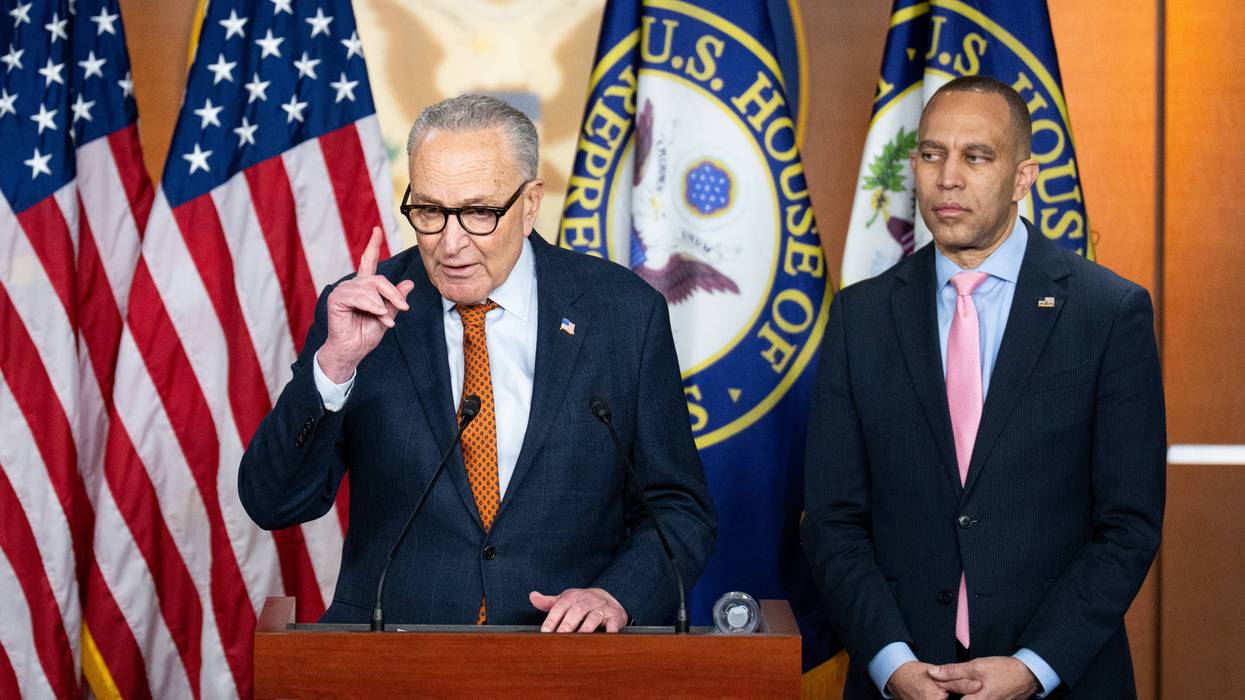
Democrats have said loudly and clearly that they want new leadership. Unfortunately, too many of the people in Washington aren’t listening.
On Tuesday, Democratic voters, independent voters, and even some Republican voters spoke loudly and clearly: they want this country to go in a different direction.
This is an amazing, unprecedented moment in my lifetime. I’m 46 years old, and this is the most hopeful political moment I’ve ever experienced.
However, the Democratic leadership we have today is completely ill-suited for this moment. They do not have the vision for what it’s going to take to rebuild the trust the American people have lost in their government, their institutions, and the Democratic Party itself.
Democrats have spoken loudly and clearly that they want new leadership. Unfortunately, too many of the people in Washington aren’t listening.
We’re going to do our dead-level best to make sure they hear us and make sure they see the names. We’re going to start sending text messages, running ads, and getting loud. We’re going to get in their faces and make it impossible to ignore what Democrats, independents, and the voters who delivered this Democratic tsunami are demanding: new leadership.
Chuck Schumer is bad at his job. Hakeem Jeffries is not ready for this moment. He is not the leader we need.
It's time for them to go.
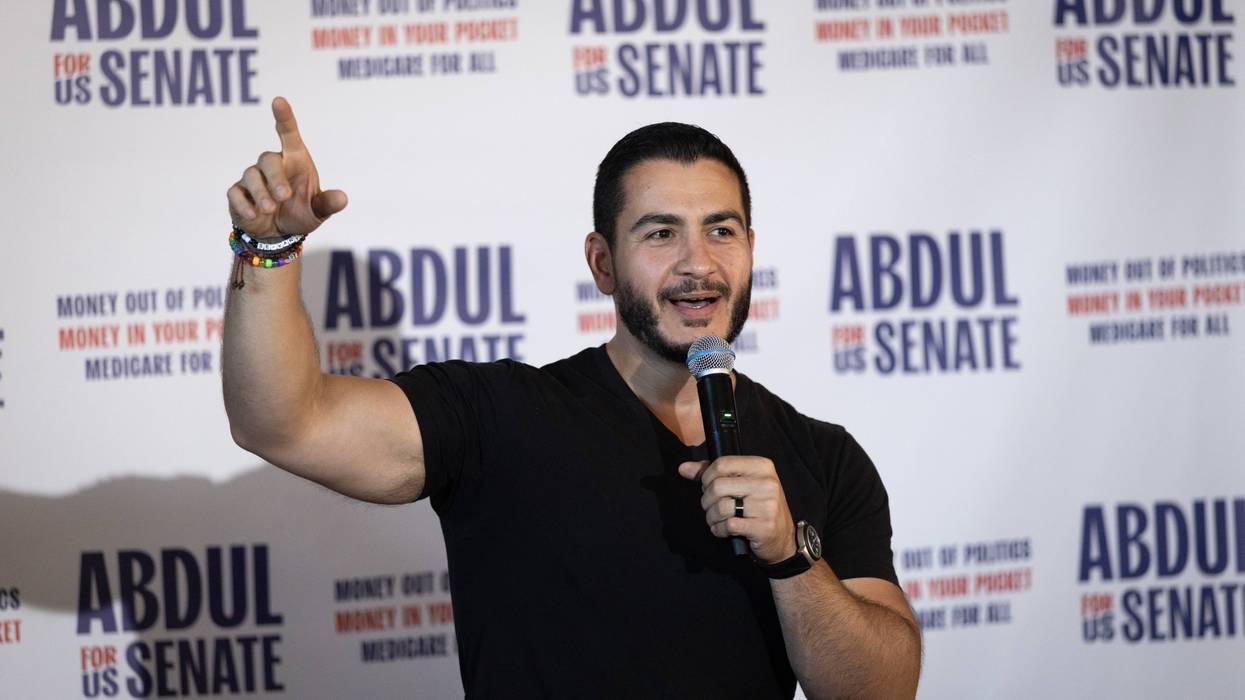
The 2028 lesson is not to find the most “electable,” most “moderate,” or most anti-MAGA Democrat. It’s to nominate one who is boldly and proudly against corporate money.
This week, voters in red and purple states sent Democrats to the Senate who ran against corporate money. James Talarico won in Texas. Annie Andrews won in South Carolina. Adam Hamilton won in Kansas. All three took $0 in corporate PAC money.
More than 16 years after Citizens United gave corporations a free speech right to unlimited political spending, I believe Americans have reached a breaking point. A fundamental realignment is underway, and the midterms are the clearest evidence yet. The 2028 lesson is not to find the most “electable,” most “moderate,” or most anti-MAGA Democrat. It’s to nominate one who is boldly and proudly against corporate money. A candidate who is not bought.
I know because I’ve spent years reporting on it. I was the fifth hire at More Perfect Union, a news start-up that would focus on the working class issues the mainstream media so often ignored. We told working-class stories across all 50 states: minor league ballplayers living in abject poverty, corporate chains flagrantly breaking the law, baristas organizing their Starbucks one store at a time, each inspired by a video of the last. We filmed factory workers at Kellogg’s and John Deere, resident doctors, Hollywood writers. The struggle was the same in every state and county, and in every workplace. It wasn’t a blue one or a red one. It was a working-class one.
Abdul El Sayed’s slogan, “Money out of politics, money in your pocket, and medicare for all” is the blueprint, and we must follow it.
It came into focus covering freight rail. In 2022, rail workers nearly shut down the US economy by refusing a contract with zero guaranteed sick days. President Joe Biden, the self-proclaimed “Union President,” brokered the deal rail workers had just rejected, then asked Congress to impose it on the 125,000 workers anyway. The Congress that did so had taken millions from the same railroads. In the 2020 cycle alone, rail PACs gave $3.7 million to congressional candidates.
That was the corporate Democrat playbook in one decision: Say you stand with workers, then side with the people who fund you when it counts. That’s the Democratic Party voters have been rejecting, and it’s the one we have to leave behind.
Now look at the midterms. Abdul El-Sayed won in Michigan, Peggy Flanagan in Minnesota, Josh Turek in Iowa, and Jon Ossoff in Georgia, all at $0 in corporate PAC money. Mary Peltola in Alaska and Scott Colom in Mississippi, whose races are too close to call as I write, fit the same mold. Angie Nixon took no corporate money and came within 200,000 votes in Florida, a state considered solidly red. Roy Cooper and Sherrod Brown won without this message, but I believe they’re the exceptions to the rule.
Abdul El Sayed’s slogan, “Money out of politics, money in your pocket, and medicare for all” is the blueprint, and we must follow it.
Talarico, the first Democrat to win a Senate seat in Texas since 1988, pointed out over and over in his campaign that "in America, we have an affordability crisis because we have a corruption crisis." Andrews was proud to say that "I don't take a dime of corporate PAC money.” and differentiated herself from her opponent by saying, "Unlike Senator Graham, I will not sell out to big money or take any corporate PAC money." This is the same anti-swamp, outsider message President Donald Trump won on, only this one has spine.
Voters are sick of watching the cost of everything rise while we send billions overseas for new wars. They’re sick of being forced to work longer hours, adopt AI without guardrails, and produce more without seeing their paychecks go up, all while the US produces its first trillionaire.
Campaign finance is public record. Tools like the Political Integrity Index let anyone see which candidates are selling out to corporations and which have taken an integrity pledge to the people who elected them. To win the presidency in 2028, Democrats must take a bold stand against corporate influence over politicians and campaigns. To save our democracy, we must do as much.
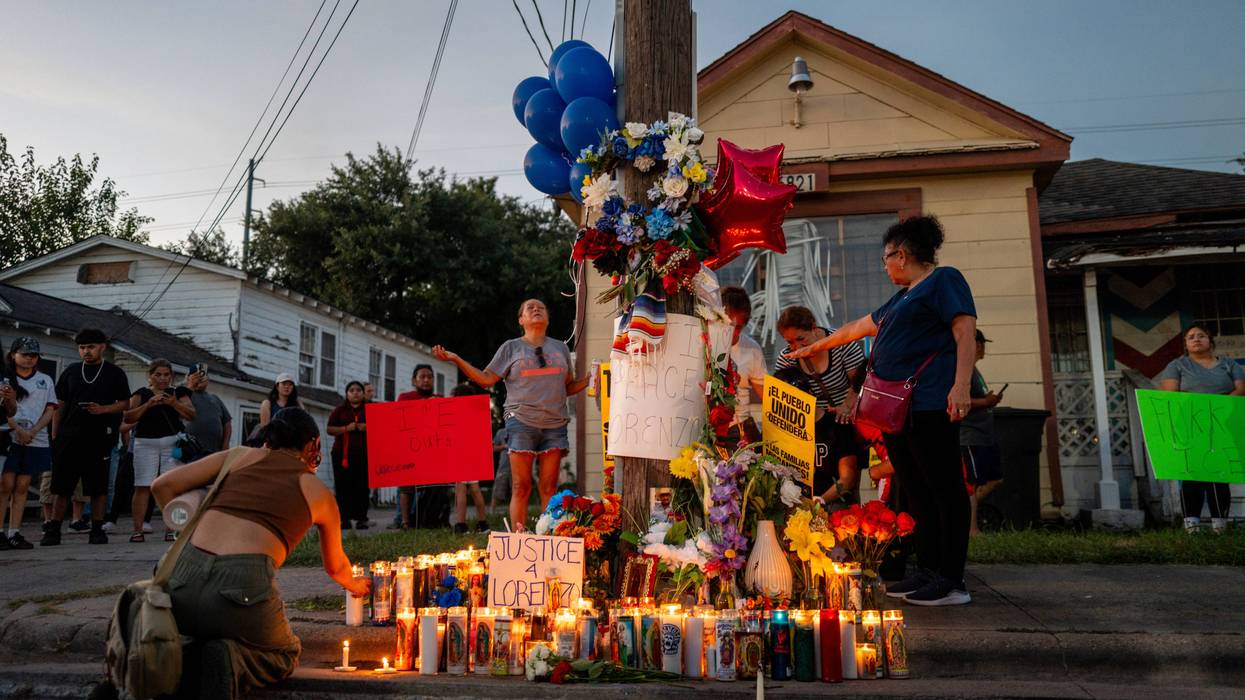
Latino voters stood by their immigrant families and neighbors on Tuesday, and Democrats need to remember that. Remember the families who remain separated. The imprisoned and the dead. And those who stood with immigrants at the risk of their own lives.
Yes, Election Day was a day of hope and victory. From coast to coast—and especially among Latino communities in key states like Texas—voters overwhelmingly rejected Immigration and Customs Enforcement violence, President Donald Trump’s mass deportation campaign, and billionaire-backed scapegoating. People saw through the lie that immigrants drive up the cost of living and chose a future focused on real economic relief. The future is suddenly looking brighter.
For an immigrant like me who came to this country and still has no ability to vote, there’s so much hope coming from Houston, where Latino voters turned out in record numbers and dedicated their vote to Lorenzo Salgado Araujo, the immigrant father who was killed by ICE. There’s hope coming from young first- and second-generation Latinos like my nephews and nieces who dedicated their votes to their immigrant family members and friends.
This message from voters is very clear for the newly elected candidates celebrating this week—everyone who won on the promise to fight back against Trumpism. Tuesday’s vote was a clear rejection of the war on immigrants. Let it also mark an end to Democratic cowardice, and the end of putting corporate interests over people.
Democrats, you had the Latino vote before and lost it. Now you have it back—don't mess this up.
It's time to act on the mandate that voters just delivered—especially the millions of Latino voters, horrified by the last two years, who just swung hard away from Trump.
Democrats, you had the Latino vote before and lost it. Now you have it back—don't mess this up. History in California, Arizona, and Texas shows that while Latino voters will reject mass deportation campaigns, failing to deliver on promises made to our communities causes that support to slip. You cannot take us for granted. You need a positive, pro-working-class, pro-immigrant agenda, and you need to compete for our votes. You can start by showing true political courage by protecting our families and neighbors.
Getting ICE out of our communities is no longer just an immigration issue—it is a safety issue for us.
That courage starts with stopping ICE. Get those violent criminals out of our communities and make sure they can never terrorize us or anyone else again. Stop ICE and Border Patrol and all the other corrupted parts of the Department of Homeland Security. Bring to justice everyone in this government responsible for so many crimes and terrors against immigrants.
Inspect detention centers and enforce real congressional oversight. Shut off the pipeline that feeds from streets and sidewalks of immigrant communities into for-profit torture prisons where neglect and abuse have led to a rising toll of sickness, injury, and death.
At the local level, you can stand up for immigrants by fiercely defending sanctuary laws, cities, and states. Keep federal agents and anti-immigrant operatives out of our homes, schools, and churches. Stop ICE’s local enablers by ending 287(g) programs that turn local police into immigration enforcers. We cannot let local law enforcement take federal dollars to racially profile and target brown communities. Put an end to the abuse now.
Latino voters stood by their immigrant families and neighbors on Tuesday, and Democrats need to remember that. Remember the families who remain separated. The imprisoned and the dead. And those who stood with immigrants at the risk of their own lives.
Remember the deaths of Renee Good, Alex Pretti. Carlos Roberto Montoya, and Lorenzo Salgado Araujo. The unconstitutional and unlawful deportation of Kilmar Abrego Garcia. The detention of 5-year-old Liam Cornejo Ramos. The brave people of Minneapolis, Los Angeles, and Chicago.
I'm grateful for everyone who voted on Tuesday for decency, humanity, and the Constitution. I'm also grateful for the courageous people, immigrants and allies, who took to the streets in the last two years, like ambulance crews rushing to the scene of an emergency or firefighters to an out-of-control blaze.
Election Day gave us many victories, but organizing gives us power—so let’s turn this mandate into action, hit the streets, hold our leaders accountable, and build the safe, just future our families deserve.

What American workers—and American democracy—need most is a larger, more powerful labor movement. Unions should take advantage of this moment to build one.
Union activists like me can be forgiven a certain degree of giddiness after Donald J. Trump’s agenda got walloped in the midterm election. After all, Trump has been one of the most anti-worker presidents in history. He stripped millions of federal employees of the right to bargain collectively, he gutted the National Labor Relations Board, and he sliced back regulations that gave overtime to millions of employees and that protected people from being improperly classified as independent contractors without labor rights. He cut taxes for corporations and billionaires and slashed food and medical benefits for working Americans.
Congress is now in the hands of Democrats, including many who trend younger and more progressive, and even more who proclaim themselves to be the friend of the working person (some even say “working class”). Alas, Trump remains in place. It would take some extraordinary parliamentary maneuvering to undo all—or perhaps any—of Trump’s anti-worker policies. There is no reason to shy away from uphill battles, but we cannot expect complete victory in the next two years.
Anyway, the agenda is broader than a few immediate policy initiatives. As I argue in my upcoming book, Building Power: Collective Action, the Writers’ Strike Against Hollywood, and Organizing for the Future (Cornell University Press), what American workers—and American democracy—need most is a larger, more powerful labor movement. That is the key to making sure the federal government acts in the interest of working people over the long haul. (By “working people” I mean everyone who earns a living by their own labor, whether by putting up buildings or tending to patients or teaching kids or writing software or working on the assembly line.)
If unions and their members (and potential members) want to make meaningful, sustainable advances, now is the time to commit to doing the hard work of organizing.
Here is the painful truth: Only about 10% of American workers are represented by unions. In the private sector, it’s closer to 6%. It is difficult to get corporate chieftains and elected politicians to fight for working people in the face of corporate opposition when union density is such a small fraction of the overall labor force and economy.
Things were this bad when Franklin Delano Roosevelt was elected. Union density was about 11% in 1934. The New Deal transformed federal labor law, FDR proclaimed that every worker should join a union, and the labor movement got to work organizing the unorganized. By 1945, density skyrocketed to nearly 35%.
Union density remained between 30-35% for decades, and tens of millions of union members won a measure of economic security. Wages and productivity increased at about the same rate, roughly doubling from 1948 to 1973 (Sven Beckert, Capital: A Global History (Penguin Press 2025) at p. 949). In other words, working people won a reasonable share of the wealth they created.
Union density nosedived after the early 1970s, and economic inequality exploded. From 1980 to 2020 income gains for the top 1% were more than triple those in the middle. The gap became even larger between the truly wealthy and the less well-off; the top 0.1% saw gains 12 times as large as those of the lowest 20% between 1979 and 2022.
A recent Economic Policy Institute study estimated the gains working people would make if union membership tripled to about 30%: $1.2 trillion a year, or about a third of the increase in economic inequality since 1979. Thus, if union density returned to where it was during the New Deal, this would put a serious dent in the economic inequality that has roiled American politics and ruined household finances. It is difficult to imagine a more powerful outcome for the Blue Tsunami than a New Deal for unions.
However (and sorry, this is a distinctly non-giddy point), one midterm election does not lock in a long-term political realignment. We need politicians to support pro-worker legislation for as long as it takes—decades, not years. The first legislative step would be to transform federal labor law to support, rather than hinder, unionization. That would make it vastly less difficult to increase union density.
None of this will happen by itself. Political candidates and consultants do not build movements. Organizers and leaders and activists and members do. Political winds shift and elections swing like pendulums. More important, politicians respond to leverage, not good vibes. They will only adopt labor law reforms if they feel sustained pressure to do so. If unions and their members (and potential members) want to make meaningful, sustainable advances, now is the time to commit to doing the hard work of organizing and bargaining, of engaging working people directly, of building their power in a sustainable way. They can use that power to exert leverage on whichever politicians seek their support. That is the surest way to capitalize on the gains that working people made in the midterm elections.

With Trump’s repudiation in the 2026 midterm elections, it is time to end Green New Deal hushing and instead consider what a Green New Deal revamped for today should be.
The overwhelming repudiation of President Donald Trump in the 2026 midterm elections may make it possible to constrain his worst depredations. But that will hardly be enough to solve the multiple crises facing the American people or the world. The Green New Deal represents the best vision we have for addressing those realities, but it needs to be updated and expanded for the world we face today. We need a “Green New Deal 2.0.”
Trump’s pet whipping boy was the Green New Deal. His excoriating attacks led many Democratic politicians to engage in “Green New Deal hushing.” With Trump’s repudiation in the 2026 midterm elections, it is time to end Green New Deal hushing and instead consider what a Green New Deal revamped for today should be.
The Green New Deal project has been promoted by a wide array of social forces. It has brought together people operating inside political systems with social movements organizing outside of them. It has used both the institutions of representative democracy and the direct-action power of the people to implement its objectives. The Green New Deal 2.0 will draw on comparable sources of power.
The Green New Deal has proven perennial because it addresses the basic problems faced by our people and planet.
No doubt there are many in both the Republican and Democratic parties who would like to see the Green New Deal where Trump believed he consigned it—in the grave. But the Green New Deal has proven perennial because it addresses the basic problems faced by our people and planet. It is a project that in all its varied manifestations takes the necessity for climate protection as the basis for a broad program for social reconstruction—a visionary program designed to protect the Earth’s climate while creating good jobs, reducing injustice, and eliminating poverty. It will rise again transformed.
In 2008, in the depths of the Great Recession, United Nations Secretary-General Ban Ki-moon called for “investment that fights climate change, creates millions of green jobs, and spurs green growth.” He said what the world needs, in short, is a “Green New Deal.”
The project of a Green New Deal rapidly picked up momentum around the world. Green New Deals became official policy in many countries, endorsed by the UN, the international trade union movement, and even by the International Monetary Fund. China, India, and the European Union began implementing some of the policies envisioned by the Green New Deal. But within a couple of years a global counterattack demanding austerity stymied much of the drive for massive investment to implement climate protection and economic justice. The Green New Deal appeared dead.
Even in the Trump era the Green New Deal has continued as a force in American life—from below.
The Green New Deal was reborn a decade later when the Sunrise youth climate movement held a sit-in in the office of US Democratic House leader Nancy Pelosi (Calif.) demanding she support a resolution for a Green New Deal proposed by newly elected Rep. Alexandria Ocasio-Cortez (D-NY). Drawing on the proposals a decade earlier for a Global Green New Deal, the resolution called for a “new national, social, industrial, and economic mobilization on a scale not seen since World War II and the New Deal.” The Green New Deal amassed support among congressional representatives, progressive organizations, and young people across the country. A poll found that more than 80% of registered voters “strongly support” or “somewhat support” the general concepts behind a Green New Deal. A poll five years later found that “the Green New Deal is still incredibly popular.”
Notwithstanding its popularity with the public, the Green New Deal met implacable opposition from the fossil fuel industry and hostile forces in both the Democratic and Republic parties. Upon his election as president, Trump declared the Green New Deal dead and proceeded to devastate both climate protection and social justice.
Nonetheless, even in the Trump era the Green New Deal has continued as a force in American life—from below. It has continued to be implemented through little-noticed initiatives by community groups, unions, city and state governments, tribes, and other nonfederal actors pursuing the climate protection and social justice goals of the Green New Deal. I have described it as the “Green New Deal from Below.”
The Green New Deal 2.0, like earlier Green New Deals, is a project to abolish the extraction and burning of fossil fuels while rapidly expanding equality, justice, and well-being. To do that it will have to learn from the earlier Green New Deals but also develop far beyond them. It will be aided in doing so by the radical reduction in the cost of fossil free energy and the ways in which energy is used—the Greentech Revolution. But the Green New Deal 2.0 will also have to function within—and help transform—the period of American dysfunction and global disorder that has come to be known as the Polycrisis.
To succeed, the Green New Deal 2.0 will need to be multilevel: local, state, regional, national, and global. From the start it needs to be global in its perspective and to transcend national borders in many of its actions. But it will initially have to be built from the bottom up, community by community, jurisdiction by jurisdiction. Eventually it will need to control and wield the power of national governments.
Achieving the goals of the Green New Deal 2.0—abolishing fossil fuel extraction and burning while rapidly reducing inequality, injustice, and deprivation—will require simultaneous action at many levels from local communities to global institutions.
The Green New Deal 2.0 won’t happen all at once; it will have to develop over time. In the US the Green New Deal 2.0 may start with an Emergency Green New Deal addressing the catastrophe now being experienced by the American people and its impending intensification. This catastrophe includes the crises of food, housing, energy, health, public safety, climate, inequality, democracy, and the rule of law—a veritable American Polycrisis. In some ways it resembles the “Yeltsin Era” that followed the collapse of the Soviet Union when systems from employment to food to healthcare to housing to the rule of law broke down; male life expectancy at birth fell by six years just between 1990 and 1994.
There is little likelihood of immediate federal solutions to this catastrophe. The newly-elected Congress has an important role to play in limiting Trump’s freedom of action, proposing alternatives, and supporting popular mobilizations. But as long as Trump remains in office, he can veto legislation and wield the powers of the executive branch. Addressing the crises we face requires people organizing themselves from below to implement an Emergency Green New Deal that will put people to work doing the things are that are necessary to ensure survival and well-being in the face of the American Polycrisis.
Achieving the goals of the Green New Deal 2.0—abolishing fossil fuel extraction and burning while rapidly reducing inequality, injustice, and deprivation—will require simultaneous action at many levels from local communities to global institutions. It will constitute an era of social reconstruction.
Here are some of the ways in which the Green New Deal 2.0 can incorporate but go far beyond previous Green New Deals:
The Greentech Revolution: Protecting the climate by replacing fossil fuels with fossil-free energy was the central pillar of the original US Green New Deal. Since then, climate catastrophe has truly arrived. But the global Greentech Revolution has created a new basis for moving to fossil-free communities, countries, and world. The Green New Deal 2.0 will accelerate the timetable for the transition to climate safety, while utilizing it as the pivot for other transformations.
Jobs: The original US Green New Deal resolution noted a “four-decade trend of wage stagnation, deindustrialization, and anti-labor policies.” It proposed to use climate mobilization as a vehicle to transform the world of work through high-quality union jobs, worker rights, labor standards, and a “job guarantee” that would ensure a job for every worker who wants one doing the work that is necessary to protect the climate and create a more just society. Since then, inequality has exploded and artificial intelligence (AI) threatens to eliminate millions of jobs and turn millions of others into excruciating daily oppression. The Green New Deal 2.0 will expand the jobs programs proposed by the Green New Deal, ensure that there are good jobs for those affected by AI, and empower workers to organize and act collectively on the job.
Affordability: Rising prices for the necessities of life are a crucial concern for working people today. The Green New Deal 2.0 will address this from the start by replacing fossil fuels with far cheaper fossil-free energy, reducing the price of everything that uses energy—that is to say, everything. It will also make massive investment in energy-conserving housing, food production, and other necessities of life that will both protect the climate and reduce the cost of living. It will tax the rich to reduce inequality and provide resources for the 99%.
Human Needs: The Green New Deal specifically addressed the unmet needs for housing, education, healthcare, and other necessities of life as part of the transition to a climate-safe society. Recent bills in Congress have proposed Green New Deals for housing and education. The Trump administration has devastated all aspects of our already inadequate social provision and is taking aim at what’s left. The Green New Deal 2.0 will establish new systems of social provision that empower local communities while providing the resources necessary to meet individual and social needs.
Justice and Equity: The original Green New Deal resolution proposed to use its programs to “promote justice and equity by preventing current and repairing historic oppression” of “indigenous peoples, communities of color, migrant communities, deindustrialized communities, depopulated rural communities, the poor, low-income workers, women, the elderly, the unhoused, people with disabilities, and youth.” Today the further degradation of all these groups is being actively promoted by the Trump administration and its supporters in all spheres of life. The Green New Deal 2.0 will use resources, policies, democratic processes, and law to reverse both historic and new forms of injustice and inequality.
Democratization: The original US Green New Deal was defeated in large part by the inordinate wealth and power of the fossil fuel industry and its power base within both Republican and Democratic parties. Since then, the Trump administration and the forces of plutocracy have further degraded our democracy and empowered the billionaire class. The initial US Green New Deal resolution called for “ensuring the use of democratic and participatory processes that are inclusive of and led by frontline and vulnerable communities and workers to plan, implement, and administer the Green New Deal.” The Green New Deal 2.0 will rebuild democracy from the bottom up. That includes establishing democratic institutions at the grassroots and establishing genuine political equality for all people. It will also extend democracy within workplaces and the economy. Donald Trump has greatly expanded the role of government in the economy for the worst of purposes, to enrich kleptocrats and war contractors. The Green New Deal 2.0 will utilize that expansion of powers to provide planning and investment to serve the common good.
Constraining Corporations and Technologies: The original New Deal of the Great Depression aimed to control the anti-social behavior of “malefactors of great wealth.” The startling growth of hyperscale data centers controlled by a handful of tech billionaires has forced new attention to the need to constrain corporations and their technology. To realize its objectives, the Green New Deal 2.0 will have to go far beyond previous green new deals in halting the anti-social behavior of today’s malefactors of great wealth, the corporations they control, and the destructive technologies they are seeking to impose. It will need to implement the “precautionary principle” that forbids introduction of new technologies until they are proven safe. More broadly, it will need to make the actions of private economic entities accountable to the public and those they affect.
Global Cooperation: Neither the climate nor the economy can be fixed at a purely local or national level. The growing chaos of the global Polycrisis, with its breakdown of international cooperation, has led to a collapse of climate protection, proliferating warfare, economic chaos, and an inability of any nation to provide security and well-being for its people. The Green New Deal 2.0 will treat a worldwide Green New Deal as a common project of the world’s people and will make cooperation among movements and nations a primary part of its local and national programs. It will promote mutually managed international trade in the interest of protecting the climate and the world’s people rather than either economic nationalism or unconstrained globalization.
The elements of the Green New Deal 2.0 will rapidly improve the lives of workers, communities, and ordinary Americans. The Greentech Revolution will not only retard climate devastation, it will reduce pollution and reverse soaring energy costs. Putting millions of people to work addressing human and environmental needs will not only provide quality employment but rapidly expand provision of food, housing, medical care, public safety, and other necessities of life. Rebuilding democracy from the bottom up will offer protection against the agressions of authoritarian government and promote our ability to control our common life.
By itself the Green New Deal 2.0 won’t quell the global Polycrisis. But working with other forces it can begin to constrain Polycrisis dynamics while also starting to transcend them. The rapid reduction in burning fossil fuels and the transition to fossil-free energy can slow and eventually reverse the destruction of the Earth’s climate. The reduction in inequity and injustice, the meeting of social needs, the provision of full employment, and the constraining of corporate power all address the inequality promoted by right-wing policies and the Polycrisis. The drive for international cooperation can help begin to bring war making, war crimes, nihilistic geopolitics, and global plunder under control and start to develop an alternative world order.
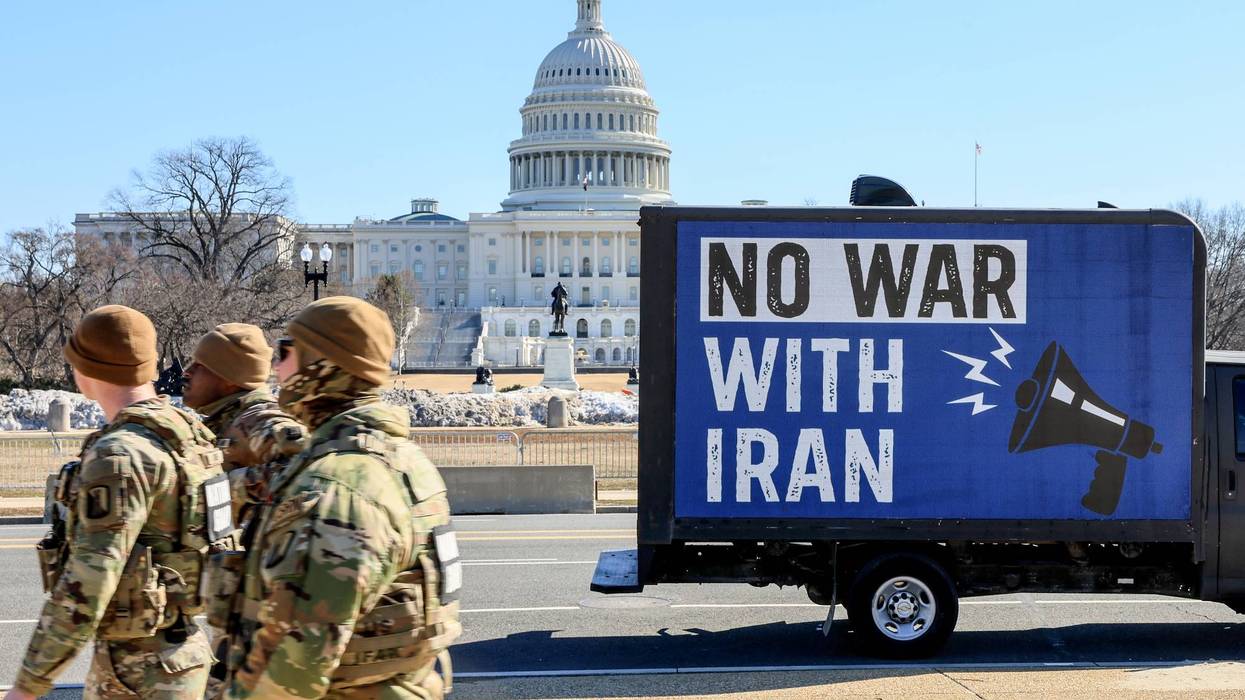
The message of voters is the same everywhere: diplomacy is safer, more effective, and trillions of dollars cheaper than war.
Voters across the United States were loud and clear on Tuesday in their historic drubbing of Trumpism. The election was a decisive rejection of Trump's war on Iran and its staggering costs at home. While savoring their victory and the historic opportunity to restore America's constitutional order, the Democrats should take the anti-war message of the election to heart, because they suffered the same verdict two years ago, when voters rejected the Biden administration's wars in Ukraine and Gaza. Last week Israeli voters rejected Netanyahu's reckless wars, and European voters are also rejecting parties that prolong the Ukraine War. The message of voters is the same everywhere: diplomacy is safer, more effective, and trillions of dollars cheaper than war.
On election night Trump conceded to Fox News, "I think a part of it was Iran." The next day Vice President JD Vance was far blunter, posting on X: "The reason we lost is the war. The president himself said so last night.... everyone knows why we lost." In the AP Voter Poll, about 60 percent of voters said the decision to use military force against Iran was wrong, and about 90 percent called the cost of living a crucial or major factor in their vote.
The war and the cost of living were of course utterly intertwined. Gasoline prices, around $2.80 per gallon before the war began on February 28, had risen by about 55 percent by mid-May and reached a monthly average of $4.43 in September. The 10-year Treasury yield climbed from below 4 percent before the war to above 5 percent in the autumn, and the Pentagon sought more than $200 billion in supplemental war funding. Every family with a mortgage, a car loan or a credit card balance suffered from the war.
Voters everywhere are sending the same message: peace through diplomacy.
The first duty of the new Congress is to restore its constitutional authority over war and its power of the purse to ensure that US forces are not sent back into combat in Iran or anywhere else on the whim of a president and the behest of domestic or foreign lobbies. Trump must of course refrain from restarting the war, which was never remotely necessary or justified. Remember that on February 28, the day the US and Israel launched the war, Oman's foreign minister, who was mediating the U.S.-Iran talks, had said that a deal was within reach.
The Democrats should not imagine that the anti-war lesson applies only to Republicans. Kamala Harris lost in 2024 because voters held the Biden administration responsible for the costs of its own wars. The energy shock that followed the escalation of the Ukraine war in 2022 drove up inflation, and gasoline topped $5 per gallon for the first time in June 2022. Biden twice rejected negotiations that could have ended the conflict: in December 2021, when his administration refused to negotiate on NATO enlargement in response to Russia's draft security treaty, and in April 2022, when the Istanbul talks were abandoned at the behest of the US and UK.
The Gaza genocide also cost the Democrats directly. Among Americans who voted for Joe Biden in 2020 but not for Harris in 2024, 29 percent named ending Israel's violence in Gaza as the main factor in their decision, the most frequently cited issue. The party's voters have moved far ahead of its leaders. A New York Times/Siena poll in May 2026 found that roughly three-quarters of Democratic voters oppose US military and economic assistance to Israel.
Voters everywhere are sending the same message: peace through diplomacy. On October 27, after Israeli wars in Gaza, Lebanon and Iran, Netanyahu lost his majority. Similarly, European leaders who have tied themselves to open-ended war in Ukraine are being rejected by the voters. Only 10 percent of Germans are satisfied with Chancellor Friedrich Merz, the lowest rating ever recorded for a German chancellor. Emmanuel Macron's approval fell to 15 percent in October. In Bulgaria, Iliana Iotova, who favors dialogue with Moscow, won the presidency on November 1 with more than 58 percent of the vote.
A key upcoming key test for the Democrats will be Ukraine. They must stop their party's typical Russia-bashing and instead support a diplomatic end to the war.
As a start, the Democrats should remember why the war started. In 1990 the United States assured Mikhail Gorbachev that NATO would not move "one inch eastward." The Clinton administration broke that promise. In 2008 the Bush administration pushed through the Bucharest declaration that Ukraine and Georgia "will become members of NATO," despite Ambassador William Burns's warning that this was the brightest of all red lines for Russia. In 2014 the United States backed the coup against Ukraine's elected president, Viktor Yanukovych, as the leaked Nuland-Pyatt call made clear. In April 2022, when negotiators in Istanbul came close to a peace agreement based on Ukrainian neutrality, the US and UK actually intervened to block the agreement. Today 75 percent of Ukrainians support negotiations with Russia to end the war.
The Democrats should not mistake their victory for a mandate to pursue their own wars.
In view of these causes of the war, I have recently set out a straightforward diplomatic framework for peace in Ukraine that would end the war. NATO would end its eastward expansion. Ukraine would adopt permanent neutrality on the model of Austria in 1955. An armistice line would be drawn, with both sides renouncing the use of force to change it. Ukraine would pursue membership in the European Union as a permanently neutral state. The Democrats should support such a diplomatic approach. It’s what can end the war, save Ukraine, and win the backing of both the Ukrainian and American people.
Most importantly, the Democrats should not mistake their victory for a mandate to pursue their own wars. The new Democratic majority should quickly reassert the constitutional authority of Congress over war and peace, champion a negotiated peace in Ukraine, end support for Israel's wars, cut the military budget, and redirect the savings toward lowering the cost of living and repairing the public finances.
These positions are not only right but are good politics. For the Democrats to win the White House in 2028, they should become the party of peace. Better yet, both parties should become parties of peace and conduct the 2028 campaign on which party will best address America’s needs for decent jobs, affordability, healthcare, housing, a safe environment, and quality education.

We may feel as if we have woken up to a different country after election day, but we have not. We woke up just as we did the day before to a country in which the collective is fighting for justice and equity relentlessly, strategically, and with love.
What is this strange feeling washing over millions of us this week? Is this relief? Is this joy? Is it disbelief that our collective voice could not be stifled despite the best attempts of the wealthy and the corrupt? We wake up to a very different world than the one that we woke up to on election day.
We have the very first openly gay man senator ever elected.
We have the first Black woman governor ever, and she is 1 of 5 Black governors elected, making it the first time that multiple Black governors will serve at once. Until now, each previous Black governor served alone, they were the only Black person in the room.
We are part of a long lineage of dreamers and resisters and creators. We voted. And that is only one small action in a large toolkit of creating more just worlds for all.
We have the first Native American woman governor ever.
We have a senator-elect in Texas who speaks of a politics of love. James Talarico, a former middle school teacher and Presbyterian seminarian, named what his campaign had to overcome in his acceptance speech:
We went up against nearly 40 years of doubt and disillusionment. We went up against more than $300 million, more than any senate campaign in American history. We went up against all the negative ads, smear campaigns, foreign bots, and AI deepfakes that money can buy. Those attacks were the final howls of a dying establishment. The death rattle of a status quo that knows its days are numbered.
We have a Latina governor in Texas for the first time, defeating a governor who has been more complicit than anyone in creating a brutally hostile environment toward immigrants and academic freedom. Abbott’s immigration policies led to the erosion of safety and human rights such as when police officers are allowed to question a person’s immigration status during a routine traffic stop, encouraging racial profiling. His Senate Bill 17 increased state censorship and widespread self-censorship, resulting in a devastating erosion of academic freedom. Harming one of the greatest riches this country has: our excellent higher education system.
We have Ohio’s first woman governor who won even after a deeply personal attack featuring her own estranged mother put forth by the Trump-promoted and backed opponent.
We have the first Native American woman US senator senator in Minnesota.
This was the very first midterm in which a single person gave more money in donations than any other person has ever spent on a single election cycle (with the exception of billionaire Mike Bloomberg who funded his own run for the presidency in 2020). The world's richest man donated a stunning $474 million, of this $168 million went toward the aim of defeating Talarico, who took no corporate PAC money and was only funded by individual donors.
The first Muslim senator was elected despite some of the most vitriolic racist attacks lodged at him and having his primary opponent choose to blow up her political career by betraying every value she ever indicated to hold by backing the Trump-favored Republican opponent.
The list of names could continue, but there is a risk to narrowing the story to the name in the headline. After all, each of these people was carried by thousands and even millions of people organizing, refusing, resisting, and caring.
It is no wonder if we feel as though we have woken up to a different country than the one we woke up to on election day. But I want to argue that we have not. We woke up just as we have woken up the day before and the one before that, and so on to a country in which the collective is fighting for justice and equity relentlessly, strategically, and with love.
There is some data to back these seemingly unnecessarily hopeful words. The early vote exceeded the 2022 midterm early vote by 9 million. This brings to mind a well-known psychological concept known as learned helplessness. The studies that led to this theoretical framework are devastating in their cruelty. Dogs were shocked while standing on a platform. And at first, they tried to get away from the painful bursts but were not given an opportunity to do so. Eventually, even when an escape was a possibility, when the door was open, they no longer even tried, they simply gave up and accepted the torture.
Even with the egregious misuse of the Justice Department, the assault on the checks and balances in our government, even with the wealthiest man in the world aiming to disempower the voters and buy elections in order to maintain his privileges. Even with the gerrymandering in many states that aimed to dilute Black political power. Even with voter intimidation by the federal government. Even with all of this, the country challenged Martin Seligman's original theories on learned helplessness. We do not lie down and accept the shocks. We are not biologically wired to quit when the stressors feel out of our control. Years after the original study in 1967, Seligman and Maier revisited learned helplessness in 2016 and concluded that passivity is not learned; instead, what is learned is a sense of agency, as that is something we build and learn together. Of course, as often happens, the research simply confirmed what the community already understood.
As we struggle to find the right words to describe what happened—is it a tsunami? Is it a firestorm? Is it a repudiation? What should the Democratic Party do next?—I want to offer my perspective as a critical social psychologist. Ignacio Martín-Baró was a Jesuit priest and University of Chicago-educated social psychologist who was assassinated by US trained unit of the El Salvadoran army on November 16th, 1989. In a few days it will be the 37th anniversary of this execution. He provoked transformative questions about the discipline of psychology itself and is regarded as one of the founders of the subdiscipline of liberation psychology. One of his core claims was that fatalism, a feeling that the story is already written so we might as well give up, is not actually natural to people. This is produced by systems. And an election like this shows us when fatalism can crack, as people reclaim their power. As we refuse to become pawns of the corrupt and the greedy. With that, what is the answer to what the Democratic Party needs to do next? Marin-Baro’s legacy reminds us that the party’s job is to follow the collective, not lead it.
We look at our neighbors who are being targeted for cruel deportations by bypassing due process despite their meaningful contributions to our communities, and we say, we stand with you. We look at our neighbors, like Alex Pretti and Renee Good, who were murdered because they refused to hide at home when their neighborhoods were under attack by masked bullies, and we grieve them with an act of radical love, which is always action. We look at our universities that are being stripped of academic freedom, becoming a tool of those in power and the state, and we say we believe in the power of education and that it is worth fighting for. We look at each other, and we know that we are being told a story that does not make sense. You, my neighbor, have never been my enemy. You have always been my keeper. We belong to each other.
Following the midterms, it is not so much that the world has changed; it is simply that we see the world more for what it has always been. Nothing has changed. The lens, smeared with lies, has been cleared somewhat with this election. We have communities who show up day after day after day for one another. They demonstrate that hope is not a soft feeling but a fierce warrior emotion that is produced by action. Mariame Kaba says it best: Hope is a discipline. We are part of a long lineage of dreamers and resisters and creators. We voted. And that is only one small action in a large toolkit of creating more just worlds for all. So is this a big blue wave? Well if it is, we created it. It is not crashing over us. We are in this water. And yes, resistance can be joyful. So come in, splash around. The water is warm. Let’s keep making waves together.