

SUBSCRIBE TO OUR FREE NEWSLETTER
Daily news & progressive opinion—funded by the people, not the corporations—delivered straight to your inbox.
5
#000000
#FFFFFF
To donate by check, phone, or other method, see our More Ways to Give page.
Daily news & progressive opinion—funded by the people, not the corporations—delivered straight to your inbox.
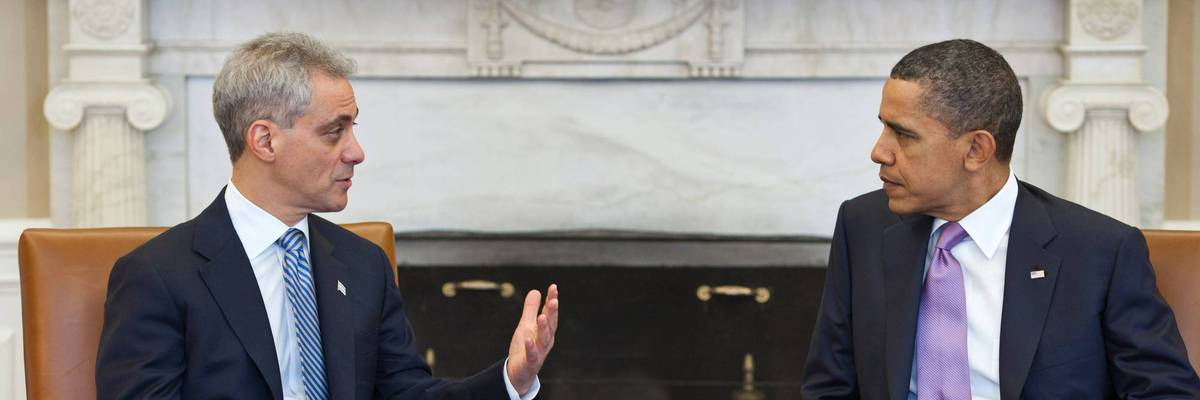
US President Barack Obama meets with Chicago Mayor-elect and former White House Chief of Staff Rahm Emanuel in the Oval Office, March 4, 2011 in Washington, DC.
How Democrats choose to deal with Musk, Trump, and other morbidly rich American oligarchs and their monopolistic empires may be the most important set of decisions party leaders have made in 50 years or more. We can't allow them to mess it up.
Elon Musk spent almost a half-billion traceable dollars (and we have no idea how much “dark money” that’s not traceable but legalized by corrupt Republicans on the Supreme Court) to try to help rightwing politicians win this week’s election. As the old joke goes, that’s both the good and the bad news.
Given how severely great wealth has distorted our republic—from buying elections and legislation to putting judges on the Supreme Court—Democrats now face some serious decisions about how to proceed.
Who should lead the Party’s efforts both in and outside of Congress? Should the Party embrace its progressive base and push policies like Medicare for All and free college, or stay with Clinton-style “moderate” positions as we move into the next Congress? Impeach Trump or, as Schumer suggested yesterday, “work with him”?
As more and more of the nation’s wealth is stolen from the bottom and middle and transferred to the top one percent, the nation’s people lose confidence in the institutions that should have been defending, protecting, and supporting them.
Corporate Democrat Claire McCaskill suggested on MS NOW recently that Democrats must embrace “moderate” positions because those are the ones most likely to be looked upon favorably by “independent” voters, but is that true?
Those same voters swung toward Trump several times recently because, instead of being “moderate,” he was proposing radical change in government policies.
Support for genuinely progressive policies like free college, Medicare for All, taxing the morbidly rich and big corporations, and aggressive actions to mitigate climate change with green energy actually poll very strongly with so-called independent voters.
And there’s something eerily familiar about today that people who’ve read histories of the 1930s and the Roosevelt administration’s New Deal recognize. It’s as if history is repeating itself.
And if that’s actually the case, the choices congressional Democrats make now about how to deal with Musk, Trump, and other morbidly rich American oligarchs and their monopolistic empires (including media monopolies) may be the most important decisions Democrats have made in 50 years or more.
And the stakes are huge: in actual, historical fact, those wielding great wealth have been responsible for the failure or near-failure of pretty much every republic that’s failed since the days of ancient Greece and Rome.
In modern times they’ve provoked the American Revolution, the French Revolution, the American Civil War, the Russian Revolution, and the downfall of dozens of smaller once-democratic or partially-democratic states from Chile in the 1960s to Egypt, Hungary, and Turkey in the last few decades. It’s also happening to Russia as you read these words, although that’s another article altogether.
And now the morbidly rich are screwing up America again, much as they did in the 1920s and the 1850s. If they succeed and enough “moderate” Democrats continue to get into bed with them, it will be both disastrous and perhaps bloody, a word that Trump himself has recently used to describe his plans for the next two years.
America has been through three great cycles since our founding, as brilliantly explained by Neil Howe in The Fourth Turning Is Here and Peter Turchin in Elites, Counter-Elites, and the Path of Political Disintegration. Turchin also summarized his thesis in a tight but concerning article for The Guardian two years ago titled “The deep historical forces that explain Trump’s win.”
(I’ve also written about these cycles of history multiple times over the years, here, here, here, here, here, etc., but it deserves a fresh examination in the light of the election and the crucial decisions now facing the Democratic Party.)
Howe explains how every 80 years or so (as our elders die out) we lose access to the lessons our grandparents learned, particularly those about the importance—nay, the necessity—of regulating great wealth so it doesn’t turn government into a vehicle to exclusively serve the morbidly rich.
When the morbidly rich take over, he notes, bad things happen: it was 73 years from the Constitution’s ratification until the oligarchs in the South started the Civil War, exactly 80 years from the end of the Civil War to the end of World War II (caused by greedy oligarchs on Wall Street kicking off the Republican Great Depression), and today we’re exactly 81 years out from the end of World War II.
Turchin breaks those 80-year cycles into 40-year segments. He points out how, in back-to-back 40-year blocks of time, the obscenely rich are brought to heel over four decades, but then rise up and take over again during the next forty years. Over and over again throughout American history.
Support for genuinely progressive policies like free college, Medicare for All, taxing the morbidly rich and big corporations, and aggressive actions to mitigate climate change with green energy actually poll very strongly with so-called independent voters.
The cover of his book Ages of Discord provides a graphic that visually explains his hypothesis, showing a red line for the accumulation of great wealth from 1780 to 2020 and working class wealth with the blue lines.
Today, we’re overdue for one of his generational flips: we are 45 years from Reagan’s counter-revolution against the New Deal, a program FDR put into place in 1933 that saved America and created the largest middle class the world had ever seen. (I’m radically simplifying both of these scholar’s works: I recommend you buy and read their books for more detail.)
In summary, Trump’s election and re-election were reflections of the success of the anti-New Deal counter-revolution launched with the Reagan Revolution in 1981, in which America’s most wealthy men essentially took back control of our government from the “New Dealers.”
Much of this was accomplished through a process of destroying unions, cutting taxes on the rich while borrowing from the future to fund them, and allowing corporations to search the world for the cheapest labor and least regulation (“free trade”). While it’s rarely mentioned in our increasingly-oligarch-captured media, they called this “neoliberalism” (as I detail in my book The Hidden History of Neoliberalism: How Reaganism Gutted America).
FDR’s New Deal created massive prosperity for the American working class, lifting us from 15 percent of Americans being in the middle class in 1933 to 65 percent of us at that status with a single paycheck when Reagan took office in 1981. (Today, we’re well below 50 percent and it takes two paychecks to get there.)
Because of roughly 40 years of success during FDR’s New Deal (1933-1981), a third of American workers had the protections of a union when Reagan took office, brand-spanking-new schools dotted the countryside, college was so cheap as to be virtually free, hospitals and health insurance companies were required to be nonprofit so healthcare was easily affordable, and housing supports meant that the cost of the average home was about twice the average annual income.
The main beneficiaries were my generation, the boomers, who came of age at the peak of the New Deal’s effects, before Reaganism bit hard into American workers, with Republicans and their morbidly rich stealing over $79 trillion of our wealth in just 45 years and handing it off to the Epstein/Musk/Bezos/Zuckerberg class.
As I point out in The Hidden History of the American Dream, when my generation was in our 30s, we controlled about 21 percent of the nation’s wealth; today people in their thirties only control 4.6 percent of America’s wealth. Average home prices today are ten times average annual income today. College is unaffordable, as is healthcare.
Forty-five years of Reaganism, embraced by both parties until 2021, have wiped out the middle class while making the rich into the super-rich. When Reagan came to office, billionaires were a rarity (there were only 7 of them) and they were constrained by law from owning judges and politicians or having an outsize influence in elections.
And then Republicans took over in 1981 and began their war on the American Dream.
In this week’s election—thanks to corrupt Republicans on the Supreme Court with their Citizens United decision—several hundred American and foreign billionaires, Elon Musk, and Israel’s AIPAC largely funded GOP campaigns, massively outspending progressive Democrats through PACs and dark money SuperPACS.
The most visible examples were the billionaire-funded campaigns against James Tallarico and Abdul El-Sayed, who were outspent by over $248 million dollars. That money, though, could not overcome the trends of history and America’s outrage at the GOP’s turn toward naked fascism.
Peter Turchin identifies a three-step process that leads to revolutionary outcomes: “popular immiseration, elite overproduction and state breakdown.”
First, the rich get control of the political system and change the tax code and regulatory state to gut worker income and union-organizing power, “immiserating” (impoverishing) the middle class.
We saw this with Reagan and corrupt Republicans on the Supreme Court dismantling union rights and workers’ power, followed by the passage of “Right To Work For Less” anti-union laws in state after Republican-controlled state.
The rich then redirect the government’s efforts away from supporting working class people to redirecting the wealth of the nation into their own money bins.
The most obvious example of this are the “tax cuts”—cumulatively totaling over $35 trillion—put into place by Reagan, Bush, and Trump.
Up next are efforts to destroy the programs supporting the middle class, as we saw with the Big Beautiful Billionaire’s Bill gutting food stamps (SNAP), Medicaid, and the Affordable Care Act (among other supports to the middle class).
Average working people know they’ve been screwed; they just don’t realize it’s the morbidly rich who did it to them unless there’s an outspoken class warrior like FDR or Bernie Sanders calling it out.
I put “tax cuts” in quotation marks, by the way, because they’re really not tax cuts: those taxes will eventually be paid. Just not by the people who should have paid them; they succeeded in pushing them out decades into the future with the assumption they’ll be paid for either by raising taxes on working people, cutting benefits to the middle class and poor, or both. Instead of “tax cuts,” we should rightly call them “tax deferrals” or “tax redistributions.”
Finally, as more and more of the nation’s wealth is stolen from the bottom and middle and transferred to the top one percent, the nation’s people lose confidence in the institutions that should have been defending, protecting, and supporting them. They see that no matter how they vote, no matter what they do, no matter how loud they protest, they’re still being screwed and the morbidly rich are still getting richer every single day.
This leads to Turchin’s “state breakdown,” which we’ve been witnessing in real time since Trump’s inauguration and the full-on implementation of the billionaire’s Project 2025, kicked off on January 20th, 2025. Step-by-step, those parts of the state that work for and protect the middle class and poor have been taken apart, while those parts that protect the rich (prisons, police, ICE, the military) have gotten trillions.
Average working people know they’ve been screwed; they just don’t realize it’s the morbidly rich who did it to them unless there’s an outspoken class warrior like FDR or Bernie Sanders calling it out.
Thus, they voted for whoever they perceive as most likely to “shake things up,” “destroy the deep state,” or “make the country great again” by restoring the wealth of the middle class.
Sometimes we choose right, as Americans did in 1860 with the election of Lincoln, and in 1932 by choosing FDR. The country was on the brink of disaster with massive fascist movements growing during each era; Lincoln and FDR defeated them and saved our nation’s democracy.
In 2024, though, the billionaires had such a grip on the media and the message, much of it through their ownership of media (Xitter, Facebook, TikTok, Instagram, Washington Post, LA Times, Fox “News,” massively subsidized podcasts, rightwing radio, etc.) and also with a tsunami of advertising cash that they convinced Americans that Trump—a billionaire rapist and convicted criminal who had promised to again cut taxes for his billionaire buddies—was the champion of the little guy.
As Trump, Vance, and Musk celebrated their 2024 election, their toast had to include the word “suckers.”
The result of this choice that put Project 2025 front-and-center has been the further disintegration of government’s protective ability for working class and poor people, turning it instead toward the wish-lists of billionaires, tech bros, and massive corporate monopolies and oligopolies.
As Turchin noted in The Guardian:
“One result of all this political dysfunction is an inability to agree on how the federal budget should be balanced. Together with the loss of trust and legitimacy, that accelerates the breakdown of state capacity.
“It’s notable that a collapse in state finances is often the triggering event for a revolution: this is what happened in France before 1789 and in the runup to the English civil war.”
If both Turchin and Howe are right and we’re now in the Fourth Turning or something like it, that explains much of the results of this week’s election. It should also give Democrats a clear vision of how to move forward.
We’re departing, in other words, the 45-year-long neoliberal/conservative/austerity part of the cycle that Reagan started and shifting into the next ~40-year cycle of progressive renewal of both our democracy and our economy.
For its own survival and that of our republic—and the success of our 2028 candidate for president—the Democratic Party must now reject the neoliberals within its own ranks.
Which means the Democratic Party and individual Democratic politicians should be embracing AOC, Bernie, Ro Khanna, Mark Pocan, Al-Sayed, and every other genuinely progressive politician as hard as they can, and push their policies to the fore.
To do anything less is to squander this moment and risk another rightwing reactionary backlash and loss of middle-class voters like we saw in the reaction to Clinton in 2016 and Harris in 2024.
For its own survival and that of our republic—and the success of our 2028 candidate for president—the Democratic Party must now reject the neoliberals within its own ranks and makes a forceful argument for returning to the systems of Reconstruction, the New Deal, and the Great Society that protected and enriched working class people in the previous cycles.
If Democrats again embrace neoliberals like Rahm Emmanuel (who’s pretty much openly campaigning for the 2028 presidential election), they’ll fail at this critical work and messaging: that could well doom our American experiment in liberal democracy.
If Democrats succeed at finding their voice, however, America may get the second chance to rebuild both our middle class and our democracy, a chance we ultimately won at the beginning of each of the past two 80-year cycles with Abraham Lincoln and FDR.
Thus, the policy and “holding Trump accountable” choices Democrats make for how they’ll proceed in the first 100 days of next year may well decide the fate of our American democracy.
This country and this world are at a monumental crossroads. US voters have an opportunity to beat back the forces of fascism and confront the billionaires who are rigging the economy, our media system, and our democracy, making it increasingly impossible for ordinary people to get by. We’re not just talking about the election. We’re talking about what must be done once these fascist elements are vanquished from power. We need a bolder set of solutions than what either major party has so far been willing to offer and a working-class movement ready to fight like hell for it. Trump didn't emerge from nowhere. The conditions that fueled MAGA authoritarianism were created by decades of radical neoliberal economic policies and a corrupt political system dominated by corporate interests. They slashed taxes on the super-rich, promising that the benefits would trickle down. They said giveaways to the corporate titans would make life more affordable for the rest of us. It was all bullshit. And when a bitter, betrayed populace searches for someone to blame, right-wing demagogues have little trouble finding scapegoats. People know when they're being lied to, but you won't hear any of this from the corporate media. Only independent journalism—powered and funded by people who believe in building a better world—can deliver truly trustworthy daily news. If you share our vision, please contribute whatever you can to sustain our work. |
Elon Musk spent almost a half-billion traceable dollars (and we have no idea how much “dark money” that’s not traceable but legalized by corrupt Republicans on the Supreme Court) to try to help rightwing politicians win this week’s election. As the old joke goes, that’s both the good and the bad news.
Given how severely great wealth has distorted our republic—from buying elections and legislation to putting judges on the Supreme Court—Democrats now face some serious decisions about how to proceed.
Who should lead the Party’s efforts both in and outside of Congress? Should the Party embrace its progressive base and push policies like Medicare for All and free college, or stay with Clinton-style “moderate” positions as we move into the next Congress? Impeach Trump or, as Schumer suggested yesterday, “work with him”?
As more and more of the nation’s wealth is stolen from the bottom and middle and transferred to the top one percent, the nation’s people lose confidence in the institutions that should have been defending, protecting, and supporting them.
Corporate Democrat Claire McCaskill suggested on MS NOW recently that Democrats must embrace “moderate” positions because those are the ones most likely to be looked upon favorably by “independent” voters, but is that true?
Those same voters swung toward Trump several times recently because, instead of being “moderate,” he was proposing radical change in government policies.
Support for genuinely progressive policies like free college, Medicare for All, taxing the morbidly rich and big corporations, and aggressive actions to mitigate climate change with green energy actually poll very strongly with so-called independent voters.
And there’s something eerily familiar about today that people who’ve read histories of the 1930s and the Roosevelt administration’s New Deal recognize. It’s as if history is repeating itself.
And if that’s actually the case, the choices congressional Democrats make now about how to deal with Musk, Trump, and other morbidly rich American oligarchs and their monopolistic empires (including media monopolies) may be the most important decisions Democrats have made in 50 years or more.
And the stakes are huge: in actual, historical fact, those wielding great wealth have been responsible for the failure or near-failure of pretty much every republic that’s failed since the days of ancient Greece and Rome.
In modern times they’ve provoked the American Revolution, the French Revolution, the American Civil War, the Russian Revolution, and the downfall of dozens of smaller once-democratic or partially-democratic states from Chile in the 1960s to Egypt, Hungary, and Turkey in the last few decades. It’s also happening to Russia as you read these words, although that’s another article altogether.
And now the morbidly rich are screwing up America again, much as they did in the 1920s and the 1850s. If they succeed and enough “moderate” Democrats continue to get into bed with them, it will be both disastrous and perhaps bloody, a word that Trump himself has recently used to describe his plans for the next two years.
America has been through three great cycles since our founding, as brilliantly explained by Neil Howe in The Fourth Turning Is Here and Peter Turchin in Elites, Counter-Elites, and the Path of Political Disintegration. Turchin also summarized his thesis in a tight but concerning article for The Guardian two years ago titled “The deep historical forces that explain Trump’s win.”
(I’ve also written about these cycles of history multiple times over the years, here, here, here, here, here, etc., but it deserves a fresh examination in the light of the election and the crucial decisions now facing the Democratic Party.)
Howe explains how every 80 years or so (as our elders die out) we lose access to the lessons our grandparents learned, particularly those about the importance—nay, the necessity—of regulating great wealth so it doesn’t turn government into a vehicle to exclusively serve the morbidly rich.
When the morbidly rich take over, he notes, bad things happen: it was 73 years from the Constitution’s ratification until the oligarchs in the South started the Civil War, exactly 80 years from the end of the Civil War to the end of World War II (caused by greedy oligarchs on Wall Street kicking off the Republican Great Depression), and today we’re exactly 81 years out from the end of World War II.
Turchin breaks those 80-year cycles into 40-year segments. He points out how, in back-to-back 40-year blocks of time, the obscenely rich are brought to heel over four decades, but then rise up and take over again during the next forty years. Over and over again throughout American history.
Support for genuinely progressive policies like free college, Medicare for All, taxing the morbidly rich and big corporations, and aggressive actions to mitigate climate change with green energy actually poll very strongly with so-called independent voters.
The cover of his book Ages of Discord provides a graphic that visually explains his hypothesis, showing a red line for the accumulation of great wealth from 1780 to 2020 and working class wealth with the blue lines.
Today, we’re overdue for one of his generational flips: we are 45 years from Reagan’s counter-revolution against the New Deal, a program FDR put into place in 1933 that saved America and created the largest middle class the world had ever seen. (I’m radically simplifying both of these scholar’s works: I recommend you buy and read their books for more detail.)
In summary, Trump’s election and re-election were reflections of the success of the anti-New Deal counter-revolution launched with the Reagan Revolution in 1981, in which America’s most wealthy men essentially took back control of our government from the “New Dealers.”
Much of this was accomplished through a process of destroying unions, cutting taxes on the rich while borrowing from the future to fund them, and allowing corporations to search the world for the cheapest labor and least regulation (“free trade”). While it’s rarely mentioned in our increasingly-oligarch-captured media, they called this “neoliberalism” (as I detail in my book The Hidden History of Neoliberalism: How Reaganism Gutted America).
FDR’s New Deal created massive prosperity for the American working class, lifting us from 15 percent of Americans being in the middle class in 1933 to 65 percent of us at that status with a single paycheck when Reagan took office in 1981. (Today, we’re well below 50 percent and it takes two paychecks to get there.)
Because of roughly 40 years of success during FDR’s New Deal (1933-1981), a third of American workers had the protections of a union when Reagan took office, brand-spanking-new schools dotted the countryside, college was so cheap as to be virtually free, hospitals and health insurance companies were required to be nonprofit so healthcare was easily affordable, and housing supports meant that the cost of the average home was about twice the average annual income.
The main beneficiaries were my generation, the boomers, who came of age at the peak of the New Deal’s effects, before Reaganism bit hard into American workers, with Republicans and their morbidly rich stealing over $79 trillion of our wealth in just 45 years and handing it off to the Epstein/Musk/Bezos/Zuckerberg class.
As I point out in The Hidden History of the American Dream, when my generation was in our 30s, we controlled about 21 percent of the nation’s wealth; today people in their thirties only control 4.6 percent of America’s wealth. Average home prices today are ten times average annual income today. College is unaffordable, as is healthcare.
Forty-five years of Reaganism, embraced by both parties until 2021, have wiped out the middle class while making the rich into the super-rich. When Reagan came to office, billionaires were a rarity (there were only 7 of them) and they were constrained by law from owning judges and politicians or having an outsize influence in elections.
And then Republicans took over in 1981 and began their war on the American Dream.
In this week’s election—thanks to corrupt Republicans on the Supreme Court with their Citizens United decision—several hundred American and foreign billionaires, Elon Musk, and Israel’s AIPAC largely funded GOP campaigns, massively outspending progressive Democrats through PACs and dark money SuperPACS.
The most visible examples were the billionaire-funded campaigns against James Tallarico and Abdul El-Sayed, who were outspent by over $248 million dollars. That money, though, could not overcome the trends of history and America’s outrage at the GOP’s turn toward naked fascism.
Peter Turchin identifies a three-step process that leads to revolutionary outcomes: “popular immiseration, elite overproduction and state breakdown.”
First, the rich get control of the political system and change the tax code and regulatory state to gut worker income and union-organizing power, “immiserating” (impoverishing) the middle class.
We saw this with Reagan and corrupt Republicans on the Supreme Court dismantling union rights and workers’ power, followed by the passage of “Right To Work For Less” anti-union laws in state after Republican-controlled state.
The rich then redirect the government’s efforts away from supporting working class people to redirecting the wealth of the nation into their own money bins.
The most obvious example of this are the “tax cuts”—cumulatively totaling over $35 trillion—put into place by Reagan, Bush, and Trump.
Up next are efforts to destroy the programs supporting the middle class, as we saw with the Big Beautiful Billionaire’s Bill gutting food stamps (SNAP), Medicaid, and the Affordable Care Act (among other supports to the middle class).
Average working people know they’ve been screwed; they just don’t realize it’s the morbidly rich who did it to them unless there’s an outspoken class warrior like FDR or Bernie Sanders calling it out.
I put “tax cuts” in quotation marks, by the way, because they’re really not tax cuts: those taxes will eventually be paid. Just not by the people who should have paid them; they succeeded in pushing them out decades into the future with the assumption they’ll be paid for either by raising taxes on working people, cutting benefits to the middle class and poor, or both. Instead of “tax cuts,” we should rightly call them “tax deferrals” or “tax redistributions.”
Finally, as more and more of the nation’s wealth is stolen from the bottom and middle and transferred to the top one percent, the nation’s people lose confidence in the institutions that should have been defending, protecting, and supporting them. They see that no matter how they vote, no matter what they do, no matter how loud they protest, they’re still being screwed and the morbidly rich are still getting richer every single day.
This leads to Turchin’s “state breakdown,” which we’ve been witnessing in real time since Trump’s inauguration and the full-on implementation of the billionaire’s Project 2025, kicked off on January 20th, 2025. Step-by-step, those parts of the state that work for and protect the middle class and poor have been taken apart, while those parts that protect the rich (prisons, police, ICE, the military) have gotten trillions.
Average working people know they’ve been screwed; they just don’t realize it’s the morbidly rich who did it to them unless there’s an outspoken class warrior like FDR or Bernie Sanders calling it out.
Thus, they voted for whoever they perceive as most likely to “shake things up,” “destroy the deep state,” or “make the country great again” by restoring the wealth of the middle class.
Sometimes we choose right, as Americans did in 1860 with the election of Lincoln, and in 1932 by choosing FDR. The country was on the brink of disaster with massive fascist movements growing during each era; Lincoln and FDR defeated them and saved our nation’s democracy.
In 2024, though, the billionaires had such a grip on the media and the message, much of it through their ownership of media (Xitter, Facebook, TikTok, Instagram, Washington Post, LA Times, Fox “News,” massively subsidized podcasts, rightwing radio, etc.) and also with a tsunami of advertising cash that they convinced Americans that Trump—a billionaire rapist and convicted criminal who had promised to again cut taxes for his billionaire buddies—was the champion of the little guy.
As Trump, Vance, and Musk celebrated their 2024 election, their toast had to include the word “suckers.”
The result of this choice that put Project 2025 front-and-center has been the further disintegration of government’s protective ability for working class and poor people, turning it instead toward the wish-lists of billionaires, tech bros, and massive corporate monopolies and oligopolies.
As Turchin noted in The Guardian:
“One result of all this political dysfunction is an inability to agree on how the federal budget should be balanced. Together with the loss of trust and legitimacy, that accelerates the breakdown of state capacity.
“It’s notable that a collapse in state finances is often the triggering event for a revolution: this is what happened in France before 1789 and in the runup to the English civil war.”
If both Turchin and Howe are right and we’re now in the Fourth Turning or something like it, that explains much of the results of this week’s election. It should also give Democrats a clear vision of how to move forward.
We’re departing, in other words, the 45-year-long neoliberal/conservative/austerity part of the cycle that Reagan started and shifting into the next ~40-year cycle of progressive renewal of both our democracy and our economy.
For its own survival and that of our republic—and the success of our 2028 candidate for president—the Democratic Party must now reject the neoliberals within its own ranks.
Which means the Democratic Party and individual Democratic politicians should be embracing AOC, Bernie, Ro Khanna, Mark Pocan, Al-Sayed, and every other genuinely progressive politician as hard as they can, and push their policies to the fore.
To do anything less is to squander this moment and risk another rightwing reactionary backlash and loss of middle-class voters like we saw in the reaction to Clinton in 2016 and Harris in 2024.
For its own survival and that of our republic—and the success of our 2028 candidate for president—the Democratic Party must now reject the neoliberals within its own ranks and makes a forceful argument for returning to the systems of Reconstruction, the New Deal, and the Great Society that protected and enriched working class people in the previous cycles.
If Democrats again embrace neoliberals like Rahm Emmanuel (who’s pretty much openly campaigning for the 2028 presidential election), they’ll fail at this critical work and messaging: that could well doom our American experiment in liberal democracy.
If Democrats succeed at finding their voice, however, America may get the second chance to rebuild both our middle class and our democracy, a chance we ultimately won at the beginning of each of the past two 80-year cycles with Abraham Lincoln and FDR.
Thus, the policy and “holding Trump accountable” choices Democrats make for how they’ll proceed in the first 100 days of next year may well decide the fate of our American democracy.

