SUBSCRIBE TO OUR FREE NEWSLETTER
Daily news & progressive opinion—funded by the people, not the corporations—delivered straight to your inbox.
5
#000000
#FFFFFF
To donate by check, phone, or other method, see our More Ways to Give page.
Daily news & progressive opinion—funded by the people, not the corporations—delivered straight to your inbox.
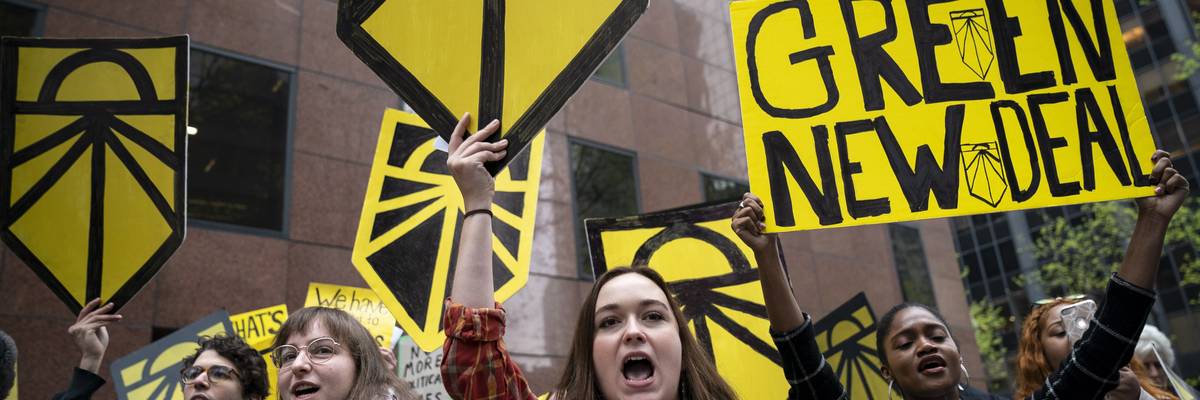
Activists rally in support of proposed Green New Deal legislation outside of Senate Minority Leader Chuck Schumer's (D-NY) New York City office, April 30, 2019 in New York City.
With Trump’s repudiation in the 2026 midterm elections, it is time to end Green New Deal hushing and instead consider what a Green New Deal revamped for today should be.
The overwhelming repudiation of President Donald Trump in the 2026 midterm elections may make it possible to constrain his worst depredations. But that will hardly be enough to solve the multiple crises facing the American people or the world. The Green New Deal represents the best vision we have for addressing those realities, but it needs to be updated and expanded for the world we face today. We need a “Green New Deal 2.0.”
Trump’s pet whipping boy was the Green New Deal. His excoriating attacks led many Democratic politicians to engage in “Green New Deal hushing.” With Trump’s repudiation in the 2026 midterm elections, it is time to end Green New Deal hushing and instead consider what a Green New Deal revamped for today should be.
The Green New Deal project has been promoted by a wide array of social forces. It has brought together people operating inside political systems with social movements organizing outside of them. It has used both the institutions of representative democracy and the direct-action power of the people to implement its objectives. The Green New Deal 2.0 will draw on comparable sources of power.
The Green New Deal has proven perennial because it addresses the basic problems faced by our people and planet.
No doubt there are many in both the Republican and Democratic parties who would like to see the Green New Deal where Trump believed he consigned it—in the grave. But the Green New Deal has proven perennial because it addresses the basic problems faced by our people and planet. It is a project that in all its varied manifestations takes the necessity for climate protection as the basis for a broad program for social reconstruction—a visionary program designed to protect the Earth’s climate while creating good jobs, reducing injustice, and eliminating poverty. It will rise again transformed.
In 2008, in the depths of the Great Recession, United Nations Secretary-General Ban Ki-moon called for “investment that fights climate change, creates millions of green jobs, and spurs green growth.” He said what the world needs, in short, is a “Green New Deal.”
The project of a Green New Deal rapidly picked up momentum around the world. Green New Deals became official policy in many countries, endorsed by the UN, the international trade union movement, and even by the International Monetary Fund. China, India, and the European Union began implementing some of the policies envisioned by the Green New Deal. But within a couple of years a global counterattack demanding austerity stymied much of the drive for massive investment to implement climate protection and economic justice. The Green New Deal appeared dead.
Even in the Trump era the Green New Deal has continued as a force in American life—from below.
The Green New Deal was reborn a decade later when the Sunrise youth climate movement held a sit-in in the office of US Democratic House leader Nancy Pelosi (Calif.) demanding she support a resolution for a Green New Deal proposed by newly elected Rep. Alexandria Ocasio-Cortez (D-NY). Drawing on the proposals a decade earlier for a Global Green New Deal, the resolution called for a “new national, social, industrial, and economic mobilization on a scale not seen since World War II and the New Deal.” The Green New Deal amassed support among congressional representatives, progressive organizations, and young people across the country. A poll found that more than 80% of registered voters “strongly support” or “somewhat support” the general concepts behind a Green New Deal. A poll five years later found that “the Green New Deal is still incredibly popular.”
Notwithstanding its popularity with the public, the Green New Deal met implacable opposition from the fossil fuel industry and hostile forces in both the Democratic and Republic parties. Upon his election as president, Trump declared the Green New Deal dead and proceeded to devastate both climate protection and social justice.
Nonetheless, even in the Trump era the Green New Deal has continued as a force in American life—from below. It has continued to be implemented through little-noticed initiatives by community groups, unions, city and state governments, tribes, and other nonfederal actors pursuing the climate protection and social justice goals of the Green New Deal. I have described it as the “Green New Deal from Below.”
The Green New Deal 2.0, like earlier Green New Deals, is a project to abolish the extraction and burning of fossil fuels while rapidly expanding equality, justice, and well-being. To do that it will have to learn from the earlier Green New Deals but also develop far beyond them. It will be aided in doing so by the radical reduction in the cost of fossil free energy and the ways in which energy is used—the Greentech Revolution. But the Green New Deal 2.0 will also have to function within—and help transform—the period of American dysfunction and global disorder that has come to be known as the Polycrisis.
To succeed, the Green New Deal 2.0 will need to be multilevel: local, state, regional, national, and global. From the start it needs to be global in its perspective and to transcend national borders in many of its actions. But it will initially have to be built from the bottom up, community by community, jurisdiction by jurisdiction. Eventually it will need to control and wield the power of national governments.
Achieving the goals of the Green New Deal 2.0—abolishing fossil fuel extraction and burning while rapidly reducing inequality, injustice, and deprivation—will require simultaneous action at many levels from local communities to global institutions.
The Green New Deal 2.0 won’t happen all at once; it will have to develop over time. In the US the Green New Deal 2.0 may start with an Emergency Green New Deal addressing the catastrophe now being experienced by the American people and its impending intensification. This catastrophe includes the crises of food, housing, energy, health, public safety, climate, inequality, democracy, and the rule of law—a veritable American Polycrisis. In some ways it resembles the “Yeltsin Era” that followed the collapse of the Soviet Union when systems from employment to food to healthcare to housing to the rule of law broke down; male life expectancy at birth fell by six years just between 1990 and 1994.
There is little likelihood of immediate federal solutions to this catastrophe. The newly-elected Congress has an important role to play in limiting Trump’s freedom of action, proposing alternatives, and supporting popular mobilizations. But as long as Trump remains in office, he can veto legislation and wield the powers of the executive branch. Addressing the crises we face requires people organizing themselves from below to implement an Emergency Green New Deal that will put people to work doing the things are that are necessary to ensure survival and well-being in the face of the American Polycrisis.
Achieving the goals of the Green New Deal 2.0—abolishing fossil fuel extraction and burning while rapidly reducing inequality, injustice, and deprivation—will require simultaneous action at many levels from local communities to global institutions. It will constitute an era of social reconstruction.
Here are some of the ways in which the Green New Deal 2.0 can incorporate but go far beyond previous Green New Deals:
The Greentech Revolution: Protecting the climate by replacing fossil fuels with fossil-free energy was the central pillar of the original US Green New Deal. Since then, climate catastrophe has truly arrived. But the global Greentech Revolution has created a new basis for moving to fossil-free communities, countries, and world. The Green New Deal 2.0 will accelerate the timetable for the transition to climate safety, while utilizing it as the pivot for other transformations.
Jobs: The original US Green New Deal resolution noted a “four-decade trend of wage stagnation, deindustrialization, and anti-labor policies.” It proposed to use climate mobilization as a vehicle to transform the world of work through high-quality union jobs, worker rights, labor standards, and a “job guarantee” that would ensure a job for every worker who wants one doing the work that is necessary to protect the climate and create a more just society. Since then, inequality has exploded and artificial intelligence (AI) threatens to eliminate millions of jobs and turn millions of others into excruciating daily oppression. The Green New Deal 2.0 will expand the jobs programs proposed by the Green New Deal, ensure that there are good jobs for those affected by AI, and empower workers to organize and act collectively on the job.
Affordability: Rising prices for the necessities of life are a crucial concern for working people today. The Green New Deal 2.0 will address this from the start by replacing fossil fuels with far cheaper fossil-free energy, reducing the price of everything that uses energy—that is to say, everything. It will also make massive investment in energy-conserving housing, food production, and other necessities of life that will both protect the climate and reduce the cost of living. It will tax the rich to reduce inequality and provide resources for the 99%.
Human Needs: The Green New Deal specifically addressed the unmet needs for housing, education, healthcare, and other necessities of life as part of the transition to a climate-safe society. Recent bills in Congress have proposed Green New Deals for housing and education. The Trump administration has devastated all aspects of our already inadequate social provision and is taking aim at what’s left. The Green New Deal 2.0 will establish new systems of social provision that empower local communities while providing the resources necessary to meet individual and social needs.
Justice and Equity: The original Green New Deal resolution proposed to use its programs to “promote justice and equity by preventing current and repairing historic oppression” of “indigenous peoples, communities of color, migrant communities, deindustrialized communities, depopulated rural communities, the poor, low-income workers, women, the elderly, the unhoused, people with disabilities, and youth.” Today the further degradation of all these groups is being actively promoted by the Trump administration and its supporters in all spheres of life. The Green New Deal 2.0 will use resources, policies, democratic processes, and law to reverse both historic and new forms of injustice and inequality.
Democratization: The original US Green New Deal was defeated in large part by the inordinate wealth and power of the fossil fuel industry and its power base within both Republican and Democratic parties. Since then, the Trump administration and the forces of plutocracy have further degraded our democracy and empowered the billionaire class. The initial US Green New Deal resolution called for “ensuring the use of democratic and participatory processes that are inclusive of and led by frontline and vulnerable communities and workers to plan, implement, and administer the Green New Deal.” The Green New Deal 2.0 will rebuild democracy from the bottom up. That includes establishing democratic institutions at the grassroots and establishing genuine political equality for all people. It will also extend democracy within workplaces and the economy. Donald Trump has greatly expanded the role of government in the economy for the worst of purposes, to enrich kleptocrats and war contractors. The Green New Deal 2.0 will utilize that expansion of powers to provide planning and investment to serve the common good.
Constraining Corporations and Technologies: The original New Deal of the Great Depression aimed to control the anti-social behavior of “malefactors of great wealth.” The startling growth of hyperscale data centers controlled by a handful of tech billionaires has forced new attention to the need to constrain corporations and their technology. To realize its objectives, the Green New Deal 2.0 will have to go far beyond previous green new deals in halting the anti-social behavior of today’s malefactors of great wealth, the corporations they control, and the destructive technologies they are seeking to impose. It will need to implement the “precautionary principle” that forbids introduction of new technologies until they are proven safe. More broadly, it will need to make the actions of private economic entities accountable to the public and those they affect.
Global Cooperation: Neither the climate nor the economy can be fixed at a purely local or national level. The growing chaos of the global Polycrisis, with its breakdown of international cooperation, has led to a collapse of climate protection, proliferating warfare, economic chaos, and an inability of any nation to provide security and well-being for its people. The Green New Deal 2.0 will treat a worldwide Green New Deal as a common project of the world’s people and will make cooperation among movements and nations a primary part of its local and national programs. It will promote mutually managed international trade in the interest of protecting the climate and the world’s people rather than either economic nationalism or unconstrained globalization.
The elements of the Green New Deal 2.0 will rapidly improve the lives of workers, communities, and ordinary Americans. The Greentech Revolution will not only retard climate devastation, it will reduce pollution and reverse soaring energy costs. Putting millions of people to work addressing human and environmental needs will not only provide quality employment but rapidly expand provision of food, housing, medical care, public safety, and other necessities of life. Rebuilding democracy from the bottom up will offer protection against the agressions of authoritarian government and promote our ability to control our common life.
By itself the Green New Deal 2.0 won’t quell the global Polycrisis. But working with other forces it can begin to constrain Polycrisis dynamics while also starting to transcend them. The rapid reduction in burning fossil fuels and the transition to fossil-free energy can slow and eventually reverse the destruction of the Earth’s climate. The reduction in inequity and injustice, the meeting of social needs, the provision of full employment, and the constraining of corporate power all address the inequality promoted by right-wing policies and the Polycrisis. The drive for international cooperation can help begin to bring war making, war crimes, nihilistic geopolitics, and global plunder under control and start to develop an alternative world order.
This country and this world are at a monumental crossroads. US voters have an opportunity to beat back the forces of fascism and confront the billionaires who are rigging the economy, our media system, and our democracy, making it increasingly impossible for ordinary people to get by. We’re not just talking about the election. We’re talking about what must be done once these fascist elements are vanquished from power. We need a bolder set of solutions than what either major party has so far been willing to offer and a working-class movement ready to fight like hell for it. Trump didn't emerge from nowhere. The conditions that fueled MAGA authoritarianism were created by decades of radical neoliberal economic policies and a corrupt political system dominated by corporate interests. They slashed taxes on the super-rich, promising that the benefits would trickle down. They said giveaways to the corporate titans would make life more affordable for the rest of us. It was all bullshit. And when a bitter, betrayed populace searches for someone to blame, right-wing demagogues have little trouble finding scapegoats. People know when they're being lied to, but you won't hear any of this from the corporate media. Only independent journalism—powered and funded by people who believe in building a better world—can deliver truly trustworthy daily news. If you share our vision, please contribute whatever you can to sustain our work. |
The overwhelming repudiation of President Donald Trump in the 2026 midterm elections may make it possible to constrain his worst depredations. But that will hardly be enough to solve the multiple crises facing the American people or the world. The Green New Deal represents the best vision we have for addressing those realities, but it needs to be updated and expanded for the world we face today. We need a “Green New Deal 2.0.”
Trump’s pet whipping boy was the Green New Deal. His excoriating attacks led many Democratic politicians to engage in “Green New Deal hushing.” With Trump’s repudiation in the 2026 midterm elections, it is time to end Green New Deal hushing and instead consider what a Green New Deal revamped for today should be.
The Green New Deal project has been promoted by a wide array of social forces. It has brought together people operating inside political systems with social movements organizing outside of them. It has used both the institutions of representative democracy and the direct-action power of the people to implement its objectives. The Green New Deal 2.0 will draw on comparable sources of power.
The Green New Deal has proven perennial because it addresses the basic problems faced by our people and planet.
No doubt there are many in both the Republican and Democratic parties who would like to see the Green New Deal where Trump believed he consigned it—in the grave. But the Green New Deal has proven perennial because it addresses the basic problems faced by our people and planet. It is a project that in all its varied manifestations takes the necessity for climate protection as the basis for a broad program for social reconstruction—a visionary program designed to protect the Earth’s climate while creating good jobs, reducing injustice, and eliminating poverty. It will rise again transformed.
In 2008, in the depths of the Great Recession, United Nations Secretary-General Ban Ki-moon called for “investment that fights climate change, creates millions of green jobs, and spurs green growth.” He said what the world needs, in short, is a “Green New Deal.”
The project of a Green New Deal rapidly picked up momentum around the world. Green New Deals became official policy in many countries, endorsed by the UN, the international trade union movement, and even by the International Monetary Fund. China, India, and the European Union began implementing some of the policies envisioned by the Green New Deal. But within a couple of years a global counterattack demanding austerity stymied much of the drive for massive investment to implement climate protection and economic justice. The Green New Deal appeared dead.
Even in the Trump era the Green New Deal has continued as a force in American life—from below.
The Green New Deal was reborn a decade later when the Sunrise youth climate movement held a sit-in in the office of US Democratic House leader Nancy Pelosi (Calif.) demanding she support a resolution for a Green New Deal proposed by newly elected Rep. Alexandria Ocasio-Cortez (D-NY). Drawing on the proposals a decade earlier for a Global Green New Deal, the resolution called for a “new national, social, industrial, and economic mobilization on a scale not seen since World War II and the New Deal.” The Green New Deal amassed support among congressional representatives, progressive organizations, and young people across the country. A poll found that more than 80% of registered voters “strongly support” or “somewhat support” the general concepts behind a Green New Deal. A poll five years later found that “the Green New Deal is still incredibly popular.”
Notwithstanding its popularity with the public, the Green New Deal met implacable opposition from the fossil fuel industry and hostile forces in both the Democratic and Republic parties. Upon his election as president, Trump declared the Green New Deal dead and proceeded to devastate both climate protection and social justice.
Nonetheless, even in the Trump era the Green New Deal has continued as a force in American life—from below. It has continued to be implemented through little-noticed initiatives by community groups, unions, city and state governments, tribes, and other nonfederal actors pursuing the climate protection and social justice goals of the Green New Deal. I have described it as the “Green New Deal from Below.”
The Green New Deal 2.0, like earlier Green New Deals, is a project to abolish the extraction and burning of fossil fuels while rapidly expanding equality, justice, and well-being. To do that it will have to learn from the earlier Green New Deals but also develop far beyond them. It will be aided in doing so by the radical reduction in the cost of fossil free energy and the ways in which energy is used—the Greentech Revolution. But the Green New Deal 2.0 will also have to function within—and help transform—the period of American dysfunction and global disorder that has come to be known as the Polycrisis.
To succeed, the Green New Deal 2.0 will need to be multilevel: local, state, regional, national, and global. From the start it needs to be global in its perspective and to transcend national borders in many of its actions. But it will initially have to be built from the bottom up, community by community, jurisdiction by jurisdiction. Eventually it will need to control and wield the power of national governments.
Achieving the goals of the Green New Deal 2.0—abolishing fossil fuel extraction and burning while rapidly reducing inequality, injustice, and deprivation—will require simultaneous action at many levels from local communities to global institutions.
The Green New Deal 2.0 won’t happen all at once; it will have to develop over time. In the US the Green New Deal 2.0 may start with an Emergency Green New Deal addressing the catastrophe now being experienced by the American people and its impending intensification. This catastrophe includes the crises of food, housing, energy, health, public safety, climate, inequality, democracy, and the rule of law—a veritable American Polycrisis. In some ways it resembles the “Yeltsin Era” that followed the collapse of the Soviet Union when systems from employment to food to healthcare to housing to the rule of law broke down; male life expectancy at birth fell by six years just between 1990 and 1994.
There is little likelihood of immediate federal solutions to this catastrophe. The newly-elected Congress has an important role to play in limiting Trump’s freedom of action, proposing alternatives, and supporting popular mobilizations. But as long as Trump remains in office, he can veto legislation and wield the powers of the executive branch. Addressing the crises we face requires people organizing themselves from below to implement an Emergency Green New Deal that will put people to work doing the things are that are necessary to ensure survival and well-being in the face of the American Polycrisis.
Achieving the goals of the Green New Deal 2.0—abolishing fossil fuel extraction and burning while rapidly reducing inequality, injustice, and deprivation—will require simultaneous action at many levels from local communities to global institutions. It will constitute an era of social reconstruction.
Here are some of the ways in which the Green New Deal 2.0 can incorporate but go far beyond previous Green New Deals:
The Greentech Revolution: Protecting the climate by replacing fossil fuels with fossil-free energy was the central pillar of the original US Green New Deal. Since then, climate catastrophe has truly arrived. But the global Greentech Revolution has created a new basis for moving to fossil-free communities, countries, and world. The Green New Deal 2.0 will accelerate the timetable for the transition to climate safety, while utilizing it as the pivot for other transformations.
Jobs: The original US Green New Deal resolution noted a “four-decade trend of wage stagnation, deindustrialization, and anti-labor policies.” It proposed to use climate mobilization as a vehicle to transform the world of work through high-quality union jobs, worker rights, labor standards, and a “job guarantee” that would ensure a job for every worker who wants one doing the work that is necessary to protect the climate and create a more just society. Since then, inequality has exploded and artificial intelligence (AI) threatens to eliminate millions of jobs and turn millions of others into excruciating daily oppression. The Green New Deal 2.0 will expand the jobs programs proposed by the Green New Deal, ensure that there are good jobs for those affected by AI, and empower workers to organize and act collectively on the job.
Affordability: Rising prices for the necessities of life are a crucial concern for working people today. The Green New Deal 2.0 will address this from the start by replacing fossil fuels with far cheaper fossil-free energy, reducing the price of everything that uses energy—that is to say, everything. It will also make massive investment in energy-conserving housing, food production, and other necessities of life that will both protect the climate and reduce the cost of living. It will tax the rich to reduce inequality and provide resources for the 99%.
Human Needs: The Green New Deal specifically addressed the unmet needs for housing, education, healthcare, and other necessities of life as part of the transition to a climate-safe society. Recent bills in Congress have proposed Green New Deals for housing and education. The Trump administration has devastated all aspects of our already inadequate social provision and is taking aim at what’s left. The Green New Deal 2.0 will establish new systems of social provision that empower local communities while providing the resources necessary to meet individual and social needs.
Justice and Equity: The original Green New Deal resolution proposed to use its programs to “promote justice and equity by preventing current and repairing historic oppression” of “indigenous peoples, communities of color, migrant communities, deindustrialized communities, depopulated rural communities, the poor, low-income workers, women, the elderly, the unhoused, people with disabilities, and youth.” Today the further degradation of all these groups is being actively promoted by the Trump administration and its supporters in all spheres of life. The Green New Deal 2.0 will use resources, policies, democratic processes, and law to reverse both historic and new forms of injustice and inequality.
Democratization: The original US Green New Deal was defeated in large part by the inordinate wealth and power of the fossil fuel industry and its power base within both Republican and Democratic parties. Since then, the Trump administration and the forces of plutocracy have further degraded our democracy and empowered the billionaire class. The initial US Green New Deal resolution called for “ensuring the use of democratic and participatory processes that are inclusive of and led by frontline and vulnerable communities and workers to plan, implement, and administer the Green New Deal.” The Green New Deal 2.0 will rebuild democracy from the bottom up. That includes establishing democratic institutions at the grassroots and establishing genuine political equality for all people. It will also extend democracy within workplaces and the economy. Donald Trump has greatly expanded the role of government in the economy for the worst of purposes, to enrich kleptocrats and war contractors. The Green New Deal 2.0 will utilize that expansion of powers to provide planning and investment to serve the common good.
Constraining Corporations and Technologies: The original New Deal of the Great Depression aimed to control the anti-social behavior of “malefactors of great wealth.” The startling growth of hyperscale data centers controlled by a handful of tech billionaires has forced new attention to the need to constrain corporations and their technology. To realize its objectives, the Green New Deal 2.0 will have to go far beyond previous green new deals in halting the anti-social behavior of today’s malefactors of great wealth, the corporations they control, and the destructive technologies they are seeking to impose. It will need to implement the “precautionary principle” that forbids introduction of new technologies until they are proven safe. More broadly, it will need to make the actions of private economic entities accountable to the public and those they affect.
Global Cooperation: Neither the climate nor the economy can be fixed at a purely local or national level. The growing chaos of the global Polycrisis, with its breakdown of international cooperation, has led to a collapse of climate protection, proliferating warfare, economic chaos, and an inability of any nation to provide security and well-being for its people. The Green New Deal 2.0 will treat a worldwide Green New Deal as a common project of the world’s people and will make cooperation among movements and nations a primary part of its local and national programs. It will promote mutually managed international trade in the interest of protecting the climate and the world’s people rather than either economic nationalism or unconstrained globalization.
The elements of the Green New Deal 2.0 will rapidly improve the lives of workers, communities, and ordinary Americans. The Greentech Revolution will not only retard climate devastation, it will reduce pollution and reverse soaring energy costs. Putting millions of people to work addressing human and environmental needs will not only provide quality employment but rapidly expand provision of food, housing, medical care, public safety, and other necessities of life. Rebuilding democracy from the bottom up will offer protection against the agressions of authoritarian government and promote our ability to control our common life.
By itself the Green New Deal 2.0 won’t quell the global Polycrisis. But working with other forces it can begin to constrain Polycrisis dynamics while also starting to transcend them. The rapid reduction in burning fossil fuels and the transition to fossil-free energy can slow and eventually reverse the destruction of the Earth’s climate. The reduction in inequity and injustice, the meeting of social needs, the provision of full employment, and the constraining of corporate power all address the inequality promoted by right-wing policies and the Polycrisis. The drive for international cooperation can help begin to bring war making, war crimes, nihilistic geopolitics, and global plunder under control and start to develop an alternative world order.