

SUBSCRIBE TO OUR FREE NEWSLETTER
Daily news & progressive opinion—funded by the people, not the corporations—delivered straight to your inbox.
5
#000000
#FFFFFF
To donate by check, phone, or other method, see our More Ways to Give page.
Daily news & progressive opinion—funded by the people, not the corporations—delivered straight to your inbox.
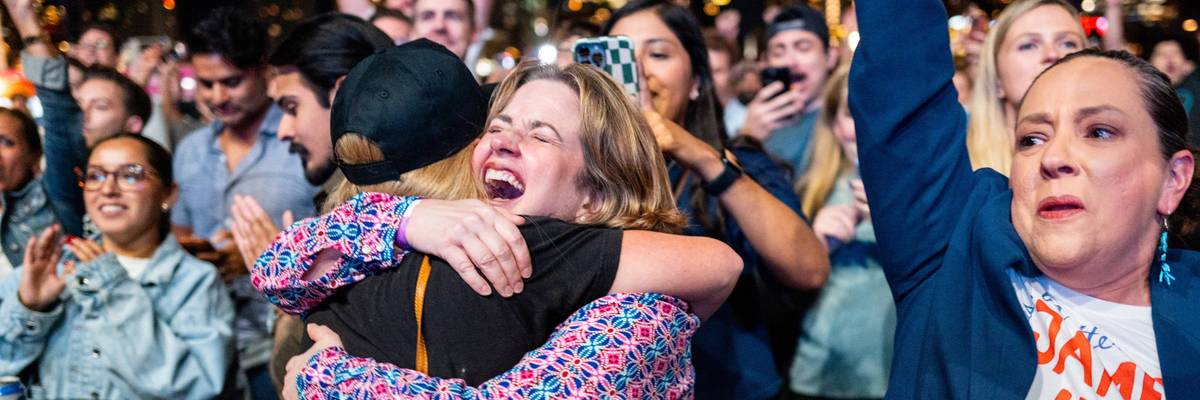
Supporters react during a midterm election night watch party for Texas Democratic Senate candidate, State Rep. James Talarico, at the Long Center on November 3, 2026 in Austin, Texas.
We may feel as if we have woken up to a different country after election day, but we have not. We woke up just as we did the day before to a country in which the collective is fighting for justice and equity relentlessly, strategically, and with love.
What is this strange feeling washing over millions of us this week? Is this relief? Is this joy? Is it disbelief that our collective voice could not be stifled despite the best attempts of the wealthy and the corrupt? We wake up to a very different world than the one that we woke up to on election day.
We have the very first openly gay man senator ever elected.
We have the first Black woman governor ever, and she is 1 of 5 Black governors elected, making it the first time that multiple Black governors will serve at once. Until now, each previous Black governor served alone, they were the only Black person in the room.
We are part of a long lineage of dreamers and resisters and creators. We voted. And that is only one small action in a large toolkit of creating more just worlds for all.
We have the first Native American woman governor ever.
We have a senator-elect in Texas who speaks of a politics of love. James Talarico, a former middle school teacher and Presbyterian seminarian, named what his campaign had to overcome in his acceptance speech:
We went up against nearly 40 years of doubt and disillusionment. We went up against more than $300 million, more than any senate campaign in American history. We went up against all the negative ads, smear campaigns, foreign bots, and AI deepfakes that money can buy. Those attacks were the final howls of a dying establishment. The death rattle of a status quo that knows its days are numbered.
We have a Latina governor in Texas for the first time, defeating a governor who has been more complicit than anyone in creating a brutally hostile environment toward immigrants and academic freedom. Abbott’s immigration policies led to the erosion of safety and human rights such as when police officers are allowed to question a person’s immigration status during a routine traffic stop, encouraging racial profiling. His Senate Bill 17 increased state censorship and widespread self-censorship, resulting in a devastating erosion of academic freedom. Harming one of the greatest riches this country has: our excellent higher education system.
We have Ohio’s first woman governor who won even after a deeply personal attack featuring her own estranged mother put forth by the Trump-promoted and backed opponent.
We have the first Native American woman US senator senator in Minnesota.
This was the very first midterm in which a single person gave more money in donations than any other person has ever spent on a single election cycle (with the exception of billionaire Mike Bloomberg who funded his own run for the presidency in 2020). The world's richest man donated a stunning $474 million, of this $168 million went toward the aim of defeating Talarico, who took no corporate PAC money and was only funded by individual donors.
The first Muslim senator was elected despite some of the most vitriolic racist attacks lodged at him and having his primary opponent choose to blow up her political career by betraying every value she ever indicated to hold by backing the Trump-favored Republican opponent.
The list of names could continue, but there is a risk to narrowing the story to the name in the headline. After all, each of these people was carried by thousands and even millions of people organizing, refusing, resisting, and caring.
It is no wonder if we feel as though we have woken up to a different country than the one we woke up to on election day. But I want to argue that we have not. We woke up just as we have woken up the day before and the one before that, and so on to a country in which the collective is fighting for justice and equity relentlessly, strategically, and with love.
There is some data to back these seemingly unnecessarily hopeful words. The early vote exceeded the 2022 midterm early vote by 9 million. This brings to mind a well-known psychological concept known as learned helplessness. The studies that led to this theoretical framework are devastating in their cruelty. Dogs were shocked while standing on a platform. And at first, they tried to get away from the painful bursts but were not given an opportunity to do so. Eventually, even when an escape was a possibility, when the door was open, they no longer even tried, they simply gave up and accepted the torture.
Even with the egregious misuse of the Justice Department, the assault on the checks and balances in our government, even with the wealthiest man in the world aiming to disempower the voters and buy elections in order to maintain his privileges. Even with the gerrymandering in many states that aimed to dilute Black political power. Even with voter intimidation by the federal government. Even with all of this, the country challenged Martin Seligman's original theories on learned helplessness. We do not lie down and accept the shocks. We are not biologically wired to quit when the stressors feel out of our control. Years after the original study in 1967, Seligman and Maier revisited learned helplessness in 2016 and concluded that passivity is not learned; instead, what is learned is a sense of agency, as that is something we build and learn together. Of course, as often happens, the research simply confirmed what the community already understood.
As we struggle to find the right words to describe what happened—is it a tsunami? Is it a firestorm? Is it a repudiation? What should the Democratic Party do next?—I want to offer my perspective as a critical social psychologist. Ignacio Martín-Baró was a Jesuit priest and University of Chicago-educated social psychologist who was assassinated by US trained unit of the El Salvadoran army on November 16th, 1989. In a few days it will be the 37th anniversary of this execution. He provoked transformative questions about the discipline of psychology itself and is regarded as one of the founders of the subdiscipline of liberation psychology. One of his core claims was that fatalism, a feeling that the story is already written so we might as well give up, is not actually natural to people. This is produced by systems. And an election like this shows us when fatalism can crack, as people reclaim their power. As we refuse to become pawns of the corrupt and the greedy. With that, what is the answer to what the Democratic Party needs to do next? Marin-Baro’s legacy reminds us that the party’s job is to follow the collective, not lead it.
We look at our neighbors who are being targeted for cruel deportations by bypassing due process despite their meaningful contributions to our communities, and we say, we stand with you. We look at our neighbors, like Alex Pretti and Renee Good, who were murdered because they refused to hide at home when their neighborhoods were under attack by masked bullies, and we grieve them with an act of radical love, which is always action. We look at our universities that are being stripped of academic freedom, becoming a tool of those in power and the state, and we say we believe in the power of education and that it is worth fighting for. We look at each other, and we know that we are being told a story that does not make sense. You, my neighbor, have never been my enemy. You have always been my keeper. We belong to each other.
Following the midterms, it is not so much that the world has changed; it is simply that we see the world more for what it has always been. Nothing has changed. The lens, smeared with lies, has been cleared somewhat with this election. We have communities who show up day after day after day for one another. They demonstrate that hope is not a soft feeling but a fierce warrior emotion that is produced by action. Mariame Kaba says it best: Hope is a discipline. We are part of a long lineage of dreamers and resisters and creators. We voted. And that is only one small action in a large toolkit of creating more just worlds for all. So is this a big blue wave? Well if it is, we created it. It is not crashing over us. We are in this water. And yes, resistance can be joyful. So come in, splash around. The water is warm. Let’s keep making waves together.
This country and this world are at a monumental crossroads. US voters have an opportunity to beat back the forces of fascism and confront the billionaires who are rigging the economy, our media system, and our democracy, making it increasingly impossible for ordinary people to get by. We’re not just talking about the election. We’re talking about what must be done once these fascist elements are vanquished from power. We need a bolder set of solutions than what either major party has so far been willing to offer and a working-class movement ready to fight like hell for it. Trump didn't emerge from nowhere. The conditions that fueled MAGA authoritarianism were created by decades of radical neoliberal economic policies and a corrupt political system dominated by corporate interests. They slashed taxes on the super-rich, promising that the benefits would trickle down. They said giveaways to the corporate titans would make life more affordable for the rest of us. It was all bullshit. And when a bitter, betrayed populace searches for someone to blame, right-wing demagogues have little trouble finding scapegoats. People know when they're being lied to, but you won't hear any of this from the corporate media. Only independent journalism—powered and funded by people who believe in building a better world—can deliver truly trustworthy daily news. If you share our vision, please contribute whatever you can to sustain our work. |
What is this strange feeling washing over millions of us this week? Is this relief? Is this joy? Is it disbelief that our collective voice could not be stifled despite the best attempts of the wealthy and the corrupt? We wake up to a very different world than the one that we woke up to on election day.
We have the very first openly gay man senator ever elected.
We have the first Black woman governor ever, and she is 1 of 5 Black governors elected, making it the first time that multiple Black governors will serve at once. Until now, each previous Black governor served alone, they were the only Black person in the room.
We are part of a long lineage of dreamers and resisters and creators. We voted. And that is only one small action in a large toolkit of creating more just worlds for all.
We have the first Native American woman governor ever.
We have a senator-elect in Texas who speaks of a politics of love. James Talarico, a former middle school teacher and Presbyterian seminarian, named what his campaign had to overcome in his acceptance speech:
We went up against nearly 40 years of doubt and disillusionment. We went up against more than $300 million, more than any senate campaign in American history. We went up against all the negative ads, smear campaigns, foreign bots, and AI deepfakes that money can buy. Those attacks were the final howls of a dying establishment. The death rattle of a status quo that knows its days are numbered.
We have a Latina governor in Texas for the first time, defeating a governor who has been more complicit than anyone in creating a brutally hostile environment toward immigrants and academic freedom. Abbott’s immigration policies led to the erosion of safety and human rights such as when police officers are allowed to question a person’s immigration status during a routine traffic stop, encouraging racial profiling. His Senate Bill 17 increased state censorship and widespread self-censorship, resulting in a devastating erosion of academic freedom. Harming one of the greatest riches this country has: our excellent higher education system.
We have Ohio’s first woman governor who won even after a deeply personal attack featuring her own estranged mother put forth by the Trump-promoted and backed opponent.
We have the first Native American woman US senator senator in Minnesota.
This was the very first midterm in which a single person gave more money in donations than any other person has ever spent on a single election cycle (with the exception of billionaire Mike Bloomberg who funded his own run for the presidency in 2020). The world's richest man donated a stunning $474 million, of this $168 million went toward the aim of defeating Talarico, who took no corporate PAC money and was only funded by individual donors.
The first Muslim senator was elected despite some of the most vitriolic racist attacks lodged at him and having his primary opponent choose to blow up her political career by betraying every value she ever indicated to hold by backing the Trump-favored Republican opponent.
The list of names could continue, but there is a risk to narrowing the story to the name in the headline. After all, each of these people was carried by thousands and even millions of people organizing, refusing, resisting, and caring.
It is no wonder if we feel as though we have woken up to a different country than the one we woke up to on election day. But I want to argue that we have not. We woke up just as we have woken up the day before and the one before that, and so on to a country in which the collective is fighting for justice and equity relentlessly, strategically, and with love.
There is some data to back these seemingly unnecessarily hopeful words. The early vote exceeded the 2022 midterm early vote by 9 million. This brings to mind a well-known psychological concept known as learned helplessness. The studies that led to this theoretical framework are devastating in their cruelty. Dogs were shocked while standing on a platform. And at first, they tried to get away from the painful bursts but were not given an opportunity to do so. Eventually, even when an escape was a possibility, when the door was open, they no longer even tried, they simply gave up and accepted the torture.
Even with the egregious misuse of the Justice Department, the assault on the checks and balances in our government, even with the wealthiest man in the world aiming to disempower the voters and buy elections in order to maintain his privileges. Even with the gerrymandering in many states that aimed to dilute Black political power. Even with voter intimidation by the federal government. Even with all of this, the country challenged Martin Seligman's original theories on learned helplessness. We do not lie down and accept the shocks. We are not biologically wired to quit when the stressors feel out of our control. Years after the original study in 1967, Seligman and Maier revisited learned helplessness in 2016 and concluded that passivity is not learned; instead, what is learned is a sense of agency, as that is something we build and learn together. Of course, as often happens, the research simply confirmed what the community already understood.
As we struggle to find the right words to describe what happened—is it a tsunami? Is it a firestorm? Is it a repudiation? What should the Democratic Party do next?—I want to offer my perspective as a critical social psychologist. Ignacio Martín-Baró was a Jesuit priest and University of Chicago-educated social psychologist who was assassinated by US trained unit of the El Salvadoran army on November 16th, 1989. In a few days it will be the 37th anniversary of this execution. He provoked transformative questions about the discipline of psychology itself and is regarded as one of the founders of the subdiscipline of liberation psychology. One of his core claims was that fatalism, a feeling that the story is already written so we might as well give up, is not actually natural to people. This is produced by systems. And an election like this shows us when fatalism can crack, as people reclaim their power. As we refuse to become pawns of the corrupt and the greedy. With that, what is the answer to what the Democratic Party needs to do next? Marin-Baro’s legacy reminds us that the party’s job is to follow the collective, not lead it.
We look at our neighbors who are being targeted for cruel deportations by bypassing due process despite their meaningful contributions to our communities, and we say, we stand with you. We look at our neighbors, like Alex Pretti and Renee Good, who were murdered because they refused to hide at home when their neighborhoods were under attack by masked bullies, and we grieve them with an act of radical love, which is always action. We look at our universities that are being stripped of academic freedom, becoming a tool of those in power and the state, and we say we believe in the power of education and that it is worth fighting for. We look at each other, and we know that we are being told a story that does not make sense. You, my neighbor, have never been my enemy. You have always been my keeper. We belong to each other.
Following the midterms, it is not so much that the world has changed; it is simply that we see the world more for what it has always been. Nothing has changed. The lens, smeared with lies, has been cleared somewhat with this election. We have communities who show up day after day after day for one another. They demonstrate that hope is not a soft feeling but a fierce warrior emotion that is produced by action. Mariame Kaba says it best: Hope is a discipline. We are part of a long lineage of dreamers and resisters and creators. We voted. And that is only one small action in a large toolkit of creating more just worlds for all. So is this a big blue wave? Well if it is, we created it. It is not crashing over us. We are in this water. And yes, resistance can be joyful. So come in, splash around. The water is warm. Let’s keep making waves together.

