SUBSCRIBE TO OUR FREE NEWSLETTER
Daily news & progressive opinion—funded by the people, not the corporations—delivered straight to your inbox.
5
#000000
#FFFFFF
To donate by check, phone, or other method, see our More Ways to Give page.
Daily news & progressive opinion—funded by the people, not the corporations—delivered straight to your inbox.
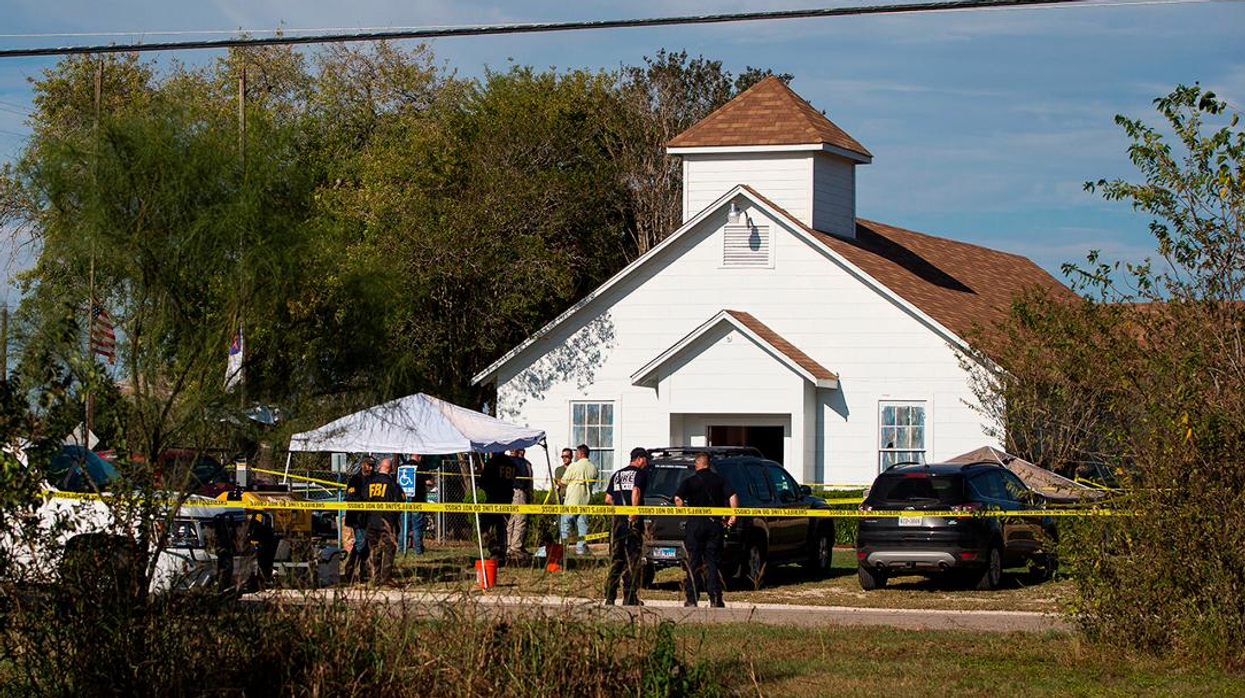
The gunman who killed 26 people and injured 20 at First Baptist Church in Sutherland Springs, Texas on Sunday had been accused of domestic violence in recent years, making him the latest perpetrator of a mass shooting to have a history of abusing an intimate partner or family members.
Devin Patrick Kelley was court-martialed by the U.S. Air Force and served a year in military prison in 2012 for assaulting his wife and baby stepson. The Texas Department of Public Safety has attributed the shooting to "a domestic situation going on," noting that Kelley's in-laws attended the church and stressing that it was not motivated by beliefs about race, religion, or politics.
But the latest addition to the list of gunmen who have killed in large numbers after their own "domestic situations" and negative statements about women, has left many arguing that violence against partners and children should be taken seriously as a politically-charged behavior--and as a risk factor for other forms of violence.
YES. And yet blinding misogyny is never considered a possible political motivator for mass violence. https://t.co/XyoCiG7yZe
-- Naomi Klein (@NaomiAKlein) November 6, 2017
On her show Full Frontal last week, Samantha Bee argued that "abused women are the canary in the coal mine for mass shootings," citing a study by Everytown for Gun Safety which showed that in 54 percent of mass shootings, a partner or family member of the attacker was among the victims.
Several recent high-profile shootings involved gunmen who had exhibited violent or threatening behavior toward women:
In her segment last week, Bee argued that stronger laws should be passed to keep guns out of the hands of domestic abusers, while others have pushed for the recognition of misogyny and violence against women as serious political issues rather than "domestic situations."
As Soraya Chamaly wrote in Rolling Stone after the Pulse shooting, Mateen's ex-wife described him as "showing no sign of violent radicalism," and argued, "it's time our society started to think of physical abuse, possessiveness, and men's entitlement to act in those ways toward women as terroristic, violent and radical."
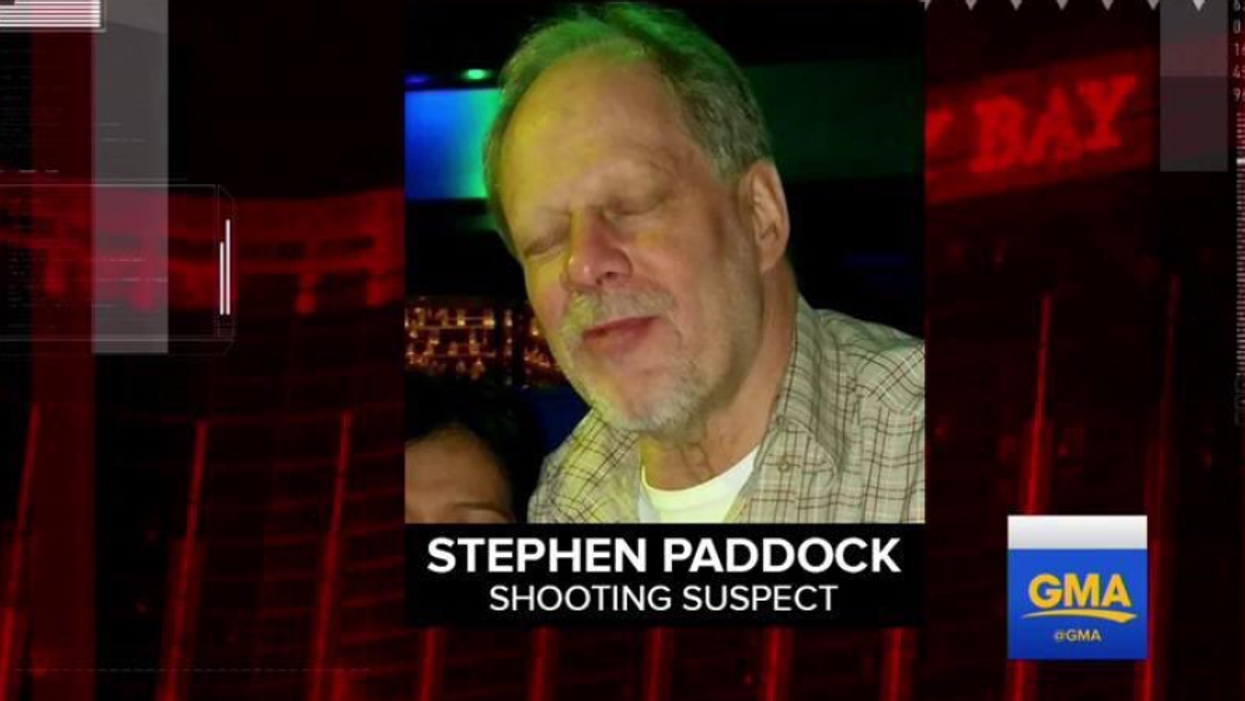
As law enforcement officials release more information about Stephen Paddock, the suspect in the Las Vegas shooting that killed nearly 60 people and injured more than 500 Sunday night, much of the reporting on his identity has focused on the fact that he is a "local individual" and a "lone wolf"--terminology that critics say has been used to signify that Paddock was a white male, and therefore not a terrorist.
Paddock resided in Mesquite, Nevada, about 80 miles away from the hotel on the Las Vegas Strip where he opened fire on a crowd at the Route 91 Harvest music festival just after 10:00pm.
Omar Mateen, the shooter in the June 2016 shooting at a nightclub in Orlando, Florida, was by definition a "local" as well, living 120 miles from the attack site. The attack was classified as an act of terrorism by President Barack Obama within 12 hours of it taking place, due to Mateen's pledge of allegiance to ISIS during the shooting.
Though the Associated Press reported Monday morning that ISIS had claimed responsibility for the Las Vegas attack, as of 12:00pm the FBI was reporting that it had found "no connection with an international terrorist group" after searching Paddock's home.
Still, journalists and other observers spoke out on social media about the reluctance of local and federal officials to call the attack, now the deadliest mass shooting in American history, an act of domestic terrorism.
In the Washington Post, Aaron Blake wrote that "the vast majority of members of Congress" have not used the words "terror" or "terrorist" in relation to the shooting. "Perhaps they don't want to get ahead of the evidence, but some argue that this is giving the shooter the benefit of the doubt in a way that simply isn't afforded to Muslims who commit such acts," he wrote.
"Thoughts and prayers."
"Too early to politicize."
"Have some respect for the dead."
"Lone wolf."
"Local individual."
"Disturbed gentleman."-- Ebony Elizabeth (@Ebonyteach) October 2, 2017
At Vox, Jennifer Williams highlighted just a few of the major attacks that have taken place in the U.S. so far this year, all carried out by white men. "In the eight months since Trump took office," she wrote, "more Americans have been killed in attacks by white American men with no connection to Islam than by Muslim terrorists or foreigners...In fact, between 2001 and 2015, more Americans were killed by homegrown right-wing extremists than by Islamist terrorists, according to a study by New America, a nonpartisan think tank in Washington, D.C."
June 2015 was a joyous time for me and LGBT people across the country. The Supreme Court decision extending the freedom to marry to all loving couples was a landmark achievement in the long and ongoing struggle for equality under the law. I was deeply honored to have played a role in helping same-sex couples win this victory.
June 2016, just one month ago, was a time of heartbreak for millions around the world, including myself. The murder of 49 people and wounding of 53 others at a gay nightclub in Orlando, Florida, was a devastating tragedy and the worst attack on the LGBT community in our nation's history.
This morning, exactly one month after this horrifying event, I appeared before Congress to discuss a bill, the "First Amendment Defense Act," that would authorize sweeping, taxpayer-funded discrimination against LGBT people. It is deeply hurtful to a still-grieving LGBT community.
This hits particularly close to home for me. My partner and eventual husband of almost 21 years, John Arthur, passed away on October 22, 2013, after a years-long battle with amyotrophic lateral sclerosis (known as ALS). I was lucky to be able to be with John, caring for him, at every difficult stage of his illness. FADA, however, would allow for any privately owned business to refuse a gay or lesbian employee like myself the ability to take time off to care for a sick spouse, even though this would violate federal family and medical leave laws.
What could ever justify such a discriminatory and harmful action?
John and I had to go to Maryland to get married because our home state of Ohio did not allow same-sex couples to marry. We were only able to do so aboard a medically equipped plane. John's condition was so fragile that we couldn't even leave the plane -- we had to be married on the airport tarmac.
When we returned to Ohio, we learned that I would not be listed on John's death certificate as his surviving spouse when he died, because the state refused to recognize our marriage for any purpose. We decided to fight back in court against this injustice.
Together with partners like the ACLU, we began a legal journey that, sadly, John did not get to see to conclusion. It culminated in a momentous victory for loving and committed couples across the country. I know John would have been proud to have played a role in this historic legal victory for equality.
Even though same-sex couples now have the ability to obtain a civil marriage license in any state in the country, our work to achieve full equality is far from over. It is critically important that our constitutional rights are not undermined by proposals, like FADA, that would subject loving couples, like me and John, and others to discrimination.
Proponents of FADA argue that it is necessary to protect churches, clergy, and others who oppose marriage equality for religious reasons. But the First Amendment is already clear on this point. Since the founding of this country, no church or member of the clergy has been forced to marry any couple if doing so would violate their religious teachings. That has not changed since same-sex couples won the freedom to marry.
Religious liberty is a core American value. Everyone in this country is free to believe (or not believe) and to live out their faith as they see fit, provided that they do not do so in a way that harms other people. As I see it, this legislation turns this value on its head by permitting discrimination and harm under the guise of religious liberty.
Given the way that this legislation is drafted, its harms are not limited to LGBT people or same-sex couples. Indeed, women, particularly single mothers, and unmarried couples could also find themselves on the receiving end of discriminatory treatment if this proposal were ever to be signed into law.
For example, the legislation could allow certain social service programs that receive federal funding, including homeless shelters, to turn away a single mother and her child. In addition, it could permit any non-profit university to continue to receive federal funding even when it fires an unmarried teacher simply for becoming pregnant.
It is difficult for me to imagine why anyone would think such discrimination should be permitted in the year 2016. I believe that the United States Congress must be better than this.
I hope that Congress will move away from elevating proposals like this that only serve to harm a vulnerable community. Congress should stand on the right side of history by steadfastly rejecting this mean-spirited and discriminatory proposal. I hope that we instead look at ways to protect LGBT people and others in America from violence, discrimination, and harm.
Everyone deserves the freedom to live their life without fearing discrimination or worse, simply because of who they are or whom they love.
We may never know the crucial determining factor or combination of factors responsible for Omar Mateen's ghastly slaughter of 49 people and the wounding of 53 others at Orlando's Pulse nightclub. Mainstream media pundits quickly cited LGBT bigotry, lax gun laws, failed FBI background checks, an infatuation with violence, deeply closeted homosexuality, and "self-radicalization."
We may never know the crucial determining factor or combination of factors responsible for Omar Mateen's ghastly slaughter of 49 people and the wounding of 53 others at Orlando's Pulse nightclub. Mainstream media pundits quickly cited LGBT bigotry, lax gun laws, failed FBI background checks, an infatuation with violence, deeply closeted homosexuality, and "self-radicalization."
But as more evidence accumulates, it's plausible that Mateen's unspeakable act was yet another grotesque version of the chickens coming home to roost. While the time and location of future attacks remain uncertain, there's no doubt that more jihadist-type chickens are en route to the henhouse. This raises the question that has remained outside polite conversation since September 11, 2001: What might lead someone like Mateen to carry out these hideous assaults on innocent U.S. citizens? Critical inquiry is not about making excuses for terrorism. Refusing to look at the causes of terrorism is inexcusable.
Years ago, Mateen spoke about becoming a martyr and watched Islamic State terrorism and propaganda videos. Classmates recall that when the second jumbo jet slammed into the Trade Center's south tower, the 14-year-old Mateen "started jumping up and down, cheering on the terrorists."
During one of his 911 calls from Pulse, he referred to the Tsarnaev brothers, the Boston Marathon bombers, as his "homeboys." In another, he claimed to be "acting in the name of God" and pledged his allegiance to ISIS leader Abu Bakr al-Bagdadi. And just before being killed by police, Mateen posted a Facebook message stating, "You kill innocent women and children by doing [U.S.] airstrikes. . . now taste the Islamic state vengeance."
Patience Carter, one of the hostages, heard Mateen say his attack was "to get America to stop bombing his country," a reference to his parents being from Afghanistan. In another conversation with a 911 operator, he demanded that the U.S. stop attacking Iraq and Syria and said, "That's why I'm out here right now."
Terrorism is only one consequence (the refugee crisis is another) that continues to reverberate in the wake of U.S. imperialist interventions, occupation, and unabated drone strike killings in Afghanistan, Yemen, Pakistan, and the Horn of Africa, and Washington's one-sided support for Israel's apartheid-like suppression of Palestinians.
As peace activist and author David Swanson notes, there is an immediate step the U.S. could take: "Stop bombing people around the world." Of course, this is the last thing that ISIS wants because the more bombs that fall, the "easier it is to motivate more killers." U.S. violence inevitably begets more violence and more sanctuaries for terrorists in the Middle East and South Asia.
To date, the U.S. has left citizens of these countries with four futile choices: (1) Remain in failed states destroyed by U.S. bombs. (2) Live under U.S.-sponsored brutal dictatorships with no prospects for change. (3) Become refugees. (4) Support or join ISIS-type organizations.
Because U.S. allies like Turkey, Pakistan, the Gulf monarchies, and, especially, Saudi Arabia are directly and indirectly in league with the terrorists, the decision has been made that this deplorable situation is preferable for U.S. "national security." The dominant interests in this country need to keep fear alive to justify any means of safeguarding their empire.
The Islamic State would not exist but for prior U.S. policy, including fateful decisions by Barack Obama and Hillary Clinton. ISIS is a death cult, and negotiating with them is impossible. Muslims must see an alternative to the dismal options listed above, an alternative that addresses their justifiable grievances. Recall Islamist Mohamed Morsi was democratically elected as president of Egypt in 2011, only to be overthrown and imprisoned by the U.S.-backed military. Only by supporting efforts to join Islam and democracy, currently exemplified by Tunisia and Indonesia, will this be possible. At this late date, it may not succeed, but there's no other sane alternative.
On Wednesday, Georgia Congressman John Lewis, a civil rights hero, led a sit-in of fellow House Democrats on the House floor to demand action on gun control legislation. Lewis strode to the lectern and called on his colleagues to "occupy this floor." Soon, about two-dozen lawmakers gathered around him as he spoke. As more Democrats came into the House chamber, including Senator Elizabeth Warren, they joined him, sitting with their legs crossed on the blue-carpeted floor. They carried picket signs with photos of the victims of gun violence and sang "We Shall Overcome," changing the words to include "We shall pass a bill someday." Some members cried. The protest lasted 25 hours. By sitting down, they were standing up to the National Rifle Association.
House Speaker Paul Ryan tried to shut down the insurrection, even going so far as to declare a recess to cut off the official television feed. But the protesters used Twitter's Periscope service to film the rebellion and fed it to C-SPAN, which in defiance of House rules that prohibit cameras on the floor when the chamber isn't in session, broadcast the sit-in anyway.
The protesting politicians were saying "enough is enough." They used this dramatic action to express what many Americans feel: We can no longer tolerate the obscene levels of carnage in our streets, schools, universities, houses of worship, shopping centers, and other sites. We need to join the rest of the civilized world in enacting reasonable measures to keep military-style weapons (like the AR-15 that Omar Mateen used in the Orlando nightclub massacre) out of the hands of civilians, and to prohibit the sale of guns to people with criminal records, mental illness, and terrorist affiliations.
By resorting to civil disobedience, the House members were acknowledging that traditional efforts to push for stronger gun laws haven't worked. Although polls show that a significant majority of Americans support tougher gun laws, their voices have been drowned out by the NRA. Along with gun and ammunition manufacturers, the NRA is responsible for the United States having the weakest gun laws of any modern democracy. In fact, the NRA only represents a tiny proportion of all gun owners, and most of them don't even agree with the fanatic views of the group's leadership--especially those of NRA head Wayne LaPierre, who earned $985,885 in 2014. But the NRA is able to mobilize a small but vocal number of people to support its extremist views, with the financial support of the gun manufacturers who profit from weak gun laws.
To successfully release the NRA's political choke-hold on Congress and on state legislatures, Americans need bold new strategies like this week's House floor sit-in. Until now, gun control advocates have largely stuck to one strategy, what I call polite moral outrage and lobbying. This strategy has made some inroads, but has failed to force enough politicians to vote for tougher laws. A second approach--a movement of reasonable gun owners for reasonable gun control--could have a huge impact by creating an alternative to the NRA. Finally, gun safety advocates need a mass movement of civil disobedience. That's what Democrats were demonstrating on the House floor this week. To be successful, this third strategy must include divestment from gun manufacturers.
These three approaches aren't mutually exclusive. In fact, the nation won't break the back of the NRA, and win stronger public safety measures, until all three strategies are at work at the same time. Here's how this one-two-three strategy would work:
Polite Vigils, Prayers, and Lobbying
Americans are tired of the carnage created by gun-related violence. In 2013, there were 33,636 deaths from firearm violence in the United States, including 11,208 homicides--31 a day. Firearms were used in 69.6 percent of all homicides that year. Many more individuals are injured--some seriously and permanently--by gun violence. America's gun death rate is far above that of other Western industrialized nations. This epidemic of gun violence is tied to the easy availability of firearms and weak gun violence prevention laws.
After each mass killing--in Columbine, Sandy Hook, Virginia Tech, Charleston, Aurora, Roseburg, Phoenix, and now the deadliest of all, Orlando--people come together to express their sympathy for the victims, their anger at the senseless violence, and their determination to bring about change.
Often led by the families and friends of the victims, citizens organize prayer services, candlelight vigils, and marches. Clergy, law enforcement officials, and community residents pledge to bring about change. They write emails to and visit their elected officials--city council members, state legislators, and members of Congress--some of whom promise to take action. Some newspapers publish editorials voicing sympathy, criticizing the NRA, and demanding tougher laws.
These events often spawn new local groups. One of the most effective is the Newtown Action Alliance, a volunteer grassroots organization formed after a gunman killed 20 school children and six adults at Sandy Hook Elementary School in Newtown, Connecticut. It brings members to Washington, D.C., to lobby Congress and sponsors an annual vigil for the victims of gun violence at the Washington National Cathedral. Po Murray, one of its founders, says that its goal is to "change the culture, change the conversation, and change the laws in order to end gun violence."
In between these upsurges of activism, local and national gun control organizations continue to do the hard and important work of keeping their cause in the news. Groups like the Brady Campaign to Prevent Gun Violence, the Violence Policy Center, and the Coalition to Stop Gun Violence conduct valuable research on the causes of gun violence, lobby public officials, educate the public about policy solutions, and alert people about pending bills so they can contact their political representatives. Compared with the NRA, these organizations operate on shoe-string budgets.
In this image from video provided by House Television, House Speaker Paul Ryan attempts to bring the House into session as rebellious Democrats stage an extraordinary all-day sit-in on the House floor to demand votes on gun-control bills.
Recently, they've been joined by some influential new players. In 2014, then-New York City Mayor Michael Bloomberg, a billionaire businessman, pledged to spend $50 million to jump-start a nationwide gun safety movement. He invested in strengthening existing groups and started Mayors Against Illegal Guns, which soon joined with another new group, Moms Demand Action for Gun Sense in America, to become Everytown for Gun Safety. Bloomberg is pouring money into political races to defeat candidates who oppose reasonable gun safety laws and are in bed with the NRA. He has recognized that the battleground over gun control is primarily at the state level and has spent big bucks trying to get states to adopt stronger gun rules and to stop efforts to weaken existing laws. The effort has included some major successes, including Colorado's passage of universal background checks and other gun control measures, and some defeats, including Everytown's failure to stop the Maine legislature from passing a law to allow gun owners to carry concealed weapons without a permit.
This year, Bloomberg's Independence USA PAC is gearing up to try to defeat Republican Senate candidates who voted to oppose federal background checks and other gun control measures. Also emerging as a political and organizational gun safety powerhouse is Americans for Responsible Solutions, founded by former House Democrat Gabrielle Giffords, of Arizona, after she was shot by a would-be assassin in 2011. Earlier this month, Giffords' husband, retired NASA astronaut Mark Kelly, teamed up with retired U.S. Army general and former CIA director David Petraeus to to launch yet another new group, Veterans Coalition for Common Sense.
This strategy built around moral outrage, lobbying, and media can be effective. Certainly it has influenced public opinion. A CNN/ORC poll released this week found that 92 percent of American voters support "a background check on anyone attempting to purchase a gun," with only 8 percent opposing. The same poll found that 85 percent of American voters supported "preventing people on the U.S. government's Terrorist Watch List or no-fly list from owning guns," with only 14 percent in opposition. Polls also consistently show that a significant majority of Americans support laws to prevent people with mental illness or criminal records from purchasing guns, the creation of a federal database to track gun sales, a ban on semi-automatic weapons, and a prohibition on the sale of assault-style weapons to civilians.
But public opinion, on its own, has little political influence. It has to be mobilized and organized--not just during episodic upsurges of moral outrage but on an ongoing basis. In this arena, these groups have until now been outgunned by the NRA, which drowns them out because it is better organized and more fanatical. Yes, in recent years, some cities and a handful of states have adopted stronger laws, but more states, like Maine, have actually weakened their existing laws. And in terms of getting something done in Washington, the strategy of traditional lobbying and media campaigns has been almost a complete failure. That's where the two other strategies come in.
Gun Owners for Reasonable Gun Control
Few activists within the mainstream gun control movement are themselves gun owners. But guns are a large part of American culture. Most Americans don't object to the manufacture and sale of rifles used in hunting, a sport that millions of Americans enjoy in relative safely. That's why strategy two is built on leveraging the influence of gun owners who think the NRA is too far outside the mainstream. A growing number of gun owners and enthusiasts want the services that the NRA offers--such as safety courses and consumer information about guns--but don't like the NRA's extremist agenda. So the time is ripe for an organization of reasonable gun owners for reasonable gun control.
The NRA was founded after the Civil War to advocate for hunter training, marksmanship, conservation of nature, and gun safety. It was a sportsmen's club, not a political lobby group. In 1977, extremists within the NRA hijacked the organization, strengthened its ties to gun manufacturers, and vowed to fight all gun regulations.
That's when LaPierre joined the organization. He's worked for the NRA since 1978 and served as its top official since 1991. He is the organization's hit man when it comes to intimidating elected officials to oppose any kind of sensible gun control laws. The NRA even defends the right of Americans to carry concealed weapons in bars, churches, schools, universities, and elsewhere. This poses a huge threat to police and civilians alike. For example, one in five law enforcement officers slain in the line of duty is killed with an assault weapon.
The NRA has two knee-jerk responses to the epidemic of gun violence.The first is that the Second Amendment gives all Americans the right to possess guns of all kinds--not just hunting rifles, but machine guns and semi-automatics. Efforts to restrict gun sales and ownership are, according to the NRA, an assault on our constitutional freedoms. The second is the cliche that "guns don't kill people, people kill people." To the NRA, weak gun laws have nothing to do with America's exorbitant number of gun-related killings. This contradicts research compiled by the Law Center to Prevent Gun Violence documenting that states with stronger gun laws have fewer gun-related deaths. States with the weakest laws are also the source of the most crime guns, even in those states with tougher laws.
Most gun-related deaths are committed by people who purchase their weapons legally. Others purchase or steal them illegally, but their ability to access guns is due to lax gun ownership laws. The NRA's job is to make it easier for people to buy and use guns. And so far it has been very successful. Since the 1994 assault-weapons ban expired in 2004, Congress hasn't enacted any major gun regulations.
Under LaPierre's leadership, the NRA has strengthened its ties to the gun manufacturers. The NRA's board includes many gun industry representatives, like Stephen Hornady, whose company, Hornady Manufacturing, sells armor-piercing bullets under the slogan "Accurate. Deadly. Dependable." The profits of these corporations (such as Remington Outdoor, Beretta, Sturm Ruger, Smith & Wesson, and Olin), and the profits of Walmart (the nation's largest seller of guns and ammunition) and other retailers, grow when there are few restrictions on the sale and ownership of guns and ammunition.
"There is a lot of profit to be made for all of this sorrow, all of this death, and all of this destruction," explained Dr. Sheldon Teperman, director of trauma surgery at the Jacobi Medical Center in New York City, who routinely deals with gunshot victims.
LaPierre has also linked the NRA to the far right, including the Tea Party. LaPierre is a regular presence at gatherings of extreme right-wing groups, whose paranoid warnings about the threat of tyranny and Obama's secret plan to confiscate all guns are meant to scare Americans into buying more guns and joining the NRA. For example, in a speech at the 2012 Conservative Political Action Conference in Washington, LaPierre said that Obama was part of a "conspiracy to ensure re-election by lulling gun owners to sleep." Obama's plan, he said, was to "erase the Second Amendment from the Bill of Rights and excise it from the U.S. Constitution." Donald Trump is echoing this NRA mantra on the campaign trail with his attacks on Hillary Clinton as a Second Amendment foe.
LaPierre speaks for the ultra-right-wing "survivalist" wing of the NRA, whose members and activities overlap with racist hate groups who believe they need to prepare for an armed struggle against their own government. He is a brilliant tactician and strategist who is able to marshal the loud voices of a relatively small group of people to stymie reasonable gun control laws.
"We must declare that there are no shades of gray in American freedom. It's black and white, all or nothing," LaPierre said at an NRA meeting. "You're with us or against us."
In fact, only a tiny proportion of the nation's gun owners are NRA members. About 90 million Americans own guns. The NRA claims to have about four million members. Even if they aren't exaggerating, that is less than 5 percent of all gun owners.
A national Public Policy Polling survey of gun owners, conducted last November, found that 83 percent support criminal background checks on all sales of firearms, while only 14 percent oppose them. Gun owner support is strongly bipartisan, with 90 percent of Democrats and 81 percent of Republicans endorsing background checks. Among gun owners, 66 percent say they would be more likely to vote for a candidate who supports background checks. Only 29 percent feel that the NRA represents their thinking when it comes to background checks. Gun owners also say the NRA is out of touch with them on these issues. The NRA's positions, in fact, are not only at odds with those of most Americans and most gun owners, but even of many NRA members. The poll found that 72 percent of NRA members support background checks.
So why is the NRA so powerful? Gun ownership is highly concentrated. Twenty percent of gun owners possess about 65 percent of the nation's guns. The NRA is able to mobilize a small but very rabid and vocal group of gun owners--as well as owners of gun shops--to attend rallies, write letters to newspapers and comments on blog sites, and contact elected officials.
Josh Sugarmann, executive director of the nonprofit Violence Policy Center, says that the NRA's most vocal members are no more than a quarter of its members--perhaps 750,000 people--for whom "guns are their life." They can make lots of noise but they don't represent most NRA members who don't fall for LaPierre's extremism.
Many gun owners are fed up with the NRA, but efforts to create an alternative gun organization have met with little success so far. One such group, the American Hunters and Shooters Association, began in 2005 and lasted for five years. Its president, Ray Schoenke, a one-time Washington Redskins football player and a successful businessman, had wanted AHSA to bridge the gap between urban liberals and rural gun owners. But the group focused almost entirely on supporting pro-gun control political candidates, did not provide services to its members, and could not sustain itself financially.
Last October, two days after the shooting at Umpqua Community College in Oregon, Mark Carman--an evangelical Christian, former police officer and military veteran, and a Republican from Nashville, where he now works as a music producer--posted a video on his Facebook page titled, "I Love My Guns--Responsible Gun Owners." He dangled his Ruger SR9 in front of the camera. "I like it," he said. "I love firearms. I do." Then he called for the expansion of background checks and the creation of a gun registry.
Within 10 days, more than 1.8 million viewers had watched Carman's video. So he created a website and a Facebook page called the American Coalition for Responsible Gun Ownership (ACRGO)--to challenge the gun lobby. According to its website, the group seeks "responsible gun ownership legislation to assure that firearm owners shall engage with reasonable due diligence in the purchase, sale, possession and/or use of all firearms."
The following month, a delegation from ACRGO--along with members of Gun Owners for Gun Control, organized by the progressive Netroots group MoveOn.org Civic Action--came to Washington, met with White House senior advisor Valerie Jarrett and members of Congress, and delivered 1.1 million signatures on a petition calling on Congress to take bold action in closing some of the loopholes in the firearms purchase process.
The response to Carman's video suggests that there is a potentially large constituency of gun owners for reasonable gun control, but Carman isn't interested in building a new organization. "I was totally unprepared for what happened," he explained. ACRGO, he said, "is just me, a website, and a Facebook page."
A moderate group could not only steal some members from the NRA but, more importantly, recruit unaffiliated gun owners who don't support the NRA's close ties with the gun industry and don't think the NRA speaks for them. It could grow into a kind of AARP for gun owners--one that provides services (such as gun safety courses) as well as mobilize its members to support reasonable gun laws and candidates who voice similar views--and poses a challenge to the NRA.
David Taylor, a retired Army officer and a two-time All-American in rifle shooting from Roswell, Georgia, was part of the delegation that met with Valerie Jarrett last November. "I was a member of the NRA for more than 10 years," Taylor explained, "but resigned my membership when its agenda turned from promoting gun safety and responsible ownership to one of uncompromising opposition to any kind of gun control."
Taylor follows in the footsteps of President George H.W. Bush. In 1995, Bush withdrew as a Life Member of the NRA after LaPierre sent an incendiary fundraising letter sent to the group's members, claiming that if assault weapons were banned, "jack-booted government thugs" would "break in our doors, seize our guns, destroy our property and even injure or kill us." We need more NRA members to publicly follow the example of David Taylor and Poppy Bush.
Civil Disobedience and Divestment
Throughout American history, all successful movements have included both reformers and radicals. Reformers work "inside" the system to bring about modest but important changes. Radicals work "outside" the system to push for more dramatic improvements. In truth, both are needed and, in most movements, reformers and radicals work together. In fact, ideas that were once considered dangerously radical--women's suffrage, Social Security, the minimum wage, and consumer protection laws--later became considered common sense. Radicals not only have bolder ideas but, in addition to such established tactics as voting and lobbying, they employ bolder actions like civil disobedience and boycotts. The successes of the women's suffrage, labor, environmental, civil rights, and LGBT movements all utilized these audacious tactics.
Last week, in the wake of the Orlando massacre, The Nation published an editorial entitled, We Need a Radical Movement for Gun Control. "When the normal political system fails," the editors wrote, "it's time to act up!"
House Democrat John Lewis, now 76, knows something about this. During the 1960s, as a young college student, he risked his life in the cause of civil rights. As an elected official, he has continued to put his body on the line for social justice. He is both a reformer and a radical, an insider and an outsider. He understands that there are times when candlelight vigils, prayer services, and well-mannered lobbying aren't enough. That's why he persuaded a number of his House colleagues--most of whom had never before engaged in any kind of protest--to join him on the House floor to express their frustration and anger at the failure of the Republicans (and a few Democrats) to embrace even modest gun safety legislation.
Lewis clearly hopes that this high-profile protest--which generated enormous media attention because of its dramatic and unusual show of conscience--will catalyze a wider protest movement that includes civil disobedience. Surely Lewis has in mind the four African American college students who, on February 1, 1960, sat in at a lunch counter at the Woolworth's five-and-dime story and refused to leave in order to protest Jim Crow racial segregation. They had no idea if their sit-in would work, but they had faith that their action would encourage others to join them. Their action inspired students at other colleges across the South to follow their example. By the end of March 1960, sit-ins had spread to 55 cities in 13 states. Many students, mostly black but also white, were arrested for trespassing, disorderly conduct, or disturbing the peace. One of them was Lewis, then a student at Fisk University in Nashville.
At the time, even many liberals--black and white--thought that the protesters were too radical. But their actions galvanized a new wave of civil rights protests. That April, several hundred sit-in activists formed the Student Nonviolent Coordinating Committee (SNCC), which became the "radical" wing of the civil rights movement. Its growing base of supporters played key roles in the freedom rides, marches, and voter registration drives that eventually led Congress to enact the Civil Rights Act of 1964 and the Voting Rights Act of 1965.
We need a comparable nonviolent protest movement now to stir things up on gun safety and challenge the influence of the NRA. There are already signs that a radical wing of the gun control movement is taking hold. On Tuesday, 18 activists affiliated with the peace group Code Pink were arrested after protesting outside the NRA headquarters in Fairfax, Virginia. The event came hours after the Senate had rejected proposals from both parties designed to keep extremists from acquiring guns and to require background checks for many firearms purchases.
The Orlando shooting has catalyzed the LGBT community to get more involved in the gun issue. It is likely that their involvement will inject new energy and its passion for civil disobedience into the gun control movement. We could soon see more civil disobedience actions at NRA's offices as well as similar protests at gun shows, the headquarters of major gun manufacturers, the homes of the CEOs of major gun makers, NRA board members, and NRA leader Wayne LaPierre, and at the offices of Congress members and state legislators who are under the thumb of the NRA.
Elected officials would be welcome to participate, but for such a strategy to be effective, it has to enlist ordinary Americans, including people who own guns, people who have been injured by gun violence, and the families of those who were killed in mass shootings and by the more mundane but still-deadly rash of daily street murders.
As with all social justice campaigns involving civil disobedience, such actions might invite criticism that they are "going too far." But such protests force people to pay attention, to think about an issue they had previously ignored, and often to revise their views. They also galvanize more people to take action so that the political snowball gets bigger and bigger. Such actions, which sometimes involve some people getting arrested, help give issues a sense of moral urgency. They state clearly that we can't continue with business as usual.
For those reluctant to participate in public protest, civil disobedience can take another form. Many movements have employed boycotts and divestment strategies to challenge powerful institutions to change their policies. The most famous boycott took place in Montgomery, Alabama, in 1955 after Rosa Parks was arrested for refusing to comply with that city's segregated bus seating laws. For over a year, citizens boycotted the buses, which eventually helped dismantle the city's segregation law. In the 1970s, many Americans boycotted grapes, wine, and lettuce produced by non-union workers to put pressure on big agricultural growers to improve working conditions and wages for migrant farmworkers, a campaign led by Cesar Chavez.
Divestment is another boycott strategy. The idea is to get pension funds, universities, churches, and other institutions to remove their investments from corporations engaged in socially irresponsible activities. In the 1980s, divestment from companies doing business in South Africa effectively helped dismantle that country's racial apartheid system. Today, many environmental activists--including students at over 300 colleges and universities--are pushing their institutions to unload their stocks in energy companies that promote fossil fuels that are destroying our planet. Several major institutions--including Stanford, Columbia, and Syracuse universities--have already done so.
The same strategy can exert pressure on the gun lobby. A group called the Campaign to Unload has been working in the trenches with people affiliated with universities, churches, union, and government pension funds to promote gun industry divestment. The effort has won some significant victories.
In 2013, the California Public Employees' Retirement System (CalPERS) and the California State Teachers' Retirement System (CalSTRS), both large public pension funds, moved to divest from manufacturers of assault weapons. That year, a pension fund for Chicago public employees (the Municipal Employees Annuity and Benefit Fund) voted to withdraw its holdings in three companies--Freedom Group, Sturm Ruger, and Smith & Wesson--that manufacture assault weapons, while the Chicago Teachers Pension Fund, which has $9.5 billion in assets, voted to divest its investments with gun makers. Last December, Letitia James, New York City's elected public advocate, sought to pressure TD Bank--which provided $280 million in financing to Smith & Wesson--to cut its ties with the gun manufacturer. In a letter to the bank, James wrote, "If you want to do business with New York City, you can't be in bed with companies that manufacture the agents that kill our children and families."
In 2014, at the urging of faculty and students, Occidental College in Los Angeles became the first higher education institution to pledge to stay away from any investments in companies that manufacture military-style assault weapons and high-capacity ammunition magazines for general public sale. Students at the University of California--which has an endowment of $88 billion, one of the largest in the country--have asked the university's board of regents to follow Occidental's example. The regents have never voted on an official policy, but according Dianne Klein, media director for the University of California's Office of the President, the university has sold all is stock in firearms manufacturers and distributors.
Earlier this year two Silicon Valley entrepreneurs--Keywon Chung and Michael Shilman--created a new tool, Goodbye Gun Stocks, that makes it easy to find out if a retirement fund or investment portfolio contains stocks from gun and ammo manufacturers and retailers. The tool covers more than 12,000 stock funds (and Thrifty Savings Plans for federal employees) based on Securities and Exchange Commission data, which amounts to $5.9 trillion in investments. Over $17 billion of those assets are invested in the consumer gun industry--about 35 percent of U.S. stock funds. You can type in the name of an investment fund, and it will show the percentage invested in nine public gun-associated companies--Olin, Ruger, Smith & Wesson, Vista Outdoor, Big 5 Sporting Goods, Dick's Sporting Goods, Cabela's, Sportsman's Warehouse, and Walmart. The tool also helps find alternative funds (with comparable or even better performance) that have no--or fewer--gun stocks. It provides side-by-side comparisons of different funds in terms of their investment in gun stocks. The Vanguard funds, for example, hold $5.7 billion in these stocks compared with Fidelity's $791 million.
A parallel group, Unload Your 401K, lets you enter your 401K provider to see whether it contain gun stocks. The group urges Americans to demand that the managers of their 401K portfolios (such as Fidelity, Prudential, Vanguard, and Merrill-Lynch) divest from gun stocks. Since it launched its divestment campaign against manufacturers of assault weapons and high-capacity ammo clips, ten hedge funds and money managers have divested their gun holdings, valued at $170 million.
If more institutions and individuals withdraw their investments from gun and ammo manufacturers that profit from the violence that is destroying our communities, particularly low-income and minority neighborhoods, it would pressure these corporations to change their practices. It would also compel more elected officials to side with the views of ordinary Americans and not the gun lobby.
"For years, the NRA dominated the political playing field on the gun issue," said Mark Glaze, president of the Campaign to Unload. "It will take years--and several election cycles--to dismantle the NRA's influence."
The Orlando massacre may be a turning point in galvanizing a stronger movement for sensible gun control. Three strategies--traditional advocacy, mobilization of sensible gun owners, and civil disobedience--point the way. Even as we grieve, we can move forward. We can stop the madness.
Democrats in the U.S. House of Representatives ended their overnight sit-in demanding gun reform Thursday morning after Republicans formally adjourned the legislative session until July 5.
More than a dozen Democrats, led by Rep. John Lewis (D-Georgia) remained on the chamber floor, although it is unclear how their efforts to force a vote on gun control will proceed as House Speaker Paul Ryan (R-Wis.) ended the session--earlier than scheduled.
As Politico reports, "The Wisconsin Republican entered the chamber at 10 p.m. to break up the protest by moving to a vote on unrelated legislation to override an Obama administration rule. Pandemonium ensued, a scene not witnessed on the House floor in years, if ever."
Democrats, who shouted "Shame! Shame!" and "No bill, no break!" as business continued, slammed Republicans for being "silent for too long" about mass shootings in the U.S. The protest was mounted after the U.S. Senate failed to pass several measures that would have expanded background checks and prevented gun sales to people on two terrorist watch lists, including the controversial No Fly list, introduced in response to the attack on an LGBTQ nightclub in Orlando earlier this month that left 49 dead and 53 wounded.
"Today we've come a distance. We've made some progress. We've crossed a bridge today, but we have other bridges to cross," Lewis said after the House adjourned. "The fight is an ongoing fight. We will not be happy, we will not be satisfied, we will not be pleased until we do something in a major way."
Republicans, meanwhile, claimed the sit-in was nothing more than a PR stunt.
As the lawmakers squabbled, civil rights advocates warned that the focus on the terrorist watch list may amount to an endorsement of a process that disproportionately targets Muslims and would not do enough to prevent future massacres.
Zaid Jilani of The Intercept noted that "this unusually bold and moving tactic was undercut by the fact that its chief goal is a political gimmick that would do little to stop gun violence, while expanding the use of a deeply flawed anti-terror watchlist."
Jilani wrote:
While sit-in participants are also advocating for expanded background checks and an assault weapons ban, their primary call to action is for a vote on a measure that would ban gun sales to people listed on a federal government watchlist - a move clearly designed more for its political potency than for its effectiveness.
As the Guardian's Spencer Ackerman reported on Wednesday, lawyers and American Muslim groups fear that "civil rights concerns over watchlisting are becoming a casualty of political expediency by gun control advocates in a debate supercharged by the massacre of 49 people at an LGBT nightclub in Orlando on 12 June."
Ramzi Kassem, a law professor at the City University of New York (CUNY), some of whose clients have been wrongly placed on the list, told Ackerman, "It's ridiculous, the notion that somehow the watchlists are a reliable measuring stick for who should be deprived of an ability to purchase weapons. The discussion on gun control vastly overstates the reliability of the watchlists. They lack transparency and any available process to get off the lists if people believe they've been wrongly listed."
The U.S. Senate on Wednesday failed to pass a bill that would have dramatically expanded the FBI's warrantless surveillance powers, but the fight is not over as Senate Majority Leader Mitch McConnell may call for a second vote on the proposed legislation.
According to the digital rights group Electronic Frontier Foundation (EFF), McConnell "switched his vote to 'No' at the last minute so that he may be able to bring up the amendment during future debate."
Civil liberties groups are mobilizing against the bill, sponsored by Sens. John McCain (R-Ariz.) and John Cornyn (R-Texas), with the ACLU issuing a statement to lawmakers urging them to "abandon this misguided effort" to address national security concerns in the wake of the Orlando shooting.
As Common Dreams reported on Tuesday, the measure, attached to a criminal justice appropriations bill, would expand the FBI's authority to use the so-called National Security Letters (NSL) to obtain Electronic Communication Transaction Records (ECTR) such as email time stamps, senders, and recipients, as well as browsing metadata such as history and location--all without a warrant.
Senators who supported the bill said it was necessary to expand law enforcement powers as a counterterrorism tool. But opponents, including Sen. Ron Wyden (D-Ore.) warned that doing so "takes a hatchet to important protections for Americans' liberty."
Ahead of Wednesday's vote, a coalition of civil liberties organizations including the EFF and the ACLU--as well as groups such as Amnesty International, Fight for the Future, and Human Rights Watch--issued an open letter to lawmakers that read in part:
The new categories of information that could be collected using an NSL--and thus without any oversight from a judge--would paint an incredibly intimate picture of an individual's life. For example, ECTRs could include a person's browsing history, email metadata, location information, and the exact date and time a person signs in or out of a particular online account. This information could reveal details about a person's political affiliation, medical conditions, religion, substance abuse history, sexual orientation, and, in spite of the exclusion of cell tower information in the Cornyn amendment, even his or her movements throughout the day.
"The civil liberties and human rights concerns associated with such an expansion are compounded by the government's history of abusing NSL authorities," the letter continues. "Given the sensitive nature of the information that could be swept up under the proposed expansion, and the documented past abuses of the underlying NSL statute, we urge the Senate to remove this provision[.]"
The ACLU also noted that the amendment would "make permanent the 'lone wolf' provision, which has reportedly never been used and allows the government to obtain secret Foreign Intelligence Surveillance Act orders for individuals who are not connected to an international terrorist group or foreign nation."
ACLU national political director Karin Johanson said Wednesday, "The Senate should not respond to the massacre in Orlando by voting to gut Americans' privacy protections and expand provisions of the Patriot Act that have consistently been abused by the government."
This story may be updated.
| Tweets about #NoBillNoBreak |
About 40 Democrats in the U.S. House of Representatives on Wednesday staged a sit-in to demand action on gun control in the wake of the Orlando shooting, occupying the chamber floor and chanting, "No bill, no break!"
Led by Rep. John Lewis (D-Georgia) and James Clyburn (D-S.C.), Democrats crowded in front of the speaker's podium, some on chairs in the front row and others sitting on the floor, to try to force a vote on gun control. House Republicans reportedly shut off cameras as the protest began, but images of the occupation percolated throughout social media networks. The cameras were later turned back on.
Lewis announced plans for a sit-in earlier Wednesday. "We have lost hundreds and thousands of innocent people to gun violence--tiny little children, babies, students and teachers, mothers and fathers, sisters and brothers, daughters and sons, friends and neighbors--and what has this body done?" Lewis said from the chamber floor Wednesday morning. "Mr. Speaker, nothing. Not one thing."
Members also tracked their sit-in on social media with the hashtags #NoBillNoBreak, #NoMoreSilence, and #GoodTrouble.
"Now is the time for us to find a way to dramatize it, to make it real," Lewis said. "We have to occupy the floor of the House until there is action."
The protest comes after a mass shooting at an LGBTQ nightclub in Orlando earlier this month killed 49 people and injured 53. Sen. Susan Collins (R-Maine) on Tuesday unveiled bipartisan legislation that would prohibit gun sales to people on two terrorist watch lists, including the contentious No Fly list, among other provisions.
On Monday night, the U.S. Senate failed to pass four gun control measures, including two that would have expanded background checks and prohibited gun sales to people on the watch list.
Sen. Chris Murphy (D-Conn.), who introduced those amendments, praised the sit-in on Twitter.
"Just watched House Republicans shut down House as @HouseDemocrats began to sit down on floor to say #NoBillNoBreak. Amazing," he wrote.
As the sun set over New York on June 12, hundreds of Muslims gathered together in Hudson River Park to break their Ramadan fast.
Iftar, the evening Ramadan meal, is often a joyous celebration of faith and family. But the mood that Sunday was solemn: That morning, news had broken of the ghastly massacre of LGBTQ revelers at Pulse nightclub in Orlando.
A lone Muslim had allegedly perpetrated the attack. Here by the Hudson, over 200 knelt in prayer.
"We're praying for those who were lost," one woman explained in a video circulated by the Huffington Post, her voice breaking. "As Muslims, we're united in our outrage over this senseless act of violence."
Meanwhile, an Orlando imam condemned terrorism as un-Islamic and affirmed his belief that "Islam teaches peace." The Florida chapter of a national Muslim group called on members to donate blood for the victims. And statements of sympathy tumbled forth from American Muslims in what CBS News called "an avalanche."
"Today, we stand in solidarity with the LGBTQ community," said the group Muslim Advocates. "Your grief is our grief. Your outrage is our outrage."
Unfortunately, none of those touching gestures deterred Donald Trump from warning darkly that "radical Islam is coming to our shores."
In a falsehood-riddled speech following the Orlando massacre, the presumptive GOP nominee blamed the shooting on immigration and "political correctness."
As Muslims all over America sent their sympathies to Orlando, Trump mocked his Democratic rival's insistence that "Muslims are peaceful and tolerant people." He accused Muslims of causing "death and destruction" by covering up terrorism in their midst (though it was later revealed that a Muslim member of Mateen's community had reported him as suspicious).
Then, in perhaps the most ominous part of the address, Trump claimed that Democrats will "take away Americans' guns and then admit the very people who want to slaughter us."
Muslim immigrants are the problem, he seems to be saying. And guns are the solution.
If you ask me, I'd feel much safer with the crowd at Hudson River Park than anywhere near a rally of armed Trump supporters. But here's the creepier part: For all his blathering that "we have to get smart" about "radical Islam," Trump is stupidly playing right into ISIS's hands.
Like Trump himself, the group benefits immensely from anything that drives a wedge between Muslims and the societies they live in.
ISIS said as much itself -- in plain English -- in a publication detailing its plan to "destroy the gray zone" between infidels and believers. Since most Muslims seem to like living in the liberal societies of Europe and North America, ISIS propagandists have written that the only way to drive up recruitment is to make Muslims feel unwelcome there.
No wonder ISIS recruiters are now featuring Donald Trump in advertisements.
It's not because they're afraid of him -- it's because few people are working harder to make Muslims feel unwelcome than he is. Civil rights groups report that Trump's rise has paralleled a shocking increase in hate crimes against Muslims in this country.
That's an outrage. And it's thoroughly self-defeating.
In fact, the United States has arguably the most prosperous, well-integrated Muslim population in the Western world. Even as ISIS has scored a few recruiting successes among the much more marginalized Muslim communities of Europe -- though even there, the group falls way outside the mainstream -- it's flat-lined here.
Scenes like the iftar gathering in New York, in other words, are the rule, not the exception. They're a touching rejoinder to the toxic politics of division and a far more accurate reflection of our Muslim neighbors than anything peddled by Trump.
And, not least, they're a much better asset in the fight against terrorism than any bullet or bomb -- or any demagogue who urges his followers to reach for their guns at the first sign of trouble.
As the debate and the raw emotion of June 12 subsides and the discussion moves into a second week, I find myself still reeling. I am not among those grieving the personal loss. My family and friends in Orlando are safe and the depth of my gratitude reflects this haunting and pronounced awareness that it might not have been so. That life must not be taken for granted. The grim reality that the news that shook mothers and fathers and brothers and sisters from their sleep last Sunday could have been mine. I feel this from far away from Orlando, and it is not lost on me that I write this waiting to retrieve a dear friend from the Brussels airport, where yet another tragedy, just months ago, shook so many.
As I consider the grief of those in Orlando, what shakes me the most is the moment those doubtlessly beautiful and brilliant lives were taken. My mind keeps drifting to the last moments for those murdered -- ordering drinks or texting their mothers from bathroom stalls -- and the thought that keeps haunting me is that it was just after "last call." The night was almost over.
The paradox is unrelenting, and it's the moment of their death that compounds my empathy and grief. I know what it feels like to be free on the dance floor at 3:00 a.m., working it out, happy, with friends, lovers and potential lovers. So many of us know that feeling -- that joy, that relative bliss and the vulnerability that comes with it. It is human. I imagine and remember the reprieve from work, from the 9-5, 11-3, or 6 until closing shift, a break from the other complications of life. I also know, as many LGBTQ people know, the sweet feeling of release from having performed our best drag all day to conform to the expectations of the dominant culture. The freedom found in some dark and crowded place where we can shake defiantly, kiss passionately and grind on the dance floor with abandon. The taunts, ridicule, and all manner of violence held at bay by the beats that feel as much within us as round us.
These spaces and moments are not perfect, but in this beautiful and sweet moment we are fully in our bodies, free in our love and desire. The more we've suffered and endured, the more the space is needed. I've always thought the song "God is a DJ" got it right, and the thought of that sacred moment interrupted by evil exacting such an unimaginable pain leaves me breathless. To the 49 souls whose lives have been lost, to the 53 injured and those who escaped, I will never again be able to dance without thinking of you.
When I've danced before, like many of us, I feel the weight of the gay clubs raided, bombed, the people beaten by police, forced to the ground while assaulted with billy clubs and police dogs. I have danced with the awareness that for the freedom we've gained and could express in Orlando, others in many other parts of our world cannot move their bodies so freely, cannot press their bodies against the bodies of those we desire without risking grave consequence. Perhaps that's what makes it all the more painful, the feeling of progress halted in one horrible instant. We had come to not expect such concentrated horror in places like Orlando.
For this reason and many, the shock of the country is understandable, and it is not at all mitigated by the fact that atrocities have happened before or persist elsewhere in similar or greater magnitude. No parent anywhere should have to feel what these parents must now feel. Yet, many have, do and will. As the war planes ready, and the soldiers prepare to be deployed, to think that the actions of this murderer will be cited as justification for the deaths of thousands is simply too much to bear. Perhaps one of the symptoms of the creeping inhumanity of our culture is our inability to mourn.
That grief drives us to action is not wrong, but for it to drive us to fear is dangerous. It is so dangerous because we are so very ill informed; we in the U.S. public are ignorant and some of this ignorance is willed. Thus, it goes that the horrible acts of a demented man serve to confirm the shortsighted convictions of ignorant people. Hypocrisy reigns, as they wrap themselves in rainbow flags to mourn lives they deemed unworthy of rights like hospital visitation.
Then comes the picking apart of the dead, perpetrator and victims. The New York Times publishes headlines like "Gays and Latinos, 2 Cultures Once at Odds," that speak of stitching together. The article eloquently chronicles the pain and homophobia of generations past. Yet this is the way the majority always tells the story, as if to be gay is to surrender your claim to Latino, as if being gay could make anyone any less Boricua, as if any of us with more complex identities could separate these insoluble aspects of our being. There is no Latino community without its LGBTQ members anymore than black or African American could exist without James Baldwin or Bayard Rustin, Alice Walker or Angela Davis. I don't wish to dishonor the victims by pointing out the violence of this reduction. Rather, I find it illustrative of a persistent problem that contributes to the creation of more victims.
Reporters, commentators and the like speak of "separate communities" reducing millions of people -- and in the case of Islam, 1.6 billion people -- to such a simplified caricature that, were the consequences not so frighteningly real in our time, it would be immediately taken as absurd. They say things like "Muslims are responsible," or "Muslims don't like gays," accepting a logic so faulty it's hard to understand how it could be said seriously. They render the Muslim gay, lesbian and trans people who have been among my friends in the United States and Europe invisible. These friends who I have, whom I've loved, also dance, arms extended, shoulders twisting. They also know the freedom of Pulse. It is true that they have struggled within their communities, as many of us have. Yet their struggle is made more difficult, not less, by bigotry and discrimination, bombs and military occupations directed at them. The W.E.B. Du Bois's phrases "What does it feel like to be a problem?" and "double consciousness" serve both LGBTQ people globally and Muslim-identified people living in Europe and the United States well. Du Bois wrote those words in 1903. Why haven't we learned?
It's all too much to deal with really. As I sit and write, my friend, Zoharah Simmons, who happens to be Muslim and feminist -- and a 50-year veteran of the Black Freedom Struggle -- arrives at Brussels Luchthaven. Following up on a conversation about nonviolence from our first event with young Belgians, our second event will be about the role of love and education in organizing for a more peaceful and just world. The airport is repaired, one does not notice the traces of the carnage that was here just three months ago. There is a part of me that wishes that I could just go from here to find a club and dance and forget it all. I'm sure I'll be able to again some day, but right now, my DJ is bowled over and weeping.