

SUBSCRIBE TO OUR FREE NEWSLETTER
Daily news & progressive opinion—funded by the people, not the corporations—delivered straight to your inbox.
5
#000000
#FFFFFF
To donate by check, phone, or other method, see our More Ways to Give page.
Daily news & progressive opinion—funded by the people, not the corporations—delivered straight to your inbox.

"You can't have your privacy violated if you don't know your privacy is violated," Rogers said in an infamous clip from 2013 as he defended the NSA's mass spying programs.
Amid an expanding assault on privacy by the federal government, Democratic nominee Dr. Abdul El-Sayed has brought the issue of mass surveillance to the forefront of Michigan's Senate race, attacking his Republican opponent, former Rep. Mike Rogers, for his longtime defense of the PATRIOT Act.
"Mike Rogers out here fighting for the Peeping Tom vote," wrote El-Sayed, a former public health official, in a social media post on Monday. "Creepy stuff, Mike."
El-Sayed was responding to an unearthed comment from Rogers, then the chair of the House Intelligence Committee, made during a 2013 committee hearing in Congress just months after whistleblower Edward Snowden's explosive revelations about the extent of the National Security Agency's (NSA) warrantless surveillance of Americans.
At the time, Congress was debating whether to enact legislation reining in a provision in the PATRIOT Act, Section 215, which the government had used to secretly collect phone records and other information in bulk from Americans not accused of wrongdoing.
Rogers was pushing American University law professor Stephen Vladeck to agree that the government should be allowed to examine Americans' business records to determine if they were connected to a foreign terrorist organization. Vladeck said he believed it should, but that protecting Americans' privacy needed to be taken into account. "The way we do it matters," he said.
The chair responded that in the decade since the policy had been enacted, nobody had ever complained about it. Vladeck, noting that the program was a secret, responded: "But who would be complaining?”
"Somebody whose privacy was violated," Rogers retorted. "You can't have your privacy violated if you don't know your privacy is violated."
The quote is highly representative of Rogers' record of support for extensive government surveillance over his decade-and-a-half in Congress. He was one of the PATRIOT Act's leading champions since its introduction in 2001 and led the charge to stop mass collection powers from being curtailed after the Snowden revelations.
“The charge that the program tramples on the privacy of citizens is simply wrong,” he said in a statement with Rep. Dutch Ruppersberger (D-Md.), then the ranking member of the Intelligence Committee.
Rogers and Ruppersberger also coauthored the Cyber Intelligence Sharing and Protection Act (CISPA) in 2012, which would have allowed companies to share cybersecurity-related information with the government, including the NSA, with protections from existing privacy restrictions. The American Civil Liberties Union argued that the bill, which failed in the Senate, would have allowed the government to obtain large amounts of sensitive personal data with few restrictions.
"You can't have your privacy violated if you don't know your privacy is violated."
In 2026, as artificial intelligence becomes a new tool for even more powerful and pervasive spying, El-Sayed has said the government must be banned from using it to "conduct warrantless surveillance."
As part of an AI policy platform rolled out in June, he said rules should be put in place to prevent its use for "domestic authoritarianism," including "mass political surveillance, protected-characteristic predictive policing, or AI targeting of dissent."
During President Donald Trump's second term, as he's used anti-"terrorism" rhetoric to justify a legal crackdown on domestic opposition, the government's expanding spy powers have become an increasing concern.
With the aid of private surveillance companies like Palantir, the administration has created an unprecedented surveillance dragnet that connects AI-powered facial recognition technology, license plate readers, and phone location tools to piles of data on Americans that have been used to supercharge its mass deportation campaign and aggressively monitor protesters and dissenters.
It has been met with some pushback in the Senate, where Republicans earlier this year narrowly failed to extend Trump's powers to surveil noncitizens under Section 702 of the Foreign Intelligence Surveillance Act (FISA) without warrants. Though US citizens are not supposed to be targeted, civil liberties advocates argue that their information is often collected easily and the government has used it to prosecute them.
Rogers has attempted to back off some of his earlier defense of mass surveillance, though he has not meaningfully pushed to reduce the government's spying powers. During a losing Senate bid against Sen. Elissa Slotkin (D-Mich.) in 2024, he said that it's "wrong" for the FBI to conduct warrantless searches against US citizens, but did not call for actually repealing or blocking Section 702.
Since serving in Congress, Rogers parlayed his time overseeing the intelligence community into a lucrative career advising and governing cybersecurity, intelligence, and government-contracting firms.
He served as a senior security adviser to AT&T while the company operated a little-known program that gave law enforcement access to searches of trillions of domestic phone records, though there is no record that he personally worked on the program.
Michigan Advance reported earlier this year that he also made almost $100,000 advising a company that helped the government of former Venezuelan President Nicolás Maduro spy on dissidents.
Noting the Republican nominee's recent pivot to Trumpian election denialism, journalist Spencer Ackerman—who has extensively covered the expansion of government surveillance during the War on Terror—suggested in a post on social media that there is little reason to believe Rogers has changed much after over a decade out of Congress.
"I saw up close his efforts, post-Snowden, to protect the NSA and ensure it continues to nullify your constitutionally-protected privacy," Ackerman said. "He was for impunity then and wants the same thing for himself."

The Trump administration's behavior leaves no room for the common trust on which diplomacy depends. There are only two choices: surrender or strengthen your military in anticipation of war.
The joint US-Israeli killing of Iranian leaders on February 28 marked the second time in a year that the United States had used negotiations as a decoy for a surprise attack. On the pattern of Germany’s invasion of Poland in 1939, our own invasion of Iraq in 2003, and Russia’s invasion of Ukraine in 2022, the US under President Trump has indeed launched a criminal war of aggression. The run-up to the war, however, followed a discernible pattern. Throughout the months preceding it, the Trump administration was testing the American public’s tolerance for just such an adventure.
First came the drone killings of alleged “narco-terrorists” on boats in the Caribbean Sea; then, the kidnapping of the president of Venezuela; and finally, the seizure of oil tankers said to originate from Venezuela (an act of piracy by any other name). Now, with the attack on Iran, the message to the world should be considered unmistakable. Nations concerned for their own survival, if they aren’t already US vassal states, are likely to avoid negotiations with the Trump administration. And what else could be expected? Its behavior leaves no room for the common trust on which diplomacy depends. There are only two choices: surrender or strengthen your military in anticipation of war.
The United States is now widely judged to be the most dangerous country in the world. Niccolo Machiavelli in The Prince advised all aspirants to the leadership of a state that it is good to be feared, but he added: Take care that you are not more hated than feared.
We may already have crossed that line.
Since the Biden and Trump administrations threw this country’s weight behind the Israeli destruction of Gaza, we now lack the standing to claim a role as the benefactor of any other nation in that region, including Iran.
What, in all our history, could have led us to fall so far? The disaster of the Vietnam War offered a decade-long glimpse into such possibilities, but the last stage of this country’s descent began with the invasion of Iraq. In early 2003, President George W. Bush told United Nations inspectors to leave that country because our bombing was about to begin. Had they been allowed to complete their search for supposed Iraqi weapons of mass destruction, they would have established that such weaponry, the pretext for our invasion, was nonexistent.
Such actions have consequences. When an international Gallup poll in 2013 asked which country was the greatest threat to world peace, the United States finished in first place. (Iran and Israel were tied for fourth.) The question has not been asked again, but in view of the wars that followed, including NATO’s regime-change bombing of Libya; a CIA-sponsored insurgency in Syria; US bombing campaigns in Somalia, Sudan, and Nigeria; Washington’s support for the destruction and mass killings in Gaza; and now the assault upon Iran, the answer to that poll today would probably be the same.
Imperial expansion generally comes with a loss of liberty at home. In the United States, the Patriot Act began that process in October 2001. Passed by Congress as an apparent response to the fears of a terrified populace just a month after the 9/11 attacks on New York City and Washington, DC, it was a remarkably comprehensive document to have been written so fast. The enhanced surveillance and security measures of the Patriot Act would, however, turn out to be just the opening chapter in a long series of abridgments of rights and anti-constitutional innovations for which the Global War on Terror served as an excuse. Nor were the tools of that war laid aside by later presidents, even when they struck a different posture.
Presidents of both parties extended the reach of our global war by reducing its visibility. Drone assassinations of presumed enemies, for instance, became a remarkably routine tactic of the Obama administration. And in Donald Trump’s second term, Immigration and Customs Enforcement (ICE) agents in American cities have brought the War on Terror home. The arrests may still be largely limited to non-naturalized immigrants and their more vociferous supporters, but nothing in the history of empire would lead one to suppose that such repressive measures (demanded in the name of “national unity”) will cease to gather force. Contempt for legality is not just an international but a national tenet of Donald Trump’s presidency.
Latent in the presidency itself has always been a risk of dictatorship. The capabilities associated with the office by its most distinguished advocate, Alexander Hamilton, are instructive here: activity, energy, dispatch, and secrecy. There have in truth been just three presidents in 250 years, George Washington, Abraham Lincoln, and Franklin Roosevelt, for whom most Americans can still feel an honest admiration. Coincidentally, they led the country during three of the very few American wars that could be justified without embarrassment. But even in the War of Independence, the Civil War, and the Second World War, the cost to civil liberties always proved high. Those wars were invariably used to justify an expansion of state power that would open the way for wars of choice.
Our absorption in what we believe we are doing for others stops us from thinking about what we are doing to ourselves.
Of course, the sovereign branch of government under the Constitution was clearly meant to be Congress, not the presidency, but for the last 85 years, in one fashion or another, Congress has continually abdicated its responsibility to approve and oversee the wars that America conducts—wars that were meant to be launched only in self-defense. Defaulting to the president on the decision to go to war is by now a deeply ingrained habit of congressional cowardice.
President Trump’s wars, however, have been new in one obvious way. Unlike any of his predecessors, he gloats over his killed or kidnapped victims. But the outlandish quality of the man can be a distraction. In truth, imperial hubris had set in and diplomacy had already faded from view before the end of Joe Biden’s presidency. With Trump having already pulled out of the Joint Comprehensive Plan of Action—or JCPOA, also known as “the Iran nuclear deal”—in his first term in office, President Biden was content to let it go unrevived. And no sooner had Russia attacked Ukraine in 2022 than Biden all but abandoned diplomacy and, in the three years that followed, never lifted the phone to speak to Russian President Vladimir Putin. To judge by the record of his presidential travels, Biden came to believe that his real job description was President of NATO.
As for Iran, it has long since acquired for Americans the status of a myth rather than an actual nation and continues to occupy a twisted place in the national psyche. All 52 of the hostages taken in that country’s 1979 revolution were, in fact, released on President Ronald Reagan’s inauguration day in 1981. For him, that was a valuable piece of theater, supplied by the very people we were still calling terrorists. By 1986, when the Iran-Contra scandal broke—the illegal trade of arms to Iran organized by senior officials in the Reagan administration in exchange for money to finance a US-backed insurgency in Nicaragua—it became hard to avoid the inference drawn by Gary Sick, the Persian Gulf adviser to President Jimmy Carter, that US and Iranian arms-for-money hustlers in both governments enjoyed mutual confidence because they had dealt with each other before. As thoroughly forgotten as the Iran-Contra affair were the CIA’s overthrow of the democratic government of Iran in 1953 and American support for Iraqi ruler Saddam Hussein during the Iraq-Iran war of 1980-1988, in which Iraq used chemical weapons against Iranian civilians. (The recent poisonous smoke from the Israeli bombing of civilian oil depots in Tehran may be evidence of a comparable war crime.)
What Americans so easily forget, the world sometimes remembers, and the perception of the United States today in Africa, Asia, and Latin America differs markedly from our perception of ourselves. Worse yet, we are led to misjudge our stature by the encouragement we receive from subordinate members of NATO, especially Great Britain, France, and Germany, descendants of defunct empires whose servility to Washington is now almost total. As surely as their representatives trooped into the Oval Office by twos and threes to plead with President Trump for a gentler deal on tariffs, they have also offered military support—an aircraft carrier here or there—to assist with the challenges that confront Washington in its latest war. Feeble though such gestures may be, the North Atlantic commercial democracies are more than ever dependent on American protection and largesse. As a result, in line with Trump administration propaganda, they portray the new conflict with Iran as an episode in a clash of civilizations that was always bound to happen.
But how inevitable was any of this? Thanks to a story in The Washington Post by John Hudson and Warren Strobel, we now know that a week before the joint Israeli-US attack, President Trump received a report from the National Intelligence Council informing him that a full-scale war on Iran would likely fail to bring down the government.
Washington’s determination to annihilate Iran, however, is nothing new. It has, in fact, been more constant and obsessive than most people realize. Back in 2007, a shipload of British sailors was captured in the territorial waters of Iran. Negotiations between the two countries were already underway when then-Vice President Dick Cheney pushed to convert the incident into a cause for war. He had earlier registered his displeasure when that year’s National Intelligence Estimate on Iran gave no grounds for believing that country was close to having a nuclear weapon. In short, there was no pretext for the war that would have lived up to the neoconservative motto, “Boys go to Baghdad, real men go to Tehran!” Still, courageous resistance from the head of CENTCOM, Admiral William J. Fallon, at that moment actually stopped the Bush-Cheney administration from getting into their third Middle Eastern war in five years. There has been no one like Fallon within a country mile of the Trump administration.
During his first term in office, in the relaxed usage casually deployed on the American left, Trump was often called a fascist. But the immobilizing speed with which each of his transgressions has succeeded the last does prompt a comparison with German foreign policy in the 1930s. A violent lunge and jolt, followed by another and yet another, too fast for his opponents to catch their breath: that’s the drill. After massive DOGE cuts and further selective purges of government workers, as well as ICE raids in Democrat-run cities and those assaults on Venezuela and Iran, what might come next? One possibility certainly is Cuba. Trump has long been fascinated with Cuba, and he’s hardly alone. That annoying island, 90 miles off the Florida coast, has troubled violent minds in the United States even longer than Iran. And on March 7, Trump promised, “Cuba is going to fall soon.”
Anti-communism was a potent drug, and we are still getting high on its fumes. It outlasted the Cold War but gathered a deeper plausibility from an older model. The sentiment that we’re doing it for their own good goes back to that American favorite among world-conquering powers, the British empire of the 19th century. The British always claimed that they ruled their imperial subjects for their sake—that is, to advance them to the next stage of civilization.
Now, Washington has taken up, as Rudyard Kipling once put it, “the savage wars of peace” and, “cold edged” as we are “with dear-bought wisdom,” we will carry on until the final war is done. From the days of the Roman empire (so the imperialist story ran), the growth of civilization followed a path along which every society could theoretically progress. Nineteenth-century England stood at its happy terminus, but given the right training, any country could arrive there eventually. Rome was cruel by comparison since only Romans were full citizens of that empire and exempt from the most humiliating punishments. The British commonwealth had a more generous presentation and was less keen on wars. (In this regard, America’s rulers are the disciples of Rome.)
Giving up empire would mean detaching ourselves from the conceit that the world wants to have our way of life and that it is our moral duty, even at the point of a gun or a drone, to give the world’s people what we imagine they are asking for.
But the United States has added something new to the relationship between the imperial center and the outlands. We have long admitted refugees from the countries we opposed and supported their inveterate hatred of the regimes they fled. If a Cuban wants the US to bomb Cuba, that rates a cheer of solidarity from many Americans. The same goes for the Polish emigré clamoring for NATO to destroy Russia or the Iranian who cheers the death cloud lately oozing over Tehran from US and Israeli attacks on civilian oil depots in that city.
But there is something odd about this pattern of vicarious hatred: very few of those refugees intend to go back to their native lands. They prefer the United States. By their unquenched thirst for revenge—not just the destruction of the bad Islamist or communist government in their former home, but a legacy of further suffering for the people who remain—they are exhibiting a horrific side of human nature. But as empire builders, we are expected to empathize and never say a word against the miserable fate, including bombs and sanctions, that our leaders have been all too happy to impose on the actual inhabitants of Cuba or Iran.
In a speech delivered in 2017, former President George W. Bush expressed regret over a weakening American determination to spread our kind of democracy and markets globally. For 70 years, he said: “The presidents of both parties believed that American security and prosperity were directly tied to the success of freedom in the world. And they knew that the success depended, in large part, on US leadership.” The world thus owed its stability to the portability of “the DNA of American idealism.” This was the language of the Berlin Airlift at the very start of the Cold War with the Soviet Union. Three generations later, we still speak that language even as, in our recent actions, we repeat the collective self-hypnosis that drew us into Vietnam. We are “winning” in Iran, Secretary of War Pete Hegseth has claimed, “decisively, devastatingly, and without mercy.”
Stop a moment at that last phrase—without mercy. It betrays a thought that American soldiers are not supposed to think, or at least not say aloud. Such strutting brutality lowers general morale by proudly displaying a failure of self-discipline. There is such a thing, in foreign policy, as lacking the standing to make certain claims. Since the Biden and Trump administrations threw this country’s weight behind the Israeli destruction of Gaza, we now lack the standing to claim a role as the benefactor of any other nation in that region, including Iran.
The worst of empire is this: that it requires conquest for its self-definition, which means it has no permanent self. Yet to the eye of the empire builder, war is an adequate substitute, an acceptable second best. Our absorption in what we believe we are doing for others stops us from thinking about what we are doing to ourselves. Giving up empire would mean detaching ourselves from the conceit that the world wants to have our way of life and that it is our moral duty, even at the point of a gun or a drone, to give the world’s people what we imagine they are asking for.
We will go on being the most dangerous country in the world, as well as an empire in free fall, until we stop supposing that we know other nations better than they know themselves. But the crisis we are now in also requires an inward look. Recalling the state of German society in the mid-1930s, in her extraordinary essay “Personal Responsibility Under Dictatorship,” Hannah Arendt offered a startling reflection: “It was as though morality, at the very moment of its total collapse within an old and highly civilized nation, stood revealed in the original meaning of the word, as a set of mores, of customs and manners, which could be exchanged for another set with no more trouble than it would take to change the table manners of a whole people.” At home and abroad, how close are we coming to just such a change?
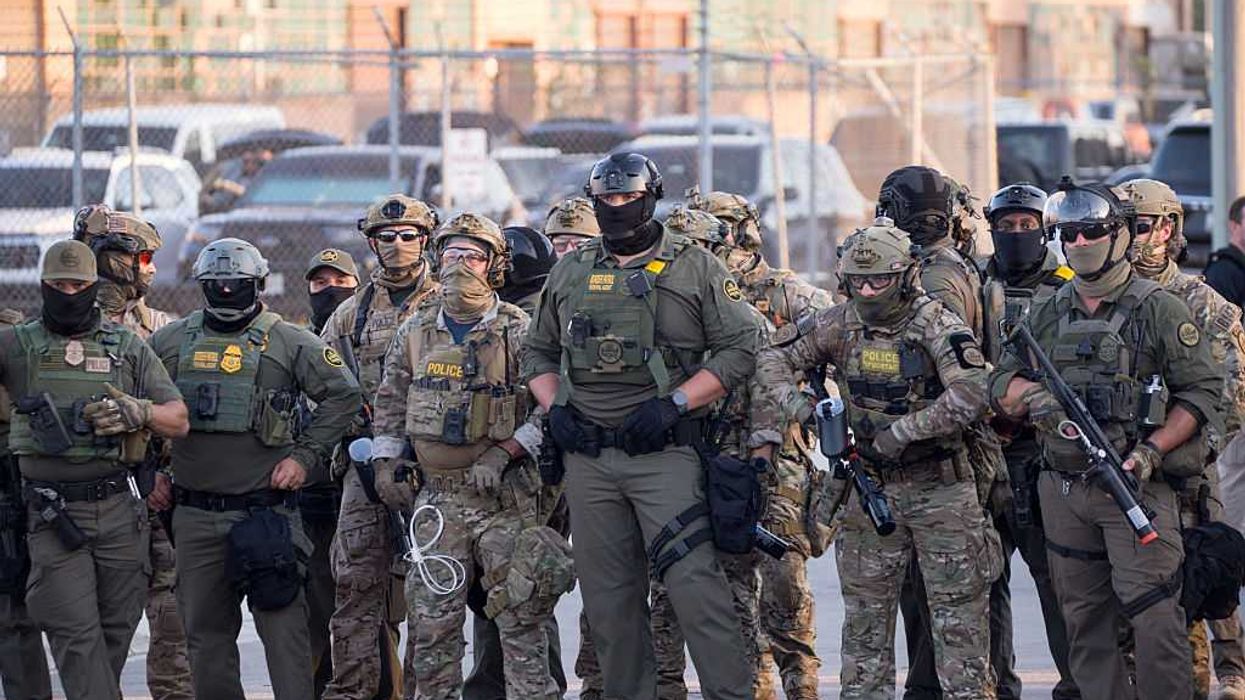
From the web to the streets, the president of the United States is weaponizing the federal government to hunt, prosecute, and punish his enemies.
In recent months, the Department of Homeland Security has issued hundreds of administrative subpoenas to tech companies demanding the personal information of social media accounts that track, criticize, or oppose Immigration Customs and Enforcement. This includes Google, Reddit, Meta, and Discord, which—in a move that makes far more sense now—recently announced it will require users to submit a face scan or upload an ID to access full content.
While alarming, this is only the latest step in a year-long effort by President Donald Trump’s DHS to expand its online surveillance apparatus under the guise of combating left-wing “political violence” and “domestic terrorism.” In February 2025, The Intercept revealed that ICE was soliciting pitches for an automated system that would scan social media and other sites for anti-ICE sentiment and threats. If anything "suspicious" were detected, a contractor would conduct a detailed review of the user’s background, including:
Previous social media activity which would indicate any additional threats to ICE; 2). Information which would indicate the individual(s) and/or the organization(s) making threats have a proclivity for violence; and 3). Information indicating a potential for carrying out a threat (such as postings depicting weapons, acts of violence, refences [sic] to acts of violence, to include empathy or affiliation with a group which has violent tendencies; references to violent acts; affections with violent acts; eluding [sic] to violent acts.
To estimate one’s “potential for carrying out a threat” or “proclivity for violence,” contractors would draw on “social and behavioral sciences” and “psychological profiles.” Sentiment analysis would likely be carried out by machine-learning algorithms. While details here are sparse, the important point for now is that this review would attempt to assess one’s present and future threat to ICE based on the agency’s own internal (and politically biased) criteria.
Once flagged, the system would scour a target’s internet history and attempt to reveal their real-world location and offline identity. Contractors would provide ICE with a slew of personal information including: “photograph, partial legal name, partial date of birth, possible city, possible work affiliations, possible school or university affiliation, and any identified possible family members or associates.”
All of this meant to invoke fear, silence dissent, and consolidate power for Trump and his allies. Yet, despite the dangers, we must resist.
In October 2025, Wired reported that ICE plans to drastically expand their surveillance capabilities by hiring nearly 30 private contractors to scan social media sites and convert posts, photos, and messages into new leads for enforcement raids.
In January 2026, investigative journalist Ken Klippenstein revealed that DHS and the FBI have over a dozen “secret and obscure” watch lists they use to track “protesters (both anti-ICE and pro-Palestinian), ‘Antifa,’ and those who are promiscuously labelled ‘domestic terrorists.’” These watch lists include a classified social media repository code named Slipstream, as well as others “used to link people on the streets together, including collecting on friends and families who have nothing to do with any purported lawbreaking.” This reporting came a few days after a video was released online of an ICE agent telling a protester that they have a “nice little database” and “now you’re considered a domestic terrorist.”
These watch lists are an extension of Trump’s National Security Presidential Memo 7 (NSPM-7). That memo mandates a “national strategy to investigate and disrupt networks, entities, and organizations that foment political violence so that law enforcement can intervene in criminal conspiracies before they result in violent political acts.” Per the memo, domestic terrorism is fomented by the spread of “‘anti-fascist’ rhetoric” including, “anti-Americanism, anti-capitalism, and anti-Christianity,” as well as “extremism on migration, race, and gender.”
The labeling of any view Trump disagrees with as “domestic terrorism” is dangerous and strategic. As Rachel Levinson-Waldman, the director of the Brennan Center for Justice’s Liberty and National Security Program, notes, under the Patriot Act, “Any federal or state crime can be used as the basis for a domestic terrorism investigation if it is ‘dangerous to human life’” and “appear[s] to be intended to intimidate or coerce a civilian population” or the government. This broad basis allows DHS to use its vast policing and surveillance powers to investigate civil rights organizations, activists, and donors to progressive causes as well as online critics. Regardless of the outcome of their investigation, being suspected of domestic terrorism—regardless of how unconstitutional, frivolous, and politically motivated the charge—can have lasting impacts, including loss of employment and housing, inability to conduct financial transactions, as well as public stigma.
Importantly, the image of the “domestic terrorist” is quite different from the ordinary criminal. The “domestic terrorist” does not simply violate the law, they commit “ideologically driven crimes” aimed to destroy the nation and its people. They represent a far greater threat. This is why the State Department has been revoking the visas of hundreds of students who express “pro-Hamas” views, whether in protest, newsletters, or on social media. For Secretary of State Marco Rubio, the presence of “these lunatics” is contrary to the national security and interests of the United States. The State Department has also denied visas to people “celebrating” the death of Charlie Kirk for similar reasons.
National security is also the basis for imposing denaturalization quotas for foreign-born citizens as well as the Trump administration’s efforts to restrict birthright citizenship for the children of undocumented immigrants. In each case, “national security,” “left-wing political violence,” and “domestic terrorism” are used to justify the denial of rights and the abuse of federal powers.
For US-born citizens like Renee Good, Alex Pretti, Marimar Martinez, or those subjected to ICE’s mass digital surveillance, those punitive measures are unavailable. Instead, the designation of “domestic terrorist” is meant to mark them as traitors—as people who, like “pro-Hamas” visa holders or “dangerous illegal criminal aliens more broadly,” do not belong in this country. For this administration, they are essentially citizens in name only—they do not “share our values, contribute to our economy, and assimilate in our society.” Thus, they too must be subjected to the full arsenal of policing and surveillance powers at DHS’ disposal.
In fact, for Trump, these "faux" citizens are a greater threat than undocumented immigrants. As then-presidential candidate Trump put it, “I think the bigger problem is the enemy from within, not even the people that have come in and destroying our country. […] I think the bigger problem are the people from within. We have some very bad people. We have some sick people. Radical left lunatics.” But the reality is that far from sick, bad, or radical, these are ordinary law-abiding people whose only crime is defying the rising piss-stained tide of Trump’s authoritarianism.
The dangers here are real and serious: The blatant First Amendment violations; the widening of DHS’ mass surveillance capabilities; the policing of dissent, both actual and possible; the coordinated effort to undermine digital activism; the complicity of tech companies in furthering the fascist ambitions of the Trump administration; the malicious smearing of those who oppose this administration as “domestic terrorists”; as well as the reality—unnerving, though far from unprecedented—that from the web to the streets the president of the United States is weaponizing the federal government to hunt, prosecute, and punish his enemies.
All of this meant to invoke fear, silence dissent, and consolidate power for Trump and his allies. Yet, despite the dangers, we must resist. We must continue calling out ICE’s abuses, championing Palestinian sovereignty, denouncing Trump’s vile imperial and colonial ambitions, and protecting our rights and freedoms from the real domestic terrorist threat: the Trump administration.
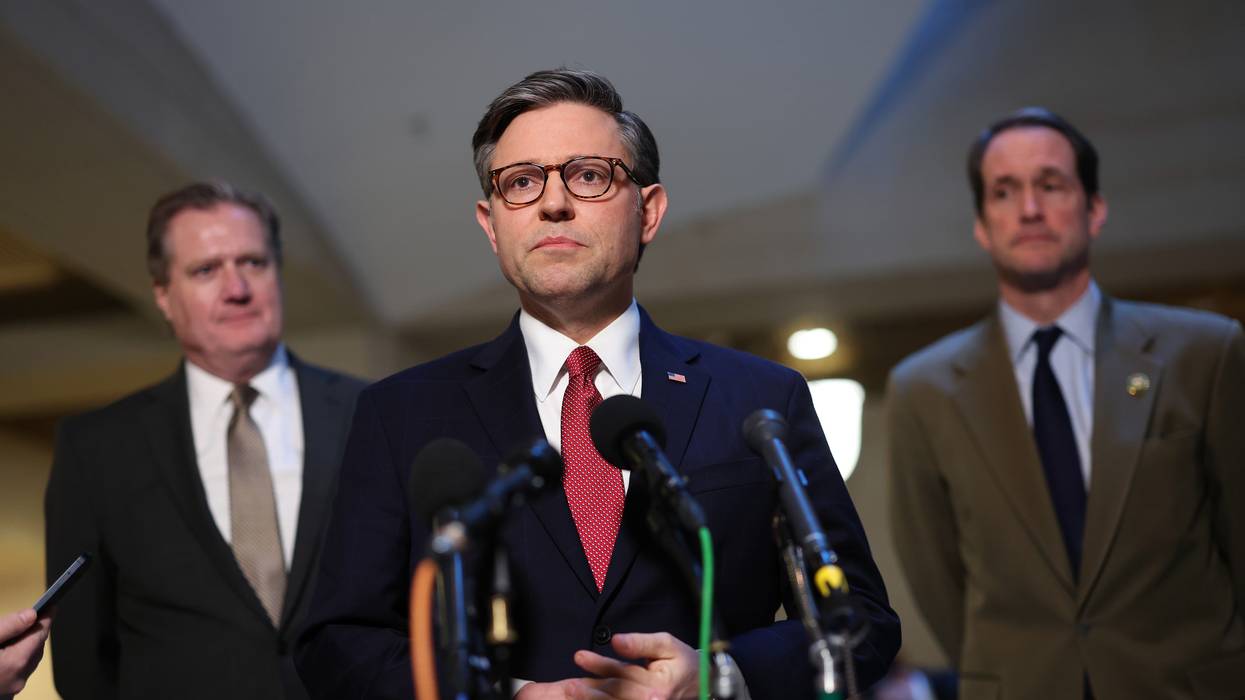
An amendment headed for a vote Friday "would put in place the largest expansion of domestic surveillance since the Patriot Act," one privacy advocate warned.
The U.S. House is expected to vote Friday on legislation to reauthorize a surveillance authority that intelligence agencies have heavily abused to collect the communications of American activists, journalists, and lawmakers without a warrant.
Friday's vote will come after House Republicans earlier this week blocked Speaker Mike Johnson's (R-La.) attempt to advance legislation reauthorizing Section 702 of the Foreign Intelligence Surveillance Act (FISA), which allows U.S. agencies to spy on non-citizens located outside of the country.
The FBI and NSA have regularly used the spying authority, which is set to expire next week, to obtain the communications of U.S. citizens, sparking a bipartisan reform push.
The legislation the House is set to consider Friday would reauthorize Section 702 for two years instead of five. Lawmakers will also vote on several amendments, including three from the House Permanent Select Committee on Intelligence (HPSCI) that would expand the spying authority.
"The first amendment would put in place the largest expansion of domestic surveillance since the Patriot Act… and I don't say that lightly," Elizabeth Goitein, co-director of the Liberty and National Security Program at the Brennan Center for Justice, wrote on social media late Thursday. "It would hugely inflate the universe of companies required to assist the government in conducting surveillance."
Another amendment, she noted, would permit "suspicionless searches for the communications of non-U.S. persons seeking permission to travel to the U.S., even if the multiple vetting mechanisms already in place have revealed no cause for concern."
The underlying legislation, titled the Reforming Intelligence and Securing America Act, "would do nothing to prevent abuses of Section 702, and it would actually weaken the FISA Court's oversight of surveillance," Goitein wrote.
The House will vote on Section 702 TOMORROW MORNING. If you think warrantless surveillance should be reined in rather than massively expanded, PLEASE USE THIS CALL TOOL ASAP (click below or call 202-899-8938) & leave a message if you get VM. 1/21 https://t.co/HAOHURZoJQ
— Elizabeth Goitein (@LizaGoitein) April 12, 2024
Members of the House Judiciary Committee, meanwhile, will offer an amendment that would require U.S. intelligence agencies to obtain a warrant before surveilling American citizens' communications under Section 702—a change opposed by the Biden White House.
The Congressional Progressive Caucus (CPC), led by Rep. Pramila Jayapal (D-Wash.), formally endorsed the amendment on Thursday after a membership vote. More than two-thirds of the CPC's membership voted in favor of endorsing the amendment.
"In 2022 alone, the FBI exploited Section 702 more than 200,000 times to search for Americans' data, circumventing the Fourth Amendment and betraying public trust," the caucus said in a statement. "These searches unjustly targeted individuals, including Members of Congress, 141 Black Lives Matter protesters, 19,000 donors to a congressional campaign, a local political party, tens of thousands of people involved in 'civil unrest,' visitors to FBI offices, and individuals based solely on their race. The House has voted multiple times to end this practice of performing backdoor searches on Americans with strong bipartisan support."
Jayapal wrote earlier this week that Congress "must reform Section 702 to include a warrant requirement if the intel community wants to spy on Americans. Period."
The House's latest attempt to extend Section 702 comes after Rep. Mike Turner (R-Ohio), the chair of the HPSCI, attempted to tip the scales in favor of continued warrantless spying by warning of a "serious national security threat" in an ominous February statement.
It quickly became clear that the Ohio Republican's statement referred to U.S. intelligence—gathered with Section 702 authority—indicating that Russia has made significant progress on a space-based nuclear weapon purportedly designed to target American satellites, which lawmakers have known about for years.
"Unfortunately, the House Intelligence Committee has tripled down on misleading their colleagues and pushing forward Patriot Act 2.0, all while fighting to expand suspicionless digital strip searches of immigrants and the already extremely broad definition of foreign intelligence information," Sean Vitka, policy director of the advocacy group Demand Progress, said in a statement ahead of Friday's vote.
Vitka expressed support for the House Judiciary Committee amendment, saying it would "create the first meaningful privacy protection against Section 702 spying since its enactment."
"We will continue to ensure that everyone in Congress knows that their constituents demand it," Vitka added.
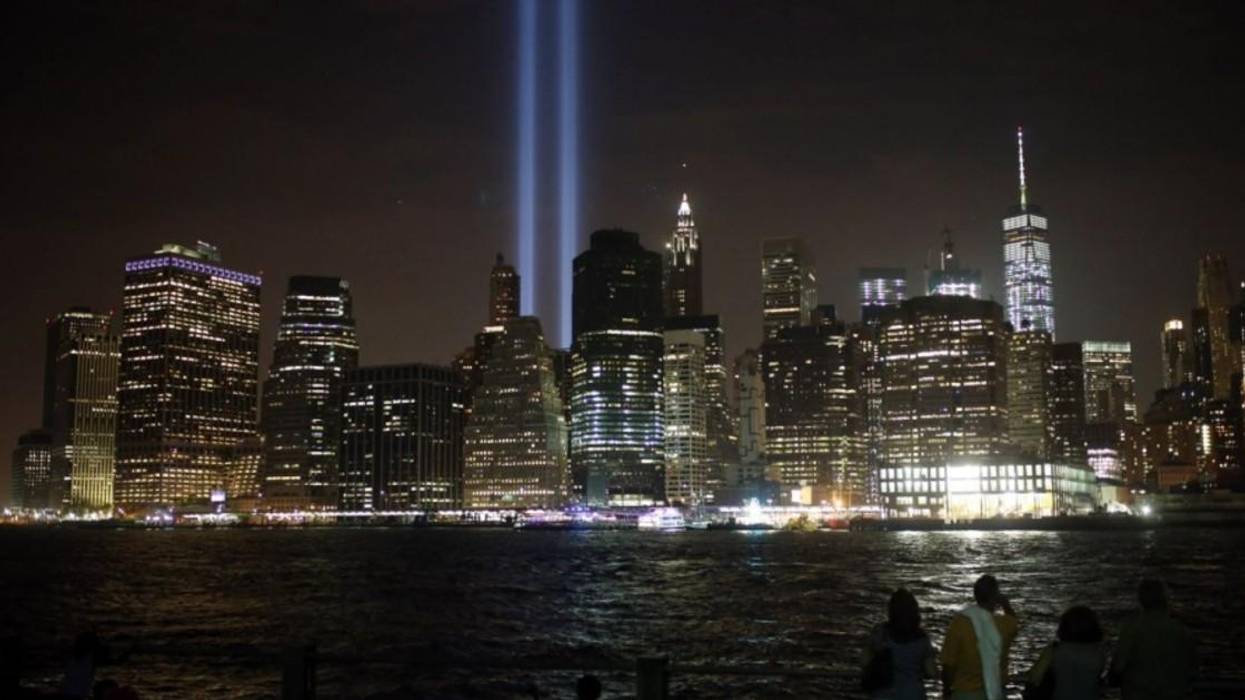
What comes after the anniversary of a tragedy? Earlier this month, many of us participated in memorials and retrospectives on the changes to American society in the two decades since the attacks of 9/11. We were among the many American Muslims who wrote about the impact of 9/11 on civil rights. As co-executive directors of Muslim Advocates, we were asked to document how the Patriot Act enabled mass surveillance and profiling of Muslims by local and national government, how a Bush-era immigrant registration program (NSEERS) effectively created a Muslim registry, and the many ways that the stereotype of Muslims as terrorists has fueled decades of anti-Muslim hate crimes and bullying. So what comes next?
Profiling, surveillance and over-prosecution of marginalized populations in this country are nothing new.
After 9/11, we were part of a group of Muslim lawyers who helped create a Muslim legal advocacy organization because we knew that things could get much worse for American Muslims. We knew and took seriously the way this country has discriminated against Black Muslims and other marginalized communities.
Simply put, profiling, surveillance and over-prosecution of marginalized populations in this country are nothing new. Trump's frenzy about an "invasion" of gangs across our southern border was not all that different from Democratic politicians' warnings about "super predators" during the passage of the 1994 crime bill. Martin Luther King, Jr. and Malcolm X were just two of many civil rights leaders under constant FBI surveillance, and the Black Panthers were targeted with the blunter, more violent end of that stick. Many in our families were alive when Japanese Americans were sent to internment camps upon zero evidence of wrongdoing. Anti-German sentiment led to bans against teaching the German language and COINTELPRO and the McCarthy hearings painted anyone with communist beliefs as an enemy of the state. Even further back in our history, the Chinese Exclusion Act explicitly banned an entire race from emigrating to this country, and Jim Crow laws did everything short of slavery to control non-whites. And of course, all of this took place on the land of the many Native peoples who were killed or forcibly removed from their homes over centuries of repeated falsehoods and betrayal by the United States government.
So, yes, it has been twenty years since 9/11. But it has also been 77 years since Korematsu, 100 years since the Tulsa massacre, 131 years since the massacre at Wounded Knee, 139 years since the passage of the Chinese Exclusion Act and 199 years since the Denmark Vesey rebellion. In other words, we need to see the bigger picture. We believe something much more transformative is possible if we demand that post-9/11 reflections are connected to the rest of American history and that we learn from all of it.
There is a terrible theme that runs throughout the story of the United States: when a group of people are seen as a threat, state power has been used to oppress them. More specifically, political interests have built and solidified their power by ramping up fear--not just stoking a fire, but creating it. American communities are thus pitted against each other, and eventually there is public support for government overreach that is outrageously outsized to the supposed threat.
Monuments and memorials should help us learn about our history and grow from it. When we were asked to opine about all the ways American Muslims suffered in the aftermath of 9/11, we knew it wasn't enough. We want to also talk about what this means for today. What does this mean for oppression in all its forms right now? And then the really difficult question: are we complicit in any of it?
Abuse of power hurts not just the abused, but also the abuser. Everyone needs to heal from these past harms, so we all must ask these questions. We could start on anniversaries. What if every commemoration of every atrocity was a step on a path toward truth and reconciliation? Maybe, then, we could see our way out of this dangerous cycle, heal the fractures in our society, and finally write a new American story.
President Joe Biden has an unprecedented opportunity to restore faith in America's intelligence agencies--if he seizes this opportunity to make a clean break with the practices of the past 20 years.
The era begun on 9/11 featured the growth of government secrecy, mass surveillance, and misplaced priorities. Hundreds of millions of Americans' information can now be captured by the FBI and National Security Agency simply because a person knows someone overseas--or a legal U.S. immigrant. As recently as 2015, the Department of Justice and NSA argued they didn't need a warrant to acquire the records of calls of all people in the United States based on the mere notion that some records could be relevant to foreign intelligence.
This warrantless mass surveillance of people in the United States--often capturing information on millions of innocent Americans, with disproportionate impacts on communities of color--fuels resentment against the government from both ends of the ideological spectrum. The ongoing deployment of facial recognition systems across the nation, for instance, alarms us all. The secrecy and unaccountability of the surveillance state delegitimizes the government and undermines trust.
Every administration for over two decades has undermined congressional efforts to understand surveillance practices and their legal justifications.
President Biden should take several corrective steps to take us back to constitutional surveillance practices. Recall that the FISA Court ordered the FBI to address issues that tainted the Carter Page investigation, followed by a DOJ inspector general audit that found pervasive problems affecting each of 29 sampled FISA applications. Attorney General William Barr responded with guidelines and guardrails for the Department of Justice for investigations of political campaigns and candidates.
Every administration for over two decades has undermined congressional efforts to understand surveillance practices and their legal justifications. In July 2020, Sens. Mike Lee, R-Utah, and Patrick Leahy, D-Vt., wrote a letter to Barr and then-Director of National Intelligence John Ratcliffe demanding to know to what extent the executive branch believes it has the inherent authority to spy on people in the United States. They received no response.
Previous administrations have misled the public and Congress about the extent of spying on Americans without congressional authorization or a court order. Now, a bipartisan cross section of lawmakers on Capitol Hill led by Reps. Pramila Jayapal, D-Wash., and Warren Davidson, R-Ohio, is demanding answers. Yet we now have reports (and one agency has confirmed) that the government is circumventing the courts and Congress and purchasing countless pieces of information about Americans from data brokers.
One year ago this week, Congress allowed Section 215 of the Patriot Act to expire. Section 215 is known as the "business records" provision and granted the government warrantless access under the banner of national security to our personal information held by businesses.
On the eve of Section 215's expiration, Sen. Richard Burr, then chairman of the Senate Intelligence Committee, took to the chamber floor to say that the executive branch has the inherent authority to surveil American citizens under an executive order known as 12333: "The president under 12333 authority can do all of this, without Congress's permission, with no guardrails." This lawless theory of executive power belongs in the distant past. Has it returned, assuming it was ever really abandoned in the first place?
While threatening to veto FISA reauthorization legislation in May 2020, then-President Trump said that "warrantless surveillance of Americans is wrong." Taking the steps we've outlined would cement Joe Biden as the people's civil liberties ally that Donald Trump never became. The new administration has the opportunity to become that ally by providing honest answers about, and taking action on, the legitimate surveillance concerns that have dogged the American people since at least the start of this century.

The Trump administration recently used one of the most controversial surveillance provisions in U.S. history to record an unidentified person or group's visit to an unspecified website, the New York Times revealed Thursday.
"The DNI's amended letter raises all kinds of new questions, including whether, in this particular case, the government has taken steps to avoid collecting Americans' web browsing information."
--Sen. Ron Wyden
The Times reports Director of National Intelligence John Ratcliffe wrote to Sen. Ron Wyden (D-Ore.) on November 6 to inform him that Section 215 of the USA PATRIOT Act had not been used to collect internet search terms, and that none of the 61 Foreign Intelligence Surveillance Court orders issued in 2019 involved "web browsing" records.
However, Ratcliffe was later forced to change his story.
Under pressure from the Times and following clarification from the U.S. Justice Department, Ratcliffe wrote to Wyden to admit that "one of those 61 orders resulted in the production of information that could be characterized as information regarding browsing," and that one order approved the collection of data regarding computers "in a specified foreign country" that were used to visit "a single, identified U.S. web page."
Wyden responded to Ratcliffe's clarification--the director called it a "corrective action"--by urging Congress to enact more robust privacy protections.
"The DNI's amended letter raises all kinds of new questions, including whether, in this particular case, the government has taken steps to avoid collecting Americans' web browsing information," Wyden said in a statement on Thursday.
"More generally, the DNI has provided no guarantee that the government wouldn't use the PATRIOT Act to intentionally collect Americans' web browsing information in the future, which is why Congress must pass the warrant requirement that has already received support from a bipartisan majority in the Senate."
Section 215, which was passed in the fear-filled days following the September 11, 2001 attacks on the United States, weakened protections put in place in 1978 with the enactment of the Foreign Intelligence Surveillance Act (FISA), which was meant to correct the most egregious and illegal surveillance revealed by the Church Committee.
Armed with what privacy advocates have called flagrantly unconstitutional surveillance powers, "the executive branch has been in nearly constant violation of FISA and the rules governing surveillance since [9/11], and during this time, it has warrantlessly collected information on virtually every American," according to Demand Progress. The group explains that:
Section 215 expanded a provision of FISA to provide the government with broad authority to collect vast swaths of records held by businesses--including in the absence of any allegation of wrongdoing. These records reveal personal details about people's lives, like whom they call, when, and for how long.
Section 215 orders also apply to people's purchase records, which reveal what people buy, when, and where. Location, medical, and firearms sales records are among the other digital and physical things subject to Section 215.
During the George W. Bush administration, Section 215's authorization of the collection of library records sparked widespread national outrage. Later, during the administration of President Barack Obama, National Security Agency whistleblower Edward Snowden revealed that Section 215 was being used to enable the bulk metadata collection of every U.S. phone call.
Snowden's revelations prompted Congress to limit such collection by passing the USA FREEDOM Act in 2015.
Section 215 expired in March 2020. In May, the Senate voted to reauthorize the FREEDOM Act. However the bill is currently stalled pending reconciliation with the House.

Two dozen advocacy groups--citing their "deep concerns regarding the possible dragnet surveillance of domestic internet activity"--sent a letter to congressional leaders Monday demanding lawmakers reject in upcoming must-pass budget legislation the reauthorization of controversial Foreign Intelligence Surveillance Act authorities.
The letter (pdf)--signed by the American Civil Liberties Union, Demand Progress, Freedom of the Press Foundation, the NAACP, and others--singles out "the lone wolf, roving wiretap, and business records authorities" of Section 215 of the USA PATRIOT Act.
Recent events, the groups wrote, have only amplified concerns.
The letter references as one example a federal court ruling earlier this month that the government's bulk collection of Americans' phone records was illegal. Adding to concerns is Attorney General William Barr and Director of National Intelligence John Ratcliffe's failure to respond to questions from Sens. Patrick Leahy (D-Vt.) and Mike Lee (R-Utah) about whether the executive branch is "secretly relying on its alleged inherent power to continue" surveillance operations without congressional oversight, which the senators said would amount to "programmatic Fourth Amendment violations at tremendous scale."
What's more, says the letter, "government witnesses... have refused to substantively answer similar questions from Representative Lofgren, Senator Wyden, and Ranking Member Feinstein."
According to the groups, "Any extension of these expired FISA authorities is controversial and more appropriately considered under traditional authorizing legislation, not a Continuing Resolution, a Covid emergency bill, or any other comparable legislative vehicle."
The demands come as the House returns from recess, and with "bipartisan Covid-19 relief negotiations on ice," as Roll Coll reported Monday, "congressional leaders have turned their attention to crafting a continuing resolution to keep the government open before the new fiscal year starts Oct. 1."
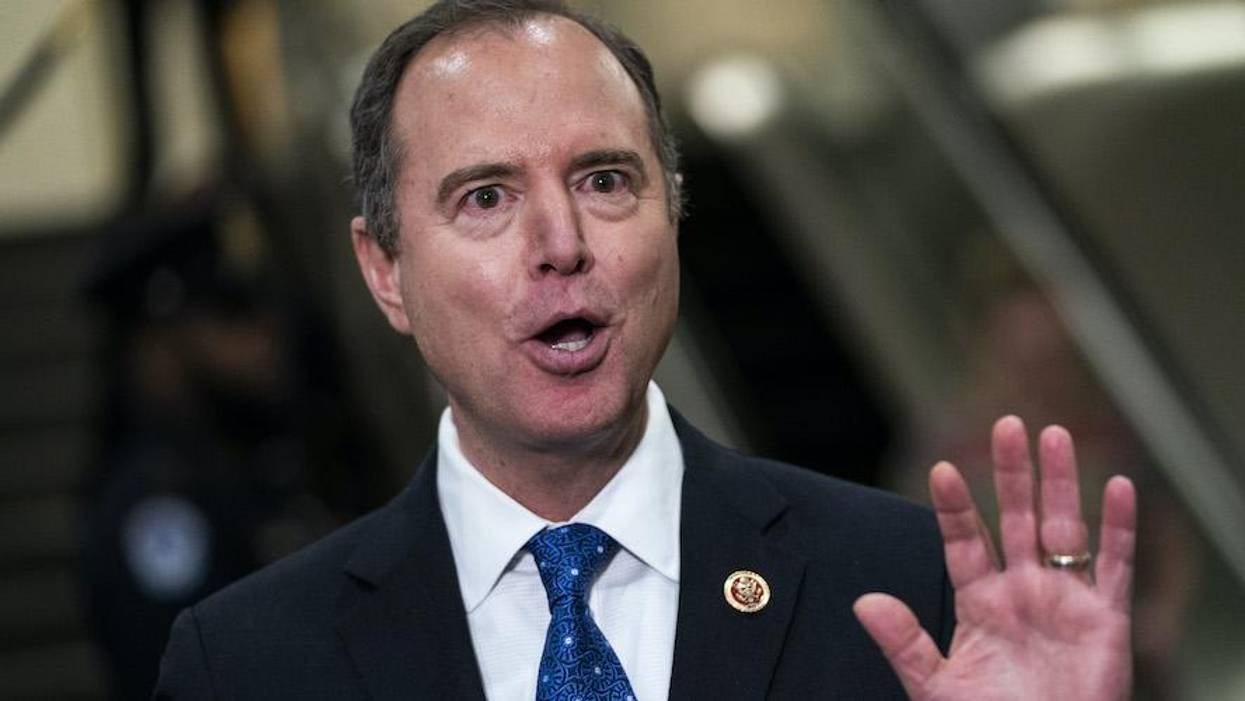
Rep. Adam Schiff worked behind the scenes to ensure the White House had expanded surveillance powers in Section 215 of the Patriot Act by selling out the civil rights of immigrants, a coalition of privacy groups alleged Wednesday.
"The consequences of Schiff's actions are inescapable: In trying to hand the Trump administration Section 215, he repeatedly sabotaged efforts to protect privacy," Demand Progress senior counsel Sean Vitka said in a statement. "This is dangerously bad law and dangerously bad oversight."
According to a letter (pdf) signed by a number of groups from the right and left including Americans for Prosperity, Demand Progress, Fight for the Future, Free Press Action, FreedomWorks, and the Project for Privacy and Surveillance Accountability, Schiff during negotiations over the reauthorization of the Patriot Act in May altered privacy protections for web activity in the Act's Section 215 so that the government could still target immigrants--including recipients of Deferred Action for Childhood Arrivals (DACA), also known as Dreamers.
That action, Vitka said, allowed the California Democrat--who serves as chairman of the House Intelligence Committee--to provide protections for "dragnet internet surveillance by cutting Dreamers and many other immigrants out of a proposed protection, which, in context, appears to have served as a loophole to protect something else: potential undisclosed surveillance of Americans' internet browsing and search histories."
According to Gizmodo, Schiff was joined in his efforts by House Speaker Nancy Pelosi (D-Calif.) to ensure the Trump administration retained extraordinary spying powers:
In May, Democrats engaged in closed-door negotiations over a proposed amendment aimed at shielding U.S. residents who are not suspected of violating the law from having their search and web browsing histories seized by the FBI without a warrant. Democratic and Republican sources on Capitol Hill told Gizmodo that the efforts were continually hindered by top Democrats, including Schiff, the chairman of the House Intelligence Committee, and House Speaker Nancy Pelosi, a former and ex-officio committee member.
[...]
Sources with knowledge of the secret meetings said that months-long efforts to introduce privacy reforms were undermined at nearly every juncture by the "national security Democrats" in control of the party. A critical vote in February was abruptly canceled, for instance, to stop a pro-privacy amendment from being attached to the FISA reauthorization bill. The bill itself was effectively shelved by Pelosi in June in an apparent effort to stymie bipartisan calls for reform.
"Throughout the 2020 PATRIOT Act reauthorization fight, Schiff has run point for [Attorney General] Bill Barr to make sure Congress doesn't know what the law it is considering means, including whether it allows the FBI and NSA to conduct dragnet surveillance of Americans' internet activity," said Vitka.
In May, Common Dreams reported on the negotiations and the actions of both Pelosi and Schiff to hold back information on the program lawmakers were voting on. Comments Schiff made at the time to Charlie Savage of the New York Times, Wednesday's letter suggest, indicate that "the government may have secretly contorted the law to justify dragnet surveillance of the internet activity of people in the United States, regardless of their United States personhood."
A regular on MSNBC, Schiff has made a name for himself over the last three years as one of President Donald Trump's most vocal critics and supporter of immigrant rights. But his actions with respect to the Dreamers and his efforts to ensure the president maintains control over an unaccountable and incredibly powerful government surveillance regime tell a different story.
That those actions were taken in secret, Vitka said, just shows that letting the intelligence collection program continue is unpopular among lawmakers.
"Ironically, if Schiff has been trying to sneak ratification of such surveillance through Congress, he has unwittingly demonstrated that he knows Congress wouldn't support it," said Vitka.

An exchange about government spying powers between Rep. Zoe Lofgren and Attorney General William Barr during a Tuesday House Judiciary Committee hearing prompted calls for an immediate explanation from the Trump administration about the legal basis for using advanced surveillance techniques on protesters nationwide.
Lofgren, a California Democrat, explained in a series of tweets that she asked Barr to detail under what authority the U.S. government can use "intrusive surveillance tools" against protesters. Barr, Lofgren said, declined to give a "real answer."
The congresswoman specifically asked about the potential deployment of cell-site simulators, facial recognition, and sweeping surveillance of internet activity. Barr replied, "I really can't speak to those instances if they've in fact occurred."
After Lofgren clarified that she was seeking an answer about the legal basis of using such tactics, the attorney general said that "most of our cyber activities are conducted by the FBI under their law enforcement powers to detect and prevent crime."
As the congresswoman noted on Twitter, her questioning of Barr came amid a federal crackdown on protests against police brutality toward Black Americans in Portland, Oregon and President Donald Trump's threats to send teams to other major cities:
Demand Progress responded with a statement Tuesday calling on Barr to immediately disclose any legal basis he sees for the federal surveillance of protesters. The advocacy group also put the exchange into the context of Barr's history and broader concerns about government surveillance under the Trump administration.
"Today, Attorney General Barr refused to acknowledge whether the government is conducting dragnet surveillance of internet activity," said Sean Vitka, senior policy counsel at Demand Progress. "He further refused to acknowledge widely reported mass surveillance practices that he may have authorized when sending the [Drug Enforcement Administration] and other agencies after protesters."
"The public needs to know whether Attorney General Barr thinks President Trump can conduct mass surveillance of protesters without congressional authorization," Vitka argued, noting that Barr "has personally authorized lawless, mass surveillance in this country before, and did so by relying on radically aggressive interpretations of executive power, by secretly abusing statutory authority, and by hiding it under the DEA."
The questions Lofgren posed during the hearing were "critically important," explained Vitka.
"It is frighteningly plausible that Attorney General Barr has told the Trump administration it may conduct domestic mass surveillance with effectively no limits, potentially even in the absence of congressional authorization," he said. "The consequences would be staggering and the chilling of free speech is already being felt."
Referencing reports that U.S. government planes flew over Black Lives Matter protests in Washington, D.C. last month and potentially spied on participants, Vitka added that "the planes are in the air. We need these answers now."
The Demand Progress statement highlighted recent examples of other members of Congress demanding answers from the administration about surveillance, particularly considering that the controversial Section 215 of the USA PATRIOT Act expired earlier this year and has not been reauthorized by federal lawmakers.
Sens. Patrick Leahy (D-Vt.) and Mike Lee (R-Utah) sent a letter (pdf) to Barr and Director of National Intelligence John Ratcliffe on July 21 asking them to confirm that federal agencies have terminated surveillance operations authorized under the now-expired FISA provisions and other related questions about the government's spy powers.
Along with highlighting the letter--which requests that Barr and Ratcliffe respond with answers by August 7--the advocacy group pointed out how Patrick Hovakimian, the nominee for general counsel of the Office of the Director of National Intelligence, recently responded (pdf) to a pre-hearing question from Sen. Ron Wyden (D-Ore.).
Wyden asked: "Does the government collect web browsing and internet search history pursuant to Section 215? If so, what are or should be any limitations on such collection or the dissemination and use of such information? Does the government collect web browsing or internet search history pursuant to FISA Pen Register/Trap and Trace authorities?"
Hovakimian responded: "I believe it is important for the IC to use its authorities appropriately against valid intelligence targets. The amendments to Title V of FISA made by Section 215 of the USA PATRIOT Act expired on March 15, 2020 and, to date, have not been reauthorized."
Given those recent exchanges between lawmakers and the administration, Demand Progress declared that "Barr's refusal to answer Rep. Lofgren's questions today adds to concerns that all of this may be occurring in secret without congressional authorization or oversight."