

SUBSCRIBE TO OUR FREE NEWSLETTER
Daily news & progressive opinion—funded by the people, not the corporations—delivered straight to your inbox.
5
#000000
#FFFFFF
To donate by check, phone, or other method, see our More Ways to Give page.
Daily news & progressive opinion—funded by the people, not the corporations—delivered straight to your inbox.
"Only a select few in the top tax bracket are benefiting from this, and the majority of you ain’t in it," said former Rep. Marjorie Taylor Greene.
Observers are once again raising concerns about insider trading on Wednesday after a trader took a colossal crude oil short position just over an hour before a US-Iran peace deal was reported to be on the horizon, causing prices to fall.
The Kobeissi Letter, a financial newsletter, reported on X that at 3:40 am on Wednesday, "nearly 10,000 contracts worth of crude oil shorts were taken without any major news."
This was equivalent to $920 million in notional value, which the letter described as "an unusually large trade" so early in the morning. But it would soon pay off.
At 4:50 am, just 70 minutes later, Axios published an exclusive scoop by Middle East reporter Barak Ravid that the White House believed the US and Iran were on the verge of agreeing to a one-page "memorandum of understanding" to end the war, which included more nuclear negotiations, one of the key sticking points for US President Donald Trump.
By 7:00 am, just over two hours after Axios dropped its report, oil prices had fallen by 12%, allowing the savvy investor to make $125 million in a matter of hours, which led to accusations that it was yet another example of "epic insider trading" by those in the know about Trump's plans.
Prices have since rebounded by about 8% after Iran announced the creation of the new "Persian Gulf Strait Authority," to mediate the passage of ships through the Strait of Hormuz on its terms.
The Trump administration has already been deluged with accusations that its members are using insider information to take advantage of financial markets and prediction market apps.
Last month, an active-duty US special forces soldier was indicted by the Department of Justice after he made about $400,000 betting on Polymarket that Venezuelan President Nicolás Maduro would be removed from power, a bet he allegedly placed using classified information about an operation he himself was involved with.
More bettors collected around $1 million in profits from bets on the specific timing of Trump's war with Iran in late February. The Financial Times also reported a surge of more than $580 million in oil futures trading right before Trump announced a pause in strikes on Iran's energy facilities in March.
Of course, Wednesday's bet theoretically could have been made without the aid of insider information.
The new peace framework is the latest in what has seemed to be an endless pattern over the past several weeks in which US officials tell media outlets that a peace agreement is on the horizon, causing oil prices to dip, only for it to collapse later in the week, often with Trump issuing hostile threats or making new demands.
It has become such a familiar story that some have speculated that the announcement of productive ceasefire talks is deliberately choreographed to calm oil markets and bring down prices, which have become a growing problem for Trump among voters.
But as The Economic Times explained, the bet placed Wednesday morning likely "is not a routine hedge" or "a portfolio rebalancing move."
"At that hour, in that size," it said, "a crude oil short of that magnitude is a deliberate, high-conviction directional bet."
Former Rep. Marjorie Taylor Greene (R-Ga.), a one-time Trump cheerleader who's become one of his leading critics, suggested Trump's erratic approach to negotiating an end to the war was just a tool used by him and his allies to profit.
"When is everyone going to start realizing that the on-again, off-again war/peace rhetoric is really just insider trading? And sprinkle in some murder," Greene wrote on social media. "Only a select few in the top tax bracket are benefiting from this, and the majority of you ain’t in it."
Democrats in Congress have urged the Securities and Exchange Commission (SEC) to investigate what Sen. Chris Murphy (D-Conn.) suggested could be "mind-blowing corruption" by the White House, not only related to Trump's wars, but also to his tariff regime, which has caused similar market chaos that bettors have been able to capitalize on with fortuitously timed wagers.
But critics have described profiting from the machinations of a war that has killed more than 1,700 civilians as particularly grotesque.
"This has to stop," said Fox News commentator Jessica Tarlov. "Lives on the line so they can insider trade!"
"Nothing about this project is in alignment with Biden's climate and environmental justice goals," said one campaigner.
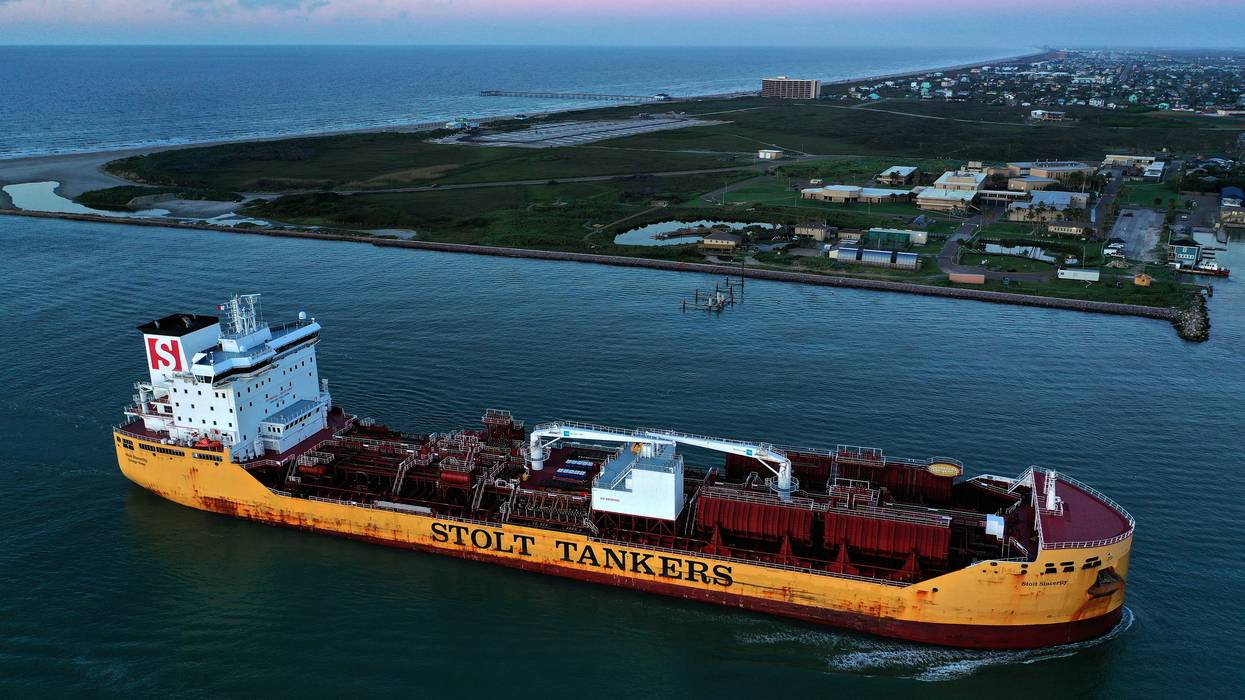
Climate action groups are vehemently rejecting the Biden administration's claim that the approval of a new offshore oil terminal—planned to be the largest in the U.S.—is in the "national interest," after the U.S. Department of Transportation announced the project had met several federal requirements and could begin operations by 2027.
The agency's Maritime Administration said last week that Enterprise Product Partners, a Houston-based pipeline company, had been granted a deepwater port license to build the Sea Port Oil Terminal (SPOT) near Freeport, Texas following a five-year federal review process.
The federal government determined the $1.8 billion terminal project had undergone sufficient environmental impact reviews and would overall benefit the country—even as it was projected by the Sierra Club, which has fought SPOT for several years, to emit greenhouse gases equivalent to those of nearly 90 coal-fired power plants.
"The evidence is clear that SPOT would be catastrophic to the climate, wildlife, and frontline communities of the Gulf," said Devorah Ancel, senior attorney with the Sierra Club. "It threatens the future existence of the endangered Rice's whale with a population of less than fifty, and its ozone pollution would compromise the health of thousands of Gulf residents who have endured decades of fossil fuel industry pollution. Make no mistake, SPOT is not in the national interest."
The project is expected to include two pipelines that would carry crude oil to the deepwater port each day, enabling the export of 2 million barrels of crude oil, loaded onto two supertankers at once, daily.
"Nothing about this project is in alignment with Biden's climate and environmental justice goals," said Kelsey Crane, senior policy advocate at Earthworks. "The communities that will be impacted by SPOT have once again been ignored and will be forced to live with the threat of more oil spills, explosions, and pollution. The best way to protect the public and the climate from the harms of oil is to keep it in the ground."
Allie Rosenbluth, U.S. manager at Oil Change International, noted that the project has been approved despite the International Energy Agency's clear assessment in 2021 that "all new investments in oil and gas projects must stop if the world is going to reach its climate goals," including limiting planetary heating to 1.5°C.
"The Biden administration's decision to approve the Sea Port Oil Terminal is a grave mistake. This approval will only harm local communities and ecosystems, and lead to even more devastating impacts of the climate crisis," said Rosenbluth. "The U.S. is already the largest producer of oil and gas and has the largest expansion plans globally. Instead of continuing this legacy of harm by approving fossil fuel projects, President Biden should be listening to the science and the masses of his constituents calling for an end to fossil fuels."
The direct action group Climate Defiance expressed doubt that the approval of SPOT will help Biden win over any voters as the 2024 election approaches.
Nine in 10 Democratic voters and Democratic-leaning independents told Pew Research Center last year that they believe the U.S. should prioritize developing renewable energy sources—and two-thirds of Republican voters under age 30 agreed.
"This project would be the single-largest oil export terminal in the U.S." said the group. "We are being boiled alive here, literally burned to death by 'moderate' politicians who see fit to torch us in the name of quarterly profits. How can we live like this? How can this go on?"
Last year was the hottest on record, and the first three months of 2024 have each broken records for high global temperatures. Scientists found last year that climate disasters including wildfires in Canada and extreme heat in Europe were made far more likely by fossil-fueled planetary heating.
Local organizers in Texas condemned the Biden administration's decision to ignore campaigners who have warned of the danger SPOT poses to marine habitats as well as people who live in the area where two crude oil pipelines have now been given final approval to run.
"We continue to struggle to see why Biden and [Transportation Secretary Pete] Buttigieg prefer to protect the corporate profits of billion-dollar oil giants like Enbridge and Enterprise over the hardcore objections of the people who would have to live with the consequences of pipelines criss-crossing our beaches," said Trevor Carroll, Brazoria County lead organizer with Texas Campaign for the Environment. "If you care about environmental justice and the climate, you just can't support a monstrosity like SPOT. The local community and the global climate justice movement are continuing to fight... This is not over."
Melanie Oldham, director of Better Brazoria, said SPOT will be "an oil spill waiting to happen that would not only lower property value, but harm our local ecosystems, ecotourism, beaches, recreation, and kill marine life like the endangered Rice's whale and Kemp's Ridley sea turtles."
"Those of us residents, beachgoers, and voters that have for the past four years opposed the SPOT offshore terminal and pipelines are very disappointed with the approval of the project license," said Oldham. "President Biden has again broken promises to protect frontline communities in Surfside and Freeport."
The administration's approval came three months after the White House announced it was delaying consideration of new gas export terminals, and the same day the federal government said fossil fuel companies will have to pay higher royalties in order to drill on federal lands.
But those climate actions paired with the SPOT approval amount only to "flip flopping," said Climate Defiance.
"It is not enough that the administration stopped new gas exports if they are going to back stab us with this death-sentence decision now," said the group. "This is not us being 'ungrateful.' This is the science. The pure, unvarnished, science."
"The controversial EACOP project threatens pristine ecosystems, biodiversity hotspots, water resources, and community lands," said campaigners.
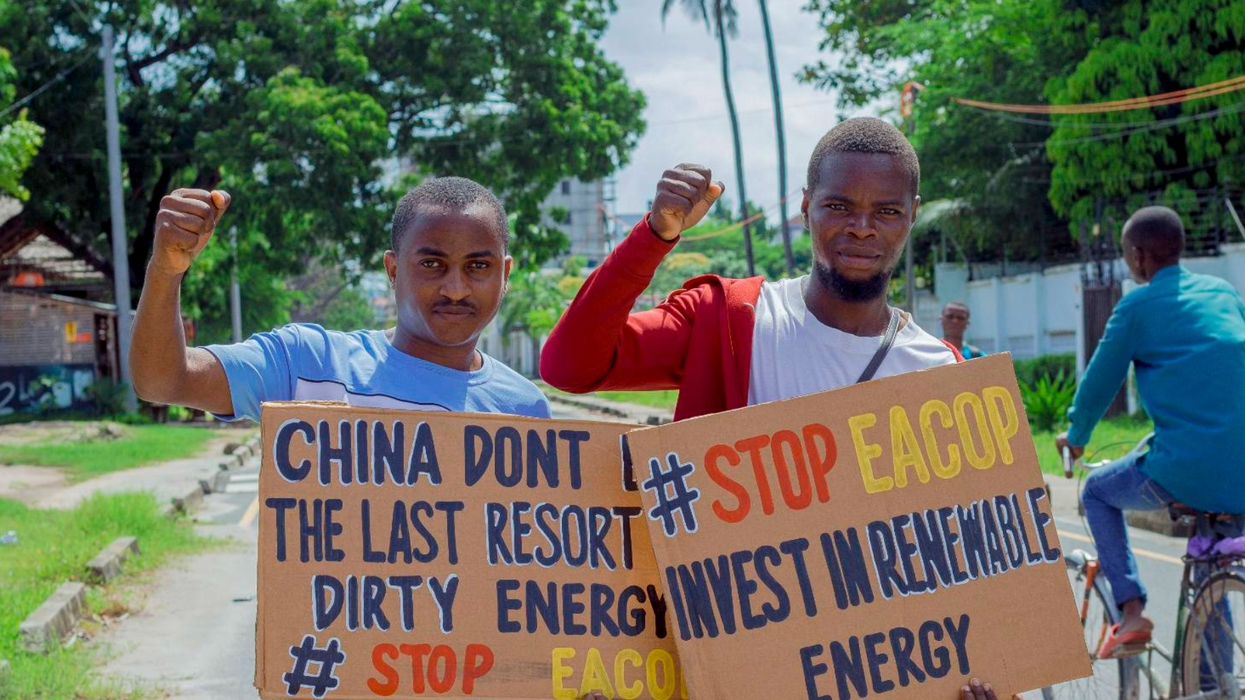
Campaigners assembled on Monday in four African countries and in Europe, rallying outside the headquarters of several Chinese financial institutions and embassies with one demand of Chinese officials: Withhold financing for the East African Crude Oil Pipeline.
The global campaign #StopEACOP has already helped push banks and insurers in North America, Europe, and Japan to refrain from getting involved in the project, which is being spearheaded by French multinational TotalEnergies and China National Offshore Oil Corporation.
Now, the state-owned China Export & Credit Insurance Corporation (SINOSURE), the Export-Import Bank of China (China Exim), and the Industrial and Commercial Bank of China (ICBC) are reportedly considering financially supporting the pipeline, which could lead to 379 million tons of fossil fuel emissions even as climate and energy experts warn there is no place for new gas and oil extraction on a pathway to limiting planetary heating to 1.5°C.
"Today, people stood united across borders to say this dangerous pipeline project must be stopped," said Zaki Mamdoo, #StopEACOP coordinator. "We urge SINOSURE, China Exim Bank, and the ICBC to listen to local communities and respect their rights, aspirations, and agency. By refusing to provide insurance or financing for EACOP, these entities must prove that they are not simply interested in profiting at the expense of Africa's well-being."
Organizers rallied at Chinese embassies in Dar es Salaam, Tanzania; Kampala, Uganda; Kinshasa, Democratic Republic of Congo (DRC); and Tshwane, South Africa. In London, United Kingdom, climate campaigners held a solidarity action outside the offices of SINOSURE and in Paris, France they rallied at the offices of the China Exim Bank and the ICBC.
The planned pipeline would run from Hoima, Uganda to Tanga, Tanzania, transporting oil from two oil fields and potentially connecting to oil blocks in the DRC.
"The controversial EACOP project threatens pristine ecosystems, biodiversity hotspots, water resources, and community lands," said #StopEACOP, as well as "contradicting global climate goals."
Campaigners had planned to deliver petitions opposing the 896-mile pipeline, as well as documents containing analysis of the socioeconomic and climate impacts of the project. According to #StopEACOP, the pipeline would run through the basin of Lake Victoria, which more than 40 million people depend on for food and water; displace landowners who say they have already faced threats and intimidation; and run through the habitats of endangered animals including lions, giraffes, roan antelopes, and sables.
#StopEACOP reported that officials at the embassies refused to receive the documents.
Organizers also denounced authorities for arresting seven advocates in Kampala.
"Every time activists and communities stand up to peacefully oppose EACOP in Uganda, they are brutalized and arbitrarily arrested," said Brian Atuheire, executive director of the African Initiative on Food Security and Environment (AIFE). "Today, seven young activists have been detained for peacefully protesting outside the Chinese Embassy in Kampala. Despite the repression, we remain resolute and have drawn strength and courage from the incredible show of solidarity from comrades worldwide."
Richard Senkondo, executive director for the Organization for Community Engagement, said any institution supporting EACOP "is perpetrating injustice."
"This pipeline will destroy our land and water—our very way of life," said Senkondo. "It poses a grave threat to the environment and the well-being and rights of our communities."
"We are united with allies around the world in our continued resistance against this harmful project," Senkondo added. "Instead of supporting such projects, we urge these Chinese institutions to be a true ally to the African continent by favoring the development of people-centered renewable energy to power Africa's future."
The Stillwater County, Montana sheriff's office said it was a "great stroke of luck" that none of the train cars were carrying oil that would have polluted the Yellowstone River.
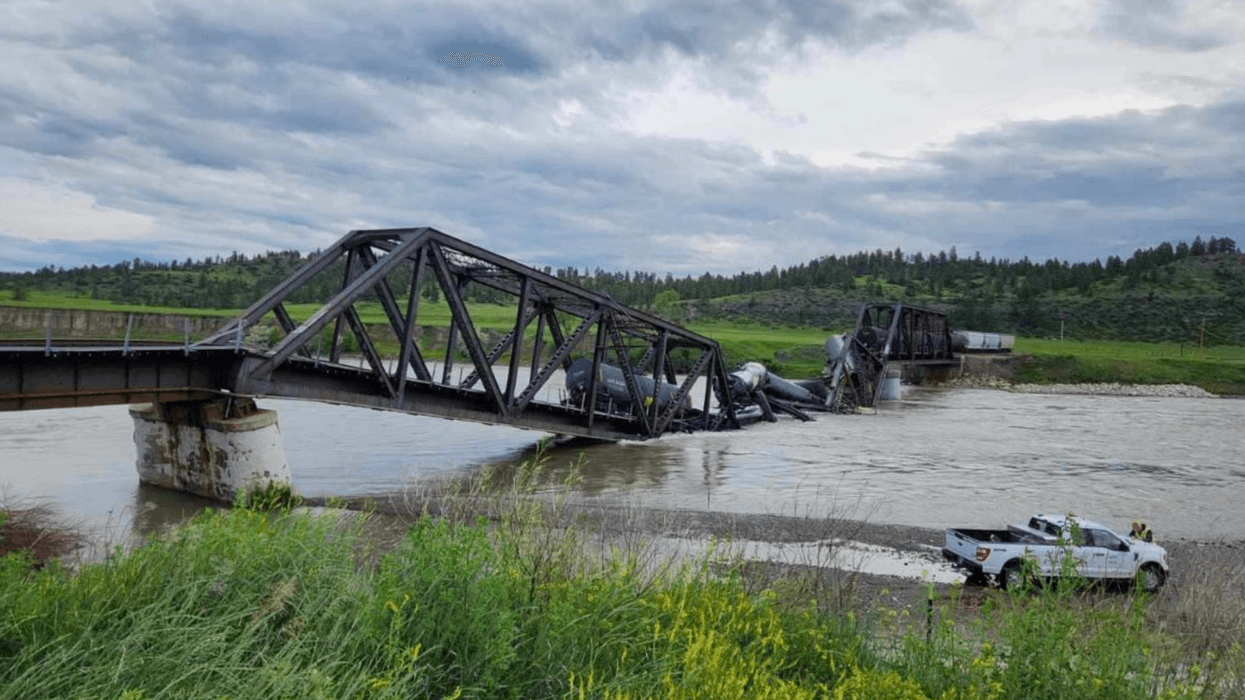
A freight train derailment and the collapse of a bridge over the Yellowstone River in Montana on Saturday raised alarm as several cars carrying asphalt and molten sulfur tumbled into the river, prompting officials to take emergency measures at nearby water plants.
The incident also brought to mind for some critics the Biden administration's plan to move forward with a railway project along the Colorado River—one that could place the drinking water of 40 million people at risk as trains transport crude oil from eastern Utah's Uinta Basin to national rail lines.
The substances solidified quickly once exposed to the cold water in the Yellowstone River on Saturday, and Stillwater County emergency services chief David Stamey told The New York Times that the solidification could limit the potential harmful effects to the environment.
Sulfur is commonly used as an insecticide, fungicide, and rodenticide, and is often used in fertilizers.
As a precaution, water treatment plant officials in Yellowstone and Stillwater Counties temporarily shut down water intake until the material had flowed past Billings, which lies about an hour's drive east of the derailment site. Authorities also asked residents to conserve water. About 167,000 people live in Yellowstone County while roughly 9,000 people live in Stillwater.
The freight train was operated by Montana Rail Link, whose spokesperson told the Times that two cars were also carrying sodium hydro sulfate, which can cause serious eye damage on exposure.
"Neither of these cars have entered the water and initial air quality assessments have been performed and confirmed that there is no release associated with the two cars," the railroad said in a statement.
Ten cars in total derailed, the Times reported.
Montana Rail Link said no one was injured in the accident.
Robert Bea, a retired engineering professor at the University of California Berkeley, told the Associated Press that recent heavy rains may have played a role in the collapse of the bridge.
"The high water flow translates to high forces acting directly on the pier and, importantly, on the river bottom," Bea told the outlet. "You can have erosion or scour that removes support from the foundation. High forces translate to a high likelihood of a structural or foundation failure that could act as a trigger to initiate the accident."
The cause of the derailment and collapse are being investigated.
To Ted Zukoski, a senior attorney in the Center for Biological Diversity's public lands program, the accident raised concerns about similar potential disasters along the Uinta Basin Railway, which could carry as many as five two-mile-long crude oil trains more than 100 miles each day alongside the Colorado River's headwaters.
“For about 100 miles of the railroad, it is close enough to the river that if you're sitting in a raft in the middle of it, you could throw a rock and hit the railroad, Zukoski told Lever News last month.
As Democratic Sens. Michael Bennet and John Hickenlooper and Rep. Joe Neguse, all of Colorado, told U.S. Transportation Secretary Pete Buttigieg in a letter earlier this year urging him to oppose the project, the public-private alliance behind the Uinta Basin Railway appears to have "no plan to mitigate the harm of a potential accident or derailment in Colorado, which could be particularly difficult to address given [Colorado's] mountainous terrain."
In addition to worsening the climate crisis by supporting the increased production of 350,000 barrels of oil per day, the Utah Clean Infrastructure Coalition has said in a fact sheet on the project, "the heavy, long oil tanker trains used to transport crude oil pose greater risks of derailment and spills than other freight trains, and an increased risk of fire due to derailment and spilling of combustible oil."
In Montana on Saturday, the Stillwater County Sheriff's office said it was a "great stroke of luck" that none of the train cars were carrying oil that would have polluted the Yellowstone.
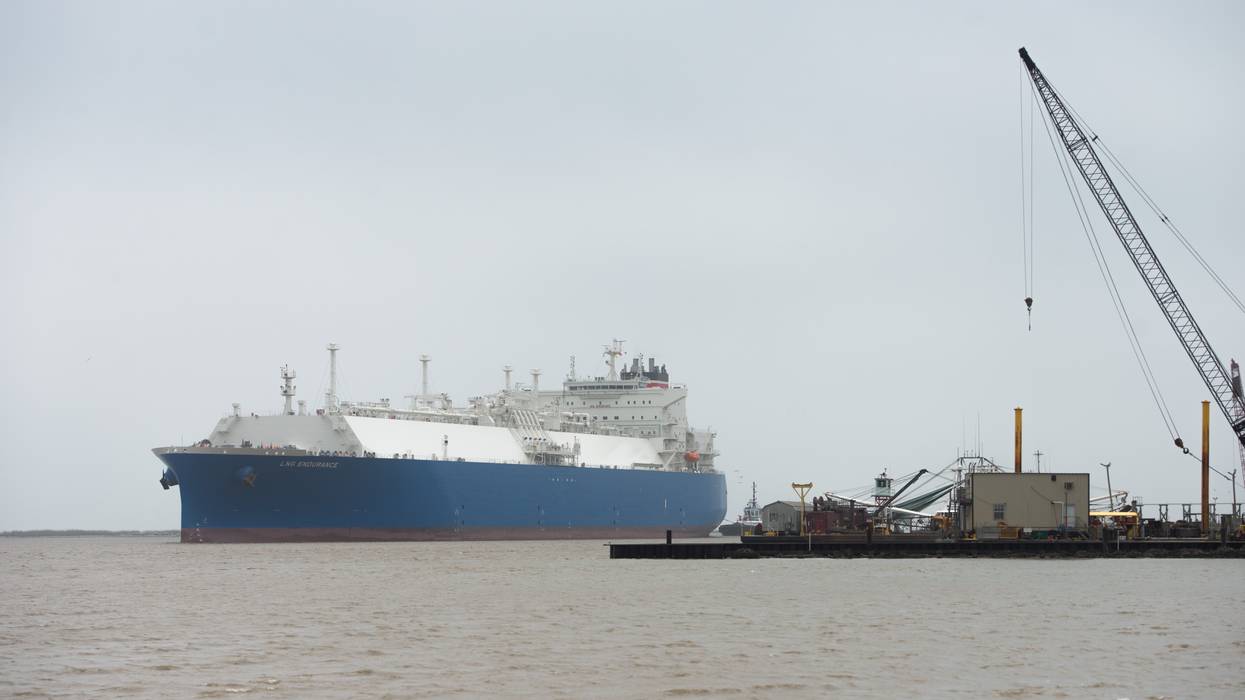
The bill, led by Democrats, comes amidst mounting concerns about the increase in liquefied natural gas export infrastructure in both the U.S. and overseas.
Sen. Edward J. Markey and Reps. Adriano Espaillat and Yvette Clark reintroduced Thursday the Block All New Fossil Fuel Exports Act to preserve a livable climate and protect frontline communities along the U.S. Gulf Coast.
The bill, which would amend the Energy Policy and Conservation Act to ban the international export of both American crude oil and liquefied methane gas (LNG), is backed by 70 organizations that wrote a letter to Congress endorsing the bill Wednesday.
"The United States is taking aggressive action to tackle the climate crisis and transition to create renewable energy solutions," the letter reads. "But recent approvals for new fossil fuel projects to export fossil fuels are threatening people's health and safety and stand in the way of global efforts to combat the climate crisis. Continued expansion of U.S. export infrastructure limits collective progress toward long-term energy security goals."
"Biden can't keep claiming to care about climate and environmental justice while allowing more of these projects that put our lives at risk."
The bill comes amidst mounting concerns about the increase in LNG export infrastructure in both the U.S. and overseas. A Greenpeace report published last month revealed that new European LNG terminals combined with both existing and proposed U.S. infrastructure would spew out as much climate pollution as adding 604 million new cars to the roads.
While the ostensible push behind this LNG expansion was the need to bolster Europe's energy needs in the aftermath of Russia's invasion of Ukraine, both the Greenpeace report and an earlier investigation from Friends of the Earth, Bailout Watch, and Public Citizen found that the fossil fuel industry was exploiting the situation to lock in LNG infrastructure that wouldn't begin delivering until 2026. More than 75% of the LNG contracts considered by the second report would actually direct shipments to the Asia-Pacific region.
What's more, the build-up of fossil fuel infrastructure connecting the Permian Basin to the Gulf Coast predates the Ukraine war—Congress spurred much of it by lifting a ban on the export of crude oil in 2015, the letter writers said. The new legislation would reinstate this ban and slow the record oil production in the Permian Basin, as well as add a ban on LNG exports.
The International Energy Agency has said that policymakers should not develop any new fossil fuels if they want to limit global warming to 1.5°C above preindustrial levels and stave off ever more extreme climate impacts. The most recent report from the Intergovernmental Panel on Climate Change went further, concluding that existing fossil fuel infrastructure would emit enough to push the Earth's average temperature past the 1.5°C goal. Another report commissioned by the International Institute for Sustainable Development from scientists at the University of Manchester's Tyndall Center found that wealthy nations like the U.S. need to end oil and gas production by 2034 to keep the critical goal alive.
Despite the science and his own campaign promises, President Joe Biden has approved more drilling on public lands during his first two years in office than President Donald Trump during the same timeframe. His Federal Energy Regulatory Commission also signed off on two Gulf Coast LNG facilities in April: Texas LNG and Rio Grande LNG, as well as the linked Rio Bravo Pipeline. In 2022, the Biden administration rubber stamped the Sea Port Oil Terminal (SPOT) off the coast of Brazoria County, Texas. All of these approvals overrode the concerns of pollution-burdened Gulf Coast communities.
"We are sick and tired of the hypocrisy from this administration," Gwen Jones, a resident of the displaced East End community in Freeport, said in a statement supporting the new bill. "Biden can't keep claiming to care about climate and environmental justice while allowing more of these projects that put our lives at risk. Prove to us that you will prioritize the health and safety of people and our planet over fossil fuel industry profits."
The bill's supporters argue that Biden could turn off the tap himself by declaring a climate emergency, reinstating the crude oil export ban, and significantly restricting LNG exports under the Natural Gas Act. They also point out that the expansion disproportionately impacts low-income communities of color who neighbor the infrastructure.
"The fossil fuel industry is bombarding my community, and we can't take it anymore. The Biden Administration recently approved the SPOT oil export facility and has allowed Freeport LNG to reopen after their dangerous explosion," Melanie Oldham, founder of Better Brazoria and a Freeport, Texas resident, said in a statement. "The hearings and comment periods for these fossil fuel projects are constant, and it's too much. We can't continue to be sacrificed to build even more reckless projects that will destroy our air quality and the climate."
In addition to limiting local pollution, the new bill would help U.S. consumers as a whole since more oil would be available for domestic use instead of being sent overseas, supporters argued.
"The BAN Fossil Fuel Exports Act is a much-needed step to prioritize American consumers and to reaffirm the U.S.'s commitment to addressing climate change on a global scale," Rep. Espaillat (D-N.Y.) said in a statement. "As our national economy continues its recovery following the Covid-19 pandemic, we must ensure hard-working Americans are not shouldered with the burdens of high energy costs and the real-world effects of global heating. This bill would make real progress towards preserving our planet while supporting American families by bringing down domestic costs."
The bill's re-introduction comes amidst global calls to halt LNG expansion as the leaders of wealthy nations gather for the G7 Summit this weekend. A coalition of groups sent a letter to the Biden administration Tuesday urging it to push back against this expansion at the upcoming meeting in Hiroshima.
"The G7 Climate and Environment Ministerial Communique in April stated that investment in the natural gas sector, including LNG, is only appropriate if 'implemented in a manner consistent with our climate objectives and without creating lock-in effects,'" the groups wrote. "The G7 should clarify at its final meeting that new LNG export and import infrastructure fails this test."
Until a few years ago, the word "occupation" was synonymous with power, imperialism and foreign invasion. Today, in the post-Occupy Wall Street era, more and more activists are using their physical presence to make demands. From Manhattan's Zuccotti Park to Tahrir Square in Cairo, occupation has become a powerful method of organizing.
One of the most dramatic such occupations is a growing encampment at the Cannonball River in North Dakota, where indigenous tribes are leading a coalition of environmental activists in protest over the building of a new crude oil pipeline.
The Dakota Access pipeline (DAPL) has stolen more than a name from American Indians ("Dakota" means "friendly" or "allied"). If built, it would pass under the Missouri River twice. The pipeline, which could leak, as many pipelines do, threatens to contaminate the drinking water, crops, and burial grounds of the Standing Rock Sioux tribe. Federal regulatory agencies, including the Army Corps of Engineers, quietly approved DAPL, transporting Bakkan crude oil from North Dakota through South Dakota, Iowa and Illinois.
Last November, President Obama rejected the Keystone XL pipeline, which would have transported tar sands oil from Alberta, Canada, to the U.S. Gulf Coast. The rejection was the result of a years-long, hard-fought battle by thousands of activists, many of whom made personal sacrifices, traveled long distances and were even arrested for their acts of civil disobedience.
DAPL, which is only seven miles shorter than Keystone would have been, has not received the same scrutiny. Now, the only thing standing in the way of the pipeline is a growing army of nonviolent protesters blocking construction. An occupation that began in April has grown to about 2,000 and is still growing. Members of the Standing Rock Sioux have set strict rules at the space they are calling Sacred Stone Camp: No weapons, alcohol, or drugs.
Members of other North American tribes, including Canadian First Nations, are traveling to the site in solidarity. Celebrities such as Leonardo DiCaprio, Shailene Woodle,y and Ezra Miller have lent their support. The protesters are standing firm, and more than 20 people have been arrested.
Jason Coppola, a filmmaker,r and journalist who has been covering the protests, explained in an interview with me that one of the most important aspects of this story is age-old: The U.S. government is violating its treaty obligations to Native American tribes. According to Coppola, "The Fort Laramie Treaty of 1868 guaranteed complete and total access, undisturbed access, [of the land] to the Great Sioux Nation of the Oceti Sakowin [Seven Council Fires]." But that treaty has not been respected. The U.S. National Archives and Records Administration explains how--as a result of an expedition led in 1874 by Gen. George Armstrong Custer in search of gold on the Black Hills reservation in North Dakota--"[t]o this day, ownership of the Black Hills remains the subject of a legal dispute between the U.S. government and the Sioux."
Coppola told me it is "important to see this fight in the broader context" because "the Lakota nation and its people have been fighting situations like this for a very long time." The DAPL dispute is not just about a pipeline running under a river. It is about the rights of the original inhabitants of the United States.
At a time when white-supremacist notions are re-emerging and a major-party presidential candidate is encouraging America to hate again, this battle of government and corporate power against Native American rights is an important reminder of the real power dynamics in the U.S. and of who has been denied rights since the founding of the country.
Earlier this year, a group of armed white men led by Ammon Bundy occupied the Malheur National Wildlife Refuge in Oregon for more than 40 days in protest of federal land ownership. Those occupiers, who garnered far greater mainstream media attention than the DAPL protesters, ignored the fact that the original stewards of the land they were claiming were members of the Burns Paiute tribe. The tribe fought for decades in court to gain rights to the land, only to be given a few hundred dollars per person as compensation.
By contrast, the very people that the U.S. has historically sold out and continues to betray lead the occupation in North Dakota. Just as it served the needs of white settlers in decades past, the government is putting corporate power and fossil fuel interests over Native American rights in the case of the DAPL project.
Energy Transfer Partners, the company building the pipeline, has launched a website with the innocent-sounding name of daplpipelinefacts.com. On it, the company touts seemingly optimistic economic gains, including the creation of "8,000 to 12,000 construction jobs" (contrasted with a mere "40 permanent operating jobs"). It echoes the standard claim of "energy independence" by liberal politicians, saying that the pipeline will help the U.S. be "truly independent of energy from unstable regions of the world" because "every barrel of crude oil produced in the United States directly displaces a barrel of imported foreign oil."
Under the "frequently asked questions" section, the website asks: "What is Dakota Access Pipeline's commitment to protecting sensitive areas and the environment, such as wetlands and culturally important sites?" The lengthy answer addresses only concerns such as restoring seed banks and vegetative cover but says nothing about the "culturally important sites" it raises in its own question. The rest of the page focuses mostly on the concerns of private landowners. There is no mention whatsoever of the Standing Rock Sioux tribe. It is as if the tribe does not exist.
Obama claimed to set his administration apart from previous ones by partnering with Native American communities. He has made it a point to visit reservations, a rare act by presidential standards. In 2014, during a visit to North Dakota, he said he was "determined to partner with tribes ... on just about every issue that touches your lives." Indeed, his rejection of the Keystone XL pipeline could be viewed in light of that partnership (Oglala Sioux leader Bryan Brewer called Keystone "a death warrant for our people" during Obama's visit). In the last few months of Obama's administration, whether it will intervene to stop the DAPL despite the approval of federal permits remains to be seen.
Regardless, indigenous activists are determined to occupy their own land for as long as it takes to stop the construction of the pipeline. If they succeed, it will be one small measure of justice in a line of injustices going back to the founding of this nation.
Recent flooding in Houston has sent crude oil and toxic chemicals into Texas waterways, and residents and experts say regulators are not doing enough to address the threat to public health and the environment.
Photographs taken by emergency management officials show oil slicks and other evidence of toxins spreading through the Sabine River on the Texas-Louisiana border after flooding in March. New evidence is mounting that spills from oil wells and fracking sites increase when water levels rise.
Yet scientists and environmental groups say that the Railroad Commission of Texas, which regulates the state oil and gas industry, has yet to improve safety precautions.
Dr. Walter Tsou, a physician and past American Public Health Association president, told the El Paso Times on Monday that the risks of fracking fluid and other industry byproducts mixing in with groundwater was "a potential disaster."
"I'm sure it will get into the groundwater and streams and creeks," Tsou said of the photographs depicting downed tanks and plumes of oil. "In other areas, cattle that drank the fracking fluid actually died an hour after drinking it. There are potential carcinogens that can lead to leukemia, brain cancer, and other endocrine disruptors that can affect premature births. So it is not good to drink fracked wastewater."
Ken Kramer, water resources chairman of the Lone Star Chapter of the Sierra Club, added, "[The oil and gas companies are] looking after the facts about what might have happened. Because of that, it's pretty hard to figure out exactly what happened."
Meanwhile, Lon Burnham, a former Democratic state representative from Fort Worth, said regulators are incentivized to go easy on polluters who contribute most of the commission's campaign funds.
"They don't enforce," Burnham told the Times. "They don't fine. But they do whine about needing more money from the Legislature."
Since the 1970s, US law has prohibited the export of crude oil. There are exceptions--the US can export oil to Canada, for example. But otherwise, oil is banned from leaving American shores.
For nearly forty years that policy was not controversial. The US was such a massive importer of oil that there was never really the chance to export any. That all changed with the huge ramp up in oil production over the last five years.
Since the 1970s, US law has prohibited the export of crude oil. There are exceptions--the US can export oil to Canada, for example. But otherwise, oil is banned from leaving American shores.
For nearly forty years that policy was not controversial. The US was such a massive importer of oil that there was never really the chance to export any. That all changed with the huge ramp up in oil production over the last five years.
Fueled by advances in fracking and a seemingly endless supply of cheap credit from Wall Street, oil companies managed to start extracting several million barrels of oil from shale rock every day. Production has jumped from 5.4 million barrels per day in 2010 to around 9.3 million today.
The debt-supported drilling boom caused prices to crash in 2014, slashing revenues for the industry across the board. The world's largest oil companies, including ExxonMobil, Chevron, BP, and Total, borrowed a record $31 billion to plug holes in their balance sheets in the first quarter of 2015.
Smaller companies are faring much worse. Some have declared bankruptcy, and many more are desperately taking out more debt to keep the lights on. Yet Wall Street firms have not turned off the spigots, allowing them to continue drilling.
With low oil prices draining corporate profits, oil companies have turned their attention to the four-decade old export ban. If markets can be liberalized, drillers will be able to sell their product to more customers abroad. That would lead to a bit of a boost in oil prices, something they are keen to see; higher prices would allow them to keep drilling much more than they otherwise would.
Calls for lifting the crude export ban began to grow last year with the formation of a lobby group called Producers for American Crude Oil Exports (PACE). That is translating into action in the US Senate, where legislation that would eliminate the export ban is gaining momentum.
Quietly, the Obama administration has been open to helping the industry out. In June 2014, the Commerce Department tweaked its longstanding definition of "crude oil." Light oil, the agency said, is actually a "condensate," and permissible to export. That swung open the doors for up to one million of barrels of oil per day to be sold abroad.
The administration insists there was no change in policy and thus no need for an act of Congress. But in reality, Obama unilaterally issued a partial lift on the export ban. Having already largely liberalized exports of liquefied natural gas, Obama is incrementally doing the same for oil.
The next step will be an "oil swap" with Mexico. While the US has a glut of light oil, Mexico produces a heavier variety. The Commerce Department may soon allow the two countries to swap their forms of oil, ultimately allowing US oil to reach the international market through Mexico. That will mark another crack in the export ban.
And with Obama's push on the Trans-Pacific Partnership (TPP), oil and gas exports could be included in a massive trade liberalization deal with a group of Pacific countries.
President Obama has positioned himself as climate champion, hailing his achievements on greenhouse gas reductions. And indeed, he has done quite a bit. His 2009 stimulus bill funneled a lot of money into clean energy. He managed to get the car industry to sign up to some tough fuel economy standards for cars and trucks. And his new regulations on power plants--still working their way through the EPA--impose important, although soft, limits on greenhouse gases. Taken together, these actions amount to more progress on climate change than any previous President in history, he likes to say. True, but that is quite a low bar.
Meanwhile, skyrocketing oil and gas production has turned the US into the largest energy producer in the world. At every turn, Obama has offered the green light to major drilling projects. In March 2010, just a few months after the failed 2009 climate negotiations in Copenhagen, he proposed opening up the Atlantic Ocean and Alaska, lifting a decades-old policy and opening up many areas for drilling for the first time. He was embarrassed a few weeks later when a well blew out in the Gulf of Mexico and he had to quickly retract his plan.
With the BP disaster safely in the past, the Obama administration has returned to unfinished business. In January 2015, the Department of Interior once again proposed new oil drilling in the Atlantic Ocean, which The New York Times described as "a prize the industry has sought for decades."
In May, Obama gave Shell the green light to drill in the Arctic Ocean, despite the company's abysmal track record there; on May 29, the same day that he took questions on Twitter and boasted of the "highest possible standards" for Arctic drilling, his Department of Interior gave the go-ahead for the production of 10.2 billion tons of coal on public lands, an absurd move that could create ghastly levels of carbon pollution. According to Greenpeace, if fully developed and burned, that coal would emit more than three times as much greenhouse gas pollution as his power plant rules would reduce, vastly overwhelming the gains from his signature climate initiative.
The export of crude oil is merely the latest example of the Obama administration's coddling of the fossil fuel industry. There will be heated debate in Congress, but if lawmakers can put together enough votes to scrap the export ban, the President will likely sign it.
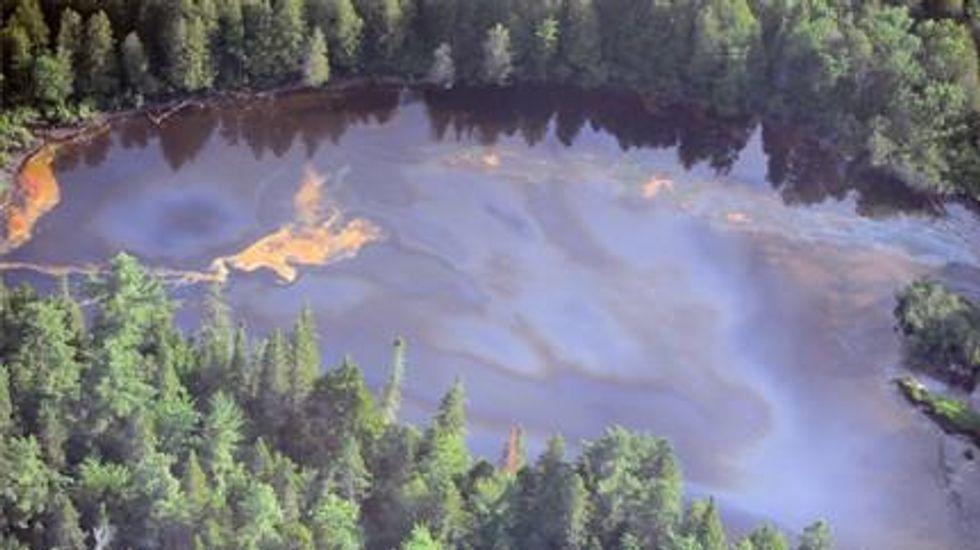
Frustrated by the Canadian government's failure to disclose the environmental impact of the July 6 train derailment and explosion in the town of Lac-Megantic, Quebec, an independent environmental group took it upon themselves to undergo a survey of the devastation.
"Confirm[ing] the fears" of the groups, the review revealed Tuesday the presence of carcinogens in nearby surface waters were nearly 400,000 times the prescribed limit, denoting a "severe impact" on water quality and soil where roughly 5.7 million liters (about 48,000 fluid barrels) of crude oil spilled from the derailed train.
Undertaken by the Quebec environmental group Societe pour Vaincre la Pollution (SVP) in collaboration with Greenpeace, the study tested surface samples drawn from the Chaudiere River, which runs through town, a week after the train derailment.
According to the Canadian Press, which reviewed the analysis, the rate of carcinogenic polycyclic aromatic hydrocarbons in the region is 394,444 times the acceptable amount for surface waters mandated by the provincial government.
Further, the study found the concentration of arsenic detected on the water's surface is said to exceed the government's acceptable standard by 28 times.
"The toxicity of this oil is quite high," said Daniel Green, co-president of the SVP, adding that the ecosystem could face long-term consequences.
There was no hiding the devastating human toll of the oil train accident which killed 47 people and leveled the small downtown. However, critics are charging the Canadian government with downplaying the environmental cost and being suspiciously guarded about the extent of the damage.
"I was surprised to see them minimize the spill," said Greenpeace coordinator Keith Stewart in a telephone interview. "This is one of the largest spills in Canadian history. It will take considerable effort to clean up."
And CBC added in their reporting on the study results:
So far, information about the exact chemical makeup of the oil has not been made public.
The Transportation Safety Board and the Environment Ministry have yet to release the results of their tests.
CBC News contacted the office of Environment Minister Yves-Francois Blanchet, but the ministry was not willing to comment on the findings.
"They've done extensive sampling -- air, water and soil, and we've yet to see any results from the government on this environmental catastrophe," added SVP's Daniel Green.
Reports last week revealed that the Montreal, Maine and Atlantic Railway (MM&A), the company behind the disaster, had an insurance policy that would only cover $25 million of the hundreds of millions of dollars in anticipated damage and clean-up costs.
These videos by SVP of the environmental group taking samples reveal evidence of oil slicks and contaminated mud following the spill.
LAC-MÉGANTIC VRAC 03 Société pour Vaincre la PollutionDéversement de 7,5 millions de litres de pétrole de schiste au Lac-Mégantic, Québec, C Canada. Le Ministère de l'environnement ...
Mégantic 01 - Vrac - SVPLe plus grand déversement de pétrole terrestre de l'Amérique du Nord et le premier de pétrole de schiste. La Société pour ...
_____________________
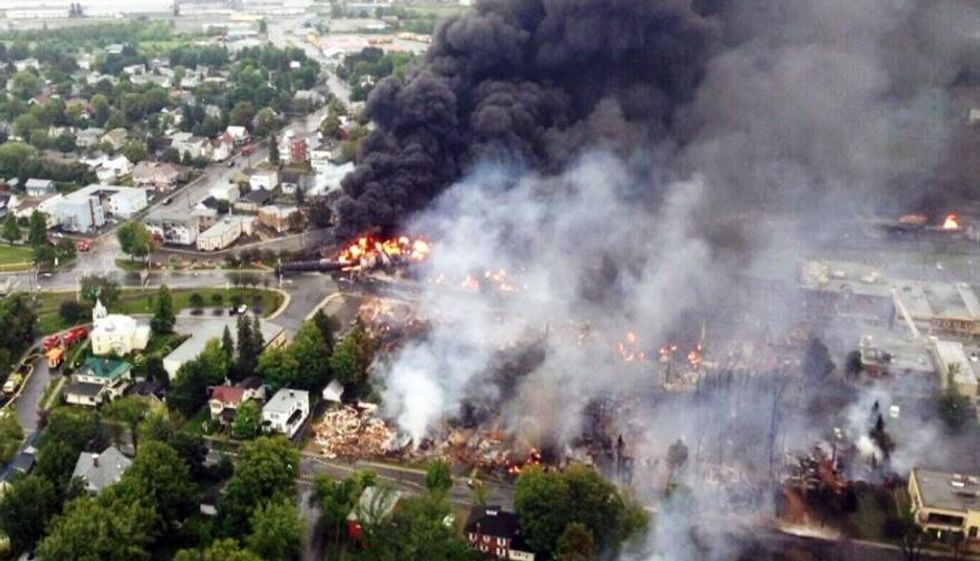
A massive explosion followed the derailment of a train carrying crude oil through Quebec early Saturday morning, engulfing a town in flames as scores of residents remain missing--confirming, once again, the massive threat posed by the transportation of volatile fossil fuels.
The explosion occurred at roughly 1:20 AM as the train derailed while passing through the small downtown of Lac-Megantic.
This video, taken at 1:20 am EST shows the fireball engulfing the small town:
According to a spokesperson for Quebec's Environment Ministry, the train's 73 rail cars were filled with crude oil and at least four of the cars erupted in a series of explosions which engulfed the town in a cloud of black, thick smoke and a fire that continues to burn.
Reportedly, there was no one on board the train as the oil-laden cars were being "remotely operated." Further, the Canadian Broadcasting Corporation reports that a "large but as-yet undetermined amount of fuel is also reported to have spilled into the Chaudiere River," with residents reporting that the water has turned to shades of orange.
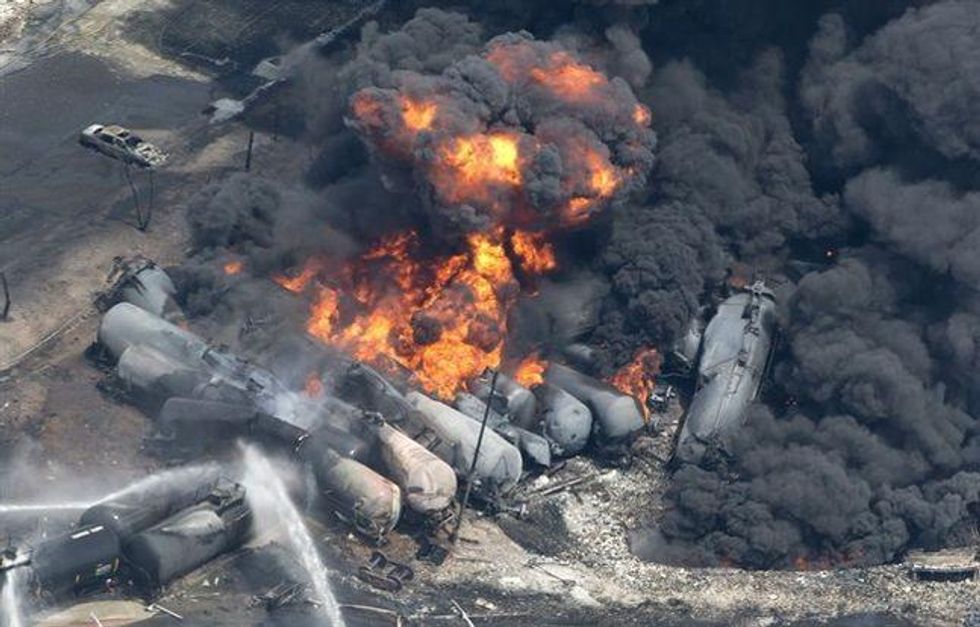
"It's dreadful," said Lac-Megantic resident Claude Bedard. "It's terrible. We've never seen anything like it."
Over 60 individuals still remain missing and authorities estimate some 30 buildings have been "affected," with several completely "flattened" by the blast.
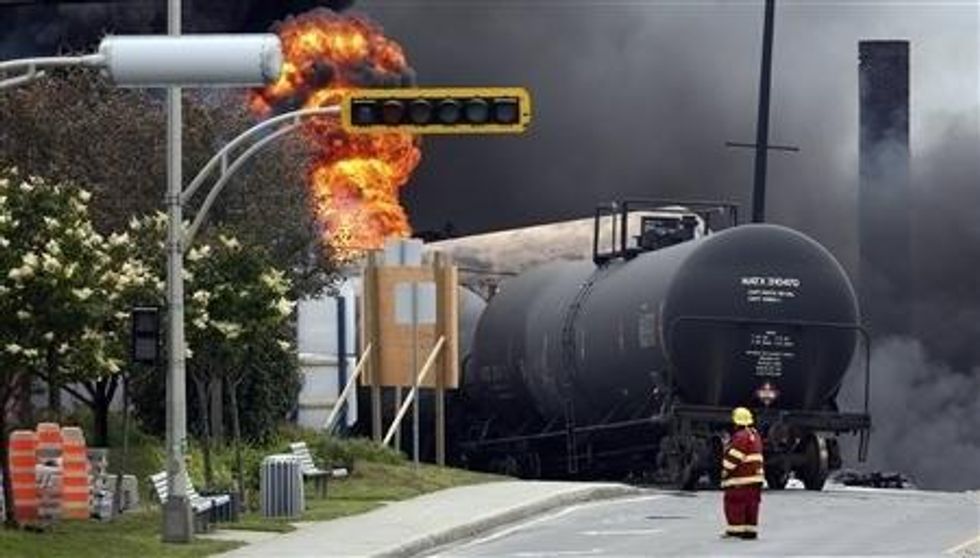
Many proponents of oil and gas drilling have argued that shipment by rail poses a 'safe' alternative to the proven dangers of oil pipelines though repeated tragedies such as this provide a further reminder of the risks of petroleum transport, in any form.
The derailed train belongs to Montreal Maine & Atlantic, which owns nearly 500 miles of track throughout Maine, Vermont, Quebec and New Brunswick, according to the company's website.