

SUBSCRIBE TO OUR FREE NEWSLETTER
Daily news & progressive opinion—funded by the people, not the corporations—delivered straight to your inbox.
5
#000000
#FFFFFF
To donate by check, phone, or other method, see our More Ways to Give page.
Daily news & progressive opinion—funded by the people, not the corporations—delivered straight to your inbox.
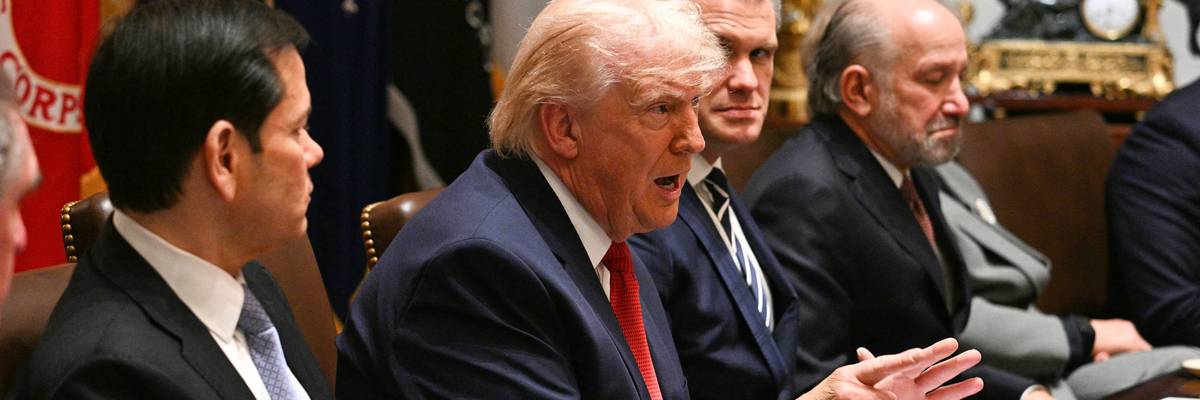
US President Donald Trump speaks flanked by top administration officials at the White House in Washington, DC on March 26, 2026.
An Iranian official said Trump's operation "failed completely" and that Iran "will not participate in direct negotiations until the United States formally announces the end of the blockade."
US President Donald Trump announced late Tuesday that he is putting his administration's scheme to guide ships through the Strait of Hormuz on hold after just one full day, a decision that came hours after top American officials touted the president's so-called "Project Freedom" at press briefings.
Trump said in a social media post that he paused the project—which allowed just two commercial ships to pass through the strait—"based on the request of Pakistan and other countries." The US president, whose war of choice is historically unpopular with the American public, also asserted that "Great Progress has been made toward a Complete and Final Agreement with Representatives of Iran," a claim that Iran rejected.
As Pakistan's prime minister welcomed Trump's announcement, an unnamed Iranian official told Drop Site's Jeremy Scahill that the US president's short-lived operation "failed completely" and that his statement announcing the pause of Project Freedom was "riddled with falsehoods." The official added that "we will not participate in direct negotiations until the United States formally announces the end of the blockade."
The US president said in his post that the illegal US naval blockade of Iran would "remain in full force and effect."
"Trump is desperately bouncing from one extreme to another," said political scientist Robert Pape in response to Trump's announcement.
Trump's decision to put Project Freedom on hold came shortly after Pentagon Secretary Pete Hegseth, Joint Chiefs of Staff Chairman Dan Caine, and Secretary of State Marco Rubio hailed the president's initiative as a bold mission to rescue some 1,600 vessels stranded in the Strait of Hormuz, which Iran closed in response to the unlawful US-Israeli war and subsequent naval blockade.
"Iran's plan, a form of international extortion, is unacceptable. That ends with Project Freedom," Hegseth declared during a press briefing on Tuesday morning.
Rubio similarly decried Iran's actions in the Strait of Hormuz—located in Omani and Iranian territorial waters—as violations of international law.
"There is no international law that allows you to say: I’m going to put mines in an international body of water, and I’m going to blow up ships that don’t listen to us and try to go through," said Rubio.
Legal scholar Maryam Jamshidi rejected the top US diplomat's assessment, calling it "all wrong."
"Hormuz is not international waters," Jamshidi wrote. "It’s an international strait composed of the territorial waters of Iran and Oman. Iran can mine its territorial waters during wartime. The laws of naval warfare also allow Iran to target ships in certain cases. The US is the only criminal here."
Dear Common Dreams reader, It’s been nearly 30 years since I co-founded Common Dreams with my late wife, Lina Newhouser. We had the radical notion that journalism should serve the public good, not corporate profits. It was clear to us from the outset what it would take to build such a project. No paid advertisements. No corporate sponsors. No millionaire publisher telling us what to think or do. Many people said we wouldn't last a year, but we proved those doubters wrong. Together with a tremendous team of journalists and dedicated staff, we built an independent media outlet free from the constraints of profits and corporate control. Our mission has always been simple: To inform. To inspire. To ignite change for the common good. Building Common Dreams was not easy. Our survival was never guaranteed. When you take on the most powerful forces—Wall Street greed, fossil fuel industry destruction, Big Tech lobbyists, and uber-rich oligarchs who have spent billions upon billions rigging the economy and democracy in their favor—the only bulwark you have is supporters who believe in your work. But here’s the urgent message from me today. It's never been this bad out there. And it's never been this hard to keep us going. At the very moment Common Dreams is most needed, the threats we face are intensifying. We need your support now more than ever. We don't accept corporate advertising and never will. We don't have a paywall because we don't think people should be blocked from critical news based on their ability to pay. Everything we do is funded by the donations of readers like you. When everyone does the little they can afford, we are strong. But if that support retreats or dries up, so do we. Will you donate now to make sure Common Dreams not only survives but thrives? —Craig Brown, Co-founder |
US President Donald Trump announced late Tuesday that he is putting his administration's scheme to guide ships through the Strait of Hormuz on hold after just one full day, a decision that came hours after top American officials touted the president's so-called "Project Freedom" at press briefings.
Trump said in a social media post that he paused the project—which allowed just two commercial ships to pass through the strait—"based on the request of Pakistan and other countries." The US president, whose war of choice is historically unpopular with the American public, also asserted that "Great Progress has been made toward a Complete and Final Agreement with Representatives of Iran," a claim that Iran rejected.
As Pakistan's prime minister welcomed Trump's announcement, an unnamed Iranian official told Drop Site's Jeremy Scahill that the US president's short-lived operation "failed completely" and that his statement announcing the pause of Project Freedom was "riddled with falsehoods." The official added that "we will not participate in direct negotiations until the United States formally announces the end of the blockade."
The US president said in his post that the illegal US naval blockade of Iran would "remain in full force and effect."
"Trump is desperately bouncing from one extreme to another," said political scientist Robert Pape in response to Trump's announcement.
Trump's decision to put Project Freedom on hold came shortly after Pentagon Secretary Pete Hegseth, Joint Chiefs of Staff Chairman Dan Caine, and Secretary of State Marco Rubio hailed the president's initiative as a bold mission to rescue some 1,600 vessels stranded in the Strait of Hormuz, which Iran closed in response to the unlawful US-Israeli war and subsequent naval blockade.
"Iran's plan, a form of international extortion, is unacceptable. That ends with Project Freedom," Hegseth declared during a press briefing on Tuesday morning.
Rubio similarly decried Iran's actions in the Strait of Hormuz—located in Omani and Iranian territorial waters—as violations of international law.
"There is no international law that allows you to say: I’m going to put mines in an international body of water, and I’m going to blow up ships that don’t listen to us and try to go through," said Rubio.
Legal scholar Maryam Jamshidi rejected the top US diplomat's assessment, calling it "all wrong."
"Hormuz is not international waters," Jamshidi wrote. "It’s an international strait composed of the territorial waters of Iran and Oman. Iran can mine its territorial waters during wartime. The laws of naval warfare also allow Iran to target ships in certain cases. The US is the only criminal here."
US President Donald Trump announced late Tuesday that he is putting his administration's scheme to guide ships through the Strait of Hormuz on hold after just one full day, a decision that came hours after top American officials touted the president's so-called "Project Freedom" at press briefings.
Trump said in a social media post that he paused the project—which allowed just two commercial ships to pass through the strait—"based on the request of Pakistan and other countries." The US president, whose war of choice is historically unpopular with the American public, also asserted that "Great Progress has been made toward a Complete and Final Agreement with Representatives of Iran," a claim that Iran rejected.
As Pakistan's prime minister welcomed Trump's announcement, an unnamed Iranian official told Drop Site's Jeremy Scahill that the US president's short-lived operation "failed completely" and that his statement announcing the pause of Project Freedom was "riddled with falsehoods." The official added that "we will not participate in direct negotiations until the United States formally announces the end of the blockade."
The US president said in his post that the illegal US naval blockade of Iran would "remain in full force and effect."
"Trump is desperately bouncing from one extreme to another," said political scientist Robert Pape in response to Trump's announcement.
Trump's decision to put Project Freedom on hold came shortly after Pentagon Secretary Pete Hegseth, Joint Chiefs of Staff Chairman Dan Caine, and Secretary of State Marco Rubio hailed the president's initiative as a bold mission to rescue some 1,600 vessels stranded in the Strait of Hormuz, which Iran closed in response to the unlawful US-Israeli war and subsequent naval blockade.
"Iran's plan, a form of international extortion, is unacceptable. That ends with Project Freedom," Hegseth declared during a press briefing on Tuesday morning.
Rubio similarly decried Iran's actions in the Strait of Hormuz—located in Omani and Iranian territorial waters—as violations of international law.
"There is no international law that allows you to say: I’m going to put mines in an international body of water, and I’m going to blow up ships that don’t listen to us and try to go through," said Rubio.
Legal scholar Maryam Jamshidi rejected the top US diplomat's assessment, calling it "all wrong."
"Hormuz is not international waters," Jamshidi wrote. "It’s an international strait composed of the territorial waters of Iran and Oman. Iran can mine its territorial waters during wartime. The laws of naval warfare also allow Iran to target ships in certain cases. The US is the only criminal here."

