SUBSCRIBE TO OUR FREE NEWSLETTER
Daily news & progressive opinion—funded by the people, not the corporations—delivered straight to your inbox.
5
#000000
#FFFFFF
To donate by check, phone, or other method, see our More Ways to Give page.
Daily news & progressive opinion—funded by the people, not the corporations—delivered straight to your inbox.
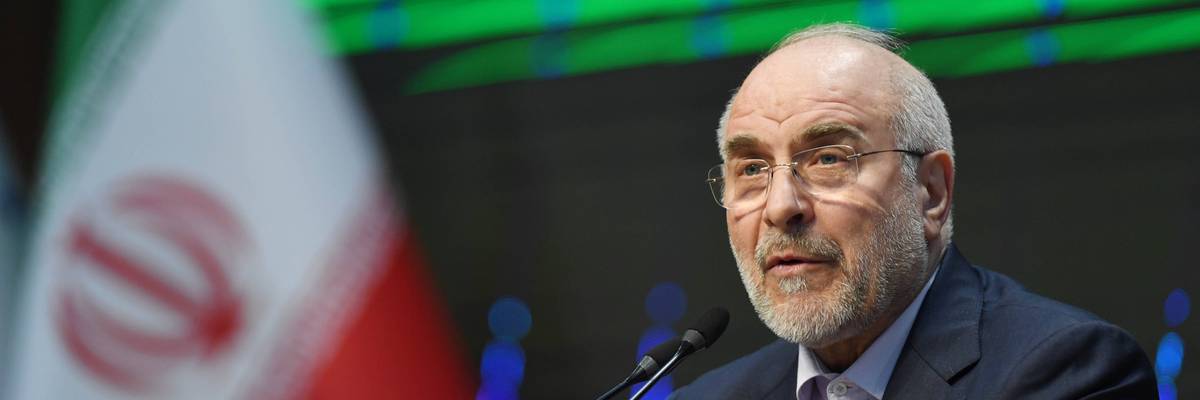
Iranian Parliament Speaker Mohammad Bagher Ghalibaf speaks at a press conference in Tehran, Iran on December 2, 2025.
"Fake news is used to manipulate the financial and oil markets and escape the quagmire in which the US and Israel are trapped," said the speaker of the Iranian Parliament.
As the Iranian government denied President Donald Trump's claim on Monday that "productive" talks are taking place between the US and the Middle Eastern country, which the White House has joined Israel in attacking for close to a month, a top Iranian lawmaker accused the president of attempting to manipulate global markets with his claim.
"No negotiations have been held with the US, and fake news is used to manipulate the financial and oil markets and escape the quagmire in which the US and Israel are trapped," said Mohammad Bagher Ghalibaf, the speaker of the Iranian Parliament, in a post on X.
Ghalibaf's theory appeared to be supported by developments in the financial markets shortly after Trump's seemingly significant announcement Monday morning.
As the market analysis and commentary website The Kobeissi Letter reported, by 7:10 am Eastern—six minutes after Trump appeared to allude to diplomatic strides toward ending his unprovoked war—the S&P 500 surged by more than 240 points, adding more than $2 trillion in market capitalization.
Iran's Foreign Ministry denied Trump's claim 27 minutes later, and by 8:00 AM Eastern the S&P 500 had fallen by 120 points, erasing nearly $1 trillion in market value.
"That's a $3 TRILLION swing market cap in 56 minutes, just in the S&P 500," said The Kobeissi Letter. "What is happening here?"
Ahead of Ghalibaf's remarks, The New Republic also posited that Trump's "news" of productive discussions was "just a ploy at market manipulation."
The quick denial of talks from the Foreign Ministry raised "serious doubts as to whether the president is telling the truth or just saying whatever he can to stop gas prices from rising more and more as Iran locks down the Strait of Hormuz."
Since the US and Israel began its assault on Iran on February 28, Iran has effectively closed the Strait of Hormuz, through which roughly one-fifth of the world's oil supply flows, and sent gas prices soaring to nearly $4 per gallon, up from $2.91 before the war.
The war, which has killed more than 3,200 Iranians and exploded into a larger conflict, with more than 1,000 people killed in Lebanon and at least 60 killed in Iraq, has appeared politically toxic for Trump, who campaigned on "no new wars" and making life more affordable for Americans.
Nearly 80% of people who voted for Trump in 2024 said last week that they hope for a quick end to the war.
Some observers noted that even the president's five-day deadline for negotiations to conclude—after which he suggested the US could launch strikes against Iran's energy infrastructure—appeared to revolve around the week's closing of energy markets on Friday.
"Every week, when markets open, Trump makes these kinds of statements to drive down oil prices," said Iranian academic Seyed Mohammad Marandi. "Even his five-day deadline aligns with the closure of the energy market. But in reality, there are no negotiations underway, nor does Trump have the capability to reopen the Strait of Hormuz. Iran's firm threat has once again forced Trump to back down."
On Saturday, Trump had threatened to "obliterate" Iran's power plants if it didn't reopen the Strait of Hormuz by Monday. Iran responded with a threat to target energy infrastructure across the region, including in Israel.
A senior Iranian official told Drop Site News that "no new developments have occurred” diplomatically between the US and Iran.
Iran's conditions for ending the war, the official said, include a simultaneous ceasefire in Iran, Lebanon, and Iraq. The government is also demanding an end to US sanctions on Iran's procurement of defensive weapons and equipment.
“The fact that he publicly responds to [Iran’s position] by posting a tweet," the official said, "is solely intended to manage the financial markets—nothing more."
Dear Common Dreams reader, It’s been nearly 30 years since I co-founded Common Dreams with my late wife, Lina Newhouser. We had the radical notion that journalism should serve the public good, not corporate profits. It was clear to us from the outset what it would take to build such a project. No paid advertisements. No corporate sponsors. No millionaire publisher telling us what to think or do. Many people said we wouldn't last a year, but we proved those doubters wrong. Together with a tremendous team of journalists and dedicated staff, we built an independent media outlet free from the constraints of profits and corporate control. Our mission has always been simple: To inform. To inspire. To ignite change for the common good. Building Common Dreams was not easy. Our survival was never guaranteed. When you take on the most powerful forces—Wall Street greed, fossil fuel industry destruction, Big Tech lobbyists, and uber-rich oligarchs who have spent billions upon billions rigging the economy and democracy in their favor—the only bulwark you have is supporters who believe in your work. But here’s the urgent message from me today. It's never been this bad out there. And it's never been this hard to keep us going. At the very moment Common Dreams is most needed, the threats we face are intensifying. We need your support now more than ever. We don't accept corporate advertising and never will. We don't have a paywall because we don't think people should be blocked from critical news based on their ability to pay. Everything we do is funded by the donations of readers like you. When everyone does the little they can afford, we are strong. But if that support retreats or dries up, so do we. Will you donate now to make sure Common Dreams not only survives but thrives? —Craig Brown, Co-founder |
As the Iranian government denied President Donald Trump's claim on Monday that "productive" talks are taking place between the US and the Middle Eastern country, which the White House has joined Israel in attacking for close to a month, a top Iranian lawmaker accused the president of attempting to manipulate global markets with his claim.
"No negotiations have been held with the US, and fake news is used to manipulate the financial and oil markets and escape the quagmire in which the US and Israel are trapped," said Mohammad Bagher Ghalibaf, the speaker of the Iranian Parliament, in a post on X.
Ghalibaf's theory appeared to be supported by developments in the financial markets shortly after Trump's seemingly significant announcement Monday morning.
As the market analysis and commentary website The Kobeissi Letter reported, by 7:10 am Eastern—six minutes after Trump appeared to allude to diplomatic strides toward ending his unprovoked war—the S&P 500 surged by more than 240 points, adding more than $2 trillion in market capitalization.
Iran's Foreign Ministry denied Trump's claim 27 minutes later, and by 8:00 AM Eastern the S&P 500 had fallen by 120 points, erasing nearly $1 trillion in market value.
"That's a $3 TRILLION swing market cap in 56 minutes, just in the S&P 500," said The Kobeissi Letter. "What is happening here?"
Ahead of Ghalibaf's remarks, The New Republic also posited that Trump's "news" of productive discussions was "just a ploy at market manipulation."
The quick denial of talks from the Foreign Ministry raised "serious doubts as to whether the president is telling the truth or just saying whatever he can to stop gas prices from rising more and more as Iran locks down the Strait of Hormuz."
Since the US and Israel began its assault on Iran on February 28, Iran has effectively closed the Strait of Hormuz, through which roughly one-fifth of the world's oil supply flows, and sent gas prices soaring to nearly $4 per gallon, up from $2.91 before the war.
The war, which has killed more than 3,200 Iranians and exploded into a larger conflict, with more than 1,000 people killed in Lebanon and at least 60 killed in Iraq, has appeared politically toxic for Trump, who campaigned on "no new wars" and making life more affordable for Americans.
Nearly 80% of people who voted for Trump in 2024 said last week that they hope for a quick end to the war.
Some observers noted that even the president's five-day deadline for negotiations to conclude—after which he suggested the US could launch strikes against Iran's energy infrastructure—appeared to revolve around the week's closing of energy markets on Friday.
"Every week, when markets open, Trump makes these kinds of statements to drive down oil prices," said Iranian academic Seyed Mohammad Marandi. "Even his five-day deadline aligns with the closure of the energy market. But in reality, there are no negotiations underway, nor does Trump have the capability to reopen the Strait of Hormuz. Iran's firm threat has once again forced Trump to back down."
On Saturday, Trump had threatened to "obliterate" Iran's power plants if it didn't reopen the Strait of Hormuz by Monday. Iran responded with a threat to target energy infrastructure across the region, including in Israel.
A senior Iranian official told Drop Site News that "no new developments have occurred” diplomatically between the US and Iran.
Iran's conditions for ending the war, the official said, include a simultaneous ceasefire in Iran, Lebanon, and Iraq. The government is also demanding an end to US sanctions on Iran's procurement of defensive weapons and equipment.
“The fact that he publicly responds to [Iran’s position] by posting a tweet," the official said, "is solely intended to manage the financial markets—nothing more."
As the Iranian government denied President Donald Trump's claim on Monday that "productive" talks are taking place between the US and the Middle Eastern country, which the White House has joined Israel in attacking for close to a month, a top Iranian lawmaker accused the president of attempting to manipulate global markets with his claim.
"No negotiations have been held with the US, and fake news is used to manipulate the financial and oil markets and escape the quagmire in which the US and Israel are trapped," said Mohammad Bagher Ghalibaf, the speaker of the Iranian Parliament, in a post on X.
Ghalibaf's theory appeared to be supported by developments in the financial markets shortly after Trump's seemingly significant announcement Monday morning.
As the market analysis and commentary website The Kobeissi Letter reported, by 7:10 am Eastern—six minutes after Trump appeared to allude to diplomatic strides toward ending his unprovoked war—the S&P 500 surged by more than 240 points, adding more than $2 trillion in market capitalization.
Iran's Foreign Ministry denied Trump's claim 27 minutes later, and by 8:00 AM Eastern the S&P 500 had fallen by 120 points, erasing nearly $1 trillion in market value.
"That's a $3 TRILLION swing market cap in 56 minutes, just in the S&P 500," said The Kobeissi Letter. "What is happening here?"
Ahead of Ghalibaf's remarks, The New Republic also posited that Trump's "news" of productive discussions was "just a ploy at market manipulation."
The quick denial of talks from the Foreign Ministry raised "serious doubts as to whether the president is telling the truth or just saying whatever he can to stop gas prices from rising more and more as Iran locks down the Strait of Hormuz."
Since the US and Israel began its assault on Iran on February 28, Iran has effectively closed the Strait of Hormuz, through which roughly one-fifth of the world's oil supply flows, and sent gas prices soaring to nearly $4 per gallon, up from $2.91 before the war.
The war, which has killed more than 3,200 Iranians and exploded into a larger conflict, with more than 1,000 people killed in Lebanon and at least 60 killed in Iraq, has appeared politically toxic for Trump, who campaigned on "no new wars" and making life more affordable for Americans.
Nearly 80% of people who voted for Trump in 2024 said last week that they hope for a quick end to the war.
Some observers noted that even the president's five-day deadline for negotiations to conclude—after which he suggested the US could launch strikes against Iran's energy infrastructure—appeared to revolve around the week's closing of energy markets on Friday.
"Every week, when markets open, Trump makes these kinds of statements to drive down oil prices," said Iranian academic Seyed Mohammad Marandi. "Even his five-day deadline aligns with the closure of the energy market. But in reality, there are no negotiations underway, nor does Trump have the capability to reopen the Strait of Hormuz. Iran's firm threat has once again forced Trump to back down."
On Saturday, Trump had threatened to "obliterate" Iran's power plants if it didn't reopen the Strait of Hormuz by Monday. Iran responded with a threat to target energy infrastructure across the region, including in Israel.
A senior Iranian official told Drop Site News that "no new developments have occurred” diplomatically between the US and Iran.
Iran's conditions for ending the war, the official said, include a simultaneous ceasefire in Iran, Lebanon, and Iraq. The government is also demanding an end to US sanctions on Iran's procurement of defensive weapons and equipment.
“The fact that he publicly responds to [Iran’s position] by posting a tweet," the official said, "is solely intended to manage the financial markets—nothing more."