SUBSCRIBE TO OUR FREE NEWSLETTER
Daily news & progressive opinion—funded by the people, not the corporations—delivered straight to your inbox.
5
#000000
#FFFFFF
To donate by check, phone, or other method, see our More Ways to Give page.
Daily news & progressive opinion—funded by the people, not the corporations—delivered straight to your inbox.
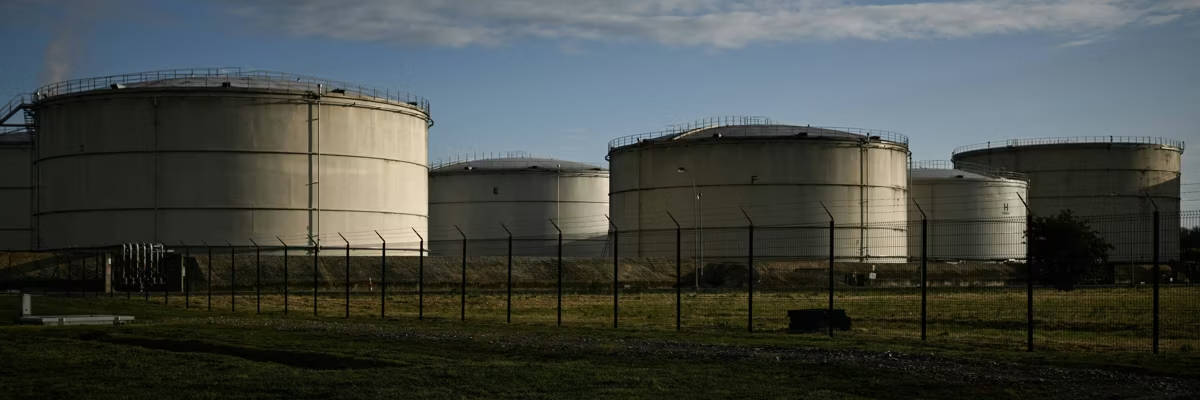
Fuel storage tanks are seen at a petroleum depot in Ambes, near Bordeaux, southwestern France, as global oil supply chains face acute disruption, on May 5, 2026.
"Only a select few in the top tax bracket are benefiting from this, and the majority of you ain’t in it," said former Rep. Marjorie Taylor Greene.
Observers are once again raising concerns about insider trading on Wednesday after a trader took a colossal crude oil short position just over an hour before a US-Iran peace deal was reported to be on the horizon, causing prices to fall.
The Kobeissi Letter, a financial newsletter, reported on X that at 3:40 am on Wednesday, "nearly 10,000 contracts worth of crude oil shorts were taken without any major news."
This was equivalent to $920 million in notional value, which the letter described as "an unusually large trade" so early in the morning. But it would soon pay off.
At 4:50 am, just 70 minutes later, Axios published an exclusive scoop by Middle East reporter Barak Ravid that the White House believed the US and Iran were on the verge of agreeing to a one-page "memorandum of understanding" to end the war, which included more nuclear negotiations, one of the key sticking points for US President Donald Trump.
By 7:00 am, just over two hours after Axios dropped its report, oil prices had fallen by 12%, allowing the savvy investor to make $125 million in a matter of hours, which led to accusations that it was yet another example of "epic insider trading" by those in the know about Trump's plans.
Prices have since rebounded by about 8% after Iran announced the creation of the new "Persian Gulf Strait Authority," to mediate the passage of ships through the Strait of Hormuz on its terms.
The Trump administration has already been deluged with accusations that its members are using insider information to take advantage of financial markets and prediction market apps.
Last month, an active-duty US special forces soldier was indicted by the Department of Justice after he made about $400,000 betting on Polymarket that Venezuelan President Nicolás Maduro would be removed from power, a bet he allegedly placed using classified information about an operation he himself was involved with.
More bettors collected around $1 million in profits from bets on the specific timing of Trump's war with Iran in late February. The Financial Times also reported a surge of more than $580 million in oil futures trading right before Trump announced a pause in strikes on Iran's energy facilities in March.
Of course, Wednesday's bet theoretically could have been made without the aid of insider information.
The new peace framework is the latest in what has seemed to be an endless pattern over the past several weeks in which US officials tell media outlets that a peace agreement is on the horizon, causing oil prices to dip, only for it to collapse later in the week, often with Trump issuing hostile threats or making new demands.
It has become such a familiar story that some have speculated that the announcement of productive ceasefire talks is deliberately choreographed to calm oil markets and bring down prices, which have become a growing problem for Trump among voters.
But as The Economic Times explained, the bet placed Wednesday morning likely "is not a routine hedge" or "a portfolio rebalancing move."
"At that hour, in that size," it said, "a crude oil short of that magnitude is a deliberate, high-conviction directional bet."
Former Rep. Marjorie Taylor Greene (R-Ga.), a one-time Trump cheerleader who's become one of his leading critics, suggested Trump's erratic approach to negotiating an end to the war was just a tool used by him and his allies to profit.
"When is everyone going to start realizing that the on-again, off-again war/peace rhetoric is really just insider trading? And sprinkle in some murder," Greene wrote on social media. "Only a select few in the top tax bracket are benefiting from this, and the majority of you ain’t in it."
Democrats in Congress have urged the Securities and Exchange Commission (SEC) to investigate what Sen. Chris Murphy (D-Conn.) suggested could be "mind-blowing corruption" by the White House, not only related to Trump's wars, but also to his tariff regime, which has caused similar market chaos that bettors have been able to capitalize on with fortuitously timed wagers.
But critics have described profiting from the machinations of a war that has killed more than 1,700 civilians as particularly grotesque.
"This has to stop," said Fox News commentator Jessica Tarlov. "Lives on the line so they can insider trade!"
Dear Common Dreams reader, It’s been nearly 30 years since I co-founded Common Dreams with my late wife, Lina Newhouser. We had the radical notion that journalism should serve the public good, not corporate profits. It was clear to us from the outset what it would take to build such a project. No paid advertisements. No corporate sponsors. No millionaire publisher telling us what to think or do. Many people said we wouldn't last a year, but we proved those doubters wrong. Together with a tremendous team of journalists and dedicated staff, we built an independent media outlet free from the constraints of profits and corporate control. Our mission has always been simple: To inform. To inspire. To ignite change for the common good. Building Common Dreams was not easy. Our survival was never guaranteed. When you take on the most powerful forces—Wall Street greed, fossil fuel industry destruction, Big Tech lobbyists, and uber-rich oligarchs who have spent billions upon billions rigging the economy and democracy in their favor—the only bulwark you have is supporters who believe in your work. But here’s the urgent message from me today. It's never been this bad out there. And it's never been this hard to keep us going. At the very moment Common Dreams is most needed, the threats we face are intensifying. We need your support now more than ever. We don't accept corporate advertising and never will. We don't have a paywall because we don't think people should be blocked from critical news based on their ability to pay. Everything we do is funded by the donations of readers like you. When everyone does the little they can afford, we are strong. But if that support retreats or dries up, so do we. Will you donate now to make sure Common Dreams not only survives but thrives? —Craig Brown, Co-founder |
Observers are once again raising concerns about insider trading on Wednesday after a trader took a colossal crude oil short position just over an hour before a US-Iran peace deal was reported to be on the horizon, causing prices to fall.
The Kobeissi Letter, a financial newsletter, reported on X that at 3:40 am on Wednesday, "nearly 10,000 contracts worth of crude oil shorts were taken without any major news."
This was equivalent to $920 million in notional value, which the letter described as "an unusually large trade" so early in the morning. But it would soon pay off.
At 4:50 am, just 70 minutes later, Axios published an exclusive scoop by Middle East reporter Barak Ravid that the White House believed the US and Iran were on the verge of agreeing to a one-page "memorandum of understanding" to end the war, which included more nuclear negotiations, one of the key sticking points for US President Donald Trump.
By 7:00 am, just over two hours after Axios dropped its report, oil prices had fallen by 12%, allowing the savvy investor to make $125 million in a matter of hours, which led to accusations that it was yet another example of "epic insider trading" by those in the know about Trump's plans.
Prices have since rebounded by about 8% after Iran announced the creation of the new "Persian Gulf Strait Authority," to mediate the passage of ships through the Strait of Hormuz on its terms.
The Trump administration has already been deluged with accusations that its members are using insider information to take advantage of financial markets and prediction market apps.
Last month, an active-duty US special forces soldier was indicted by the Department of Justice after he made about $400,000 betting on Polymarket that Venezuelan President Nicolás Maduro would be removed from power, a bet he allegedly placed using classified information about an operation he himself was involved with.
More bettors collected around $1 million in profits from bets on the specific timing of Trump's war with Iran in late February. The Financial Times also reported a surge of more than $580 million in oil futures trading right before Trump announced a pause in strikes on Iran's energy facilities in March.
Of course, Wednesday's bet theoretically could have been made without the aid of insider information.
The new peace framework is the latest in what has seemed to be an endless pattern over the past several weeks in which US officials tell media outlets that a peace agreement is on the horizon, causing oil prices to dip, only for it to collapse later in the week, often with Trump issuing hostile threats or making new demands.
It has become such a familiar story that some have speculated that the announcement of productive ceasefire talks is deliberately choreographed to calm oil markets and bring down prices, which have become a growing problem for Trump among voters.
But as The Economic Times explained, the bet placed Wednesday morning likely "is not a routine hedge" or "a portfolio rebalancing move."
"At that hour, in that size," it said, "a crude oil short of that magnitude is a deliberate, high-conviction directional bet."
Former Rep. Marjorie Taylor Greene (R-Ga.), a one-time Trump cheerleader who's become one of his leading critics, suggested Trump's erratic approach to negotiating an end to the war was just a tool used by him and his allies to profit.
"When is everyone going to start realizing that the on-again, off-again war/peace rhetoric is really just insider trading? And sprinkle in some murder," Greene wrote on social media. "Only a select few in the top tax bracket are benefiting from this, and the majority of you ain’t in it."
Democrats in Congress have urged the Securities and Exchange Commission (SEC) to investigate what Sen. Chris Murphy (D-Conn.) suggested could be "mind-blowing corruption" by the White House, not only related to Trump's wars, but also to his tariff regime, which has caused similar market chaos that bettors have been able to capitalize on with fortuitously timed wagers.
But critics have described profiting from the machinations of a war that has killed more than 1,700 civilians as particularly grotesque.
"This has to stop," said Fox News commentator Jessica Tarlov. "Lives on the line so they can insider trade!"
Observers are once again raising concerns about insider trading on Wednesday after a trader took a colossal crude oil short position just over an hour before a US-Iran peace deal was reported to be on the horizon, causing prices to fall.
The Kobeissi Letter, a financial newsletter, reported on X that at 3:40 am on Wednesday, "nearly 10,000 contracts worth of crude oil shorts were taken without any major news."
This was equivalent to $920 million in notional value, which the letter described as "an unusually large trade" so early in the morning. But it would soon pay off.
At 4:50 am, just 70 minutes later, Axios published an exclusive scoop by Middle East reporter Barak Ravid that the White House believed the US and Iran were on the verge of agreeing to a one-page "memorandum of understanding" to end the war, which included more nuclear negotiations, one of the key sticking points for US President Donald Trump.
By 7:00 am, just over two hours after Axios dropped its report, oil prices had fallen by 12%, allowing the savvy investor to make $125 million in a matter of hours, which led to accusations that it was yet another example of "epic insider trading" by those in the know about Trump's plans.
Prices have since rebounded by about 8% after Iran announced the creation of the new "Persian Gulf Strait Authority," to mediate the passage of ships through the Strait of Hormuz on its terms.
The Trump administration has already been deluged with accusations that its members are using insider information to take advantage of financial markets and prediction market apps.
Last month, an active-duty US special forces soldier was indicted by the Department of Justice after he made about $400,000 betting on Polymarket that Venezuelan President Nicolás Maduro would be removed from power, a bet he allegedly placed using classified information about an operation he himself was involved with.
More bettors collected around $1 million in profits from bets on the specific timing of Trump's war with Iran in late February. The Financial Times also reported a surge of more than $580 million in oil futures trading right before Trump announced a pause in strikes on Iran's energy facilities in March.
Of course, Wednesday's bet theoretically could have been made without the aid of insider information.
The new peace framework is the latest in what has seemed to be an endless pattern over the past several weeks in which US officials tell media outlets that a peace agreement is on the horizon, causing oil prices to dip, only for it to collapse later in the week, often with Trump issuing hostile threats or making new demands.
It has become such a familiar story that some have speculated that the announcement of productive ceasefire talks is deliberately choreographed to calm oil markets and bring down prices, which have become a growing problem for Trump among voters.
But as The Economic Times explained, the bet placed Wednesday morning likely "is not a routine hedge" or "a portfolio rebalancing move."
"At that hour, in that size," it said, "a crude oil short of that magnitude is a deliberate, high-conviction directional bet."
Former Rep. Marjorie Taylor Greene (R-Ga.), a one-time Trump cheerleader who's become one of his leading critics, suggested Trump's erratic approach to negotiating an end to the war was just a tool used by him and his allies to profit.
"When is everyone going to start realizing that the on-again, off-again war/peace rhetoric is really just insider trading? And sprinkle in some murder," Greene wrote on social media. "Only a select few in the top tax bracket are benefiting from this, and the majority of you ain’t in it."
Democrats in Congress have urged the Securities and Exchange Commission (SEC) to investigate what Sen. Chris Murphy (D-Conn.) suggested could be "mind-blowing corruption" by the White House, not only related to Trump's wars, but also to his tariff regime, which has caused similar market chaos that bettors have been able to capitalize on with fortuitously timed wagers.
But critics have described profiting from the machinations of a war that has killed more than 1,700 civilians as particularly grotesque.
"This has to stop," said Fox News commentator Jessica Tarlov. "Lives on the line so they can insider trade!"