

SUBSCRIBE TO OUR FREE NEWSLETTER
Daily news & progressive opinion—funded by the people, not the corporations—delivered straight to your inbox.
5
#000000
#FFFFFF
To donate by check, phone, or other method, see our More Ways to Give page.
Daily news & progressive opinion—funded by the people, not the corporations—delivered straight to your inbox.
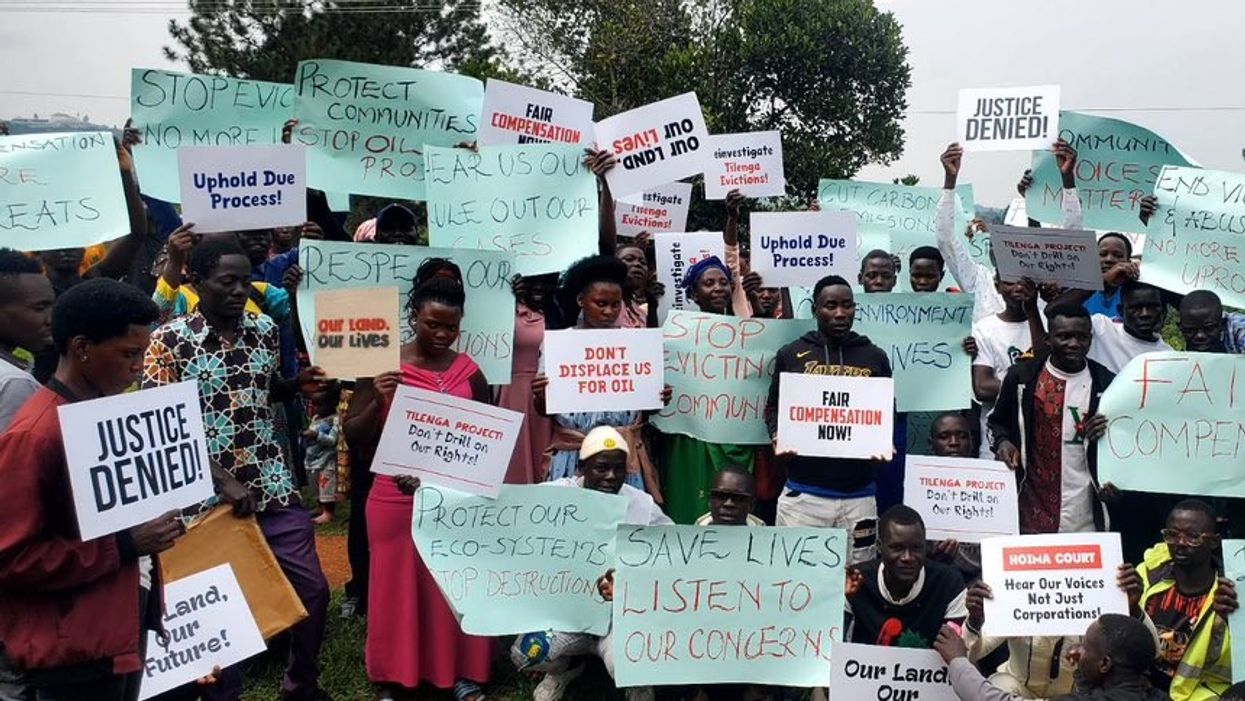
"The arrest of climate activists against EACOP is a blatant move to silence crucial advocates for change," said Fridays for Future Uganda.
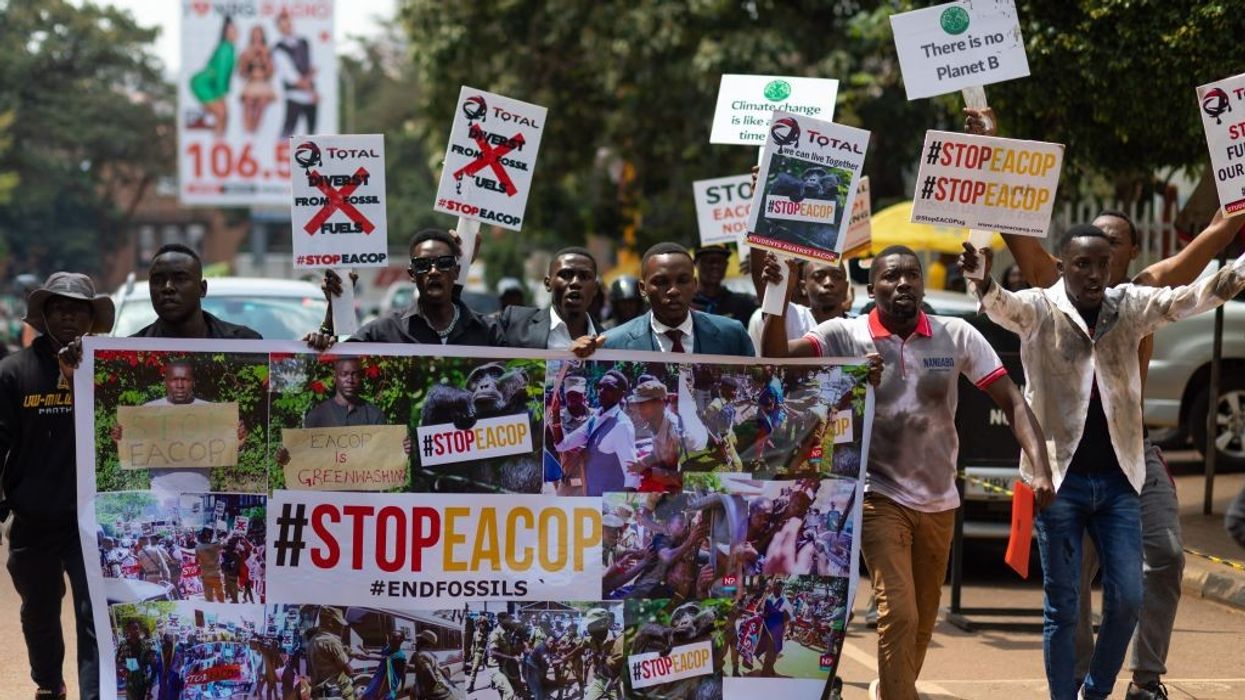
Police and soldiers from Uganda's U.S.-trained army cracked down on demonstrators at two Monday protests against the East African Crude Oil Pipeline, continuing the globally condemned oppression of EACOP opponents.
In the capital city of Kampala, where protesters tried to march on Parliament and the Chinese Embassy "there are 21 people arrested, they included 19 males and two females," defense attorney Samuel Wanda told Agence France-Presse. They were taken to the city's central police station and charging details were not yet available. Eight protesters would be directly impacted by the project.
As AFP noted, the China National Offshore Oil Corporation has an 8% stake in EACOP, which is set to carry crude nearly 900 miles from Uganda's Lake Albert oilfields to the port of Tanga in Tanzania. Ugandan and Tanzanian state-owned companies each have a 15% stake, and the remaining 62% is controlled by the France-based multinational TotalEnergies.
"The arrest of Stop EACOP activists in Kampala today is an attack on democracy and the right to protest," said climate campaigner and environmental consultant Ashley Kitisya on social media. "We condemn this crackdown and call for the immediate release of all detained activists. Peaceful voices demanding justice must not be silenced. #StopEACOP."
Fridays for Future Uganda declared that "the arrest of climate activists against EACOP is a blatant move to silence crucial advocates for change."
"Many affected are misled and unaware of the true risks," the youth-led group added. "We must oppose this injustice and demand EACOP’s immediate halt to protect people and the environment."
Hundreds of peaceful pipeline opponents—including breastfeeding mothers—also gathered in Hoima City, according to the Kampala-based Monitor. They were at a Kitara Secondary School (SS) and planned to demonstrate at regional EACOP offices but "were surrounded by heavily armed police" and Uganda Peoples' Defence Forces (UPDF) soldiers "who foiled the protest."
As the outlet noted last year, declassified U.S. State Department data shows that from 2019-21, Uganda received $8.5 million in military training assistance from the United States, and from 2012-16, the African country got grants for equipment worth $21.9 million .
On Monday, Christopher Opio told Hoima Resident City Commissioner Badru Mugabi that the project affected persons (PAPs) he represents had not received a government response to an April petition "so, we decided to say we can again put our concerns in writing. Today, we were taking our petition to the offices of EACOP, and Petroleum Authority of Uganda (PAU) peacefully."
As the Monitor detailed:
Mugabi responded saying: "If you have a court case and the court has not heard you, please come to our offices. We shall put these courts to order, or we shall appeal to their supervisors. But walking to these offices will not change the status quo legally."
Later, Mugabi selected a few PAPs' representatives and escorted them to deliver their petition to the offices of EACOP and PAU while the rest of the aggrieved locals were left at Kitara SS under tight security.
In a series of social media posts, the StopEACOP campaign called out law enforcement for blocking the peaceful protest in Hoima, highlighting the threats and intimidation faced by PAPs and local climate activists.
Despite the oppression in Uganda, protests are planned in Tanzania on Thursday, according to the global climate organization 350.org.
"The EACOP project threatens local communities, water resources, biodiversity, and efforts to curb climate change while providing little to benefit ordinary Ugandan and Tanzanian people," the group said Monday. "Already, tens of thousands of people along the pipeline's route and near its associated oil drilling sites have been forcibly displaced, losing their land, livelihoods, and traditional ways of life. Many have been relocated to inadequate homes on infertile land, making it impossible to grow crops or sustain their families. Others have received inadequate compensation or none at all, leaving them unable to rebuild their lives."
"Additionally, community members and activists face escalating threats, including violence, intimidation, arrests, harassment, and even abductions for resisting the project," 350 added. "Impacted communities and land, human rights, and environmental defenders in the project's host countries are taking to the streets to demand an end to EACOP and justice for the harm that has already been caused."
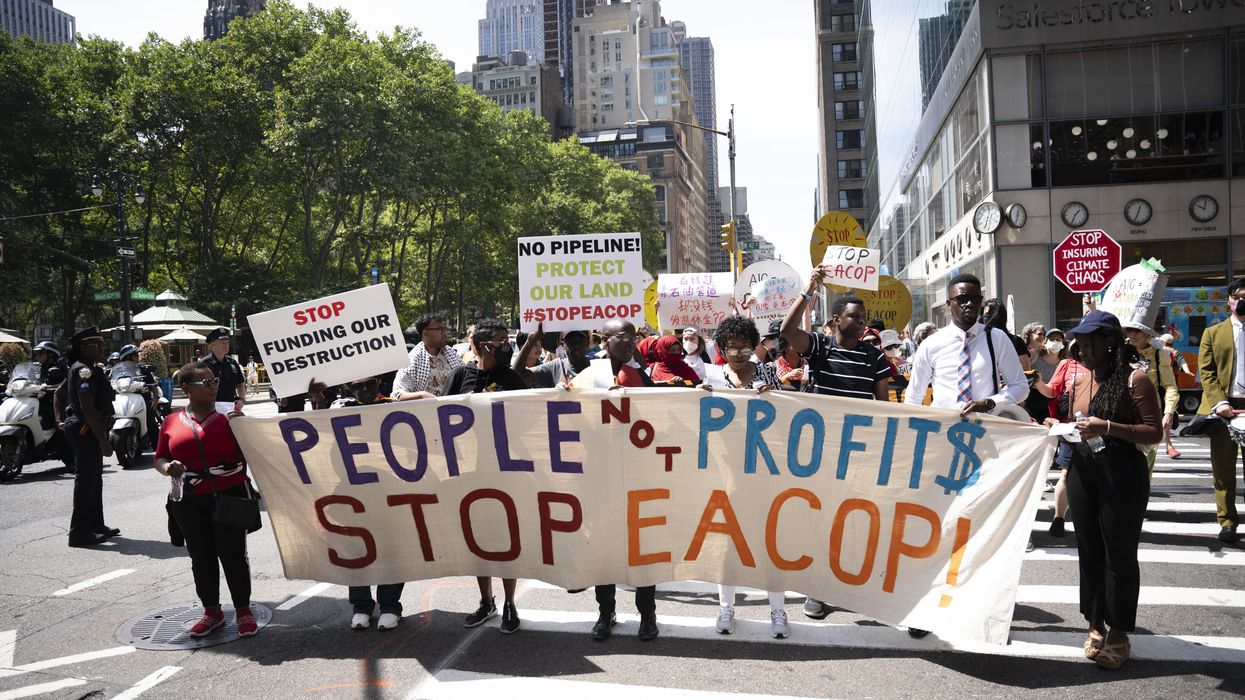
"We will continue to stand in solidarity and fight together with our African comrades to stop EACOP, to stop the plunder of our homelands, to stop the displacement of our peoples, and to stop imperialist climate destruction."
The "Summer of Heat" continues—both in terms of record-breaking temperatures driven by fossil fuels and a series of nonviolent direct actions targeting Wall Street for its contributions to the climate emergency.
After protests last month calling out Citibank for "financing the arsonists," climate campaigners on Friday set their sights on finance and insurance giant AIG for "stubbornly" refusing to join over two dozen other insurers that won't cover the East African Crude Oil Pipeline (EACOP).
EACOP is set to run nearly 900 miles from Uganda's Lake Albert oilfields to the port of Tanga in Tanzania. Rights groups have sounded the alarm about how the project has devastated the lives and livelihoods of people in its path as well as violence endured by African activists, who have been "kidnapped, arbitrarily arrested, detained, or subjected to different forms of harassment."
Ugandan climate activist Hillary Taylor Seguya declared Friday that "EACOP is a carbon bomb being built in my backyard."
"Thousands of communities in Uganda are being displaced because of corporate greed," added the campaigner, who is affiliated with StopEACOP. "Today, as Ugandans, as Tanzanians, as Africans, we want to be loud and clear that we shall not allow any pipeline to put oil in our backyards."
Friday's demonstration targeting AIG's office in New York City was organized by activists from the Ugandan diaspora and groups including 350.org, the Black Hive, and Desis Rising Up and Moving (DRUM).
"I am here to ask AIG to refuse to insure EACOP, and to insure our future instead," said Joseph Senyonjo, a Ugandan diaspora activist. "AIG is one of the biggest insurance companies in the world, and they still haven't ruled out insuring EACOP. So we are here to say: We don't want carbon bombs, we don't want fossil fuels. We want renewable energy. Insure our futures instead."
Protesters held signs and banners with messaging that included: "AIG = Climate Crimes," "Protect Our Land," "People Not Profits," "Stop Funding Our Destruction," "Stop Insuring Climate Chaos," and "The People Say: Stop EACOP!"
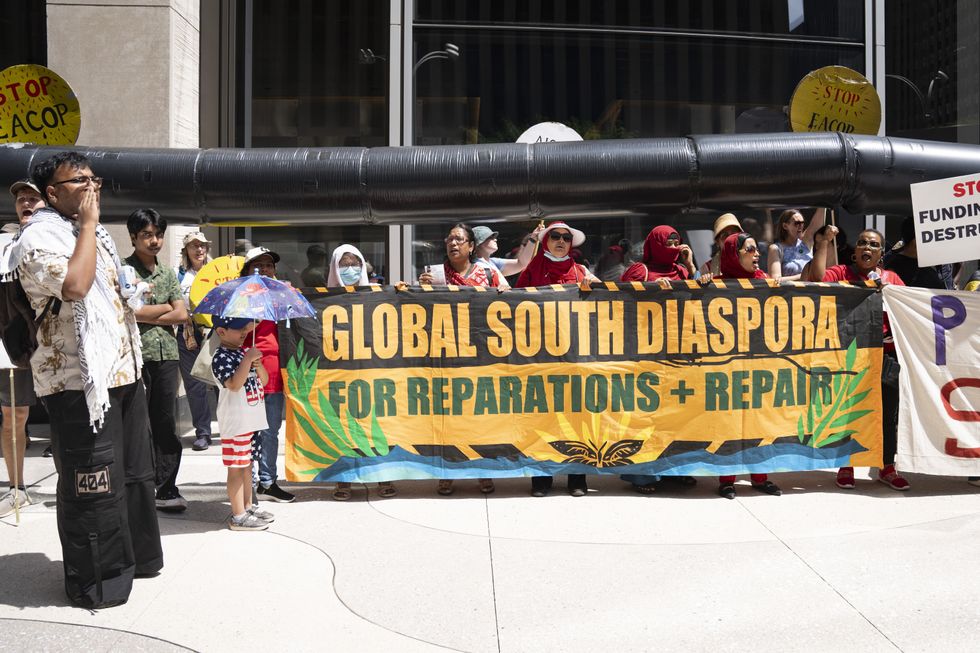 Demonstrators hold banner that says, "Global South Diaspora for Reparations + Repair," while protesting AIG and EACOP in New York City on July 26, 2024. (Photo: 350.org)
"From the pipeline's path in East Africa, to the corporate offices here, to our government institutions, we need to make our message clear: Stop EACOP!" said Evan Bell of 350 Mass. "I am willing to do what it takes to make sure AIG does not insure EACOP."
Bell noted that he is afraid of the New York Police Department, "especially after their brutal response to campus protesters peacefully demonstrating for an end to genocide in Gaza."
"But I am more afraid of runaway climate change," he added. "I'm more concerned about the current human rights abuses in Uganda and Tanzania. But we are more determined than we are scared."
Molly Ornati of 350 Brooklyn emphasized that "the EACOP pipeline is a doubly destructive disaster—for the people of Uganda and Tanzania, and the planet. The construction of the 900-mile pipeline will disrupt and destroy the homes, land, and livelihood of 100,000 people along the route, as well as the surrounding water and ecosystems."
"Once built, it will be a carbon bomb for humanity," Ornati warned. "In the climate crisis there are no borders, and we are a global movement, united in support of frontline communities, fighting to stop the greed of fossil fuel finance."
DRUM's Mohiba Ahmed delivered a similar message of unity, saying that "we add our communities' voices to the growing international demand 'Stop EACOP!' because we know that our struggles are one and interconnected."
"Our peoples in Bangladesh, Pakistan, Nepal, Guyana, and Trinidad are similarly harmed by foreign domination, imperialism, and capitalist projects that reduce our lives to investments, profit margins, and coins," she stressed.
"Our people and homelands contribute the least to the human-caused climate crisis but disproportionately suffer the most," she added, "and that is why we will continue to stand in solidarity and fight together with our African comrades to stop EACOP, to stop the plunder of our homelands, to stop the displacement of our peoples, and to stop imperialist climate destruction."
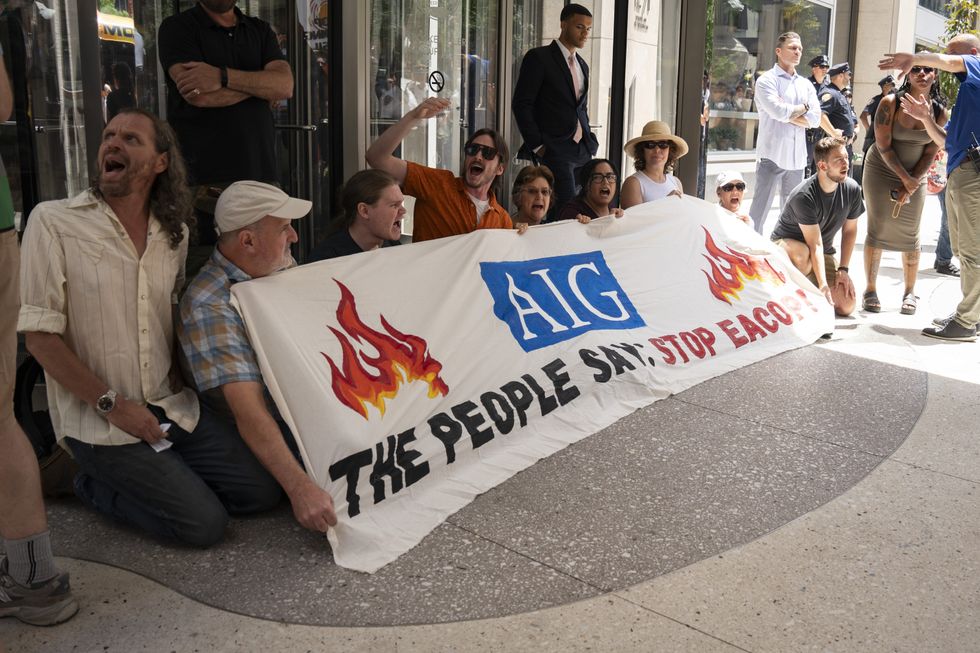 Opponents of EACOP block AIG's office with a banner in New York City on July 26, 2024. (Photo: 350.org)
Beth Yirga of the Black Hive—part of the Movement for Black Lives—highlighted the frontline resistance to the pipeline, declaring that "we stand with Ugandans and Tanzanians, whose bravery and stories of resistance to stop EACOP are inspiring."
"The climate crisis we are facing exacerbates the oppressive systems designed to extract the most from our planet and global majority community, and unites us that are most impacted," she said. "From Cancer Alley on the riverbanks of the Mississippi River to the lead in Flint, Michigan's water, to the attempts of crude oil extraction in Western Uganda, to the ongoing cobalt mining crisis in Congo, the destructive practices of environmental racism on Black communities is collectively held and felt across the world."
"As we fight to stop climate injustices globally," Yirga added, "we also collaborate to imagine and build a world free of the capitalistic pillaging of Mother Earth."
"Speaking up for frontline communities should never lead to this," the #StopEACOP movement said following the release of Stephen Kwikiriza, who was held for a week for opposing the TotalEnergies/CNOOC-led project.
Opponents of a highly controversial oil pipeline under construction in East Africa on Monday demanded an investigation into the Ugandan army's treatment of an environmental activist who was hospitalized after allegedly being severely beaten while he was detained last week.
Stephen Kwikiriza, an activist with the Kampala-based Environmental Governance Institute (EGI), was found dumped on the side of a highway about five hours' drive from the Ugandan capital Sunday night following a weeklong detention by the country's army.
"Unfortunately, he is in poor condition after enduring severe beatings, mistreatment, and abuse throughout the week," EGI said, according to Al Jazeera. "Doctors are conducting various examinations."
Like other climate and environmental campaigners in the movement to stop the East African Crude Oil Pipeline (EACOP), Kwikiriza is believed to have been targeted for his activism against the project, which is being built by the French fossil fuel giant TotalEnergies in partnership with the China National Offshore Oil Corporation (CNOOC), the Uganda National Oil Company, and others.
The Paris-based International Federation for Human Rights (FIDH) said Kwikiriza was apparently abducted by Ugandan army officers in civilian clothes in what the group called a "particularly worrying escalation of repression."
FIDH said 11 activists have been "kidnapped, arbitrarily arrested, detained, or subjected to different forms of harassment by the Ugandan authorities between May 27 and June 5, 2024," part of what critics call a government campaign targeting StopEACOP campaigners that goes back years.
"Speaking up for frontline communities should never lead to this," the StopEACOP movement
said on social media following Kwikiriza's release. "We urge human rights organizations to hold Ugandan authorities accountable and ensure human rights and environmental defenders can work safely."
"We also ask TotalEnergies and CNOOC to investigate the injustices done in their names as alleged," the coalition added. "You can still make profits without harming communities or enabling human rights violations."
A senior Ugandan military official told Agence France-Presse that Kwikiriza "was taken into custody for questioning regarding his illegal activities, including mobilizing fellow activists to oppose the oil pipeline."
In a statement to
Reuters, TotalEnergies said Monday that the company "does not tolerate any threat or attack against those who peacefully defend and promote human rights."
If completed, the $3.5 billion, nearly 900-mile EACOP project is expected to transport up to 230,000 barrels of crude oil per day from fields in the Lake Albert region of western Uganda through the world's longest electrically heated pipeline to the Tanzanian port city of Tanga on the Indian Ocean.
A July 2023 report by Human Rights Watch (HRW) detailed how EACOP has devastated the lives and livelihoods of tens of thousands of people in its path while exacerbating the climate emergency.
"The Ugandan government needs to end its harassment of opponents of oil development in the country, such as the East African Crude Oil Pipeline Project, which has already devastated thousands of people's livelihoods in Uganda and, if completed, will displace thousands of people and contribute to the global climate crisis," HRW senior environmental rights advocate Myrto Tilianaki said in a statement issued during Kwikiriza's detention.
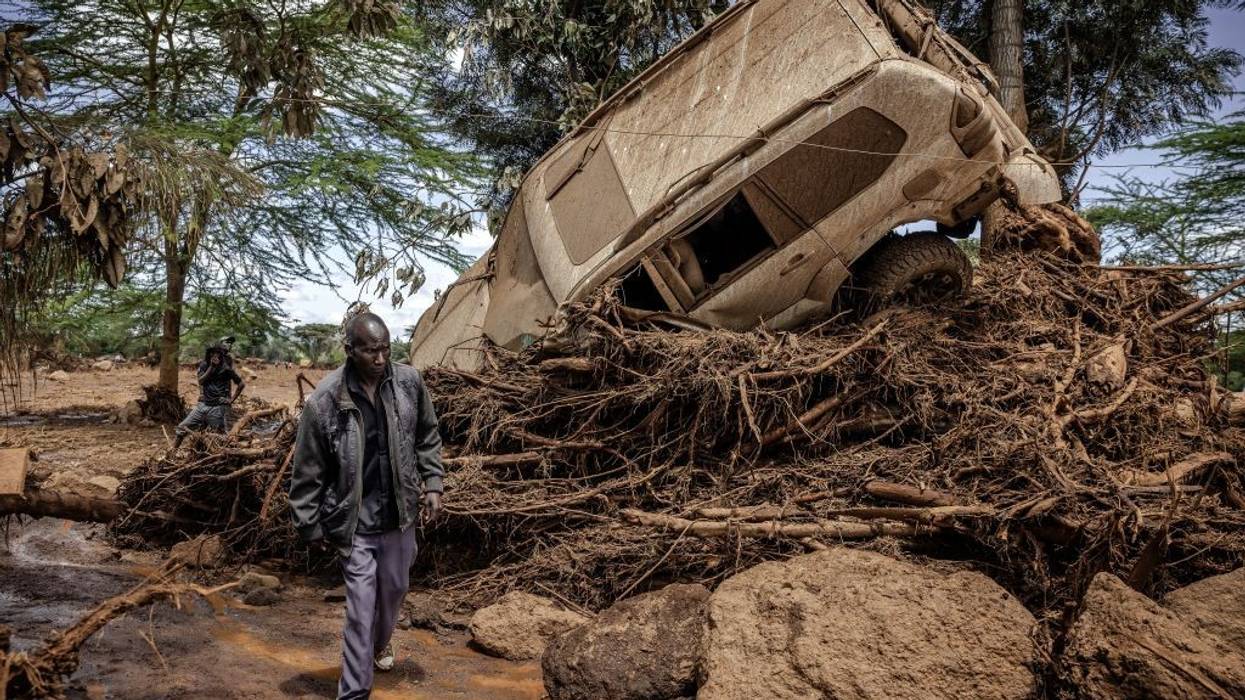
"The ongoing floods in East Africa are the present and future if we don't accelerate the energy transition to renewables," said one African climate campaigner.
The United Nations migration agency warned Wednesday that extreme flooding caused by weeks of torrential rain has triggered widespread displacement in half a dozen East African countries, with hundreds of thousands of people affected and more than 200,000 displaced over the past five days alone.
The International Organization for Migration (IOM) said that more than 637,000 people in Burundi, Kenya, Rwanda, Somalia, Ethiopia, and Tanzania have been affected and at least 234,000 people have been displaced as "torrential rains have unleashed a catastrophic series of events, including flooding, mudslides, and severe damage to vital infrastructure such as roads, bridges, and dams."
"These disasters have not only claimed numerous lives but have also escalated the suffering of the affected populations and heightened the risk of waterborne diseases," IOM added.
At least 238 people have died in Kenya alone, with many more injured. Kenyan President William Ruto has declared a day of mourning on Friday.
"No corner of our country has been spared from this havoc," Ruto said in a May 3 address to his nation. "Sadly, we have not seen the last of this perilous period as this situation is expected to escalate."
While Africa is responsible for less than 4% of global greenhouse gas emissions—the lowest share on the planet—the continent is suffering disproportionately during the worsening planetary emergency, with 17 of the 20 countries most threatened by global heating located on the continent of nearly 1.5 billion people.
East Africa and the Horn of Africa are particularly affected. Yet fossil fuel projects including the East African Crude Oil Pipeline (EACOP)—which, if completed, will transport up to 230,000 barrels a day of crude oil nearly 900 miles from fields in the Lake Albert region of western Uganda to the Tanzanian port city of Tanga on the Indian Ocean—continue apace.
Meanwhile, activists who oppose projects like EACOP face persecution and even arrest.
"The unprecedented and devastating flooding has unveiled the harsh realities of climate change, claiming lives and displacing communities," IOM East and Horn of Africa Regional Director Rana Jaber said in a statement. "As these individuals face the daunting task of rebuilding, their vulnerability only deepens."
"In this critical moment even as IOM responds, the call remains urgent for sustainable efforts to address human mobility spurred by a changing climate," Jaber added.

If insurance companies updated their policies and refused to insure new fossil fuel projects like the East African Crude Oil Pipeline, there would be no new oil pipelines, liquefied natural gas terminals, or dirty coal mines.
2023 was a record-breaking year for all the wrong reasons. "The hottest in 125,000 years, it brought more $1 billion extreme weather events than ever recorded.
Wildfires raged on multiple continents, including Canadian forest fires so intense that they caused smoky skies across the United Kingdom and central Europe. Floods swept homes away, and a flood in Libya killed more than 11,300 people. Storms, hurricanes, and droughts have increased at a violent pace, devastating communities, lives, and crops.
Having grown up on a farm in Uganda, I have seen the damage of the climate crisis firsthand. My family lived in a small village near the banks of Lake Victoria, the second largest freshwater lake in the world, and my childhood was spent climbing trees, planting seeds, and eating fruit straight from the trees. We grew bananas, guavas, beans, cassava, sugarcane, and coffee. It sounds idyllic but I remember the first time I realised climate change would affect us—it was a rainy season unlike any we had seen before. For days and nights heavy rain battered the fields and strong winds bent and broke the crops until they were unsavable. Not only did the rains affect us financially, but I missed months of my schooling because flooding blocked the roads and I couldn’t get to school.
The insurance industry’s role is to protect and manage risk, but right now it is failing spectacularly at both.
Burning fossil fuels, which releases carbon pollution into the air and causes our world to overheat, is the number one cause of the climate chaos we’re facing. 2024 may be even hotter than 2023, resulting in even more catastrophic weather.
But there is still hope. Those with power must act now, and the insurance industry holds more power than most to slow the crisis and protect our future. Without insurance, fossil fuel projects can’t operate. If insurance companies updated their policies and refused to insure new fossil fuel projects, there would be no new oil pipelines, liquefied natural gas terminals, or dirty coal mines. If they focused instead on insuring clean, safe energy and a just transition, our communities and our world would be safer for current and future generations.
The insurance industry’s role is to protect and manage risk, but right now it is failing spectacularly at both. Instead of protecting communities, it’s adding fuel to the fire by continuing to insure new fossil fuel projects. The East African Crude Oil Pipeline (EACOP) is a prime example. This proposed pipeline would run 1,443 kilometers between Hoima in Uganda and Tanga inTanzania, but the project has stalled as it has not yet secured full insurance and financing due to the many human and environmental rights abuses associated with it. These include the harassment and imprisonment of peaceful protesters, the disturbing of sacred burial grounds, and the forcible removal of communities to make way for the pipeline. If EACOP gets insured and goes ahead, it will cross 200 rivers and pass through Lake Victoria’s water basin. Over 40 million people depend on the lake for survival, as well as countless animal species; if the pipe leaks and spills oil into the water, what will happen to them?
The corporations behind EACOP say it will “unlock East Africa’s potential,” but let’s be clear: It is neocolonialism at its best, and the only ones who will gain are the foreign companies set to profit. EACOP will irrevocably damage East Africa’s biodiversity, displace thousands of people, destroy their livelihoods and communities, and unleash 32.3 million metric tons of carbon into the atmosphere per year, setting off a climate bomb that will make our world overheat to devastating levels. The International Energy Agency has stated that there can be no new oil pipelines if we are to save the future, and yet insurance companies including AIG, Tokio Marine, Chubb, Hiscox, and Lloyd’s of London still refuse to rule out insuring EACOP.
We have been campaigning to stop EACOP since it was announced in 2013, and so far 28 global insurers have ruled out involvement in the dangerous project. Even the Minister of Energy and Mineral Development for Uganda, Ruth Nankabirwa, acknowledged that difficulties obtaining insurance have been a key reason that the project has stalled. This is a huge win for our communities, but we need all major (re)insurers to rule out supporting such a dangerous new oil pipeline to make sure that it never gets built. And to do that, we need your help.
I have been arrested, threatened, and called a traitor to my country for fighting for our collective future, but I won’t stop because I know what is at risk if we don’t win. My family no longer owns a farm, and I no longer play at being a farmer; instead, I plant seeds in a different way. I am proud to be a climate activist. I believe that the work we do now will grow into a brighter tomorrow, that hope will bloom into action, and that together we can push the insurance industry to be the heroes the world needs now, because later is too late. Please join the Insure Our Future Global Week of Action through March 3 and add your voice to the demand for AIG, Tokio Marine, Lloyd’s of London, and other global insurers to publicly step away from EACOP.

"As Africans, we need to show TotalEnergies the red card," said one climate campaigner.
As the African Cup of Nations soccer tournament gets set to kick off in Côte d'Ivoire this weekend, Greenpeace on Friday satirically skewered French oil giant TotalEnergies, the event's main sponsor, for "greenwashing" its harmful impacts on the people of Africa and the global climate.
In a cheeky three-minute parody video, Zimbabwean comedian Munashe Chirisa and British writer and performer Jolyon Rubinstein play Total executives "wilfully exploiting AFCON's millions of global viewers to boost its image, while continuing to profit from climate-wrecking fossil fuel extraction across the continent."
"The beautiful game is a chance to show how much we care about Africa, its coastlines, vast forests, and savannas, which sneakily might be hiding some oil we can suck back to Europe," the pair banter. "I mean, if it wasn't for the oil fields we plunder across your splendid continent, we wouldn't have made $6 million every 90 minutes."
"While you Africans have been going through a cost-of-living crisis, we have just recorded our most profitable year yet," they note. "Ka-ching!"
"So what if our industry produces enough oil to fill a stadium every three hours and 37 minutes," they ask. "We spend a tiny percentage of our budget sponsoring AFCON to keep you Africans happy whilst we blow the big bucks on planning massive carbon bombs that will blow up the continent."
The comedians continue: "Yes, the science says we need to stop all new drilling, but our shareholders say 'fuck that, fuck all of that.' Which is why we're the company with the most new oil and gas explorations on the whole African continent."
"You think you've seen droughts, famines, and forced migration? You ain't seen nothin' yet," they promise. "We're committed to turbocharging the climate crisis."
While Africa produces the world's lowest per-capita carbon emissions, the continent is suffering disproportionately during the worsening planetary emergency, with 17 of the 20 countries most threatened by global heating located on the continent of nearly 1.5 billion people.
"It's time to kick TotalEnergies out of our stadiums. Our passion for football runs deep, but so does our love for a clean, healthy Africa."
"Fossil fuels—the lifeblood of climate-wrecking companies like TotalEnergies—are poisoning the lungs of African athletes and soccer fans," Greenpeace Africa oil and gas campaigner Thandile Chinyavanhu said in a statement.
"Science says we must transition away from fossil fuels to clean energy. But Total continues to displace communities for new oil drilling, and spew toxins before shipping massive profits back to Europe," she continued. "Total is turning AFCON from a celebration of African unity into a grotesque greenwashing stunt."
"It's time to kick TotalEnergies out of our stadiums," Chinyavanhu added. "Our passion for football runs deep, but so does our love for a clean, healthy Africa."
Samm Farai Monro, co-founder of the group Kick Polluters Out and creative director of the Magamba Network, a Zimbabwe-based civil society organization, said that "TotalEnergies is guilty of foul play. They like to portray a clean, green image of themselves with their sponsorship of AFCON. But the reality is very different."
"At a time when scientists are telling us to stop any new fossil fuels projects, Total is developing more oil and gas resources in Africa than any other company," Farai Monro added. "As Africans, we need to show TotalEnergies the red card. We love football. We hate pollution!"
Greenpeace accuses Total of "a wave of destruction across the African continent," including the East African Crude Oil Pipeline (EACOP), which, if completed, will transport up to 230,000 barrels a day of crude oil nearly 900 miles from fields in the Lake Albert region of western Uganda to the Tanzanian port city of Tanga on the Indian Ocean.
In addition to exacerbating the climate emergency, EACOP and the related Tilegna oil field development would displace around 100,000 Ugandans and Tanzanians, according to a Human Rights Watch report published last year.
"The global energy crisis has been a giant cash grab for fossil fuel firms," said one campaigner. "And instead of investing their record profits in clean energy, these companies are doubling down on oil, gas, and shareholder payouts."
The year 2023 was marked by weather events that made it increasingly clear that the Earth has entered what United Nations Secretary General António Guterres called the "era of global boiling," with wildfires and prolonged heatwaves impacting millions of people and scientists confirming their suffering was the direct result of fossil fuel extraction and planetary heating.
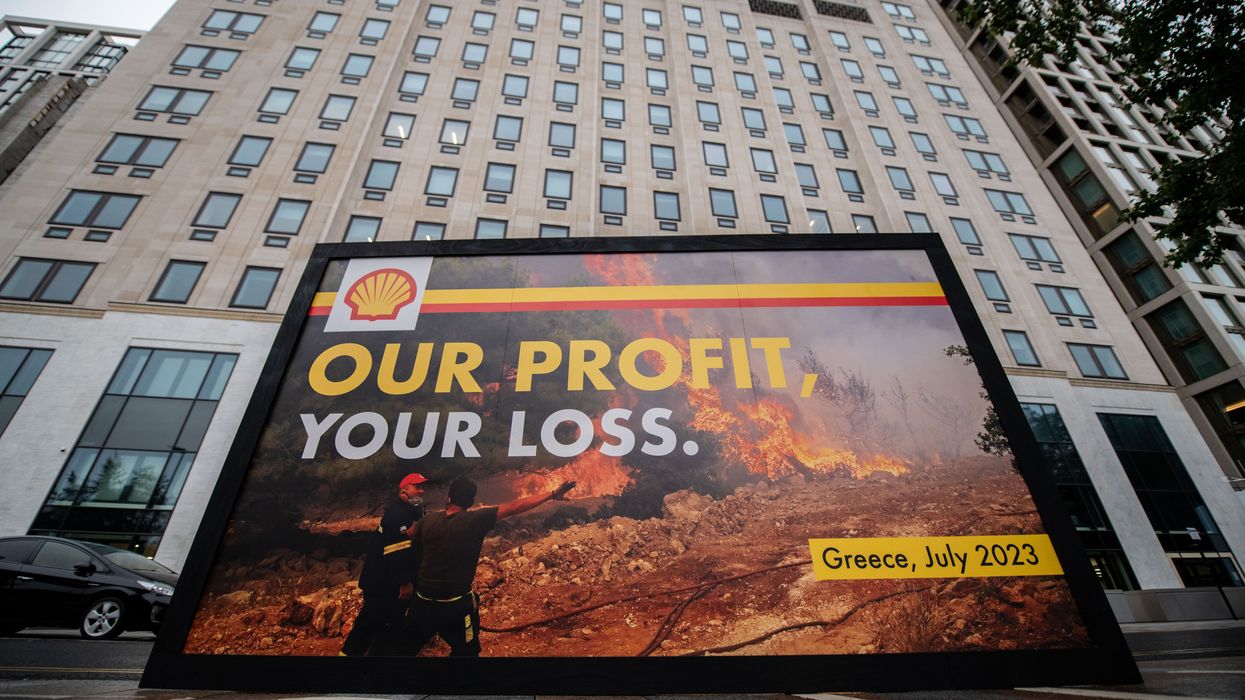
But for the world's five largest oil giants, the year marked record profits and the approval of several major new fossil fuel projects, allowing the companies to lavish their shareholders with payouts that are expected to exceed $100 billion—signaling that executives have little anxiety that demand for their products will fall, said one economist.
The companies—BP, Shell, Chevron, ExxonMobil, and TotalEnergies—spent $104 billion on shareholder payouts in 2022, and are expected to reward investors with even more in buybacks and dividends for 2023, The Guardian reported.
Shell announced plans in November to pay investors at least $23 billion—more than six times the amount it planned to spend on renewable energy projects—while BP promised shareholders a 10% raise in dividends and Chevron could exceed the $75 billion stock buyback it announced early last year.
Alice Harrison, a campaigner for Global Witness, noted that fossil fuel shareholders will be enjoying their paydays as households across Europe struggle with fuel poverty and the world faces the rising threat of climate disasters brought on by the industry.
"The global energy crisis has been a giant cash grab for fossil fuel firms," Harrison told The Guardian. "And instead of investing their record profits in clean energy, these companies are doubling down on oil, gas, and shareholder payouts. Yet again millions of families won't be able to afford to heat their homes this winter, and countries around the world will continue to suffer the extreme weather events of climate collapse. This is the fossil fuel economy, and it's rigged in favor of the rich."
In 2023 campaigners intensified their demands for accountability from the oil, gas, and coal industries, and as of last month had successfully pressured more than 1,600 universities, pension funds, and other institutions to divest from fossil fuels. In the U.S., provisions in the Inflation Reduction Act, which has been touted as the "largest investment in climate and energy in American history," went into effect.
But Dieter Helm, a professor of economic policy at the University of Oxford, The Guardian that if the industry were truly fearful of policymakers phasing out fossil fuel extraction and expediting a transition to renewable sources, they would be spending far less on new projects and shareholder payouts.
"For this to be the case you would have to believe that the energy transition is happening, and that demand for fossil fuels is going to fall," Helm told The Guardian.
In 2023, U.S. President Joe Biden infuriated climate campaigners by approving the Willow oil drilling project in Alaska, which could lead to roughly 280 million metric tons of heat-trapping carbon dioxide emissions. His administration also included in a debt limit deal language that would expedite the approval of the Mountain Valley Pipeline, which could emit the equivalent of more than 89 million metric tons of carbon dioxide, while the U.K. government greenlit a massive oil drilling field in the North Sea and French company TotalEnergies continued to construct the 900-mile-long East African Crude Oil Pipeline, which would transport up to 230,000 barrels of crude oil per day.
"These companies are investing a huge amount in new projects, and they're handing out bigger dividends because they are confident that they're going to make big returns," Helm said. "And when we look at the state of our current climate progress, who's to say they're wrong?"
Climate campaigner Vanessa Nakate pointed out that the shareholder paydays are expected following a deal on a loss and damage fund at the 28th annual United Nations Climate Change Conference, aimed at helping developing countries to fight the climate emergency. That fund was hailed as "historic" and included a commitment of $700 million from wealthy countries—a sum that is expected to be dwarfed by fossil fuel investors' profits.
"They have picked people's pockets, fueled inflation and pollution, and deepened poverty," U.K. House of Lords member and Tax Justice Network co-founder Prem Sikka said of the oil giants. "Governments do nothing to end their monopolistic control. Need to break-up this cartel."
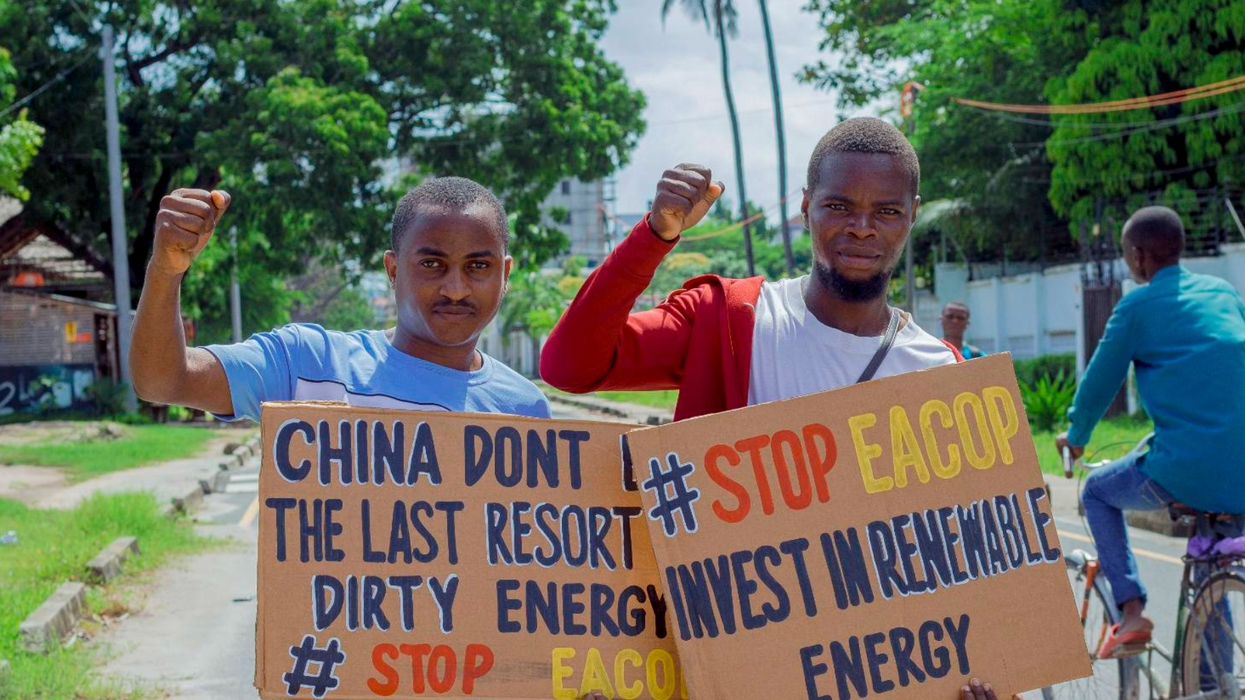
"The controversial EACOP project threatens pristine ecosystems, biodiversity hotspots, water resources, and community lands," said campaigners.
Campaigners assembled on Monday in four African countries and in Europe, rallying outside the headquarters of several Chinese financial institutions and embassies with one demand of Chinese officials: Withhold financing for the East African Crude Oil Pipeline.
The global campaign #StopEACOP has already helped push banks and insurers in North America, Europe, and Japan to refrain from getting involved in the project, which is being spearheaded by French multinational TotalEnergies and China National Offshore Oil Corporation.
Now, the state-owned China Export & Credit Insurance Corporation (SINOSURE), the Export-Import Bank of China (China Exim), and the Industrial and Commercial Bank of China (ICBC) are reportedly considering financially supporting the pipeline, which could lead to 379 million tons of fossil fuel emissions even as climate and energy experts warn there is no place for new gas and oil extraction on a pathway to limiting planetary heating to 1.5°C.
"Today, people stood united across borders to say this dangerous pipeline project must be stopped," said Zaki Mamdoo, #StopEACOP coordinator. "We urge SINOSURE, China Exim Bank, and the ICBC to listen to local communities and respect their rights, aspirations, and agency. By refusing to provide insurance or financing for EACOP, these entities must prove that they are not simply interested in profiting at the expense of Africa's well-being."
Organizers rallied at Chinese embassies in Dar es Salaam, Tanzania; Kampala, Uganda; Kinshasa, Democratic Republic of Congo (DRC); and Tshwane, South Africa. In London, United Kingdom, climate campaigners held a solidarity action outside the offices of SINOSURE and in Paris, France they rallied at the offices of the China Exim Bank and the ICBC.
The planned pipeline would run from Hoima, Uganda to Tanga, Tanzania, transporting oil from two oil fields and potentially connecting to oil blocks in the DRC.
"The controversial EACOP project threatens pristine ecosystems, biodiversity hotspots, water resources, and community lands," said #StopEACOP, as well as "contradicting global climate goals."
Campaigners had planned to deliver petitions opposing the 896-mile pipeline, as well as documents containing analysis of the socioeconomic and climate impacts of the project. According to #StopEACOP, the pipeline would run through the basin of Lake Victoria, which more than 40 million people depend on for food and water; displace landowners who say they have already faced threats and intimidation; and run through the habitats of endangered animals including lions, giraffes, roan antelopes, and sables.
#StopEACOP reported that officials at the embassies refused to receive the documents.
Organizers also denounced authorities for arresting seven advocates in Kampala.
"Every time activists and communities stand up to peacefully oppose EACOP in Uganda, they are brutalized and arbitrarily arrested," said Brian Atuheire, executive director of the African Initiative on Food Security and Environment (AIFE). "Today, seven young activists have been detained for peacefully protesting outside the Chinese Embassy in Kampala. Despite the repression, we remain resolute and have drawn strength and courage from the incredible show of solidarity from comrades worldwide."
Richard Senkondo, executive director for the Organization for Community Engagement, said any institution supporting EACOP "is perpetrating injustice."
"This pipeline will destroy our land and water—our very way of life," said Senkondo. "It poses a grave threat to the environment and the well-being and rights of our communities."
"We are united with allies around the world in our continued resistance against this harmful project," Senkondo added. "Instead of supporting such projects, we urge these Chinese institutions to be a true ally to the African continent by favoring the development of people-centered renewable energy to power Africa's future."
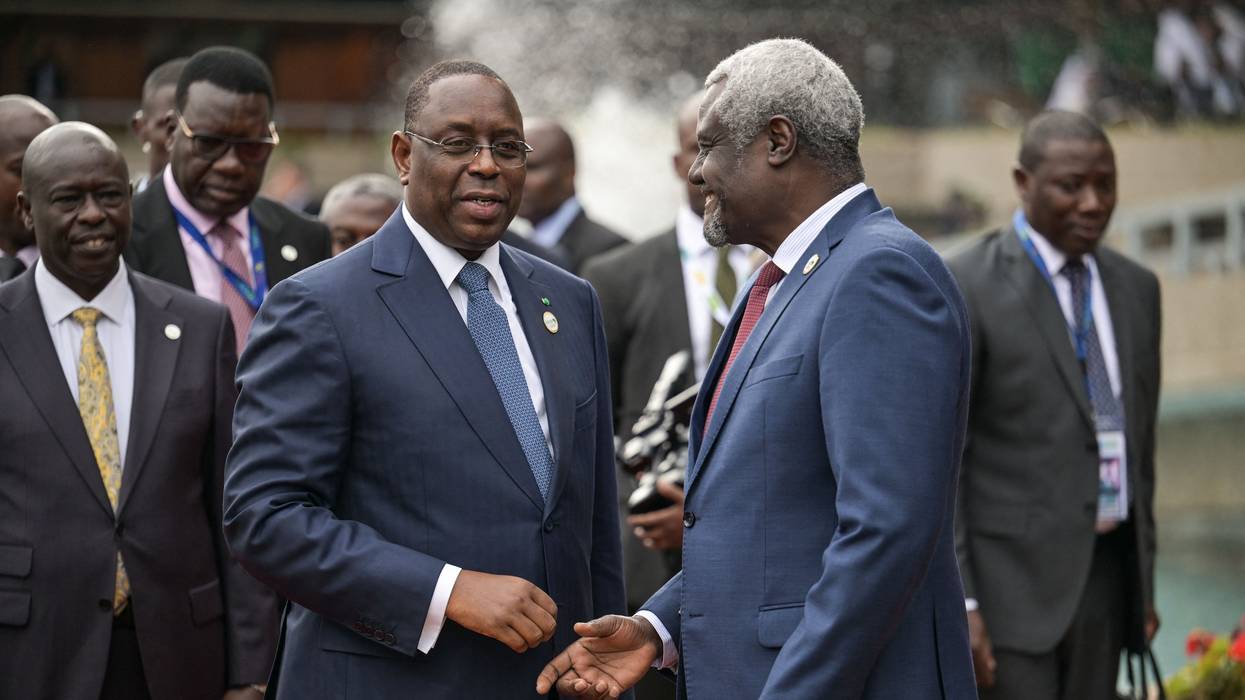
"The solutions do not lie with private capital and the age-old profit driven model," said one advocate.
The historic Africa Climate Summit held in Nairobi, Kenya this week marked the first time leaders from across the continent convened to focus on the climate crisis, but campaigners on Friday said the voices of the most vulnerable were largely silenced during the three-day summit while leaders drafted a declaration that critics say fell prey to "distracting false solutions."
While the Nairobi Declaration on Climate Change and Call to Action was applauded by advocates for its call to boost Africa's renewable energy capacity to 300 gigawatts (GW) by 2030, critics said leaders across the continent showed they are still too eager to bend to the interests and desires of the fossil fuel industry and its financial backers.
The declaration's demands include:
But groups including the think tank Power Shift Africa (PSA) said the commitment of hundreds of millions of dollars by international governments and development banks for carbon markets initiatives were "essentially, a diversion, and even wastage, of money that could go into investment in real climate solutions."
PSA called the African Carbon Market Initiative "a wolf in sheep's clothing" in a report released this month, warning that "polluters and investors" have for decades promoted carbon markets—in which fossil fuel companies claim to "offset" emissions by investing in conservation initiatives or sustainability—but the system enables "the wealthy to continue polluting, while giving an illusion of commensurate carbon neutralization through questionable accounting methodologies."
As Al Jazeera reported, the continent earns less than $10 per ton of carbon removed from the atmosphere in its existing market initiatives, while other regions can receive over $100.
Joab Bwire Okanda, a senior adviser at Christian Aid, welcomed the declaration's call for a global carbon tax but told the BBC that "to make polluters really pay, false solutions like carbon credits that allow polluters a free ride without taking meaningful action need to be consigned to the dustbin."
350.org said the summit should have ended with a renewable energy commitment that was far greater than 300 GW by the end of the decade, calling for 11,000 GW—"the level required to limit global heating to 1.5°C" over preindustrial levels.
"This is a good starting point, but it falls short of expectations," said Charity Migwi, regional campaigner for 350Africa.org. "As Africans grapple with the debilitating impacts of the climate crisis, African leaders engage in rhetoric and false solutions such as fossil gas and carbon markets that seek to delay meaningful climate action and the much-needed just transition away from fossil fuels, that is central to the fight against the climate crisis. African nations must walk the talk in regards to limiting global warming by shunning fossil fuels."
Zaki Mamdoo, campaign coordinator for StopEACOP, which aims to end French oil company TotalEnergies' East African Crude Oil Pipeline (EACOP) project, said the Nairobi Declaration "says little about the need to halt the development of new fossil fuels on the continent," even after a Human Rights Watch report in July showed the project has threatened the homes of more than 100,000 people in Tanzania and Uganda, caused food insecurity, and pushed children to leave school while also likely having "devastating environmental effects."
"This summit has provided a platform for governments to flirt with big business while [advocacy groups], trade unions, [and] youth organizations are confined to the fringes with little influence on the outcome of high-level deliberations," said Mamdoo. "If we are to use the crisis of climate as an opportunity to simultaneously uplift our people out of poverty and ensure the well-being of all—then we need the interests of these groups to be at the forefront of decision-making. The solutions do not lie with private capital and the age-old profit driven model."
Others agreed that "local voices" of people who have been most impacted by the climate emergency were missing from the summit.
"Their stories of hope, perseverance, suffering, and disaster were glaringly absent, hidden away behind security barriers and military armament," said Yegeshni Moodley, climate and energy justice campaign lead for Friends of the Earth South Africa. "The use of top-down, technocratic false solutions negates the value of local knowledge and traditional practices that have sustained generations on their land. We must decry and lament the situation Africa has been placed into, where her lands and riches are once again being sold away to the distress and poverty of her people.”
People across the continent are facing the effects of the climate crisis, which has been blamed for a famine in Madagascar and has forced more than 1 million people in Somalia to leave their homes as a prolonged drought has overtaken the country.
Advocates say that Africa must be recognized as a key ally in providing solutions to the climate emergency rather than cast aside as a victim.
"Our leaders need to know that people across Africa are waking up to what needs to be done," said Essoklnam Pedessi of the Renewable Energy Coalition in Togo. "We are calling for less talk and more action. We need to break away from the failed approaches and distracting false solutions. Africa has abundant wind and solar to power up for 100% renewable energy."
"What it needs," she added, "is climate funding to unlock this potential."

"We have an abundance of clean, renewable energy," said one African activist. "But to unlock it, Africa needs funding from countries that have got rich off our suffering."
As the first-ever Africa Climate Summit kicked off in Nairobi, Kenya on Monday, an analysis by the humanitarian group Oxfam found that rich nations have delivered just a small fraction of the aid that East African nations say they need each year to meet their climate goals.
Unlike rich countries that account for a disproportionate share of planet-warming greenhouse gas pollution, East Africa has contributed "almost nothing" to global carbon emissions that are driving record-shattering heat worldwide, Oxfam's new report notes. In 2021, according to one recent estimate, the average North American emitted 11 times more carbon dioxide than the average African.
The World Meteorological Organization pointed out Monday that Africa is responsible for less than 10% of global carbon emissions.
Yet "East Africa is one of the world's worst-hit regions by climate change and is now experiencing its worst climate-induced extreme weather, fueling an alarming hunger crisis," Oxfam's report states. "Over 31.5 million people are currently facing acute hunger across Ethiopia, Kenya, Somalia, and South Sudan."
Those countries, which suffer billions of dollars worth of climate-related damage each year, have said they will need at least $53.3 billion annually to meet critical targets under the Paris Climate Agreement. According to Oxfam, wealthy countries provided just $2.4 billion in aid to East African nations in 2021.
More broadly, Oxfam noted, high-income countries pledged that they would provide $100 billion a year by 2020 to help lower-income countries fight climate chaos.
"Oxfam estimates that in 2020 the real value of financial support specifically aimed at climate action was only around $21 billion to $24.5 billion—much less than officially reported figures suggest," the group's report states.
Fati N'Zi-Hassane, Oxfam's Africa director, said Monday that "even by their own generous accounts, polluting nations have delivered only pittance to help East Africa scale up their mitigation and adaptation efforts."
"Nearly half the funds (45%) they did give were loans, plunging the region further into more debt," N'Zi-Hassane added.
Climate finance is expected to be a major topic of discussion at the Nairobi summit, which comes after months of scorching heat on the continent.
"Africa is seen as a sunny and hot continent," Amadou Thierno Gaye, a research scientist and professor at Cheikh Anta Diop University in Dakar, told Bloomberg in July. "People think we are used to heat, but we are having high temperatures for a longer duration. Nobody is used to this."
The Associated Press reported Monday that "there is some frustration on the continent about being asked to develop in cleaner ways than the world's richest countries—which have long produced most of the emissions that endanger climate—and to do it while much of the support that has been pledged hasn't appeared."
Mohamed Adow of Power Shift Africa told AP that "we have an abundance of clean, renewable energy and it's vital that we use this to power our future prosperity. But to unlock it, Africa needs funding from countries that have got rich off our suffering."
In addition to calling on rich nations to contribute the aid they've promised to support Africa's renewable energy transition, African civil society groups are urging their leaders to reject fossil fuel expansion, specifically warning against the completion of TotalEnergies' East African Crude Oil Pipeline (EACOP).
A recent Human Rights Watch report warned that more than 100,000 people in Uganda and Tanzania are set to "permanently lose land to make way for the pipeline and Tilenga oilfield development." One analysis indicates the pipeline could result in 379 million tonnes of planet-warming emissions over its lifespan—more than 25 times the combined annual emissions of Uganda and Tanzania.
Zaki Mamdoo, coordinator of the Stop EACOP Coalition, said Monday that "the African Climate Summit could provide the platform needed for the continent to dramatically shift its trajectory and future—from one that is set to bear the brunt of climate collapse, to one of energy security and prosperity driven by decentralized and people-centered renewables."
"For this to happen," said Mamdoo, "African leaders will need to rise to the occasion and make firm commitments to significantly upscale renewable energy developments while resisting and withdrawing any and all support for exploitative and destructive projects like the East African Crude Oil Pipeline."