

SUBSCRIBE TO OUR FREE NEWSLETTER
Daily news & progressive opinion—funded by the people, not the corporations—delivered straight to your inbox.
5
#000000
#FFFFFF
To donate by check, phone, or other method, see our More Ways to Give page.
Daily news & progressive opinion—funded by the people, not the corporations—delivered straight to your inbox.
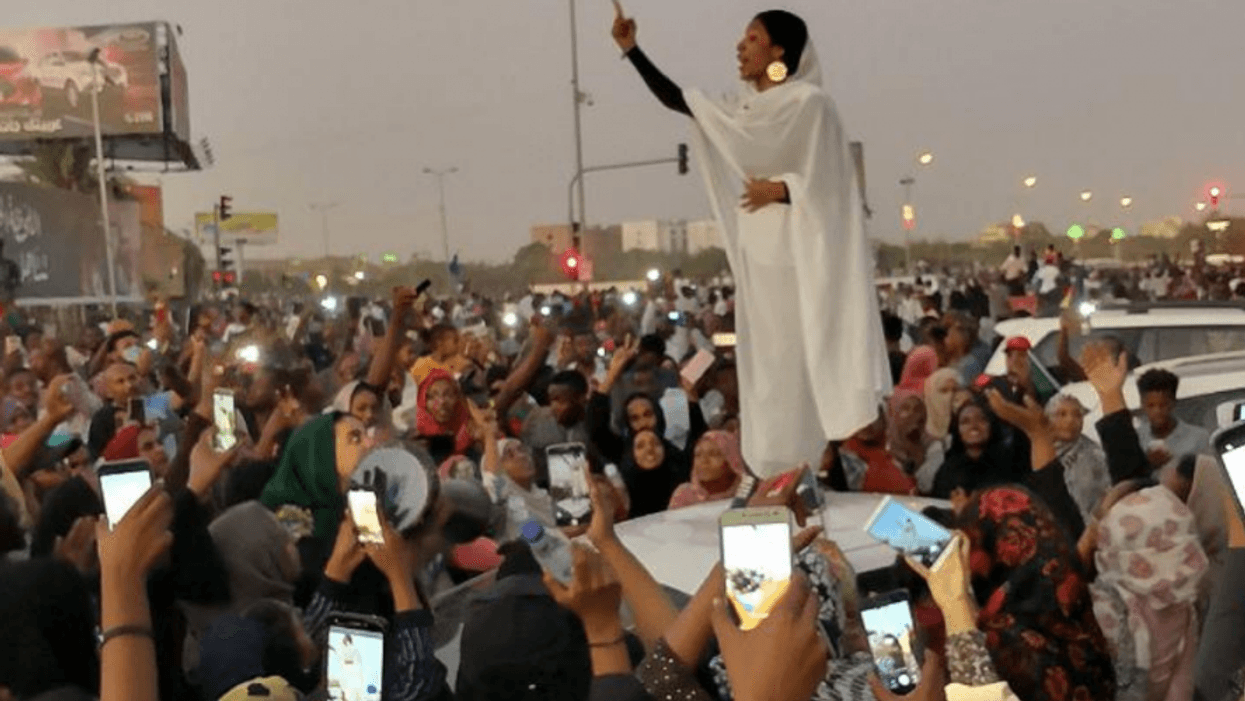
"Al-Shebab," said my student Jerry early in the fall 2010 semester. "We're calling our small group al-Shebab. It means 'The Youth.'" From his name alone, I wouldn't have guessed his background, but he was proud of his family's Egyptian roots and had convinced his classmates to give their group an Arabic name.
As usually happens when the semester ends and my dozens of students scatter, Jerry and I lost touch. The following April, however, we ran into each other at a rally organized by students at my university to support the Arab Spring. Like many others around the world, I'd watched transfixed as brave unarmed civilians faced down riot police on the bridges leading to Cairo's Tahrir Square. I'd celebrated on February 11, 2011, when the corrupt and authoritarian Egyptian president Hosni Mubarak resigned as the military took control of that country.
Jerry's eyes sparkled when he saw me. "Isn't it amazing?" he shouted. Yes, it was amazing... until it wasn't.
This spring, eight years later, there has been a new set of popular uprisings in northern Africa, from Algeria to Morocco, to Sudan. Let's hope they have more lasting success than Egypt's Arab Spring.
It's All About the Military
The victory over Hosni Mubarak was indeed amazing, perhaps too amazing to last, since the real arbiter of events in Egypt was then, and continues to be, its military. In the parliamentary elections of November 2011, the long-suppressed Muslim Brotherhood took almost half that body'sseats. In June 2012, the Brotherhood's candidate, Mohammed Morsi, became the country's first elected president, winning a runoff race with just under 52% of the vote.
That August, Morsi made the move that would eventually doom him, replacing his defense minister with Lieutenant General Abdel Fattah el-Sisi. He also quickly turned in an increasingly autocratic direction, issuing decrees granting himself more power and proposing a new constitution that would do the same (which was approved by more than 60% of the voters in a low-turnout referendum).
By June 2013, many Egyptians were frustrated both with Morsi's increasingly authoritarian rule and the stagnation of the economy. Once again, millions of people gathered in Cairo, this time to call for his removal, at which point the military pushed him out, installing the head of the constitutional court, Adly Mansour, as interim president. Muslim Brotherhood supporters responded with violent attacks, burning police stations and government buildings. The government repression that followed was fierce enough that, in October 2013, the Obama administration suspended the further transfer of U.S. military equipment to Egypt. Eventually, new elections were held and, in May 2014, Morsi's Defense Minister, el-Sisi, won the presidency with a suspicious 96.9% of the vote. By then, the Muslim Brotherhood had been outlawed and would soon be declared a terrorist organization.
In April of this year, el-Sisi, running essentially unopposed, was reelected. Never one to slight an authoritarian ruler, President Trump immediately called to congratulate him and then invited him to the White House to discuss "robust military, economic, and counterterrorism cooperation" between the two countries. A few weeks later, in a "snap referendum," the Egyptian constitution was altered to allow el-Sisi to retain the presidency until at least 2030 -- essentially, that is, for life. That move also cemented the country's military, long its dominant economic power, as its sole political power, too.
Trump Goes A-Wooing in the Middle East and North Africa
From Russia's Vladimir Putin to Brazil's Jair Bolsonaro, the American president who "fell in love" with North Korea's Kim Jong-un has rarely met an autocrat he didn't take to (though his bromance with Kim may finally be souring). So, it's no surprise that el-Sisi's trip to Washington was a success and his country is now on course to remain the second-largest recipient of U.S. aid after Israel. Ninety-four percent of that aid goes to "peace and security" -- in other words, to Egypt's military and police.
Trump is, however, distinctly polyamorous when it comes to Middle Eastern and North African (MENA) autocratic types, as his long-standing love affair with Israel's recently reelected prime minister, Benjamin (Bibi) Netanyahu, indicates. Given Trump's own history of racism, Bibi's embrace of Israel's 2018 "Nation-State" law undoubtedly only turned up the heat on their relationship. This infamous legislation moves Israel further in the direction of apartheid. It legalizes Jewish-only communities, demotes Arabic from its status as an official language, and states that "the right to exercise national self-determination" in Israel is "unique to the Jewish people."
While the world waits less than breathlessly for Jared Kushner's long-promised Israel-Palestine peace plan, President Trump keeps gift-wrapping pieces of disputed territory and handing them directly to Bibi in his own spontaneous version of an Israel First peace plan. In December 2017 came the announcement of his administration's decision to move the U.S. embassy in Israel from Tel Aviv to Jerusalem. Trump claimed that "recognizing Jerusalem as Israel's capital would advance the peace process and make a permanent status agreement between the two sides easier." Maybe he saw this as a move towards peace because it unilaterally took the ultimate status of Jerusalem, one of the pieces in any such plan, off the Israeli-Palestinian playing board.
Next up came the Golan Heights, a slice of territory on Syria's western border, captured by Israel in 1967 during the Six Day War between Israel and Jordan, Syria, and Egypt. In 1981, Israel passed a law annexing the area, an act rejected by the U.N. Security Council, whose resolution stated that "the Israeli decision to impose its laws, jurisdiction, and administration in the occupied Syrian Golan Heights is null and void and without international legal effect." As a permanent member of the Security Council, the United States joined that unanimous vote. Nonetheless, this spring, just before a very close Israeli election, President Trump reversed longstanding policy and announced his recognition of Israel's annexation of the Heights. Happy Birthday, Bibi.
In the days before the election, Netanyahu then doubled down on annexation, proclaiming his intention to make Jewish settlements on the West Bank a permanent part of Israel along with the Golan Heights. In so doing, he'll be fulfilling Ariel Sharon's decades-old boast about Israel's intentions for the Palestinians:
"We'll make a pastrami sandwich out of them. We'll insert a strip of Jewish settlements in between the Palestinians, and then another strip of Jewish settlements right across the West Bank, so that in twenty-five years' time, neither the United Nations nor the United States, nobody, will be able to tear it apart."
Meanwhile, Trump seems to have developed a new crush, this time on a Libyan military figure the New York Times calls a "would-be strongman": 75-year-old self-styled "Field Marshal" Khalifa Hifter. Based in the eastern part of Libya, where he has been aligned with one of that divided land's several rival governments, Hifter, a former CIA asset, launched an attack on the capital, Tripoli, on April 5th. Though not successful so far, his assault has already caused hundreds of deaths, with more likely to follow.
A Mediterranean port in the northwestern corner of the country, Tripoli houses Libya's internationally recognized government headed by Prime Minister Fayez Sarraj, which doesn't actually do much governing. Ever since the Obama administration and NATO intervened to topple autocrat Muammar al-Gaddafi, power in Libya has been divided among multiple militias, including Hifter's military, and Islamist groups like ISIS.
When the field marshal attacked Tripoli, the initial Trump administration response was swift and negative. Secretary of State Mike Pompeo issued a statement indicating the opposition of "the administration at the highest levels," announcing that"we oppose the military offensive." He urged Hifter to immediately "halt... these military operations." His reaction accorded with that of "most Western governments and the United Nations," which, according to the New York Times, "have also condemned the attack and demanded a retreat."
Hours later, however, President Trump personally called Hifter (as National Security Advisor John Bolton had done earlier) and essentially encouraged him to keep up his assault on Tripoli. According to a White House statement:
"The President recognized Field Marshal Hifter's significant role in fighting terrorism and securing Libya's oil resources, and the two discussed a shared vision for Libya's transition to a stable, democratic political system."
Why is Donald J. Trump supporting a Libyan warlord, even as his move to take Tripoli seems to be failing? Perhaps because Hifter also has the support of Trump's other MENA buddies, Egypt's el-Sisi, the Saudi Arabian government of Crown Prince Mohammed bin Salman --which only recently executed 37 people (36 beheaded and one crucified), including several who confessed under torture and were minors at the time of their alleged crimes -- and the leaders of the United Arab Emirates. Those Arab powers are betting that Hifter can suppress any Libyan version of the Muslim Brotherhood. And there's one more autocrat backing Hifter, Trump's old flame Vladimir Putin. Indeed, for once Russia and the United States find themselves on the same side in the U.N. Security Council, where they joined to block a resolution demanding a ceasefire and condemning Hifter's military moves. Meanwhile, in a gesture of love for the Saudis, Trump vetoed a resolution passed with rare bipartisan congressional support that would have ended U.S. backing for the Kingdom's brutal war in Yemen.
For all his love of authoritarians, there is, however, one Middle Eastern nation that hasn't won Trump's affections: Iran. In May 2018, he pulled the United States out of the Joint Comprehensive Plan of Action (JCPA), an international accord under which Iran had agreed not to develop nuclear weapons. In return, economic sanctions on that country were eased, while it was allowed to resume selling oil on the international market, and regained access to billions of dollars in frozen assets overseas.
The JCPA's other signatories included Russia, France, Great Britain, and China, along with Germany and the European Union. None of them followed Trump's lead. Only recently, his administration has threatened sanctions against any country buying oil from Iran after May 1st, a move mainly affecting China, India, Japan, South Korea, and Turkey. This attempt to economically starve Iran into submission comes even as his administration declared that country's Revolutionary Guards a " foreign terrorist organization." As the hardliners in both lands face off, further escalation becomes increasingly, and dangerously, likely.
Spring Stirrings
As we brace for a possible future conflict with Iran (what could possibly go wrong?), it's sometimes easy for those of us who have spent our lives opposing U.S. military actions to forget that Washington isn't, in fact, behind every world event. Other peoples have their own struggles and their own agency -- on display this spring in two MENA countries that have long suffered under corrupt and authoritarian governments: Algeria and Sudan. (And there appear to be stirrings in Morocco, as well.)
Algeria: Every semester I show the students in my Ethics: War, Torture, and Terrorism class The Battle of Algiers. Director Gillo Pontecorvo's classic film depicts the first urban uprising against French colonial power by Algeria's National Liberation Front (FLN), brutally suppressed by France's paratroopers between1954 and 1957. It contains enough war, torture, and terrorism to fuel a semester's worth of conversation. Inevitably, students want to know what happened in Algeria after the French were finally driven out in 1962. "That," I tell them, "is a sad story."
Indeed it is. After leading Algerians to victory over France, the FLN ruled the country for almost two decades, mostly under military control after a 1965 coup. Following popular uprisings in 1988, a new constitution opened political space for other parties, while reducing the army's role in government. The most popular of those parties turned out to be the Islamic Salvation Front (FIS), which was devoted to a fundamentalist version of political Islam. When it appeared clear that the FIS would win both local and national elections, the FLN and the military stepped in to prevent it, resulting in a series of coups and an ongoing civil war.
Eventually, a new FLN leader, Abdelaziz Bouteflika, came to power in 1999 and never left. Earlier this year, he announced through intermediaries -- he has not been seen in public since 2014 -- that he would seek a fifth term. Evidently suffering from stomach cancer, he had a stroke in 2013 and has been out of the country much of the time since for medical treatment, most recently in Switzerland.
The latest announcement finally provoked a full-scale popular uprising, led by--and this should sound familiar to readers of this piece--al-shebab, the youth, many of whom had known no other president. ("Youth" is attractive, which is probably why a terror group in Somalia has also taken that name.) In an oil-rich country where a quarter of those under 30 are out of work, the younger generation is fed up with behind-the-scenes military rule, a sick autocrat, and the pervasive corruption that goes with it all. For weeks this spring, Algerians in their millions poured into the streets, demanding that Bouteflika leave office. On April 2nd, facing this massive, determined, non-violent resistance -- and with a push from the military -- he resigned. Seventy-seven-year-old Abdelkader Bensalah, like Bouteflika a veteran of the war of independence, has replaced him until new elections in July.
The protesters haven't, however, let up, arguing that Bouteflika may be gone but the power structure that kept him in office--"le pouvoir"--is still running the government. Perhaps as a sop to the movement, on April 22nd, the police detained five of the country's most powerful businessmen on accusations of corruption. It remains to be seen whether the strength of this new resistance can be converted into a political version of people's power for the long term.
Sudan: Meanwhile in Sudan, weeks of similarly massive popular uprisings have dislodged another autocrat, forcing that country's military to remove President Omar al-Bashir. He is now reportedly in prison, while a search of his home turned up bags containing more than $100 million in cash.
As in Algeria, many of the demonstrators are young and in Sudan a majority of them appear to be women. The most organized among them is a group of doctors, other health workers, and lawyers known as the Sudanese Professionals Association. As in Algeria, the key question is whether this movement will be able to hold out against the power of the military until a genuinely civilian government can be installed.
The original Arab Spring--Tunisia possibly excluded--ended in bloodshed and autocratic or military rule. Still, the youth in parts of the region clearly remain both dissatisfied and hopeful enough to take to the streets to try to bring democracy and clean government to their countries.
An American Spring?
Speaking of aging autocrats, we've got one of our own in Washington, D.C. So where are the American millions in the streets? Where is our American Spring? Admittedly, we were there when he first took office, but two years of constant outrage seem to have worn us down or out. As a whirlwind tour of the MENA region suggests, the death and destruction Donald Trump has had a hand in producing extends far beyond our own borders. And we can add to the list of horrors perhaps the greatest one of all: his apparent determination to hasten the collapse of civilization by pulling the U.S. out of the Paris climate accords and doubling down on fossil fuels.
And then there's the question of our own quaint constitution with its attachment to the rule of law. Now that we have the (redacted) Mueller report, isn't it time for Americans to stand up for democracy and clean government here at home? I can understand Nancy Pelosi's reluctance to begin impeachment proceedings, given the unlikelihood of a conviction by a Republican Senate. But if we don't want to end up like so many other countries, replacing one autocrat with another, we have to find a way to hold the one we now have accountable for his high crimes and misdemeanors.
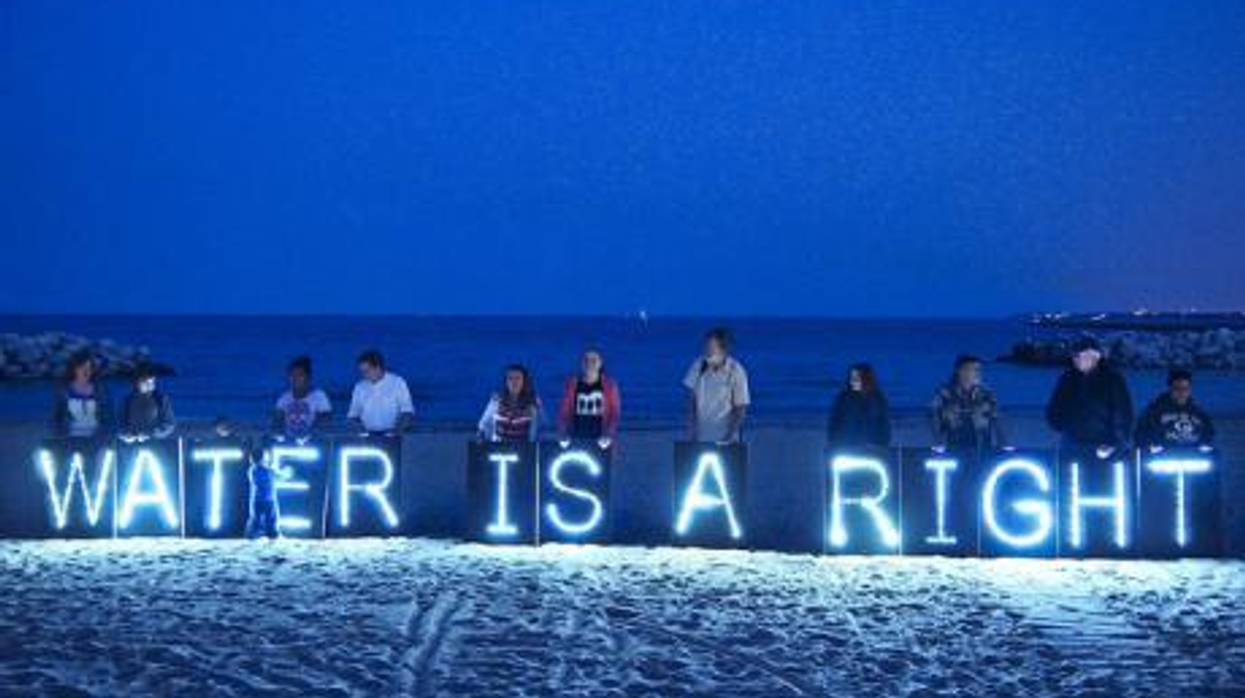
When Donald Trump announced in June that the US would pull out of the Paris Climate Agreement, it was noticeable that the most effective opposition came not from Congress but from cities and states.
379 mayors representing more than 68 million Americans said they would implement the Accord regardless of the head-in-the-sand attitude of the country's president. More significantly, given the weakness of the Paris agreement, more than 40 cities have gone further and committed to 100% renewable energy no later than 2050.
This practical defiance highlights how the city in our globalised world is emerging as a place of resistance, alternatives and solutions to our world's multiple crises.
Cities are privileged places
Cities have a long history as cradles of social transformation, whether it was the urban revolts in Budapest, Stockholm and other European cities in 1848, the municipal victories and participatory budgeting experiments of the Workers Party in Brazil in the late 1980s or the emerging municipalist movement in Spain and other regions more recently. Cities constitute a privileged place to organise collectively and to imagine new ways of living and working together, spaces where bodies and minds interact and where ideas spread quickly and have unparalleled impact.
Cities have a long history of providing privileges to their inhabitants, while extracting wealth from those outside its boundaries.
This is not to over-romanticise them. Cities, as other human constructions, have their own structures of concentrated power, inequality and exclusion. Greek city-states framed ideas of democracy that we still use today, but their societies were based on slavery and patriarchy. Medieval city-states were laboratories of modern liberal democracies and welfare systems based on taxation, but they were also the places where capitalism, colonialism, international finance and unfair trade relations emerged. Cities have a long history of providing privileges to their inhabitants, while extracting wealth from those outside its boundaries.
Nevertheless, cities have noticeably emerged as a critical arena for many recent social struggles from the Arab Spring in Tahrir square, Cairo or the Umbrella Revolution in Hong Kong. It has happened at time when cities for the first time in history now house more than 54% of the world's population (expected to reach 67% by 2050).
For social movements, the cities are a strategic place to organise, not only practically but also politically. More than two decades of neoliberalism have succeeded in entrenching corporate power within national and international institutions and international legal frameworks - making it ever more difficult terrain for people's movements, who have to defeat powerful interests and appeal to a deliberately disempowered electorate. Cities by contrast offer a more level playing field where people power can still take on and defeat corporate power and thereby prove that political mobilisation can deliver results.
Participation and power
The political theorist, the late Benjamin Barber, argued that cities are capable of reconnecting "participation, which is local, with power, which is central". While nation states used to play that role, he argued they have become too large (and we would add also too captured by corporate capital) to sustain the kind of "bottom-up citizenship, civil society and voluntary community" that is essential to democracy.
Across the world, social movements are actively seizing this potential power, advancing important social demands, whether for dignified work, sustainable food systems, green energy or racial justice. Much of this transformation takes place under the radar, as mainstream largely corporate media continues to focus all its attention on the happenings in the national corridors of power.
Even we were surprised in 2015 when our organisation, the Transnational Institute, decided to look at the number of municipalities who had brought water services back under public control and discovered 235 cases in 37 countries of cities and communities remunicipalising their water. Given the power of transnational water companies like Suez and Veolia - and the grip that the ideology of privatisation has on national and international water policy - this was nothing short of a silent revolution.
A follow-up report earlier this year that broadened its focus to include energy and housing unveiled 835 examples of (re)municipalisation of public services involving more than 1,600 municipalities in 45 countries. TNI researcher, Satoko Kishimoto, says "What is most important about these cases is that they kill once and for all the myth that 'there is no alternative' to neoliberalism. They show that not only is there a clear alternative to privatisation, but that it also has the potential to both improve services and transform society and environment for the better."
An alternative to neoliberalism
In many cases, the experience of resisting corporate capital and defending rights, such as those of access to water or housing, has itself been transformational. It has helped activists reconnect with those alienated by neoliberalism, and also opened up peoples' imaginations to think of new ways of organising work, services and social needs. The energy and dynamism that is released is palpable, captured in documentary films such as Demain (Tomorrow)
The experiences of trying to set up green businesses in Totnes in the UK, for example, eventually led to an international project, Reconomy, that seeks to build local economies that are sustainable, equitable and anchored in wellbeing, rather than tied to economic growth at any cost. An initiative by the New Delhi government to set up hundreds of small free health clinics to do diagnostics and simple treatments has inspired health activists across the world. In Barcelona, the experience of resisting house repossession inspired some activists to fight and win municipal elections based on a participatory platform of policies that include fining banks that speculate on empty homes, creating a new municipal energy company and providing sanctuary to refugees.
Barcelona's new city council is now helping to foster a movement of 'fearless cities' committed to the same principles of participation, openness and social and environmental justice. Their first gathering in Barcelona in June 2017 attracted more than 600 participants representing more than 100 municipalist platforms from around the world.
The feminization of politics
Municipal activism is also an opportunity to put feminism and the feminization of politics at the forefront. As Laura Roth and Kate Shea Baird have argued "the feminization of politics, beyond its concern for increasing presence of women in decision-making spaces and implementing public policies to promote gender equality, is about changing the way politics is done." In practice, this means leaving aside patterns of our patriarchal society such as competition, dominant leaderships, vertical organizations, egoism and structures that have typically excluded women from politics. It is noticeable how many of the new leaders in the municipalist movement are women.
Perhaps the proximity, scope and nature of the political conflicts at the city level, such as struggles for access to water and housing, rather than monetary policy or military alliances, also provide an arena where non-patriarchal modes of political action are better suited.
Vandana Shiva, philosopher and activist, at Fearless Cities, June 9 - 11, 2017. Flickr/Barcelona En Comu. Some rights reserved.
Transformative Cities Initiative: a unique participatory award
These successful experiences around the remunicipalisation of public services and the rising municipalist movement have inspired TNI to launch the Transformative Cities Initiative. Our goal is to build an atlas of real utopias, make these experiences viral, and to share the learning that comes from implementing these experiments. This month, we are launching a unique participatory award to recognise transformative experiences. In the first year, the focus will be on water, energy and housing. In future years, the initiative will expand its focus to other areas such as migration and solidarity, territorial food governance and drugs harm reduction.
We are encouraging both social movements and cities to use this opportunity to share your story. We plan to bring participants together, to learn from and systematise these experiences, in order to inspire and accelerate the process of transformation in other regions and places. We are giving special attention to experiences from the Global South, whose experiences are not adequately focused on or shared in global debates. We are giving special attention to experiences from the Global South, whose experiences are not adequately focused on or shared in global debates.
At a time when our current political framework offers most people a choice between neoliberal globalisation and authoritarian nationalism, between the global mall and the border wall, it is critical that the real alternatives coming from social movements are fertilized and strengthened.
A strategy that only seeks to resist increasingly authoritarian national governments, defending an ever-shrinking civic space, is demoralising and self-defeating. Similarly a strategy that articulates national and international alternatives that have no chance of realisation is equally disempowering.
Cities offer the chance to break with the dichotomy of despair - they give us a chance to trial out transformative change at a local level, and in so doing providing the building blocks for the global transformation that is so desperately needed. As the Fearless Cities gathering put it, "The local was where democracy was born; it is now where we will recover it."
When the world watched Egyptians bravely gather en masse in Tahrir Square in Cairo in January 2011 to Arab Spring Hosni Mubarak out of office, we were mightily impressed and most of us cheered the nonviolent resistance.
The western press lionized the Egyptian military as it seemed to support the uprising and the generals kindly offered to run the country on an interim basis. Sure enough, there was an election eventually, Mohammed Morsi won, and the military handed over power.
For a minute.
Then we saw the military not-so-kindly grab power, ousting the elected Morsi and General Sisi ordered mass arrests and torture of dissident pro-democracy Egyptian activists.
Now, a few short years since the US calmly watched democracy betrayed badly by the Egyptian military, the U.S. press is valorizing the military officers who are starting to snap some discipline into the most chaotic, dysfunctional, investigated White House this senior citizen has ever observed, at least since the months leading up to Richard 'I am not a crook' Nixon's resignation.
Be careful.
Falling all over ourselves in gratitude because a Marine general imposes some order in the executive branch may benefit the racially biased, anti-immigrant, pro-military agenda of the range of rightwing members of Congress, but that new efficiency is not going to result in the policy changes most Americans want nor those which protect the healthy water and air we all need.
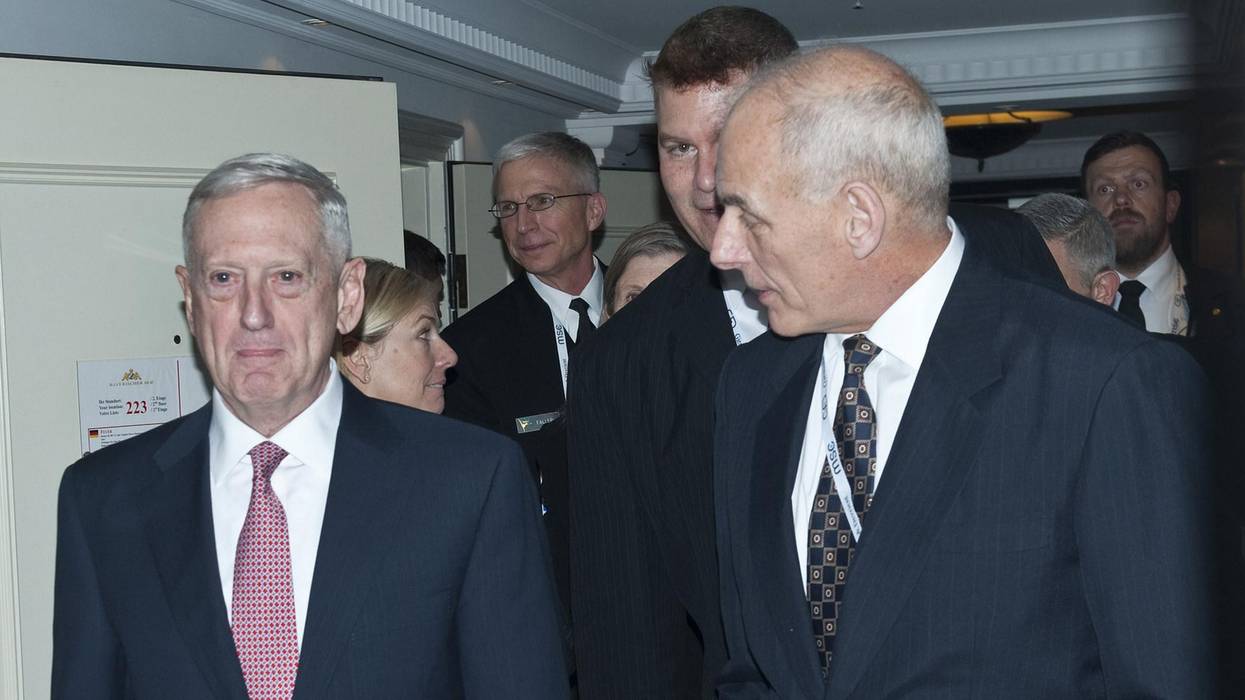
From H.R. McMaster (National Security Adviser), to John Kelly (Chief of Staff) to James Mattis (Secretary of Defense) to Joseph Dunford--all generals--Trump is ceding power to those who know how to seize it. Generals now head his staff in the White House.
In short, handing over the keys to the democratic system to the military might seem like a safe path toward stability, but it failed miserably for the Egyptians and even in our disrupted state we should not seek to hitch our lines to the ones who do not practice democracy, who have a mission to control by threat of destruction, and who practice a dominating form of rule, not a democratic form of governance.
None of these generals is a Dwight Eisenhower, all are dedicated to the Trump agenda--ramping up global climate chaos, sowing race hate and violence, targeting refugees and immigrants fleeing from wars we supply arms to wage, rolling back civil rights, being cozy with the likes of autocrats Putin, Duterte, and yes, General al-Sisi, while scorning democratic humane clean energy leaders like Merkel.
Be ye advised.
It is the darkest of times; it is the brightest of times. A mentally ill President slouches toward the nuclear suitcase to mistake a Twitter feed for the big one. But he can see in the windows of the Oval Office, out in streets, the 99% and the Black Lives and the Kayaktivists and the Pussy Power and the Dreamers and the Water Protectors at Standing Rock.
This succession of startling movements are the seeds of our revolution. The pattern over the five plus years since Occupy Wall Street is one of peaks and valleys. Up in the visionary light of a life-saving rebellion and then down into the aftermath of months and months of organizing, meetings and marches and rallies... We're entering that valley again now, headed for a hangover, as the daily rallies slow down.
Senior officials in the Church of Stop Shopping believe that a miracle is hiding in plain sight. What these uprisings all have in common is something we need to know by heart. They all share a quality of vigorous generosity.
We've been to all of these American revolutions, and they really date back to the taking of the Wisconsin state house in March of 2011. When the pizzas were delivered to the Madison rotunda and the delivery guy said that people in Tahrir Square paid for them long distance - that set the tone. These were real communities with gift economies, instant practical traditions, and lots of music.
Remember the peaks of these revolutions and we can solve the let-down and slow-down. Here's our idea. Put the spirit of these uprisings into a small container. We call it Naive Activism. Our activism is tailor-made for this long walk through the shadow of death. We use the blueprint of the big protests: 1) take the space 2) pop the hypnosis 3) and for god's sake be kind. Let's call it "rapid deployment love."
Here is our under-10- minutes ritual for banks that finance fossil fuel extraction. We (5 or 8 of us) enter the lobby of Citi, TD or Wells Fargo--each is heavily invested in Dakota Access and other pipelines. We lay down newspapers. One of us dressed in white lies down on the papers clutching a symbol of the Earth, a rock, a branch, a wing... We pour an oily concoction (safflower oil and graphite) upon this prostrate person while we sing and preach and film. We hand out flyers about good banks and bad banks. Then we clean up and, help the human Jackson Pollock to the door, and disappear down the subway steps.
These are meant to be "spiritual trespassings". We've gone banking this oily way three times in the last month--it's quick and dirty. We're making a simple point. We're a small overture to the Earth's invasions of the institutions that are want to kill Her. Yes, bankers --there is another movement about to move. The Earth is coming! The Earth is coming!
If there is a look of dismay and horror on the face of the bank manager who watches the splattering oil hit the body and the piece of nature--that manager is seeing over Trump's wall! Just when she or he is wide-eyed, be gentle. We want to help. We have the laughter and the music. We are the stranger at a protest that accidentally bumps into you. We both share that moment of mutual forgiveness. Radical!
I can hear someone lamenting that it is naive to think that a trillion dollar bank would change its policy because of such small-scale protests. Of course, nothing impacts banks. Not the marches arriving from 500 years of struggle through the Middle Passage and the Trail of Tears. Not judges or juries or federal agencies or Presidents. Not even the threat of the end of life on Earth. Nothing touches banks except the people who walk right through the front door.
Zuccotti Park, Ferguson and Standing Rock. Each began on a modest scale and each was called naive, at the beginning. An urban pocket park, a stretch of sidewalk in front of a police station, tipis by a river in North Dakota. People came from great distances to go to these spots, and they immediately pitched in. How can I help?
Something about that community-making, without the supervision of corporations, was key to why when people heard about it, they wanted to join up. This was called naive, illegal, selfish, violent, divisive... but it was just love working hard and refusing to leave.
Here's our small gesture. We accept the oil on our body. We offer you the information. We clean up. Does that feel familiar somehow? Have a deju vu quality? In these dark times, we remember the light on the high ground. It's just people saving each other's lives. Radical!
It is difficult to be optimistic about the Middle East in 2017.
With the bloodshed in Aleppo, Mosul, Yemen and elsewhere in the region, the anger, hatred and sectarian divides have only grown deeper.
Indeed, while some point to Tehran celebrating its victory in Aleppo, success on the battlefield is coupled with even deeper divisions between Iran and some of its Arab or Sunni neighbours, paving a path towards greater conflict rather than reconciliation.
The celebrations of today ring very hollow, as the region as a whole is likely heading towards greater instability in the year to come
Ultimately, as all parties involved should know, true security only stems from the ability to live in peace with one's neighbours, not one's ability to outgun them.
Thus, the celebrations of today ring very hollow, as the region as a whole is likely heading towards greater instability in the year to come.
It is fashionable in Washington today to blame the bloodshed in the region on the Obama administration's perceived inactivity and unwillingness to commit the United States to a more militant posture in the Middle East.
Such assessments tend to overlook the deeper structural causes that have helped create the current crisis - structural factors that predate Obama and which the US has little ability to impact.
Reality is that since the early 1990s, the order in the region was an unnatural one.
The Dual Containment policy put into place by the Clinton administration guaranteed order in the region by supporting the US's main allies in the region - Israel, Saudi Arabia and Egypt - while isolating and containing Iran and Iraq.
While this order did provide the region with a degree of stability, it was not able to sustain itself - it was directly dependent upon US military and economic power.
The main benefactors of this order - again, Israel, Saudi Arabia and Egypt - neither possessed the power nor the political will to uphold this order. They were free riding on American power and saw no reason as to why they shouldn't.
A regional order based on the exclusion of two of the most powerful states of that region does not have a good chance of enduring in the long run under any circumstances.
But it wasn't the opponents of this order - primarily Iran - who destroyed it, but rather the US itself.
By invading Iraq in 2003 and failing the task of stabilising the country in the post-war period, the US didn't just destroy that country, but instability in Iraq spread throughout the region and destroyed both the regional order and, perhaps more crucially, it weakened the US to the degree that it no longer had the power, credibility and political will to stabilise the Middle East and establish a new order there.
With Pax Americana dead and buried, regional powers were thrown into a vicious zero-sum game to safeguard their interests
The vacuum that was created by this ordeal set off by the US itself then also helped midwife other, underlying societal challenges in the Arab world that earlier had been prevented from fully surfacing in the pre-2003 era.
While the US was strong, its autocratic allies felt confident in clamping down on internal dissent. They could count on the US's silence - whatever protests or gentle pushes for reform Washington mustered, they never challenged the political status quo of its allies.
By 2011, however, the story was different. The US was now significantly weakened.
The cost of sustaining order in the region had skyrocketed, courtesy of the Iraq War, while the dividends of hegemony were plummeting.
Now sustaining the order not only entailed maintaining stability between states, but rebuilding collapsed and collapsing states.
Though it tried to keep Mubarak in power, the Tahrir Square protesters revealed this new reality: America's ability to shape the outcome of events in the Middle East was not what it used to be.
Ripe for revolution - but not democracy
The power to tilt the scale in favour of Mubarak simply did not exist any longer. By weakening the US through the unwise invasion of Iraq, Washington no longer had the capacity to protect its authoritarian Arab allies in the region.
Once American support for these dictatorships was gone, the long existing societal factors that all pointed in the direction of change came to the forefront and rendered these states ripe for revolution
Once American support for these dictatorships was gone, the long existing societal factors that all pointed in the direction of change (but had been largely stymied by Washington's backing of the autocrats) came to the forefront and rendered these states ripe for revolution - though not for democracy.
Just as much as power begs to be balanced, disorder begs to be re-ordered.
With Pax Americana dead and buried, regional powers were thrown into a vicious zero-sum game to safeguard their interests, and establish a new order beneficial to their own security imperatives.
These transition periods from one order to another are historically particularly violent and unstable.
While a stronger US military posture arguably could have helped protect some of Washington's interests in the region or perhaps delayed the security deterioration temporarily, the idea that a more militant US policy could have fixed the region's problems is a mirage.
As the former director for the Middle East in Obama's National Security Council, Phil Gordon, points out:
"In Iraq, the US intervened and occupied, and the result was a costly disaster. In Libya, the US intervened and did not occupy, and the result was a costly disaster. In Syria, the US neither intervened nor occupied, and the result is a costly disaster."
Absent a wholesale attempt to create a new order - a task Washington lacks the power to undertake on its own - isolated cases of military intervention won't bring durable stability to the region or alter the trajectory of its political developments.
Nor is the current instability a result of the historic nuclear deal with Iran from 2015.
Shifting allies
While the Saudi-Iranian rivalry has intensified over the years, its roots are found in the post-2003 disorder and their jockeying to influence the future balance in the region.
Even the convergence of Saudi and Israeli interest in countering Iran predates the nuclear deal.
Already in 2006, Saudi Arabia was a de facto partner of Israel in its war against Hezbollah in Lebanon.
The difference today is that Saudi Arabia is much more open about its collusion with Israel. The nuclear deal didn't cause their de facto alliance, it only brought it out of the shadows.
Going forward, there are few signs that stability will return to the region in 2017. Even if the battle of Aleppo signals a turning point in the war in Syria, it is unlikely to signal the end of the war.
Russia and Iran may be celebrating their victory, but true stability will only come to the region when all of the regional powers commit themselves to a diplomatic process of brokering a new order.
Currently, however, there is far more commitment to military rather than diplomatic strategies. Absent a reversal of this, 2017 will be even grimmer than 2016.
I speak about the Middle East to people of various political persuasions around the US, from leftist college students to conservatives on AM radio talk shows. Most Americans are wary of further US military intervention in the region and ask intelligent questions about this very complicated topic. But I inevitably run into people advocating conspiracy theories--from both the left and right.
I speak about the Middle East to people of various political persuasions around the US, from leftist college students to conservatives on AM radio talk shows. Most Americans are wary of further US military intervention in the region and ask intelligent questions about this very complicated topic. But I inevitably run into people advocating conspiracy theories--from both the left and right.
Conspiracy theories, although seemingly quite radical and anti-government, actually divert attention from the very real evils that exist in the region.
Here are six of the most common myths:
1. The US created the Islamic State
Some leftists argue that the US created al-Qaeda in order to fight the USSR in Afghanistan in the 1980s. Now it's done the same with the Islamic State (ISIS or IS) in order to sow dissention in Iraq and Syria.
The theory got even wider credence when Donald Trump declared that President Barak Obama was the "founder" of IS and "the co-founder was crooked Hilary Clinton."
Ah, where to start? The US didn't create either al-Qaeda or the Islamic State. Yes, the US backed the most right-wing mujahedeen in Afghanistan in the 1980s. But those reactionaries, some of whom later formed al-Qaeda, always had their own agenda. They took money and arms from the US while planning to attack the US and its allies at a later time.
The Islamic State, then known as al-Qaeda in Iraq (AQI), formed in Iraq as one of the many groups fighting the 2003 US occupation. The US and Iraqi Sunnis defeated AQI militarily in the 2007 Anbar surge. AQI regrouped, moved to Syria, and emerged as IS in 2014.
The US has been bombing IS since 2014 and is organizing ground assaults on IS-controlled cities in Iraq and Syria--hardly the sign of an alliance. The US occupation of Iraq laid the political basis for the formation of IS but did not create it.
2. The US was the secret instigator of all the Arab Spring uprisings.
A few journalists and book authors on the left point to the failures of the Arab Spring and that most regimes in the region remain pro-US. They argue that the US instigated the Arab Spring demonstrations in order to emerge a stronger power at the end of the day. One commentator even claims the US had planned the Arab Spring five years in advance.
Funny, that's not what almost everyone said at the beginning of 2011. When the people of Tunisia rose up and young people occupied Tahrir Square in Cairo, leftists and progressives correctly argued that these were immensely popular movements against local dictators and US domination. Even Iran's clerical rulers tried to take credit for the uprisings, calling Egypt an "Islamic Liberation Movement."
The two main actors who opposed the Arab Spring were al-Qaeda, which had no visible support at the time, and the US government. Vice President Biden expressed strong US support for Egyptian dictator Hosni Mubarak just a few days before he fell from power.
It's often forgotten now, but Arab Spring demonstrations continued for months throughout the region, and for years in Saudi Arabia and Bahrain. Are these demonstrators bravely protesting against US-allied regimes somehow instigated by the US?
3. The Syria uprising was not a popular movement but instead was instigated by the US in order to remove the anti-imperialist Assad.
Not surprisingly, the Assad government makes this argument. It is surprising, however, that a small number of American leftists fall for it.
Just a few weeks after the uprising began in Syria in March 2011, Assad called the demonstrators terrorists backed by Saudi Arabia, Israel, and the US. In reality, the protestors were a mixture of civil society activists and conservative political Islamists, the same combination of folks who rose up throughout the region. The Assad regime cracked down hard, beating, arresting, torturing and killing protestors.
Although there had been scattered armed attacks from the beginning, armed conflict only became dominant towards the end of 2011 and early 2012. By 2014 extremists such as the al-Qaeda-affiliated Nusra Front and the Islamic State came to dominate the armed opposition.
Assad cheerleaders argue that he is an anti-imperialist and a key player in the "Resistance Front," consisting of countries that support the Palestinians and oppose Israel. There's only one problem with that claim. Palestinians living in Gaza and the West Bank don't support Assad. Hamas, the party controlling Gaza, broke with Assad and backed the popular uprising starting in 2011.
Fatah and the PLO, the dominant forces in the West Bank, are officially neutral but have a long history of conflict with the Assad family. Hafez al-Assad, the current president's father, jailed PLO activists and tried to replace Yasser Arafat with a pro-Syrian leader. Bashar al-Assad never allowed the PLO to organize within Syria.
Of course, the US, Saudi Arabia, Israel, and Turkey have all armed rebel groups, including extremists such as the IS. They each seek to install a government in Syria favorable to their views. But being attacked by imperialists and their allies doesn't make you an anti-imperialist.
4. Iran is the number one state sponsor of terrorism in the world.
This falsehood is promoted by many leading politicians in the US as well as by the rulers of Saudi Arabia and other Arab dictatorships. They argue that Iran supports Hezbollah in Lebanon and the Houthi movement in Yemen, along with Shia insurgents in Saudi Arabia and Bahrain. James "Mad Dog" Mattis, Trump's nominee for Secretary of State, even claims that Iran cooperates with the Islamic State in a common terrorist campaign against the US.
Iran certainly asserts its political and military presence in the region, seeking to lead an anti-US/anti-Israeli alliance stretching from Lebanon through Syria, Iraq, Bahrain and Yemen. The Iran-backed groups are conservative political Islamists (mostly Shia) who engage in armed struggle, but they have genuine popular support. Hezbollah, for example, is both part of the ruling coalition in the Lebanese Parliament and an armed militia. Some of the groups have used terrorist tactics, such as intentionally blowing up civilians, but they are not the same as terrorist groups such as the Islamic State.
As for Mad Dog's assertions, he's simply creating a conspiracy myth. The Islamic State has attempted to launch terrorist attacks inside Iran, and Iran is fighting the IS in both Iraq and Syria. Mad Dog's misinformation campaign seeks to lump together everyone opposed to US policy into one block and gin up popular support for an eventual military attack on Iran.
Saudi Arabia is a far bigger supporter of terrorist groups than Iran. It supports the Al Qaeda affiliated Syrian Conquest Front (formerly al Nusra) and backs terrorist groups in Pakistan and Afghanistan, including the Taliban.
But since Saudi Arabia is key to US oil interests and a military ally, by definition, it can't be listed as a state sponsor of terrorism.
5. The US intentionally creates failed states like Libya in order to keep the region in turmoil.
Advocates of this view look at conditions in Libya today, the result of US and European intervention, and say that the US always intended to create a failed state. That view doesn't square with reality.
The US, France, Britain, and other Western powers became involved in Libya, in large part, because of its oil. Those countries wanted to overthrow dictator Muammar Gaddafi in order to keep Libyan oil flowing over the long run on terms favorable to Western oil companies.
Yet today Libya has almost completely stopped exporting oil, leading to an estimated 8.3% drop in GDP, according to a World Bank report. Since when do imperialist countries conspire to cut off their own oil supplies?
In reality, the US and its allies implemented a series of plans aimed at reestablishing Western domination of Libya--but they keep failing.
Plan A: Use Western air superiority to help pro-Western rebels quickly overthrow Gaddafi. Failure #1: the quick overthrow lasted almost eight months.
Plan B: Find a former government official friendly to Washington to install as strongman and hold elections that US-backed parties would surely win. Failure #2: US-backed Mahmoud Jibril became interim prime minister, but he lasted only seven months. The parliament has little popular support.
Plan C: Using the CIA, find militia groups willing to ally with the US. Failure #3: the CIA attempted to make alliances with various militias, but those efforts blew up during the infamous attack on the Benghazi CIA annex in 2012, resulting in the death of the US ambassador.
The US certainly carried out policies that resulted in a failed state, but that was not the goal.
6. The Bush administration planned the 9/11 attacks in order to further repression and start wars in the Middle East.
This one is the granddaddy of all modern conspiracy theories, promulgated by both the left and right. Even right-wing populist and former president of Iran, Mahmoud Ahmadinejad, gave credence to the view. The theory attracts support because the US has engaged in false flag operations in the past, for example, trying to blame communists for the 1953 CIA coup in Iran.
I won't spend time debunking the phony assertions that the World Trade Center was wired with explosives in advance. The editors of Popular Mechanics have done an excellent job criticizing that and many other falsehoods.
Please consider a major flaw that is rarely discussed, the attack on the Pentagon. 9/11 Truthers claim the US fired a missile into the Pentagon, as seen by the cylindrical shaped destruction of the building. This is consistent with the assertion that government operatives, not al-Qaeda hijackers, caused the devastation in New York.
Well, in fact, thousands of commuters on Washington DC freeways saw the airplane descending towards the Pentagon. An AP news photo showed part of the airplane fuselage sitting on the front lawn of the Pentagon that day.
And, if a missile had hit the Pentagon, what happened to American Airlines #77 that left Dulles Airport that morning? Well, answer some 9/11 Truthers, it was forced to land at a secret location and all the passengers were gassed to death. Think of the omniscient power of the conspirators!
The Bush administration did not plan 9/11, but it did take full advantage of America's anger and fear. It used 9/11 to invade and occupy Afghanistan and Iraq, pass the repressive Patriot Act, and engage in widespread torture and abuse in Guantanamo and secret CIA sites scattered around the world. That's reason enough to oppose the US government. Conspiracy theories simply divert attention from the government's real crimes.
All of the conspiracy advocates share a common methodology. They look at the situation as it exists after the fact and then create a fictional narrative showing that today's crisis was planned all along.
They overestimate the power of the US empire while underestimating the power of ordinary people to make change. If the Bush Administration murdered almost 3,000 people on 9/11 and successfully covered it up, how can we possibility fight back? If the US-created Arab Spring caused chaos, why should anyone rise up against their oppressors?
Pardon me for my optimism. But I don't believe in conspiracy theories and still believe in the power of ordinary people to make fundamental change.
Democrats need to stop grasping at straws.
Shocked by Trump's win and dismayed at his half billionaire, half military junta cabinet, liberals are thrashing about in the stinking waters of dying American democracy, hoping against hope for something -- anything -- to stop Trump from becoming president on January 20th. That, or to send him packing as soon as possible afterward.
Some Dems point to the CIA allegation that the president-elect received an assist, via WikiLeaks, from Russian government hackers. If this could proved, they ask, especially if Trump knowingly colluded with Vladimir Putin's tech-savvy underlings to deny Hillary Clinton her God-intended victory, wouldn't that force him to step aside?
Sorry, my liberal friends: that deus won't ex machina.
"Democrats have one last chance to act like Democrats -- something they haven't done in 50 years -- or watch their party come apart at the seams."
First, the intelligence community hasn't presented a shred of evidence, much less proof, that the Russians hacked the DNC or John Podesta's emails. (Even Americans know that "overwhelming circumstantial evidence" doesn't mean anything.) When Trump scoffed that the wise men of U.S. intelligence were the same geniuses who gave us the Iraq War, he had a point. The spooks are discredited. No proof, no scandal. Even if there were proof, who would force Trump back to his Tower? Not the Republican congressmen and senators wallowing in the surprise win they handed him. No GOP leaders behind it, no impeachment.
Then there's the mother of all Hail Mary passes: trying to convince roughly 40 members of the Electoral College pledged to Trump to vote for Hillary instead. This, courtesy of Michael Moore et al., is much discussed in liberal circles. It is a Thing. But it is a Dumb Thing, one doomed to failure. Electors are hacks slavishly devoted to their parties. It's much too much to ask them to turn "faithless" in support of a coup, to undermine democracy in support of a candidate whose approval ratings never climbed above (tied for) "most unpopular ever."
There are only two realistic ways to get rid of President Trump: street protests and Democratic intransigence.
A sustained campaign of national street protests might make it so impossible for him to govern that he might lose support among influential Republican leaders, especially those from blue states. Pro tip: "sustained" means 24-7, 365 days a year. Not 20 or 200 people here and there, but thousands and tens of thousands, in every city -- a great constellation of Tahrir Squares that brings traffic, consumerism, news, the economy, to a grinding halt.
Of course, Trump might order his cops and soldiers to shoot the protesters. That's what China did to the students at Tiananmen Square, a crackdown of which Trump approved: "Then [the Chinese authorities] were vicious, they were horrible, but they put it down with strength. That shows you the power of strength."
Or, like Obama did to Occupy Wall Street, have his Homeland Security department coordinate systematic beatdowns, or "sweeps" as corporate media dutifully calls such things. Resistance is not a tea party.
Things may and probably will change. However, I wouldn't hold my breath waiting for a mass uprising a la Paris May 1968. There's no party or group capable of mass organizing in the United States, much less a radical leftist front -- which is what such a militant mobilization would require.
Protests are boring. It rains and snows. Cops are scary.
This is why the anti-Trump protests following Election Day petered out in less than a week, and why January 21st's Million Women March is likely to impress for a day, then be forgotten January 22nd. (Example: men are welcome but don't know it. Because: stupid title. Was the URL for Million Women Plus One March taken? Also: didn't we learn from the election that Democrats get in trouble when they snub guys?)
Our best chance to stop or slow down Trump lies with Democratic legislators in the House and Senate.
Recent history doesn't give reason to believe that Congressional Democrats will turn into a left-wing "party of no," working as hard as Tea Party Republicans did to block President Obama's judicial appointments and legislative initiatives. These are the same Democrats whose votes gave George W. Bush the fascist USA-Patriot Act and two aggressive wars of choice with no end in sight.
But what if the party of Pelosi and Reid were to grow a pair? There's a lot they could do to take the wind out of The Donald's authoritarian sails.
To a man, Trump's cabinet picks are morally objectionable, ideologically unacceptable and objectively unqualified: a climate denialist to the run the EPA, an idiot at HUD, a general (one of several) for the DOD who wants Congress to change a law mandating civilian rule, the CEO of ExxonMobil as Secretary of State.
Democrats should say "you're fired!" to every last one of these turkeys.
And they can. Thanks to Harry Reid, the filibuster rule is no more, so Republicans can approve these guys with a simple majority. But any Democratic Senator -- just one -- may put a secret personal hold on a presidential appointee. That's exactly what Democrats should do. And that's what we ought to demand. Let Trump go back to LinkedIn to find better-qualified nominees.
Democrats should demand special prosecutors to look into Trump's tax returns and the brazen conflicts of interest between his real estate business and his duties as president. Tie the bastard up with endless hearings, just like the GOP did with the Monica Lewinsky scandal and Benghazi.
Since payback is a bitch and Trumpism presents a grave and present danger to the republic, no Democratic legislator ought to negotiate with Republicans or vote for any Republican-sponsored bills. Yes, that counts the stuff Democrats might actually like, such as building new infrastructure. If the GOP wants it, the answer is no. Always. No matter what.
You don't "find common ground with" or "cooperate with" or "reach out to" a tyrant-in-waiting. Which, after the next terrorist attack or other security threat, is exactly what Trump will expose himself as. Faced with incipient evil you stand firm, united in your conviction that everything that tyrant-in-waiting stands for is evil and un-American.
You block everything they want. You become the biggest Party of No parliamentary democracy has ever known. Because, even if you're not sure it's the right thing to do, it's smart.
Disgusted and now dominant, the Bernie Sanders wing of the Democratic Party is ten seconds from bolting. Democrats have one last chance to act like Democrats -- something they haven't done in 50 years -- or watch their party come apart at the seams.
Nonresistance is futile.
The recent abusive border search of a Canadian photojournalist should serve as a warning to everyone concerned about press freedom these days.
The recent abusive border search of a Canadian photojournalist should serve as a warning to everyone concerned about press freedom these days.
Ed Ou is a renowned photographer and TED senior fellow who has traveled to the United States many times to do work for The New York Times, Time magazine, and other media outlets. Last month, Ed was traveling from Canada to the U.S. to report on the protests against the Dakota Access pipeline in Standing Rock, North Dakota, when he was taken aside for additional inspection.
What came next left him questioning what he thought he knew about the U.S. government and the values it stands for, and we're officially protesting to the Department of Homeland Security and U.S. Customs and Border Protection.
Although Ed clearly identified himself as a journalist on his way to Standing Rock, the CBP officers detained him for more than six hours and subjected him to multiple rounds of intrusive interrogation.
They questioned him at length about his work as a journalist, his prior professional travel in the Middle East, and dissidents or "extremists" he had encountered or interviewed as a journalist. They photocopied his personal papers, including pages from his handwritten personal diary.

After all that, the officers denied Ed admission to the country without giving him a valid reason. One of the officers said he couldn't provide any details. Another officer said that Ed's refusal to grant access to his mobile phones "did not help."
Ed's treatment was unjustified and unlawful. Although CBP has the authority to stop and search travelers at the border for the purpose of identifying people who are inadmissible or engaged in criminal activity, the officers exceeded that authority. They had no legitimate cause to detain Ed for six hours, interrogate him about his professional activities, copy his diary, or search his phones. That abusive and harassing conduct is all the more troubling given that the officers apparently conditioned Ed's admission to the U.S. on his willingness to assist them in searching his phones.
Ed's ordeal is yet another indication that the government is treating the border as an all-purpose dragnet for intelligence gathering -- an approach that is at odds with the Constitution, federal law, and CBP policies on border searches.
When CBP takes that approach to journalists, the dangers are particularly acute. Forcing journalists to turn over their newsgathering materials breaches confidences they are ethically required to honor, discourages reporting on current events, and turns journalists into unwilling agents of the national security state.
And conditioning foreign journalists' admission to the United States on their willingness to agree to intrusive searches encourages similarly abusive treatment of American journalists in other countries.
Ed is fighting back though.
We've sent a letter on his behalf to DHS and CBP seeking assurance that Ed will not be subjected to intrusive and inappropriate searches in the future because of his work as a journalist. We're also asking the government to purge any confidential information it obtained inappropriately during the search.
That the Obama administration would subject a journalist like Ed to harassment and abusive inspection at the border is wrong and alarming. And what this administration claims the authority to do today, the next administration could claim the authority to do in January.
Check out Ed's photos and reporting here.
"To me, freedom of speech is something that represents the very dignity of what a human being is... that's what marks us off from the stones and stars." These are words spoken by Mario Savio, the spokesperson for the Free Speech Movement in the 60's.
"To me, freedom of speech is something that represents the very dignity of what a human being is... that's what marks us off from the stones and stars." These are words spoken by Mario Savio, the spokesperson for the Free Speech Movement in the 60's. Decades later, the power of free speech has surged onto the global stage and began reclaiming the dignity of humanity.
We are now entering WikiLeaks 10 year anniversary. The organization registered their domain on October 4, 2006 and blazed into the public limelight in the spring of 2010 with the publication of Collateral Murder. This video footage depicted the cruel scenery of modern war seen from an Apache helicopter gun-sight. It became an international sensation, with the website temporarily crashing with the massive influx of visitors.
This stateless media organization, with no allegiance to any country and no corporate or government money behind it, has published over 10 million documents. WikiLeaks founder Julian Assange remains detained in the Ecuadorian embassy. In an interview with Der Spiegel on 10 years of WikiLeaks, he gave his view that the US diplomatic cables they published were the single most important collection of documents, which are up to 3 million now.
Since its first publication on December 28, 2006, the effect of WikiLeaks has been felt across the world. From the 2007 release of the Kroll report on official corruption in Kenya that affected the outcome of the national election, to the exposing of the moral bankruptcy of Iceland's largest bank in 2009, the information they revealed empowered people and helped revitalize democracy in many countries.
By the end of 2010, WikiLeaks' social and political impact became quite apparent. An Amnesty International report in 2011 pointed to the role of leaked documents in triggering revolutionary global uprisings. The BBC documentary WikiLeaks: Secret Life of a Superpower also attributed their revelations as a spark for the Arab revolutions. On this 10 year celebration, we shall look back the birth of WikiLeaks and examine its effect on freedom of speech around the world.
Consent of the Governed
WikiLeaks started with a mission to open governments by releasing sensitive and classified documents that belong to the public, which had been unjustifiably kept secret. Early on, Assange saw the existence of a network working in collaborative secrecy as detrimental to all people. The concept of WikiLeaks can be seen as based on this analysis of a hidden force of governance and leaks were used as a means to bring accountability to those in power.
Assange recognized how "people's will to truth, love and self-realization" are pushed away by institutional hierarchies. He gave a metaphorical picture of this force.
"When we look at an authoritarian conspiracy as a whole, we see a system of interacting organs, a beast with arteries and veins whose blood may be thickened and slowed until it falls, stupefied; unable to sufficiently comprehend and control the forces in its environment."
This beast-like being doesn't only exist in power structures, but works inside each person through impulses and desires that are often unknown to us. It is a thinking that arises from animalistic desires that conspires in secret and moves quickly into abstraction, seizing the past, present and future of civilization.
In the old colonial era, this was enacted in the brutal use of force and subjugation. Now in modern time, democracy's notion of the 'consent of the governed' has become a battleground for conquest by this hidden beast. By controlling information and manipulating perception, this creature inside civilization enters thoughts and feelings, dragging our humanity down.
Objectivity of Knowledge
Instincts and personal desires seem to hide in a particular foundation of knowledge, namely what is understood as the creed of objectivity, a dominant logic based in empiricist epistemology laid out by scientists and later researchers of what has become a social science. Professors David Scott and Robin Usher (1996) shed light on the prevailing value of this notion of objectivity:
"One of the most important aspects of these epistemological 'good grounds' are that the researcher was 'objective', i.e. that he or she was unbiased, value neutral and took care to ensure that personal considerations did not intrude into the research process - in other words, that the researcher's subjectivity has been eliminated as a factor in the knowledge claim." (p. 12)
This notion of objectivity assumes separation of observer from the observed and tends to divide the whole world into subject and object. It is a way of knowledge based on solipsism; knowing alone. Through this ethos of separation, it has established a kind of knowledge that scholar and environmental activist Vandana Shiva once attributed to what Francis Bacon described as, "the marriage of knowledge with power, a particular kind of knowledge, a very mechanistic knowledge that defined nature as dead--and, on the other side, women as passive."
The creed of objectivity has become a powerful shield that covers the motives and influence of special interests or private agendas. In Democracy INC: The Press and Law in the Corporate Rationalization of the Public Sphere, professor of journalism David Allen (2005) observed how science has become a methodology that backs up professional legitimacy and that professionalism was used as a disguise for "public service and impartiality" and to promote a particular ideology in society (p. 55).
Quoting Harvard law professor Morton J. Horwitz, Allen (2005) described that "the attempt to place law under the banner of 'science' was designed to separate politics from law, subjectivity from objectivity and layman's reasoning from professional reasoning" (p. 71). He continued, noting how the creed of objectivity is also used as a professional methodology for journalism, using this purported neutrality as a "strategic ritual", which in the words of sociologist Gaye Tuchman; "journalists use to turn facts into truth" (p. 58).
People who are indoctrinated into this orthodoxy of objectivity have become a new class of humanity. This was once priests and royalty. Now they are scientists, lawyers and journalists that carry the role of authority, elevated from the status of ordinary citizens. Like a kind of intellectual survival of the fittest, perceived truth is crafted through a win or lose, right or wrong debate with shattering logical conclusiveness, certainty, cleverness and persuasion. The ultimate accomplishment of this practice is a merger in perception of the public interest with the narrow interests of the few, specifically citizen's adoption of a knowledge that denies inherent connections to the other and defines each other in rank.
By locking people in a singular viewpoint, this invisible force of control makes those captured in its sight surrender their experience and become defined within this confined narrative. With the cloak of objectivity, this beast within humanity claims authority, rising through the will to rewrite history.
Source Driven Journalism
WikiLeaks challenges this authority of knowledge that manufactures consent of the governed without public participation. They do this through engaging in a new journalism backed by the conscience of whistleblowers. In an interview on Democracy Now!, Assange described the engine behind the organization:
"What keeps us going is our sources. These are the people, presumably, who are inside these organizations, who want change. They are both heroic figures taking much greater risks than I ever do, and they are pushing and showing that they want change in, in fact, an extremely effective way."
One of WikiLeaks most prominent sources was U.S. Army Private Chelsea Manning, who is now serving 35 years in prison. The publication of the Collateral Murder video in 2010 brought the first glimpse of this innovative source-driven journalism. With the powerful unfolding images of the 18 minute film, we were able to see what Manning saw. In this raw image of modern war in Iraq, Manning witnessed something that those indoctrinated by the ideology of terrorism often fail to see.
At her pretrial hearing for releasing the largest trove of secret documents in U.S. history, Manning spoke about facts regarding the July 12, 2007 aerial weapons team in the video depicting the incident in New Baghdad. Manning pointed out "the seemingly delightful bloodlust" that soldiers engaged in and spoke about the specific moment where the father driving his kids to school in a van stopped and attempted to assist the wounded, noting how she was "saddened by the AWT crew's lack of concern about human life."
Manning had come to see this everyday reality in Iraq from the perspective of those who had been conjured into the designation of "enemy." In that moment, she began to see these unfolding human events more from the point of view of those she was trained to see as 'others' and methodically demonized by the Bush era doctrine of War on Terror. She saw what amounted to murder; the acts of these soldiers, who she found as "similar to a child torturing ants with a magnifying glass." She saw civilians, including journalists defending themselves against the aggressors invading their own neighborhood. Through her act of conscience, Manning restored knowledge gained through placing herself in relationship with others;
In elucidating the etymology of the word conscience, Jungian psychoanalyst Edward Edinger (1984) related this to the concept of consciousness:
"Conscious derives from con or cum, meaning 'with' or 'together,' and scire, 'to know' or 'to see.' It has the same derivation as conscience. Thus the root meaning of both consciousness and conscience is 'knowing with' or 'seeing with' an 'other.' In contrast, the word science, which also derives from scire, means simple knowing, i.e., knowing without 'withness.' So etymology indicates that the phenomena of consciousness and conscience are somehow related and that the experience of consciousness is made up of two factors--'knowing' and 'withness.'" (p. 36)
Edinger articulated how conscience and consciousness transforms the dichotomy of subject and object, as it is "the experience of knowing together with an other, that is, in a setting of twoness" (p. 36). Manning's act of conscience gave birth to a new subjectivity, one that can witness and bring back the consciousness of withness. Through this knowing of putting oneself in the shoes of others, the mirror of subject-object dichotomy was shattered, liberating the perspective that had once been conquered.
Her courage to defy the US military's official narrative and put forth a view that had been concealed by the euphemism of collateral damage broke the chains of illegitimate authority that enslaved most people into a false vision of isolated personhood and the biases of patriotism, imperialism, and militarism.
WikiLeaks' source-driven journalism has ushered in a new form of science. It is a conscience that unites the knowledge that had been separated; that which was dividing the population into knower and the known, master and slaves. It brings a true objectivity rooted in inter-subjectivity, making journalists and American people who have been elevated to a professional class or privileged citizens of empire to see events together with others as citizens of the world.
Methods of Transparency
Unlike conventional journalism's creed of objectivity, WikiLeaks employs a different methodology. At an interview with journalist John Pilger, when he was asked about his passion, Assange responded, "We are an activist organization. The method is transparency. The goal is justice" and emphasized the importance of not mixing up the two.
In the current climate of secrecy, transparency is largely talked about in the context of exposing concealed information to hold a powerful organization accountable. Yet transparency also means an act of self-disclosure, in which transparency is brought forth voluntarily. WikiLeaks' method of transparency extends into both.
Senior researcher at Harvard's Berkman Center David Weinberger recognized the importance of transparency in the form of disclosure of bias or potential conflict of interest. He proposes transparency as the new objectivity:
"What we used to believe because we thought the author was objective we now believe because we can see through the author's writings to the sources and values that brought her to that position. Transparency gives the reader information by which she can undo some of the unintended effects of the ever-present biases. Transparency brings us to reliability the way objectivity used to."
This creed of transparency allows WikiLeaks to be true to their source. It replaces the source of legitimacy of the professional class, guarded by their false objectivity with the conscience of ordinary people. Like any researcher who strives to disclose their motives and hidden agendas, WikiLeaks is eminently transparent in disclosing the motives behind their work. Assange said at the Sydney Peace Prize award ceremony: "We're objective but not neutral. We're on the side of justice - objectivity is not the same as neutrality."
This commitment to justice is manifested in their publishing criteria. In the website's publishing policy, WikiLeaks spelled out the criteria for their publishing, saying that they accept material that is of "diplomatic, political, ethical, or historical significance, which has not been published before, which is being suppressed ..."
Assange described how they are most interested in a particular quality of information and pointed out that concealed information has greater potential for just reform because those who hide it spend energy and resources in concealment for a reason.
With this transparency, WikiLeaks incorporates the scientific basis of objectivity within the very infrastructure of their website. The technological system does not play favorites or target specific groups or governments. Their job is to simply verify the authenticity of the submitted materials and if it fits the criteria for publication, then they find a way to best represent and manifest the wishes of the source. In the mainstream media spin concerning the recent DNC leaks, where they criticize WikiLeaks as aiding Donald Trump, Assange made it clear that the role of the organization is to publish whatever is given to them and they will not censor their publications for any political reasons. He noted that if they receive documents pertaining to Trump, they would publish them.
Upon this carefully established foundation, WikiLeaks engages in scientific journalism. They always release the full source material related to a story. Assange explained:
"Everything we do is like science. It is independently checkable because the information which has informed our conclusions is there, just like scientific papers which are based on experimental data and must make that experimental data available to other scientists and to the public if they want their papers to be published."
When the information that led to a conclusion is made available to the public, people can follow the process themselves and examine the validity of the disclosures and analysis so they can make their own independent conclusions about the material.
WikiLeaks editor Sarah Harrison, who showed extraordinary commitment to source protection in her rescue of Edward Snowden from Hong Kong, stated that WikiLeaks believes the public should have access to full source documents in order to see pieces of information within their context as any omission can change its nature. Along with scientific journalism, Harrison also noted the ethics of preserving history and providing people with full archives in a searchable format, allowing "the public an ability to engage with their own history."
Instead of pretending to be neutral and bias free, honest disclosure of motives allows journalists to connect with their convictions - in service to the wishes of the source and achieve their stated goal of justice.
Unleashing the Power of Free Speech
WikiLeaks liberates the right to free speech from authorities that restrict access. They amplify the voice of the common man by working to bring maximum political impact. Assange spoke of how "history belongs to human civilization that understands in order to better itself." The whistleblowing site pushes boundaries of free speech in order to get information back to the historical record. Their act of publishing online instigated not only a free flow of information, but also an awakening of history.
In the released video of Collateral Murder, the buried stream of history arose and intersected with the present. In the unfolding scenery in that Iraqi suburb, the shadow of colonization lingers. A hidden past behind the legacy of the U.S. Empire, with its dark history of genocide and slavery haunts the present. It is now being carried over into the military-industrial age of the 21st century with the global war of terror and its outward thrusting machine-like brutality.
The cynical naming of the Apache helicopter evokes a memory of the mass murder of American natives. Native American activist and writer Winona LaDuke once spoke of how the military is full of native nomenclature and it is common military-speak that when you leave a base in a foreign country to say that you are heading out into 'Indian Country.' The brutal projection of U.S. power into the oil-rich Middle East contains echoes of these same savagery of massacres waged against indigenous people.
Those images released from the cross-hairs of a gun sight on that fatal day in New Baghdad shattered the mirror that has kept us in amnesia of our true history, rendering us into mere reflections in the eyes of those who seek to bend the narrative to their selfish aims. In this awakened consciousness, a spark of awareness reversed the shadows and those who had been made into 'enemy combatants' on the other side of the barrel of the gun started to reveal who they are.
The voices that had been silenced between the lines of history books now began to speak. The words of Frederick Douglass in his speech The Meaning of July Fourth for the Negro echoes from the past:
"Whether we turn to the declarations of the past, or to the professions of the present, the conduct of the nation seems equally hideous and revolting. America is false to the past, false to the present, and solemnly binds herself to be false to the future."
Tiny cracks have now been opened within the cemented consciousness of Western civilization. Winds of silence have begun to unwind untold stories of our ancestors. Mathew King of the Lakota tribe once spoke:
"We Indians lived a good life, a happy life until you came here and made it miserable. Who gave you the right to do that? You killed our people. You killed our chiefs. You stole our land. But God gave us this land. You can't take it away!"
The beast inside humanity grows in darkness, trying to swallow the consciousness of knowing together, so to render all into automatons and become defenseless before the terrain of an occupied future. Free speech is the freeing of consciousness from forces that keep us asleep and make us remain victims of our unredeemed past. The roots of speech go deep into listening. It is the heart that seeks for what is silenced and actively senses what remains to be spoken. This act of speaking calls for a response, as human speech can't exist alone. Images buried inside history beckons. They seek to be re-membered. When original events are brought to public sight, the veil of night shifts and our perception of reality changes, making it possible for us to become aware of that which would have us fall prey to a single vision.
Manning's conscience cast a light onto what has been forgotten in history, allowing the view that was lost to come forward. At the same time, we are now given an opportunity to see something that has been sealed from our memory, our barbarian within; that which binds our will to the tyranny of the past, which has continued into the present. This act of free speech is not just a political deed, but as Savio once said, is something that represents our very dignity; "the thing that marks us as just below the angels."
Awakening the Sleeping Giant
With its perfect record of confirming the authenticity of their documents, WikiLeaks has begun to awaken our own giant from its long slumber --the author within each person whose inspiration can defeat what seeks to conspire inside us.
2011 was the year it all caught fire. Courage that was sparked online became contagious on the streets. What had only been in history books was unfolding in real time as a rolling wave of revolutions moved around the world. The fire of self-immolation and global awakening, confirmed by US-Tunisian diplomatic cables spread like wildfire through social media and lit the passions of Egyptians in Tahrir Square.
Around the globe, people began taking the reins of their destiny into their own hands. In the U.S., coalitions of resistance made across political parties morphed into the powerful 99% alliance. WikiLeaks cables fueled insurgents in Mexico, bolstering its peaceful youth movement against political corruption of the media. "The TV is yours," read one banner, "but Mexico is ours."
From TPP trade agreement chapters, the emails of AKP, Turkish ruling party to the recent DNC emails that revealed the rigged presidential primary, WikiLeaks is still going strong, inviting people to participate in the history that is happening.
With the coming of this momentous 10 year anniversary, let us celebrate this publisher of last resort --this fierce vanguard of democracy. Greek philosopher Diogenes once said, "the most beautiful thing in the world is free speech." WikiLeaks, the innovation of stateless journalism on the Internet is perhaps the most beautiful thing that has happened in the world for decades and it continues to grow.
In his New York Times column yesterday, Paul Krugman did something that he made clear he regarded as quite brave: He defended the Democratic Party presidential nominee and likely next U.S. president from journalistic investigations.
In his New York Times column yesterday, Paul Krugman did something that he made clear he regarded as quite brave: He defended the Democratic Party presidential nominee and likely next U.S. president from journalistic investigations. Complaining about media bias, Krugman claimed that journalists are driven by "the presumption that anything Hillary Clinton does must be corrupt, most spectacularly illustrated by the increasingly bizarre coverage of the Clinton Foundation." While generously acknowledging that it was legitimate to take a look at the billions of dollars raised by the Clintons as Hillary pursued increasing levels of political power -- vast sums often received from the very parties most vested in her decisions as a public official -- it is now "very clear," he proclaimed, that there was absolutely nothing improper about any of what she or her husband did.
Krugman's column, chiding the media for its unfairly negative coverage of his beloved candidate, was, predictably, a big hit among Democrats -- not just because of their agreement with its content but because of what they regarded as the remarkable courage required to publicly defend someone as marginalized and besieged as the former first lady, two-term New York senator, secretary of state, and current establishment-backed multimillionaire presidential front-runner. Krugman -- in a tweet proclamation that has now been re-tweeted more than 10,000 times -- heralded himself this way: "I was reluctant to write today's column because I knew journos would hate it. But it felt like a moral duty."
As my colleague Zaid Jilani remarked: "I can imagine Paul Krugman standing in front of the mirror saying, 'This is *your Tahrir Square* big guy.'" Nate Silver, early yesterday morning, even suggested that Krugman's Clinton-defending column was so edgy and threatening that the New York Times -- which published the column -- was effectively suppressing Krugman's brave stance by refusing to promote it on Twitter (the NYT tweeted Krugman's column a few hours later, early in the afternoon). Thankfully, it appears that Krugman -- at least thus far -- has suffered no governmental recriminations or legal threats, nor any career penalties, for his intrepid, highly risky defense of Hillary Clinton.
That's because -- in contrast to his actually brave, orthodoxy-defying work in 2002 as one of the few media voices opposed to the invasion of Iraq, for which he deserves eternal credit -- Krugman here is doing little more than echoing conventional media wisdom. That prominent journalists are overwhelmingly opposed to Donald Trump is barely debatable; their collective contempt for him is essentially out in the open, which is where it should be. Contrary to Krugman's purported expectation, countless Clinton-supporting journalists rushed to express praise for Krugman. Indeed, with very few exceptions, U.S. elites across the board -- from both parties, spanning multiple ideologies -- are aligned with unprecedented unity against Donald Trump. The last thing required to denounce him, or to defend Hillary Clinton, is bravery.
Read the rest of this article at The Intercept.