

SUBSCRIBE TO OUR FREE NEWSLETTER
Daily news & progressive opinion—funded by the people, not the corporations—delivered straight to your inbox.
5
#000000
#FFFFFF
To donate by check, phone, or other method, see our More Ways to Give page.
Daily news & progressive opinion—funded by the people, not the corporations—delivered straight to your inbox.
"This measure was a ruse, promoted by House Speaker Mike Johnson, to make it appear that congressional Republicans were tackling an ethical quagmire when, in fact, it would have accomplished very little."
Democrats in the Senate have blocked what they described as a loophole-laden Republican-led bill to ban members of Congress from purchasing stocks.
Sen. Tom Cotton (R-Ark.) blasted his Democratic colleagues on Wednesday after they declined to give the votes necessary to advance the bill—known as the Stop Insider Trading Act—past the Senate filibuster.
"The Democrats who blocked it went back on their word to protect their own wallets—they should be ashamed of themselves," Cotton said.
But Democrats described the bill, which passed the Republican-controlled House of Representatives in July, as a sham. Sen. Dick Durbin (D-Ill.) said the bill "does not adequately ban congressional stock trading," and described it as "meaningless messaging."
While the bill would have prohibited members of Congress, their spouses, and dependent children from buying stocks, it would not have required them to divest the hundreds of millions of dollars worth of stock they already own.
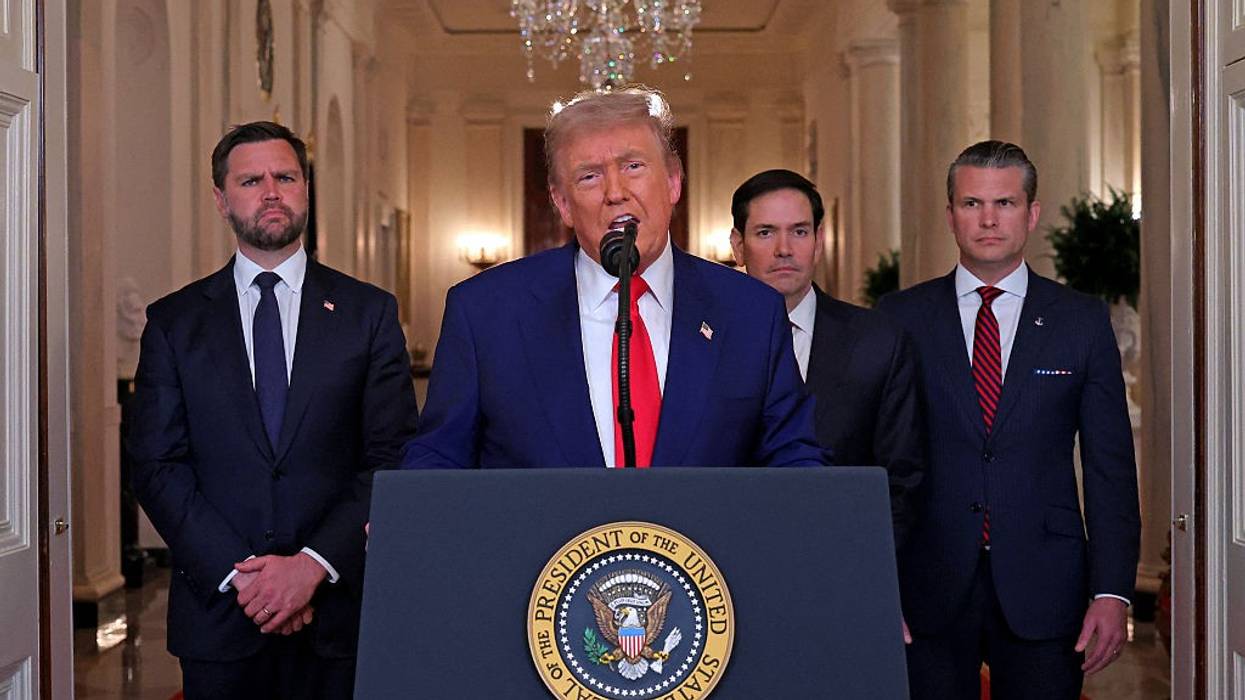
It also would have exempted President Donald Trump and other executive branch employees. During his second term in office, Trump has made around 30,000 securities trades since returning to office. Bloomberg estimated, based on public disclosures, that he'd made more than 21,000 trades worth between $600 million and $1.86 billion in 2025 alone.
The bill passed by House Republicans also attached a national photo ID requirement for voting as well as additional identification requirements for vote-by-mail, which voting rights advocates argued could disenfranchise millions of eligible voters who do not possess a valid photo ID.
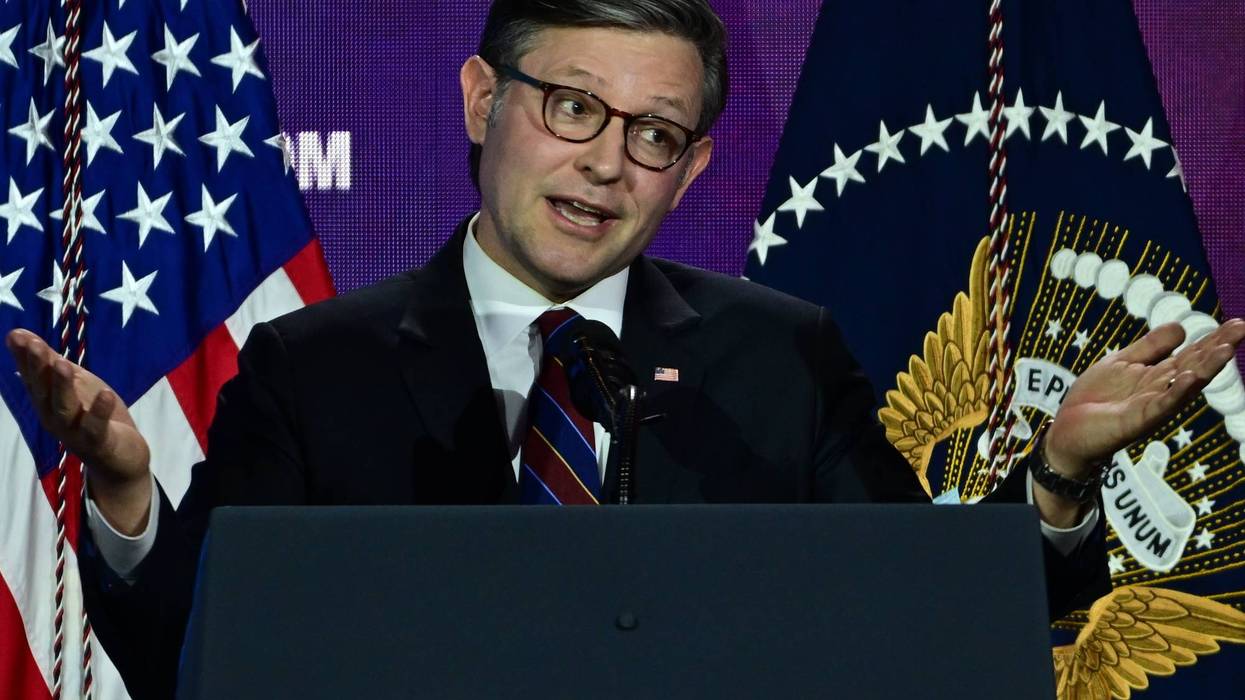
"This measure was a ruse, promoted by House Speaker Mike Johnson (R-La.), to make it appear that congressional Republicans were tackling an ethical quagmire when, in fact, it would have accomplished very little," said Craig Holman, government affairs lobbyist for Public Citizen.
Democrats have argued that the watered-down Republican proposal was meant to sap momentum from stronger bills, amid broad public demand for a stock trading ban.
Holman noted that "there was serious legislation to stop congressional insider trading, but Johnson would not bring up any of the serious proposals for a floor vote."
A bipartisan bill that has stalled in the House would have required members of Congress to divest stock they currently own. Meanwhile, the GOP-controlled House Rules Committee blocked a Democratic proposal that would have made the president and vice president subject to the ban.
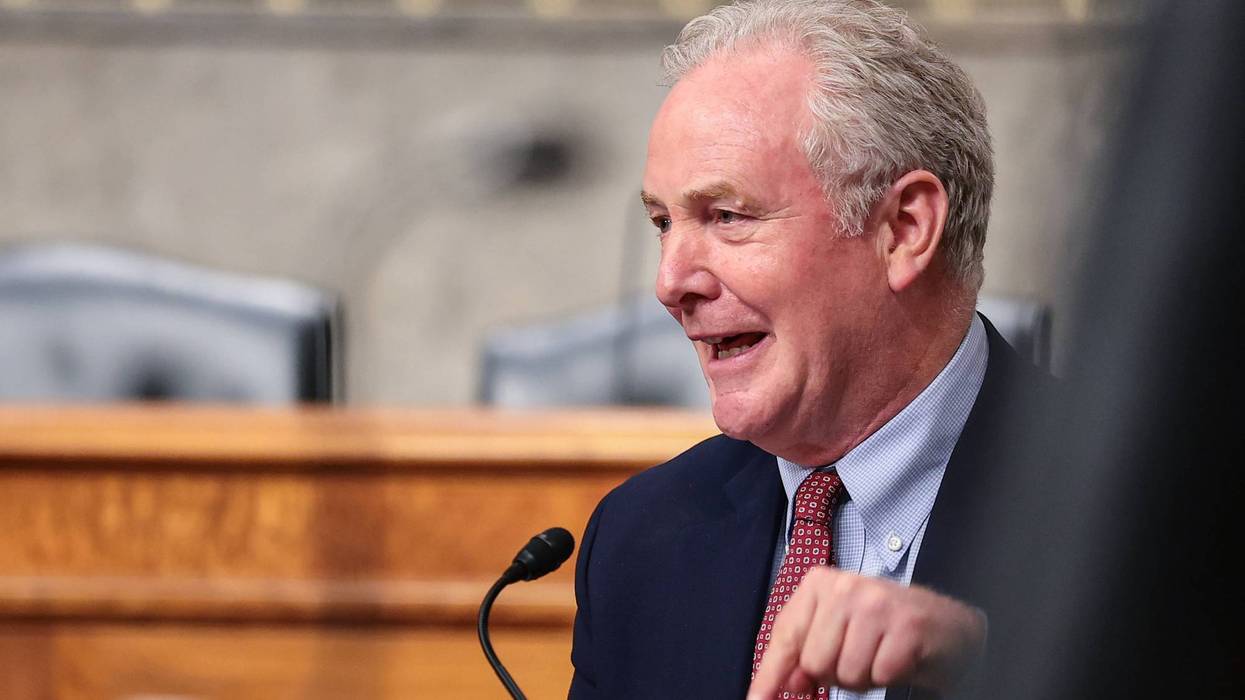
"Let’s be clear: I support a total ban on Congress members trading stock," said Sen. Chris Van Hollen (D-Md.) on Wednesday. "But Republicans are trying to package a fraudulent version of that with a bill to disenfranchise American voters."
"This is politics at its worst," he said. "Put a real ban on the floor if you’re serious."
While US presidential history isn't short on scandals, self-enrichment corruption under Trump 2.0 is—to borrow his pet refrain—“like nothing we’ve ever seen before.”
Does Teapot Dome ring a bell?
Generations of high school history teachers taught Teapot Dome as an outrageous episode of unprecedented and still unsurpassed corruption. A 1960s US history textbook is typical:
Death mercifully claimed [President Warren G.] Harding on August 2, 1923, before the worst of the scandals came to light, that involving the naval oil reserves at Teapot Dome, Wyoming, and Elk Hills, California. These reserves had been transferred to private control on noncompetitive bidding by Secretary of the Interior [Albert B.] Fall, after Harding had moved control of them from the Navy Department to the Interior Department. Fall’s transfer of the reserves, which had raised suspicions, created a furor when it was discovered that Fall had obtained a $100,000 interest-free loan, $233,000 in Liberty Bonds, and a herd of blooded cattle in the transaction. Fall was indicted, prosecuted, and sentenced to a year in prison and a fine of $100,000. The Secretary of the Navy, who was guilty of stupidity in permitting the original transfer, was forced to resign.
“The worst of the scandals”? One hundred thousand dollars in 1923 would be worth about $2 million today. Those Liberty Bonds would be worth $4.5 million. Measured against the Trump 2.0 regime, the scale of this corruption is small potatoes.
To be sure, in the century between Teapot Dome and Trump 2.0 other presidents engaged in less-than-upright behavior. The Internal Revenue Service (IRS) found that Nixon owed substantial back taxes, leading to his famous "I am not a crook" speech (and the Watergate burglary led him to resign). Lyndon Johnson ordered the Federal Communications Commission (FCC) to give preferential treatment to his wife’s radio and TV stations. Over 120 of Ronald Reagan’s appointees resigned because of indictments, convictions, or being under a cloud, until then the largest number of corruption cases of any administration in US history (though nothing stuck to the original “Teflon President”). Bill Clinton invited political donors to sleep in the White House’s Lincoln Bedroom. Republican allegations that Joe Biden engaged in “egregious” corruption never panned out, though his son Hunter did parlay family connections into profitable business partnerships abroad. During Trump 1.0, the president’s main self-enrichment schemes involved millions that government agencies, public officials from Congress, the executive branch, and state and foreign governments, lobbyists, corporate bigwigs, and political campaigns spent at his hotels and golf courses and some modest pay-for-access schemes like hiking Mar-A-Lago membership dues.
Self-enrichment corruption under Trump 2.0, however, is—to borrow his pet refrain—“like nothing we’ve ever seen before.” Here’s a non-exhaustive catalog, limited to self-enrichment schemes involving the president and his family and cronies (many machinations occur behind the scenes). A full treatment of corruption that did not involve direct self-enrichment would include partisan gerrymandering; voter suppression measures; gutting regulation and oversight mechanisms; extorting universities, law firms, and news media; no-bid contracts for campaign donors’ companies; destroying the government registry of anonymous shell companies; and bogus investigations of political opponents and voting rights and civil rights organizations. Such a list would require not an opinion column, but an encyclopedia or a new wing of the Museum of Political Corruption. Some of the bullying efforts did end up enriching President Donald Trump, as when Paramount paid him $16 million (plus $20 million of additional advertising commitments) for the supposedly deceptive editing of a 2024 Kamala Harris interview. Shortly thereafter, the FCC approved Paramount’s $8 billion merger with Skydance, bringing CBS News into the right-wing media ecosystem (A subsequent merger with Warner Brothers is on hold, but could do the same with CNN).
As during Trump 1.0, under 2.0 foreign entities and political groups directed funds to Trump-owned properties. Events like the Saudi-backed LIV Golf tournament held at one of Trump's Florida clubs resulted in massive payouts. Trump continues to rake in millions in name licensing. He leaned on Amazon founder Jeff Bezos to pay tens of millions for a documentary about Melania that bombed at the box office.
When the Trump 2.0 administration facilitates the use of offshore financial paradises to shield corporate profits from taxation, services get cut and the rest of us must pay higher taxes to make up the difference.
Government watchdogs tracked hundreds of major donors who funneled money into inaugural and political action committees, vanity projects like the White House ballroom, and Trump family cryptocurrency ventures. Many received ambassadorial, cabinet, and other high-level appointments. The crypto initiatives—which generated an estimated $2.3 billion for the family and at least $3.8 billion in losses for retail investors—are vehicles for foreign and corporate interests to buy favors, such as regulatory rollbacks, tariff relief, and government contracts. Days before Trump’s second inauguration, the Emirati royal family took a 49% stake—$500 million—in World Liberty Financial. Not long after, the Trump administration green-lit the sale to the UAE of Nvidia AI chips, a deal that netted $187 million for the Trumps and $31 million for the family of Trump's Middle East envoy Steve Witkoff. Shortly before the Trump administration eased sanctions on his family’s businesses, Indian billionaire Mukesh Ambani invested at least $100 million in a struggling Texas startup, America First Refining, which had secretly given Donald Trump Jr. a financial stake.
Emblematic of the mixing of business with Middle East policy—directed by Witkoff and Trump son-in-law, Jared Kushner—himself from a notoriously corrupt family—was Qatar’s “donation” of a pimped-out 747 jet worth $400 million as a new, fancier Air Force One and eventual exhibit at Trump’s planned presidential library. Since 2025, Trump’s adult sons raked in millions from war industry start-ups. A Washington Post investigation found these firms generated “at least $3.2 billion in direct government business since the sons invested and an additional $3.1 billion in future contract options. Some have gained coveted spots on shortlists of preapproved contractors that can bid exclusively on up to nearly $200 billion in future work.”
The Trump Organization pursued over 20 overseas projects, many tied to foreign state investments. A $1.5 billion golf resort in Vietnam that may throw 4,000 farmers off their land drew scrutiny when the US lowered threatened tariffs shortly after the project broke ground. Kushner’s plans to build a multibillion-dollar resort in a protected natural reserve in Albania have backfired in the face of massive public resistance and accusations that the Miami-based businessman who sold Kushner the land may have acquired it with laundered drug money and forged deeds.
Corrupt pardons are another way Trump 2.0 benefits and normalizes bribery. Beneficiaries include money launderer Changpeng Zhou of Binance, who cut a deal with World Liberty Financial (which this month received conditional approval to become a bank); narco and former Honduran President Juan Orlando Hernández, whose pardon likely buttressed a pro-Trump candidate in that country’s election; and New York Mayor Eric Adams, who received various emoluments from the Turkish government and promised to cooperate with Trump on immigration enforcement. Court decisions and public outrage may have killed the proposed $1.776 billion "anti-weaponization" fund to compensate political allies. But the resolution of Trump’s $10 billion IRS lawsuit—clear collusion between the plaintiff and the government he runs—granted him and his family members and companies immunity from all federal tax audits and liabilities for returns filed prior to May 19, 2026, a gift likely worth between $100 and $600 million. While a court struck this down, Trump is appealing.
Under Trump 2.0, insider trading and pump-and-dump schemes proliferated. Trump purchased more than $1 million in Dell stock not long before the Pentagon awarded a $9.7 billion contract to the Texas-based computer company. Three months before White House advisers pressed the Pentagon to loan $620 million to Vulcan Elements, Donald Trump Jr.’s venture capital firm took an undisclosed stake in the North Carolina-based rare earths start-up. Another federally financed rare earths deal that Commerce Secretary Howard Lutnick negotiated with Kazakhstan netted Lutnick and Trump businesses millions in fees and profits. Trump Jr. also invested in a drone manufacturer, Unusual Machines, and received an additional 200,000 shares for serving as an adviser. The day the company announced his appointment, its stock nearly doubled, making him millions of dollars.
During the on-again off-again war against Iran and the on-again off-again trade wars, Trump’s comments and social media messages about impending “deals,” attacks, or tariffs provided ample opportunities for insiders to speculate on oil futures, stocks, and prediction markets. Trump has reportedly traded individual stocks on which he possibly had insider information. Trump Media even pitched a $100,000-per-month data feed —“Truth API” —to deliver banks and trading outfits “the fastest” access to influential Truth Social posts, a bargain for large-scale market cheaters.
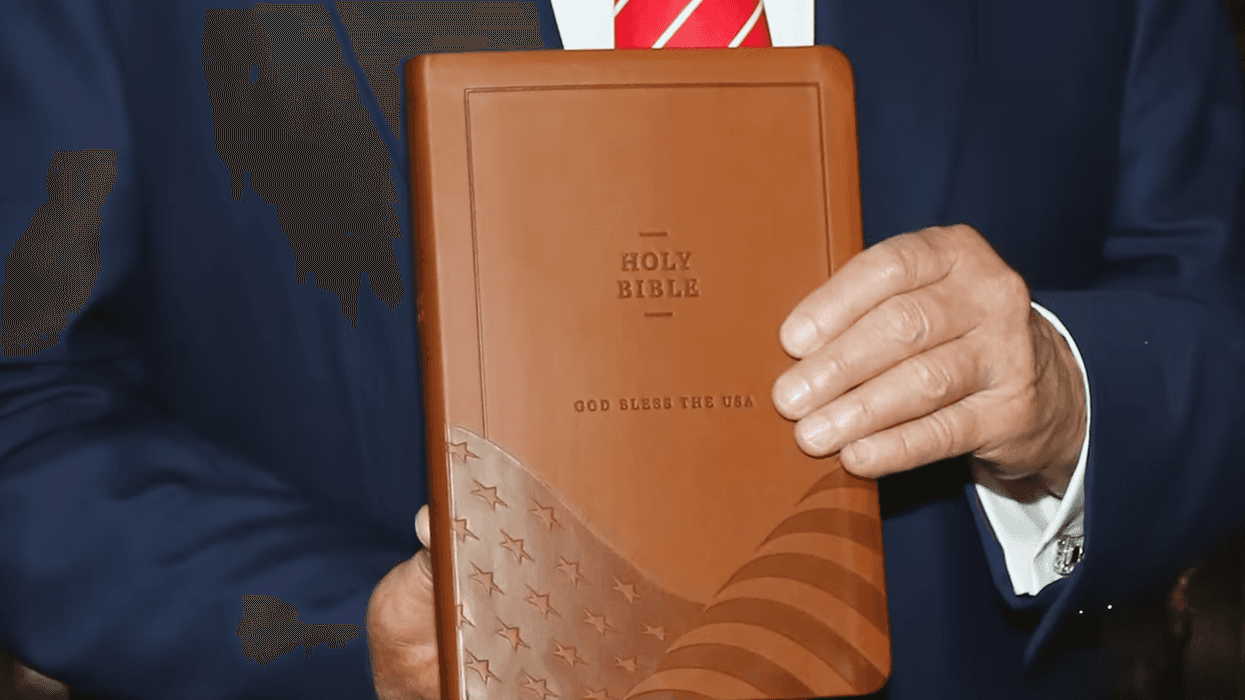
And since all that grift doesn’t sate Trump’s infinite need for more wealth, he ratcheted up sales of overpriced caps, watches, gold-colored cell phones, autographed Bibles, gold sneakers, bathrobes, fragrances, pickleball paddles, keychains, fake gold playing cards, and assorted other branded merch, trashing all previous norms about tasteful, dignified, and ethical presidential behavior.
The New York Times, The Wall Street Journal, The New Yorker, and books such as Barbara McQuade’s The Fix: Saving America from the Corruption of a Mob-Style Government have covered the Trump 2.0 grift in greater detail than is possible here. What they often fail to emphasize sufficiently, however, are the myriad connections between this thievery and harms that average Americans experience.
When the Trump 2.0 administration facilitates the use of offshore financial paradises to shield corporate profits from taxation, services get cut and the rest of us must pay higher taxes to make up the difference. The same is true for billionaires who don’t pay taxes. Tariffs hit Americans in their pocketbooks, as have skyrocketing energy prices resulting from the Iran War and demand from new data centers and crypto farms.
When the Trump regime finally ends —as it inevitably will—how many of us will remember the details of its record-breaking corruption? How many of us will demand accountability?
When Meta’s Mark Zuckerberg agreed to pay Trump $25 million to settle a dispute over the suspension of his Facebook page in the aftermath of January 6, to reinstate the page and eschew fact-checking on the platform, and to donate $1 million to Trump’s 2025 inaugural bash, it exposed Americans to increased disinformation, while depriving them of the tools needed to detect it.
When the president illegally refuses to spend funds Congress appropriated, it undermines government programs, including those that serve the most vulnerable Americans, such as Medicaid and Supplemental Nutrition Assistance Program recipients, veterans, and Social Security disability and retirement beneficiaries.
Probably the worst aspect of Trump 2.0 is the restructuring of government institutions and the entire economy to serve private interests, whether by scrapping regulations that expose us to toxins, financial predators, and dangerous workplaces or by rewriting history to erase painful aspects of our history and the contributions of minorities, women, immigrants, and other groups the regime detests. Elevating loyalty over competence facilitates this reengineering of governance to favor the mega rich and exacerbates domestic and geopolitical tensions.
In 2018, Steve Bannon famously articulated a key Trump stratagem, “to flood the zone with shit.” The intention was to deploy spectacle and disinformation to overwhelm and exhaust the media and citizenry, sow chaos and confusion, deflect and distract from real problems, erase memory, and assure that nobody would hold the powerful to account. Bannon is out, though still bloviating in the manosphere, but the shit flood continues. When the Trump regime finally ends —as it inevitably will—how many of us will remember the details of its record-breaking corruption? How many of us will demand accountability?
Maybe Teapot Dome didn’t ring a bell. How many of us recall our high school history courses, anyway? The New Republic recently summed up the contemporary significance of that ancient scandal: “For a long time, Harding’s administration had a serious claim to the title of ‘most corrupt’... Harding’s ghost must be grateful to Team Trump.”
Advance knowledge of both a military threat and its cancellation could allow politically connected traders to profit from the oil market twice—first from the panic, then from its disappearance.
Military threats move markets before they move armies. Announce a massive strike against Iranian oil, military, and infrastructure sites, and traders will immediately begin pricing in damaged production, regional retaliation, interrupted shipping, higher insurance costs, and possible disruption of the Strait of Hormuz. No missile needs to be launched. The announcement itself can add a substantial geopolitical premium to every barrel of oil.
Cancel the attack a few days later, however, and much of that premium may disappear just as quickly. Oil prices fall as traders conclude that the threatened supply disruption will not occur.
For ordinary investors, this is an exceptionally dangerous sequence. They must guess whether the threat is credible, whether an attack will happen, how much damage it might cause, whether Iran will retaliate, and how long any disruption will last. But for someone possessing advance knowledge of both the threat and its prearranged cancellation, the same sequence could provide an extraordinary opportunity to profit from a government-created price movement in both directions.
Consider a hypothetical political-corruption scheme.
Before the threat is announced, politically connected insiders go long 1,000 crude-oil futures contracts at $75 per barrel. A standard crude-oil futures contract represents 1,000 barrels, so 1,000 contracts provide exposure to one million barrels of oil. At $75 per barrel, the position has a notional value of $75 million.
This hypothetical identifies a corruption risk that should not be dismissed merely because it does not resemble the traditional envelope of cash passed beneath a table.
The traders do not necessarily put up the entire $75 million. Futures are leveraged instruments. Depending on prevailing exchange requirements, broker rules, and market volatility, a position of that size might require roughly $9 million in initial collateral, although a broker could demand considerably more for such a concentrated and conspicuous trade.
Then comes the public announcement: a massive military strike is imminent.
Television networks display maps of Iranian oil facilities. Analysts speculate about retaliation. Commentators warn that the Strait of Hormuz could be closed. Traders who had bet on lower oil prices rush to cover their short positions, while momentum buyers pile into the market out of fear that oil will soon become still more expensive.
Suppose the price rises from $75 to $100 per barrel.
The insiders close their 1,000 long contracts. A $25 increase across one million barrels produces a gross profit of $25 million.
But they are not finished.
Knowing the military threat is scheduled to be withdrawn, they immediately reverse direction and sell short 1,000 contracts at $100. To the public, the crisis appears to be intensifying. To the insiders, the ending is already known.
A few days later, the attack is canceled. With the immediate threat to oil production receding, the geopolitical premium collapses and oil falls from $100 back to $75. The insiders buy back the 1,000 contracts they previously sold short, earning another $25 million.
The two trades produce a combined gross profit of approximately $50 million. Measured against the roughly $9 million initially posted as collateral, that is about a 556% gross return. Not bad.
That figure should not be confused with a risk-free return on an ordinary $9 million investment. Technically, the traders would still control positions with notional values ranging from $75 million to $100 million. Futures margin requirements might rise. Prices could temporarily move against them. A broker might require additional collateral. A position of 1,000 contracts could attract regulatory scrutiny, although that possibility could be alleviated.
Inside information would not make those risks literally disappear. It would, however, radically reduce the central uncertainty facing everyone else: that is, which direction the market will move after each announcement. Knowing both turning points would make the enormous notional exposure far less worrisome than it would be to an ordinary trader.
Who pays for the insiders’ profits?
During the first phase, traders who had previously sold oil short may be forced to buy back their contracts as prices rise. Those purchases can accelerate the spike and provide liquidity for insiders closing profitable long positions near the top.
During the second phase, the losses fall on investors who buy after hearing the military threat. These late buyers are not necessarily irrational. They are reacting to public information supplied by government officials and to the genuine possibility of war, damaged infrastructure, and interrupted oil supplies. But they do not know that the threat is scripted to disappear.
When the attack is canceled and oil falls, those buyers are left holding the bag. Their losses become the economic counterpart of the insiders’ second profit.
What appears to the public as an unfolding geopolitical emergency therefore appears to the insider as a price chart whose two principal turning points have been conveniently set.
This hypothetical does not establish that any particular official, relative, donor, associate, or political ally has executed such trades. Suspicion is not proof. A serious allegation would require trading records, beneficial-ownership information, communications, financial disclosures, and evidence connecting traders to those controlling the announcements. Examining such records could be discouraged.
What appears to the public as an unfolding geopolitical emergency therefore appears to the insider as a price chart whose two principal turning points have been conveniently set.
This hypothetical identifies a corruption risk that should not be dismissed merely because it does not resemble the traditional envelope of cash passed beneath a table.
Government officials possess the power to create market-moving information. Military threats, sanctions, tariff announcements, regulatory decisions, and abrupt policy reversals can generate billions of dollars in gains and losses within hours. When advance notice of those actions is shared selectively—or when public policy is manipulated for private profit—the government itself becomes the instrument of market manipulation.
That possibility demands safeguards: timely disclosure of officials’ financial interests, meaningful restrictions on trading by senior policymakers and their households, scrutiny of unusual commodity positions surrounding major announcements, preservation of relevant communications, and investigation of accounts whose beneficial owners may be concealed behind partnerships, trusts, or shell entities.
The central question is not whether a hypothetical insider could make money from a manufactured crisis. The arithmetic shows that the opportunity is obvious.
The question is whether anyone with access to the script could begin trading before the public learns how the drama will end.

"This White House-Wall Street-Trump-Business feedback loop represents the depraved essence of insider trading," said the Maryland Democrat.
"Are you helping the president sell people advance access to market-moving information?"
That's the opening line of a Thursday letter that US House Judiciary Committee Ranking Member Jamie Raskin (D-Md.) sent to Kevin McGurn, interim CEO of President Donald Trump's Trump Media & Technology Group (TMTG) Corp.
TMTG runs Trump's Truth Social platform and earlier this month announced plans to launch "Truth API" by August 1. API, or application programming interface, lets software applications talk to each other. Critics have warned that the new endeavor will give Wall Street firms faster access to posts by the president and other top accounts.
"Trump Media's target market for buyers of this service is 'high-frequency and algorithmic trading firms,' which would each pay a
handsome $100,000 monthly subscription fee," Raskin wrote. "Nearly half of each fee would go directly into the pocket of Donald Trump, who owns roughly 41% of the company's shares through a trust that he continues to control."
"Put another way, Trump Media will soon be selling early access to President Trump's so-called 'Truth' missives to the most sophisticated investment firms in the world," he stressed. "This insider-information scheme will enable Wall Street to profit from the president's frequent market-moving posts on major businesses and cash in on swings in stock prices caused by the president's buying and selling (or pumping and dumping, if you prefer) of publicly traded stocks to unwitting retail investors."
As Investopedia pointed out Thursday: "In recent months Trump has posted about new developments in the Iran War, which is particularly important for buyers and sellers of futures contracts who are trying to ascertain where oil prices are headed. Over the past year, he has also posted about tariff policy, government investments in publicly traded companies, and other corporate news developments."
Additionally, as Raskin highlighted, "Trump has promoted over 20 companies on his Truth Social account shortly after purchasing the companies’ stocks, including government contractors where the Trump administration exerted substantial ability to move markets in those companies' favor. Donald Trump Jr.'s investment firm, 1789 Capital, has posted a staggering 200% investment return since his father's return to the White House, with the president recently admitting that his oldest sons are coventurers in his corruption."
Once the new service is up and running, "whenever President Trump uses Truth Social to announce that a ceasefire is imminent, or prematurely leaks US jobs data, his customers will now be able to front-run the market using their privileged access to his social media posts, leaving retail investors, pension plans, and retirement accounts irreparably disadvantaged," he warned. "This is precisely the type of harm that federal securities laws are designed to prevent."
Concerns about TMTG's plans led Democratic Sens. Elizabeth Warren (Mass.) and Adam Schiff (Calif.) to demand that US Securities and Exchange Commission Chair Paul Atkins launch an investigation. The senators wrote to the Trump-nominated SEC leader on Tuesday that the current administration "is the most corrupt in the nation's history," and the company's "new service threatens to undermine the integrity of capital markets."
In the meantime, Raskin—a constitutional scholar who managed Trump's historic second impeachment—is conducting his own probe of what he called a "reverse Robin Hood scheme," arguing that "this White House-Wall Street-Trump-Business feedback loop represents the depraved essence of insider trading." The congressman is demanding a lengthy list of records from the CEO of Trump's company by August 13.
"The president of the United States should be using the office to 'take care' that laws are enforced and to advance the public interest," he said, nodding to the US Constitution. "Instead, President Trump is, once again, using it to enrich in spectacular fashion himself, his family, and corporate cronies while also destroying the integrity of financial markets in the process."
"If Republicans actually wanted to stop congressional stock trading, they’d pass our bipartisan Restore Trust in Congress Act," said Rep. Pramila Jayapal.
The US House of Representatives on Wednesday held a series of key votes, including one in which over a dozen Democrats helped Republicans pass a purported congressional stock trading ban, even though the GOP tacked on a voter suppression provision demanded by President Donald Trump.
The chamber passed the Stop Insider Trading Act (HR 7008) in a 232-198 vote. The Democrats who voted in favor are Reps. Kathy Castor (Fla.), Henry Cuellar (Texas), Don Davis (NC), Jared Golden (Maine), Vicente Gonzalez (Texas), Josh Gottheimer (NJ), Marcy Kaptur (Ohio), Susie Lee (Nev.), Jared Moskowitz (D-Fla.), Chris Pappas (NH), Marie Gluesenkamp Perez (Wash.), Darren Soto (Fla.), and Derek Tran (Calif.).
Taking aim at Trump on Wednesday, Congresswoman Sydney Kamlanger-Dove (D-Calif.) said that "the Stock Trader in Chief made 21,000 stock trades in his first year back in office. I 100% support a stock trading ban for Members of Congress AND the president and VP. But the bill Republicans brought to the floor was only about appeasing Trump."
"It caters to Trump's election conspiracy theories by enacting haphazard voter ID restrictions, and it conveniently excludes him and JD from the ban," she added, referring to Vice President JD Vance. "I voted no."
Many other House Democrats joined voting rights advocates in opposing the bill in the lead-up to Wednesday's vote, with Congressional Black Caucus Chair Yvette Clarke (D-NY) denouncing it as "a Trojan horse—using the premise of congressional ethics reform to advance a broader effort to restrict access to the ballot box."
In a letter to Congress earlier this week, the Campaign Legal Center (CLC) warned that "the Voter ID Act—which mostly mirrors a section of the deeply unpopular SAVE Act—aims to impose onerous new requirements on voting. It would demand Americans provide ID to cast a ballot but only accept an unreasonably narrow list of acceptable types of documentation. It excludes widely held and reliable forms of ID that young people and voters of color disproportionally rely on, while failing to account for the diversity of tribal identification practices."
As for the stock portion of the bill, CLC wrote, it "would not actually ban lawmakers from trading stocks or stop members from unduly profiting from their official positions," and "contains exceptions that regrettably swallow the few new rules it does try to enact."
Rep. Pramila Jayapal (D-Wash.) on Wednesday renewed her call for passing the bipartisan Restore Trust in Congress Act.
In addition to HR 7008, the House on Wednesday passed an annual military spending package and a budget reconciliation framework that includes $10 billion for election-related grants.
By adding SAVE America Act provisions to unrelated measures, House Speaker Mike Johnson (R-La.) is trying "to placate Mr. Trump and far-right House Republicans who are furious that the voting restriction bill has run aground in the Senate," The New York Times noted. "The moves are unlikely to budge Senate Republicans; they consider the bill dead, given that it cannot draw the 60 votes needed to move forward in that chamber."
As for the chamber's Democrats, Senate Minority Leader Chuck Schumer (NY) and his party's Election Protection Task Force on Wednesday brought together various experts, including Ian Bassin of Protect Democracy, former White House ethics czar Norm Eisen, lawyer Marc Elias, Vanita Gupta of New York University School of Law, and Skye Perryman of Democracy Forward.
"We all know that Donald Trump wants to steal America's elections, plain and simple. And Democrats won't let it happen," Schumer said. "We are looking at every very way to prevent him from stealing the elections. He's desperate. He's made life harder, more difficult for Americans. He wants to steal the election because he knows he can't win the election. Our job is to stop it. And so, we are doing many things. This month we're talking about Trump's corruption."
"But one of the things we are doing is a tabletop exercise where some of the experts on election reform will challenge us with certain scenarios that Trump might use. We're looking at things he would do to undo elections before Election Day, on Election Day, and after Election Day," he explained. "And we had one tabletop exercise three, four weeks ago. And it greatly strengthened our knowledge and ability to anticipate what he might do and how to thwart him. That's what we're doing here today. And whatever he does, we will be ready to respond."
"Public Citizen again calls on the CFTC to wake up and do its job of overseeing the prediction market industry and enforcing the insider trading laws," said the watchdog's government affairs lobbyist.
As Kalshi confirmed Thursday that it referred a White House teleprompter operator to federal regulators for flagged bets on its prediction market, President Donald Trump's press secretary denounced the suspended staffer's reported actions—without addressing any of the mounting outrage over how her boss has cashed in on his return to the Oval Office.
Citing unnamed sources, ABC News reported that Gabriel Perez, who has been one of Trump's teleprompter operators since his first presidential campaign, is in talks with federal regulators at the Commodity Futures Trading Commission (CFTC) "to settle allegations he used his inside knowledge of the president's speeches to win more than $100,000."
"Of all Trump's closest aides, sources say Perez typically has the final eyes on nearly all of the president's prepared remarks—and is often known to take last-minute edits from Trump himself," the outlet detailed. Federal investigators reportedly found that Perez bet on words or topics mentioned by Trump in more than a dozen speeches.
While the CFTC declined to comment, Robert DeNault, Kalshi's head of enforcement, told multiple media outlets that "our surveillance team promptly flagged and referred these trades to the CFTC after an exchange investigation. We have been assisting regulators on this matter and provided evidence we collected, as we do in any referral."
Asked about the insider trading allegations on Thursday—just hours before Trump was set to deliver a prime-time address on election security—White House Press Secretary Karoline Leavitt told reporters that Perez has been put on unpaid administrative leave, at the direction of the president himself, and called his reported behavior a "disgrace."
"The White House has extremely strict ethical guidelines with respect to issues like this," Leavitt also claimed.
As National Public Radio detailed Thursday:
In March, White House staff received a memo warning against using nonpublic government information to place bets on Kalshi and its biggest competitor, Polymarket.
The memo, which was reviewed by NPR, stated that it is a criminal offense for anyone inside the White House to "buy" or "sell" on the sites. Prediction markets offer "yes" or "no" contracts that change in price based on the speculation of bettors. Aides in the White House were told in the memo that misusing government information "is a very serious offense and will not be tolerated."
The US Department of Justice this year has charged at least two people for their use of Polymarket: US Army special forces soldier who allegedly gambled on the abduction of Venezuelan President Nicolás Maduro, and a Google software engineer accused of using internal company information to place bets; they've both pleaded not guilty.
However, in the case of Perez, "the CFTC alerted federal prosecutors in Manhattan, who declined to open a criminal investigation," according to ABC News. Instead, he's discussing a potential settlement that would require him "to give back his profits and refrain from making similar trades."
Responding to the reporting in a Thursday statement, Craig Holman, government affairs lobbyist at the watchdog group Public Citizen, noted that "betting on political events on the prediction markets has become highly profitable for a small handful of anonymous bettors."
"Ever since the American invasion of Venezuela and Iran, a few people have been placing very large bets moments before the events take place, and scoring millions in profits," he emphasized. "The timing and accuracy of these bets strongly suggest insider trading, probably by a few individuals in the know within the Trump administration."
The reported behavior by Perez "is further evidence of illegal insider trading on the prediction markets—an industry that the Commodity Futures Trading Commission has let operate like the Wild West," Holman continued. "Public Citizen again calls on the CFTC to wake up and do its job of overseeing the prediction market industry and enforcing the insider trading laws."
The New York Times reported in May that the Trump administration has stacked CFTC with industry insiders who have systematically "mowed down" staffers interested in providing oversight on prediction markets like Polymarket and Kalshi.
Meanwhile, according to recently unveiled annual financial disclosures, Trump made an unprecedented $2.2 billion—more than half of it from his family's cryptocurrency exploits—during his first year back in the White House.
Based on those disclosures, Trump may have finally "crossed a line that even the presidency cannot erase, violating the nation's insider trading laws," Sen. Ed Markey (D-Mass.)—who helped write those laws—highlighted in a Wednesday blog post.
Trump—who infamously bankrupted multiple Atlantic City casinos—also has plans to get into prediction markets. His social media company, Trump Media and Technology Group, said last October that it would soon launch a prediction betting marketplace on Truth Social.
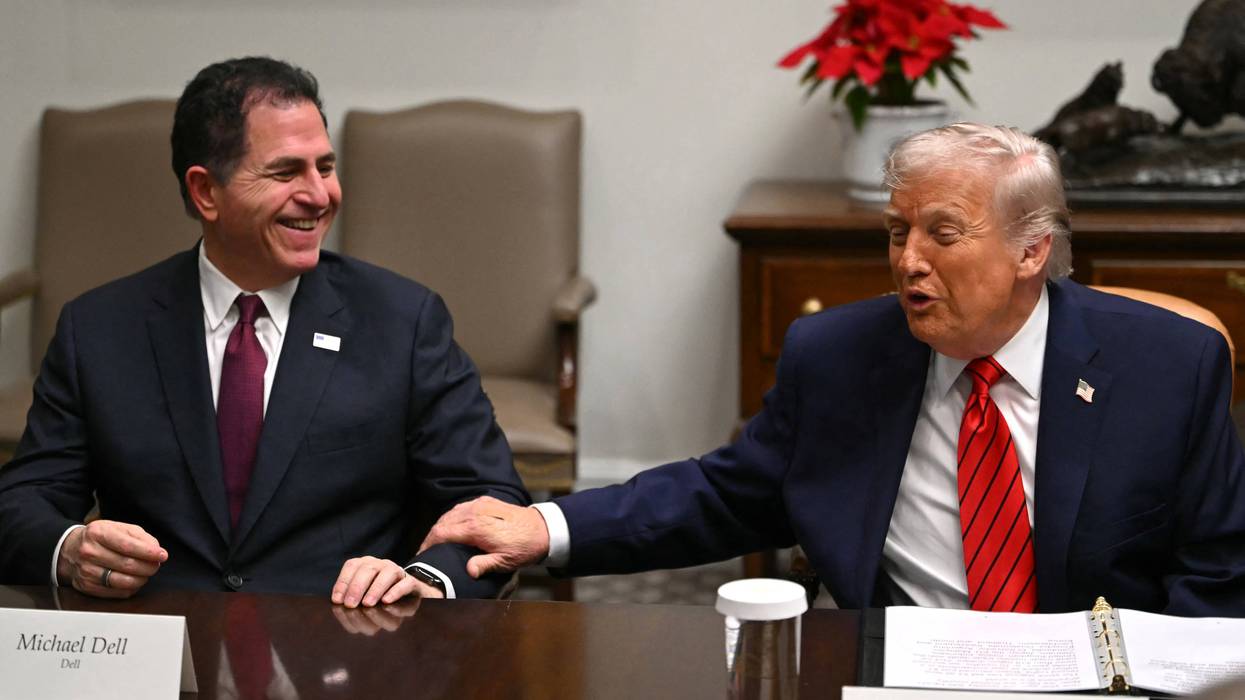
The on-paper value of the president's Dell stock holdings has soared potentially by millions since he told Americans to "go out and buy a Dell" earlier this month.
Just weeks after President Donald Trump urged Americans to "go out and buy a Dell" and months after he bought millions of dollars worth of stock in the company, the computer giant was awarded a $9.7 billion Pentagon contract.
The Department of Defense confirmed the contract with Dell Federal Systems, the government-focused arm of Dell Technologies, on Wednesday.
Euronews reported:
As part of the Core Enterprise Technology Agreement (CETA), a Pentagon-wide Microsoft licensing and software procurement framework, the company will provide and manage Microsoft software licences, cloud subscriptions and on-premises software licensing across the US military, intelligence agencies and the US Coast Guard.
The contract would have raised scrutiny regardless, given the Dell family’s proximity to Trump in his second term. CEO Michael Dell and his wife, Susan, have pledged $6.25 billion to help fund the so-called “Trump accounts” that were part of the president's 2025 mega budget legislation, a policy that critics have described as a tax shelter for the wealthy.
This tied the Dell family fortune to Trump's political agenda. In recent months, he's also hitched it to his own personal wealth.
Follow this:First, Trump quietly buys up to $5 million of Dell stock.Then, he urges his followers to “go out and buy a Dell.”Today, his Pentagon awards a $9.7 billion deal to Dell. www.bloomberg.com/news/article...
[image or embed]
— Bill Grueskin (@bgrueskin.bsky.social) May 27, 2026 at 7:45 PM
During his frenetic burst of stock trading in the first three months of the year, Trump purchased between $1 million and $5 million in Dell stock on February 10, according to financial disclosure forms, when the stock traded at $126 per share.
Months later, at a Mother's Day event on May 8, he publicly shilled for the company's products—a possible violation of White House ethics policy—and lavished praise upon the Dell family:
They've done such a job, such a job on that. They put up a lot of money, too [for Trump accounts]. Put up $6.25 billion. That's somebody and he started making computers on his bed in college and selling them because they were better than other computers.
And he just—I said, "How did you do that?" He said, "Well, I did it and I just never stopped." He just kept going.
So, go out and buy a Dell, they're great.
After the president's remarks, the value of Dell stocks surged by 14.6% to an all-time high of just under $264 before settling at just over $260 by the end of the day.
The announcement of the lucrative new Pentagon deal on Wednesday has caused the stock’s value to soar, reaching nearly $318 per share as of Thursday morning. The value was $305 per share before the announcement.
In total, the share price of Dell stock has climbed by about 155% since Trump bought it back in Feburary. Depending on how much of it he owns, that means he could have unrealized gains of between $1.55 million to $7.74 million. About 47% of those unrealized gains would have come just in the last month since he used the White House to boost Dell stock.
Acting US Navy Chief Information Officer Barry Tanner has insisted that there was no playing favorites when Dell was selected for the contract.
But Trump, who has increased his net worth by an eye-popping $3 billion since retaking office last year, according to the watchdog Citizens for Responsibility and Ethics in Washington (CREW), has regularly faced accusations of lavish self-dealing.
In fact, a ProPublica report out on Thursday found that his White House adviser, Peter Navarro, personally intervened to push the Pentagon to give a $620 million loan to a startup linked to Donald Trump, Jr., out of dozens of companies that were under consideration.
Dell is also far from the first company to receive a Trump administration contract or other beneficial action after Trump purchased their stock. Earlier this month, NOTUS reported that Trump had bought shares in companies, including Palantir, Axon, and AMD, mere weeks before they were granted government contracts or regulatory relief.
Tommy Vietor, a National Security Council staffer under former President Barack Obama and now the host of the liberal Pod Save America podcast, said on social media that the Dell contract was an example of how “every day there’s another example of insider trading and corruption by Trump himself.”
Noting that Trump’s personal profit from the presidency far exceeds that of anyone else who has held the office, Tim Miller, a journalist and commentator at The Bulwark, said that a contract with such an obvious conflict of interest would be a “front-page story and weekslong scandal for anyone other than Trump.”
Before Trump v. United States, presidents knew they could be criminally prosecuted if they looted the government, but Chief Justice John Roberts’s ruling all but stops any bribery prosecution before it starts.
On Monday, Donald Trump dropped his sham lawsuit against the federal government. In exchange, the Justice Department under his control will establish a $1.8 billion fund for “victims of lawfare,” as Acting Attorney General Todd Blanche put it. This will be a slush fund for Trump’s allies—presumably January 6 insurrectionists and others already rewarded with a pardon.
There is a zone of lawlessness around the Oval Office, erected by the Supreme Court when it granted current and former presidents effective immunity from prosecution if their crimes involved “official acts.” Loot the taxpayers, misuse government power for graft, and you’re off the hook.
Last week, the president filed a report with the Office of Government Ethics detailing the stock trades he made this year. It is a novelistic tale of profiteering, recognizable as insider trading in every way except, perhaps, under the law.
Former US Pardon Attorney Liz Oyer offers a useful guide.
It’s epic corruption in plain sight. History shows that after scandal comes reform—often, but not always.
In recent months, as Paramount and Netflix vied to buy Warner Brothers, Trump bought stock in all three companies. Now the Justice Department is considering whether to approve Paramount’s purchase of Warner Brothers.
As CNBC reported, Trump “scooped up shares” in the data firm Palantir. Soon after, he abruptly praised the firm. “Palantir Technologies (PLTR) has proven to have great war fighting capabilities and equipment,” Trump posted, even highlighting its ticker name. “Just ask our enemies!!!” All this while Palantir was winning big federal contracts.
He invested in Oracle while brokering its deal to buy TikTok.
Just this week, he paraded off Air Force One in China, flanked by the CEOs of Nvidia and Boeing. Trump bought millions of dollars of Boeing stock before the trip, which led to the sale of 200 Boeing airplanes to the Chinese government. Among his biggest purchases has been Nvidia stock, which has seen steep increases after the US government cleared 10 Chinese companies to purchase its advanced chips, in a big reversal from earlier national security concerns.
Altogether, Oyer writes, “You’ll find it hard to avoid the conclusion that, to Donald Trump, governing is synonymous with profiteering.”
This president is constrained by the weakest legal rules in history.
Start with that immunity ruling, Trump v. United States. Before that, presidents knew they could be criminally prosecuted if they looted the government. Chief Justice John Roberts’s ruling all but stops any bribery prosecution before it starts, by preventing any inquiry into the president’s motivations, even when the act looks and smells like a bribe. Justice Amy Coney Barrett noted that the ruling would “hamstring the prosecution” in a case such as bribery. (Having critiqued the misguided majority, Barrett then mystifyingly voted with it.)
Insider trading laws are weak, in any case. The Securities Exchange Act of 1934 prohibits using nonpublic information to guide stock trading, but its application to elected officials remains murky. In 2012, Congress passed the Stock Act to prevent insider trading among members of Congress, but the president and vice president remain exempt.
It’s epic corruption in plain sight. History shows that after scandal comes reform—often, but not always.
In January, the Brennan Center published Nine Solutions for Political Corruption. In it, we call for a law to require the president to divest from all stocks and other assets that could generate a conflict of interest. That was the norm, and now it must be a law. Ethics rules should cover presidents and vice presidents too.
And we call for a constitutional amendment to end the unilateral power of a president to issue corrupt pardons.
What about that Trump v. United States ruling? In the past, after the Supreme Court has erred so gravely, we’ve changed the Constitution. The 14th Amendment, for example, undid the Dred Scott decision. Another amendment is needed to clean up the immunity mess.
The sturdiest protection against corruption would be fierce anger from fleeced taxpayers. A few months ago, when asked about his conflicts of interest, Trump said, “I found out that nobody cared, and I’m allowed to.”
It turns out that Americans do care. In January, a YouGov poll found that “large shares of both Democrats and Republicans think their party focuses too little on corruption.”
Let’s make this a major issue for the campaign trail and press politicians from both parties to provide solutions, not just soundbites. Or else, as Oyer wrote, we risk having future presidents who “loot and pillage our country without a shadow of shame.”
"Only a select few in the top tax bracket are benefiting from this, and the majority of you ain’t in it," said former Rep. Marjorie Taylor Greene.
Observers are once again raising concerns about insider trading on Wednesday after a trader took a colossal crude oil short position just over an hour before a US-Iran peace deal was reported to be on the horizon, causing prices to fall.
The Kobeissi Letter, a financial newsletter, reported on X that at 3:40 am on Wednesday, "nearly 10,000 contracts worth of crude oil shorts were taken without any major news."
This was equivalent to $920 million in notional value, which the letter described as "an unusually large trade" so early in the morning. But it would soon pay off.
At 4:50 am, just 70 minutes later, Axios published an exclusive scoop by Middle East reporter Barak Ravid that the White House believed the US and Iran were on the verge of agreeing to a one-page "memorandum of understanding" to end the war, which included more nuclear negotiations, one of the key sticking points for US President Donald Trump.
By 7:00 am, just over two hours after Axios dropped its report, oil prices had fallen by 12%, allowing the savvy investor to make $125 million in a matter of hours, which led to accusations that it was yet another example of "epic insider trading" by those in the know about Trump's plans.
Prices have since rebounded by about 8% after Iran announced the creation of the new "Persian Gulf Strait Authority," to mediate the passage of ships through the Strait of Hormuz on its terms.
The Trump administration has already been deluged with accusations that its members are using insider information to take advantage of financial markets and prediction market apps.
Last month, an active-duty US special forces soldier was indicted by the Department of Justice after he made about $400,000 betting on Polymarket that Venezuelan President Nicolás Maduro would be removed from power, a bet he allegedly placed using classified information about an operation he himself was involved with.
More bettors collected around $1 million in profits from bets on the specific timing of Trump's war with Iran in late February. The Financial Times also reported a surge of more than $580 million in oil futures trading right before Trump announced a pause in strikes on Iran's energy facilities in March.
Of course, Wednesday's bet theoretically could have been made without the aid of insider information.
The new peace framework is the latest in what has seemed to be an endless pattern over the past several weeks in which US officials tell media outlets that a peace agreement is on the horizon, causing oil prices to dip, only for it to collapse later in the week, often with Trump issuing hostile threats or making new demands.
It has become such a familiar story that some have speculated that the announcement of productive ceasefire talks is deliberately choreographed to calm oil markets and bring down prices, which have become a growing problem for Trump among voters.
But as The Economic Times explained, the bet placed Wednesday morning likely "is not a routine hedge" or "a portfolio rebalancing move."
"At that hour, in that size," it said, "a crude oil short of that magnitude is a deliberate, high-conviction directional bet."
Former Rep. Marjorie Taylor Greene (R-Ga.), a one-time Trump cheerleader who's become one of his leading critics, suggested Trump's erratic approach to negotiating an end to the war was just a tool used by him and his allies to profit.
"When is everyone going to start realizing that the on-again, off-again war/peace rhetoric is really just insider trading? And sprinkle in some murder," Greene wrote on social media. "Only a select few in the top tax bracket are benefiting from this, and the majority of you ain’t in it."
Democrats in Congress have urged the Securities and Exchange Commission (SEC) to investigate what Sen. Chris Murphy (D-Conn.) suggested could be "mind-blowing corruption" by the White House, not only related to Trump's wars, but also to his tariff regime, which has caused similar market chaos that bettors have been able to capitalize on with fortuitously timed wagers.
But critics have described profiting from the machinations of a war that has killed more than 1,700 civilians as particularly grotesque.
"This has to stop," said Fox News commentator Jessica Tarlov. "Lives on the line so they can insider trade!"

"In a functional democracy, he would offer his resignation tonight."
A broker for Pentagon Secretary Pete Hegseth reportedly tried to make a "big investment" in a bundle of weapons stocks just weeks before the US and Israel launched their war on Iran, an unpopular assault that Hegseth has aggressively championed.
Citing three unnamed people familiar with the matter, The Financial Times reported on Monday that Hegseth's "broker at Morgan Stanley contacted BlackRock in February about making a multimillion-dollar investment in the asset manager’s Defense Industrials Active ETF... shortly before the US launched military action against Tehran." The bombing began on February 28.
A spokesperson for the Pentagon denied the story, calling it "entirely false and fabricated" and insisting that neither Hegseth nor any of his representatives approached BlackRock about such an investment. But the FT reported that the broker's "inquiry on behalf of the high-profile potential client was flagged internally at BlackRock."
The investment was not ultimately made because the fund—which includes behemoths such as RTX, Lockheed Martin, Boeing, and Northrop Grumman—was not available for Morgan Stanley clients to buy at the time.
The purchase would not have been immediately lucrative: Over the past month, the Defense Industrials Active ETF is down over 12%. But the reported allegation that Hegseth's broker sought to make the largest investment in the weapons industry set off alarm bells, particularly amid growing concerns that Trump administration officials are using inside knowledge and manipulating markets to cash in on the war.
"You know, back when the [US government] gave a damn about anti-corruption, this is something we would've seen as a 'no no,'" said Richard Nephew, a former anti-corruption coordinator at the US State Department.
Economist Justin Wolfers wrote of Hegseth that, "in a functional democracy, he would offer his resignation tonight."
Instead, Pentagon spokesperson Sean Parnell demanded that the FT issue an "immediate retraction," dismissing the newspaper's story as "yet another baseless, dishonest smear designed to mislead the public."
Hegseth has emerged as the most prominent and belligerent cheerleader of the Iran war in the US, and—according to President Donald Trump—the Pentagon chief was the first of the president's advisers to "speak up" in favor of the assault during the internal decision-making process.
Trump has also suggested Hegseth does not want the war to end, saying last week that the Pentagon chief was "quite disappointed" when the president claimed the conflict would be over shortly.
"I don’t want to say this, but I have to," Trump told reporters at the White House. "I said, Pete and General Razin’ Caine, this thing is going to be settled very soon, and they go, ‘Oh, that’s too bad.'"