SUBSCRIBE TO OUR FREE NEWSLETTER
Daily news & progressive opinion—funded by the people, not the corporations—delivered straight to your inbox.
5
#000000
#FFFFFF
To donate by check, phone, or other method, see our More Ways to Give page.
Daily news & progressive opinion—funded by the people, not the corporations—delivered straight to your inbox.
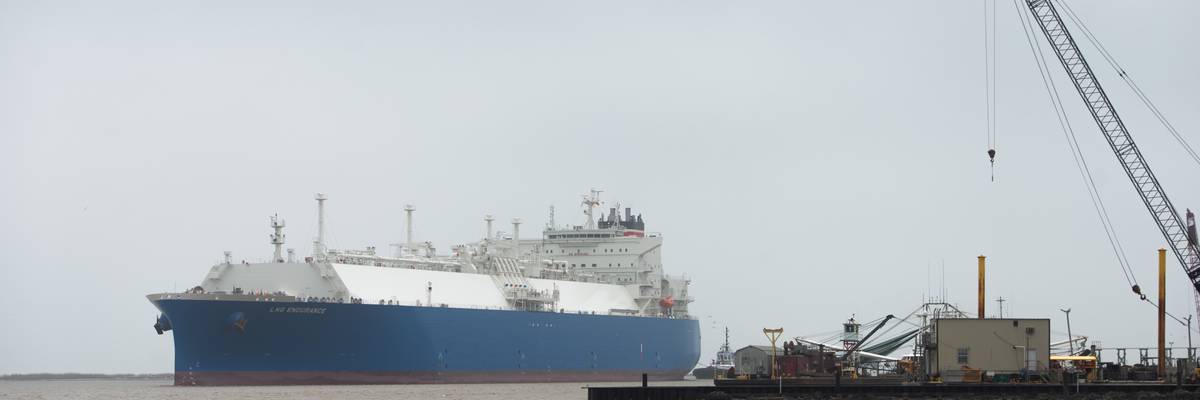
A liquefied natural gas (LNG) tanker makes its way into Cameron Pass near the site of Venture Global LNGs facility at Cameron Pass, near Cameron, Louisiana, on Wednesday, April 13, 2022.
The bill, led by Democrats, comes amidst mounting concerns about the increase in liquefied natural gas export infrastructure in both the U.S. and overseas.
Sen. Edward J. Markey and Reps. Adriano Espaillat and Yvette Clark reintroduced Thursday the Block All New Fossil Fuel Exports Act to preserve a livable climate and protect frontline communities along the U.S. Gulf Coast.
The bill, which would amend the Energy Policy and Conservation Act to ban the international export of both American crude oil and liquefied methane gas (LNG), is backed by 70 organizations that wrote a letter to Congress endorsing the bill Wednesday.
"The United States is taking aggressive action to tackle the climate crisis and transition to create renewable energy solutions," the letter reads. "But recent approvals for new fossil fuel projects to export fossil fuels are threatening people's health and safety and stand in the way of global efforts to combat the climate crisis. Continued expansion of U.S. export infrastructure limits collective progress toward long-term energy security goals."
"Biden can't keep claiming to care about climate and environmental justice while allowing more of these projects that put our lives at risk."
The bill comes amidst mounting concerns about the increase in LNG export infrastructure in both the U.S. and overseas. A Greenpeace report published last month revealed that new European LNG terminals combined with both existing and proposed U.S. infrastructure would spew out as much climate pollution as adding 604 million new cars to the roads.
While the ostensible push behind this LNG expansion was the need to bolster Europe's energy needs in the aftermath of Russia's invasion of Ukraine, both the Greenpeace report and an earlier investigation from Friends of the Earth, Bailout Watch, and Public Citizen found that the fossil fuel industry was exploiting the situation to lock in LNG infrastructure that wouldn't begin delivering until 2026. More than 75% of the LNG contracts considered by the second report would actually direct shipments to the Asia-Pacific region.
What's more, the build-up of fossil fuel infrastructure connecting the Permian Basin to the Gulf Coast predates the Ukraine war—Congress spurred much of it by lifting a ban on the export of crude oil in 2015, the letter writers said. The new legislation would reinstate this ban and slow the record oil production in the Permian Basin, as well as add a ban on LNG exports.
The International Energy Agency has said that policymakers should not develop any new fossil fuels if they want to limit global warming to 1.5°C above preindustrial levels and stave off ever more extreme climate impacts. The most recent report from the Intergovernmental Panel on Climate Change went further, concluding that existing fossil fuel infrastructure would emit enough to push the Earth's average temperature past the 1.5°C goal. Another report commissioned by the International Institute for Sustainable Development from scientists at the University of Manchester's Tyndall Center found that wealthy nations like the U.S. need to end oil and gas production by 2034 to keep the critical goal alive.
Despite the science and his own campaign promises, President Joe Biden has approved more drilling on public lands during his first two years in office than President Donald Trump during the same timeframe. His Federal Energy Regulatory Commission also signed off on two Gulf Coast LNG facilities in April: Texas LNG and Rio Grande LNG, as well as the linked Rio Bravo Pipeline. In 2022, the Biden administration rubber stamped the Sea Port Oil Terminal (SPOT) off the coast of Brazoria County, Texas. All of these approvals overrode the concerns of pollution-burdened Gulf Coast communities.
"We are sick and tired of the hypocrisy from this administration," Gwen Jones, a resident of the displaced East End community in Freeport, said in a statement supporting the new bill. "Biden can't keep claiming to care about climate and environmental justice while allowing more of these projects that put our lives at risk. Prove to us that you will prioritize the health and safety of people and our planet over fossil fuel industry profits."
The bill's supporters argue that Biden could turn off the tap himself by declaring a climate emergency, reinstating the crude oil export ban, and significantly restricting LNG exports under the Natural Gas Act. They also point out that the expansion disproportionately impacts low-income communities of color who neighbor the infrastructure.
"The fossil fuel industry is bombarding my community, and we can't take it anymore. The Biden Administration recently approved the SPOT oil export facility and has allowed Freeport LNG to reopen after their dangerous explosion," Melanie Oldham, founder of Better Brazoria and a Freeport, Texas resident, said in a statement. "The hearings and comment periods for these fossil fuel projects are constant, and it's too much. We can't continue to be sacrificed to build even more reckless projects that will destroy our air quality and the climate."
In addition to limiting local pollution, the new bill would help U.S. consumers as a whole since more oil would be available for domestic use instead of being sent overseas, supporters argued.
"The BAN Fossil Fuel Exports Act is a much-needed step to prioritize American consumers and to reaffirm the U.S.'s commitment to addressing climate change on a global scale," Rep. Espaillat (D-N.Y.) said in a statement. "As our national economy continues its recovery following the Covid-19 pandemic, we must ensure hard-working Americans are not shouldered with the burdens of high energy costs and the real-world effects of global heating. This bill would make real progress towards preserving our planet while supporting American families by bringing down domestic costs."
The bill's re-introduction comes amidst global calls to halt LNG expansion as the leaders of wealthy nations gather for the G7 Summit this weekend. A coalition of groups sent a letter to the Biden administration Tuesday urging it to push back against this expansion at the upcoming meeting in Hiroshima.
"The G7 Climate and Environment Ministerial Communique in April stated that investment in the natural gas sector, including LNG, is only appropriate if 'implemented in a manner consistent with our climate objectives and without creating lock-in effects,'" the groups wrote. "The G7 should clarify at its final meeting that new LNG export and import infrastructure fails this test."
Dear Common Dreams reader, It’s been nearly 30 years since I co-founded Common Dreams with my late wife, Lina Newhouser. We had the radical notion that journalism should serve the public good, not corporate profits. It was clear to us from the outset what it would take to build such a project. No paid advertisements. No corporate sponsors. No millionaire publisher telling us what to think or do. Many people said we wouldn't last a year, but we proved those doubters wrong. Together with a tremendous team of journalists and dedicated staff, we built an independent media outlet free from the constraints of profits and corporate control. Our mission has always been simple: To inform. To inspire. To ignite change for the common good. Building Common Dreams was not easy. Our survival was never guaranteed. When you take on the most powerful forces—Wall Street greed, fossil fuel industry destruction, Big Tech lobbyists, and uber-rich oligarchs who have spent billions upon billions rigging the economy and democracy in their favor—the only bulwark you have is supporters who believe in your work. But here’s the urgent message from me today. It's never been this bad out there. And it's never been this hard to keep us going. At the very moment Common Dreams is most needed, the threats we face are intensifying. We need your support now more than ever. We don't accept corporate advertising and never will. We don't have a paywall because we don't think people should be blocked from critical news based on their ability to pay. Everything we do is funded by the donations of readers like you. When everyone does the little they can afford, we are strong. But if that support retreats or dries up, so do we. Will you donate now to make sure Common Dreams not only survives but thrives? —Craig Brown, Co-founder |
Sen. Edward J. Markey and Reps. Adriano Espaillat and Yvette Clark reintroduced Thursday the Block All New Fossil Fuel Exports Act to preserve a livable climate and protect frontline communities along the U.S. Gulf Coast.
The bill, which would amend the Energy Policy and Conservation Act to ban the international export of both American crude oil and liquefied methane gas (LNG), is backed by 70 organizations that wrote a letter to Congress endorsing the bill Wednesday.
"The United States is taking aggressive action to tackle the climate crisis and transition to create renewable energy solutions," the letter reads. "But recent approvals for new fossil fuel projects to export fossil fuels are threatening people's health and safety and stand in the way of global efforts to combat the climate crisis. Continued expansion of U.S. export infrastructure limits collective progress toward long-term energy security goals."
"Biden can't keep claiming to care about climate and environmental justice while allowing more of these projects that put our lives at risk."
The bill comes amidst mounting concerns about the increase in LNG export infrastructure in both the U.S. and overseas. A Greenpeace report published last month revealed that new European LNG terminals combined with both existing and proposed U.S. infrastructure would spew out as much climate pollution as adding 604 million new cars to the roads.
While the ostensible push behind this LNG expansion was the need to bolster Europe's energy needs in the aftermath of Russia's invasion of Ukraine, both the Greenpeace report and an earlier investigation from Friends of the Earth, Bailout Watch, and Public Citizen found that the fossil fuel industry was exploiting the situation to lock in LNG infrastructure that wouldn't begin delivering until 2026. More than 75% of the LNG contracts considered by the second report would actually direct shipments to the Asia-Pacific region.
What's more, the build-up of fossil fuel infrastructure connecting the Permian Basin to the Gulf Coast predates the Ukraine war—Congress spurred much of it by lifting a ban on the export of crude oil in 2015, the letter writers said. The new legislation would reinstate this ban and slow the record oil production in the Permian Basin, as well as add a ban on LNG exports.
The International Energy Agency has said that policymakers should not develop any new fossil fuels if they want to limit global warming to 1.5°C above preindustrial levels and stave off ever more extreme climate impacts. The most recent report from the Intergovernmental Panel on Climate Change went further, concluding that existing fossil fuel infrastructure would emit enough to push the Earth's average temperature past the 1.5°C goal. Another report commissioned by the International Institute for Sustainable Development from scientists at the University of Manchester's Tyndall Center found that wealthy nations like the U.S. need to end oil and gas production by 2034 to keep the critical goal alive.
Despite the science and his own campaign promises, President Joe Biden has approved more drilling on public lands during his first two years in office than President Donald Trump during the same timeframe. His Federal Energy Regulatory Commission also signed off on two Gulf Coast LNG facilities in April: Texas LNG and Rio Grande LNG, as well as the linked Rio Bravo Pipeline. In 2022, the Biden administration rubber stamped the Sea Port Oil Terminal (SPOT) off the coast of Brazoria County, Texas. All of these approvals overrode the concerns of pollution-burdened Gulf Coast communities.
"We are sick and tired of the hypocrisy from this administration," Gwen Jones, a resident of the displaced East End community in Freeport, said in a statement supporting the new bill. "Biden can't keep claiming to care about climate and environmental justice while allowing more of these projects that put our lives at risk. Prove to us that you will prioritize the health and safety of people and our planet over fossil fuel industry profits."
The bill's supporters argue that Biden could turn off the tap himself by declaring a climate emergency, reinstating the crude oil export ban, and significantly restricting LNG exports under the Natural Gas Act. They also point out that the expansion disproportionately impacts low-income communities of color who neighbor the infrastructure.
"The fossil fuel industry is bombarding my community, and we can't take it anymore. The Biden Administration recently approved the SPOT oil export facility and has allowed Freeport LNG to reopen after their dangerous explosion," Melanie Oldham, founder of Better Brazoria and a Freeport, Texas resident, said in a statement. "The hearings and comment periods for these fossil fuel projects are constant, and it's too much. We can't continue to be sacrificed to build even more reckless projects that will destroy our air quality and the climate."
In addition to limiting local pollution, the new bill would help U.S. consumers as a whole since more oil would be available for domestic use instead of being sent overseas, supporters argued.
"The BAN Fossil Fuel Exports Act is a much-needed step to prioritize American consumers and to reaffirm the U.S.'s commitment to addressing climate change on a global scale," Rep. Espaillat (D-N.Y.) said in a statement. "As our national economy continues its recovery following the Covid-19 pandemic, we must ensure hard-working Americans are not shouldered with the burdens of high energy costs and the real-world effects of global heating. This bill would make real progress towards preserving our planet while supporting American families by bringing down domestic costs."
The bill's re-introduction comes amidst global calls to halt LNG expansion as the leaders of wealthy nations gather for the G7 Summit this weekend. A coalition of groups sent a letter to the Biden administration Tuesday urging it to push back against this expansion at the upcoming meeting in Hiroshima.
"The G7 Climate and Environment Ministerial Communique in April stated that investment in the natural gas sector, including LNG, is only appropriate if 'implemented in a manner consistent with our climate objectives and without creating lock-in effects,'" the groups wrote. "The G7 should clarify at its final meeting that new LNG export and import infrastructure fails this test."
Sen. Edward J. Markey and Reps. Adriano Espaillat and Yvette Clark reintroduced Thursday the Block All New Fossil Fuel Exports Act to preserve a livable climate and protect frontline communities along the U.S. Gulf Coast.
The bill, which would amend the Energy Policy and Conservation Act to ban the international export of both American crude oil and liquefied methane gas (LNG), is backed by 70 organizations that wrote a letter to Congress endorsing the bill Wednesday.
"The United States is taking aggressive action to tackle the climate crisis and transition to create renewable energy solutions," the letter reads. "But recent approvals for new fossil fuel projects to export fossil fuels are threatening people's health and safety and stand in the way of global efforts to combat the climate crisis. Continued expansion of U.S. export infrastructure limits collective progress toward long-term energy security goals."
"Biden can't keep claiming to care about climate and environmental justice while allowing more of these projects that put our lives at risk."
The bill comes amidst mounting concerns about the increase in LNG export infrastructure in both the U.S. and overseas. A Greenpeace report published last month revealed that new European LNG terminals combined with both existing and proposed U.S. infrastructure would spew out as much climate pollution as adding 604 million new cars to the roads.
While the ostensible push behind this LNG expansion was the need to bolster Europe's energy needs in the aftermath of Russia's invasion of Ukraine, both the Greenpeace report and an earlier investigation from Friends of the Earth, Bailout Watch, and Public Citizen found that the fossil fuel industry was exploiting the situation to lock in LNG infrastructure that wouldn't begin delivering until 2026. More than 75% of the LNG contracts considered by the second report would actually direct shipments to the Asia-Pacific region.
What's more, the build-up of fossil fuel infrastructure connecting the Permian Basin to the Gulf Coast predates the Ukraine war—Congress spurred much of it by lifting a ban on the export of crude oil in 2015, the letter writers said. The new legislation would reinstate this ban and slow the record oil production in the Permian Basin, as well as add a ban on LNG exports.
The International Energy Agency has said that policymakers should not develop any new fossil fuels if they want to limit global warming to 1.5°C above preindustrial levels and stave off ever more extreme climate impacts. The most recent report from the Intergovernmental Panel on Climate Change went further, concluding that existing fossil fuel infrastructure would emit enough to push the Earth's average temperature past the 1.5°C goal. Another report commissioned by the International Institute for Sustainable Development from scientists at the University of Manchester's Tyndall Center found that wealthy nations like the U.S. need to end oil and gas production by 2034 to keep the critical goal alive.
Despite the science and his own campaign promises, President Joe Biden has approved more drilling on public lands during his first two years in office than President Donald Trump during the same timeframe. His Federal Energy Regulatory Commission also signed off on two Gulf Coast LNG facilities in April: Texas LNG and Rio Grande LNG, as well as the linked Rio Bravo Pipeline. In 2022, the Biden administration rubber stamped the Sea Port Oil Terminal (SPOT) off the coast of Brazoria County, Texas. All of these approvals overrode the concerns of pollution-burdened Gulf Coast communities.
"We are sick and tired of the hypocrisy from this administration," Gwen Jones, a resident of the displaced East End community in Freeport, said in a statement supporting the new bill. "Biden can't keep claiming to care about climate and environmental justice while allowing more of these projects that put our lives at risk. Prove to us that you will prioritize the health and safety of people and our planet over fossil fuel industry profits."
The bill's supporters argue that Biden could turn off the tap himself by declaring a climate emergency, reinstating the crude oil export ban, and significantly restricting LNG exports under the Natural Gas Act. They also point out that the expansion disproportionately impacts low-income communities of color who neighbor the infrastructure.
"The fossil fuel industry is bombarding my community, and we can't take it anymore. The Biden Administration recently approved the SPOT oil export facility and has allowed Freeport LNG to reopen after their dangerous explosion," Melanie Oldham, founder of Better Brazoria and a Freeport, Texas resident, said in a statement. "The hearings and comment periods for these fossil fuel projects are constant, and it's too much. We can't continue to be sacrificed to build even more reckless projects that will destroy our air quality and the climate."
In addition to limiting local pollution, the new bill would help U.S. consumers as a whole since more oil would be available for domestic use instead of being sent overseas, supporters argued.
"The BAN Fossil Fuel Exports Act is a much-needed step to prioritize American consumers and to reaffirm the U.S.'s commitment to addressing climate change on a global scale," Rep. Espaillat (D-N.Y.) said in a statement. "As our national economy continues its recovery following the Covid-19 pandemic, we must ensure hard-working Americans are not shouldered with the burdens of high energy costs and the real-world effects of global heating. This bill would make real progress towards preserving our planet while supporting American families by bringing down domestic costs."
The bill's re-introduction comes amidst global calls to halt LNG expansion as the leaders of wealthy nations gather for the G7 Summit this weekend. A coalition of groups sent a letter to the Biden administration Tuesday urging it to push back against this expansion at the upcoming meeting in Hiroshima.
"The G7 Climate and Environment Ministerial Communique in April stated that investment in the natural gas sector, including LNG, is only appropriate if 'implemented in a manner consistent with our climate objectives and without creating lock-in effects,'" the groups wrote. "The G7 should clarify at its final meeting that new LNG export and import infrastructure fails this test."