SUBSCRIBE TO OUR FREE NEWSLETTER
Daily news & progressive opinion—funded by the people, not the corporations—delivered straight to your inbox.
5
#000000
#FFFFFF
To donate by check, phone, or other method, see our More Ways to Give page.
Daily news & progressive opinion—funded by the people, not the corporations—delivered straight to your inbox.
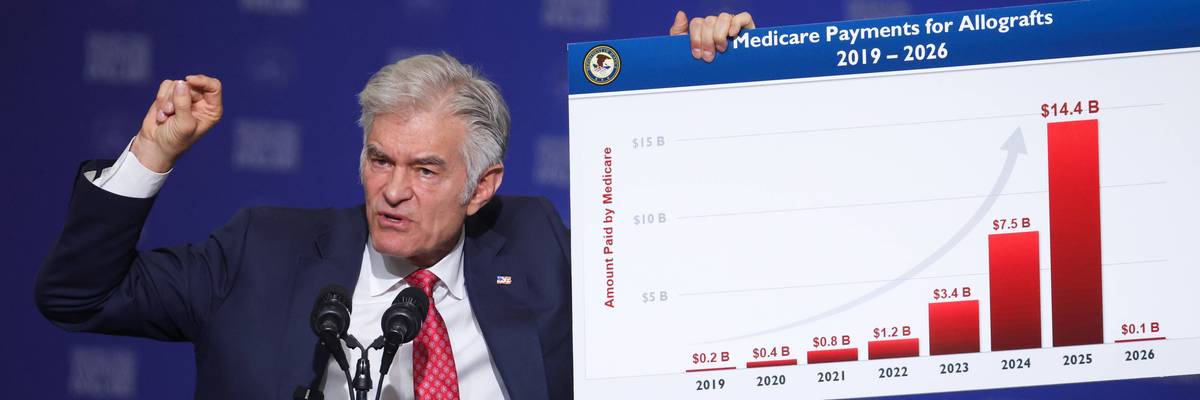
Administrator for the Centers for Medicare & Medicaid Services Dr. Mehmet Oz holds up a graph as he speaks ahead of US Vice President JD Vance at the 128th Air Refueling Wing Hangar on July 8, 2026, in Milwaukee, Wisconsin.
Under a new policy the administration is defending in court, low-income people with cancer, HIV, Parkinson's, and other life-threatening illnesses must prove they're too sick to work or risk losing their health insurance.
A federal judge on Thursday denied a request by more than two dozen Democratic states to halt a Trump administration policy announced last month that would require Medicaid recipients with terminal diseases to prove they are too sick to work in order to be exempt from new work requirements that go into effect this coming January.
While introducing over $1 trillion in tax cuts for the wealthiest 1% of Americans, last year's massive GOP tax and budget bill also imposed new 80-hour-per-month work requirements that states must implement for Medicaid expansion recipients, who receive government-subsidized insurance coverage at or below 138% of the poverty line.
The law specified that those who are “medically frail or otherwise have special medical needs” are excluded from the work requirement, and specifically listed people with a “serious or complex medical condition.” But it remained unclear what exact conditions met these criteria.
Earlier this month, the Centers for Medicare and Medicaid Services (CMS) introduced a new rule stating that even if a person receives a terminal diagnosis for a disease like cancer, HIV/AIDS, or Parkinson's, that is still not enough for them to be exempt from the work requirements.
Beginning on January 1, 2028, it says they must also demonstrate to states that their condition “significantly impairs” their ability to meet the work requirement.
Democratic attorneys general in 25 states and the District of Columbia filed a preliminary injunction over the rule late last month, arguing that CMS had rewritten the law to introduce a vague and needlessly restrictive new hurdle that vulnerable people will face in obtaining desperately needed care.
“This is one of those cases where it’s really hard to overstate how dire the consequences could be,” North Carolina’s Democratic attorney general, Jeff Jackson, told Politico. “You’re going to have 50 states doing 50 different things, and we’re all going to have to create a whole new bureaucracy... You are talking about a lot more paperwork, more evaluations, more doctor visits, and a lot more work for doctors themselves.”
The Democratic AGs argued that implementation of the work requirements should be paused because they lacked the staff or capacity to meet the timeline set by CMS, which requires states to communicate to enrollees how they'll be affected by the changes by the end of August.
US District Judge Richard Stearns on Thursday denied their initial request to immediately halt the implementation of the requirements while the lawsuit proceeds, but also did not rule on the lawsuit's merits, which are scheduled to be decided before the requirements go into effect on January 1.
Several medical associations, including the American Medical Association, the American College of Physicians, and the American Academy of Pediatrics, have come out against the rule, arguing that it would have dire consequences for people who suffer from severe illness.
"One of the most significant factors in whether someone survives a cancer diagnosis is whether they have health insurance coverage," Lisa Lacasse, president of the American Cancer Society Cancer Action Network, explained in June.
"The new restrictions link the definition of medical frailty to a person’s ability to work," she continued. "This would mean cancer patients and survivors who are suffering from debilitating side effects of the disease or treatment would have to officially prove they can’t work, in a process that is likely to be difficult and take a long time."
The nonpartisan Congressional Budget Office has projected that over the coming decade, changes to healthcare policy introduced by Republicans would increase the number of uninsured Americans by about 11.8 million.
Around 5.7 million of them are projected to be Medicaid recipients who either do not meet the 80-hour work requirement or are otherwise eligible but tripped up by one of the newly imposed paperwork hurdles.
Taya Graham and Stephen Janis argued earlier this week in a piece for The Real News Network that eligible people losing coverage is not an unfortunate side effect of the law, but a goal of the Republicans who passed it, who sought a way to thin the ranks of those who qualify for Medicaid without having to take the politically unpopular step of actually clawing back benefits.
They wrote that what has happened to recipients of the Supplemental Nutrition Assistance Program (SNAP) illustrates how burdensome these new requirements may become.
As The New York Times reported earlier this month, in Arizona, 440,000 people have already been dropped from SNAP after it enacted a formidable regime of paperwork for low-income recipients to prove eligibility, including requiring some people with panhandling income to obtain documentation from donors who drop them a buck on the street.
"If this is what people receiving SNAP benefits have been subjected to," Graham and Janis wrote, "imagine what’s going to happen to people who will need to navigate the new [Medicaid] requirements while struggling with a debilitating or terminal illness."
Medical issues are a leading cause of bankruptcy in the US. According to one study, over 4 in 10 cancer patients over 50 had depleted all their assets within two years of diagnosis.
Melanie D’Arrigo, a campaigner for single-payer healthcare in New York, said that President Donald Trump "cut cancer research, cut healthcare,” and with new Medicaid restrictions, “wants to make sure Americans continue to work as they go broke battling cancer.”
Dear Common Dreams reader, It’s been nearly 30 years since I co-founded Common Dreams with my late wife, Lina Newhouser. We had the radical notion that journalism should serve the public good, not corporate profits. It was clear to us from the outset what it would take to build such a project. No paid advertisements. No corporate sponsors. No millionaire publisher telling us what to think or do. Many people said we wouldn't last a year, but we proved those doubters wrong. Together with a tremendous team of journalists and dedicated staff, we built an independent media outlet free from the constraints of profits and corporate control. Our mission has always been simple: To inform. To inspire. To ignite change for the common good. Building Common Dreams was not easy. Our survival was never guaranteed. When you take on the most powerful forces—Wall Street greed, fossil fuel industry destruction, Big Tech lobbyists, and uber-rich oligarchs who have spent billions upon billions rigging the economy and democracy in their favor—the only bulwark you have is supporters who believe in your work. But here’s the urgent message from me today. It's never been this bad out there. And it's never been this hard to keep us going. At the very moment Common Dreams is most needed, the threats we face are intensifying. We need your support now more than ever. We don't accept corporate advertising and never will. We don't have a paywall because we don't think people should be blocked from critical news based on their ability to pay. Everything we do is funded by the donations of readers like you. When everyone does the little they can afford, we are strong. But if that support retreats or dries up, so do we. Will you donate now to make sure Common Dreams not only survives but thrives? —Craig Brown, Co-founder |
A federal judge on Thursday denied a request by more than two dozen Democratic states to halt a Trump administration policy announced last month that would require Medicaid recipients with terminal diseases to prove they are too sick to work in order to be exempt from new work requirements that go into effect this coming January.
While introducing over $1 trillion in tax cuts for the wealthiest 1% of Americans, last year's massive GOP tax and budget bill also imposed new 80-hour-per-month work requirements that states must implement for Medicaid expansion recipients, who receive government-subsidized insurance coverage at or below 138% of the poverty line.
The law specified that those who are “medically frail or otherwise have special medical needs” are excluded from the work requirement, and specifically listed people with a “serious or complex medical condition.” But it remained unclear what exact conditions met these criteria.
Earlier this month, the Centers for Medicare and Medicaid Services (CMS) introduced a new rule stating that even if a person receives a terminal diagnosis for a disease like cancer, HIV/AIDS, or Parkinson's, that is still not enough for them to be exempt from the work requirements.
Beginning on January 1, 2028, it says they must also demonstrate to states that their condition “significantly impairs” their ability to meet the work requirement.
Democratic attorneys general in 25 states and the District of Columbia filed a preliminary injunction over the rule late last month, arguing that CMS had rewritten the law to introduce a vague and needlessly restrictive new hurdle that vulnerable people will face in obtaining desperately needed care.
“This is one of those cases where it’s really hard to overstate how dire the consequences could be,” North Carolina’s Democratic attorney general, Jeff Jackson, told Politico. “You’re going to have 50 states doing 50 different things, and we’re all going to have to create a whole new bureaucracy... You are talking about a lot more paperwork, more evaluations, more doctor visits, and a lot more work for doctors themselves.”
The Democratic AGs argued that implementation of the work requirements should be paused because they lacked the staff or capacity to meet the timeline set by CMS, which requires states to communicate to enrollees how they'll be affected by the changes by the end of August.
US District Judge Richard Stearns on Thursday denied their initial request to immediately halt the implementation of the requirements while the lawsuit proceeds, but also did not rule on the lawsuit's merits, which are scheduled to be decided before the requirements go into effect on January 1.
Several medical associations, including the American Medical Association, the American College of Physicians, and the American Academy of Pediatrics, have come out against the rule, arguing that it would have dire consequences for people who suffer from severe illness.
"One of the most significant factors in whether someone survives a cancer diagnosis is whether they have health insurance coverage," Lisa Lacasse, president of the American Cancer Society Cancer Action Network, explained in June.
"The new restrictions link the definition of medical frailty to a person’s ability to work," she continued. "This would mean cancer patients and survivors who are suffering from debilitating side effects of the disease or treatment would have to officially prove they can’t work, in a process that is likely to be difficult and take a long time."
The nonpartisan Congressional Budget Office has projected that over the coming decade, changes to healthcare policy introduced by Republicans would increase the number of uninsured Americans by about 11.8 million.
Around 5.7 million of them are projected to be Medicaid recipients who either do not meet the 80-hour work requirement or are otherwise eligible but tripped up by one of the newly imposed paperwork hurdles.
Taya Graham and Stephen Janis argued earlier this week in a piece for The Real News Network that eligible people losing coverage is not an unfortunate side effect of the law, but a goal of the Republicans who passed it, who sought a way to thin the ranks of those who qualify for Medicaid without having to take the politically unpopular step of actually clawing back benefits.
They wrote that what has happened to recipients of the Supplemental Nutrition Assistance Program (SNAP) illustrates how burdensome these new requirements may become.
As The New York Times reported earlier this month, in Arizona, 440,000 people have already been dropped from SNAP after it enacted a formidable regime of paperwork for low-income recipients to prove eligibility, including requiring some people with panhandling income to obtain documentation from donors who drop them a buck on the street.
"If this is what people receiving SNAP benefits have been subjected to," Graham and Janis wrote, "imagine what’s going to happen to people who will need to navigate the new [Medicaid] requirements while struggling with a debilitating or terminal illness."
Medical issues are a leading cause of bankruptcy in the US. According to one study, over 4 in 10 cancer patients over 50 had depleted all their assets within two years of diagnosis.
Melanie D’Arrigo, a campaigner for single-payer healthcare in New York, said that President Donald Trump "cut cancer research, cut healthcare,” and with new Medicaid restrictions, “wants to make sure Americans continue to work as they go broke battling cancer.”
A federal judge on Thursday denied a request by more than two dozen Democratic states to halt a Trump administration policy announced last month that would require Medicaid recipients with terminal diseases to prove they are too sick to work in order to be exempt from new work requirements that go into effect this coming January.
While introducing over $1 trillion in tax cuts for the wealthiest 1% of Americans, last year's massive GOP tax and budget bill also imposed new 80-hour-per-month work requirements that states must implement for Medicaid expansion recipients, who receive government-subsidized insurance coverage at or below 138% of the poverty line.
The law specified that those who are “medically frail or otherwise have special medical needs” are excluded from the work requirement, and specifically listed people with a “serious or complex medical condition.” But it remained unclear what exact conditions met these criteria.
Earlier this month, the Centers for Medicare and Medicaid Services (CMS) introduced a new rule stating that even if a person receives a terminal diagnosis for a disease like cancer, HIV/AIDS, or Parkinson's, that is still not enough for them to be exempt from the work requirements.
Beginning on January 1, 2028, it says they must also demonstrate to states that their condition “significantly impairs” their ability to meet the work requirement.
Democratic attorneys general in 25 states and the District of Columbia filed a preliminary injunction over the rule late last month, arguing that CMS had rewritten the law to introduce a vague and needlessly restrictive new hurdle that vulnerable people will face in obtaining desperately needed care.
“This is one of those cases where it’s really hard to overstate how dire the consequences could be,” North Carolina’s Democratic attorney general, Jeff Jackson, told Politico. “You’re going to have 50 states doing 50 different things, and we’re all going to have to create a whole new bureaucracy... You are talking about a lot more paperwork, more evaluations, more doctor visits, and a lot more work for doctors themselves.”
The Democratic AGs argued that implementation of the work requirements should be paused because they lacked the staff or capacity to meet the timeline set by CMS, which requires states to communicate to enrollees how they'll be affected by the changes by the end of August.
US District Judge Richard Stearns on Thursday denied their initial request to immediately halt the implementation of the requirements while the lawsuit proceeds, but also did not rule on the lawsuit's merits, which are scheduled to be decided before the requirements go into effect on January 1.
Several medical associations, including the American Medical Association, the American College of Physicians, and the American Academy of Pediatrics, have come out against the rule, arguing that it would have dire consequences for people who suffer from severe illness.
"One of the most significant factors in whether someone survives a cancer diagnosis is whether they have health insurance coverage," Lisa Lacasse, president of the American Cancer Society Cancer Action Network, explained in June.
"The new restrictions link the definition of medical frailty to a person’s ability to work," she continued. "This would mean cancer patients and survivors who are suffering from debilitating side effects of the disease or treatment would have to officially prove they can’t work, in a process that is likely to be difficult and take a long time."
The nonpartisan Congressional Budget Office has projected that over the coming decade, changes to healthcare policy introduced by Republicans would increase the number of uninsured Americans by about 11.8 million.
Around 5.7 million of them are projected to be Medicaid recipients who either do not meet the 80-hour work requirement or are otherwise eligible but tripped up by one of the newly imposed paperwork hurdles.
Taya Graham and Stephen Janis argued earlier this week in a piece for The Real News Network that eligible people losing coverage is not an unfortunate side effect of the law, but a goal of the Republicans who passed it, who sought a way to thin the ranks of those who qualify for Medicaid without having to take the politically unpopular step of actually clawing back benefits.
They wrote that what has happened to recipients of the Supplemental Nutrition Assistance Program (SNAP) illustrates how burdensome these new requirements may become.
As The New York Times reported earlier this month, in Arizona, 440,000 people have already been dropped from SNAP after it enacted a formidable regime of paperwork for low-income recipients to prove eligibility, including requiring some people with panhandling income to obtain documentation from donors who drop them a buck on the street.
"If this is what people receiving SNAP benefits have been subjected to," Graham and Janis wrote, "imagine what’s going to happen to people who will need to navigate the new [Medicaid] requirements while struggling with a debilitating or terminal illness."
Medical issues are a leading cause of bankruptcy in the US. According to one study, over 4 in 10 cancer patients over 50 had depleted all their assets within two years of diagnosis.
Melanie D’Arrigo, a campaigner for single-payer healthcare in New York, said that President Donald Trump "cut cancer research, cut healthcare,” and with new Medicaid restrictions, “wants to make sure Americans continue to work as they go broke battling cancer.”