SUBSCRIBE TO OUR FREE NEWSLETTER
Daily news & progressive opinion—funded by the people, not the corporations—delivered straight to your inbox.
5
#000000
#FFFFFF
To donate by check, phone, or other method, see our More Ways to Give page.
Daily news & progressive opinion—funded by the people, not the corporations—delivered straight to your inbox.
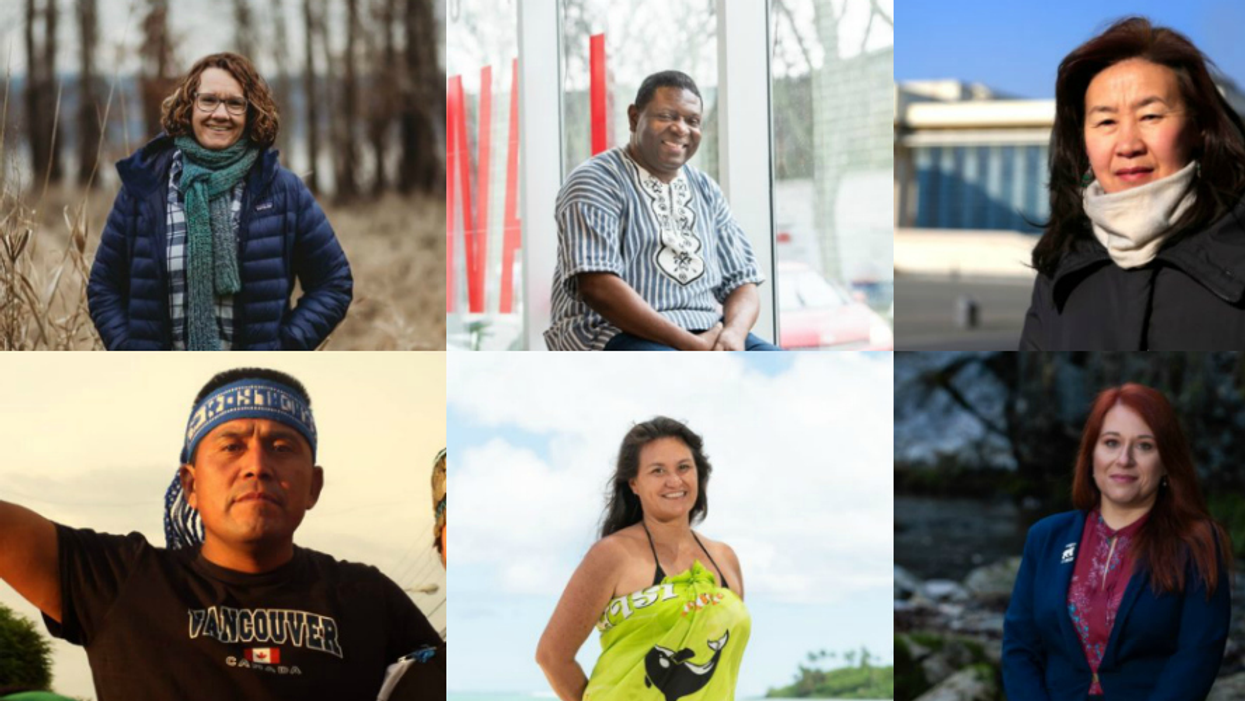
From preserving marine biodiversity to protecting tropical forests from palm oil developers, the six recipients of a prestigious environmental award are "extraordinary individuals who have moved mountains to protect our planet."
"Each of them has selflessly stood up to stop injustice, become a leader when leadership was critical, and vanquished powerful adversaries who would desecrate our planet."
--Susie Gelman, Goldman Environmental Foundation
That's according to the Goldman Environmental Foundation, which for the past 30 years has honored grassroots activists from across the globe. This year's winners, described on Twitter by fellow activist Bill McKibben as "a great collection of #KeepItInTheGround leaders," were announced Monday.
Each of the six recipients hails from one of the world's inhabited continents.
Environmental lawyer Alfred Brownell is being recognized for his successful efforts to stop palm oil plantation developers from destroying forests vital to biodiversity in his home country of Liberia. For safety reasons--and after his government threatened to arrest Brownell for his activism--he now lives in exile in the United States.
Brownell told The Guardian about an encounter with private security guards in 2016.
"They threatened to cut off my head, to eat my heart, and drink out of my skull," Brownell said. "They began a war dance around the car. They were drinking and said they would cannibalize me."
Brownell added that receiving the honor has made him optimist about returning to Liberia in the future: "I hope this award will help change the minds of people in Liberia so we find more allies to speak to the government and the company. We need to find a way to engage with them so I can go home."
Bayarjargal Agvaantseren, of Mongolia, was selected for her work to establish the Tost Tosonbumba Nature Reserve in the South Gobi Desert--which is home to the snow leopard, a vulnerable species threatened by mining in the area. Due in part to pressure from Agvaantseren, the Mongolian government has canceled all mining licenses in the reserve.
Alberto Curamil--a Mapuche, Chile's largest indigenous group--organized the people of Araucania to block the construction of two hydroelectric projects that could have diverted more than 500 million gallons of water daily from the Cautin River, with dire consequences for the regional ecosystem. Curamil was arrested for his activism last year and remains in jail.
The first-ever recipient from North Macedonia, Ana Colovic Lesoska, campaigned against a pair of hydropower plants. The campaign she led convinced key international backers to pull their funding for the projects in the Mavrovo National Park, one of the last habitats for the endangered Balkan linx. She, too, has faced consequences for her activism.
"I've received death threats and warnings that I will be imprisoned," she told the The Guardian. "Newspaper articles have suggested we are aiding foreign governments just because the rivers we are protecting run to Albania."
Jacqueline Evans, of the Cook Islands, is also the first person from her country to receive the Goldman prize. Evans fought for legislation to restrict large-scale commercial fishing and seabed mining around her nation's 15 islands to safeguard south Pacific marine biodiversity--including whales, sea turtles, manta rays, seabirds, and sharks.
The North American recipient, Linda Garcia, was among the activists who blocked the construction of the continent's largest oil terminal, which was set to be built in Vancouver, Washington. Garcia organized residents of Fruit Valley, a racially diverse, low-income neighborhood whose air would have been impacted by the project.
"Each of them has selflessly stood up to stop injustice, become a leader when leadership was critical, and vanquished powerful adversaries who would desecrate our planet," Susie Gelman, president of the Goldman Environmental Foundation, said in a statement. "These are six ordinary, yet extraordinary, human beings who remind us that we all have a role in protecting the Earth."
The foundation planned an award ceremony in San Francisco for Monday evening featuring a speech from former Vice President Al Gore, a vocal environmental activist. The event will be broadcast on Facebook, Twitter, and YouTube, with updates posted on social media using the hashtag #GoldmanPrize30. A second ceremony is scheduled for May 1 at the National Academy of Sciences in Washington, D.C.
"Thirty years ago, when Richard and Rhoda Goldman started the Goldman Environmental Prize, the idea of celebrating grassroots environmentalists was a novel one," said Gore, a friend of the founders. "Today, thanks in large part to the Goldmans, the world recognizes just how important it is to honor and illuminate those who have shown courage in the face of environmental destruction."
Bolstering global demands to #BreakFreeFromPlastic and end the world's worsening pollution crisis, a new study from the United Kingdom shows that "microplastics are being found absolutely everywhere."
"Plastic is polluting our rivers, lakes, and wetlands in a similar way as pollutants such as so-called 'emerging contaminants' like pharmaceutical waste, personal care products, and pesticides."
--Christian Dunn, Bangor University
"It's no use looking back in 20 years time and saying: 'If only we'd realized just how bad it was,'" lead researcher Christian Dunn of Bangor University in Wales told the Guardian. "We need to be monitoring our waters now and we need to think, as a country and a world, how we can be reducing our reliance on plastic."
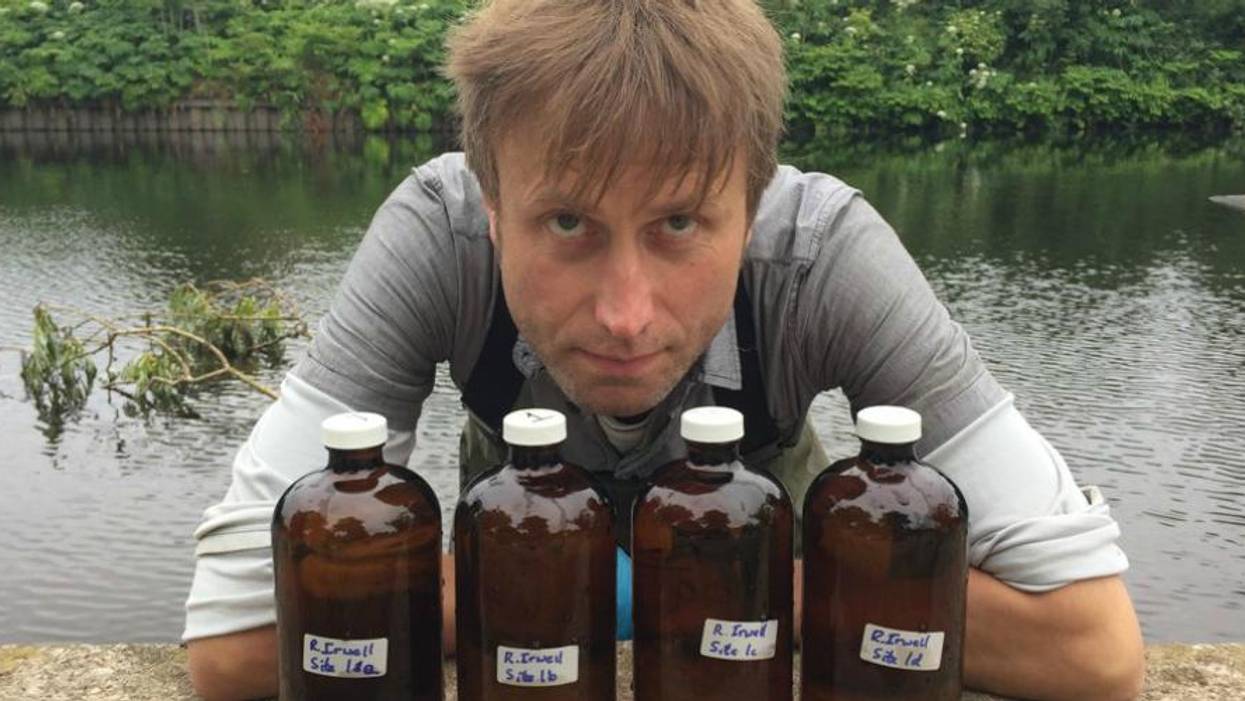
Dunn worked with a team of scientists and postgraduate students as well as the environmental group Friends of the Earth to test 10 rivers and lakes, including the Thames River in London and two sites in the Loch Lomond & Trossachs National Park, for microplastics.
Microplastics are tiny particles that have broken away from large plastics such as synthetic clothing or discarded food containers. Much of the concern over microplastic contamination has come from studying ocean pollution, but researchers also have found particles in sea turtles' bellies, many marine mammals, and even human stools.
"It was more than a little startling to discover microplastics were present in even the most remote sites we tested, and quite depressing they were there in some of our country's most iconic locations," Dunn said in a statement. "Plastic is polluting our rivers, lakes, and wetlands in a similar way as pollutants such as so-called 'emerging contaminants' like pharmaceutical waste, personal care products, and pesticides.
Dunn said the findings makes clear that "there needs to be a concerted effort to regularly monitor all our inland waters." He also acknowledged that more research is need on microplastics because "as with all emerging contaminants, we don't yet fully know the dangers they present to wildlife and ecosystems, or even human health, and to what levels they occur in all our water systems."
A report put out last month warned that "the lifecycle impacts of plastic paint an unequivocally toxic picture: plastic threatens human health on a global scale."
Writing for the Guardian on Wednesday, journalist Damian Carrington outlined another study released in February that found "microplastics can harbor harmful microbes."
Research by the National University of Singapore found more than 400 types of bacteria on 275 pieces of microplastic collected from local beaches. They included bugs that cause gastroenteritis and wound infections in humans, as well as those linked to the bleaching of coral reefs.
In light of the recent studies, Julian Kirby, a plastics campaigner at Friends of the Earth, called on his country's MPs to "get behind new legislation, currently before Parliament, that would commit the government to drastically reduce the flow of plastic pollution that's blighting our environment."
Kirby also emphasized that the crisis is a global issue: "Plastic pollution is everywhere--it's been found in our rivers, our highest mountains, and our deepest oceans."
"Countries must seize the opportunity of current global discussions, to develop a holistic response to the plastic health crisis that involves reducing the production, use, and disposal of plastic worldwide."
--David Azoulay, CIEL
Public health and environmental campaigners and experts have welcomed regional efforts, such as the European Union's new rules on single-use plastics, but continue to emphasize that tackling plastic pollution requires international cooperation.
"Both the supply chains and the impacts of plastic cross and re-cross borders, continents, and oceans," David Azoulay of the Center for International Environmental Law (CIEL) said in February. "No country can effectively protect its citizens from those impacts on its own, and no global instrument exists today to fully address the toxic lifecycle of plastics."
"Countries must seize the opportunity of current global discussions," he concluded, "to develop a holistic response to the plastic health crisis that involves reducing the production, use, and disposal of plastic worldwide."
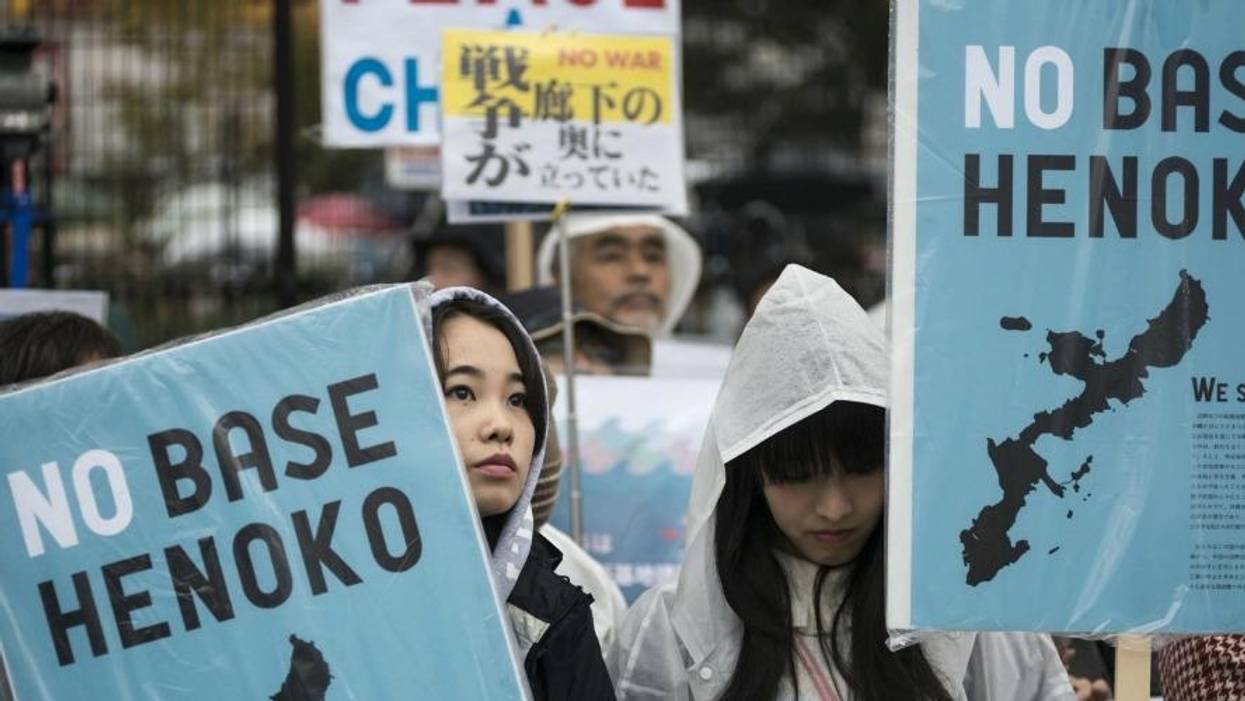
"Don't cry here," an 86-year-old Okinawan grandmother I had never met before told me. She stood next to me and took my hand. I had been visiting my family in Okinawa with my four children early in August and had traveled to Henoko, in the northeastern region of our main island, to join the protest against the U.S. military's relocation of the U.S. Marine Corps Air Station from Futenma, located in the center of an urban district, to Camp Schwab, in a more remote coastal region. My teenage daughter, Kaiya, and I had spent the day with a crowd of elders holding protest signs in front of the gates of Camp Schwab. Rows and rows of more than 400 trucks hauling large rocks passed by, ready to outline an ocean area for the new base, equivalent to the size of 383 football fields. Our beautiful, tropical ecosystem with all of its internationally proclaimed and protected biodiversity was to soon be crushed, destroying coral and marine life. This, despite the overwhelming opposition of Indigenous island people. I began to cry as I held up my protest sign.
"Grandma is going to cry when I get home tonight so I will be crying with you," she said squeezing my hand. "Here, we fight together." We watched as trucks flooded through the gate of the military base where Japanese police had pushed us away moments before. With tears in her eyes she said, "It wouldn't be strange if we all jumped in front of every one of those trucks, because this is our ocean. This is our island."
If built, there will be no reversing the damage to our ocean, our coral, and our sea life.
Four months have passed since I joined the Okinawan elders back home and so many have continued to hold sit-ins every week -- for some, every day -- despite being forcefully removed by Japanese riot police. Meanwhile, the concrete blocks and metal bars have been dropped into the ocean on top of the coral to outline where the base will be constructed. Governor Takeshi Onaga, who had succeeded in halting the base construction, died from cancer in August and the Okinawan people elected a new governor, Denny Tamaki, by an overwhelming majority -- based on his promise that he would stop the Henoko destruction. More than 75,000 Okinawans showed up in an island-wide protest during typhoon weather to show the world how strongly we oppose this base construction. Yet, the Japanese central government announced that on December 13th (UST) -- this Thursday -- they will resume the landfill with sand and concrete. Authorities argued that building a new Henoko base is necessary in order to maintain the U.S.-Japan security alliance; and U.S. government leaders touted the base's location for regional security.
But if built, there will be no reversing the damage to our ocean, our coral, and our sea life.
The Henoko base construction is framed by the history of colonization and racism against Okinawans, as well as by our ongoing resistance as we attempt to end the long era of U.S. occupation. Okinawa was once an independent kingdom; it was colonized by Japan in the 17th century and during World War II became the victim of the bloodiest battle in the history of the Pacific, where more than a third of our people were killed within three months, including members of my family. Ninety-two percent of Okinawans were left homeless.
Frequent violent crimes against women and children by U.S. military personnel regularly bring out hundreds of thousands of protesters to demand justice and humanity and the complete removal of U.S. bases.
The United States then took the land from the Okinawan people, created military bases, and imposed a new constitution on Japan that took away Japan's right to have an offensive military. Henceforth, the U.S. military would "protect" Japan with bases throughout Japanese territory. However, three-quarters of all U.S. bases on Japanese territory are on Okinawa, even though Okinawa makes up only 0.6 percent of the total landmass that Japan controls. Okinawa's main island alone is only 62 miles long, and an average of one mile wide. It is here that 73 years of U.S. base occupation has created environmental destruction, air pollution and noise pollution, and exposed survivors and families to the sights and sounds of war. Frequent violent crimes against women and children by U.S. military personnel regularly bring out hundreds of thousands of protesters to demand justice and humanity and the complete removal of U.S. bases.
And the occupation continues. Now, the Japanese central government enforces the construction of yet another base -- this one in the ocean itself, in the Henoko region of Okinawa. This new chapter in the ongoing invasion of Okinawa disregards the sovereignty, self-determination and human rights guaranteed by United Nations resolutions. The Okinawan people have voted overwhelming to oppose the base construction -- for more than 20 years, since the base was first proposed.
The Okinawan people have voted overwhelming to oppose the base construction -- for more than 20 years, since the base was first proposed.
The marine habitat of Henoko is second only to the Great Barrier Reef in biodiversity. More than 5,300 species live in Oura Bay, including 262 endangered species like the dolphin-like dugong and sea turtles. Already this week, the Ryukyu Shimpo reported that two of the closely monitored dugong are missing, with predictions that the noise level of the construction has already hindered their ability to graze on seaweed beds.
For me, the Henoko struggle is about honoring my people's existence and our right to protect our native land. I draw inspiration from the Australian students' protest to stop the Adani coal company from building coal mines in Queensland, and from the Kanaka Maoli people's movement to block the destruction of Mauna Kea in Hawai'i for an 18-story telescope. Okinawa is my home, my ancestral home. To have it destroyed is unfathomable.
The United States has more than 800 military bases in more than 70 countries across the globe. And each of these places are, or were, people's homes -- just like my people's in Okinawa.
Of course, what's happening in Okinawa is not an isolated outrage. The United States has more than 800 military bases in more than 70 countries across the globe. And each of these places are, or were, people's homes -- just like my people's in Okinawa. The devastation of Henoko is part of a larger, world-wide U.S. imperialist footprint. What happens in Okinawa matters for Indigenous peoples everywhere. What happens in Okinawa matters for sovereignty fights everywhere. What happens in Okinawa matters for fragile ecosystems everywhere.
As I write, I'm receiving reports from Okinawa announcing the arrival of more ships carrying sand and concrete ready to pour the outline of the 205 hectare area. With only four days left before this destruction of irreplaceable biodiversity, a fellow Okinawan American activist and I created a hashtag campaign to demand the stopping of the base construction in Henoko: #standwithokinawa.
Please post your solidarity message, demanding your representatives take part in protecting Henoko, and connect with organizations and allies to help us fight for our rights as Okinawan people. In addition, organize international solidarity efforts to amplify the urgency of stopping the base construction. Sign the petition to President Trump demanding that the United States stop the landfill of Henoko at https://petitions.whitehouse.gov/petition/stop-landfill-henoko-oura-bay-until-referendum-can-be-held-okinawa.
In the words of one auntie at the sit-in this past summer, "It hasn't been the governments or politicians that have stopped this heliport construction over the last five years. It has been ordinary people; volunteers, the elderly and people who just care about Okinawa. And that's going to be who changes this now. Ordinary people, many, many of us together." We need the world with us. Stand with Okinawa.

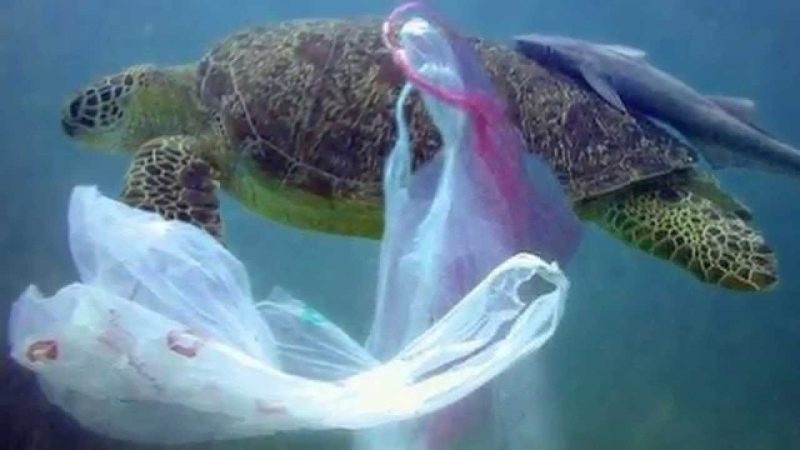
A new study of sea turtles in three oceans and seas drove home the point, green campaigners said Wednesday, that the world's governments and corporations are not doing enough to reduce plastic pollution--and marine life is suffering as a result.
One hundred and two sea turtles inhabiting the Atlantic and Pacific Oceans and the Mediterranean Sea were the subject of the study by the University of Exeter and Plymouth Marine Laboratory in the United Kingdom--and all 102 of the creatures were found with plastics, microplastics, and other synthetics in their digestive systems.
"From our work over the years we have found microplastic in nearly all the species of marine animals we have looked at; from tiny zooplankton at the base of the marine food web to fish larvae, dolphins, and now turtles," said Penelope Lindeque, who co-authored the report. "This study provides more evidence that we all need to help reduce the amount of plastic waste released to our seas and maintain clean, healthy and productive oceans for future generations."
"This global environmental crisis must be tackled at the source for the sake of marine life, the world's oceans, our health, and our communities." --Graham Forbes, Greenpeace USA
A total of about 800 particles less than half a centimeter long were found in the turtles' guts, with scientists finding an average of 150 pieces of plastic in each animal. The Mediterranean was found to be the most polluted body of water the scientists studied, with some turtles' bodies containing 500 plastics.
"How many more studies like this do we need for corporations to take strong action to curb the production of throwaway plastic which is predicted to quadruple by 2050?" said Graham Forbes, global plastic project leader for Greenpeace USA. "This global environmental crisis must be tackled at the source for the sake of marine life, the world's oceans, our health, and our communities."
The study provides "a clear sign that we need to act to better govern global waste," study author Brendan Godley told Plastics News. "It really is a great shame that many or even all of the world's sea turtles have now ingested microplastics."
The most common materials found inside the turtles were pieces of tires, marine equipment, cigarettes, and clothing. Microbeads used in some cosmetic products, which the United Kingdom banned earlier this year following the U.S. ban in 2015, were also found in many of the turtles.
Smaller plastics may not present a choking danger for sea turtles as larger materials do, the study's authors noted, but they can cause other health problems for the animals.
"Future work should focus on whether microplastics may be affecting aquatic organisms more subtly," lead author Dr. Emily Duncan said in a statement. "For example, they may possibly carry contaminants, bacteria or viruses, or they may affect the turtle at a cellular or sub-cellular level. This requires further investigation."
"Our society's addiction to throwaway plastic is fueling a global environmental crisis that must be tackled at source," said Louise Edge, an oceans campaign coordinator at Greenpeace.

Defenders of ocean habitats and marine life are up in arms on Friday as the Trump administration is set to approve new abilities for the fossil fuel industry to conduct widescale and "deafening" underwater seismic in federal waters off the U.S. Atlantic coast.
The decision is expected to come from the National Marine Fisheries Service, a division of the Commerce Department, but conservation groups say it is a smack in the face to ocean ecosystems and a political nonstarter they vow to fight tooth and nail.
"This action flies in the face of massive opposition to offshore drilling and exploration from over 90 percent of coastal municipalities in the proposed blast zone," said Diane Hoskins, campaign director at Oceana. "These permits were already denied because of the known harm that seismic airgun blasting causes. President Trump is essentially giving these companies permission to harass, harm and possibly even kill marine life, including the critically endangered North Atlantic right whale - all in the pursuit of dirty and dangerous offshore oil. This is the first step toward offshore drilling in the Atlantic and we're going to make sure coastal communities know what's happening and fight this."
Michael Jasny, director of the Marine Mammal Protection Project at NRDC, said the president's action is totally detached from the reality of the threats the world's ecosytems now face.
"Just one week after issuing dire warnings on the catastrophic fallout of climate change to come, the Trump Administration is opening our coastlines to for-profit companies to prospect for oil and gas--and is willing to sacrifice marine life, our coastal communities and fisheries in the process," fumed Jasny. "This is the first step towards drilling and scientists warn that seismic activity alone could drive the endangered North American right whale to extinction. We'll stand with citizens, coastal businesses, scientists, lawmakers, and commercial and recreational fishermen who oppose seismic blasting, and we will fight this illegal action."
According to the Washington Post:
In addition to harming sea life, acoustic tests -- in which boats tugging rods pressurized for sound emit jet engine-like booms 10 to 12 seconds apart for days and sometimes months -- can disrupt thriving commercial fisheries. Governors, state lawmakers and attorneys general along the Atlantic coast say drilling threatens beach tourism that has flourished on the coast in the absence of oil production.
Seismic testing maps the ocean floor and estimates the whereabouts of oil and gas, but only exploratory drilling can confirm their presence. The Deepwater Horizon oil spill that soiled the Gulf of Mexico resulted from an exploratory drill. Another gulf disaster that looms almost as large has spewed oil for more than 14 years. The Taylor Energy Co. spill of up to an estimated 700 barrels a day started when a hurricane ripped up production wells, and could continue for the rest of the century, according to the Interior Department.
"Seismic blasting is a violent, destructive precursor to unnecessary offshore oil drilling," said Angela Howe, Surfrider Foundation Legal Director, in a statement. "According to estimates from the Bureau of Ocean Energy Management (BOEM), the seismic exploration projects could directly harm tens of thousands of whales and dolphins, in addition to thousands of manatees, seals, and sea turtles. This type of damage to our coastal resources is unacceptable. The Surfrider Foundation and our strong coalition of allies will stand up to protect our ocean, waves and beaches for the future."
While the seismic blasting is awful enough, Earthjustice warns that this is only a part of the Trump adminstration's assault on the oceans and marine life. As the group notes:
While destructive in their own right, the seismic tests are only a first step in the Trump administration's broader plans for dramatic expansion of offshore drilling in the Atlantic and beyond. The Department of the Interior has proposed opening 90 percent of U.S. federal offshore waters to the fossil fuel industry, exposing nearly every coastline in the nation to the risk of an environmentally devastating oil spill and the degradation that comes with industrializing more of our rich ocean environments. Since the planning process for this offshore leasing expansion got underway, more than 1.45 million Americans have demonstrated intense opposition with rallies, marches and comments submitted to the Department of Interior agency responsible for crafting the plan.
"As usual, the Trump administration is pulling out all the stops to give favors to the fossil fuel industry, whatever the cost to coastal communities and wildlife," said Athan Manuel, the lands protection program director for the Sierra Club. "We will continue to fight back against their dangerous plans to subject our coasts to seismic blasting and expanded offshore drilling."

Offering a warning of what's to come as human-caused global warming increasingly exacerbates extreme weather, scientists have determined that Hurricane Walaka--one the Pacific's most powerful storms ever--washed away a remote and ecologically important 11-acre island in Northwestern Hawaii.
East Island was part of French Frigate Shoals in the Papahanaumokuakea Marine National Monument and, according to the Honolulu Civil Beat, "a critical habitat for endangered Hawaiian monk seals and green sea turtles."
While researchers expected that the gravel and sand island, perched atop a coral reef, would eventually disappear into the rising seas, the discovery--facilitated by satellite imagery--caught Chip Fletcher, a professor of earth sciences at the University of Hawaii, and his colleagues by surprise.
"I had a holy shit moment, thinking 'Oh my God, it's gone,'" said Fletcher, who had conducted research on the island in July. "It's one more chink in the wall of the network of ecosystem diversity on this planet that is being dismantled."
"It's one more chink in the wall of the network of ecosystem diversity on this planet that is being dismantled."
--Chip Fletcher, University of Hawaii
The extent of the ecological damage and whether the island will ever return is still unknown, but about a seventh of the entire population of Hawaiian monk seals--one of the most endangered marine mammals--was born on East Island, and more than half of all Hawaiian green sea turtles--which are classified as threatened under the Endangered Species Act--had nested on it.
Randy Kosaki, the monument's deputy superintendent for research and field operations for the National Oceanic and Atmospheric Administration (NOAA), said the French Frigate Shoals have now lost two islands in the same number of months.
"The take-home message is climate change is real and it's happening now," concluded Kosaki. "It's not a hoax propagated in China as some folks have said," an apparent reference to President Donald Trump's remarks that resurfaced during his campaign.
"These small, sandy islets are going to really struggle to persist" as the seas rise because of anthropogenic global warming, Charles Littnan, director of NOAA's protected species division, told the Huffington Post. "This event is confronting us with what the future could look like."
Bill McKibben, co-founder of 350.org, concurred that the island's disappearance is a warning to humanity. "We're going to see a lot of these stories in the years ahead, and every one will be so sad," he tweeted.

We're an egoistical, delusional lot, us humans. We're the only species on the planet who despoils its own life support system and who does not live within biological limits. Does that make us the most intelligent or least intelligent species?
Charlatan academics, ecomodernists, and tech giants would have you believe that we are living in the greatest era known to man and that our human intelligence and innovation--particularly of the technological sort--will carry us through these perilous ecological times.
Preservation of our environment remains well toward the bottom of our priorities. Personally and collectively, in our daily lives and in the media, we fixate on career, financial accumulation, economic growth, political performance, consumerism, entertainment, social media, and external validation. None of these aspects of our lives mean anything without a livable planet full of basic resources, and every one of these fixations contribute directly or indirectly to our planetary degradation.
Noam Chomsky has even begun to recognize that our precarious environmental predicament--primarily envisioned as the issue of climate change, though it encompasses so much more--is the most crucial existential threat to human life on the planet. Of late, whenever you see Chomsky interviewed or hear him speak, he tends to emphasize that of many injustices and dire risks to the people of the United States, the people oppressed by U.S. empire, and humanity as a whole, all pale in comparison to the our environmental crisis.
In the fall of 2017, a group of world scientists issued a second warning to humanity (the first of which was delivered in 1992): if we do not make significant changes to our way of life immediately, we will no longer be able to ward off the inevitable precipitous decline of our planetary ecosystem as a result of our poor environmental stewardship. Still more scientists cautioned as recently as Aug. 6, 2018 that if we do not undertake a societal transformation, a host of positive feedback mechanisms would be unleashed that could soon render the Earth uninhabitable to many species, including humans. The scientific tendency toward conservatism in predictions of risk, as evidenced by the underestimation of the timing and severity of climate change by the Intergovernmental Panel on Climate Change (IPCC), would imply that time is of the essence. While an individual ecosystem is able to withstand and adapt to deleterious forces for a certain amount of time, if that injurious bombardment continues unabated, the ecosystem will finally reach a threshold, at which point it will collapse. The Earth's entire biosphere is no different.
And yet charlatan academics who cherry-pick data outside of their fields to support their elitist perspective, like Steven Pinker, as well as ecomodernists, such as Ted Nordhaus and Michael Shellenberger at the Breakthrough Institute, and tech giants such as Elon Musk, would have you believe that we are living in the greatest era known to man and that our human intelligence and innovation--particularly of the technological sort--will carry us through these perilous ecological times. It's an optimistic message that everyone likes to hear, but it is hollow at its core. Just read through their proclamations and manifestos. What you will find is wishful-thinking based on flimsy, unsubstantiated premises that we all want to believe so that we in the first world can carry on in our daily lives with little disruption to our usual profligate consumption, and especially, to corporate capitalism. Indeed, fourth-wave environmentalism, which too many of the large environmental non-profit organizations like the Environmental Defense Fund, the Nature Conservancy, and the World Wildlife Fund promote, is predicated on corporate-environmental partnerships and technological modernization. It is touted as "win-win"--yet in practice, it is nothing but a loss for the biosphere.
On Aug. 1, 2018 we celebrated "Earth Overshoot Day," the day when human beings had utilized more resources than the planet would be able to replenish in a year. The Global Footprint Network has been calculating this day since 1970, when it took us, on average, until December to utilize all of the resources that the planet held for us annually. Now, we use our allotted natural resources by August. Regardless of the margin of error in this estimate, it is clear that since all of this yearly overuse is cumulative and compounded over time, we have long overused planetary resources by this point, and we'd need decades for the Earth to compensate for our past and continuing gluttony. Obviously, some of us are more responsible for this conspicuous consumption than others, which the Global Footprint Network breaks down by country; also obviously, the United States sits near the top of the list of planetary abusers.
The more one lives in excess of one's needs and more extravagantly in one's wants, the more responsible one is for the degradation of the planet.
While the ecological footprint is derived from a variety of factors, a simple axiom provides the truth about our resource use: those people and societies who adhere to their basic needs live more sustainably than those who partake in their wants. The more one lives in excess of one's needs and more extravagantly in one's wants, the more responsible one is for the degradation of the planet. Thus, the richest among us, regardless of how "green" they purport to be, are the most destructive to the environment, and it follows that the richest and largest conglomerates and corporations will contribute the most to environmental destruction.
Concurrent with Earth Overshoot Day on Aug. 1, The New York Times Magazine released (online before print) Nathaniel Rich's lengthy piece entitled "Losing Earth," which sought to chronicle the historical political atmosphere surrounding the climate change debate in America from 1979-1989. Rich's premise is that during this crucial decade the United States government had a chance to save the planet from the catastrophic global warming that we are currently experiencing throughout the globe, but because of their failure to act, we are left with our current climatic predicament. Immediately after the publication of this piece, critics countered that Rich largely ignored the role of climate change deniers within the Republican Party and from the fossil fuel sector, who engaged in a concerted corporate disinformation campaign about climate change for decades. Instead, they say, Rich's piece placed too much blame on the collective human "we."
In a way, Rich and his critics are both right and wrong. We are all to blame for our ecological catastrophe, but our American government--which is now a de facto subsidiary of major corporations--along with the corporations themselves and the rich who benefit most from corporate profits, are far more to blame than the rest of us because they have far more power and ability to enact changes and control societal norms. The poor basically bear no burden because when you are struggling to meet your basic needs, it's nearly impossible to prioritize anything beyond those simple human requirements.
In any event, both Rich and his critics miss the big picture; resource depletion and climate change are only part of the problem. Even if the U.S. government and the entire planet had tackled climate change--the solutions offered, at this point, mainly concern switching to 100 percent renewable energy and possibly utilizing questionable geoengineering technofixes with untold unintended consequences--we would still be left with enormous global ecological issues. Our over-consumption, as evidenced by Earth Overshoot Day (and simple observation), stems in a large part from our over-production, which stems from our economic assumption that we must live in a world with incessant economic growth. Furthermore, what we produce and consume most, other than fossil fuels themselves, are synthetic substances--often derived from fossil fuels. Synthetic toxics, the likes of which did not exist for more than 99 percent of the Earth's lifespan, pose specific threats to organisms because organisms have had little time to evolve and adapt to them.
The excessive production of, consumption of, and resultant pollution from these toxic substances may pose as large of a risk to the planet, if not a larger one, than climate change itself.
The excessive production of, consumption of, and resultant pollution from these toxic substances may pose as large of a risk to the planet, if not a larger one, than climate change itself. (Side note: toxicsor toxicantsare manmade substances that pose health threats to organisms. Toxins, by contrast, are produced by organisms, like the venom of a snake or the poison from a bee sting. This is an important distinction that scientists, doctors, advocates, and journalists should keep in mind, especially when discussing the danger of toxics to human health and the health of entire ecosystems.) Indeed, when asked about the environment, some prominent people, such as controversial biologist Paul Ehrlich, have suggested that "the toxic chemicals that we are distributing from pole to pole may turn out to be a worse problem" than global warming. Even renowned British investment banker Jeremy Grantham surmised, "I think chemicals will turn out to be a hotter button than climate change." Yet, we continue to produce, consume, and dispose of these toxics unrelentingly.
One of the most major toxic pollutants we boundlessly produce and consume is plastic. As recently as this year, many people first became aware of the enormous problem of plastic pollution. Perhaps largely because of the BBC documentary series "Blue Planet II," which took time away from its beautiful, awe-inspiring footage of marine flora and fauna to show the profound problem of macro and micro plastic pollution in our oceans, or because of National Geographic's comprehensive series of reports, some people were finally alerted to a problem that was right before their eyes, but commonly disregarded. In response to the newfound knowledge, several companies and municipalities banned plastic straws and urged a reduction of our consumption of "single use" plastics. Yet these measures will barely begin to curb the plastic problem, considering production of plastic is still on course to soar by 40 percent in the next decade. Not only is it vital that we try to eliminate the pollution already created, but we must curtail the stream of pollution that rolls of off assembly lines every day if we are to make any progress whatsoever. The only real method to deal with the problem of waste stemming from our over-consumption is cutting it off at its source. That also means we must have the foresight and ethical fortitude to stop creating such unsustainable and toxic substances in the first place, no matter what fortunes we forgo in the process.
Plastic became an issue partially because it became too large and obvious to continue to ignore (see: plastic gyres in seas, plastics ingested into the bellies of birds, sea turtles entwined in plastic debris, for just a small sampling), much like rivers catching on fire or cities filled with smog in the 1970s. Still, there are so many other insidious problems with production and consumption and its attendant waste. In addition to plastics, we have numerous other persistent organic pollutants (POPs)--pesticides, industrial chemicals like PCPs and PFOAs, and pharmaceuticals--lingering throughout the globe and harming the health of organisms and ecosystems in ways we have only begun to recognize.
Many of these pollutants act as endocrine disrupting chemicals (EDCs) and can potentially cause a host of health effects through their endocrine mimicking ability. One of the major documented effects is the feminization of male animals--which has been consistently found in all vertebrates and most recently in sharks. Males turning into females may not sound like a huge ecological problem on its surface, unless you consider the fact that the loss of a male population could lead to the extinction of a species. Consequently, scientists are now wondering about what effects we may be seeing in humans--effects such as decreased fertility, increased reproductive cancers, even ambiguous gender identity.
We also have an epidemic of e-waste from the constant production, consumption, and disposal of our consumer electronics. Our desire for non-essential products of convenience and entertainment, along with our technological gadgetry (computers, tablets, smartphones) has left the third world awash in a toxic stew.
We also have an epidemic of e-waste from the constant production, consumption, and disposal of our consumer electronics. Our desire for non-essential products of convenience and entertainment, along with our technological gadgetry (computers, tablets, smartphones) has left the third world awash in a toxic stew, as some of our e-waste is shipped overseas to be dismantled for parts and burned for valuable elemental compounds if it is not buried in our own landfills. And much like all of these other troubles linked to over-consumption, the problem of e-waste just continues to grow.
We currently have no true solutions to the waste and pollution from our over-consumption. Unless and until we have the means of dealing with the waste stream of such items, they probably should not be produced or consumed in the first place. Recycling is not the answer, though "green" consumers would like to think it is. It both utilizes tremendous energy and produces toxic byproducts of its own (particularly the recycling of plastic) and it cannot possibly absorb all of the products discarded. Plus, since recycling is just a market industry, and with China's decision to stop buying waste, most of what we hope to recycle is ending up in landfills, which are completely unsustainable at their core.
For the past century or two, we've gone down a slippery slope of permissiveness in terms of environmental responsibility as a civilization, and we may never ascend from the bottom. The only true sustainability is biodegradability--meaning whatever resources we take from the Earth are able to be returned to the Aarth. Ultimately, sustainability means that what we use returns to the Earth in a timely manner that does not pollute, causing ill health or irreparable ecological damage. Consequently, almost nothing we call "sustainable" within our corporate industrial civilization truly is. For the most part, we barely even compost the organic, decomposable items that could easily go back to the Earth, replenishing the nutrients to and enhancing the quality of the Earth's soil. Instead, these too end up in a landfill.
Most of what we take for granted as benign is not. A lot of what we expect is safe at acceptable levels is not. For example, we spread over one billion pounds of biological poisons on our food supply each year in the U.S., but we call them pesticides. We hype their safety and necessity while we ingest immeasurable amounts of them and while they migrate to our air, water, and ecosystems, all under the guise of progress, even sometimes, sustainability. This is utter insanity. Maybe the alarming increase in mental health issues, such as depression and anxiety, is a reflection of a natural and normal attempt to cope in an utterly insane, overwhelming, unsustainable world rather than being reflective of physiological disease or genetic defect, both of which have yet to be found. We are polluting our minds with too much junk content, our bodies with too much junk food, and our planet with just too much junk.
No one field is responsible for the predicament we are in, and no one sector will solve the problem. Every field, every industry in their current form is unsustainable and grossly polluting. This includes the military, finance, fashion, entertainment, information technology (IT), agriculture, medicine, transportation (driving, flying, cruising, boating), engineering, construction, real estate, publishing, art, scientific research, even education. But again, we do not need scientific evidence to notice what is right in front of us. I used to conduct a thought exercise with my students in Environmental Studies. I would ask them to pick any item from anywhere and to perform an informal life cycle analysis of that item: that is, try to find out about all of the resources and energy needed to create that item, used during the life of the item, and emitted as pollution or toxic waste throughout the lifespan of the item through its end of use. Through this exercise, if you work in a hospital setting, you might discover that a chemical utilized in the process of MRI could end up as a toxic pollutant in certain ecosystems. If you work in IT, you might learn that server farms and promising new applications such as Bitcoin require extensive amounts of energy and resources to function. If you do this with any part of any industry, you will not need any special scientific training to discover our sustainability problem.
The fact is, we need to make the environment a priority in every field. Sustainability cannot be a novelty or a footnote; environmental impact must be the foundation of all disciplines. All students should be required to take introductory environmental studies classes. All academic subjects need to have sustainability as the base of their field. We cannot make "green" or "eco-friendly" niches within industries. Rather, we must strive to eliminate any practices and products that are not within our ecological limits and that are not necessary to our survival, because the overwhelming consensus of all scholars suggests that we are, without a doubt, imperiling our own survival if we continue on with business as usual.
We need to deconstruct our lives. We need to take things away and abstain from what cannot be sustainable. We need to create new norms, new stories, and new values. Perhaps the genius is not in the tech billionaire that creates unsustainable technology of questionable merit, but the wise person who could have intellectually created the technology, but who considered the social, psychological, and environmental ramifications, and decided against it.
Years ago I read an anecdote about refugee immigrants from a third world nation who had settled in America. As a welcoming gesture, they were brought to a shopping mall, but rather than being awestruck by the array of products and consumer choices, they were overwhelmed and repulsed by the excess. If we are to survive as a species, we should all learn to feel this way.
At this point, we cannot count on our government officials to offer real solutions... The rest of us, in every sector of society, in every field, need to pick up the slack and make necessary large-scale changes in production and consumption on both the individual and systemic levels.
At this point, we cannot count on our government officials to offer real solutions--or at least solutions substantial enough to tackle the multitude of issues we face. It's as if we have a preventable and reversible illness that could be solved through a change of lifestyle. We go to the doctor to be diagnosed. The Republicans react by denying the illness altogether. The Democrats ask for a magic pill, because they do not want to go through the trouble of exercising, eating less, and only ingesting quality, nutritious food. The rest of us, in every sector of society, in every field, need to pick up the slack and make necessary large-scale changes in production and consumption on both the individual and systemic levels. What these changes amount to most of all is living simply, personally and collectively. This is the true #resistance.
We cannot take for granted, as economists and industrialists do, that we will continue to produce and consume more. This premise, which undermines all of our research and policy initiatives pertaining to the environment, has been completely ineffective and must be abandoned.
Americans and other first-world citizens have the notion that their happiness, their desire for comfort, their want of cool gadgetry, their egos, their power, and their careers are more important than life itself. As a result, even the most environmentally-minded middle class people are too tied to their creature comforts (a.k.a., consumer excesses) that they still rank among the biggest consumers and polluters. Americans often deride others for living beyond their means (meaning their financial abilities), but no one ever worries about living beyond our needs, which is perhaps the fundamental cause of our suicidal path as a species.
Anyone who did not grow up rich or even upper middle class knows what it is like to sacrifice, knows what it is like to have to pick and choose--to only buy or use what is needed, rather than what is desired. You know you have to live without. You can't afford to splurge. This is where we are with life on the planet. We can't splurge anymore as individuals, but more critically, as industries and as societies. In fact, we couldn't afford to overindulge decades ago, and we should have never done so in the first place. We don't need science to understand this, and we don't need an ecological footprint calculator. We need empathy and a sense of connection with all life on the planet. If we can learn to consume according to our needs rather than our decadent desires, not only might we all live more enjoyable, fulfilling, and healthy lives, but we all might just continue to be able to live.

The Trump administration's "assault on our oceans" continued on Tuesday with an executive order that rescinds an Obama-era policy aimed at bolstering the health of the oceans and the Great Lakes.
"In one stroke of the pen, we have gone from hard-earned, responsible stewardship of the ocean to short-term, reckless, blind pursuit of a buck and a vote."
--marine biologist Jane Lubchenco" Oil drillers and other industry interests are cheering," environmental group Heal the Bay tweeted following Trump's action.
The new executive order revokes the 2010 National Ocean Policy put in place following the Deepwater Horizon disaster and which, as Earthjustice notes, "was built on decades of science, public input, and bipartisan recommendations."
Trump's new order calls for "promot[ing] ocean industries" and establishes the interagency Ocean Policy Committee. The White House states that the committee "will focus on growing the ocean economy," and says the president "is rolling back excessive bureaucracy created by the previous administration."
More to the point, as The Hill reports, "The order encourages more drilling and other industrial uses of the oceans and Great Lakes."
Among the critics of the new order is noted marine biologist Jane Lubchecno, a former NOAA administrator who helped create the National Ocean Policy.
"In one stroke of the pen, we have gone from hard-earned, responsible stewardship of the ocean to short-term, reckless, blind pursuit of a buck and a vote," she tweeted.
According to NRDC senior policy analyst Alison Chase, the new order is simply "irresponsible."
"There is no longer a requirement to work with states to provide for coordinated ocean protection and there is no longer a national policy to promote healthy ocean ecosystems," she explained.
"We reject the administration's false argument that federal management of the oceans prevents their productive and sustainable use," said Jacqueline Savitz, Oceana's chief policy officer for North America. "Strong and effective regulations lay out 'rules of the road' that safeguard our health, safety, and natural resources. These safeguards play an essential role in balancing the interests of private users of the oceans with the broader need for conservation of ocean resources for all Americans," she argued.
The shift, added Miyoko Sakashita, oceans director with the Center for Biological Diversity, "makes it crystal clear that Trump views our oceans solely as a source of profits for the oil industry and other polluters. Industrializing our oceans and coastal areas is exactly what we don't need, especially when whales, sea turtles, and other marine animals are already struggling against a long list of threats."
Lawmakers also added to the chorus of criticism. Sen. Ed Markey (D-Mass.), for one, warned that the administration "is doing everything it can to allow another BP oil spill."
In addition, House Democrats on the Natural Resources Committee called for a hearing on the issue. In a letter sent Tuesday to committee chairman Rep. Rob Bishop (R-Utah), the Democrats called the new order "short-sighted" and underscored that "healthy oceans are central to the livelihoods of millions of Americans."

Remember that silly game we used to play with fortune cookies from Chinese restaurants? Maybe people still play it. It's the one where you read your fortune and tack on "... in bed" to the end of the sentence - like, "You will soon meet a mysterious stranger ... in bed." The supplemental phrase usually fits fairly smoothly onto the given fortune, and generates a few chuckles from listeners.
Here's a new game in a similar vein, but this one doesn't engender much laughter. First, take a look at the statements below. See if you can identify which are true versus which are false.
If you follow conventional wisdom, listen to conventional media sources, or adhere to conventional dictates of American culture, you might think that nearly every statement is true.
But in reality, every sentence is false.
Unlike in the fortune cookie game where the phrase "in bed" is added to each fortune, our game has a twist. Our game is played all day, every day. In our game, the additional phrase is never spoken, but it permeates all of our thoughts and decisions, even those within the sacrosanct realm of science. The addendum is an underlying assumption, a tacit, presumed postscript to every stated social, political, economic, environmental, and health concept in our society. It is an idea that is implicit in every policy we make, universally accepted as a given. Most people have internalized the phrase so much they do not even realize it exists, let alone acts as appendix to almost all of the truths held by modern civilized societies. So, our unnamed, unknown game consists of adding this unspoken phrase to every aforementioned statement. The phrase is "... if we are to preserve capitalism."
Imagine if we eradicated that unspoken addendum. Imagine what we could accomplish.
Imagine justice. Imagine equality. Imagine good health. Imagine ecological sustainability.
Imagine ending the game.
We can't.
Can we?

The Trump administration's newly unveiled proposal to vastly expand offshore drilling threatens to unleash an "oil-soaked nightmare" with the potential of over 5,000 spills that could leak more than 34 million gallons of oil into U.S. waters, an environmental group warned Wednesday.
"No president has ever pushed a drilling plan that would do so much damage along so many American coastlines. It's really astonishing," said Abel Valdivia, an ocean scientist at the Center for Biological Diversity who conducted the analysis.
Trump's Interior Department announced the five-year plan earlier this month, which boasted offering "the largest number of lease sales in U.S. history" for drilling in the National Outer Continental Shelf (OCS).
The Obama administration put 94 percent of the OCS off limits to drilling; the new plan, in contrast, would make over 90 percent of the OCS available for oil and gas exploration. Specifically, the draft proposal--promptly condemned as an "all-out assault on public lands and waters"--includes 19 lease sales off the coast of Alaska, 12 in the Gulf of Mexico, nine in the Atlantic region, and seven 7 in the Pacific region.
Using federal records and historical data from 1974-2015, the Valdivia estimated that the majority--53 percent--of the spills (2975) would occur in the Gulf of Mexico. Twenty-eight percent (1,574) of the spills would happen in northern Alaska, mostly in the Chukchi and Beaufort seas. As environmental groups have long warned, oil drilling in this environment is particularly foolhardy, given the extreme weather conditions, the nearest Coast Guard base being nearly a thousand miles away, and the potential impact on wildlife such as polar bears and caribou already burdened by the climate crisis, not to mention its impacts on indigenous rights.
The analysis found that 12 percent of the spills (657) would be along the West Coast, while the East coast would fare best with about 7 percent of the spills (364).
"Trump's plan will be a long, oil-soaked nightmare for our coasts and wildlife," Valdivia said.
The Center for Biological Diversity notes that the spill estimates are conservative. The analysis doesn't take into consideration the possibility of a mega-disaster like BP's Deepwater Horizon, nor does it capture the potential spill impacts of Trump's proposed rollback of offshore drilling safety regulations.
"Oil spills do long-lasting damage to marine ecosystems and wildlife, from the smallest plankton to sea turtles and dolphins," Valdivia said. "Marine organisms are already under significant stress from overfishing, pollution, and climate change, and toxic oil spills are the last thing they need."
Given such impacts, the proposals have sparked protests coast to coast, and opposition from Republican and Democratic governors alike.
Speaking about the impacts of the proposed drilling expansion to Democracy Now!, author and professor of art and ecology at the University of New Mexico Subhankar Banerjee said the administration is "doing everything to undermine the public process. They're silencing scientists. They're marginalizing and silencing indigenous communities. We need an all-out, antiwar-style movement now."