

SUBSCRIBE TO OUR FREE NEWSLETTER
Daily news & progressive opinion—funded by the people, not the corporations—delivered straight to your inbox.
5
#000000
#FFFFFF
To donate by check, phone, or other method, see our More Ways to Give page.
Daily news & progressive opinion—funded by the people, not the corporations—delivered straight to your inbox.

Grassroots organization commits to holding every 2028 candidate to the pledge and publicly track who speaks out and who stays silent when super PACs spend on their behalf.
Following today’s announcement by the Democratic National Committee that candidates must pledge to denounce super PAC and dark money spending on their behalf to qualify for the 2028 presidential primary debates, Our Revolution, the nation’s largest independent grassroots organization, welcomed the new requirement.
Getting big money out of Democratic primaries has been a priority for Our Revolution since Bernie Sanders’ 2016 campaign. In its latest post-election survey, 89% of respondents ranked banning corporate and dark money from the 2028 Democratic primaries among their top three party reforms.
Our Revolution will press every 2028 presidential candidate to sign the pledge and publicly track whether they denounce super PAC and dark money spending on their behalf. The organization will also continue working with state party reformers to get corporate and dark money out of Democratic primaries at every level, from presidential and congressional races to state and local contests.
Joseph Geevarghese, Executive Director of Our Revolution, said of today’s announcement, “People have watched Washington insiders enrich themselves while working families struggle to afford rent, child care and a trip to the doctor. Democrats can’t count on Trump’s unpopularity to restore trust in our party. If we promise to take on big money and then look away when a billionaire-funded super PAC buys ads for one of our candidates, why should voters believe us the next time?
Ken Martin and the DNC took a welcome step because grassroots progressives organized and kept the pressure on. Now we’ll give the pledge teeth. We’ll press every 2028 candidate to sign it, track who speaks out when super PACs spend to help them or attack their opponents, and make sure voters know who stays silent. We’ll hold candidates’ feet to the fire, especially when the money is working in their favor.
Earning back trust means delivering on what people are asking for: Medicare for All, universal child care, affordable education and an economy working people can afford to live in. That means taking on the corporate interests that spend millions to keep those priorities off the table. We won this step by organizing, and that’s how we’ll make it stick.”
Larry Cohen, a DNC member and member of the DNC task force on party reform and Our Revolution’s founding board chair added, “After Bernie’s 2016 campaign, grassroots organizers and reformers inside the DNC kept pushing to put voters in charge of our primaries. Ken Martin took that work seriously when he ran for chair, and we thank him for following through. This win belongs to the members, organizers and party reformers who kept showing up for a decade. Now we have to see it through.”
Interview availability: Larry Cohen, a longtime advocate for Democratic Party reform, is available to discuss how organizers built support inside and outside the DNC for curbing super PAC and dark money spending, from the post-2016 reform effort to the new debate requirement. He can also explain how proposals such as the People’s Pledge could help hold candidates accountable when outside groups spend on their behalf. Joseph Geevarghese is available to discuss Our Revolution’s survey findings and how the organization plans to hold 2028 candidates to the pledge.
Our Revolution will reclaim democracy for the working people of our country by harnessing the transformative energy of the "political revolution." Through supporting a new generation of progressive leaders, empowering millions to fight for progressive change and elevating the political consciousness, Our Revolution will transform American politics to make our political and economic systems once again responsive to the needs of working families. Our Revolution has three intertwined goals: to revitalize American democracy, empower progressive leaders and elevate the political consciousness.

"Jensen Huang’s reinstatement shows that under Trump, Vance, and Rubio, our national security is for sale," said US Sen. Ron Wyden.
Critics of President Donald Trump on Monday expressed outrage after he personally intervened to push for Jensen Huang's reinstatement as CEO of AI chip designer Nvidia just weeks after he resigned amid revelations that he'd had multiple affairs, including with a woman scrutinized by US intelligence over her ties to China’s top spy agency.
Shortly after Nvidia announced that it was bringing Huang back, Trump called into CNBC to take credit for convincing the board to give its scandal-plagued CEO a second chance.
During the interview, Trump was asked if he gave an assurance to the board that Huang would not be prosecuted for any crimes he may have committed during his tenure.
"I didn't use the word 'prosecuted,' but I said that... we believe he's fine," the president said. "He's absolutely fine. I gave them enough assurance."
CNBC: Did you give the board of Nvidia an assurance that Jensen Huang would not be prosecuted at all?TRUMP: I didn't use the word 'prosecuted,' but I said that we believe he's fine. He's absolutely fine. I gave them enough assurance. https://t.co/YOmYVD1d2t
— Aaron Rupar (@atrupar) November 23, 2026
Under Huang's leadership, Nvidia donated $25 million to Trump's luxury White House ballroom. The Nvidia CEO also pledged $1 billion to Trump's Genesis Mission AI project.
A financial disclosure report filed earlier this year revealed that Trump owned at least $12 million of Nvidia stock, meaning the president could personally profit from Huang's return if remains in possession of those shares. Nvidia share prices surged by more than 30% on Monday following news of Huang's reinstatement.
Sen. Chris Van Hollen (D-Md.), who is vying to become the next Senate Majority Leader, said Trump's moves to get Huang reinstated was just the latest example of his unprecedented corruption.
"This is what a rigged system looks like," Van Hollen wrote in a social media post. "Trump trades NVIDIA stock, they give $25 million to his ballroom, and now Trump gets Huang hired back."
Sen. Ron Wyden (D-Ore.), who is in line to become the next chair of the Senate Finance Committee, vowed the next Congress would get to the bottom of the Trump-Nvidia scandal.
"Jensen Huang’s reinstatement shows that under Trump, Vance, and Rubio, our national security is for sale," he wrote. "In January, Democrats will hold this corrupt administration accountable."
Sen. Ruben Gallego (D-Ariz.) called on Congress to "investigate what stock positions took place before the announcement" of Huang's reinstatement, while labeling the Trump White House "the most corrupt in history."
Rep. Pat Ryan (D-NY) vowed the US House of Representatives would also conduct a vigorous investigation of Trump's actions.
"Trump literally called into a Nvidia board meeting to save Jensen Huang's ass," Ryan wrote. "All it cost was a $25 million donation to the ballroom. Blatant corruption. We need an independent investigation into how Huang may have sold our national security to a Chinese spy."
Democratic lawmakers were not the only ones taking shots at Trump's corruption, as many progressive advocacy groups weighed in as well.
Nidhi Hegde, executive director of the American Economic Liberties Project, said that Trump's intervention showed that Nvidia had become "too big to fail," and accused the president of caring "more about Wall Street than American national security."
Hegde also predicted that the boost given to the stock market by Huang's return would be short lived.
"However the market reacts today, this is not a healthy economy," Hegde said. "It’s a monopoly that supports a bubble that will eventually pop, and take with it the retirement savings we’ve all allowed to get tangled up in this corrupt mess."
Jeff Hauser, executive director of the Revolving Door Project, questioned the Trump administration's loyalty to the United States.
"The entire justification for Trump’s artificial intelligence policies has been that the United States must win a purported 'race' with China," noted Hauser, "but everything about the Nvidia story suggests that Trump and [US Secretary of Commerce Howard] Lutnick are okay assisting China’s AI development."
"Given their stated policy preferences, history of corruption, and the wild disconnect with their stance on Nvidia," Hauser continued, "patriots have to take very seriously the possibility that the administration is no longer fundamentally loyal to the American people."
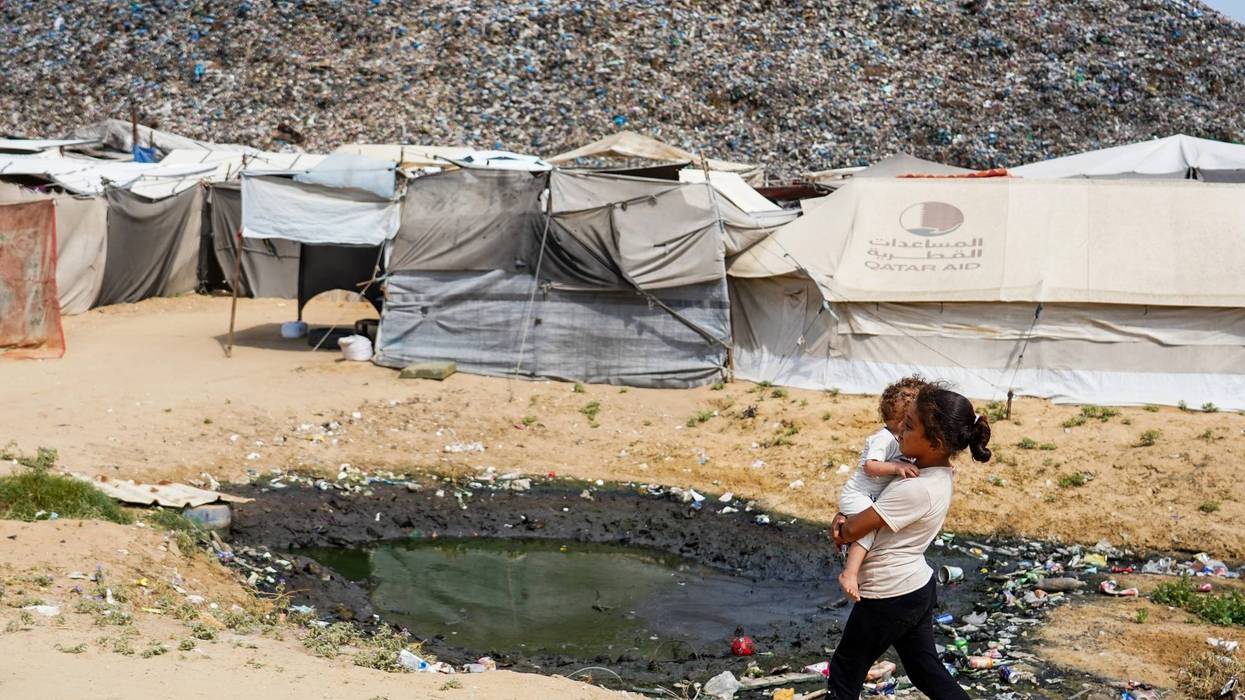
"The associated health consequences" of toxins, said one humanitarian, "will be severe, with children and pregnant women among those facing the highest risks.”
US government officials and commentators from both sides of the political aisle have insisted for years that Israel's assault on Gaza is targeted at Hamas fighters and have bristled at accusations that Israel, with US backing, is intentionally attempting to ethnically cleanse the exclave of Palestinians and make it uninhabitable for the population.
But one advocate for Palestinian rights said Monday that the "environmental war crimes" described in a new report on how Gaza's air, soil, and water have become toxic due to more than three years of relentless bombing—despite a ceasefire deal reached last year—are "also known as genocide."
The report by Oxfam International and the Conflict and Environment Observatory (CEOBS)—titled "Environmental War Crimes: How Israel’s Military Assault Has Turned Gaza Into a Toxic Wasteland, Threatening Human Survival"—finds that while Israel's military onslaught has directly impacted about 78% of Gaza's land area, a spatial analysis identified indicators of potential contamination from heavy metals, residue from explosives, asbestos from destroyed buildings, dioxins, and biological contaminants across almost the entirety of Gaza—more than 99% of the exclave.
“Israel's ongoing genocide in Gaza includes military assaults on its environment, which are environmental war crimes threatening life now and for generations to come," said Amitabh Behar, executive director of Oxfam. "The destruction and contamination of Gaza will have fundamentally degraded the environmental conditions necessary for human safety and survival. This would breach Israel’s legal obligations under international humanitarian and human rights law."
PRESS RELEASE: More than 99 per cent of #Gaza shows indicators of environmental contamination from Israel's military assault READ HERE: https://t.co/nIx81uPiPV https://t.co/1k8QkTzMzU
— Oxfam International Media Team (@newsfromoxfam) November 23, 2026
The organizations used satellite imagery, remote sensing, scientific analysis, and other open-source data—including the United Nations Environment Program's estimate that Israel's US-backed assault had generated more than 61 million tons of debris across Gaza—to build a comprehensive picture of the exclave's contamination.
The highest levels of potential contamination were identified in Gaza City, Khan Younis, Rafah, Jabalia, and the Salah al-Din Road, which correspond closely "with the areas subjected to the most sustained bombardment, ground military operations, infrastructure destruction, and debris accumulation."
The destruction of buildings, wastewater treatment facilities, industrial and energy facilities, and waste-management systems "has released a complex mixture of contaminants," reads the report, including explosive residue, perchlorates, asbestos fibers, crystalline silica, persistent organic pollutants, and pathogens—all of which can then move through the air, soil, groundwater, and surface water.
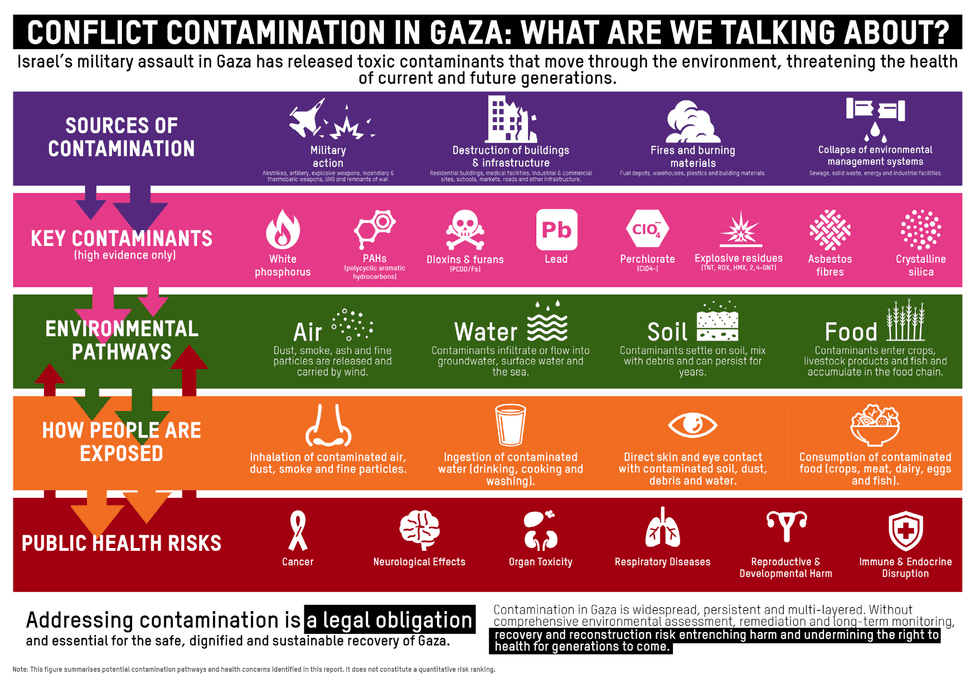 A graphic shows the public health risks associated with top contaminants found in Gaza, which Palestinians are being exposed to through a variety of interconnected pathways. (Image: Oxfam International)
"The population is likely to have been exposed to contaminants through multiple and interconnected pathways," the report continues.
Contamination described in the report include:
The analysis of the widespread, toxic contamination "contributes to the body of evidence relevant to the prohibition of deliberately inflicting conditions of life calculated to bring about the physical destruction of a protected group under Article II(c) of the Genocide Convention," reads the report. Top human rights groups and Holocaust scholars are among those who have argued that Israel's bombardment of Gaza amounts to a genocide, and South Africa has a genocide case against Israel before the International Court of Justice.
Lama Abdul Samad, a global water and sanitation specialist at Oxfam who was the lead author of the report, said that the widespread contamination is made even more difficult to address and mitigate because "unexploded ordnance continues to restrict safe access to most areas."
"The analysis highlights the urgent need for Israel to grant access for a detailed environmental assessment on the ground to clarify the risks to public health and identify options for urgent harm reduction measures," said Samad. "Restoration is likely to require extensive clearance, monitoring, and specialized remediation of affected areas from contaminants like explosive residues, organic pollutants, and heavy metals.”
Under international law, the report states, "the natural environment is not legally neutral... It is civilian in character and therefore protected."
"International humanitarian law explicitly protects both objects indispensable to civilian survival and the natural environment," the report continues. In Israel's attacks on Gaza, "the resulting contamination of groundwater, soil, air, and coastal waters is environmental harm that is legally relevant under international humanitarian law."
Oxfam called on Israel to allow a "full, independent, field-based Post-Conflict Environmental Assessment."
"Rebuilding without addressing environmental risks could expose Palestinians to entirely preventable harm," said Saeda Shaebat, the director of the Palestinian Environmental Quality Authority in Jerusalem.
New Oxfam and CEOBS analysis finds 99% of Gaza shows indicators of environmental contamination.Toxic residues from Israel’s military assault is threatening the air, soil and water that people rely on.Israel must allow independent testing and essential aid.Read: https://t.co/KYvtJSmzpN
— Oxfam International (@Oxfam) November 23, 2026
Behar said that "Palestinians living in Gaza are being exposed to toxins in multiple ways through air, food, water, and via direct contact with contaminated soils and debris. These risks will persist for generations to come, unless clean-up, remediation, and recovery actions are prioritized.”

Joe Kasper, who served Hegseth for three months at the start of the Trump administration, said he'd "overindulged in ego, in attitude, and in entitlement."
Defense Secretary Pete Hegseth’s former chief of staff is calling for the top Pentagon official to resign over what the aide described as a “shitshow” in Iran and Hegseth’s “belligerent” leadership of the department.
Joe Kasper, who served as Hegseth’s chief of staff during the first three months of the Trump administration, told Politico in an interview published Monday that the self-styled “secretary of war” has “overindulged in ego, in attitude, and in entitlement.”
Over the course of nearly an hour, Kasper savaged Hegseth over his purges of senior military personnel, his blocking of promotions for Black and female leaders, and his obsession with “distractions” like measuring soldiers’ testosterone levels.
EXCLUSIVE: The former chief of staff to Defense Secretary Pete Hegseth, Joe Kasper, is calling on him to resign, telling me he has badly mismanaged both the Pentagon and his “shitshow” war in Iran. He said Hegseth has prioritized showmanship over his job. https://t.co/QK5YIcLIiL
— Daniel Lippman (@dlippman) November 23, 2026
“There’s quite an emphasis on the showmanship,” he said. “The virtues of humility and basically service before self and those things have disappeared. I didn’t see those at the start, and see them ever less so now.”
Kasper said he realized within his first week on the job in early 2025 that it was “all about Pete rather than the institution and the men and women who support it.”
That spring, Kasper was embroiled in a bitter power struggle with three other Pentagon officials—senior adviser Dan Caldwell, Hegseth’s deputy chief of staff Darin Selnick, and Colin Carroll, chief of staff to Deputy Defense Secretary Stephen Feinberg. All three were fired in April 2025 after they were accused of leaking sensitive information, including details of US military planning to “reclaim” the Panama Canal.
Kasper, who led the charge for their ouster, also left his full-time post that month. Hegseth has insisted that Kasper was not fired and has publicly defended him as a “great guy.”
Kasper now says there was no evidence that the men he accused had leaked information. An internal investigation also found no evidence of leaks by the three men, according to The New York Times. Caldwell later rejoined the administration in the Office of the Director of National Intelligence.
A senior Pentagon official dismissed Kasper’s criticism on Monday as “gossip” from a “disgruntled former staffer—someone who could barely survive 90 days in the building.”
“Secretary Hegseth is laser-focused on restoring lethality to the force and supporting our warfighters, while Mr. Kasper is more focused on rewriting history to cover for his own failed tenure,” the official said.
Kasper, however, suggested that Hegseth’s power is already waning. Democrats are preparing to inundate the Pentagon with subpoenas over Hegseth’s role in launching the unauthorized war on Iran, now in its ninth month despite early promises that it would last mere weeks. Other targets include his campaign of extrajudicial boat strikes, which have killed over 200 people in the Caribbean and Pacific, and the department’s award of military contracts to members of President Donald Trump’s family and to his allies.
“Pete’s ability to be effective has been constrained, and very soon he’ll have lost any ability to be effective,” Kasper said. “For that reason and others, it’s time for Pete to call it quits.”
Exclusive: Sen. Ernst rebukes lack of "transparency" from Pentagon on Iran https://t.co/g0Cn1QCyME
— Axios (@axios) November 19, 2026
Lawmakers in both parties have criticized Hegseth. Earlier this month, the House narrowly rejected a bid to advance eight articles of impeachment against him brought by Rep. Thomas Massie (R-Ky.), a leading GOP critic of Trump’s foreign policy. Massie said Hegseth would “remain a threat to the Constitution if allowed to remain in office.” He dismissed the idea that Hegseth’s problem was a lack of effectiveness.
"In fact, he was very effective at killing schoolchildren in Iran," Massie said.
Even some Republicans who support the broad outlines of the Trump administration’s aggressive foreign policy have criticized Hegseth’s extreme secrecy and hostility toward congressional oversight. Hegseth has excluded Democratic members of Congress from classified briefings, withheld information about the costs, casualties, and objectives of the war on Iran, and repeatedly denied requests for evidence in investigations into the boat strikes.
In a memoir released in October, outgoing Sen. Thom Tillis (R-NC) said his vote to confirm Hegseth was his “biggest regret.” In a separate interview, Tillis said the secretary “takes [Congress] for granted, and... treats us more like a manufacturing line in his company than his board of directors.”
Sen. Joni Ernst (R-Iowa), who is also retiring, said last week that “a lot of people would be able to guess” that she regretted voting to confirm Hegseth. She added that there is “very little transparency right now with what is being discussed between the White House and the Department of War.”
Kasper suggested Hegseth has nobody to blame but himself for the rupture with Congress.
“He’s not just burned bridges up on the Hill,” he said. “He’s napalmed them… He’s going to be suffocated, and it’s not like it’s going to be a slow suffocation. It’s going to be a quick asphyxiation.”
Should Hegseth remain in office, the incoming Democratic majority in the House could revive the impeachment effort. If the House impeaches him, it would take a two-thirds vote of senators present to remove him. With Democrats expected to hold 56 Senate seats beginning in January, potentially as few as 11 Republicans may be needed to remove Hegseth from office.
"The goal, for me, is to get Pete Hegseth removed as the head of the Department of Defense," Rep. Jason Crow (D-Colo.), who sits on the House Armed Services and Intelligence committees, told The Atlantic last week. "Every day he sits atop the DOD is a day that our service members don’t have the leadership, they don’t have the competency, they don’t have the direction and the support that they need, and they are being put at great risk."

"While everyday Americans struggle with rising gas and grocery prices, Trump hosted an exclusive dinner tonight at his own resort for top buyers of his crypto meme coin."
US President Donald Trump on Sunday hosted a third exclusive dinner for the biggest holders of his brazenly corrupt meme coin as his administration moved to strip modest nutrition assistance from over 6 million additional Americans amid high grocery prices.
Sunday's dinner took place at the president's private golf club in Sterling, Virginia, where more than 100 people who held a combined $8.6 million worth of the $TRUMP crypto coin—which is currently trading below $1, down from a high of around $75—gathered to "dine on grilled filet mignon and pan-seared halibut while hearing speeches from the likes of Kevin O'Leary of the 'Shark Tank' television show and NBA veteran Tristan Thompson," Reuters reported.
The top 120 meme coin holders who attended Sunday's gala received a gift bag that included a watch and a Trump fragrance.
Financial disclosures show that Trump pocketed around $635 million in earnings from his meme coin last year, but investors haven't fared nearly as well. According to a recent Public Citizen analysis, "Trump’s crypto schemes have left investors at least an estimated $4.7 billion underwater," with the $TRUMP coin accounting for $3.2 billion of those losses.
“As Trump tries to extract the last possible dollars from his waning $TRUMP cryptocurrency scam, it has turned into a pay-for-access deal more than ever before,” Public Citizen co-president Robert Weissman said on Sunday, pointing to his group's new finding that more than half of the crypto wallets appearing on the gala leaderboard "received their $TRUMP tokens from cryptocurrency exchanges that prohibit US customers."
“Our analysis shows that foreign interests are likely among those paying for the privilege of dining with the president," said Weissman.
Ahead of Sunday's dinner, a group of Democratic US senators argued that the scoring system used to determine who would qualify to attend the exclusive gala "appears to be a pay-to-play scheme designed to reward the president’s wealthy allies and con the president’s supporters while lining his pockets directly."
"With the president poised to grow his financial holdings as a direct result of the November 22, 2026 gala dinner—particularly as American families suffer rising costs—it is incumbent upon the administration to answer to the American people about the President’s involvement in and profits from the upcoming event," the senators wrote.
The dinner came less than two weeks after the Trump administration unveiled a proposed rule that would take Supplemental Nutrition Assistance Program (SNAP) benefits from around 6.3 million people, including many children.
The rule, if enacted, would compound the devastating impacts of the SNAP cuts that Trump and congressional Republicans enacted last year, taking food aid from more than 5 million people so far.
"Just a reminder that while everyday Americans struggle with rising gas and grocery prices, Trump hosted an exclusive dinner tonight at his own resort for top buyers of his crypto meme coin, which he claims he made $635 million off of last year," Citizens for Responsibility and Ethics in Washington, a government watchdog group, wrote on Sunday.

"Billionaires shouldn’t be able to buy our elections at any level."
Sen. Bernie Sanders is welcoming the Democratic National Committee's new restrictions on dark money in the 2028 presidential primary, but he says the party can go even further.
The DNC on Monday announced rules for the 2028 presidential primary, including one that bars Democratic candidates from appearing on a debate stage unless they denounce the involvement of super political action committees (PACs) and dark money groups in the race.
More specifically, the DNC is requiring that each presidential campaign provide "a uniform denunciation statement... upon notification of spending that violates the pledge."
The rules further state that super PAC and dark money spending that occurs "prior to a candidate’s launch must be denounced if reported to the DNC and determined to violate the terms of the pledge," a reference to the DNC’s Presidential Primary Fair Campaign Practices Pledge.
Additionally, any candidate found to have authorized super PAC spending on their behalf will need to "need to refund the spending party committee and provide proof of refund in order to be in compliance."
Sanders (I-Vt.), a longtime advocate of getting big moneyed interests out of the political process, wrote in a Monday social media post that the new DNC rules were a good start, while emphasizing more must be done.
"The DNC announced that 2028 presidential candidates must reject dark money and disavow Super PAC spending on their behalf. Excellent!" Sanders wrote. "Now let’s expand those restrictions to Democratic Senate and House primaries. Billionaires shouldn’t be able to buy our elections at ANY level."
The new DNC rules also earned kudos from Sen. Elizabeth Warren (D-Mass.).
"The DNC’s pledge is a powerfully important step in getting big money out of politics," Warren said. "Coming off an election where candidates across the country proved that the many beat the money, I hope candidates will not just take this pledge, but embrace it."
Reps. Greg Casar (D-Texas), Maxwell Frost (D-Fla.), and Pramila Jayapal (D-Wash.), co-chairs of the Congressional Progressive Caucus PAC, emphasized that "dark money should have no place in our elections, especially in Democratic primaries," noting that "Americans just rejected corruption at all levels" during the 2026 midterm elections.
"While Congress must work to ban all super PACs by law," they added, "we are glad to see the DNC taking a first step to make sure our party answers to the voters, not billionaires and special interests. We urge all 2028 candidates to take this pledge and reject dark money."

"I think the message out of this election was economic populism, and you need somebody who has a history of fighting powerful, big-money special interests in favor of the public interest. That has been my north star."
With the Senate Democratic leadership contest just over a week away, Sen. Chris Van Hollen of Maryland said Sunday that he has secured more than half of the votes he needs to lead the caucus in the new Congress, declaring that "momentum is in our direction."
Van Hollen, who decided to challenge longtime Democratic leader Sen. Chuck Schumer (D-NY) earlier this month following a surge of grassroots support, said in an appearance on NBC's "Meet the Press" that the American public wants to "see change, and you don’t get change by going back to business as usual." The Maryland Democrat needs at least 29 votes to win the Senate Democratic leadership contest, which will be held via secret ballot on December 1.
Van Hollen said Sunday that he has locked down "north of 15" supporters. According to a tracker maintained by Punchbowl News, six members of the Senate Democratic caucus have publicly endorsed Van Hollen, compared with 16 for Schumer.
Schumer, who is deeply unpopular with the Democratic base, has repeatedly insisted that he has enough votes to win reelection as caucus leader, but Van Hollen has disputed that narrative, accusing Schumer of counting some of Van Hollen's supporters as his own.
"If you look at our caucus, you can see a huge appetite for change," Van Hollen said on Sunday, pointing to support from Sen. Elissa Slotkin (D-Mich.) as evidence that "this is not about progressives versus moderates."
"This is about those who understand that the last election was an election on economic populism," said the Maryland Democrat. "People are sick and tired of an economic system rigged in favor of the very wealthy, against working people, and fueled by political corruption. That is the big tent that all of our candidates ran on, and that was the call of the American people."
Van Hollen outlined some of his top priorities if he wins the leadership election, including "completely" reforming the "very broken" US healthcare system and overhauling a tax code that "right now is rigged in favor of the very wealthy against working people." Van Hollen is a supporter of Medicare for All and a billionaire wealth tax.
"You don’t earn people’s trust by going back to business as usual," said Van Hollen. "I think the message out of this election was economic populism, and you need somebody who has a history of fighting powerful, big-money special interests in favor of the public interest. That has been my north star. That is what can bring us all together in the Senate Democratic caucus to get things done now."
Van Hollen's "Meet the Press" appearance came shortly after Sen.-elect Abdul El-Sayed (D-Mich.)—one of the newly elected senators backing the Maryland Democrat in the leadership race—said on the show that the contest is "not about rejecting Senator Schumer."
"He and I worked very well together during the general election. I like him personally. This is about embracing what Senator Van Hollen has to offer," said El-Sayed. "The people are suffering. I got elected to address the affordability crisis. I got elected to keep our money here at home. I got elected to guarantee people healthcare, and I want to make sure that we are willing to do what it takes to get that done. And that is the responsibility of the next Senate majority leader."

"I don't really care what it's called. I care that the people of this country finally have the unmet promise of guaranteed healthcare," said the Democratic senator-elect from Michigan.
US Sen.-elect Abdul El-Sayed spent the weekend reiterating his willingness to work with Republican President Donald Trump to deliver healthcare for all Americans, a key focus of the Michigan Democrat's successful midterm campaign.
After Trump said during a Friday press conference that he was "open to great healthcare," and while it couldn't be what some progressive Democrats in Congress want, "it can be a combination of what we all want," El-Sayed and Sen. Bernie Sanders (I-Vt.), the longtime leading advocate of Medicare for All on Capitol Hill, encouraged the president to work with them.
"Trumpcare for All?” El-Sayed wrote on social media with a clip of the president's remarks. Then, on Saturday, the president took to his Truth Social platform to share an earlier post from the senator-elect with images of proposed "Trumpcare" cards.
"If the president is serious about meeting the unmet promise of guaranteed healthcare in this country, I'm ready to work alongside leaders in the Senate," El-Sayed said in a Saturday statement to The Hill. He specifically pointed to Sanders and Democratic Sens. Ron Wyden (Ore.), Elizabeth Warren (Mass.), and Chris Van Hollen (Md.), who is running for Senate majority leader.
The topic also came up during El-Sayed's Sunday appearance on NBC News' "Meet the Press," during which he told Kristen Welker that "my job is to make sure that we're advancing the goal to get everybody in this country healthcare. I ran on three things: money out of politics, money in your pocket, Medicare for All. Now, I don't really care what it's called. I care that the people of this country finally have the unmet promise of guaranteed healthcare."
"If the president is serious about leaving a lasting legacy, there is nothing better than the ultimate Trump card, a card that they can have in their back pocket from the moment they are born to the moment that they pass away that guarantees them the healthcare that has been so elusive in this country without premiums, co-pays, and deductibles," El-Sayed continued. "If he's open to the conversation, I am open to it too. I know that Sen. Van Hollen, who you'll be speaking with later, is certainly open [to] it, and it’s a big reason why I support him for Senate majority leader."
Asked about getting enough votes in Congress, given that Democrats are set to take over both chambers in January but support for the policy is not universal in the party, El-Sayed said that "I think the assumption is that you can't get Republican votes. Now, the last I've seen is that Donald Trump controls a lot of that caucus. If he says that he wants Trumpcare for All and that he's open to signing it if it gets on his desk, I think you're going to find a lot of Republicans open to vote for it too. Now, it might be kind of awkward if folks in my party aren't as interested in supporting it if you have broad bipartisan support."
Welker also asked El-Sayed if he supports Sanders' Medicare for All Act—to which he responded: "I support his bill. But the version of Medicare for All I'd like to see is somewhat like thinking about health insurance like public schools. Everybody is entitled to a public school. Some people send their kids to private schools. But the next day, if they wanted to, they could send their kids to public schools. Everybody's entitled to it. That's how I'm thinking about public health insurance under Medicare for All."
"I don't think it's about what it takes away. I think it's about the guarantee and the security that it offers," El-Sayed said. "I'm broadly supportive of Sen. Sanders' extreme effort to finally force this conversation. You know, you cannot have a conversation about Medicare for All without credit to Sen. Sanders and folks like Sen. Warren, Sen. Wyden, Sen. Van Hollen, others who have been working on this for a very long time."
When Welker asked about Sanders' bill potentially eliminating private health insurance, the former public health official stressed that "the essence of Medicare for All is the guaranteed public health insurance... I understand the attempt to drive a wedge here about whether or not there is a space for private health insurance. But the goal here in an America where millions of people are struggling because they don't have health insurance is to guarantee every single person cradle-to-grave coverage."
El-Sayed also pushed back against Republicans in Congress who attacked the policy on social media, such as Sen. Rand Paul (R-Ky.), who complained about cost.
An August study by Yale University experts found that Sanders' bill would save $1 trillion and over 114,000 lives per year.
El-Sayed also called out at Sen. John Kennedy (R-La.), who discussed the policy Sunday on "Meet the Press."
El-Sayed isn't the only incoming progressive senator open to working with Trump—whose allies in Congress used their majorities last year to take away healthcare and food assistance from families in need—on expanding coverage.
As Politico pointed out, while Democratic Sen.-elect Peggy Flanagan (Minn.) said on CNN's "State of the Union" this weekend that her priority is reversing cuts to Medicaid and food aid, she also supports working with Trump on healthcare for everyone.
"Listen, call it whatever you want. I think people are ready for Medicare for All," said Flanagan, who, like El-Sayed, was backed by Sanders on the campaign trail. "If we have to call it Trumpcare in order to get it across the finish line, that's fine by me."

"Türkiye and Australia are handing the incoming COP32 presidency the wreckage of their failed leadership," said one activist. "Ethiopia should move us forward, not take us back to square one."
Green groups are already looking ahead to the next United Nations Climate Change Conference after COP31 ended in overtime on Sunday, with governments rejecting a "dangerous" final proposal that didn't even mention fossil fuels, but failing to offer any alternative—a conclusion that critics called "bitterly disappointing" and a "colossal failure."
Ani Dasguputa, president and CEO of the World Resources Institute, said that "the hollow outcome at COP31 was a failure of political leadership, not a failure of the Paris Agreement. When narrow national interests override collective responsibility to confront the climate crisis, the entire world pays the price. Climate summits are not stages for posturing; they require every country to roll up their sleeves and do the hard work of finding ambitious common ground."
"Now is the time for countries to learn from this setback and recommit to multilateral climate action," he declared. "Nations must come together to offer an ambitious, collective response to the climate crisis by taking concrete steps to rapidly slash emissions, remove carbon from the atmosphere, and build resilience to protect communities from worsening climate impacts."
"The Paris Agreement remains indispensable as the world's central framework for collective climate action, driving ambition, and holding countries accountable for promises that have profound consequences for people's lives and livelihoods," Dasguputa added. "The answer to a disappointing COP is not to retreat from multilateralism, but to make it deliver."
Fatima Eisam-Eldeen, a fossil fuel researcher at the University of Barcelona, stressed that "no agreement is better than a bad agreement. Where this COP failed to come to a final decision, at least it kept false solutions from being validated through the negotiations. We must not waste more precious time and resources on derailing tactics, because for frontline communities, this is a life-or-death situation."
"The real solution is clear: We need to phase out fossil fuels fast, in a just and orderly manner, and for that, we need mechanisms," she said. Eisam-Eldeen also took aim at Australia and Turkey, who co-hosted COP31 in the Turkish city of Antalya, and urged leadership from Ethiopia, which is set to lead COP32 in its capital, Addis Ababa, next November.
"This presidency made a mess, and now the COP in Ethiopia must clean it up, raise ambition, and deliver for the people who need it today," she said. "It's a sad but well-known phenomenon: The mess made by the states with wasted interest in continuing burning fossil fuels will be cleaned up by the people suffering its consequences."
Next year #COP32 is to be hosted by Ethiopia. They have already said their focus will be on finance, no mention of phasing out fossil fuels. In 2028 COP 33 moves to Asia and already China and India have said they won’t host it. (It falls the same week as US elections)www.rte.ie/news/world/2...
[image or embed]
— Philip Boucher-Hayes (@philipb-h.bsky.social) November 22, 2026 at 2:53 PM
Rukiya Khamis, East Africa team lead at 350.org, similarly said that "with no progress on finance, Türkiye and Australia are handing the incoming COP32 presidency the wreckage of their failed leadership. Ethiopia should move us forward, not take us back to square one."
With the next summit being held in the Horn of Africa, Khamis pointed out that people across that continent and the world "have spent this year struggling with rising energy prices and deadly droughts and floods. Yet rich polluting nations have chosen to side with the fossil fuels lobby and closed their wallets at a time when we urgently need a lifeline."
"Countries on the frontline of this crisis should not have to beg for the resources they need to protect their people, rebuild after disasters, and secure reliable and accessible renewable energy," she argued. "We cannot wait for the next COP. Beyond COP, we need governments to act now. Tax fossil fuel profits, and use polluter levies to build a safe, affordable future for everyone."
Ann Harrison, climate justice policy adviser at Amnesty International, agreed that "governments must now deliver what COP31 failed to provide. The route from Antalya must lead to the Pacific in July 2027, where Tuvalu and Ireland will co-host the Second International Conference on the Just Transition Away from Fossil Fuels, and then to COP32 in Addis Ababa, Ethiopia. These meetings must move beyond red lines and obstruction to deliver a full, fast, fair, and funded phaseout of fossil fuels, backed by massively scaled-up grant-based and non-debt-creating climate finance to meet the actual level of need."
"People facing deadly floods, wildfires, droughts, hunger, and displacement cannot wait through another cycle of broken promises," Harrison continued. "COP32 must not repeat this betrayal. It must put the rights, demands and leadership of the people most affected by climate change ahead of the interests of polluters."
Meena Raman on the #COP31 outcome: "Everything that developing countries wanted – adaptation, just transition, climate finance – is going to [COP32] Africa. If journalists are already writing an obituary because of the EU’s veto, that’s the biggest hypocrisy."connect.carbonbrief.org/t/experts-is...
[image or embed]
— Aruna Chandrasekhar (@arunacsekhar.bsky.social) November 22, 2026 at 10:02 AM
At COP31, "beyond the negotiating rooms, countries continued to advance the energy transition through first-mover initiatives, such as the Coalition on Phasing Out Fossil Fuel Incentives including Subsidies (COFFIS), Beyond Oil and Gas Alliance, and the process on transitioning away from fossil fuels that began in Santa Marta, with more countries announcing their roadmaps to transition," noted Patricia Fuller, president and CEO of the International Institute for Sustainable Development.
"While these efforts are encouraging, they cannot substitute for an effective multilateral process," she emphasized. "If all countries are to have a meaningful voice in shaping the global response to climate change, work must begin now to restore confidence in the UN process and its ability to deliver on the goals of the Paris Agreement."
Jasper Inventor, head of the Greenpeace International delegation in Antalya, suggested that "if COPs can’t deliver action, then perhaps it’s time to change the process," and specifically called out the European Union—which has faced widespread criticism despite opposing the final bad deal.
"Declaring climate finance 'dead in the water' before COP31 even began, the EU poisoned the trust needed for a stronger outcome," Inventor explained. "The final standoff over fossil fuels should not paper over the monumental breach of faith that kick-started it all. Developed countries need to look in the mirror, honor their climate finance obligations and hold the oil and gas companies to account. It is time to make polluters pay for the climate damages they cause."
High time for the users of the fossil fuel drug to shake off their addiction, rather than waiting for the drug dealers to sign on to that plan. The EU needs to speed up the European Green Deal rather than slowing it down!
[image or embed]
— Prof. Stefan Rahmstorf (@rahmstorf.bsky.social) November 22, 2026 at 8:38 AM
Bryan Bixcul, just transition lead at the International Indigenous Peoples Forum on Climate Change, said that he was "deeply troubled by the level of dysfunction we witnessed" in the UN Framework Convention on Climate Change process.
"In the same year that science warned we are on track to exceed the 1.5°C threshold," he said, referring to the Paris Agreement's key temperature target for this century, "COP31 failed to face that reality head-on and name fossil fuels as the root cause of climate change. Antalya ends without its key deal, putting the interests of petrostates and fossil fuel lobbyists ahead of people, especially Indigenous peoples."
"Our territories are on the frontline of this fight," Bixcul added. "If drilling continues, temperatures will keep rising, our waters will be contaminated, and our lands destroyed. If the energy transition moves ahead without recognizing our rights and without adequate finance, a new mining push will once again kill, destroy, and set us back in the fight against climate change. There is no meaningful progress on the just transition mechanism, and no clarity on climate finance. How are we supposed to trust this process?"
No more climate COPs with fossil-fuel company lobbyists or fossil-fuel producing countries.
— Peter Gleick (@petergleick.bsky.social) November 22, 2026 at 1:04 PM
Bill Hare, CEO of Climate Analytics, asserted that "what the nonagreement here means for the COP process will be worked out in the coming few months, but three lessons are already clear. One is that the experiment where two countries share the presidency should not be repeated."
"The second is that if the world is to move forward with a transition away from fossil fuels, many countries need to come prepared to push back against Saudi Arabia," he continued. "This country has been the most implacable opponent of climate action for over 30 years and has had an outsize influence on three of the last five COPs—Sharm El Sheikh, Baku, and now Antalya—and the international community has to stop that happening again."
"Thirdly, with momentum building for countries to compile fossil fuel transition roadmaps, many more need to join this in 2027," he added, "so that by the COP in Ethiopia, a large number of countries have roadmaps prepared or underway, to spur a global transition away from fossil fuels."

Calling the defeated final proposal "dangerous," one campaigner said that "the countries and communities fighting for climate justice are not backing down, and the road to COP32 in Ethiopia must be about action."
The longest United Nations Climate Change Conference on record ended in overtime on Sunday, with the governments gathered in Türkiye for COP31 unable to reach an agreement on tackling the fossil fuel-driven global emergency.
The Turkish and Australian governments hosted the conference in Antalya. According to The Guardian, Australia's minister for climate change and energy, Chris Bowen, told reporters outside the plenary room that he hadn't slept for three days.
"Unfortunately, we were unable to reach agreement on a cover decision, and that's very disappointing," Bowen said, hours after the latest draft drew a fresh wave of criticism. "Ultimately, looking back, many parties who are people of good faith had very strong red lines on a couple of key issues, and despite many, many attempts, on reflection those red lines were not able to be met."
The European Union, Panama, and small island nations were among those that rejected the proposal. Explaining the EU's position, the Irish climate and environment minister, Darragh O'Brien, said that "it is unconscionable that we would have a climate act that makes no reference to fossil fuel, no reference to transitioning away from fossil fuels."
While Big Oil-backed US President Donald Trump has ditched the Paris Agreement and declined to send a delegation to COP31, even though his country is the largest historical climate polluter, other major petroleum producers such as Saudi Arabia and Russia lobbied against mentioning fossil fuels. Panama's climate minister, Juan Carlos Navarro, told Politico that "the world is hostage to petroleum producers. That is the truth... And they will not stop."
In the lead-up to the conference, scientists warned that temporarily surpassing the Paris Agreement's 1.5°C threshold for temperature rise this century, relative to preindustrial levels, is now inevitable, and the world is barreling toward "an irrecoverable overshoot" of that target absent a rapid reduction in planet-heating emissions.
Jasper Inventor, head of the Greenpeace International delegation at COP31, said that "it's bitterly disappointing to leave without a clear outcome or a credible pathway to end fossil fuels. We stopped a bad deal that favors fossil fuels, but leaving without a deal is still a failure for communities on the climate frontlines. As always, it is the world's most vulnerable communities who bear the consequences of this failure. We've run out of time to avoid overshoot, but we can still keep 1.5°C alive."
Climate campaigners from around the world joined Inventor in expressing frustration that "COP31 has failed to deliver any meaningful outcomes on climate action," as Oxfam International climate change policy lead Nafkote Dabi put it after two weeks of talks. "Shame on rich polluting countries for once again turning their backs on communities fighting for survival in a climate crisis they did little to cause. Shame on the presidencies for prioritizing profits and ego over progress."
"And shame on all the countries that stubbornly blocked and distracted from discussions meant to deliver crucial funding to people watching their homes swallowed by floods, their crops wither in droughts, and their lives upended by deadly heat," said Dabi. "Instead of implementation, COP31 has delivered yet another victory for rich polluting countries and fossil fuel interests. The co-presidencies—who both remain heavily invested in fossil fuels and are profiting from climate destruction—attempted to broker a decision without a single mention of fossil fuels in favor of false solutions."
Nikki Reisch, a director at the Center for International Environmental Law, explained that "the proposed cover decision did not advance the provision of climate finance, said nothing about the root cause of the crisis, and made no mention of states' legal obligations to prevent and repair climate harm, as clarified by the International Court of Justice. On loss and damage, it fared no better as it offered little more than expressions of deep concern about mounting impacts. And a text that welcomed a scale-up of future fantasy fixes like carbon dioxide removal (CDR) technologies and proven-to-fail industry favorites like carbon capture and storage (CCS), without so much as a whisper about fossil fuels, would have been a massive giveaway to polluters."
Calling out the hosts, Global Climate and Health Alliance executive director Jeni Miller stressed that "the rightly rejected 'Antalya Pact' comes as climate change compounds this year's super El Niño, causing severe droughts in Fiji and Bolivia, extreme flooding in the western US, and wildfires in Southeast Asia, and putting millions of additional people at risk of hunger or famine."
Amiera Sawas, head of research and policy at the Fossil Fuel Treaty Initiative, highlighted that "while Global North countries rejected the outcome on the basis that there was no language on transitioning away from fossil fuels, these same countries have not themselves presented serious or credible phaseout plans, nor do they intend to support others in their transitions. Many wealthy countries continue expanding fossil fuel extraction despite their international legal obligations, while developing countries carrying unpayable debt can't plan an exit at all."
"The EU and some of its most powerful member states have blocked progress or, worse, reneged on past commitments," Sawas continued. "Demanding the words 'fossil fuels' in the cover text while blocking mandated agenda items and pointing fingers at developing countries is acting in bad faith. We need real commitments to a fair and financed phaseout of fossil fuels that delivers on the Paris Agreement, not collapses it. That means a just transition, where those most responsible pay their fair share and workers, communities, and Indigenous peoples have a meaningful say in what it looks like."
Mohamed Adow, director of the think tank Power Shift Africa, declared that "this has been the worst ever COP, and its collapse needs to be a wake-up call for the world. Rich nations and polluting governments cannot keep arriving empty-handed and expecting a carefully worded declaration to get them off the hook."
Romain Ioualalen, global policy lead at Oil Change International, similarly asserted that "this will go down as one of the worst COPs in history. COP hosts Australia and Türkiye have failed to steward the negotiations. This sad stalemate only benefits fossil fuel interests while people and communities will continue paying the highest price for the crisis they didn't create."
"Don't fall for the EU's attempt to portray themselves as heroes. They are the ones who are largely to blame for this result... But let's be clear: The outcome on the table was dangerous," he continued, welcoming the proposal's defeat. "Countries failed to rise to the moment, but we refuse to lower the bar. The countries and communities fighting for climate justice are not backing down, and the road to COP32 in Ethiopia must be about action."
Asad Rehman, chief executive of Friends of the Earth in England, Wales, and Northern Ireland, also emphasized how bad the final deal was: "After decades of broken pledges and hollow commitments, an agreement built on yet more empty promises would have been unforgivable and no substitute for the transformative action we urgently need. So the dramatic rejection of the presidency's final text by some, though underscoring the lack of consensus that's been reached, restores some level of faith in its recognition that a deal of this caliber is no deal at all."
"What matters now is not when governments reconvene, it's how they do so," he argued. "The world doesn't need more meetings with woolly commitments. We need global governments, including the UK, to come back to the negotiating table ready to deliver. That means cutting emissions fairly at home, transitioning our economies in a way that leaves no one behind, and providing the public climate finance so desperately needed to protect people, livelihoods, and our planet from unimaginable harm."
Savio Carvalho, head of campaigns and networks at 350.org, also looked ahead: "You'd think that in the middle of the worst fossil fuel crisis in history, after a year of devastating wildfires, floods, and collapsing glaciers, world leaders would finally rise to the moment. But they didn't. We averted a truly bad outcome because many countries stood up to the fossil fuel industry and rejected dangerous distractions. But we still left COP31 without a clear plan to exit coal, oil, and gas. There's no real money on the table to help countries survive the climate breakdown that is already at our doorstep."
"The world needs governments with the courage to stand with people and the planet, even when the fossil fuel industry pushes back," Carvalho added. "This isn't the end. We'll keep pushing until governments end the age of fossil fuels. Every meeting and every decision in the year ahead counts. The time for delay is over."

The Republican president said that "these credit card companies have made a lot—and the credit card fees that they charge—I'm all into it."
Two weeks after saying that if President Donald Trump "wants to be Mr. Veto, let's test that out," Sen. Elizabeth Warren on Saturday welcomed his renewed support for one of his 2024 campaign trail promises: capping credit card interest rates at 10%.
"Let's cap credit card interest rates and save Americans money," Warren (D-Mass.) wrote on social media in response to a Fox News interview in which Trump was asked about possibly working with incoming Democratic majorities in Congress on the policy.
"I would do it," Trump said of a one-year cap, claiming he didn't know Democrats had long pushed for the policy when he initially endorsed it. "These credit card companies have made a lot—and the credit card fees that they charge—I'm all into it."
"I know that some people would say it's not free enterprise, but what's free enterprise when you're sitting home, and you get a bill that some guy sat up in an office on Park Avenue, and they said let's charge a fee that's too high?" he added. "So I'm all for that."
In February 2025, when Sens. Josh Hawley (R-Mo.) and Bernie Sanders (I-Vt.) introduced a bill that would cap credit card interest rates at 10% for five years, Sanders—who caucuses with Democrats—highlighted Trump's campaign pledge. Reps. Alexandria Ocasio-Cortez (D-NY) and Anna Paulina Luna (R-Fla.) lead the bill in the House of Representatives.
This past February, dozens of civil rights, consumer protection, labor, veteran, and other groups called on Congress to pass that legislation, and also pointed to Trump's January social media post backing a one-year 10% cap. At the time, the average credit card interest rate was 19.61%, according to Bankrate. As of early this month, it was 19.71%.
Early November featured a blue tsunami in the midterm elections that set up Democrats to take over both the Senate and House in January. Since then, progressives including Sanders and Warren have called for passing bold policies and daring the Republican president to veto them—while Trump has started selling a red hat with the word "veto" on it.
"Trump says he welcomes the nickname 'Mr. Veto.' Well, let's test that out by passing legislation the American people support,” Warren wrote shortly after the midterms, urging Democrats to stop his Iran War, reverse GOP healthcare cuts while expanding coverage, fund universal childcare, and cancel "the tax breaks Trump and the Republicans handed out to corporations, ultramillionaires, and billionaires."
After Trump suggested Friday that he was "open to great healthcare," Sanders and Sen.-elect Abdul El-Sayed (D-Mich.) reiterated their calls to pass Medicare for All legislation, a fight Sanders has long spearheaded on Capitol Hill.
"I appreciate the president's comments," said Sanders. "Our job now is to do what every other major country does: Guarantee healthcare to all as a human right and substantially lower the cost of prescription drugs. I look forward to working with President Trump."