SUBSCRIBE TO OUR FREE NEWSLETTER
Daily news & progressive opinion—funded by the people, not the corporations—delivered straight to your inbox.
5
#000000
#FFFFFF
To donate by check, phone, or other method, see our More Ways to Give page.


Daily news & progressive opinion—funded by the people, not the corporations—delivered straight to your inbox.
"Those who consider waving the flag of a state to be 'inciting hatred' have either lost their judgment or been blinded by their own ignominy."
Spanish Prime Minister Pedro Sánchez hit back Thursday after senior Israeli officials condemned FC Barcelona star Lamine Yamal for waving a Palestinian flag during a parade celebrating the soccer team's La Liga championship.
The 18-year-old winger—who has established himself as one of the world's best soccer players—waved the flag from atop an open team bus during Monday's celebration in Barcelona. Yamal also shared a photo of him holding the flag with his 42.5 million Instagram followers. The post had nearly 7 million "likes" as of Thursday afternoon.
The display of solidarity with Palestine—whose people have endured 31 months of genocide in Gaza and generations of illegal occupation, settler colonization, apartheid, and ethnic cleansing in the West Bank—drew predictably baseless claims of "antisemitism" and "supporting terrorism" from numerous Israelis, including Security Minister Itamar Ben-Gvir, who in 2007 was convicted of supporting a Jewish terror group.
"He is raising the flag of a nonexistent entity," Ben-Gvir said of Yamal in a Facebook post. Numerous Israeli officials including Ben-Gvir deny the existence of the Palestinian people and nation.
Israeli Defense Minister Israel Katz said on X Thursday that Yamal "chose to incite against Israel and foment hatred while our soldiers are fighting the terrorist organization Hamas, an organization that massacred, raped, burned, and murdered Jewish children, women, and elderly" during the October 7, 2023 attack.
"Whoever supports this type of message should ask themselves: Does he consider this humanitarian? Is this moral?" added Katz, who oversees military forces that have killed or wounded more than 250,000 Palestinians in Gaza in a war that United Nations experts and many others, including prominent Israeli Holocaust scholars, have called a genocide.
Responding to the criticism, Sánchez wrote on X: "Those who consider waving the flag of a state to be 'inciting hatred' have either lost their judgment or been blinded by their own ignominy. Lamine has only expressed the solidarity with Palestine felt by millions of Spaniards. Another reason to be proud of him."
The Spanish government's support for Palestine includes intervention in the International Court of Justice genocide case against Israel, backing the International Criminal Court's effort to bring Israeli Prime Minister Benjamin Netanyahu to justice for alleged crimes against humanity and war crimes in Gaza, promotion of United Nations Gaza ceasefire resolutions, an arms embargo against Israel, and formal recognition of Palestinian statehood.
Katz also said on X that he expects "a great and respected club like FC Barcelona to distance itself" from Yamal's display of solidarity "and make it unequivocally clear that there is no place for incitement or for support of terrorism."
FC Barcelona coach Hansi Flick said Tuesday that if Yamal wants to show support for Palestine, "it is his decision. He is old enough. He's 18 years old."
Yamal's display came just weeks before the Fédération Internationale de Football Association (FIFA) Men's World Cup kicks off in the United States, Canada, and Mexico. Yamal is a member of the Spanish national team. Some observers have voiced concerns about possible backlash from the Trump administration, which has revoked and denied visas for people who publicly support Palestine.
"While young people like us are being killed and subjected to genocide in Palestine, we cannot be in class," said one protester in Madrid.
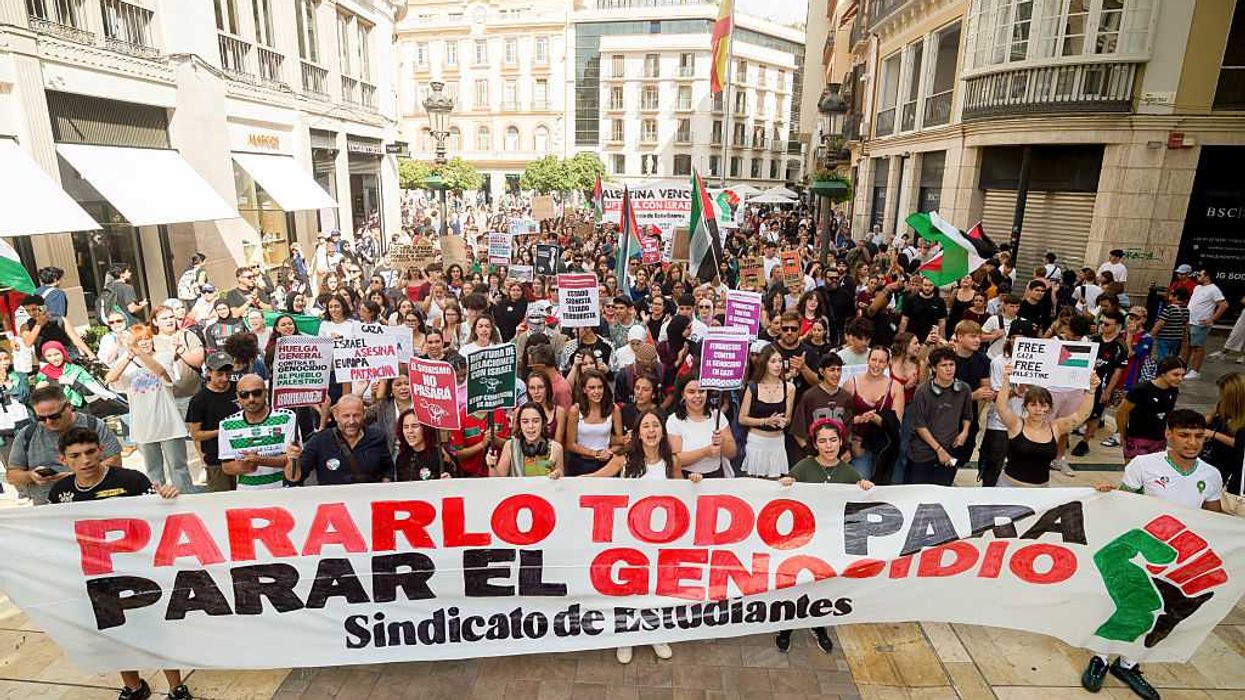
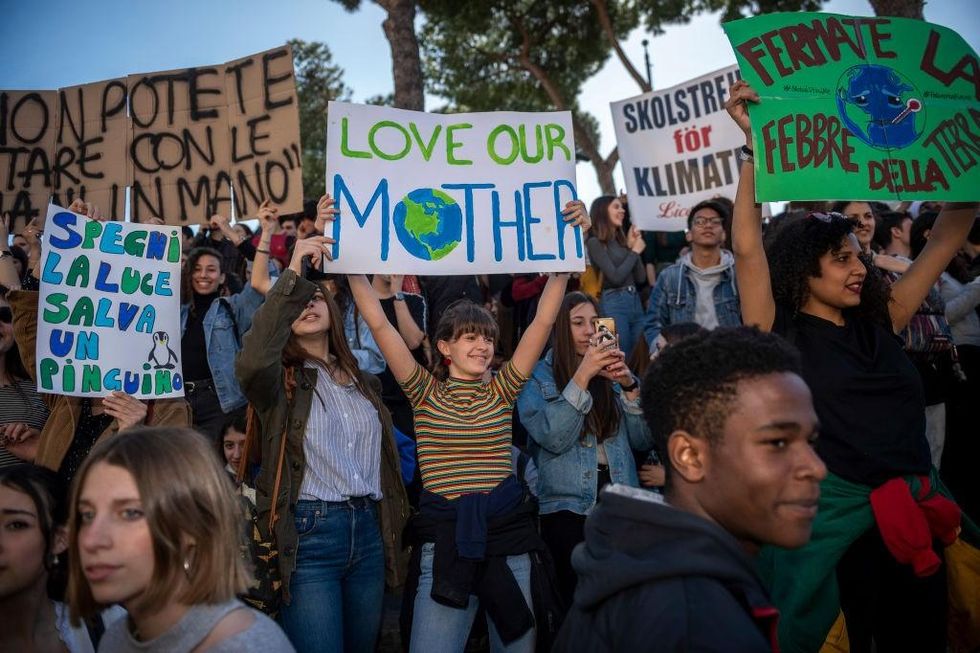
Tens of thousands of students walked out of classrooms in cities and towns across Spain on Thursday to protest Israel's ongoing US-backed genocide in Gaza and abduction of Global Sumud Flotilla members, dozens of whom are Spanish.
The National Students' Union organized Thursday's protests under the slogan "stop the genocide against the Palestinian people." Demonstrations, which took part in at least 39 cities and towns, varied in size from small groups to thousands who turned out in Barcelona and the capital Madrid, where students held banners with messages like "Stop Everything to Stop the Genocide," "All Eyes on the Global Sumud Flotilla," and "Free Palestine!"
"We're not going to look the other way," the union said in a statement. "The Palestinian cause is the cause of the youth and the millions who stand for human rights and social justice. That is why... we called the general student strike to empty the classrooms and fill the streets with dignity."
Maria, a Spanish student interviewed by Turkey's Anadolu Ajansı in Madrid, said: "While young people like us are being killed and subjected to genocide in Palestine, we cannot be in class. The whole world must do everything it can to stop this genocide.”
Another Madrid protester, Francesca—an Italian student studying in Spain—told Anadolu that “we must pressure governments to stop Israel."
"Allowing genocide in full view of the world is unacceptable," she added. "The killing of women, children, and students in Palestine must end."
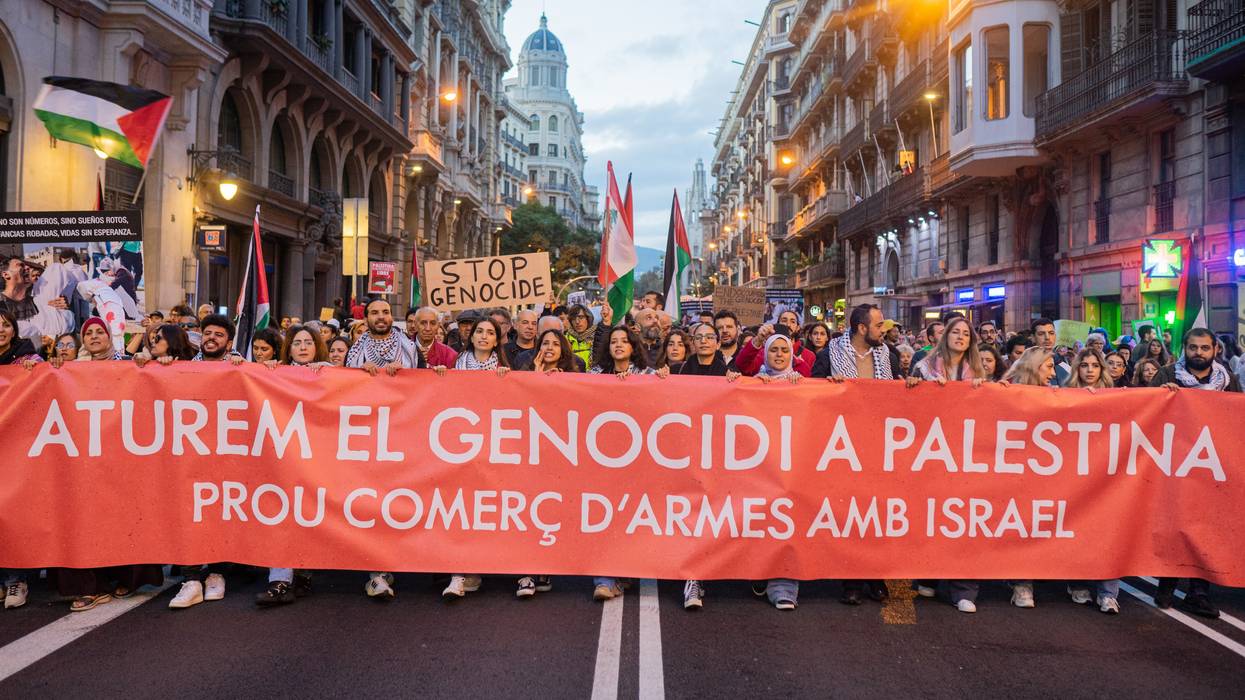
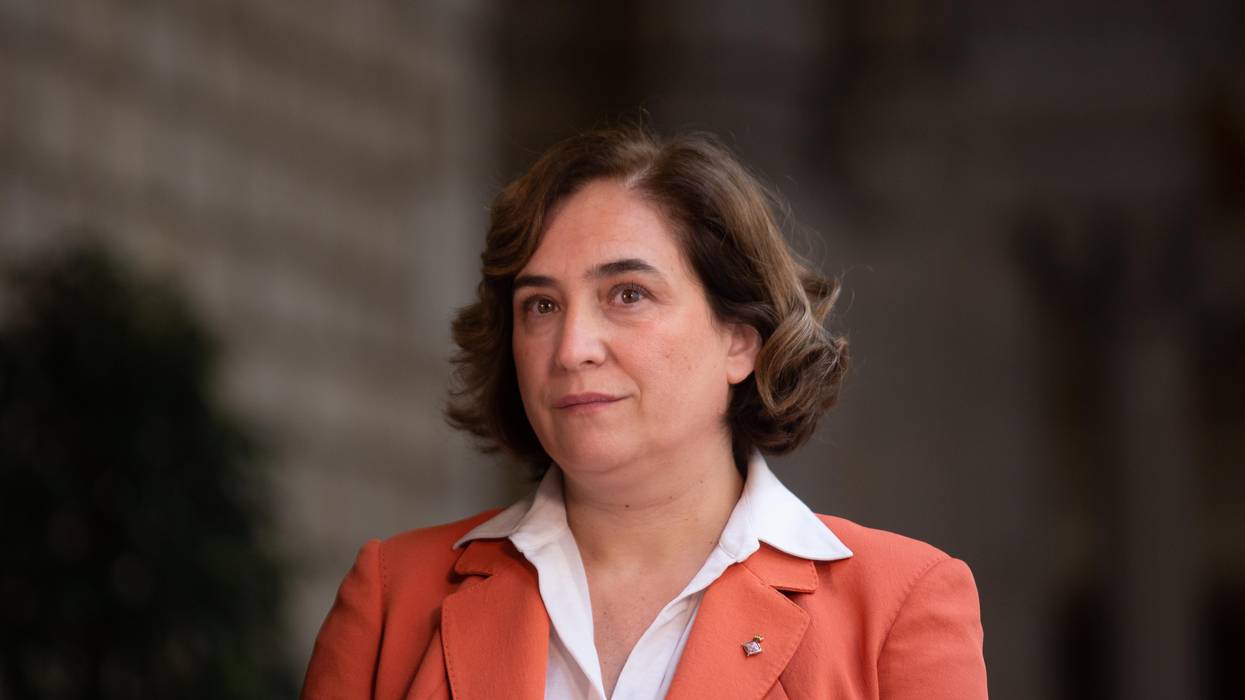
In Barcelona—whose former leftist Mayor Ada Colau was among the dozens of Spaniards who set sail for Gaza from the port city—an estimated 6,500 students and others took to the streets Thursday.
"What I can do is be here, with my presence," student Donia Armani told El País. "The more people, the better; so the Palestinians will not be alone."
Armani's mother added, “The Palestinians are like a brotherly people, we feel a lot from the absurd images we see."
Ana, a 14-year-old student protesting in Barcelona, said: “I think it’s very bad what’s happening," adding that Israel does "not let food arrive and also bombs them, which causes many, especially small children, to die, and I am very sorry."
Thursday's walkouts took place as Israeli forces continued assaulting Gaza on Thursday, killing scores of Palestinians amid a backdrop of ongoing famine and forced displacement. Since October 2023, Israeli forces have killed at least 66,225 Palestinians in Gaza, although experts say the actual death toll is much higher. At least 168,938 other Palestinians have been wounded, and thousands more are missing and presumed dead.
Spain's socialist-led government has been a leading critic of Israel's genocide in Gaza, taking numerous proactive steps including cutting off arms transfers to the erstwhile ally, prohibiting the shipment of fuel to the Israeli military, formally recognizing Palestinian statehood, and backing South Africa's genocide case currently before the International Court of Justice in The Hague.
The Spanish Foreign Ministry says at least 30 Spaniards are among the many Global Sumud Flotilla activists seized by Israeli forces in international waters overnight Thursday while attempting to deliver desperately needed humanitarian aid to Gaza.
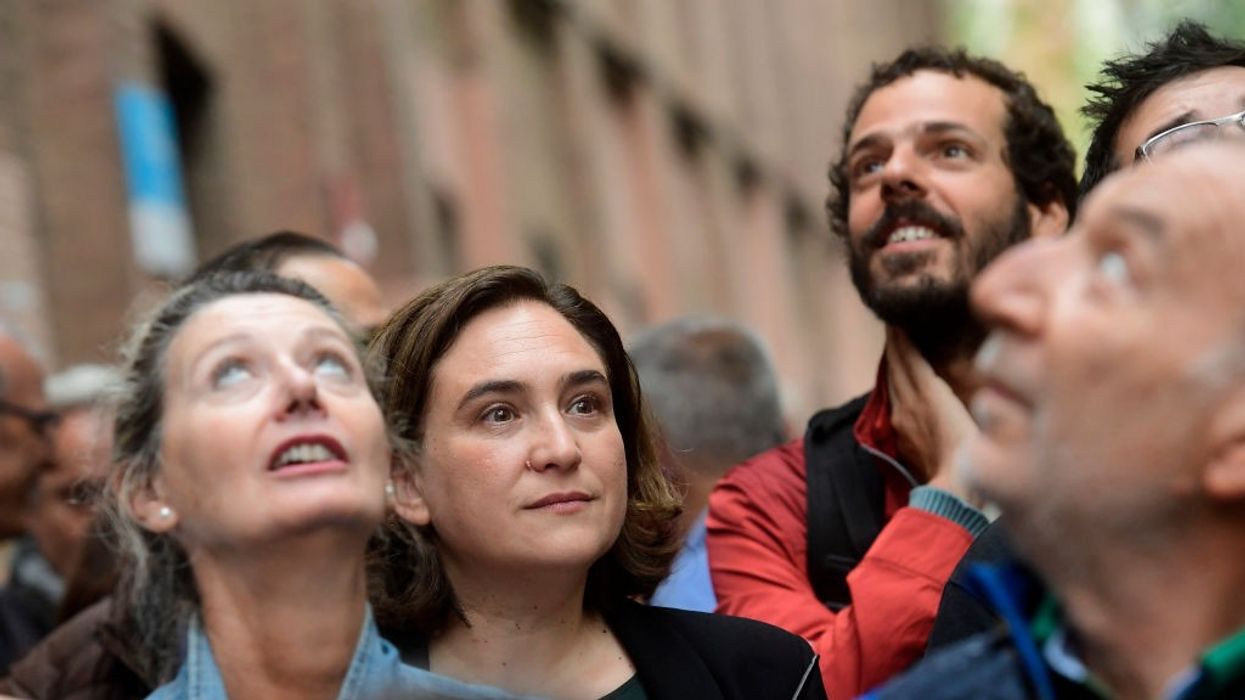
"It's not a war, it's a genocide," said Councilmember Ada Colau. "We not only need to denounce it, we must act and not stay on the sidelines."
The city council of Barcelona, Spain's second-largest city, voted Friday to suspend relations with Israel's far-right government over what the party behind the move called the "genocide" in Gaza.
Introduced by the leftist Barcelona en Comú party—which asserted that "no government can turn a blind eye to a genocide"—the resolution demands the municipal government discontinue "institutional relations with the current government of Israel until there is a definitive cease-fire, and respect for the basic rights of the Palestinian people and compliance with United Nations resolutions are guaranteed."
The resolution also calls for requiring public contracts to ensure that "no operator belongs to or carries out" activities "that go against international humanitarian law" and "rejects and condemns attacks against the population civilian, both Israeli and Palestinian, as well as any action constituting collective punishment, such as the forced displacement of population, the systematic destruction of homes and civilian infrastructure, or the blocking of the supply of energy, water, food, medical supplies and medicines to the population of the Gaza Strip."
Barcelona en Comú Councilmember Ada Colau said in a statement that "it's not a war, it's a genocide, and as [Spanish] President Pedro Sánchez has stated, it is unbearable, and if it is unbearable, we not only need to denounce it, we must act and not stay on the sidelines."
"Every 10 minutes, a child dies in the Gaza Strip under the bombs of one of the most powerful armies in the world," she added.
Colau, whose eight-year tenure as Barcelona's mayor ended in June, earlier this year
announced her city was cutting ties with Israel and ending its symbolic 25-year-old "twin cities" relationship with Tel Aviv due to the Israeli government's "crime of apartheid against the Palestinian people."
Barcelona's current mayor, Jaume Collboni of the Socialists' Party of Catalonia, reversed Colau's move in September.
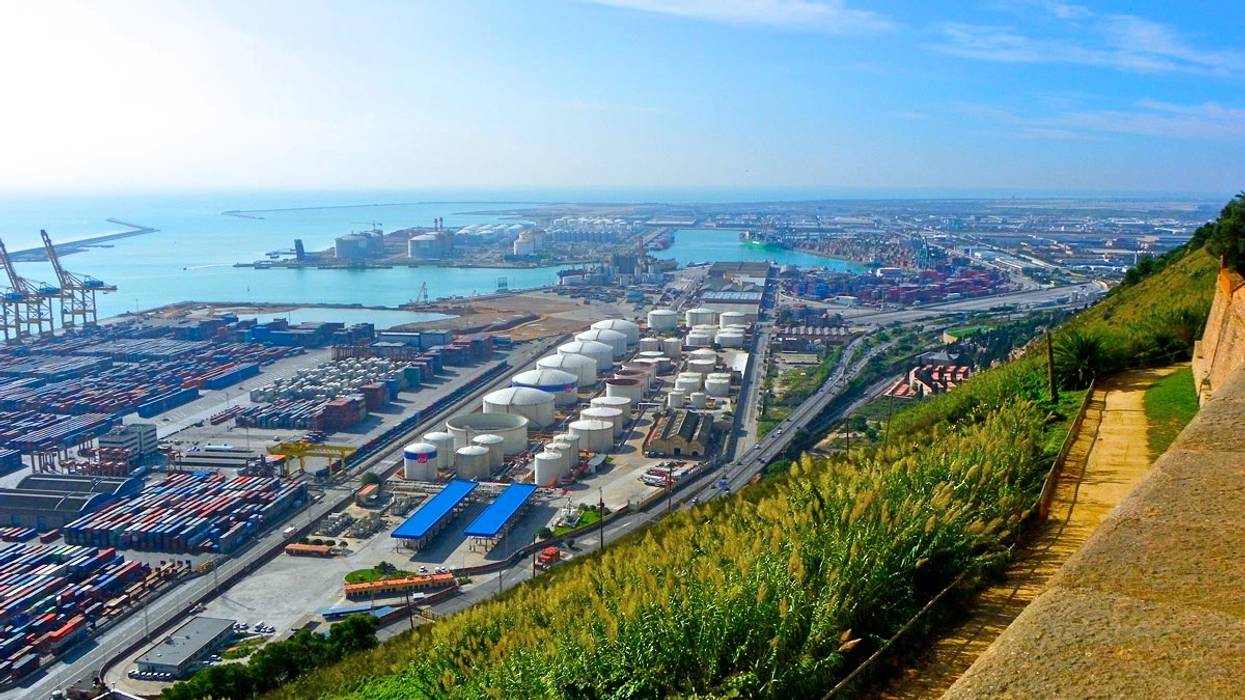
Earlier this month, Barcelona dockworkers also showed solidarity with Palestinians by refusing to load or unload military materials onto any ship bound for Israel or any conflict zone where they could be used against civilians.
The new Barcelona resolution urges Israel and Hamas to make permanent the temporary four-day ceasefire that began Friday morning, as well as an end to Israeli violence against Palestinian civilians in the illegally occupied West Bank and the unconditional and safe release of all hostages taken by Hamas.
On Friday, Hamas freed 24 captives—13 Israeli women and children, 10 Thai nationals, and one Filipino—as part of the cease-fire agreement. Israel released 39 Palestinian women and minors from behind bars to fulfill its end of the deal. Hamas has agreed to free 50 of its hostages in exchange for the release of 150 Palestinians imprisoned by Israel.
Israeli forces have arrested thousands of Palestinians on what critics claim are often dubious grounds meant to give Israel leverage and bargaining chips.
According to the Gaza Health Ministry, nearly 15,000 Palestinians, including more than 4,000 women and over 6,000 children, have been
killed by Israeli bombs and bullets since the Hamas-led attacks on southern Israel that left around 1,200 people dead and 240 others kidnapped. The international humanitarian group Oxfam
said Thursday that newborn babies are dying from preventable causes in Gaza's hospitals due to the Israeli siege.
More than 36,000 Palestinians have been wounded by Israeli attacks on Gaza, while around 7,000 others—including over 4,700 children—are missing and presumed dead. More than 1.7 million Gazans have been forcibly displaced and around half the homes in the besieged strip have been damaged or destroyed, according to United Nations agencies.
At least 255 Palestinians have also been killed by Israeli soldiers and settlers in the occupied West Bank and East Jerusalem.
In addition to the Barcelona councilmembers who voted Friday for the resolution, other Spanish officials have also called for cutting ties with Israel's government over its Gaza onslaught.
Last month, outgoing Social Rights Minister Ione Belarra, who also leads the leftist Podemos party, urged her country's coalition government to petition the International Criminal Court to open a war crimes investigation of Israeli Prime Minister Benjamin Netanyahu for Israel's indiscriminate bombardment of Gaza and for cutting off food, fuel, and electricity from the besieged strip's 2.3 million residents.
On Thursday, Belarra criticized Sánchez—a member of the Spanish Socialist Workers' Party—for visiting Israel this week, arguing that his trip "only serves to whitewash Netanyahu and to equate the state of Israel, an occupying power that perpetrates a genocide, with the victims of the Palestinian people."
"Such inaction," she added, "is absolutely unbearable."
The move builds on a growing number of direct actions targeting weapons bound for Israel as its bombardment of Gaza has claimed more than 10,000 lives.
The union representing Barcelona's dockworkers promised Monday not to load or unload military materials onto any ship bound for Israel or another warzone where they could be used against civilians.
In their statement, the Organization of Port Stevedores of Barcelona, OEPB in Catalan, called for a cease-fire in Israel, Palestine, Ukraine, and every other global conflict.
"We have decided... not to allow shipping activity in our port that contains military equipment, with the sole purpose of protecting any civilian population in any territory," the union wrote. "No cause justifies sacrificing civilians."
OEPB said it was its duty as a workers' organization to "respect and vehemently defend" the Universal Declaration of Human Rights—"Human rights that appear to have been forgotten by the countries that have signed their Magna Carta, and that are now being violated in Ukraine, Israel, the Palestinian territories, and other parts of the planet."
The union's statement came as the death toll from Israel's bombardment of the Gaza Strip surpassed 10,000. Hamas also killed 1,400 in the October 7 attack on Israel that launched the current bout of open conflict, though Gaza has been under Israeli blockade for 16 years. At least 9,614 civilians have been killed in Ukraine between when Russia invaded on February 24, 2022, and September 10, the Office of the United Nations High Commissioner for Human Rights said.
In addition to calling for a cease-fire in all global hostilities, the OEPB called on the United Nations specifically to "cease its posture of complicity through inaction" and return to its mission of preserving international peace and security, protecting human rights, distributing humanitarian aid, supporting sustainable development and climate action, and protecting international rights.
"We, several unions active in ground logistics, call on our members not to handle any flights that ship military equipment to Palestine/Israel."
It's unsure how many weapons the OEPB's promise will actually stop from reaching their destination, according to Reuters. Spain exported 1.3 billion euros in military equipment during the first half of 2022, with 9 million of that sent to Israel. However, the Spanish government has said it does not plan to export any deadly weapons to Israel to use in its current attack on Gaza.
OEPB secretary Josep Maria Deop told Reuters Tuesday that the statement was largely symbolic and intended to encourage other Spanish ports to follow his union's example. But he said that military equipment did likely ship from Barcelona and that peace organizations could help the union pinpoint which vessels to avoid.
The move also builds on a growing number of direct actions targeting weapons bound for Israel. It came a week after four Belgian transport unions issued a statement urging their members not to handle Israel-bound military equipment, as Reuters reported at the time.
"While a genocide is under way in Palestine, workers at various airports in Belgium are seeing arms shipments in the direction of the war zone," the unions said.
"We, several unions active in ground logistics, call on our members not to handle any flights that ship military equipment to Palestine/Israel, like there were clear agreements and rules at the start of the conflict with Russia and Ukraine," their statement continued.
Protesters also attempted to block the MV Cape Orlando from leaving the ports of Oakland and Tacoma after receiving word it was being loaded with weapons destined for Israel. They delayed its progress for nine hours in Oakland on Friday and more than eight in Tacoma on Monday.
Also on Monday, more than 75 activists blocked the entrances to a Boeing plant in Missouri that manufactures bombs used by Israel in Gaza, as Middle East Eye reported. The plant had provided Israel with nearly 1,000 bombs including Small Diameter Bombs and Joint Direct Attack Munitions.
"We are joining millions of people across the U.S. and around the world in demanding an end to Israel's brutal assault on Gaza and its decades-long occupation of Palestine," Ellie Tang, an organizer with the anti-war group Dissenters, told Middle East Eye.
The protest, which also included members of the St. Louis Palestine Solidarity Committee and Resist STL, prevented Boeing workers from entering the plant for a few hours Monday morning, the St. Louis Post-Dispatch reported.
Members of Palestine Action in the U.K. and Palestine Action U.S. have also carried out several direct actions targeting weapons makers, in particular Elbit Systems, which is Israel's largest arms manufacturer. On Monday, Palestine Action blockaded an Elbit factory in Kent, after which three protesters were arrested. On Tuesday, they blocked off the entrance to Elbit headquarters in Bristol.
In Bristol, police arrested four protesters and took more than three hours to remove the blockade once they arrived, the group said.
What can we learn from the successes and shortcomings of Barcelona en Comú so far? And can the Comuns take their process of democratic revolt further?
“They want us isolated, but they will find us in common.”
In May 2015, this slogan was the rallying cry of a Spanish movement that startled its country’s political establishment by propelling into power Ada Colau, Barcelona’s first female mayor. Colau took office alongside a winning slate of city councilors who had joined together in a new formation called Barcelona en Comú, Catalan for “Barcelona in Common.” Their victory reflected a decision by activists to move from occupying the town squares to taking over city halls, and it would have profound consequences for the future of one of Europe’s most prominent metropolitan areas.
Eight years later, Ada Colau and the Comuns, as they are referred to locally, face a different political situation. They are no longer insurgent outsiders launching an improbable challenge to the region’s traditional parties. Rather, they are leaders who have spent eight years in office, amassing a record of accomplishment but also encountering the challenges of governance. Now, they are fighting for a third term — attempting not only to convince voters that their mission of creating a “fearless city” should continue, but also to cobble together alliances with other parties that will allow them to stay in command of Barcelona’s historic City Hall.
After two terms, the radical experiment in Barcelona has found limits to the project of bringing social movement energy into the corridors of institutional power. And yet, it remains an intriguing model of electoral strategy.
So what can we learn from the successes and shortcomings of Barcelona en Comú so far? And can the Comuns take their process of democratic revolt further?
Barcelona en Comú came out of a moment of intensive social movement activity that fomented after the global financial crisis of 2008. In the spring of 2011, more than six million Spaniards poured into public spaces across some 60 towns and cities, joining protests that included a May 15 mobilization in Madrid’s Puerta del Sol square. The demonstration turned into a 28-day occupation and gave name to the “M15” movement. Its participants, known as the Indignados, or “the outraged,” railed against unemployment, austerity and rampant corruption in government, rejecting the country’s elite with the call of “no nos representan,” or “they don’t represent us.” Along with the “movement of the squares” in Greece, the mobilization shook Europe and helped to inspire Occupy Wall Street later that year.
After two terms, the radical experiment in Barcelona has found limits to the project of bringing social movement energy into the corridors of institutional power. And yet, it remains an intriguing model of electoral strategy.
Subsequently, activists in Barcelona and other Spanish cities decided to channel some of the spirit of the protests into efforts to take over the institutions of local government. “We took the social networks, we took the streets and we took the squares,” leaders of Barcelona en Comú would later write. “However, we found that change was being blocked from above by the institutions. So… we decided to win back the city.”
The Comuns drew not only from the ethos of M15, but also from Barcelona’s vibrant network of neighborhood movements. Ada Colau, for one, rose to prominence as spokesperson of the Platform for People Affected by Mortgages, or PAH, a dynamic anti-eviction group. The PAH formed support groups for people in debt, used nonviolent direct action to stop residents from being removed from their homes, led delegations to pressure banks to accept new agreements with mortgage holders, and worked to transform the country’s housing laws. Shortly after Colau was photographed being dragged away by riot police during one particularly visible 2013 protest against a bank that refused to negotiate with an evicted family, one local newspaper poll showed a 90 percent approval rating for the organization.
Instead of forming a traditional political organization, Colau and other organizers envisioned Barcelona en Comú as a new structure that would be open, transparent and participatory. They sought to create a “confluence” that would bring a new social base into politics and invite in members who were not previously represented. Calling their new organization a “platform” rather than a “party,” Barcelona en Comú did include the participation of five existing political parties (Procés Constituent, ICV-EUiA, Podemos, Equo, and the newly formed Guanyem). But they did not divide up the spoils between them, as would be typical in most European-style coalition politics. Rather, the Comuns required these pre-existing groups to join in a wider collective process and to build a shared identity around a common agenda for transforming the city.
Barcelona en Comú crafted its electoral program through proposals gleaned from open meetings in public spaces across the city and ideas from civic organizations. This was followed by a process of popular debate and collective refinement that played out over many months. “It is essential to start like this,” the Comuns argued, “proving that there are other ways of doing politics — listening, participating, collaborating — from the very beginning.” The result was an agenda committing newly elected leaders to a program for change that combined neighborhood-level demands with a set of broader mandates. Priorities ranged from combating corruption, guaranteeing social rights and creating housing security, to subsidizing transportation and energy costs for those in need. The Comuns vowed to bring an explicitly feminist lens to city politics, as well as to reign in the runaway expansion of the tourism industry.
At a time when large numbers of residents were disgusted with “la casta,” the country’s entrenched class of political and economic elites, the populist appeal to voters worked. Barcelona en Comú was able to secure a plurality of seats on the city council in 2015, and Colau subsequently managed to gain a second term as mayor after elections in 2019.
Once in government, the Comuns were able to use municipal institutions to work towards their vision. But they have also seen their aspirations frequently run up against a variety of unpleasant realities. They have had to maneuver within a slow-moving political process while facing the challenges of constant opposition from political foes, demonization by the mainstream media and lawsuits with deep-pocketed corporate backers. In other words, Occupied City Hall proved to be a battleground of its own.
Today, the completion of two terms in office invites reflection on what insights can be drawn from the experience of the Comuns. A first notable lesson is straightforward: eight years matter.
Barcelona en Comú can point to many examples of how it has made a significant positive impact over the course of two terms in office. As only a partial list: Ada Colau’s government increased overall social spending by 50 percent, including a significant expansion of mental health services and programs for the homeless. It quadrupled the budget for social housing and built 2,100 new housing units. It recovered 150 million euros from big companies by cracking down on tax fraud. Among other initiatives designed to control the tourism industry, the administration stood up to intensive lobbying from business and real estate interests by maintaining a years-long moratorium on new hotel construction and imposing regulations on platforms such as Airbnb. They closed upwards of 7,500 illegal tourist flats and, by some estimates, prevented the creation of tens of thousands more.
As scholars Erik Forman, Elia Gran and Sixtine van Outryve reported in Dissent in 2020, “They set up a sustainable public energy company, a publicly owned dental clinic that offers affordable rates and the city’s first municipal LGBTQ center. The city created coop businesses for migrants and refugees and is attempting to use city procurement to source from cooperatives. More recently, they enacted a measure requiring that 30 percent of new buildings be used for affordable housing and created an anti-eviction unit.” Colau’s administration also declared Barcelona a “city of refuge,” expanding municipal services to refugees, asserting a local role in asylum policy and fostering a network of European cities that are welcoming of migrants — a set of actions that clashed with national policies set in Madrid.
Finally, Barcelona has been a leader in pushing cities toward greater sustainability. The city declared a climate emergency in 2020 and committed some $600 million towards slashing carbon emissions. Barcelona’s 103-point climate plan includes the dramatic bolstering of bike lanes, restrictions on polluting vehicles, expanding urban gardens, installation of public solar panels and incorporating sustainability standards into public contracts.
The mayor has been willing to polarize the public around the drive to push cars out of the city. The city’s flagship “Superblock” program aims, in Colau’s words, “to recover one million square meters of public space for popular use” by merging multiple city blocks into pedestrian havens. Environmental writer David Roberts has characterized it as a plan for green urban design “bigger and more ambitious … than anything being discussed in America.” The Superblocks, he wrote, constitute “a vision for a different way of living in the 21st century, one that steps back from many of the mistakes of the auto-besotted 20th century, refocusing on health and community.”
“From the very beginning, those of us who participated in Barcelona en Comú were sure that the democratic rebellion in Barcelona wouldn’t be just a local phenomenon.”
Strangely, despite all of these accomplishments, the Comuns have found themselves more isolated than when they started.
One thing that was exciting about Barcelona en Comú’s dramatic appearance in 2015 is that the group did not emerge alone. Rather, it self-consciously situated itself as part of something larger. Domestically, Barcelona was only one of many leftist drives to capture city government in Spain. A variety of like-minded “municipalist” platforms won office in cities across the country, including A Coruña, Cadíz, Valencia, Zaragoza, and — most prominently — Madrid. Internationally, the Comuns launched a network called “Fearless Cities” to connect with progressive governments in cities from Rosario, Argentina to Bologna, Italy, as well as upstart coalitions still vying for power.
“From the very beginning, those of us who participated in Barcelona en Comú were sure that the democratic rebellion in Barcelona wouldn’t be just a local phenomenon,” the platform’s leaders wrote. “We want Barcelona to be the trigger for a citizen revolution in Catalonia, Spain, Southern Europe and beyond.”
However, in elections in 2019, the wave that gave rise to municipalist hopes across Spain abruptly crashed ashore. In many Spanish cities, progressives were ousted by more conservative opponents; in other cases, activist “confluences” fractured and were replaced by more traditional party politicking. “The right won in Madrid,” explained David Cid, a member of the Catalonian parliament who has been part of the Comuns. Since then, “they have been undoing all the work” of the left, he said. “To really consolidate your model of the city, you can’t change things in four years. You can change a city in eight or 12 years.”
Holding an initial plurality of only 11 of 41 seats on the city council, Barcelona en Comú always relied on the support of other parties to move its initiatives forward. As the establishment media launched relentless attacks on Colau and her colleagues, business interests deployed legal challenges to many progressive measures — blocking, in one instance, efforts to “re-municipalize” Barcelona’s privatized water supplier. The platform’s councilors quickly felt the limits of their power. “Just trying to implement your manifesto when you need the vote of opposition parties to do it means that, inevitably, you’re not going to be able to do everything you wanted to do,” said Kate Shea Baird, who served on the Executive Committee of Barcelona en Comú, in a 2018 interview in the Ecologist.
“You get into City Hall, even a relatively powerful City Hall like Barcelona, and you realize that not all of the power is there,” she continued. “Airbnb has a lot of power. The Catalan government has a lot of power. The Spanish government has a lot of power. The media has a lot of power. Winning the election is the first step to getting anything done.”
Echoing this sentiment, Álvaro Porro, an activist who has become the city’s Commissioner for Social Economy, Local Development and Food Policy, quipped: “We’re the most ambitious government in the history of Barcelona, with the least power in the history of Barcelona.”
During Colau’s first term, the issue of Catalan nationalism exploded into headlines, with large-scale protests for independence meeting staunch repression from the national government. In response, the mayor tried to walk a fine line, supporting the rights of demonstrators but opposing separatist demands — a position that invited criticism from all sides.
In the 2019 elections, Barcelona en Comú, vying for another term in power, came in second place and lost one of its council seats. Colau was able to retain control of City Hall only by securing the backing of the centrist Socialist party as well as that of more conservative councilors who wanted to block pro-independence forces. Reliance on such dealmaking limited the ability of the Comuns to maneuver aggressively, and it also dampened the enthusiasm of its base. Combined with the COVID pandemic, these developments served to slow progress during Colau’s second term.
In advance of the upcoming elections in late May, other parties are actively calculating the leverage they might enjoy by shifting to other alliances. Given these circumstances, whether the Comuns can turn eight years of change into 12 remains to be seen.
A second important lesson learned after two terms in office is that, while controlling the levers of city power can allow for real gains, changing the culture of institutional politics is another challenge entirely.
From its inception, Barcelona en Comú sought to approach the electoral realm differently than traditional parties. “A citizen platform doesn’t just aim to change local policies,” its leaders wrote. “It also aims to change the rules of the game and create new ways of doing politics.” This ambition created excitement, but it also generated high expectations and opened space for disillusionment with changes that felt less than revolutionary.
As one means of setting itself apart, Barcelona en Comú sought to avoid creating cults of personality around celebrity politicians, favoring instead a social movement model of leaderful participation. However, Ada Colau’s charisma and public appeal have loomed large. This could be seen in the process that brought the Comuns together. In terms of its structure, the platform wanted to reach beyond established political cadres and avoid becoming “a coalition or an alphabet soup of party acronyms.” For the traditional left parties that signed on, agreeing to join such a structure was a sacrifice. After all, their top representatives were not guaranteed priority spots on a “list” of candidates and their political priorities would be subject to review by assemblies of activists.
Yet the reason the small parties in Barcelona were more willing to merge individual identities into a common project than in, say, Madrid, was due to the obvious benefit of being associated with Colau. “Without Ada Colau, who is a completely amazing politician, this process would not be so successful,” argued Mauro Castro, a political scientist who has a background working in Barcelona’s autonomous social movements and is a member of La Hidra Cooperative, a think tank and public education initiative. “To be honest, she’s just a machine. She’s very good at keeping everybody aligned.”
Another way in which Barcelona en Comú attempted to distinguish its candidates from mainstream politicians was by having them sign on to a strict code of ethics. This was designed to curtail the privileges associated with professional politicians and lessen the distance between the city’s political leaders and ordinary residents. Borrowing a slogan from the Mexican Zapatistas, the Comuns dubbed their approach “Governing by Obeying.” The code involved limiting elected officials to two consecutive terms in office, doing away with perks such as official cars and paid expenses, and consenting to high standards of transparency. Moreover, Barcelona en Comú’s councilors — up to and including Colau — agreed to voluntarily cap their income at three times the minimum wage, initially 2,200 euros (or around $2,500) per month. They have donated the remainder of their official salaries to social movement groups.
Although some other left parties in Spain such as Podemos also follow a similar protocol, it goes without saying that such a practice appears quite extraordinary by U.S. political standards — at least for politicians who are not independently wealthy and actually rely on their government paychecks to live. It also marked a sharp break from precedent in Barcelona: the Guardian reported in 2016 that while Colau’s effective take-home pay came to well under 30,000 euros during her first year in office, her predecessor Xavier Trias had regularly pocketed 140,000 euros annually in salary and expenses.
The code of ethics has made a lasting impact on the city’s political culture, and it reflects a moment when public outrage at political corruption ran high. Over time, however, the Comuns have moved to relax some standards — particularly their commitment to strict term limits. In 2022, Barcelona en Comú members voted to approve Ada Colau and other senior councilors running once again for reelection.
Another example of how established norms have proven difficult to shake relates to what Colau and other Spanish leftists have called the “feminization of politics.” Central in the formation of Barcelona en Comú was the idea of bringing an overtly feminist perspective to organizing and governance. For Colau, such politics includes a culture of listening and empathy, calling on politicians to “lower the levels of testosterone” in their combative posturing, recognizing the importance of care work, setting up structures that allow for a balance between the personal and the professional. It also means validating the idea that, in the mayor’s words, “politics done collectively are better than those done individualistically.”
Even supporters feel that change has been limited when it comes to effecting how politics plays out.
This perspective translated into policy. By 2021, the City Council’s website could cite efforts to “incorporate the gender perspective in every area of politics and society so as to combat the more structural aspects of gender inequality and sexism and overcome the situations of discrimination that still persist in a patriarchal society such as ours.” Among other measures, Colau’s government created the Councilor’s Office for Feminism and LGBTI Affairs, created the municipal child care program Concilia to support work-life balance, halted fines on sex workers, launched the “Anti-Sexist Barcelona” program to combat sexual violence, incorporated gender-based criteria into city planning and design, and established Barcelona Activa, an employment program for women.
Yet even supporters feel that change has been limited when it comes to effecting how politics plays out. Gala Pin, an activist who served as a city councilor and deputy mayor with the Comuns from 2015 to 2019, states that, in terms of municipal policy, the focus on feminism has made a big difference. “But feminism in politics,” she said,” if we talk about being able to reconcile private life with being in institutional politics, or how decisions are made, I don’t think there is a big difference now, to be honest. I think the dynamic of the institutions has won the battle in some sense.”
Ada Colau described the tension in a 2016 documentary: “I can’t be the Ada I used to be,” she said. “When I was at the PAH it was easier to show the political power that comes from admitting weakness, contradiction, doubt … Initially I honestly thought this could be carried over into politics and that it was necessary … But that doesn’t work in politics because your own people want you to always be there, to be strong, to lead and to not have any doubts.”
Such experiences reflect a broader difficulty. In Mauro Castro’s view, the Comuns have had to accommodate themselves to functioning within the constraints of mainstream institutions. “They’re doing the best public policy that they can, definitely,” he said. “I would not imagine any better place in the world in terms of doing public policy. But public policies are not changing the way you govern.” Once activists accept the realpolitik of working within the institutions, Castro contends, they are put in a defensive posture that involves highlighting bureaucratic achievements, cautioning about the limits of the possible, and backing away from the more radically participatory visions that animated their initial campaign.
Having spent a term as a deputy mayor, Gala Pin retains faith in the project, but also expresses some reservations: “Over time you internalize the dynamics of political institutions,” she said of her experience. “You change them a little bit, but they change you much more.”
A third lesson is that movements and parties play different roles — and perhaps can never be fully reconciled. Barcelona en Comú has consistently emphasized the importance of citizens taking ownership over politics beyond periodically casting votes at the polls. “For us, ‘winning back the city’ is about much more than winning the local elections,” the Comuns’ leaders wrote in their guide to building a municipalist campaign. “It means putting a new, transparent and participatory model of local government, which is under citizen control, into practice … Our strategy has been to start from below, from what we know best: our streets, our neighborhoods.”
Barcelona en Comú has operationalized its vision internally by developing its political positions in frequent consultation with a multi-tiered network of neighborhood assemblies and working groups. Externally, they have implemented mechanisms for the public at large to take part in city policymaking. Perhaps most notable is the online Decidim platform, through which more than 100,000 registered users have voted on citizen-generated proposals for neighborhood improvements and engaged in participatory budgeting processes that, in 2022, distributed some 30 million euros in resources.
However, the Comuns’ marquee public participation measure — which aimed to allow issues that garnered signatures from just 15,000 voters to go to citywide referendum — faced stiff opposition and was ultimately ruled invalid by the courts. Internally, recruitment of activists slowed after the 2015 elections, as the platform turned to focus on the challenges of running city offices. As two leaders from the group’s executive committee would later write, “The upshot was that it was quite difficult to join Barcelona en Comú as a new member between 2015 and 2018.” Pandemic fatigue later contributed to further demobilization, they added.
Early on, some observers of the political process in Spain had hopes that Podemos at the national level and the municipalist platforms in the cities could become hybrid “movement parties.” These organizations, in the words of sociologist Cristina Flesher Fominaya, would “maintain links to, and characteristics of, participatory social movements while at the same time trying to win state power through elections.” Yet it seems clear that Barcelona en Comú is not a substitute for social movements operating on the outside of mainstream institutions.
“I think it is important to say that we didn’t want to represent the social movements,” notes Gala Pin. Although the Comuns formed as a result of the resolve of many individuals who had been politicized through movement activism to collectively intervene in electoral politics, there was never a formal decision by grassroots groups themselves to endorse the platform. “We said, ‘We come from the movements, but they have to stay independent,’” remarked Pin.
Several aspects of the experience of Barcelona en Comú have highlighted how movements and government operate according to different logics. Outside critics charge that, despite the Comuns’ efforts to engage their base, it is extremely difficult to avoid a situation in which governance becomes the domain of specialized administrators. “It has become professionalized,” Castro said of Barcelona en Comú’s time in City Hall. “It has become something very influenced by the machine.” When social movements raise criticisms, he said, city officials will consistently respond by saying, “Yeah, you know, things are too complicated.”
Moreover, movement participants complain that their groups lost capacity when a large number of organizers were absorbed into roles in the city bureaucracy. As a consequence, there was less active mobilization pushing for the new insiders to pursue their most ambitious goals.
At its best, an inside-outside strategy is able to acknowledge these tensions while also seeing how groups pursuing different approaches can relate to one another as part of a common ecology of change. As Kate Shea Baird has written of the muncipalist project, “transformative politics … must also involve building an ecosystem of social movements, economic initiatives and community institutions that can support these candidates’ agendas from outside City Hall, and hold them to account when necessary.”
During the first year in office, Colau’s own organizational home, the PAH, criticized her over lack of progress in stopping evictions. As scholars Sebastiaan Faber and Bécquer Seguín reported, the mayor responded with a Facebook post in which she stated, “I’d do the same thing in your position.” Colau further explained: “I’ve said it many times and I repeat it again now more forcefully and with more conviction than ever: without an organized and demanding citizenry, not only would there not be real change, there would also not be a democracy worthy of its name.”
In the end, the push for change from within the government and without requires maintaining a tricky balance — which most politicians scarcely acknowledge at all.
Mauro Castro emphasizes other conflicts between outside activists and their contacts in city government. “For example, we are now struggling for a new housing law,” he explained. “And only at the last moment do [the Comuns] say, ‘Go to the streets, protest so we can push more within this coalition government.’” By that time, activists felt disaffected by the process and resented being called in just as reinforcements. “So the movements are like, ‘Fuck you,’” he said.
Castro acknowledges, however, that relationships between inside and outside activists have allowed for valuable informal exchanges of information. Elena Tarifa, a journalist who serves on the international committee of the Comuns, wrote in 2021 that the fact that “many of Barcelona en Comú’s activists come from neighborhood associations and diverse social movements” helps to “keep the channels of communication open.”
Although there have been instances of tension, there have also been times when inside action and social movement protest have combined effectively. In 2018, the city advanced efforts to regulate rideshare services such as Uber — which Colau would later denounce as “speculative pirates.” When initial regulations were blocked by Catalonia’s High Court of Justice, taxi drivers blocked major roads for days in a strike that quickly spread to other cities. City officials stood with the strikers, and Colau helped to pressure the national government in Madrid to reach a settlement favorable to the drivers.
In the end, the push for change from within the government and without requires maintaining a tricky balance — which most politicians scarcely acknowledge at all. Despite having criticisms of the platform, Castro believes that, for social movements, the Comuns losing to more traditional parties would be a blow. “It’s good to have Barcelona en Comú. We need to create more Barcelonas en Comú.” He reflects that after others take over, whenever that may be, “We will realize what it means to lose them.”
Voters will decide if Colau and her colleagues will be able to extend their unusual exercise in governance into a third term following elections later this month. Regardless, the Comuns will leave lasting changes. Before the platform changed the political debate, Gala Pin argued, “no one was talking about massive tourism and the consequences for the city. Maybe some radical social movements were, but the government did not listen to us.” Now it does, she says — and she has seen similar progress on climate change, feminism, LGBTQ recognition and other issues. When it came to housing, Pin said, “city council was always saying ‘we don’t have the power to deal with housing issues.’ Now every party is saying that they want to build up more public housing and that Colau is not doing enough.” Creating those shifts, she contends, is a type of power.
Whatever challenges the experiment in occupying Barcelona’s halls of governance has involved, it has produced profound lessons for those who traveled from movements to institutions to try to make such shifts — and therefore it will remain fruitful ground for study for others looking to transform their own cities. As Álvaro Porro said, “There’s a lot of practical knowledge embodied in this experience, coming from mistakes and from successes, which I really feel we need to share.”
Research assistance provided by Sophia Zaia and Sean Welch.
"We cannot be silent," said Colau.
Barcelona Mayor Ada Colau on Wednesday announced her city is cutting ties with Israel and ending its symbolic 25-year-old "twin cities" relationship with Tel Aviv over the Israeli government's violent anti-Palestinian policies.
Colau said at a press conference that the city council came to its decision in response to campaigning by more than 100 rights groups and 4,000 residents, who urged her to cut ties with Israel.
In a letter to Israeli Prime Minister Benjamin Netanyahu, the leftist mayor said her constituents called on her to "condemn the crime of apartheid against the Palestinian people, support Palestinian and Israeli organizations working for peace, and break off the twinning agreement between Barcelona and Tel Aviv."
She added that she is "temporarily" suspending Barcelona-Israel relations "until the Israeli authorities put an end to the system of violations of the Palestinian people and fully comply with the obligations imposed on them by international law."
"We cannot be silent," wrote Colau.
The letter and Colau's announcement to the press come two weeks after an Israeli military raid on a refugee camp in the occupied West Bank killed at least nine Palestinians, including an elderly woman.
Colau said groups in Barcelona began urging her to cut ties with Israel after an 11-day air assault on Gaza in May 2021.
Groups including Amnesty International, Human Rights Watch, and the Israel-based B'Tselem have accused the Israeli government of imposing apartheid policies on Palestinians, including its military occupation of the West Bank and its construction of settlements on Palestinian land.
Michael Lynk, the United Nations special rapporteur on Palestinian human rights, also called Israel's treatment of Palestine "apartheid" last year.
The Sanctions National Committee (BNC), one of the groups that helped push the Barcelona city council to hold Israel accountable, applauded Colau's move.
"Barcelona has become the first city council to suspend ties with apartheid Tel Aviv in solidarity with the Palestinian people, a move that is reminiscent of the historic and courageous city councils that pioneered cutting links with apartheid South Africa," BNC said in a statement.Losing Barcelona. That was the headline on the story in Jacobin this week. A local vote in a far-off city; had I not just returned from Barcelona, I might have left it at that. possibilitiy
The truth is, US media give us so little coverage of goings-on elsewhere, and so little context as to why Americans should care, there's little incentive to keep up; but Barcelona's different. For close to a decade now, it's been what my friend Sol Trumbo Vila calls a beacon for the possibilities of transformative change at the city level.
Led by former housing activist Ada Colau, who was elected Mayor in May 2015, Barcelona's government has been in the hands of a movement that had become a political party--Barcelona en Comu.
Led by former housing activist Ada Colau, who was elected Mayor in May 2015, Barcelona's government has been in the hands of a movement that had become a political party--Barcelona en Comu. They won office on a pledge to "develop the city as a commons," meaning a place for people, not a profit center for speculators and extractive corporations. In office, Colau halted new hotels, stopped thousands of foreclosures, supported worker owned cooperatives, and formed the state's largest publicly-owned utility. They also encouraged a free, neutral, cooperatively owned broadband network called Guifi.net that offers low price WiFi and a prize-winning alternative to the telecom giants.
Colau established new systems of governance with more local consultation. Did she solve all the problems of an austerity-hit city hemmed in by bans on borrowing, hiring and expanding the public budget? No. Did she figure out ways to work with others without disappointing their base? Not always. Most damaging was their fence-sitting on the Catalan independence question. Having seen the footage of heavily armed federal police literally batoning people as they clung to their forbidden ballot boxes, I get it why separatist Ernest Maragall may have scored 4,800 more votes than Colau in this May's vote.
But Losing Barcelona? Maragall and Colau actually stood neck and neck in council seats when the Jacobin article appeared. They were both left of center parties. Colau could have teamed up with him to stay in government but lose the Mayor's post, or she could have partnered with more left-of-center winners--Pedro Sanchez's socialist party (PP), which came in second after a high profile surge in national elections earlier in the month. In the end, Colau was re-elected mayor by the city council with the support of the Socialists and the backing of former French prime minister, Manuel Valls.
So, Losing Barcelona? Even if Colau had lost the election, the commons agenda is seeded deep into the city. In an interview, even crusty Maragall endorsed support for cooperatives and digital democracy and the Fearless Cities network that Colau and others helped to start.
And at the level of principle, Colau has not finished making change yet. Having polled her base last weekend, Colau put the question to the people. Barcelonans had the chance to vote on what deal she should make. Let the people decide. Putting that principle into practice has got to be a win, no matter what.
Eighty years ago this April, Spain fell under a thirty-year dictatorship after Right beat Left in a brutal civil war. That history feels acutely alive to me today, and not just because, for the first time in my life, I'm in Spain.
General Franco's rebels, backed by Mussolini and Hitler and the religious extremists of the day, defeated the Republic and its cobbled-together army of anarchists, communists and internationalists over three years (1936-39). My grandfather, Claud Cockburn, was there with the fighting in Spain's central plains and in the city of Barcelona as it was hanging on, watching bombs hit the northern mountains that I've been looking at for days.
Today, Spain is holding steady. Prime minister Pedro Sanchez and his socialist party expanded power in regional and national elections and became the biggest social democrat block in the EU. The nationalist populists did less well than they bragged they'd do in most of Europe, but the Left's parties generally did the same, and progressives are relying on the Spanish and Portuguese to hold the bigots at bay in Brussels while, from Brazil to Bethlehem and Bombay to DC's Beltway, the stink of fascism is in the air.
It was windy yesterday, and between rain showers, we talked about being buffeted by old tensions: nationalism vs internationalism, authoritarianism vs democracy, elitism vs cooperation, patriarchy and racism vs intersectionality and the common good.
"The story of resilience resonates," said Loren Harris, Chief Program and Strategy Officer with the Kenneth Rainin Foundation in Oakland, which supports organizations working in the arts, education, and health. History is part of what draws internationalists like Harris back to this region. Another is its experiment in solidarity.
"In the twentieth century, it was monarchy that was crashing. Today, it's the rule of capital," said the Democracy Collaborative's Marjorie Kelly,* who, with Harris, was part of a delegation to study the area's co-operatives.
Claud described the co-ops and free clinics that helped Barcelonans survive under siege. For the past four years, Barcelona en Comu has been continuing that tradition, expanding public assets and public decision-making under the city's first female mayor, activist Ada Colau. Here in Basque country, which was occupied and punished by Franco, a liberation theologian preached job creation through cooperation and birthed the Mondragon Federation, now the biggest network of worker-owned cooperatives in the world. Recently, the OECD reported that this co-op rich community has one of the narrowest wealth gaps on the continent, which is to say, the rich extract less relative to the poor--or put another way, the place is more fair.
In Barcelona, Claud read from the wall posters: "We want prosperity for the whole people and we know this is possible within our democratic republic; that is why we defend the Republic, just as we defend the rightful liberties of Catalonia, the Basque country, Galicia and Morocco."
As ever, Spain's Left has fissures. This Sunday, a Catalan separatist edged out Ada Colau in the race for Mayor. Left voters are a majority, but their parties are divided here, and globally, as they've been before.
There's no war in these mountains--no Guernica being bombed tonight. Still, I recall Claud describing how stakes pile high slowly as the barometer moves to storm.
As one onlooker told Claud almost 80 years ago, "I suppose you and I think the rich are going to sit quiet and--what's the phrase--accept the verdict of the people? Like hell they are."
Which way is the barometer moving? Next stop for me is Barcelona.
*Marjorie Kelly's forthcoming book with Ted Howard, The Making of a Democratic Economy: Building Prosperity for the Many, Not Just the Few will be out inJuly from Berrett-Koehler Publishers.
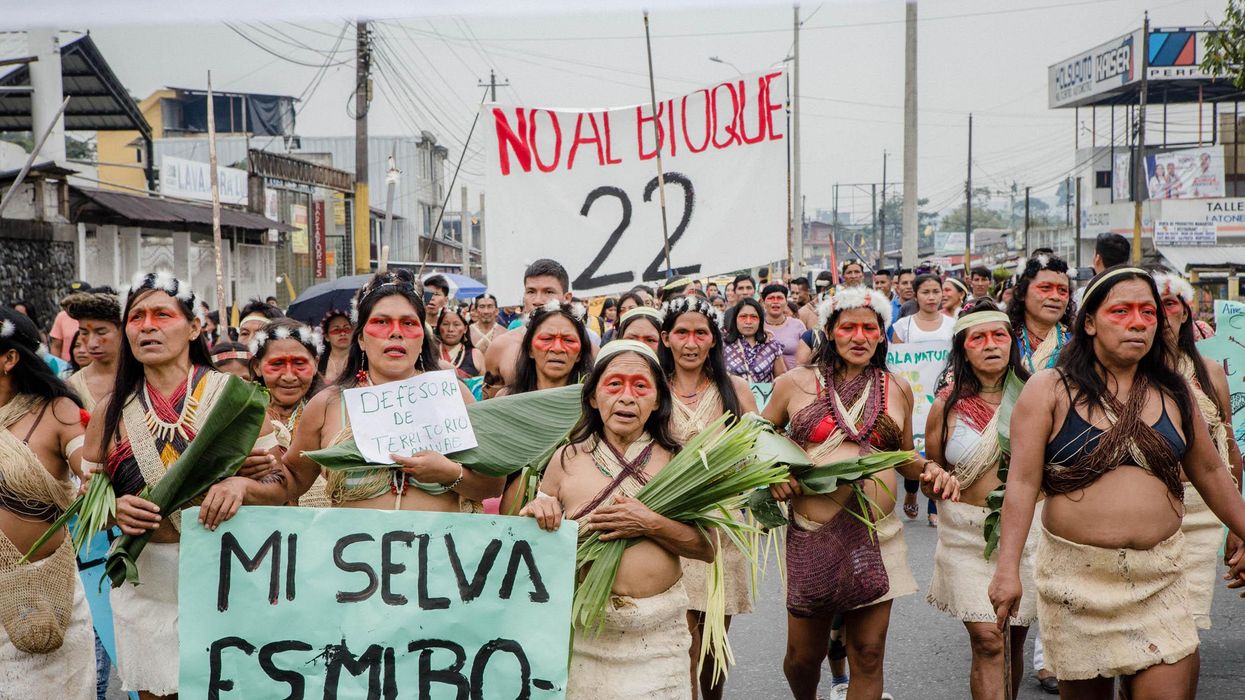
On May 16, hundreds of Indigenous peoples traveled from different regions of the Ecuadorian Amazon to the capital city of Quito to demand respect for the April 26 historic court ruling, in which the Waorani people of Ecuador successfully defended half a million acres of Indigenous territory in the Amazon rainforest from oil drilling. Coming after two weeks of deliberations, the landmark decision by the three-judge panel of the Pastaza Provincial Court immediately and indefinitely suspended plans to auction around 180,000 hectares of Indigenous Waorani territory to oil companies. It represents a major setback for the Ecuadorian government.
The total land area that the ruling protects, at least for now, is much larger even than the land that was up for auction. According to Amazon Frontlines, a nonprofit advocacy group that assisted the Waorani's legal case, "The verdict also disrupts the contemplated auctioning of 16 oil blocks that cover over 7 million acres of Indigenous territory by providing an invaluable legal precedent for other Indigenous nations across the Ecuadorian Amazon."
At the May 16 mobilization in Quito, Indigenous groups also denounced the government's statements following the ruling. "We hope that in the appeal that sentence can be reversed," said Minister of Energy and Non-Renewable Natural Resources Carlos Perez. Disregarding Indigenous autonomy and rights, Perez added: "It is not possible to make regional or local decisions about certain things that have a national impact as in the case of hydrocarbons and mining." In their ruling, the judges stood by the standards of the Constitutional Court of Ecuador and international law. Decisions about Indigenous territory simply cannot be made by the central government unilaterally.
Specifically, the ruling voids the consultation process with the Waorani that was undertaken by the Ecuadorian government in 2012, which the judges said violated the Waorani's right to free, prior and informed consultation and to self-determination. The ruling said that the consultation was done in bad faith, failed to properly inform the Waorani of the risks and impacts of the government's plans to auction off their territory, and didn't take into consideration Waorani culture or traditional decision-making methods.
After the Waorani were called to a rushed March 13 hearing to argue their case in the provincial capital of Puyo, Lina Maria Espinosa, attorney for the Waorani, said that the court demonstrated "the discriminatory practices of the Ecuadorian state, and its inability or lack of interest in respecting the rights and customs of the millenary cultures and peoples seeking to protect their territories and their constitutional rights."
"Our ancestors' bones are buried under this earth," said the Waorani people in a statement on Amazon Frontlines. "Deer, boar and jaguar still roam free across this land. Our memory, our language, and our songs are borne from the forest, and we will ensure that they live on, generation after generation." One of the key elements of the ruling is the fact that the lands in question are protected under Ecuador's constitution, which establishes the "inalienable, unseizable and indivisible" rights of Indigenous people "to maintain possession of their ancestral lands and obtain their free adjudication."
The panel of judges ruled that the Ecuadorian government must repeat the free, prior and informed consent process according to the standards of international law and the Constitutional Court of Ecuador, and that the Ministry of Energy and Non-Renewable Natural Resources and the Ministry of the Environment must sufficiently train government officials regarding the right to free, prior and informed consent and self-determination before sending them out into the field.
"The government tried to sell our lands to the oil companies without our permission," said Nemonte Nenquimo, president of the Coordinating Council of the Waorani Nationality of Ecuador-Pastaza (Pastaza CONCONAWEP), a political organization of the Waorani and plaintiff in the lawsuit. "We decide what happens in our lands. We will never sell our rainforest to the oil companies. The government's interest in oil is not more valuable than our rights, our forests, our lives."
Co-filed with Pastaza CONCONAWEP and the Ecuadorian Human Rights Ombudsman against the Ecuadorian Ministry of Energy and Non-Renewable Natural Resources, the Secretary of Hydrocarbons and the Ministry of Environment, the lawsuit alleged that the Waorani's rights granted to them under the Ecuadorian constitution "were violated due to an improper consultation process prior to an oil auction which would offer up the Waorani's lands in the Pastaza region to the highest bidding oil company," according to Amazon Frontlines. The government's auction, announced in February of last year, included 16 new oil concessions covering over seven million acres of roadless, primary Amazonian forest across southeast Ecuador. An eastern jungle province whose eponymous river is one of the more than 1,000 tributaries that feed the mighty Amazon, Pastaza encompasses some of the world's most biodiverse regions.
Waorani spokesperson Oswando Nenquimo said that while the ruling is "a legal precedent for Indigenous rights," he conceded that "the fight is far from over."
He added, "The government will appeal because they still want the oil beneath our land." Indeed, the day after the ruling, the Ecuadorian government announced just that. In a statement, the Ministry of Energy and Non-Renewable Natural Resources said it "will appeal the decision, given that although documents and videos were presented and compliance with all standards was demonstrated, these were not taken into account."
"The upcoming appeal is a critical moment for the Waorani, but also for Indigenous peoples across the country looking to protect millions and millions of acres of ancestral forest homelands," Brian Parker, a lawyer with Amazon Frontlines, told the Independent Media Institute. "They are uniting behind the Waorani because Indigenous people's right to free, prior and informed consent and self-determination has been violated systematically by the Ecuadorian government for the benefit of oil, mining and hydroelectric projects all across the country."
Then on May 21, President Lenin Moreno issued a new decree, handing over two blocks of Indigenous territory in the Yasuni National Park Area--without consulting Waorani Indigenous communities, possibly setting up yet another legal confrontation.
Concessions vs. Constitutional Rights
The concessions overlap with the titled territories of the Shuar, Achuar, Kichwa, Waorani, Shiwiar, Andoa and Sapara nations, with one block located almost entirely within Waorani territory. If taken over by the fossil fuel industry, the Indigenous coalition warns, the health and livelihoods of the communities living in the area--as well as the region's unique biodiversity and sensitive ecosystem--will be threatened. But regardless of the environmental and sociocultural threat, the plaintiffs successfully argued that the concessions trample on their constitutional rights.
Oil and other extractive development may also pose a separate constitutional challenge. In 2008, Ecuador became the first country to recognize the rights of nature in its constitution, which was rewritten to acknowledge that nature in all its life forms "has the right to exist, persist, maintain and regenerate its vital cycles, structure, functions and its processes in evolution."
Industrial Development vs. Indigenous People
Ecuador is one of the smallest oil producers in the Organization of the Petroleum Exporting Countries (OPEC)--only the Republic of the Congo, Equatorial Guinea and Gabon pump less. But that has not hindered it from making big deals with oil-hungry nations. In 2009, a year after Ecuador defaulted on around $3 billion worth of debt, then-President Rafael Correa made an oil-for-cash agreement with China. In exchange for selling his nation's crude oil to Petrochina, China provided Ecuador with a $1 billion loan.
Now the country seeks to attract investments totaling around $800 million to boost the production of oil, which the government maintains is critical to improving the nation's economy. "It's time for the private sector to invest," said President Lenin Moreno in the 2018 televised address, arguing that public-private partnerships in the infrastructure, oil, energy, mining and telecoms sectors could generate $7 billion in investments by 2021.
The Waorani's lawsuit stemmed from the state's broken promise. In December 2017, following a two-week, 200-mile march by Indigenous activists from the Amazon jungle to Quito demanding an end to extractive industry development on their territories, the Moreno administration made a commitment to the Confederation of Indigenous Nationalities of Ecuador (CONAIE), Ecuador's largest Indigenous organization, to end new oil and mining concessions in regions where local Indigenous nationalities had not been consulted. However, as the suit alleged, the Waorani were not properly consulted.
Specifically, Article 57, section 7 of the constitution guarantees "free prior informed consultation, within a reasonable period of time, on plans and programs for prospecting, producing and marketing non-renewable resources located on their lands which could have an environmental or cultural impact on them." The suit claimed these rights were violated as the Waorani were not properly consulted prior to the announcement of the new oil concessions. In addition, the Ecuadorian government is also bound by two international agreements to consult with its Indigenous populations: Convention 169 of the International Labor Organization (ILO), ratified by the nation in 1998, and the United Nations Declaration on the Rights of Indigenous Peoples, which was adopted in 2007.
However, many activists and Indigenous leaders ultimately don't want consultation at this point; they want oil development to end entirely. "We took the president at his word regarding the end of oil and mining concessions in our territories," said Jaime Vargas, CONAIE's president. "We don't need more consultation, however. Given the destruction in the northern Ecuadorian Amazon and in other areas of the world at the hands of the oil industry, we already have enough information to say 'No' to all oil activity."
Mitch Anderson, executive director and founder of Amazon Frontlines, which created a petition on behalf of the Waorani urging the Ecuadorian government to halt oil development on Indigenous land, told the Independent Media Institute that instead of "environmental degradation, institutional corruption and further indebtedness to foreign interests, in this case China," the Ecuadorian government should "take an urgently needed, forward-thinking path which supports forest protection, respects Indigenous rights and promotes investment in green economic alternatives that will ultimately contribute to the building of a sustainable future for the country and planet."
As Alicia Cahuiya of the Waorani group told President Lenin Moreno at a meeting at the presidential palace in Quito in March 2018, "Oil has not brought development for the Waorani. It has only left us with oil spills and sickness." Not only could drilling in the rainforest lead to the damage and contamination of the Amazon's ecosystem from oil spills, leaks and the dumping of toxic waste, but the building of roads to access these remote regions may spur the development of other industries such as mining or agriculture, which could lead to the kind of massive deforestation that has decimated the Brazilian Amazon.
Instead of making the economy even more dependent on dirty fossil fuel--oil currently accounts for between a third and a half of its total export income--Moreno could instead increase incentives for the development of clean renewable energy. At the UN General Assembly Second Committee meeting in October, Ecuador's UN ambassador Helena Yanez Loza underscored the importance of renewable energy, saying that Ecuador "emphasizes that human beings and Mother Earth must live together, recognizing nature as a subject with its own rights."
Ecuador has already demonstrated success in developing solar, wind, hydro and geothermal energy. In addition, sustainable tourism could ultimately fuel a larger share of GDP for Ecuador, which is blessed with remarkable natural beauty and biodiversity. According to the Ministry of Tourism, tourism revenues grew in 2018 in comparison to 2017, registering an estimated $1.3 billion. (By comparison, Ecuador crude petroleum exports in 2017 totaled $5.63 billion.) In 2018, more than 350,000 U.S. tourists traveled to Ecuador, representing a 44 percent increase compared to 2017.
A History of Pollution
For decades, the Ecuadorian government has faced stiff opposition against untrammeled industrial development from its Indigenous population. "This fight didn't grow overnight; it's been the fight of the Waorani for years," said Nemonte Nenquimo. Indeed, April's court ruling is the end of the latest chapter in a protracted battle between Indigenous people across Ecuador and fossil fuel interests that has been going on since 1993, when local tribes turned to the legal system to compel Texaco--and now Chevron, its parent company since 2000--to clean up the Ecuadorian Amazon rainforest and care for the people who have been sickened by the oil operations that began in 1967, when Texaco struck oil in the country's northeastern province of Sucumbios.
In a 2008 Los Angeles Times op-ed about that legal battle, author and former public defender David Feige wrote that Texaco's environmental legacy in the region "includes as many as 16 million gallons of spilled crude--50 percent more than the Exxon Valdez dumped in Prince William Sound, Alaska, in 1989; hundreds of toxic waste pits, many containing the chemical-laden byproducts of drilling; and an estimated 18 billion gallons of waste, or 'produced,' water, which some tests have shown to contain possibly cancer-causing polycyclic aromatic hydrocarbons at levels many times higher than those permitted in the U.S. All these pollutants were discharged in one of the most sensitive ecosystems in the world--the Amazon rainforest."
This troubling history makes the current administration's push to auction off land to oil drilling all the more ill-advised. "When we extract oil, it has a very high price for the environment, and sometimes, it's not paid by those who use the oil," said Antoni Rosell-Mele, an environmental chemist at the Autonomous University of Barcelona in Spain, who co-authored a 2017 study that found that the Amazon rainforest in neighboring Peru is suffering from extensive contamination from decades of fossil fuel development.
In that study, the researchers analyzed nearly 3,000 water samples from four Amazon rivers gathered between 1987 and 2013 and found an "extremely elevated presence of chloride, chromium, barium, lead and hexavalent chromium," industrial chemicals involved in oil drilling that are toxic to humans, wildlife and the environment. The researchers also estimate that oil extraction activities in the region have changed the overall chemical composition of the Amazon's waters, including 30 percent more salt than is naturally present.
Destroy the Rainforests, Destroy Ourselves
The Indigenous fight in Ecuador is a fight that anyone who cares about biodiversity and the global climate should join. After all, the Ecuadorian Amazon isn't just one of the most sensitive ecosystems in the world--it's key for the environmental health of the entire planet. Known as the "lungs of the planet," the Amazon rainforest "inhales" carbon dioxide and "exhales" oxygen, helping to stabilize the global climate by safely storing up to 140 billion metric tons of carbon. Deforestation by extractive and agricultural industries releases this carbon into the atmosphere, further accelerating global warming, the effects of which are felt across the world, from rising seas along U.S. coasts and melting Arctic glaciers, to wildfires in Europe and droughts in Africa.
Ecuador is also home to an astounding number of species. The nation is the eighth most biodiverse on Earth and the most biodiverse when considering the number of species by unit area. It is home to the highest number of species by area worldwide, including more than 1,500 species of birds, more than 840 species of reptiles and amphibians, and more than 300 species of mammals. Ecuador's Yasuni National Park boasts nearly 20,000 plant species, more flora than anywhere on Earth.
But despite its high level of biodiversity, Ecuador also has a low representation of species living within its protected areas. According to a 2014 study conducted by a team of researchers from the Technological University Indoamerica in Quito, there are more than 100 vulnerable, endangered and critically endangered species in the Ecuadorian Amazon for which conservation goals have been missed. Lawyers for the Indigenous communities fighting oil development can also refer courts to the nation's constitution, which provides "protection of ecosystems, biodiversity and the integrity of the country's genetic assets, [as well as] the prevention of environmental damage."
Unfortunately, the pro-drilling camp "doesn't see the forest," said Waorani leader Nemonte Nenquimo in her keynote address at last year's Bioneers conference in Marin, California, which gathered leaders and activists involved in environmental protection and the rights of nature around the globe. "They see oil wells where we see gardens. They see money where we see life." Sharing her fight to protect her ancestral lands from exploitation by industrial development, Nenquimo warned that if given "a foothold in our lands," the oil industry "will bring money, sickness and contamination. They will try to divide our families and change our way of thinking."
"We demand our rights be respected. For our children, for other Indigenous communities," Nenquimo told the judges in her closing argument. "Our territory is not for sale. Our territory is part of our life. We will die if the oil companies enter our lands. We will fight until the end, not just here in this court. That's my last word, with all my heart and all my soul."
This article was produced by Earth | Food | Life, a project of the Independent Media Institute.
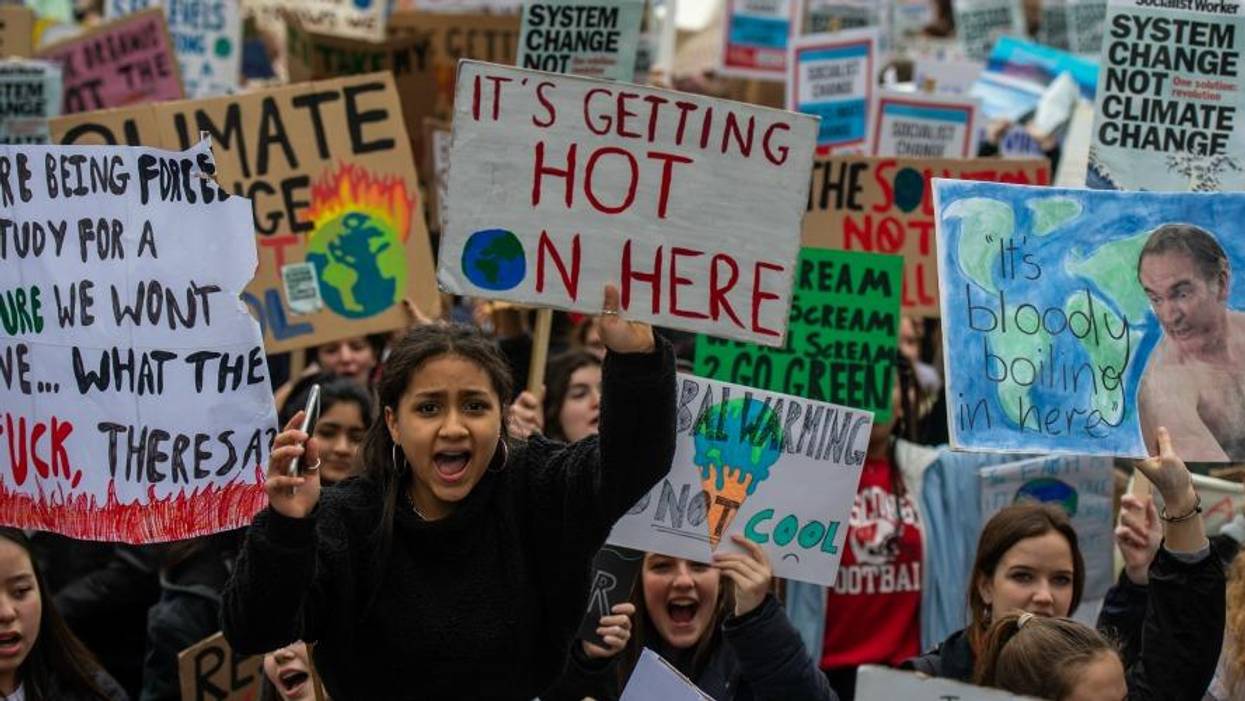
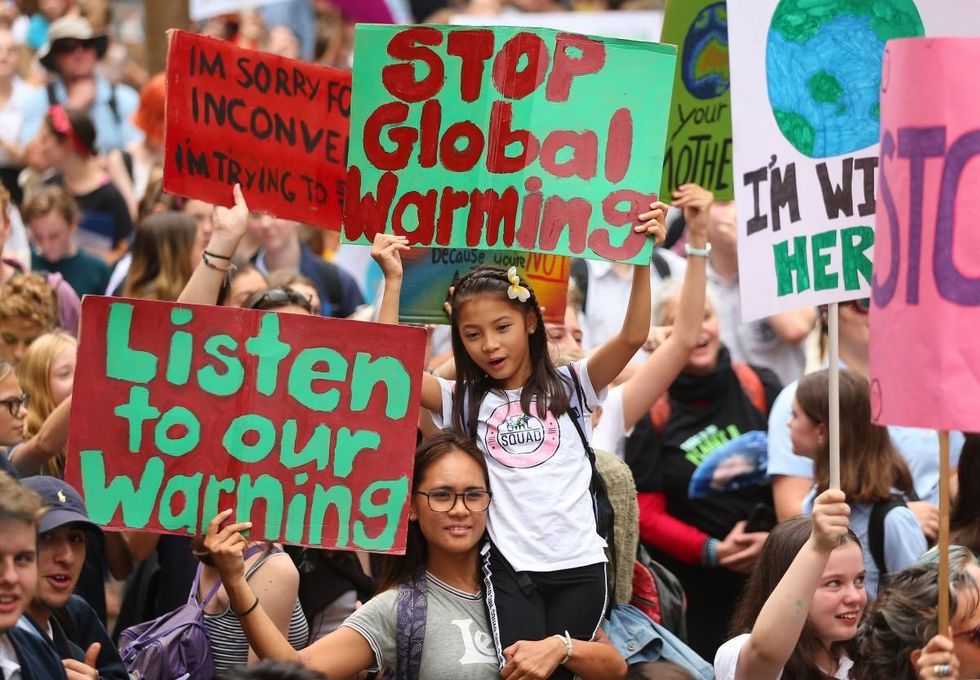
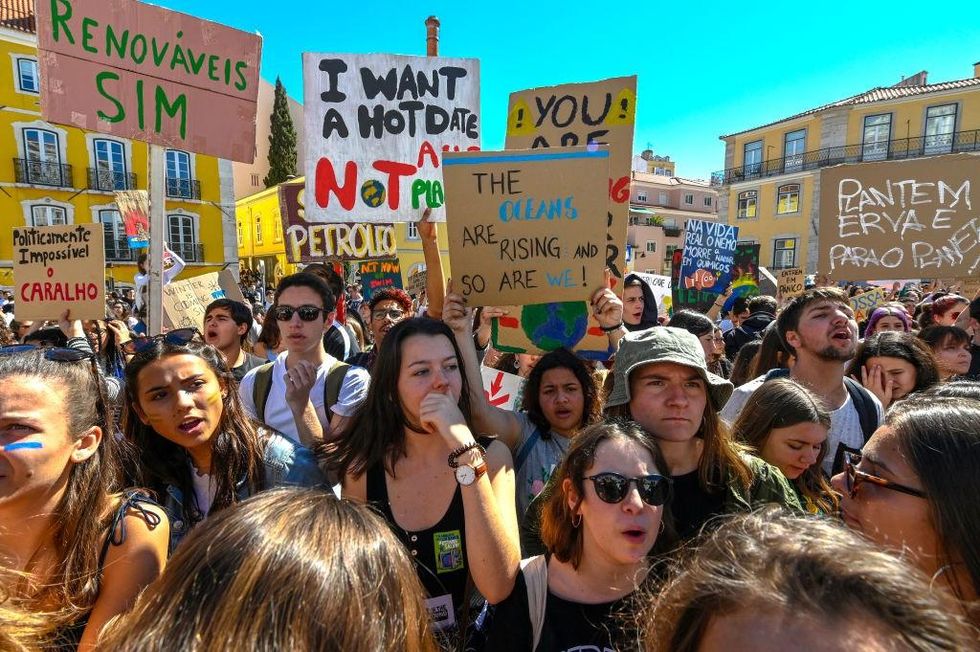
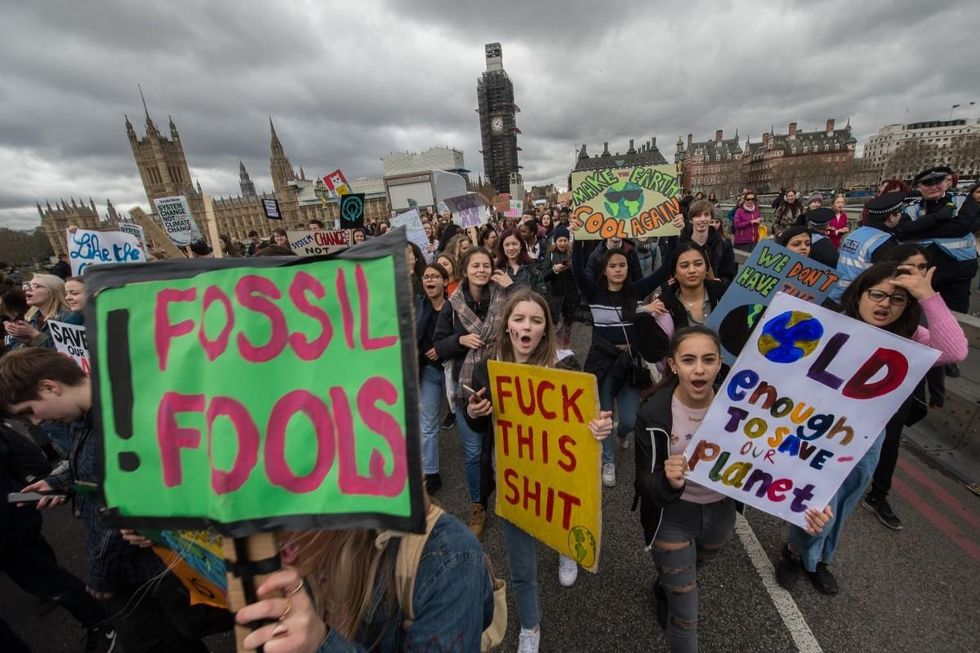
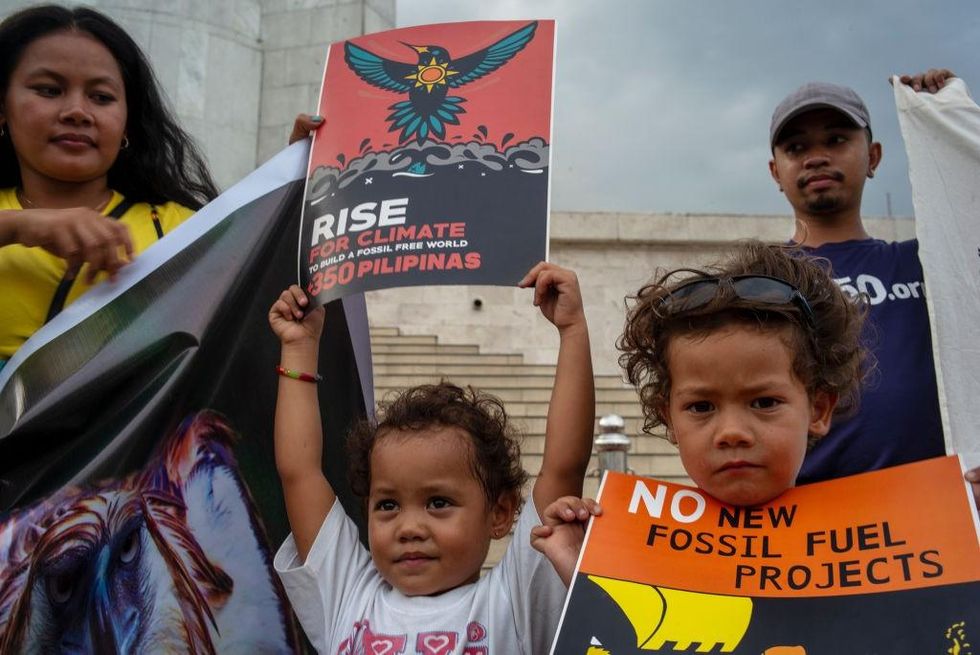
All over the planet on Friday, millions of children and young adults walked out of their classrooms in an unprecedented collective action to demand a radical and urgent shift in society's energy and economic systems in order to avert the worst impacts of human-caused global warming and climate change.
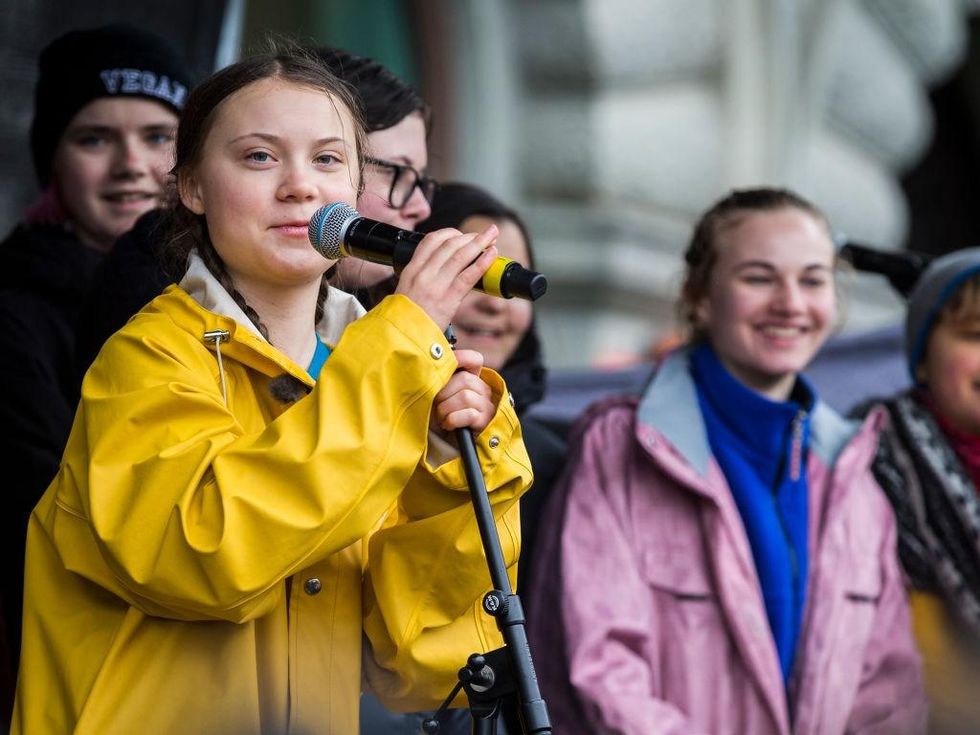
With demonstrations in more than 100 countries and tens of thousands of schools, the worldwide Climate Strike is the largest since 16-year-old Greta Thunberg sparked a wave of increasingly huge marches and walkouts with her one-person strike outside the Swedish Parliament last year.
Since then, Thunberg has admonished and appealed to world leaders at COP24 and Davos, successfully securing a commitment from the European Union to fight the climate crisis while inspiring strikes all over the world. European students began holding weekly walkouts in Brussels in December, while Australian, and German young people are among those who have organized strikes as well.
"We have been born into this world and we have to live with this crisis, and our children and our grandchildren," Thunberg told a crowd of her peers in Stockholm in Friday. "We are facing the greatest existential crisis humanity has ever faced. And yet it has been ignored. You who have ignored it know who you are."
In Pictures:


On social media, supporters posted images and videos of students chanting, marching, and waving signs demanding action from their elected officials as well as rebuking some leaders who have criticized the students for skipping school. As one sign in London read, "I'll do my work when you do yours."
Brussels:
Minneapolis, Minnesota:
Montreal:
Lisbon:
Oh boy, look what happened in Lisbon, Portugal.#FridaysForFuture #ClimateStrike pic.twitter.com/K1Ew1Zg4ey
-- Angela Fay (@lifelearner47) March 15, 2019
New York:
Kyiv, Ukraine:
Santiago, Chile:
Paris: