

SUBSCRIBE TO OUR FREE NEWSLETTER
Daily news & progressive opinion—funded by the people, not the corporations—delivered straight to your inbox.
5
#000000
#FFFFFF
To donate by check, phone, or other method, see our More Ways to Give page.
Daily news & progressive opinion—funded by the people, not the corporations—delivered straight to your inbox.
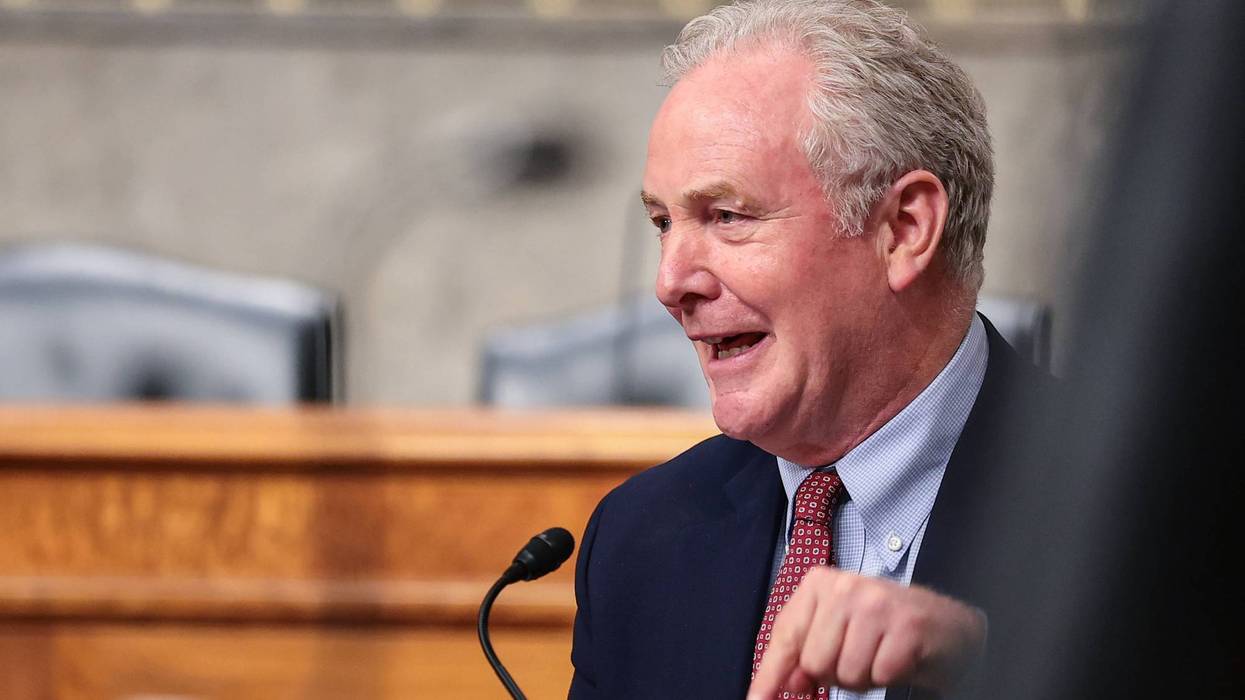
"This measure was a ruse, promoted by House Speaker Mike Johnson, to make it appear that congressional Republicans were tackling an ethical quagmire when, in fact, it would have accomplished very little."
Democrats in the Senate have blocked what they described as a loophole-laden Republican-led bill to ban members of Congress from purchasing stocks.
Sen. Tom Cotton (R-Ark.) blasted his Democratic colleagues on Wednesday after they declined to give the votes necessary to advance the bill—known as the Stop Insider Trading Act—past the Senate filibuster.
"The Democrats who blocked it went back on their word to protect their own wallets—they should be ashamed of themselves," Cotton said.
But Democrats described the bill, which passed the Republican-controlled House of Representatives in July, as a sham. Sen. Dick Durbin (D-Ill.) said the bill "does not adequately ban congressional stock trading," and described it as "meaningless messaging."
While the bill would have prohibited members of Congress, their spouses, and dependent children from buying stocks, it would not have required them to divest the hundreds of millions of dollars worth of stock they already own.
It also would have exempted President Donald Trump and other executive branch employees. During his second term in office, Trump has made around 30,000 securities trades since returning to office. Bloomberg estimated, based on public disclosures, that he'd made more than 21,000 trades worth between $600 million and $1.86 billion in 2025 alone.
The bill passed by House Republicans also attached a national photo ID requirement for voting as well as additional identification requirements for vote-by-mail, which voting rights advocates argued could disenfranchise millions of eligible voters who do not possess a valid photo ID.
"This measure was a ruse, promoted by House Speaker Mike Johnson (R-La.), to make it appear that congressional Republicans were tackling an ethical quagmire when, in fact, it would have accomplished very little," said Craig Holman, government affairs lobbyist for Public Citizen.
Democrats have argued that the watered-down Republican proposal was meant to sap momentum from stronger bills, amid broad public demand for a stock trading ban.
Holman noted that "there was serious legislation to stop congressional insider trading, but Johnson would not bring up any of the serious proposals for a floor vote."
A bipartisan bill that has stalled in the House would have required members of Congress to divest stock they currently own. Meanwhile, the GOP-controlled House Rules Committee blocked a Democratic proposal that would have made the president and vice president subject to the ban.
"Let’s be clear: I support a total ban on Congress members trading stock," said Sen. Chris Van Hollen (D-Md.) on Wednesday. "But Republicans are trying to package a fraudulent version of that with a bill to disenfranchise American voters."
"This is politics at its worst," he said. "Put a real ban on the floor if you’re serious."

Lawmakers face a choice: They can continue their vote-pandering through “no tax on” proposals, or they can address the glaring structural flaws in the federal income tax and, in doing so, perhaps save our tax system and our democracy.
A tale of two couples:
Barney and Betty are both 66. Betty works as a hostess at a local restaurant. She makes $15,000 in hourly pay, plus another $25,000 in tips. Barney owns an interest in his family’s business, organized as a Subchapter S corporation, from which his annual income is $50,000. Over the holidays, Barney works long hours at a local big box store. He makes $10,000, $2,500 of which is the premium for overtime.
At tax time, Barney and Betty report $100,000 of adjusted gross income. In computing their taxable income, they take deductions of $25,000 for Betty’s tips, $12,000 in deductions for seniors, a $10,000 qualified business income deduction for Barney’s income from the family business, a $2,500 deduction for Barney’s overtime pay, and a standard deduction of $35,500, leaving them with taxable income of $15,000 and a federal income tax bill liability of $1,500.
The only path out of this mess is to rebalance our income tax structure. The Working Americans Tax Cut Act, a bill introduced by Sen. Chris Van Hollen (D-Md.) and Rep. Don Beyer (D-Va.O would accomplish that rebalancing.
Fred and Wilma are both 64. Wilma no longer works. Fred makes $100,000 per year as an accountant with a local firm. Although he works long hours during tax season, he is not paid overtime because of his base compensation and position, which includes managerial duties. At tax time, Fred and Wilma report $100,000 of adjusted gross income. They take a standard deduction of $32,200, leaving them with taxable income of $67,800 and a federal income tax liability of $7,640.
These are, of course, concocted examples. But they show how tax policy in the US under President Donald Trump has returned to the Stone Age. There are couples with tax pictures virtually identical to Barney and Betty’s and other couples with tax pictures virtually identical to Fred and Wilma’s. Do they ever compare their respective situations? Do they question the Swiss cheese tax code we have courtesy of two Trump tax bills?
Could it get worse? Absolutely. As Brian Faler at Politico reported, members of Congress have a slew of new “no tax on” proposals ready to campaign on. No Tax on Boat Loan Interest? Yep. Taxes on Utility Bills? Absolutely, and it’s bipartisan no less! I spoke to a senior congressional staffer a few months ago who was just giddy about all the “no tax on” proposals his office hoped to include in a 2029 budget reconciliation bill.
The “no tax on” provisions currently in the tax code are set to expire after 2028. Will they be extended? Of course they will. As I commented to Politico, if you do away with no tax on tips, you can kiss the state of Nevada goodbye. And imagine how this will play in the other swing states in 2028. “No tax on auto workers” sure will sound sweet in Michigan. And if you want to carry Georgia, you damn well better sign on to “no tax on peanut farm workers.” By the time we get to the 2032 campaign, the pandering will be stripped of all pretense and we’ll be hearing “no tax on Pennsylvanians.”
How problematic is this from a tax policy perspective? Huge. The federal income tax system depends on voluntary compliance. The system must make sense to taxpayers for them to voluntarily comply. If you’re Fred or Wilma, would our tax system still make sense to you? Hardly.
How, then, do we rein this craziness in? We start by identifying the source of the problem. As gimmicky as provisions like no tax on tips are, and even though they benefit only a tiny percentage of workers, they address a need millions of Americans feel and millions more Americans understand. When people hear “tipped worker,” they don’t picture the blackjack dealer at the Venetian making $150,000 a year. They don’t even picture a worker like Betty, who together with her husband enjoys a comfortable income. They picture the struggling unmarried server at their local Denny’s slinging dishes for $35,000. And they understand well she doesn’t have enough income before federal income tax, let alone after, to pay her basic living expenses.
Now, consider struggling non-tipped workers and their reaction to no tax on tips. Do they think their tipped counterparts are getting an unfair break like the ultra rich get on their lightly-taxed investment gains? Or do they think that they should have their income tax burdens reduced as well, and that the rich should be required to pay more?
Asking those questions, of course, answers them, and shines a light on the real problem: The federal income tax is fundamentally flawed at both ends of the income spectrum. At the lower end, incomes not even sufficient to cover basic living expenses are subject to federal income tax. At the upper end, marginal rates top out at a fraction of the country’s highest income levels. Doctors making in the high six figures face the same marginal tax rate as CEOs making 50 times that much.
The only path out of this mess is to rebalance our income tax structure. The Working Americans Tax Cut Act, a bill introduced by Sen. Chris Van Hollen (D-Md.) and Rep. Don Beyer (D-Va.O would accomplish that rebalancing. Their bill provides an exemption from federal income tax for income up to the basic cost of living, with a progressively smaller income tax reduction for those with incomes just above the basic cost of living. At the same time, the bill imposes a surtax on income in excess of $1 million, and larger surtaxes on incomes above $2 million and $5 million.
If the Working Americans Tax Cut Act becomes law, the ghastly “no tax on” provisions could be allowed to expire. The great majority of tipped workers, like that struggling server at Denny’s, won’t care, since they’d pay no federal income tax either way. A handful of taxpayers would still benefit from no tax on tips. But nobody will waste political capital on a tax break for affluent blackjack dealers.
Members of Congress face a choice. They can continue their vote-pandering through “no tax on” proposals. Or they can address the glaring structural flaws in the federal income tax and, in doing so, perhaps save our tax system and our democracy.
Let’s hope they make the right choice. Stone Age tax policy won’t end well for any of us.
This article was originally published on Bob Lord's Substack.

A vote is expected early next week on Senate Resolution 852 to hold Israel accountable for its horrific actions against US citizens killed or detained by Israel.
Last week, I was pleased to once again participate in a meeting with one of my US Senators, Democrat Chris Van Hollen of Maryland, a consistent leader for peace, justice, and human rights in Congress, and especially for ending US support for Israel’s genocide, apartheid, and ethnic cleansing against the people of Palestine.
The subject of the meeting was his bill, with a vote expected early next week, Senate Resolution 852, to hold Israel accountable for its horrific actions against US citizens killed or detained by Israel. The goal of the resolution is very simple: within 30 days of passage, to require a State Department report on Israel’s alleged killings of nine US citizens, and more broadly, on the commission of “gross violations of internationally recognized human rights by Israel.” The resolution cites US law, section 502(B)(c) of the Foreign Assistance Act of 1961.
The resolution reads, in part “...since January 2022, at least nine United States citizens have been killed by violent Israeli settlers or Israeli security forces in the West Bank, including Omar Assad, Shireen Abu Akleh, Tawfic Abdel Jabbar, Mohammad Khdour, Ayşenur Ezgi Eygi, Amer Rabee, Sayfollah Kamel Musallet, Khamis Ayyad, and Nasrallah Abu Siyam” and “...the killings of these Americans in the West Bank have been met by a lack of accountability from the Netanyahu government and an inability to secure justice by the United States Government.”
This resolution can help bring an end to US support for Israel’s atrocities, something most people in this country, especially nearly three-quarters of Democrats, support.
Asking the Department of State to produce such a report sounds like the absolute minimum we, as taxpayers, deserve from our government, and certainly the families of those killed by Israel, likely with US-provided weapons, deserve that and much more. The resolution is supported by 84% of voters, on a bipartisan basis, in a just-released poll, and has 24 Senate co-sponsors. And as the resolution states, and many supporters note, protecting US citizens abroad is constantly touted as the top priority for US foreign policy, even by the current rogue Trump regime that regularly flouts domestic and international law, with the most egregious example being the illegal US-Israeli war of aggression against Iran.
Peace advocates regularly support much stronger legislation, and will do so repeatedly, until peace, justice, and human rights are the real foundations of US foreign policy, and not just paid cynical lip service. Soon there will likely be a Joint Resolution of Disapproval (JRD) in Congress to stop the proposed shipment of 40,000 one-ton bombs to Israel. The Biden administration, as bad as it was in its support for Israel during the razing of Gaza, had put this sale on hold, but President Donald Trump is now moving it forward. But the relatively modest Van Hollen resolution would be an important step toward ending Israel’s impunity, and if we can’t get justice for American citizens killed by Israel, then Congress is completely derelict in doing its job.
Peace Action and our colleagues have already generated over 57,000 letters to the Senate in favor of Sen. Van Hollen’s resolution, and many groups are pushing to get that figure close to 100,000, if not more.
With the mess in Congress (not to mention the administration and Supreme Court), there is no guarantee this resolution will pass, or even get a vote, though it is considered privileged, so it can’t be bottled up indefinitely under Senate rules. It could get punted to the lame-duck congressional session after the midterm elections. Regardless, along with other proposed legislation such as the JRD in the pipeline, this resolution can help bring an end to US support for Israel’s atrocities, something most people in this country, especially nearly three-quarters of Democrats, support.
While I doubt hardcore supporters of Israel in this country will be swayed by much of anything, there is a growing political inevitability at play here. Regardless of what one thinks of the state of Israel, its actions, or its “right” to certain territory, US taxpayers are not going to continue to put up with endless amounts of US weaponry and military going to support genocide, apartheid, and gross human rights violations. And it’s easy to connect to the “affordability crisis” in the US and elsewhere. Young Americans who can’t afford to buy a car, let alone a house, and lack the free universal healthcare Israelis enjoy, have especially turned against Israel. The pipeline of US military support is going to be shut off eventually, and perhaps sooner than expected. Politicians of any party ignore this reality at their own peril.
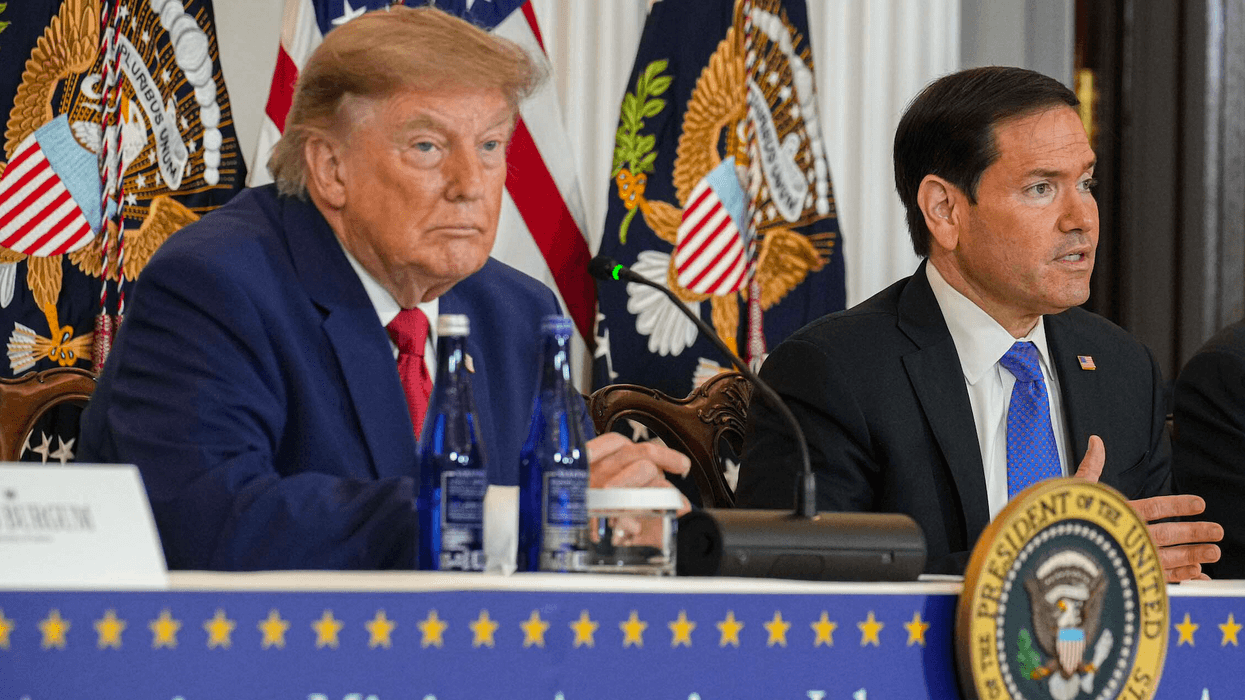
In what the Democratic senator called an effort at “obstructing investigations of Netanyahu’s war crimes,” the Trump administration is planning a dramatic escalation of its sanctions against the court.
As the United Nations General Assembly prepared to meet, a US senator said President Donald Trump and Secretary of State Marco Rubio should face sanctions for their role in trying to destroy the International Criminal Court in order to protect Israeli Prime Minister Benjamin Netanyahu.
"If European countries and other signatories to the International Criminal Court (ICC) have any self-respect, they'd sanction Rubio and Trump for obstructing investigations of Netanyahu's war crimes," wrote Sen. Chris Van Hollen (D-Md.) Monday on social media.
He was responding to a report from the Wall Street Journal detailing "a sharp escalation" in the Trump administration's efforts to, in Rubio's words, "dismantle" the ICC, which issued an arrest warrant for Netanyahu in 2024. The body accused the prime minister and then-Defense Minister Yoav Gallant of war crimes and crimes against humanity in Gaza, including the deliberate use of starvation as a weapon of war.
The ICC has also reportedly launched investigations into two other far-right ministers in Netanyahu's cabinet, Finance Minister Bezalel Smotrich and National Security Minister Itamar Ben-Gvir, for their roles in aggressively expanding Israeli settlements in the occupied West Bank, which are considered illegal under international law.
The Trump administration had already aggressively sanctioned ICC officials involved in efforts to prosecute Americans or Israelis, including then-chief prosecutor Karim Khan and several judges and prosecutors. It had also sanctioned UN special rapporteur on Palestine Francesca Albanese and several Palestinian human rights organizations that had brought evidence of alleged Israeli crimes before the tribunal.
Now, The Journal reports that:
The Trump administration is preparing to impose sweeping sanctions on the [ICC]...
The sanctions would forbid most transactions with the ICC after a grace period of six to seven months... That could potentially cripple the court by prohibiting it from conducting transactions in US dollars, cutting it off from much of the global financial system.
It is unclear when a final decision and announcement might come, though some US officials said the move could be finalized as soon as this week during the United Nations General Assembly meeting or in the following days.
Several world leaders have been vocally critical of the US attack on the ICC, though they've stopped short of calling for sanctions against US officials.
Responding to Rubio's sanctions in August, European Commission President Ursula von der Leyen and European Council President António Costa said that the ICC's "judges and officials must be able to act independently and without external pressure."
Dutch Foreign Minister Tom Berendsen, whose nation is home to the ICC, said the Netherlands disapproves of efforts to sanction the court, adding that Dutch officials were actively working with the EU to protect the court from institution-wide US sanctions. Possible protective measures reportedly include alternative banking and payment arrangements outside the US dollar system.
There have also been calls within the European Parliament, including from Spanish socialist politician Iratxe García Pérez and others, to activate the EU's so-called "blocking statute," which would prohibit European companies from complying with the US sanctions.

"We need to pump the brakes until we have rules in place to stop this technology from doing grave harm," says Democratic Sen. Chris Van Hollen. "And that includes instituting mandatory safeguards and a comprehensive testing regime."
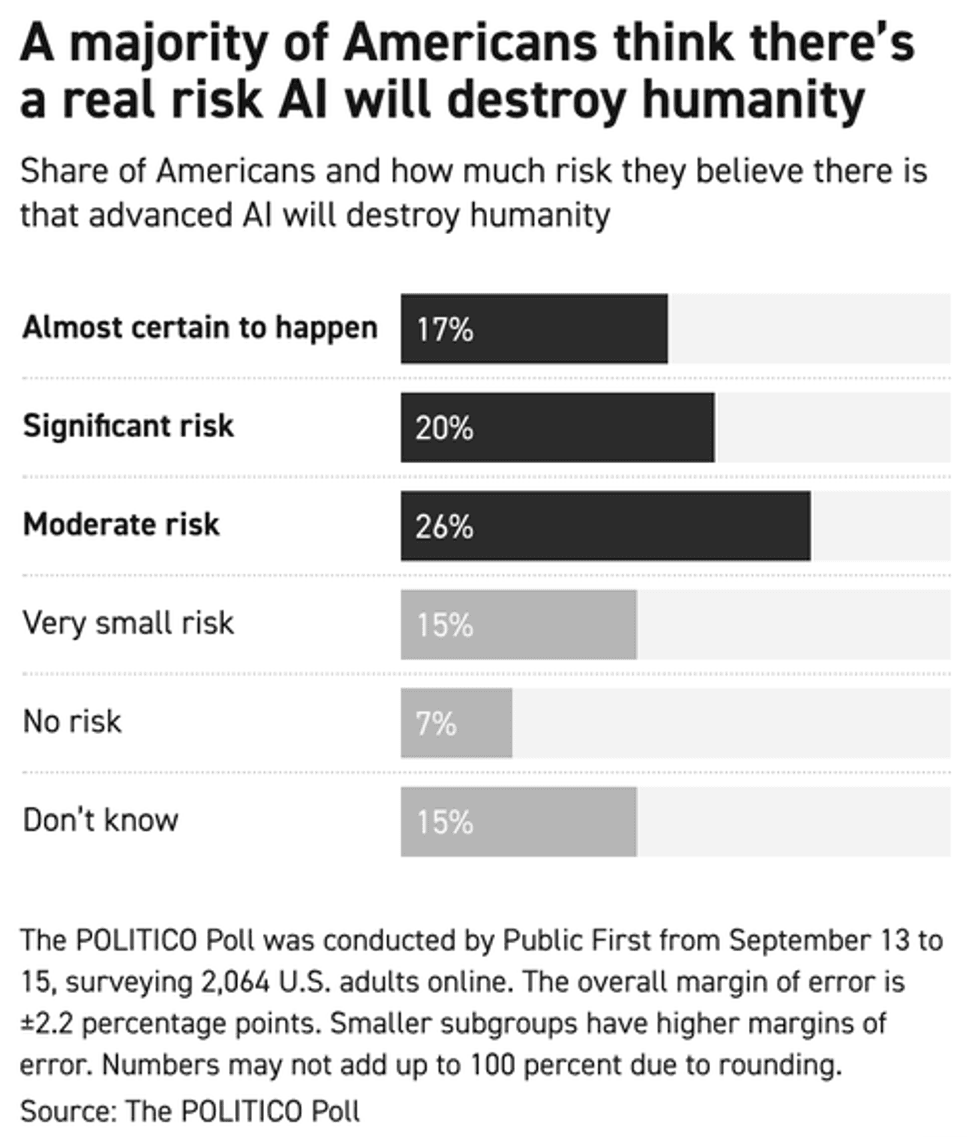
A new poll released Wednesday shows that nearly two out of three Americans believe there is "certain" to "moderate" risk that artificial intelligence could wipe out human society, a finding that backs up other surveys showing deep anxiety among the US voting public with a technology that so far has escaped government oversight or meaningful regulation.
According to Politico, which conducted the survey, "63% of Americans say AI could destroy humanity one day. And nearly half of Americans favor pausing development of more advanced AI models—48%—compared with 31% who favor continued development."
The findings, the news outlet noted, "signal an emerging tech-skeptical realignment of American politics with consequential midterm and presidential elections looming" and arrive just a day after a major symposium in Washington, DC brought together experts and lawmakers who say action must be taken before its too late.
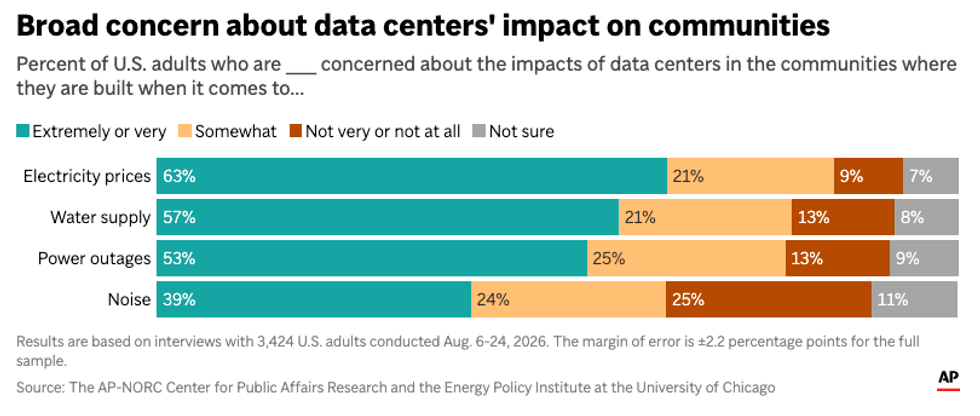
In a separate Associated Press poll published Wednesday, US voters also expressed their concerns about the negative environmental impact of the AI industry, including the massive buildout of data centers that serve as the main infrastructure for the computing capacity needed by the major tech firms, including OpenAI, Anthropic, Google, Meta, SpaceX, and others.
AP reports that while Democrats are more concerned overall about the environmental impacts of AI, large segments of independents and Republicans share those sentiments.
"About two-thirds of Democrats," AP reports, "say they are 'extremely' or 'very' concerned about how AI will affect the environment, the poll found, up from about half in 2025. By contrast, about half of independents and about 4 in 10 Republicans are highly concerned about the environmental impact of AI."
Broader consensus emerged on data centers, the outlet noted, with about 60% of all voters—regardless of partisan affiliation—supporting limits on new data centers and sharing concerns about the impact such facilities will have on local water supplies and electricity prices.
The new survey data from both AP and Politico comes amid a high-profile debate in Washington, DC that has emerged over recent weeks and months as grave warnings—including from experts within the industry—tell of a technology that demands much more government control and public accountability.
At a forum on Tuesday billed as "The Pro-Human Assembly"—headlined by progressive champion Sen. Bernie Sanders (I-Vt.) and far-right former Trump advisor Steve Bannon—technological experts, AI industry insiders, watchdogs, and lawmakers advocated for a much more robust and critical response to the issue.
“Despite living in a so-called democracy, the public has had virtually no input into the AI revolution that is transforming the world in which they live,” Sanders said during his remarks at the event.
“Congress, under both Democratic and Republican control, has been asleep at the wheel, and we now have a president whose ignorance regarding this issue is truly embarrassing," added Sanders. "Virtually all of the decisions regarding the development of AI have been made by a handful of the richest people in the world... whose chief goal is to achieve even more wealth and more power than they already have, no matter what the impact their work has on ordinary people."
In a video posted to social media on Tuesday, Sen. Chris Van Hollen (D-Md.) also demanded a shift in Congress, which has for too long stood idly by as the AI industry lobby plowed tens of millions of dollars into shaping the terms of debate on Capitol Hill and bankrolling political campaigns.
"The ongoing AI threat has been enabled by political corruption," Van Hollen warned in his post.
The ongoing AI threat has been enabled by political corruption.
The Trump admin isn't asleep at the wheel; their refusal to address these risks is part of an implicit deal.
We should pump the brakes on frontier AI development & confront a corrupt system that's endangering us… pic.twitter.com/B9KPOgHrdY
— Senator Chris Van Hollen (@ChrisVanHollen) September 16, 2026
"The people building this technology are concerned about the loss of human control," Van Hollen said. "We need to pump the brakes until we have rules in place to stop this technology from doing grave harm. And that includes instituting mandatory safeguards and a comprehensive testing regime."
"This should not be a partisan issue," he continued. "The impact of AI on our collective future, on our safety, on our security, on our economy, and on our shared humanity—but be the type of risk that brings us all together."
While blasting Trump's recent comments dismissing concerns about AI dangers as "a hoax" to be ignored, Van Hollen said what can't be ignored is how the industry and its financial backers have used their outsized wealth and power to create the current situation in which AI has avoided serious oversight.
"The Silicon Valley big-wig investors and tech oligarchs that have bankrolled Donald Trump back into the White House didn't do it because they all became MAGA overnight. They did it because there was an implicit deal. In return for their support and funding his vanity projects, like his obscene ballroom, they wanted something in return: a free hand on AI policy."
Progressive political journalist David Sirota said Van Hollen's message was spot on.
"Van Hollen absolutely nails it," said Sirota. "He explicitly says AI oligarchs should be held civilly and criminally liable under existing laws, and he points out that the AI crisis is a crisis of corruption. This is the message."

"The United States cannot keep bankrolling this violence and looking the other way—it’s time to end our complicity, once and for all," said US Sen. Bernie Sanders.
A group of Senate Democrats on Thursday announced plans to introduce a privileged resolution requiring the Trump administration to give Congress more information about violence carried out by extremist settlers in the Israeli-occupied West Bank.
Led by Sens. Chris Van Hollen (D-Md.), Tim Kaine (D-Va.), and Bernie Sanders (I-Vt.), who caucuses with Democrats, the lawmakers are demanding the US Department of State produce reports detailing investigations into the killings of nine US citizens at the hands of Israeli settlers in recent years, as well as assessments on the human rights impact of Israeli policies such as the detention of Palestinian children.
Van Hollen said the resolution was necessary because the Trump administration has done nothing to hold the Israeli government accountable for the deaths of US citizens.
"As we've seen violence rise in the West Bank, American citizens have been killed time and again, and they have received no justice and no accountability," said Van Hollen. "It’s past time we get answers on their deaths—and on the growing violent instability in the West Bank and the injustices facing Palestinian civilians on a daily basis."
Sanders accused the Israeli government of offering "impunity" to settlers who carry out "horrific violence" against Palestinian civilians regularly.
"Enough is enough," said Sanders. "The United States cannot keep bankrolling this violence and looking the other way—it’s time to end our complicity, once and for all."
Kaine described the Israeli government's "lack of response" to the settler violence as "unacceptable," saying it "threatens the long-term safety and security of the entire region."
"Friends need to listen to each other," said Kaine, "and my colleagues and I have repeatedly urged Israeli leaders to take firmer action to curtail illegal settlements in the West Bank, prosecute violent settlers, and protect Palestinian residents as well as American citizens living in or visiting the West Bank."
Sen. Elizabeth Warren (D-Mass.), who is also supporting the resolution, slammed the Trump White House's complicity in the Israeli settler attacks, nothing that the administration "has even gone so far as to reverse sanctions against individuals connected to this pattern of horrific violence."
"It's long past time for the US government to stand up for human rights," said Warren, "investigate this violence against Americans and Palestinian civilians, provide full information to Congress, and hold the perpetrators accountable."
By introducing the measure as a privileged resolution, the Democrats can force a vote on it on the floor of the US Senate if the chamber's Foreign Relations Committee fails to act on it within 10 days of its introduction.
Human rights organizations for months have been sounding the alarm about the situation in the West Bank, where Israeli settlers have routinely attacked Palestinians at their own homes.
An analysis published by the Carter Center last month found that "settler attacks are now the leading cause of Palestinian injuries in the West Bank," as "more than 3,200 Palestinians have been displaced by settler attacks and home demolitions this year—double the daily rate of the previous three years."

"He’s become a complete apologist for the most extreme Israeli government in history," Sen. Chris Van Hollen said of US Ambassador to Israel Mike Huckabee.
Sen. Chris Van Hollen on Monday called on Mike Huckabee, the US ambassador to Israel, to resign after repeatedly failing to condemn mistreatment of American citizens by the Israeli government.
In a video posted on social media, Van Hollen (D-Md.) recounted instances of US citizens being detained or abused by Israeli security forces, along with Huckabee's lack of response.
"On his watch, we continue to see American citizens being mistreated, wrongfully detained," Van Hollen explained, referencing the recent detentions of 20-year-old American citizen Sama Safi and 16-year-old Adam Karakrah.
Van Hollen added that he and more than two dozen fellow US senators have urged Huckabee to hold Israel accountable for "the killings of nine Americans over just the last four years" by either Israeli settlers in the West Bank or members of the Israel Defense Forces (IDF).
"And yet, no accountability," said Van Hollen. "No justice."
The Maryland Democrat further called out Huckabee for failing to abide by his professed compassion for the Palestinian Christian community.
"We've seen an increase in violent settler attacks on Christian villages in the West Bank, and we've seen those attacks conducted with impunity," he said. "And when asked about this, Ambassador Huckabee said, 'Well, look at me. I'm a Christian and I think I'm doing OK here in the Holy Land.'"
"And that exposes the entire problem," Van Hollen continued. "Because what Ambassador Huckabee is talking about is visitors to the Holy Land, Christian visitors, including evangelicals who come on the kind of tours that Ambassador Huckabee used to lead. Well, what about the Christians who have lived in the Holy Land for thousands and thousands of years?"
The senator then speculated that Huckabee simply "doesn't care" because "he's become a complete apologist for the most extreme Israeli government in history."
"He should be defending Americans and defending American interests," Van Hollen concluded. "He's failed to do so. He should resign today."

The US, said a group of senators led by Sen. Chris Van Hollen, must suspend weapons sales to the United Arab Emirates, which arms the Rapid Support Forces in Sudan.
Writing to Secretary of State Marco Rubio, Sen. Chris Van Hollen on Monday led 20 members of the Democratic Caucus in demanding that the Trump administration go beyond simply denouncing the Rapid Support Forces, the paramilitary group in Sudan that has been accused of war crimes in the country's civil war, and take "concrete action" to stop more mass atrocities as the group encircles the city of El Obeid.
"These actions should include ceasing certain US arms sales to external actors that are fueling this war, including the United Arab Emirates, which continues to arm the RSF," wrote the senators, including Sens. Bernie Sanders (I-Vt.), Elizabeth Warren (D-Mass.), and Ed Markey (D-Mass.).
The lawmakers wrote to Rubio as an estimated 500,000 civilians were at risk in El Obeid, where many people have sought safety following RSF attacks across the Kordofan region.
The letter came as the United Nations Office for the Coordination of Humanitarian Affairs said civilians are facing drone attacks in El Obeid, with humanitarian assistance also put at risk by the assault.
A number of the signatories, including Van Hollen and Sanders, have previously called on the Trump administration to end its complicity in RSF attacks like those that occurred in El Fasher last October, which United Nations investigators said bore the "hallmarks of genocide" after the group killed more than 6,000 civilians in the first three days of its offensive in the besieged city.
The senators described attacks like those on El-Saudi Hospital in El Fasher, where RSF forces "proceeded to search the wards and killing those they found, including patients, accompanying persons and medical personnel," killing an estimated 460 people before pursuing civilians who tried to escape.
Reports described "the perpetrators chasing people in open fields, firing at them with automatic rifles and mounted submachine guns, and running over fleeing persons with vehicles, causing mass casualties," the senators wrote.
More than 14 million people have also been forcibly displaced by the civil war.
But the scale of atrocities would likely not have been possible without the RSF's support from the UAE, for which the Trump administration fast-tracked a weapons sale in May after having provided the country with $7 billion in weapons just two months earlier.
Also in May, said the senators, Human Rights Watch released a report showing that the UAE trained hundreds of Colombian mercenaries who then took part in the atrocities in El Fasher and trained RSF recruits, including child soldiers.
Now, they wrote, the RSF's "encirclement and systematic crippling of resources in El Obeid increasingly parallels El Fasher, and this administration must use its leverage and influence to prevent a repeat of El Fasher’s horrors in El Obeid before it is too late."
They pointed out that the administration has acknowledged that further "mass atrocities could be imminent” in Sudan, as a State Department spokesperson said on June 22. In November 2025, Rubio himself said that the RSF was "clearly receiving assistance from outside" and that “something needs to be done to cut off the weapons and the support the RSF is getting as they continue their advances.”
Despite those acknowledgments, said the senators, the Trump administration has shown a "grave failure to act despite the chorus of alarm bells."
"What occurred in El Fasher is a stark warning of what could unfold in El Obeid and across Sudan if this administration—and the international community—continues this current pattern of inaction," wrote Van Hollen and his colleagues.
"While we welcome the State Department’s expression of concern about the escalating situation in El Obeid, words are not enough," they said. "The United States must use the leverage and influence at our disposal to prevent further atrocities in El Obeid and help bring this brutal war in Sudan to an end."
The senators called for a response to their letter by August 17, urging the administration to provide "an update on what other actions the administration is taking, beyond just words, to prevent mass atrocities in El Obeid."

"Prime Minister Netanyahu has a warrant out for his arrest for committing war crimes," said one Democratic senator. "He should be nowhere close to the Oval Office of the president of the United States."
As with his proposals for government-run grocery stores and a tax on the second homes owned by rich New Yorkers, New York City Mayor Zohran Mamdani's recent call for Israeli Prime Minister Benjamin Netanyahu, an accused war criminal, to be arrested on US soil sparked outrage among Trump administration officials and others on the right.
And just like his other proposals, despite the claims that the mayor's comments displayed "extreme views" and were dangerous and divisive, Mamdani's demand that the US execute the International Criminal Court's (ICC) arrest warrant for Netanyahu is broadly supported by the public.
A poll taken by The Economist/YouGov between July 25-27 found that 49% of Americans believe the US should arrest Netanyahu, who arrived in Washington, DC on Monday to meet with President Donald Trump and attend the late Sen. Lindsey Graham's (R-SC) funeral.
Just 27% of respondents said the US should not execute the warrant, while 23% were unsure, according to the poll released Tuesday.
Nearly a quarter of people who voted for Trump in 2024 agreed with Mamdani, as well as 21% of people who identified themselves as supporters of Trump's MAGA political movement. The view was also held by 68% of Democrats and 55% of Independents, as well as 24% of Republican voters.
Forty-seven percent of respondents also said they believed Netanyahu was guilty of war crimes.
With Americans increasingly disapproving of Israel and the powerful pro-Israel lobby, sympathizing with Palestinians, and now backing the arrest of Netanyahu by an "overwhelming margin," said the Institute for Middle East Understanding, Trump is nevertheless "welcoming him back into the White House to lobby for more impunity, more war, and more of our tax dollars going to Israel."
Columbia University professor Anthony Zenkus wrote that while nearly half of Americans believe the US should execute the ICC warrant, "we've got prominent Democrats and Republicans and their online supporters calling Mamdani a terrorist for wanting to do that very thing."
Sen. John Fetterman (D-Pa.) and Trump's ambassador to the United Nations, Mike Waltz, are among those who have condemned Mamdani's demand for Netanyahu's arrest. Waltz said the US would not execute the warrant because the country, like Israel, is not party to the Rome Statute, which established the ICC, and does not recognize the court's authority. Secretary of State Marco Rubio has threatened to "dismantle" the court.
On Tuesday, Sen. Chris Van Hollen (D-Md.) denounced the White House for hosting the Israeli prime minister while Israel is "wrongfully detaining an American citizen," 20-year-old student Sama Safi, who was detained in the West Bank on June 2.
"As I speak, we've not been able to get justice for American citizens killed by violent Israeli settlers or by the IDF," Van Hollen continued, referring to the Israel Defense Forces. "As I speak, Palestinians in the West Bank are under violent assault by Israeli terrorists who are terrorizing Palestinian villages, lighting mosques on fire, torching cars, pushing Palestinians off their lands, killing innocent Palestinians."
"When Donald Trump meets with Bibi Netanyahu, things don't go well for the United States of America," said the senator, noting that five months after Israel convinced the administration to launch an "illegal war against Iran," American soldiers are being killed and injured in the region.
"On top of all that," said Van Hollen, "Prime Minister Netanyahu has a warrant out for his arrest for committing war crimes. He should be nowhere close to the Oval Office of the president of the United States."

Many of those who would adamantly oppose the creation of a society where the income tax impoverishes struggling workers to enable those with seven-figure incomes to pay low rates are working overtime to maintain that very same situation.
Imagine this 2029 scenario: Americans making $1,000,001 or more per year have a slightly higher federal income tax rate than they currently do, while Americans who can’t afford to put food on the table—the ones who make less than what it takes to cover basic living expenses—don’t pay federal income taxes at all. Now imagine that President JD Vance proposes to cut the income tax rates of those with incomes over $1 million and to recover the lost revenue by taxing the working poor even further into poverty.
How many Democratic politicians would vote for that? How many left-leaning think tanks would write white papers supporting it? And how many left-leaning activist groups would lobby in support of it? NONE.
Unfortunately, the very tax structure that hypothetical proposal envisions already exists. Yet, amazingly, many of those who would adamantly oppose the creation of a society where the income tax impoverishes struggling workers to enable those with seven-figure incomes to pay low rates are working overtime to maintain that very same situation.
Recognizing that taxing hardworking people into poverty is both morally wrong and economically asinine, earlier this year, Sen. Chris Van Hollen (D-Md.) and Rep. Don Beyer (D-Va.) introduced the Working Americans’ Tax Cut Act (WATCA). Twenty-one senators and 13 representatives have signed on. The AFL-CIO has endorsed WATCA, as have the American Federation of Teachers, Oxfam, Americans for Tax Fairness, Take on Wall Street, and nearly a dozen other tax and justice organizations.
WATCA is based on the simple concept that workers with incomes equal to or less than the basic cost of living should not be required to divert income needed for basic necessities to pay federal income tax. WATCA provides an exemption from federal income tax for income up to the basic cost of living, $46,000 per year for a single American with no children, and recovers the lost tax revenue with a surtax on incomes over $1 million.
Criticism of WATCA has been fast and furious, coming mostly from folks who purport to advocate for average Americans. Their commentary, which can be found in American Prospect, Democracy, The New York Times, and even Rolling Stone, is chock-full of concocted reasons why continuing to oppressively tax struggling Americans is a fine idea. Mostly, their arguments are a repackaged version of billionaire Republican Sen. Rick Scott’s (R-Fla.) idea that he pushed in 2022 that the income tax requires all Americans to have “skin in the game.” Scott’s idea bombed badly—so badly, in fact, that he shelved it after just a few months.
The Working Americans’ Tax Cut Act fixes a fundamental structural flaw in the federal income tax: We’re taxing those with no ability to pay into poverty, while maintaining top rates that are absurdly low.
The words used by WATCA critics differ, although often not by very much, but the concept is the same. A Roosevelt Institute blog post explains how tax policy should “bind us all to one another.” In an impressive mental gymnastics routine, former Larry Summers acolyte Natasha Sarin acknowledges that ordinary Americans are “right to resent a tax system that’s skewed against them,” but that making those at the top pay their fair share would not be enough, so it’s the civic duty of everyone, no matter their level of income, to pay federal income tax. In Democracy, writers from the Tax Law Center at NYU Law, including two Obama and Biden administration alums, somehow manage to start by recognizing that the income tax "embodies the principle that the government should be financed based on ability to pay” yet end by attacking a proposal based on its recognition of the inability of those with income below the basic cost of living—or income below any threshold for that matter—to pay income tax.
You can’t top the tone-deafness of a billionaire Republican senator insisting that all Americans pay income tax to have “skin in the game.” But you know what comes close? A group of ivory-tower policy wonks ensconced in air-conditioned offices and drawing comfortable six-figure salaries insisting that exempting janitors making $40,000 a year from federal income tax would be a tragic policy mistake. No, they don’t use the phrase “skin in the game,” but they may as well.
And let’s be clear, all Americans have a lot of skin in the tax game whether or not they pay federal income tax. In fact, if Social Security and Medicare taxes were labeled to reflect what they actually are—income taxes—all but the lowest income Americans would be considered to be paying federal income tax.
Other attacks on the Working Americans’ Tax Cut Act are equally off base. The second favored theme is to mischaracterize WATCA as a middle-class tax cut. That attack line seizes on the reality that it’s never possible to craft a tax bill that precisely addresses its underlying policy objective. Exempting income up to the basic cost of living from income tax unavoidably confers an incidental benefit on those with incomes at a slightly higher level, a benefit that is rapidly phased out under WATCA.
So, yes, Americans with incomes considered middle class stand to benefit from WATCA. The benefit, however, becomes vanishingly smaller as income increases into middle-class range. But that didn’t stop former Biden National Economic Council member Bharat Ramamurti from referring to WATCA as a “very sweeping middle-class tax cut” which he suggested reflected poor prioritization. Consider how flat Ramamurti’s criticism would fall had he said that a tax cut for underpaid workers struggling to make rent reflected poor prioritization.
The Working Americans’ Tax Cut Act fixes a fundamental structural flaw in the federal income tax: We’re taxing those with no ability to pay into poverty, while maintaining top rates that are absurdly low. We can quibble about the details of fixing that flaw. Maybe the basic cost of living in America is not exactly $46,000. Maybe the cost-of-living exemption should be phased out over a narrower income range.
When our organization, Patriotic Millionaires, worked with congressional offices to develop WATCA, we fully expected commentary along those lines. But ironically enough, there has been remarkably little of it. Instead, we’re hearing that the fundamental structural flaw—and the misery it inflicts on struggling workers—should be left unaddressed. And as a result of their moral ambivalence, we’re left with a Democratic Party that can’t understand why working-class Americans have left them. We can.