SUBSCRIBE TO OUR FREE NEWSLETTER
Daily news & progressive opinion—funded by the people, not the corporations—delivered straight to your inbox.
5
#000000
#FFFFFF
To donate by check, phone, or other method, see our More Ways to Give page.
US government officials and commentators from both sides of the political aisle have insisted for years that Israel's assault on Gaza is targeted at Hamas fighters and have bristled at accusations that Israel, with US backing, is intentionally attempting to ethnically cleanse the exclave of Palestinians and make it uninhabitable for the population.
But one advocate for Palestinian rights said Monday that the "environmental war crimes" described in a new report on how Gaza's air, soil, and water have become toxic due to more than three years of relentless bombing—despite a ceasefire deal reached last year—are "also known as genocide."
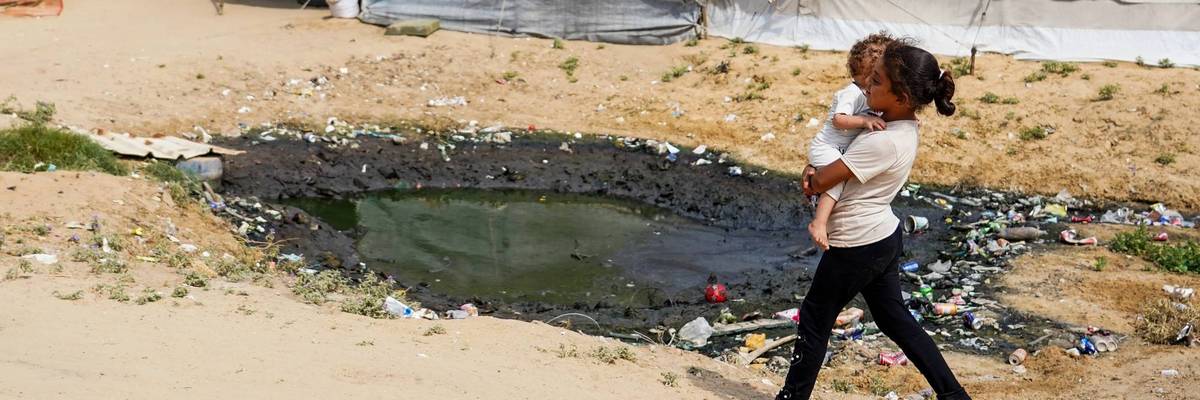
The report by Oxfam International and the Conflict and Environment Observatory (CEOBS)—titled "Environmental War Crimes: How Israel’s Military Assault Has Turned Gaza Into a Toxic Wasteland, Threatening Human Survival"—finds that while Israel's military onslaught has directly impacted about 78% of Gaza's land area, a spatial analysis identified indicators of potential contamination from heavy metals, residue from explosives, asbestos from destroyed buildings, dioxins, and biological contaminants across almost the entirety of Gaza—more than 99% of the exclave.
“Israel's ongoing genocide in Gaza includes military assaults on its environment, which are environmental war crimes threatening life now and for generations to come," said Amitabh Behar, executive director of Oxfam. "The destruction and contamination of Gaza will have fundamentally degraded the environmental conditions necessary for human safety and survival. This would breach Israel’s legal obligations under international humanitarian and human rights law."
The organizations used satellite imagery, remote sensing, scientific analysis, and other open-source data—including the United Nations Environment Program's estimate that Israel's US-backed assault had generated more than 61 million tons of debris across Gaza—to build a comprehensive picture of the exclave's contamination.
The highest levels of potential contamination were identified in Gaza City, Khan Younis, Rafah, Jabalia, and the Salah al-Din Road, which correspond closely "with the areas subjected to the most sustained bombardment, ground military operations, infrastructure destruction, and debris accumulation."
The destruction of buildings, wastewater treatment facilities, industrial and energy facilities, and waste-management systems "has released a complex mixture of contaminants," reads the report, including explosive residue, perchlorates, asbestos fibers, crystalline silica, persistent organic pollutants, and pathogens—all of which can then move through the air, soil, groundwater, and surface water.
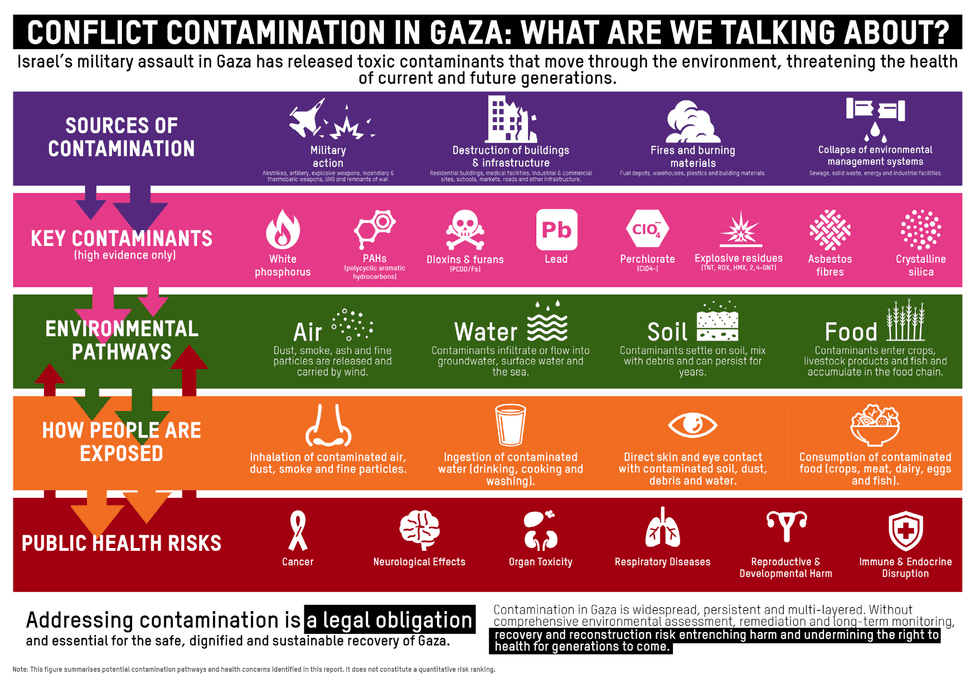 A graphic shows the public health risks associated with top contaminants found in Gaza, which Palestinians are being exposed to through a variety of interconnected pathways. (Image: Oxfam International)
"The population is likely to have been exposed to contaminants through multiple and interconnected pathways," the report continues.
Contamination described in the report include:
The analysis of the widespread, toxic contamination "contributes to the body of evidence relevant to the prohibition of deliberately inflicting conditions of life calculated to bring about the physical destruction of a protected group under Article II(c) of the Genocide Convention," reads the report. Top human rights groups and Holocaust scholars are among those who have argued that Israel's bombardment of Gaza amounts to a genocide, and South Africa has a genocide case against Israel before the International Court of Justice.
Lama Abdul Samad, a global water and sanitation specialist at Oxfam who was the lead author of the report, said that the widespread contamination is made even more difficult to address and mitigate because "unexploded ordnance continues to restrict safe access to most areas."
"The analysis highlights the urgent need for Israel to grant access for a detailed environmental assessment on the ground to clarify the risks to public health and identify options for urgent harm reduction measures," said Samad. "Restoration is likely to require extensive clearance, monitoring, and specialized remediation of affected areas from contaminants like explosive residues, organic pollutants, and heavy metals.”
Under international law, the report states, "the natural environment is not legally neutral... It is civilian in character and therefore protected."
"International humanitarian law explicitly protects both objects indispensable to civilian survival and the natural environment," the report continues. In Israel's attacks on Gaza, "the resulting contamination of groundwater, soil, air, and coastal waters is environmental harm that is legally relevant under international humanitarian law."
Oxfam called on Israel to allow a "full, independent, field-based Post-Conflict Environmental Assessment."
"Rebuilding without addressing environmental risks could expose Palestinians to entirely preventable harm," said Saeda Shaebat, the director of the Palestinian Environmental Quality Authority in Jerusalem.
Behar said that "Palestinians living in Gaza are being exposed to toxins in multiple ways through air, food, water, and via direct contact with contaminated soils and debris. These risks will persist for generations to come, unless clean-up, remediation, and recovery actions are prioritized.”
US government officials and commentators from both sides of the political aisle have insisted for years that Israel's assault on Gaza is targeted at Hamas fighters and have bristled at accusations that Israel, with US backing, is intentionally attempting to ethnically cleanse the exclave of Palestinians and make it uninhabitable for the population.
But one advocate for Palestinian rights said Monday that the "environmental war crimes" described in a new report on how Gaza's air, soil, and water have become toxic due to more than three years of relentless bombing—despite a ceasefire deal reached last year—are "also known as genocide."
The report by Oxfam International and the Conflict and Environment Observatory (CEOBS)—titled "Environmental War Crimes: How Israel’s Military Assault Has Turned Gaza Into a Toxic Wasteland, Threatening Human Survival"—finds that while Israel's military onslaught has directly impacted about 78% of Gaza's land area, a spatial analysis identified indicators of potential contamination from heavy metals, residue from explosives, asbestos from destroyed buildings, dioxins, and biological contaminants across almost the entirety of Gaza—more than 99% of the exclave.
“Israel's ongoing genocide in Gaza includes military assaults on its environment, which are environmental war crimes threatening life now and for generations to come," said Amitabh Behar, executive director of Oxfam. "The destruction and contamination of Gaza will have fundamentally degraded the environmental conditions necessary for human safety and survival. This would breach Israel’s legal obligations under international humanitarian and human rights law."
The organizations used satellite imagery, remote sensing, scientific analysis, and other open-source data—including the United Nations Environment Program's estimate that Israel's US-backed assault had generated more than 61 million tons of debris across Gaza—to build a comprehensive picture of the exclave's contamination.
The highest levels of potential contamination were identified in Gaza City, Khan Younis, Rafah, Jabalia, and the Salah al-Din Road, which correspond closely "with the areas subjected to the most sustained bombardment, ground military operations, infrastructure destruction, and debris accumulation."
The destruction of buildings, wastewater treatment facilities, industrial and energy facilities, and waste-management systems "has released a complex mixture of contaminants," reads the report, including explosive residue, perchlorates, asbestos fibers, crystalline silica, persistent organic pollutants, and pathogens—all of which can then move through the air, soil, groundwater, and surface water.
A graphic shows the public health risks associated with top contaminants found in Gaza, which Palestinians are being exposed to through a variety of interconnected pathways. (Image: Oxfam International)
"The population is likely to have been exposed to contaminants through multiple and interconnected pathways," the report continues.
Contamination described in the report include:
The analysis of the widespread, toxic contamination "contributes to the body of evidence relevant to the prohibition of deliberately inflicting conditions of life calculated to bring about the physical destruction of a protected group under Article II(c) of the Genocide Convention," reads the report. Top human rights groups and Holocaust scholars are among those who have argued that Israel's bombardment of Gaza amounts to a genocide, and South Africa has a genocide case against Israel before the International Court of Justice.
Lama Abdul Samad, a global water and sanitation specialist at Oxfam who was the lead author of the report, said that the widespread contamination is made even more difficult to address and mitigate because "unexploded ordnance continues to restrict safe access to most areas."
"The analysis highlights the urgent need for Israel to grant access for a detailed environmental assessment on the ground to clarify the risks to public health and identify options for urgent harm reduction measures," said Samad. "Restoration is likely to require extensive clearance, monitoring, and specialized remediation of affected areas from contaminants like explosive residues, organic pollutants, and heavy metals.”
Under international law, the report states, "the natural environment is not legally neutral... It is civilian in character and therefore protected."
"International humanitarian law explicitly protects both objects indispensable to civilian survival and the natural environment," the report continues. In Israel's attacks on Gaza, "the resulting contamination of groundwater, soil, air, and coastal waters is environmental harm that is legally relevant under international humanitarian law."
Oxfam called on Israel to allow a "full, independent, field-based Post-Conflict Environmental Assessment."
"Rebuilding without addressing environmental risks could expose Palestinians to entirely preventable harm," said Saeda Shaebat, the director of the Palestinian Environmental Quality Authority in Jerusalem.
Behar said that "Palestinians living in Gaza are being exposed to toxins in multiple ways through air, food, water, and via direct contact with contaminated soils and debris. These risks will persist for generations to come, unless clean-up, remediation, and recovery actions are prioritized.”