

SUBSCRIBE TO OUR FREE NEWSLETTER
Daily news & progressive opinion—funded by the people, not the corporations—delivered straight to your inbox.
5
#000000
#FFFFFF
To donate by check, phone, or other method, see our More Ways to Give page.
Daily news & progressive opinion—funded by the people, not the corporations—delivered straight to your inbox.

Voters just asked Congress to slow down. The permitting legislation would do the opposite.
Earlier this month, voters took to the polls and overwhelmingly voiced their desire to slow the build-out of data centers in their communities. Now, a debate is raging about what the Bipartisan American Affordability and Jobs Act (BAAJA)—the permit reform bill that has passed the Senate and now awaits consideration in the House—will mean for data centers.
After carefully considering all 500 pages of the bill, NRDC experts weigh in with our conclusion: BAAJA will make data centers pay for grid upgrades, but it will also make it easier to build infrastructure projects of all kinds, including pipelines and data centers, and harder to stop or improve them. Data centers are in a race to get online faster, and “speed to power” is often their biggest constraint. Unsurprisingly for a bill that includes many of the Data Center Coalition’s highest priority asks, BAAJA will ease that constraint in multiple ways.
Learn More
All of these changes significantly undermine the states’ abilities to protect their residents and natural resources and the communities’ abilities to meaningfully participate in decisions about where and how data centers are built. They also substantially curtail the role of Tribes in assessing projects that directly affect their sovereign interests.
Many BAAJA supporters have described it as a bill that will make data centers pay their own way. Section 2107(a) of the bill does protect residential customers and businesses from paying for federally regulated grid upgrades triggered by data centers. However, BAAJA does not protect people from other data center–driven costs, like higher wholesale electricity prices, increased gas utility bills, or more expensive supply chain components.
NRDC works to safeguard the earth--its people, its plants and animals, and the natural systems on which all life depends. We combine the power of more than three million members and online activists with the expertise of some 700 scientists, lawyers, and policy advocates across the globe to ensure the rights of all people to the air, the water, and the wild.
(212) 727-2700
The Centers for Medicare and Medicaid Services proposed letting insurance giants automatically enroll seniors in privatized Medicare Advantage plans.
The Trump administration on Wednesday proposed allowing corporate health insurance giants to automatically enroll seniors who are newly eligible for Medicare in for-profit Medicare Advantage plans, drawing immediate backlash from advocates who say the scheme is part of a broader effort to privatize Medicare.
The proposal from the Centers for Medicare and Medicaid Services (CMS) appears in an 868-page rule published in the Federal Register. CMS says it is considering allowing Medicare Advantage providers such as UnitedHealthcare and Aetna to "implement a seamless continuation of coverage enrollment process in which a newly Medicare-eligible individual enrolled in a commercial or marketplace plan it offers may be deemed to have elected an MA plan offered by the same organization."
The automatic enrollment system would apply to people who purchase a marketplace plan offered by an insurer that also provides MA plans, which are notorious for massively overbilling the federal government and denying necessary care.
Companies would have to get CMS approval before "engaging in use of the seamless enrollment mechanism," the proposal states. They would also have to give "advance notice to the individual of the organization's intent to seamlessly enroll them into an MA plan."
The Trump administration's proposal, which aligns with an idea pushed by the far-right Project 2025 initiative, is open for public comment until January 19, 2027.
"This administration is hell-bent on privatizing Medicare as fast as possible, especially after the shellacking they received in the midterms. We are going to fight them tooth and nail at every turn," Alex Lawson, executive director of the progressive advocacy group Social Security Works, told Common Dreams. "We are going to mobilize a flood of public comments opposing this rule, and make sure seniors are aware of the Trump administration's schemes to privatize Medicare."
Wendell Potter, a former health insurance executive who now champions Medicare for All, warned that "if the administration moves forward on this, it most certainly will lead to a much more rapid privatization of Medicare."
Potter noted in a blog post that Congress and CMS previously allowed insurers to automatically enroll seniors in MA plans if they did not opt out when notified. "Seniors and advocates said those notices were easy to miss in the pile of mail new retirees get from companies trying to sign them up," he observed.
Under the new proposal, Potter wrote, "CMS is considering requiring insurers to get agency approval and give people at least 60 days’ written notice with instructions for opting out."
"The winners would be the companies that sell both commercial or Obamacare coverage and Medicare Advantage," wrote Potter. "That includes UnitedHealthcare, Aetna, Elevance (which operates Anthem Blue Cross plans), and Centene. People who just turned 65 are among the cheapest Medicare enrollees to cover. Default enrollment would hand them over without the marketing costs or broker commissions insurers pay to win them now."
CMS is headed by Mehmet Oz, who previously voiced support for a proposal dubbed "Medicare Advantage for All."
The Trump administration outlined its plan as congressional Democrats increasingly coalesced around a push to expand traditional Medicare by lowering the eligibility age, insuring all children, and adding dental, hearing, and vision coverage. The lack of such coverage in traditional Medicare is one of the reasons that more than half of the Medicare-eligible population is currently enrolled in an MA plan.
"Instead of privatizing Medicare, we need to expand Medicare by adding vision, hearing, and dental coverage as well as an out-of-pocket cap," said Lawson. "We need to take on the massive overpayments that privatized Medicare companies receive and prevent their deadly delays and denials. And we must stop the Trump administration's schemes to introduce these same delays and denials into traditional Medicare. We will not stop until everyone in America has guaranteed, high-quality healthcare."

"States have a legal and moral duty to pressure Israel's government to stop the ongoing genocide against Palestinians in Gaza, protect the rights of women and girls, and address gendered crimes."
Nearly two years after Amnesty International concluded "unequivocally" that Israel was committing genocide in the Gaza Strip, the human rights group on Wednesday published an analysis exposing the "profound gendered dimensions" of the ongoing and systematic violence against Palestinians.
The report provides "new details about the brutal harms inflicted on women and girls that continue to devastate their lives and cause agonizing suffering despite the so-called ceasefire," said Amnesty secretary general Agnès Callamard.
Published on the International Day for the Elimination of Violence Against Women, "No Conditions for Life" lays out how "Israeli forces have killed thousands of women and girls, an average of roughly 30 a day before the so-called ceasefire, many through attacks that violated international humanitarian law, and also indirectly caused the death of an unknown number of additional women and girls through its unlawful blockade."
Since the Israel Defense Forces (IDF) began their retaliation for Hamas' October 2023 attack, various United Nations reports highlighted that a significant share of the fatalities in Gaza are women and children. The Amnesty report notes that as of October 1, the overall death toll had reached at least 74,237, including 13,299 women and 9,032 girls. That's 22,331 female fatalities, or 30.1% of the total.
Despite a "ceasefire" agreed to over a year ago, the death toll has continued to rise. As of Monday, at least 74,746 Palestinians were dead and 176,234 wounded, according to local authorities. Experts warn the true toll is likely far higher.
Wednesday's "harrowing" report features firsthand accounts of several survivors, including from "one of the deadliest strikes documented by Amnesty International," which was "on the Abu Nasr family home in Mashrou' Beit Lahia" on October 29, 2024. An estimated 240 relatives were staying in a five-story building until an Israeli airstrike killed 137 of them: 38 women, 44 men, 31 boys, and 24 girls.
"I woke up to a strike on my back," said 51-year-old Afaf, who lost her mother, husband, five children, and two grandchildren. "I found myself slipping into a hole. My daughter was next to me; her children were screaming, and my daughter-in-law was breathing her last. Only two of my children survived; the rest were all killed."
For those like Afaf who have lived through the years of bombings, raids, and limited humanitarian aid, "women and girls have been forced into a daily struggle for survival marred by grief, trauma, violence, repeated displacement, extreme deprivation, fear, and profound loss," says the Amnesty report. "They have been deprived of access to essential healthcare, including sexual and reproductive healthcare, and put at increased risk of gender-based violence."
"Israel's actions have also severely undermined Palestinians' ability to make decisions about if and when to have children, to conceive, carry pregnancies to term, and give birth safely," the report continues. "Women and girls in Gaza have experienced these harms cumulatively and repeatedly, resulting in devastating levels of physical, mental, and reproductive harm."
One survivor who used the name Sara for the report went into labor at a northern Gaza school where she'd sought shelter on December 6, 2023. She was forced to walk several hundred meters to Al-Awda Hospital—which, like other healthcare facilities across the exclave, has been repeatedly attacked by the IDF. Sara made the trek "with the assistance of her mother-in-law, along with an injured man and his father, carrying a white flag together," the report details.
"Suddenly, I heard gunfire, and my mother-in-law fell to the ground. I looked at her and saw that a bullet had entered the back of her head and exited through her forehead. She died instantly. I froze for a moment, then I started running, all while having strong contractions," Sara recalled. "The medical staff received me while I was still in shock."
"I did not feel the baby as he was delivered," she said. "I did not feel anything at all. I kept telling them that my mother-in-law was outside and asked if anyone could help her. I was still hoping she might be alive. They told me that no one could leave the hospital. The staff asked everyone to go inside, and they closed all the doors. They said the Israeli forces were getting closer and had taken positions in the houses surrounding the hospital."
Sara added that "right after I gave birth, they placed me in a room to rest. About an hour later, snipers fired directly at the room. I remember five bullets hitting the room. It was a miracle that neither my baby nor I was hit... I had to remain in the hospital under total siege for 18 days... No one felt safe inside the hospital. Snipers were positioned all around it, shooting at anyone who moved. I saw a cleaner shot and killed in front of me."
Another woman who shared her story with Amnesty is 37-year-old Ola, who gave birth in November 2023 in Gaza City. Shortly after that, some relatives, including her 14-year-old son, were killed in an airstrike, and the survivors were forcibly displaced.
"I was recovering from a cesarean section. I walked toward al-Falah School but left shortly before it was hit. We then went to another relative’s home near the school that was struck. We spent a night of terror and were then displaced to the south," she explained. I walked about 14 km [8.7 miles] on foot while recovering from the cesarean. I would walk two steps, then sit down to rest. I left with my husband’s brother’s children; they had lost both parents, and I had to take care of them. I, so in need of care myself, had to care for orphans and my own children and to walk with them."
The report stresses that "women's unmet reproductive health needs, gendered caregiving responsibilities, and pre-existing inequalities have intensified the harm they have endured. These violations have been an integral part of Israel's genocide against Palestinians in Gaza."
Amnesty estimated that "at least 85 Palestinian women and girls from Gaza have been held in Israeli detention facilities in Israel or the occupied West Bank and released back to Gaza" since October 2023. The group said that "the conduct described—particularly repeated, invasive strip searches involving forced nudity, and sometimes blindfolds, handcuffs, and exposure to male guards or cameras, as well as threats of rape—amounts to cruel, inhuman, or degrading treatment and sexual violence under international law. Several women Amnesty International interviewed also described being forced to kiss flags or sing humiliating songs."
While the Israeli agency COGAT told Agence France-Presse that Amnesty was "echoing Hamas' false narratives" and pointed to the medical equipment and medicine that have entered Gaza since the deal reached last year, Callamard said that "our report further demonstrates that even after the so-called ceasefire between Hamas and Israel in October 2025, Israel has continued to commit genocide, by deliberately inflicting on Palestinians in Gaza conditions of life calculated to bring about their physical destruction and causing serious bodily and mental harm to them."
Israel faces an ongoing genocide case led by South Africa at the International Court of Justice, and the International Criminal Court (ICC) has issued arrest warrants for Israeli Prime Minister Benjamin Netanyahu—who may soon be out of a job after last month's election—and his former defense minister, Yoav Gallant.
"Over the past three years, Israel has demonstrated an unending calculated intent to destroy Palestinians in Gaza," Callamard said. "States have a legal and moral duty to pressure Israel's government to stop the ongoing genocide against Palestinians in Gaza, protect the rights of women and girls, and address gendered crimes. They must use all means at their disposal to dismantle the structures enabling Israel's unlawful occupation and system of apartheid."
"This includes immediately halting all arms transfers to Israel, imposing targeted sanctions on Israeli officials implicated in genocide and other crimes under international law, and ensuring that businesses do not contribute to or profit from Israel’s unlawful conduct. They must do everything to ensure Israeli officials responsible for crimes are investigated and prosecuted," she added, calling on countries to support the ICC and ensure Netanyahu faces the court's judges.

"With Chuck Schumer having a lower public approval rating at this moment than Trump does, there is a very good chance that we can vote for a new leader," said actor Mark Ruffalo.
If Democratic voters were in charge of picking the next Senate majority leader, it appears Sen. Chris Van Hollen would be in position to win a landslide victory.
An Economist/YouGov poll released Tuesday finds that 40% of Democratic voters prefer Van Hollen (D-Md.) to take over as leader of the Democratic Senate caucus next year, versus just 19% who support current Senate Minority Leader Chuck Schumer (D-NY).
People who voted for former Vice President Kamala Harris for president in 2024 are even more supportive of Van Hollen, with 48% saying they prefer the Maryland Democrat as the next Senate leader, versus just 18% who express support for Schumer.
Actor Mark Ruffalo on Wednesday pointed to polling on Schumer's favorability and urged progressives to push their senators to back Van Hollen.
"As of right now, the majority of Democratic senators are undecided, and they're listening to what their constituents are saying," Ruffalo said in a video posted on social media. "And with Chuck Schumer having a lower public approval rating at this moment than [President Donald] Trump does, there is a very good chance that we can vote for a new leader."
Chuck Schumer has a lower public approval rating than Trump. Read that again.We voted for a big blue wave for big blue CHANGE—and now we need Democrats in the US Senate to answer that call by electing Senator @vanhollen.senate.gov as Majority Leader.Call your Senators now at 877-219-6902!
— Mark Ruffalo (@MarkRuffalo) November 25, 2026
An unofficial Senate leadership whip count published by Drop Site suggests Van Hollen still has an uphill climb to securing the votes needed to become leader next year.
According to Drop Site's tally, Schumer currently has 16 Democratic senators either committed to or leaning toward voting for him, versus just nine senators committed to or leaning toward Van Hollen.
Van Hollen last week said that the race for Senate leader was still wide open, claiming to have secured the backing of around 15 Democratic senators.
Multiple progressive advocacy organizations, including Our Revolution, Indivisible, and MoveOn, have officially endorsed Van Hollen, as have major labor unions, including the International Association of Machinists and Aerospace Workers and National Nurses United.

"The American people want a breakup with Israel."
An advertisement urging the United States to cut off military aid to Israel is set to air during NBC’s "Saturday Night Live Thanksgiving" special on Wednesday evening, as new polling shows growing support for ending the transfer of weapons used in a US-backed genocide of Palestinians.
The 30-second spot, titled “Every Three Seconds,” was produced by the Institute for Middle East Understanding (IMEU) Policy Project. It directs viewers to a website where they can urge Congress to block President Donald Trump’s reported plan for a new five-year, $19 billion arms agreement with Israel.
The title of the ad—which features a young girl who works to save $400 for a bicycle over the course of a year—refers to the current US-Israel military aid agreement, a 10-year, $38 billion memorandum of understanding signed by former President Barack Obama that expires in 2028. That amounts to roughly $400 in US taxpayer funding every three seconds.
According to IMEU Policy Project:
A poll also released today by IMEU Policy Project and conducted by YouGov, and first reported in Semafor, found that 56% of Trump 2024 voters who abandoned Republicans in the midterms support blocking the transfer of bombs to Israel. 59% support reducing or ending all military aid to Israel.
42% say Trump has been too supportive of Israel, compared with just 12% who say he has not been supportive enough. Another 46% say support has been at the right level.
The poll surveyed 636 Trump 2024 voters who either did not vote in 2026 or cast a ballot for a candidate besides the Republican in at least one federal race. The survey was fielded from November 4-18 and has a margin of error of +/- 4.3%.
"Israel's collapsing support is not just a Democratic Party issue. It is happening across the political spectrum," IMEU Policy Project executive director Margaret DeReus said in a statement. "Any candidate—Democrat or Republican—who refuses to stand up to the Israeli government’s demands for blank checks and endless war in the Middle East is putting their seat at risk."
"Democrats didn’t learn that lesson in time in 2024," she added. "Republicans didn’t learn that lesson in time in 2026, and the 2028 election will hinge on which party accepts this basic fact first: The American people want a breakup with Israel.”
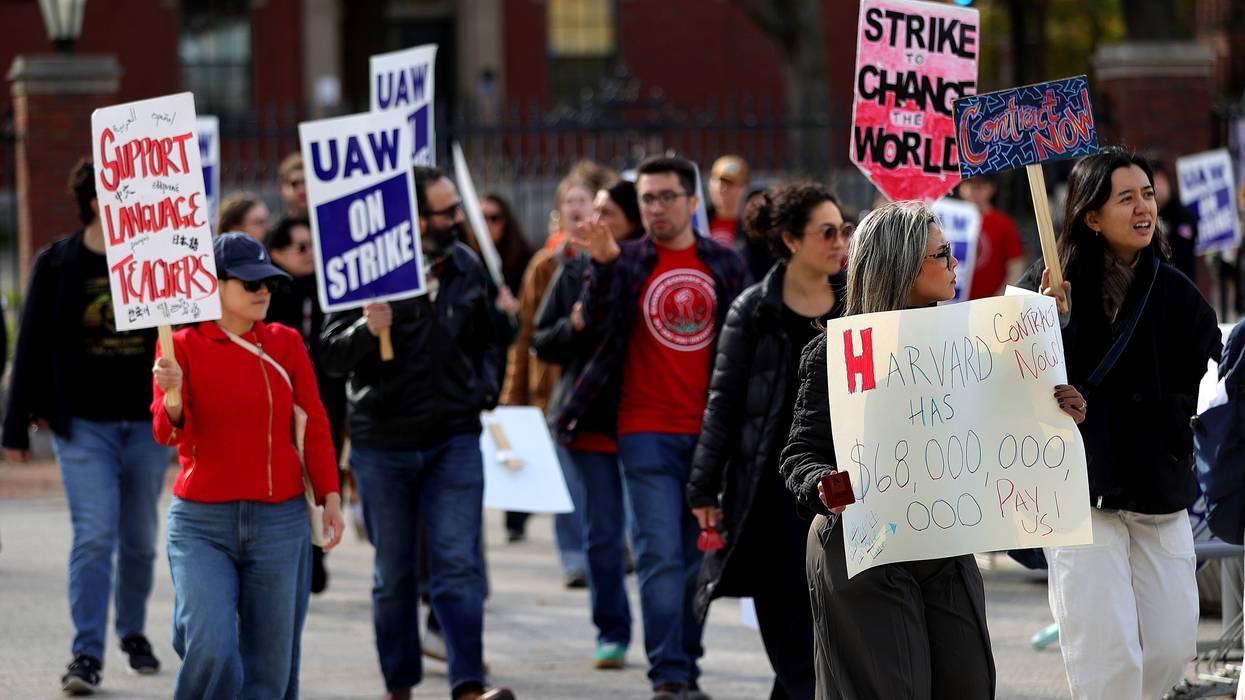
"I've never crossed a picket line, and I don't intend to start," said incoming Rep. Sam Forstag, a former Montana labor leader.
Fifty-three Democrats newly elected to the US House of Representatives said Tuesday that they plan to skip Harvard University’s orientation for incoming lawmakers in December unless the school reaches a “fair contract” with striking student workers.
In a letter sent Tuesday, the lawmakers—who make up about three-quarters of the 73 new House Democrats elected this cycle—said the biennial program, which Harvard has hosted since 1972, “seems like a truly fantastic bipartisan opportunity” to learn from the prestigious university.
“However, as much as we would like to attend, we have been informed that to attend your event, we would be required to cross a union picket line,” they wrote to university president Alan Garber, Harvard Kennedy School director of programs and events Jacob Watts, and provost John Manning.
The Harvard Graduate Students Union-United Auto Workers (HGSU-UAW), which represents more than 4,000 graduate and undergraduate student workers, has been on strike since October 27.
After more than 20 months of contract negotiations, thousands of teaching fellows, research assistants, and other hourly student workers walked out for the second time this year because Harvard had failed to meet the union’s demands for higher wages and benefits, protections for noncitizen workers, and an independent process for handling harassment and discrimination complaints, according to The Harvard Crimson.
"As newly elected members of the 120th Congress, we were elected because of our commitments to helping working people, and we remain steadfast in our support for unions and collective bargaining," the lawmakers wrote. "So long as these workers are on strike, any trip we take to Harvard would be to stand in solidarity with our striking union siblings."
NEW: Fifty-three Democrats elected to Congress this month said Tuesday that they would skip Harvard’s orientation for incoming lawmakers as long as the University’s graduate student workers remain on strike.José Luis Ortega Castro reports.https://t.co/YDEVlQr2di
— The Harvard Crimson (@thecrimson) November 24, 2026
Support from union members was a critical factor in Democratic victories across the map in November. According to the AFL-CIO, the nation’s largest labor federation, a record 639 card-carrying union members were elected in federal, state, and local races around the country.
Three longtime union organizers and leaders elected to the House this month spearheaded the Harvard boycott: Montana smokejumper Sam Forstag, former vice president of National Federation of Federal Employees Local 60; New York UAW organizer Claire Valdez; and Bob Brooks, president of the Pennsylvania Professional Fire Fighters Association.
“I’ve never crossed a picket line, and I don’t intend to start,” Forstag said in a video posted Tuesday. "Harvard has an endowment of $68 billion. They can afford to pay people a living wage."
The union has asked for annual pay of at least $53,800 for salaried graduate workers, $45,000 for graduate teaching fellows, and for hourly workers to make at least $24 per hour. It also wants pay to increase by 4.5% each year.
According to the UAW, some graduate teaching fellows currently earn just $26,000 annually, low enough to qualify for food assistance in Massachusetts in some cases. The school’s endowment, meanwhile, increased by $11 billion this year.
“Elite universities are unimaginably wealthy, and they massively underpay their graduate students, substituting real compensation for the hope of eventually landing an elite faculty job,” said Rep.-elect Daniel Biss (D-Ill.), another incoming lawmaker who signed the letter. “They even often insist grad students aren’t workers, even though they give their labor (teaching and research) in exchange for money.”
In the letter, the lawmakers said they’d reconsider attending the orientation, scheduled for December 6-8, if the university agreed to a fair contract with the workers.
Forstag told the school's administrators, "If me and so many other members of Congress are going to be making a trip out there in December, it's going to be to join our brothers and sisters on the picket line until and unless you engage in good faith in contract negotiations and give those workers a fair deal."
Solidarity isn’t just something we talk about. It’s something we do.To the workers on strike at Harvard: we’ve got your backs. ✊ https://t.co/PWggeatMQj
— Sam Forstag (@SamForstag) November 24, 2026
Harvard receives hundreds of millions of dollars from the federal government each year to support scientific and medical research.
“The richest university in the world should be able to pay its workers a fair wage,” said Denish Jaswal, the president of HGSU-UAW. “It is not too much to ask for Harvard to protect noncitizen workers and to create a workplace free from harassment and discrimination. If Harvard is going to be asking newly elected members of Congress for funding, Harvard shouldn’t be surprised when those same members demand that Harvard treats its workers with dignity.”
Jaswal told The Boston Globe that the support from newly elected Democrats was “incredibly telling, and it really sets a strong tone that is positive for labor that they reached out to us, and that this is their first act to support us.”
Other Massachusetts Democrats have also expressed support for the picketers, including Sens. Elizabeth Warren and Ed Markey, incoming House Majority Leader Katherine Clark, and Rep. Ayanna Pressley.
"We stand with the Harvard Graduate Students Union and the Harvard Academic Workers as they strike and fight for good wages, workplaces free of harassment, and a university that works for all," they said in a joint statement last week.
Rep. Chris Deluzio (D-Pa.), who helped to organize faculty at the University of Pittsburgh with the United Steelworkers before being elected to Congress in 2022, praised his incoming colleagues' unapologetic stand with organized labor.
"Being pro-worker means knowing which side of a picket line to stand on," he said, adding that it was "great to see" Forstag, Brooks, and Valdez "leading so many new members in solidarity."
Rep.-elect Brad Lander (D-NY), who also signed the letter, congratulated his colleagues on their pro-union leadership. Democrats plan to prioritize passing the landmark Protecting the Right to Organize Act, or PRO Act, after retaking Congress in January.
Lander said, "Let’s make this the most pro-labor Democratic majority in generations."
The other Democrats who signed the letter are Darializa Avila Chevalier (NY), Mitchell Berman (Wis.), Adrian Boafo (Md.), Victoria Broderick (Tenn.), Luke Bronin (Conn.), Jasmine Clark (Ga.), Paige Cognetti (Pa.), Cait Conley (NY), Pia Dandiya (Fla.), Zach Dembo (Ky.), J.D. Ford (Ind.), La Shawn Ford (Ill.), Patty Garcia (Ill.), Oliver Gilbert (Fla.), Angela Gonzales-Torres (Calif.), Adam Hamawy (NJ), Frederick Haynes III (Texas), Christina Hines (Mich.), Jacqui Irwin (Calif.), Lindsay James (Iowa), Cyril Jefferson (NC), Jake Johnson (Minn.), Eric Jones (Calif.), Melat Kiros (Colo.), Kristina Knickerbocker (Ohio), Dan Koh (Mass.), Brad Lander (NY), Micah Lasher (NY), William Lawrence (Mich.), Don Leonard (Ohio), Ben McAdams (Utah), Mike McGuire (Calif.), Donavan McKinney (Mich.), Donna Miller (Ill.), Jeremy Moss (Mich.), Katy Padilla Stout (Texas), Richard Pan (Calif.), Brian Poindexter (Ohio), Denise Powell (Neb.), Chris Rabb (Pa.), Janelle Sarauw (US Virgin Islands), Hilda Solis (Calif.), Sarah Trone Garriott (Iowa), Randy Villegas (Calif.), Marni von Wilpert (Calif.), Fred Wellman (Mo.), Robert White (DC), Scott Wiener (Calif.), and LaKesha Womack (NC).

"Attorney General Blanche seemed unable to explain his failure to render even basic due diligence in this case," said Democratic Rep. Jamie Raskin.
US President Donald Trump said Tuesday that he would be open to pardoning newly reinstated Nvidia CEO Jensen Huang for any potential crimes as top officials at the Justice Department dodged questions about whether Huang is currently—or was ever—facing a federal investigation.
Trump, whose investment accounts hold hundreds of thousands of Nvidia shares, told the New York Post that a pardon is "always an option" should Huang—a close ally of the White House and one of the richest men in the world—face charges during the remainder of the president's second term. The president added that he doesn't think a pardon will "be necessary."
"I’ve always found him to be 100% aboveboard and, you know, a very smart person," said Trump, a convicted felon who has been accused of turning the pardon process into a pay-to-play racket.
The president's remarks came as US Attorney General Todd Blanche, who previously worked as Trump's personal lawyer, gave bizarrely evasive responses to questions about Huang during a news conference on Tuesday.
"What does that mean?” Blanche said after a reporter asked whether Huang had been investigated by the DOJ. Huang, who was reinstated as Nvidia CEO less than two weeks after resigning earlier this month, has been accused of violating US export laws and potentially compromising the country's national security with one of his several extramarital affairs.
"For what?" the attorney general asked the reporter, adding that he never saw any suggestion in news reports or "leaks" that Huang was under investigation. (On Monday, Trump told CNBC that the Justice Department "did a pretty good investigation" and concluded that Huang was "exonerated.")
Watch Blanche's comments:
Rep. Jamie Raskin (D-Md.), who is in line to chair the powerful House Judiciary Committee in the new Congress, slammed Blanche for playing "dumb" in response to basic and important questions about Huang and Nvidia, which the attorney general called "a good corporate citizen."
"Attorney General Blanche seemed unable to explain his failure to render even basic due diligence in this case," said Raskin. "When the president claimed Huang had been ‘exonerated,’ what was his basis for that sweeping conclusion, and exonerated for what, exactly? Was the conclusion based on real facts and evidence or simply a reflection of the fact that the president, [Commerce Secretary Howard] Lutnick, and others have converging personal, political, corporate and financial interests in making sure Huang stays put and the secret pipeline for our most sensitive AI chips to go to China stays securely covered up?"
"Do they just want to sweep the whole matter under the rug?" the Maryland Democrat added. "While the Attorney General turns a blind eye to alleged espionage, circumvention of export laws, and rampant corruption in the Administration, Congress is stepping in to get all the facts and to use our legislative powers to protect the battered interests and laws of the American people.”

"Trump has made life in America far too expensive. Today’s report shows once again that families are paying the price for his so-called 'Big Beautiful Bill,’ his tariff taxes, and his disastrous war in Iran," said US Rep. Brendan Boyle.
The Trump administration on Wednesday unveiled a sweeping new package of tariffs, even as data released by the US Bureau of Economic Analysis showed inflation accelerated over the last month.
As reported by The New York Times, the latest Trump tariffs target "imports from dozens of countries, including China, Japan. and the members of the European Union." Among the new duties is "a 20% tax on some imports from China" that could rise as high as 40% in the coming months.
The new tariffs were announced just as the latest personal consumption expenditures (PCE) price index, which is the US Federal Reserve's preferred measure of inflation, showed that prices in October posted a yearly gain of 3.8%, or nearly double the central bank's 2% target rate.
Heather Long, chief economist at Navy Federal Credit Union, noted in a social media post that the headline rate increase of 3.8% was higher than the so-called "core" rate, which excludes food and energy prices.
"It's yet another reminder that the inflation problem right now goes beyond a mere energy shock," Long wrote. "Price pressures are spreading out across the economy."
Long also pointed out that inflation-adjusted consumer spending was flat last month, a sign that "months of elevated inflation is taking a toll."
Rep. Brendan Boyle (D-Pa.), who is in line to become the chair of the House Budget Committee next year, called the latest PCE data a reflection of Trump's economic mismanagement.
" Donald Trump has made life in America far too expensive," the Pennsylvania Democrat said. "Today’s report shows once again that families are paying the price for his so-called ‘Big Beautiful Bill,’ his tariff taxes, and his disastrous war in Iran."
Boyle warned that "things could get even worse for millions of Americans" next year "as some of Trump’s most devastating healthcare and food assistance cuts take effect," a reference to cuts made in the 2025 GOP budget law to both Medicaid and the Supplemental Nutrition Assistance Program.
"As the next Chairman of the House Budget Committee, I’ll fight like hell to reverse these cruel cuts and make life more affordable," Boyle said.
During a Wednesday interview on Fox Business, National Economic Council Director Kevin Hassett was grilled by host Ashley Webster about why the administration is slapping more tariffs on imported goods even as Americans are still struggling with price increases.
FOX BUSINESS: Let's talk about these new tariffs. Critics will say this will just push up the cost of household items for people. Give me the reasoning behind it.HASSETT: What we've seen over and over with the tariffs is that the exporters have been more or less eating the price. Inflation has gone way way down.FOX: Inflation year over year is up 3.8%, which is the highest since May 2023
— Aaron Rupar (@atrupar) November 25, 2026
"Critics will say this is going to be something that is going to jack up the price of goods here in the US," Hassett said. "But what we've seen over and over with the tariffs over the last couple of years is that the exporters have been more or less eating the price... And so inflation has gone way, way down over the last couple of years."
Webster, however, was not buying Hassett's spin.
"Inflation year-over-year is up 3.8%, which matches May's reading," he said, "which was the highest month since May 2023."
Rep. Don Beyer (D-Va.) said the latest Trump tariffs show the need for the next US Congress to reassert its control over taxation policy.
"Responding to the nationwide rejection of Trump’s tariffs on election day by raising them further under the pretense of a sham investigation," Beyer said, "shows that Congress can’t leave these authorities in the hands of the president.”

"Imagine packing up your kids and leaving home the day before Thanksgiving because the Army is about to set off a blast that could send toxic lead dust over your neighborhood," said one US lawmaker. "That’s what families near Middletown, Iowa, are being asked to do."
The US Army detonated roughly 5 tons of degraded lead azide inside a military installation in the town of Middletown, Iowa on Wednesday morning, despite protest and outrage voiced by nearby residents, environmentalists, and lawmakers who warned that not enough had been done to safeguard communities from the fallout expected from the explosion and resulting toxic plume.
A plume of smoke could be seen rising over the area after witnesses on the ground reported feeling two or three explosions in quick succession.
The US Army said it would hold a press conference later Wednesday morning to offer an update on the controlled detonation.
Ahead of the operation, lawmakers and other critics voiced their concerns about the manner in which it was carried out and the potential harms to communities impacted by the chemicals unleashed by the explosion.
"Imagine packing up your kids and leaving home the day before Thanksgiving because the Army is about to set off a blast that could send toxic lead dust over your neighborhood," Congresswoman Chellie Pingree, a Democrat from Maine, said Tuesday night after a judge, in response to a lawsuit by environmental groups, ruled Monday that the Army could proceed with the controlled detonation.
"That’s what families near Middletown, Iowa, are being asked to do," added Pingree. "How on earth did the Army let it get this far?"
Local outlet KCRG on Wednesday morning posted a live video feed from outside the military facility in Middletown:
- YouTube
As the New York Times reports, with no legal challenges left to stop the detonation, area residents had no choice but to prepare the best they could:
The tiny farming town of Middletown, Iowa, felt like it was bracing for a cyclone on Tuesday, a day before the Army plans to detonate nearly five tons of dangerously degraded explosives.
People who live closest to the blast site at the 19,000-acre Iowa Army Ammunition Plant were covering their windows with blue tape to keep them from shattering when the big bang happens at 9 a.m. Wednesday.
Others were checking weather forecasts to see whether the wind would carry a toxic plume of lead dust toward their homes and farms. Pregnant women and parents of young children—who are particularly vulnerable to lead exposure—agonized over whether they should ride it out, shutting themselves inside, or escape southeastern Iowa altogether a day before Thanksgiving.
Local residents like Lucy Giehl, who spoke to CBS News, said people in her town of Burlington, which is downwind from Middletown, are woefully unprepared and that the advice she received from military officials about how to best mitigate the potential harms have not be reassuring:
Lucy Giehl, a resident in Burlington, Iowa, a city that sits about 9 miles away from the ammunition plant where the Army plans to detonate about 5 tons of degraded lead azide on Wednesday, said a plant spokesperson told her to use a baby wipe or “hose everything down and it’ll go away,” after the controlled detonation.“People are completely unprepared,” Giehl said, after worrying about whether it would be safe to let her dogs in the yard if there is “raining lead” in her community.The plume, which has the potential to threaten homes, playgrounds, farmlands and other spaces, could travel as far as 100 miles from the plant in Middletown, the Army said.
— CBS News (@CBSNews) November 25, 2026
During a press conference on Tuesday, Maj. Gen. Eric Shirley, the Army’s leader of the operation, told reporters that "inaction was no longer an option."
Shirley explained that "there's not a way to remediate, safely for the public, the removal of this lead azide beyond the controlled demolition that we have fully planned for and are prepared to safely execute."
Army explains to decision to detonate lead azide in Iowa following backlash
In the state capital of Des Moines on Tuesday night, protesters gathered outside the State House to oppose the detonation and demand further transparency and accountability from the Army and other relevant federal agencies.
Protesters held signs that read "Iowa Is Not a Sacrifice Area" and "No Lead in Our Air" as they denounced what some of those in attendance described as a "lead bomb" being dropped on the state
Paige Iverson, co-chair of Central Iowa Democratic Socialists of America (DSA) and an attendee of the protest, told Status Coup News that the US Army should suspend the detonation until it can "prove beyond a reasonable doubt" that this manner of disposing of the dangerous chemicals "is the safest available option at this time" and not just the most expedient.
"We need proof this is not just the cheapest or easiest solution for the Army," she said.
LIVE: Protesters DEMAND Army Stop TOXIC LEAD BOMB https://t.co/y4ZsAUZq5h
— Status Coup News (@StatusCoup) November 25, 2026
In a social media post Tuesday night, Sen. Jeff Merkley (D-Ore.) said it was "outrageous" for the court to greenlight "Trump’s hugely dangerous plan to detonate tons of lead bomb-making material" in Middletown. "We know there’s no safe level of lead," Merkley said. "This is a rushed, mismanaged plan that is putting thousands of people at risk!"
In her remarks, Pingree decried that the EPA under the Trump administration "recently raised the level of lead in children’s blood it uses to set soil cleanup goals," an ominous policy change given the situation in Iowa.
"There is NO SAFE LEVEL OF LEAD in a child’s blood," Pingree said. "These relaxed thresholds mean it will be harder for those impacted to secure government-led cleanup or pursue contamination claims. We need a full investigation into how this became an emergency and whether the Army passed up safer ways to dispose of these explosives. The Army and EPA owe these communities answers, public test results, and a commitment to clean up any contamination the blast leaves behind."

"As currently drafted, BAAJA would help fast-track data center development on federal lands and severely limit public input into these projects."
A group of House Democrats who lead key congressional panels urged their colleagues on Tuesday to vote against fossil fuel industry-backed permitting reform legislation that's expected to hit the floor next week, warning the bill is "fatally flawed" and would undermine Tribal sovereignty, weaken bedrock environmental laws, and accelerate data center development.
The new letter's signatories include Rep. Jared Huffman (D-Calif.), the top Democrat on the House Natural Resources Committee, and Rep. Teresa Leger Fernández (D-NM), the top Democrat on the House Subcommittee on Indian and Insular Affairs. The letter spotlighted provisions of the Senate-passed Bipartisan American Affordability and Jobs Act (BAAJA) that assail the National Historic Preservation Act (NHPA), the Clean Water Act, and the Endangered Species Act to speed federal approval of energy projects, including climate-wrecking gas pipelines and data centers.
On the data center issue, which has generated national uproar across party lines, the letter welcomed "provisions of the bill that would help protect ratepayers from data center development." But the Democratic signatories reject as "simply false" the claim by bill supporters that the legislation "does nothing to help ease federal permitting for data centers." Sen. Sheldon Whitehouse (D-RI), one of the lead Democratic sponsors of BAAJA, has dismissed concerns about the bill's data center provisions as "ghost stories" and said the bill is critical to boost clean energy production.
The seven Democrats behind the new letter noted that the Bureau of Land Management is "actively considering at least 17 data centers on federal lands."
"These types of projects on federal land or for some of these pipelines that would power a data center would normally be subject to the National Environmental Policy Act, the NHPA, the Endangered Species Act, and the Clean Water Act, all of which BAAJA weakens to favor the project sponsor," the lawmakers wrote. "As currently drafted, BAAJA would help fast-track data center development on federal lands and severely limit public input into these projects."
"Our constituents are incredibly upset that data centers are moving forward without community input on issues ranging from clean water use to carbon emissions," the letter continued. "BAAJA would exacerbate that exclusion of local voices in the permitting process for data centers."
The key committee Democrats called for a no vote on BAAJA and pushed for "a legislative process that will allow for meaningful consideration of this bill in the House, including hearings, markups, and an amendment process."
"As members with expertise on these issues, we know that we can pass a permitting reform bill without eroding Tribal sovereignty and key protections," they wrote.
The letter came amid reports that House Republican leaders intend to hold a vote on the Senate-passed permitting reform bill next week, after the Thanksgiving holiday. Politico reported that top Republicans "have had to urge members, specifically those who are not returning next year, to show up for votes amid the razor-thin GOP majority in the lame duck"—an indication that Democrats could have an opportunity to block the bill, which is backed by the American Petroleum Institute and other powerful corporate interests.
Huffman, who has outlined an alternative permitting reform plan, said Tuesday that "some BAAJA boosters claim their flawed bill must be passed right now, without fixes, because the environmental committee chairs in the next Congress (Sen. [Jeff] Merkley and me) won't do permitting reform."
"That is a lie," said Huffman. "Both of us have made the commitment clearly and publicly. You can hold us to it."
In a video posted to social media earlier this week, Huffman said that if BAAJA doesn't pass before Democrats retake control of Congress in January, "I guarantee you House Democrats will keep working on this and we’ll deliver a much better deal—responsible permitting reform that helps build the things we need faster and more affordably without throwing tribes, local communities, and the environment under the bus.”

The Salvadoran's departure ends an ordeal that included an unlawful deportation to a notorious prison, a criminal prosecution a federal judge deemed vindictive, and threats to send him to African nations.
Kilmar Ábrego García, the Maryland man whose wrongful deportation to a notorious prison in his native El Salvador became an international symbol of President Donald Trump's deadly anti-immigrant crackdown, is leaving the United States for Spain, ending a nearly 20-month legal battle with the administration.
Ábrego García's attorney, Sean Hecker, confirmed Tuesday that the 31-year-old was leaving for Spain under a negotiated agreement with the Trump administration, according to The Washington Post. Ábrego García reportedly boarded a commercial flight from the Washington, DC area on Tuesday evening.
El País reported that Ábrego García ultimately hopes to make his way to Mexico.
"We will always admire his remarkable courage in staring down and defeating a vindictive prosecution instigated by the highest reaches of the Justice Department," Hecker said of Ábrego García in a statement, according to the Post. "He, in turn, is grateful to those who stood by him."
Ábrego García lived in Maryland with his US citizen wife, Jennifer Vasquez Sura, and their three children, and worked as a sheet metal apprentice. He came to the United States as a teenager after fleeing death threats from the Barrio 18 gang in El Salvador.
In 2019, an immigration judge barred his deportation to El Salvador, citing the danger he faced there. Nevertheless, in March 2025 the Trump administration deported him to the Central American country, where he was imprisoned at the notorious Terrorism Confinement Center (CECOT) supermaximum security prison.
Ábrego García's legal team said at the time that he suffered beatings and “psychological torture” while imprisoned at CECOT.
The Trump administration initially acknowledged that Ábrego García's removal was an administrative error, but officials subsequently resisted court orders to facilitate his return, even after the US Supreme Court directed them to do so.
Ábrego García was eventually returned to the United States in June 2025, but his ordeal was far from over.
Federal prosecutors pursued human smuggling charges against him in Tennessee, allegations he denied. In May 2026, a federal judge dismissed the indictment, finding that the prosecution was selective and "vindictive" and likening the US Department of Justice's (DOJ) approach to a prosecutor who picked "the person first and the crime second."
Meanwhile, immigration officials tried to deport Ábrego García to a series of African countries, including Uganda, Eswatini, Ghana, and Liberia, in what his attorneys said was retaliation for his successful legal challenges.
Ábrego García had repeatedly offered to leave voluntarily for Costa Rica, where he had indicated he could find protection. US immigration officials refused to accept that arrangement, instead continuing to pursue deportation to countries with which he had no ties.
The exact conditions of Tuesday's agreement have not been publicly disclosed.
Sen. Chris Van Hollen (D-Md.), who traveled to El Salvador to meet with Ábrego García inside CECOT, hailed what he called a "free man."
“I am relieved that he will be safe, in a country of his choosing, and free—including from this administration’s constant persecution,” the candidate for Senate majority leader added.