SUBSCRIBE TO OUR FREE NEWSLETTER
Daily news & progressive opinion—funded by the people, not the corporations—delivered straight to your inbox.
5
#000000
#FFFFFF
To donate by check, phone, or other method, see our More Ways to Give page.
Daily news & progressive opinion—funded by the people, not the corporations—delivered straight to your inbox.
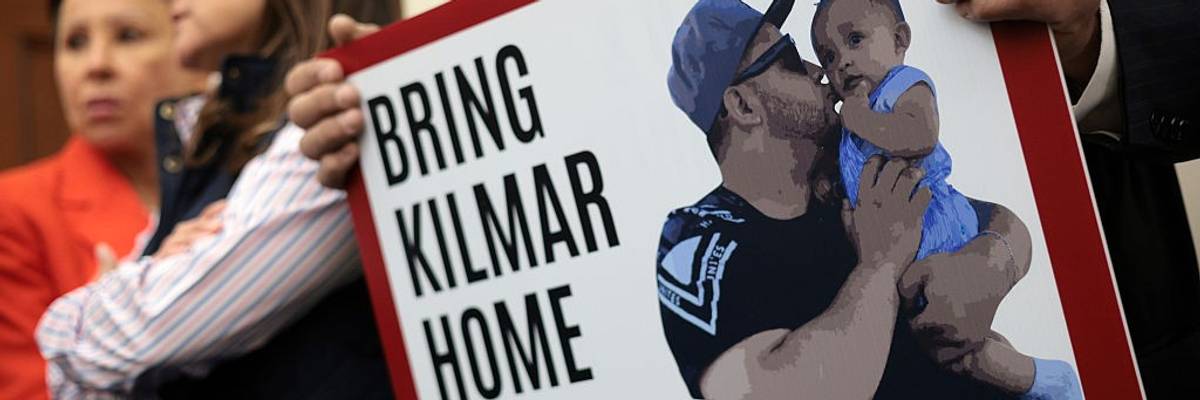
A member of the Congressional Hispanic Caucus holds a picture of Kilmar Ábrego García during a news conference on April 9, 2025 in Washington, DC.
"Our client... is freed of these outrageous, vindictive charges," said an attorney representing Ábrego García. "It’s a good day."
A federal judge on Friday dismissed criminal charges against Kilmar Ábrego García, the man whom the Trump administration unlawfully deported to El Salvador last year.
Judge Waverly Crenshaw of the United States District Court for the Middle District of Tennessee ruled that the US Department of Justice's (DOJ) case against Ábrego García should be thrown out on grounds of selective and vindictive prosecution.
In his ruling, Crenshaw likened the President Donald Trump's DOJ to a prosecutor who picked "the person first and the crime second" when it indicted Ábrego García on human smuggling charges last year.
Crenshaw, an appointee of former President Barack Obama, zeroed in on the fact that the DOJ reopened a three-year-old investigation into a Ábrego García mere days after the US Supreme Court unanimously ordered the Trump administration to facilitate his return to the US, arguing that the timing and other evidence established "likeliness of vindictiveness" of the government's case.
While the government provided arguments attempting to rebut claims of vindictive prosecution, Crenshaw ultimately found them unpersuasive and argued that the "new evidence" the government used to justify reopening the case was something that prosecutors should have discovered before with due diligence.
After an examination of the government's claims, Crenshaw found that its case against Ábrego García was reverse engineered to justify his unlawful removal to El Salvador—where he was imprisoned at the notorious Terrorism Confinement Center (CECOT).
"The objective evidence here shows that, absent Ábrego's successful lawsuit challenging his removal to El Salvador, the government would not have brought this prosecution," Crenshaw wrote in his conclusion. "The executive branch closed its investigation on the November 2022 traffic stop. Only after Ábrego succeeded in vindicating his rights did the executive branch reopen that investigation."
Sean Hecker, an attorney representing Ábrego García, celebrated the judge's ruling shortly after it was issued.
"We are going to savor this one," Hecker wrote in a social media post. "Our client, Kilmar Ábrego García, is freed of these outrageous, vindictive charges. It’s a good day."
Aaron Reichlin-Melnick, senior fellow at the American Immigration Council, warned that Ábrego García is not yet out of the woods given that the Trump administration is still trying to deport him to Uganda even though he has said he would accept being deported to Costa Rica.
Reichlin-Melnick nevertheless said that this was a major victory against the Trump administration.
"It is extremely hard to win a vindictive prosecution motion," he wrote, "but here the evidence was so strong that the judge had almost no choice but to grant it."
New York University law professor Ryan Goodman described Crenshaw's ruling as an "extraordinary rebuke" of the Trump DOJ, and noted that it highlighted the role played by acting US Attorney General Todd Blanche in the vindictive prosecution "nearly 30 times."
Journalist Nathan Newman said that Ábrego García deserved praise for standing firm in the face of relentless pressure by the federal government and fighting back.
"When history is written," wrote Newman, "the bravery and tenacity of Kilmar Ábrego García in defiance of the Trump administration will deserve a hefty credit for building the resistance to Trump's evil. A good day."
Dear Common Dreams reader, It’s been nearly 30 years since I co-founded Common Dreams with my late wife, Lina Newhouser. We had the radical notion that journalism should serve the public good, not corporate profits. It was clear to us from the outset what it would take to build such a project. No paid advertisements. No corporate sponsors. No millionaire publisher telling us what to think or do. Many people said we wouldn't last a year, but we proved those doubters wrong. Together with a tremendous team of journalists and dedicated staff, we built an independent media outlet free from the constraints of profits and corporate control. Our mission has always been simple: To inform. To inspire. To ignite change for the common good. Building Common Dreams was not easy. Our survival was never guaranteed. When you take on the most powerful forces—Wall Street greed, fossil fuel industry destruction, Big Tech lobbyists, and uber-rich oligarchs who have spent billions upon billions rigging the economy and democracy in their favor—the only bulwark you have is supporters who believe in your work. But here’s the urgent message from me today. It's never been this bad out there. And it's never been this hard to keep us going. At the very moment Common Dreams is most needed, the threats we face are intensifying. We need your support now more than ever. We don't accept corporate advertising and never will. We don't have a paywall because we don't think people should be blocked from critical news based on their ability to pay. Everything we do is funded by the donations of readers like you. When everyone does the little they can afford, we are strong. But if that support retreats or dries up, so do we. Will you donate now to make sure Common Dreams not only survives but thrives? —Craig Brown, Co-founder |
A federal judge on Friday dismissed criminal charges against Kilmar Ábrego García, the man whom the Trump administration unlawfully deported to El Salvador last year.
Judge Waverly Crenshaw of the United States District Court for the Middle District of Tennessee ruled that the US Department of Justice's (DOJ) case against Ábrego García should be thrown out on grounds of selective and vindictive prosecution.
In his ruling, Crenshaw likened the President Donald Trump's DOJ to a prosecutor who picked "the person first and the crime second" when it indicted Ábrego García on human smuggling charges last year.
Crenshaw, an appointee of former President Barack Obama, zeroed in on the fact that the DOJ reopened a three-year-old investigation into a Ábrego García mere days after the US Supreme Court unanimously ordered the Trump administration to facilitate his return to the US, arguing that the timing and other evidence established "likeliness of vindictiveness" of the government's case.
While the government provided arguments attempting to rebut claims of vindictive prosecution, Crenshaw ultimately found them unpersuasive and argued that the "new evidence" the government used to justify reopening the case was something that prosecutors should have discovered before with due diligence.
After an examination of the government's claims, Crenshaw found that its case against Ábrego García was reverse engineered to justify his unlawful removal to El Salvador—where he was imprisoned at the notorious Terrorism Confinement Center (CECOT).
"The objective evidence here shows that, absent Ábrego's successful lawsuit challenging his removal to El Salvador, the government would not have brought this prosecution," Crenshaw wrote in his conclusion. "The executive branch closed its investigation on the November 2022 traffic stop. Only after Ábrego succeeded in vindicating his rights did the executive branch reopen that investigation."
Sean Hecker, an attorney representing Ábrego García, celebrated the judge's ruling shortly after it was issued.
"We are going to savor this one," Hecker wrote in a social media post. "Our client, Kilmar Ábrego García, is freed of these outrageous, vindictive charges. It’s a good day."
Aaron Reichlin-Melnick, senior fellow at the American Immigration Council, warned that Ábrego García is not yet out of the woods given that the Trump administration is still trying to deport him to Uganda even though he has said he would accept being deported to Costa Rica.
Reichlin-Melnick nevertheless said that this was a major victory against the Trump administration.
"It is extremely hard to win a vindictive prosecution motion," he wrote, "but here the evidence was so strong that the judge had almost no choice but to grant it."
New York University law professor Ryan Goodman described Crenshaw's ruling as an "extraordinary rebuke" of the Trump DOJ, and noted that it highlighted the role played by acting US Attorney General Todd Blanche in the vindictive prosecution "nearly 30 times."
Journalist Nathan Newman said that Ábrego García deserved praise for standing firm in the face of relentless pressure by the federal government and fighting back.
"When history is written," wrote Newman, "the bravery and tenacity of Kilmar Ábrego García in defiance of the Trump administration will deserve a hefty credit for building the resistance to Trump's evil. A good day."
A federal judge on Friday dismissed criminal charges against Kilmar Ábrego García, the man whom the Trump administration unlawfully deported to El Salvador last year.
Judge Waverly Crenshaw of the United States District Court for the Middle District of Tennessee ruled that the US Department of Justice's (DOJ) case against Ábrego García should be thrown out on grounds of selective and vindictive prosecution.
In his ruling, Crenshaw likened the President Donald Trump's DOJ to a prosecutor who picked "the person first and the crime second" when it indicted Ábrego García on human smuggling charges last year.
Crenshaw, an appointee of former President Barack Obama, zeroed in on the fact that the DOJ reopened a three-year-old investigation into a Ábrego García mere days after the US Supreme Court unanimously ordered the Trump administration to facilitate his return to the US, arguing that the timing and other evidence established "likeliness of vindictiveness" of the government's case.
While the government provided arguments attempting to rebut claims of vindictive prosecution, Crenshaw ultimately found them unpersuasive and argued that the "new evidence" the government used to justify reopening the case was something that prosecutors should have discovered before with due diligence.
After an examination of the government's claims, Crenshaw found that its case against Ábrego García was reverse engineered to justify his unlawful removal to El Salvador—where he was imprisoned at the notorious Terrorism Confinement Center (CECOT).
"The objective evidence here shows that, absent Ábrego's successful lawsuit challenging his removal to El Salvador, the government would not have brought this prosecution," Crenshaw wrote in his conclusion. "The executive branch closed its investigation on the November 2022 traffic stop. Only after Ábrego succeeded in vindicating his rights did the executive branch reopen that investigation."
Sean Hecker, an attorney representing Ábrego García, celebrated the judge's ruling shortly after it was issued.
"We are going to savor this one," Hecker wrote in a social media post. "Our client, Kilmar Ábrego García, is freed of these outrageous, vindictive charges. It’s a good day."
Aaron Reichlin-Melnick, senior fellow at the American Immigration Council, warned that Ábrego García is not yet out of the woods given that the Trump administration is still trying to deport him to Uganda even though he has said he would accept being deported to Costa Rica.
Reichlin-Melnick nevertheless said that this was a major victory against the Trump administration.
"It is extremely hard to win a vindictive prosecution motion," he wrote, "but here the evidence was so strong that the judge had almost no choice but to grant it."
New York University law professor Ryan Goodman described Crenshaw's ruling as an "extraordinary rebuke" of the Trump DOJ, and noted that it highlighted the role played by acting US Attorney General Todd Blanche in the vindictive prosecution "nearly 30 times."
Journalist Nathan Newman said that Ábrego García deserved praise for standing firm in the face of relentless pressure by the federal government and fighting back.
"When history is written," wrote Newman, "the bravery and tenacity of Kilmar Ábrego García in defiance of the Trump administration will deserve a hefty credit for building the resistance to Trump's evil. A good day."