

SUBSCRIBE TO OUR FREE NEWSLETTER
Daily news & progressive opinion—funded by the people, not the corporations—delivered straight to your inbox.
5
#000000
#FFFFFF
To donate by check, phone, or other method, see our More Ways to Give page.
Daily news & progressive opinion—funded by the people, not the corporations—delivered straight to your inbox.

In response to the White House's new clean energy executive order, Food & Water Watch Managing Director of Advocacy Programs and Policy Mitch Jones released the following statement:
"While this executive order lays out noteworthy investments in solar energy and important changes in transportation and energy efficiency, their effectiveness is undermined by the White House's failures to address the root cause of the climate crisis: Fossil fuel development.
"If Biden was actually serious about tackling the climate crisis, he would ban new oil and gas extraction on federal lands like he repeatedly promised to do. Instead, the White House continues to approve new drilling and fracking projects on public lands, and just conducted a massive sale of offshore drilling leases in the Gulf of Mexico. The administration also seems eager to expand the export of fossil fuels, creating new sources of climate, air and water pollution at home.
"The focus on 'net zero' and zero emissions goals leaves the door open for expensive and dirty energy infrastructure including nuclear and fossil fuel-based hydrogen. We need President Biden to stop pushing policies that will keep us hooked on dirty energy."
Food & Water Watch mobilizes regular people to build political power to move bold and uncompromised solutions to the most pressing food, water, and climate problems of our time. We work to protect people's health, communities, and democracy from the growing destructive power of the most powerful economic interests.
(202) 683-2500
"Saw a rat on the rails at Tasker-Morris and it has my vote."
Pennsylvanians aren't just sick of Sen. John Fetterman. Nearly 6 in 10 say that if he came up for reelection today, they'd sooner check the box for literally anybody else.
That's according to a PennLive/Bravo Group poll released Wednesday, in which just 40% of likely voters in Pennsylvania said they'd vote for their Democratic senator, compared with 58% who said they'd choose an unspecified "someone else."
While he was elected in 2022 as a progressive in the mold of Sen. Bernie Sanders (I-Vt.), Fetterman's transition into a left-punching Fox News talking head over the past four years has made him abysmally unpopular within his own party.
After watching Fetterman enthusiastically cheer Israel’s genocidal war in Gaza, block efforts to halt President Donald Trump’s illegal wars in Venezuela and Iran, defend the honor of US Immigration and Customs Enforcement (ICE) as agents killed several US citizens and immigrants, and mock the idea of lowering Americans’ healthcare costs, just 19% of Democrats in his home state said they approved of him compared to 69% who disapproved, according to a Quinnipiac poll released earlier this month.
Republicans, meanwhile, are loving him: 77% said they approve of how he's handling his job.
Fetterman is now publicly flirting with a party switch, citing the rising number of Democrats who have voted to restrict arms to Israel as the primary reason.
“If our party ever becomes, and just makes it official, the anti-Israel party, that’s when I would leave because that’s been a moral clarity for me,” Fetterman said earlier this month. “That’s our special ally, you know?”
But Fetterman's pariah status among Democrats doesn't mean he can be easily cast out.
With the strong possibility that Democrats could hold a narrow Senate majority after November's midterms, Fetterman is setting himself up to be de facto king of the Senate with the power to near-singlehandedly dictate policy in the vein of the conservative former Sens. Joe Manchin (D-WV) and Kyrsten Sinema (D-Ariz.) during the Biden years.
Fearing the party’s resident “ogre,” as US Senate candidate Abdul El-Sayed recently called him, may break ranks in the next Congress, Senate Minority Leader Chuck Schumer (D-NY) has spent the week trying to make nice. As Semafor reported on Friday:
Chuck Schumer showered John Fetterman with praise this week, declaring him a “very good member,” liked and respected by colleagues in Democrats’ “big tent party.”
Fetterman was grateful for the shoutout and has repeatedly shot down the idea he’d switch caucuses in the Senate. But he’s still not sure he fits with where his party is going.
“I truly appreciate the leader’s nice words,” Fetterman told Semafor on Thursday. He added that “I don’t know if the Democratic Party is ‘big tent’ enough for proud, pro-Israel supporters that also strongly reject the warped mutation of” democratic socialists now rising in their ranks.
Fetterman, who has long struggled with his mental and physical health and expressed apathy about fulfilling basic senatorial tasks like showing up to votes and committee hearings, has not yet committed to running for reelection in 2028.
Even if he did, it's hard to imagine him faring well in a Democratic primary where most voters would sooner vote for a rat they saw crawling through a SEPTA station, as one social media user put it.
An effort by progressive groups to "primary Fetterman" is already underway, and as the left swaggers from recent victories over the establishment, names like the Berniecrat Rep. Summer Lee (D-Pa.) are being bandied about as possible replacements.
And despite his current status as a GOP darling, it's unclear if they'd choose a turncoat over the genuine article. While his foreign policy record would make Dick Cheney blush, Fetterman has not yet gone full-MAGA on some load-bearing issues like LGBTQ+ rights and gutting social programs.
Having immolated any goodwill on the left, Fetterman appears to lack a clear constituency.
Meanwhile, according to the new poll, those who want him gone really want him gone: 30% of Pennsylvanians surveyed said they'd "definitely" vote for someone else and 29% said they'd "probably" vote for someone else. By comparison, just 12% said they'd "definitely" vote for Fetterman again, while 28% said they "probably" would.
Isi Breen, a former communications official for Rep. Ilhan Omar (D-Minn.), remarked on social media, "I literally have never seen an elected official losing so badly to 'literally anyone else.'"

"No matter what they call themselves, prediction markets like Kalshi are gambling platforms, plain and simple," said New York Attorney General Letitia James.
The state of New York on Friday announced it was suing online prediction market Kalshi for operating as "an illegal gambling operation."
In a complaint filed with the New York State Supreme Court, New York Attorney General Letitia James alleged that Kalshi was running an unlicensed gambling business "in flagrant disregard" of the Empire State's "constitution, penal laws, and other statutes."
The complaint notes that, among other things, Kalshi allows users as young as 18 years old to place bets on its platform, while New York state law limits legalized gambling to persons aged 21 or older.
"New York’s gambling laws protect children from underage betting and help combat gambling addiction," said James in her announcement of the lawsuit. "No matter what they call themselves, prediction markets like Kalshi are gambling platforms, plain and simple. By ignoring our laws, Kalshi is running an illegal operation and harming New Yorkers in the process. We are taking them to court to uphold our laws and protect New Yorkers."
James' lawsuit asks the court to permanently bar Kalshi from operating inside the state unless it obtains a license from the New York State Gaming Commission; ordering it to "produce an accounting of all bets placed, monies lost by customers in connection with its gambling business"; and forcing it to pay assorted "restitution, disgorgement, damages, and penalties" for its assorted violations of the law.
New York Gov. Kathy Hochul, in a statement supporting the lawsuit against Kalshi, accused the company of ignoring state gambling laws, "which exist to protect consumers, prevent problematic gambling, deliver funding for critical public services, and ensure that every company plays by the same rules."
Minnesota state Rep. Emma Greenman (D-63B), who earlier this year authored legislation to ban prediction markets in her state, said that teenagers getting hooked on gambling apps is becoming a major problem.
“We’re seeing studies come out that say [the companies] are targeting 18- to 21-year-olds,” said Greenman, “and we are seeing gambling starting younger and younger.”
President Donald Trump's administration, however, has regularly worked to quash state governments' efforts to regulate online prediction markets such as Kalshi and Polymarket.
Specifically, the administration has stacked the Commodity Futures Trading Commission (CFTC) with prediction market and sports betting industry insiders who have been pursuing legal action against any states attempting to clamp down on the online gambling platforms.
Earlier this year, CFTC Chair Michael Selig warned states against trying to regulate prediction markets, which he said would “circumvent the clear directive of Congress.”
“Our message to Wisconsin is the same as to New York, Arizona, and others,” said Selig. “If you interfere with the operation of federal law in regulating financial markets, we will sue you.”

"While Americans suffer from high prices and the Iran war imposes tens of billions of dollars of new costs on the American public, the oil industry wins big."
ExxonMobil and Chevron repeated $26.5 billion in combined profits in the second quarter of 2026 as US President Donald Trump's illegal war on Iran drove up gas prices around the world, punishing consumers at the pump while boosting oil companies' bottom lines.
Chevron on Friday announced $12 billion in profits for the second quarter—its highest quarterly profit in six years—while Exxon posted $14.5 billion. Exxon touted its "industry-leading shareholder distributions," which "totaled $9.4 billion, including $4.3 billion of dividends and $5.1 billion of share repurchases."
Reuters noted that the two companies' results "mirrored those of European oil majors TotalEnergies and Shell, which also posted banner second-quarter profits buoyed by higher oil prices."
The oil giants' earnings came weeks after a Harris survey found that 95% of Americans believe the US is facing an affordability crisis, with gas and groceries at the top of the list of "unaffordable goods and services." The current national average price for a gallon of gas is $4.1.
"The pattern is consistent: While Americans suffer from high prices and the Iran war imposes tens of billions of dollars of new costs on the American public, the oil industry wins big," a group of Democratic senators wrote in a recent letter. "President Trump has made the calculus explicit in his own words. When it comes to families facing increasing prices in the context of the Iran war, he said: ‘I don’t think about Americans’ financial situation.'"
Sierra Club said Thursday that Big Oil's wartime profits are "paid by you," and called for a "windfall profits tax to recover a portion of the excess profits oil companies rake in during a global crisis and return that money to the people who paid higher prices."
"At the same time as oil and gas companies are preparing for a multibillion-dollar payday, they are working with the Trump administration to block investment in clean energy sources that would make American families more energy independent," the group added. "It's time to make polluters pay."

"Trump’s sweetheart audit immunity deal is perhaps the most brazenly corrupt action taken by a president in American history," said one top Senate Democrat.
Republicans on the Senate Finance Committee voted Thursday to block a Democratic amendment that would have prohibited the Internal Revenue Service from giving sweeping tax audit immunity to President Donald Trump, his family, and their businesses.
If passed, the amendment would have nullified a central element of the deal that the US Justice Department cut with the IRS in May to settle Trump's $10 billion lawsuit against the tax agency. Experts have argued that such broad audit immunity is unlawful, and Democrats have warned the agreement could leave the IRS with no recourse if Trump decided to dodge taxes on the billions of dollars he has pocketed during his second stint in the White House.
Democrats on the Finance Committee sought to attach their amendment to bipartisan legislation aimed at streamlining tax administration. The amendment failed in a 13-14 vote along party lines, and the bipartisan bill passed out of committee 26-1—with Sen. Elizabeth Warren (D-Mass.) the lone opponent. Warren told Politico that she "cannot support a bill that rubber stamps Donald Trump’s corruption."
"Senate Republicans blocked Democrats' proposal to end Donald Trump's IRS sweetheart deal," Warren wrote on social media following Thursday's vote. "This deal gives him FULL IMMUNITY from audits on tax returns he's filed. It's corruption on steroids."
The vote on the Democratic amendment came as Trump's attorney general nominee, Todd Blanche, remained stalled in the Senate, in large part due to the Justice Department's failure to commit to sufficient limitations on the IRS audit immunity deal, which Blanche signed.
Blanche, who is currently the acting attorney general, testified during a Senate confirmation hearing earlier this month that the IRS audit immunity deal is "not forward-looking," but a key Republican said this week that the Justice Department has not yet provided sufficient written commitments to limit the immunity agreement.
Blanche reportedly met with the two Senate GOP holdouts—John Cornyn of Texas and Thom Tillis of North Carolina—on Thursday in an effort to hash out a deal to advance his nomination. Trump, who has aggressively avoided taxes throughout his career and broke with political tradition by refusing to voluntarily release his federal income tax returns, threatened on Thursday to pull Blanche's nomination until Cornyn and Tillis leave the Senate next year, having lost reelection.
The New York Times summarized the IRS immunity deal, should it survive legal and political scrutiny:
First, the IRS has to drop any inquiries, whether civil audits or criminal investigations, it was pursuing into Mr. Trump, his family members, their companies, or 'affiliated individuals.' Second, the IRS can’t start any new investigations into tax returns that this potentially large pool of people and companies has already filed.
That means that any tax maneuver the Trumps have already used, whether the IRS was already auditing it or not, is now off limits. The agency typically has three years after someone files a tax return to assess more in taxes. So there are potential audits of Mr. Trump and his family that the IRS could have initiated—claims that 'could have been asserted,' in the language of Mr. Blanche’s order—that it is now not supposed to. But the next tax return that Mr. Trump files could, theoretically, still be eligible for an audit.
“Trump’s sweetheart audit immunity deal is perhaps the most brazenly corrupt action taken by a president in American history, and Congress must permanently put a stop to the unchecked greed on display,” Sen. Ron Wyden (D-Ore.), the ranking member of the Senate Finance Committee, said earlier this week. “Elected officials cannot look taxpayers in the eye and ask them to play by a set of rules that the president of the United States is exempt from."
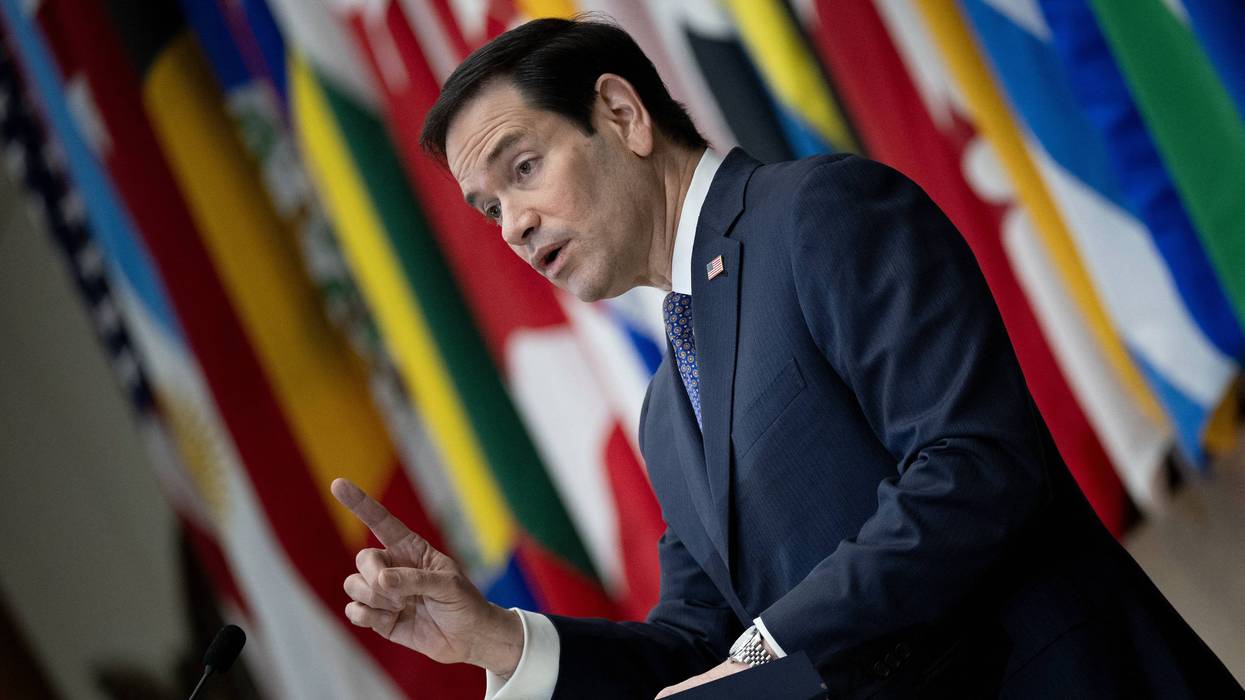
"This is what happens when the US Department of State fires career experts and tries to have AI conduct diplomacy."
"AI use gone wrong." "Utter embarrassment." "Stupid empire." "Idiot Reich."
Those were just some of the responses to Thursday reporting on a US Department of State map presented at a global conference in Brazil that mislabeled every African country it included.
"Reuters viewed a video of the presentation given at the AIDS 2026 conference in Rio de Janeiro, which shows the errant map displayed halfway during a presentation about the State Department's new health agreements," the news agency reported.
"A Reuters analysis found the image of the map included in the presentation contained an artificial intelligence watermark that signals it was made with OpenAI tools," the outlet noted. "The company said it was investigating the report."
While Jeff Graham, who oversees the President's Emergency Plan for AIDS Relief (PEPFAR) and was speaking at the conference, did not respond to Reuters' requests for comment, the State Department said that "we take full responsibility for the confusion and misrepresentation it caused for attendees, including our African partners."
Critics around the world, including Democrats in Congress, blasted the department under Secretary of State Marco Rubio and President Donald Trump, who have reduced staff by 3,000 between layoffs and voluntary departures.
A recent Financial Times article headlined "RIP the US State Department" noted that "as of late June more than half of American ambassadorships were vacant, including high-status posts from Germany to Saudi Arabia," and nearly 80% of American embassies across Africa lack an ambassador.
Sharing the Reuters reporting on social media Thursday, Nick Cleveland-Stout, a research associate in the Democratizing Foreign Policy program at the Quincy Institute for Responsible Statecraft, commented, "Checking in on the whole defund the State Department thing."
Former US Ambassador to Jamaica Luis Moreno said that "this is the pathetic result when you fire career, nonpartisan diplomatic personnel and replace them with unqualified partisan hacks who rely on faulty AI."
US Senate Foreign Relations Committee Ranking Member Jeanne Shaheen (D-NH) declared: "What an embarrassment. This is what happens when the US Department of State fires career experts and tries to have AI conduct diplomacy."
Congressman Jonathan Jackson (D-Ill.) stressed that "Trump's Department of State showed up to a global conference with an AI-generated map that mislabeled nations across Africa. Every. Single. One. This isn't just an embarrassing mistake."
"It's a symbol of an administration that has treated a continent of 1.5 billion people as an afterthought while China is deepening engagement across the African continent," he argued. "That's what happens when you hollow out expertise and stop taking diplomacy seriously. Our African partners and the American people deserve better."

“Trump is exploiting African states’ urgent need to restore lifesaving health aid," said one campaigner.
US Department of State text messages detailing health agreements between the Trump administration and African nations have sparked fresh alarm among public health advocates, who warn that the coercive deals could allow the United States to secure access to virus samples and valuable data while failing to guarantee that countries providing them will receive vaccines, treatments, and other benefits in return.
Public Citizen said Thursday that it had analyzed documents concerning the Trump administration's terms for sharing pathogen data in health agreements with African nations. The consumer advocacy group described these terms as "unfair" and said that they threaten "to undermine the core equity bargain of the [World Health Organization's] Pandemic Agreement negotiations."
The conditions of the proposed deals, said Public Citizen, "would require African states to share viral samples and pathogen information with the US and allow the US to share that information with drugmakers, but provide no credible expectation of benefits in return or access to medical tools developed from those samples."
"This undercuts the federated proposal for viral sharing with access benefits put forward this month at WHO negotiations by the Africa+ Group, which includes all countries for which bilateral specimen agreements are available," Public Citizen added.
At the center of the controversy are agreements that tie US health assistance—which has been eviscerated by the Trump administration with widespread deadly consequences—to commitments involving disease surveillance, data sharing, and, in some cases, the exchange of pathogen samples.
Supporters argue the deals strengthen America's ability to detect and respond to emerging infectious diseases while providing partner countries with much-needed funding after devastating cuts to US aid. Public health advocates, however, contend the agreements shift power away from multilateral institutions and toward one-on-one negotiations in which lower-income countries have less leverage against the world's wealthiest and most powerful nation.
As Common Dreams reported last month, President Donald Trump's so-called “America First” approach to global health strategy is characterized by transactional agreements with African governments to restore some funding. Human rights advocates have raised concerns about the possibly coercive nature of this strategy.
“Trump is exploiting African states’ urgent need to restore lifesaving health aid and pushing them to give up a shot at real lifesaving medical access and equity, for which so many people have worked, bled, and died,” Peter Maybarduk, director of Public Citizen's Access to Medicines program, said Thursday in a statement. "African states at WHO have led the way in efforts to secure a fair deal and cooperation to fight pandemics, but individually, these states are vulnerable to Trump’s threats.”

"Abandoning children to meet deportation targets is immoral. This must stop. These children deserve legal representation."
Thousands of unaccompanied immigrant children could lose their lawyers beginning Friday as federally funded contracts supporting them are set to expire, prompting advocates to warn that the move will leave vulnerable minors to face deportation proceedings frightened and alone.
Since 2003, the US Department of Health and Human Services (HHS) has funded a nationwide network of around 100 advocacy groups that have offered legal services to unaccompanied minors who arrived in the United States without their parents or legal guardians, as well as children already in immigration custody.
The Trump administration's move to withhold over $65 million in congressionally appropriated funding starting late last year forced dozens of nonprofit advocacy groups to trim operations, refuse new clients, or end vital programs altogether. There is no apparent plan for continuing representation for roughly 20,000 children currently receiving legal assistance as they navigate the US immigration courts and deportation process.
"This is a five-alarm fire," Sen. Jeff Merkley said Thursday on social media. "It’s wrong under every moral code."
Shaina Aber, executive director of Acacia Center for Justice—one of the nonprofits that received funding through the program—told El País' Patricia Clarembaux on Thursday, "We don’t know what’s going to happen on August 1 because the government has not informed us of the transition plan for the 20,000 children who have representation under this contract."
“It will really depend on whether the attorneys have alternative funding that allows them to continue," she added.
A child cannot be expected to navigate immigration court alone, yet that is exactly what will happen starting this Saturday if the Trump administration succeeds in dismantling these legal services.Tell Congress to honor its promise to protect unaccompanied children: tinyurl.com/protect-kids
[image or embed]
— Acacia Center for Justice (@acaciajustice.org) July 29, 2026 at 2:51 PM
HHS told El País that its Office of Refugee Resettlement—which is responsible for looking after immigrant minors—“remains fully compliant with legal and regulatory obligations and does not act in any way that could dissuade a child from seeking appropriate legal relief.”
However, as Acacia Center noted, "without legal representation, fewer than 1% of immigrant children are granted immigration relief. Without access to counsel, tens of thousands of vulnerable children could be forced to navigate life-changing legal proceedings with fewer protections, fewer advocates, and less time."
"HHS must honor its commitment and fulfill its obligation to pay for legal services already provided to prevent unaccompanied children from being stripped of their lawyers and deported without due process," the group argued.
Critics also point to President Donald Trump's record of mistreating unauthorized immigrants, especially children, over the course of his two terms. During his first term (2017–21), "zero tolerance" policies, including family separation and expanded use of what many observers call concentration camps, left thousands of children traumatized. Detention in overcrowded and often squalid facilities reportedly plagued by abuse has harmed many children since Trump's return to the White House last year.
Katie, a member of the group Women of Welcome and sponsor of immigrant children, responded to the imminent HHS funding cutoff last week, saying, “I have worked with immigrants in my professional life and have a lot of immigrant friends, but seeing the journey through the eyes of these kids was very new."
"The little girl I am adopting has been through a lot of trauma, and I may never know what she has gone through," Katie added. "She is resilient and funny, but she is 6, and she shouldn’t have to fight this system alone. This experience has not only deepened my faith, but I have learned more and more about how important the work of advocacy and loving people is. For these children, it is difficult to fight a system that isn’t built to protect them.”
Anna Devereaux, senior managing attorney at the Michigan Immigrant Rights Center, said that “children are children, regardless of their nationality, and our law and our values require us to act in their best interest."
"But the government’s failure to provide long-term funding has made it challenging to sustain a legal program for children," she added. "If this funding ends now, the future for these children is uncertain.”
Aber said: “These children are not leverage in a political negotiation. They are human beings—many of whom fled violence, trafficking, and abuse—who have a legally and morally recognized right to have their cases heard with a lawyer by their side."
"Abandoning children to meet deportation targets is immoral," she asserted. "This must stop. These children deserve legal representation."

Yair Lapid, the opposition leader some Democrats believe will rescue Israel from extremism, said the nation should expand its territory to match "the Bible's borders" earlier this year.
Faced with mounting pressure from constituents to stop providing military support to Israel's genocidal wars, some Democrats in Congress who've long expressed unwavering support for the country are hoping that its elections this fall could provide a reset.
On Wednesday, a clique of Democrats met with former Israeli Prime Minister Yair Lapid, a leader of the opposition coalition aiming to oust Prime Minister Benjamin Netanyahu, whose far-right government's unapologetic pursuit of ethnic cleansing against Palestinians and push toward indefinite occupation of southern Lebanon have made support among liberals increasingly untenable.
Lapid has described the ascendancy of his coalition as an opportunity for Democrats who'd recently voted against measures to provide Israel with weapons aid to wipe the slate clean and restore the status quo of ironclad bipartisan support that Israel had enjoyed for decades.
At the meeting, arranged by the staunch Israel supporter Sen. Jacky Rosen (D-Nev.), Lapid said he urged the Democrats in the room, which included Sens. Michael Bennet (Colo.), Richard Blumenthal (Conn.), Maggie Hassan (NH), Cory Booker (NJ), Brian Schatz (Hawaii), Alex Padilla (Calif.), John Hickenlooper (Colo.) and Catherine Cortez Masto (Nev.), according to The Jerusalem Post, "not to give up on Israel and to show solidarity in the face of its challenges."
Lapid is often portrayed in the Western press as a more "moderate" alternative to Netanyahu and his coalition of religious nationalist and ultra-Orthodox parties. Lapid is comparatively secular and has criticized Netanyahu's assaults on institutions like the courts, while showing himself more open to aligning with Israel's marginalized Arab parties.
But on the questions that have led Israel to lose favor with American voters—those of Israel's aggressive warmaking—Lapid has expressed views that seem hardly less extreme than those of the current government, including the idea that Israel should continue to expand its borders across the Middle East in accordance with biblical texts.
The idea that Israel should wage wars of conquest against its neighbors was once confined to the fringes, but has become mainstream in recent years with the support of far-right figures in Netanyahu's government, like Finance Minister Bezalel Smotrich and Security Minister Itamar Ben-Gvir, who've pushed for Israel to expand its illegal settlements in the West Bank and begin moving settlers into Gaza and Lebanon after they're depopulated of their inhabitants.
In February, Lapid was asked during a press conference if he agreed with a statement by US Ambassador to Israel Mike Huckabee that the state had a religious right to seize all the land between the Nile and the Euphrates Rivers.
Per Middle East Eye, he responded as follows:
"I support anything that will allow the Jews a large, broad, strong land and a safe haven for us, our children and our children's children. That I support," he told a Kipa News reporter.
When asked "How broad?" Lapid responded: "As broad as possible."
He added that there were practical "considerations of security and policy and time," but said Israeli territory could expand as far as Iraq.
"Zionism is based on the Bible, our mandate over the land of Israel is biblical, the biblical borders of Israel are very clear," he said. "I believe our ownership deed over the land of Israel is the Bible, therefore the borders are the Bible's borders."
Rania Khalek, a journalist and commentator at BreakThrough News, warned that by viewing Lapid as a palatable alternative to Netanyahu, Democrats were aligning themselves with "violent colonial religious fanaticism... despite the fact that their base overwhelmingly despises this Greater Israel settler project."
Remarking on his comments endorsing the idea of Israeli expansion into Iraq, she marveled that "Yair Lapid is supposedly the liberal opposition to Netanyahu. Yet he sounds just like Ben-Gvir here."
Lapid has been nominally critical of Netanyahu's policy toward Gaza, but largely only from a tactical perspective rather than a humanitarian one.
He defended Israel against criticism as it imposed a "complete siege" that cut off food, water, and electricity from the strip in October 2023, and claimed most killed in Gaza were "terrorists"; supported legislation aimed at crippling the main United Nations aid agency for Palestinians, and endorsed President Donald Trump's idea of permanently removing the residents of Gaza.
Lapid has also been a strong proponent of war with Iran, praising Trump and Netanyahu's strikes in late February as a "just war against evil" and calling for the nation's leadership to be "obliterated." During a speech earlier this week, he endorsed the idea of striking Iran's energy infrastructure, calling it "the right thing to do in the long term."
While serving as prime minister in 2022, Lapid signaled rhetorical support for a two-state solution with the Palestinians, a marked difference from Netanyahu, who has long been adamantly against it. However, the man likely to become prime minister if Lapid's coalition wins, former premier Naftali Bennett, has long opposed a Palestinian state, recently calling it a "huge mistake."

"Today’s decision reaffirms that immigrants who contribute to our communities and have lived here for years deserve dignity, not detention," said US Rep. Pramila Jayapal.
Two separate federal courts on Thursday rejected Trump administration's justification for its mass detention of immigrants.
First, a three-judge panel on the 9th Circuit Court of Appeals ruled 2-1 that the administration had misconstrued the 1996 Immigration and Nationality Act (INA) as mandating detention without bond for all undocumented immigrants in the US.
The court found that the INA's mandatory detention policy only applied to undocumented immigrants who had been apprehended shortly after crossing the border and not to undocumented immigrants who have lived in the US for years after entering the country illegally.
Judge Daniel Bress, an appointee of President Donald Trump, wrote for the majority that the administration's interpretation of the INA would constitute "a major change to the immigration laws by subjecting millions" of undocumented immigrants already living in the US to mandatory detention.
"We accordingly do not think that Congress in 1996 made such a large-scale change to our established system of immigration detention in the way that the government now contends," Bress added.
Shortly after the decision, a three-judge panel on the 7th Circuit Court of Appeals similarly rejected the Trump administration's mass detention policy, ruling 2-1 that the government's interpretation of the law "rests upon the illogical use of both legal fiction and ordinary meaning" to determine whether someone who has long lived in the US is "seeking admission" to the US.
Aaron Reichlin-Melnick, senior fellow at the American Immigration Council, noted that six federal appeals courts so far have ruled against the administration's mass detention policy, while only two have ruled in favor. Decisions on the policy are also pending in three other federal appeals courts.
While predicting that the legal fight over interpretation of the INA is likely headed to the US Supreme Court, Reichlin-Melnick nonetheless said that the rulings were "great news."
Rep. Pramila Jayapal (D-Wash.) hailed the 9th Circuit's ruling against the Trump administration as a "big win."
"While this will likely be litigated further," Jayapal wrote in a social media post, "today’s decision reaffirms that immigrants who contribute to our communities and have lived here for years deserve dignity, not detention."

"Listen to the American people. Vote to end this war," said Sen. Chuck Schumer. "We’re going to keep forcing Republicans to vote until we do.”
The vast majority of US Senate Republicans were joined by Democratic Sen. John Fetterman on Thursday in voting against a war powers resolution to block the Trump administration from continuing to attack Iran without congressional approval, as new polling showed nearly two-thirds of Americans think the war is not worth fighting.
For the second time in as many weeks and the 13th time this year, Senate Democrats called on Republicans to limit President Donald Trump's authority to take military action, pointing to rising anger over the assault on Iran, which has killed at least 18 US service members and more than 3,400 Iranians, as well as thousands more across the region, mostly in Lebanon, as Iran has retaliated in the unprovoked US-Israeli conflict.
“Are Senate Republicans listening? The country is clamoring for you to end this war,” Senate Minority Leader Chuck Schumer (D-NY) said. “I urge and plead with my Republican colleagues: Listen to the American people. Vote to end this war. We’re going to keep forcing Republicans to vote until we do.”
The Associated Press-NORC Research Center poll released Thursday showed that 64% of Americans disapprove of the continuation of the war, including 37% of Republicans. Seventy percent of respondents said the Trump administration should prioritize a permanent ceasefire with Iran after a memorandum of understanding to end the war collapsed in early July and Trump relaunched attacks on the Middle Eastern country.
Seventy-two percent of respondents also said it was "extremely" or "very" important to them to ensure gas and oil prices are reduced after the war. Iran's closure of the Strait of Hormuz has sent the price of gas soaring—adding to Americans' concerns over the rising cost of essentials.
Three Republicans—Sens. Susan Collins (Maine), Lisa Murkowski (Alaska), and Rand Paul (Ky.)—joined Democrats in supporting the war powers resolution, with a final vote of 50-49. But even Republicans who supported allowing Trump to continue the war he started in February, despite the fact that the War Powers Act of 1973 only gives him 60-90 days to end a conflict he has started, addressed the cost-of-living crisis the war is worsening.
“The rising gas prices are a real concern to everybody,” Sen. Mike Rounds (R-SD) said.
Sen. Kirsten Gillibrand (D-NY) said on the Senate floor Thursday that while Trump is "pouring billions of tax dollars into an open ended war in Iran, this reckless war is driving up monthly bills and making everyday life harder for working families. "
.@SenGillibrand (D-NY) urges for passage of Iran War Powers Resolution, ahead of the vote: "This reckless war is driving up monthly bills and making everyday life harder for working families... Under the constitution, we have the power to end the war today — let's use it!" pic.twitter.com/zhLNOzNioZ
— CSPAN (@cspan) July 30, 2026
The resolution failed hours after Iranian media reported that one of the strikes by US Central Command Wednesday night had killed a family of three, including a 2-year-old child.