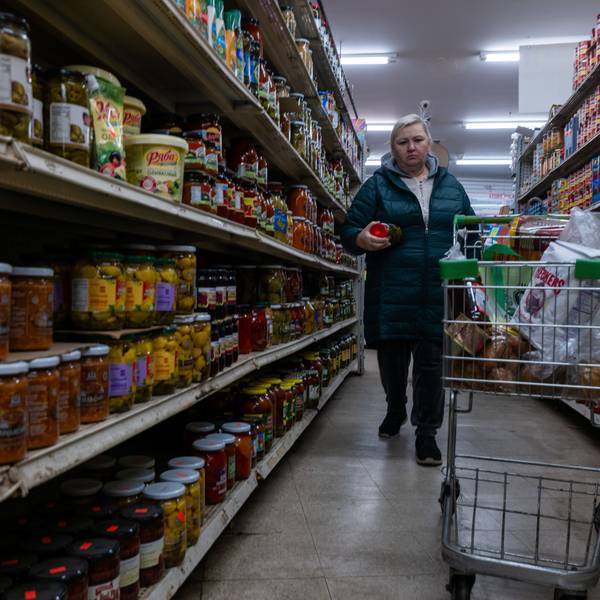
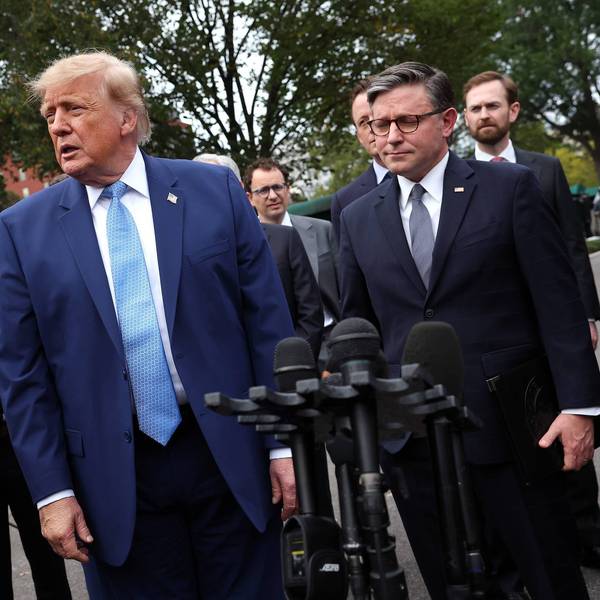
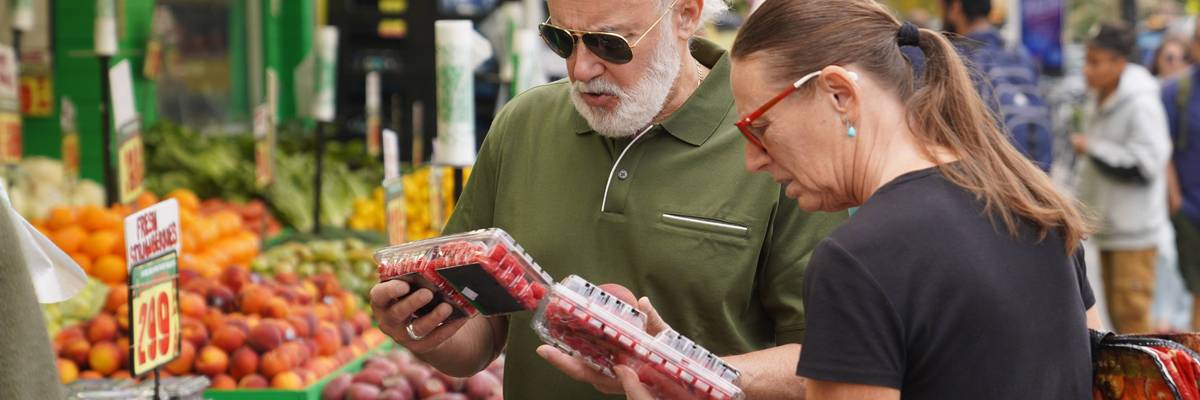
Customers check fruit at a grocery store in New York City on October 14, 2026.
Consumer Sentiment Data Another Sign Trump 'Affordability Crisis Is Getting Worse, Not Better'
"High prices and borrowing costs are making it harder for people to afford everyday necessities, and inflation expectations are rising again."
With early voting underway for the midterm elections and Democrats campaigning on how prices have soared under a Republican-controlled Congress and President Donald Trump, data released Friday show US consumer sentiment nearing an all-time low.
The University of Michigan's Surveys of Consumers announced that its Consumer Sentiment Index dropped to 48 this month, down from 48.1 in September and 53.6 last October. The record low was 44.8, this past May.
Surveys of Consumers director Joanne Hsu noted Friday that "increases in sentiment among Republicans and Democrats were balanced by declines among independents," and also highlighted some of the survey's other findings.
UMich consumer sentiment... 48.0... 2nd-worst in history
[image or embed]
— Mike Zaccardi, CFA, CMT (@mikezaccardi.bsky.social) October 23, 2026 at 10:02 AM
"While year-ahead business conditions improved about 14%, they stand 16% less than last October's read," she continued. "This month's decline in the Current Conditions subindex was driven entirely by buying conditions for durables, which plunged 18% on the basis of higher interest rates and rising concerns about the affordability of such purchases. Purchasing power continues to dominate consumer views of the economy. Sentiment is now 10% below a year ago and 15% less than February, just prior to the Iran conflict."
"Year-ahead inflation expectations ticked up from 4.6% last month to 4.7% this month," said Hsu, who also put out a related report on inflation. "The current reading substantially exceeds the 3.4% seen in February before the Iran conflict began, along with all 2024 readings. Long-run inflation expectations also stepped up from 3.4% in September to 3.5%, notably higher than their 2024 range of 2.8% to 3.2%. Inflation expectations over both time horizons increased for the second straight month to their highest readings since May."
Data released last week by the US Bureau of Labor Statistics show inflation grew faster than expected in September, partly due to Trump's illegal Iran War, and an online tracker published earlier this month by Sen. Elizabeth Warren (D-Mass.), ranking member of the Senate Banking Committee, highlights how costs have jumped for childcare, electricity, gasoline, groceries, healthcare, and rent.
Tonantzin Carmona, a former Biden administration adviser who now directs economic policy at The Century Foundation, a progressive think tank, called the University of Michigan's new consumer sentiment numbers "another sign that the affordability crisis is getting worse, not better."
"High prices and borrowing costs are making it harder for people to afford everyday necessities, and inflation expectations are rising again," she said. "What's more, our research shows that debt payments are eating up more than half of every dollar of real income growth, with debt payments rising more than eight times as fast as take-home income since the end of 2022."
"As inflation outpaces wage gains," she added, "workers are being squeezed from every direction—and October's consumer sentiment numbers, which are the second-lowest on record, reflect just how little families have left after paying their bills."
In 1980, inflation was 14% and unemployment was 8%. Consumer sentiment: 52.In 2026: still 52.Turns out Americans aren't just worried about the economy https://newsletter.platypuseconomics.com/p/its-not-the-economy-its-whos-running
[image or embed]
— Justin Wolfers (@justinwolfers.bsky.social) October 21, 2026 at 10:04 AM
In the lead-up to his colleagues updating consumer sentiment figures, University of Michigan economist Justin Wolfers published a Wednesday blog post noting that "every couple of weeks, someone on cable TV sits me down, points a camera at me, and asks the exact same thing. Our economic statistics look pretty good, so why are Americans so gloomy?"
"My prime suspect: An overwhelming majority of Americans rate economic policy under Trump as poor—the worst it has ever been—and they worry what this means for their economic futures," Wolfers wrote. He took "the share of people who say the government is doing a poor job" and subtracted "the share who say it's doing a good job," with a higher figure signaling a "harsher verdict."
"In late 2024, the verdict stood at +14. That means 14 percentage points more Americans thought the government was doing a poor job than a good one," he explained. By last May, when the consumer sentiment was the worst on record, "it had hit +66."
Based on his examination of the survey results over the years, Wolfers decided that "the next time someone points a camera at me and asks why Americans are so gloomy when the numbers look fine, here's my answer. They're not misreading the economy. They're reading the people running it. And their verdict today is the harshest on record."
We are at a crossroads
This country and this world are at a monumental crossroads. In a few short weeks, US voters will have an opportunity to beat back the forces of fascism and confront the billionaires who are rigging the economy, our media system, and our democracy, making it increasingly impossible for ordinary people to get by. We’re not just talking about the election. We’re talking about what must be done once these fascist elements are vanquished from power. We need a bolder set of solutions than what either major party has so far been willing to offer and a working-class movement ready to fight like hell for it. Trump didn't emerge from nowhere. The conditions that fueled MAGA authoritarianism were created by decades of radical neoliberal economic policies and a corrupt political system dominated by corporate interests. They slashed taxes on the super-rich, promising that the benefits would trickle down. They said giveaways to the corporate titans would make life more affordable for the rest of us. It was all bullshit. And when a bitter, betrayed populace searches for someone to blame, right-wing demagogues have little trouble finding scapegoats. People know when they're being lied to, but you won't hear any of this from the corporate media. Only independent journalism—powered and funded by people who believe in building a better world—can deliver truly trustworthy daily news. Our Fall Campaign is underway, and we need your help. To power our newsroom through the rest of the year, we need to raise $125,000 by midnight on October 31. So if you share our vision, please contribute whatever you can to sustain our work. |
With early voting underway for the midterm elections and Democrats campaigning on how prices have soared under a Republican-controlled Congress and President Donald Trump, data released Friday show US consumer sentiment nearing an all-time low.
The University of Michigan's Surveys of Consumers announced that its Consumer Sentiment Index dropped to 48 this month, down from 48.1 in September and 53.6 last October. The record low was 44.8, this past May.
Surveys of Consumers director Joanne Hsu noted Friday that "increases in sentiment among Republicans and Democrats were balanced by declines among independents," and also highlighted some of the survey's other findings.
UMich consumer sentiment... 48.0... 2nd-worst in history
[image or embed]
— Mike Zaccardi, CFA, CMT (@mikezaccardi.bsky.social) October 23, 2026 at 10:02 AM
"While year-ahead business conditions improved about 14%, they stand 16% less than last October's read," she continued. "This month's decline in the Current Conditions subindex was driven entirely by buying conditions for durables, which plunged 18% on the basis of higher interest rates and rising concerns about the affordability of such purchases. Purchasing power continues to dominate consumer views of the economy. Sentiment is now 10% below a year ago and 15% less than February, just prior to the Iran conflict."
"Year-ahead inflation expectations ticked up from 4.6% last month to 4.7% this month," said Hsu, who also put out a related report on inflation. "The current reading substantially exceeds the 3.4% seen in February before the Iran conflict began, along with all 2024 readings. Long-run inflation expectations also stepped up from 3.4% in September to 3.5%, notably higher than their 2024 range of 2.8% to 3.2%. Inflation expectations over both time horizons increased for the second straight month to their highest readings since May."
Data released last week by the US Bureau of Labor Statistics show inflation grew faster than expected in September, partly due to Trump's illegal Iran War, and an online tracker published earlier this month by Sen. Elizabeth Warren (D-Mass.), ranking member of the Senate Banking Committee, highlights how costs have jumped for childcare, electricity, gasoline, groceries, healthcare, and rent.
Tonantzin Carmona, a former Biden administration adviser who now directs economic policy at The Century Foundation, a progressive think tank, called the University of Michigan's new consumer sentiment numbers "another sign that the affordability crisis is getting worse, not better."
"High prices and borrowing costs are making it harder for people to afford everyday necessities, and inflation expectations are rising again," she said. "What's more, our research shows that debt payments are eating up more than half of every dollar of real income growth, with debt payments rising more than eight times as fast as take-home income since the end of 2022."
"As inflation outpaces wage gains," she added, "workers are being squeezed from every direction—and October's consumer sentiment numbers, which are the second-lowest on record, reflect just how little families have left after paying their bills."
In 1980, inflation was 14% and unemployment was 8%. Consumer sentiment: 52.In 2026: still 52.Turns out Americans aren't just worried about the economy https://newsletter.platypuseconomics.com/p/its-not-the-economy-its-whos-running
[image or embed]
— Justin Wolfers (@justinwolfers.bsky.social) October 21, 2026 at 10:04 AM
In the lead-up to his colleagues updating consumer sentiment figures, University of Michigan economist Justin Wolfers published a Wednesday blog post noting that "every couple of weeks, someone on cable TV sits me down, points a camera at me, and asks the exact same thing. Our economic statistics look pretty good, so why are Americans so gloomy?"
"My prime suspect: An overwhelming majority of Americans rate economic policy under Trump as poor—the worst it has ever been—and they worry what this means for their economic futures," Wolfers wrote. He took "the share of people who say the government is doing a poor job" and subtracted "the share who say it's doing a good job," with a higher figure signaling a "harsher verdict."
"In late 2024, the verdict stood at +14. That means 14 percentage points more Americans thought the government was doing a poor job than a good one," he explained. By last May, when the consumer sentiment was the worst on record, "it had hit +66."
Based on his examination of the survey results over the years, Wolfers decided that "the next time someone points a camera at me and asks why Americans are so gloomy when the numbers look fine, here's my answer. They're not misreading the economy. They're reading the people running it. And their verdict today is the harshest on record."
- Data Shows 'Shocking' Consumer Sentiment Plunge as Trump Economic Chaos Takes Hold ›
- Consumer Sentiment Tanks, Prices Rise, Growth Stalls as Trump’s Illegal and Costly Iran War Pushes Economy to the Brink ›
- Consumer Sentiment Falls to Near-Record Low as Trump Wrecks Hope in US Economy ›
- As Trump Ravages Economy, US Consumer Sentiment Hits Record Low ›
- ‘America’s Not OK’: Surveys Show US Wellbeing in Steep Decline Under Trump ›