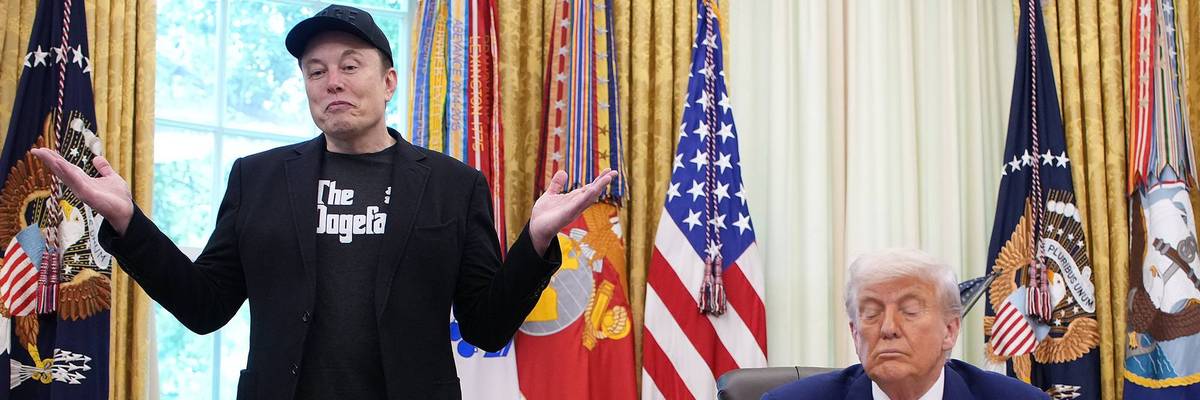
Tesla CEO Elon Musk speaks alongside U.S. President Donald Trump to reporters in the Oval Office of the White House on May 30, 2025 in Washington, DC.
Democrats Ask Trump: Did You Use Elon Musk's Grok AI Chatbot to Help Plan Maduro Kidnapping?
“If the American President is relying on the policy advice of a Musk-designed, Hitler-friendly chatbot with a predilection for child pornography in order to carry out his official duties, Americans have a right to know."
A pair of top Democrats in the US House of Representatives on Thursday are asking new questions about the influence that artificial intelligence chatbots may have had in the deliberations or planning of President Donald Trump's unlawful military operations against Venezuela earlier this year that resulted in the kidnapping of the country's president, Nicolas Maduro.
In a letter sent directly to Trump, Rep. Jamie Raskin (D-Md.), ranking member of the House Judiciary Committee, and Rep. Robert Garcia (D-Calif.), ranking member of the House Committee on Oversight and Government Reform, called on the president to preserve any and all of his conversations with artificial intelligence chatbots and asked for confirmation on whether or not he had specifically engaged with Elon Musk’s Grok chatbot concerning the US military assault on Venezuela.
The committee Democrats pointed to public reporting about a meeting between Trump and Musk that took place prior to the US military operation in Venezuela that raises serious questions about the role the president's interaction may have played in shaping his understanding of the situation in the country and fallout from such an audacious—and "100% illegal"—plan.
As TechCrunch summarized earlier this month:
In December 2025, about a month before the US invaded Venezuela and captured its president, Nicolás Maduro, President Trump had a secret meeting with Elon Musk, Time magazine reports. This was roughly seven months after Musk left his role in the Trump administration at the Department of Government Efficiency (DOGE).
During this meeting, Trump “spent hours” talking to Musk’s Grok chatbot, including asking how Venezuelans would respond to the capture of their president, a source told Time. Just a few months earlier, in September, Trump began ordering U.S. military strikes against Venezuelan boats that Trump alleged were involved in drug trafficking.
People had apparently been turning to Grok asking about the boat strikes and political climate in Venezuela, as The Atlantic reported at the time. So Grok told Trump that Maduro was a “deeply unpopular dictator and that many Venezuelans would likely celebrate his downfall,” Time reported.
If such reporting is accurate, Raskin and Garcia said in their letter to Trump that the "episode is deeply troubling," and offered three key reasons.
"First, you consulted Grok—but not Congress—on your military deployment to Venezuela, circumventing Congress’s constitutional power to declare war and introducing instead into American foreign policy decision making a technology that is highly manipulable and demonstrably error-prone," the pair wrote.
"Second," the letter continues, "the unsecured use of AI chatbots by you and your closest advisors exposes the United States to acute national security risks. Your Administration’s disdain for operational security is well-documented. Secretary of Defense Pete Hegseth famously used unsecured channels to relay information about impending U.S. military strikes to his wife, brother, and personal lawyer."
The third reason, they said, is that Trump and his advisors’ "use of AI exposes the country to malign influence from unknown and unaccountable third parties."
The letter details a series of specific controversies with the Grok chatbot model, including its ability to create sexualized images of people—including children—without their permission and creating pro-Nazi content and advocating for a "second Holocaust" based, unsurprisingly, on what the model itself attributed to public comments by Musk.
"These disturbing examples illustrate why the White House’s AI prompts and outputs must be preserved," said Raskin and Garcia in the letter.
"If the American President is relying on the policy advice of a Musk-designed, Hitler-friendly chatbot with a predilection for child pornography in order to carry out his official duties, Americans have a right to know," they wrote. "If the United States military killed dozens of innocent schoolchildren based on the faulty advice of an AI chatbot, we have a right to know that too. And if an unelected oligarch is influencing U.S. policy through his AI-generated alter ego, Americans have a right to know how governmental decisions are being reached."
In service of that message, the lawmakers told Trump that any and all "AI prompts submitted by you and your staff, as well as the outputs you received, plainly fall within the definition of presidential records," and should be properly preserved in accordance with existing statute.
In addition, "to ensure that the American public’s rights to presidential records are being adequately protected," the pair requested a closed-door briefing regarding the use of AI chatbot technologies by the president, his staff, and other relevant personnel. They also asked a series of detailed questions on the subject for which they requested answers, in writing, by November 11.
We are at a crossroads
This country and this world are at a monumental crossroads. In a few short weeks, US voters will have an opportunity to beat back the forces of fascism and confront the billionaires who are rigging the economy, our media system, and our democracy, making it increasingly impossible for ordinary people to get by. We’re not just talking about the election. We’re talking about what must be done once these fascist elements are vanquished from power. We need a bolder set of solutions than what either major party has so far been willing to offer and a working-class movement ready to fight like hell for it. Trump didn't emerge from nowhere. The conditions that fueled MAGA authoritarianism were created by decades of radical neoliberal economic policies and a corrupt political system dominated by corporate interests. They slashed taxes on the super-rich, promising that the benefits would trickle down. They said giveaways to the corporate titans would make life more affordable for the rest of us. It was all bullshit. And when a bitter, betrayed populace searches for someone to blame, right-wing demagogues have little trouble finding scapegoats. People know when they're being lied to, but you won't hear any of this from the corporate media. Only independent journalism—powered and funded by people who believe in building a better world—can deliver truly trustworthy daily news. Our Fall Campaign is underway, and we need your help. To power our newsroom through the rest of the year, we need to raise $125,000 by midnight on October 31. So if you share our vision, please contribute whatever you can to sustain our work. |
A pair of top Democrats in the US House of Representatives on Thursday are asking new questions about the influence that artificial intelligence chatbots may have had in the deliberations or planning of President Donald Trump's unlawful military operations against Venezuela earlier this year that resulted in the kidnapping of the country's president, Nicolas Maduro.
In a letter sent directly to Trump, Rep. Jamie Raskin (D-Md.), ranking member of the House Judiciary Committee, and Rep. Robert Garcia (D-Calif.), ranking member of the House Committee on Oversight and Government Reform, called on the president to preserve any and all of his conversations with artificial intelligence chatbots and asked for confirmation on whether or not he had specifically engaged with Elon Musk’s Grok chatbot concerning the US military assault on Venezuela.
The committee Democrats pointed to public reporting about a meeting between Trump and Musk that took place prior to the US military operation in Venezuela that raises serious questions about the role the president's interaction may have played in shaping his understanding of the situation in the country and fallout from such an audacious—and "100% illegal"—plan.
As TechCrunch summarized earlier this month:
In December 2025, about a month before the US invaded Venezuela and captured its president, Nicolás Maduro, President Trump had a secret meeting with Elon Musk, Time magazine reports. This was roughly seven months after Musk left his role in the Trump administration at the Department of Government Efficiency (DOGE).
During this meeting, Trump “spent hours” talking to Musk’s Grok chatbot, including asking how Venezuelans would respond to the capture of their president, a source told Time. Just a few months earlier, in September, Trump began ordering U.S. military strikes against Venezuelan boats that Trump alleged were involved in drug trafficking.
People had apparently been turning to Grok asking about the boat strikes and political climate in Venezuela, as The Atlantic reported at the time. So Grok told Trump that Maduro was a “deeply unpopular dictator and that many Venezuelans would likely celebrate his downfall,” Time reported.
If such reporting is accurate, Raskin and Garcia said in their letter to Trump that the "episode is deeply troubling," and offered three key reasons.
"First, you consulted Grok—but not Congress—on your military deployment to Venezuela, circumventing Congress’s constitutional power to declare war and introducing instead into American foreign policy decision making a technology that is highly manipulable and demonstrably error-prone," the pair wrote.
"Second," the letter continues, "the unsecured use of AI chatbots by you and your closest advisors exposes the United States to acute national security risks. Your Administration’s disdain for operational security is well-documented. Secretary of Defense Pete Hegseth famously used unsecured channels to relay information about impending U.S. military strikes to his wife, brother, and personal lawyer."
The third reason, they said, is that Trump and his advisors’ "use of AI exposes the country to malign influence from unknown and unaccountable third parties."
The letter details a series of specific controversies with the Grok chatbot model, including its ability to create sexualized images of people—including children—without their permission and creating pro-Nazi content and advocating for a "second Holocaust" based, unsurprisingly, on what the model itself attributed to public comments by Musk.
"These disturbing examples illustrate why the White House’s AI prompts and outputs must be preserved," said Raskin and Garcia in the letter.
"If the American President is relying on the policy advice of a Musk-designed, Hitler-friendly chatbot with a predilection for child pornography in order to carry out his official duties, Americans have a right to know," they wrote. "If the United States military killed dozens of innocent schoolchildren based on the faulty advice of an AI chatbot, we have a right to know that too. And if an unelected oligarch is influencing U.S. policy through his AI-generated alter ego, Americans have a right to know how governmental decisions are being reached."
In service of that message, the lawmakers told Trump that any and all "AI prompts submitted by you and your staff, as well as the outputs you received, plainly fall within the definition of presidential records," and should be properly preserved in accordance with existing statute.
In addition, "to ensure that the American public’s rights to presidential records are being adequately protected," the pair requested a closed-door briefing regarding the use of AI chatbot technologies by the president, his staff, and other relevant personnel. They also asked a series of detailed questions on the subject for which they requested answers, in writing, by November 11.
- ‘No War Crimes Are Off Limits' as Trump Reportedly Mulling Bombing Targets in Venezuela ›
- International Law Experts Agree: Trump-Ordered Attack on Venezuela 100% Illegal ›
- Trump Says Ground Attack on Venezuela Imminent—Plus Colombia, Mexico Also in US Crosshairs ›
- Trump Administration Has ‘Made the Decision to Attack Military Installations Inside Venezuela’: Report ›